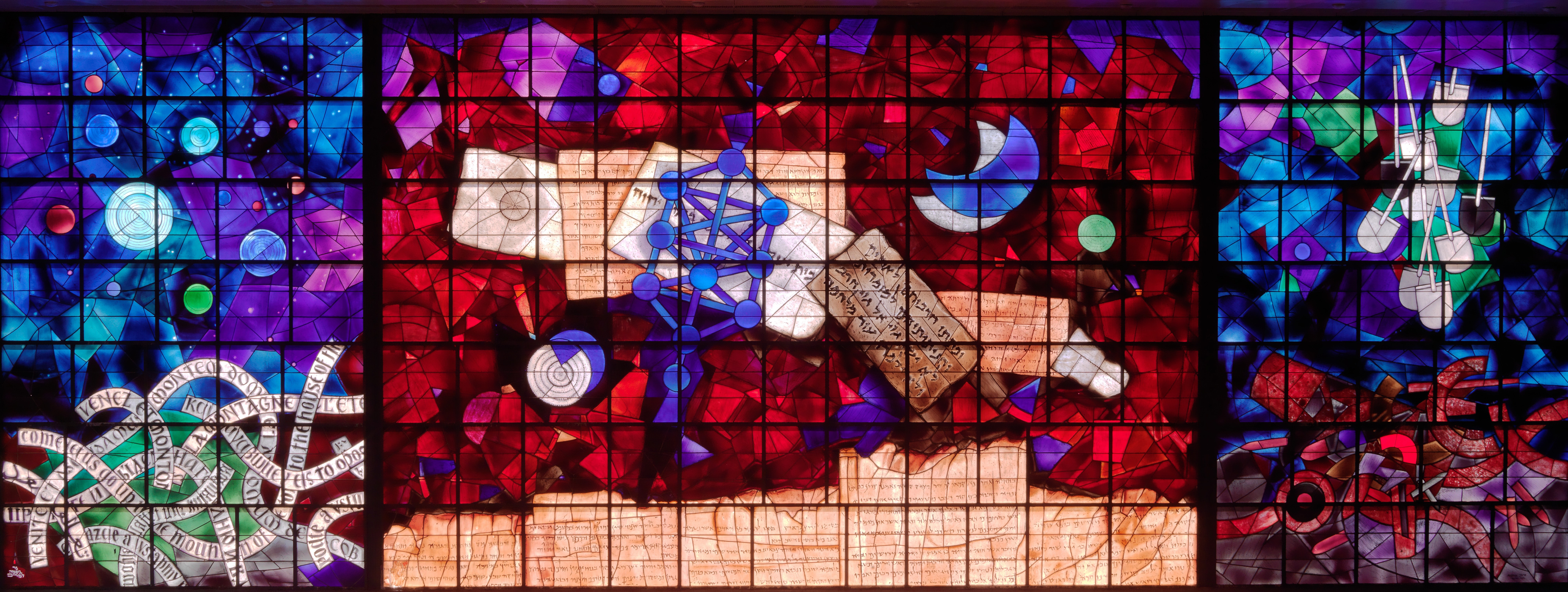
LOOK: Isaiah’s Vision of Eternal Peace by Mordecai Ardon
Mordecai Ardon (Israeli, 1896–1992) (designer) and Charles Marq (French, 1923–2006) (fabricator), Isaiah’s Vision of Eternal Peace, 1982–84. Stained glass, 6.5 × 17 m. Old National Library of Israel building, Givat Ram campus, Hebrew University of Jerusalem. Photo: Hanan Cohen.
Born in 1896 to a Jewish family in the village of Tuchów in what is today Poland, Mordecai Ardon studied art in Germany under Paul Klee and Wassily Kandinsky. When the Nazis came to power in 1933, he moved to Jerusalem, becoming a teacher in 1935 at Palestine’s chief art academy, the Bezalel School of Arts and Crafts, which he directed from 1940 to 1952. Known for their vibrant tones and stirring rhythms, Ardon’s paintings often explore the connections between the visible and the invisible and reflect his interest in mysticism and antiquity.
From 1982 to 1984 Ardon carried out a commission by the National Jewish University and Library (now the National Library of Israel) in Jerusalem to develop a monumental triptych of stained glass. His painted designs were translated into the medium of stained glass by the French master glazier Charles Marq, a frequent collaborator of Marc Chagall’s. The result is titled Isaiah’s Vision of Eternal Peace.
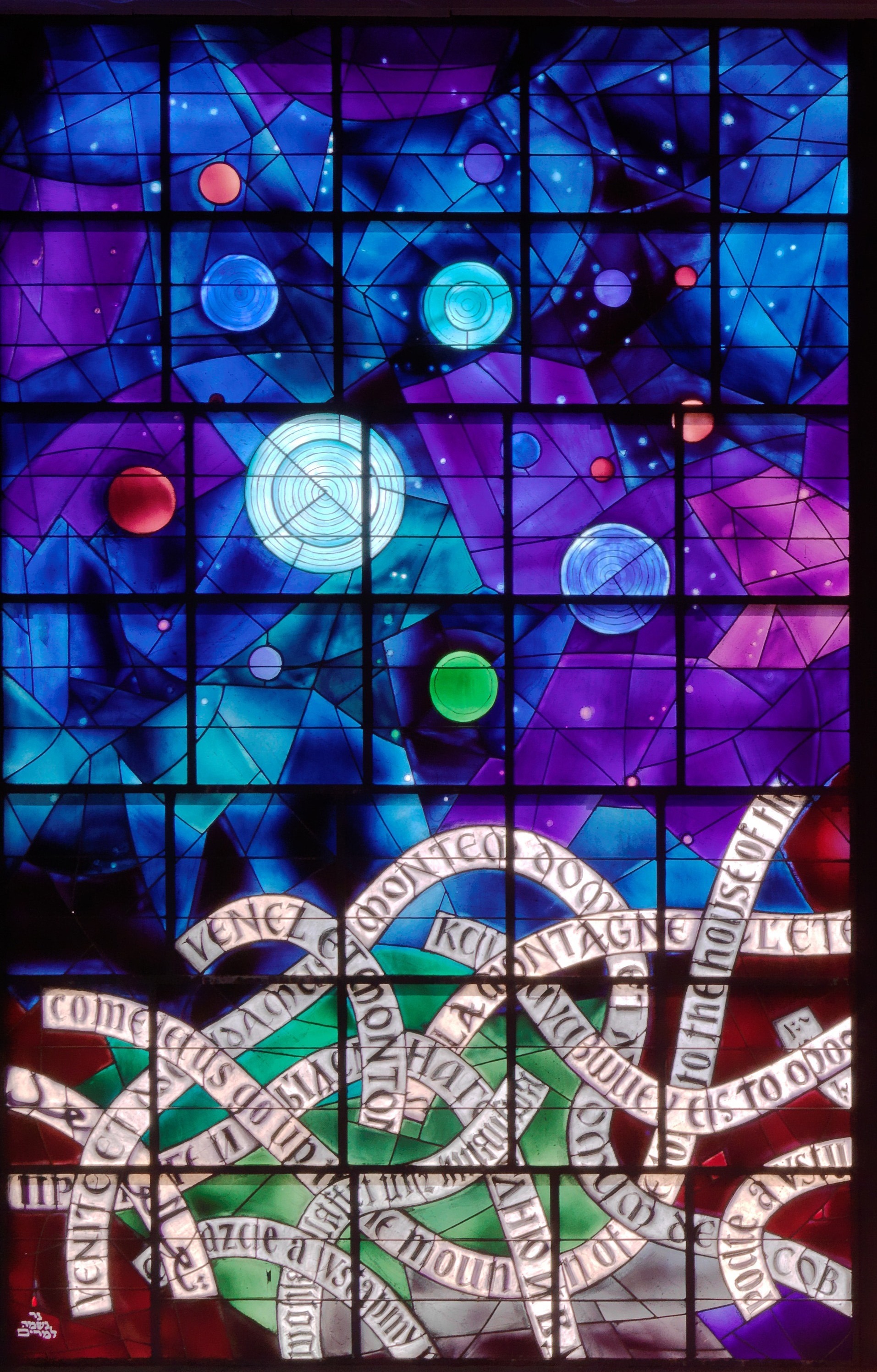
The left panel illustrates Isaiah 2:2–3:
In days to come the mountain of the LORD’s house shall be established as the highest of the mountains and shall be raised above the hills; all the nations shall stream to it. Many peoples shall come and say, “Come, let us go up to the mountain of the LORD, to the house of the God of Jacob, that he may teach us his ways and that we may walk in his paths.”
Winding like roads, the white bands contain the boldfaced line in various languages—I can detect English, Russian, Polish, Arabic, Latin, and French—representing the peoples of the world streaming to Jerusalem.
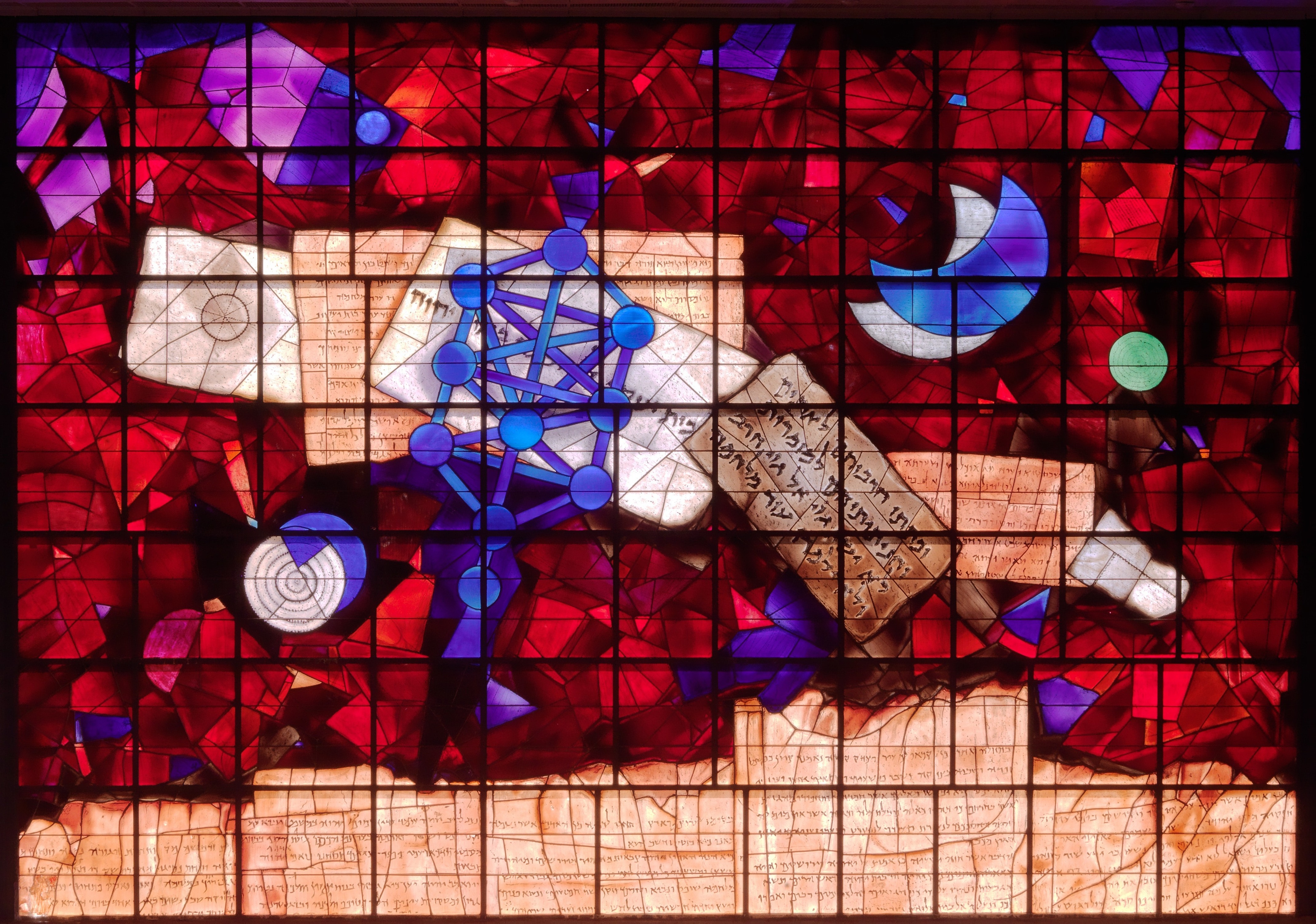
The center panel depicts a merging of the earthly and heavenly Jerusalems. At the bottom stand the city walls, made up of the seventeen sheets of parchment that comprise the Great Isaiah Scroll from Qumran, dating to around 100 BCE. Floating above are Kabbalistic symbols, including the Tree of the Sefirot, signifying the Divine Presence. There are also several Hebrew texts from Jewish history that I can’t identify.
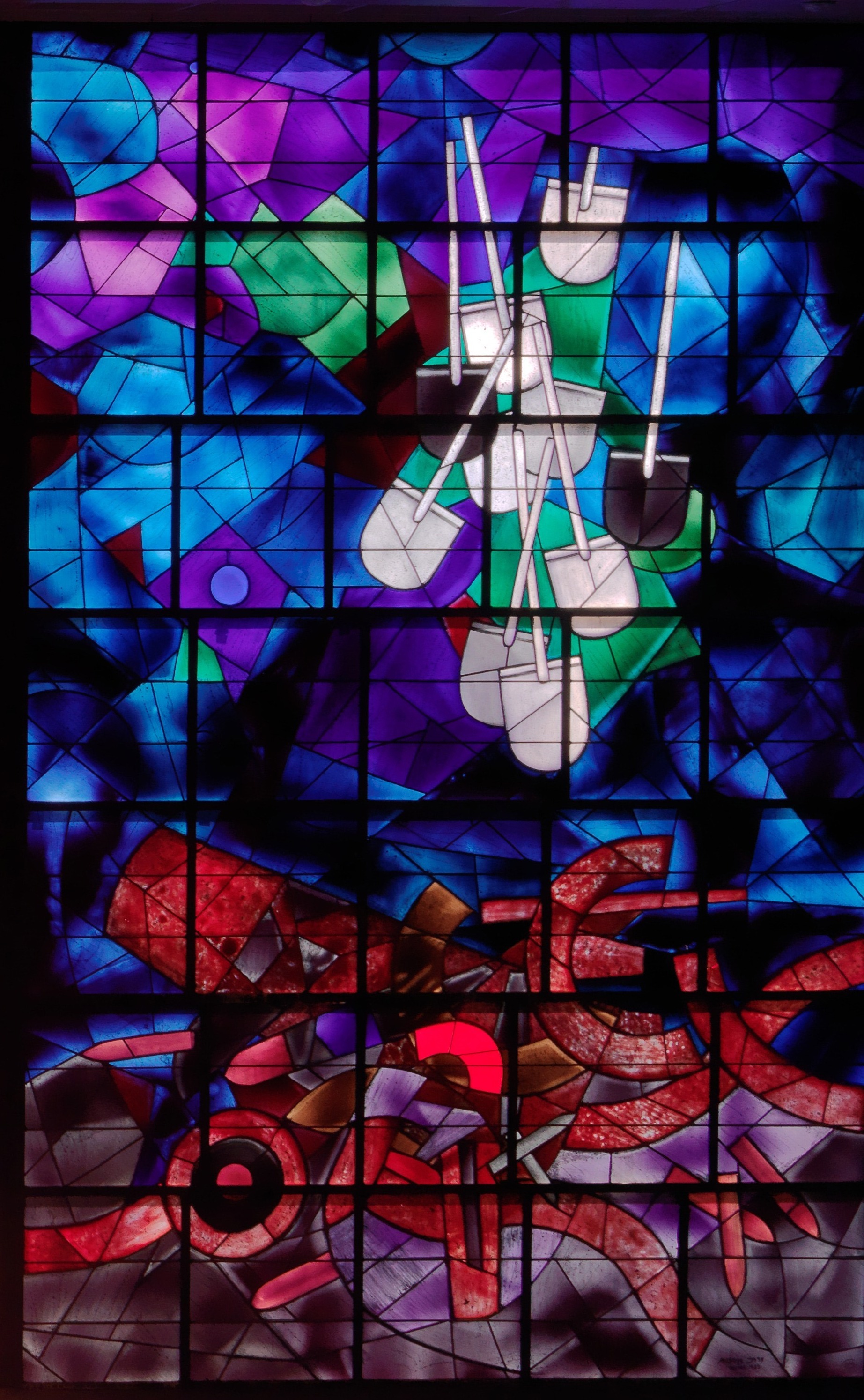
The right panel visualizes the fulfillment of Isaiah 2:4: “. . . they shall beat their swords into plowshares and their spears into pruning hooks; nation shall not lift up sword against nation; neither shall they learn war any more.” All the machinery of war—tanks and fighter jets, guns and bullets—lies in a garbage heap at the base, and shovels emerge overhead as the weapons are transformed into farming tools.
This glasswork covers an entire wall of the old National Library of Israel building on the Givat Ram campus of Hebrew University. The library moved into a new building in October 2023, situated between the Knesset and the Israel Museum in the heart of Jerusalem. But Ardon’s window remains in its original building at HUJI, which has become a multipurpose space.
LISTEN: “Lo Yisa Goy (Study War No More)”(ֹא יִשָּׂא גוֹי)|Traditional Jewish folk song, arr. Linda Hirschhorn and Fran Avni | Performed by Vocolot, on Behold! (1998)
(Transliteration: Lo yisa goy el goy cherev Lo yilmadu od milchama)
(Translation: Nation will not take up sword against nation Nor will they train for war anymore)
And into plowshares [they’ll] beat their swords Nations shall learn war no more
The lyrics of this traditional Jewish antiwar song come from the original Hebrew of Isaiah 2:4, a text held sacred by both Jews and Christians. The song looks with prayerful hope toward the day when global peace will be a reality.
If this is the glorious end state to which we all are headed, the future that God has envisioned and charted for us, then why do we participate in violence now? When governments try to control people through violence, and those people respond with violence, that response only provokes violent retaliation, and so the cycle continues on and on—militancy and death. The line between aggressor and defender becomes blurred. We’ll never get closer to the Isaiah 2 ideal by asserting ourselves with weapons.
May the people of God be a people who refuse violence even when the state commands it, even when we’ve been hit tremendously hard and the urge for payback is intense. May we not become what we fear, inflicting terror because we have been terrorized. And may God bring peace and healing to people and nations who have been victims of war; so too perpetrators of war. To those just trying to survive and be free in this fallen world as best they know how.
The first chapter of Isaiah, which precedes the famous “swords into plowshares” chapter, contains this word from the Lord to his people:
When you stretch out your hands, I will hide my face from you; even though you make many prayers, I will not listen; your hands are full of blood. Wash yourselves clean, make yourselves clean; remove the evil of your doings from before my eyes; cease to do evil, learn to do good; seek justice, rescue the oppressed, defend the orphan, plead for the widow.
—Isaiah 1:15–17
So let us renounce our vindictiveness and “wash ourselves clean.” And then let us sing this song (1) as a prayer that the Messiah, whom Christians recognize to be Jesus of Nazareth, would come to actualize this beautiful vision of peace, but (2) also as a pledge, committing ourselves to the path of life—to, in the words of the apostle Paul, “overcom[ing] evil with good” (Rom. 12:21).
I like Vocolot’s “Lo Yisa Goy” arrangement best; it has a celebratory mood, as if the coming peace is in sight. But what follows is a handful of others that carry more of a lamentful tone, which is also appropriate as we consider the persistence of war and how short we fall of God’s plan for human flourishing that’s never at the expense of others.
For harp and voice by Estela Ceregatti of Brazil, 2020:
A cappella by the American Midwest female vocal trio Rock Paper Scissors, 2010:
For strings, by La Roche Quartett from Germany, 2018:
A virtual choir under the direction of Andrea Salvemini, 2020:
The last performance employs an increasing number of instruments as the song progresses: guitar, recorder, keyboard, cello, percussion, and accordion. It also includes steps to an Israeli circle dance performed by participants in isolation because this was during the days of COVID quarantines; elsewhere online you can find communal performances where the circle is closed.
Some versions add these two lines as a verse, adapted from Micah 4:4:
And every man ’neath his vine and fig tree Shall live in peace and unafraid
>> “Peace on Earth” by U2: “Heaven on earth—we need it now. I’m sick of all this hanging around. Sick of the sorrow, sick of the pain . . .” U2’s “Peace on Earth” was inspired by the Omagh bombing in Northern Ireland on August 15, 1998. It first appeared on their 2000 album All That You Can’t Leave Behind, but I prefer the stripped-down acoustic version they recorded last year on Songs of Surrender.
The song wrestles with the tension between the angels’ proclamation of peace in Luke 2 and the course of history ever since, riddled, as before, with violence. “Hope and history won’t rhyme,” the lyrics lament—they’re just not matching up. “Peace on earth” feels naive; the words sometimes stick in our throats. The refrain addresses Christ: “Jesus, can you take the time / To throw a drowning man a line?” In its emotional honesty and its asks, it resembles a biblical psalm. (Bono has in fact spoken about how the Psalms have influenced his songwriting.)
When U2 performed “Peace on Earth” live at Sphere Las Vegas this February, Bono substituted the names of five Irish casualties of the Troubles listed in one of the verses with the names of four Palestinian and Israeli children who have been killed in the current Israel-Hamas War: Gal, Ayat, Hind, and Mila.
>> “There Will Be a Day (Isaiah 2)” by Caroline Cobb, arr. Joel Littlepage: I cued up my favorite song from last year’s Dawning Light service at Grace Mosaic church in Washington, DC (it’s at 32:50–37:29 of the video): “There Will Be a Day” by Caroline Cobb, based on Isaiah 2. The song is from Cobb’s album A Seed, a Sunrise: Advent to Christmas Songs (2020)—it’s my favorite of all her songs, and because of its emotional and summative power, I’ve set it as the concluding track of my Advent Playlist. Joel Littlepage, Grace Mosaic’s pastor of worship and formation and the director of the Daily Prayer Project, arranged it with gospel inflections for his church’s annual Advent carols service. He’s at the keyboard; his wife, Melissa Littlepage, is the vocal soloist (she’s also the choir director); and the saxophonist is Skip Pruitt.
ARTWORK: Home (land) Birth (place) by Beth Krensky:Beth Krensky is an artist, activist, and educator of Jewish heritage who describes herself as “a gatherer of things—objects, words, spirit—and a connector of fragments to make us whole.” Her website documents many compelling artistic projects she has undertaken over the past decade. One of them, Home (land) Birth (place), is a performance from 2016 with her academic colleague Amal Kawar, a professor of political science and the author of Daughters of Palestine: Leading Women of the Palestinian National Movement.
Beth Krensky (American, 1965–), Home (land) Birth (place), a performance with Amal Kawar, 2016, Great Salt Lake, Utah. Photo: Josh Blumental.
For this piece, Krensky sewed together a truce flag from baby clothes and other white linens and attached it to two olivewood poles onto which she burned quotes from Israeli and Palestinian mothers who have lost a child to Israeli-Palestinian violence. She and Kawar held the flag aloft in the desert outside their hometown of Salt Lake City as a call for peace. Read the artist’s statement at the link above, and view additional photos of the flag here.
+++
DEVOTIONAL POST: “Swords Will Be Turned into Plowshares,” Center for Christianity, Culture, and the Arts at Biola University: Every year Biola University’s CCCA publishes free daily Advent and Christmas devotions online that feature an artwork, a song, a poem, and a written reflection—the work of many contributors. You can access their 2024 Advent Project here.
Last year I was particularly taken with the peace-themed compilation offered on January 2, which includes a poem by Denise Levertov, a socially conscious, participatory art project led by Pedro Reyes (more on that in next roundup item), a Sweet Honey in the Rock rendition of an African American spiritual, and a wonderful reflection by Dr. Natasha Aleksiuk Duquette, a literature professor. Check it out.
+++
ARTICLE: “Mexican Artist Pedro Reyes Molds 1,527 Guns into Shovels Used to Plant Trees,”Colossal: Pedro Reyes is a Mexican artist, architect, and cultural agent who seeks to turn social problems into opportunities for tangible change through works that integrate elements of theater, psychology, and activism. (I learned about him through Biola’s Advent Project, above.) In 2008, in cooperation with city authorities, he led a campaign in Culiacán, Mexico, to collect firearms, giving donors vouchers for electronic appliances in exchange. The hundreds of guns he received were publicly crushed by a steamroller, melted, and remolded into shovels, which were then distributed to public schools and other institutions who committed to planting trees with them. This project was an effort to curb local gun violence and to cultivate the collective imagination toward life.
Pedro Reyes (Mexican, 1972–), Palas por Pistolas (Guns for Shovels), 2008Artist Pedro Reyes steamrolled 1,527 surrendered guns for his Palas por Pistolas project, transforming them into shovels for planting trees.
I’m interested in exploring more of Reyes’s work, as I love what he’s doing. In 2016, as a visiting lecturer in MIT’s Art, Culture, and Technology Program, he cotaught the course “The Reverse Engineering of Warfare: Challenging Techno-optimism and Reimagining the Defense Sector (an Opera for the End of Times).” A full-color illustrated survey of his projects, Pedro Reyes: Ad Usum / To Be Used, was published by Harvard University Press in 2017.
+++
INSTAGRAM SERIES: “Alternative Advent 2024” by Kezia M’Clelland: Through December 24, follow the Instagram account @alternative_advent for a progressively revealed photo essay of Advent promises told through journalistic images from 2024, sourced from various news organizations. I call attention to this project every year. The woman behind it, Kezia M’Clelland, has a master’s degree in violence, conflict, and development from SOAS University of London and helps equip churches and communities to support children and families in crisis situations.
Chagall’s Peace Window is one of the most significant works in the United Nations’ art collection. On my quick visit to New York City last month, where the UN is headquartered, I was hoping to see it, but I emailed ahead of time and found out it’s not currently available for viewing due to construction behind it. (You can “see” it but not really, because it’s not lit, and there’s a tall plastic barrier in front.) I was disappointed, but I decided to visit the UN anyway, to see what other art I might find.
The United Nations was founded in 1945 for the purpose of preventing a third world war. Comprising 193 member states, the organization is committed to maintaining international peace and security, developing friendly relations among nations, and promoting social progress, better living standards, and human rights. Their motto is “Peace, dignity, and equality on a healthy planet.”
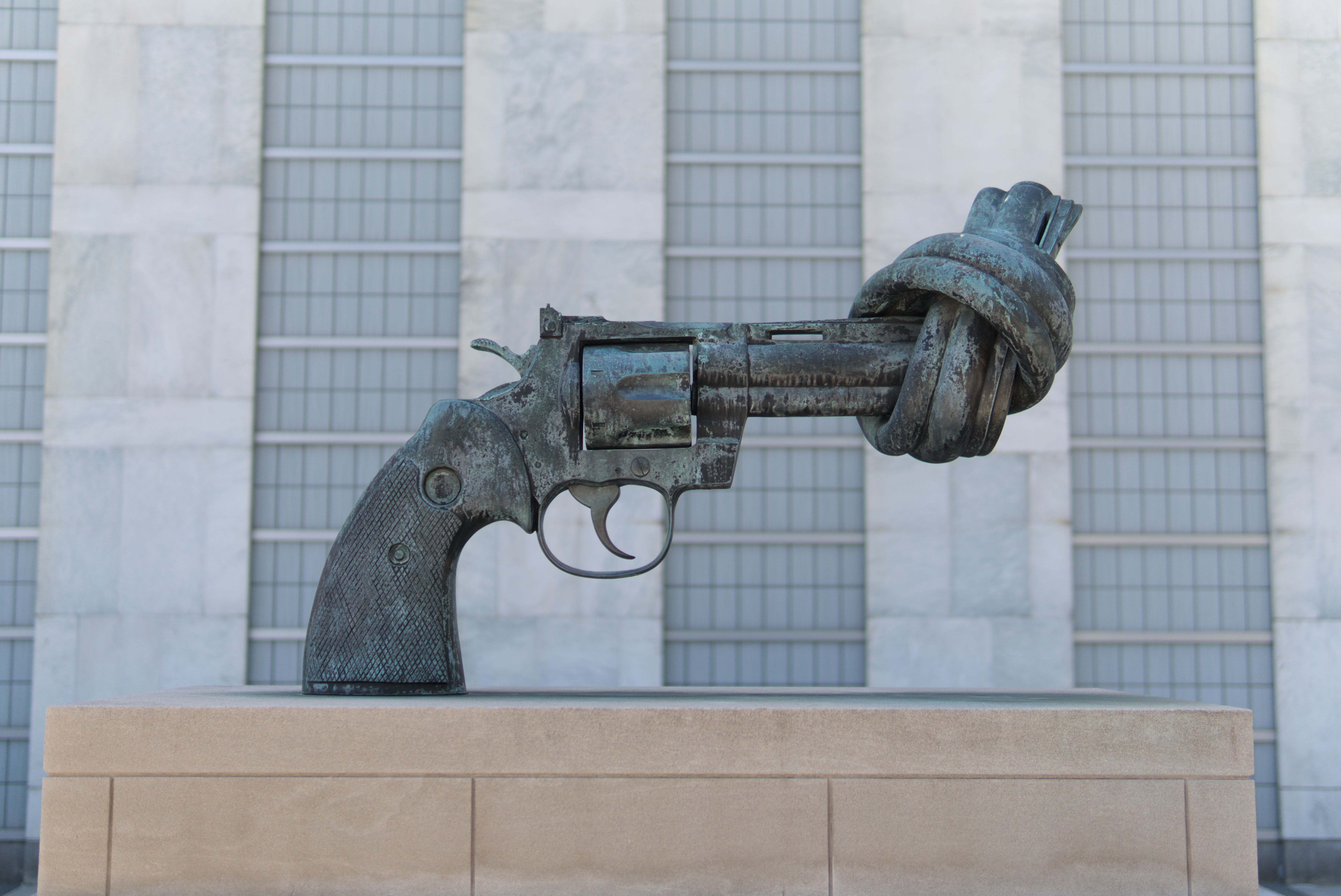
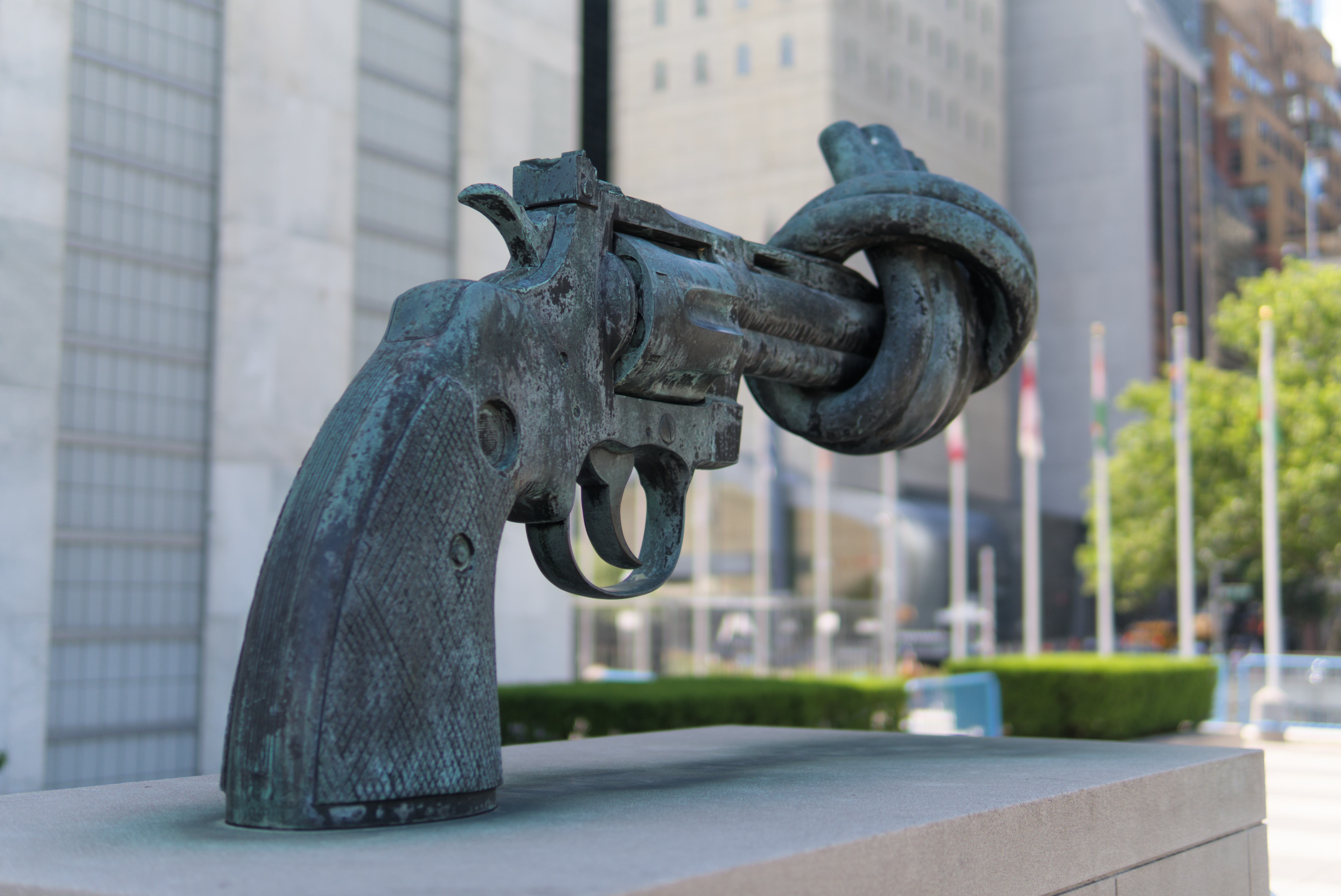
After presenting my ID, getting my photo taken, being stickered, and going through security, I was inside the campus and directed to the General Assembly Building. Outside the entrance to this building is the famous Non-Violence bronze, aka TheKnotted Gun, by Carl Fredrik Reuterswärd of Sweden. The artist made the sculpture in 1980 after his friend John Lennon was murdered. He wanted to honor the singer-songwriter’s vision of a peaceful world.
Carl Fredrik Reuterswärd (Swedish, 1934–2016), Non-Violence, 1984. Bronze, 79 × 44 × 50 in. United Nations Headquarters (outside the General Assembly building), New York. Gift from Luxembourg. Photo: Victoria Emily Jones. [object record]
The original cast was first placed at the Strawberry Fields memorial in New York City’s Central Park, across the street from the Dakota apartment building where Lennon and his wife, Yoko Ono, lived, and where he was shot. But Reuterswärd worried it would be stolen there. In 1988, the Government of Luxembourg bought the sculpture and donated it to the United Nations, who installed it inside the gate of their New York headquarters.
Non-Violence is an oversize replica of a Colt Python .357 Magnum revolver with the barrel tied in a knot and the muzzle pointing upward, rendering the weapon useless. In his statement from 1988, Reuterswärd said, “Humor is the finest instrument we have to bring people together. While making my peace-symbol, I thought of the importance of introducing a touch of humor, just to make my ‘weapon’ symbolically ridiculous and completely out of order.”
Reuterswärd ultimately made over thirty additional casts of Non-Violence, which are publicly installed in cities such as Beijing, Beirut, Cape Town, Lausanne, and Mexico City.
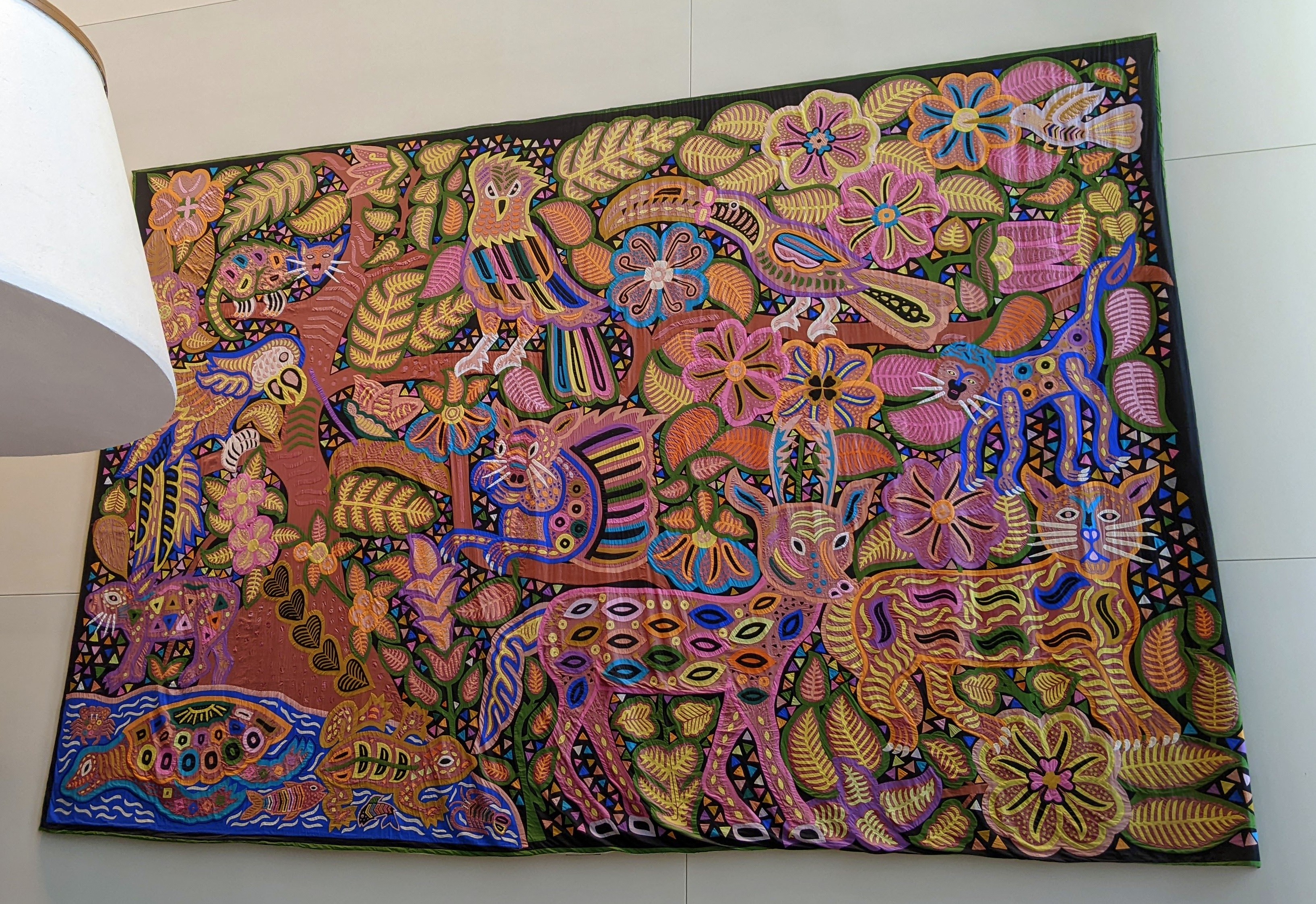
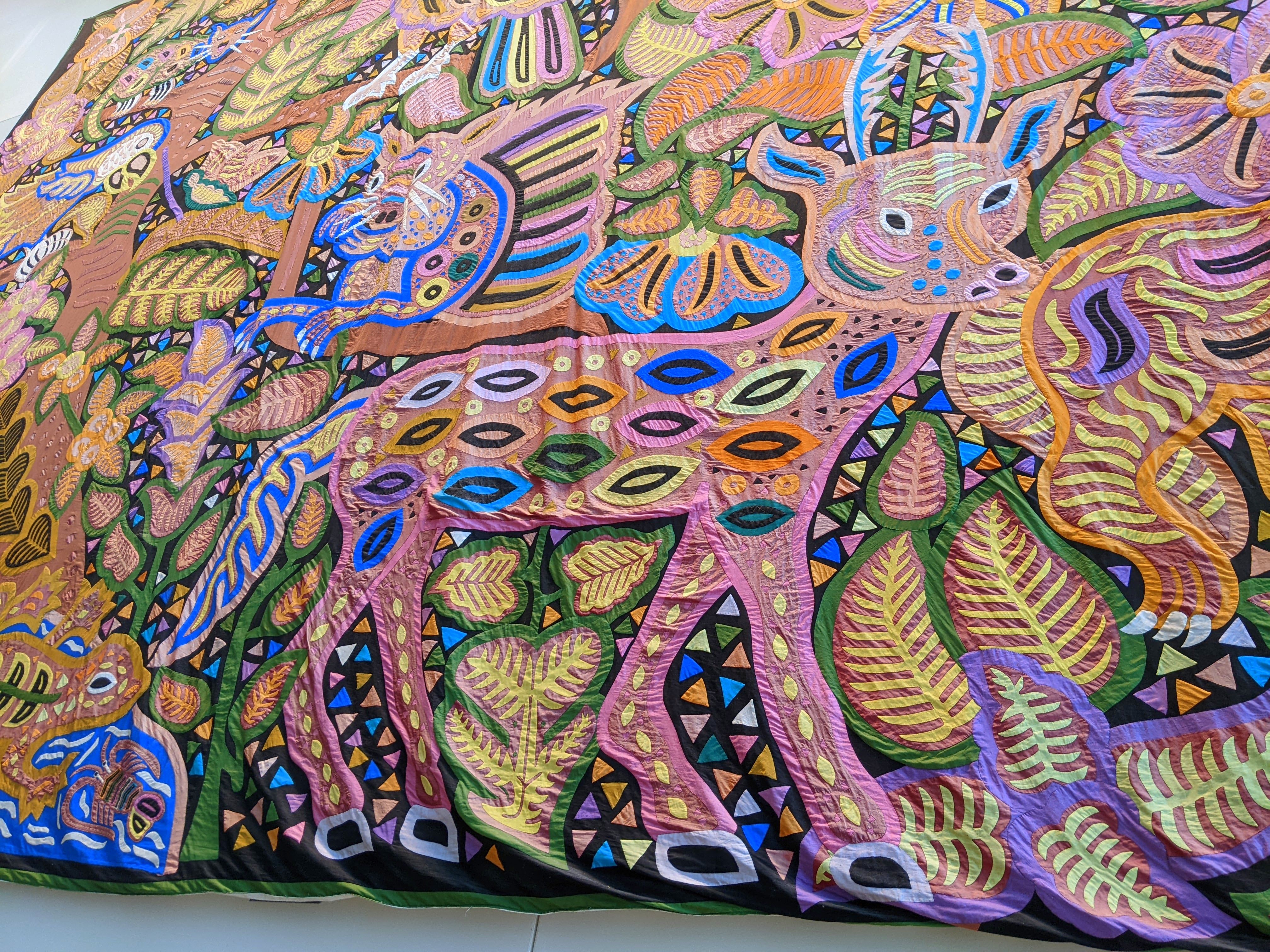
After spending some time with this iconic work, I entered the General Assembly lobby. What first caught my eye, on the right wall, was a monumental Mola Tapestry from Panama, made by unidentified Kuna women. (To learn about the art form, see my previous blog post from Lent 2022.)
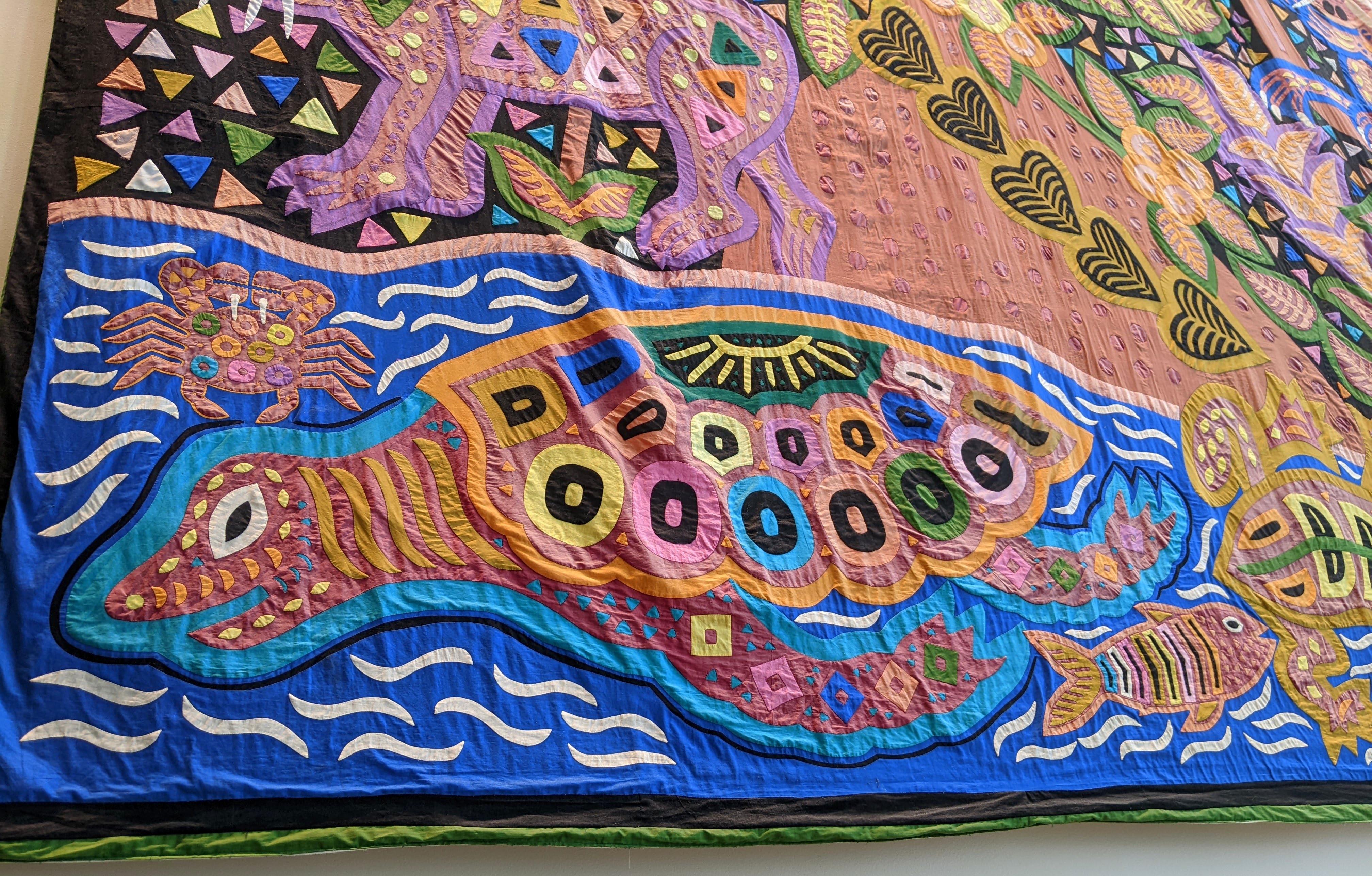
Mola Tapestry by the Kuna people, 1993. Reverse appliqué tapestry, 190 × 284 in. General Assembly Building, United Nations Headquarters, New York. Gift from Panama. Photo: Victoria Emily Jones. [object record]
Molas are made using a reverse appliqué technique, in which several layers of multicolored cloth are sewn together and then parts of each layer are cut out to form the design. These textile panels are traditionally made on a smaller scale and sewn onto women’s blouses, but as outside interest in them grew, local artisans started making some to be displayed as wall hangings.
This one shows a colorful array of indigenous flora and fauna, including a toucan, owl, hummingbird, monkey, turtle, frog, squirrel, rabbit, deer, and wildcat.
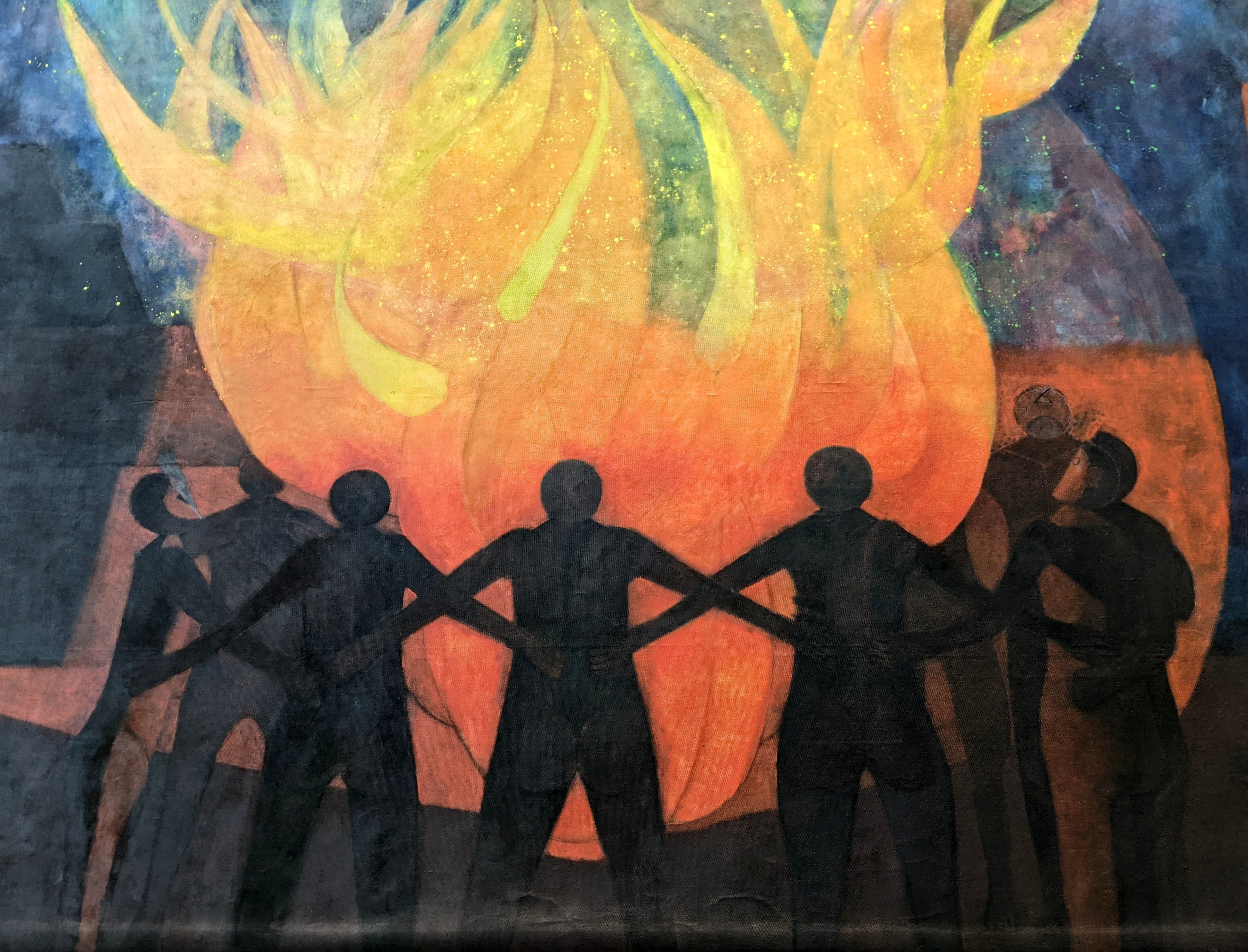
On the opposite wall is a nearly thirty-foot-long painting titled La Fraternidad (Brotherhood) by Mexican artist Rufino Tamayo [previously], which shows a group of people gathered around a fire with interlaced arms. The fire may represent enlightenment, knowledge and power, or the Divine Presence.
Rufino Tamayo (Mexican, 1899–1991), La Fraternidad (Brotherhood), 1968. Oil on canvas, 160 × 358 in. General Assembly Building, United Nations Headquarters, New York. Gift from Mexico, 1971. Photo: Victoria Emily Jones. [object record]
At the left is an ancient Aztec or Mayan pyramid, whereas the structure at the right is modern. Tamayo said this shows the span of time, from the ancient era into the present and future.
From 2009 to 2014 the painting was on display at the Mexican state legislature, after which it was restored and returned to the UN.
Situated in front is a replica of an ancient Greek sculpture depicting Poseidon of Artemision, god of the sea, in an active stance. His right hand would have originally wielded a trident, representing his power. At first I thought it an odd choice for the UN to display an apparently militant figure, as Poseidon used his trident as a weapon to fight Trojans, Titans, and others, and indeed here he seems poised to deliver a death blow. But after some rudimentary research, I found that Poseidon also created life-giving springs with the strike of his trident (think Moses striking the rock with his staff), and used it to calm turbulent waters. These ameliorating acts align with the UN’s mission and make the Poseidon sculpture a fitting addition to their collection.
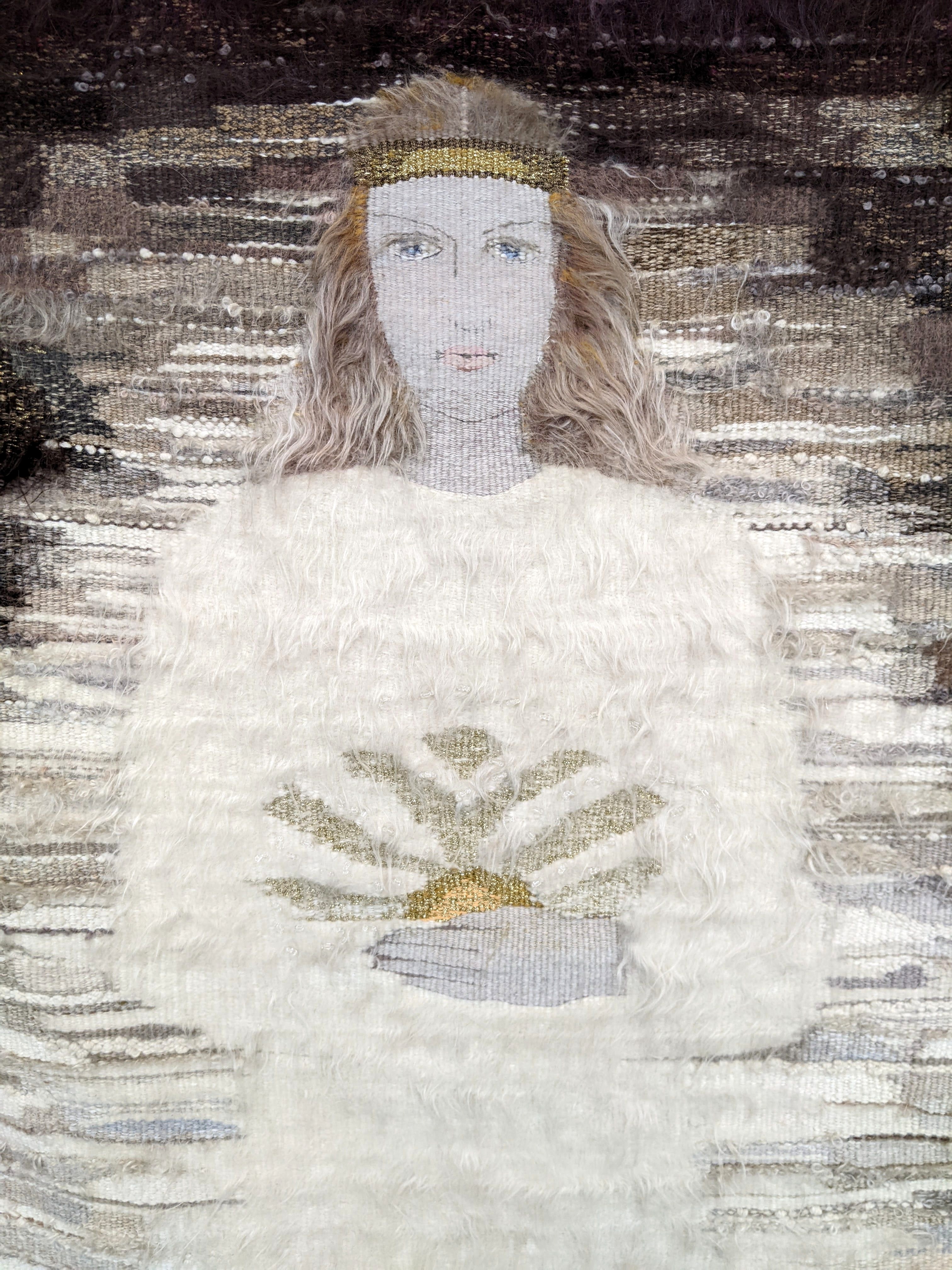
Also in the lobby is a wool tapestry from Latvia. Titled Hope, it’s by the well-known Latvian textile artist Edīte Pauls-Vīgnere.
Edīte Pauls-Vīgnere (Latvian, 1939–), Hope, 1994. Tapestry, 126 × 114 in. General Assembly Building, United Nations Headquarters, New York. Gift from Latvia. Photo: Victoria Emily Jones. [object record]
The female figure in the foreground is, I’m assuming, a personification of hope, dressed in a white gown and golden headband and holding the sun. She stands in front of the Freedom Monument in Riga, which shows Lady Liberty holding three gilded stars, symbolizing the three constitutional districts of Latvia.
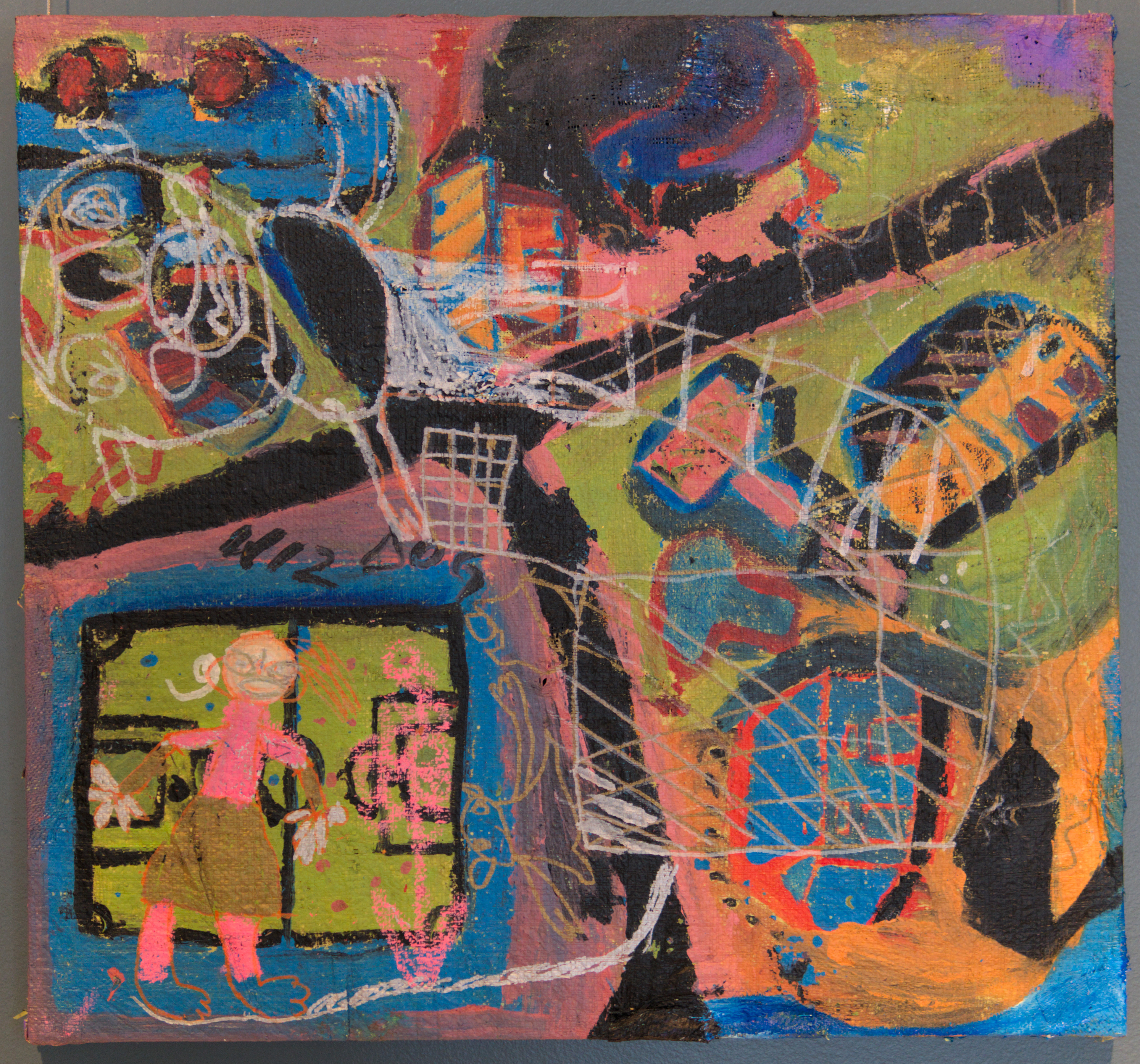
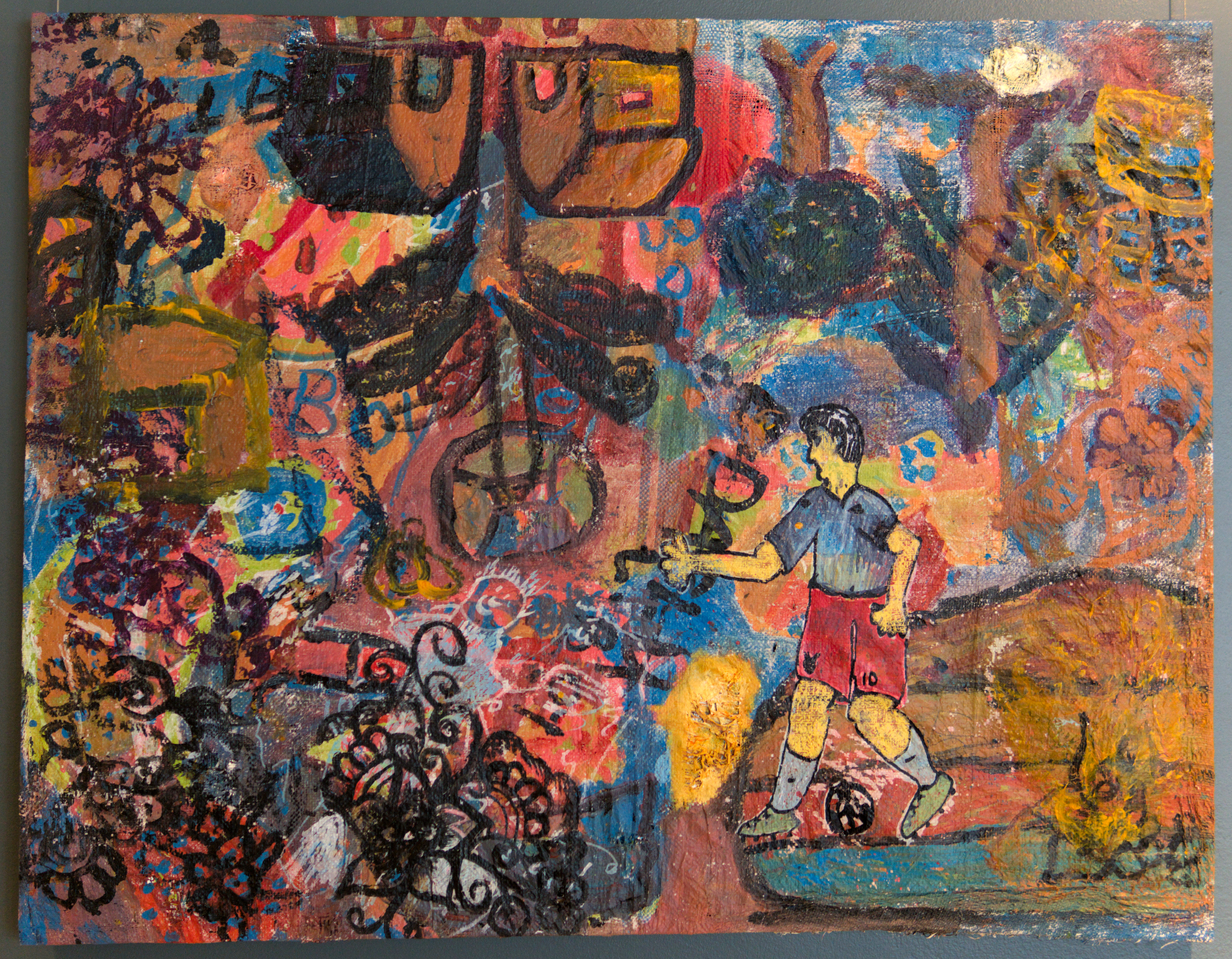
Deeper inside the lobby was a temporary exhibition, Interwoven: Refugee Murals Across Borders, organized jointly by UNHCR (the UN Refugee Agency) and Artolution. It opened on June 20, World Refugee Day, and will continue through July 19. The exhibition presents paintings by refugees and host communities in refugee camps, conflict zones, and crisis-affected communities across the world. These were created through a collaborative process in which the work circulated to different locations, with artists contributing additions at each stop. The end results show interwoven narratives of the diverse peoples forced to flee their homes. Themes include joy, lament, labor, empowerment, identity, and home.
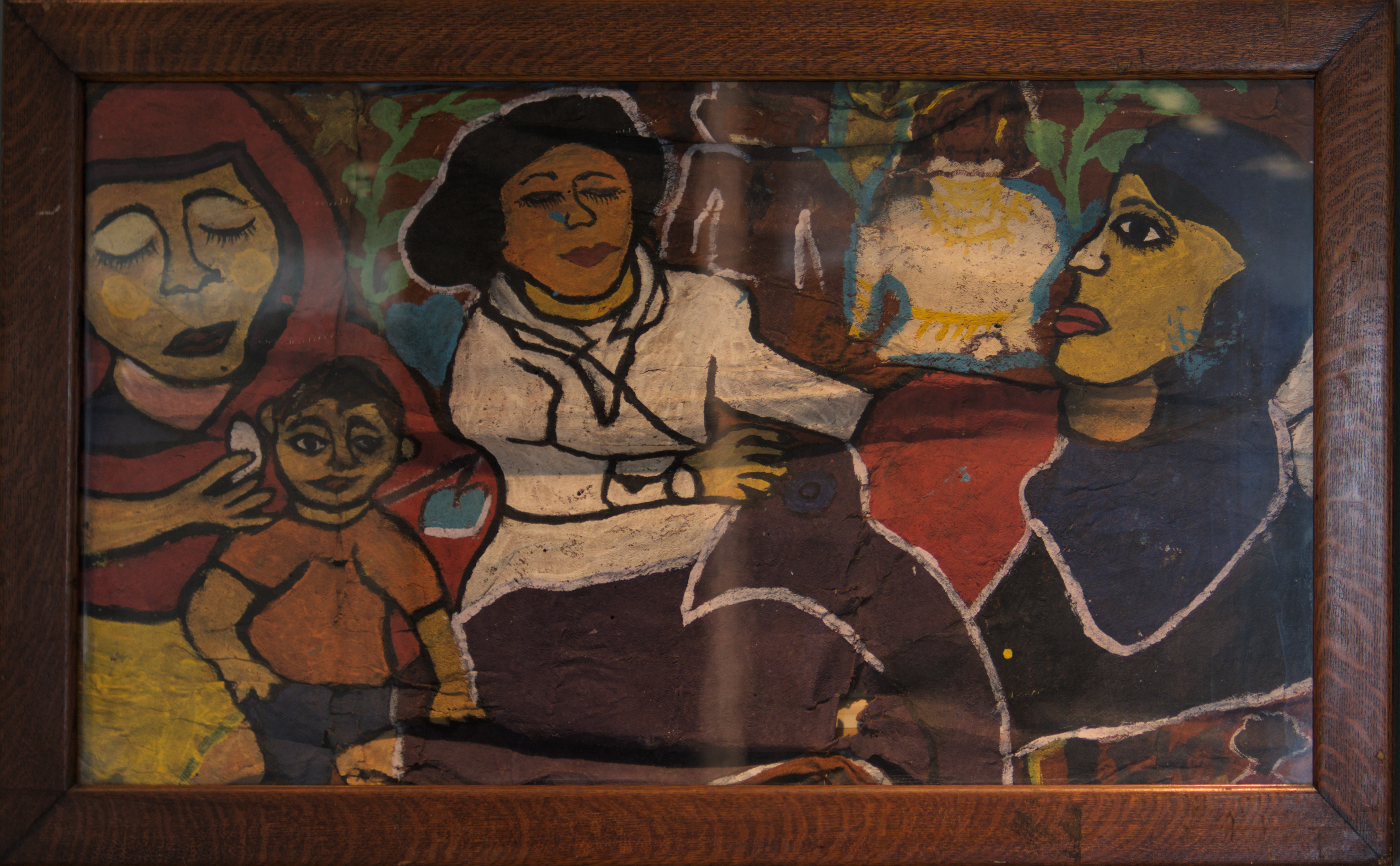
Made by about a dozen refugee girls and women from four countries, Fabric of Women’s Resilience began in Uganda with a small group of South Sudanese, who prepared the traditional bark cloth from the bark of a mutuba tree. This substrate then traveled to Bangladesh, where Rohingya women painted a pregnant woman lying on a bed while a female doctor presses a stethoscope to her belly, and on the left, a mother bathing her child. The artists said they wanted to encourage mothers to seek access to prenatal healthcare and to practice good hygiene with their babies.
Fabric of Women’s Resilience, a collaborative painting by approx. twelve Rohingya, Syrian, Afghan, and South Sudanese refugee women, 2018. Acrylic on bark cloth, 24 × 60 in. Photo: Victoria Emily Jones.
In Greece, the bark cloth traveled to Samos refugee camp, where one young Afghan woman, with the help of others, painted one of her traumatic childhood experiences: being married off at age twelve to an older man. This scene at the top is a bit crumpled in the frame, so it’s difficult to see, but the child bride is crying, and the man has a white beard.
The painting also went to Azraq refugee camp in Jordan, where Syrian women added a woman carrying a baby on her back while reading a book to show that women can be mothers and pursue an education. (This scene was at the extreme right but must have come off; view the full original painting on the exhibition webpage, fourth image down.) It ended its journey with a return to Uganda, where the South Sudanese women filled in the remaining spaces with plants, fish, and fruits.
Other artworks include The Creature of Home and Play in the Midst of Chaos, painted on food distribution bags and as a collaboration between South Sudanese and Rohingya refugees, both children and adults.
The Creature of Home, which traveled to BidiBidi Refugee Settlement in Uganda and Balukhali Refugee Camp in Bangladesh, depicts chickens, a soccer field, memories of home, and tools needed to take care of the land.
The Creature of Home, a collaborative painting by South Sudanese refugees at BidiBidi Refugee Settlement, Uganda, and Rohingya refugees at Balukhali Refugee Camp, Bangladesh. Photo: Victoria Emily Jones.
Play in the Midst of Chaos, which traveled to BidiBidi Refugee Settlement in Uganda and Bhasan Char Island in Bangladesh, captures a sense of joy with its vivid colors and depiction of sports. It also highlights the importance of planting trees and taking climate action.
Play in the Midst of Chaos, a collaborative painting by South Sudanese refugees at BidiBidi Refugee Settlement, Uganda, and Rohingya refugees at Bhasan Char Island, Bangladesh. Photo: Victoria Emily Jones.
Seeing the Interwoven exhibition sent me down an internet rabbit trail of learning more about the co-organizer, Artolution, and the work they’re doing, which then impelled me to learn more about the refugee communities in which they’re active. Follow them on Instagram, Facebook, or Twitter. I also commend to you the Founder Spirit podcast interview with Artolution cofounder and public artist, educator, and humanitarian Max Frieder.
All the above artworks can be seen for free without an appointment. (However, note that the temporary exhibitions change throughout the year.) But to access the sculptures in the garden, which is kept locked, your only option is to pay $26 for the guided, forty-five-minute Garden Tour.
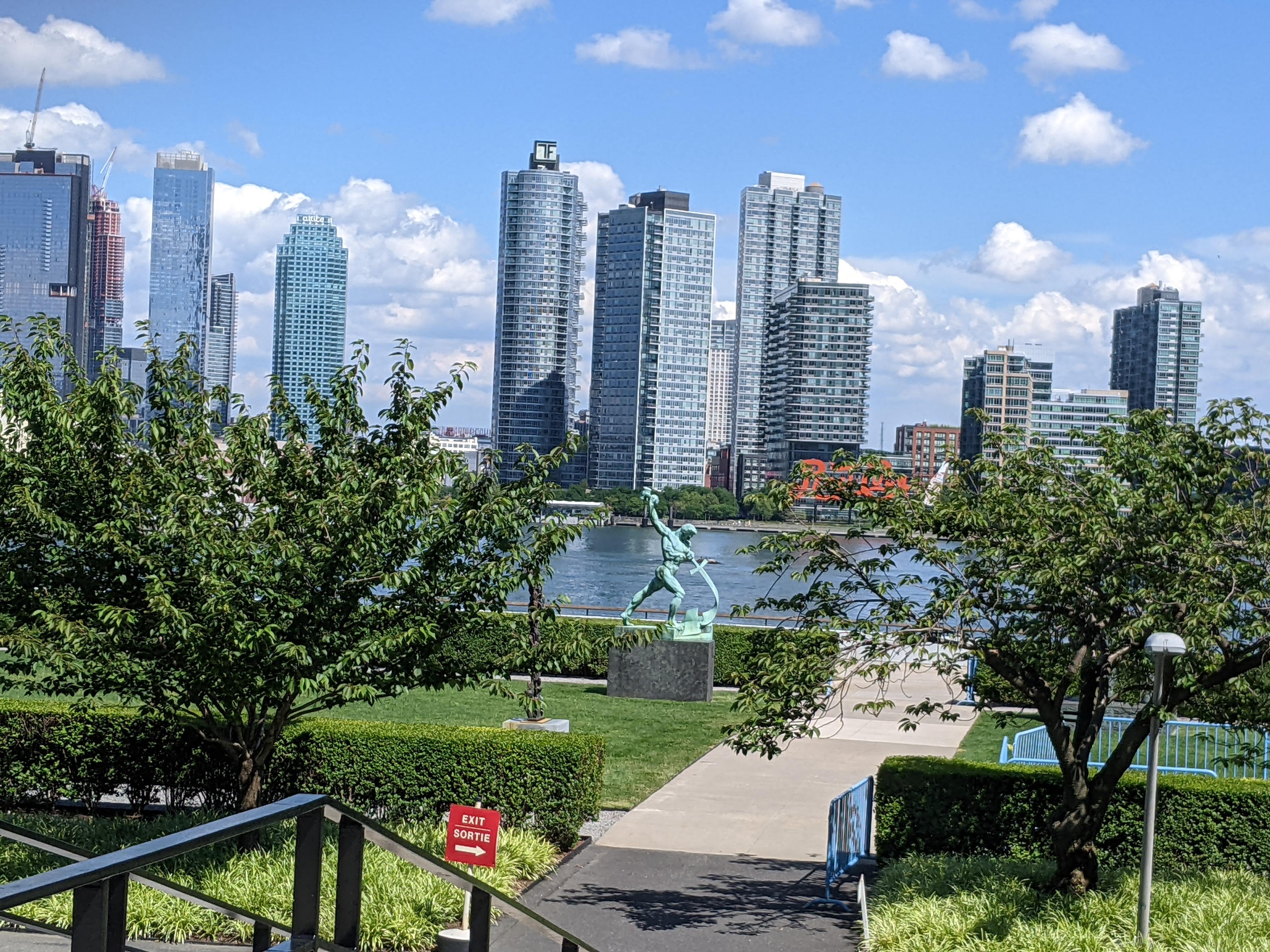
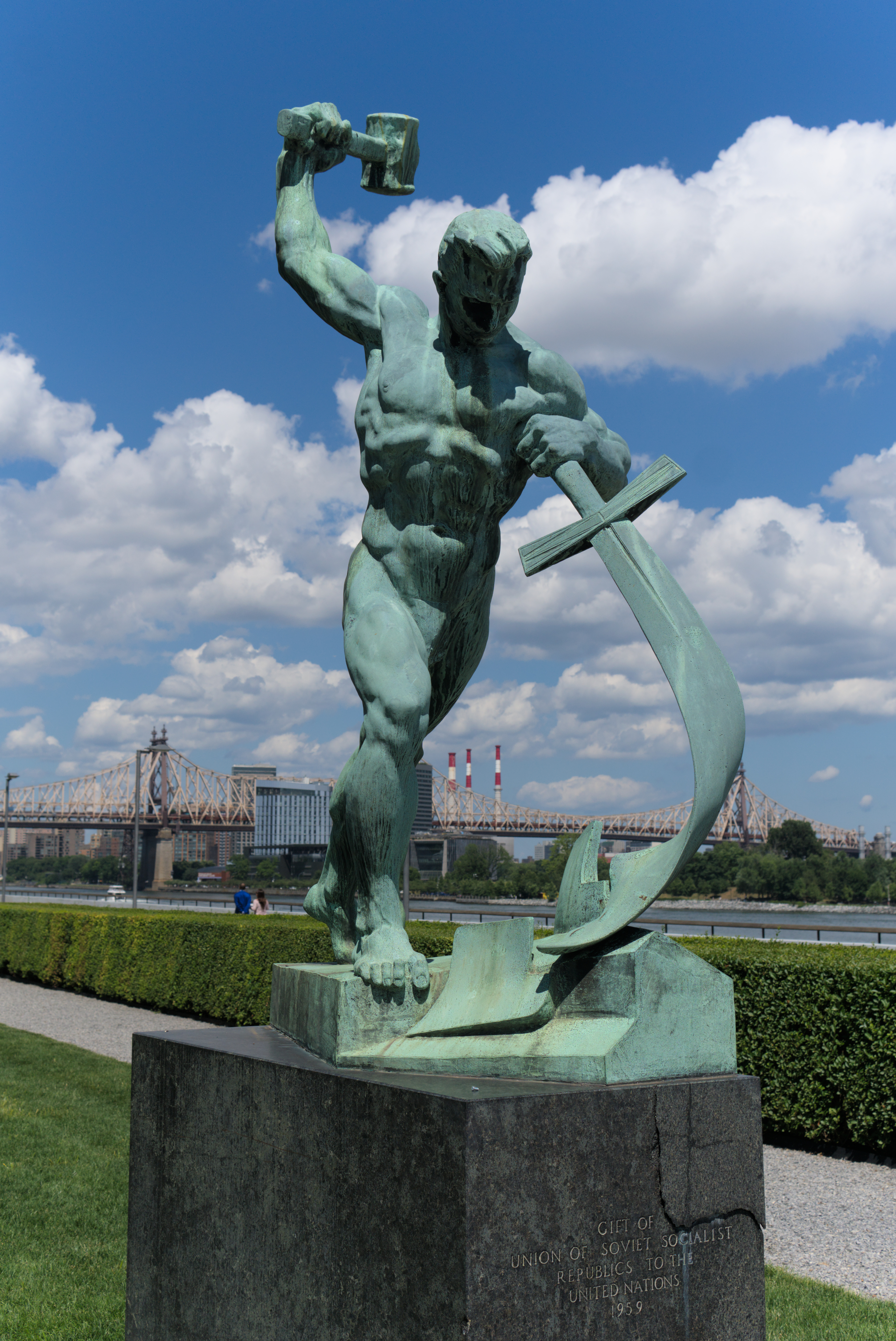
I had seen photos of the biblically inspired Let Us Beat Swords into Ploughshares and wanted to see it in person, so I paid up. It’s vaguely visible from the vantage of the free-access plaza outside the main entrance of the General Assembly Building.
But let’s move in closer.
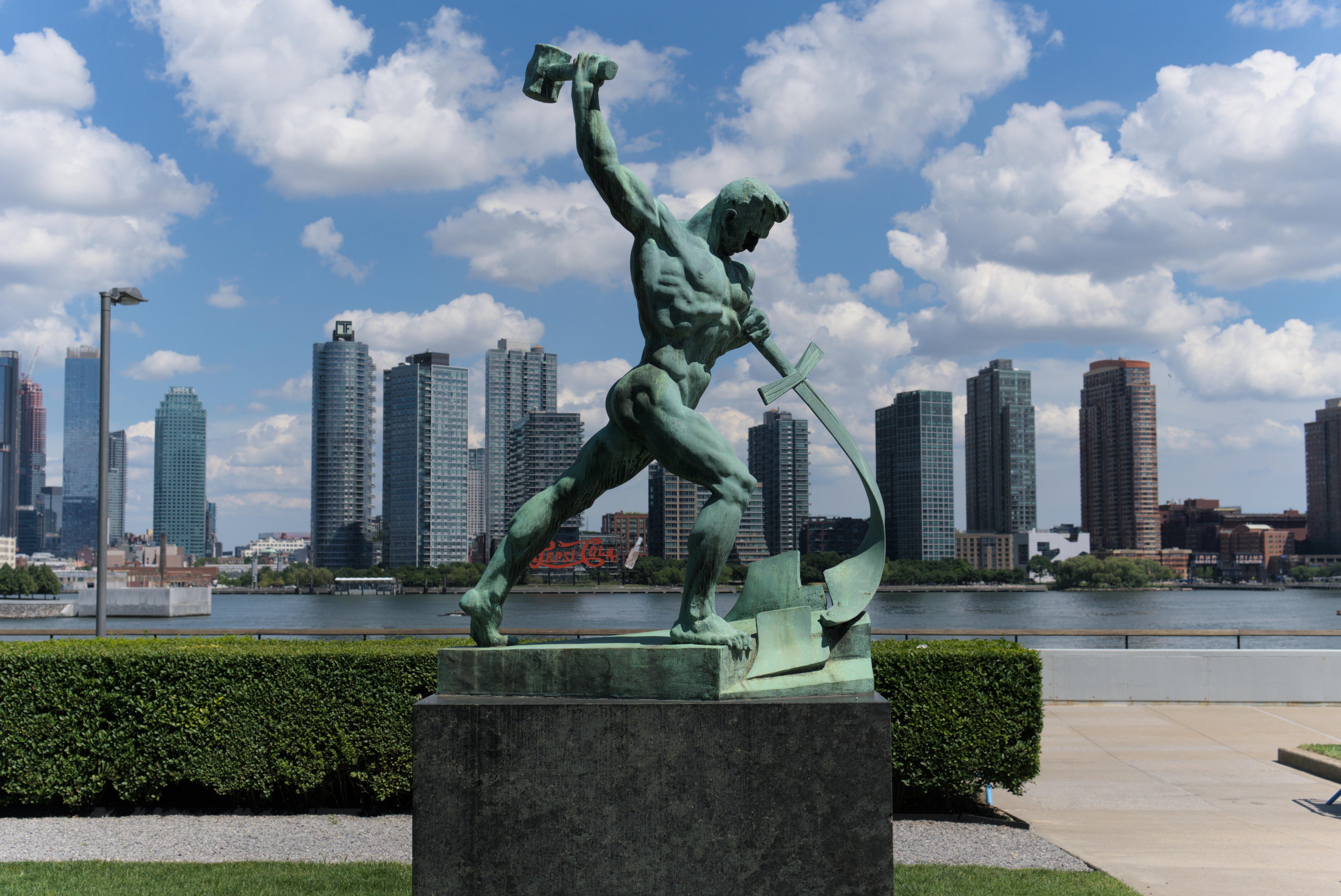
Yevgeny Vuchetich (Russian, 1908–1974), Let Us Beat Swords into Ploughshares, 1959. Cast bronze and granite pedestal, figure 111 × 76 × 35 in., pedestal 44 × 75 × 34 in. North Lawn, United Nations Headquarters, New York. Gift from the USSR. Photo: Victoria Emily Jones. [object record]
Gifted to the United Nations by the USSR in 1959, the bronze sculpture is by the Soviet artist Yevgeny (sometimes spelled “Evgeniy”) Vuchetich, who was of Russian, French, and Serbian heritage and lived most of his life in Russia. It shows a muscular man (modeled by Olympic wrestler Boris Gurevich) hammering a sword into a plow blade, used to cut furrows for planting crops. Representing the transformation of tools of death into tools of life, the imagery is taken from Isaiah 2:4 in the Hebrew Bible, in which the prophet proclaims that “in days to come,” people of all nations “shall beat their swords into plowshares and their spears into pruning hooks; nation shall not lift up sword against nation; neither shall they learn war any more.” The vision is that in the kingdom of God, instead of the land being littered with human blood and corpses, it will be cultivated and bring forth good food.
This scripture text is the basis of the African American spiritual “Down by the Riverside” [previously], whose refrain declares, “I ain’t gonna study war no more!” One of the commonly used verses is “I’m gonna beat my sword into a plow.” Here’s Michael Wright’s version:
And, from 1959, the Golden Gate Quartet’s, arranged by Orlandus Wilson:
Reflecting the song lyrics, Vuchetich’s sculpture is itself planted “down by the riverside”—the East River.
Vuchetich was one of the major figures of Soviet government–backed monumental sculpture, making his name from depictions of military heroes. So I find it a little odd that he was commissioned to make this peace sculpture that subverts the very militarism his other sculptures celebrate. One of his most famous pieces is The Motherland Calls; located at the top of Mamayev Kurgan hill overlooking the city formerly known as Stalingrad, it shows a female personification of Russia lifting high a sword in one hand and calling the Soviet people to battle with the other.
Look, many artists will take what work they can get, regardless of whether a commission matches their own ideology. I don’t claim to know what Vuchetich’s personal views were about war, violence, and empire.
Regardless of its disjunction with the artist’s larger oeuvre—and the uncomfortable fact that the donor’s successor state and caretaker of the sculpture, the Russian Federation, is persisting in an illegal and immoral war against its neighbor Ukraine—I really appreciate the theological imagination that Let Us Beat Swords into Ploughshares embodies, entreating us to apply our strength to constructive, not destructive, acts.
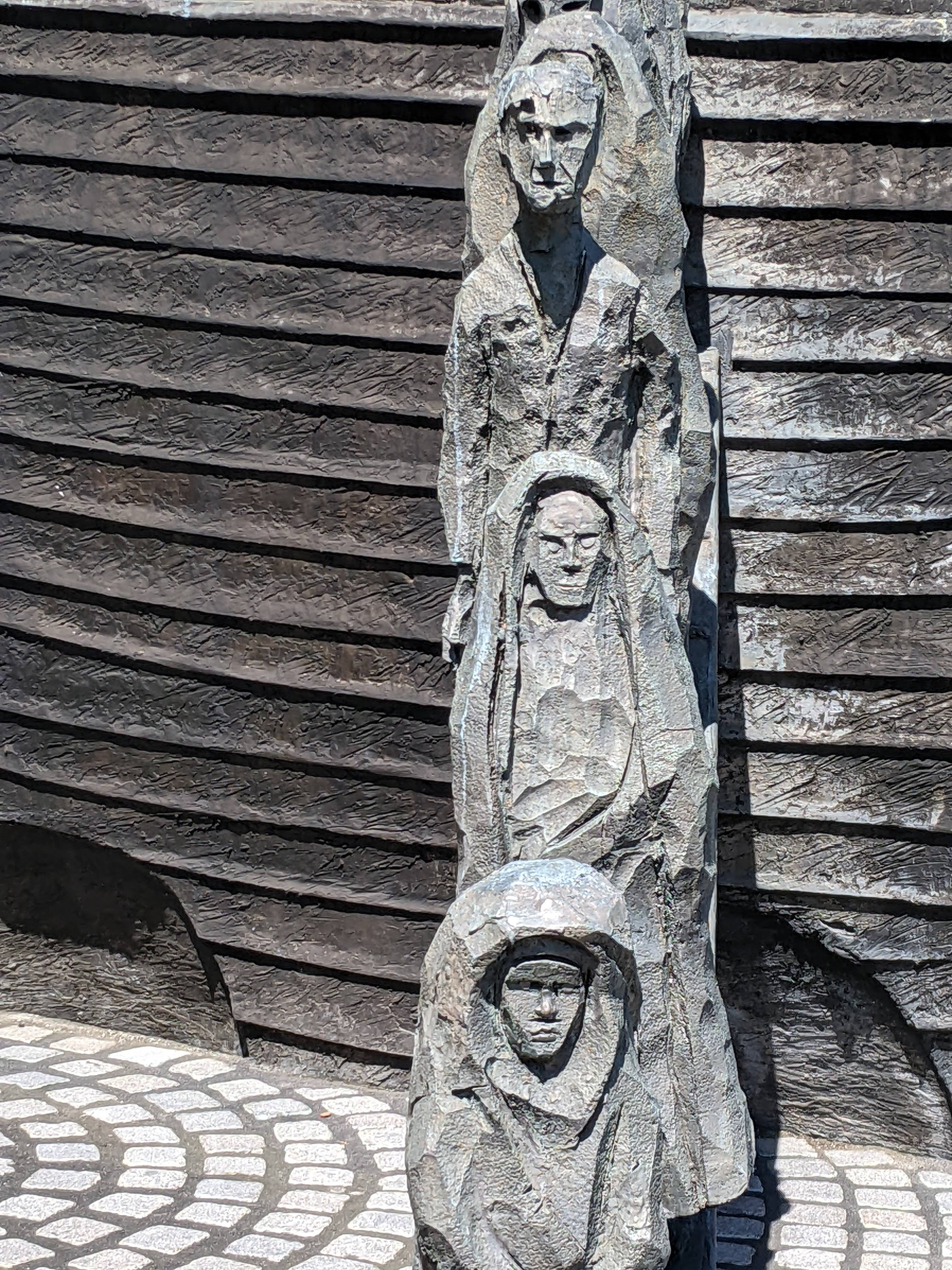
Nearby in the garden, not pictured in this article, is a literalization of the “swords into plowshares” principle. A recent gift from the Government of Colombia, Kusikawsay (Quechua for “peaceful and happy life”) is made of steel armaments melted and cast into the shape of a canoe, sailing upward. A donor representative said the sculpture for them symbolizes the end of an over-fifty-year armed conflict in their country. The idea is that the grotesque paraphernalia of war is metamorphosed into a benign watercraft that, in how it’s positioned, symbolizes humanity’s traveling into a lofty future.
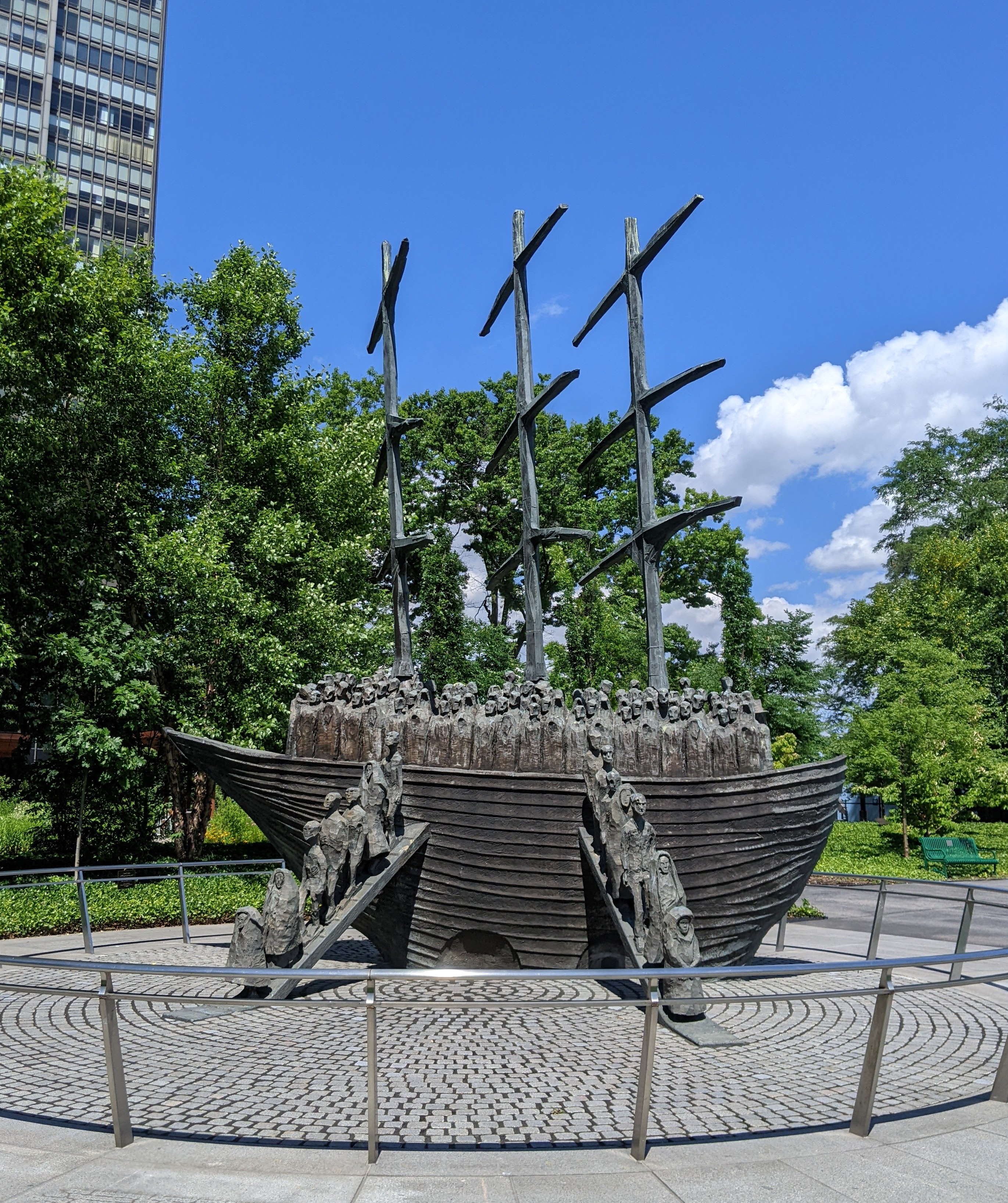
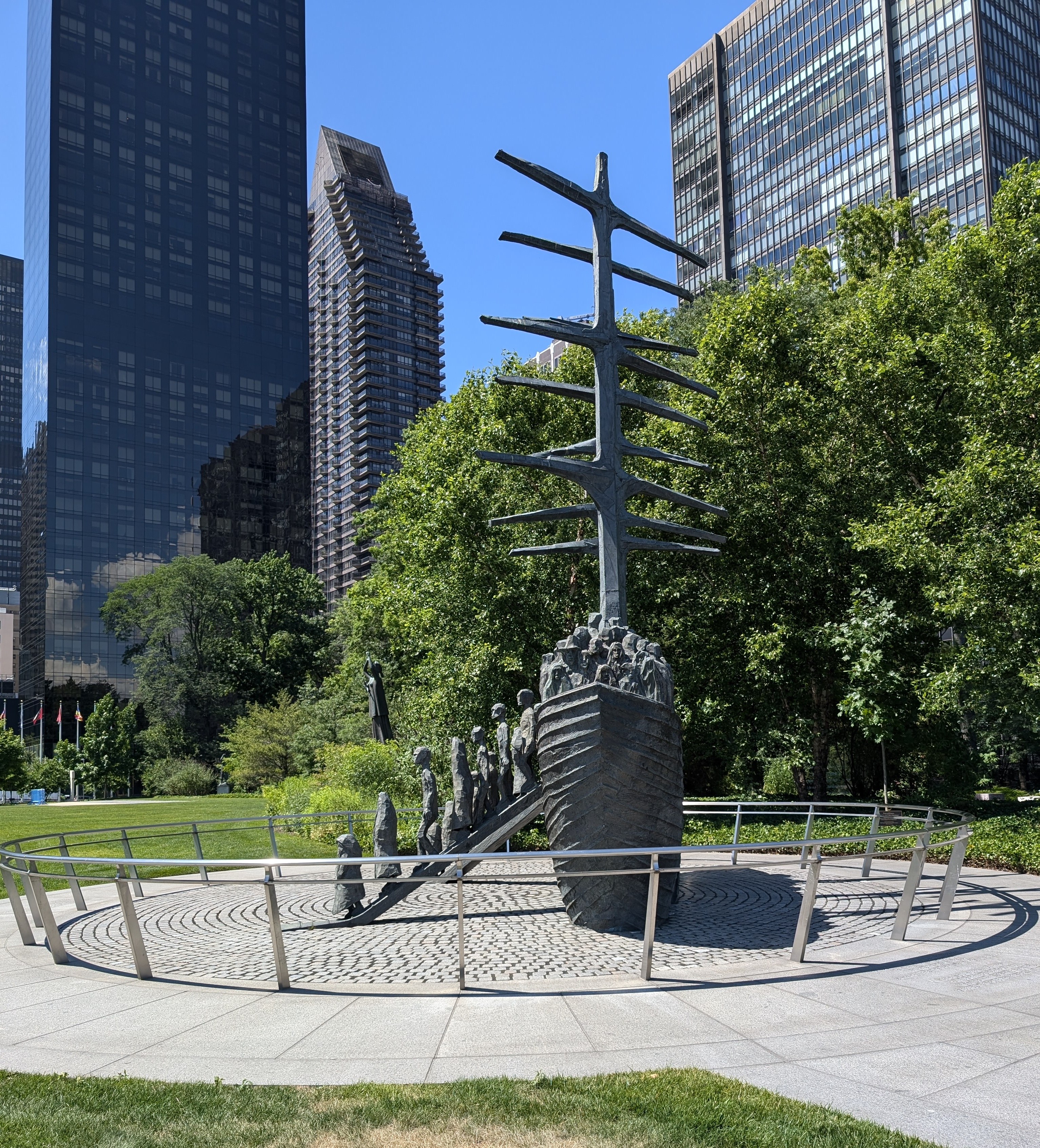
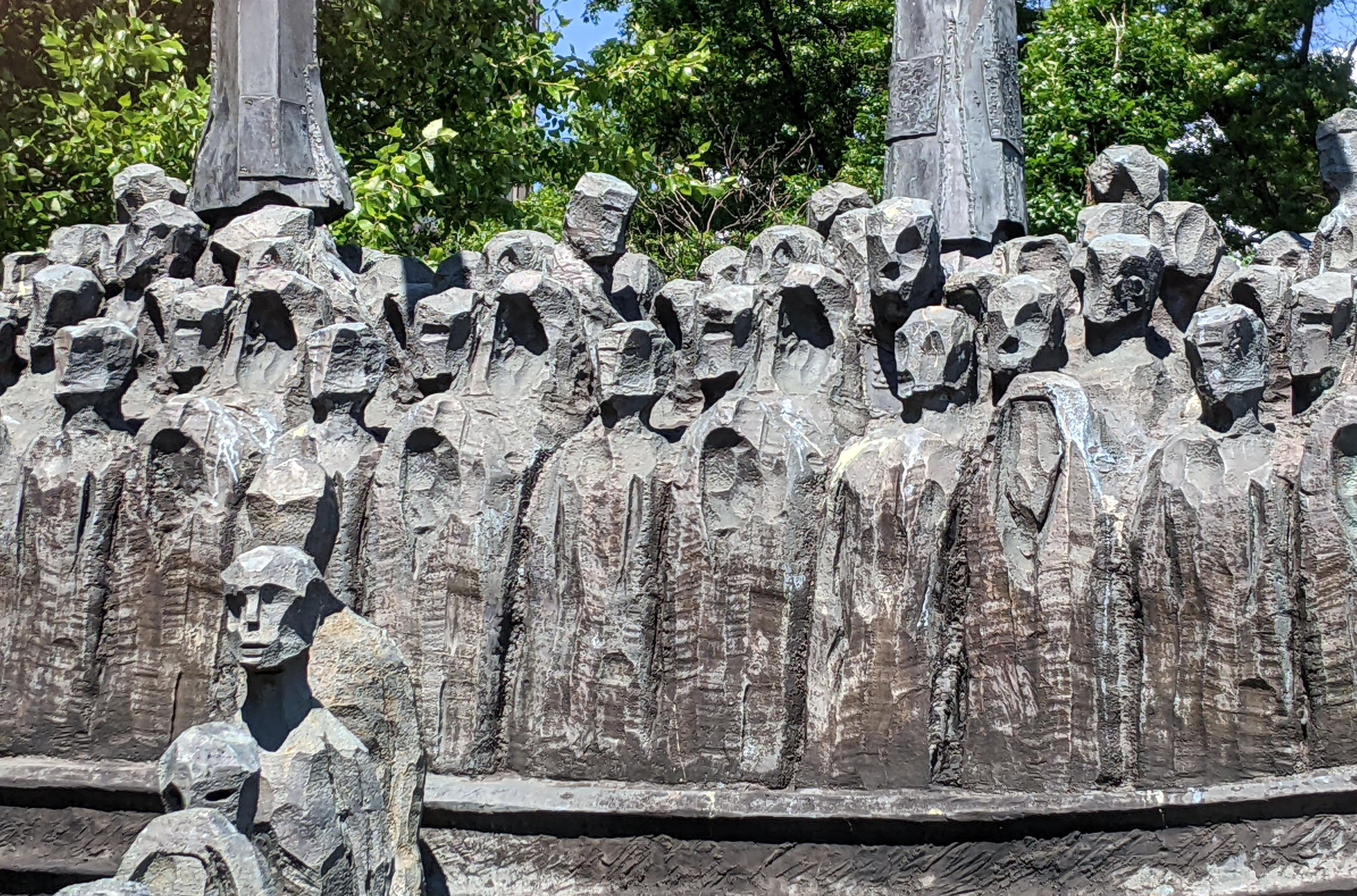
Another boat on the UNHQ’s North Lawn is Arrival by the Irish sculptor John Behan, which shows Irish immigrants disembarking into a new world. The sculpture was intended as a thank-you to the many nations that have received the Irish over the years, including Great Britain, the United States, Canada, Australia, Argentina, Chile, Mexico, New Zealand, and Brazil.
John Behan (Irish, 1938–), Arrival, 2000. Bronze, stainless steel on granite pavers, 26 × 23 ft. North Lawn, United Nations Headquarters, New York. Gift from Ireland. Photo: Victoria Emily Jones. [object record]
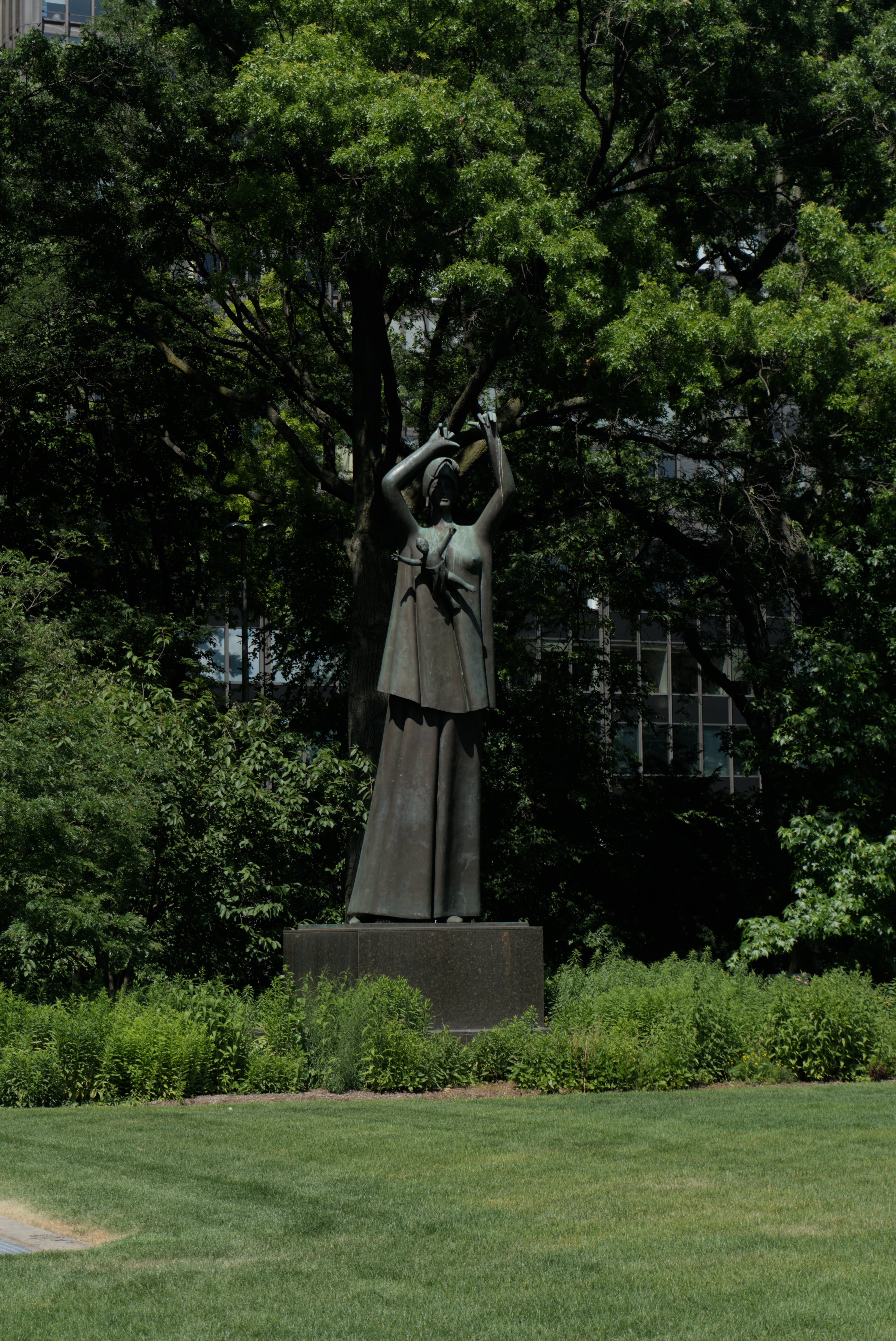
This piece wasn’t covered by the Garden Tour, nor was the colossal Mother and Child by the Italian artist Giacomo Manzù, which I spotted across the lawn and hurriedly snapped a distant photo of while scurrying to keep up with the group.
Giacomo Manzù (Italian, 1908–1991), Mother and Child, 1989. Bronze, 254 × 66 × 52 in. North Lawn, United Nations Headquarters, New York. Gift from Italy. Photo: Victoria Emily Jones. [object record]
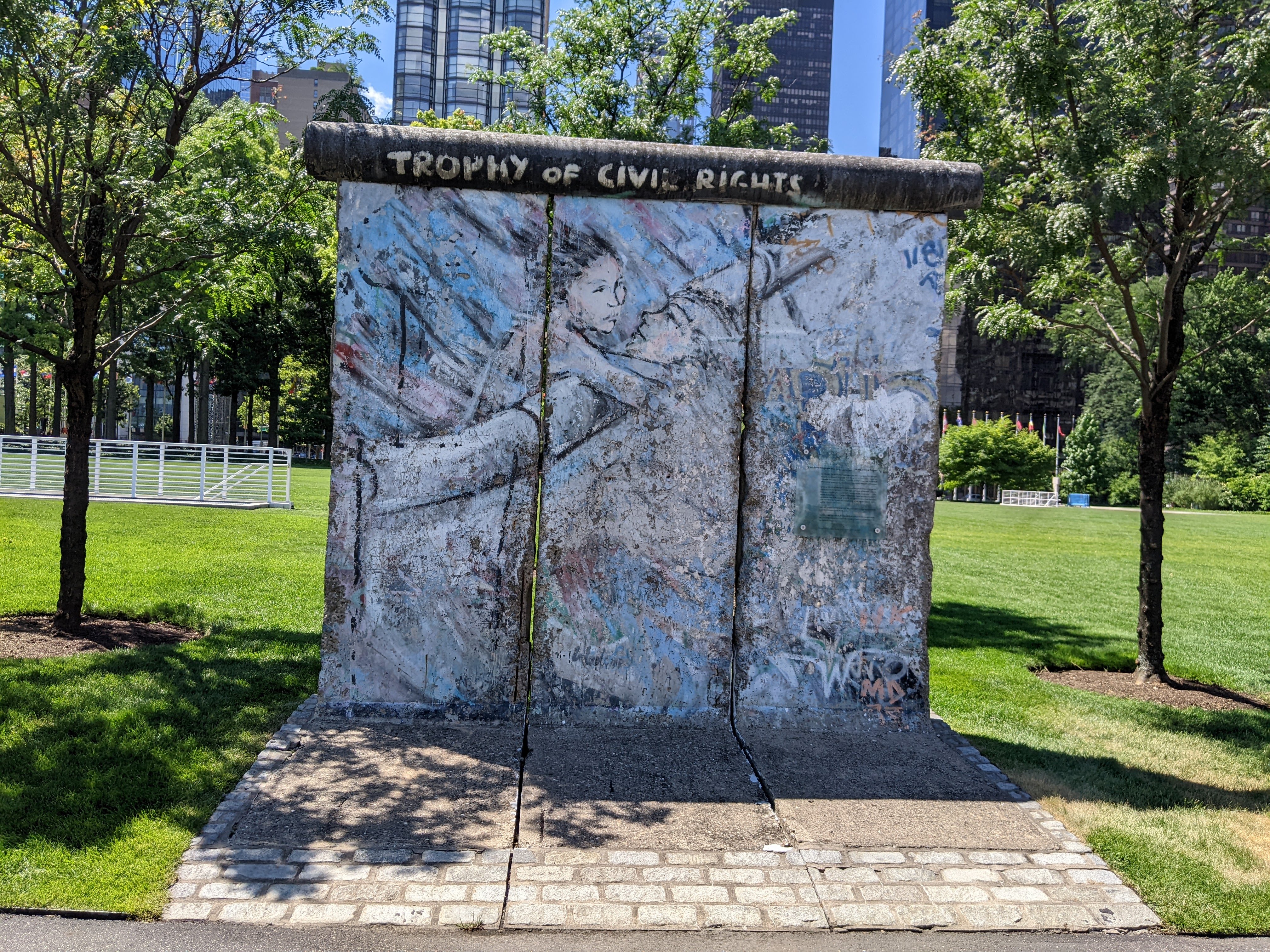
One of the pieces our guide did stop for and spend a good amount of time on was a fragment of the Berlin Wall gifted by Germany in 2002, after the wall came down in 1989. The ninety-six-mile-long barrier was erected in 1961 to divide the country into East (Communist) and West (Federal Republic), but a peaceful revolution in East Germany resulted in its fall and the country’s reunification as a federal republic, marking the end of the Cold War in Europe.
Kani Alavi (Iranian German, 1955–), Trophy of Civil Rights (Berlin Wall Fragment), ca. 1998. Precast reinforced concrete wall sections with paint, overall 84 × 114 in. North Lawn, United Nations Headquarters, New York. Gift from Germany. Photo: Victoria Emily Jones. [object record]
The front of this three-slab wall fragment (that is, the side visible from the paved path) bears a mural by Kani Alavi, an Iranian artist who moved to West Berlin in 1980, living in an apartment overlooking the formidable “Checkpoint Charlie.” Throughout the 1980s, artists painted images on the west side of the wall as a form of political commentary and resistance. The east side, however, was unpainted during the Cold War because it was so heavily guarded; attempted art interventionists probably would have been shot.
After the border opened on November 9, 1989, and demolition of the wall began, Alavi was a key organizer of what’s known as the East Side Gallery, inviting artists from Germany and around the world to paint murals on the east side of the wall, across a segment that would be deliberately left standing as a memorial. “Alavi helped transform the most visible symbol of the Iron Curtain into an enduring monument to the power of freedom,” Ryan Prior wrote for CNN. This open-air gallery is one of Berlin’s most visited attractions, featuring the work of at least 118 artists from twenty-one countries.
Alavi painted Trophy of Civil Rights (I’m not sure whether that inscription was his or just a remnant from another artist, but it’s become the mural’s de facto title) on a section of remaining wall sometime around 1998. “It is a representation of two people hugging over the wall, a dramatic situation of people trying to get close to each other,” he told NPR through a translator. “It shows how the people were separated. It shows how a culture was divided by a wall. That’s what happened, and that’s what I showed.”
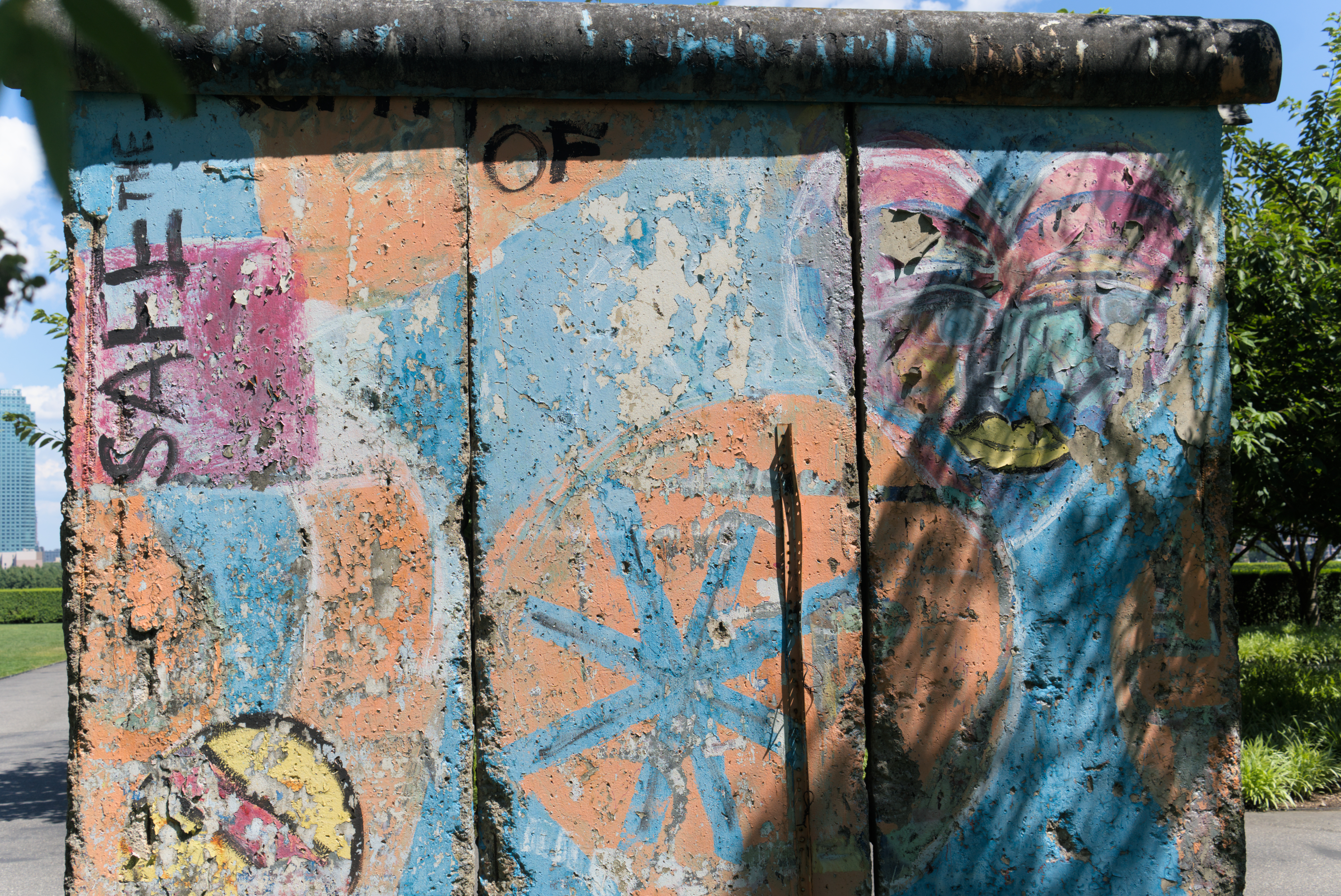
The other side of the wall is painted with miscellaneous graffiti by anonymous artists.
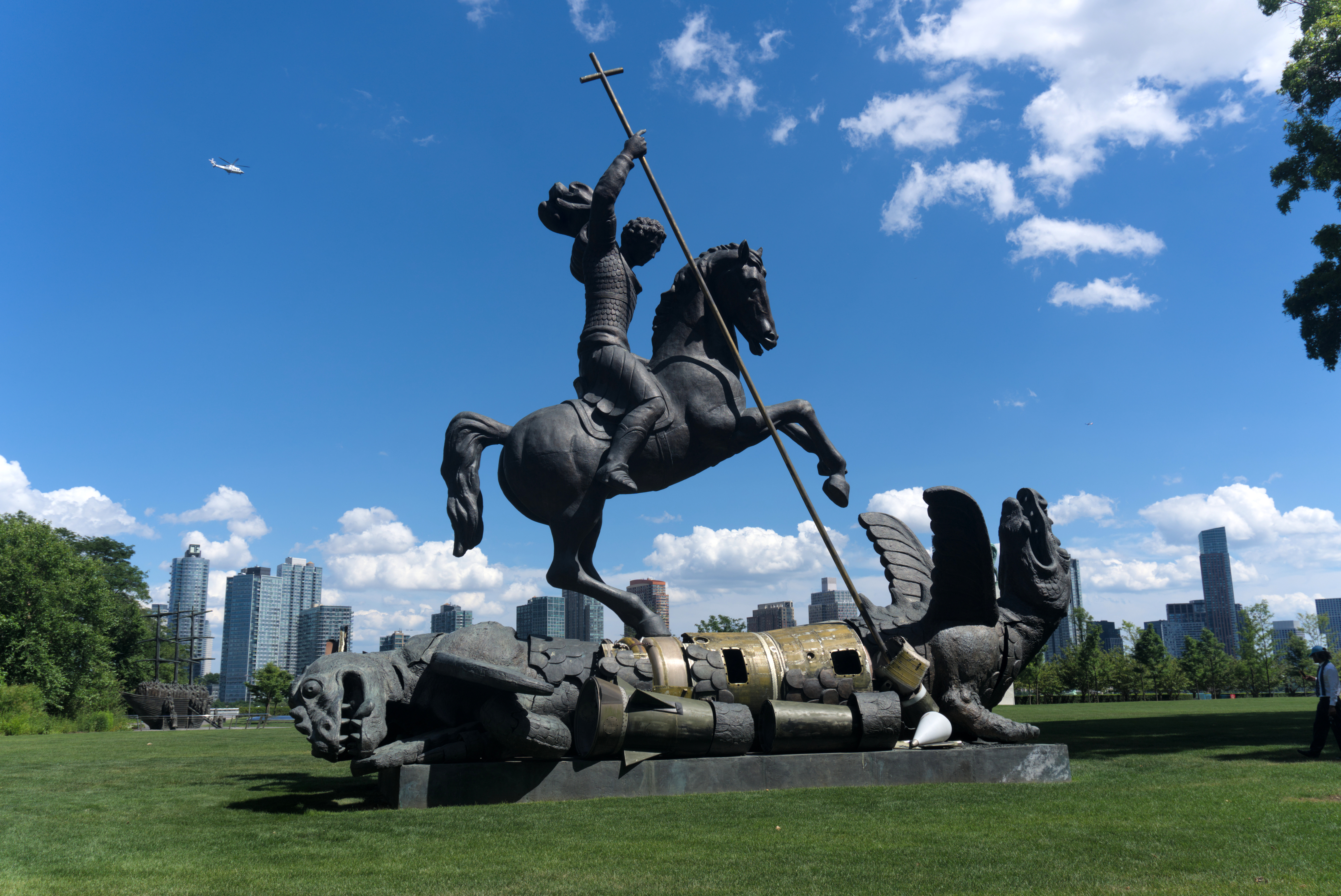
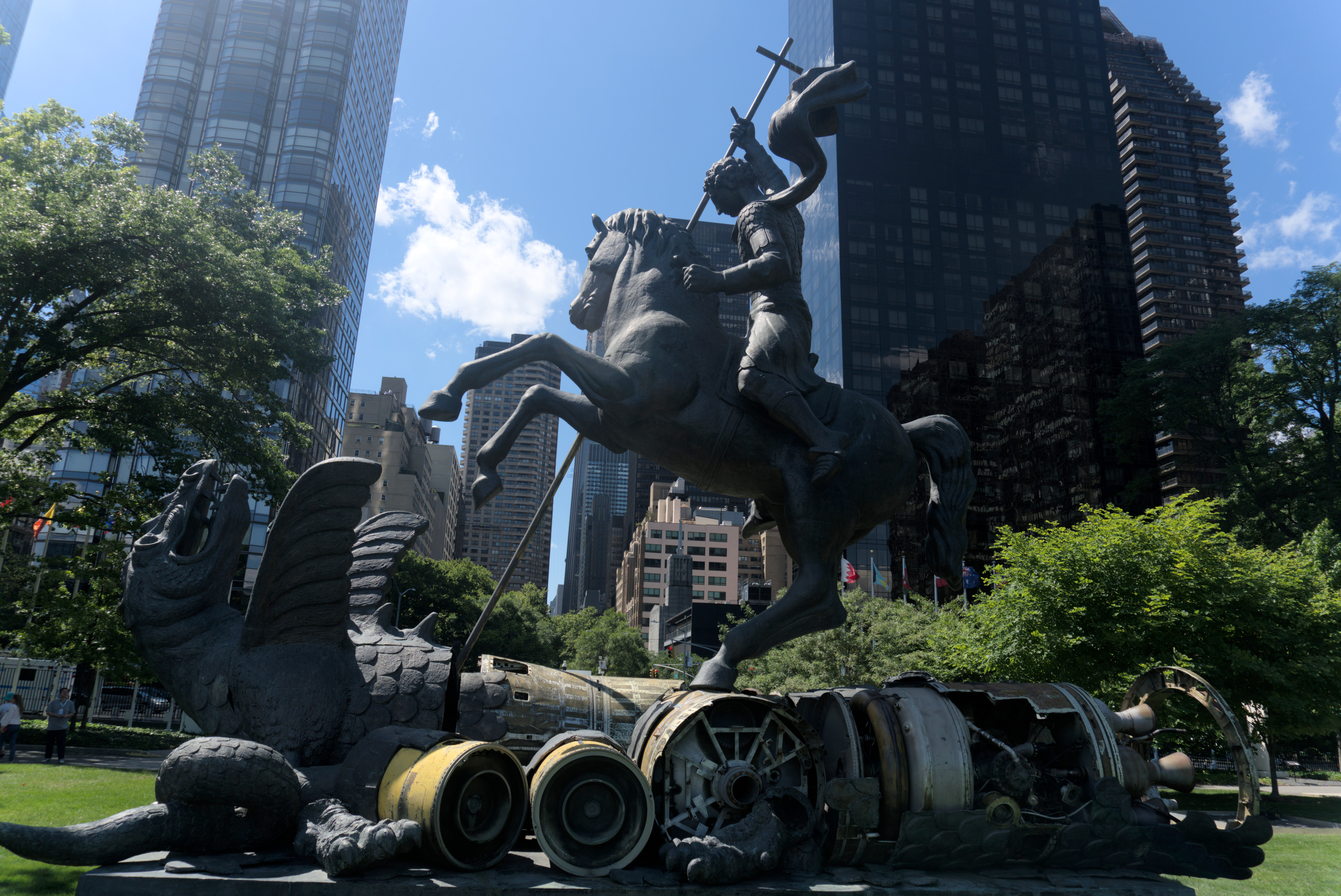
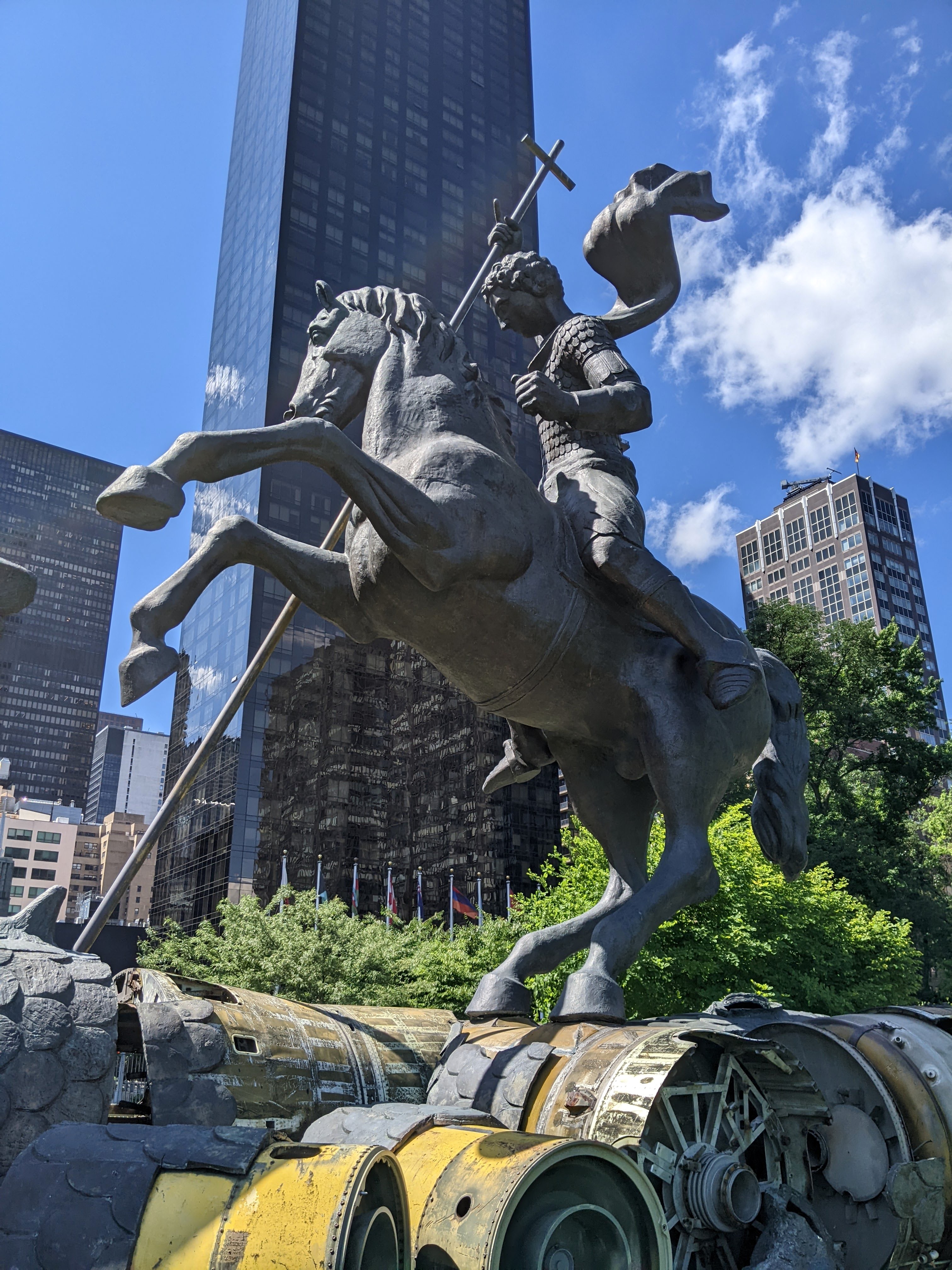
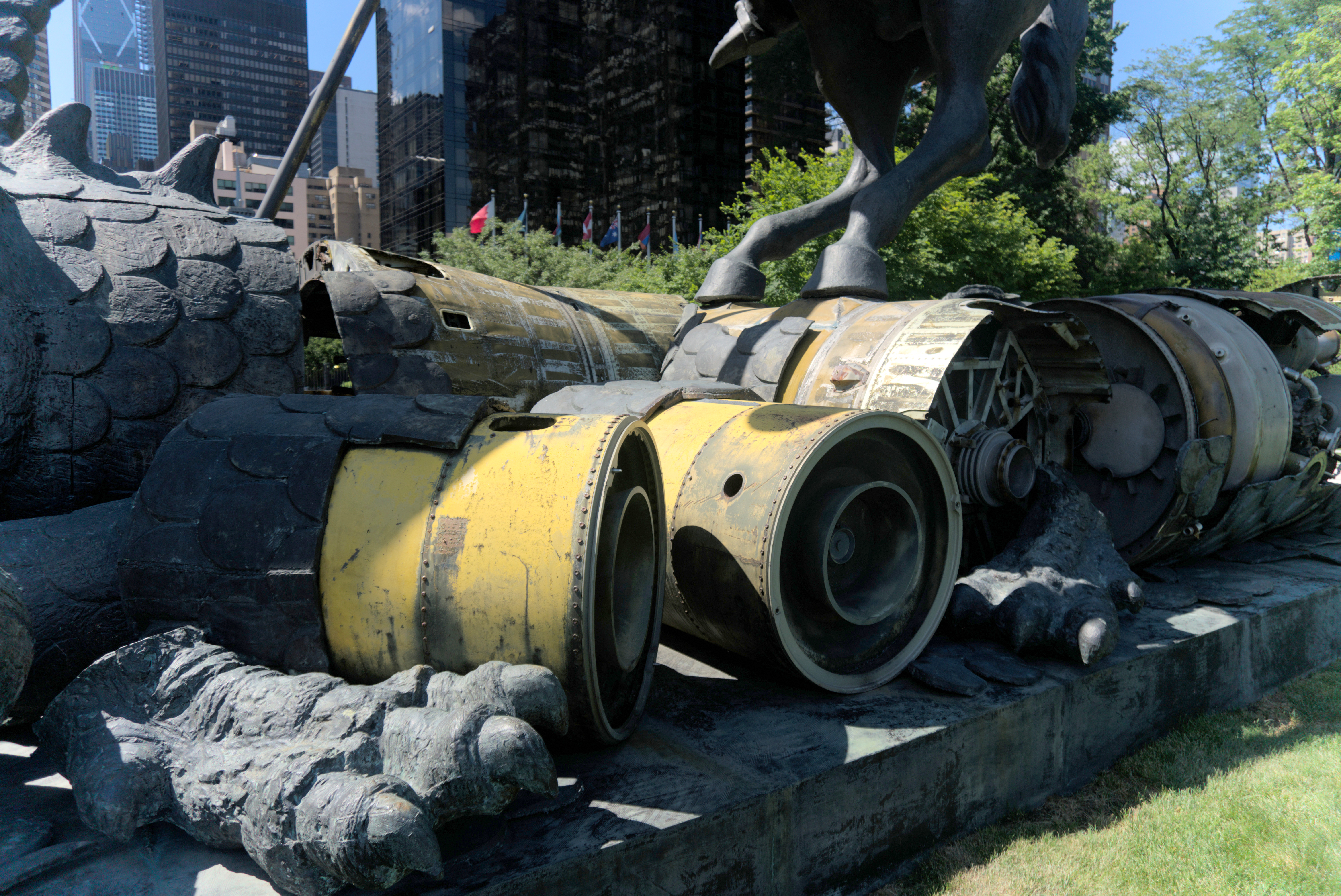
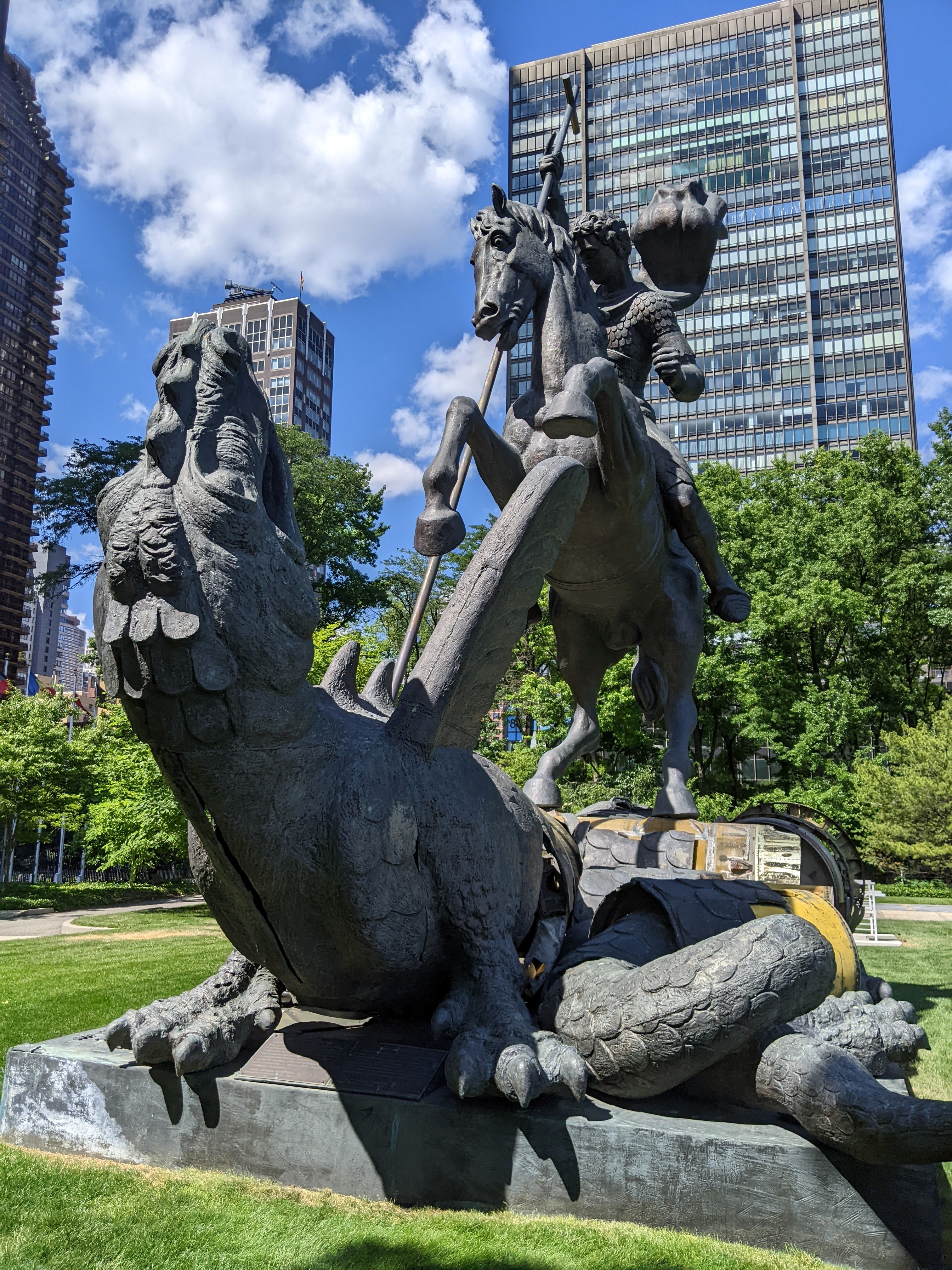
The largest sculpture on the North Lawn, standing at thirty-one feet tall and weighing forty tons, is Good Defeats Evil by the Georgian Russian sculptor Zurab Tsereteli. It depicts the Early Christian martyr-saint George, who was tortured and executed in 303 under the Diocletian persecution. Legends about him started developing in the sixth century and by the thirteenth century were widely circulated and embellished to include a tale of him slaying a dragon to save a Libyan princess whom the terrorized villagers had planned to sacrifice to it for appeasement.
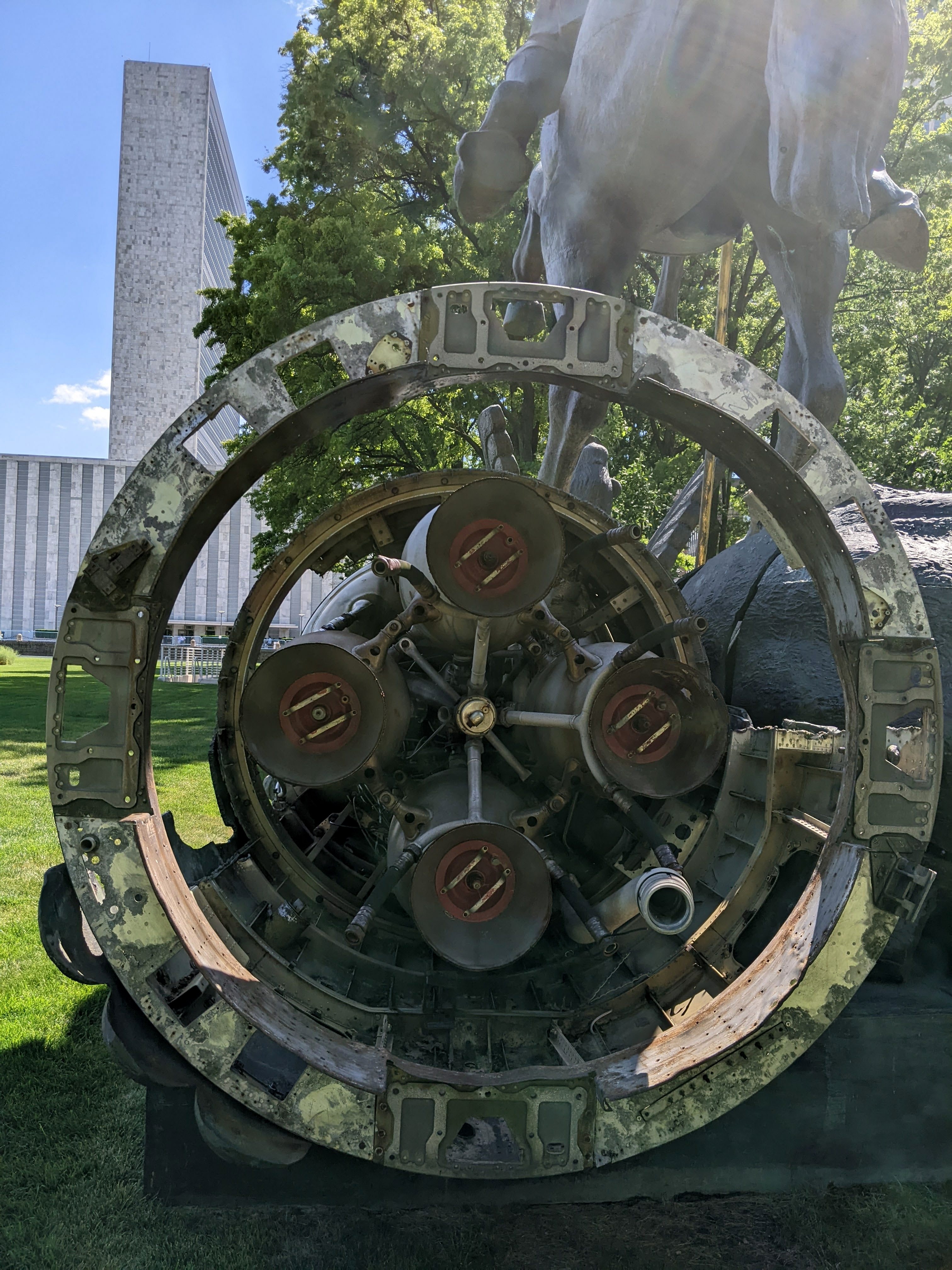
Zurab Tsereteli (Georgian Russian, 1934–), Good Defeats Evil, 1990. Cast bronze figure with dragon formed from sections of two destroyed nuclear missiles, 31 × 18 × 10 ft. North Lawn, United Nations Headquarters, New York. Gift from the USSR. Photo: Victoria Emily Jones. [object record]
(Side note: Saint George is not to be confused with Saint Michael the Archangel from the book of Revelation, who in Christian iconography is usually shown on foot [but occasionally on horseback], also slaying a dragon. The easiest way to tell the two saints apart is that Michael has wings, whereas George does not.)
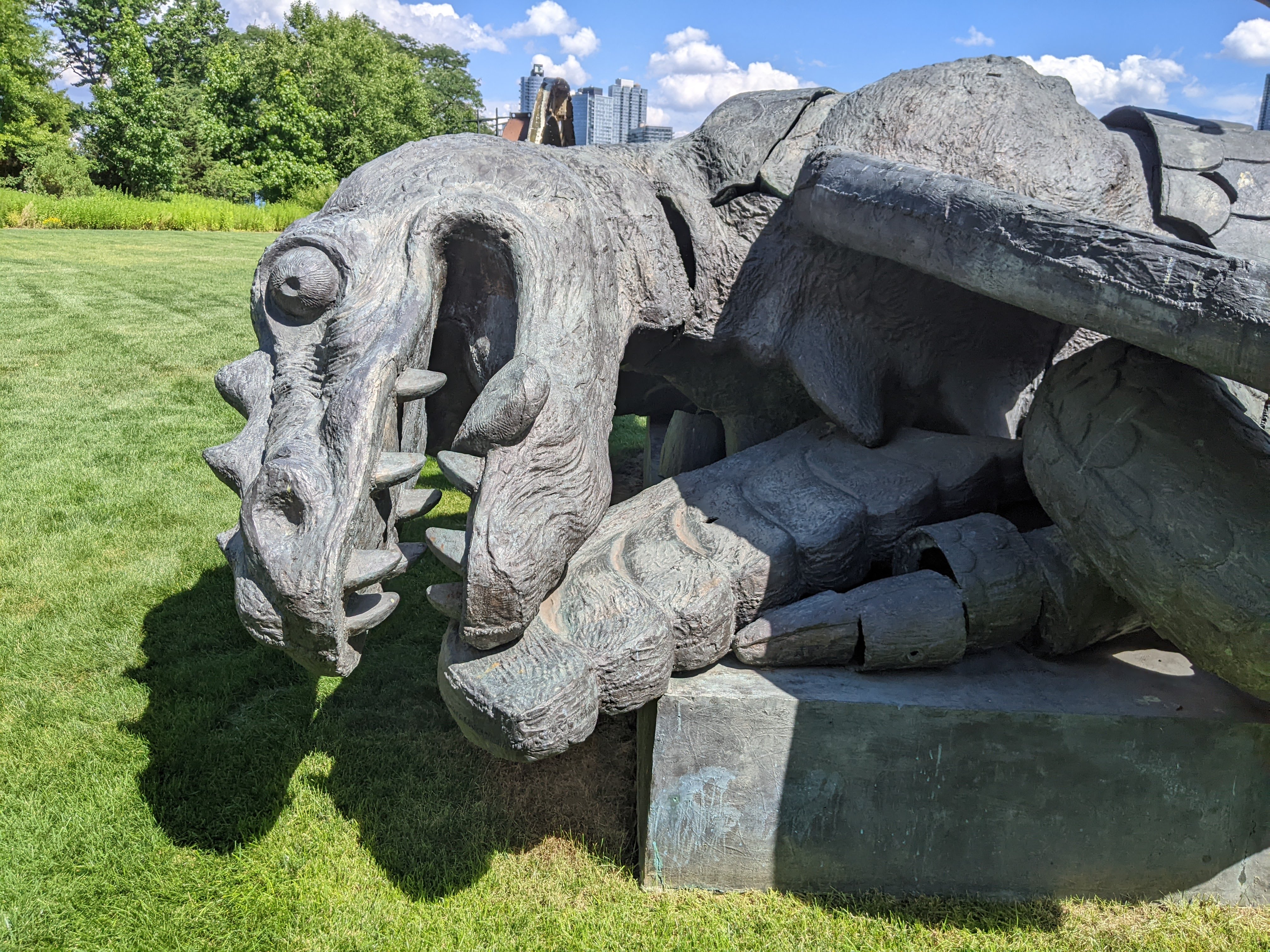
The most intriguing aspect of this sculpture is that the two-headed dragon is made up of sections of two destroyed nuclear missiles, making the piece a symbol of disarmament. According to the UN website, here
the dragon is not the mythological beast of early Christian tradition, but rather represents the vanquishing of nuclear war through the historic treaty between the Soviet Union and the United States [the Treaty on the Elimination of Intermediate-Range and Short-Range Nuclear Missiles, signed in 1987]. Created as a monument to peace, the sculpture is composed of parts of actual United States and Soviet missiles. Accordingly, the dragon is shown lying amid actual fragments of these weapons, the broken pieces of Soviet SS-20 and U.S. Pershing missiles.
The dragon’s two heads thus represent the world’s two largest nuclear arsenals during the Cold War: those of the Soviet Union and the United States.
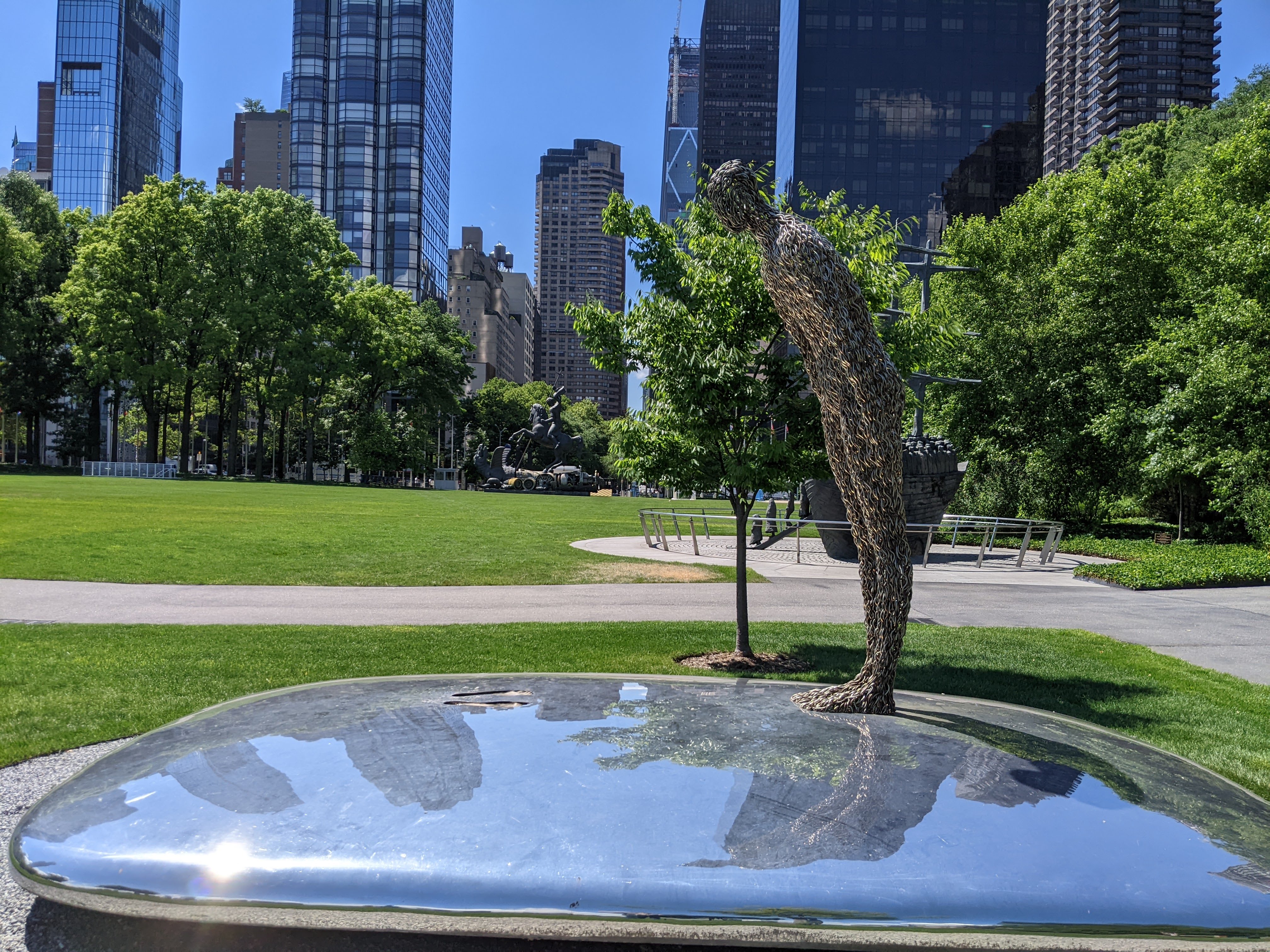
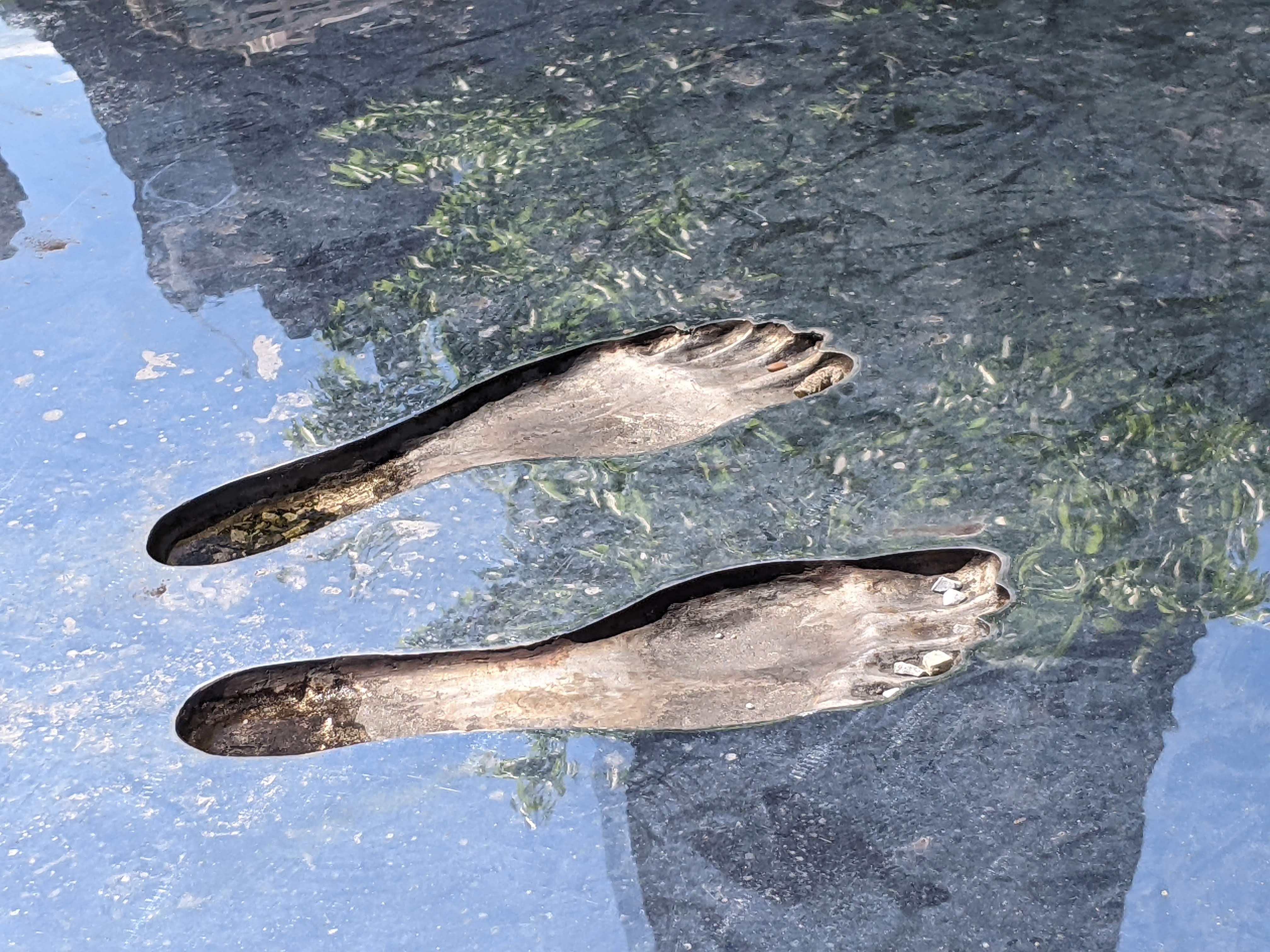
The last sculpture I’ll mention is Consciousnessby the Mongolian artist Ochirbold Ayurzana. It consists of a rounded, high-luster steel alloy floor plate on which stands a human figure, made of twisted metal strings, examining the footprints they’ve left on the planet. What mark will we make, for good or ill? The sculpture is dedicated to the historic adoption of two global developmental milestone documents: the UN 2030 Agenda for Sustainable Development and the Paris Agreement on Climate Change.
Ochirbold Ayurzana (Mongolian, 1976–), Consciousness, 2017. Steel, metal on pedestal, 110 × 196 × 125 in. North Lawn, United Nations Headquarters, New York. Gift from Mongolia. Photo: Victoria Emily Jones. [object record]
This is just a selection of the many artworks on view at the United Nations Headquarters in Manhattan. To view a full catalog, click here.
Garden Tours are offered every Wednesday at 2 p.m. from May through August, and Art Tours are offered every other Thursday at 1:15 p.m. year-round—or either one upon request. I’m grateful for their having accommodated me and my husband while we were in town!
I really wish the UN would allow visitors to move through the garden at their own speed, though, as the tour was so fast-paced that I hardly had time to take in a sculpture before we were made to move on to the next one. Approximately one to three minutes was apportioned for each work, which is hardly enough time to sit with the weight and history of some of these pieces. And I didn’t have time to change camera lenses for different types of shots. Because you have to be accompanied by a staff person, you are not allowed to linger behind when the group advances. Some leeway was given to me, but overall I felt rushed. Perhaps the pacing was anomalous because it was such a hot day—in the nineties—and the few shaded areas were prioritized.
Despite the swiftness, I really enjoyed the tour and experiencing and learning about the variety of sculptures and other art pieces from a variety of UN member countries, which celebrate peace, joy, and global unity and project a hopeful future.
Fernando Peña Defilló (Dominican, 1928–2016), La ofrenda (The Offering), 1993. Oil and acrylic on canvas, 126 × 166 cm. Private collection. Source: Latin American Art in the Twentieth Century, ed. Edward J. Sullivan (Phaidon, 1996), p. 110.
May those whose hell it is To hate and hurt Be turned into lovers Bringing flowers.
—Shantideva, eighth century
These lines are from chapter 10, stanza 9, of the Bodhicharyavatara (Way of the Bodhisattva), a Mahayana Buddhist text by the eighth-century Indian monk Shantideva. I first encountered this religious classic, originally written in Sanskrit, while working at Shambhala Publications. The excerpt above was adapted by author David Richo from a translation by the Padmakara Translation Group. Here’s 10.9 in full, as translated by PTG:
May the hail of lava, fiery stones, and weapons Henceforth become a rain of blossom. May those whose hell it is to fight and wound Be turned to lovers offering their flowers. [source]
Other translations include those by Stephen Batchelor—
May the rains of lava, blazing stones, and weapons From now on become a rain of flowers, And may all battling with weapons From now on be a playful exchange of flowers. [source]
—and Fedor Stracke:
May the rain of leafs, embers, and weapons Become forthwith a rain of flowers. May those cutting each other with knives Forthwith throw flowers for fun. [source]
I am so struck by this short benediction that prays our hate be transformed into love, our hardness into softness, our cold, sterile weaponry into delicately petaled, fragrant blooms. Shantideva recognized that when we lash out in physical or verbal violence, we create a hell that’s all our own. We may intend to inflict suffering on another, but in doing so, we often wound ourselves—psychologically, spiritually. When we dehumanize others, we become less human.
Instead of hurling rocks, punches, bullets, or insults, what if we were to completely confound our enemies by offering them words or tokens of love? Love is the way of the bodhisattva, the “enlightened being.” It’s the way of Jesus—he who said, “Love your enemies; do good to those who hate you; bless those who curse you; pray for those who mistreat you” (Luke 6:27–28).
Loving people doesn’t mean we can’t be angry at them—but we cannot allow our anger to fester into bitterness and ill will or to explode in harmful outbursts. It should be a productive anger.
How might we use an ethic of love to direct our anger or somebody else’s toward a good end, to defuse a contentious situation? Not taking the easy way out by simply ignoring or retreating from a problem, but confronting our opponent in peaceful, creative, and potentially transformative ways?
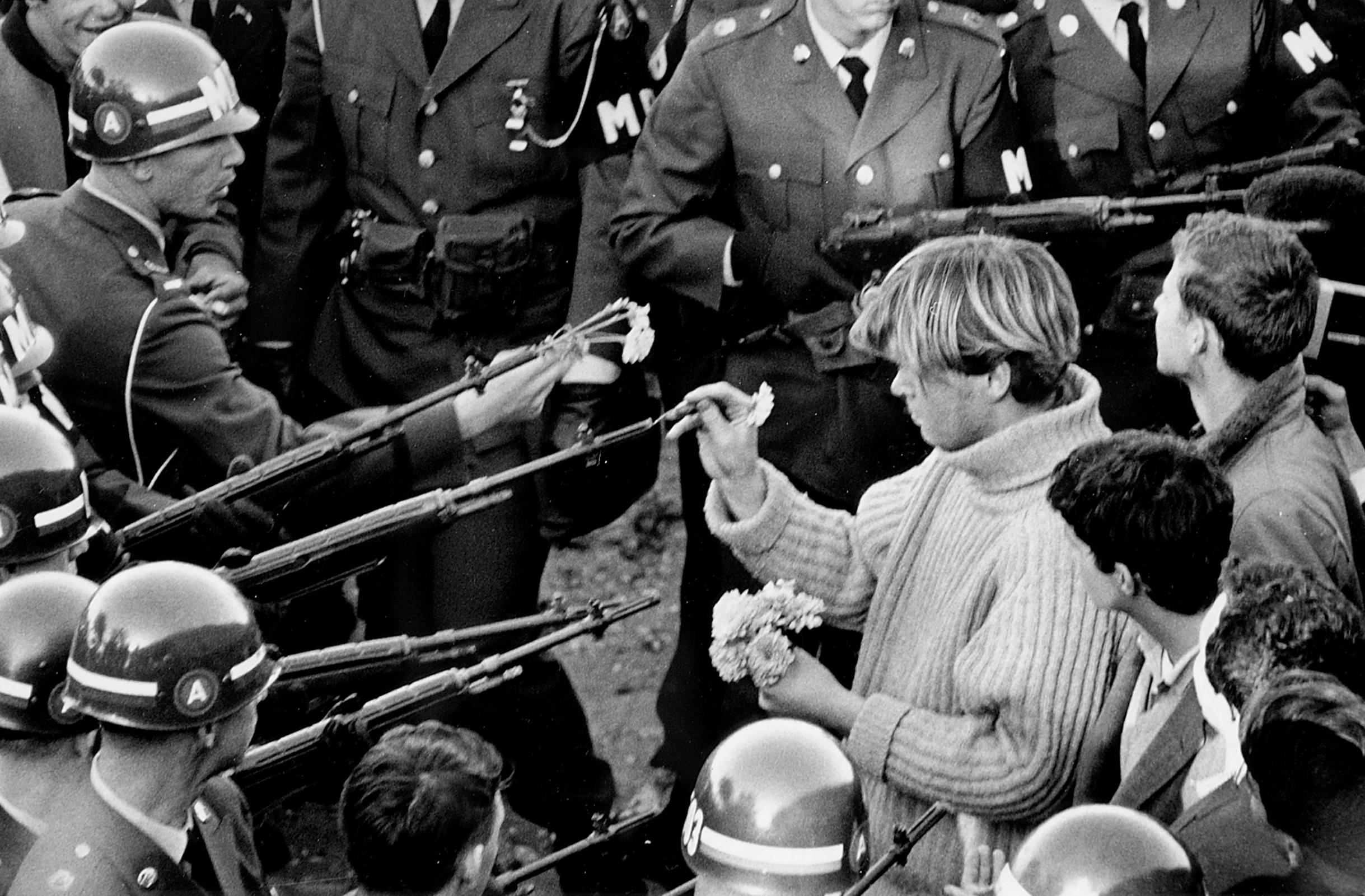
I’m reminded of the historic Pulitzer Prize–nominated photograph Flower Power, taken by Washington Star photojournalist Bernie Boston on October 21, 1967, when he was covering an antiwar march on the Pentagon. As the 503rd Military Police Battalion formed a semicircle around demonstrators to prevent them from climbing the Pentagon steps, Boston captured eighteen-year-old George Edgerly Harris III, aka Hibiscus, placing a carnation into the barrel of an M14 rifle held by one of the soldiers. What a powerful image!
Bernie Boston (American, 1933–2008), Flower Power, Arlington, Virginia, 1967
Two years earlier in his essay “How to Make a March/Spectacle,” Allen Ginsberg was the first to expound on the potency of flowers as a spectacle to simultaneously disarm opponents and influence thought. He said “masses of flowers” should be handed out on the front lines of protests to police, the press, and onlookers as a symbol of nonviolent advocacy. He also suggested candy bars and toys.
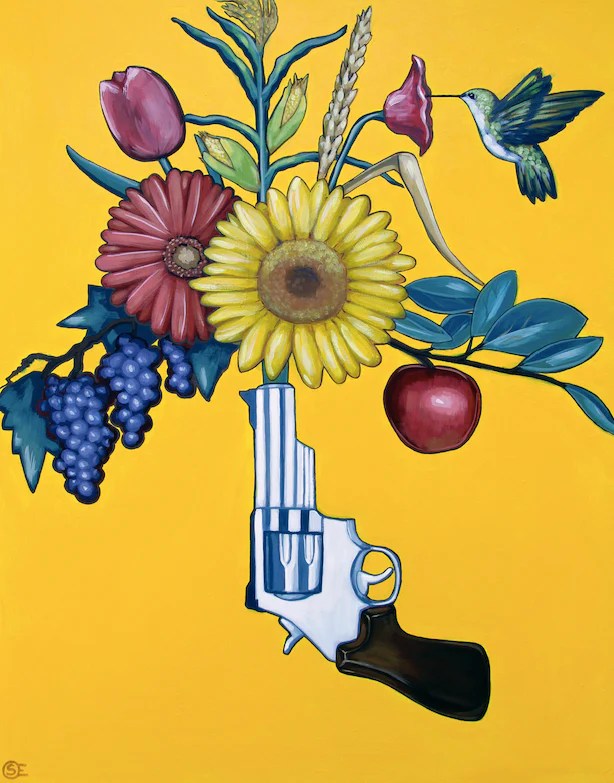
Artist Scott Erickson seems to have drawn on Boston’s Flower Power photograph in his visual interpretation of Isaiah 2:4, Swords into Plowshares, which shows a sprig of foliage growing out of the barrel of a pistol, oriented upward like a vase. Its deadly power mocked and reversed, the gun releases a benign projectile that attracts and nourishes rather than strikes fear.
The evocative Bible verse on which this painting is based prophesies a day when all the nations “shall beat their swords into plowshares, and their spears into pruning hooks”—a poetic way of describing the cessation of violence, as tools of destruction are transformed into gardening tools.
Christian activist Shane Claiborne has been instrumental in helping me see the immense beauty of Isaiah’s visions of the eschaton—he has worked with RAWtools to decommission firearms and literally forge them into shovels, spades, and other life-giving implements!—along with the holy foolishness of the gospel and all that implies. Before becoming a leader of the new monasticism movement, Claiborne went to circus school, and he has often put that training to use on the streets of Philadelphia where he lives. In his first book, The Irresistible Revolution: Living as an Ordinary Radical (2006), he writes,
Whenever there is a fight on our block, my first instinct is to run inside and grab our torches and begin juggling them, to upstage the drama of violent conflicts in our neighborhood. Perhaps the kids will lose interest in the noise of a good fight and move toward the other end of the block to watch the circus. I truly believe we can overwhelm the darkness of this world by shining something brighter and more beautiful. (285)
He has also written about Jesus’s “triumphal” entry into Jerusalem as a theatrical parody of power: he rode in on a dinky donkey instead of a warhorse, showing a much different alternative to the military might of empires. (“Imagine the president riding a unicycle in the Fourth of July parade”! Jesus for President, p. 122) And then on the cross, Jesus made a spectacle of human violence. In exchange for taunts and blows, he gave forgiveness, a metaphorical bouquet.
The UK-based street artist Banksy draws on the association of flowers with love and peace and their playful ability to disrupt violence in his mural Rage, Flower Thrower, which debuted on the West Bank wall in Israel-Palestine. Nathan Mladin, a researcher for Theos think tank, wrote about this artwork for the Visual Commentary on Scripture’s Logics of Reversals exhibition:
With a balaclava drawn over his face, the young protester is shown leaning back, as though braced to hurl a Molotov cocktail. But instead of a weapon, he wields a flower bouquet, the only coloured element in this otherwise monochrome work. We expect an act of aggression—all other elements of the mural suggest imminent violence—but instead we are offered a call to peace. . . . Theologically construed, the mural hints at the eschatological terminus of violence.
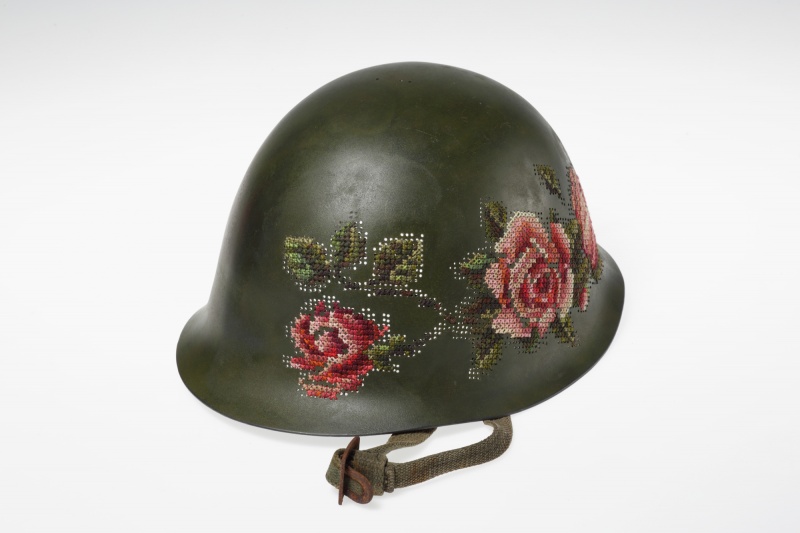
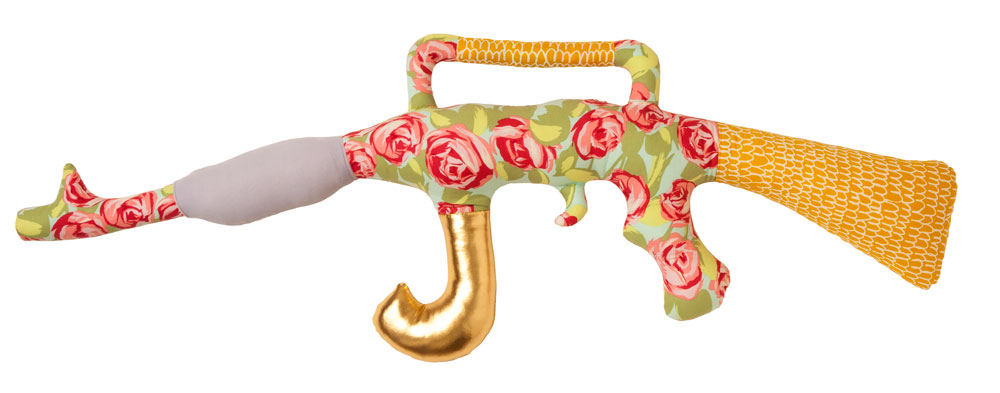
The absurd juxtaposition of flowers and violence is employed too by Lithuanian artist Severija Inčirauskaitė-Kriaunevičienė, who embroiders floral patterns onto antique soldiers’ helmets sourced from various countries, and Natalie Baxter of Lexington, Kentucky, whose Warm Gun series comprises over one hundred quilted stuffed guns, “droopy caricatures of assault weapons,” she says, “bringing ‘macho’ objects into a traditionally feminine sphere and questioning their potency.”
Severija Inčirauskaitė-Kriaunevičienė (Lituanian, 1977–), from the series Kill(ed) for Peace, 2016. Antique soldier’s helmet, cotton, cross-stitch embroidery, drilling, and industrial needle punching, 30 × 22 × 21 cm. Private collection, Latvia.Natalie Baxter (American, 1985–), Rose to the Occasion, from the Warm Gun series, 2016. Fabric and polyfill, 15 × 42 × 3 in.
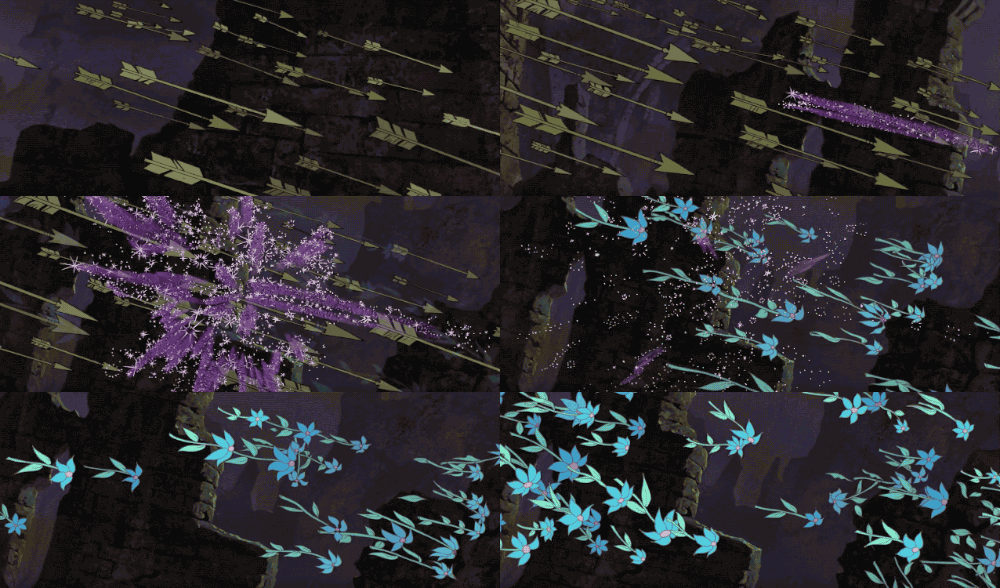
Another artistic example of overcoming brutality with gentleness can be found in the climactic battle sequence from Disney’s animated classic Sleeping Beauty (1959). As Prince Phillip escapes from Maleficent’s dungeon with the aid of the three good fairies, Maleficent’s goons shoot arrows at him—but Flora transforms them by magic into flowers, which fall innocuously about his booted feet. (The animation is by Dan McManus.)
Flora’s other enchantments include turning launched boulders into soap bubbles and a curtain of boiling water, tipped from a cauldron over a doorway, into a rainbow. Each of these deflective maneuvers involves the transformation of something threatening into something whimsical. While they do not ultimately deter the villain from her murderous rampage, and alas, Phillip conquers evil with a sword (albeit the Sword of Truth—there’s metaphor at play here), Flora’s few creative interventions at the outset of the battle assert an attractive counterethic that we would do well to embrace.
I need the dreams of Isaiah and the prayers of Shantideva, I need the ridiculous street theater of Hibiscus and Shane Claiborne and the activist blacksmithing of RAWtools, I need Banksy’s murals in zones of conflict and other subversive art, I need fairy tales from writers and animation studios, to help me relinquish my hate and imagine wholesome new ways of engaging my enemies. Most of all, I need Christ’s vibrant, upending gospel embedded more deeply in my heart, and the Holy Spirit—renewer, transformer—to melt the disdain and loathing I feel for certain figures in the current US political landscape and reshape it into loving regard.
While I do not have an urge to enact physical violence on anyone, I often seethe and think unkindly thoughts toward those I deem morally odious. Sometimes I pray they get what’s coming to them. But then I am convicted by that un-Christlike posture. I crave the eyes and mind of Christ, who sees everyone as redeemable and worthy of love, bearers of the divine image, and who moves toward them with open arms instead of clenched fists.
“May those whose hell it is to hate and hurt be turned into lovers bringing flowers.”
I pray this, sincerely, for others (I have a few particular names in mind), and also for myself.
Blogger’s Note: One of the first three departments created in 1789 in the new executive branch of the United States government was the War Department—now called the Department of Defense. Having witnessed the evils of war firsthand while serving as surgeon general of the Middle Department of the Continental Army, founding father Benjamin Rush published an essay in Banneker’s Almanac in 1793 advocating for the formation of a cabinet-level Department of Peace to promote a counterethic. Among other things, his proposed Secretary of Peace would be responsible for abolishing capital punishment; dissolving state militias, including getting rid of military uniforms and titles; and providing every family with a Bible by which to become educated in Christ’s law.
His plan even provides for the interior decoration of the Peace Office—which must include lamb, dove, and olive branch imagery; biblical inscriptions; and a collection of plowshares and pruning hooks forged from the melted-down metals of swords and spears—as well as its sonic environment: the daily singing of peace hymns. The War Office, by contrast, should display images of death and destruction and bear cautionary inscriptions.
Literary satire, maybe. Then again, maybe not. Rush was an uncompromising champion of many causes throughout his lifetime, including, besides nonviolence, public education, prison and mental health reform, the abolition of slavery, mass distribution of Bibles, and temperance. While his proposal for a U.S. Department of Peace may sound airy-fairy and ridiculous, he very much believed in its practicality, and his confidence has been matched by twentieth- and twenty-first-century politicians: since the publication of Rush’s “Plan of a Peace-Office,” almost a hundred bills have been introduced in Congress proposing the creation of such a department, most recentlyin 2015.
Among the defects which have been pointed out in the Federal Constitution by its antifederal enemies, it is much to be lamented that no person has taken notice of its total silence upon the subject of an office of the utmost importance to the welfare of the United States, that is, an office for promoting and preserving perpetual peace in our country.
It is to be hoped that no objection will be made to the establishment of such an office, while we are engaged in a war with the Indians, for as the War-Office of the United States was established in time of peace, it is equally reasonable that a Peace-Office should be established in the time of war.
The plan of this office is as follows:
I. Let a Secretary of the Peace be appointed to preside in this office, who shall be perfectly free from all the present absurd and vulgar European prejudices upon the subject of government. Let him be a genuine republican and a sincere Christian, for the principles of republicanism and Christianity are no less friendly to universal and perpetual peace than they are to universal and equal liberty. Continue reading “ESSAY: “A Plan of a Peace-Office for the United States” by Benjamin Rush”→









 Art & Theology