
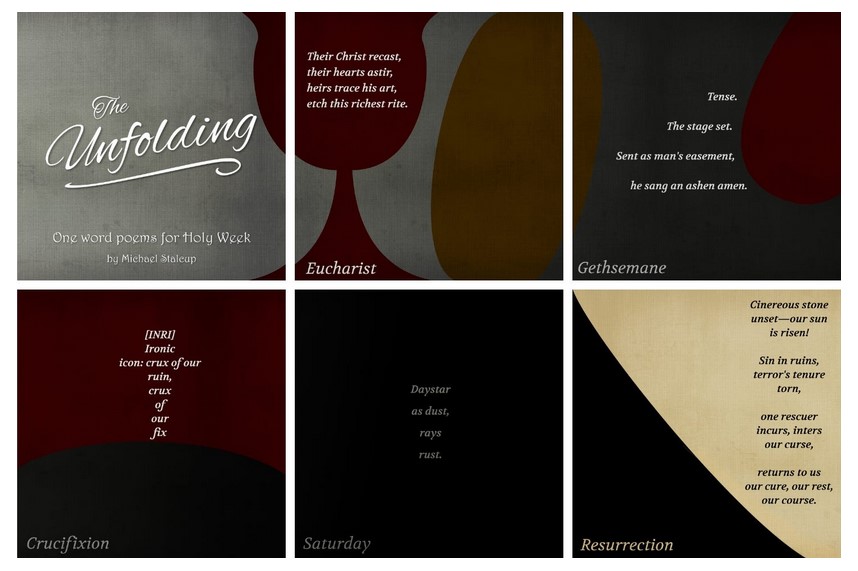
POEM SEQUENCE: “The Unfolding” by Michael Stalcup: Michael Stalcup has published a sequence of five short poems in Solum Journal that “tells the story of Jesus’ death and resurrection by unfolding five words that take us from Maundy Thursday through Easter Sunday,” he says. “I wrote these poems in a very unusual way, restricting myself to words that could be formed from the letters in each poem’s title. . . . This poetic form calls for creativity within intense limitations, which seems fitting for Holy Week—a time when Jesus crafted the most beautiful art this world has ever known within the constraints of his own suffering and death.” Stalcup has also presented them on Instagram (click on the image below).
+++
ARTICLE: “Don’t Rush Past Good Friday” by Brian Zahnd: Pastor and author Brian Zahnd cautions us not to shortchange the cross on the way to Easter, but rather to slow down and dwell there, beholding the crucified Christ.
+++
SONGS:
>> “Friday Morning” by Sydney Carter, performed by Timothy Renner: This Good Friday song by the English folk musician Sydney Bertram Carter (1915–2004) is difficult—one might even say blasphemous. That’s because it’s voiced from the perspective of the “bad” thief, who is spewing hatred and bitterness over his fate and blaming God for having created such a cruel world. But we’re aware of an irony in the refrain that the convicted man is not: “It’s God they ought to crucify / Instead of you and me, / I said to the carpenter / A-hanging on the tree.”
Read or listen to a reflection on “Friday Morning,” by Andrew Pratt, here.
>> “Go to Hell” by Nick Chambers: This song is a setting of a poem by Pádraig Ó Tuama from his collection Sorry for Your Troubles (Canterbury Press Norwich, 2013). The title is shocking, I know, but it’s derived from a line in the Apostles’ Creed, where we Christians profess that after Jesus died, he “descended into hell.” The singer-songwriter, Nick Chambers, writes in the YouTube video description: “In between Good Friday and Easter Sunday is possibly strangest day of the Christian year. On Holy Saturday, not only is Jesus, the God-Man, in the grave; traditions abound about his descent to the dead, his ‘harrowing of hell.’ What does it mean for the coming down of God-with-us not to end on earth but ‘under the earth,’ extending hope to the furthest regions of human pain and abandonment? Such a question deserves more poetry than explanation.”
“Go to hell” is a slang expression of scorn or rejection, to which Jesus was no stranger. As in the previous song, there’s an irony here, in telling Jesus to go to hell—because he did. Literally. Ó Tuama meditates on how Jesus shares in our vulnerabilities and yearnings and seeks to pull us out of the hells we’re in and redeem our stories.
Hear the poem read by the poet here, or at the end of the Stations of the Cross video below. “he is called to hell, this man / he is called to glory . . .”
+++
GUIDED MEDITATION: “Stations of the Cross, Good Friday, 2020” by Pádraig Ó Tuama: In 2020 the poet-theologian Pádraig Ó Tuama put together this twenty-minute video reflection for Good Friday structured around the Stations of the Cross, consisting of photos of art he’s taken and the praying of collects he’s written. (Several of the collects can be found in his book Daily Prayer with the Corrymeela Community from 2017.) The throughline is a set of stained-glass Stations by Sheila Corcoran at the Church of Our Lady Queen of Heaven at Dublin Airport; others are by Jong-Tae Choi, Gib Singleton, Sieger Köder, Richard P. Campbell, and Audrey Frank Anastasi.

But before stepping onto Jesus’s Via Dolorosa, Ó Tuama considers Judas, sharing a stained glass panel by Harry Clarke that illustrates a medieval legend about the Irish monastic saint Brendan the Navigator. According to the Navigatio Sancti Brendani Abbatis, on one of his voyages St. Brendan encountered Judas at sea, tied to an iceberg. He learned that an angel had taken pity on Judas in hell and given him a reprieve of one hour to cool himself from the flames of judgment. Ó Tuama then prays for those who, like Judas, are tormented by guilt and see no way out.
He closes with a reading of his poem “Go to Hell” (set to music in the previous roundup item).
+++
SONG: “For the Songless Hearts” by Jon Guerra: “There’s a lot of hubbub around Easter weekend in churches. And for good reason,” says singer-songwriter Jon Guerra. “But our hearts can’t always cooperate with the prescribed mood of the Easter season: ‘Celebrate! Be happy! Sing!’ Sometimes the last thing we are able to do is sing. Thankfully, Good Friday and Easter are not about mustering a mood. Good Friday and Easter are about remembering that there is One who meets us in our life and meets us in our death. He sings for us—and over us—when we can’t.”
That’s what “For the Songless Hearts” is about—a single released in 2017, and which Guerra sings with his wife, Valerie. In a Mockingbird blog post about it, Guerra admonishes, “Remember that before the tomb was empty, it was full. ‘When he was laid in the tomb, he laid right next to you.’” Jesus knew the depths of sorrow and the sting of death. We are not alone in such experiences.
_Cropped.jpg)
 Art & Theology