Roundup: Restful Advent; preparing the way; walking with the Holy Family

ADVENT SERIES: Restful Advent by Tamara Hill Murphy: Tamara Hill Murphy [previously] is one of my favorite spiritual writers, her thoughtful words and curation of resources having served as a well of inspiration for me over the years. Each year, similar to Art & Theology but with the sensibilities and expertise of an Anglican spiritual director, she publishes a new daily Advent and Christmastide guide through her Substack, Restful, running this year from November 30 to January 5. Each post in the series includes lectionary readings, art, music, a prayer, and a simple practice to help us notice God’s presence during these waiting days. This time around, the Daybook will feature excerpts from Claude Atcho’s new book Rhythms of Faith along with ideas from The Liturgical Home by Ashley Tumlin Wallace and some of my own formerly published art commentaries.

“The Daybook is a way to pay attention to Christ’s three arrivals—then, now, and still to come—and to walk through December with a quieter heart and a stronger hope,” Murphy writes.

Murphy is offering Art & Theology readers a 50% discount to Restful using this link, which brings the subscription cost down to $4/month (let it run for two months if you want to receive the full Christmastide Daybook) or $32/year, which will give you access to her year-round content. The offer expires January 5, 2026.

+++

BLOG POST: “The Sacred Journey of Advent” by Ashley Tumlin Wallace, The Liturgical Home: “Advent,” writes Wallace, “is a season of preparation, for the coming of Christ at Christmas, and also for His return in glory at the end of time.” This is a great introduction to the season that kicks off the new church year.

+++

SONGS:

One of the scripture texts of Advent is Isaiah 40:3–5:

A voice cries out:
“In the wilderness prepare the way of the LORD;
    make straight in the desert a highway for our God.
Every valley shall be lifted up,
    and every mountain and hill be made low;
the uneven ground shall become level,
    and the rough places a plain.
Then the glory of the LORD shall be revealed,
    and all flesh shall see it together,
    for the mouth of the LORD has spoken.”

The Gospel-writers Matthew (3:3), Mark (1:3), and Luke (3:4) all see this exclamatory figure as John the Baptist, who told people to prepare for God’s coming by repenting of sin, since holding on tightly to ways of unlove erects barriers to God’s entry into one’s life. Here are two songs based on this Advent passage.

>> “Prepare the Way” by Maverick City Music and Tribl, feat. Chandler Moore and Siri Worku, on Tribl I (2021): This song repeats, again and again, the Advent mantra “Prepare the way,” embedding John the Baptist’s invitation deeply into hearts and minds. Its tag beseeches Christ to come with the fire of purging, the rain of refreshment, and the oil of blessing. To welcome this coming, this transformation and growth, we need to decenter ourselves, ceding to God the place of primacy, from which he works our good and his glory.

>> “Prepare the Way” by Christopher Walker, on Rise Up and Sing, 3rd ed., vol. 3 (2009): This 1991 song is by Christopher Walker, a church music composer, lecturer, and choral conductor originally from the UK but now living in Santa Monica, California. Published by OCP (Oregon Catholic Press), it would make a great song for a children’s Advent choir.

+++

2018 SERIES: Advent Caravan: Walking with the Holy Family by Sarah Quezada: I learned about Sarah Quezada’s work at the intersection of faith, justice, and culture through Tamara Hill Murphy (see first roundup item) in 2018, when Quezada published a five-part series reflecting on the likelihood that Mary and Joseph traveled to Bethlehem for the census not alone but in a caravan. Interweaving personal story, biblical interpretation, and current events, Quezada considers how the holy couple’s experience in the final months of Mary’s pregnancy connects to the reality of people on the move seeking hope, peace, joy, and love today.

While the series is not hosted online, I received permission from Quezada to reproduce it here.

On Instagram, Quezada also shared a photo of her friend’s Advent mantel, where she combined figurines from her various nativity sets to form a “caravan” of travelers.
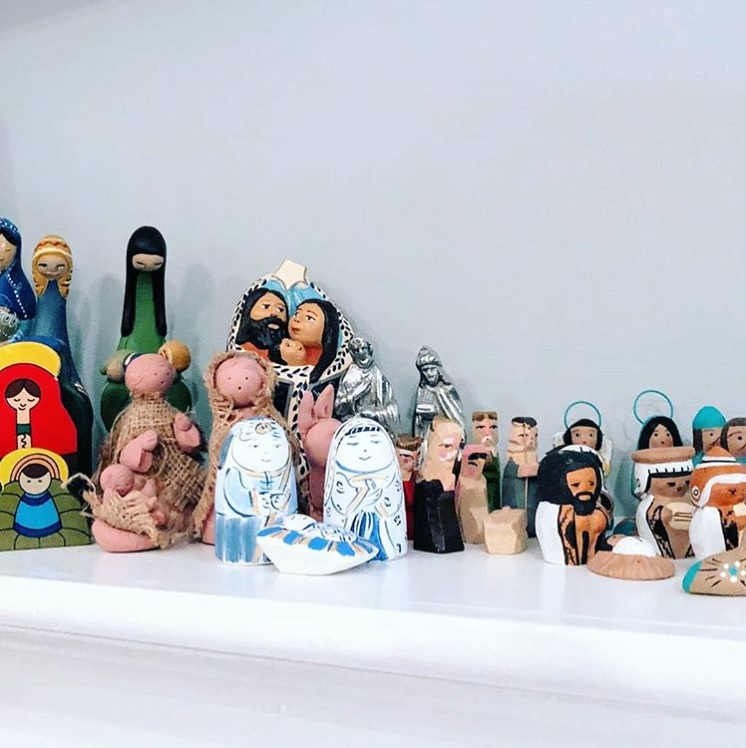
Advent caravan
Photo via @sarahquezada

+++

YOUTUBE PLAYLIST: Jouluradion Hoosianna: Jouluradio is a Finnish radio station that broadcasts annually from November 1 to January 6, playing all Advent and Christmas music. Since 2012, every year they premiere a new arrangement and video performance of the popular Scandinavian Advent hymn “Hoosianna” (Hosanna, an Aramaic expression meaning “Save now!”), which Lutheran and Catholic churches in Finland sing on the first Sunday of the season. Based on Matthew 21:9, its lyrics greet the approaching Christ, affirming his identity and craving the deliverance only he can bring:

Hoosianna, Daavidin Poika,
kiitetty olkoon hän!
Kiitetty Daavidin Poika,
joka tulee Herran nimeen.
Hoosianna, hoosianna,
hoosianna, hoosianna!
Kiitetty Daavidin Poika,
joka tulee Herran nimeen.
Hosanna, Son of David,
Most blessed Holy One,
Hosanna, Son of David,
Who comes in the name of the Lord!
Hosanna, hosanna, hosanna
In the highest!
Hosanna, Son of David,
Who comes in the name of the Lord!

This hymn was written by the German composer, educator, and piano and organ virtuoso Georg Joseph Vogler in 1795 while working in Sweden as court conductor as well as tutor to the crown prince Gustav IV Adolf.

The Jouluradio commissions, which the station has compiled in a YouTube playlist, encompass a range of genres, including jazz, hip-hop, choral, pop, and electronic. Below is a list of previous years’, of which I’ve embedded the two asterisked ones on this page. Jouluradio typically releases their annual “Hoosianna” the day before Advent, so 2025’s will likely be posted this Saturday. [HT: Gracia Grindal]

Roundup: “God’s Love” playlist, embracing the ephemeral, and more

LENT SERIES: “Let go of unlove this Lent: Let’s practice love together—a new and improved Lenten reflection series starting March 5th” by Tamara Hill Murphy: I’ve been nurtured for years by Murphy’s gentle spiritual writing and curated beauty and wisdom, and I especially appreciate her annual Advent and Lent Daybook series. This Lent, she’ll be exploring four postures of cruciform love given to us in 1 Corinthians 13, providing daily scripture readings, prayers, and art, along with weekly practices. You can gain access for just $16. (She uses the Substack platform.)

Erickson, Scott_Forgive Thy Other
Forgive Thy Other by Scott Erickson

I like how Murphy frames the season: “Lent is a significant time for us to seek a deeper understanding of God’s heart and recognize the gaps in our experiences of His love. Through its beautiful stories, prayers, and practices, Lent also invites us to reflect on our own expressions of love and unlove. The Book of Common Prayer encourages us to let go of our unloving ways so we can love what (and who) God loves. Let’s joyfully embrace this transformative season together, reflecting God’s love with compassion and understanding.”

+++

NEW PLAYLIST: God’s Love (Art & Theology): Related to Tamara Hill Murphy’s 2025 Lent Daybook theme: here’s a new playlist I put together of songs about the abounding, ever-present love of God the Father, Son, and Holy Spirit, a love that seeks, heals, and transforms.

The cover photo is of an early twentieth-century relief sculpture from the exterior of Holy Trinity Church in the town of St Andrews, Scotland, taken by Joy Marie Clarkson; it shows a pelican pecking her breast to feed her young with her own blood, a medieval symbol of Christ’s self-giving love.

There’s some overlap between this playlist and my dedicated Lent Playlist. I hope it uplifts you in the knowledge of the depths and riches of God’s love for you.

+++

SONGS:

>> “And Am I Born to Die?”: Lent opens with a call to “remember you are dust, and to dust you shall return.” A reflection on human mortality, this somber hymn was written by the great English Methodist hymnist Charles Wesley (1707–1788) and set to music—a shape-note tune—by Ananias Davisson (1780–1857), a Presbyterian elder from Virginia. In this video from January 2023, it’s performed by the Appalachian folk musician Nora Brown, with Stephanie Coleman on fiddle and James Shipp on harmonium.

And am I born to die?
To lay this body down?
And must my trembling spirit fly
Into a world unknown?

Awaked by trumpet sounds,
I from my grave shall rise,
And see the Judge, with glory crowned,
And see the flaming skies.

Soon as from earth I go,
What will become of me?
Eternal happiness or woe
Must then my portion be.

>> “Nunc tempus acceptabile” (Now Is the Accepted Time): Second Corinthians 5:20b–6:10 is traditionally read on Ash Wednesday, a passage that includes the adjuration, “Behold, now is the acceptable time; behold, now is the day of salvation!” (2 Cor. 6:2). There’s a beautiful tenth-century Latin chant hymn for Lent, from the Liber Hymnarius, that opens with this line. In 2013, the Chicago-based composer and conductor Paul M. French set it to music for SSA a cappella choir, its unison opening unfolding into an increasingly expressive three-part harmony. It’s performed here by the Notre Dame Magnificat Choir under the direction of Daniel Bayless.

Nunc tempus acceptabile 
Fulget datum divinitus,
Ut sanet orbem languidum
Medela parsimoniae.

Christi decoro lumine
Dies salutis emicat,
Dum corda culpis saucia
Reformat abstinentia.

Hanc mente nos et corpore,
Deus, tenere perfice,
Ut appetamus prospero
Perenne pascha transitu.

Te rerum universitas,
Clemens, adoret, Trinitas,
Et nos novi per veniam
Novum canamus canticum.

Amen.
Today is the accepted time.
Christ’s healing light, the gift divine,
shines forth to save the penitent,
to wake the world by means of Lent.

The light of Christ will show the way
that leads to God’s salvation day.
The rigor of this fasting mends
the hearts that hateful sinning rends.

Keep all our minds and bodies true
in sacrifice, O God, to you,
that we may join, when Lents have ceased,
the everlasting Paschal feast.

Let all creation join to raise,
most gracious Trinity, your praise.
And when your love has made us new,
may we sing new songs, Lord, to you.

Amen.

Translation © 2006 Kathleen Pluth

+++

LECTURE: “Embracing the Ephemeral: How Art Honors Creaturehood” by James K. A. Smith, Duke Divinity School, February 17, 2022: Mortality means something more than being a creature who will someday die, says philosopher James K. A. Smith; it is a way of being, not defined solely by its terminus. “To be created is to be ephemeral, fugitive, contingent. To be a creature is to be a mortal, subject to the vicissitudes of time.” Part of the Duke Initiatives in Theology and the Arts Distinguished Lecture Series, this talk about developing a Christian temporal awareness is based on chapter 4 of Smith’s then-forthcoming, award-winning book How to Inhabit Time (Brazos, 2022), titled “Embrace the Ephemeral: How to Love What You’ll Lose.”

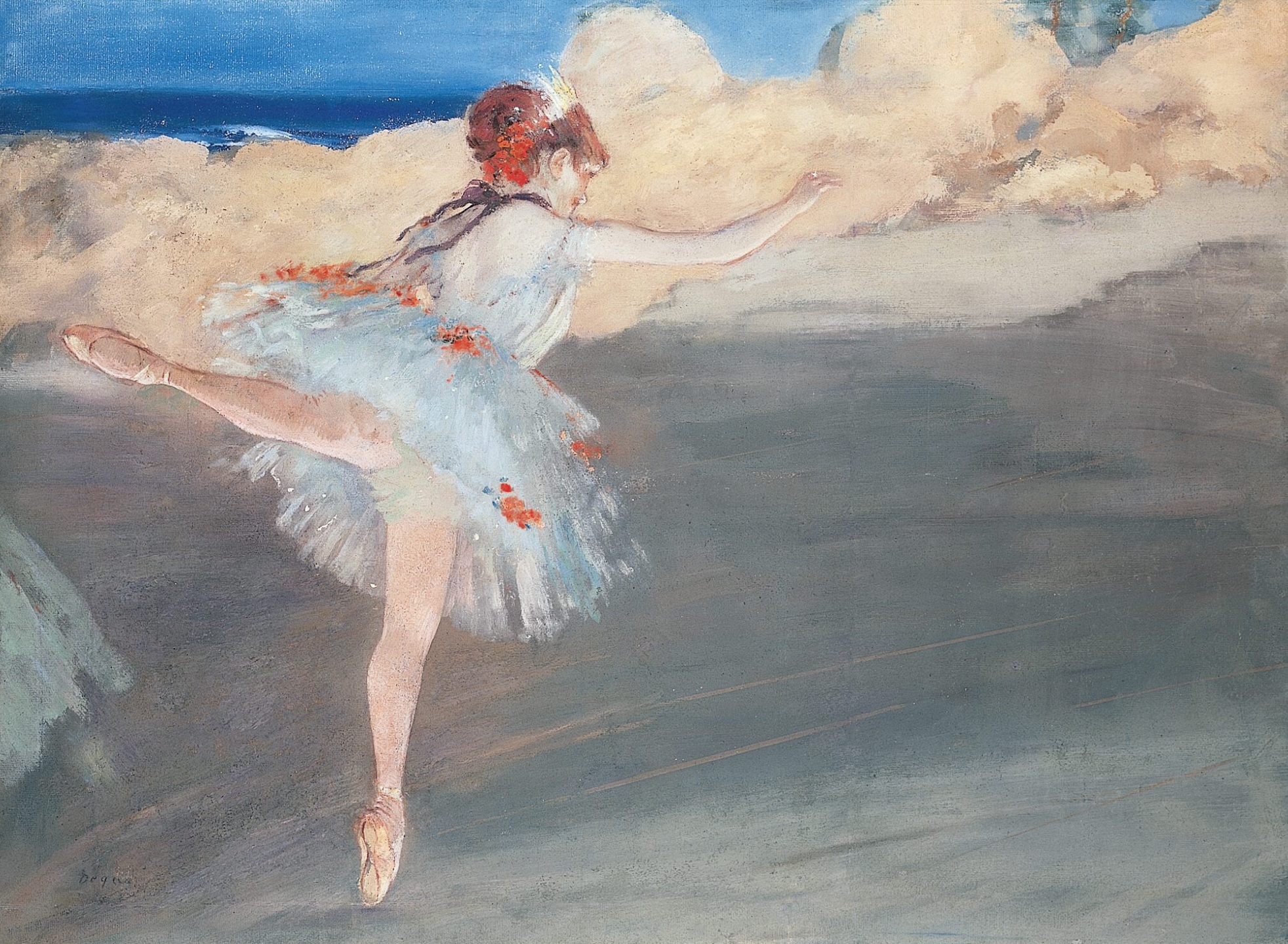
Degas, Edgar_The Star
Edgar Degas (French, 1834–1917), The Star: Dancer on Pointe, ca. 1878–80. Gouache and pastel on paper, mounted on board, 22 1/4 × 29 3/4 in. (56.5 × 75.6 cm). Norton Simon Museum, Pasadena, California.

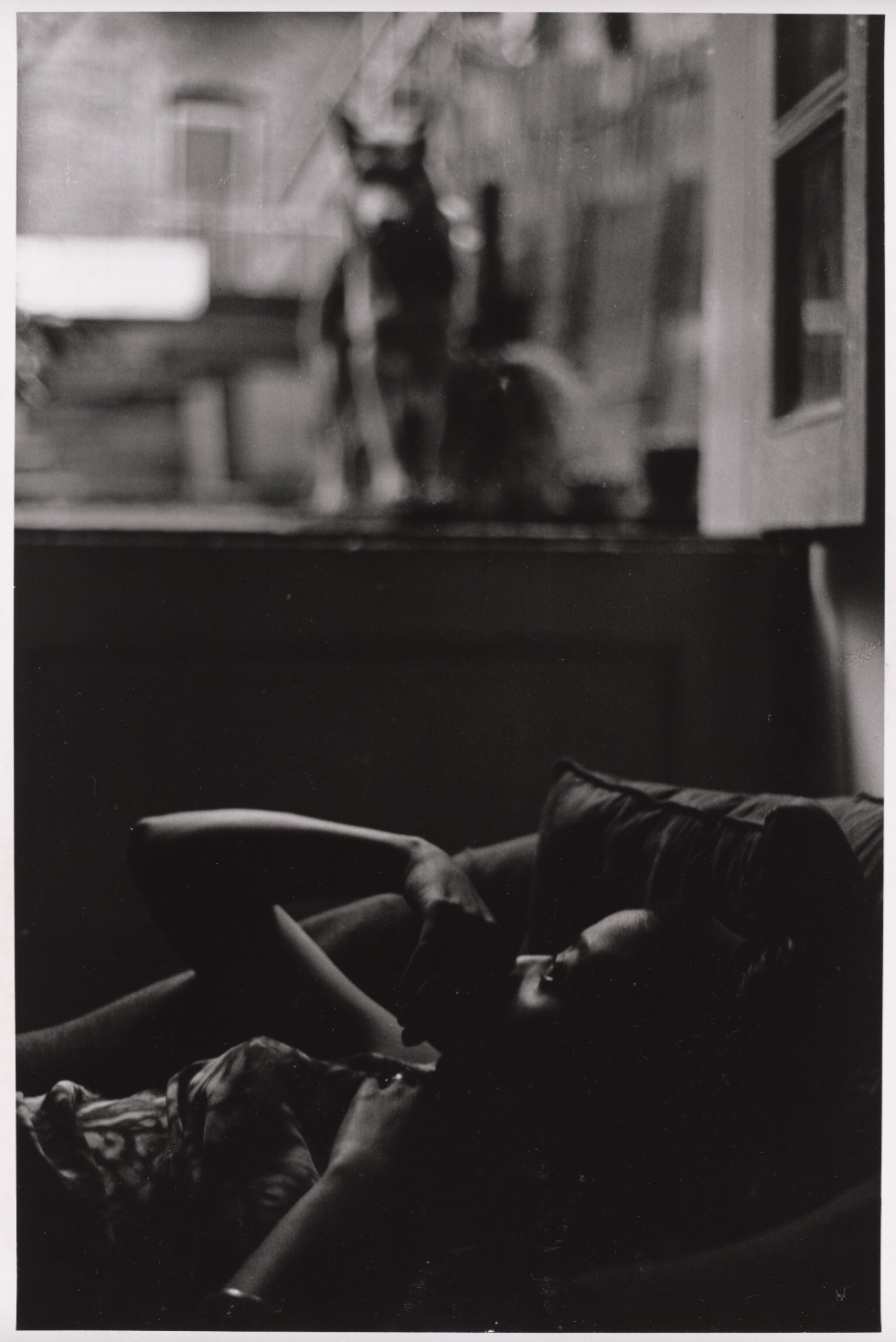
Randall, Herbert_Untitled (Lower East Side, NY)
Herbert Randall (American, 1936–), Untitled (Lower East Side, New York), 1960s. Gelatin silver print, 13 7/16 × 8 7/8 in. (34.2 × 22.5 cm). J. Paul Getty Museum, Los Angeles.

Some notes I took:

  • “We need not only memento mori, but also memento tempore—reminders of our temporality, not just our mortality.”
  • “Imagine embracing the ephemeral as a discipline of not only conceding our mortality as a condition but also receiving our mortality as a gift.”
  • “Our finitude is not a fruit of the fall, even if it is affected by the fall. Contingency is not a curse. . . . Aging is not a curse. Autumn is not a punishment. Not all that is fleeting should be counted as loss. The coming to be and passing away that characterize our mortal life are simply the rhythms of creaturehood.”
  • Resting in our mortality instead of resenting it
  • Theologian Peter Leithart says hebel means not “emptiness,” “vanity,” or “meaninglessness” but, literally, “mist” or “vapor.” The Teacher in Ecclesiastes uses that word repeatedly to describe human life: it’s vaporous, elusive, escapes our efforts to hold on to it, to manage it.
  • “The Fly” by William Oldys
  • Mono no aware, a Japanese aesthetic principle—what the thirteenth-century Japanese Buddhist nun Abutsu-ni referred to as “the ah-ness of things”
  • “It may be artists who help us best appreciate the fragile dynamism of creaturehood.”
  • Exhibition: Working Together: The Photographers of the Kamoinge Workshop. A collective of Black photographers founded in New York City in 1963. Their photographs don’t capture the ephemeral; they hallow it.
  • How to sift tragedy from good creaturely rhythms in which good things fade?
  • “To dwell faithfully mortally is to achieve a way of being in the world for which not all change is loss and not all loss is tragic, while at the same time naming and lamenting those losses that ought not to be. . . . To be faithfully mortal is a feat of receiving and letting go, celebrating and lamenting. Being mortal is the art of living with loss, knowing when to say thank you and knowing when to curse the darkness.”
  • “One Art” by Elizabeth Bishop: “The art of losing isn’t hard to master . . .”

A Q&A takes place from 39:00 onward. The first question, asked by theologian Jeremy Begbie, is the one I had, and it recurs with different phrasing at 58:17.

+++

POEM: “Ash Wednesday” by Anya Krugovoy Silver: I first encountered this poem in the excellent devotional Between Midnight and Dawn: A Literary Guide to Prayer for Lent, Holy Week, and Eastertide, and it has stuck with me ever since. (It was originally published in the equally excellent The Ninety-Third Name of God, Silver’s first poetry collection.)

Mortality is one of the main themes in Silver’s poetry, including the physicalities of being human, as reflected in “Ash Wednesday,” in which she, the speaker, muses on the shared Christian ritual of the imposition of ashes at the beginning of Lent. Silver, who died of breast cancer eight years after writing this poem, was used to practicing memento mori (“remember you must die”): her mastectomy scar and silicone breast prosthesis are constant reminders of the fact, she writes. She wants to touch the body of God, wants to wrap her fingers around some tangible promise of healing, but both remain elusive. Instead she resolves to embrace the finiteness of her present form, taking the burnt remains of those Hosanna palms from last year and wearing them with repentance and praise, knowing that what is sown in perishability will be raised in imperishability (1 Cor. 15:42).

I’m compelled by how Silver both laments her fragility and owns it. There’s a defiant quality to the tone, the ash-and-oil mixture that’s thumbed into her forehead in the shape of a cross evoking a football player applying eye black in front of a locker room mirror before the big game. Wearing the mark of Christ, she’s ready for the face-off between herself and death.

Roundup: Gift-wrapping liturgy, feasting without shame, and more

PRAYER: “A Liturgy for the Wrapping of Christmas Gifts” by Wayne Garvey and Douglas McKelvey: Taken from Every Moment Holy, volume 3 from the Rabbit Room Press.

+++

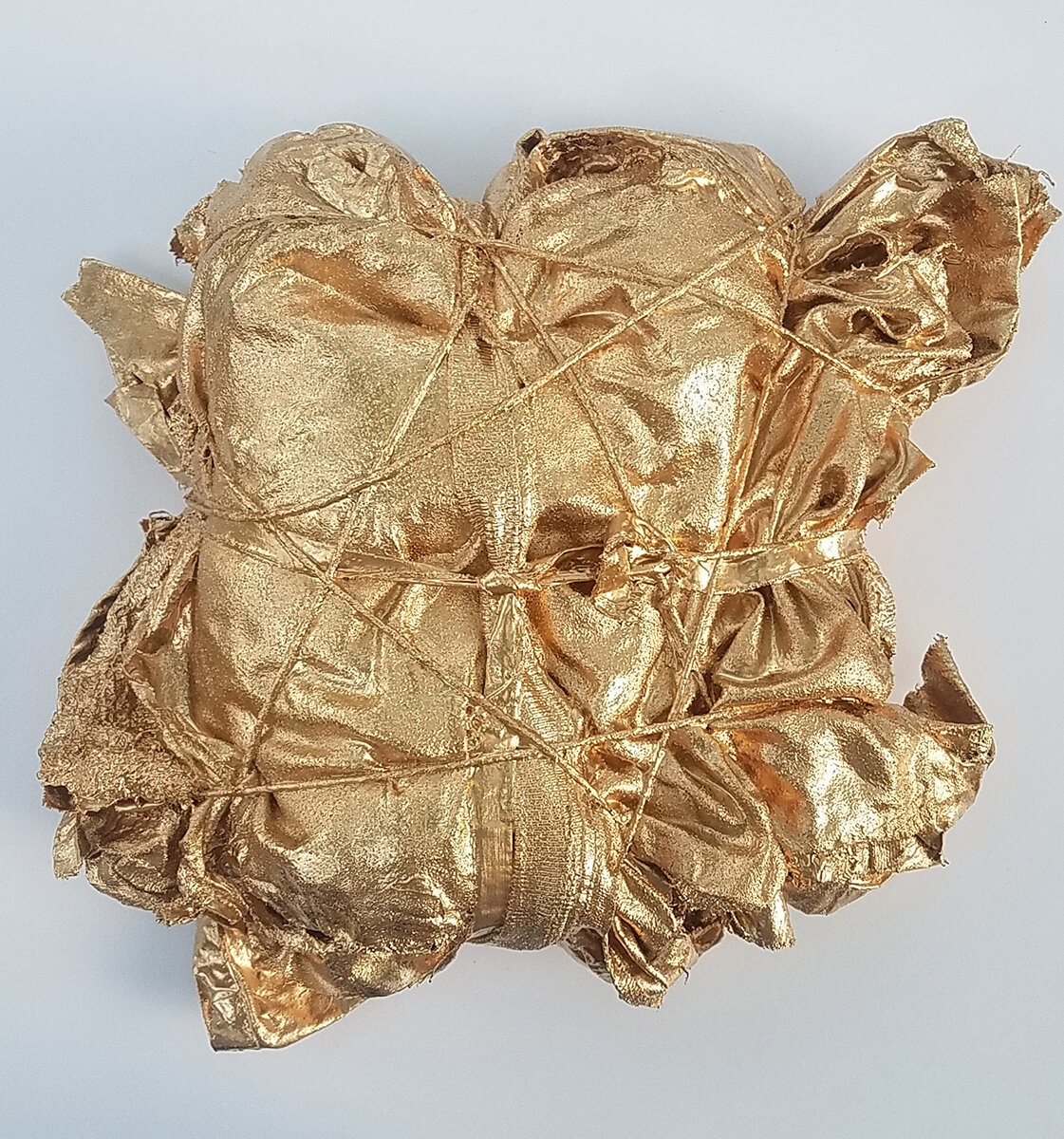
ART SERIES: Magnificat by Mandy Cano Villalobos: Mandy Cano Villalobos [previously] is a multidisciplinary artist from Grand Rapids, Michigan. Her Magnificat series consists of bundles of discarded clothing, bound in string and meticulously hand-coated with imitation gold. The title—the Latin name of Mary’s praise song that opens, “My soul magnifies the Lord!”—invites associations with the Christmas story, including the image of the swaddled Christ child, a gift to the world that surprises and delights.

Cano Villalobos, Mandy_Magnificat XV
Mandy Cano Villalobos (American, 1979–), Magnificat XV, 2019. Cloth, string, and imitation gold.

Villalobos, Mandy Cano_Magnificat installation
Installation of select pieces from the Magnificat and Cor Aurum series by Mandy Cano Villalobos, December 2020, Sojourn Midtown, Louisville, Kentucky

The series debuted in 2019 at Cano Villalobos’s solo show All That Glitters at the Urban Institute for Contemporary Arts (UICA) in Grand Rapids. I first encountered it, though, through online promotions of Sojourn Midtown’s Advent 2020 installation to correspond with the church’s sermon series Wrapped in Flesh, for which twelve of the artist’s works, some from her related Cor Aurum (Heart of Gold) series, were placed in niches around the sanctuary.

“The objects, all made of wood and fabric covered in imitation gold, point to something both humble and glorious,” writes Michael Winters, Sojourn Midtown’s arts and culture director. “Like these small sculptures of rags and gold, the birth of Jesus was also marked by humility and glory.”

+++

ARTICLE: “My Swaddled Savior” by Jeff Peabody, Christianity Today: Pastor Jeff Peabody of Tacoma, Washington, describes the traditional Japanese art of furishoki, or wrapping goods in cloths, as he reflects on Jesus having been swaddled as an infant, a wrapped gift given to the world. “Jesus came to us in furoshiki, wrapped in cloths,” he writes.

+++

BLOG POST: How to receive gifts and enjoy feasting without shame, by Tamara Hill Murphy: In this old blog post of hers, spiritual director and The Spacious Path author Tamara Hill Murphy absolves us of the guilt we so often feel around (1) receiving (unreciprocated) gifts and (2) feasting. We should receive both presents and food, she says, as means of grace. Too often we’re embarrassed when we receive a gift from someone to whom we gave no gift, or a gift of lesser value, and so instead of receiving their gift with joy, we receive it with shame or an annoying sense of obligation. But Murphy says she hopes to receive gifts this way: “When Jesus told us to come to him as little children, he must have been imagining the way children openly, delightedly, innocently receive gifts. Children do not question their place as ones worthy of receiving gifts. Children boldly believe the beauty of unearned kindness.”

As for food, how many times have you been to a Christmas party or dinner and heard people bemoan all the fat and sugar they’ve been consuming, and about how they’ll have to punish their body in the new year to work off the extra calories, to shrink themselves back down to size? Feasting, though, is a spiritual discipline, a way to celebrate important events, like the birth of Christ, with family and friends. Feel no shame about indulging in gustatory pleasures this Christmas! Take in the sweet, the creamy, and the juicy! Murphy’s mom’s motto for hospitality is a wise one: “While we feast, we savor.”

On her blog A Clerk of Oxford, medievalist Eleanor Parker also affirms the virtue of feasting, noting how the popular modern practice of fasting in January runs counter to medieval Christian practice:

Since the late 20th century it’s become common to invert the traditional relationship between fasting and feasting in the Christmas season. The ancient custom was to fast in Advent in preparation for the feast, and then to celebrate for at least twelve days after Christmas (and to some degree, all through January). Now we do it the other way around; for many people the feast is followed by a penitential fast, in the form of ‘Dry January’ or New Year’s resolutions about eating less and going to the gym. As a manifestation of the desire for a fresh start, this ‘new year, new you’ impulse is natural enough, but it does strike me as strange that it’s so often framed in negative terms. There’s an odd sense, encouraged mostly perhaps by journalists and advertisers, that the indulgence of Christmas is a ‘sin’ which has to be atoned for – as if eating and drinking with friends and family, to celebrate the turn of the year from darkness to light, is a moral lapse for which one must subsequently make amends by privation and self-punishment. We are much less kind to ourselves in these weeks after Christmas than the strictest confessor would have been in the Middle Ages. Feasting at Christmas is not something to atone for, but a proper observance due to the season; and that feasting is also the sustenance we need to carry us into the New Year with energy and strength.

+++

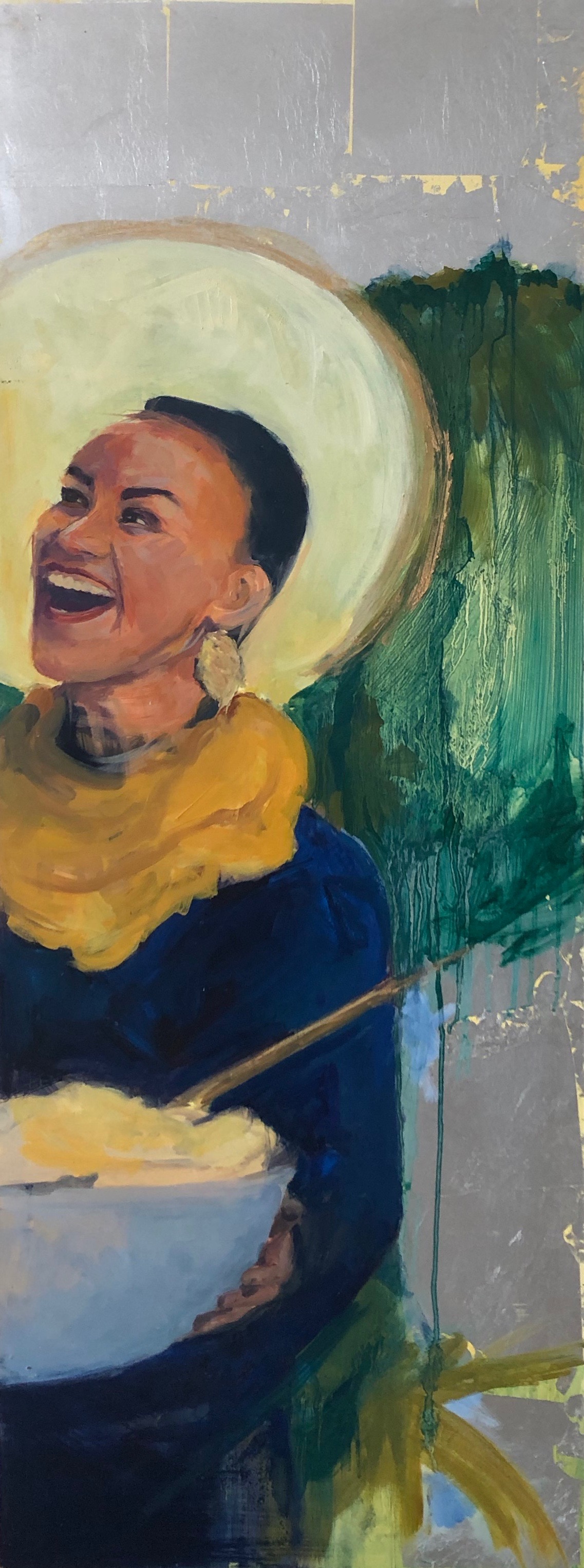
VIDEO: “Our Vocation of Delight: On Advent, Beauty, and Joy” by Christen Yates: In this thirty-minute “Space for God” Advent devotional from Coracle, artist Christen Yates (Instagram @christenbyates) invites us to experience the Christian “duty of delight” through engaging a selection of artworks by herself, Sedrick Huckaby, Letitia Huckaby, and Ashley Sauder Miller. She opens with a liturgical commission she fulfilled for the Advent season while serving as artist in residence at her church in Charlottesville: a portrait painting of congregation member Arley Bell (née Arrington), a baker who is now the owner of Arley Cakes in Richmond. Waiting for her dough to rise, Arley captures the joyful expectancy of Advent.

Yates, Christen_Arley, baker
Christen Yates (American, 1977–), Advent: Arley, baker, 2016. Oil and gold and silver leaf on board, 48 × 18 in. Collection of All Souls Charlottesville, Charlottesville, Virginia. Photo courtesy of the artist.

Roundup: New Easter songs, joint Easter-iftar dinner, and more

Here’s my new (nonthematic) playlist for the month of April!

But also, because Easter lasts through May 18, be sure to check out the 184 songs I handpicked for the season, which includes some new ones mixed in since the playlist’s original publication.

+++

NEW SONGS:

>> “He Lives” by Emma Nissen: Emma Nissen is a Latter-day Saint singer-songwriter from Arizona known for her gorgeous jazz vocals. Here she performs an original song about God the Father giving his Son, Jesus, to redeem the world through his life, death, and resurrection. “Let there be light, let there be love . . .”

>> “Living Among the Dead” by Caleb Stine: Alt-country singer-songwriter Caleb Stine, based in Baltimore, released this Johnny Cash–esque, resurrection-themed song just before Easter. The title and chorus come from the words the angels spoke to the women who went to Jesus’s tomb the Sunday after his death, looking for his body. “Why do you look for the living among the dead?” they asked. “He is not here but has risen. Remember how he told you, while he was still in Galilee, that the Son of Man must be handed over to the hands of sinners and be crucified and on the third day rise again” (Luke 24:5–7).

The first verse narrates that momentous visit to the tomb. The second verse fast-forwards to the present day and raises issues of poverty, mental illness, substance abuse, culture warring, and militarism, some caused and others exacerbated by the death-dealing policies or neglect of the government. Many people look to politicians for salvation, trusting in their often empty promises, embracing their divisive rhetoric, and ignoring major character flaws for the sake of power. This song cautions us not to go to a dry well for sustenance—not to quench our thirst for living water in places that cannot give it.

The third verse tells of a “thin man in a dusty hat” who regales the story of a carpenter who healed and fed people, who drove out demons from bodies and greedy opportunists from temple courtyards, who befriended those of little means and those who were ostracized. He addressed human suffering head-on with tenderness and self-sacrifice. When the chorus comes in a final time, I hear in it that this loving, serving, reconciling Christ is still living, his Spirit is still moving, and that we ought to get behind that movement, practicing resurrection where we live. “Be not of fear, be of light, lift your head.” As the body of Christ, we should follow him in doing the same deeds and proclaiming the same good news of liberation.

+++

BLOG POST: “50 Ways to Practice Resurrection during the 50 Days of Eastertide” by Tamara Hill Murphy: Spiritual director and writer Tamara Hill Murphy of Connecticut shares fifty simple ideas for celebrating the Easter season in your day-to-day, including retelling baptism stories, visiting a botanical garden, watching a movie that makes you laugh, swinging on the playground, cooking a new veggie recipe, building a new piece of furniture, or washing your car by hand. “I find a lot of joy . . . in seeing these ordinary choices during my day as ways to practice a life that trumps death, a resurrection kind of life,” Murphy writes.

+++

PODCAST EPISODE: “The Beauty—the Poetry—of Christian Experience” with Benjamin Myers, Faith & Imagination: I listen to at least a dozen podcast episodes a week, and this one has been one of my favorites of the past few months. Dr. Benjamin Myers is a literature professor at Oklahoma Baptist University and a former poet laureate of Oklahoma. Here, host Matthew Wickman interviews Myers about two of his six books: A Poetics of Orthodoxy: Christian Truth as Aesthetic Foundation (2020) and the poetry collection The Family Book of Martyrs (2022). They talk about the incarnation and its implications on art; the disclosure of the extraordinary in the ordinary; the inherently unsecular nature of all good poetry; how beauty mirrors grace; the importance of the humanities in Christian education (how it “thickens up” the soul); the obligation of Christian art to capture both the “something good” and the “something missing” of our lives; and how love calls us to the things of this world.

A few additional highlights for me:

  • Myers came to faith after attending a Lessons & Carols service, compelled by the beauty and truthfulness of the story it told.
  • “Beauty is not just in the eye of the beholder but also in the being of God.”
  • At 37:24, Myers reads a poem he wrote for his youngest daughter: “Elizabeth Discovers Rock and Roll.”

+++

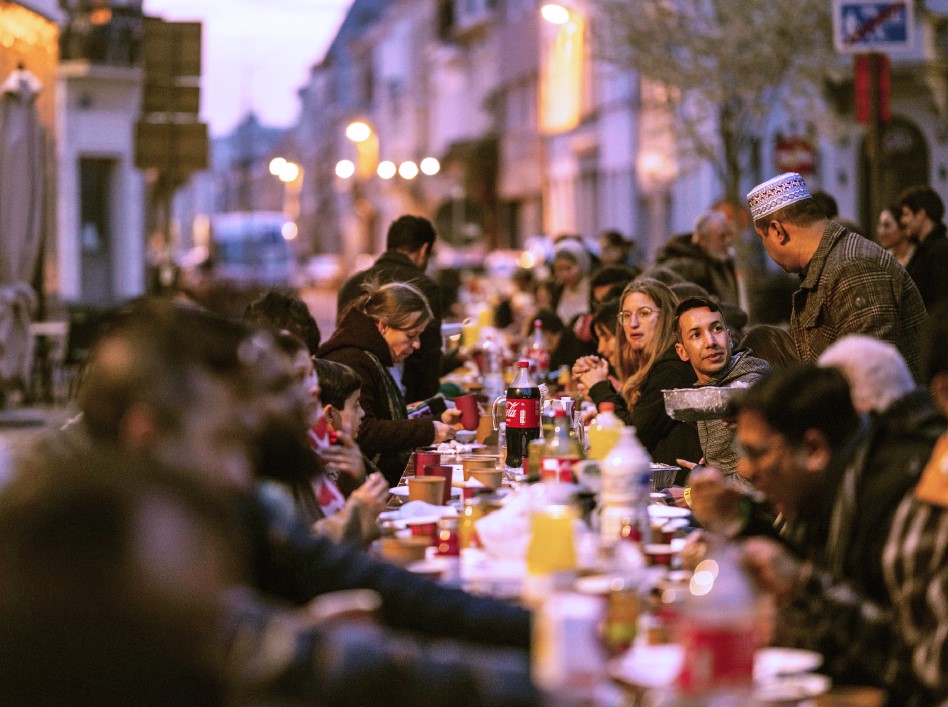
INSTAGRAM VIDEO: from AJ+: On March 31 in the Borgerhout district of Antwerp, a mile-plus-long table set up along the Turnhoutsebaan brought together city residents for a joint Easter-iftar dinner. Easter is the most sacred feast of the Christian year, celebrating the resurrection of Jesus; on Easter Sunday, Christians break the forty-day fast they’ve held for the duration of Lent. Lent almost always overlaps in part with Ramadan, a Muslim holy month of fasting that commemorates the prophet Muhammad’s first revelation. On each day of Ramadan after sunset, the fast is broken with an evening meal called an iftar.

Easter-iftar dinner
Christians and Muslims in Antwerp broke their fasts together at an outdoor Easter-iftar dinner on March 31. Photo: Sanad Latifa.

Borgerhout carried out this interfaith initiative in collaboration with the FMV cultural association and other partners in the hopes of promoting dialogue, social cohesion, and connection. I love this idea of gathering folks together across lines of religious difference to enjoy community, good food, and spiritual celebration! For more information, see https://www.2kmsamenaantafel.be/.

+++

NEW ALBUM: Three Gifts by Liturgical Folk and Jon Guerra: Ryan Flanigan of Liturgical Folk and Jon Guerra have teamed up to release an EP of three songs, one for each of the three theological virtues: faith, hope, and love (1 Cor. 13:13). Here’s “the greatest of these”:

Lent devotionals with arts component

Next Wednesday, February 14, is the first day of Lent—a season of focused prayer and simple living. During this time I will continue publishing weekly “Artful Devotion” posts based on scripture readings from the Revised Common Lectionary, plus I have a few other posts planned. I’m especially excited about what I’ll be publishing this Sunday—the fruits of many months of labor; I hope you’ll check back!

If you are looking for daily devotional content during Lent that incorporates the arts, check out some of these resources. See also last year’s list: https://artandtheology.org/2017/03/07/art-resources-for-lent/.

“The Lent Project V” by Biola University: From Ash Wednesday through the first week of Easter, Biola University’s Center for Christianity, Culture, and the Arts will be publishing daily “aesthetic meditations” on Christ’s life, death, and resurrection. The scripture texts, art images, music, and poetry are curated by a CCCA team, and staff are invited to contribute written reflections that respond to them. “The mood of Lent can be beautifully captured through the arts, which are often cathartic expressions of longing, suffering, loneliness, love, death and rebirth,” says university president Barry H. Corey. “Art is a great chronicler both of the drama of human history and the aches of the human heart.” Here are some artworks Biola has featured in previous years; click on each to experience the full devotion:

The Bread by Michael Borremans
Michaël Borremans (Belgian, 1963–), The Bread, 2012. Oil on canvas, 29 × 23 cm.

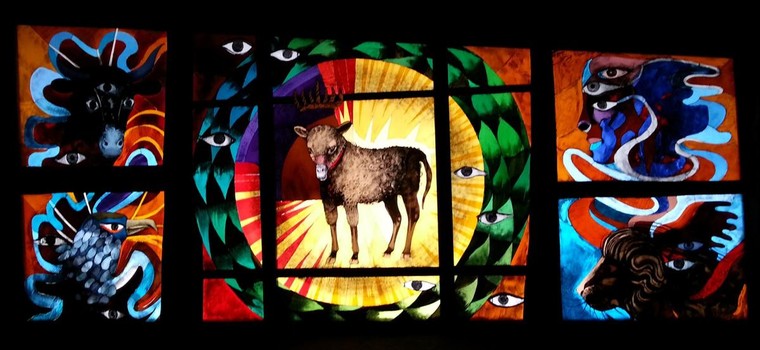
Lamb of God by Arcabas
Arcabas (French, 1926–), Lamb of God. Stained glass, Notre-Dame des Neiges Church, Alpe d’Huez, France.

Deposition and Christ Falling on the Way to Calvary (Palestinian Museum)
The Deposition & Christ Falling on the Way to Calvary, 2014. Collage, from “The Presence of the Holy See” project at the Palestinian Museum. Photographs by Alexandra Boulat (French, 1962–2007); paintings by Raphael.

Jesus on the Shore by Maja Lisa Engelhardt
Maja Lisa Engelhardt (Danish, 1956–), Jesus on the Shore. Altarpiece, Turup Church, Assens, Denmark.

Lenten Readings 2018 by Kevin Greene: For the seventh year in a row, Kevin Greene, a teaching elder at West End Presbyterian Church in Richmond, Virginia, is publishing short daily devotions, each one containing an art image and a piece of music. (Last year I learned of lots of new artists through him!) For the prayer component he has used various resources in the past—the Revised Common Lectionary, sermons on the cross of Christ across the centuries, Wesley’s Scripture Hymns, and excerpts from the early church fathers—but this year he will be using collects (pronounced COL-lects) from the Book of Common Prayer. Unfamiliar with the term? Click here to read how a collect works.   Continue reading “Lent devotionals with arts component”