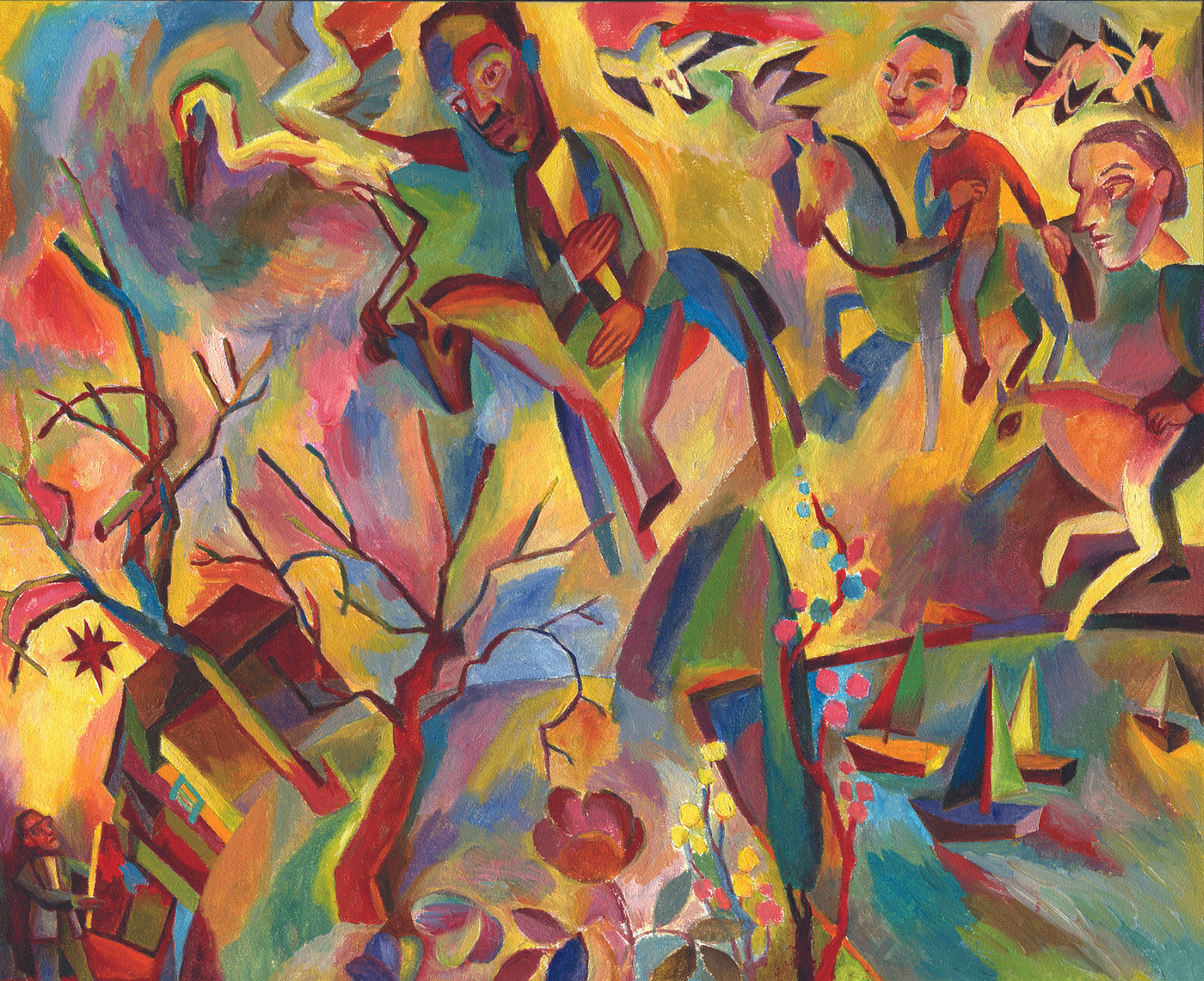
Today’s art and music selections are not a cultural match—the painting comes from the United States, bears Nigerian, Chinese, and Persian influences, and features a famous Dutch modernist in the corner, while the piano composition, written by a Hungarian based on a Romanian folk tune, comes from Central and Eastern Europe. But I find them to be a great match tonally—they’re both vibrant and spirited—not to mention the subject matter they share.
Tomorrow will be the final post in the daily Christmas series for this liturgical year.
LOOK: The Magi and Mondrian by Tanja Butler
Tanja Butler (American, 1955–), The Magi and Mondrian. Oil and acrylic on Masonite, cradled with 2-inch unstained birch plywood, overall 10 × 12 in.
Artist’s statement by Tanja Butler [previously], via ArtWay: “The magi represent the cultures of the world, coming from the four corners of the earth to bring homage to the newborn King. The poses are drawn from royal Nigerian sculpture, Chinese paintings, and Persian manuscripts. The magi are forerunners of generations to come; all nations will bring the gifts of their unique cultures. In the bottom left corner Piet Mondrian offers his painting of chrysanthemums, an image reflecting natural order and creative stasis, the single-minded goal for which he sacrificed all nonessentials – a reminder of the determined search of the magi.”
LISTEN: “Trei crai de la Răsărit” (Three Kings from the East), series 1, no. 10 from Romanian Christmas Carols (Sz. 57, BB 67) by Béla Bartók, 1915 | Performed by György Sándor, 1962
“Trei crai de la Răsărit” (Three Kings from the East) is from a suite of twenty very short piano compositions in two series by the Hungarian composer Béla Bartók, which he based on Romanian colinde he had collected throughout the Transylvanian region. This one comes from the village of Rogoz in Bihor County.
Colinde (sing. colindă) are Romanian folk songs sung at Christmastime, typically by small groups of young men who after some rehearsal walk from house to house on Christmas Eve, caroling at each door. As Bartók himself noted, not all the colinde texts relate to Christmas; many regale folktales, ancient battles yarns, and pagan myths about nature and spirits. Christianity in Romania has absorbed and transformed some elements of the region’s pre-Christian past, integrating winter solstice traditions into a repertoire of Christmas song that also, of course, includes stories of Jesus’s birth.
“Trei crai de la Răsărit,” about the visit of the three wise men, is one of the explicitly Christian colinde. As the piano prances, I can picture the travelers riding with excitement toward Bethlehem.
Though I’ve found a few slow, somber Romanian songs with this same title, I’ve been unable to find the particular tune Bartók adapted for this più allegro (more lively, faster) movement that concludes the first series of his Romanian Christmas Carols. I’m curious to hear a vocal version and to know the lyrics—which Bartók had suggested be printed above the right hand in the score, an idea his publisher decided against.
To listen to the full suite as performed by Dezső Ránki and to follow along with the sheet music, see this video (“Trei crai de la Răsărit” occurs at 4:39–4:54):
The heavens bespeak the glory of God.
The firmament ablaze, a text of his works.
Dawn whispers to sunset.
Dark to dark the word passes: glory glory.

All in a great silence,
no tongue’s clamor—
yet the web of the world trembles
conscious, as of great winds passing.

The bridegroom’s tent is raised,
a cry goes up: He comes! a radiant sun
rejoicing, presiding, his wedding day.
From end to end of the universe his progress.
No creature, no least being but catches fire from him.
This paraphrase of Psalm 19:1–6 by Daniel Berrigan is from Uncommon Prayer: A Book of Psalms(University of Michigan Press, 1978; Orbis, 1998).Used by permission of the Daniel Berrigan Literary Trust. www.danielberrigan.org
The first section of Psalm 19 is about how the natural world declares the glories of its Maker. The night sky, the psalmist describes, is like a tent that spreads its cover over the sun, parting open every morning to release it on the world. The sun is compared to a bright-eyed, handsome, and happy bridegroom emerging from his chamber, and to a vigorous runner who tracks a massive course.
I like to read Psalm 19:1–6 for Advent, especially the poet-priest Fr. Daniel Berrigan’s paraphrase of it, as his use of he/him/his pronouns instead of it/its draws out a Christological connection I hadn’t seen before in this text, made even more pronounced by the apocalyptic tone Berrigan adopts and the sense of excitement he conveys. The poem can, of course, be read as simply the glorious waking of a day, as the psalmist intended. But there’s another layer I want to explore: signs in the heavens, and the coming of Christ.
In the Christian tradition, Jesus is compared to both a sun and a bridegroom, and he, too, like the skies, “bespeak[s] the glory of God.” “Oriens”—Dawn or Dayspring—is one of the traditional titles of Christ, typically invoked in liturgies on December 21 as part of the O Antiphons cycle. From the Church of England’s Common Worship: “O Morning Star, splendor of light eternal and sun of righteousness: come and enlighten those who dwell in darkness and the shadow of death” (cf. Luke 1:78–79; John 8:12; Mal. 4:2). The coming of Jesus—in Bethlehem, in human hearts, and on the last day—illuminates and sets ablaze, revealing who God is and who we ourselves most truly are and exciting the world, flinging abroad the divine light.
As for the bridegroom, Jesus uses this metaphor for himself in his parable of the ten bridesmaids (Matt. 25), as God does in Isaiah 62:5, and indeed one of the major motifs in the book of Revelation is a wedding between Christ and his people. Christ will return to us, scripture suggests, like a husband coming to bring home his new bride.
One of the antiphons for First Vespers of Christmas, I’ve just learned, sung the evening of December 24, connects the bridegroom of Psalm 19 with Jesus. Cum ortus fuerit sol de caelo, the church chants, videbitis Regem regum procedentem a Patre, tanquam sponsum de thalamo suo. (“When the sun shall have risen in the heavens, ye shall see the King of kings coming from the Father, as a Bridegroom from his bride-chamber.”)
Tanja Butler (American, 1955–), Woman Clothed with the Sun, 2008. Acrylic paint, collaged painted paper, and cotton fabric on gessoed acid-free paper, 14 × 5 in. Collection of Victoria Emily Jones.
Artist Tanja Butler further extends Psalm 19’s fittingness for Advent by drawing the passage into conversation with Revelation 12:1–6. This section of John’s Apocalypse introduces us to “a woman clothed with the sun, with the moon under her feet, and on her head a crown of twelve stars”; she gives birth to a baby boy “who is to rule all the nations” but whom a great dragon seeks to devour. In most Christian interpretations, this Woman of the Apocalypse is associated with the Virgin Mary, and there’s a robust iconographic tradition in this vein.
Butler innovates on that tradition with her mixed-media work Woman Clothed with the Sun by showing the infant Jesus busting out of his mother’s womb like the strong athlete of Psalm 19:5. (Ready. Set. Go!) He has a race to run, a mission to fulfill. He is also shown as the sun that clothes his mother and that emerges from a dark (uterine) tent. He is the source and center point of the explosive rays of colorful light in the painting.
In an ArtWay profile, Butler describes her piece as follows:
Mary is represented with the unborn Christ, Light of the World, ready to “come forth from his pavilion, like a champion rejoicing to run his course” (Psalm 19:5). She holds a ladder, referencing both Jacob’s vision and the cross, the ladder of ascent between earth and heaven.
This is a cosmic birth necessitated by a cosmic struggle that will resolve in a cosmic victory: the reunion of God and humanity.
Daniel Joseph Berrigan, SJ, (1921–2016) was an American Jesuit priest, peace activist, award-winning poet, and professor of theology and biblical studies. Through his writings and public witness, he endorsed a consistent life ethic, opposing war, nuclear armament, abortion, capital punishment, and the causes of poverty in the name of Jesus Christ and his holy gospel. Fr. Berrigan, along with his brother Philip, was one of the Catonsville Nine, imprisoned in 1968 for destroying draft files in a protest against the Vietnam War. Later, he spent much of the eighties ministering to AIDS patients in New York City. He is the author of some fifty books.
Tanja Butler (born 1955) is a painter and liturgical artist based in the Albany, New York, area. Her subjects are devotional in character, and her sources of inspiration include Byzantine icons, medieval art, and folk art. Her work is included in the collections of the Vatican Museums, the Hammer Museum in Los Angeles, the Portland Museum of Art in Maine, and the Boston Public Library. “My aim is to develop imagery that has the simplicity and clarity of a child-like vision,” she says, “required, we’re told, if we are to see the kingdom of God.”
Tanja Butler (American, 1955–), Easter Panels: “The Angel at the Tomb,” “Christ’s Victory Over the Gates of Hell and Death,” “Christ Appearing to Mary in the Garden,” and “The Angel Guarding the Entrance to Paradise,” 2005. Acrylic on canvas, each 8 ft. high. Collection of the artist.
“The tomb is empty!” So declares the angel in the far-left panel of this Easter quadriptych by Tanja Butler, an artist from New England. The angel gestures toward Jesus’s bare and open coffin and his cast-aside graveclothes, telling the women (out of frame) that “he has been raised, as he said” (Matt. 28:6).
The second panel shows Jesus trampling down the gates of hell (the doors laid across each other in an X-shape references traditional iconography of Christ’s descent into Hades). He has defeated death, as indicated by the skull under his feet. A rainbow, symbol of God’s promise, arcs across the scene. Shaped in blessing and communicating doctrinal truths, the fingers on his right hand form the letters IC XC, the first and the last letters of the Greek words IHCOYC XPICTOC, “Jesus Christ.” His five wounds—on wrists, feet, and side—are still present on his resurrected body, but they have been transfigured.
The third panel shows the resurrected Christ appearing to Mary Magdalene in the garden of his burial. With one hand he reaches out to reassure her, but with the other he reminds her that he will be ascending soon, and so not to cling to him (Noli me tangere, as this scene is traditionally named). I believe that the twisting object that seems to proceed from Mary’s mouth and exits the garden gate is a speech scroll, suggesting that she is proclaiming the gospel; “apostle to the apostles,” she is tasked with delivering the news of resurrection to the Eleven. But with its riverine shape, it also reminds me of Jesus’s words to the Samaritan woman at the well: “Those who drink of the water that I will give them will never be thirsty. The water that I will give will become in them a spring of water gushing up to eternal life” (John 4:14).
(Update, 4/20/22: Butler tells me she had in mind the release of the Holy Spirit, breaking through walls and barriers.)
In the far-right scene, the angel who had been guarding paradise with a flaming sword (Gen. 3:24) has put down his sword and now invites us to enter. The sentry has become a porter! He gestures toward the doorway that Christ’s death and resurrection has opened for us. The fall has been undone. We are welcomed home.
“Tanja Butler (b. 1955) was born in Germany and moved to the United States as a young girl. She received her B.A. and M.A. from the University of Albany. Her artistic practice has focused on liturgical art, illustration, and community service projects. She is inspired by Byzantine icons, American and European folk art, Persian manuscripts and textile patterns, African art, Early Christian art, Russian Suprematist paintings, Cubism and Fauvist color. Informed by studies in art history and time working in Italy, she was particularly influenced by the frescoes of Fra Angelico in the Monastery of San Marco in Florence. Her collection of 600 graphic images, Icon: Visual Images for Every Sunday, was published by Augsburg Fortress Publishers. Her work is included in the collections of the Vatican Museum of Contemporary Religious Art; the Billy Graham Center Museum at Wheaton; the Boston Public Library; the DeCordova Museum; and the Armand Hammer Museum of Art, UCLA. In 2014 she retired from her position as an associate professor of art at Gordon College in Wenham, Massachusetts, where she taught painting, drawing, liturgical art, and illustration and frequently integrated service opportunities in her courses.” [source]
Temporary installation at Christ Church, Hamilton/Wenham, Massachusetts, 2005
1. Pourquoi, parmi les morts, chercher les vivants? Jésus est ressuscité! Comme la lumière du soleil levant, Jésus est ressuscité, alléluia, Jésus est ressuscité.
2. Que la terre entière sache la vérité Jésus est ressuscité! Comme la vie nouvelle qu’il nous a donnée, Jésus est ressuscité, alléluia, Jésus est ressuscité.
3. L’ennemi est vaincu, il est terrassé, Jésus est ressuscité! À lui la victoire, nous sommes libérés, Jésus est ressuscité, alléluia, Jésus est ressuscité.
4. Nous voyons sa gloire dans tout l’univers. Jésus est ressuscité! L’image parfaite du Dieu notre Père, Jésus est ressuscité, alléluia, Jésus est ressuscité.
5. Acclamons Jésus, il a vaincu la mort! Jésus est ressuscité! Dansons et chantons, car il est le plus fort, Jésus est ressuscité, alléluia, Jésus est ressuscité.
6. Pourquoi, parmi les morts, chercher les vivants? Jésus est ressuscité! Comme la lumière du soleil levant, Jésus est ressuscité, alléluia, Jésus est ressuscité.
English translation:
1. Why seek the living among the dead? Jesus is risen! Like the light of the rising sun, Jesus is risen, hallelujah, Jesus is risen.
2. Let the whole earth know the truth: Jesus is risen! Like the new life he gave us, Jesus is risen, hallelujah, Jesus is risen.
3. The enemy is defeated, he is struck down, Jesus is risen! To him the victory, we are freed, Jesus is risen, hallelujah, Jesus is risen.
4. We see his glory throughout the universe. Jesus is risen! The perfect image of God our Father, Jesus is risen, hallelujah, Jesus is risen.
5. Let us acclaim Jesus, he conquered death! Jesus is risen! Let’s dance and sing, because he is the strongest, Jesus is risen, hallelujah, Jesus is risen.
6. Why seek the living among the dead? Jesus is risen! Like the light of the rising sun, Jesus is risen, hallelujah, Jesus is risen.
Born and raised in South Africa, singer-songwriter Pat Berning moved to southern France with his wife Linda in 1988, following a call they felt while working for the international ministry Youth for Christ. Though he didn’t know the language at the time, now he sings and records primarily in French, and occasionally in English or Zulu.
His live performance above of his original song “Jésus est ressuscité” is from the Christian arts festival Psalmodia Gagnières—sometime in the early to mid-2000s. The album version uses male and female singers and has call-and-response elements. “Jesus is risen!” the refrain goes. Such a fun and celebratory song.
The hip-hop dancer in the video is Sodapop. He and his wife, Christine Jeanville (a classical and contemporary dancer), founded Machol Danser la Vie in 2005, named after the man in 1 Kings 4:31 whose name means “dancing.” The ministry organizes workshops that promote healing, empowerment, and connection with others and God through dance. And in 2018 they opened the Ecole de Formation sur l’ Identité et la Louange par le Mouvement (Training School on Identity and Worship through Movement).



 Art & Theology