Advent, Day 12: Wise and Foolish Virgins

LOOK: The Wise and Foolish Virgins, Norwegian tapestry

Wise and Foolish Virgins (Norway)
The Wise and Foolish Virgins, Norway, 17th century. Wool, bast fiber, 83 1/2 × 61 in. (212.1 × 154.9 cm). Minneapolis Institute of Art, Minneapolis, Minnesota.

The golden age of Norwegian tapestry (billedvev) spans roughly 1550 to 1800. Of all the woven subjects during this period, the Wise and Foolish Virgins was the most popular. The art historian Thor B. Kielland registered a total of seventy-five such tapestries from the seventeenth century alone. Draped over a bed, they would have provided warmth, decoration, and moral instruction. I love their aesthetic!

Jesus’s parable of the wise and foolish virgins comes from Matthew 25. Ten young women are members of a bridal party, and they’re awaiting the arrival of the bridegroom so that the celebration can start. In the tapestry pictured here, the top figures represent the wise virgins, whose oil-filled lamps indicate their readiness to accompany the bridegroom to the wedding feast. Those in the lower register, however, foolishly allowed their lamps to burn out; they weep into their handkerchiefs because the feasting started when they were out replenishing their oil supply, and now they’re too late.

That’s Christ the bridegroom in the upper right.

If I’m honest, this parable is uncomfortable for me. I don’t like that the neglectful women are locked out of the party. I don’t want anyone who wants in to be turned away. I want the bridegroom to show them grace, as the landowner did the day laborers who worked the vineyard for only one hour, giving them the same wage as those who worked for nine. But the parable of the virgins, with its stark sense of finality, is one of Christ’s teachings, so I want to grapple with it, not simply ignore it to suit my own proclivities.

I learned much about the existing body of Ten Virgins tapestries from rural Norway from Laura Berlage’s webinar “Dressing the Wise and Foolish Virgins: What Tapestry Can Teach Us About Women, Dress, and Culture in 16th and 17th Century Norway,” presented on July 17, 2023. She says the tapestries were made by women (unlike those produced by the guilds in Flanders and Paris), for women (they were used as bridal coverlets and included in dowries). They preached preparedness for young wives. “Good comes to those who are prepared,” Berlage elaborates; “you can’t get to heaven by borrowing someone else’s spiritual work.”

Regarding the headwear, Berlage clarifies: “The crowns the virgins wear are not because they’re princesses. There is a special tradition in Norway of wearing a crown at your wedding, which is an ancient nod to the Norse goddess Freja (later said to be an emblem of the Virgin Mary).”

Over time, Berlage says, the original meaning of the parable got lost, such that weavers no longer differentiated between the two sets of virgins, for example. She calls this phenomenon “image decay” and compares it to the telephone game.

For a shorter, less academic lesson on the ten virgins in Norwegian tapestry, see the six-minute video “Woven Wise and Foolish Virgins” by Robbie LaFleur:

LISTEN: “Himmelriket Liknas Vid Tio Jungfrur” (The Kingdom of Heaven Is Like Unto Ten Virgins) | Words from Then Swenska Psalmboken (The Swedish Hymnbook), 1697 | Traditional melody from Mockfjärd, collected by Nils Andersson in 1907 from Anders Frisell | Performed by Margareta Jonth on the album Religious Folk-Songs from Dalecarlia, 1977, reissued 1994

Himnelriket liknas vid tio jungfrur
som voro av olika kynne.
Fem månde oss visa vår tröga natur
Vårt sömnig och syndiga sinne.
Gud nåde oss syndare arma.

Vår brudgum drog bort uti främmande land
Och månde de jungfrur befalla
Sig möta med ljus och lampor i hand
Enär som han ville dem kalla.
De fävitske dröjde för länge.

De ropa: O Herre, o Herre låt opp,
Låt oss icke bliva utslutna!
Men ute var nåden, all väntan, allt hopp
Ty bliva de arma förskjutna
Till helvetets jämmer och pina.

Så låter oss vaka och hava det nit
Att tron och vår kärlek må brinna.
Vi måge här följa vår brudgum med flit
Och eviga salighet finna.
Det himmelska bröllopet. Amen.
The kingdom of heaven is like unto ten virgins
Who were of different character.
Five showed us our slothful nature,
Our sleepy and sinful selves.
God have mercy on us poor sinners.

Our bridegroom traveled in foreign lands
And ordered the virgins
To meet him with lighted lamp in hand
Whenever he called them.
The foolish ones waited too long.

They cry, “O Lord, O Lord, open up,
Let us not be locked out!”
But it was too late for mercy, for waiting, for hope,
For the poor souls were cast
Into hell’s wailing and torment.

So let us watch and show zeal
That faith and our love may burn.
Let us follow our bridegroom diligently
And find eternal bliss,
The heavenly wedding. Amen.

Trans. William Jewson (source: liner notes)

Flemish Tapestry with Scenes of the Passion

This month I traveled to parts of Germany and Belgium to experience some of the art of those countries, with a focus on medieval religious art. In Brussels, besides exploring the famous Oldmasters Museum (part of the Royal Museums of Fine Arts of Belgium), I visited the lesser-known Art and History Museum, whose collection includes not just western European art from prehistoric times through the nineteenth century, but also art from Asia (China, Korea, India, Pakistan, Afghanistan, Sri Lanka, Tibet, Nepal, Turkey, Iran, Cambodia, Thailand, Burma), Oceania, the pre-Columbian Americas, and ancient Egypt, Greece, and Rome.

Art and History Museum, Brussels

I spent the most time with the medieval European art on the ground floor—wooden statuettes, ivory and alabaster carvings, stained glass, paintings, metalworks, and tapestries. With the Google Translate app open, I hovered my phone over the Dutch and French descriptive labels to read them in English.

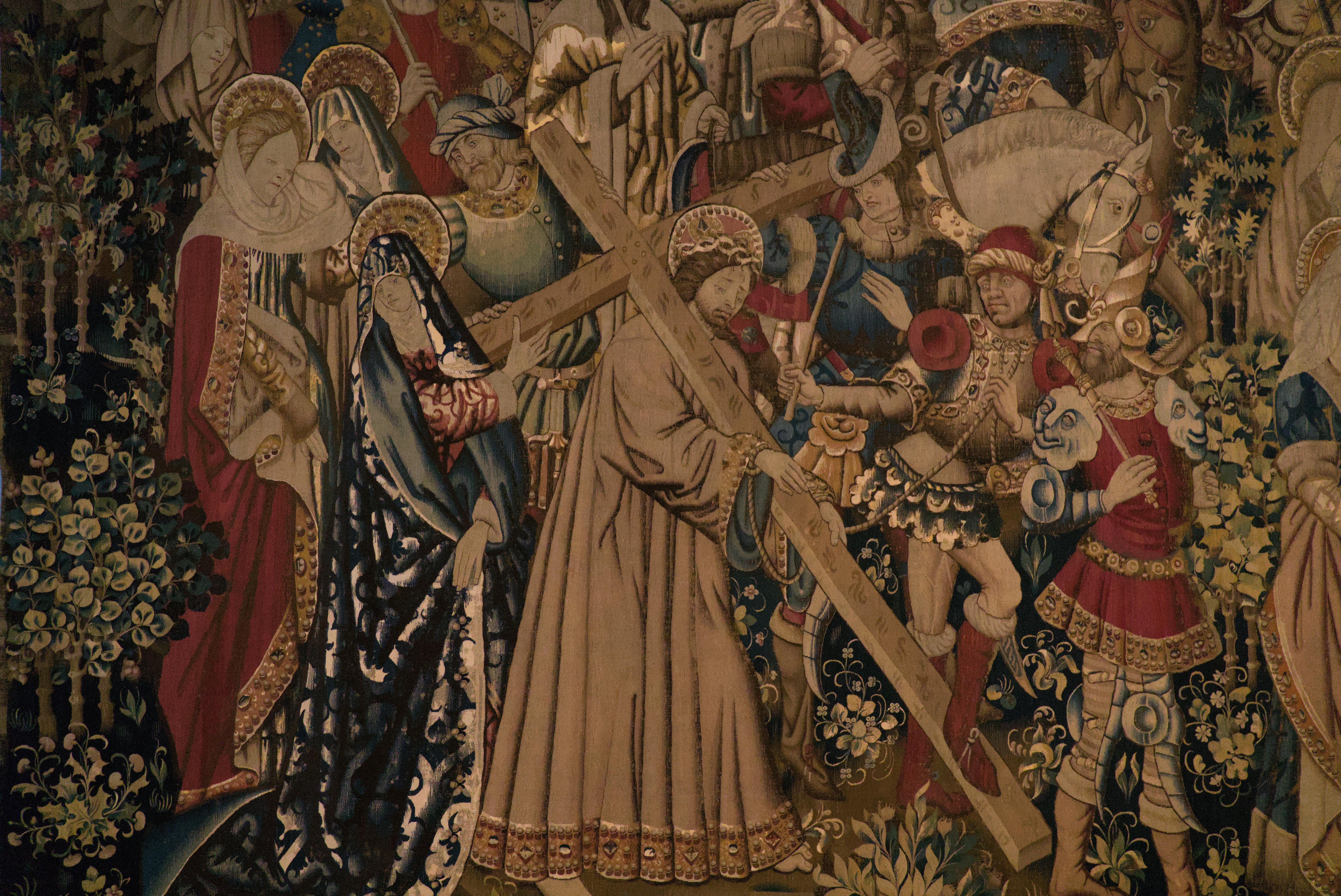
My favorite tapestry I saw, from fifteenth-century Tournai, portrays three scenes from the passion of Christ: Christ Carrying the Cross, the Crucifixion, and the Resurrection. The museum gallery it’s displayed in also houses a large medieval loom, which is what’s protruding at the bottom right corner of the following photo.

Tapestry of the Passion
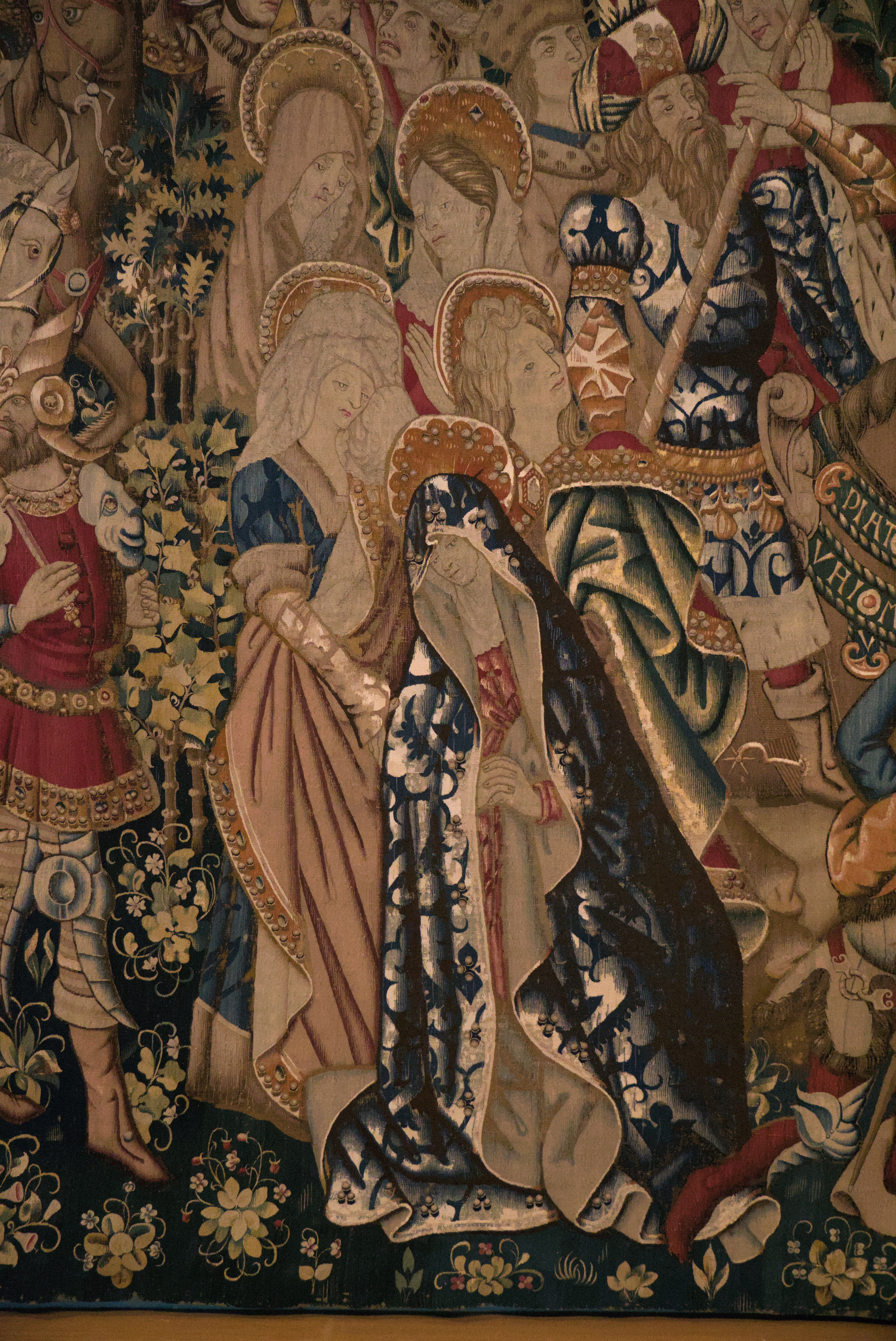
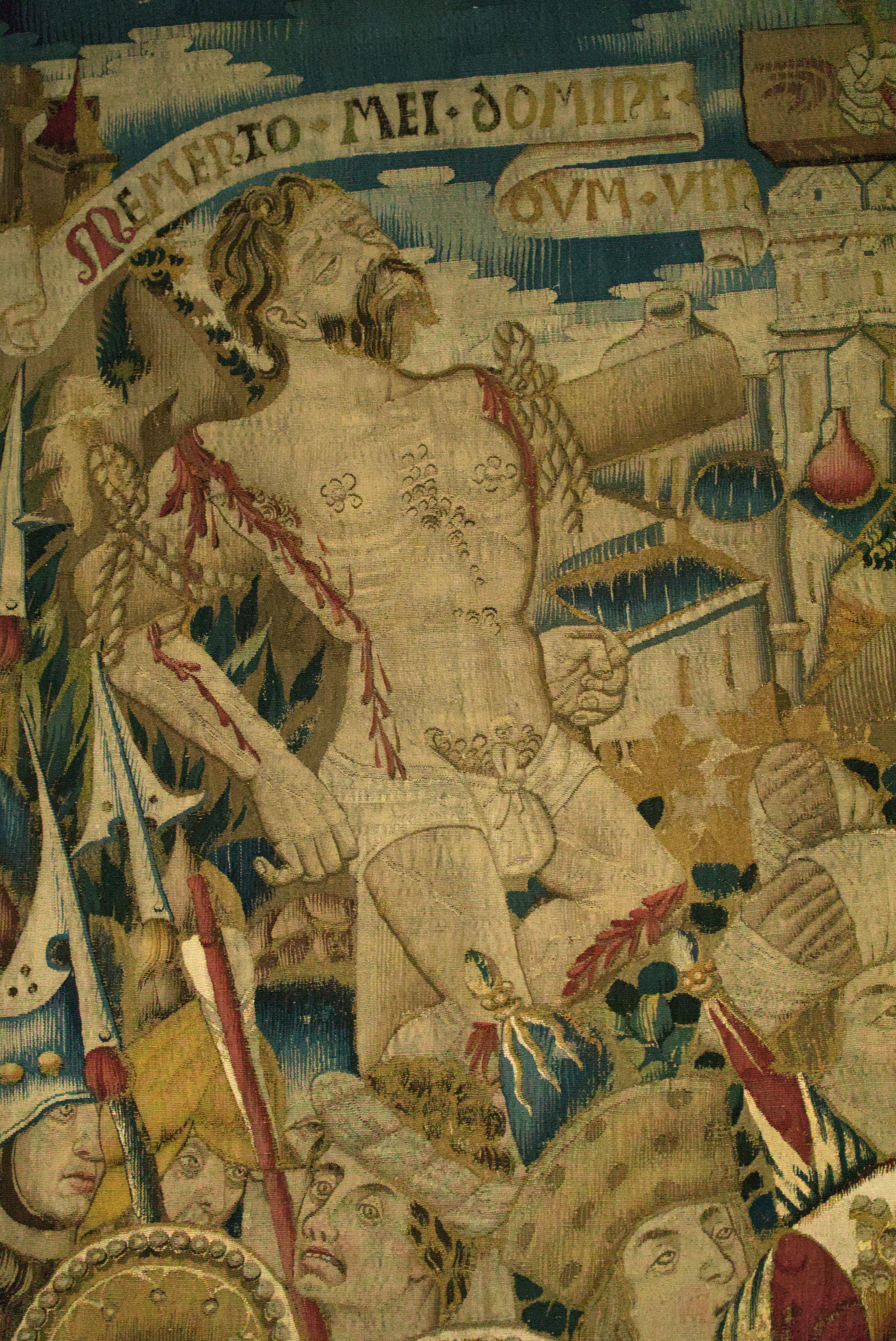
Scenes from the Passion, Tournai, ca. 1445–55. Tapestry of wool and silk, 424 × 911 cm. Art and History Museum, Brussels, Belgium, Inv. 3644. All photos by Victoria Emily Jones.

Tapestries made in the Flemish city of Tournai were among the most sought after in the fifteenth century. These large-scale wall hangings were bought by royalty, nobles, and high-ranking clergy to decorate their palaces. This one, nearly thirty feet long, is the second of a two-part hanging whose first part (portraying Christ’s Entry into Jerusalem, the Last Supper, and the Arrest of Christ) is in the collection of the Vatican.

Below are some detail shots.

First, Christ carries his cross. A soldier pulls him forward by a rope tied to his wrists, while tauntingly standing on the vertical wood beam and hitting him with a baton. On a less serious note, those are some spiffy face-shaped shoulder scales on the right.

Sept2025_DSC1508

Christ crucified:

Sept2025_DSC1509

A group of four women mourn—the Virgin Mary up front in the blue mantle, backed by three other Marys—alongside a curly-haired apostle John in green.

Sept2025_DSC1515

On Christ’s right (the viewer’s left), the penitent thief, with his last breaths, says, Memento mei, Domine, dum ven[eris in regnum tuum] (Remember me, Lord, when you come into your kingdom) (Luke 23:42).

Sept2025_DSC1512

The pointing man below the cross to Christ’s left, our right, is the Roman centurion (officer in command of one hundred soldiers) who, when Jesus died, proclaimed, Vere filius Dei erat iste (Truly this man was the Son of God!) (Matt. 27:54; Mark 15:39; cf. Luke 23:47).

Sept2025_DSC1513

On the other side of the cross, a Roman spearman, to whom tradition gives the name Longinus, points to his eyes. That’s because according to a medieval legend, Longinus was blind, but when he pierced Jesus’s side to verify his death, some of the blood from the open wound fell into Longinus’s eyes and restored his sight, after which he confessed allegiance to Christ.

Sept2025_DSC1516

Despite these three stories—two biblical, one apocryphal—of Christian conversion at the cross, Christ’s death did not move all the hearts of those present. At the base of the cross, two men fight with knives over Christ’s garment, their greed and aggression a foil to Christ’s selflessness and gentleness, and an example of the sin he came to redeem us from.

Sept2025_DSC1514

And again, pacifist though I am, I can’t help but remark on the fine-looking armor in the crowd:

Sept2025_DSC1519

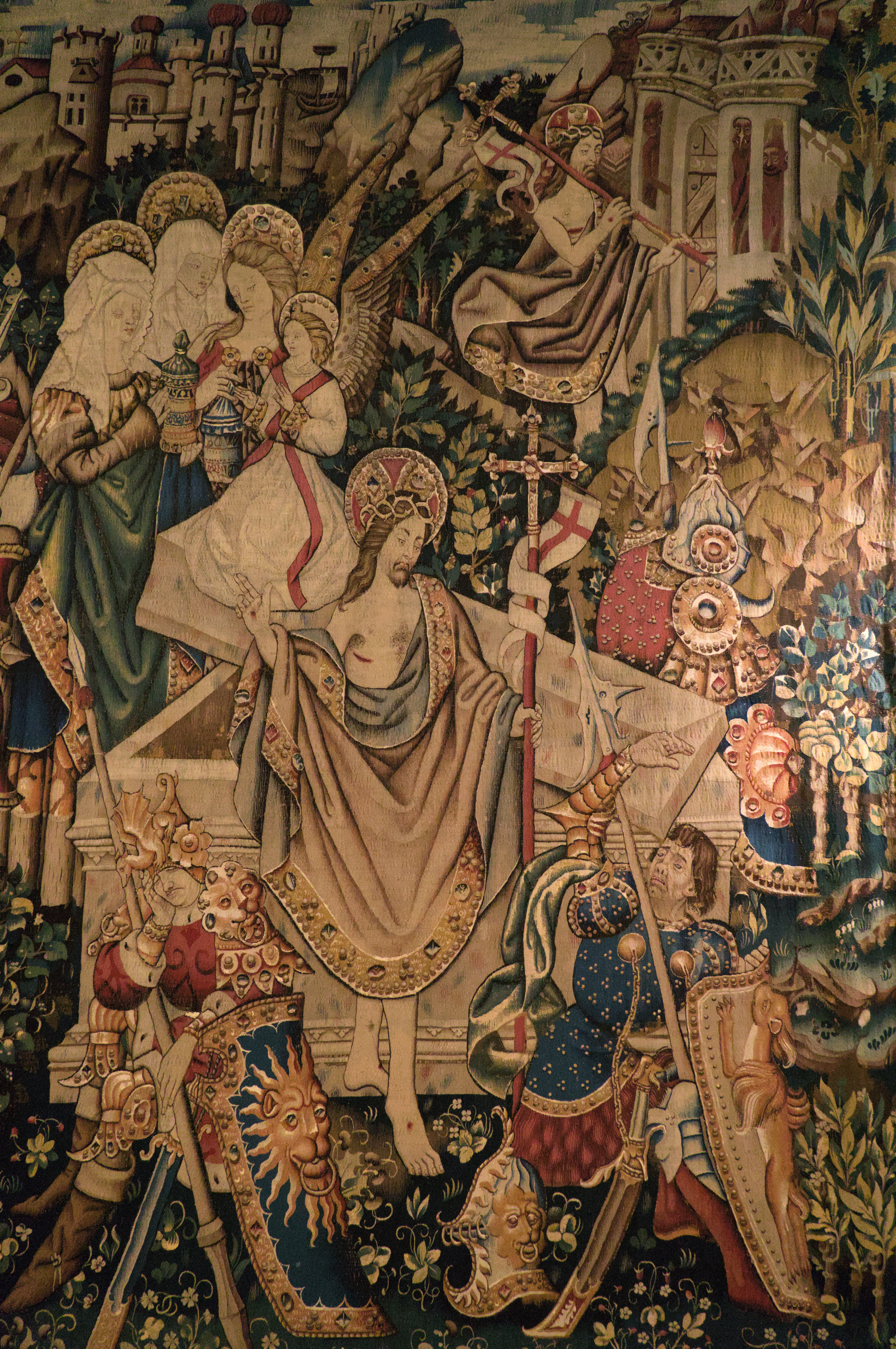
The right-most third of the tapestry portrays vignettes of the Resurrection.

Sept2025_DSC1525

At the bottom, Christ emerges triumphant from his tomb, holding a banner in one hand and bestowing blessing with the other.

Sept2025_DSC1521

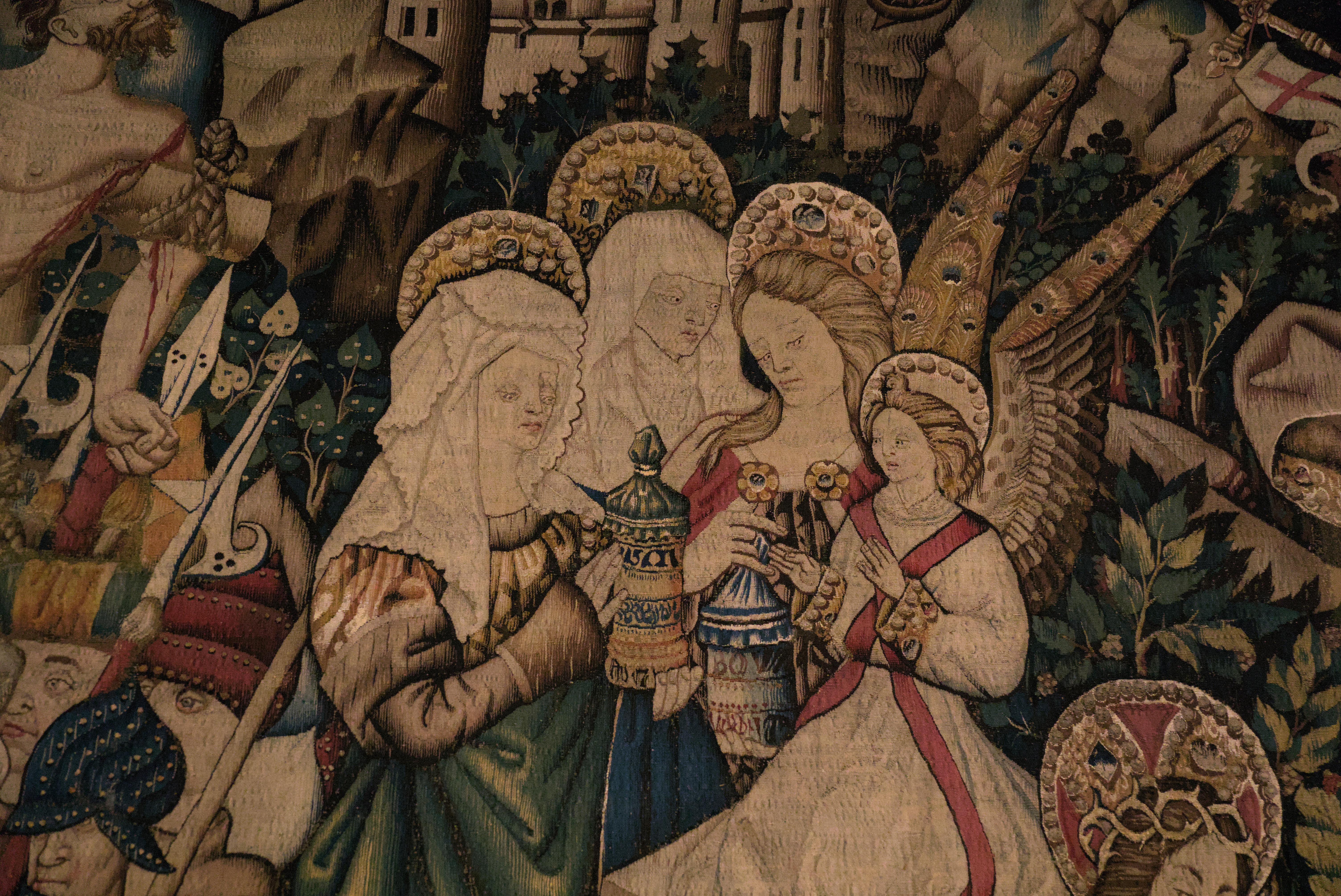
In the middle ground, the three Marys arrive at the empty tomb, ointments in hand, where they meet an angel who informs them that Christ has risen from the dead. Mary Magdalene is the one with her hair uncovered.

Sept2025_DSC1520

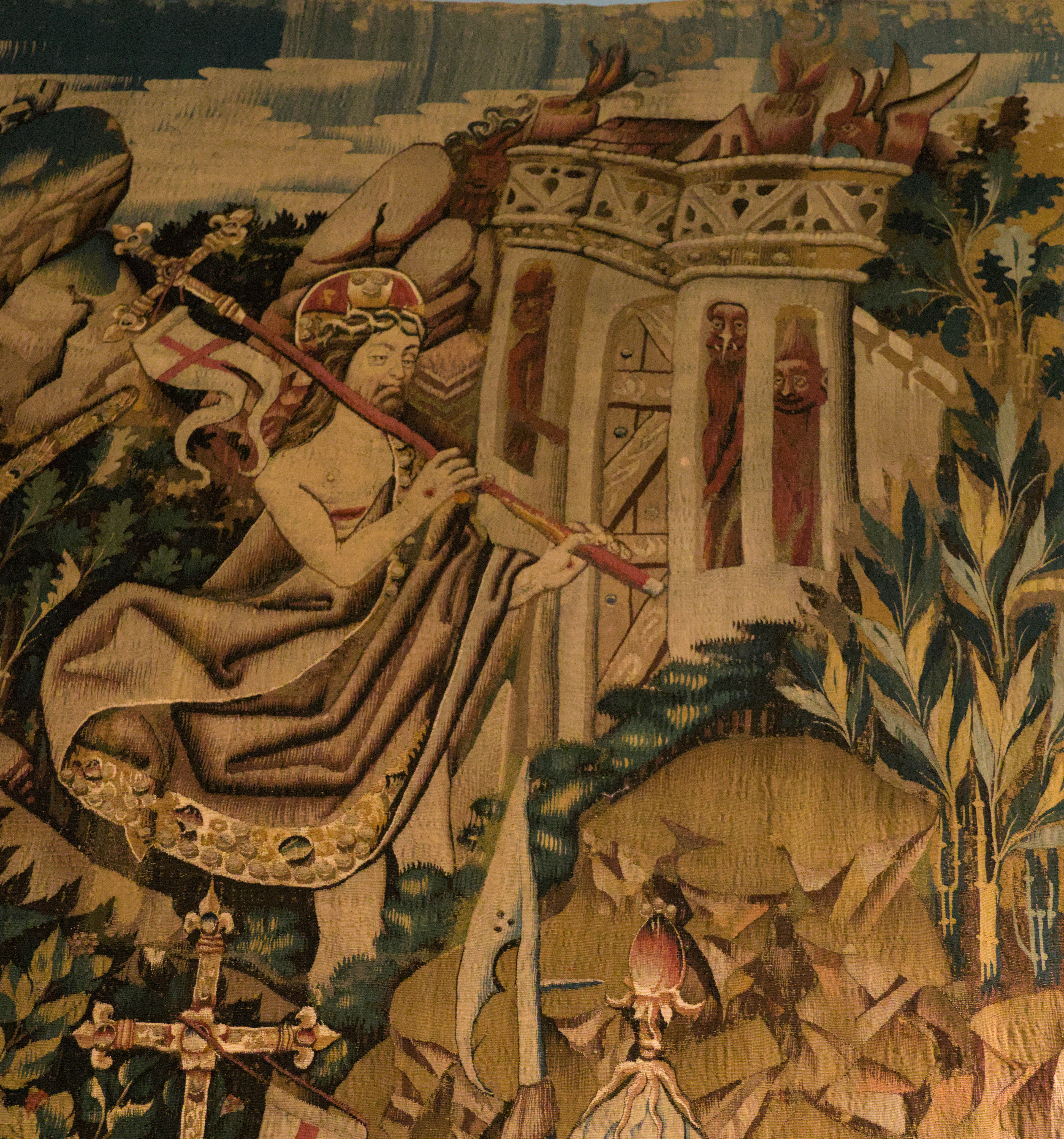
The risen Christ appears again at the top right, harrowing hell, a realm that is represented as a turreted fortress from whose windows fiery red demons glower and smirk. Christ has come to break down the doors and release the Old Testament saints being held captive—that is, those who died trusting in Yahweh and who were awaiting Christ’s redemption in the netherworld.

Sept2025_DSC1522

Let’s zoom in closer, shall we?

Sept2025_DSC1523

This is just one of the many artistic treasures, woven and otherwise, at Brussels’ Art and History Museum. I highly recommend a visit! I easily spent several hours there.

Advent Prelude: Guide Us

LOOK: Milky Way by Frida Hansen

Hansen, Frida_Milky Way
Frida Hansen (Norwegian, 1844–1931), Melkeveien (Milky Way), 1898. Tapestry, 260 × 345 cm. Museum für Kunst und Gewerbe (Museum of Arts and Crafts), Hamburg, Germany.

This art nouveau tapestry by Norwegian artist Frida Hansen received a gold medal at the world’s fair in Paris in 1900. It shows angelic figures unfolding a starry veil over the night sky. They glide forward above a band of Hebrew script that references the creation of the stars in Genesis 1.

The God who brought light in darkness in the beginning is bringing light again as we enter a new liturgical year.

Comprising the first five weeks of that new year, Advent-Christmas-Epiphany is a time of starlight, promise, and revelation. The first of the triad, Advent, is particularly concerned with themes of longing, waiting, lament, and future-oriented hope. We make ready our hearts to receive Christ—he who came to us first as a babe in a manger, in a vulnerable body like ours, to teach and suffer and redeem, and who is coming back one day in unveiled power and majesty to bring the fullness of God’s heavenly kingdom to earth.

Two millennia ago, God hung a special star in the sky for the magi to follow, guiding them on their way to the Christ child. May God similarly illumine our way to Christ as we seek him this season, giving us eyes to see and ears to hear the gospel of God-with-us and cultivating in us an eager readiness for Christ’s return.

I think of Hansen’s crowned young ladies as ushering us into the deep, dark blue of Advent to behold the signs that sparkle in scripture, foretelling a wondrous future.

For an excellent illustrated article about Hansen’s life and work, see “Frida Hansen: A leading star in European textile art” by Anne Sommerin Simonnæs.

LISTEN: “Star of Wonder” by Sara Groves, on O Holy Night, 2008; adapted and arranged from the refrain of “We Three Kings” by John Henry Hopkins, 1857

Star of wonder, star of light
Star of royal beauty bright
Guide us
O guide us
Won’t you guide us


Want to follow along with the music on Spotify? Most of the songs in this Advent blog series, and many more besides, can be found on the Art & Theology Advent Playlist.

Roundup: “The Loving Look,” Keiskamma retrospective, and more

ONLINE EVENT: “Theodicy of Beauty” by Sarah Clarkson, March 6, 2:30 p.m. ET: “The question of suffering is one of the central, aching questions of faith. Too often, we meet suffering with an argument for God’s goodness, rather than an invitation to find and discover his goodness anew. Join me for an exploration of what it means to encounter and trust the beauty of God in our times of darkness, suffering, and pain. Drawing on my own story of mental illness and depression, I’ll explore what it means to engage with God’s goodness in a radically healing way, one that restores our capacity to imagine, hope, and create. We’ll use literature, art, and poetry to discern the ways that God arrives in our darkness to heal us, and also to restore us as agents of his loveliness in the midst of a broken world.”

This Crowdcast talk by Sarah Clarkson is based on her book This Beautiful Truth: How God’s Goodness Breaks into Our Darkness. Registration is $7 and includes a complimentary downloadable copy of “Encountering Beauty,” an arts-based reader’s guide to Clarkson’s book. I have appreciated her From the Vicarage: Books, Beauty, Theology newsletter and her wise, gentle reflections on spirituality, literature, and motherhood on Instagram @sarahwanders, so I’m looking forward to hearing from her on this topic!

+++

LECTURES (available on podcast platforms):

>> “The Loving Look” by Dr. Elissa Yukiko Weichbrodt: In this keynote address for the 2018 Beautiful Orthodoxy conference, art historian Elissa Yukiko Weichbrodt [previously], author of Redeeming Vision: A Christian Guide to Looking at and Learning from Art, discusses how contemporary art—which can sometimes be confounding or otherwise challenging—can drive us to confession, empathy, and love. Sharing her encounters with three contemporary artworks, she talks about art as a place where we can experience sanctification and common grace; how the Incarnation further vested our material world with significance; art as an invitation to embodied knowledge; art as part of how we order and understand our physical world; artworks as mirrors and shapers of culture; and how viewers, not just artists, are called to faithfulness.

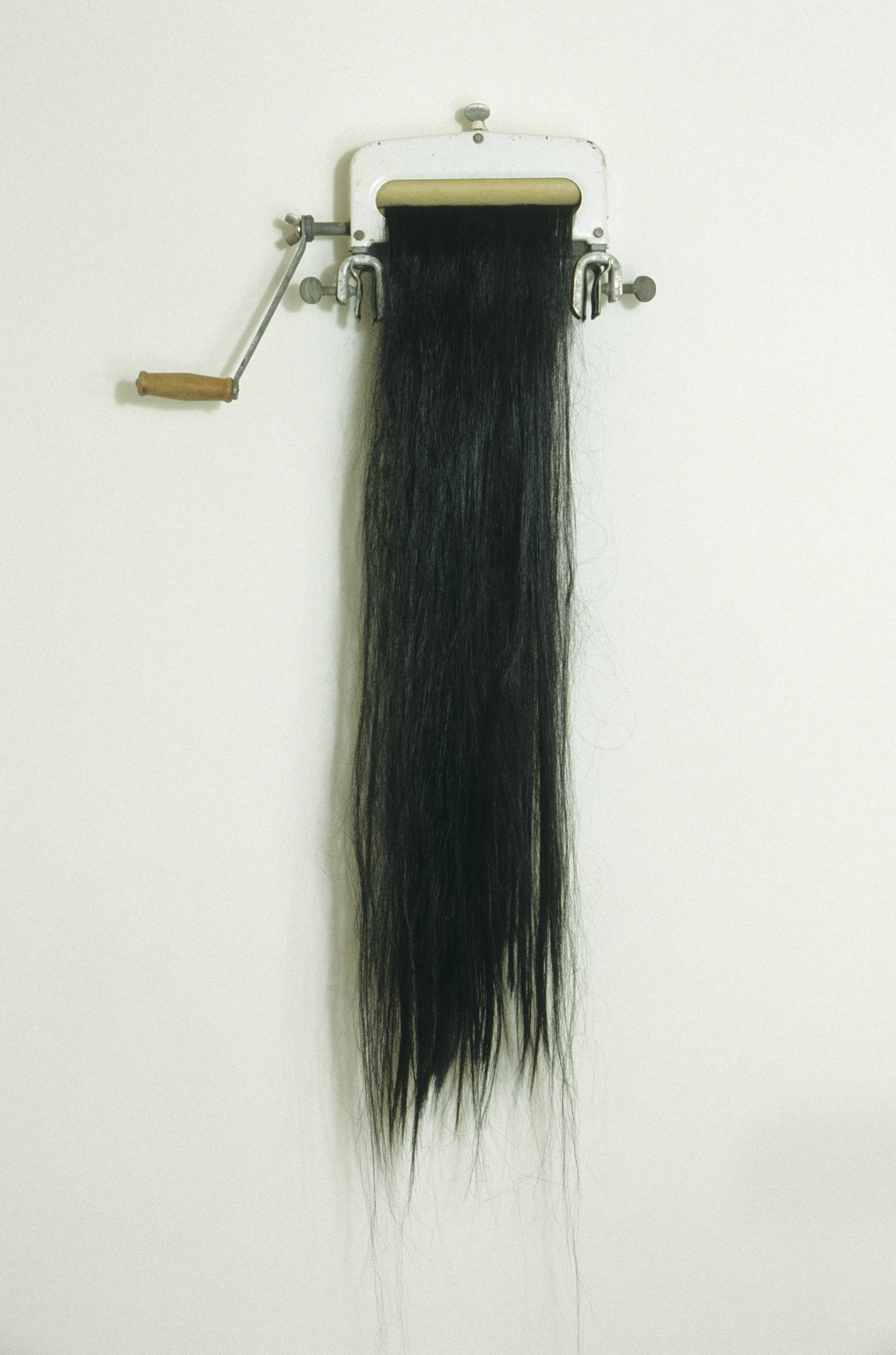
Yamamoto, Lynne_Wrung
Lynne Yamamoto (American, 1961–), Wrung, 1992. Wringer, synthetic hair, nails, string, 42 × 13 × 5 in.

She cites Esther Lightcap Meek’s Loving to Know: Covenant Epistemology, in which Meek says that all acts of coming to know are integrative; they become part of us. Knowledge is an act of covenantal care, Meek says. We don’t know in order to love; we love in order to know. Weichbrodt says, “For me, contemporary art—particularly art made by artists grappling with histories and experiences that have remained largely unseen, unknown, and unloved by the dominant culture—has served as a catalyst for faithful knowing.”

Besides Wrung, the two other works she spotlights are Outline by Lorna Simpson and From Here I Saw What Happened and I Cried by Carrie Mae Weems.

>> “The Arts as a Means to Love” by Dr. Mary McCampbell: In this lecture given for English L’Abri, Mary McCampbell [previously], an associate professor of humanities at Lee University, discusses some of the ideas from her book Imagining Our Neighbors as Ourselves: How Art Shapes Empathy. I appreciate how her writing and teaching embraces the arts of film and television alongside literature, such that not only are works like The Power and the Glory by Graham Greene, “A Good Man Is Hard to Find” by Flannery O’Connor, and Beloved by Toni Morrison explored, but so are, for example, the comedy-drama Lars and the Real Girl and the drama series Better Call Saul. Discrediting the recent odd assertion from a prominent evangelical corner that empathy is a sin, McCampbell affirms that empathy is, on the contrary, an essential Christian virtue, and one that the narrative arts are adept at forming in us, exposing us to people and stories outside our realms of experience and helping us recognize the image of God in unlikely places.

+++

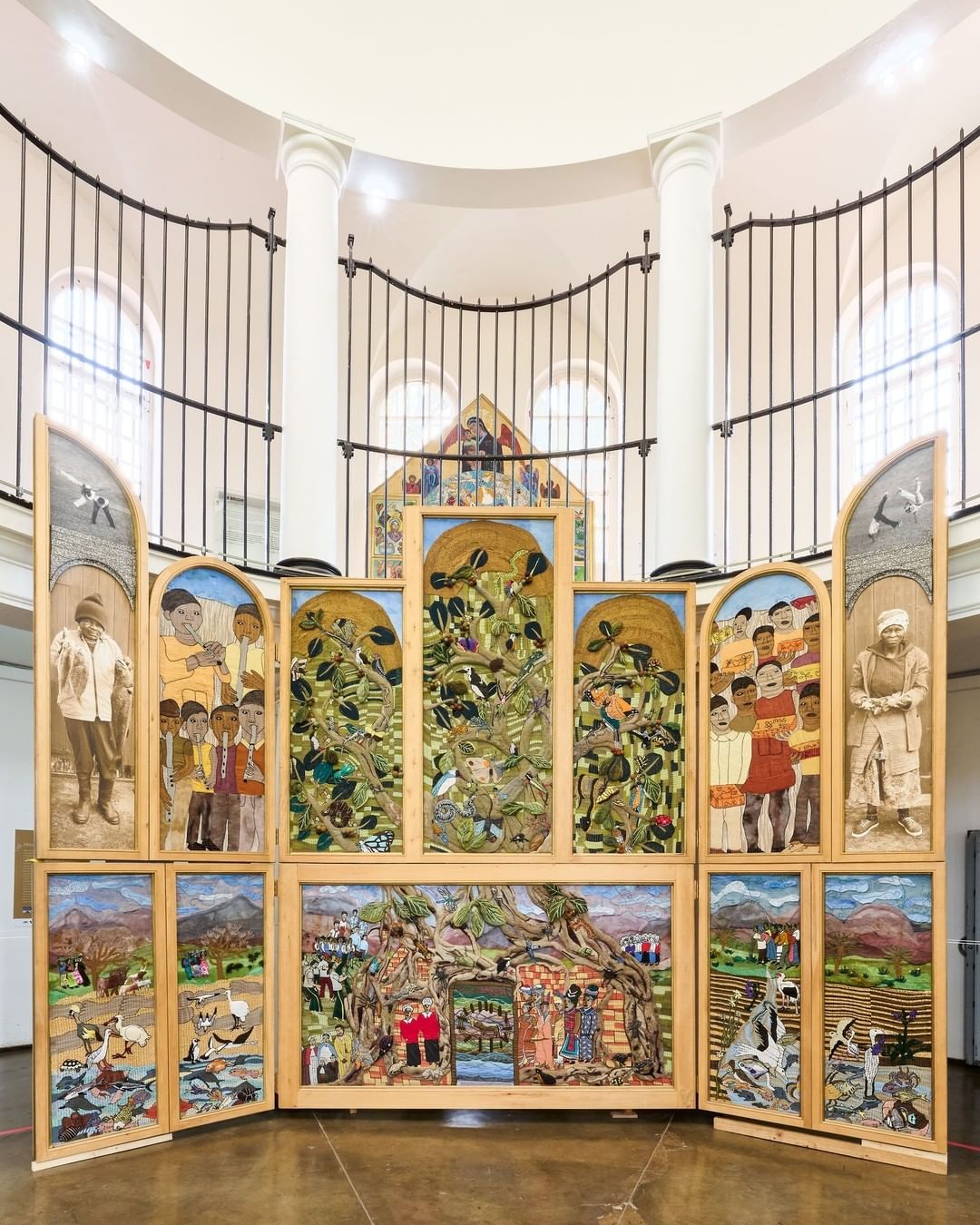
EXHIBITION REVIEW: “Mourning and Perseverance Stitched into South African Tapestries” by Alexandra M. Thomas: Through March 24 at Constitution Hill in Johannesburg, you can see Umaf’evuka, nje ngenyanga, dying and rising, as the moon does, a major retrospective of the work of the Keiskamma Art Project. Founded in 2000, the project archives the collective memory and oral histories of the rural Eastern Cape of South Africa through textile artworks, mainly by Xhosa women. Monumental and small-scale works tell stories of trauma, grief, hope, faith, resilience, and celebration. One of my favorite art research projects has been the one I did on the Isenheim-inspired Keiskamma Altarpiece in 2015, which resulted in the article “Sewing seeds of hope in South Africa”; this altarpiece is one of the many works on display. Let me call out just two others. The photos are from the current exhibition.

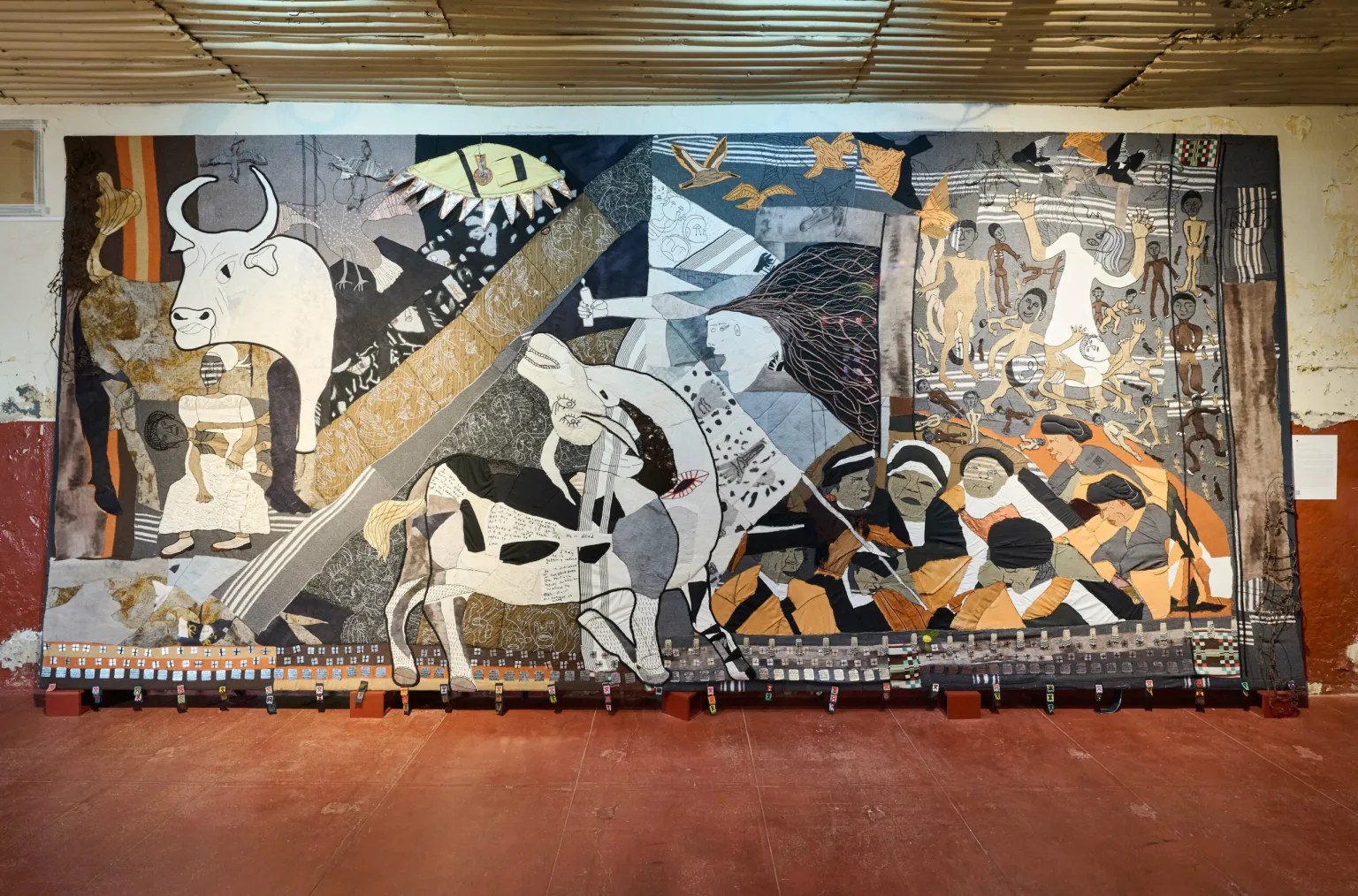
Keiskamma Guernica
Keiskamma Guernica, 2010. Mixed media, including appliqué, felt, embroidery, rusted wire, metal tags, beaded AIDS ribbons, used blankets, and old clothes, 3.5 × 7.8 m. Collection of Javett Art Centre at the University of Pretoria, Tshwane, South Africa. Photo: Anthea Pokroy / Keiskamma Trust.

Creation Altarpiece (Keiskamma)
Creation Altarpiece, 2007. Mixed media, including felt, embroidery, photographs, beadwork, wirework, and appliqué, 3.8 × 5.2 m (open). Collection of Unisa Art Gallery, Tshwane, South Africa.

Keiskamma Guernica, after Picasso’s famous antiwar painting, laments the limited access to HIV treatment in rural South Africa in the 2000s and the negligence of government hospitals, which resulted in many HIV/AIDS deaths. The piece repurposes the blankets and clothes of the deceased and serves as an expression of outrage as well as a form of commemoration. Creation Altarpiece, modeled loosely after the Ghent Altarpiece, exults in the region’s abundant wildlife and natural resources and in life-giving initiatives like Hamburg’s music education program, its capoeira group (a dance-like martial art), and the memory boxes made by orphaned children to remember their parents. The three top central panels depict a fig tree eating up an old hotel built by colonialists (a real-life scene observed in the nearby village of Bell!), and the bottom three show villagers of all kinds gathering around Christ, represented as a bull (whereas lambs were commonly sacrificed in ancient Israelite religion, traditional Xhosa religion calls for bull sacrifices).

View the beautiful exhibition catalog here.

+++

SONG: “Kyrie” by Ngwa Roland: Ngwa Roland is a composer and the director of De Angelis Capella [previously], a Catholic choir from Yaoundé, Cameroon. Here is his choral setting of the Kyrie eleison (Greek for “Lord, have mercy”), an important Christian prayer used in liturgies around the world.

+++

ARTICLES:

>> “To One Kneeling Down No Word Came” by Jonathan Chan, Yale Logos: Jonathan Chan is a Singapore-based poet and essayist who graduated with a master’s degree in East Asian Studies from Yale in 2022. In this personal essay he reflects on the poetry of R. S. Thomas, a twentieth-century Anglican priest from Wales, particularly as it relates to the toil of prayer—prayer as a discipline requiring persistence and solitude. Thomas’s poems often express a sense of alienation from God, which is not what we might expect from a pastor, but, as Chan remarks, “God’s absence cultivates a desire for God’s presence.”

>> “Stabat Mater: How a 13th Century Lament Resonates Today” by Josh Rodriguez, Forefront: Back in July 2020, composer Josh Rodriguez [previously here and here] published this article on four modern settings of one of the most celebrated Latin hymns of all time, the twenty-stanza Stabat Mater Dolorosa (lit. “The sorrowful mother was standing”), about Mary mourning the death of her son Jesus. Written in the Middle Ages, it continues to inspire composers today, and it remains “a powerful vehicle for ‘grieving with those who grieve,’” Rodriguez writes. He spotlights the settings by James Macmillan, Julia Perry, Hawar Tawfiq, and Paul Mealor, analyzing some of the musical elements of each and quoting the composers in regards to the piece’s meaning to them.