Roundup: Weighed-down sheep, sin and grace, Bermejo’s devil, and more

POEM: “Lost Sheep” by Margaret DeRitter: DeRitter writes about a lost Merino sheep in Australia who, because left unsheared for so long, was carrying over seventy-five pounds of wool on his back. He was found in 2021 and rescued by Edgar’s Mission Farm Sanctuary in Lancefield.

+++

SONGS:

>> “What Have We Become” by the Sweeplings: The Sweeplings are Cami Bradley and Whitney Dean, a singing-songwriting folk pop duo. From their album Rise and Fall (2015), “What Have We Become” laments how sin encroaches on our lives—we may welcome it in at first, but then it takes over, makes of our house a wasteland. This theme is embodied by a shadowy, thorny-veiled dancer in the music video.

>> “It Knows Me” by Avi Kaplan: Living outside Nashville, Tennessee, Avi Kaplan is best known for being the original vocal bass of the a cappella group Pentatonix, from 2011 to 2017. This song of self-probing is from his second solo EP, I’ll Get By (2020). It’s about the freedom that comes from reckoning with one’s inner darkness and accepting grace. The animation in the video is by Mertcan Mertbilek.

Kaplan, who is Jewish, wrote on Facebook,

“It Knows Me” is an extremely personal song to me. I believe that everyone has a darker side of them, and that you can choose to play into that, or you can choose to not. This song is about that battle between those two forces, and having a little grace for yourself when you do falter on your path.

>> “Not the Devil Song” by Marcus & Marketo: Marcus & Marketo (Marcus Clingaman and Marketo Michel) are a worship music duo from South Bend, Indiana, fusing the styles of gospel, classical, country, and soul. “Not the Devil Song,” which they wrote in 2019, is about the power Christians are given to tell Satan to back off! When he dangles temptations in front of you, whispers lies in your ear, sows seeds of doubt or fear or hopelessness, you can confidently retort, “Devil, no, you gotta let go; Jesus died to save my soul.”

+++

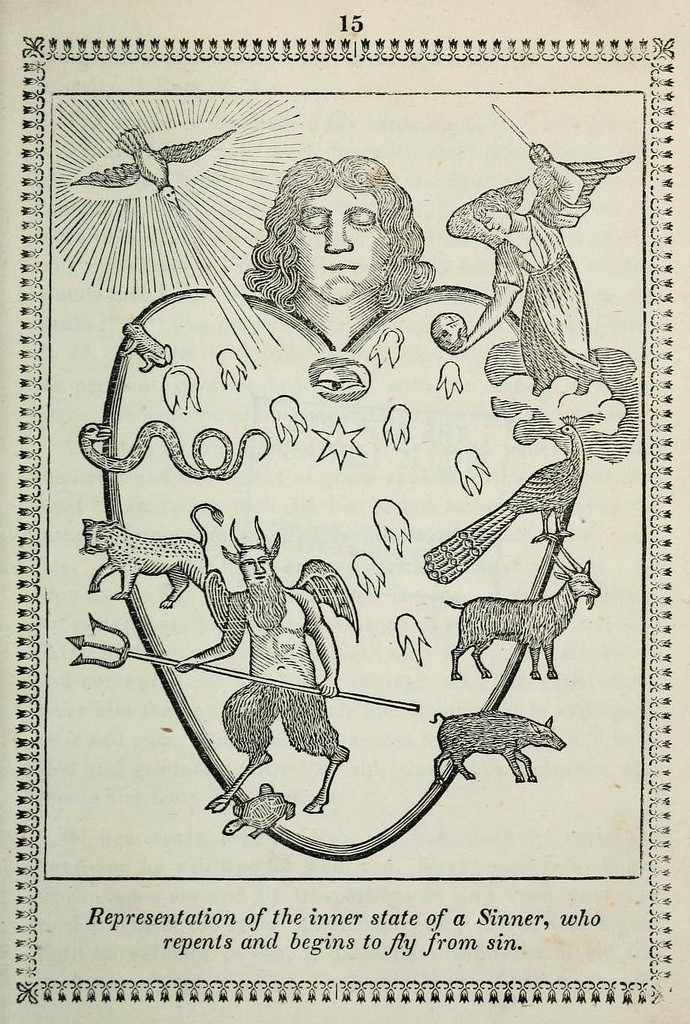
WOODCUT SERIES: Das Herz de Menschen (The Heart of Man): “The following illustrations—which, in a wonderful marriage of word and image, plot out the life of the Christian soul—form the central strain in The Heart of Man: Either a Temple of God, or a Habitation of Satan: Represented in Ten Emblematical Figures, Calculated to Awaken and Promote a Christian Disposition (1851), an English edition of a German book published in 1812 in Berlin by the ‘divine’ and philanthropist Johannes Gossner (1773-1858),” which was itself based on an older French text. The illustrations are not credited and are probably copies of ones that originated in France in the late seventeenth or early eighteenth century.
The Heart of Man

In his book The Forge of Vision (2015), visual studies scholar David Morgan contrasts this emblematic series with the related Cor Jesu amanti sacrum by Anton Wierix (which I wrote about here). Whereas the Wierix engravings from Antwerp are marked by sweetness, with the Christ child gently cleaning and setting up house in the human heart, the anonymous illustrations Gossner uses portray more of a psychomachia (battle for the soul), with armed angels seeking to oust Satan and his minions.

+++

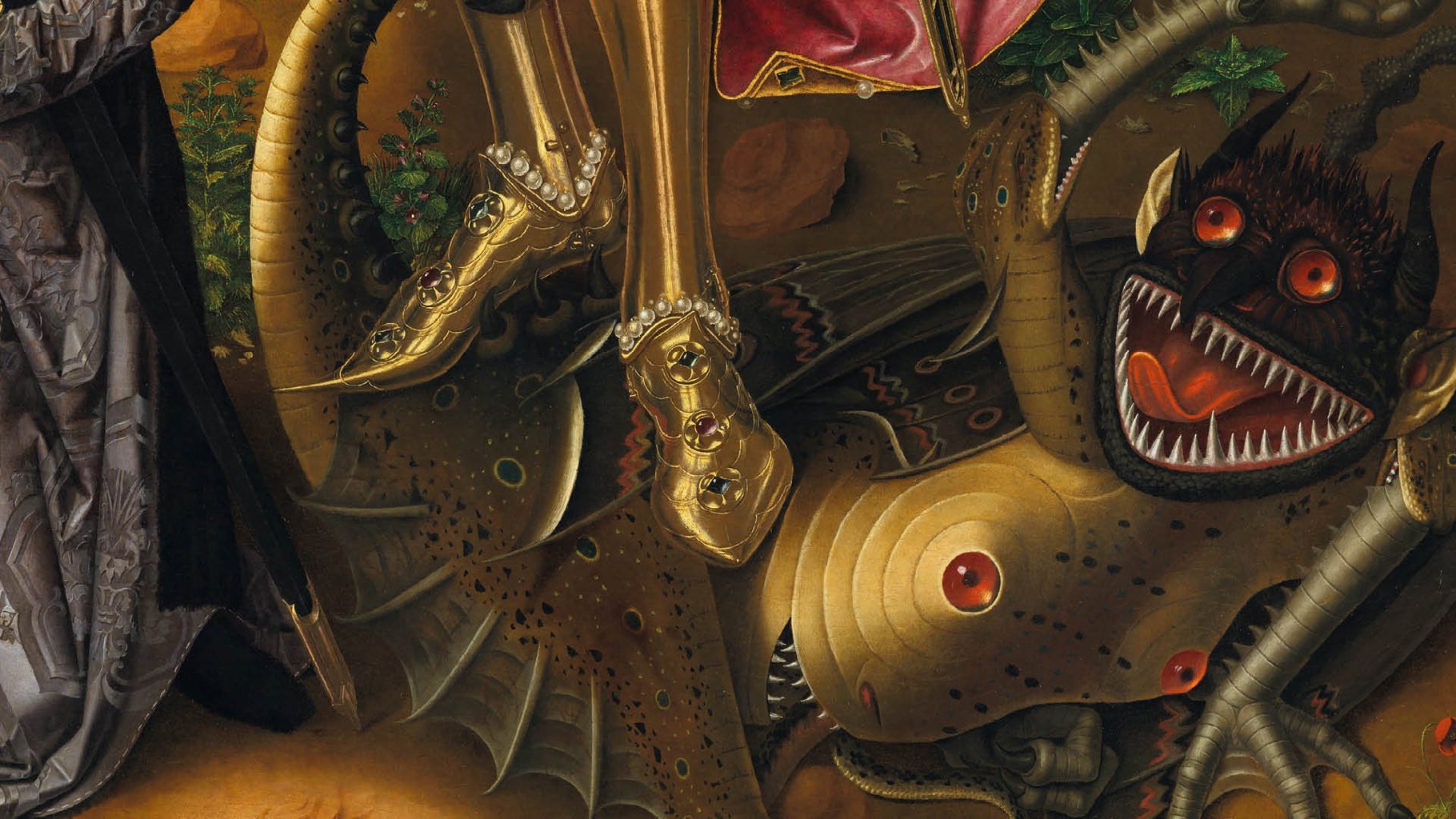
VIDEO: “How Bermejo paints good and evil in Saint Michael Triumphs over the Devil: In this nine-minute video, Daniel Sobrino Ralston, associate curator for Spanish paintings at the National Gallery in London, examines a late Gothic painting in the museum’s collection by the Spanish artist Bartolomé Bermejo, showing the archangel Michael slaying Satan. Based on Revelation 12:7–9, this subject gave artists the chance to flex their imaginations in portraying evil incarnate and its vanquishment. Possessing an impressive capacity for fantastical invention, Bermejo gives the devil snakes for arms, eyes for nipples, bird claws, moth-like wings, a spiky tail, and a cactus growing out of its head!
Bermejo, Bartolome_St. Michael (detail)
Bartolomé Bermejo (Spanish, ca. 1440–after 1495), Saint Michael Triumphs over the Devil (detail), 1468. Oil and gold on wood, 179.7 × 81.9 cm. National Gallery, London.

If this visual subject interests you, I recommend the book Angels and Demons in Art by Rosa Giorgi, from the J. Paul Getty Museum’s Guide to Imagery series.


Lent, Day 12

LOOK: Mr. & Mrs. Satan Fishing by Leroy Almon

Almon, Leroy_Mr. and Mrs. Satan Fishing
Leroy Almon (American, 1938–1997), Mr. & Mrs. Satan Fishing, 1991. Polychrome bas-relief wood carving, 22 1/2 × 24 in. Gordon Gallery, Nashville.

Leroy Almon (1938–1997) was born in Tallapoosa, Georgia, but grew up in Ohio. While working for Coca-Cola in Columbus, he met the self-taught woodcarver Elijah Pierce [previously] at Gay Tabernacle Baptist Church, where Pierce served as lay preacher, and in 1979 became apprenticed to him. Pierce taught Almon how to make low-relief carvings in wood using pocketknives and hand chisels, and then to paint them. Initially the two collaborated on pieces, until 1982, when Almon returned to Tallapoosa. There he restored his childhood home, converting the basement into an art studio. Like his mentor, he too combined the vocations of art making and evangelical preaching.

Almon is well known for his didactic carvings on the subjects of religion, politics, and African American history. The battle between good and evil is at the forefront of his art. Satan fishing for souls is a theme he developed and returned to many times in variation; see, for example, here, here, here, and here. Such carvings show a caricatured Satan (red, horned, spiky-tailed, and goateed) dangling various vices—gambling, promiscuity, sex, drugs, greed, hypocrisy, etc.—as bait before humans who appear ready to bite. Sometimes he’s joined by his wife, Mrs. Satan!

In the version at the Gordon Gallery in Nashville, cards, cash, a romantic couple (presumably unwed), alcohol, cigarettes, a bomb, hard drugs, and a church building are on the line. The latter symbolizes the false piety of many churchgoers and the corruption inside institutionalized Christianity.

In The New Encyclopedia of Southern Culture, Vol. 23: Folk Art, Jenifer P. Borum praises Almon’s ability to “mix fire-and-brimstone warnings about the world’s evils with a playful sense of humor”; she refers to the “comic moralism” of his work. My first reaction upon seeing Mr. & Mrs. Satan Fishing was to laugh out loud. But then I wondered whether the humor was intentional. Does the artist want us to chuckle? I haven’t been able to find any statements from Almon. The image likely represents very real temptations that afflicted his community and maybe, some of them, him personally. I suppose the humor could be self-conscious, but if so, it’s a dark humor—gravitas masked in levity. Almon knew that “like a roaring lion [our] adversary the devil prowls around, looking for someone to devour” (1 Pet. 5:8).

Leroy Almon
Leroy Almon on his front stoop in Tallapoosa, Georgia, 1987. Photo: Roger Manley.

LISTEN: “The Devil Ain’t Lazy” by Fred Rose; originally recorded by Bob Wills & His Texas Playboys, 1947 | Performed by Pokey LaFarge on Pokey LaFarge, 2013

The devil ain’t lazy (No siree)

He roams around with sticks and stones
Passing out his moans and groans
The devil ain’t no lazy bones
He works 24 hours a day

The devil ain’t lazy (No siree)

He likes to see us fight and fuss
Makes us mean enough to cuss
Then he blames it all on us
He works 24 hours a day

He travels like a lightning streak
And he strikes from town to town
Then he gets you when you’re weak
He’ll tear your playhouse down

The devil ain’t lazy (No siree)

He tells us he won’t hurt a fly
Then he makes us steal and lie
Keeps us sinning until we die
He works 24 hours a day

The devil ain’t lazy (No siree)

Gets his pitchfork out each night
Gives the folks an awful fright
I know he does it just for spite
He works 24 hours a day

The devil ain’t lazy (No siree)

Tells us how to find success
I know he’ll wind up in distress
I’ll tell ya why: the devil is an awful mess
He works 24 hours a day

He likes to see things scorch and burn
He don’t make no excuse
If he catches you, he’ll turn you
Every way but loose

The devil ain’t lazy (No siree)

So if you think you’re strong and brave
Smart enough to not behave
You got one foot in the grave
He works 24 hours a day
24 hours a day (Yes, he does!)
He works 24 hours a day

Lent, Day 5

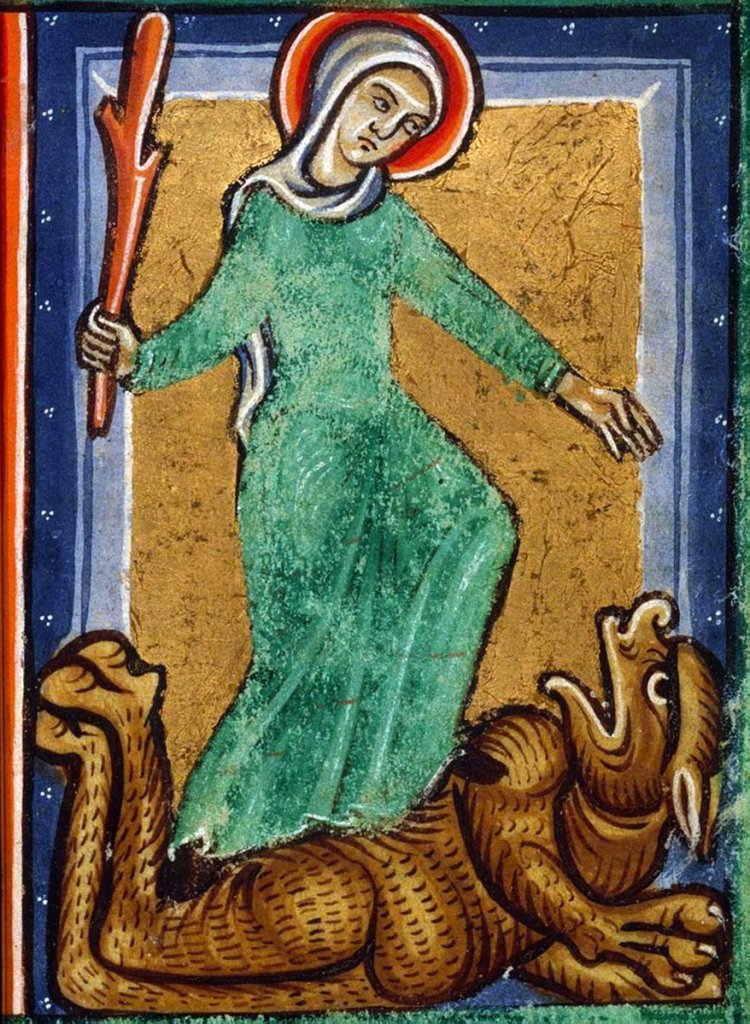
LOOK: (1) “St. Juliana of Nicomedia, the devil at her feet,” from a Picture Bible made at the Abbey of Saint Bertin, Saint-Omer, France, ca. 1190–1200. KB, 76 F 5, fol. 32r. Koninklijke Bibliotheek (Royal Library), The Hague, Netherlands. (2) “St. Juliana of Nicomedia binding the devil,” from the Passionary of Weissenau, made in Germany, 12th century. Codex Bodmer 127, fol. 44v. Fondation Martin Bodmer, Cologny, Switzerland.

St. Juliana of Nicomedia and the devil
St. Juliana binding the devil

Saint Juliana (ca. 286–ca. 304) was a Christian from Nicomedia in present-day Turkey—the eastern capital of the Roman Empire in her day—who suffered martyrdom under the Diocletian persecutions. Legend has it that she engaged in some serious combat with the devil, so in art she is sometimes shown beating him with a club, binding him with a rope or chain, or otherwise incapacitating him. Bam!

[Related post: “Stomp (Artful Devotion)”]

LISTEN: “Satan, Take Your Hands Off Me” by Essie Mae Brooks, on Rain in Your Life (2000)

. . .
Satan, take your hand off me.
I’m in God’s hand.
Jesus, my Jesus,
Has got his arm,
They wrapped all around me,
And the world can’t do me no harm.
. . .

Born in 1930, Essie Mae Brooks is a gospel singer-songwriter from Houston County, Georgia. Rain in Your Life is her debut album, which was followed up by I’ve Been Washed in the Water in 2002.

These two projects were financed by the Music Maker Relief Foundation, a nonprofit dedicated to preserving the musical traditions of the South by directly supporting the musicians who bear those traditions. Cofounder Tim Duffy realized, while studying folklore in college, that preservationists tended to focus on documenting and archiving rather than on taking care of the artists themselves, and he wanted to take a more people-centered approach. So he and his wife Denise launched the foundation in 1994, seeking to empower and sustain folk and blues musicians in and around Winston-Salem, North Carolina, and beyond.

Music Maker provides tour booking, management, and recording services to its artists in addition to grants, but more than that, it offers ongoing support that helps artists pay their bills. The organization focuses on the most vulnerable musicians: those over fifty-five who live on less than $25,000 a year.

To learn more, you can listen to the 2019 NPR segment “Capturing the Undersung Blues People of the Rural South” (or, from 2014, “Preserving American Roots Music Begins with Keeping the Lights On”). And visit the Music Maker website to explore more artists.

“Satan, Take Your Hands Off Me” by Essie Mae Brooks is featured on the Art & Theology Lent Playlist on Spotify.

Resist (Artful Devotion)

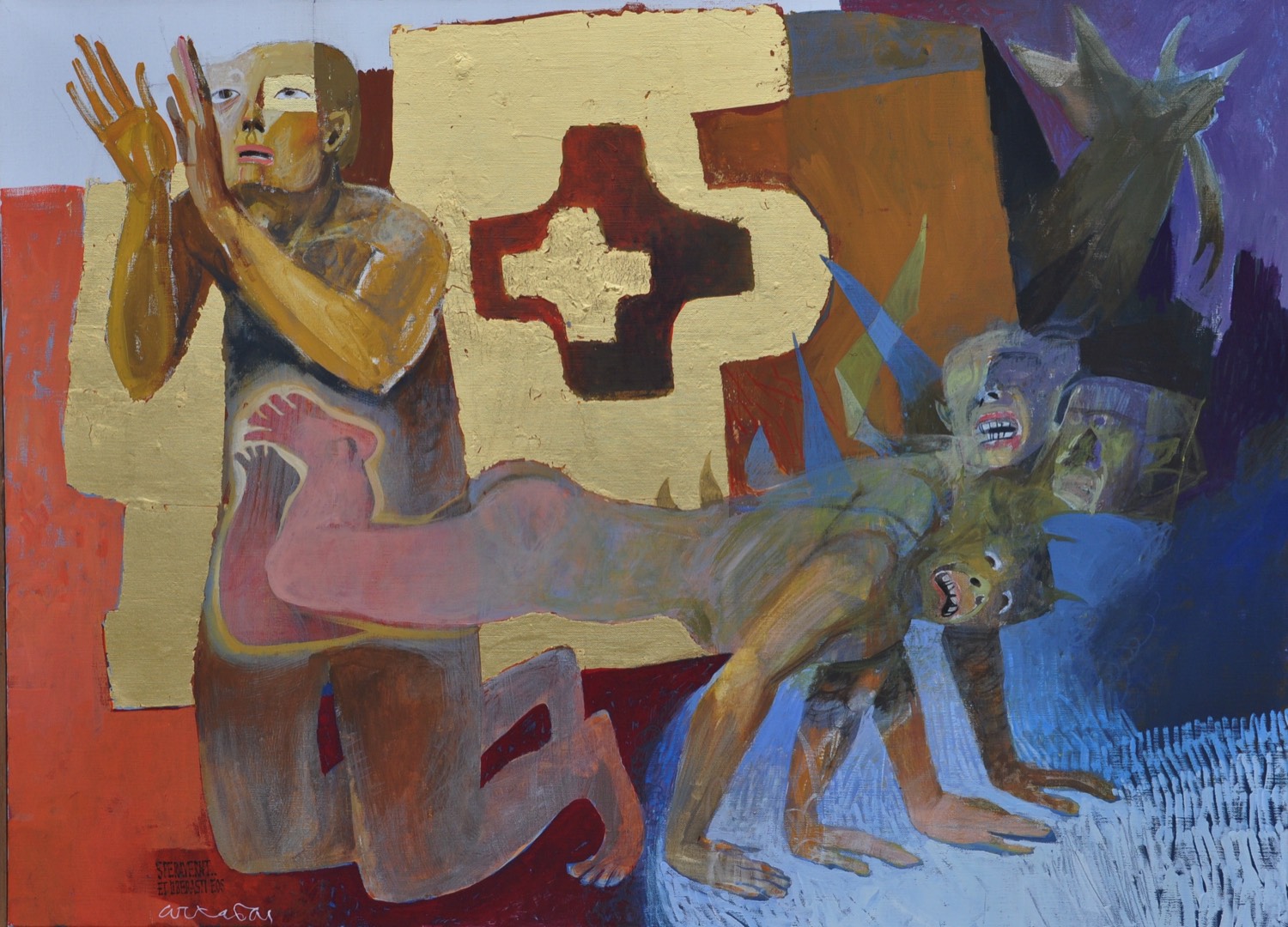
Prayer by Arcabas
Painting by Arcabas (French, 1926–2018)

Submit yourselves therefore to God. Resist the devil, and he will flee from you.

—James 4:7

+++

SONG: “Way Down in the Hole” by Tom Waits, on Franks Wild Years (1987)


This post belongs to the weekly series Artful Devotion. If you can’t view the music player in your email or RSS reader, try opening the post in your browser.

To view all the Revised Common Lectionary scripture readings for Proper 20, cycle B, click here.

“The Pleasure Principle” by Raymond Oliver

Who are you? Why do you not let me live
As I please? And how could your caress, so rough,
Be kinder than my smooth alternative?

Your steel-brush strokes are forcing me to slough,
Daily, my fleshy growths of appetite,
But still they come; I cannot have enough.

I would forever scratch my itches, light
At first, then harder at the thickened sore;
But you would give me radical delight,
Gouging my itches till I have no more.

“The Pleasure Principle” is published here with the permission of Southern Humanities Review, where the poem first appeared in Spring 1974.

+++

In this poem, sinful desires are characterized as skin sores whose itchiness is temporarily relieved when scratched—but the scratching also makes the sores become irritated and enlarged and even more vile-looking, and the itch comes back not too long after.

The speaker addresses God, first in a posture of defensiveness. God has presumably penetrated his conscience, illuminating his sin, and he responds with a string of accusatory questions to the effect of, “Who do you think you are, coming into my life, telling me what I can and can’t do? I am happy as I am, thank you very much.”   Continue reading ““The Pleasure Principle” by Raymond Oliver”