POEM SERIES: “Twelve Days of Advent” by Kate Bluett: This year on her blog, writer Kate Bluett [previously] is publishing a series of original metrical verses based loosely on the cumulative song “The Twelve Days of Christmas.” She calls it the Twelve Days of Advent and through it explores the theology of Christ’s coming. I love this creative, sacred spin on the popular seasonal ditty! Here’s where the series currently stands (my favorite poems are in boldface):
“A Partridge in a Pear Tree”: Bluett imagines, in the tree of the knowledge of good and evil, a bird singing (representing, as I take it, God’s word), but Adam and Eve heed not his song, and, taking the tree’s forbidden fruit, find themselves exiled. The bird weeps for the alienation of his two friends, and wings his way east of Eden, into the home of a young maiden, a daughter of Eve, who receives him, shelters him, an act that leads to restoration. Bluett uses some of the language of late medieval English folksong, such as “with a low, low, my love, my love” and “welaway.”
“Four Calling Birds”: This poem is brilliant. In it the four matriarchs in Jesus’s genealogy speak to Mary, tenderly calling her “Child” and rejoicing in her “bringing forth our life’s tomorrow.” Tamar, Rahab, Ruth, Bathsheba—they’ve long awaited redemption, and now they’re at its threshold. Mary’s yes to God’s call “set[s] [their] dry bones stirring, thrumming / with a hope [they’d] hardly dared.” They inform her that her vocation will involve great suffering (as we know, she’ll experience the brutal death of her son)—but her willingness to give up her son to the cross, to endure that rupture, will mean new life for the world.
“Six Geese a-Laying”: Picking up the Isaianic language of the wilderness being made glad, the poetic speaker sings an eschatological vision of flocks coming home to “the orchard of the rood” (rood = cross) to lay and hatch eggs in nests once empty, now brimming with life.
SUBSTACK SERIES: “Art + Advent 2025” by Elissa Yukiko Weichbrodt: The art historian Elissa Yukiko Weichbrodt [previously], author of Redeeming Vision and the Loving Look Substack, is one of my favorite writers. This Advent she is writing a weekly series of art reflections centered on the themes of hope, peace, joy, and love.
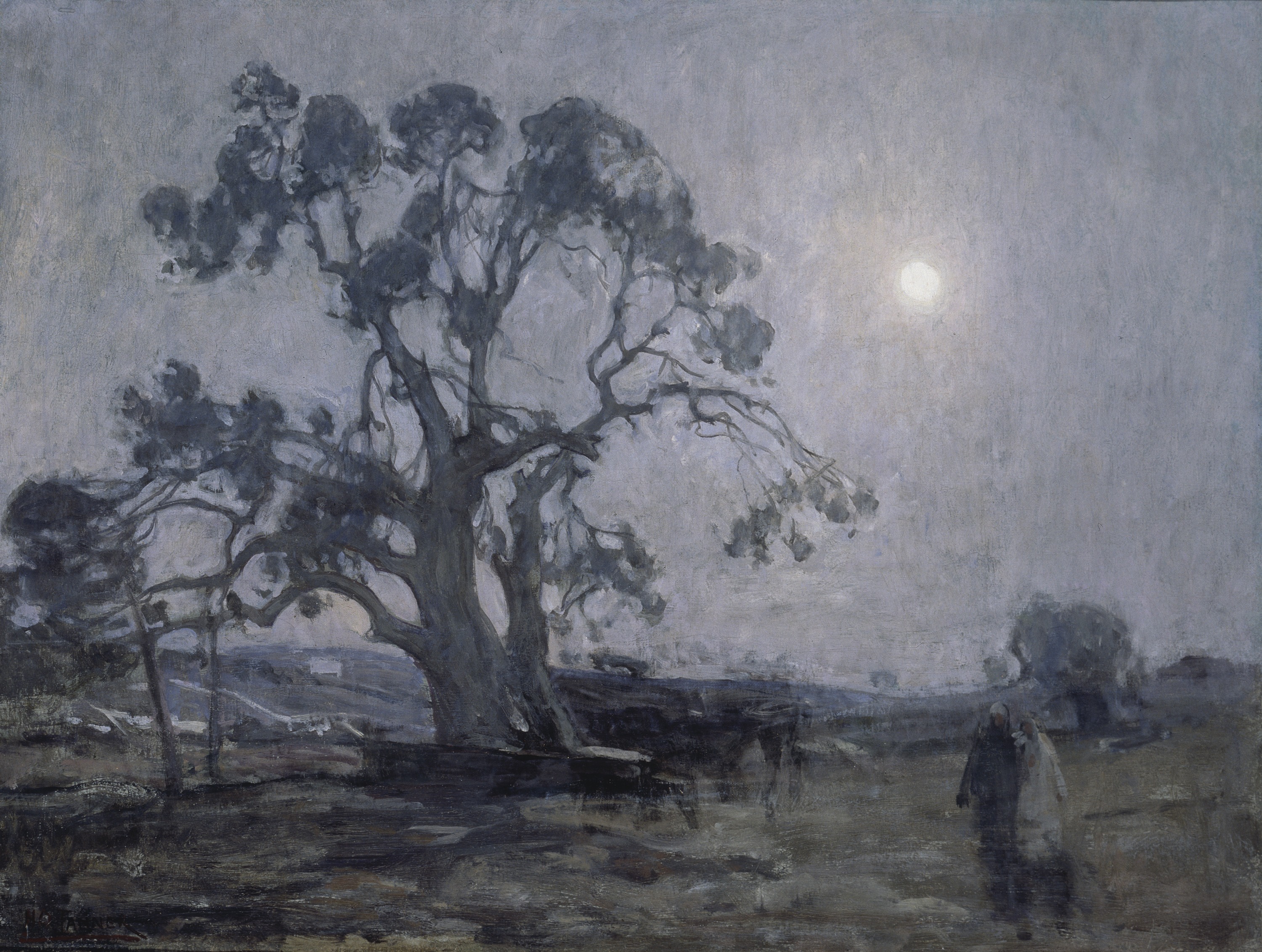
>> “Week 1 // Hope: Abraham’s Oak and Sarah’s Laughter”: Looking at Henry Ossawa Tanner’s painting Abraham’s Oak, Weichbrodt writes about shadowy promise. She also considers, with reference to an early Byzantine mosaic of the Hospitality of Abraham, how to hope again after being wounded, as Sarah did, is a vulnerable thing. “As Advent begins, I find myself peering into a Tanner-like mist, seeing the dim outline of longed-for goodness taking shape in the distance. Sometimes I’m full of hope, but I’m also, like Sarah, sometimes full of armored laughter.”
Henry Ossawa Tanner (American, 1859–1937), Abraham’s Oak, 1905. Oil on canvas, 21 3/8 × 28 5/8 in. (54.4 × 72.8 cm). Smithsonian American Art Museum, Washington, DC.
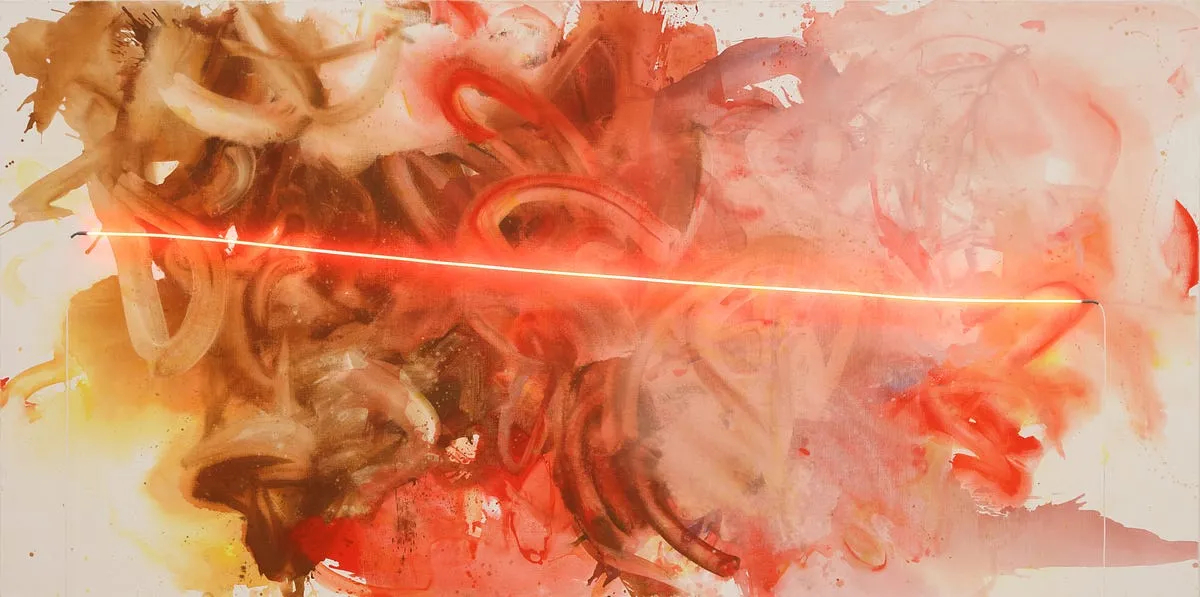
>> “Week 2 // Peace: A Stitch Pulling Tight”: “How do we do repair work in a fraying world with our own, fraying selves? What thread can stitch together all these gaping wounds?” Weichbrodt asks. She looks at Mary Weatherford’s monumental painting Gloria (new to me!), finding in the hot coral neon light blazing across the canvas resonance with Renaissance paintings of the Annunciation, which portray the Light of the World as the stitch that mends the tear between God and humanity.
Mary Weatherford (American, 1963–), Gloria, 2018. Flashe paint and neon on linen, 117 × 234 in. (297.2 × 594.4 cm). High Museum of Art, Atlanta.
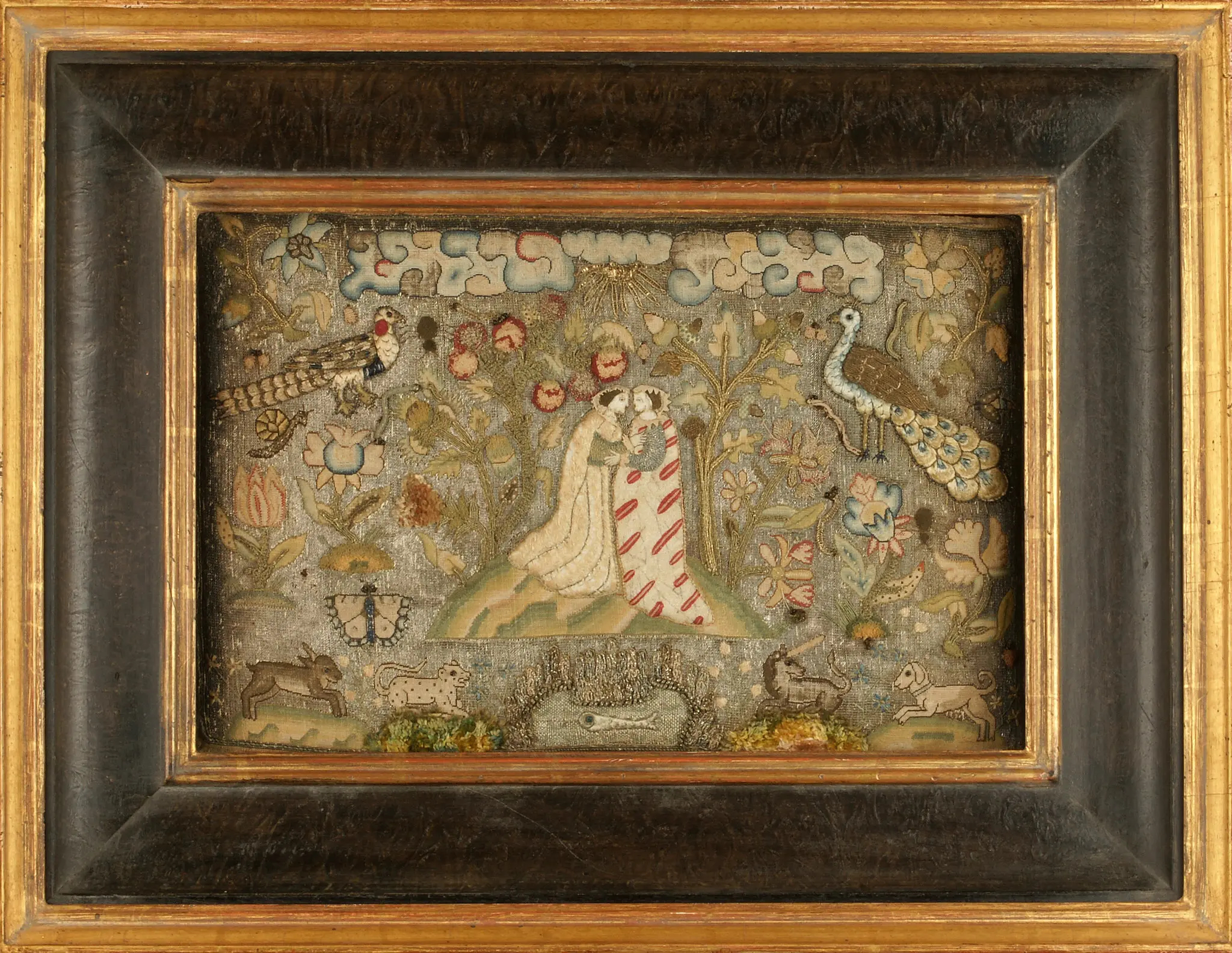
>> “Week 3 // Joy: Far as the Curse Is Found”: In this post, Weichbrodt explores nine Visitation paintings and one extraordinary embroidery. “Every time I see [a Visitation artwork],” Weichbrodt writes, “I encounter joy. It’s not that Mary and Elizabeth are always smiling. Often, their expressions are quite serious. But joy—deep, sustained, sustaining joy—circulates between them like an electrical current.” Justice, threshold, and fecundity are among the supplementary themes touched on.
The Visitation, England, first half of 17th century. Embroidery, 44.1 × 57 cm (framed). Ashmolean Museum, University of Oxford.
Weichbrodt’s final Advent 2025 post, on love, will be published this Saturday.
+++
SONGS:
Here are four newly released Christmas songs of note: two originals, one lyrical adaptation of a classic, and a new arrangement.
>> “War on Christmas” by Seryn:Seryn’s new album is titled War on Christmas. Here’s the title track:
The refrain is:
There is a war on Christmas But it’s not the one you think It’s in the news, it’s out of mind It happens overseas Cause as we sing the hymns and songs With families by our sides There is a war on Christmas Someone’s fighting to survive
“War on Christmas” is a phrase some Christian conservatives in the US use to express their feeling of having their faith traditions attacked by the sinister forces of pluralism when people or signage greet them with a generic “Happy Holidays” instead of “Merry Christmas.” I roll my eyes big-time when I hear people complain about this, because it’s ridiculous for any American to assert that they are impeded from or ostracized for celebrating Christmas in this country, or to take offense that a stranger does not automatically assume their particular religious affiliation.
Seryn’s song affirms that yes, there is a war on Christmas—only it’s a war not against personal religious freedoms in America but against peace, love, and the other values Christ came to teach and embody. When humans wage literal wars with literal weapons, killing and maiming each other and inducing mass terror—that’s an assault against Christ’s mass, with its message of welcome and reconciliation. So, too, when we perpetuate hate, whether on personal, national, or global scales. As another Christmas song puts it, “Hate is strong and mocks the song of ‘Peace on earth, goodwill to men.’”
>> “O New Commingling! O Strange Conjunction!” by the Anachronists: The lyrics to this new song by the Anachronists [previously]—Corey Janz, Andrés Pérez González, and Jonathan Lipps—are a paraphrase from the sermon “On the Theophany, or Birthday of Christ” by Gregory of Nazianzus (ca. 329–390), one of the most influential and poetic theologians of the early church. Gregory delivered the sermon, labeled “Oration 38” in the Nicene and Post-Nicene Fathers series, at Christmastime in 380 in Constantinople, where he served as bishop. In section 13, the Anachronists’ source for the song, he expresses awe at the beautiful mystery of the Incarnation. Below is an excerpt from the public-domain NPNF translation.
The Word of God Himself—Who is before all worlds, the Invisible, the Incomprehensible, the Bodiless, Beginning of Beginning, the Light of Light, the Source of Life and Immortality, the Image of the Archetypal Beauty, the immovable Seal, the unchangeable Image, the Father’s Definition and Word—came to His own Image, and took on Him flesh for the sake of our flesh, and mingled Himself with an intelligent soul for my soul’s sake, purifying like by like; and in all points except sin was made man. . . . O new commingling; O strange conjunction; the Self-Existent comes into being, the Uncreate is created, That which cannot be contained is contained. . . . He Who gives riches becomes poor, for He assumes the poverty of my flesh, that I may assume the richness of His Godhead. He that is full empties Himself, for He empties Himself of His glory for a short while, that I may have a share in His fullness. What is the riches of His goodness? What is this mystery that is around me? I had a share in the image; I did not keep it; He partakes of my flesh that He may both save the image and make the flesh immortal. He communicates a second Communion far more marvelous than the first.
>> “Away in a Manger (Then to Calvary)” by Sarah Sparks: Singer-songwriter Sarah Sparks [previously] released a new EP, Christmas Hymns, last month, comprising five classic carols, including one with revised lyrics that further draw out the significance of the Incarnation. I’m a big fan of Sparks’s voice and her no-frills acoustic style.
Away in the manger No crib for a bed The great King of Heaven Does lay down his head The stars he created Look down where he lay The little Lord Jesus Asleep on the hay
And there in the manger The Maker of earth In riches and glory? No, born in the dirt With oxen and cattle With shepherds and sheep No stranger to weakness He loves even me
And there in the manger Is our Servant-King He sits with the lowly He washes their feet Away in the manger Then to Calvary His birth, life, and death And his raising for me
And there in the manger Is my greatest friend His mercy, his patience His grace know no end Be near me, Lord Jesus For all of my days In life and in death Till we meet face to face
>> “Angels We Have Heard on High” by the Petersens: Last Friday the Petersens [previously] released a music video—shot at Wonderland Tree Farm in Pea Ridge, Arkansas—debuting their new bluegrass arrangement of one of my favorite Christmas carols. Banjo, mandolin, fiddle, acoustic guitar, dobro, upright bass—I love the instrumentation of the bluegrass genre and what it adds here, and the Petersens are consummate performers.
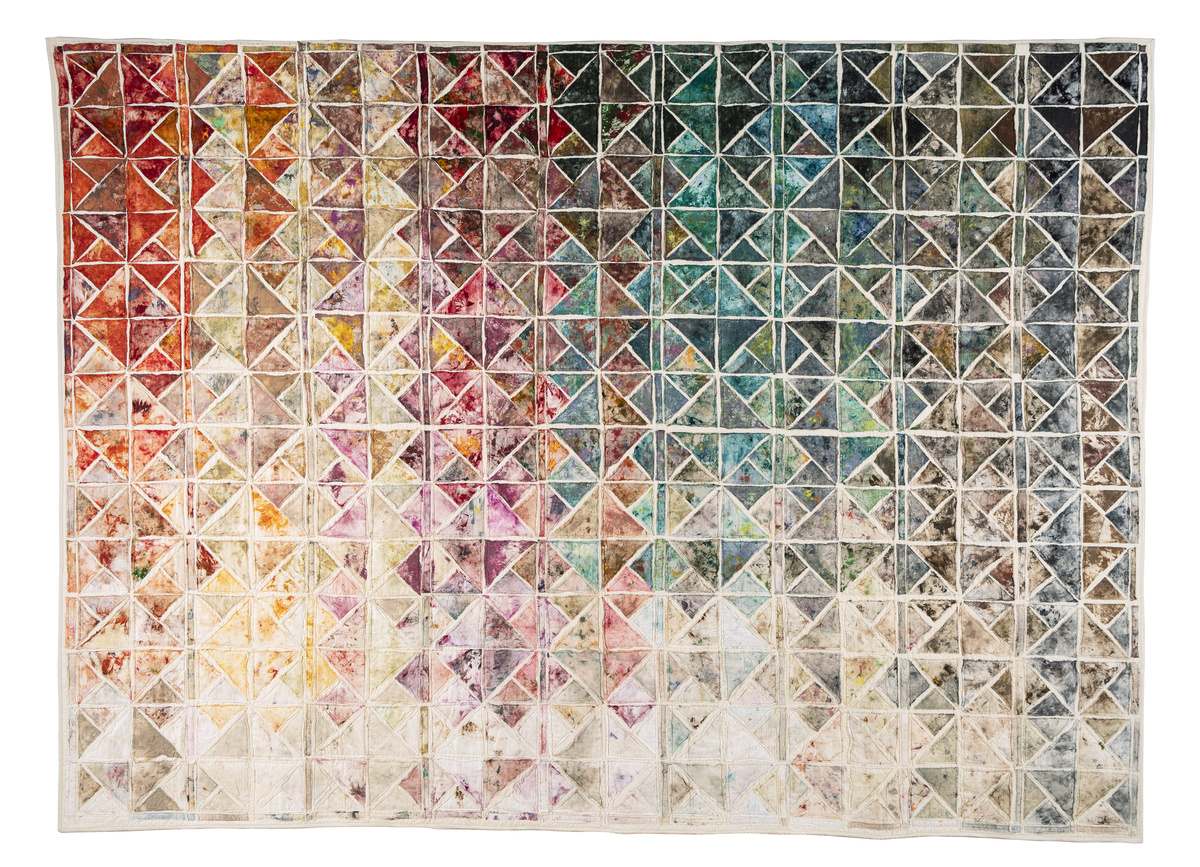
LOOK: the rain bows and the rainbows by Katy Mixon
Katy Mixon (American, 1984–), The rain bows and the rainbows (one day we will switch sides), 2018. Oil paint and used hand rags on muslin, 100 × 138 in.
I saw this quilt by Katy Mixon in December 2021 at the exhibition Break the Mold: New Takes on Traditional Art Making at the North Carolina Museum of Art. I was struck first by its prismatic color, and then by its title—which, the artist told me, comes from a dream she had after her close friend died. To bow, long o, is to bend into a curve; as a noun, a bow is a weapon used to propel an arrow, or a knotted ribbon typically worn by young girls. To bow, short o (as in “ow”), is to incline in respect or submission. The multiple meanings of this homograph open the title to different readings.
But the overall meaning points to the multihued arc that appears in the sky after a rainfall, as sunlight refracts through water vapor.
In the Judeo-Christian tradition, the rainbow is a sign of God’s covenant with Noah and has come to symbolize divine promise more generally, or hope—after the bleakness, beauty.
Mixon’s making process involves upcycling rags, which is itself a kind of redemptive act, saving used scraps and piecing them together into a new whole.
“Katy Mixon’s ‘quilts’ began as an outgrowth of her painting process,” the NCMA exhibition text read. “She routinely wipes her hands, palette knives, and other tools with baby wipes, which she then tosses into her studio’s garbage can. ‘One day [I] looked at the trash and realized it was full of all this hastily discarded color,’ she notes. She began saving the vibrant detritus with no specific purpose in mind, but after remembering her grandmother’s homemade quilts and discovering the famed African American quiltmakers of Gee’s Bend, Alabama, Mixon had a plan for her colorful scraps. ‘For me, the quilted works are alternate endings in the painting’s life cycle,’ Mixon says. ‘Painting as a practice, with the used rags as kaleidoscopic evidence.’”
Describing her technique, Mixon told me: “I compose the pieced tops and work with local longarm quilters to add the batting and backing. I finish each piece with hand stitching, often using crewel embroidery to define brush marks and tonal variations.”
LISTEN: “Joyful” | Words by Kate Bluett | Music by Paul Zach | Performed by Paul Zach with Taylor Leonhardt and Nick Dahlquist, on Christmas Hymns (2022)
The MP3 file of the song is embedded here with Paul Zach’s permission.
Come, O Lord, and make us joyful as you came to Mary’s womb; buried deep beneath our sorrows, where our hopes take root and bloom. Be the promise that sustains us through the seasons of the years, ’til at last we see your radiance when you shine beyond our tears.
Come, O Lord, and show your mercy as you came in Bethlehem; let us see the sunlight bursting through the shadows once again. Let us hear the song of glory where the silence held us fast. We will come to you rejoicing from the shackles of the past.
Come, O Lord, as living water; make our deserts green again, where the wellspring of our laughter will refresh us like the rain. After all the years of waiting for the promise long foretold, come at last, and let the day break in the morning of your joy!
LOOK: The Wise and Foolish Virgins, Norwegian tapestry
The Wise and Foolish Virgins, Norway, 17th century. Wool, bast fiber, 83 1/2 × 61 in. (212.1 × 154.9 cm). Minneapolis Institute of Art, Minneapolis, Minnesota.
The golden age of Norwegian tapestry (billedvev) spans roughly 1550 to 1800. Of all the woven subjects during this period, the Wise and Foolish Virgins was the most popular. The art historian Thor B. Kielland registered a total of seventy-five such tapestries from the seventeenth century alone. Draped over a bed, they would have provided warmth, decoration, and moral instruction. I love their aesthetic!
Jesus’s parable of the wise and foolish virgins comes from Matthew 25. Ten young women are members of a bridal party, and they’re awaiting the arrival of the bridegroom so that the celebration can start. In the tapestry pictured here, the top figures represent the wise virgins, whose oil-filled lamps indicate their readiness to accompany the bridegroom to the wedding feast. Those in the lower register, however, foolishly allowed their lamps to burn out; they weep into their handkerchiefs because the feasting started when they were out replenishing their oil supply, and now they’re too late.
That’s Christ the bridegroom in the upper right.
If I’m honest, this parable is uncomfortable for me. I don’t like that the neglectful women are locked out of the party. I don’t want anyone who wants in to be turned away. I want the bridegroom to show them grace, as the landowner did the day laborers who worked the vineyard for only one hour, giving them the same wage as those who worked for nine. But the parable of the virgins, with its stark sense of finality, is one of Christ’s teachings, so I want to grapple with it, not simply ignore it to suit my own proclivities.
I learned much about the existing body of Ten Virgins tapestries from rural Norway from Laura Berlage’s webinar “Dressing the Wise and Foolish Virgins: What Tapestry Can Teach Us About Women, Dress, and Culture in 16th and 17th Century Norway,” presented on July 17, 2023. She says the tapestries were made by women (unlike those produced by the guilds in Flanders and Paris), for women (they were used as bridal coverlets and included in dowries). They preached preparedness for young wives. “Good comes to those who are prepared,” Berlage elaborates; “you can’t get to heaven by borrowing someone else’s spiritual work.”
Regarding the headwear, Berlage clarifies: “The crowns the virgins wear are not because they’re princesses. There is a special tradition in Norway of wearing a crown at your wedding, which is an ancient nod to the Norse goddess Freja (later said to be an emblem of the Virgin Mary).”
Over time, Berlage says, the original meaning of the parable got lost, such that weavers no longer differentiated between the two sets of virgins, for example. She calls this phenomenon “image decay” and compares it to the telephone game.
For a shorter, less academic lesson on the ten virgins in Norwegian tapestry, see the six-minute video “Woven Wise and Foolish Virgins” by Robbie LaFleur:
LISTEN: “Himmelriket Liknas Vid Tio Jungfrur” (The Kingdom of Heaven Is Like Unto Ten Virgins) | Words from Then Swenska Psalmboken (The Swedish Hymnbook), 1697 | Traditional melody from Mockfjärd, collected by Nils Andersson in 1907 from Anders Frisell | Performed by Margareta Jonth on the album Religious Folk-Songs from Dalecarlia, 1977, reissued 1994
Himnelriket liknas vid tio jungfrur som voro av olika kynne. Fem månde oss visa vår tröga natur Vårt sömnig och syndiga sinne. Gud nåde oss syndare arma.
Vår brudgum drog bort uti främmande land Och månde de jungfrur befalla Sig möta med ljus och lampor i hand Enär som han ville dem kalla. De fävitske dröjde för länge.
De ropa: O Herre, o Herre låt opp, Låt oss icke bliva utslutna! Men ute var nåden, all väntan, allt hopp Ty bliva de arma förskjutna Till helvetets jämmer och pina.
Så låter oss vaka och hava det nit Att tron och vår kärlek må brinna. Vi måge här följa vår brudgum med flit Och eviga salighet finna. Det himmelska bröllopet. Amen.
The kingdom of heaven is like unto ten virgins Who were of different character. Five showed us our slothful nature, Our sleepy and sinful selves. God have mercy on us poor sinners.
Our bridegroom traveled in foreign lands And ordered the virgins To meet him with lighted lamp in hand Whenever he called them. The foolish ones waited too long.
They cry, “O Lord, O Lord, open up, Let us not be locked out!” But it was too late for mercy, for waiting, for hope, For the poor souls were cast Into hell’s wailing and torment.
So let us watch and show zeal That faith and our love may burn. Let us follow our bridegroom diligently And find eternal bliss, The heavenly wedding. Amen.
This month I traveled to parts of Germany and Belgium to experience some of the art of those countries, with a focus on medieval religious art. In Brussels, besides exploring the famous Oldmasters Museum (part of the Royal Museums of Fine Arts of Belgium), I visited the lesser-known Art and History Museum, whose collection includes not just western European art from prehistoric times through the nineteenth century, but also art from Asia (China, Korea, India, Pakistan, Afghanistan, Sri Lanka, Tibet, Nepal, Turkey, Iran, Cambodia, Thailand, Burma), Oceania, the pre-Columbian Americas, and ancient Egypt, Greece, and Rome.
I spent the most time with the medieval European art on the ground floor—wooden statuettes, ivory and alabaster carvings, stained glass, paintings, metalworks, and tapestries. With the Google Translate app open, I hovered my phone over the Dutch and French descriptive labels to read them in English.
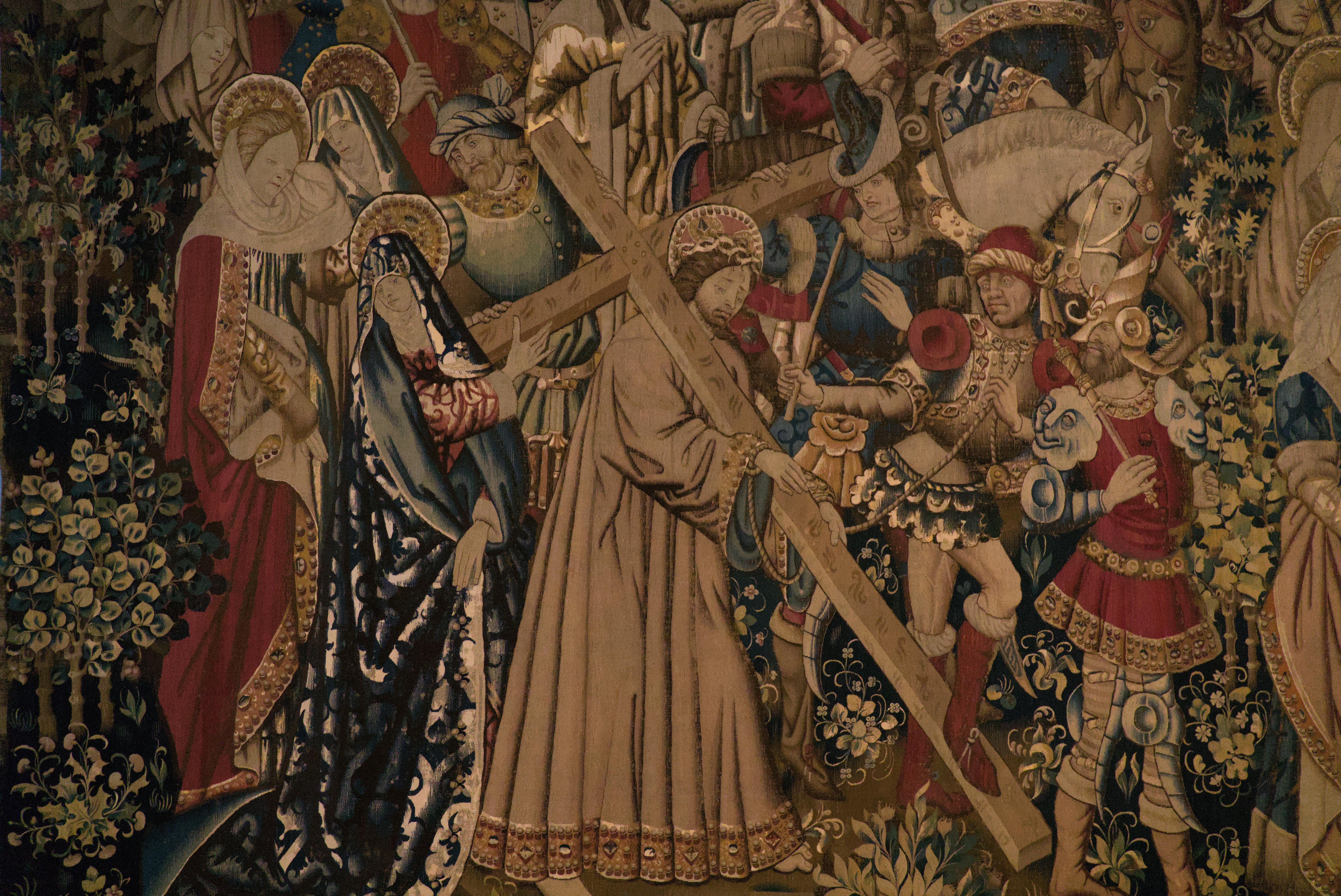
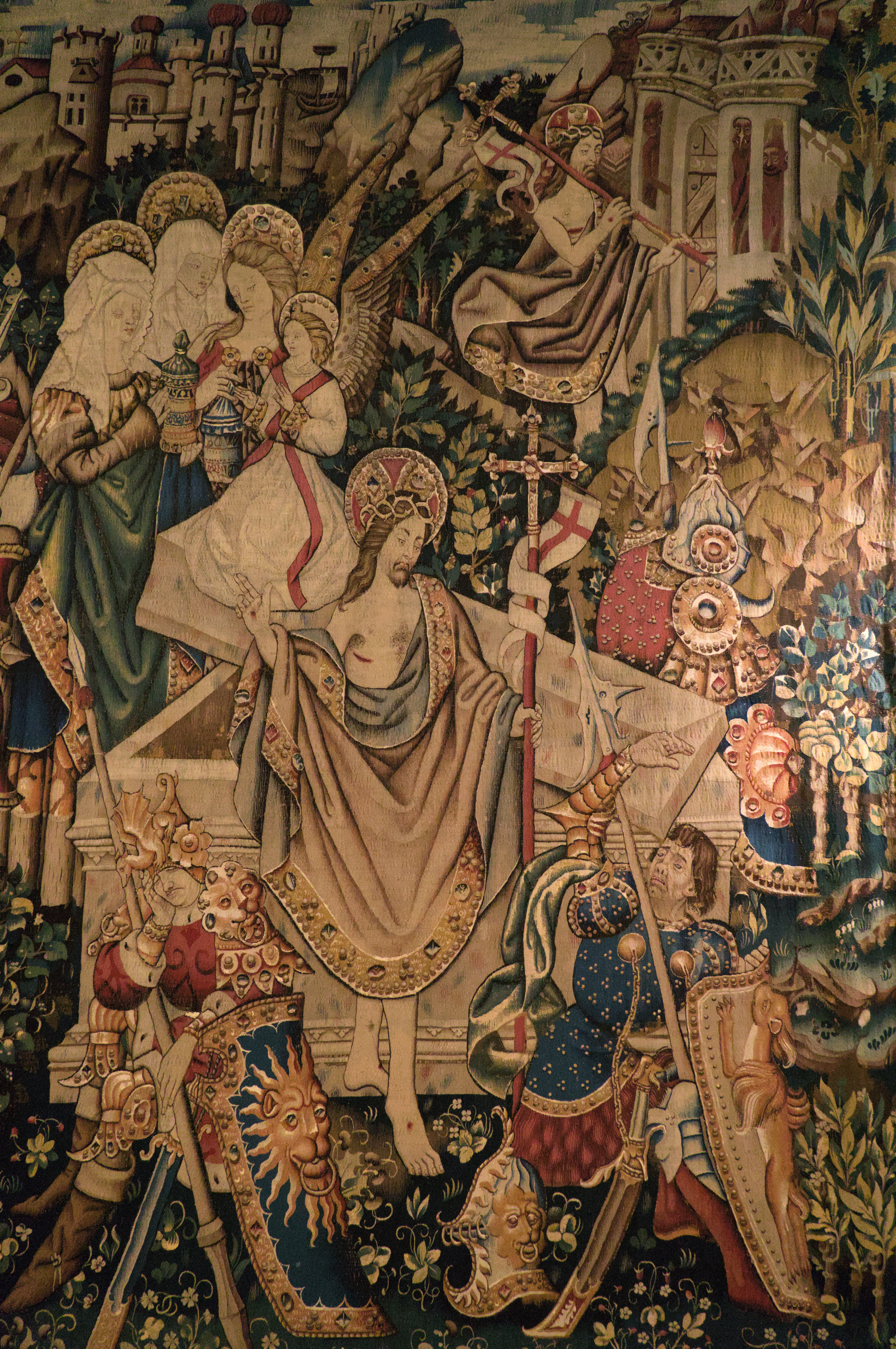
My favorite tapestry I saw, from fifteenth-century Tournai, portrays three scenes from the passion of Christ: Christ Carrying the Cross, the Crucifixion, and the Resurrection. The museum gallery it’s displayed in also houses a large medieval loom, which is what’s protruding at the bottom right corner of the following photo.
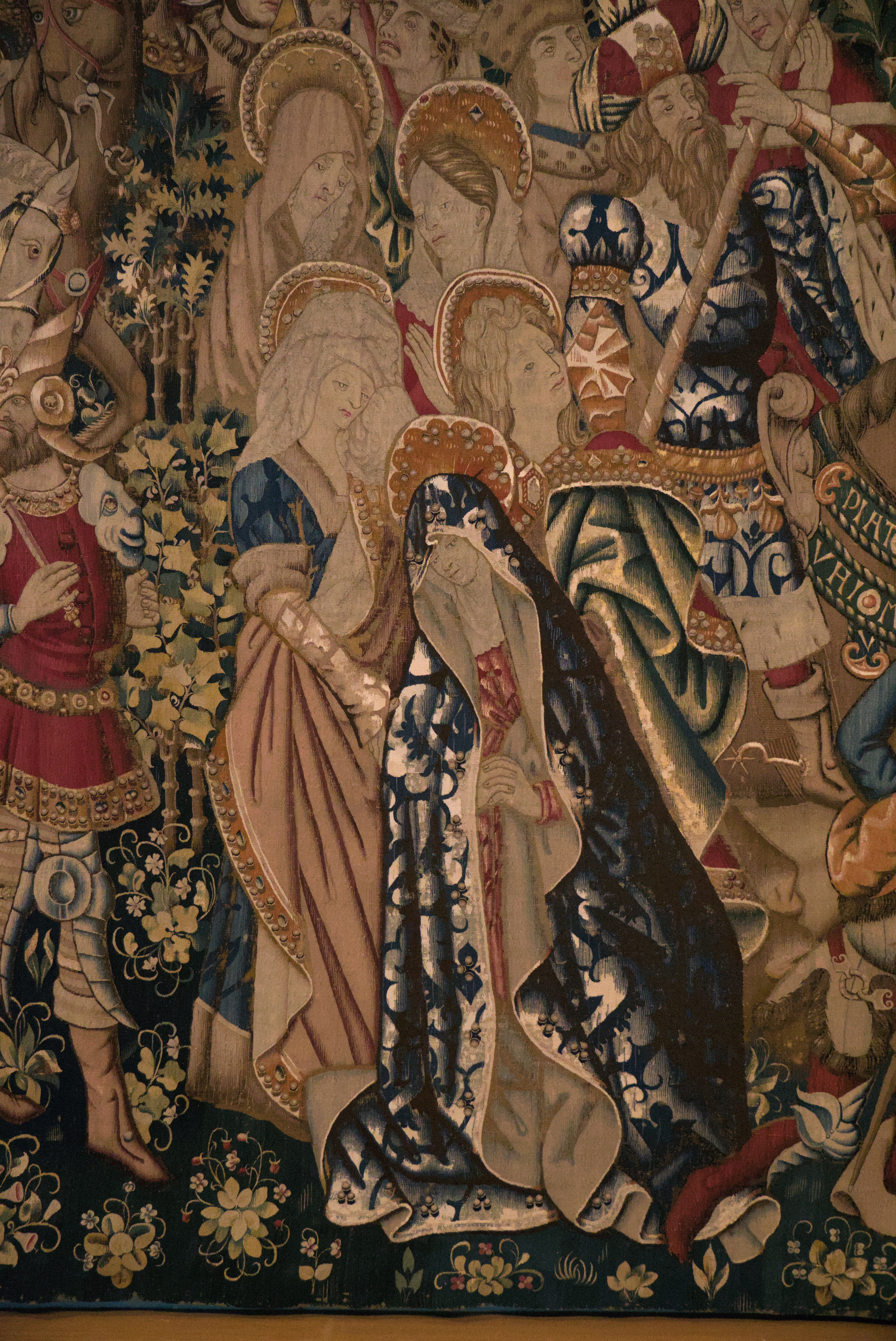
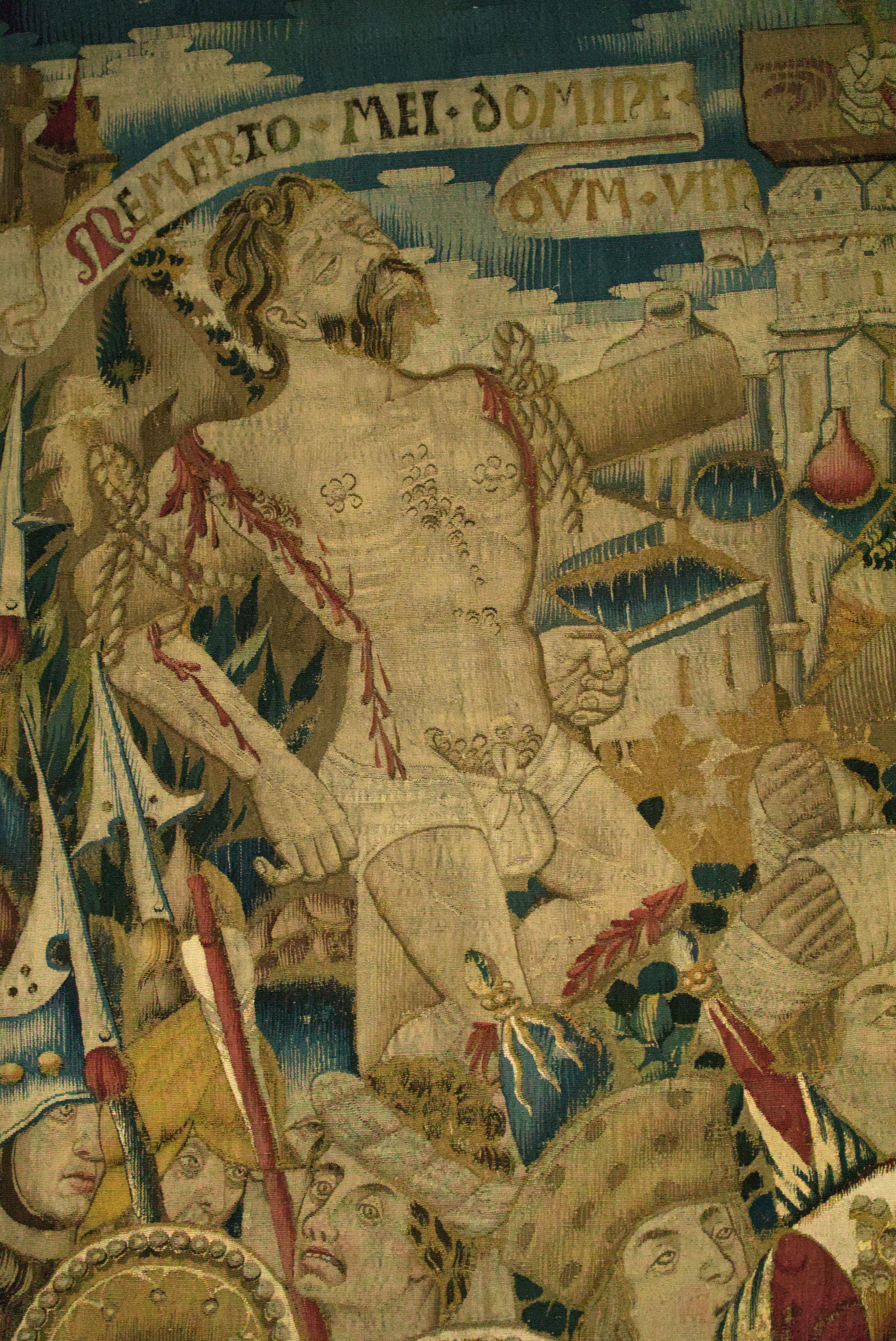
Scenes from the Passion, Tournai, ca. 1445–55. Tapestry of wool and silk, 424 × 911 cm. Art and History Museum, Brussels, Belgium, Inv. 3644. All photos by Victoria Emily Jones.
Tapestries made in the Flemish city of Tournai were among the most sought after in the fifteenth century. These large-scale wall hangings were bought by royalty, nobles, and high-ranking clergy to decorate their palaces. This one, nearly thirty feet long, is the second of a two-part hanging whose first part (portraying Christ’s Entry into Jerusalem, the Last Supper, and the Arrest of Christ) is in the collection of the Vatican.
Below are some detail shots.
First, Christ carries his cross. A soldier pulls him forward by a rope tied to his wrists, while tauntingly standing on the vertical wood beam and hitting him with a baton. On a less serious note, those are some spiffy face-shaped shoulder scales on the right.
Christ crucified:
A group of four women mourn—the Virgin Mary up front in the blue mantle, backed by three other Marys—alongside a curly-haired apostle John in green.
On Christ’s right (the viewer’s left), the penitent thief, with his last breaths, says, Memento mei, Domine, dum ven[eris in regnum tuum] (Remember me, Lord, when you come into your kingdom) (Luke 23:42).
The pointing man below the cross to Christ’s left, our right, is the Roman centurion (officer in command of one hundred soldiers) who, when Jesus died, proclaimed, Vere filius Dei erat iste (Truly this man was the Son of God!) (Matt. 27:54; Mark 15:39; cf. Luke 23:47).
On the other side of the cross, a Roman spearman, to whom tradition gives the name Longinus, points to his eyes. That’s because according to a medieval legend, Longinus was blind, but when he pierced Jesus’s side to verify his death, some of the blood from the open wound fell into Longinus’s eyes and restored his sight, after which he confessed allegiance to Christ.
Despite these three stories—two biblical, one apocryphal—of Christian conversion at the cross, Christ’s death did not move all the hearts of those present. At the base of the cross, two men fight with knives over Christ’s garment, their greed and aggression a foil to Christ’s selflessness and gentleness, and an example of the sin he came to redeem us from.
And again, pacifist though I am, I can’t help but remark on the fine-looking armor in the crowd:
The right-most third of the tapestry portrays vignettes of the Resurrection.
At the bottom, Christ emerges triumphant from his tomb, holding a banner in one hand and bestowing blessing with the other.
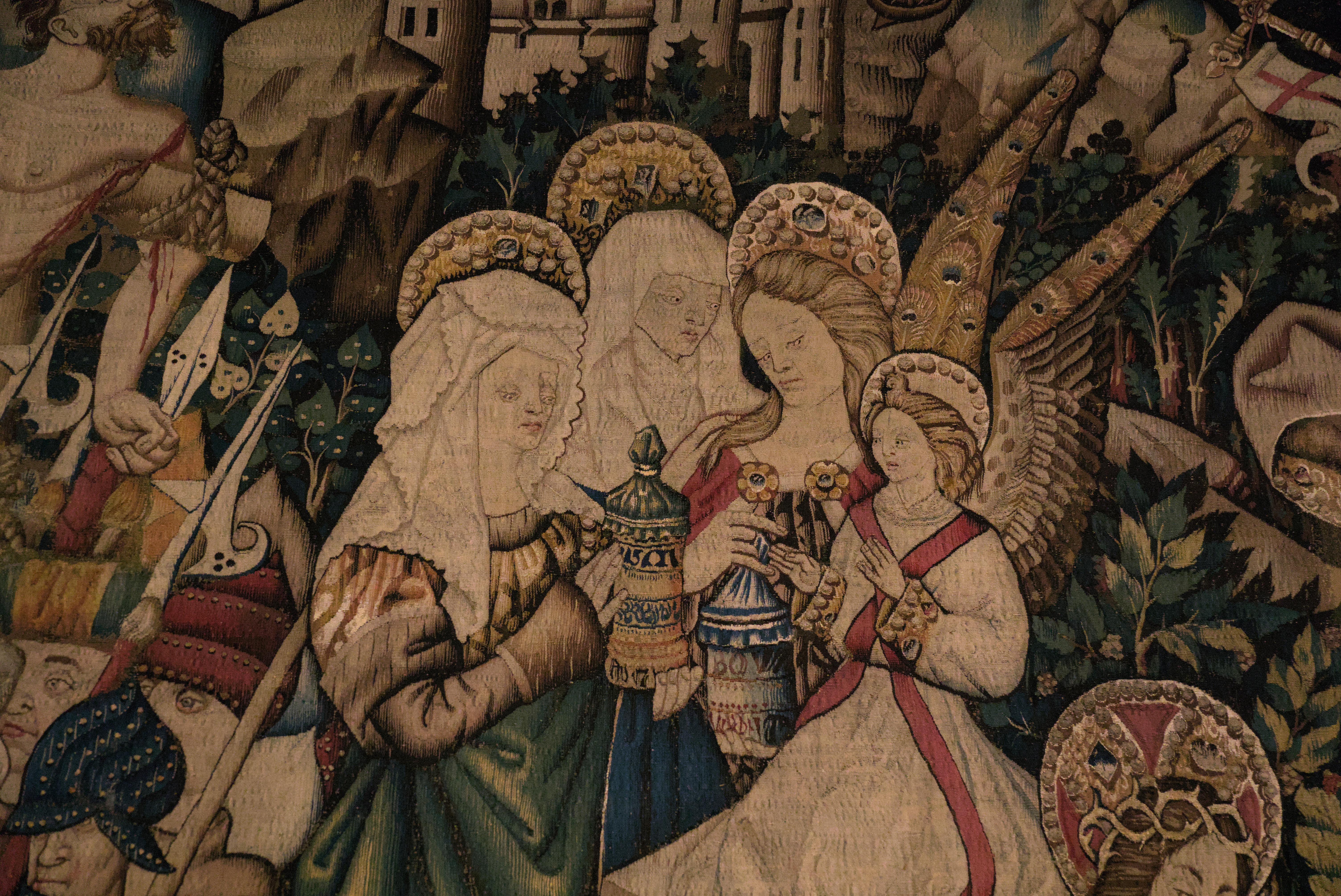
In the middle ground, the three Marys arrive at the empty tomb, ointments in hand, where they meet an angel who informs them that Christ has risen from the dead. Mary Magdalene is the one with her hair uncovered.
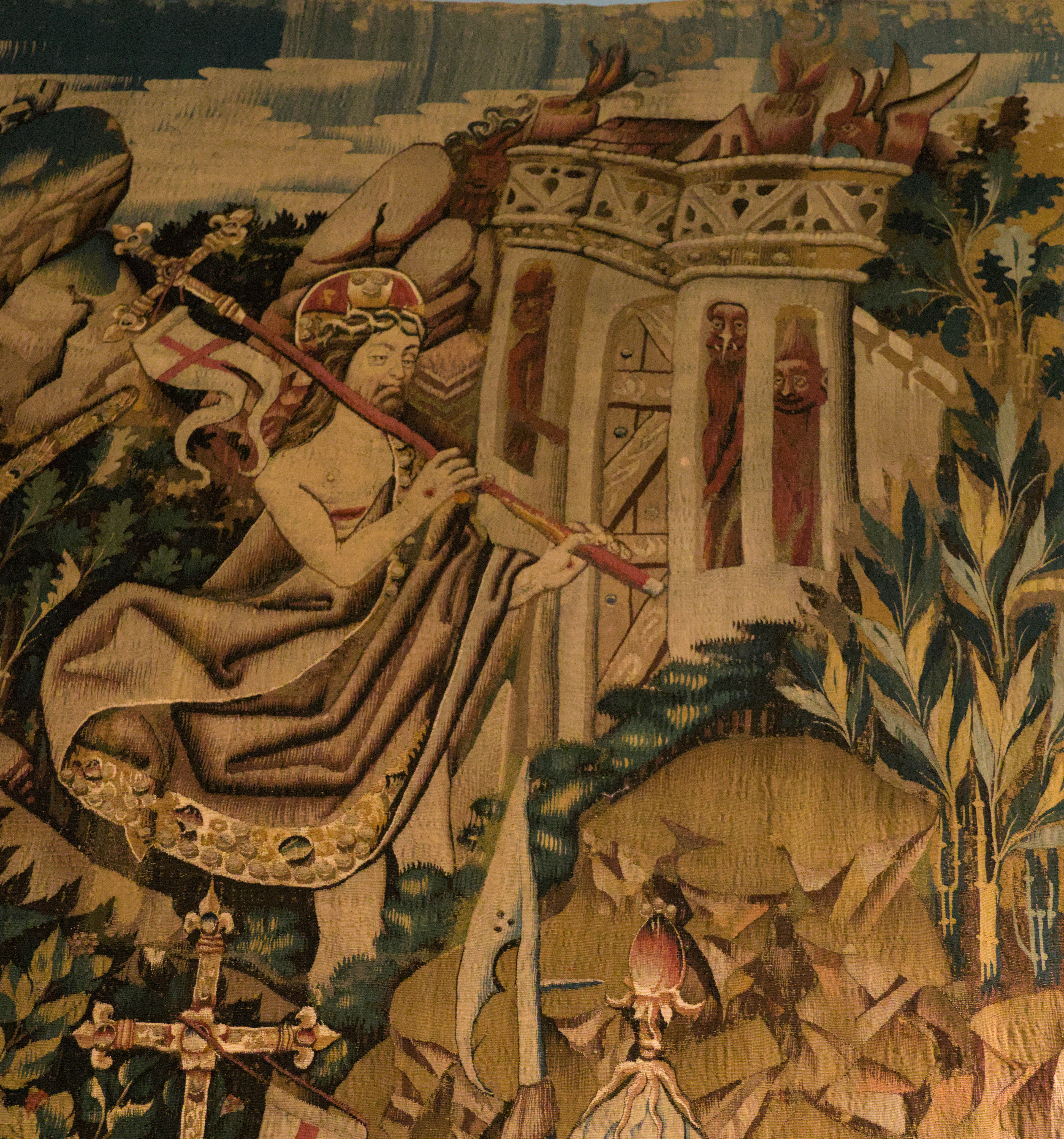
The risen Christ appears again at the top right, harrowing hell, a realm that is represented as a turreted fortress from whose windows fiery red demons glower and smirk. Christ has come to break down the doors and release the Old Testament saints being held captive—that is, those who died trusting in Yahweh and who were awaiting Christ’s redemption in the netherworld.
Let’s zoom in closer, shall we?
This is just one of the many artistic treasures, woven and otherwise, at Brussels’ Art and History Museum. I highly recommend a visit! I easily spent several hours there.
Chagall’s Peace Window is one of the most significant works in the United Nations’ art collection. On my quick visit to New York City last month, where the UN is headquartered, I was hoping to see it, but I emailed ahead of time and found out it’s not currently available for viewing due to construction behind it. (You can “see” it but not really, because it’s not lit, and there’s a tall plastic barrier in front.) I was disappointed, but I decided to visit the UN anyway, to see what other art I might find.
The United Nations was founded in 1945 for the purpose of preventing a third world war. Comprising 193 member states, the organization is committed to maintaining international peace and security, developing friendly relations among nations, and promoting social progress, better living standards, and human rights. Their motto is “Peace, dignity, and equality on a healthy planet.”
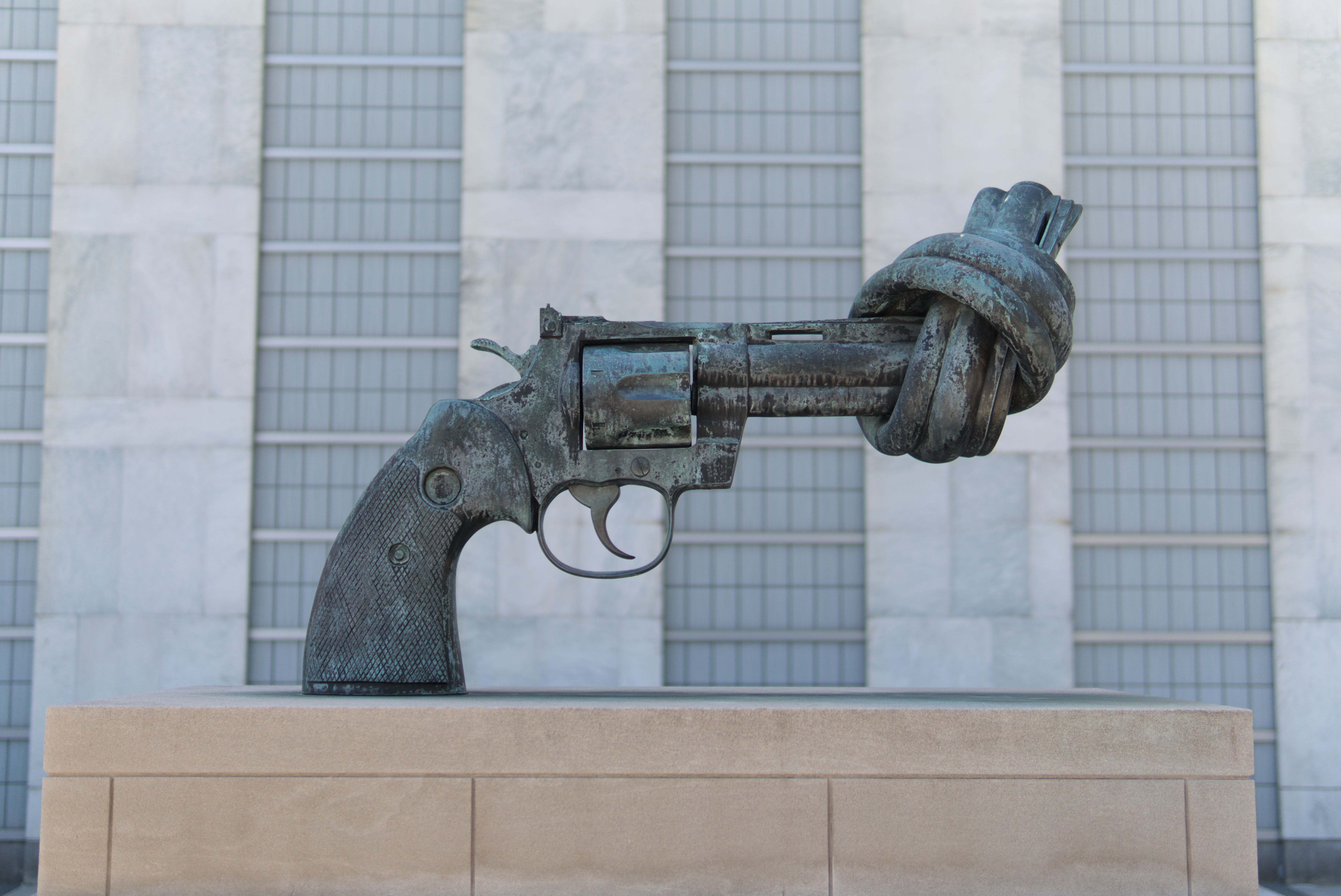
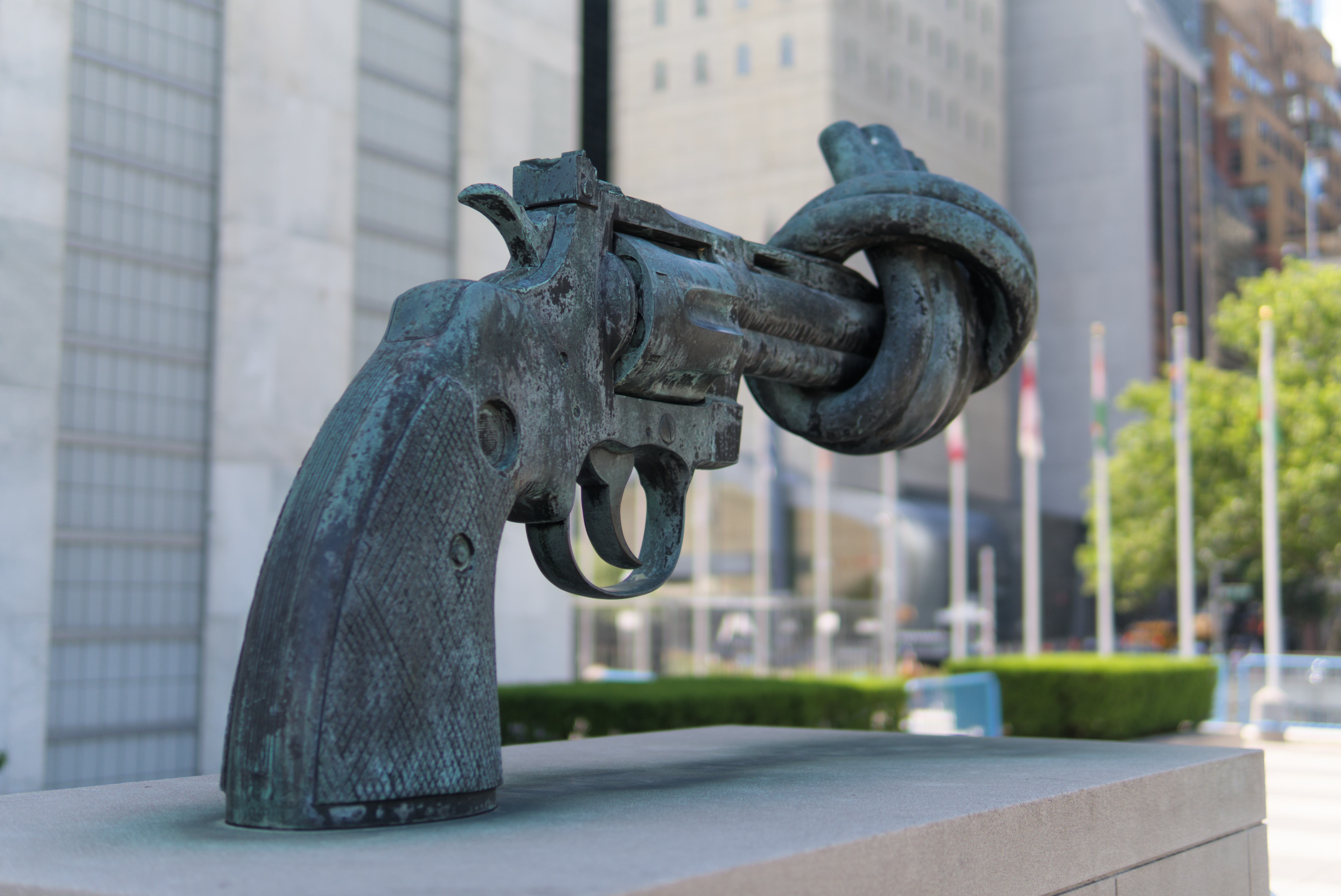
After presenting my ID, getting my photo taken, being stickered, and going through security, I was inside the campus and directed to the General Assembly Building. Outside the entrance to this building is the famous Non-Violence bronze, aka TheKnotted Gun, by Carl Fredrik Reuterswärd of Sweden. The artist made the sculpture in 1980 after his friend John Lennon was murdered. He wanted to honor the singer-songwriter’s vision of a peaceful world.
Carl Fredrik Reuterswärd (Swedish, 1934–2016), Non-Violence, 1984. Bronze, 79 × 44 × 50 in. United Nations Headquarters (outside the General Assembly building), New York. Gift from Luxembourg. Photo: Victoria Emily Jones. [object record]
The original cast was first placed at the Strawberry Fields memorial in New York City’s Central Park, across the street from the Dakota apartment building where Lennon and his wife, Yoko Ono, lived, and where he was shot. But Reuterswärd worried it would be stolen there. In 1988, the Government of Luxembourg bought the sculpture and donated it to the United Nations, who installed it inside the gate of their New York headquarters.
Non-Violence is an oversize replica of a Colt Python .357 Magnum revolver with the barrel tied in a knot and the muzzle pointing upward, rendering the weapon useless. In his statement from 1988, Reuterswärd said, “Humor is the finest instrument we have to bring people together. While making my peace-symbol, I thought of the importance of introducing a touch of humor, just to make my ‘weapon’ symbolically ridiculous and completely out of order.”
Reuterswärd ultimately made over thirty additional casts of Non-Violence, which are publicly installed in cities such as Beijing, Beirut, Cape Town, Lausanne, and Mexico City.
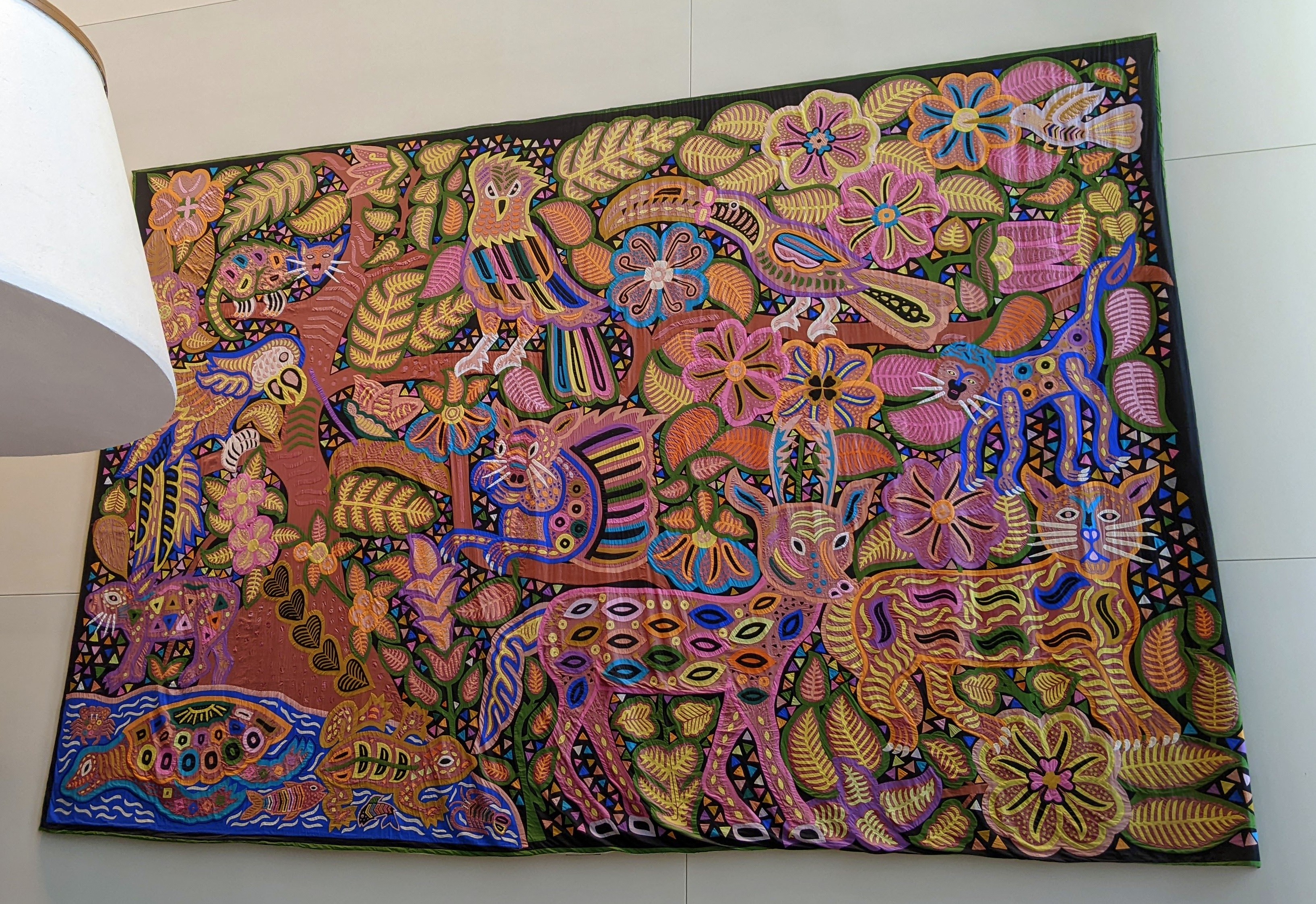
After spending some time with this iconic work, I entered the General Assembly lobby. What first caught my eye, on the right wall, was a monumental Mola Tapestry from Panama, made by unidentified Kuna women. (To learn about the art form, see my previous blog post from Lent 2022.)
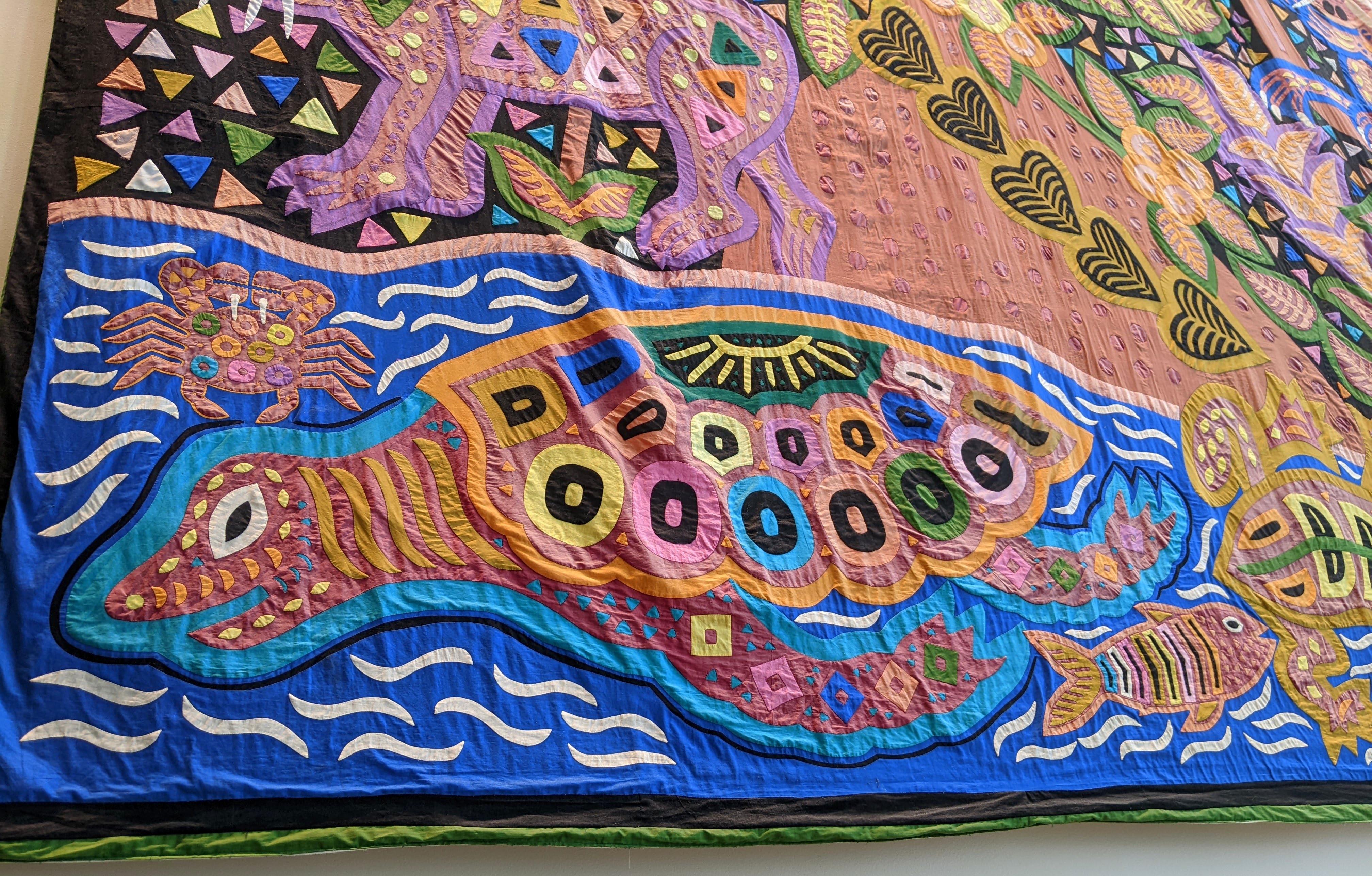
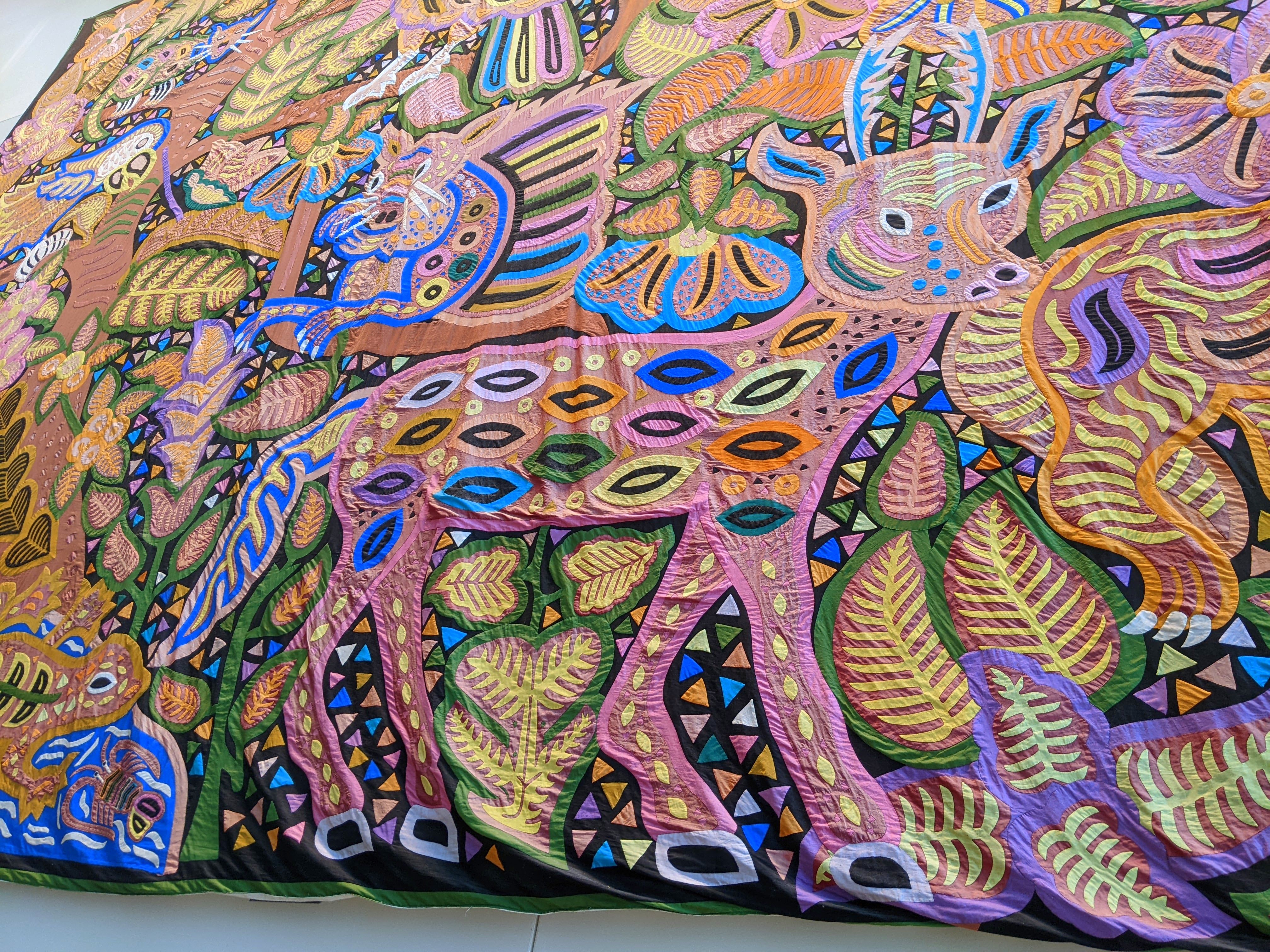
Mola Tapestry by the Kuna people, 1993. Reverse appliqué tapestry, 190 × 284 in. General Assembly Building, United Nations Headquarters, New York. Gift from Panama. Photo: Victoria Emily Jones. [object record]
Molas are made using a reverse appliqué technique, in which several layers of multicolored cloth are sewn together and then parts of each layer are cut out to form the design. These textile panels are traditionally made on a smaller scale and sewn onto women’s blouses, but as outside interest in them grew, local artisans started making some to be displayed as wall hangings.
This one shows a colorful array of indigenous flora and fauna, including a toucan, owl, hummingbird, monkey, turtle, frog, squirrel, rabbit, deer, and wildcat.
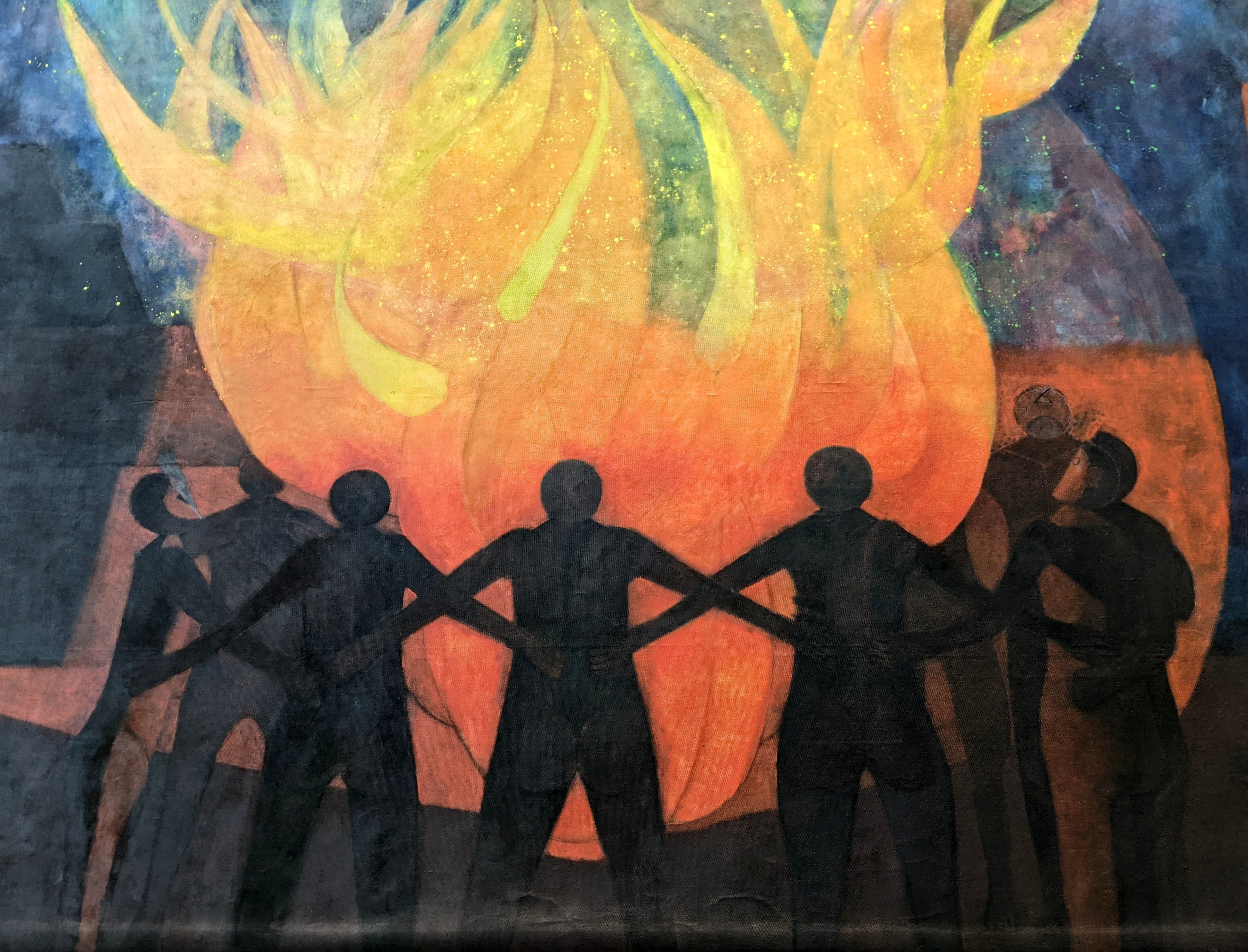
On the opposite wall is a nearly thirty-foot-long painting titled La Fraternidad (Brotherhood) by Mexican artist Rufino Tamayo [previously], which shows a group of people gathered around a fire with interlaced arms. The fire may represent enlightenment, knowledge and power, or the Divine Presence.
Rufino Tamayo (Mexican, 1899–1991), La Fraternidad (Brotherhood), 1968. Oil on canvas, 160 × 358 in. General Assembly Building, United Nations Headquarters, New York. Gift from Mexico, 1971. Photo: Victoria Emily Jones. [object record]
At the left is an ancient Aztec or Mayan pyramid, whereas the structure at the right is modern. Tamayo said this shows the span of time, from the ancient era into the present and future.
From 2009 to 2014 the painting was on display at the Mexican state legislature, after which it was restored and returned to the UN.
Situated in front is a replica of an ancient Greek sculpture depicting Poseidon of Artemision, god of the sea, in an active stance. His right hand would have originally wielded a trident, representing his power. At first I thought it an odd choice for the UN to display an apparently militant figure, as Poseidon used his trident as a weapon to fight Trojans, Titans, and others, and indeed here he seems poised to deliver a death blow. But after some rudimentary research, I found that Poseidon also created life-giving springs with the strike of his trident (think Moses striking the rock with his staff), and used it to calm turbulent waters. These ameliorating acts align with the UN’s mission and make the Poseidon sculpture a fitting addition to their collection.
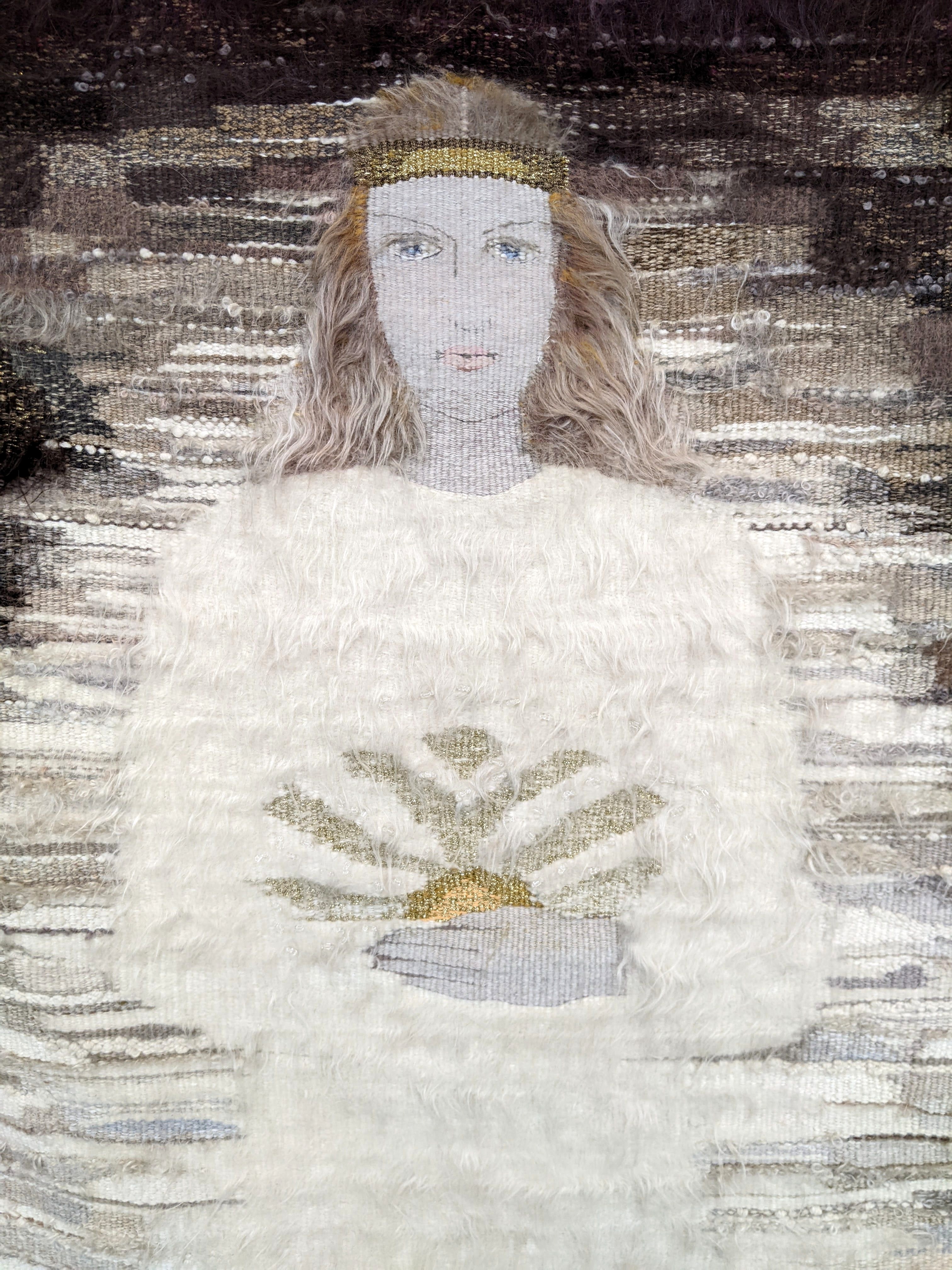
Also in the lobby is a wool tapestry from Latvia. Titled Hope, it’s by the well-known Latvian textile artist Edīte Pauls-Vīgnere.
Edīte Pauls-Vīgnere (Latvian, 1939–), Hope, 1994. Tapestry, 126 × 114 in. General Assembly Building, United Nations Headquarters, New York. Gift from Latvia. Photo: Victoria Emily Jones. [object record]
The female figure in the foreground is, I’m assuming, a personification of hope, dressed in a white gown and golden headband and holding the sun. She stands in front of the Freedom Monument in Riga, which shows Lady Liberty holding three gilded stars, symbolizing the three constitutional districts of Latvia.
Deeper inside the lobby was a temporary exhibition, Interwoven: Refugee Murals Across Borders, organized jointly by UNHCR (the UN Refugee Agency) and Artolution. It opened on June 20, World Refugee Day, and will continue through July 19. The exhibition presents paintings by refugees and host communities in refugee camps, conflict zones, and crisis-affected communities across the world. These were created through a collaborative process in which the work circulated to different locations, with artists contributing additions at each stop. The end results show interwoven narratives of the diverse peoples forced to flee their homes. Themes include joy, lament, labor, empowerment, identity, and home.
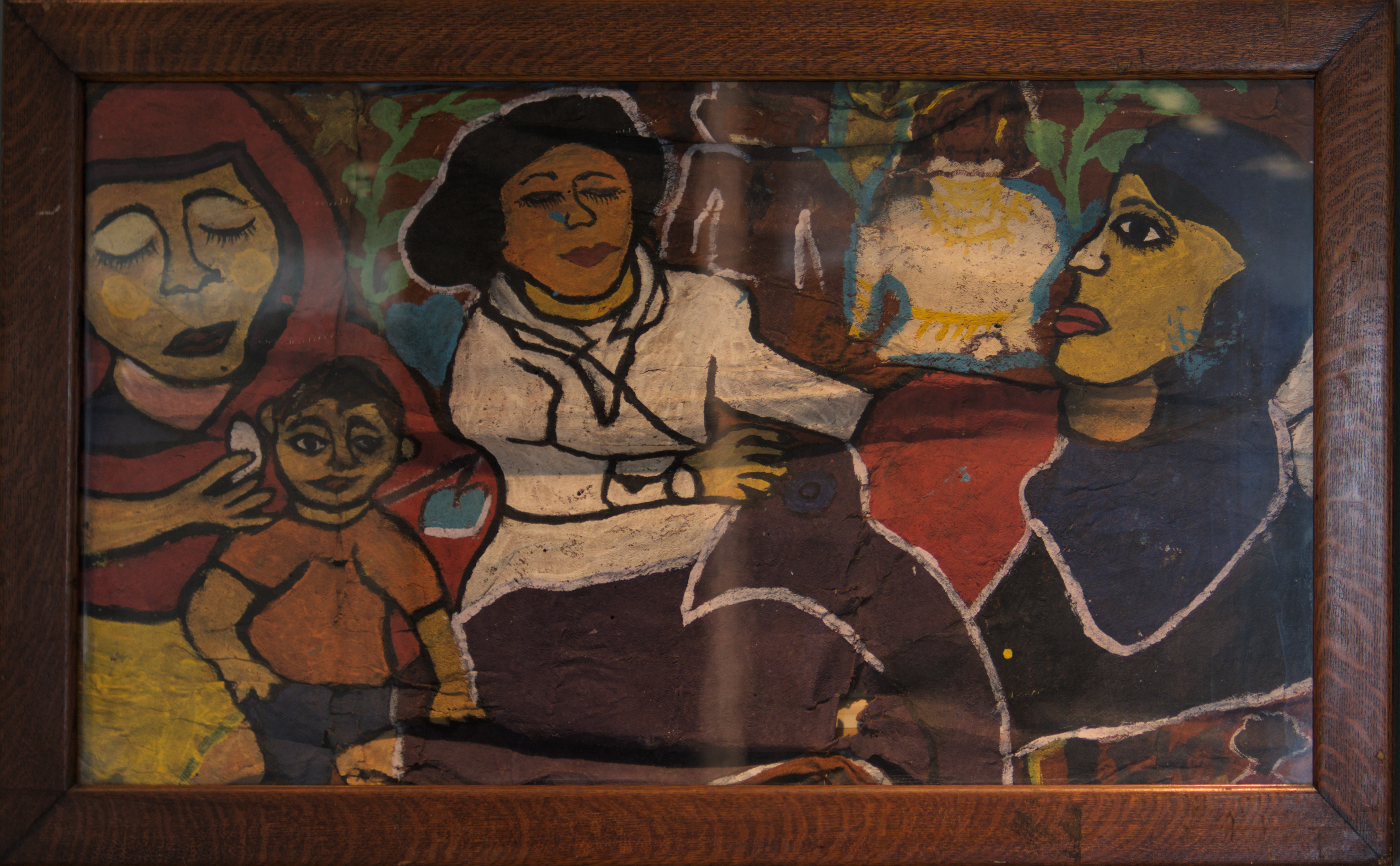
Made by about a dozen refugee girls and women from four countries, Fabric of Women’s Resilience began in Uganda with a small group of South Sudanese, who prepared the traditional bark cloth from the bark of a mutuba tree. This substrate then traveled to Bangladesh, where Rohingya women painted a pregnant woman lying on a bed while a female doctor presses a stethoscope to her belly, and on the left, a mother bathing her child. The artists said they wanted to encourage mothers to seek access to prenatal healthcare and to practice good hygiene with their babies.
Fabric of Women’s Resilience, a collaborative painting by approx. twelve Rohingya, Syrian, Afghan, and South Sudanese refugee women, 2018. Acrylic on bark cloth, 24 × 60 in. Photo: Victoria Emily Jones.
In Greece, the bark cloth traveled to Samos refugee camp, where one young Afghan woman, with the help of others, painted one of her traumatic childhood experiences: being married off at age twelve to an older man. This scene at the top is a bit crumpled in the frame, so it’s difficult to see, but the child bride is crying, and the man has a white beard.
The painting also went to Azraq refugee camp in Jordan, where Syrian women added a woman carrying a baby on her back while reading a book to show that women can be mothers and pursue an education. (This scene was at the extreme right but must have come off; view the full original painting on the exhibition webpage, fourth image down.) It ended its journey with a return to Uganda, where the South Sudanese women filled in the remaining spaces with plants, fish, and fruits.
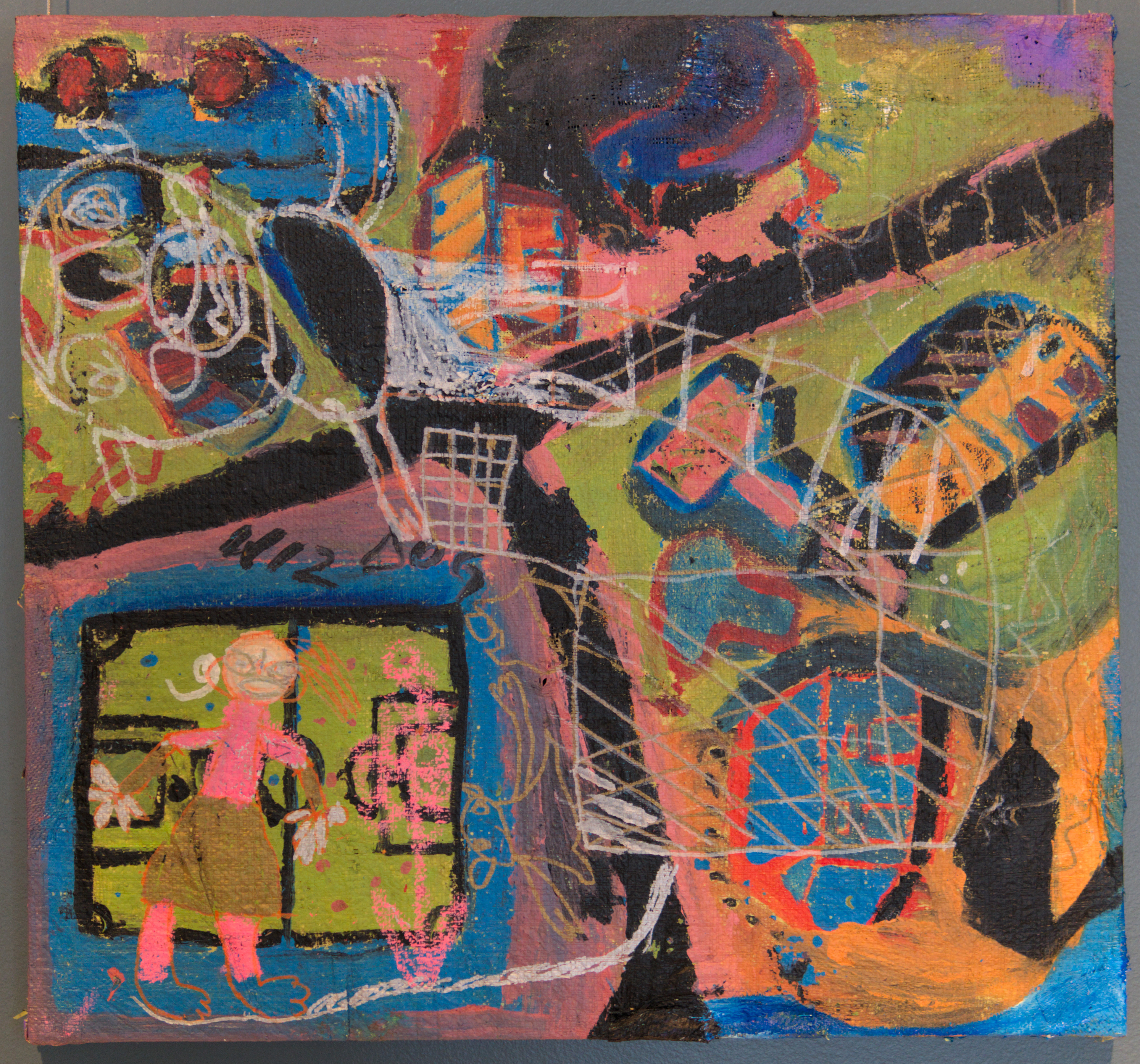
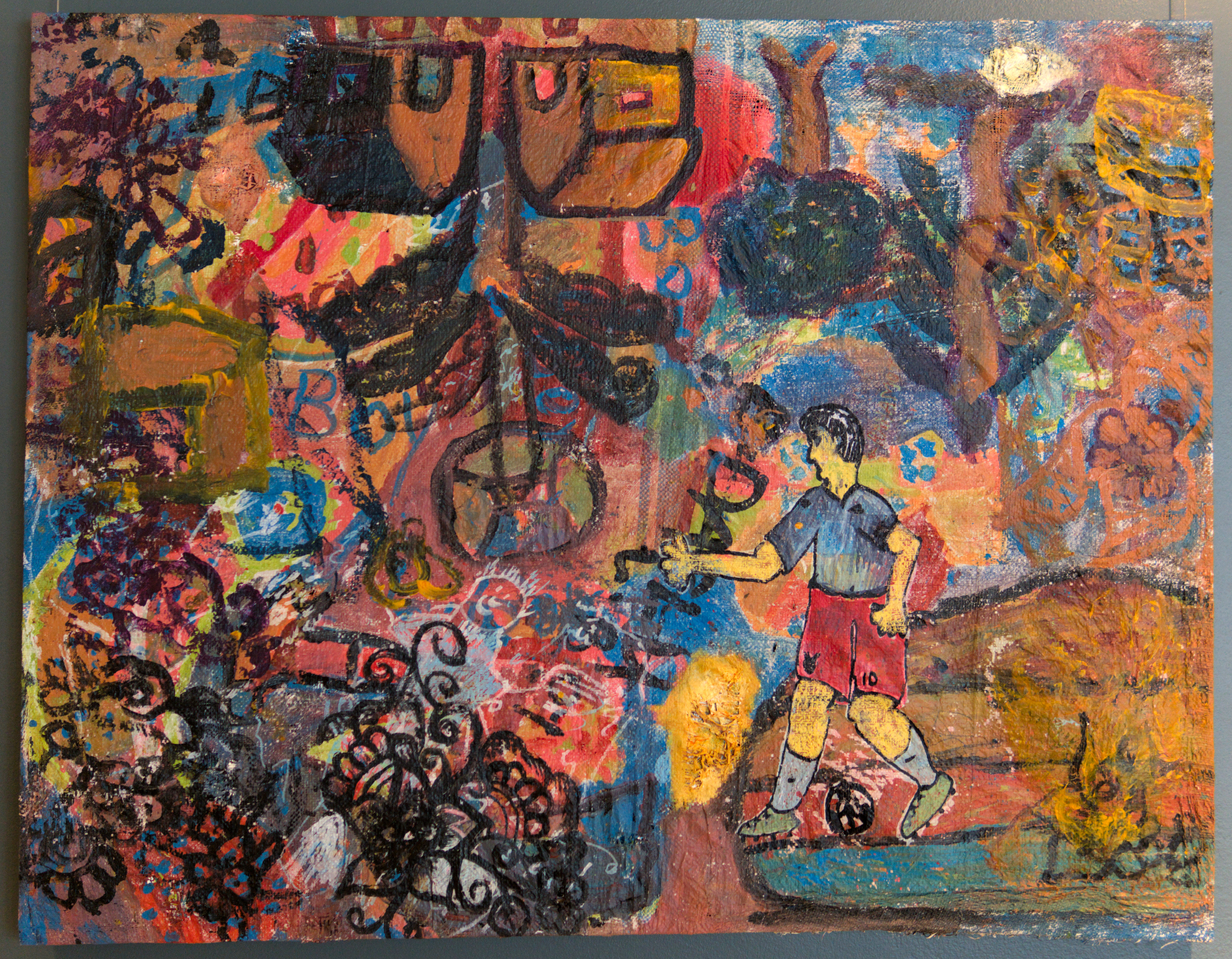
Other artworks include The Creature of Home and Play in the Midst of Chaos, painted on food distribution bags and as a collaboration between South Sudanese and Rohingya refugees, both children and adults.
The Creature of Home, which traveled to BidiBidi Refugee Settlement in Uganda and Balukhali Refugee Camp in Bangladesh, depicts chickens, a soccer field, memories of home, and tools needed to take care of the land.
The Creature of Home, a collaborative painting by South Sudanese refugees at BidiBidi Refugee Settlement, Uganda, and Rohingya refugees at Balukhali Refugee Camp, Bangladesh. Photo: Victoria Emily Jones.
Play in the Midst of Chaos, which traveled to BidiBidi Refugee Settlement in Uganda and Bhasan Char Island in Bangladesh, captures a sense of joy with its vivid colors and depiction of sports. It also highlights the importance of planting trees and taking climate action.
Play in the Midst of Chaos, a collaborative painting by South Sudanese refugees at BidiBidi Refugee Settlement, Uganda, and Rohingya refugees at Bhasan Char Island, Bangladesh. Photo: Victoria Emily Jones.
Seeing the Interwoven exhibition sent me down an internet rabbit trail of learning more about the co-organizer, Artolution, and the work they’re doing, which then impelled me to learn more about the refugee communities in which they’re active. Follow them on Instagram, Facebook, or Twitter. I also commend to you the Founder Spirit podcast interview with Artolution cofounder and public artist, educator, and humanitarian Max Frieder.
All the above artworks can be seen for free without an appointment. (However, note that the temporary exhibitions change throughout the year.) But to access the sculptures in the garden, which is kept locked, your only option is to pay $26 for the guided, forty-five-minute Garden Tour.
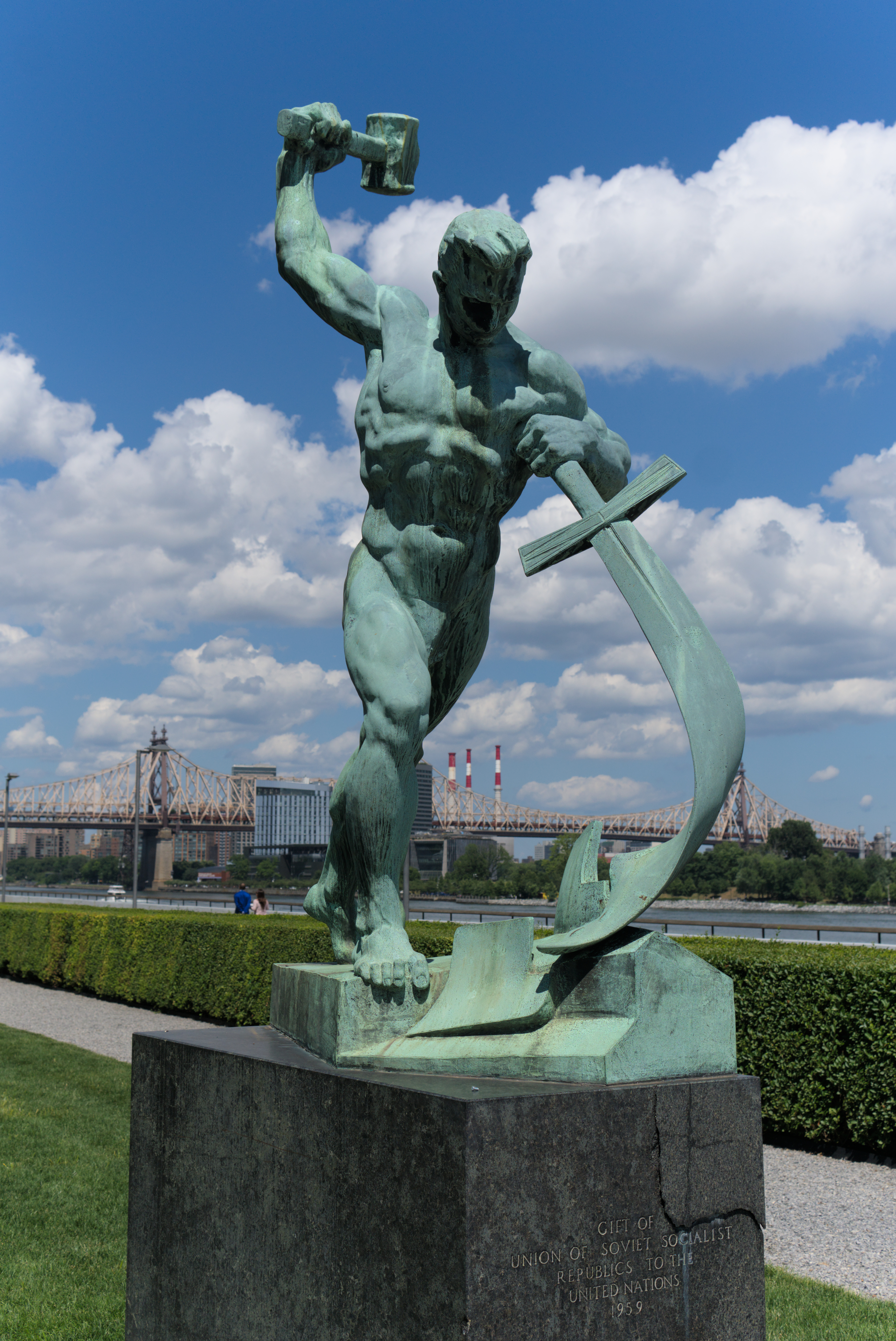
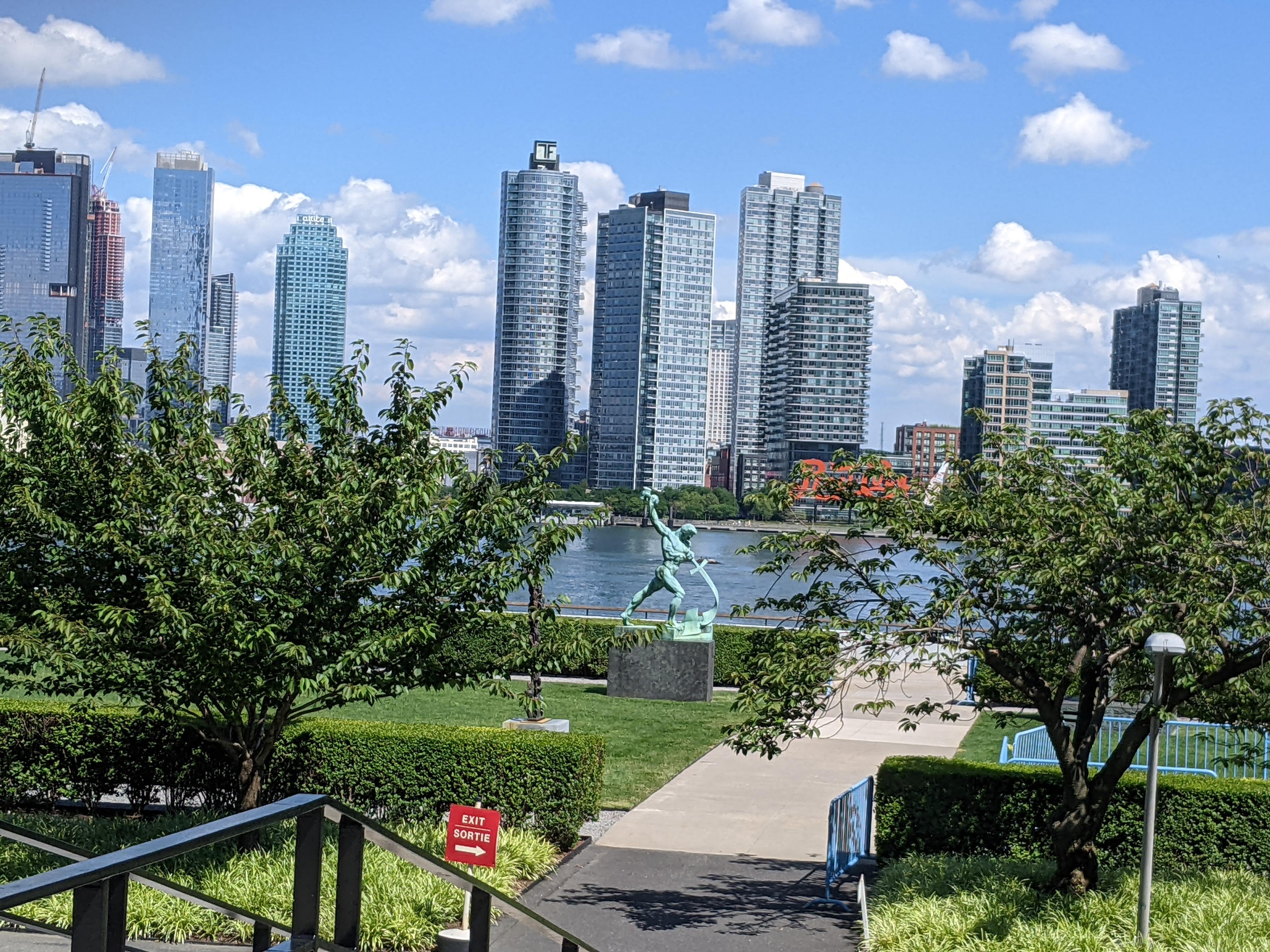
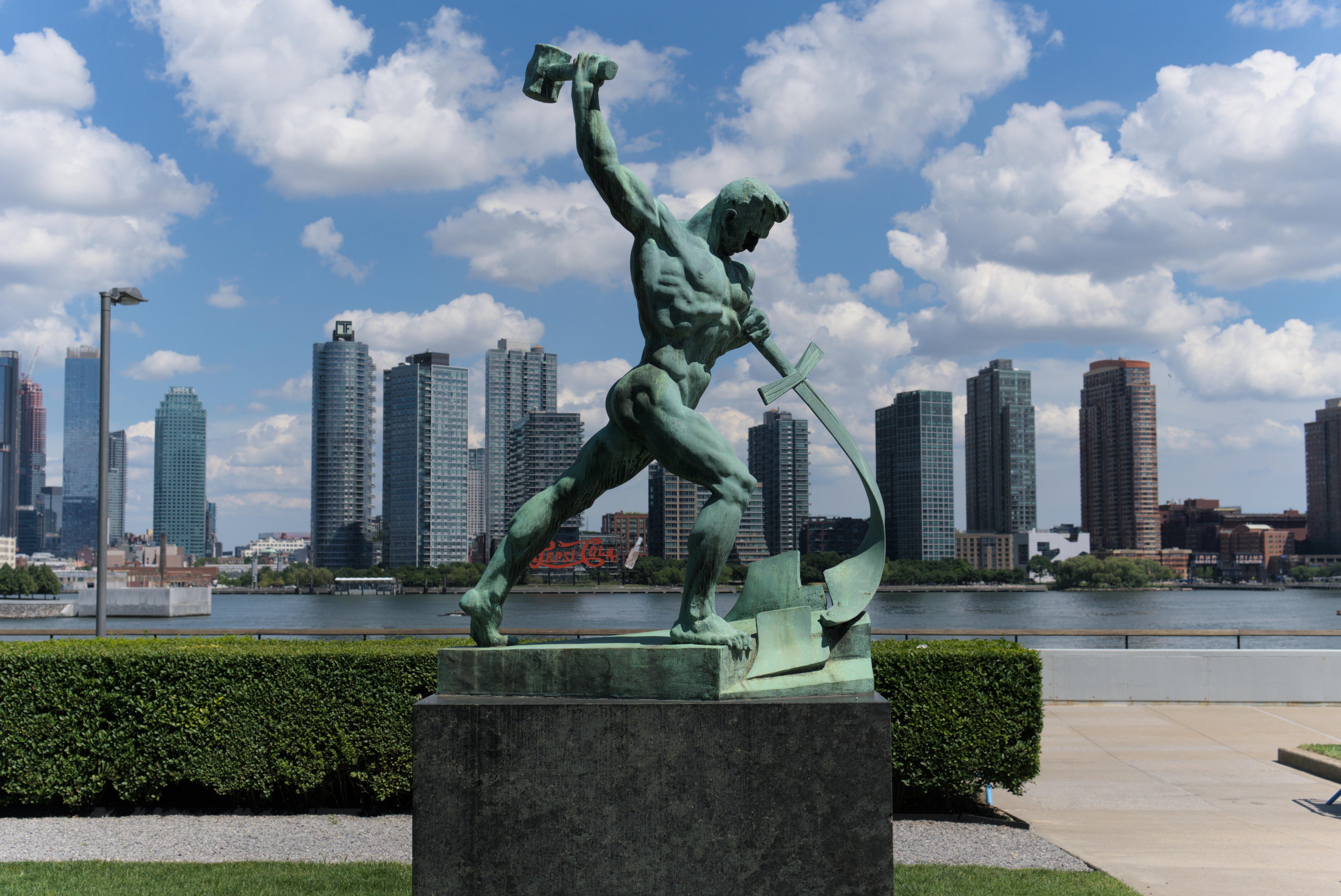
I had seen photos of the biblically inspired Let Us Beat Swords into Ploughshares and wanted to see it in person, so I paid up. It’s vaguely visible from the vantage of the free-access plaza outside the main entrance of the General Assembly Building.
But let’s move in closer.
Yevgeny Vuchetich (Russian, 1908–1974), Let Us Beat Swords into Ploughshares, 1959. Cast bronze and granite pedestal, figure 111 × 76 × 35 in., pedestal 44 × 75 × 34 in. North Lawn, United Nations Headquarters, New York. Gift from the USSR. Photo: Victoria Emily Jones. [object record]
Gifted to the United Nations by the USSR in 1959, the bronze sculpture is by the Soviet artist Yevgeny (sometimes spelled “Evgeniy”) Vuchetich, who was of Russian, French, and Serbian heritage and lived most of his life in Russia. It shows a muscular man (modeled by Olympic wrestler Boris Gurevich) hammering a sword into a plow blade, used to cut furrows for planting crops. Representing the transformation of tools of death into tools of life, the imagery is taken from Isaiah 2:4 in the Hebrew Bible, in which the prophet proclaims that “in days to come,” people of all nations “shall beat their swords into plowshares and their spears into pruning hooks; nation shall not lift up sword against nation; neither shall they learn war any more.” The vision is that in the kingdom of God, instead of the land being littered with human blood and corpses, it will be cultivated and bring forth good food.
This scripture text is the basis of the African American spiritual “Down by the Riverside” [previously], whose refrain declares, “I ain’t gonna study war no more!” One of the commonly used verses is “I’m gonna beat my sword into a plow.” Here’s Michael Wright’s version:
And, from 1959, the Golden Gate Quartet’s, arranged by Orlandus Wilson:
Reflecting the song lyrics, Vuchetich’s sculpture is itself planted “down by the riverside”—the East River.
Vuchetich was one of the major figures of Soviet government–backed monumental sculpture, making his name from depictions of military heroes. So I find it a little odd that he was commissioned to make this peace sculpture that subverts the very militarism his other sculptures celebrate. One of his most famous pieces is The Motherland Calls; located at the top of Mamayev Kurgan hill overlooking the city formerly known as Stalingrad, it shows a female personification of Russia lifting high a sword in one hand and calling the Soviet people to battle with the other.
Look, many artists will take what work they can get, regardless of whether a commission matches their own ideology. I don’t claim to know what Vuchetich’s personal views were about war, violence, and empire.
Regardless of its disjunction with the artist’s larger oeuvre—and the uncomfortable fact that the donor’s successor state and caretaker of the sculpture, the Russian Federation, is persisting in an illegal and immoral war against its neighbor Ukraine—I really appreciate the theological imagination that Let Us Beat Swords into Ploughshares embodies, entreating us to apply our strength to constructive, not destructive, acts.
Nearby in the garden, not pictured in this article, is a literalization of the “swords into plowshares” principle. A recent gift from the Government of Colombia, Kusikawsay (Quechua for “peaceful and happy life”) is made of steel armaments melted and cast into the shape of a canoe, sailing upward. A donor representative said the sculpture for them symbolizes the end of an over-fifty-year armed conflict in their country. The idea is that the grotesque paraphernalia of war is metamorphosed into a benign watercraft that, in how it’s positioned, symbolizes humanity’s traveling into a lofty future.
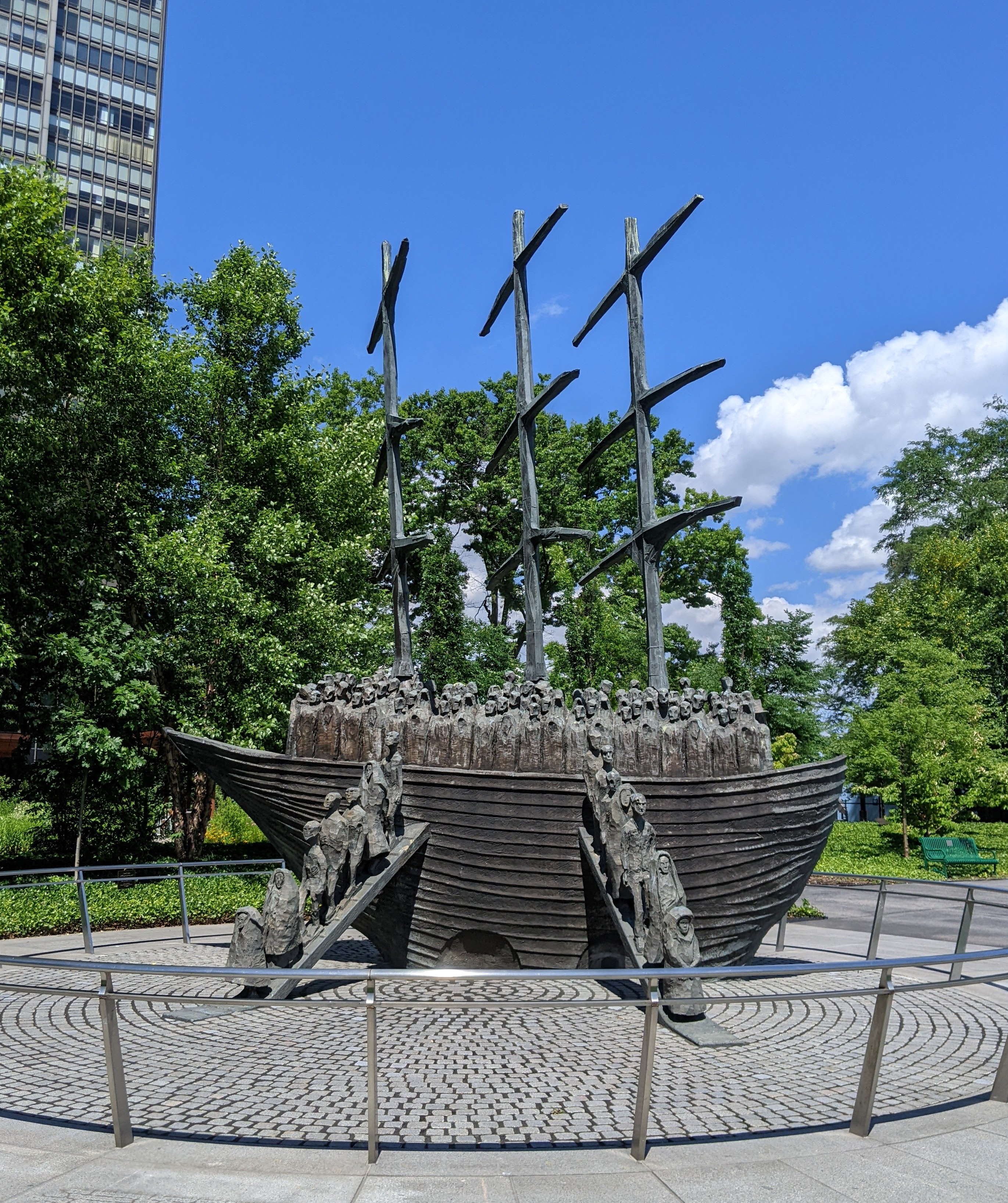
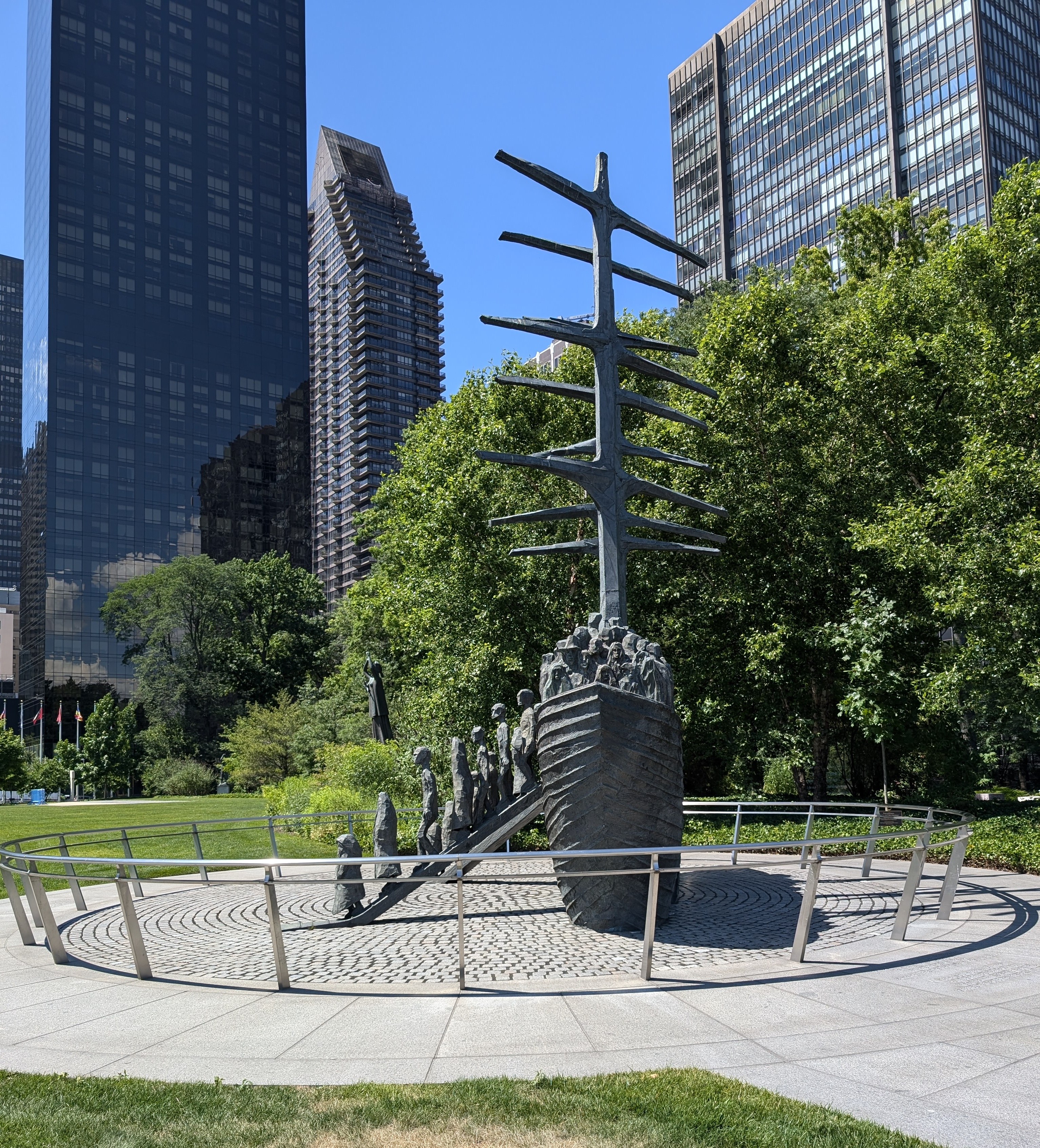
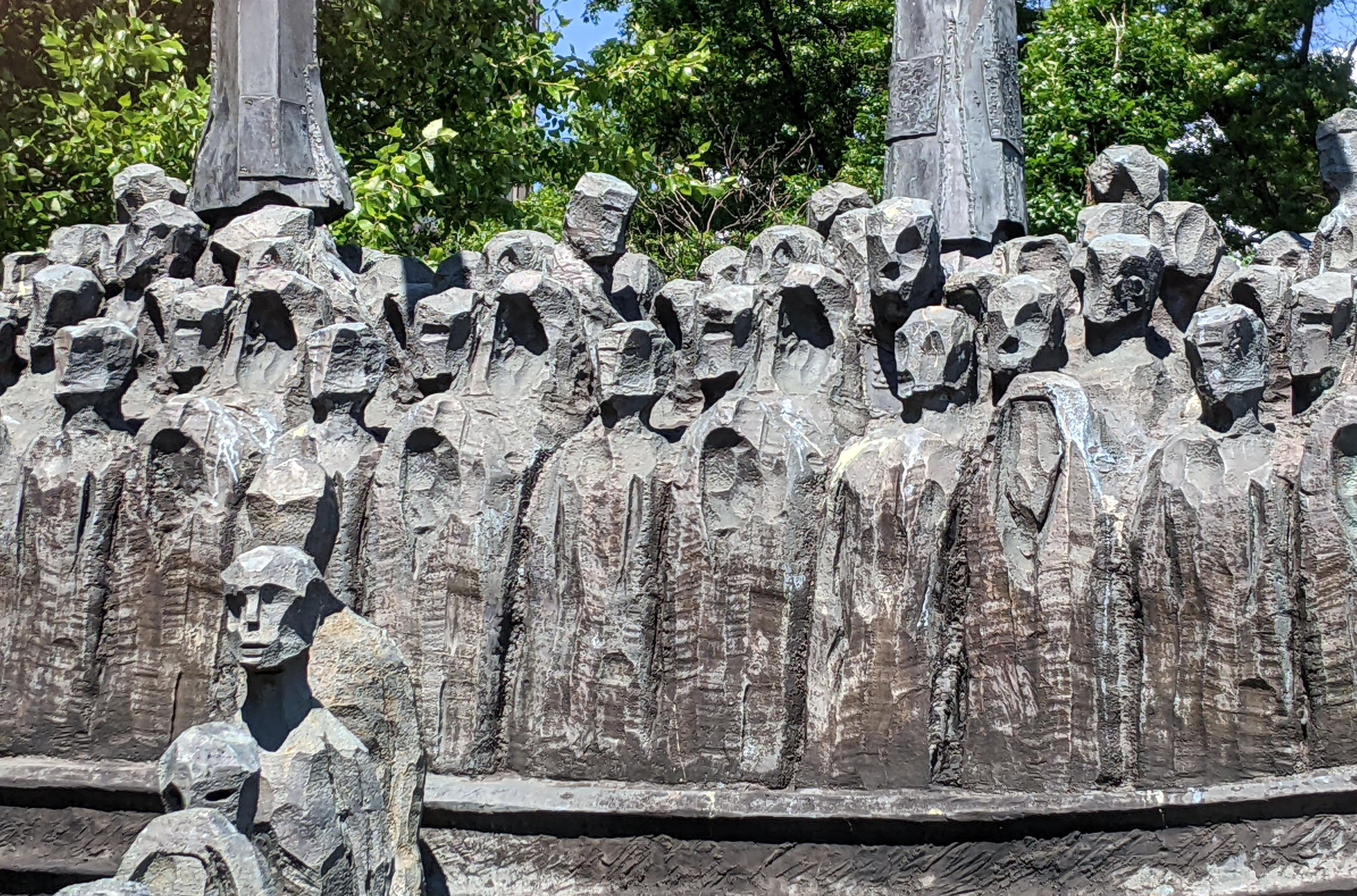
Another boat on the UNHQ’s North Lawn is Arrival by the Irish sculptor John Behan, which shows Irish immigrants disembarking into a new world. The sculpture was intended as a thank-you to the many nations that have received the Irish over the years, including Great Britain, the United States, Canada, Australia, Argentina, Chile, Mexico, New Zealand, and Brazil.
John Behan (Irish, 1938–), Arrival, 2000. Bronze, stainless steel on granite pavers, 26 × 23 ft. North Lawn, United Nations Headquarters, New York. Gift from Ireland. Photo: Victoria Emily Jones. [object record]
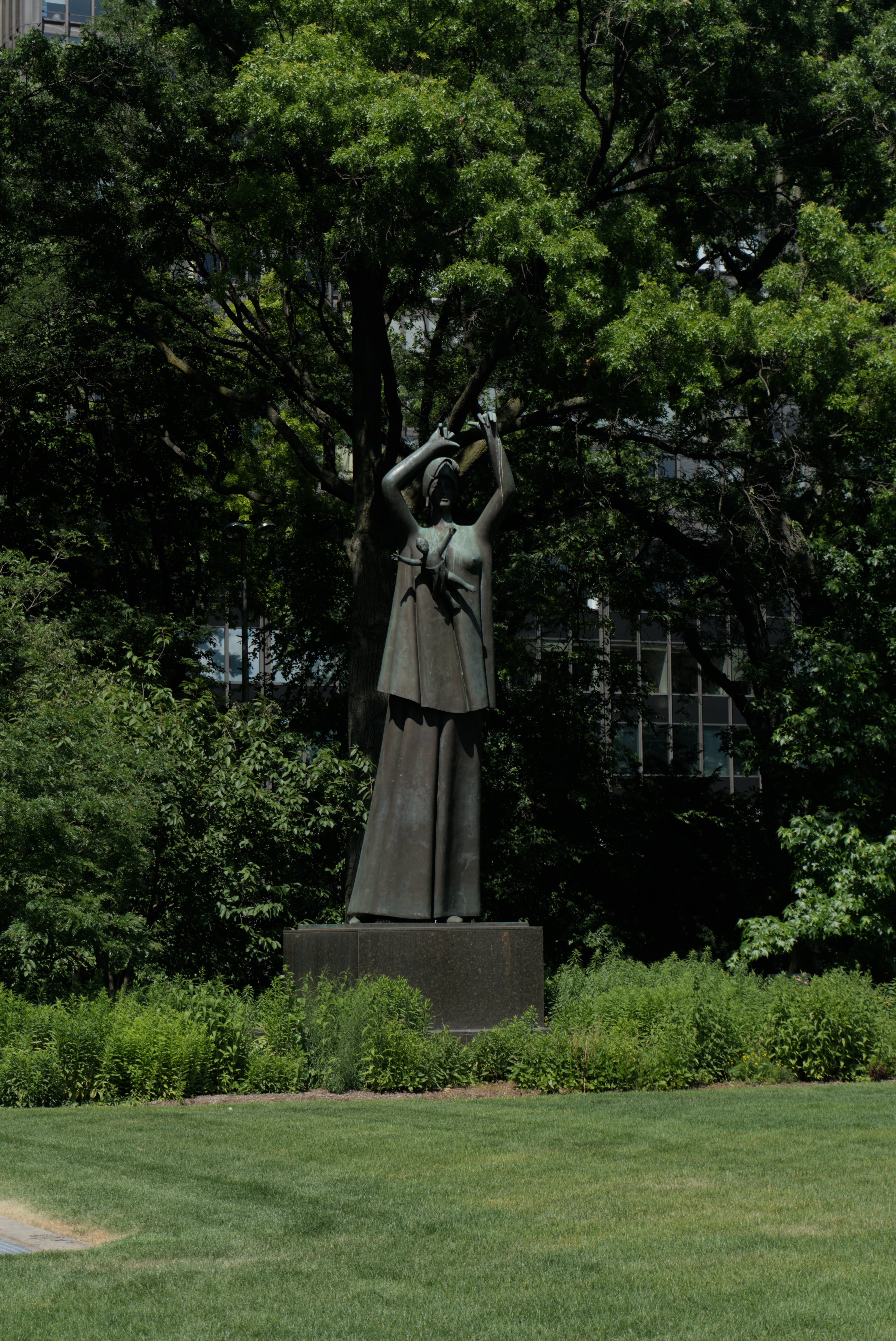
This piece wasn’t covered by the Garden Tour, nor was the colossal Mother and Child by the Italian artist Giacomo Manzù, which I spotted across the lawn and hurriedly snapped a distant photo of while scurrying to keep up with the group.
Giacomo Manzù (Italian, 1908–1991), Mother and Child, 1989. Bronze, 254 × 66 × 52 in. North Lawn, United Nations Headquarters, New York. Gift from Italy. Photo: Victoria Emily Jones. [object record]
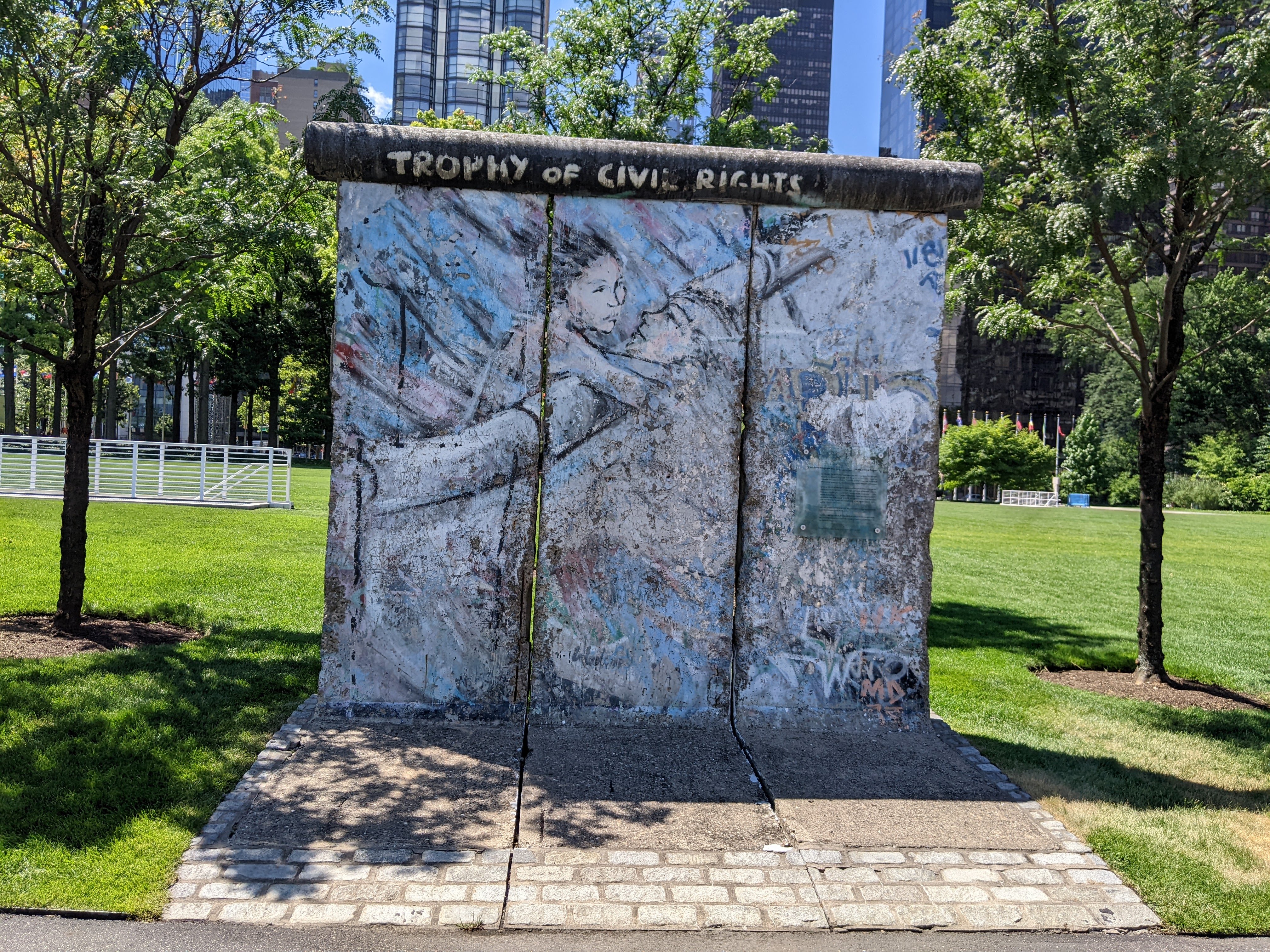
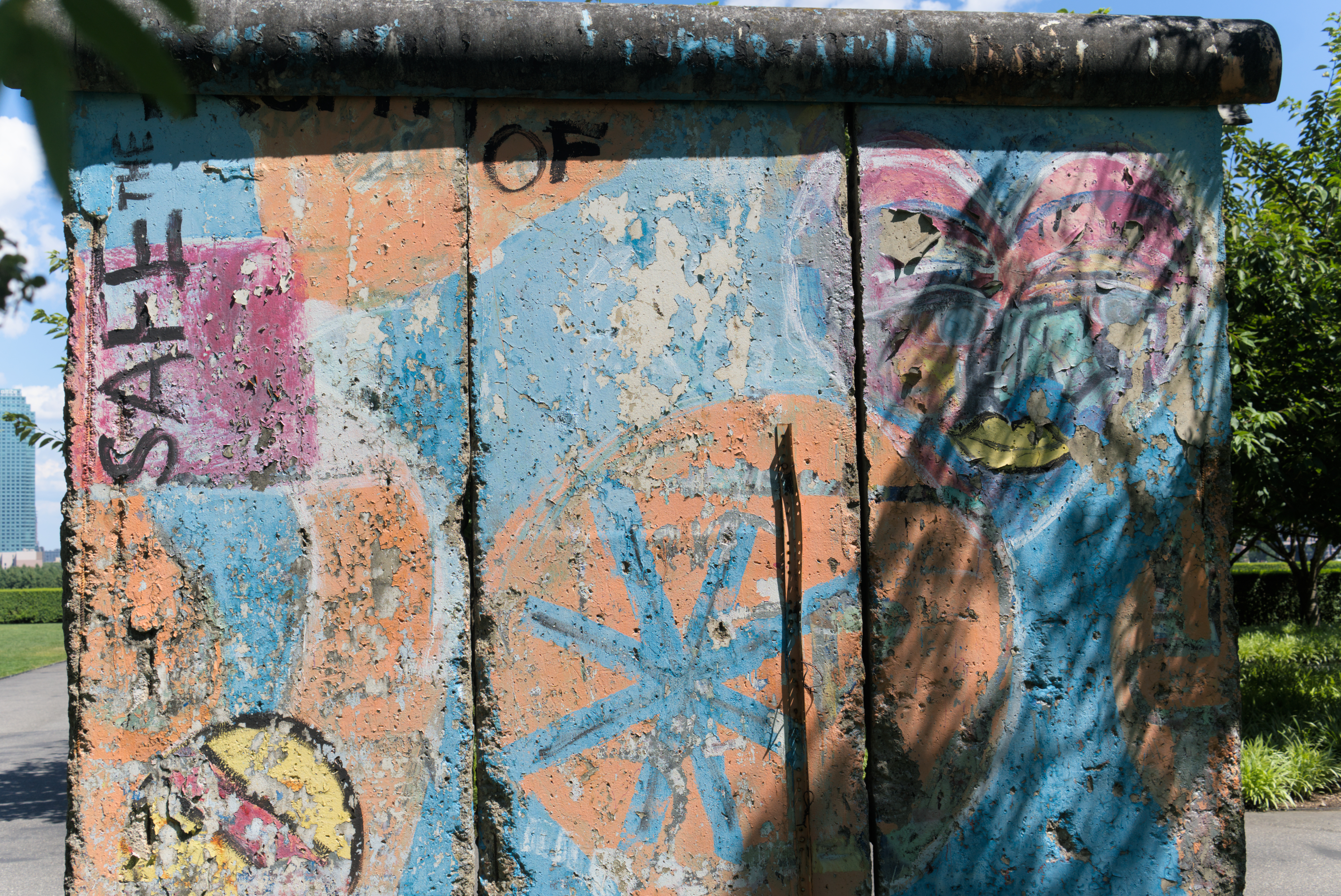
One of the pieces our guide did stop for and spend a good amount of time on was a fragment of the Berlin Wall gifted by Germany in 2002, after the wall came down in 1989. The ninety-six-mile-long barrier was erected in 1961 to divide the country into East (Communist) and West (Federal Republic), but a peaceful revolution in East Germany resulted in its fall and the country’s reunification as a federal republic, marking the end of the Cold War in Europe.
Kani Alavi (Iranian German, 1955–), Trophy of Civil Rights (Berlin Wall Fragment), ca. 1998. Precast reinforced concrete wall sections with paint, overall 84 × 114 in. North Lawn, United Nations Headquarters, New York. Gift from Germany. Photo: Victoria Emily Jones. [object record]
The front of this three-slab wall fragment (that is, the side visible from the paved path) bears a mural by Kani Alavi, an Iranian artist who moved to West Berlin in 1980, living in an apartment overlooking the formidable “Checkpoint Charlie.” Throughout the 1980s, artists painted images on the west side of the wall as a form of political commentary and resistance. The east side, however, was unpainted during the Cold War because it was so heavily guarded; attempted art interventionists probably would have been shot.
After the border opened on November 9, 1989, and demolition of the wall began, Alavi was a key organizer of what’s known as the East Side Gallery, inviting artists from Germany and around the world to paint murals on the east side of the wall, across a segment that would be deliberately left standing as a memorial. “Alavi helped transform the most visible symbol of the Iron Curtain into an enduring monument to the power of freedom,” Ryan Prior wrote for CNN. This open-air gallery is one of Berlin’s most visited attractions, featuring the work of at least 118 artists from twenty-one countries.
Alavi painted Trophy of Civil Rights (I’m not sure whether that inscription was his or just a remnant from another artist, but it’s become the mural’s de facto title) on a section of remaining wall sometime around 1998. “It is a representation of two people hugging over the wall, a dramatic situation of people trying to get close to each other,” he told NPR through a translator. “It shows how the people were separated. It shows how a culture was divided by a wall. That’s what happened, and that’s what I showed.”
The other side of the wall is painted with miscellaneous graffiti by anonymous artists.
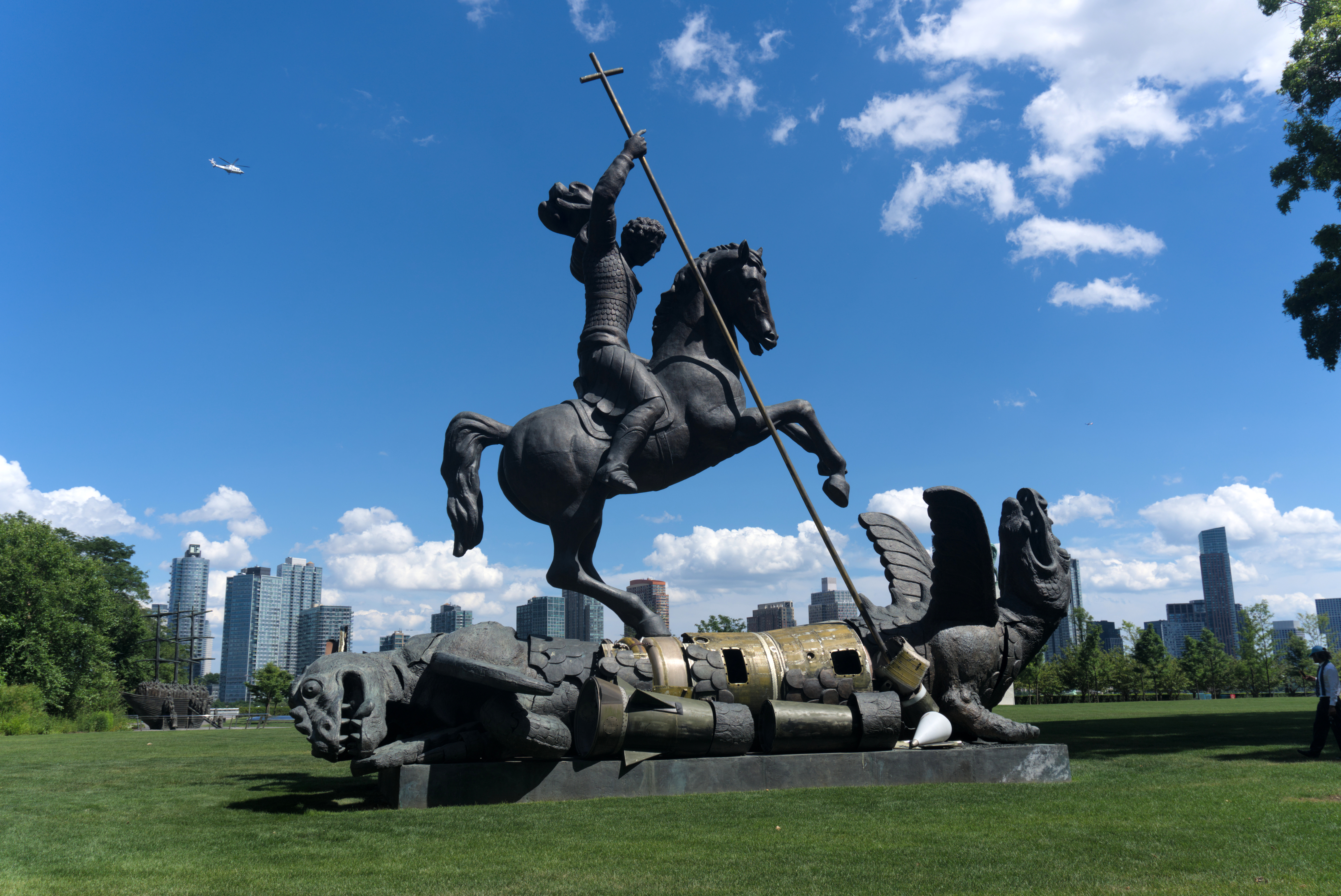
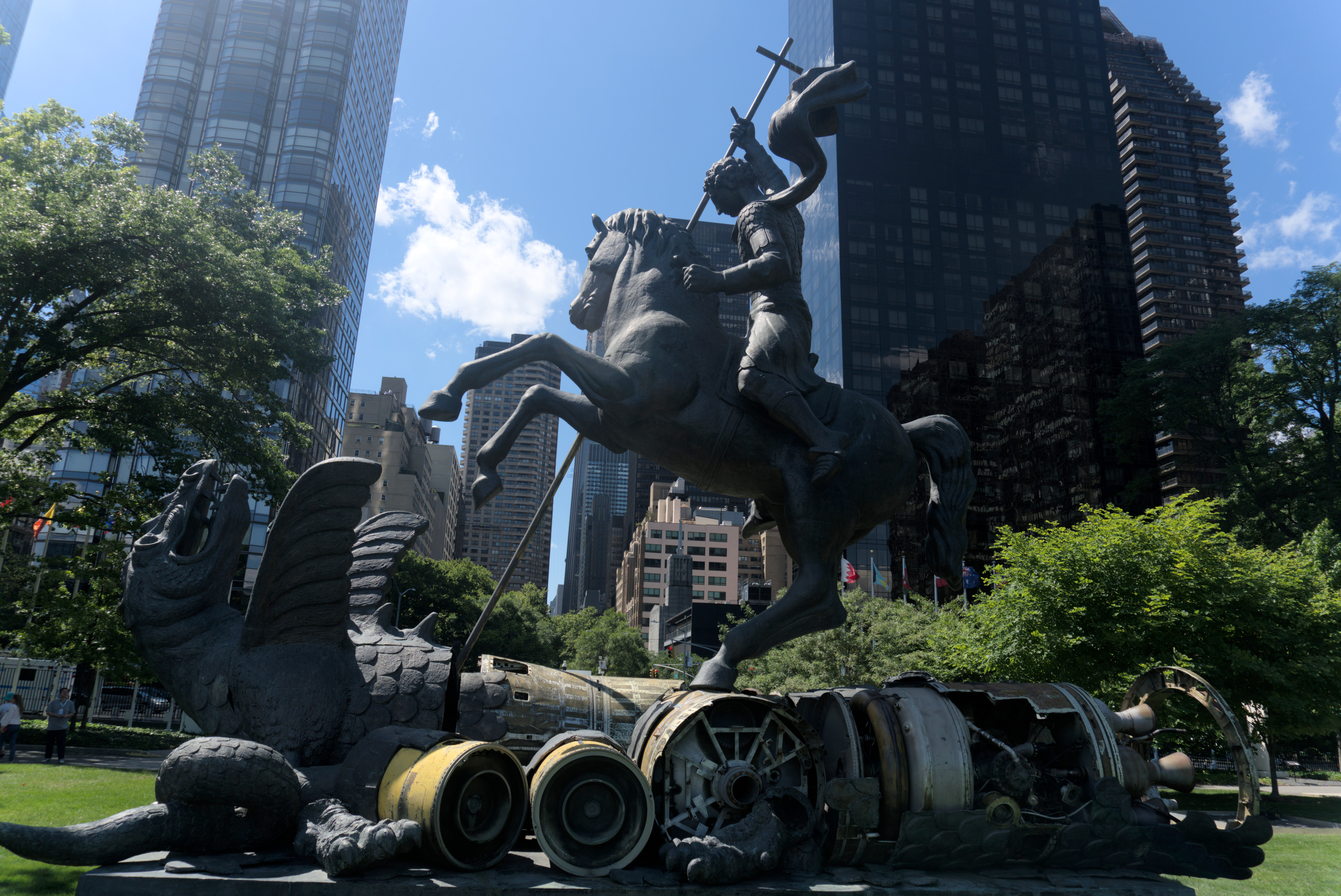
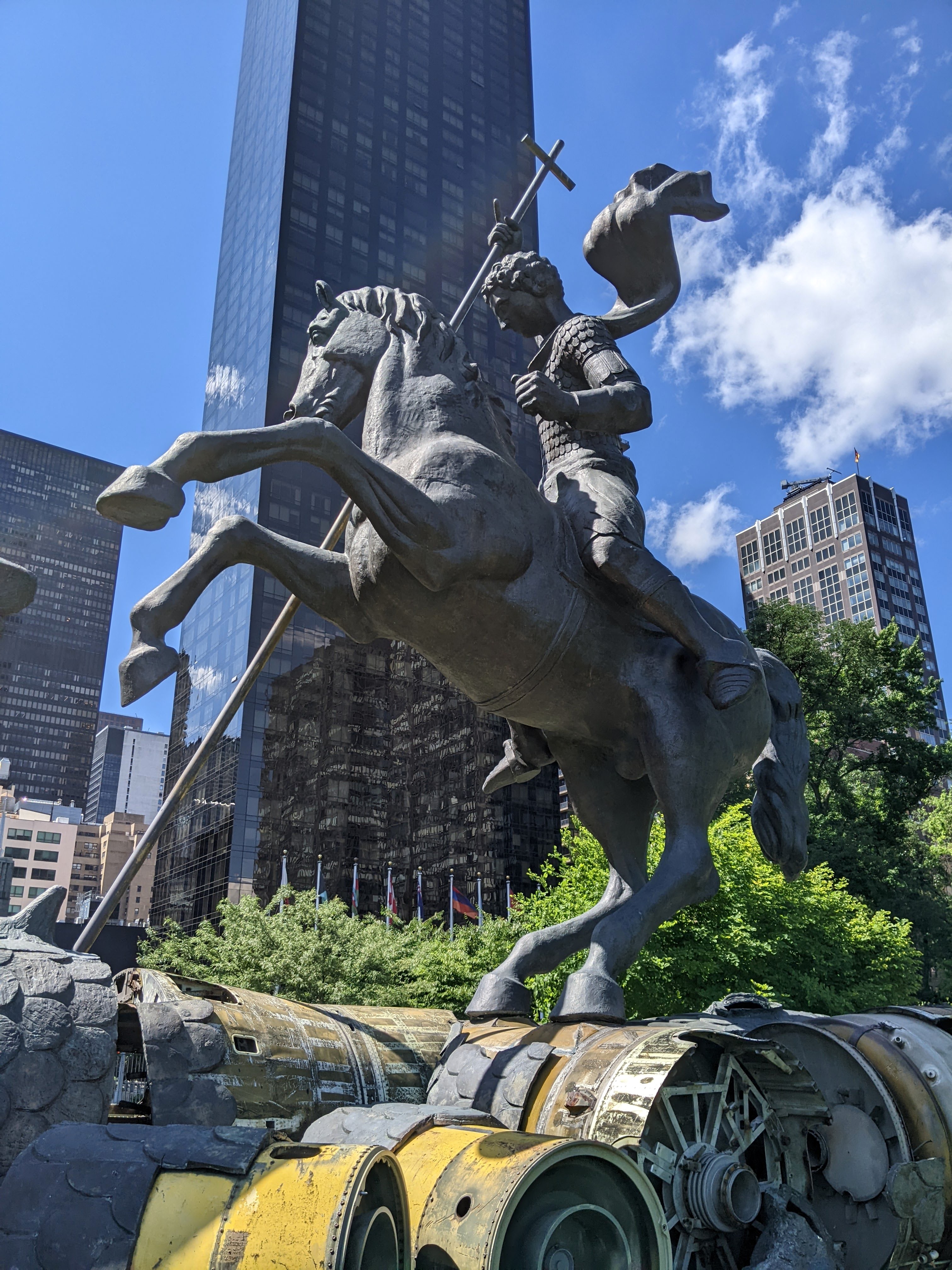
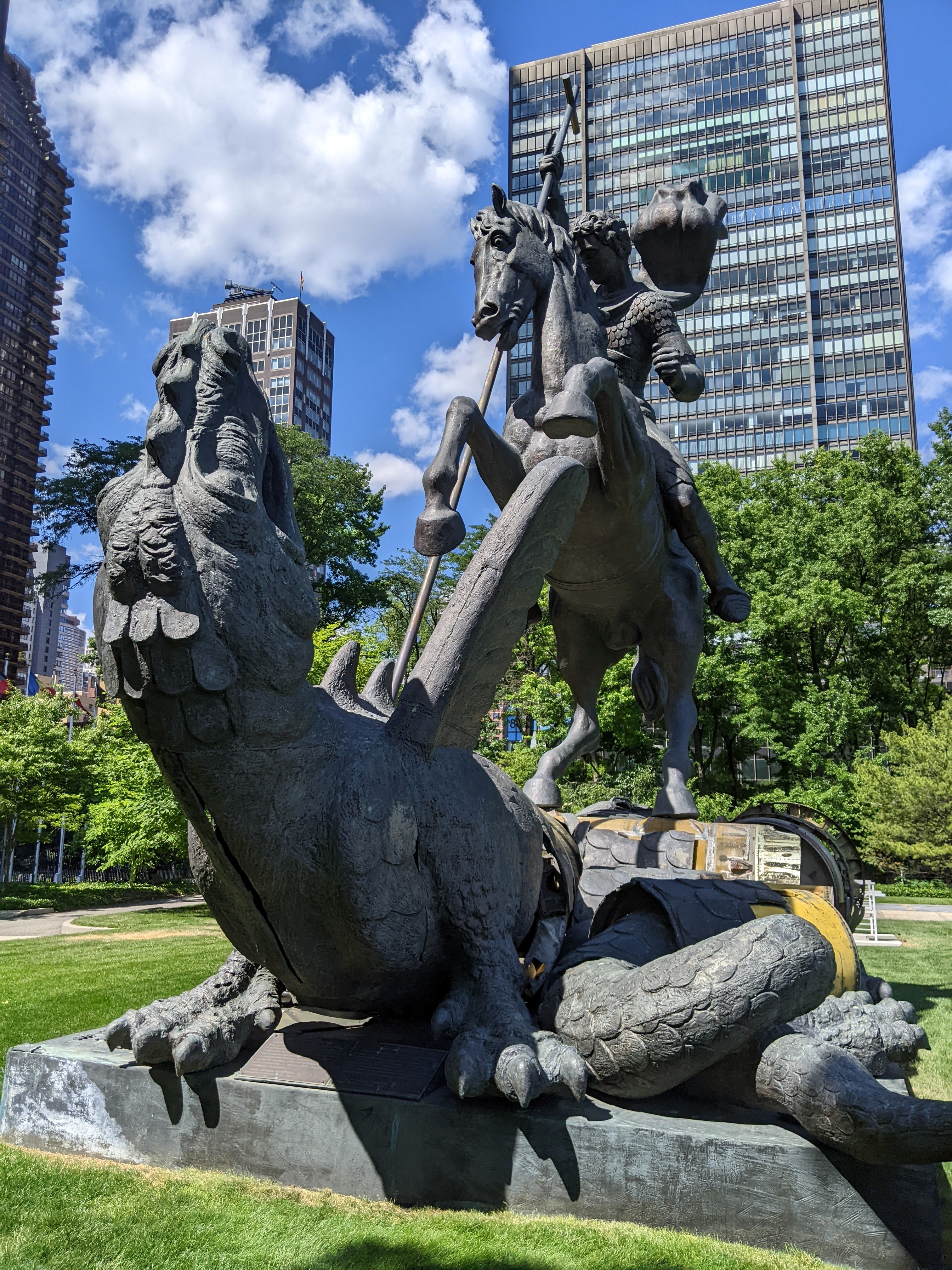
The largest sculpture on the North Lawn, standing at thirty-one feet tall and weighing forty tons, is Good Defeats Evil by the Georgian Russian sculptor Zurab Tsereteli. It depicts the Early Christian martyr-saint George, who was tortured and executed in 303 under the Diocletian persecution. Legends about him started developing in the sixth century and by the thirteenth century were widely circulated and embellished to include a tale of him slaying a dragon to save a Libyan princess whom the terrorized villagers had planned to sacrifice to it for appeasement.
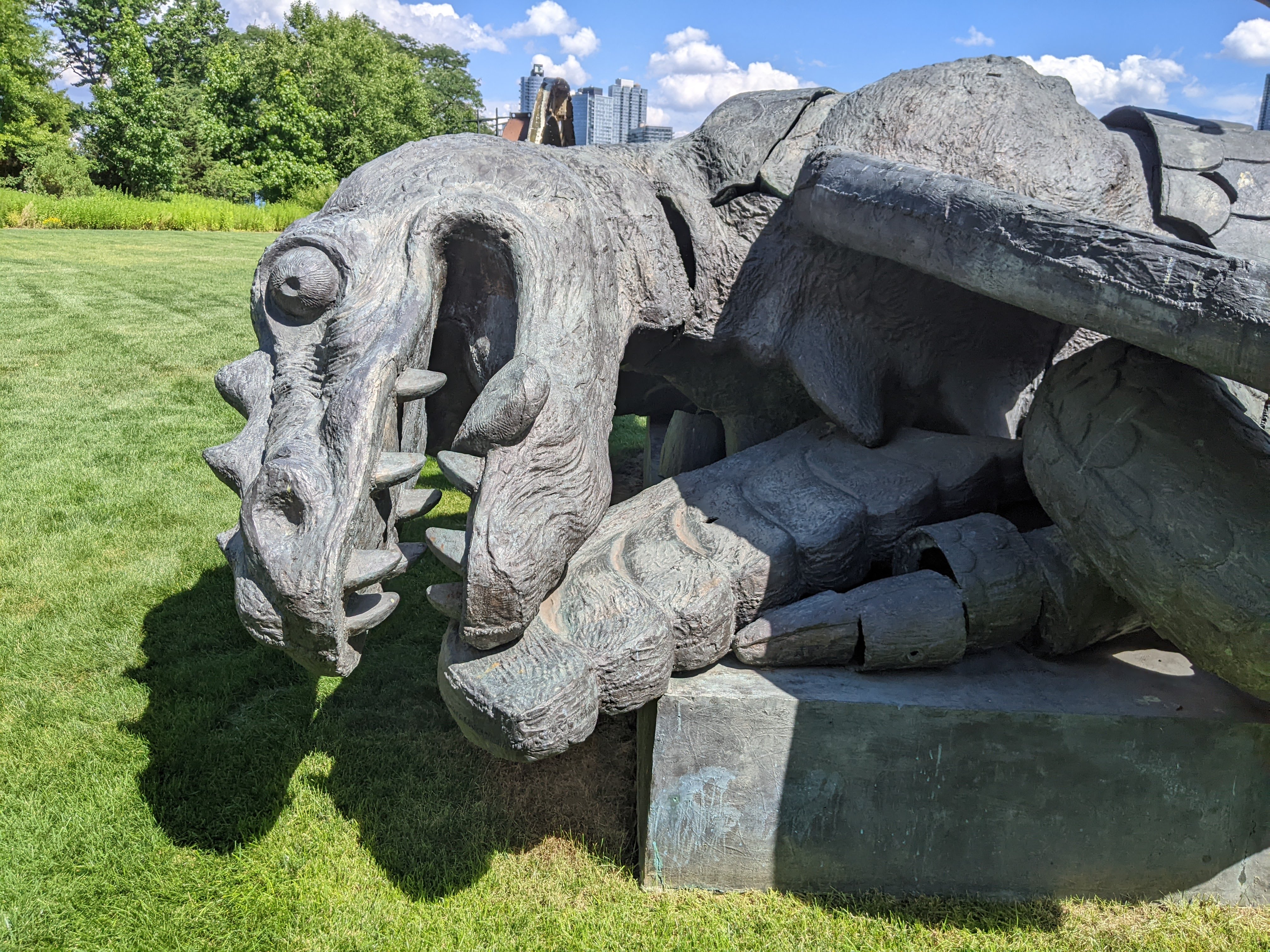
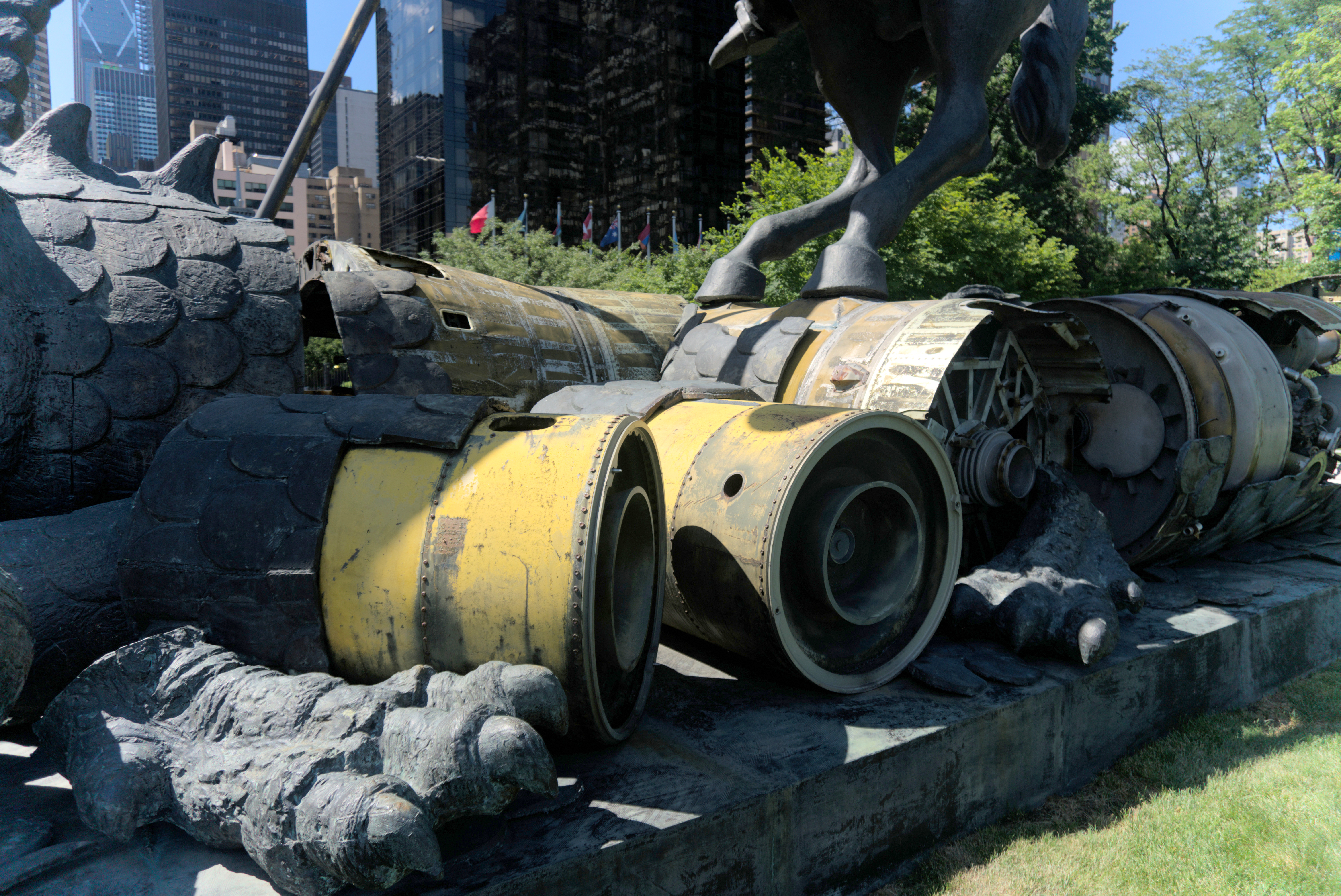
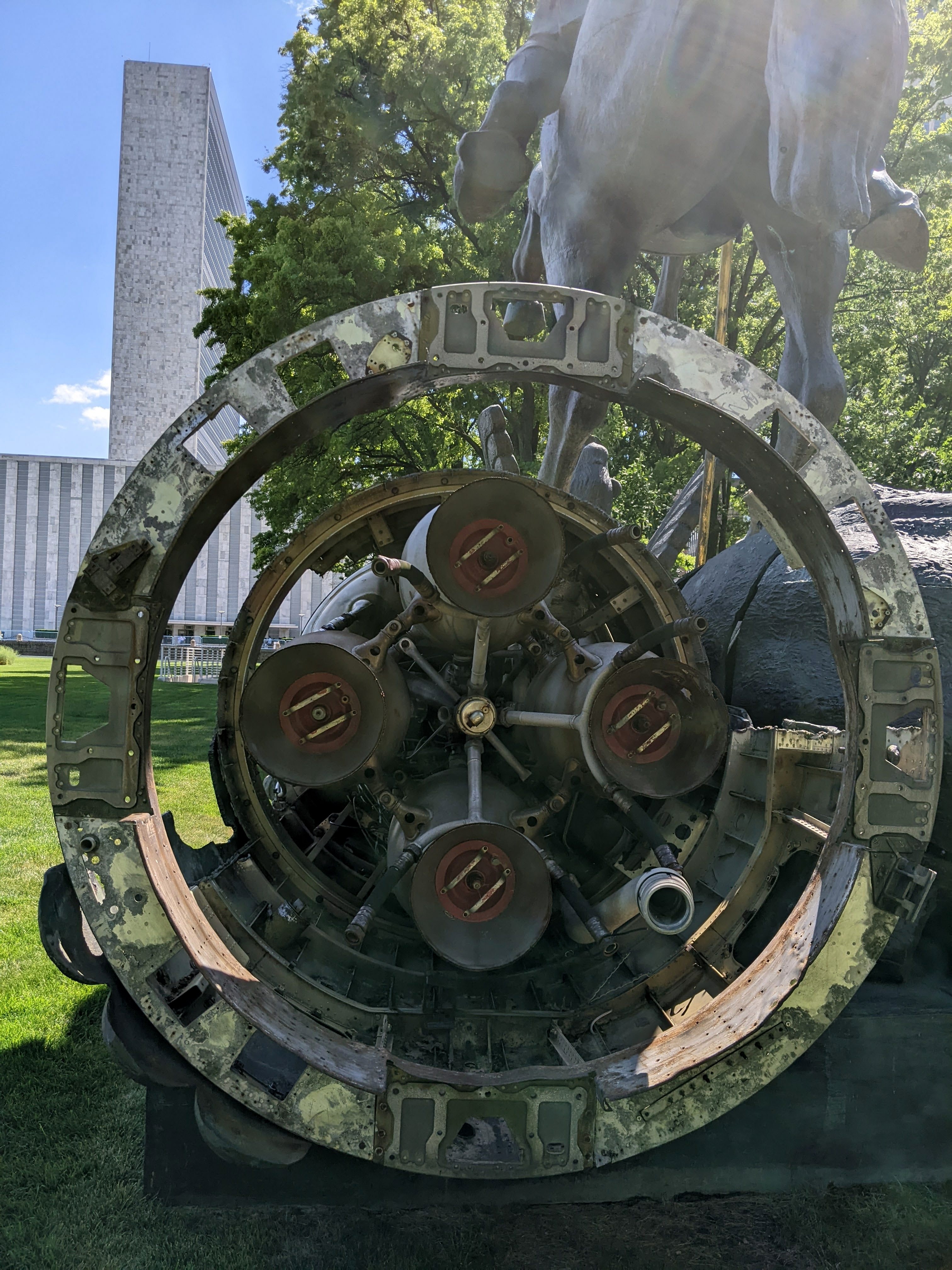
Zurab Tsereteli (Georgian Russian, 1934–), Good Defeats Evil, 1990. Cast bronze figure with dragon formed from sections of two destroyed nuclear missiles, 31 × 18 × 10 ft. North Lawn, United Nations Headquarters, New York. Gift from the USSR. Photo: Victoria Emily Jones. [object record]
(Side note: Saint George is not to be confused with Saint Michael the Archangel from the book of Revelation, who in Christian iconography is usually shown on foot [but occasionally on horseback], also slaying a dragon. The easiest way to tell the two saints apart is that Michael has wings, whereas George does not.)
The most intriguing aspect of this sculpture is that the two-headed dragon is made up of sections of two destroyed nuclear missiles, making the piece a symbol of disarmament. According to the UN website, here
the dragon is not the mythological beast of early Christian tradition, but rather represents the vanquishing of nuclear war through the historic treaty between the Soviet Union and the United States [the Treaty on the Elimination of Intermediate-Range and Short-Range Nuclear Missiles, signed in 1987]. Created as a monument to peace, the sculpture is composed of parts of actual United States and Soviet missiles. Accordingly, the dragon is shown lying amid actual fragments of these weapons, the broken pieces of Soviet SS-20 and U.S. Pershing missiles.
The dragon’s two heads thus represent the world’s two largest nuclear arsenals during the Cold War: those of the Soviet Union and the United States.
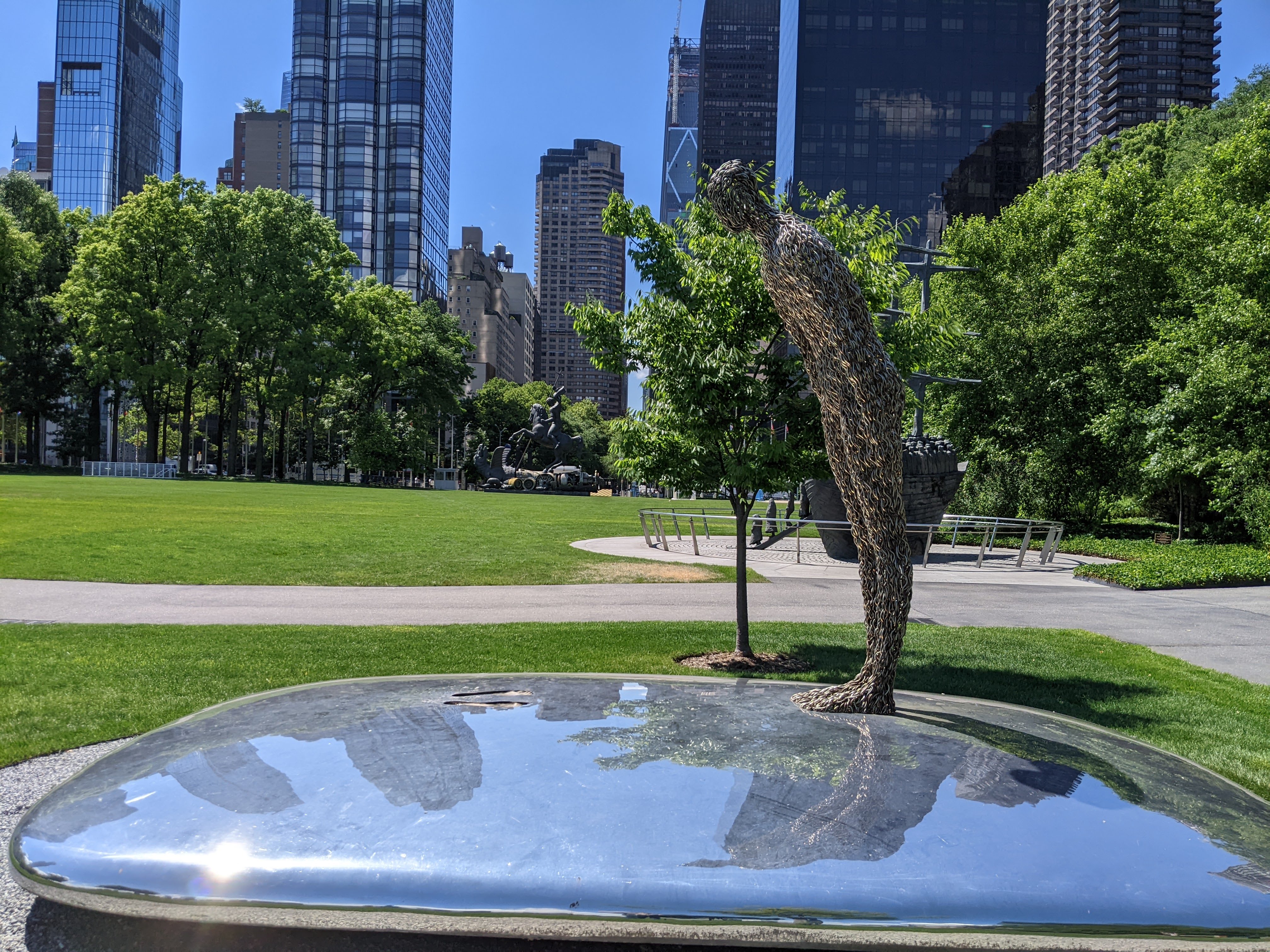
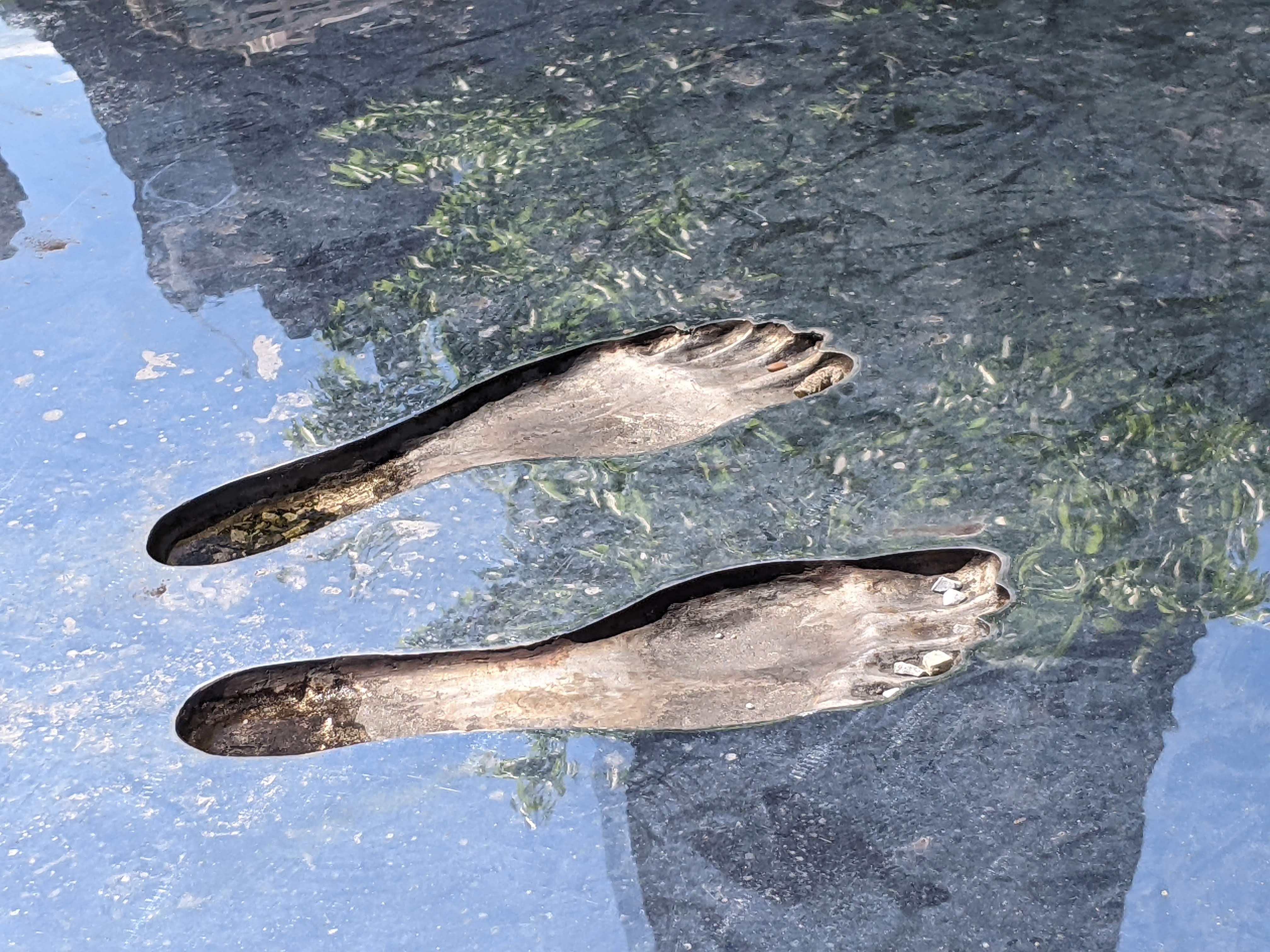
The last sculpture I’ll mention is Consciousnessby the Mongolian artist Ochirbold Ayurzana. It consists of a rounded, high-luster steel alloy floor plate on which stands a human figure, made of twisted metal strings, examining the footprints they’ve left on the planet. What mark will we make, for good or ill? The sculpture is dedicated to the historic adoption of two global developmental milestone documents: the UN 2030 Agenda for Sustainable Development and the Paris Agreement on Climate Change.
Ochirbold Ayurzana (Mongolian, 1976–), Consciousness, 2017. Steel, metal on pedestal, 110 × 196 × 125 in. North Lawn, United Nations Headquarters, New York. Gift from Mongolia. Photo: Victoria Emily Jones. [object record]
This is just a selection of the many artworks on view at the United Nations Headquarters in Manhattan. To view a full catalog, click here.
Garden Tours are offered every Wednesday at 2 p.m. from May through August, and Art Tours are offered every other Thursday at 1:15 p.m. year-round—or either one upon request. I’m grateful for their having accommodated me and my husband while we were in town!
I really wish the UN would allow visitors to move through the garden at their own speed, though, as the tour was so fast-paced that I hardly had time to take in a sculpture before we were made to move on to the next one. Approximately one to three minutes was apportioned for each work, which is hardly enough time to sit with the weight and history of some of these pieces. And I didn’t have time to change camera lenses for different types of shots. Because you have to be accompanied by a staff person, you are not allowed to linger behind when the group advances. Some leeway was given to me, but overall I felt rushed. Perhaps the pacing was anomalous because it was such a hot day—in the nineties—and the few shaded areas were prioritized.
Despite the swiftness, I really enjoyed the tour and experiencing and learning about the variety of sculptures and other art pieces from a variety of UN member countries, which celebrate peace, joy, and global unity and project a hopeful future.
Frida Hansen (Norwegian, 1844–1931), Melkeveien (Milky Way), 1898. Tapestry, 260 × 345 cm. Museum für Kunst und Gewerbe (Museum of Arts and Crafts), Hamburg, Germany.
This art nouveau tapestry by Norwegian artist Frida Hansen received a gold medal at the world’s fair in Paris in 1900. It shows angelic figures unfolding a starry veil over the night sky. They glide forward above a band of Hebrew script that references the creation of the stars in Genesis 1.
The God who brought light in darkness in the beginning is bringing light again as we enter a new liturgical year.
Comprising the first five weeks of that new year, Advent-Christmas-Epiphany is a time of starlight, promise, and revelation. The first of the triad, Advent, is particularly concerned with themes of longing, waiting, lament, and future-oriented hope. We make ready our hearts to receive Christ—he who came to us first as a babe in a manger, in a vulnerable body like ours, to teach and suffer and redeem, and who is coming back one day in unveiled power and majesty to bring the fullness of God’s heavenly kingdom to earth.
Two millennia ago, God hung a special star in the sky for the magi to follow, guiding them on their way to the Christ child. May God similarly illumine our way to Christ as we seek him this season, giving us eyes to see and ears to hear the gospel of God-with-us and cultivating in us an eager readiness for Christ’s return.
I think of Hansen’s crowned young ladies as ushering us into the deep, dark blue of Advent to behold the signs that sparkle in scripture, foretelling a wondrous future.
LISTEN: “Star of Wonder” by Sara Groves, on O Holy Night, 2008; adapted and arranged from the refrain of “We Three Kings” by John Henry Hopkins, 1857
Star of wonder, star of light Star of royal beauty bright Guide us O guide us Won’t you guide us
Want to follow along with the music on Spotify? Most of the songs in this Advent blog series, and many more besides, can be found on the Art & Theology Advent Playlist.
ONLINE EVENT: “Theodicy of Beauty” by Sarah Clarkson, March 6, 2:30 p.m. ET: “The question of suffering is one of the central, aching questions of faith. Too often, we meet suffering with an argument for God’s goodness, rather than an invitation to find and discover his goodness anew. Join me for an exploration of what it means to encounter and trust the beauty of God in our times of darkness, suffering, and pain. Drawing on my own story of mental illness and depression, I’ll explore what it means to engage with God’s goodness in a radically healing way, one that restores our capacity to imagine, hope, and create. We’ll use literature, art, and poetry to discern the ways that God arrives in our darkness to heal us, and also to restore us as agents of his loveliness in the midst of a broken world.”
This Crowdcast talk by Sarah Clarkson is based on her book This Beautiful Truth: How God’s Goodness Breaks into Our Darkness. Registration is $7 and includes a complimentary downloadable copy of “Encountering Beauty,” an arts-based reader’s guide to Clarkson’s book. I have appreciated her From the Vicarage: Books, Beauty, Theology newsletter and her wise, gentle reflections on spirituality, literature, and motherhood on Instagram @sarahwanders, so I’m looking forward to hearing from her on this topic!
+++
LECTURES (available on podcast platforms):
>> “The Loving Look” by Dr. Elissa Yukiko Weichbrodt: In this keynote address for the 2018 Beautiful Orthodoxy conference, art historian Elissa Yukiko Weichbrodt [previously], author of Redeeming Vision: A Christian Guide to Looking at and Learning from Art, discusses how contemporary art—which can sometimes be confounding or otherwise challenging—can drive us to confession, empathy, and love. Sharing her encounters with three contemporary artworks, she talks about art as a place where we can experience sanctification and common grace; how the Incarnation further vested our material world with significance; art as an invitation to embodied knowledge; art as part of how we order and understand our physical world; artworks as mirrors and shapers of culture; and how viewers, not just artists, are called to faithfulness.
She cites Esther Lightcap Meek’s Loving to Know: Covenant Epistemology, in which Meek says that all acts of coming to know are integrative; they become part of us. Knowledge is an act of covenantal care, Meek says. We don’t know in order to love; we love in order to know. Weichbrodt says, “For me, contemporary art—particularly art made by artists grappling with histories and experiences that have remained largely unseen, unknown, and unloved by the dominant culture—has served as a catalyst for faithful knowing.”
>> “The Arts as a Means to Love” by Dr. Mary McCampbell: In this lecture given for English L’Abri, Mary McCampbell [previously], an associate professor of humanities at Lee University, discusses some of the ideas from her book Imagining Our Neighbors as Ourselves: How Art Shapes Empathy. I appreciate how her writing and teaching embraces the arts of film and television alongside literature, such that not only are works like The Power and the Glory by Graham Greene, “A Good Man Is Hard to Find” by Flannery O’Connor, and Beloved by Toni Morrison explored, but so are, for example, the comedy-drama Lars and the Real Girl and the drama series Better Call Saul. Discrediting the recent odd assertion from a prominent evangelical corner that empathy is a sin, McCampbell affirms that empathy is, on the contrary, an essential Christian virtue, and one that the narrative arts are adept at forming in us, exposing us to people and stories outside our realms of experience and helping us recognize the image of God in unlikely places.
+++
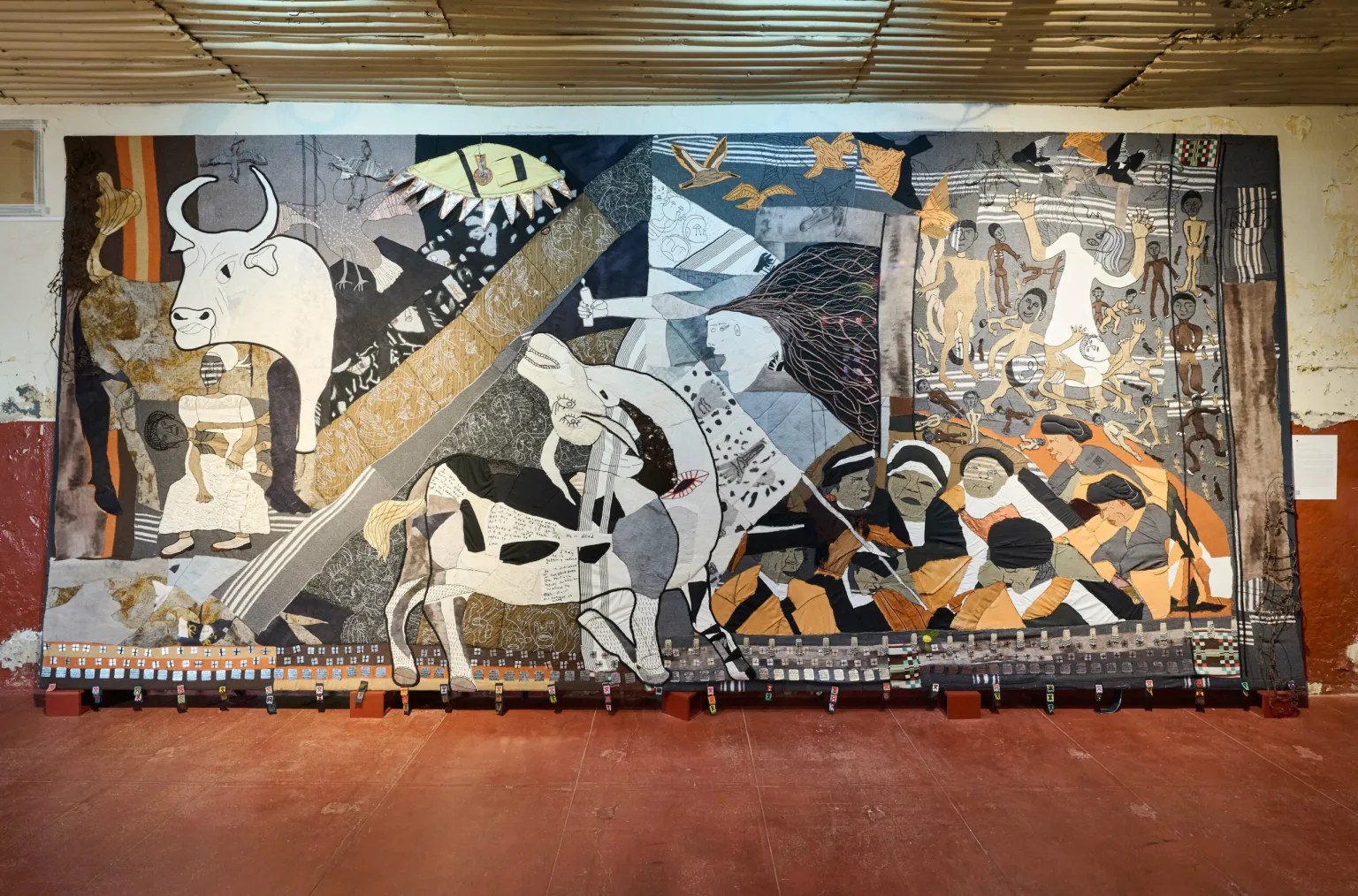
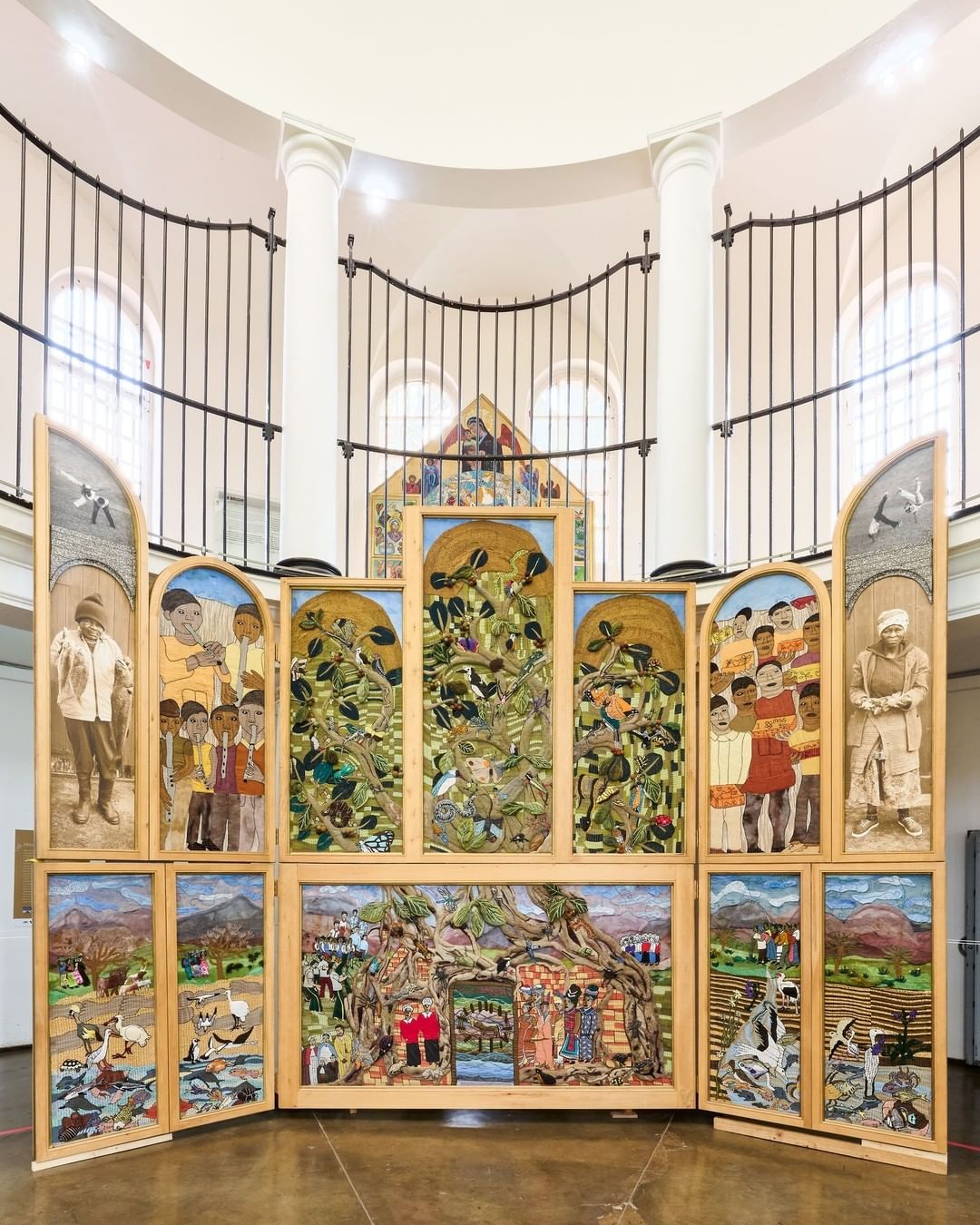
EXHIBITION REVIEW: “Mourning and Perseverance Stitched into South African Tapestries” by Alexandra M. Thomas: Through March 24 at Constitution Hill in Johannesburg, you can see Umaf’evuka, nje ngenyanga, dying and rising, as the moon does, a major retrospective of the work of the Keiskamma Art Project. Founded in 2000, the project archives the collective memory and oral histories of the rural Eastern Cape of South Africa through textile artworks, mainly by Xhosa women. Monumental and small-scale works tell stories of trauma, grief, hope, faith, resilience, and celebration. One of my favorite art research projects has been the one I did on the Isenheim-inspired Keiskamma Altarpiece in 2015, which resulted in the article “Sewing seeds of hope in South Africa”; this altarpiece is one of the many works on display. Let me call out just two others. The photos are from the current exhibition.
Keiskamma Guernica, 2010. Mixed media, including appliqué, felt, embroidery, rusted wire, metal tags, beaded AIDS ribbons, used blankets, and old clothes, 3.5 × 7.8 m. Collection of Javett Art Centre at the University of Pretoria, Tshwane, South Africa. Photo: Anthea Pokroy / Keiskamma Trust.Creation Altarpiece, 2007. Mixed media, including felt, embroidery, photographs, beadwork, wirework, and appliqué, 3.8 × 5.2 m (open). Collection of Unisa Art Gallery, Tshwane, South Africa.
Keiskamma Guernica, after Picasso’s famous antiwar painting, laments the limited access to HIV treatment in rural South Africa in the 2000s and the negligence of government hospitals, which resulted in many HIV/AIDS deaths. The piece repurposes the blankets and clothes of the deceased and serves as an expression of outrage as well as a form of commemoration. Creation Altarpiece, modeled loosely after the Ghent Altarpiece, exults in the region’s abundant wildlife and natural resources and in life-giving initiatives like Hamburg’s music education program, its capoeira group (a dance-like martial art), and the memory boxes made by orphaned children to remember their parents. The three top central panels depict a fig tree eating up an old hotel built by colonialists (a real-life scene observed in the nearby village of Bell!), and the bottom three show villagers of all kinds gathering around Christ, represented as a bull (whereas lambs were commonly sacrificed in ancient Israelite religion, traditional Xhosa religion calls for bull sacrifices).
SONG: “Kyrie” by Ngwa Roland:Ngwa Roland is a composer and the director of De Angelis Capella [previously], a Catholic choir from Yaoundé, Cameroon. Here is his choral setting of the Kyrie eleison (Greek for “Lord, have mercy”), an important Christian prayer used in liturgies around the world.
+++
ARTICLES:
>> “To One Kneeling Down No Word Came” by Jonathan Chan, Yale Logos:Jonathan Chan is a Singapore-based poet and essayist who graduated with a master’s degree in East Asian Studies from Yale in 2022. In this personal essay he reflects on the poetry of R. S. Thomas, a twentieth-century Anglican priest from Wales, particularly as it relates to the toil of prayer—prayer as a discipline requiring persistence and solitude. Thomas’s poems often express a sense of alienation from God, which is not what we might expect from a pastor, but, as Chan remarks, “God’s absence cultivates a desire for God’s presence.”
>> “Stabat Mater: How a 13th Century Lament Resonates Today” by Josh Rodriguez, Forefront: Back in July 2020, composer Josh Rodriguez [previously here and here] published this article on four modern settings of one of the most celebrated Latin hymns of all time, the twenty-stanza Stabat Mater Dolorosa (lit. “The sorrowful mother was standing”), about Mary mourning the death of her son Jesus. Written in the Middle Ages, it continues to inspire composers today, and it remains “a powerful vehicle for ‘grieving with those who grieve,’” Rodriguez writes. He spotlights the settings by James Macmillan, Julia Perry, Hawar Tawfiq, and Paul Mealor, analyzing some of the musical elements of each and quoting the composers in regards to the piece’s meaning to them.
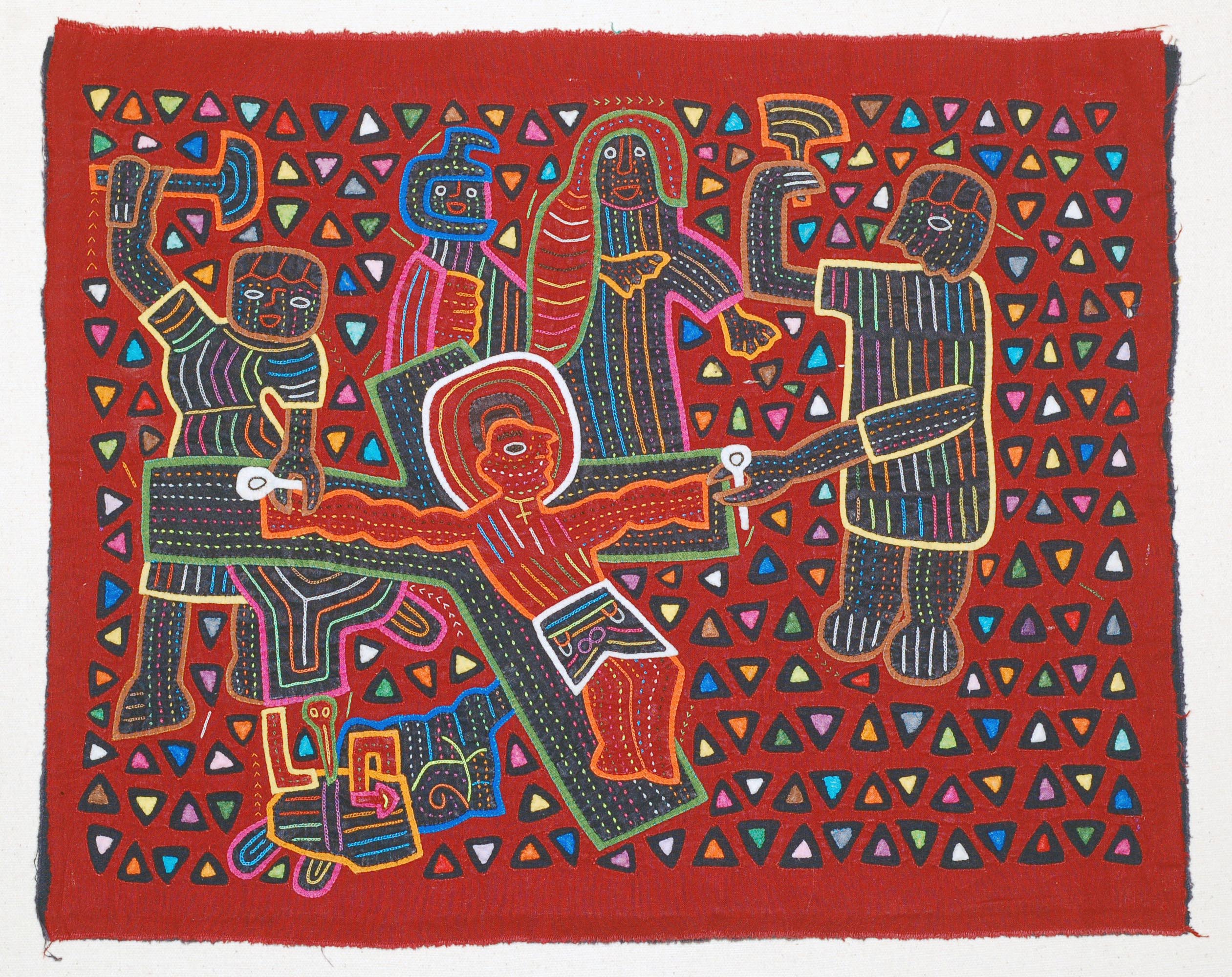
Christ Nailed to the Cross, mola (reverse appliqué panel) from the San Blas Islands, late 20th century. Bowden Collections.
The Kuna (also spelled Guna or Cuna) Indians live on the San Blas archipelago off the east coast of Panama, a cluster of some 378 islands in the Caribbean Sea. They are politically autonomous, and much of their traditional culture is intact.
Since the late nineteenth century, Kuna women have been making what are called molas, reverse appliqué panels made in pairs for the front and back of women’s blouses. As mola collector Jane Gruver describes, “several layers of cloth are stacked together and the design is made by cutting through the different layers of fabric to expose the desired color. Once the specific shape is achieved, the area is stitched around. Sometimes embroidery and applique are also used to add detail.” This colorful, wearable textile art is an integral part of Kuna culture.
The earliest molas featured geometric designs, which the Kunas translated from their customary body painting designs, but now a vast variety of representational subjects are common, including animals, plants, domestic scenes, political satire, dragons, mermaids, superheroes, spacecraft—and biblical stories!
The first Christian missionary to the San Blas Islands was Annie Coope, a single woman from the United States who arrived in the first decade of the 1900s and established a school on the island of Nirgana in 1913. A significant number of the Kuna embraced Christianity, such that there are now churches on thirty of the islands, as well as eighteen Kuna churches in and around Panama City, according to Wycliffe. A Kuna translation of the New Testament was published in 1995, at the behest of Kuna pastor Lino Smith Arango, and a Kuna Old Testament was completed in 2014.
The mola above shows two men hammering nails into Christ’s palms as two mourning figures—presumably John and Mary—stand behind. This piece is from the collection of Sandra and Bob Bowden in Chatham, Massachusetts, who are among today’s major collectors of modern biblical art. It is one of forty molas in the traveling exhibition Eden to Eternity: Molas from the San Blas Islands, available for rental for a nominal fee.
VISUAL MEDITATION: “Mary’s Fecund Yes” by Victoria Emily Jones, on Annunciation by Mats Rehnman: My latest ArtWay reflection was published Sunday. It’s on a whimsical Annunciation painting by touring storyteller, author, and visual artist Mats Rehnman, influenced in part by the Annunciation design woven into several nineteenth-century carriage cushions from Scania, Sweden.
ART TALK:“Saying Yes: The Annunciation in Contemporary Art” by Victoria Emily Jones: Speaking of the Annunciation . . . my March 18 presentation from the Breath and the Clay creative arts gathering is now online! (The aforementioned Rehnman piece is one of six I discuss.) With permission from the conference organizers, I have uploaded it to my YouTube channel for public viewing.
It’s an act of vulnerability for me to share it with you, as I’m aware of the ways in which it is deficient (in terms of speech delivery and production values). I lack technical prowess and a charismatic personality and am self-conscious about being on camera—but hopefully with practice, I will improve. The main thing is, I want the work of these artists to be known and shared. I hope to demonstrate how art can pull us deeper into the biblical story, revealing new and sometimes surprising angles or simply helping us dwell there with love and intent, and also how it’s possible to do “theology through art,” relying not exclusively on academic writings or sermons (great as they both are) to do that important work.
While I have created a video for a scholar friend’s art history channel, this is the first on my own channel—which I invite you to subscribe to. (I need at least 100 subscribers to create a custom URL for the channel.) I don’t have imminent plans for more videos, but I am starting to brainstorm ideas and will probably send out a survey to my blog subscribers to get a better sense of what you all would want to see. Several of you have requested that I get into video making, but I’ve been slow to move on it, wanting to better figure out my niche and what I could uniquely bring to such a dense market. I realize that video is a content format that is overwhelmingly preferred to blog posts these days, so I want to make use of it. But videos are much more time-consuming and difficult to produce without having a budget or a team behind me, and also not having the direct access to artworks that museums and other entities have. Please pray for this upcoming venture!
+++
CROSS-CONTINENTAL MUSIC VIDEO: “Song of Hope” by Praveen Francis and friends: This Afro-pop music video is a collaboration between musicians, dancers, and technicians in India, Guatemala, the UK, Republic of the Congo, Cameroon, and the United States. The project was initiated by Praveen Francis, a music producer and sound engineer from Coimbatore in Tamilnadu, India, who wrote the original composition. The languages are English, French, and Lingala, but the hook is a series of nonlexical vocables: “Na na na . . .” [HT: Global Christian Worship]
The video was released April 10, 2021, shortly before the second COVID wave hit India. “This Pandemic has ravaged all our lives,” Francis says. “But we will not give up. We will fight back because there is still HOPE.”
+++
EXHIBITION: Constructed Mysteries: Spirituality and Creative Practice, February 8–April 18, 2021, Olson Gallery, Bethel University: Curated by Kenneth Steinbach and Michelle Westmark Wingard, Constructed Mysteries showcased the art of nine mid-career artists or artist teams whose work engages Christian spirituality: Heather Nameth Bren, Shin-hee Chin, Caroline Kent, Scott Kolbo, Joyce Yu-Jean Lee, Nery Gabriel Lemus, Marianne Lettieri, Cherith Lundin, and Justin Randolph Thompson and Bradly Dever Treadaway. The exhibition has come to a close, but there’s a wonderful twenty-minute video tour of it that’s archived on YouTube, with artist commentaries starting at 2:44:
In addition to the video, there’s an exhibition catalog available for online viewing. It features a series of artist interviews, which address topics such as silence, the importance of process, and the nature of parable. And of course it includes photos of all the works in the exhibition. Let me highlight just two.
Marianne Lettieri, Fenêtre de Réparateurs (Window of Repairers), 2020. Vintage pincushions, wood, paper, 33 × 18 × 3 1/2 in.
The first is by my friend Marianne Lettieri [previously], whose work is informed by her “increased awareness of the enchantment of everyday actions and moments—the sequences of ordinary human existence.
I would hate to think that life is just the important events. You get married, you get an award, have a baby. These are big things, and some are what we call sacraments in the church, but I’ve realized that peeling potatoes, fixing the faucet, and other common tasks make up most of our daily living. The big moments are a part of it, but it’s the string of these small moments that are present and sacred acts we need to pay attention to.
Much of her art illuminates the value of domestic labor, such as Fenêtre de Réparateurs, which sets forty-one used pincushions, still bearing the threads put there by their previous owners, into a wooden framework, evoking a stained glass window. “This work speaks about a culture of menders—people who choose to save, repair, and transform damaged things,” says Lettieri.
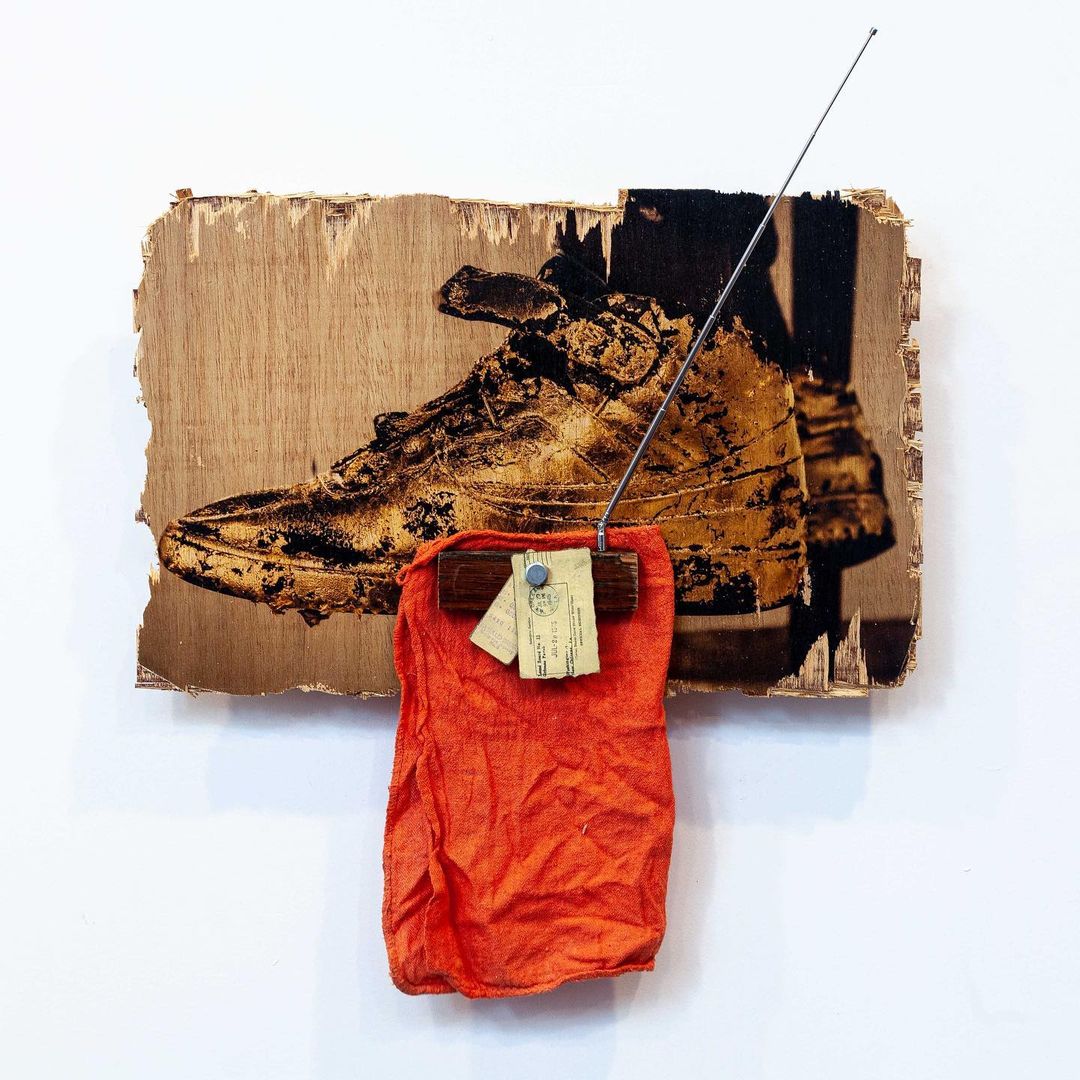
Justin Randolph Thompson and Bradly Dever Treadaway, Baby Needs New Shoes, 2021. Photographic transfer on wood with antenna and rag, 20 × 13 × 2 in.
Second, Traveling Shoes is a performative sound work by longtime collaborators Justin Randolph Thompson and Bradly Dever Treadaway, from 2013’s Flux Night in Atlanta. It involved a two-seat shoe-shine “chariot” being dragged through the crowds, stopping to gold-leaf the shoes of anyone who was interested. All the while, on the back of the chariot, a three-piece jazz band played the traditional African American song “Traveling Shoes,” which is about getting ready for Jesus’s return. The original performance, which lasted around three hours and has been re-created in several different contexts since then, is archived in a twelve-minute video, which is what was on display at Bethel. To go alongside, the curators asked the duo to submit a photograph from the performance series; they went the extra mile and used a photo as the basis of a new mixed-media work that incorporates objects used in the performance, such as a mechanic’s rag and an antenna, which is what I’ve posted here.
+++
RELIGIOUS POEMS SAMPLER: “Original and unorthodox poems about theology,” compiled by Mark Jarman: An excellent selection of ten poems, all but one available for reading from the Poetry Foundation. Jarman is a leading poet of the twenty-first century and a Christian. He was too humble to include one of his own poems on the list, but his poetry is much in this vein, so for number 11 I would add Jarman’s “Five Psalms,” from his collection To the Green Man (2004).
Yaroslava Tkachuk (Ukrainian, 1981–), Expectant, 2014. Linen, silk, seeds, copper, and acrylic, 100 × 40 cm. Photo courtesy of the artist. [Original for sale; click photo for more info]
Therefore the Lord himself will give you a sign. Behold, the virgin shall conceive and bear a son, and shall call his name Immanuel.
—Isaiah 7:14
+++
SONG: “Maria” by David Maloney, on A Christmas Album by Reilly & Maloney (1984, reissued 2012)
Christmas Day, it’s coming fast
Bringing joy to the world at last
Joy to the world
Maria . . .
This post belongs to the weekly series Artful Devotion. If you can’t view the music player in your email or RSS reader, try opening the post in your browser.
To view all the Revised Common Lectionary scripture readings for the Fourth Sunday of Advent, cycle A, click here.