
Psalms roundup: “Considering Lament” song suite, Lucille Clifton poem, Pentaglot Psalter from Egypt, and more

My roundups aren’t typically thematic, but in this one I’ve pulled together content around the Psalms—plus a link to my new monthly playlist, from which I call out particular psalms.

SPOTIFY PLAYLIST: June 2026 (Art & Theology): Most months of the year, I release a playlist of thirty songs, mostly by Christian artists—an assortment of psalms, hymns, and other spiritually inclined music. The psalm settings I feature this month are Psalm 10:1 for choir by the South Korean composer Jung Jae-il (known for his work on Parasite and Squid Game); “Psalm 55” by Poor Bishop Hooper (they’ve set all 150 songs from the Psalter!); Psalm 97:11 in Hebrew (“Light dawns for the righteous and joy for the upright in heart”) by the Jewish women’s a cappella ensemble Vocolot; Psalm 103:1, a new cover of Andraé Crouch’s “Bless His Holy Name” by Paul Zach, Jessica Fox, and IAMSON; Psalm 117, in English and Spanish and with Latin rhythms, by The Soil and The Seed Project (see below); a song by the indie singer-songwriter Sam Wilson that uses Psalm 119:103 as a refrain; and “Psalm 139” by the New Jersey–based DJ duo (and married couple) KNGDM REVIVAL.

+++

NEW ALBUM: Psalms by The Soil and The Seed Project: Released last month, this double album contains thirty-four new songs and one re-release. The first disc consists of word-for-word settings of psalms using the NIV or NRSV translations—hence why the album is classified as part of their “Bible Memory Collection”—whereas the second disc comprises songs inspired by the Psalms—loose paraphrases and, more commonly, songs that talk to God in a psalmic vein, encompassing the same broad emotional range as the biblical Psalter. There are songs of praise and gratitude, of weariness and lament, as well as petitionary songs seeking rescue or direction, presence or protection, stillness or fruitfulness.

Here’s the bilingual Psalm 117 setting “Praise the LORD, All You Nations”—the shortest psalm and the shortest chapter in the entire Bible—by Seth Thomas Crissman and Jorge Eliecer Triana, sung by Nicolas Melas and Lauren Yoder. I’ve followed it with “Lord, I Get Grumpy” by Clara Weaver, which she sings with Nichole Barrows while, it sounds like, doing dishes! “Lord, I need your patience” is something I pray a lot; now I can sing it.

Led by my friend Seth Thomas Crissman (MDiv, Eastern Mennonite Seminary), The Soil and The Seed Project is more than just a songwriting collective; they create all kinds of “creative resources that help us together turn towards Jesus in the ordinary moments of life.” Their latest Psalms package includes, in addition to the album, coloring pages and a Little Liturgies booklet with responsive readings, reflection questions, and suggested activities, all written with children in mind. You can download all these resources for FREE from their website!

+++

VIDEOS:

>> “Shaped by the Psalms: A Psalm Festival,” Calvin Institute of Christian Worship: In February, Calvin University in Grand Rapids, Michigan, hosted “Psalms 150: A Conference Experience,” bringing together a variety of guest speakers, musicians, and artists around the Psalms. This video is one of the worship services held at the conference, featuring litanies, prayers, meditations, and seventeen psalm-based songs by artists such as Rawn Harbor, Kiran Young Wimberly and the McGraths, and Bellwether Arts, who were present to lead. The choirs were conducted by either Nate Glasper, Mark Stover, or guest conductor Vinroy D. Brown Jr. There was also a live painting by Joel Schoon-Tanis.

>> “Considering Lament: Psalms of Protest, Pain and Hope,” Presbyterian Church in Ireland: This video presents Considering Lament: Psalms of Protest, Pain and Hope, a suite of eight lament psalms composed in 2026 by David and Karen Campbell based on the experiences of victims and first responders to the Troubles, a violent ethno-nationalist-religious conflict in Northern Ireland that lasted from the late 1960s to 1998 but whose wounds are still felt. The suite grew out of a project conceived by the Peace and Reconciliation Panel of the Presbyterian Church in Ireland’s Council for Public Affairs, which involved Rev. Dr. Karen Campbell and her husband David convening Psalm study groups in eight locations across Northern Ireland over the course of two years. The stories, thoughts, and feelings shared in response to the eight given lament psalms—Psalms 5, 7, 39, 59, 64, 82, 109, and 140—and in relation to the sectarian traumas the participants have endured informed the Campbells’ musical adaptations of these psalms. Click on the link above for the song list.

The lament psalms, Campbell says, “provided vessels to channel all kinds of emotions – from disappointment, anger, betrayal and sorrow – without losing hope,” an avenue “to present our hurts before the One who knows what it means to experience pain . . . and grief.” The Considering Lament suite was recorded by local artists in a studio in South Armagh and is available for free streaming, and you can download an accompanying booklet that includes sheet music. It premiered March 26 at an evening of live worship (see video) that interwove the eight songs with painful stories told firsthand, with a liturgy to connect them and to guide worshippers in prayer and reflection around the theme of suffering and loss.

To learn more about the Considering Lament project, read this wonderful interview with Karen Campbell, conducted by Joan Huyser-Honig for the Calvin Institute of Christian Worship.

+++

HISTORICAL PSALTERS: Barberini Oriental 2 and Ethiopien d’Abbadie 105: As you know, I’m very interested in Christian material culture, and if a cultural object has an appealing aesthetic, all the better! Here are two psalters (a volume containing the biblical book of Psalms) I photographed at the Africa and Byzantium exhibition at the Metropolitan Museum of Art in 2023. The first, dated to somewhere between the twelfth and fourteenth centuries, is a pentaglot (five-language) psalter from Dayr al-Suryan, a multicultural and multilinguistic monastic community in Egypt. From left to right in parallel columns are Ge‘ez, Syriac, Coptic, Arabic, Armenian, and Syriac again. This format would have facilitated comparative study of the Bible as well as common readings in the liturgy.
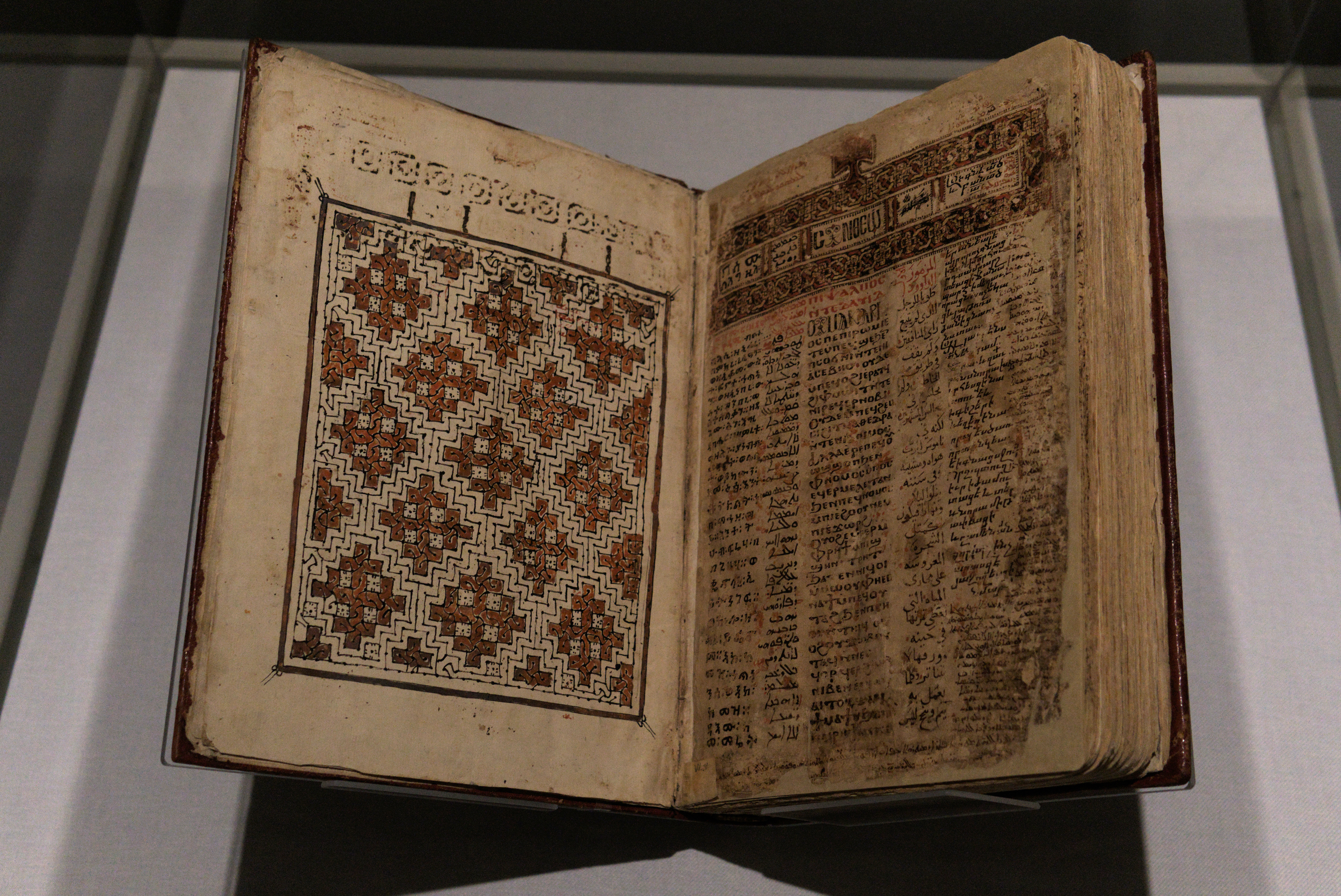
Pentaglot Psalter
Pentaglot Psalter, Egypt, 12th–14th century (restored and rebound 1636). Ink on parchment, 14 1/2 × 11 × 2 3/4 in. (36.8 × 28 × 7 cm). Vatican City, Biblioteca Apostolica Vaticana, Barb. Or. 2, fols. 2v–3r. Photo: Victoria Emily Jones. [object record]

Another psalter, from fifteenth-century Ethiopia, was open to a full-page illustration of King David, the author of many of the psalms, playing an Ethiopian box lyre called a begena, traditionally played by elite and royal men. He is shaded by an attendant with a ceremonial umbrella. In most countries at the time, it was common practice for artists to contextualize the Old and New Testament saints of the ancient Near East to their own culture. (Think, for example, of the contemporaneous Italian and Dutch Renaissance paintings.) This anonymous artist has signified “imperial ruler” by giving David the familiar trappings of an Ethiopian emperor. The manuscript would have been used by a priest or monk in the Ethiopian Orthodox Church in both his personal devotions and liturgical services.
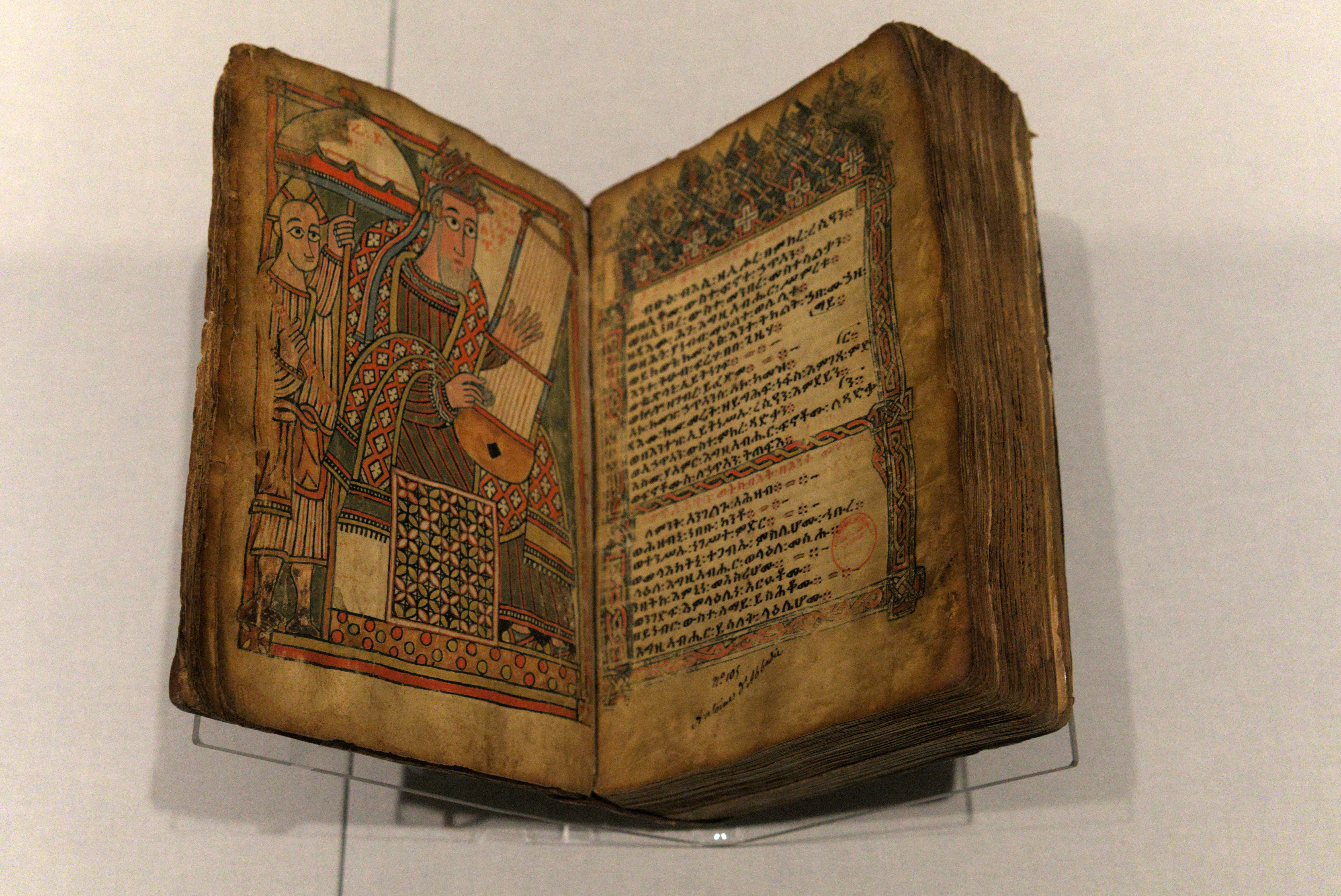
David the Musician (Ethiopia)
David the Musician, from a psalter from Tigray, Ethiopia, 15th century. Ink and tempera on parchment, 11 7/8 × 8 1/4 in. (30 × 21 cm). Ethiopien d’Abbadie 105, fols. 13v–14r. Collection of the Académie des Sciences, Institut de France, on deposit at the Bibliothèque Nationale de France, Paris. Photo: Victoria Emily Jones. [object record]

+++

POEM: “OLD HUNDRED” by Lucille Clifton: I originally wrote the following commentary for the Daily Prayer Project’s Ordinary Time 2024 periodical, which was Psalms-themed:

OLD HUNDRED is a famous hymn tune from the Genevan Psalter, so named because it came to be associated with William Kethe’s metrical paraphrase of Psalm 100, “All People That on Earth Do Dwell.” In her early poem “OLD HUNDRED,” written in the latter half of the 1960s, the African American poet Lucille Clifton (1936–2010) also engages with the Hundredth Psalm, interleaving its first line with the opening lyric of the spiritual “Nobody Knows the Trouble I’ve Seen” and blues-like phrases to create a multitextured expression of praise and lament.

Like the Psalter itself, life encompasses both gladness and sorrow. While many of the psalms call us to rejoice and give thanks, others express deep pain and questioning. The vocalist and composer Ruth Naomi Floyd says the greatest blues line ever written is Psalm 22:1, which Jesus “sings” from the cross: “My God, my God, why have you forsaken me?”

Clifton had seen trouble; so had Jesus. (“Nobody knows but Jesus . . .”) And Jesus is a friend who stands with us in hardship, weathering it alongside. When God’s promises seem far off and we can’t muster a hallelujah, looking to Jesus can give us the strength, both to be honest about our trouble and to put it in God’s hands and so lay hold of joy. “OLD HUNDRED” wrestles through that.

Does this poem feel disjunctive or integrated? What do you make of Clifton’s use of all-caps? After reading the poem, read Psalm 100 and the lyrics to “Nobody Knows” and compare them. Consider how they both fit into the church’s repertoire of songs.

“OLD HUNDRED” can be found in Clifton’s Collected Poems, a volume I highly recommend.
Favorite Films of 2021, Part 1

I know, I know. My top 20 list of films from 2021 is very late. Several that I wanted to see before compiling the list didn’t come to a theater near me until after the Oscar nominees were announced . . . But better late than never, right?

I’m breaking up the list into two separate posts.

I am counting films as from 2021 if they were released in the US in that year. If the film is available for free through a streaming service to subscribers, I will mention that at the end of the description; most of the others can be rented online for a fee, or you might also try checking your local library for a DVD.

Note: Several of these films are rated R, and for a variety of reasons. If you want to avoid specific types of mature content, I suggest you consult the Parents’ Guide on the IMDB page of whatever movie you’re considering watching.

If you’d like to see my top 20 films of 2020, click here.

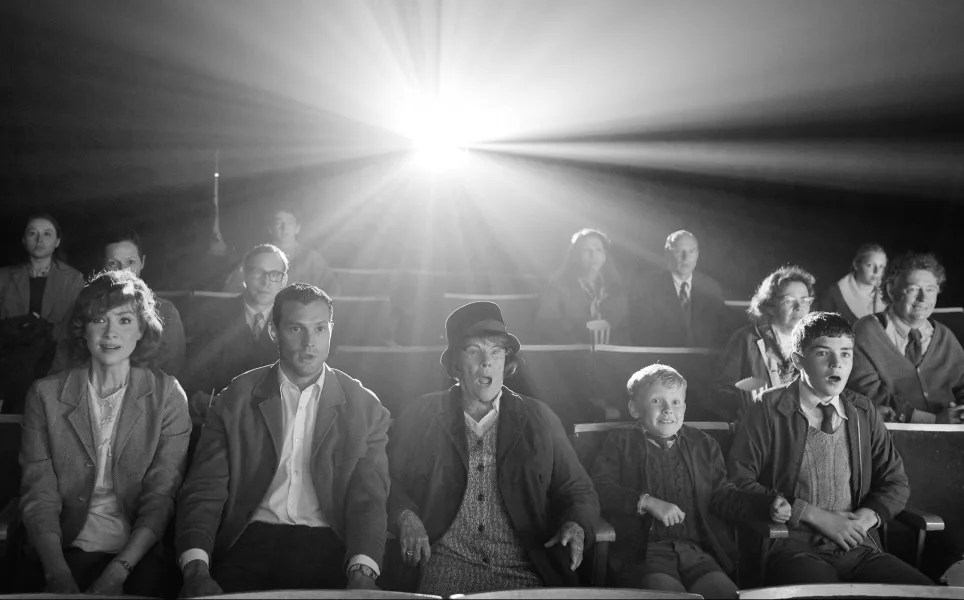
Belfast film still
The joy of cinema is one of the themes in Kenneth Branagh’s semiautobiographical film Belfast, as all three generations of Buddy’s family enjoy going to the movies together. In this still, they react to the flying car riding off the cliff in Chitty Chitty Bang Bang.

1. Belfast, dir. Kenneth Branagh. Drawn from writer-director Kenneth Branagh’s own childhood, Belfast takes place in 1969–70 in a working-class neighborhood in the Northern Ireland capital, at the beginning of the thirty-year period of political violence known as the Troubles. This conflict was between (mostly Catholic) nationalists seeking independence from Britain, and (mostly Protestant) loyalists who saw themselves as British and thus sought to preserve Northern Ireland’s union with Britain. The focus of the film, however, is on family, not politics, as all the events of the year are filtered through the perspective of nine-year-old Buddy (Jude Hill). He sees his dad, for example, who refuses to participate in the riots, as a hero in the vein of his favorite western film characters.

Belfast is poignant and nostalgic and not at all the worse for being so. The “Everlasting Love” scene near the end is euphoric—and well earned!—and made me cry. In the wake of a death and amid financial debt, impending displacement from what has been their family’s hometown for generations, and other marital strains, Pa (Jamie Dornan) sings a pop song to Ma (Caitriona Balfe) from a lounge stage and pulls her into a dance, creating a moment of pure celebration, love, and defiant survival. The film’s highlight for me is how it holds together life’s joys and struggles, sorrows and laughter. Branagh, who moved with his parents and brother from Belfast to Reading, England, at age nine to escape the violence, dedicated the film to “those who stayed, those who left, and those who were lost” in Belfast.

2. The Power of the Dog, dir. Jane Campion. An adaptation of a Thomas Savage novel, this film subverts the traditional image of the western cowboy, exploring male virility, vulnerability, and agency. What is required to protect those you love? Is it muscles and bluster and a “gloves off” sort of grit, or a courage rooted someplace else?

Set in Montana in 1925, the film centers on the macho-posturing Phil Burbank (Benedict Cumberbatch), who runs a cattle ranch with his brother George (Jesse Plemons). When George marries the widowed Rose (Kirsten Dunst), she and her impressionable teenage son Peter (Kodi Smit-McPhee) settle at the Burbank estate. Phil is set off by Peter’s “sissiness”—his willowy frame, his slight lisp, his delight in crafting paper flowers for his mother—and he reacts with incessant bullying. He is cruel, mocking, and emotionally abusive not only to Peter but also to Rose, whom he resents for layered reasons.

The ending makes us see one of the characters in a completely different light and therefore prompts us to reread some of the emotional dynamics we have witnessed. The title comes from Psalm 22:20: “Deliver my soul from the sword; my darling from the power of the dog” (KJV).

Streaming on Netflix.

3. The Lost Daughter, dir. Maggie Gyllenhaal. Ambivalence toward motherhood is rarely explored onscreen. We see mother characters overwhelmed and exhausted, even stifled, but the sacrifices they make in those roles are almost always portrayed as ultimately worth it for the profound love and joy they experience as a result of being a mom. Because we’re conditioned, culturally and religiously, to view children as an unmitigated blessing, to express any kind of regret about having children is taboo (we’re only allowed to regret not having children). Women are expected to relish their role as mothers and to find their deepest fulfillment in that role, and if they don’t, they’re branded as “bad” or selfish.

I can already hear the alarm bells going off with my readers right now. “Children are a gift from God! How dare we be anything less than grateful for them! Women are designed to bear and nurture life! What could possibly be more fulfilling than living out that design?” One of the great things about films is that they often help us to enter into other experiences and perspectives, to access the feelings of another and, through that, our own. That doesn’t mean we forsake our beliefs and convictions, but we open ourselves up to a story that could challenge our sometimes overly simplistic thinking. One doesn’t have to reject the Bible to acknowledge that motherhood is messy and that for many women it requires them to confront (or else bury) darker pulls and emotions. Contrary to what we’re often told, motherliness does not come naturally to all women! There’s much more I could say about this, but let’s get to The Lost Daughter:

First-time writer-director Maggie Gyllenhaal, who herself has two daughters, wanted to make a film that explores all the complicated, unresolved emotions surrounding motherhood, which can include terror, anxiety, doubt, annoyance, and despair. An adaptation of Elena Ferrante’s novel of the same title, it follows Leda (Olivia Colman), a middle-age literature professor on holiday in Greece. One day on the beach she encounters a young mother named Nina (Dakota Johnson), who triggers Leda’s memories of her own two daughters, now in their twenties. We see flashbacks to Leda’s life as a struggling twenty-something mom (played by Jessie Buckley). She loves her children but feels plundered by them. And so she does something “aberrant,” as Gyllenhaal put it in an interview, which we find out about halfway through the film.

The film neither punishes nor condones its protagonist’s behavior. To what degree Leda feels guilt, regret, or satisfaction, and about what specifically, is largely left to the viewer to interpret, as she’s a hard one to read. (Colman gives us a very interior performance, which I think is to her and the film’s credit.) She is obviously troubled by past decisions, as her dizzy spells and thievery would suggest. There is also quite a bit of open-ended symbolism at play throughout.

Streaming on Netflix.

4. Drive My Car, dir. Ryûsuke Hamaguchi. The forty-minute prologue of this three-hour film establishes the relationship between theater actor-director Yusuke Kafuku (Hidetoshi Nishijima) and his screenwriter wife, Oto (Reika Kirishima). Within this pocket of time, Oto dies of a cerebral hemorrhage—after Yusuke finds out about her having an affair but before he confronts her about it. Roll opening credits.

Based loosely on a short story by Haruki Murakami, Drive My Car is about grief, intimacy, betrayal, forgiveness, self-knowledge, and communication across barriers. Two years after his wife’s death, Yusuke participates in a residency in Hiroshima, where he has been invited to direct a multilingual stage production of Chekhov’s Uncle Vanya, about a forty-seven-year-old man who is so world-weary that he wants to die. Yusuke’s concept is for the actors to act in their native language—Mandarin, Japanese, Korean, Korean Sign Language—feeding off their dialogue partner’s tones, speech rhythms, body language, and facial expressions, while subtitles are projected on a screen for the play’s audience.

Yusuke’s emotional healing comes through his work on this play (“Chekhov is terrifying because his lines drag the real out of you,” he says) and through the friendship he develops with his assigned driver, Misaki Watari (Toko Miura), a young woman who also carries a private grief. The two help each other come to terms with loss and regret and learn how to live again.

Streaming on HBO Max.

5. Flee, dir. Jonas Poher Rasmussen. This animated documentary chronicles the refugee experience of Amin Nawabi (not his real name), who fled from Afghanistan to Russia with his family in 1992 when he was eleven to escape the Mujahedeen attacks that became more frequent in Kabul after the Soviet withdrawal. He sought asylum in Europe for the next few years as an unaccompanied minor and eventually settled in Denmark, where he attended high school in Copenhagen and became friends with classmate Jonas Poher Rasmussen, now a filmmaker. More than twenty years later, he is telling his story for the first time, and it is Rasmussen he has entrusted it to.

The use of animation, a rare but not unheard-of choice for a documentary, has several advantages. It enables the subject to remain anonymous for his own safety. It allows for the re-creation of scenes from Amin’s childhood that were not, and could not have been, captured on film. And it enhances the expressiveness, tone, and meaning of certain scenes. The animation is supplemented, sparingly, with archival newsreel footage that gives historical veracity to some of Amin’s memories. And an important link to “the real” is forged by the use of Amin’s own voice in the animated interview sessions, conducted over several years, and sometimes in voiceover in the flashbacks. (His younger self is voiced by actors who capture him at two different ages—nine to eleven, and fifteen to eighteen.)

Throughout the film, Amin works to integrate his past and present and to make a home (“someplace safe, somewhere you know you can stay, and you don’t have to move on”) with his fiancé, Kasper, whom he has not yet spoken his traumas to.

Streaming on Hulu.

6. CODA, dir. Sian Heder. Sure, this film follows a predictable narrative arc and hits all the notes you would expect. But it’s so good! Seventeen-year-old Ruby (Emilia Jones) is the only hearing member of her family (CODA = child of deaf adults). Before school each day she works on the family’s fishing boat with her dad (Troy Kotsur) and older brother (Daniel Durant), while her mom (Marlee Matlin) runs the business side of things. But she finds herself increasingly drawn toward singing as a career path, and she starts to consider applying to Berklee College of Music in Boston.

The conflict is a familiar one: follow the plans your parents have laid out for you, or chase your own dreams, your own calling. Ruby needs to find her identity apart from being her family’s interpreter. But how can she honor the talents she’s been gifted with and her family obligations? Ruby’s parents slowly learn to accept and support her ambitions, even though they revolve around an auditory art form that is not accessible to them, and even though it means she’ll have to leave home. A turning point comes when they see her sing a duet at a school concert. In what is the most moving scene in the film, they experience the performance through watching the reactions of others in the audience.

Streaming on Apple TV+.

7. The Killing of Two Lovers, dir. Robert Machoian. A stylish arthouse drama set in rural Utah, this film follows David (Clayne Crawford), who’s desperately trying to keep his family of six together during a separation from his wife, Niki (Sepideh Moafi). He refuses to accept that the marriage is over. Shot in a 4:3 aspect ratio and with lots of long takes, the film is raw, potent, unflinching. And I love where it ends up.

Streaming on Hulu.

8. The Truffle Hunters, dir. Michael Dweck and Gregory Kershaw. This documentary made me smile more than any other film I saw last year. It’s so tender, and so gorgeously shot. And it’s got to be my favorite dog movie!

Truffle hunters are typically a secretive bunch, but the filmmakers got access to several of these elderly men from northern Italy who forage the forests with their trusty dogs, seeking out the edible fungus, a gourmet delicacy, to sell at high-priced auctions or on the black market. There are no interviews, no voiceovers—just a quietly observant camera. Despite the high prices truffles fetch, the hunters live simple lives in their Piedmont villages. And each has his own personality.

There’s a heavy focus on the relationship between the men and their dogs. They share meals with them, take baths with them, sing “Happy Birthday” to them, bring them to church. Aurelio, who is single and has no children, looks for someone to take care of his dog Birba when he dies; his chatter with Birba, and his expressions of love (like baking her a cake for her birthday), is the most endearing part of the film. It was also precious to see Titina, Carlo’s dog, being blessed by a priest—to use her gift of scent to serve others, to bring joy, as her finds will end up being used to make delicious dishes.

9. The Father, dir. Florian Zeller. Because of the COVID-19 extended eligibility period for Oscar submissions last year, this film was technically part of the 2021 Academy Awards, even though it was released in February 2021. Anthony Hopkins, who won Best Actor for this role, plays Anthony, an elderly man with dementia. As he loses his grip on the things and people around him, he becomes easily agitated and resists the care of his daughter Anne (Olivia Colman).

Zeller said he wanted the audience to feel as though, like Anthony, they’re “groping their way through a labyrinth,” so he wove a complex narrative that mixes reality with Anthony’s memories. We are made to feel his confusion, terror, frustration, and disorientation, in part by the use of multiple actors to portray a single character, such that we’re also not sure who’s who and what’s going on. Kudos to editor Yorgos Lamprinos and production designer Peter Francis for their work, as both those skills are key in pulling off this kind of storytelling.

The film is heartbreaking—the biggest downer on my list, for sure, especially with its climactic scene where Anthony breaks down and cries for his mommy. But by inviting us into Anthony’s suffering, The Father develops our empathy for those whose brains stop functioning properly in old age, for whom the world no longer makes any sense—an incredibly fearful thing.

10. C’mon C’mon, dir. Mike Mills. Johnny (Joaquin Phoenix) is a radio journalist who travels the US asking kids big questions about life. When his sister (Gaby Hoffmann) is forced to deal with a mental health crisis her ex-husband is experiencing, Johnny becomes the caretaker of her son (Woody Norman) for an extended period. The uncle-nephew bonding that follows constitutes the core of the film. Unlike The Lost Daughter, C’mon C’mon paints a bright and affirmative portrait of parenthood. It acknowledges the challenges of raising children while also celebrating the many small, beautiful moments of connection that are possible between adult and child.

Read part 2.

Bomb-shattered glass transformed into Resurrection Window

From 1968 to 1998 Northern Ireland was embroiled in a period of conflict known as the Troubles, during which violence in the streets was commonplace. On one side of the conflict was the unionist, loyalist, and overwhelmingly Protestant majority, who wanted Northern Ireland to remain part of the United Kingdom. On the other side was the nationalist, republican, almost exclusively Catholic minority, who wanted Northern Ireland to become part of the Republic of Ireland. A nationalist Catholic protest against institutionalized discrimination on October 5, 1968, that was countered with violence is what sparked the thirty-year guerrilla war, resulting in the deaths of over 3,500 people, mostly civilians. Killings were perpetrated on both sides, each of which had its own paramilitary organizations launching armed campaigns.

First Lisburn Presbyterian Church in County Antrim is one of many churches that suffered damage during the conflict when on August 5, 1981, a car bomb planted by the Irish Republican Army exploded in Market Street. The explosion left the church’s roof, plasterwork, balcony, organ, and windows in need of serious repair. (Thankfully, though, there were no fatalities.)

Church member Norah Boyle describes the congregation’s reaction:

Arriving on the scene early, as I thought, I had already been preceded by a small army of workers from the congregation who, without prior organising, had heard of the damage and raced to the church, many complete with buckets, brooms, mops and other cleaning materials. Some just stood in a state of shocked disbelief at the sight before them; some wept; others reacted to the shock in a burst of physical activity, first to clear the rubble away and search for any stained glass pieces, yes, even those pieces embedded in the pews and other woodwork. Totally impervious to the danger of further falling plaster, woodwork or masonry they worked on, clearing, cleaning, dusting, polishing. . . .

I could not possibly have witnessed the scenes that I did and the reaction to them by the congregation without having my faith in God and my love for First Lisburn deepened.

As a witness to its hope for peace in Northern Ireland, First Lisburn decided to remain in its location and rebuild. One of the major questions it faced in this process was what to do with the seventeen windows that had been blasted—whether to restore their former pictorial designs or to create new ones. The property committee decided to honor the church’s heritage by having artists recreate the previous designs, except for one of the clear-glass windows on the balcony, which they commissioned the famous studio James Watson & Son to reinvent in stained glass on the theme of resurrection.

Resurrection Window by James Watson
Resurrection Window, 1987, designed and executed by James Watson. First Lisburn Presbyterian Church, County Antrim, Northern Ireland.

Resurrection window2-002
Detail. Photo courtesy of Rev. John Brackenridge, First Lisburn Presbyterian Church.

Called the Resurrection Window, it’s made almost entirely of shards that were blown out of the original windows. The plaque at its base reads,

This window is a memorial of the bomb-blast of 5th August 1981 and the subsequent restoration of our church and halls. It is a tribute to our neighbours in shops and offices and their will to overcome disaster. It is an echo of the motto of this town: “EX IGNE RESURGAM” (I will arise from the fire). It is a witness to our faith in Jesus Christ our Lord.

Continue reading “Bomb-shattered glass transformed into Resurrection Window”