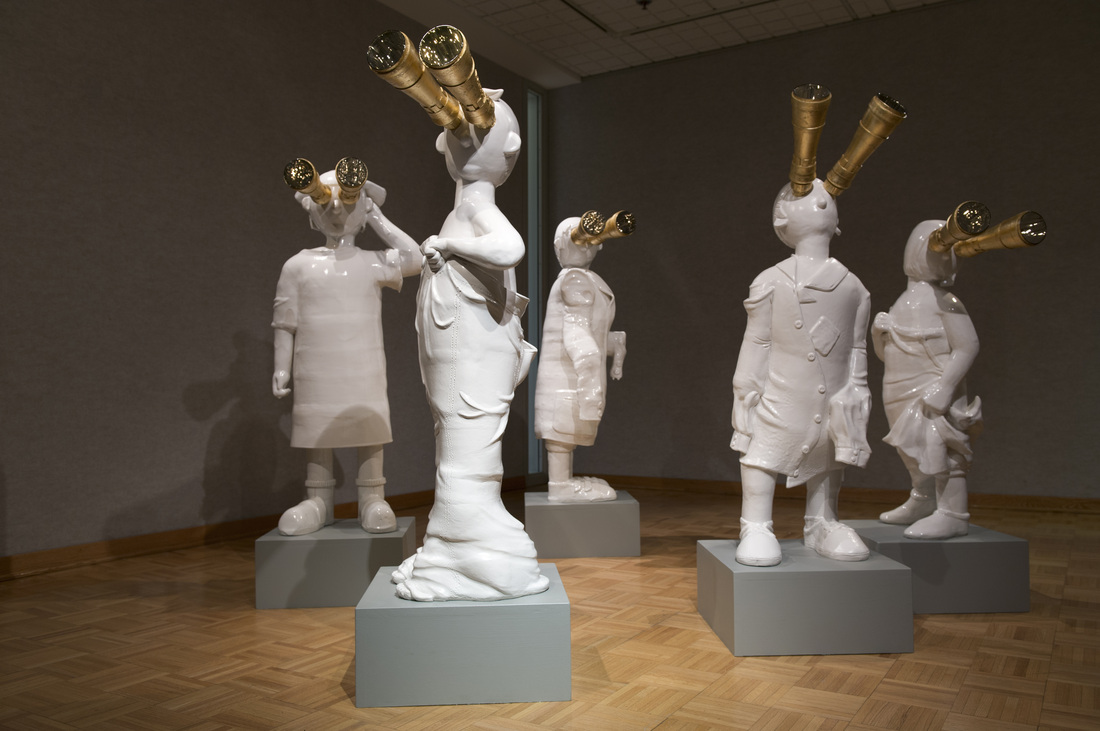
Namdoo Kim (Korean, 1985–), Golden Binoculars, 2013. Glass, ceramic, mixed media, each figure 42 × 20 × 20 in. Installation at the 2018 SOFA Chicago art fair (now Intersect Chicago).
Watchman, tell us of the night, what its signs of promise are. Traveler, o’er yon mountain’s height, see that glory-beaming star. Watchman, does its beauteous ray aught of joy or hope foretell? Traveler, yes; it brings the day, promised day of Israel.
Watchman, tell us of the night; higher yet that star ascends. Traveler, blessedness and light, peace and truth its course portends. Watchman, will its beams alone gild the spot that gave them birth? Traveler, ages are its own; see, it bursts o’er all the earth.
Watchman, tell us of the night, for the morning seems to dawn. Traveler, darkness takes it flight; doubt and terror are withdrawn. Watchman, let thy wanderings cease; hie thee to thy quiet home. Traveler, lo! the Prince of Peace, lo! the Son of God is come!
Unfolding in alternating couplets, this nineteenth-century hymn from England presents a dialogue between a traveler and a watchman—that is, someone stationed at a vantage to look out for coming invasions or things out of the ordinary. The traveler asks the watchman what he sees and what its meaning is; the watchman responds that he sees a glorious star ascending up over the mountains, portending blessing and peace not just for the land of its rising but for all peoples. A beneficent invasion!
This post is part of a daily Advent series from December 2 to 24, 2023 (with Christmas to follow through January 6, 2024). View all the posts here, and the accompanying Spotify playlist here.
Below are songs by three different bands/artists who will be playing at the festival: “Praise to God (Whirlwinds),” a new setting by the Walking Roots Band of an eighteenth-century hymn by Anna Barbauld (recorded on The Soil and The Seed Project, vol. 4 and appearing on the Art & TheologyThanksgiving Playlist); “Again, Amen” by Spectator Bird (sisters Rachel and Lindsey FitzGerald); and “Grieve and Rejoice” by Ryan Scarberry, director of music at Incarnation Anglican Church in Williamsburg, Virginia.
+++
ONLINE EVENT: “In Memoriam: An Evening Celebrating Frederick Buechner’s Literary Contributions,” August 15, 2023: “Celebrated as one of the foremost spiritual writers of his generation, Frederick Buechner’s witty, vivid, and rich writing has inspired readers’ minds and stirred hearts through his more than 30 published books for six decades. One year after his passing, Frederick Buechner (July 11, 1926–August 15, 2022) remains an influential voice for writers across genres, from novelists and memoirists to homileticians and theologians alike. For those writers who feel not religious enough for religious readers, or too religious for non-religious readers, Buechner’s voice has been a welcome, guiding light.
“On the one-year-anniversary of Frederick Buechner’s passing, Image is hosting space for community members to gather and share their appreciation for Buechner’s literary contributions. From themes of paying attention to one’s life and stewarding one’s grief, to the unexpected influences on one’s vocation and the ordinary miraculous moments of everyday life, Buechner’s words offer a variety of invitations through which one might come to see the world and one’s place within it more deeply. Image community members are invited to bring a favorite selection of Buechner’s writing to read aloud and to briefly reflect on the difference his words have made for their life.” Register for this free, moderated, open-mic-style time of sharing and reflections at the link above.
+++
DOCUMENTARY: The Sea in Between (2013) by Mason Jar Music: Blayne Johnson and his family, who reside in Mayne Island, British Columbia, are big fans of Portland, Oregon-based indie singer-songwriter Josh Garrels. In 2012 Johnson reached out to Garrels and some of the folks at Mason Jar Music, the Brooklyn-based creative collective Garrels has worked with, to invite them up to his home for a relaxing getaway, and to play for his family and neighbors. Mason Jar specializes in live performance videos, so they sent a small crew and a handful of musicians with the intention of shooting a few of those at various locations around the island—along the bay, on a farm, in a church. Then they decided to extend the footage from the week into a feature-length documentary, directed by Matt Porter, which you can watch for free on YouTube (embedded directly below). The song recordings were released afterward on an album of the same name, along with others that didn’t make the final cut of the film.
The Sea in Between, the film, is about vocation, the creative process, patronage, faith, family, community, and the beauty of place, and it centers on the joy of making and experiencing music together. Besides Garrels, the musicians are Dan Knobler (slide guitar, mandolin), Jay Kirkpatrick (banjo, accordion), Russell Durham (violin), Charlaine Prescott (cello), Jason Burger (drums), Chad Lefkowitz-Brown (clarinet, flute, saxophone), and Gabriel Gall (miscellaneous), who served as music director and wrote the orchestrations. Michelle Garrels and Matt Porter play the aquarion (glass marimba), and everyone contributes vocals. Perhaps my favorite song from the film is “Pilot Me” (not to be confused with the Edward Hopper hymn “Jesus, Savior, Pilot Me”; this is a Garrels original):
+++
SONG: “O nata lux” by Thomas Tallis, performed by VOCES8: “O nata lux de lumine” (O Light Born of Light) is the office hymn at Lauds of the Feast of the Transfiguration, celebrated August 6. Here VOCES8 performs a setting from the English High Renaissance by Thomas Tallis, inside St. Bartholomäus-Kirche in Pegnitz, Germany.
O nata lux de lumine,
Jesu redemptor saeculi,
Dignare clemens supplicum
Laudes precesque sumere.

Qui carne quondam contegi
Dignatus es pro perditis,
Nos membra confer effici
Tui beati corporis.
O Light born of Light,
Jesus, redeemer of the world,
with loving-kindness deign to receive
suppliant praise and prayer.

Thou who once deigned to be clothed in flesh
for the sake of the lost,
grant us to be members
of thy blessed body.
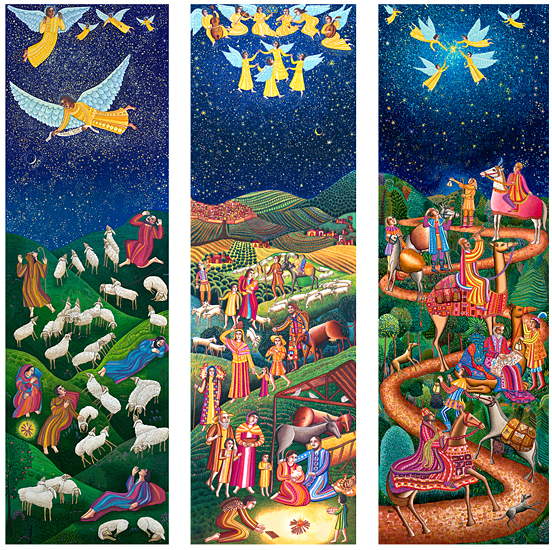
John August Swanson (American, 1938–2021), Epiphany, 1988. Serigraph, 38 × 12 in. Edition of 210. [for sale]
Tomorrow, January 6, is the feast of Epiphany, commemorating the visit of the magi to the infant Christ, an episode that represents God’s manifestation to the nations beyond Israel. Printmaker John August Swanson visualizes their journey in a starkly vertical composition that was conceived as the right wing of a triptych (three-paneled artwork), the other two panels depicting the Annunciation to the Shepherds and the Nativity. In subsequent years he addedA Visit (depicting the Annunciation to Mary), Flight into Egypt, and Presentation in the Temple to the set.
Epiphany depicts the journey of the three Magi as they travel up a serpentine trail. One of the Wise Men is seated as he looks at a map of the constellations with his magnifying glass; his servant holds a lamp so that he can see. Another Magi searches with his telescope into the sky. They look up in search of their beautiful guiding star as angels surround and point to it. They have exotic birds, peacocks, and dogs among their animals. I have tried to capture the details of the many plants, bushes, and trees and to create a variety of colors of green.
I used many symbols within the tapestries draping the animals. These patterns depict the Lion of Judah, the lamp in the darkness, the rain falling on the parched ground, the key to the locked door, the crown and the heart, and the gates to the city.
This is part of a series of three images (triptych). They were inspired by the Mexican tradition that I am familiar with for Christmas. Families will each create a beautiful crèche (nacimiento) with many figures and animals, creating a whole environment with landscaping in miniature around the Nativity figurines.
His other inspirations for this set include the opera Amahl and the Night Visitors by Gian Carlo Menotti and the medieval stained glass windows in Chartres Cathedral.
John August Swanson, Advent Triptych, 1985–88 [for sale as poster or card]
John August Swanson (1938–2021) [previously] was born in Los Angeles of a Mexican mother and Swedish father. His father died when he was young, and he was raised in a multigenerational Mexican Catholic home. He studied serigraphy under Corita Kent [previously], and it became his primary medium. A serigraph is a type of print in which each color is individually layered by applying ink through a silkscreen onto paper. Epiphany has forty-eight individual colors.
LISTEN:“Bright and Glorious” | Original Danish text (“Deilig Er Den Himmel Blaa”) by Nikolai F. S. Grundtvig, 1810 | English translation by Jens Christian Aaberg, 1927; first stanza adapted by the editors of the Lutheran Service Book and Hymnal, 1958 | Music by Seth Thomas Crissman and Greg J. Yoder, 2017 | Performed by the Walking Roots Band on Hark! A Walking Roots Band Christmas, 2017
Bright and glorious is the sky Radiant are the heavens high Where the golden star is shining All its rays to earth inclining Leading to the newborn king Leading to the newborn king
Him they found in Bethlehem Yet he wore no diadem They but saw a maiden lowly With an infant pure and holy Resting in her loving arms Resting in her loving arms
Guided by the star, they found Him whose praise the ages sound We, too, have a star to guide us That forever will provide us With the light to find our Lord With the light to find our Lord
As a star, God’s holy word Leads us to our King and Lord Brightly from its sacred pages Shall this light throughout the ages Shine upon our path of life Shine upon our path of life
The Walking Roots Band (TWRB) is an acoustic folk/bluegrass-ish music group steeped in Anabaptist hymn-singing traditions and based in Harrisonburg, Virginia. Several of its members are the creative forces behind The Soil and The Seed Project, a liturgy and arts initiative that launched in 2021.
Here they’ve retuned an Epiphany hymn from Denmark, which compares the star that led the magi to Jesus to the Bible, God’s word, which serves as a guiding light for spiritual seekers, leading us to Christ himself. Its pages offer countless epiphanies—revelations of God’s glory, opportunities for divine encounter. Its wisdom and truth can illuminate our paths if we let it.
For the first time, this year I plan on publishing short daily posts for the entirety of Lent and for the Octave of Easter, pairing a visual artwork with a piece of music along the seasons’ themes (for an example of this format, see here)—just an FYI of what to expect. I also have several poems lined up. And you might want to check out the Art & Theology Lent Playlist and Holy Week Playlist on Spotify (introduced here and here respectively), which I’ve expanded since last year. I’m very pleased with the Holy Week Playlist in particular.
+++
NEW RESOURCE FOR HOME LITURGIES:The Soil and The Seed Project: Directed by Seth Thomas Crissman of The Walking Roots Band [previously] and with the contributions of a team of artists, writers, and musicians, “The Soil and The Seed Project nurtures faith through music, art, and Little Liturgies for daily and weekly use in the home. These resources help establish new rhythms of faith as together we turn towards Jesus, believing and celebrating the Good News of God’s Love for the whole world.” The project launched in November 2021 with its Advent/Christmas/Epiphany collection. When the project is complete it will consist of four volumes of music (forty-plus songs total—all original, save for a couple of reimagined hymns) and four liturgical booklets that include responsive scripture-based readings, reflection prompts, suggested practices, and an original artwork.
Thanks to a community of generous donors, The Soil and The Seed Project gives away all its content for free, including shipping, to anyone who is interested (individuals, couples, families, churches, etc.); request a copy of the latest music collection and liturgies here. CDs and printed booklets are available only while supplies last (1500 copies have been pressed/printed for this collection), but digital copies of course remain available without limit.
+++
CONVERSATIONS AT CALVIN: Below are two videos (of many!) from the 2022 Calvin Symposium on Worship, which took place earlier this month.
>> “Modern-Day Prophets: How Artists and Activists Expand Public Worship” with Nikki Toyama-Szeto: A writer, speaker, and activist on issues of justice, leadership, race, and gender, Nikki Toyama-Szeto is the executive director of Christians for Social Action and a leading voice for Missio Alliance. Here she is interviewed by preacher and professor Noel Snyder. They discuss the generativity of imagination, and its invitation to displacement; the connection between corporate worship and public witness; the movement of the Holy Spirit outside church walls; “political” and “pastoral” as classifications that differ from group to group; embracing messiness; and what pastors can learn from artists and activists.
A few quotes from Toyama-Szeto that stood out to me:
“Part of what we’re trying to do at Christians for Social Action is stir the Christian imagination for what a fuller followership of Jesus looks like in a more just society. The word ‘imagination,’ and I would say specifically Christian imagination, I think of as the dream that God dreams for his people and his creation. What does it mean to be oriented toward the dream that God is dreaming? Another word for it is shalom—the full flourishing of all his creation and all his people. And if you look at the gap between where we are today and what that dream is, that gap is imagination. How is it that we get from here, the broken world we see . . . how do we press in and lean into the dreams that God dreams for his people and for his world?”
“For me, I have found artists and prophets—those who are agitating for justice—are ones who help dislodge me from everyday things I take for granted, and those assumptions, and they help me to dream new and bigger dreams.”
“The pursuit of justice is the declaration of God’s character in the public square.”
Smith shares his frustration that often the only Christians who endeavor to learn other languages and develop cultural intelligence and appreciation are those who are preparing to be missionaries in a foreign country, and they do it only for the purpose of missional effectiveness.
If you take one piece of theology [i.e., evangelism] and try and make that the bit that’s about cultural difference, that puts distortions into the conversation. . . . You might want to think about mission, but you might also want to think about what it means to be made in the image of God. Does that mean everyone’s the same, or does it mean everyone has responsibility for shaping culture and we might all do it in different ways, and you have to make space for that? We might need to think about the cross. We might need to think about God’s embrace of us and how we embrace each other. We might need to think about love of neighbor. We might need to think about the body of Christ and the makeup of the early church. . . . You might have to visit a whole bunch of different theological places to get a composite picture rather than saying this is the doctrine that somehow solves cultural difference for us.
I was also struck by Smith’s discussion of how cultural difference can help us read the scriptures in a new way (see 19:38ff.). He gives an example from In the Land of Blue Burqas, where Kate McCord, an American, describes her experience reading the Bible with Muslim women from Afghanistan, and particularly how they taught her a very different interpretation of John 4, the story of Jesus’s encounter with the Samaritan woman at the well. Wow.
+++
VISUAL COMMENTARY ON SCRIPTURE: The Transfiguration: In churches that follow the Revised Common Lectionary, this Sunday, the last Sunday in the Epiphany season, is Transfiguration Sunday, giving us a vision with which to enter Lent. (Other traditions celebrate Jesus’s transfiguration on August 6.) In this video from the Visual Commentary on Scripture project, art historian Jennifer Sliwka and theologian Ben Quash discuss this New Testament event through three visual artworks: a fifteenth-century icon by Theophanes the Greek, which shows the “uncreated light” revealed to Peter, James, and John on Mount Tabor; a fresco by Fra Angelico from the wall of a friar’s cell in Florence, where Jesus’s pose foreshadows his suffering on the cross; and a contemporary light installation by the seminary-educated American artist Dan Flavin, comprising fluorescent light tubes in the shape of a mandorla. Brilliant!
+++
CIVA TRAVELING EXHIBITION: Again + Again, curated by Ginger Henry Geyer with Asher Imtiaz: “A photography exhibition that invites recurring and fresh contemplation of the ordinary and extraordinary through the seasons of the Christian liturgical calendar,” sponsored by Christians in the Visual Arts. The show will be on view at Second Presbyterian Church in Indianapolis from February 26 to March 26 and is available for rental in North America after that. I saw it at St. David’s Episcopal Church in Austin in November at the CIVA biennial and was impressed! It is accompanied by a beautifully designed catalog that pairs each photograph with a poem, several of which were written specifically for the exhibition and which respond directly to a given photo.
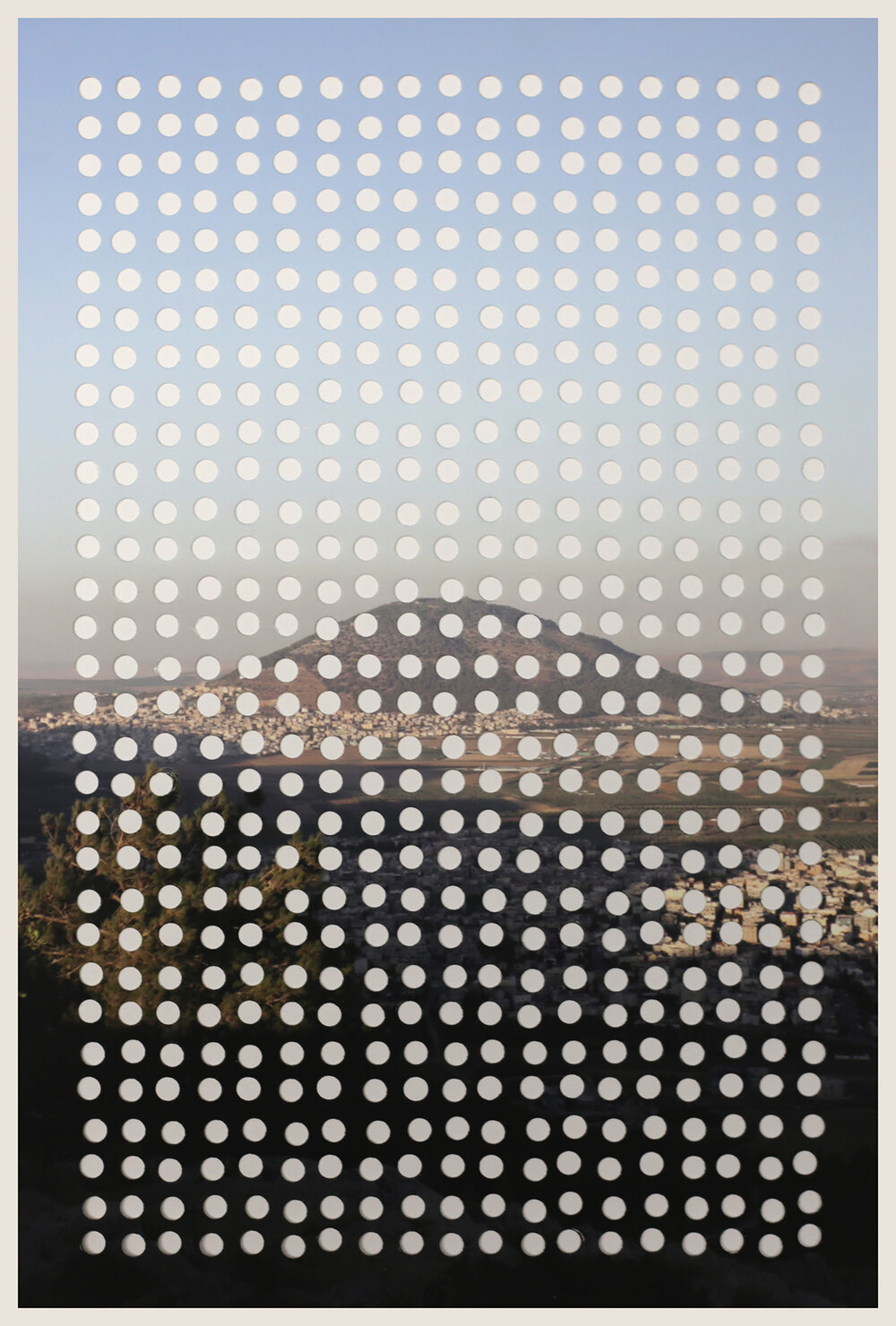
Michael Winters, Mount Tabor, June 2017, 2017. Inkjet print with holes punched out in white wood frame, 19 × 13 in.
One of my favorite art selections is Mount Tabor, June 2017 by Michael Winters, the director of arts and culture at Sojourn Church Midtown in Louisville, Kentucky. “Mount Tabor . . . is where the transfiguration of Christ is thought to have occurred,” Winters writes. “I stood viewing that scene in 2017. It looked so normal. I’m not sure why I felt compelled to punch holes in this photograph, but I think it’s because I wanted to be able to see through this ‘normal’ landscape to the glory of the transfigured Christ—which is to say, I wanted to see reality.”
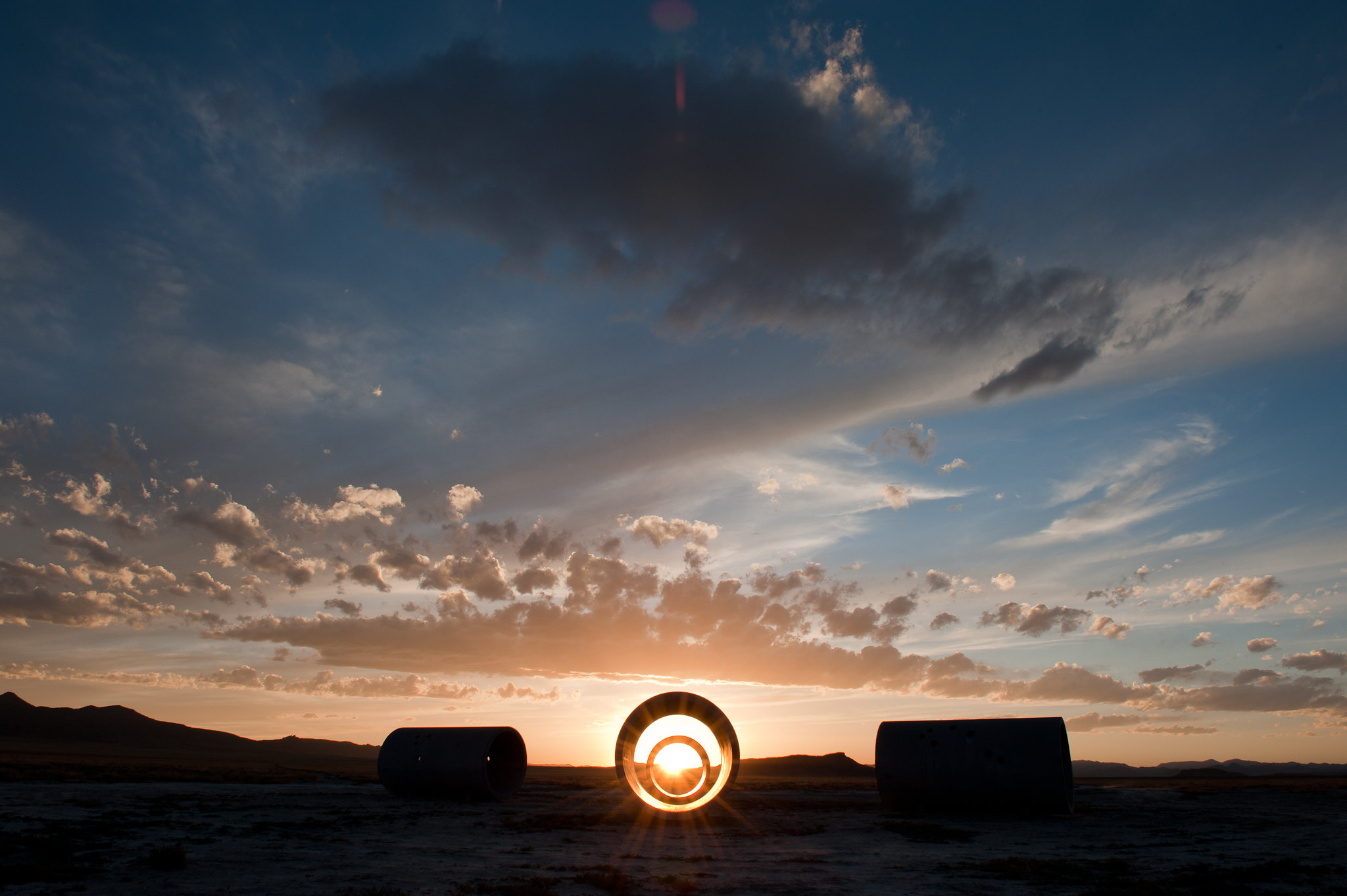
Nancy Holt (American, 1938–2014), Sun Tunnels, 1973–76. Concrete, steel, and earth, each cylinder 18 feet long and 9 feet in diameter. Great Basin Desert, Utah. Owned by the Dia Art Foundation. Photo: Will Thompson.
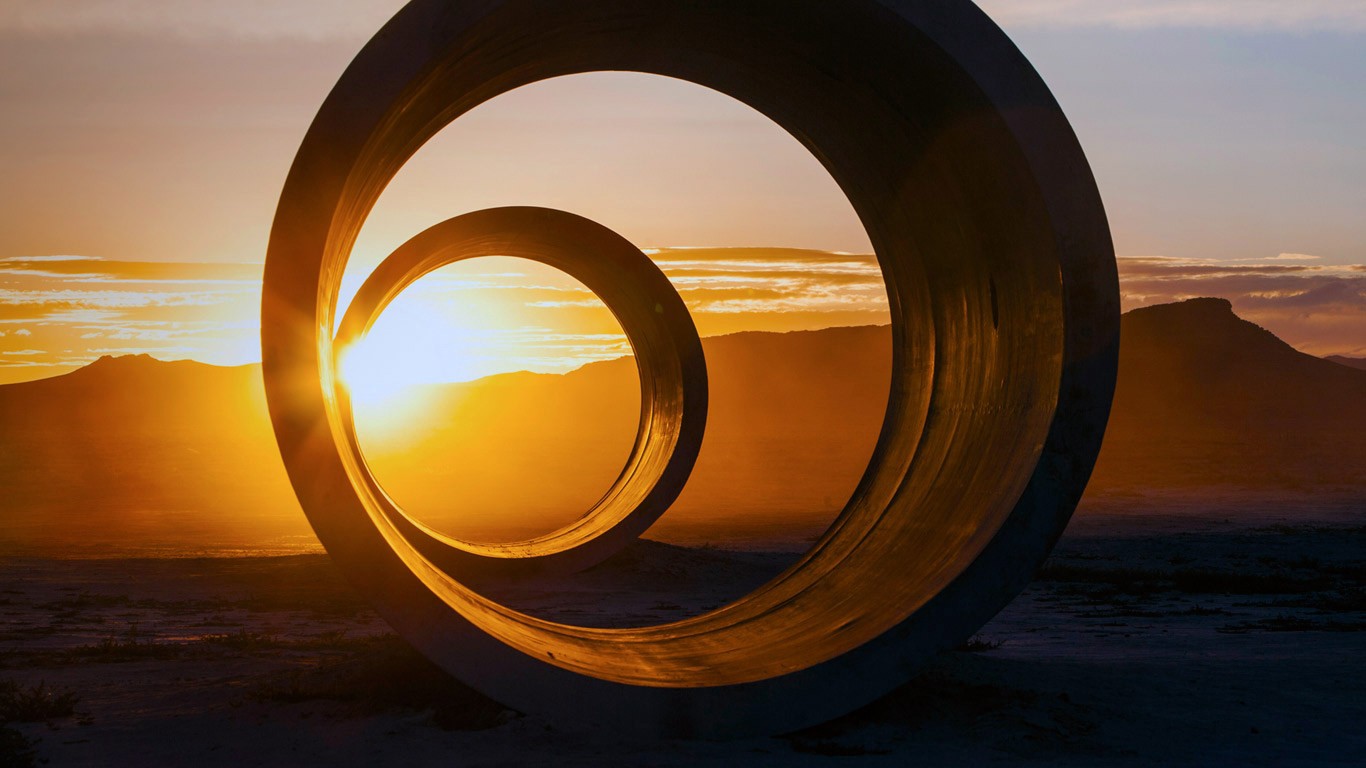
A large-scale outdoor installation in northwestern Utah, Sun Tunnels by land artist Nancy Holt
consists of four large concrete cylinders, arranged on the desert floor in a cruciform pattern that aligns with the sunrise and sunset during the summer and winter solstices. In addition to this perfect solar framing, each of the cylinders is pierced with smaller holes representing the stars of four constellations: Draco, Perseus, Columba, and Capricorn. Holt’s design allows for an ever-changing play of celestial light and shadow upon the resolutely material surfaces of her work. Part timepiece and part compass, Sun Tunnels is also a “camera” of sorts, dependent on natural light, with the concrete tubes acting as viewfinders that frame precise images which, in Holt’s words, “bring the vast space of the desert back to human scale.” [source]
LISTEN: “Light Upon the Mountains” | Words by Henry Burton, 1910 | Music by Jackson T. Maust and Seth Thomas Crissman, 2015 | Performed by The Walking Roots Band on Hark! A Walking Roots Band Christmas, 2017
There’s a light upon the mountains and the day is at the spring, When our eyes shall see the beauty and the glory of the king: Weary was our heart with waiting, and the night-watch seemed so long, But his triumph-day is breaking and we hail it with a song.
In the fading of the starlight we may see the coming morn; And the lights of all are paling in the splendors of the dawn: For the eastern skies are glowing as with light of hidden fire, And the hearts of all are stirring with the throbs of deep desire.
He is breaking down the barriers, he is gathering up the way; He is calling for his angels to build up the gates of day: But his angels here are human, not the shining hosts above; For the drumbeats of his army are the heartbeats of our love.
Hark! we hear a distant music, and it comes with fuller swell; ’Tis the triumph song of Jesus, of our king, Immanuel! Go ye forth with joy to meet Him! And, my soul, be swift to bring All thy sweetest and thy dearest for the glory of our king!
Come, thou long-expected Jesus, Born to set thy people free; From our fears and sins release us, Let us find our rest in thee.
“Psalms in Dialogue: Psalms 22, 23, and 24,” presented by Duke University Chapel: This multidisciplinary video presentation brings together dancers, musicians, a theologian, a painter, and (other) members of the Duke community to draw out the meaning of, or respond to, these three sequential psalms through art, prayer, and conversation. The livestreamed event aired October 17 and will be available for viewing for a limited time. Several of the segments, which I’ve time-stamped below, are intercut with photos from the streets in 2020 (showing the impact of the pandemic and racial unrest), of artist Makoto Fujimura in his studio and of his three finished paintings, and of Ekklesia Contemporary Ballet dancers in training. I wish more university chapels and well-resourced churches would offer experiences like this! Thank you to my friend Peggy for telling me about it. Read more about Duke Chapel’s multiyear Psalms project here.
1:51: “How do we name the impossible mystery?,” a theological reflection by Morley Van Yperen
6:02: Organ: “Jésus accepte la souffrance,” from La Nativité du Seigneur [previously] by Olivier Messiaen, performed by Christopher Jacobson
10:58: Psalm 22 by Makoto Fujimura, 2020, oyster shell on Belgium canvas, 48 × 48 in.
49:45: Recitation of Psalm 24 by Julia Hendrickson
51:32: Conversation continued
1:11:49: “He’s Got the Whole World in His Hands,” African American spiritual arranged by Mark A. Miller, performed by the Duke Chapel Choir
+++
POEMS: This week’s edition ofImageUpdate includes two poems that I really appreciated. The first, which was new to me, is “America” by Claude McKay, a key figure in the Harlem Renaissance. Originally published in The Liberator in 1921, it expresses the pain of living in a country where you’re hated for your race and yet remains optimistic, beginning, “Although she feeds me bread of bitterness, / And sinks into my throat her tiger’s tooth, / Stealing my breath of life, I will confess / I love this cultured hell . . .” The second poem is “Making Peace” by Denise Levertov, one of the best-known Christian poets of the twentieth century. “The poets must give us / imagination of peace, to oust the intense, familiar / imagination of disaster,” she writes. Poets can help us feel our way toward shalom—give us a vision of its permeating the world that inspires us to live out its rhythms, its metaphors, its structure, its grammar, our lives like poems.
+++
MUSIC VIDEO: “We Americans” by the Avett Brothers: I’m so moved by this song from the Avett Brothers’ 2019 album Closer Than Together—its grappling with the historical legacy of the US, its greatness and its guilt, with a mixture of heartache, empathy, and hope. It’s one of the healthiest expressions of patriotism I’ve ever come across in a song. We need to see America as the complex entity that she is, which means in part not ignoring her flaws but with love exposing them so that they can be remediated and we can move forward together more faithful to her celebrated ideals. “We Americans” is both confession and supplication, an “I’m sorry, God” and “God, help us to do better.” The final chorus:
I am a son of God and man And I may never understand The good and evil But I dearly love this land Because of and in spite of We the People We are more than the sum of our parts All these broken bones and broken hearts God, will you keep us wherever we go? Can you forgive us for where we’ve been? We Americans
>> “Bring Your Peace” by the Walking Roots Band: This song was written this year by Seth Thomas Crissman and Greg J. Yoder of the Walking Roots Band as part of a collection of fifteen songs for Shine, a children’s Sunday school curriculum published by MennoMedia and Brethren Press. It appears on Everybody Sing: Worship Songs for Children, released in June as a double album with Everybody Sing: Songs for the Seasons (which comprises ten original songs by The Many). The song asks God to bring his peace into our fears and into the storms we face, and to make us instruments of that peace to others.
>> “Rest Assured,” sung by the Walking Roots Band: TWRB learned this song from a bandmate’s parent (original authorship unknown) and recorded it a cappella in their separate locations at the start of quarantine in March. The chorus goes,
Rest assured, He’s not forgotten Rest assured, He’ll take care of you Look at the times He’s been there before He’ll be there again, rest assured


 Art & Theology