
When they had sung the hymn, they went out to the Mount of Olives.
Then Jesus said to [his disciples], “You will all fall away because of me this night, for it is written, ‘I will strike the shepherd, and the sheep of the flock will be scattered.’ But after I am raised up, I will go ahead of you to Galilee.”
Peter said to him, “Even if all fall away because of you, I will never fall away.”
Jesus said to him, “Truly I tell you, this very night, before the cock crows, you will deny me three times.”
Peter said to him, “Even though I must die with you, I will not deny you.” And so said all the disciples.
Then Jesus went with them to a place called Gethsemane, and he said to his disciples, “Sit here while I go over there and pray.” He took with him Peter and the two sons of Zebedee and began to be grieved and agitated. Then he said to them, “My soul is deeply grieved, even to death; remain here, and stay awake with me.” And going a little farther, he threw himself on the ground and prayed, “My Father, if it is possible, let this cup pass from me, yet not what I want but what you want.”
Then he came to the disciples and found them sleeping, and he said to Peter, “So, could you not stay awake with me one hour? Stay awake and pray that you may not come into the time of trial; the spirit indeed is willing, but the flesh is weak.”
Again he went away for the second time and prayed, “My Father, if this cannot pass unless I drink it, your will be done.” Again he came and found them sleeping, for their eyes were heavy.
So leaving them again, he went away and prayed for the third time, saying the same words. Then he came to the disciples and said to them, “Are you still sleeping and taking your rest? Now the hour is at hand, and the Son of Man is betrayed into the hands of sinners. Get up, let us be going. Look, my betrayer is at hand.”
—Matthew 26:30–46
LOOK: Exceeding Sorrowful by Douglas Porter
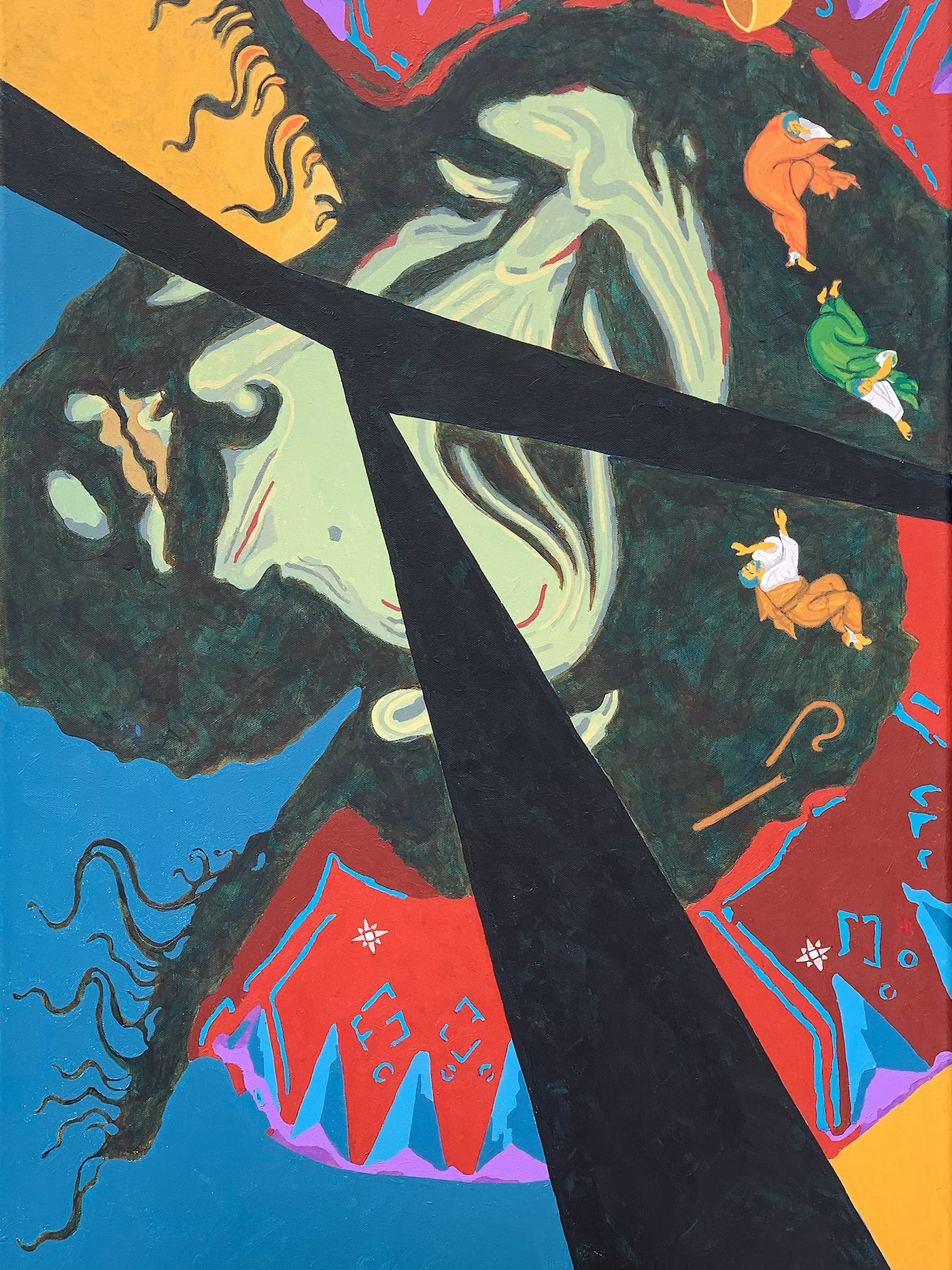
Doug Porter is a painter, video artist and editor, and graphic designer from Orillia, Ontario. His painting Exceeding Sorrowful portrays the religious subject known as the Agony in the Garden. The painting’s title comes from the King James Version of Matthew 26:38, where Jesus tells his inner circle of disciples (Peter, James, and John), “My soul is exceeding sorrowful, even unto death: tarry ye here, and watch with me.”
He had just eaten the Passover seder with them and the rest of the Twelve, pronouncing some strange words at the table: “Take, eat; this is my body,” he said as he broke the bread. And as he raised the wineglass, he commanded them, “Drink from it, all of you, for this is my blood of the covenant, which is poured out for many for the forgiveness of sins . . .”
Singing a hymn and going out to the Mount of Olives, he then foretold his disciples’ desertion of him. Adapting God’s words from Zechariah 13:7, he told them that he, their shepherd, would be struck, and they, his sheep, would be scattered. They all protested, but their faithlessness would soon be revealed.
Using rich hues reminiscent of stained glass, Porter shows Christ with his eyes closed as if a wave of pain is passing over him, and his brow anxiously furrowed. (The head of Christ is based on a painted wood crucifix by Coppo di Marcovaldo of Italy, from around 1260.) He is broken, shattered; the three jagged shards of him pull away to reveal a dark void. At the top the rim of the cup of suffering is just visible, which he pleads with God to remove. But as he communes with the Father, he becomes increasingly bolstered in his resolve to carry out his mission to the very end.
On the right is a shepherd’s staff, also broken, representing Christ’s words about his being struck. Three of his “sheep” are sprawled out on the ground. The figures of Peter, James, and John are based on a fifteenth-century icon of the Transfiguration by Theophanes the Greek. These three disciples on the Mount of Olives had been privileged earlier to see their Lord gloriously transfigured on another mount: Tabor. And yet despite having received that divine vision, in Gethsemane they fall asleep, failing to support Jesus in his final hours.
In a few days, Jesus’s exceeding sorrow and pain would be transfigured. But on that Thursday and Friday, he drank that cup to its dregs.
You can read Porter’s statement about this painting on his website (scroll down to fifth entry).
LISTEN: “Miracle” by Dave Von Bieker, on Bridge Songs ONE by Urban Bridge Church (2007) | MP3 provided by permission of the artist
Update, 3/28/24: Von Bieker told me my interest in the song has spurred him on to remake it! Here’s his new recording from this week:
This garden grows death
And it’s damp and it’s dark
Your three closest friends
Are asleep on the bark
Of a tree that once grew tall
Offering its shade
But it’s dead and it’s mourning
It’s black and decayedAnd you search for a place
That is far enough out
So your voice won’t be heard
When you cry and you shout
Have you come here to bargain?
Have you come to ask why?
Is that fear or pure sorrow
Buried in your eyes?And isn’t it time
To turn water into wine?
To drink a different cup?
To forget what’s on your mind?
It seems a good time
To take up Satan’s deal
To leap from tall buildings
Without bruising a heelBut now’s not the time for miracles
Now’s not the time for trap doors and way outs
Oh, now’s not the time for miracles
Everything comes in its timeIt’s a strange sort of prayer
More a fight to the death
You walk back to your watchmen
There isn’t one left
They’ve all slept through this spiritual
Solar eclipse
They don’t get it, how could they
Who would have guessed this?And you drop to your knees
There’s no way out, not yet
And your pores are still dripping
With blood, oh, with sweat
Jacob left with a limp
Moses’ tongue couldn’t find
An excuse, Paul be blinded
Why fight him when you know it’s no use?
When you know, wellThat now’s not the time for miracles
Now’s not the time for trap doors and way outs
No, now’s not the time for miracles
Everything comes in its timeYou sit at her bedside
And cry to the roof
I don’t know why I hold on
When I have no proof
But there’s something in knowing
You knew how this felt
Yeah, there’s something in sharing
This hand that we’re dealtAnd isn’t it time to say,
“Wake up, arise! Come on,
Take up your mat! Come on
And open your eyes!”
Isn’t it time now?
He’s sick, close to death
He’s been in the grave for four days
Why not yet?But now’s not the time for miracles
Now’s not the time for trap doors and way outs
No, now’s not the time for miracles
And everything comes in its time
And everything comes in its time
Dave Von Bieker is a singer-songwriter from Edmonton, Alberta, Canada, who performs and records under the artist name “Von Bieker.” He wrote “Miracle” while part of a songwriting group connected to Urban Bridge Church, a Pentecostal Assemblies of Canada church plant in downtown Edmonton that existed from 2006 to 2015. “We [were] writing songs that dance around the edges of the sacred and songs that wade right through it,” he said. “We [were] questioning and shouting with our songs.”
Starting in 2007, each year the collective shared some of their work at a live concert event they dubbed Bridge Songs and released an album. “Miracle” is from the first such album, Bridge Songs ONE. This album is no longer available, but Von Bieker gave me permission to share this song from it, which I learned about last year as a subscriber to his newsletter, Von Bieker Backstage.
The narrator of the song observes Christ’s distress in the garden of Gethsemane and questions why he doesn’t work a miracle to avoid the cross. Then the refrain comes in—perhaps in Christ’s voice, perhaps in the voice of the concessionary narrator—saying that “now’s not the time for miracles” but suggesting that the miracle of resurrection will come in its time.
A bloody crucifixion is probably not the path to victory we would have imagined, but it’s the path God in his wisdom laid out and took and by doing so showed com-passion (literally “suffering with”) on humanity. The physical, mental, and spiritual anguish that God in Christ endured speaks to God’s awesome love, which comes alongside us in our own suffering.
In the third verse “Miracle” appears to shift to a contemporary scene of a loved one (daughter? wife? mother? friend?) lying gravely ill in bed. Why doesn’t God intervene to miraculously heal? It then moves back again in time to the story of Lazarus, who died. His sister Martha chastises Jesus for his delayed arrival to Lazarus’s bedside. Upon seeing the four-days-dead body of his friend in the tomb, “Jesus began to weep” and was “greatly disturbed” (John 11:35, 38). Then, after giving space to his grief, he calls into the dark cavern, “Lazarus, come out!”—and wouldn’t you know, Lazarus comes stumbling out alive! A delayed miracle.
I love how this song enfolds the story of Christ into our own and that of the Old and New Testament saints, who wrestled with God and stammered their doubts and had their obstinacy obliterated by blinding light, or their fervent belief validated by a brother’s sudden awakening from the grave.
In addition to writing songs, in September 2011 Von Bieker founded Bleeding Heart Art Space, a community space dedicated to exploring art, faith, and justice. He served as director, or “arts chaplain,” until June 2018. Bleeding Heart started as a ministry of Urban Bridge Church, and when that church closed, Bleeding Heart was grafted into St. Faith’s Anglican Church, under whose aegis it remains active today, organizing pop-up solo and group exhibitions and hosting ArtLucks for local artists to share what they’ve been working on.
 Art & Theology