
“Te lucis ante terminum”: A bedtime prayer for all ages

When I was little, my bedtime routine involved me propping up my plush Precious Moments doll beside me on my bedside floor, her hands Velcroed together, so that she could accompany me in praying this prayer:

Now I lay me down to sleep
I pray the Lord my soul to keep
If I should die before I wake
I pray the Lord my soul to take

This rhyming quatrain from colonial New England,[1] simple though it is, cultivated in me a warm sense of God’s care and protection through the night.

Perhaps the latter half sounds morbid—but keep in mind that it comes from a time when child mortality rates were much higher, as, given the lack of advanced medicine and effective vaccines, illnesses were frequent and often fatal. A later variation of the prayer omits the reference to death, replacing the second couplet with the cutesier “Thy love guard me through the night, / And wake me with the morning light.”


I will both lie down and sleep in peace,
for you alone, O LORD, make me lie down in safety.

—Psalm 4:8

As an adult, I’ve encountered another evening prayer that reminds me of “Now I Lay Me Down to Sleep”—similar content, same meter, but likely dating all the way back to the fifth or sixth century, and originally written in Latin. It’s called Te lucis ante terminum (Before the Ending of the Day):

Te lucis ante terminum,
Rerum Creator poscimus,
Ut pro tua clementia
Sis præsul et custodia.

Procul recedant somnia,
Et noctium phantasmata;
Hostemque nostrum comprime,
Ne polluantur corpora.

Præsta, Pater piissime,
Patrique compar Unice,
Cum Spiritu Paraclito
Regnans per omne sæculum.
Before the ending of the day,
Creator of the world, we pray
That with Thy wonted favor Thou
Wouldst be our Guard and Keeper now.

From all ill dreams defend our eyes,
From nightly fears and fantasies;
Tread under foot our ghostly foe,
That no pollution we may know.

O Father, that we ask be done,
Through Jesus Christ, Thine only Son;
Who, with the Holy Ghost and Thee,
Doth live and reign eternally.

Trans. John Mason Neale

This prayer is sung liturgically as the office hymn at Compline in the Roman Rite. It was originally, and continues to be, sung to plainsong melodies from the Liber Usualis (Usual Book) and the Sarum Rite, such as this one:
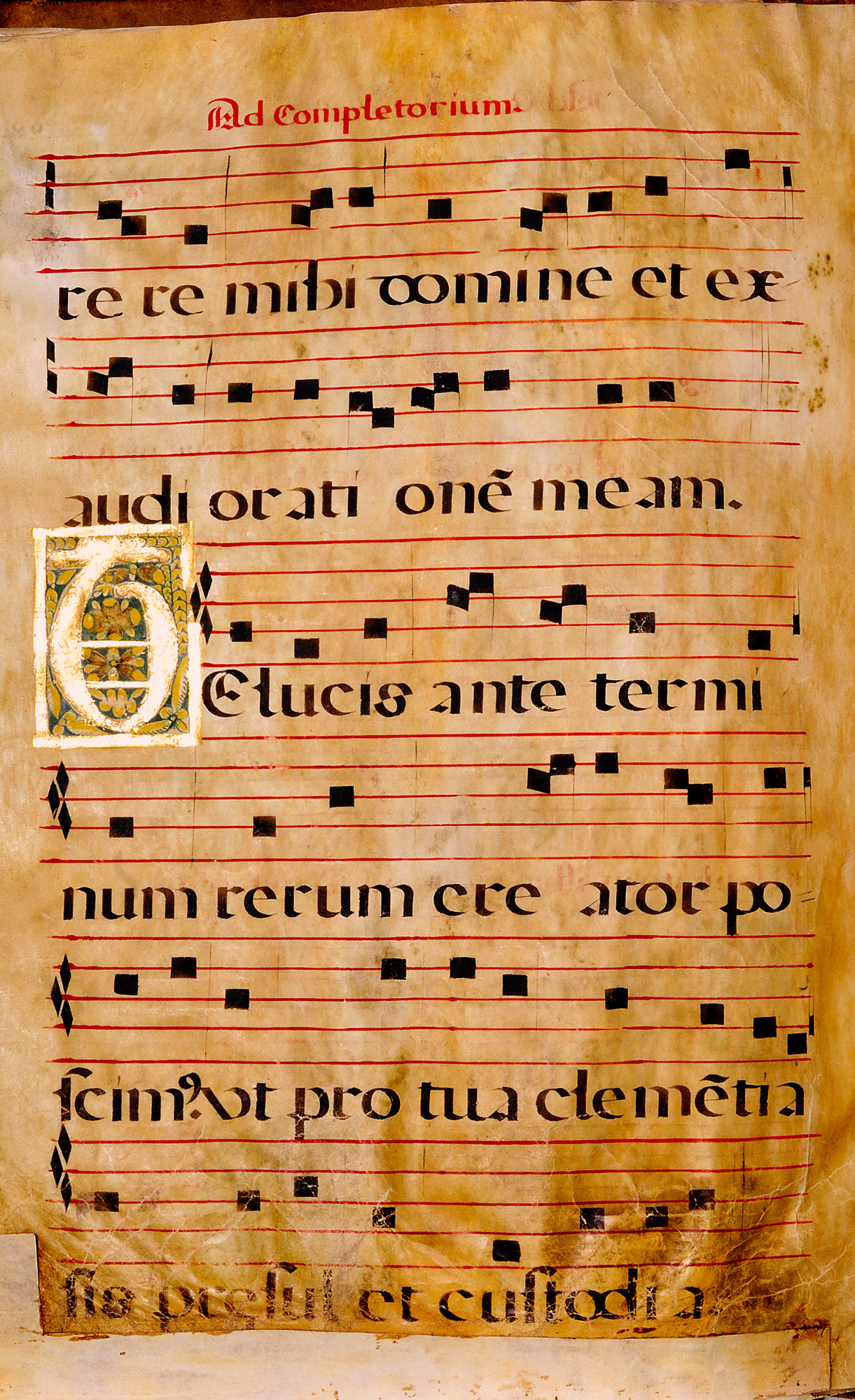
Spanish Chant Manuscript Page 203
Te lucis ante terminum from an antiphonary, Spain, 1575–1625. Rare Books and Special Collections, University of British Columbia Library, Vancouver. [object record]

(To hear it chanted in English, see the album Lighten Our Darkness: Music for the Close of Day by the Cambridge Singers.)

The great English High Renaissance composer Thomas Tallis wrote two five-voice settings of the hymn in 1575, of which the ferial tone is performed here by The King’s Singers:

In 1998 J. Aaron McDermid of North Dakota composed a setting, performed by The Singers—Minnesota Choral Artists under the direction of Matthew Culloton:

McDermid writes,

Upon my first reading [of Te lucis] I was immediately struck by the color and imagination inherent in the language, particularly in the second stanza – where the deep calm of the previous verse is replaced by foreboding images of the shades of night. A beautiful symmetry is achieved by the addition of the eloquent Gloria Patri that brings the hymn to a close. Through the patient and fluid unfolding of the Latin, St. Ambrose[2] has imbued this hymn with a sense of comfort and warmth, offering hope for a light to illumine the dark hours to come.

The last setting I want to share is Owain Park’s from 2020, released under the title “Night Prayer.” His was inspired by ancient plainchant and was specially composed for virtual choirs during COVID-19. Listen to the premiere performance by his vocal consort, the Gesualdo Six (Park is the singer at bottom right):

The photographs by Ash Mills in this video, some of them long-exposure (gorgeous!), are of Salisbury Cathedral’s annual “From Darkness to Light” Advent procession, in which the medieval church is gradually filled with the light of over one thousand candles.

For an album recording of Park’s “Night Prayer,” available on Spotify and other streaming platforms, see When Sleep Comes: Evening Meditations for Voices and Saxophone from Tenebrae.

These are just a few of the many musical settings of Te lucis ante terminum that have been composed over the centuries. For a list of others, see https://www.cpdl.org/wiki/index.php/Te_lucis_ante_terminum.

The music gives the words a gravitas and a beauty that I think they lack on their own. Why not choose one of these as a bedtime track to play for your little one as they fall asleep! Or for your own anxious soul. The pronouns are first-person plural, indicating that this prayer is intended to be prayed in community. Make it a family listening event. And if you feel so inclined, you might even try chanting along with the choir of Yorkminster Park Baptist Church in Toronto!


NOTES

1. Although I’ve seen “As I Lay Me Down to Sleep” spuriously attributed as “Old English,” its earliest known appearance in print is in the 1737 edition of the New England Primer, a popular reading textbook used in the American colonies, published in Boston.

2. Abbot S.-G. Pimont, author of Les Hymnes du Bréviaire romaine (Paris, 1874), is the one who attributed the text of Te lucis to Ambrose of Milan (ca. 339–397), but this authorship claim was rejected by the Benedictine editors of The Catholic Encyclopedia (Robert Appleton, 1912) and by patristics scholar Luigi Biraghi and today is generally regarded as false.

Roundup: Sing Me High Music Festival, visual LP shot on Mayne Island, and more

SPOTIFY PLAYLIST: August 2023 (Art & Theology): Here’s this month’s!

+++

MUSIC FESTIVAL: “Sing Me High,” August 11–12, 2023: Celebrating music and faith in the Shenandoah Valley. Next Friday evening and all day Saturday at the Brethren & Mennonite Heritage Center in Harrisonburg, Virginia, various folk, bluegrass, and acoustic musicians from the region will be performing: the Walking Roots Band [previously], Chatham Rabbits, Maya de Vitry, Spectator Bird, Honeytown, Juniper Tree, Tide Spring, Good Company, Ebony Nicole, Ears to the Ground Family (read my review of their debut album), Shekinah, Ryan Scarberry, Clymer & Kurtz, and the Rain Pickers. Buy your tickets ahead or at the gate. I’ll be there! (In the audience, that is.)

Below are songs by three different bands/artists who will be playing at the festival: “Praise to God (Whirlwinds),” a new setting by the Walking Roots Band of an eighteenth-century hymn by Anna Barbauld (recorded on The Soil and The Seed Project, vol. 4 and appearing on the Art & Theology Thanksgiving Playlist); “Again, Amen” by Spectator Bird (sisters Rachel and Lindsey FitzGerald); and “Grieve and Rejoice” by Ryan Scarberry, director of music at Incarnation Anglican Church in Williamsburg, Virginia.

+++

ONLINE EVENT: “In Memoriam: An Evening Celebrating Frederick Buechner’s Literary Contributions,” August 15, 2023: “Celebrated as one of the foremost spiritual writers of his generation, Frederick Buechner’s witty, vivid, and rich writing has inspired readers’ minds and stirred hearts through his more than 30 published books for six decades. One year after his passing, Frederick Buechner (July 11, 1926–August 15, 2022) remains an influential voice for writers across genres, from novelists and memoirists to homileticians and theologians alike. For those writers who feel not religious enough for religious readers, or too religious for non-religious readers, Buechner’s voice has been a welcome, guiding light.

“On the one-year-anniversary of Frederick Buechner’s passing, Image is hosting space for community members to gather and share their appreciation for Buechner’s literary contributions. From themes of paying attention to one’s life and stewarding one’s grief, to the unexpected influences on one’s vocation and the ordinary miraculous moments of everyday life, Buechner’s words offer a variety of invitations through which one might come to see the world and one’s place within it more deeply. Image community members are invited to bring a favorite selection of Buechner’s writing to read aloud and to briefly reflect on the difference his words have made for their life.” Register for this free, moderated, open-mic-style time of sharing and reflections at the link above.

+++

DOCUMENTARY: The Sea in Between (2013) by Mason Jar Music: Blayne Johnson and his family, who reside in Mayne Island, British Columbia, are big fans of Portland, Oregon-based indie singer-songwriter Josh Garrels. In 2012 Johnson reached out to Garrels and some of the folks at Mason Jar Music, the Brooklyn-based creative collective Garrels has worked with, to invite them up to his home for a relaxing getaway, and to play for his family and neighbors. Mason Jar specializes in live performance videos, so they sent a small crew and a handful of musicians with the intention of shooting a few of those at various locations around the island—along the bay, on a farm, in a church. Then they decided to extend the footage from the week into a feature-length documentary, directed by Matt Porter, which you can watch for free on YouTube (embedded directly below). The song recordings were released afterward on an album of the same name, along with others that didn’t make the final cut of the film.

The Sea in Between, the film, is about vocation, the creative process, patronage, faith, family, community, and the beauty of place, and it centers on the joy of making and experiencing music together. Besides Garrels, the musicians are Dan Knobler (slide guitar, mandolin), Jay Kirkpatrick (banjo, accordion), Russell Durham (violin), Charlaine Prescott (cello), Jason Burger (drums), Chad Lefkowitz-Brown (clarinet, flute, saxophone), and Gabriel Gall (miscellaneous), who served as music director and wrote the orchestrations. Michelle Garrels and Matt Porter play the aquarion (glass marimba), and everyone contributes vocals. Perhaps my favorite song from the film is “Pilot Me” (not to be confused with the Edward Hopper hymn “Jesus, Savior, Pilot Me”; this is a Garrels original):

+++

SONG: “O nata lux” by Thomas Tallis, performed by VOCES8: “O nata lux de lumine” (O Light Born of Light) is the office hymn at Lauds of the Feast of the Transfiguration, celebrated August 6. Here VOCES8 performs a setting from the English High Renaissance by Thomas Tallis, inside St. Bartholomäus-Kirche in Pegnitz, Germany.

O nata lux de lumine,
Jesu redemptor saeculi,
Dignare clemens supplicum
Laudes precesque sumere.

Qui carne quondam contegi
Dignatus es pro perditis,
Nos membra confer effici
Tui beati corporis.
O Light born of Light,
Jesus, redeemer of the world,
with loving-kindness deign to receive
suppliant praise and prayer.

Thou who once deigned to be clothed in flesh
for the sake of the lost,
grant us to be members
of thy blessed body.

If You Love Me (Artful Devotion)

Laurencin, Marie_Girl with a Dove
Marie Laurencin (French, 1885–1956), Girl with a Dove, 1928. Oil on linen, 46.3 × 38.4 cm (18 1/4 × 15 1/8 in.). National Gallery of Art, Washington, DC. Photo: Victoria Emily Jones.

“If you love me, you will keep my commandments. And I will ask the Father, and he will give you another Helper, to be with you forever, even the Spirit of truth, whom the world cannot receive, because it neither sees him nor knows him. You know him, for he dwells with you and will be in you.

“I will not leave you as orphans; I will come to you. Yet a little while and the world will see me no more, but you will see me. Because I live, you also will live. In that day you will know that I am in my Father, and you in me, and I in you. Whoever has my commandments and keeps them, he it is who loves me. And he who loves me will be loved by my Father, and I will love him and manifest myself to him.”

—John 14:15–21

+++

SONG: “If Ye Love Me” | Text taken from John 14:15–17, trans. William Tyndale, 1539 | Music by Thomas Tallis, 1565 | Performed by the Cambridge Singers under the direction of John Rutter, on Treasures of English Church Music, 1995


This post belongs to the weekly series Artful Devotion. If you can’t view the music player in your email or RSS reader, try opening the post in your browser.

To view all the Revised Common Lectionary scripture readings for the Sixth Sunday of Easter, cycle A, click here.