
LOOK: Tibetan Nativity thangka
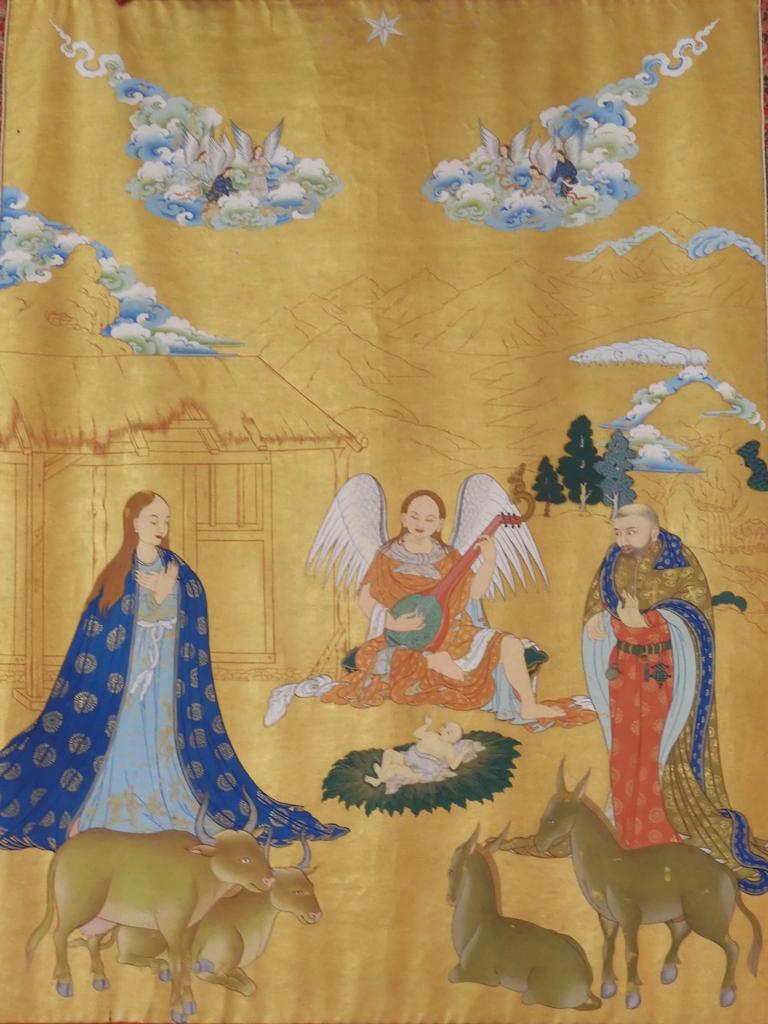
A traditional Tibetan art form, a thangka (roughly pronounced tonka; literally “recorded message”) is a painting on a portable fabric scroll of silk or cotton. Traditionally they depict Tibetan Buddhist deities or influential leaders and are used for personal meditation or instruction of monastic students.
This thangka, however, portrays a Christian narrative: the birth of Jesus Christ. He lies on a leafy bed on the ground, surrounded by Mary, Joseph, two yaks, two horses, and an angel who is seated much like a bodhisattva and who plays the dramnyen (a Himalayan six-stringed lute, roughly pronounced dra-nyen). The stylization of the clouds and mountains is clearly Tibetan, whereas the angels seated on the clouds bear Western influence, as does Mary’s gesture of hands crossed reverently over the chest.
The Nativity Thangka was presented by the Dalai Lama in 1998 to the World Community for Christian Meditation, “a global spiritual community united in the practice of meditation in the Christian tradition . . . shar[ing] the fruits of this practice widely and inclusively . . . and building understanding between faiths and cultures.” It is on display at WCCM’s Bonnevaux outside Poitiers, France, a retreat center that is home to a residential community living in the spirit of Saint Benedict.
LISTEN: “Gawala! Gibala!” (O what joy! O what happiness!), a Tibetan Christmas carol | Composer and lyricist unknown | Performed by the WEC UK Resonance band, 2020 [HT: Global Christian Worship]
Téring Gyamgön trungsong
Gawala!
Gyamgön Yeshu trungsong
Gibala!Gawala! Gibala!
The Savior’s born on this day
Gawala!
The Savior Jesus is born
Gibala!Gawala! Gibala!
He was born in Bethlehem
Gawala!
He was in a stable
Gibala!Gawala! Gibala!
Shepherds saw the angels
Gawala!
Bringing news of great joy
Gibala!Gawala! Gibala!
From the East a star rose
Gawala!
Showing where the road lay
Gibala!Gawala! Gibala!
From the fields came shepherds
Gawala!
Shepherds sang their praise songs
Gibala!Gawala! Gibala!
From the East came wise men
Gawala!
Offering gold and silver
Gibala!Gawala! Gibala!
Angels filled the heavens
Gawala!
Singing songs of gladness
Gibala!Gawala! Gibala!
The day of joy has risen
Gawala!
Songs of beauty sounding
Gibala!Gawala! Gibala!
Gibä nyima sharsong
Gawala!
Nyenbä luyang langsong
Gibala!
Ian Collinge, the man leading this song in the video above, is an ethnomusicologist who trains people in cross-cultural and multicultural music at All Nations Christian College and London School of Theology. In addition, he and his wife, Helen, lead Arts Release, a ministry of WEC International that they founded in 2008. One of its initiatives is Resonance [previously], a multicultural collective of Christian musicians formed in the UK in 2011 with the aim of integrating songs from the global church into the Western worship repertoire. The Resonance band raises awareness of the beautifully rich diversity of musical expressions that exist around the world to praise the Triune God of the Bible.
Collinge learned “Gawala! Gibala!” while living in Nepal in the 1990s doing music research, which is also when he learned to play the dramnyen. Besides the dramnyen, the recording also uses a Tibetan instrument called the erkha, small pellet-bells that are sometimes attached to the legs and used in dancing or are otherwise played unattached to clothing, as here.
“I can easily imagine this song being done as a dance song, especially as a circle dance,” Collinge tells me. “I am playing it in the Southern Tibetan dramnyen style, distinguished by this tuning and introduction/ending and links patterns, and I have arranged it in the typical slow then fast section format.”
Addendum, 12/30/21: After reading this post, a friend of mine sent me a video of one of her friends, Migmar Dondup Sherpa, playing the same song on the dramnyen! I post it here with his permission. Sherpa is a worship leader at his church in Nepal, and he also writes original worship songs in Nepali and Tibetan.
 Art & Theology