Show us the way home Wayfarers all, Lord Hold us in mercy Through this dark night
O God, we wait on you O God, we wait on you
Gather us in Mender of everything Bright mourning dove Rise over all of us
This post is part of a daily Advent series from December 2 to 24, 2023 (with Christmas to follow through January 6, 2024). View all the posts here, and the accompanying Spotify playlist here.
When journeying through your dark night Burn this as a light Until the dawn horizon Burn, burn this as a light
What God has voiced inside you Burn, burn this as a light Creation all about you Burn, burn this as a light
The song of children laughing Burn, burn this as a light The sound of people singing Burn, burn this as a light
The morning star arises Burn, burn this as a light Raising our joys from sorrows Burn, burn this as a light
The tree of life bearing fruit Burn, burn this as a light The healing of the nations Burn, burn this as a light
When you come to take us home We’ll lay our oil lamps down In the abiding light of the Lamb We’ll lay our oil lamps down
Beside your glorified body We’ll lay our oil lamps down Healed by the holy hands of love We’ll lay our oil lamps down
“Burn This as a Light” is the last of twelve songs on an album of the same name. Tom Wuest (pronounced “weest”) and his wife, Karen, recorded Burn This as a Light with their sons, Isaiah (trumpet) and Arbutus (alto saxophone and clarinet), over the course of 2016 at their home in the Ohio River Valley. Friends Kenny Havens, Peter La Grand (of Ordinary Time), Calum Rees, and Jono Ryan also play on the album, the latter three contributing parts from their remote locations.
Tom writes,
These songs of hope, which are all rooted in the biblical narrative, grew out of particular stories of sorrow and reflect our prayerful working while watching and waiting for a God-breathed dawn to arise. . . . We sing [these prayers] for the healing of the nations, the land, and the waters of the earth. Burn this as a light. We sing for the renewal of the church. Burn this as a light. We sing for God’s peace upon the poor and oppressed, near and far. Burn this as a light. We sing for our creaturely neighbors and the creation that graces these hills. Burn this as a light.
The title track acknowledges the darkness through which we pilgrims travel but catalogs a number of earthly glimmers of the new day that can embolden our faith, our hope, our love along the way. Communal song, children’s laughter, the natural world, our callings, our moral consciousness—these are but a few of the things that we can “burn as a light,” that is, that can remind us of the goodness and beauty that is our origin and destiny, and thus light the path forward, help us make it Home.
We can also “burn as a light” those passages of scripture that tell us who we are and where we’re headed. The song references several biblical visions—for example, those of the ancient Hebrew prophets, who saw with their inner eye sorrow turned to joy (Isa. 35:10; 61:3; Jer. 31:13), and God’s revelation to John of the new heavens and the new earth (Rev. 22). It’s a passage we’ve visited several times already in this Advent series, but it’s so good, I’ll quote it again:
Then the angel showed me the river of the water of life, bright as crystal, flowing from the throne of God and of the Lamb through the middle of the street of the city. On either side of the river is the tree of life with its twelve kinds of fruit, producing its fruit each month, and the leaves of the tree are for the healing of the nations. Nothing accursed will be found there any more. But the throne of God and of the Lamb will be in it, and his servants will worship him; they will see his face, and his name will be on their foreheads. And there will be no more night; they need no light of lamp or sun, for the Lord God will be their light, and they will reign forever and ever. . . .
“See, I am coming soon . . . I, Jesus, . . . the root and descendant of David, the bright morning star.”
—Revelation 22:1–5, 12, 16
In the end we’ll lay our oil lamps down, because we will have made it through the dark. There will be only light, the light of Christ—blazing, transfiguring, fulfilling.
Singer-songwriter and farmer Tom Wuest was born in Cincinnati, Ohio. He married Karen in 1993 and, after she finished her MFA in creative writing in Colorado, the two of them moved to Vancouver, where their sons were born. In Vancouver Tom studied theology at Regent College while writing singable music for churches. He also helped start Red Clover Farm (then part of the ministry Jacob’s Well), growing organic produce on vacant lots for distribution to the community. After seven years of urban farming, in 2008 the Wuests moved to Galiano Island, one of the Gulf Islands off the southern coast of British Columbia, to farm in a rural context.
In 2011 Tom and his family returned to the US and lived among the Vineyard Central community in Norwood, Ohio, before moving, in 2012, about an hour southeast to a one-hundred-acre plot of land in Adams County, where they set about restoring an old farmstead, living in a dairy barn while they built their house. It’s there, at the foothills of the Appalachian Mountains, that they live now. On their farm they tend animals, vineyards, and large gardens; make their own cheese, butter, bread, and wine; and forage onions, garlic, mushrooms, and other wild foods. They regularly hosted and supported the “parish farmers” of Moriah Pie, a pay-as-you-can, locally sourced pizzeria in Norwood founded by Robert and Erin Lockridge, during its eight years of operation.
“A large part of my vocation is connected to sustainable building and tending the beauty, integrity, and health of the community of creation,” Tom told me. “The songs I write all come out of the confluence of this labor as I seek to love this place, this community, and all who dwell here—offered in love to the broader community of ‘seekers and sufferers’ (as Jürgen Moltmann puts it) in the world.”
Tom’s most recent musical project has been collaborating on the Parish Collective’s Songs of Place, a live album that will be released in the coming months and that features six of Tom’s original songs. When writing music, he says, he likes to look for places where the story of God meets our story.
Psalm 91 (Psalm 90 in the Vulgate) is a psalm of protection, commonly invoked in times of hardship or before embarking on a journey. It conveys the sheltering presence of God, using the metaphor, tender and intimate, of a mother bird who cares for her fledglings, shading them under her wings and lifting them up out of danger. This image recurs throughout the Psalter and the Bible at large (see Pss. 17:8; 36:7; 57:1; 63:7; Exod. 19:4; Deut. 32:11).
Agnes Pelton (American, 1881–1961), The Primal Wing, 1933. Oil on canvas, 25 × 24 in. San Diego Museum of Art, California. Source: Agnes Pelton: Desert Transcendentalist, p. 113.
Let me quote the psalm in full, using the King James Version, whose poetic quality cannot be beat:
1 He that dwelleth in the secret place of the most High shall abide under the shadow of the Almighty.
2 I will say of the Lord, He is my refuge and my fortress: my God; in him will I trust.
3 Surely he shall deliver thee from the snare of the fowler, and from the noisome pestilence.
4 He shall cover thee with his feathers, and under his wings shalt thou trust: his truth shall be thy shield and buckler.
5 Thou shalt not be afraid for the terror by night; nor for the arrow that flieth by day;
6 Nor for the pestilence that walketh in darkness; nor for the destruction that wasteth at noonday.
7 A thousand shall fall at thy side, and ten thousand at thy right hand; but it shall not come nigh thee.
8 Only with thine eyes shalt thou behold and see the reward of the wicked.
9 Because thou hast made the Lord, which is my refuge, even the most High, thy habitation;
10 There shall no evil befall thee, neither shall any plague come nigh thy dwelling.
11 For he shall give his angels charge over thee, to keep thee in all thy ways.
12 They shall bear thee up in their hands, lest thou dash thy foot against a stone.
13 Thou shalt tread upon the lion and adder: the young lion and the dragon shalt thou trample under feet.
14 Because he hath set his love upon me, therefore will I deliver him: I will set him on high, because he hath known my name.
15 He shall call upon me, and I will answer him: I will be with him in trouble; I will deliver him, and honour him.
16 With long life will I satisfy him, and shew him my salvation.
The righteous will be protected, sings the psalmist, from sickness and attack, whether by arrow or by wild animal. Because of the psalm’s specific mention of plagues, or “deadly disease,” it became especially popular during the COVID-19 pandemic.
Now, we know from experience that some of these statements cannot be taken at face value. Physical harm does befall those who love God. Believers were among the “ten thousand” (and more) felled by the most recent raging pestilence. It’s wrong to conclude that this was a result of their lack of faith.
Biblical scholar J. Alec Motyer clarifies that “the promise [in Psalm 91] is not security from but security in.” That God looks after us is an absolute principle, but the Bible makes clear that no one is immune from suffering. Still, we can trust in God’s grace and strength and ultimate deliverance, and entreat him for specific protections. Bodily salvation won’t come in full until the new heavens and the new earth are ushered in, but we are kept spiritually in the shelter of our loving God.
That doesn’t mean Psalm 91 is a lie; it is poetry, and poetic language is often not meant to be literal. The assurances are still worth praying. God does often intervene on our behalf.
The ancient Jewish community at Qumran near the Dead Sea, through whom the oldest manuscript fragments of the Hebrew Bible come to us, referred to Psalm 91 as a “psalm against demons,” and it is thought to have been used by that community in exorcisms. Jewish midrash interprets many of the listed threats as veiled language for demons, and there is Christian precedent for that interpretation as well. In Luke 10:17, Jesus’s followers marvel that “Lord, in your name even the demons submit to us!,” to which Jesus affirms that yes, “I have given you authority to tread on snakes and scorpions and over all the power of the enemy, and nothing will hurt you”—language very similar to that in Psalm 91.
In the Late Antique era, both Jews and Christians wore the words of Psalm 91 on amulets, to attain or simply feel God’s guarding power. In the church it is traditionally sung or recited during Compline services and on the first Sunday of Lent (in Matthew 4:6 the devil manipulatively quotes verse 11 in his temptation of Christ in the desert).
This psalm has also influenced popular culture, as from it comes the concept of guardian angels (vv. 11–12).
Below I have selected fifteen musical settings or adaptations of Psalm 91 from diverse sources, including homophonic and polyphonic choral works, songs in indie folk and soul styles, a Puerto Rican hymn, a Nepali bhajan, and more.
For each I have embedded either a YouTube video or Bandcamp track, and if a Spotify link exists, I’ve included it at the end of the description. If you cannot see these music players in your email client or RSS feed reader, open the post in your browser.
This is a curation, not a collation, meaning that I’ve intentionally picked these songs from among hundreds of options, for both excellence and variety. I tried to limit the list to ten and just couldn’t, but I thought twenty would be too overwhelming, so I compromised by choosing fifteen with five honorable mentions. I’ve added almost all twenty to a YouTube playlist (the Sister Sinjin song isn’t available on that platform), if you prefer to listen that way.
1. Gregorian chant performed by Harpa Dei: Born in Germany and raised in Ecuador, siblings Nikolai, Lucía, Marie-Elisée, and Mirjana Gerstner form the sacred vocal quartet Harpa Dei. Here they sing Psalm 91 in Latin in the medieval plainchant tradition. Subtitles are provided in Spanish and English.
For a plainchant in English, albeit of verses 4–5 only, see here.
2. “Psalm 91” by Victory Boyd: This is probably my favorite of all the selections. Victory Boyd is one of seven musical siblings, and before she started her solo career, she was a member of the vocal-harmony sibling act Infinity Song. Her voice is gorgeous, as is this simple musical setting she wrote, conveying both the vulnerability and confidence present in the psalm.
3. “Psalm 91” by Poor Bishop Hooper: Every Wednesday since January 1, 2020, married couple Jesse and Leah Roberts, who record music under the alias Poor Bishop Hooper, have been releasing a new psalm-based song for free download as part of their EveryPsalm project. Handling them consecutively, they have just eight left to go! They made a live video for “Psalm 91,” which shows them playing their own piano four hands accompaniment. [Spotify]
4. “Qui habitat in adjutorio altissimi” (He who dwells in the shelter of the Most High)by Josquin des Prez, adapted by Laurel MacDonald: Josquin des Prez (pronounced “joss-can day pray”) was a highly influential Franco-Flemish composer of the High Renaissance. In 1542 he wrote a setting of Psalm 91[90]:1–8 in Latin for twenty-four voices (SATB ×6)—that is, six distinct soprano parts, six distinct alto parts, etc.
Inspired by this choral motet, in 2007 composer and video artist Laurel MacDonald worked with longtime associate John Oswald to create qui, a sound installation of twenty-nine voices singing an adaptation of des Prez’s “Qui habitat” in twenty-nine languages over twenty-nine speakers, for the Royal Ontario Museum in Toronto. MacDonald revisited the project in 2010, creating the short video “XXIX” (below) with twenty-one of the original qui singers, each singing in the language of his or her personal heritage. They weave a complex tapestry with interlocking threads of Krio, Spanish, Korean, Hungarian, Hindi, Greek, Finnish, English, French, Italian, Latin, Zulu, Xhosa, Sesotho, Georgian, Russian, English, Tamil, Hebrew, Swahili, Japanese, and Arabic—a multilingual declaration of God’s protective power.
To hear Josquin des Prez’s motet as originally conceived, click here.
5. “Your Wings” by Lauren Daigle: Lauren Daigle is one of the most popular CCM (contemporary Christian music) artists of the past decade. Two-time-Grammy-winning and with two platinum records, she is often compared to Adele in terms of her vocal style—soulful, rich, in a husky register. In April 2020 she released on YouTube a stripped-down, “social distancing” version of her Psalm 91–based song (written with Jason Ingram and Paul Mabury) from Look Up Child, with just her and a piano. You can get a sense of her strong stage presence from the video; here she hits the melody with both her voice and her body—bouncy on the verses, smooth on the refrain! [Spotify (studio version)]
6. “Whomsoever Dwells” by Sinéad O’Connor: “Whomsoever Dwells,” written with Ron Tomlinson, is one of nine Hebrew Bible–based songs that appears on Sinéad O’Connor’s stellar 2007 double album, Theology. (Thanks to Art & Theology reader Koen Desmecht for introducing me to this!) The acoustic performance below—from November 8, 2006, at The Sugar Club in Dublin—was released on disc one, subtitled “The Dublin Sessions,” and features guitars, fiddle, harp, and low whistle; the same song, arranged for a pop-rock band and recorded in a London studio, is on disc two. (I much prefer the acoustic version.)
“Theology is an attempt to create a place of peace in a time of war and to provoke thought,” O’Connor said. It is very “personal” and “emotional.”
7. “El que habita al abrigo de Dios” (Those Who Dwell in the Shelter of God) by Luz Ester Ríos de Cunaand Rafael Cuna: This 1943 hymn from Puerto Rico is a versification of Psalm 91 in Spanish by Luz Ester Ríos de Cuna, with music by her husband, Rafael Cuna (1907–1995). I learned of it from the bilingual hymnal Santo Santo Santo: Cantos para el pueblo de Dios (Holy, Holy, Holy: Songs for the People of God). Here it’s performed by musicians from Iglesia Central del Movimiento Misionero Mundial en el Perú (Central Church of the World Missionary Movement in Peru) in Lima. Their names are not given.
8. “Denn er hat seinen Engeln befohlen” (For he shall give his angels charge),MWV B 53by Felix Mendelssohn: Early Romantic composer Felix Mendelssohn, a Reformed Christian with Jewish ancestry, wrote this setting of Psalm 91:11–12 in German in 1844 for Berlin Cathedral, where he was serving as Generalmusikdirektor (royal composer of church music). It is for an unaccompanied eight-part choir, but he later reused it with orchestral accompaniment as movement 7 of his oratorio Elijah.
9. “No Harm Befall You (Psalm 91)” by Sister Sinjin: Released on the 2022 compilation album Joy to the World (Psalms 90–106) from Cardiphonia Music, “No Harm Befall You” was written by Elizabeth Duffy and is sung by her and Kaitlyn Ferry, who make up the Indianapolis folk duo Sister Sinjin. Their harmonies are a hallmark of their music.
10. “Psalm 91” by Sharyn:Sharyn (pronounced “sha-REEN”) is a Ugandan-born, London-based gospel/R&B singer-songwriter “whose mission is to spread the gospel through adventurous, original, and engaging music,” she says. She wrote “Psalm 91” during the height of the coronavirus, as that scripture passage is one she would read again and again as a source of comfort amid the uncertainty. “This song is an affirmation and a reminder of who God is, what He can do, will do and has done,” she says. “Never forget that God is faithful and his promises are the greatest form of protection we can ever have. His promises are your armor and shield.” The recording features Calibleubird on backing vocals. [Spotify]
11. “Shelter Me” by Buddy Miller: In a 2010 episode of PBS’s Soundstage, country-rock artist Buddy Miller performed a set with other Americana greats Emmylou Harris, Shawn Colvin, and Patty Griffin, including this original song (written with Julie Miller) from his 2004 album Universal United House of Prayer. “Shelter Me” is about not being scared in the face of disaster or war, for God is our hiding place. The song could apply to Psalm 57 just as well, which addresses the same themes as Psalm 91 and even uses the same language of sheltering under the wings of the Almighty. [Spotify (studio version)]
12. “Underneath the Shadow” by Tom Wuest: This is one of twelve quiet, sparsely instrumented songs that Tom Wuest recorded with his wife, Karen, which were written as their two young sons fell asleep. They all “draw their lyrics from the psalms and from our family’s joy in and meditation upon the good creation of God,” he says. Fitting indeed for meditation, “Underneath the Shadow” comprises just three simple lines: “Underneath the shadow of Your wings / We dwell underneath the shadow of Your wings / Hidden close to Thee, we find rest.” [Spotify]
13. “Mero Saransthaan (My Shelter)” by Suraj Khadka: A Nepali adaptation of Psalm 91, this bhajan (devotional song) from 2021 features traditional instruments from the Indian subcontinent: sarangi (vertical fiddle), bansuri (bamboo flute), and dholak, madal, and tabla (drums). Thanks to Dr. Paul Neeley at Global Christian Worship for alerting me to this one.
14. “Lang en gelukkig (Psalm 91)” (Long and Happy) by Psalmen voor Nu: Founded in 2002, Psalmen voor Nu (Psalms for Now) was a project in the Netherlands to set all 149 psalms (they combined Psalms 42 and 43) in Dutch to music, a task they completed in 2014 with the release of their eleventh album. Seeking “to introduce as many people as possible to the beauty and power of the psalms,” the team comprised some twenty theologians, poets, and composers, plus a band. They wanted the texts to be understandable and the melodies modern and singable. This particular song from the project was written by Liesbeth Goedbloed (words) and Roeland Smith (music) and released in 2013. It has a smoky nightclub vibe. I’ve copied the lyrics below. [Spotify]
[1] Als je bij de Allerhoogste woont, mag je in zijn schaduw slapen. Als je zegt: ‘De Hoogste is mijn huis. mijn God, ik kan op u vertrouwen’, dan mag je in zijn schaduw slapen.
[2] Het is God die jou bevrijdt van de dood, de zwarte dood. Hij dekt je met zijn vleugels toe. Ga maar slapen. Je bent moe. Zijn trouw zal jou beschermen. Dan kun je slapen, dan kun je slapen. God waakt over jou. Dan kun je slapen.
[3] Voor de angst die elke avond komt, hoef je niet meer bang te wezen, ook al spookt de zwarte dood weer rond, al sloopt een ziekte alle mensen, jij hoeft niet meer bang te wezen.
[4] Ook al komt de dood dichtbij, vallen duizend mensen om, toch zul jij altijd veilig zijn wat de rest ook overkomt en slechte mensen krijgen, durf je te kijken, durf je te kijken? hun verdiende loon. Durf je te kijken?
[5] Jij zei ooit: ‘Mijn God, u bent mijn huis. Geen ziekte komt de drempel over.’ Die ellende gaat je deur voorbij, sinds je dicht bij God ging wonen. Geen ziekte komt je drempel over.
[6] Zijn engelen staan klaar. Ze dragen je op handen. God stuurt ze met je mee. Je stoot je nergens aan. De leeuw, de draak, de adder jij loopt over ze heen.
[7] Want je houdt van mij, zegt God, en die liefde maakt je vrij. Ik dek je met mijn vleugels toe, omdat jij weet wie ik ben. Je kent mijn naam en roept me. Ik kom je redden, ik kom je redden. En ik antwoord jou: ik kom je redden.
[8] In de zwartste nacht blijft ik bij jou. Ik red je en ik geef je leven. Deze keer is alle eer voor jou. Ik zeg: Ik ben voor jou een zegen! Voor jou een lang gelukkig leven!
[Outro] Lang en gelukkig, lang zul je leven, lang zul je leven, lang en gelukkig, lang zul je le ven! [source]
15. “In Him I Will Trust” by Sherri Youngward: Covering Psalm 91:1–5, this is one of sixteen psalm-passage settings by Bay Area singer-songwriter Sherri Youngward. For more, see her two Scripture Songs albums.
If you appreciated this post and would like to see more like it in the future, please consider donating to my work. If you do, leave a note telling me which psalm you’d like me to do next!
DANCE:“Ave Maria”:Queensland Ballet dancers Victor Estévez and Mia Heathcote perform a pas de deux (ballet duet) to the Schubert melody that today is most associated with the prayer “Ave Maria,” which begins, “Hail Mary, full of grace, the Lord is with thee.” These are the words the angel Gabriel spoke to Mary when he came to announce that she would bear in her body the Son of God. Though I can’t say what this duo had in mind when they choreographed the piece, I can’t help but think, given the music choice, of the Annunciation—the Divine coming to dance with humanity, to partner with her for the redemption of the world. The dancing starts thirty-five seconds in.
+++
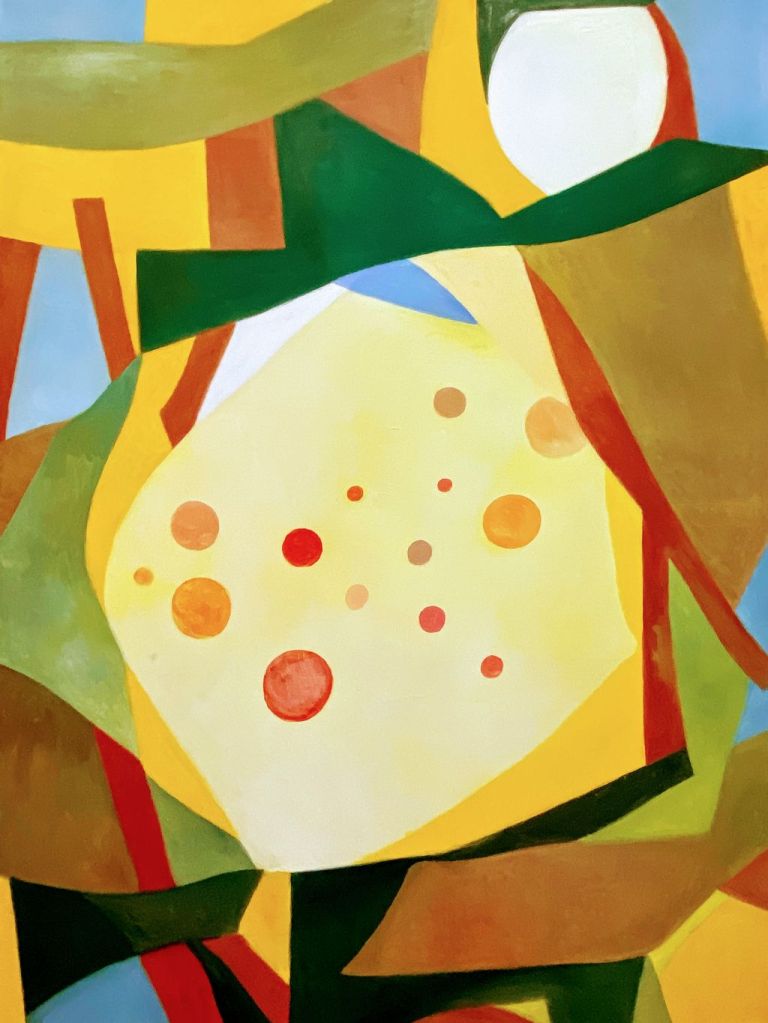
VISUAL MEDITATION: “Embodied Joy, Serious Joy: Making Room in the Body and Life for New Creation” by Alexandra Davison: I shared a visual meditation by this culture care leader just last week. In this devotional piece based on Luke 1:41–55, Davison discusses two abstract paintings from Louise Henderson’s The Twelve Months series. In October, “Henderson has a cropped representation of a pregnant woman, her belly bright and fruitful as a melon, shines with what Henderson describes from her own pregnancy as ‘bubbles of life circulating in the womb.’ She magnifies joy from its tiniest beginnings both seen and unseen in the mother and the child.” Reflecting on this ebullient image in conjunction with her own pregnancy experience and Mary’s, Davison ends by quoting an adaptation of the Magnificat by songwriter Marcus Walton.
Louise Henderson (New Zealand, 1902–1994), October, from the series The Twelve Months, 1987. Oil on canvas, 250 × 150 cm. Auckland Art Gallery Toi o Tāmaki, New Zealand.
+++
VIDEO INSTALLATION:Mary! by Arent Weevers: One of the primary images or metaphors for the season of Advent is pregnancy—the pregnant Mary awaiting the birth of Jesus, her belly swelling a little more each day, and a world heavy with expectancy, at the threshold of (re)birth. In 2009, media artist and theologian Arent Weevers [previously] created a gorgeous video installation titled Mary!. “Standing in the middle, a heavily pregnant young woman. Her hair partly covers her naked body to her ankles. She peers past you, with no expression on her face. From underneath, a gusty wind begins to blow, wafting her hair slowly upwards into the air. Suddenly, the woman bends slightly forward, her left arm in front of her abdomen, and grimaces painfully. Losing her balance, she falls sideways out of the frame until only black remains.” You can preview the video here. (Because of the nudity, there will be a content warning you have to accept before proceeding.)
Weevers’s art aims to express the paradoxical nature of the human body—its vulnerability and its strength—and in her role as Mary, the actor in this video exemplifies both so well. Gloriously gravid and standing tall at first, the woman looks into the distance and sees the future suffering of her son. She clasps her belly protectively in response, hunching forward as the painful knowledge of his destiny shoots through her.
+++
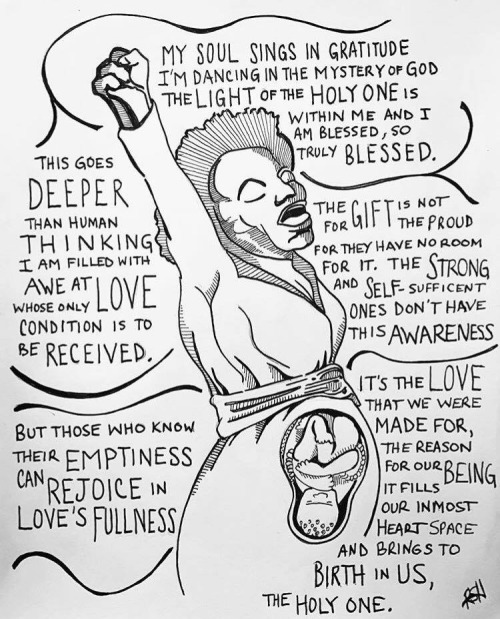
MAGNIFICAT SERMON (and sketch): “The Love That We Are Made For” by Bob Henry: Bob Henry is an American Quaker pastor who often sketches in preparation for and in response to sermons. In this sermon he delivered December 11, 2016, at Silverton Friends Church in Oregon, he reflects on the oldest and most radical Advent hymn: Mary’s Magnificat. We are so used to thinking of Mary as quiet and demure, but Henry imagines her as “a strong woman with arms flaring, fists raised, wild bodily movements, beads of sweat forming on her brow, and a strong voice throwing down these words from Luke 1:46–55.”
“Mary’s Freedom Song.” Illustration and lettering by Bob Henry, 2016. Text by Joy Cowley, 2007, adapted from Luke 1:46–55.
This characterization is expressed in his drawing, which shows a Black Mary, full of faith and fire, surrounded by the words of Joy Cowley’s “Modern Magnificat.” He says the women of the African Methodist Episcopal Church in Chicago, where he used to teach Bible, embody for him Mary’s bold declaration of justice, freedom, and hope in today’s world. He challenges us to sing Mary’s song in our own political climates.
+++
SONG: “Magnify”: For its November 29 worship service, Good Shepherd New York [previously] premiered a new arrangement of Tom Wuest’s “Magnify,” sung by Paul Zach and Lauren Goans, part of the Good Shepherd Collective (see 7:33 in the video below). The piano part includes the Gloria theme from “Angels We Have Heard on High,” played liltingly. Love it! (Update 12/14/20: Paul Zach posted a standalone video of this song on Instagram this morning.)
+++
I’ve added a new batch of songs to “Advent: An Art & Theology Playlist.” I like to “DJ” them (to balance the styles and moods and create thematic links), so they’re not all grouped at the bottom, but you can look at the “Date added” column to see the latest additions. I want to acknowledge the source of those I found from other Advent playlists and resources: Credit goes to Teer Hardy of the Crackers and Grape Juice podcast, compiler of the “Advent Begins in the Dark” playlist, for “The Man Comes Around” by Johnny Cash, “Jesus Gonna Be Here” by Tom Waits, “Shepherd’s Lament” by Kirby Brown, and “Are You Ready?” by Jason Champion. Pastor, pianist, arranger, and Daily Prayer Project founding director Joel Littlepage cued me in to the songs “Tenemos Esperanza,” “Toda la Tierra,” “Hold on Just a Little While Longer,” and “He’s Right on Time” through his “DPP Advent Songbook.” “I Believe in Being Ready” by Rising Appalachia comes from Lauren Plummer’s “Advent 2020: All Earth Is Waiting,” and “My Soul Doth Magnify the Lord” by O’Landa Draper and the Associates is from Tamara Hill Murphy’s “Advent 2020: Gracious Invitation.” “Intro Comfort My People” by Jamaican artist Chrisinti is featured in Biola’s Advent Project 2020.
INTERVIEW:“Singing the Songs of Injustice” with David M. Bailey and W. David O. Taylor: David Bailey is the director of the reconciliation ministry Arrabon and founder of its music-making and liturgical resource arm, Urban Doxology, and David Taylor is an assistant professor of theology and culture at Fuller Theological Seminary. In this conversation the two men discuss how “biblical, angry, congregational worship can help transform our hearts and churches.” “God has given us the psalms to be an ‘anger school’ for us and I’ve discovered that when we skip class, we aren’t emotionally equipped to deal with difficult stuff we’re experiencing now,” Taylor says. “The extraordinary gift of the psalms is that they show us how to pray angry prayers without being overcome by our anger, how to hate without sinning (to borrow from Saint Paul’s language), or, as Eugene Peterson once put it, how to ‘cuss without cussing.’”
Bailey and Taylor talk about the constant simmer of race relations in America, faithful versus unfaithful expressions of anger, the language of “enemy” in the Psalms, the importance of lament in Sunday gatherings and the need for language that expresses the horizontal aspects of what it means to be a Christian, and leading without moderation during turbulent times.
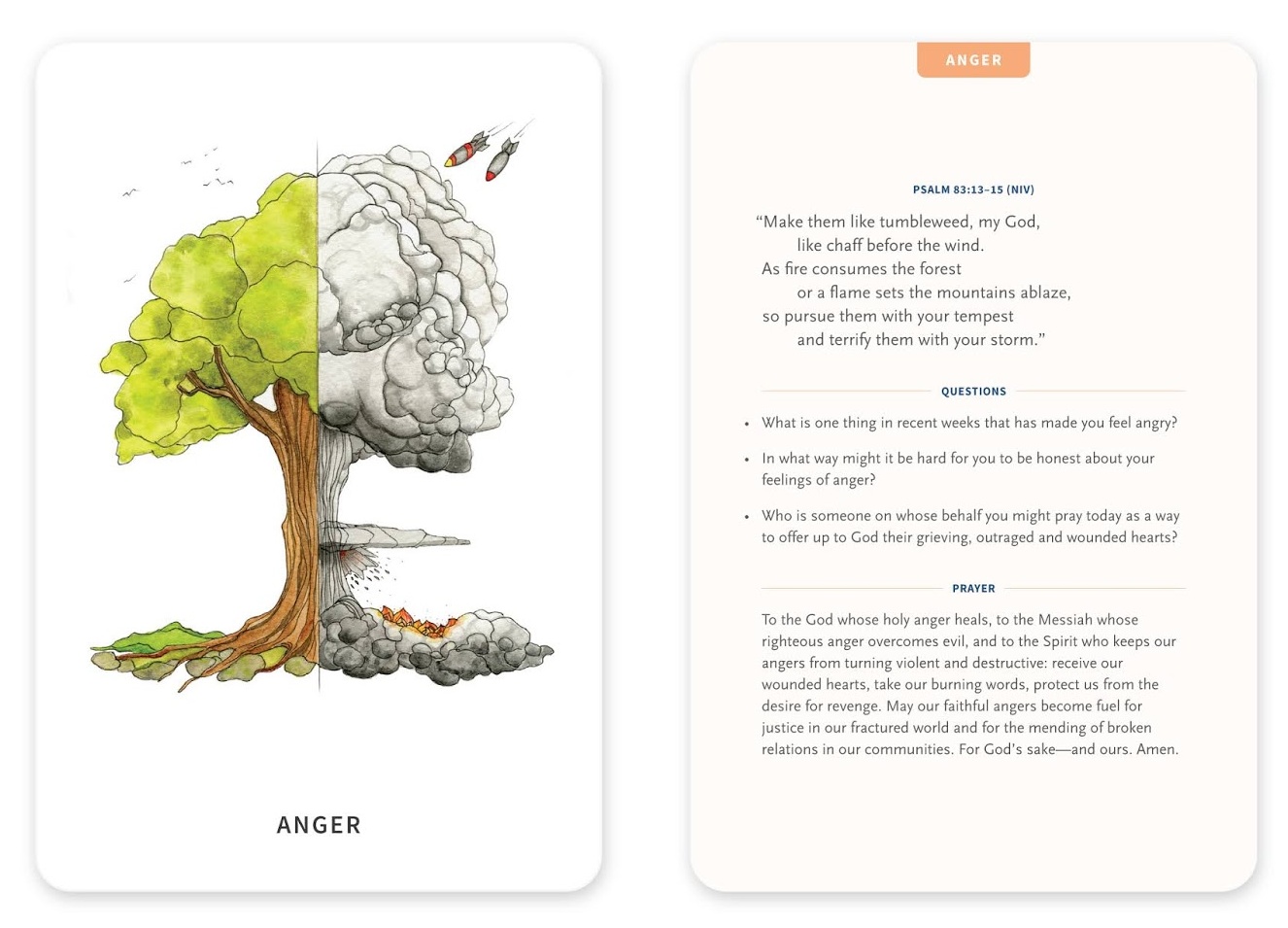
The Psalms of Anger: Prayer Card (illustration by Phaedra Taylor)
Taylor’s latest book, Open and Unafraid: The Psalms as a Guide to Life, contains a chapter on “The Psalms of Anger.” Read an excerpt here, or view this video talk. To coincide with the release in March, he and his wife Phaedra created a set of fifteen prayer cards. His prayer on the “Anger” card reads, “To the God whose holy anger heals, to the Messiah whose righteous anger overcomes evil, and to the Spirit who keeps our angers from turning violent and destructive: receive our wounded hearts, take our burning words, protect us from the desire for revenge. May our faithful angers become fuel for justice in our fractured world and for the mending of broken relations in our communities. For God’s sake—and ours. Amen.”
“I Just Wanna Live” by Johnnetta Bryant, performed by Keedron Bryant: Twelve-year-old gospel singer Keedron Bryant posted a video on Instagram last week of himself singing a song his mom wrote in response to the killing of George Floyd. “God gave me those lyrics” for Keedron, she said in a joint interview on Today. Keedron said he prayed the song, meditated with it, then hit record. It’s a heart-baring, heartbreaking lament, a plea for divine protection in a world that is especially dangerous for young black males.
“It Is Enough!” by R. DeAndre Johnson: R. DeAndre Johnson is the pastor of music and worship life at Christ Church Sugar Land outside Houston. He wrote the lyrics for “It Is Enough!” in July 2016 following the deaths of Alton Sterling and Philando Castile but hadn’t set them to music until now. The nine verses bear the refrain “Kyrie eleison” (Lord, have mercy!), or “Christe eleison” (Christ, have mercy!), a common cry of lament. “There are no words that can contain / The depth of sorrow, grief, and pain / That mothers, sons, and all exclaim: / Kyrie eleison!” Johnson sang the song for his church’s livestreamed service on May 31. A lead sheet is available on his Facebook page. [HT: Global Christian Worship]
“I Want Jesus to Walk with Me”: Sharon Irving is a singer-songwriter, spoken-word artist, and worship leader from Chicago who was also a semifinalist on season 10 of America’s Got Talent. In this video from 2015 she sings a spiritual that expresses deep sorrow—“When my strength is failing,” “When my heart is aching,” “When my life feels like a burden”—but also trust in the companionship of Christ, who walks with us through valleys of death. Having likely originated as an improvisation, the song has several lyrical variations and can be easily adapted to voice a range of feelings: “In my rage,” “In my frustration,” “In my exhaustion,” “In my confusion,” etc.
“O This Night Is Dark” by Tom Wuest: Last Sunday my congregation sang Isaac’s Wardell’s setting of Psalm 126 [previously], whose refrain is “Although we are weeping, Lord, help us keep sowing the seeds of your kingdom . . .” Seeds of love, truth, justice, hope. I just learned that Wardell’s song was inspired by Tom Wuest’s “O This Night Is Dark,” released in 2008 on Rain Down Heaven. In addition to Psalm 126, Wuest’s song also references 1 Corinthians 15, Isaiah 2, Amos 9, and Isaiah 65.
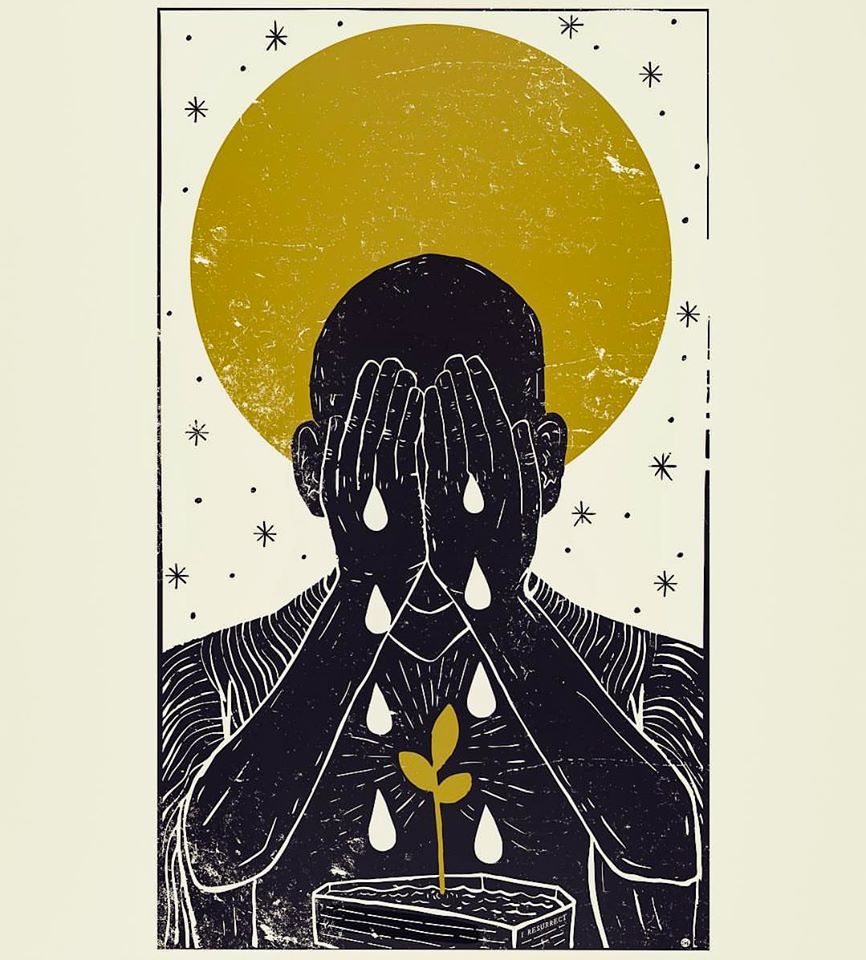
And this week as I was listening to the song, the following image by Scott Erickson showed up on my Instagram feed, with the caption “If one part suffers, all the parts suffer with it” (1 Cor. 12:26).
Scott Erickson (American, 1977–), The Sorrowful Saint, 2016
Erickson painted the image in July 2016 in response to the fatal shootings of Sterling and Castile. It suggests that tears of grief can be generative, that new life can rise out of death. That’s not at all to say that death is good because it catalyzes a movement of change, but that our mourning the evils of racism and murder, our publicly crying out “Enough!,” is not fruitless, though it often seems so. Growth will come.
+++
VIDEO ART: Weight by André Daughtry: “Weight is an attempt to visualize societal projections on the black male body,” writes André Daughtry, a Brooklyn-based interdisciplinary photography and media artist, writer, and performer. The piece is from 2014, and last year PBS’s AllArts station commissioned Daughtry to restage it in New York City as part of a larger video work. [HT: ImageUpdate]
Daughtry has a master’s degree in theology and the arts from Union Theological Seminary and serves as community minister of the arts at Judson Memorial Church, which has a long history of nurturing artists. “We believe that artists have the potential to serve as our modern-day prophets,” the church website reads. “They show us where we’ve been, who we are, and what we can become.”
+++
PODCAST EPISODE: “The SPU Conversation About Spike Lee Films,”North by Pacific Northwest: In this Seattle Pacific University conversation released April 11, 2019, two cinephiles, Jeffrey Overstreet and Josh Hornbeck, discuss some of the films of writer-director Spike Lee, “the boldest and brashest auteur in American film” (Guardian). The first several minutes, though, are spent decrying the then recent Oscar win of Green Book, which popular audiences loved but critics were generally sour on because it perpetuates the simplistic and ultimately false notion that to solve racism, white people just need to realize that “we’re all the same” and find a black friend.
Best known for Do the Right Thing (1989), Lee is one of several filmmakers they cite who deals with race in more complex ways, and while some people dismiss him as an “angry black man,” many celebrate him for forcing audiences to reckon with the problem of racism. “I think there should be rage inside of every conscious human being in the world, because there’s stuff that’s just not right,” he said in a 2000 interview. “Anger can be constructive.” Lee’s films are heavy-handed, in-your-face; they shout and unsettle. Heavy-handedness usually makes for bad art, but Overstreet and Hornbeck show how the approach works for Lee.
Starting at 16:44, they focus on the satirical comedy-drama Bamboozled (2000), which joined the prestigious Criterion Collection just this March. (It’s also been the subject of much scholarly study across fields, one instance I’ve come across being an essay by art theorist W. J. T. Mitchell, titled “Living Color: Race, Stereotype, and Animation in Spike Lee’s Bamboozled,” in What Do Pictures Want? The Lives and Loves of Images.) “Under pressure to help revive his network’s low rating, television writer Pierre Delacroix (Damon Wayans) hits on an explosively offensive idea: bringing back blackface with The New Millennium Minstrel Show. The white network executives love it, and so do audiences, forcing Pierre and his collaborators to confront their public’s insatiable appetite for dehumanizing stereotypes.”
From 25:54 onward, Overstreet and Hornbeck discuss more generally their passion for cinema and the importance of revisiting films.
People have been expressing frustration that The Help, a civil rights era drama that sidelines the perspectives of its black characters, is the number one most-streamed movie on Netflix right now. Film critic Alissa Wilkinson gives a list of fifteen movies to watch instead on racial injustice and being black in America. A mix of dramas and documentaries by such filmmakers as Barry Jenkins, Ava DuVernay, Spike Lee, and others, these are black-centered stories that help illuminate where we’re at right now. All are available for online streaming, and Wilkinson provides links to her reviews.



 Art & Theology