
QUOTES:
Mary’s response to this announcement [of Jesus’s forthcoming birth]—her Magnificat—is even more overtly revolutionary. Her song in Luke’s Gospel is not a lullaby; it is a manifesto. She declares that the mighty will be cast down from their thrones, the lowly lifted, the hungry filled with good things, and the rich sent away empty. This is the language of redistribution, the language of a world reordered by justice rather than domination. It is no surprise that tyrants have feared this text; throughout modern history, the Magnificat has been prohibited and/or discouraged in public worship in places like Guatemala, Argentina, and India because oppressed communities used it as a rallying cry for liberation. Mary’s theology is insurgent.
—Kat Armas, “The Politics of Birthing God,” Some Things Abuelita (Substack), December 2, 2025
What I love about Hannah and Mary is they step into God’s eternal streams of justice and of righteousness and of what it means to live as a faithful follower of Yahweh. They step into this expansive world of what God is going to do and has promised to do in the world, instead of the smaller space of their own need—which again, is OK and understandable. But they take us to places where, if we’re honest, most of our prayers don’t regularly go.
—Rev. Dr. Tracey Bianchi, “Waiting with Women (Advent Series Part 2): Hannah’s Story and the Gift of Peace (Shalom),” The Alabaster Jar (podcast), December 8, 2025
+++
VIDEO DEVOTION: “Beholding the Magnificat with Mary Gardner”: In this “Space for God” video devotion from Coracle, Rev. Mary Amendolia Gardner, an Anglican priest with a bachelor’s degree in art history and a master’s in Christian spirituality, guides us in lectio divina (sacred reading) with Luke 1:46–55 and visio divina (sacred seeing) with James Tissot’s Magnificat.
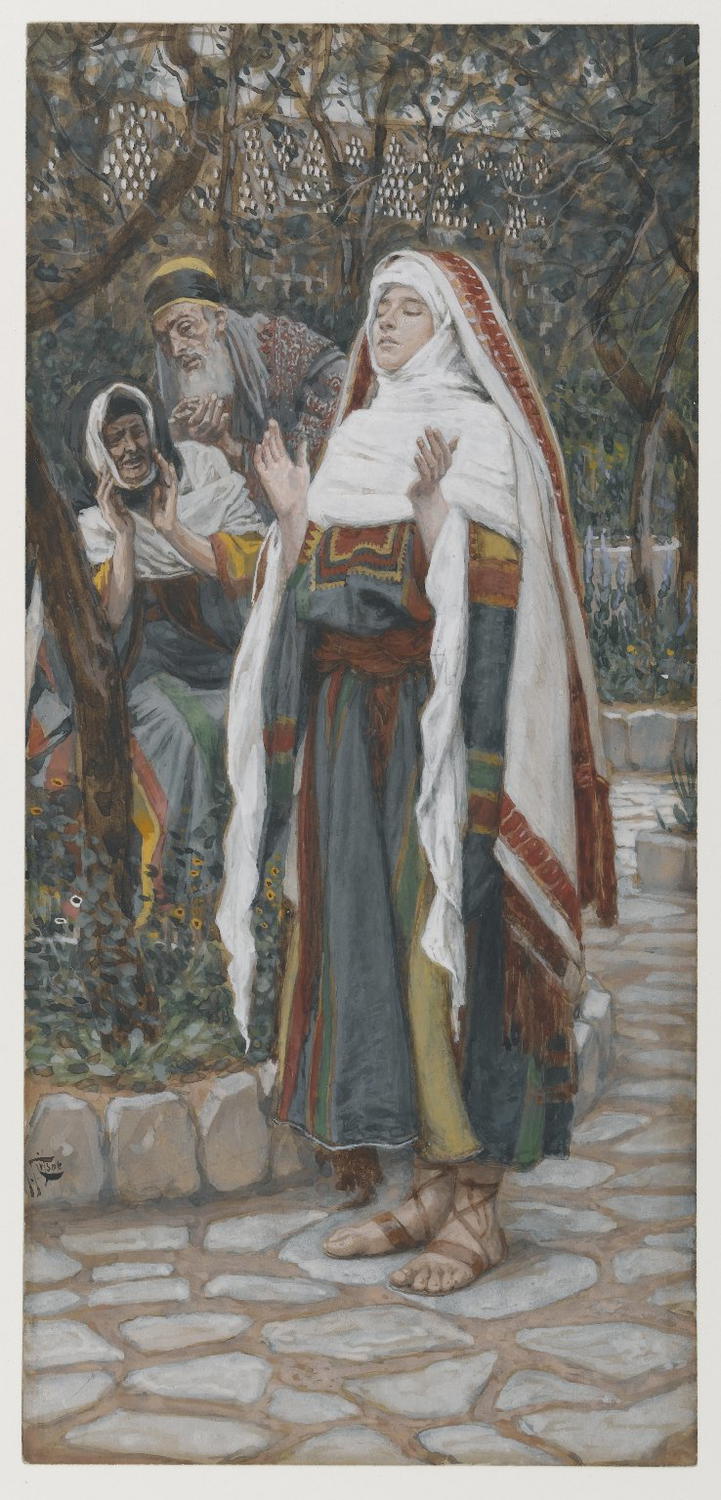
I typically don’t care for Tissot’s biblical watercolors, because of their illustrative quality—they remind me of pictures from the Sunday school curriculum I followed as a child. But I do like this one, which shows Mary in a position of wisdom and authority, absorbed in prayer, preparing to preach and prophesy. Elizabeth and Zechariah stand in attentive awe on the sidelines, their eyes directed toward the divine child she carries in her body while they await her words. The priest’s tongue had been tied, but Mary’s has been loosed. The Cuban American theologian Kat Armas, in the post quoted above, calls Mary “the first theologian of the Gospel,” as she boldly proclaims the messianic deliverance God has set in motion.
+++
SONGS:
>> “For Ages Women Hoped and Prayed” by Jane Parker Huber: “We join the song that Mary sings, an earthly, heavenly theme.” Performed at Wheaton Bible Church in Illinois.
>> “Mary, Did You Know” with alternative lyrics by Jennifer Henry: The original lyrics of this Gaither Vocal Band song were written by Mark Lowry in 1985, and they were set to music by Buddy Greene in 1991; the song became a popular hit. However, some Christians take issue with the rhetorical device that implies Mary did not know her son was God, that he would deliver Israel, and that he would reign forever, when that’s precisely what Gabriel told her from the beginning and what she alludes to in her Magnificat. (Defenders say these questions are most likely voiced by people in Mary’s life who didn’t know all that God had conveyed to her; or that it’s legitimate to wonder whether Mary knew the specifics that would unfold, and to suppose that even if she knew theoretically who Jesus was, she may have struggled to grasp the full scope and significance of his messiahship.)
In 2017, the Canadian theologian and activist Jennifer Henry rewrote the lyrics to center on the Magnificat and its mobilizing influence on justice movements across the globe. That song is sung here by Eric Lige, who is accompanied by Vahagn Stepanyan on piano.
>> “Magnificat” by Simon de Voil, feat. Alexa Sunshine Rose: This adaptation of the Magnificat is by Simon de Voil, a sacred musician, “interspiritual minister,” and retreat leader originally from Scotland now living in Vermont. The imagery in the video is not what I would have expected: It’s footage of bears in the woods. Perhaps it alludes to how all of creation will be redeemed in “the world that is to come”? The bears here, though, seem at peace, so maybe it’s a picture of blessedness, or of creation’s praise alongside Mary’s.
+++
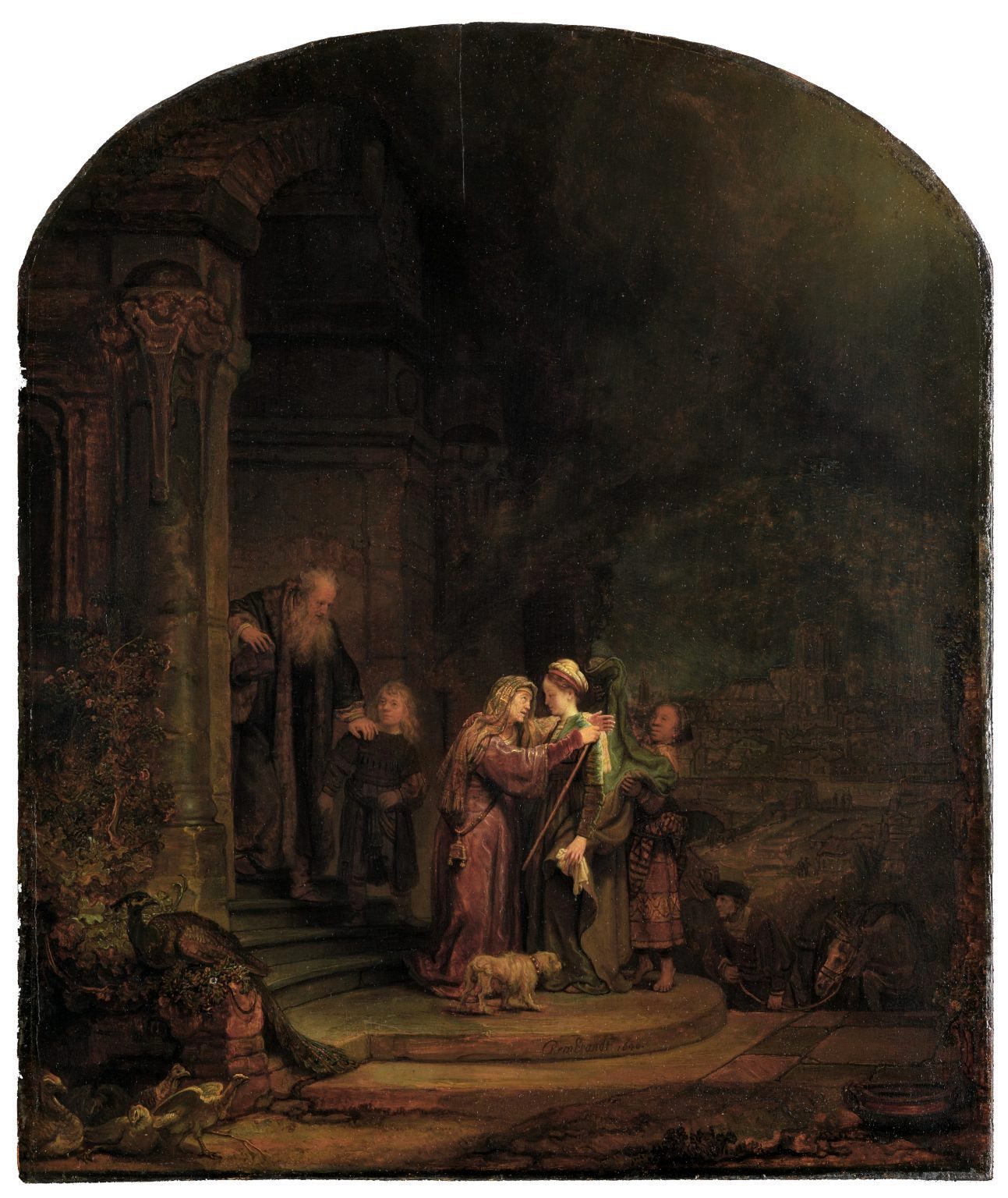
SERMON: “Liberated to See by the God Who Sees” by Wes Vander Lugt, Trinity Forest Church, Concord, North Carolina, December 7, 2025: I’m always pleased when preachers, as part of their biblical exegesis, skillfully integrate art into their sermons—not as mere illustration or decoration but as itself interpreting scripture and/or doing theological work. In the sermon he gave for the Second Sunday of Advent this year, Rev. Dr. Wes Vander Lugt [previously], an ordained Presbyterian minister and director of the Leighton Ford Initiative in Theology, the Arts, and Gospel Witness at Gordon-Conwell Theological Seminary, preached on Luke 1:5–25, 39–45, about how God sees us and liberates us to see him and others. He discusses Rembrandt’s Visitation painting, especially the artist’s use of light and shadow—Mary and Elizabeth step out of the shadows, out of a place of feeling unseen, into the light of God’s grace, says Vander Lugt, where they are known and knowing.
He also touches on, very briefly, James B. Janknegt’s 2008 Visitation, which shows how John the Baptist has been liberated to see Jesus, even as the two are still in utero. See 17:49–20:05.
+++
FROM THE ARCHIVE: The Magnificat is a topic I’ve covered on the blog several times over the past ten years. Here are some examples:
- “Christmas Bonus: Magnificat,” a poem by Stewart Henderson: https://artandtheology.org/2024/12/15/christmas-bonus-magnificat-by-stewart-henderson/
- Beth Felker Jones’s Visitation digital collage with the song “Among Us” by Nick Chambers: https://artandtheology.org/2024/12/15/advent-day-15-among-us/
- Jan Richardson’s The Hour of Lauds: Visitation collage and “My Soul Doth Magnify the Lord” by O’Landa Draper and the Associates: https://artandtheology.org/2023/12/17/ten-songs-of-joy-for-gaudete-sunday/
- An excerpt from Rosemary Catalano Mitchell and Gail Anderson Ricciuti’s book Birthings and Blessings, with Laurie Gudim’s painting Mary and Elizabeth: https://artandtheology.org/2024/05/31/cradling-the-darkness-together-kindling-the-light/
- Kate Green’s painting Mary and Elizabeth with Phillip A. Peterson’s “Praise the Lord” from Oratorio of Prayers: https://artandtheology.org/2023/12/17/advent-day-15-praise/
- Fred Carter’s wood sculpture Behold My Miracle with “The Glory of Jah” by Sinéad O’Connor: https://artandtheology.org/2022/12/09/advent-day-13-magnificat/
- An adaptation of the Magnificat by M Jade Kaiser (formerly M Barclay), with a painted wood sculpture by George Bandele: https://artandtheology.org/2022/05/27/magnificat-adaptation-rev-m-barclay/
- Louise Henderson’s painting October, Arent Weevers’s video installation Mary!, a sermon and sketch by Quaker pastor Bob Henry, and the song “Magnify” by Tom Wuest: https://artandtheology.org/2020/12/12/roundup-ave-maria-ballet-pregnancy-magnificat/
- Hannah Frank’s Sun drawing with “Visitation Song” by Aly Aleigha: https://artandtheology.org/2020/05/25/bursting-with-god-news-artful-devotion/
- Steven C. Warner’s choral piece “Jina la Bwana: An African Magnificat” with Mickey McGrath’s painting Windsock Visitation: https://artandtheology.org/2017/12/12/jina-la-bwana-ni-takatifu-artful-devotion/
- The Visitation painting by Pontormo, The Greeting video artwork by Bill Viola, “Magnificat” from John Adams’s Christmas oratorio El Niño, and a reflection by Evan Rosa on Mary’s vision of greatness: https://artandtheology.org/2017/12/03/advent-2017-online-arts-devotional-by-biola-university/
 Art & Theology