
Today, June 4, is Trinity Sunday! Here’s a handful of art and music items on the topic.
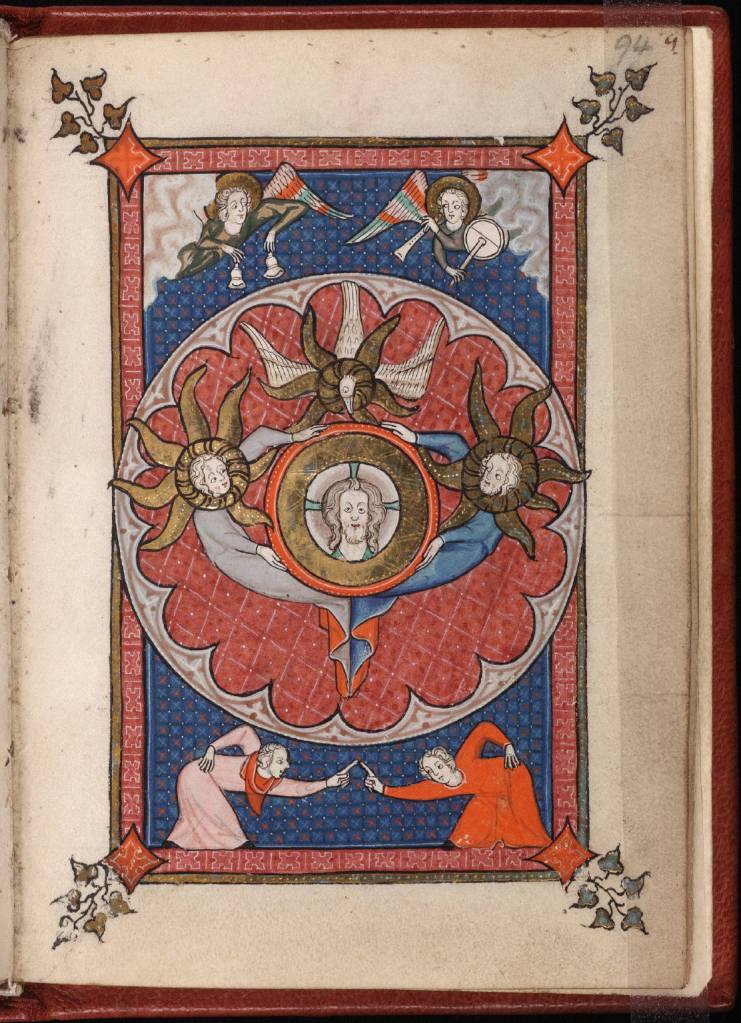
VISUAL MEDITATION: “The Wheeling Playfulness of the Trinity” by Victoria Emily Jones: The Rothschild Canticles [previously] from ca. 1300 Flanders contains some of the most inventive and delightful artistic renderings of the Trinity that I’ve ever seen. I key in on four of them in today’s visual meditation for ArtWay.
+++
MUSICAL COMMENTARY: “Theology in Sound and Motion: Perichoresis, for Brass Quintet” by Delvyn Case: Delvyn Case provides musical and theological commentary on his brass quintet composition “Perichoresis” (2006), inspired by the divine dance of the Trinity. “Its overall mood is joyous, an ecstatic whirling-about in which all three members become lost in the ecstasy of divine fellowship,” he writes. “At the exact moment of the dance when one member moves, the other fills in the spot left vacant.” “Perichoresis” premiered by Boston’s Triton Brass and appears on Case’s 2018 album Strange Energy. About this piece, Bible scholar and theologian Walter Brueggemann said, “I . . . have pondered ‘perichoresis’ for a long time. This is the finest exposition of that thick idea that I have encountered.”
+++
SONGS:
>> “Trinity Song” by Paul Zach: Performed in 2021 by Solomon Dorsey with Liz Vice and Madison Cunningham, this song by Paul Zach evolved into “God of Grace and Mystery” for The Porter’s Gate’s 2022 album Climate Vigil Songs. This earlier iteration has a Trinitarian focus that’s just lovely. “God of all eternity / Father, Spirit, and the Son / Ever-loving Three-in-One / O divine community / . . . / Calling us to join your dance . . .”
>> “One-Two-Three” by the Chosen Gospel Singers: This song was recorded in Los Angeles for Specialty Records and released as a single in 1952, with singers J. B. Randall (bass), E. J. Brumfield (tenor), George Butler (tenor), Fred Sims (tenor), and Oscar Cook (baritone). It opens with a repetition of the lines “One, two, three / One-in-Three and the Trinity.” The refrain is:
One for the Father
Two for the Son
Three for the Holy Ghost
All made of one
The song is largely eschatological. The first verse is about John the Revelator’s vision of the New Jerusalem descending, among other wonders; it ascribes a vision of the Trinity to John, even though that is not explicit as such in either John’s Gospel or the Apocalypse (but see “The Trinity in the Book of Revelation” by Edwin Reynolds). The second verse anticipates our singing and praising the Triune God in heaven, dressed in our brand-new robes. It also mentions David and Goliath, and I’m honestly not sure how that relates. But with gospel songs, floating lyrics are common, taken from one song and spliced into another, some more coherent than others in their new context.
+++
ESSAY: “The Hospitality of Abraham in the Work of Julia Stankova, Painter of Bulgarian Icons” by François Bœspflug: The first half of this peer-reviewed article introduces readers to the Bulgarian artist Julia Stankova, rehearsing her biography and examining her relationship to the icons tradition. The second half explores twelve of her paintings on the subject of the three angelic visitors to Abraham and Sarah in Genesis 18, whom the narrator suggests are a manifestation of God (“The LORD appeared to Abraham at the oaks of Mamre . . .”); because of the number of visitors, many Christians interpret this passage as revealing something of God’s triune nature, and for this reason traditional icons of the story are often titled The Trinity.

Since the publication of this article in 2019, Stankova has made at least three more paintings on the subject, all of which foreground Sarah and are titled Sarah’s Smile. She has just heard the angels announce that she will conceive a son in her old age.
+++
POEM: “After Rublev’s Trinity” by Carrie Purcell Kahler: Published in Image no. 99 (Winter 2018), p. 21, this ekphrastic poem by Carrie Purcell Kahler interprets the famous fifteenth-century Trinity icon by Andrei Rublev. Sometimes referred to as “the hospitality of Abraham,” this biblical episode, as the iconographers interpret it, is really about the hospitality of God, who extends a hand to humanity, ever inviting us to sit at his table.

A new choral setting of this poem by Garrett John Law is premiering today at Holy Trinity Episcopal Church in Covina, California, where Law serves as music director and organist. I believe it can be heard on the 10:30 a.m. PT worship service livestream on the church’s YouTube channel, but I’m not sure whether the performance will be archived online for later viewing. (Update, 6/12/23: Here it is! Sung by Holy Trinity’s seven-person choir.)




 Art & Theology