Joy, Faith, and Strength in the Mixed-Media Art of Missionary Mary Proctor

All photos in this article are my own.

The American Visionary Art Museum, located right off Baltimore’s Inner Harbor, is midway through its two-year exhibition The Strength to Be Joyful: Messages from Mary Proctor. Exuberant, colorful, and eclectic, the paintings on display, many of them collaged with buttons, cloth, and found objects, are filled with stories from Proctor’s life, lessons taught to her by her grandmother, and prayers and scripture. Her work celebrates faith, love, friendship, creativity, and self-worth.
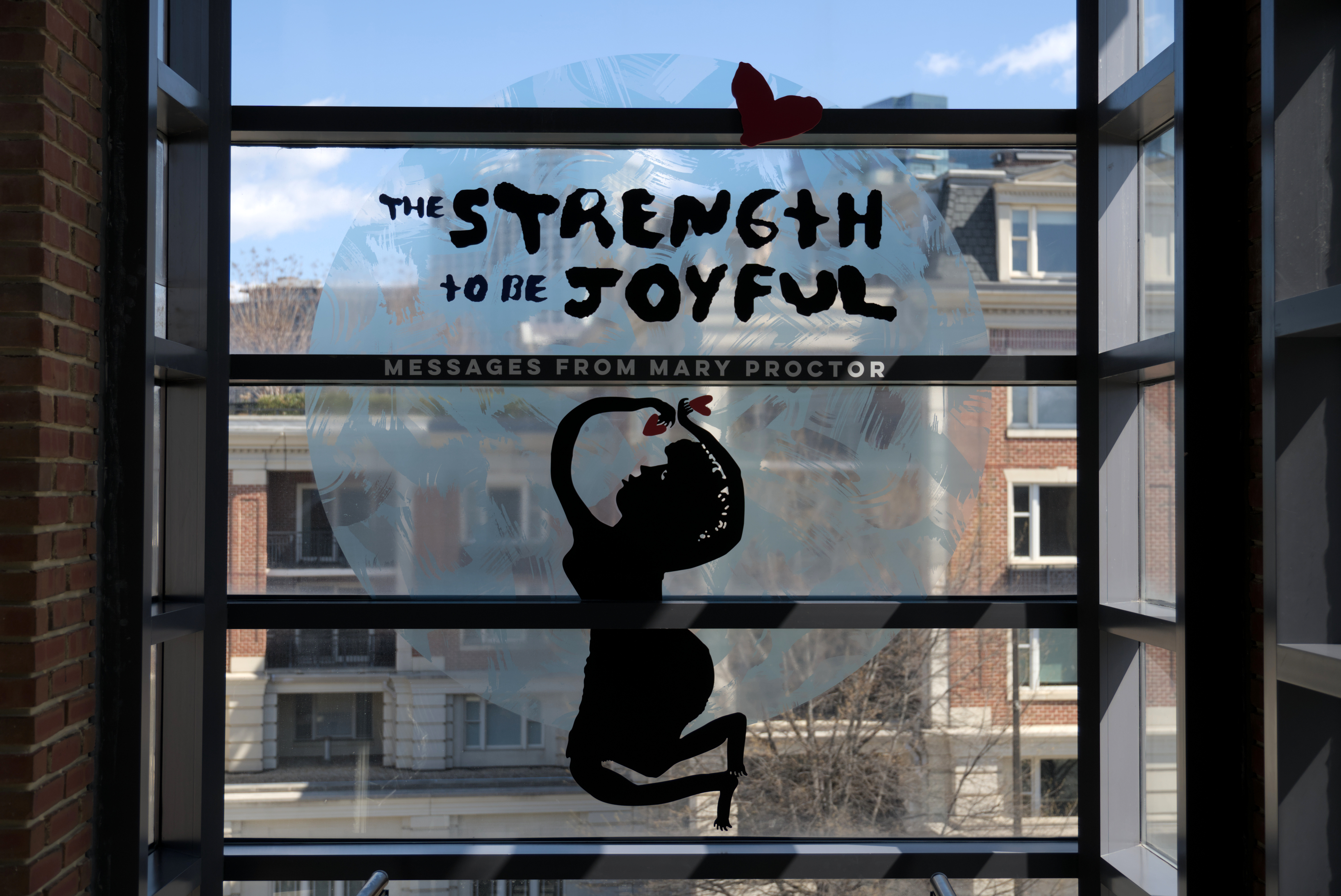
The Strength to Be Joyful
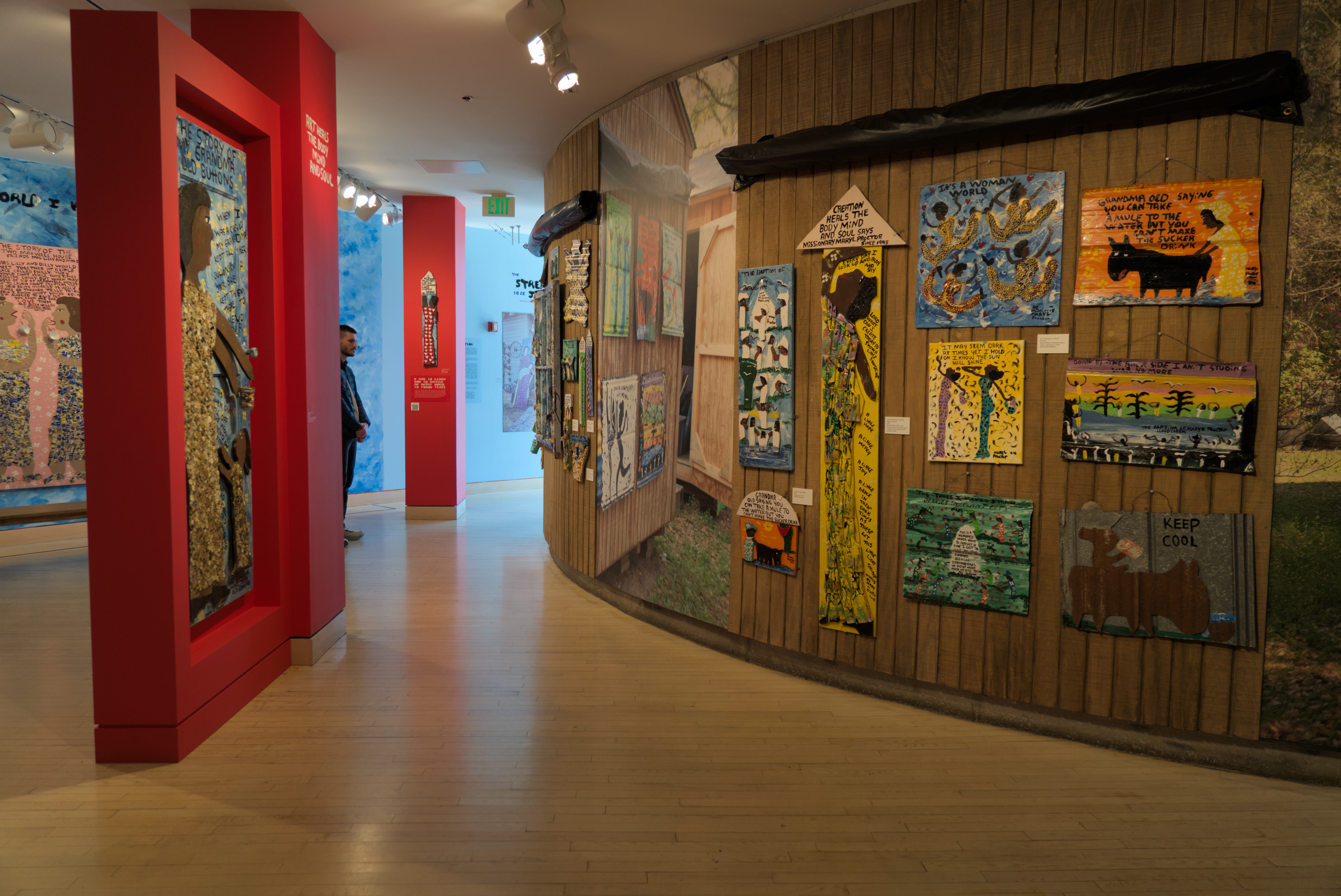
Exhibition view, The Strength to Be Joyful

Mary Louise Proctor (née Cooksey) was born June 11, 1960, in Lloyd, Florida, a small town in Jefferson County, about twenty miles east of Tallahassee. Her mother Paulina gave birth to her at a young age, and she was raised by her maternal grandparents, Frank and Hattie Cooksey. She had an especially close bond with her grandmother, who formed her in the Christian faith and whom she describes as tender, wise, and forgiving.

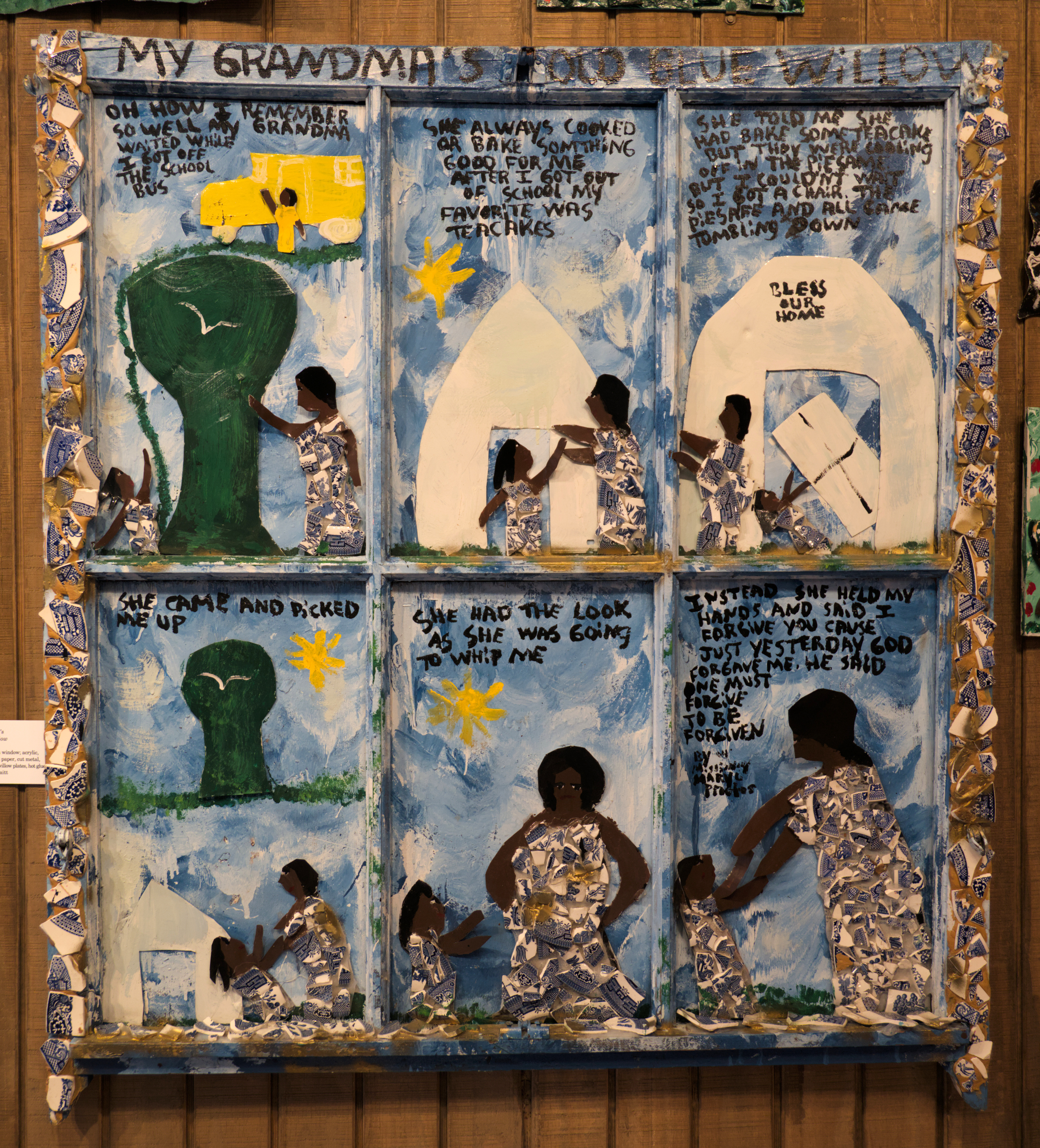
One particular episode she recalls from her childhood is accidentally breaking a stack of her grandmother’s Blue Willow plates while reaching for a teacake. “I thought she would whip me,” Proctor recounted in paint in 1997. “Instead she held my hands and said, ‘I forgive you cause just yesterday God forgave me.’ And she said one must forgive to be forgiven.” The door painting Story of Grandma’s Old Blue Willow Plates portrays Proctor’s grandma reaching out to her as a child to remove her shame and console her, assuring her of her unconditional love. The clothing of the two figures is rendered in shards of the broken chinoiserie dishware, veined with gold paint, kintsugi-like—a metaphor for repair. Centered at the top of the door, round and gleaming like a sun or a halo, is an intact plate. Below it two angels—one Black, one white—resembling the plate’s turtledoves, swoop in and support the title Proctor has given this sacred memory.
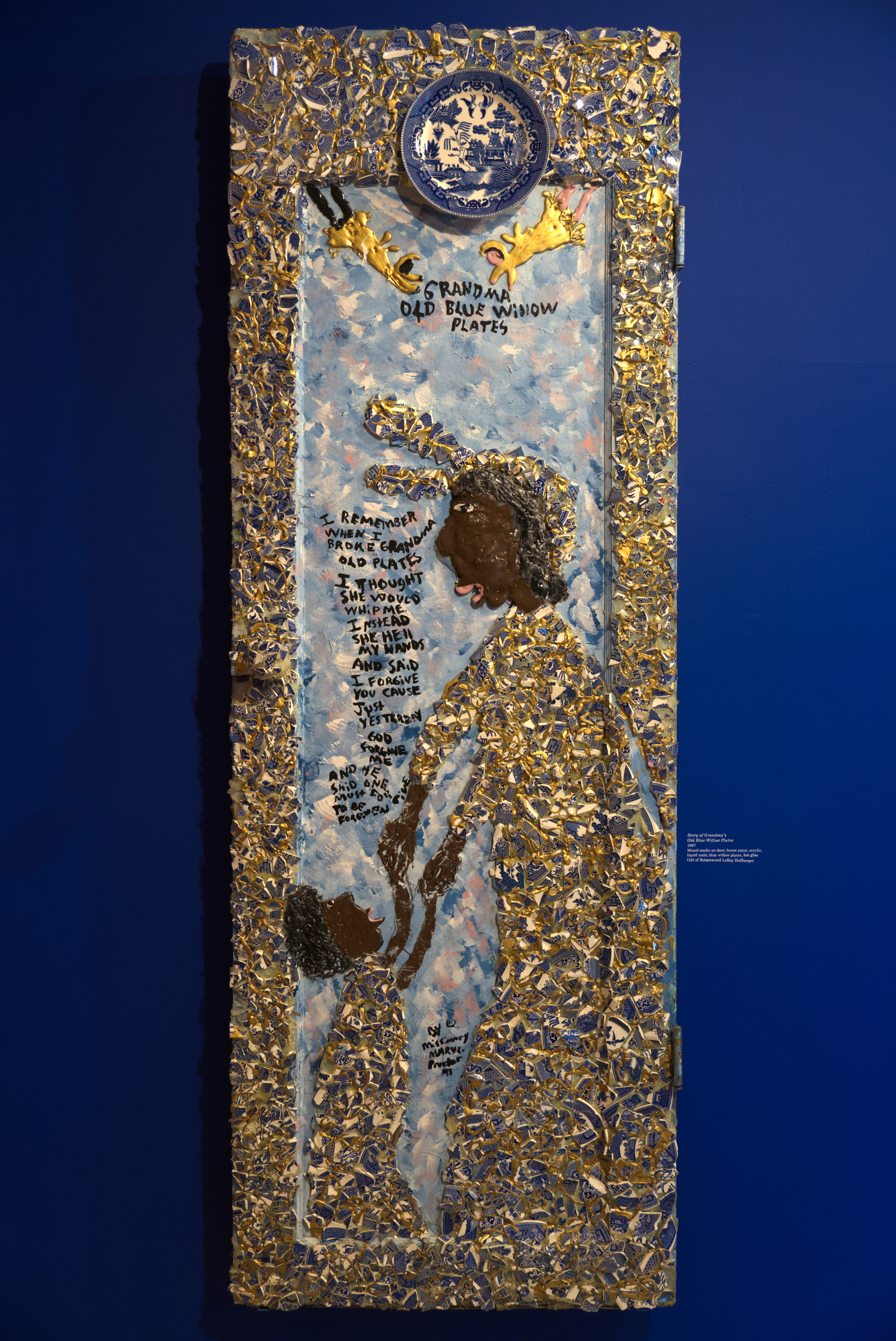
Grandma's Old Blue Willow Plates
Mary L. Proctor (American, 1960–), Story of Grandma’s Old Blue Willow Plates, 1997. House paint, acrylic, liquid nails, Blue Willow plates, and hot glue on door. American Visionary Art Museum, Baltimore.

My Grandma's Old Blue Willow
Mary L. Proctor (American, 1960–), My Grandma’s Old Blue Willow, 2004. Acrylic, spray paint, cut paper, cut metal, liquid nails, Blue Willow plates, and hot glue on window. American Visionary Art Museum, Baltimore.

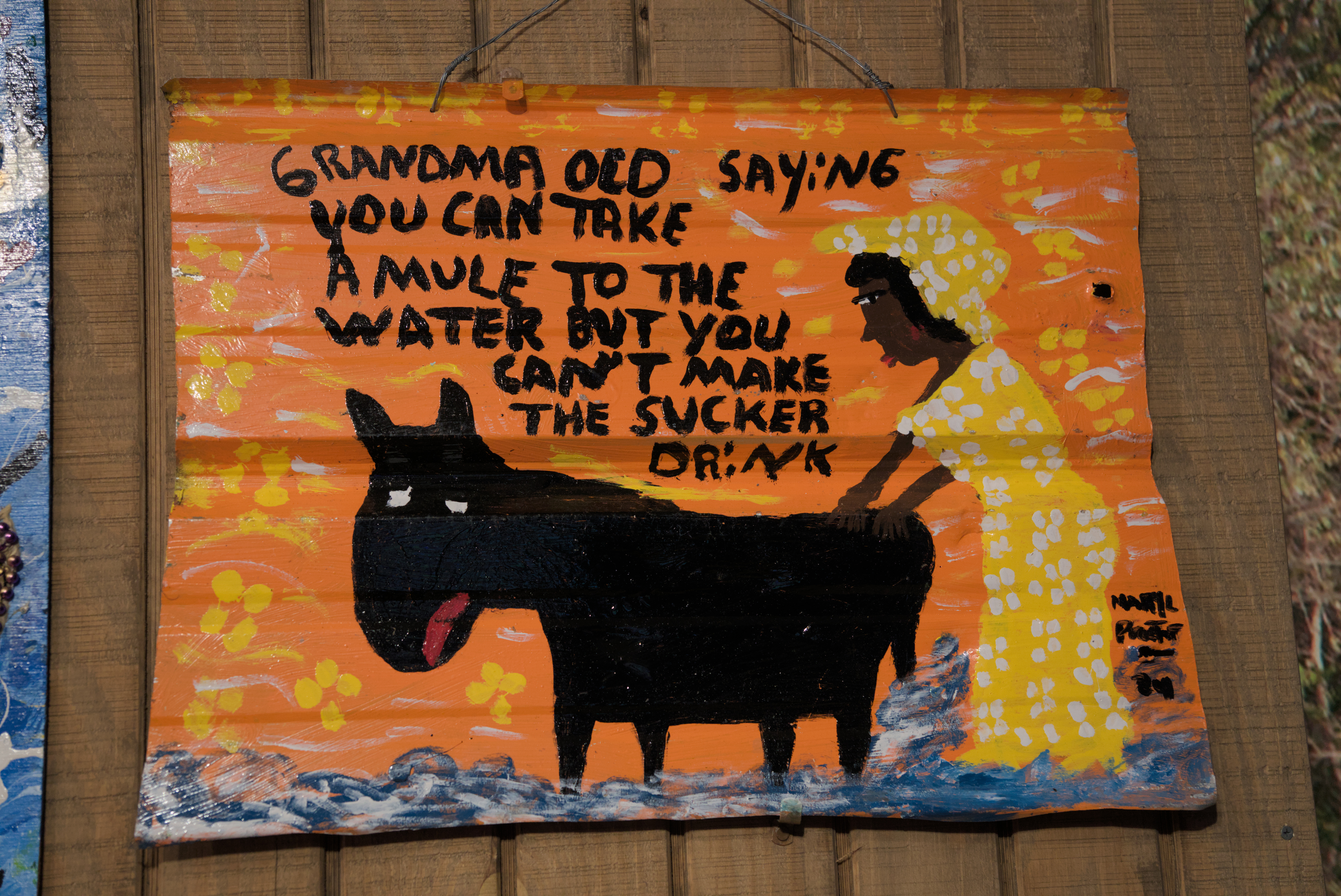
Memories of her grandma, and her grandma’s wisdom sayings, feature in much of Proctor’s work. One painting enumerates eleven “things my old grandmoma told me yesterday [that] holds me today,” such as “Tell you bussiness to God” and “Every body that smile in your face ain’t your friend.” One proverb her grandma would regularly recite is “You can take a mule to the water but you can’t make the sucker drink,” teaching her that we can offer help to other people but ultimately can’t control their choices.
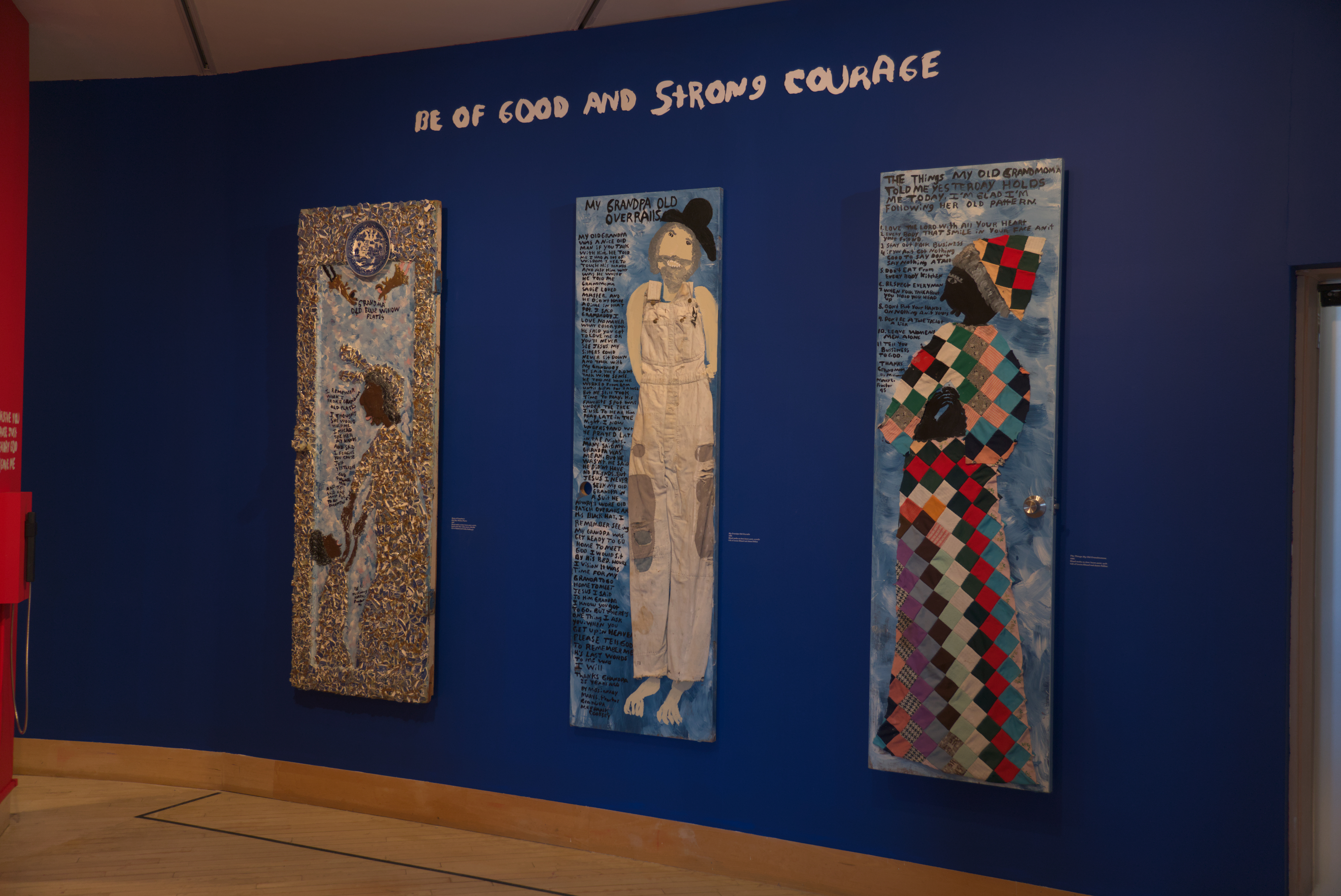
Exhibition view, The Strength to Be Joyful
Left to right: Story of Grandma’s Old Blue Willow Plates, 1997; My Grandpa Old Overalls, 1995; The Things My Old Grandmomma, 1995

Mule painting

Proctor dropped out of school in ninth grade and, after escaping an abusive relationship, married Tyrone Proctor in 1980. She worked as a nurse’s aide until a nerve injury made the job unfeasible, at which point she pivoted to collecting and selling miscellaneous objects for a living.

In January 1994, tragedy struck when Proctor’s grandmother, aunt, and uncle died in a house fire. Proctor was traumatized by seeing the charred bodies removed from the wreckage, and she sunk into a depression. She wrestled with God and even considered suicide.

“The most beautiful personality you ever seen was my grandma. She loved everybody,” Proctor tells. “And I was like, what happened to my grandmother? I mean, why, Lord, why did you allow her to go? That’s my best friend. I was wondering why such a woman had to go like that. Why did it happen?”

While she didn’t receive an answer to that question, she did receive a new direction for her life. In February 1995, while praying and fasting, God spoke to her, telling her to “paint the door.” Not quite sure what he meant, she grabbed three detached doors that she had in her yard and painted the likenesses of her family members on them. This was the beginning of her healing process and her career as a folk artist.

Proctor was already used to salvaging things, from dumpsters and roadsides, that others deemed trash, and making good purchases at flea markets. Now instead of cleaning them up to sell or resell in their current forms, she found uses for them in her art making, and started saving other discarded items as well. Buttons, beads, shells, nails, coins, mirrors, sticks, Spanish moss, coffee cans, toys, shoes, pails, patches of cloth—any of these are worthy art materials for her, along with her go-to house paint. With them, she embellishes doors of all sizes and other types of discarded wood, which she’ll often cut into shapes that suit her.

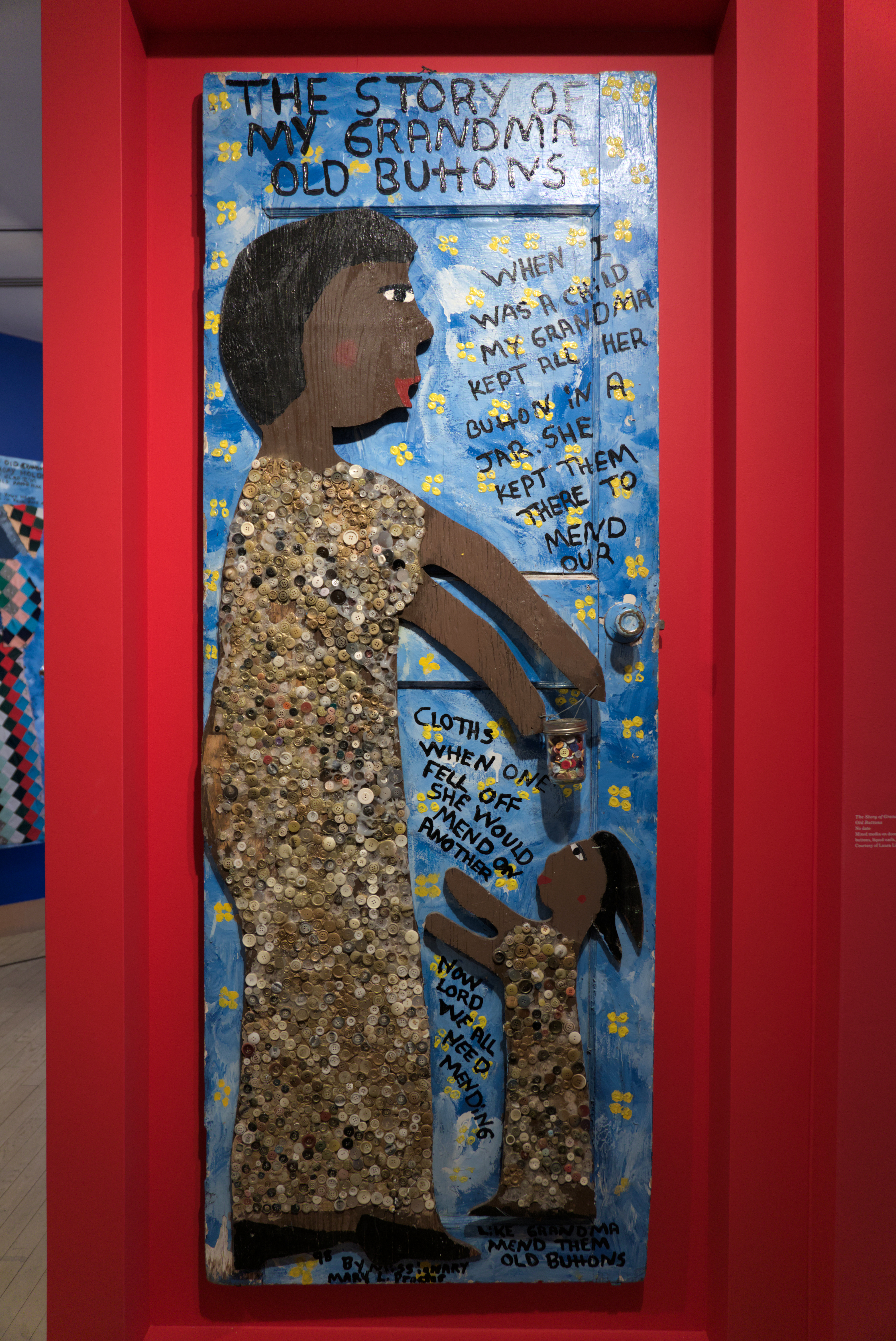
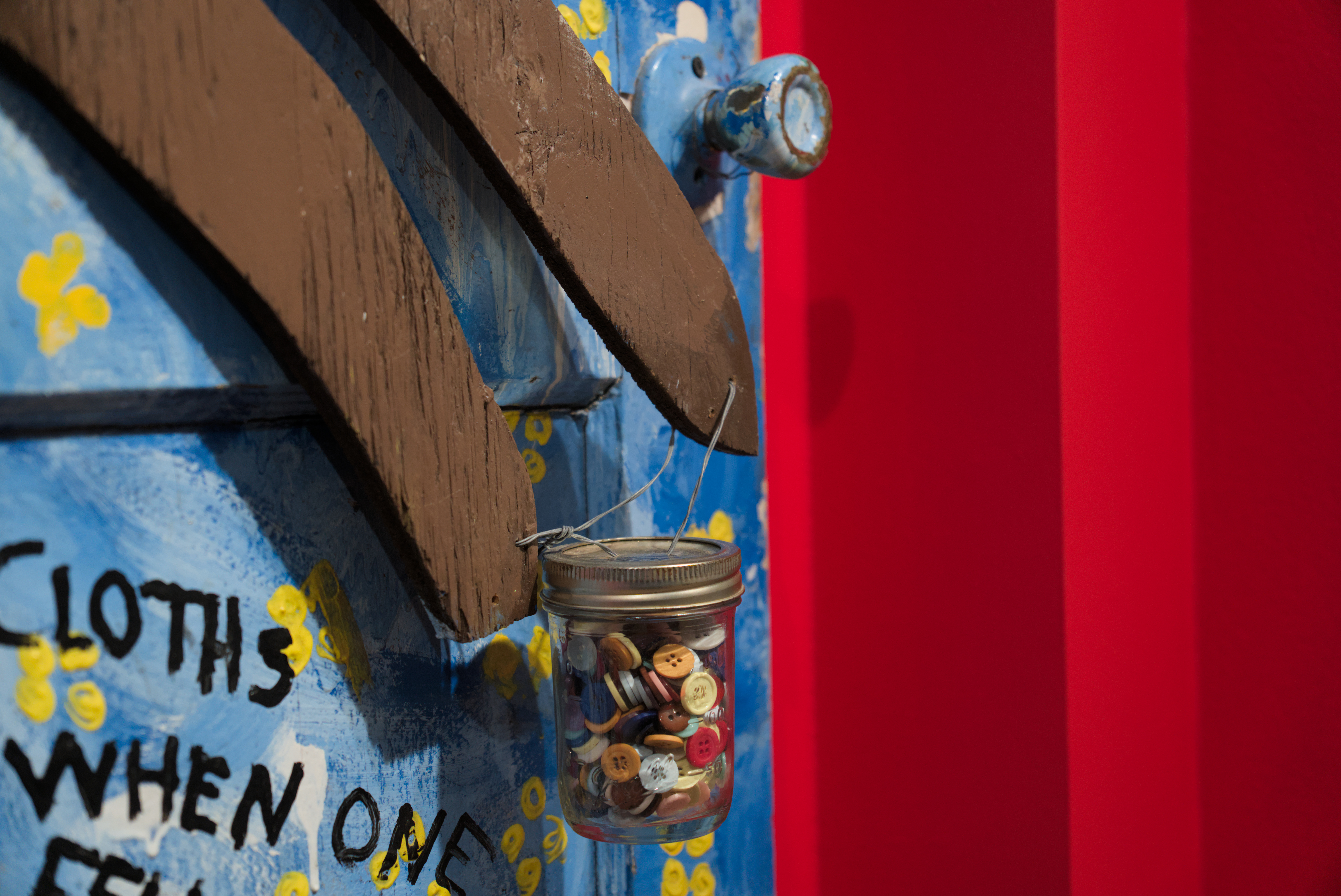
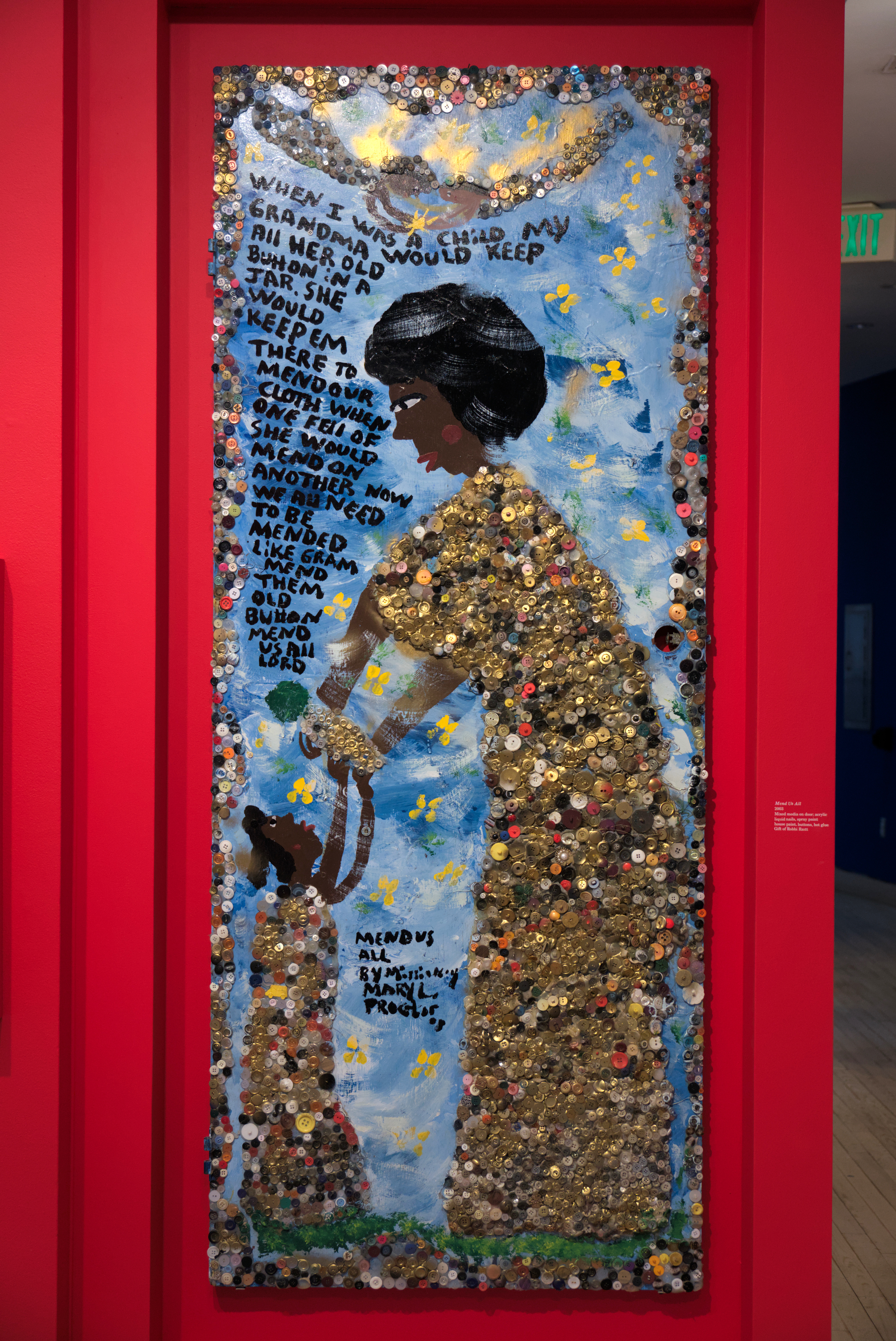
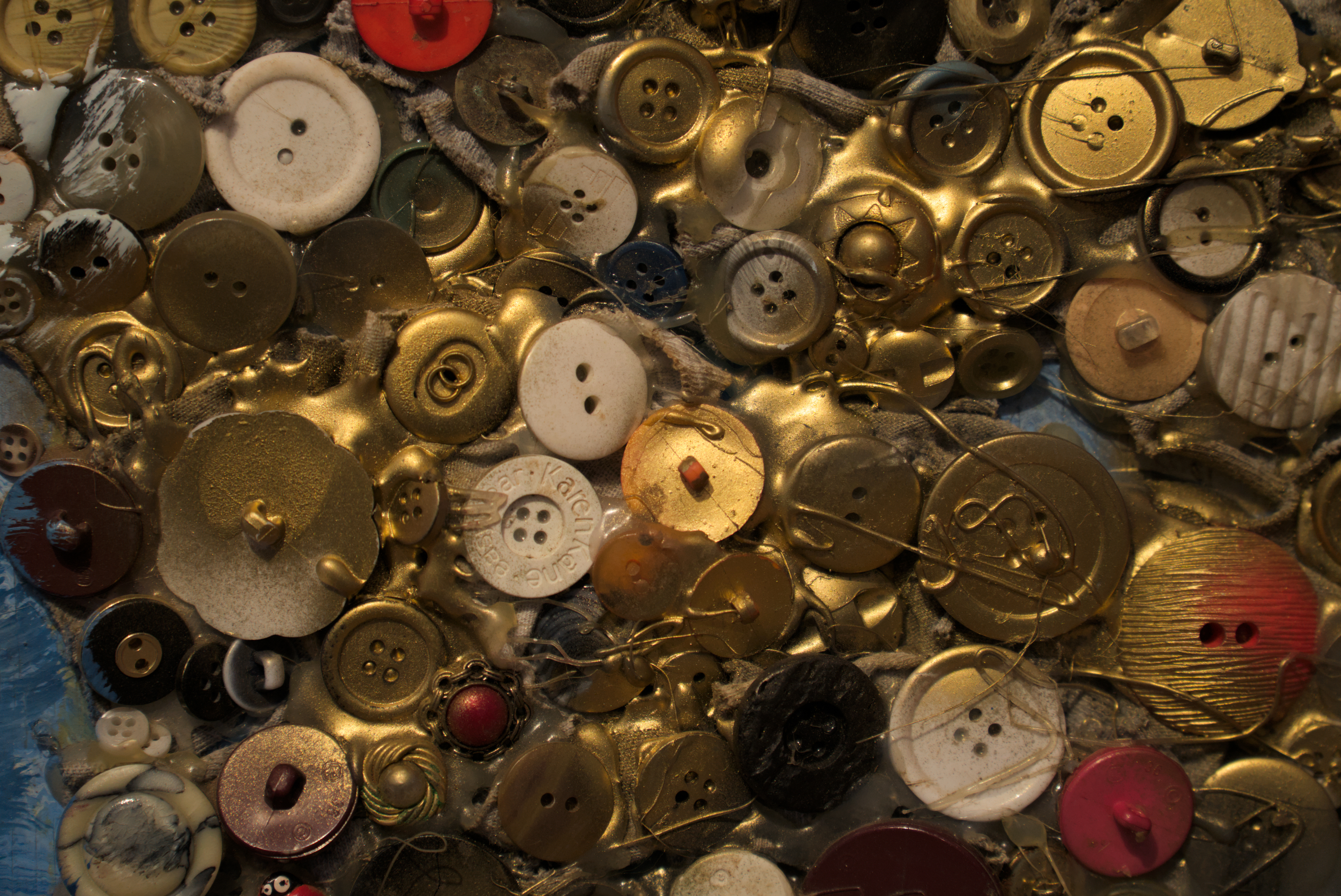
For her, the reclamation of cast-off things reflects God’s redeeming work in our own lives—how he rescues, restores, mends. This work of mending was also modeled by her grandma, who, rather than throwing out old clothes with missing buttons or tears, would lovingly fix them up. “When I was a child,” Proctor reminisces, “my grandma would keep all her old button[s] in a jar. She would keep em there to mend our cloth. When one fell of[f] she would mend on another. Now we all need to be mended like Gram mend them old button[s]. Mend us all, Lord. Mend us all.” Two doors tell this story, showing Gram handing a young Proctor a mended garment or a jar of buttons, the two figures themselves constituted of buttons. In the wispy blue background, angels shower yellow flower petals over the scene, a rain of mercy.
Mend Us All
Mary L. Proctor (American, 1960–), Mend Us All, 2003. Acrylic, liquid nails, spray paint, house paint, buttons, and hot glue on door. American Visionary Art Museum, Baltimore.

Buttons detail
The Story of Grandma Old Buttons
Mary L. Proctor (American, 1960–), The Story of Grandma’s Old Buttons, n.d. House paint, acrylic, buttons, liquid nails, mason jar, and hot glue on door. American Visionary Art Museum, Baltimore.

The Story of Grandma Old Buttons (detail)

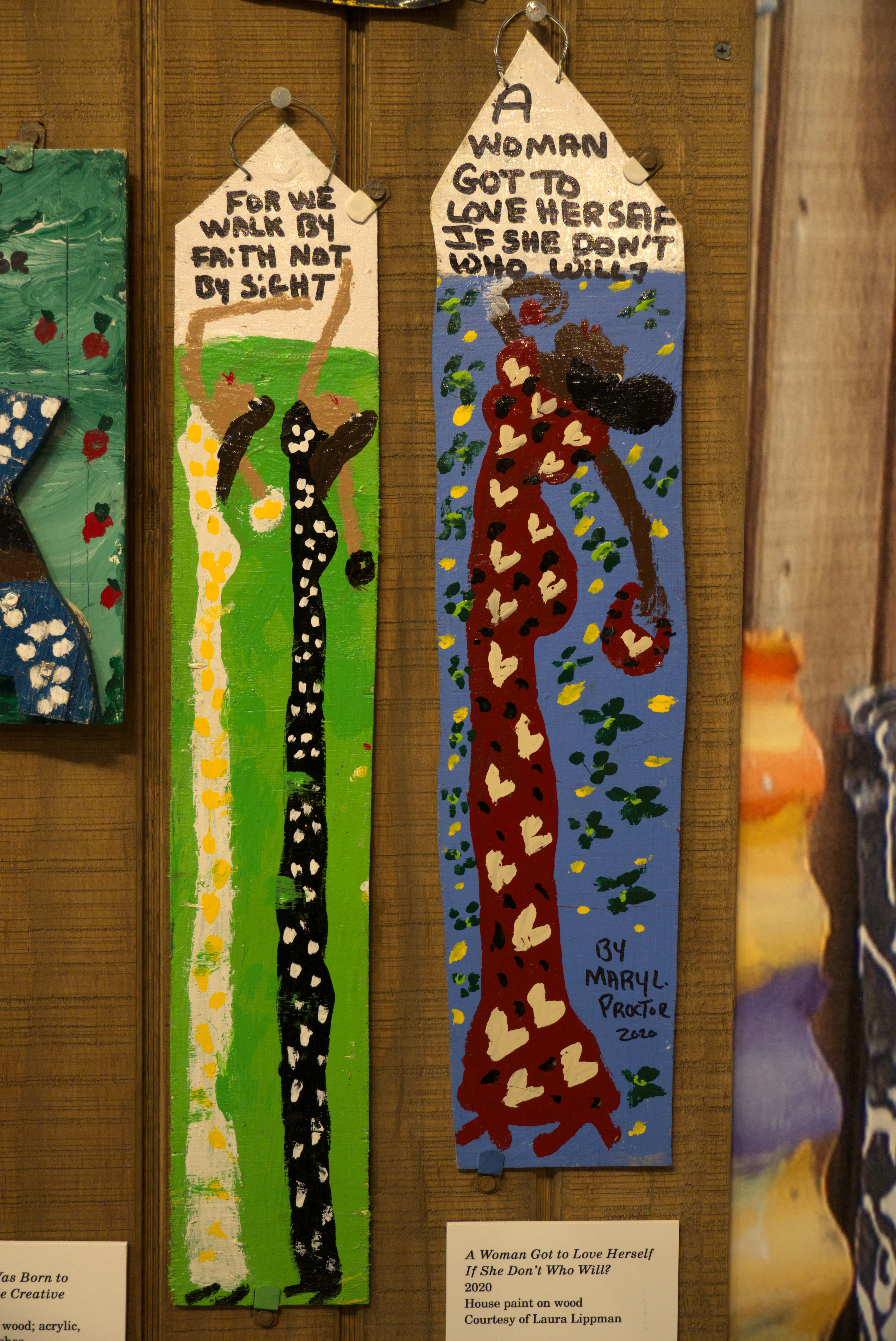
Black women are Proctor’s most frequently depicted subject, whether herself, specific relatives, or more generic women. Her most iconic image type, which exists in many variations, is of a Black woman looking and reaching up, signifying trust in God. For these, she often cuts her substrate into a narrow vertical orientation, emphasizing the seeking of things above, a stretching toward the heavens. Her husband calls her paintings in this format “slims.” Two such slims counsel women to walk by faith, per 2 Corinthians 5:7, and to practice self-love.
Slims

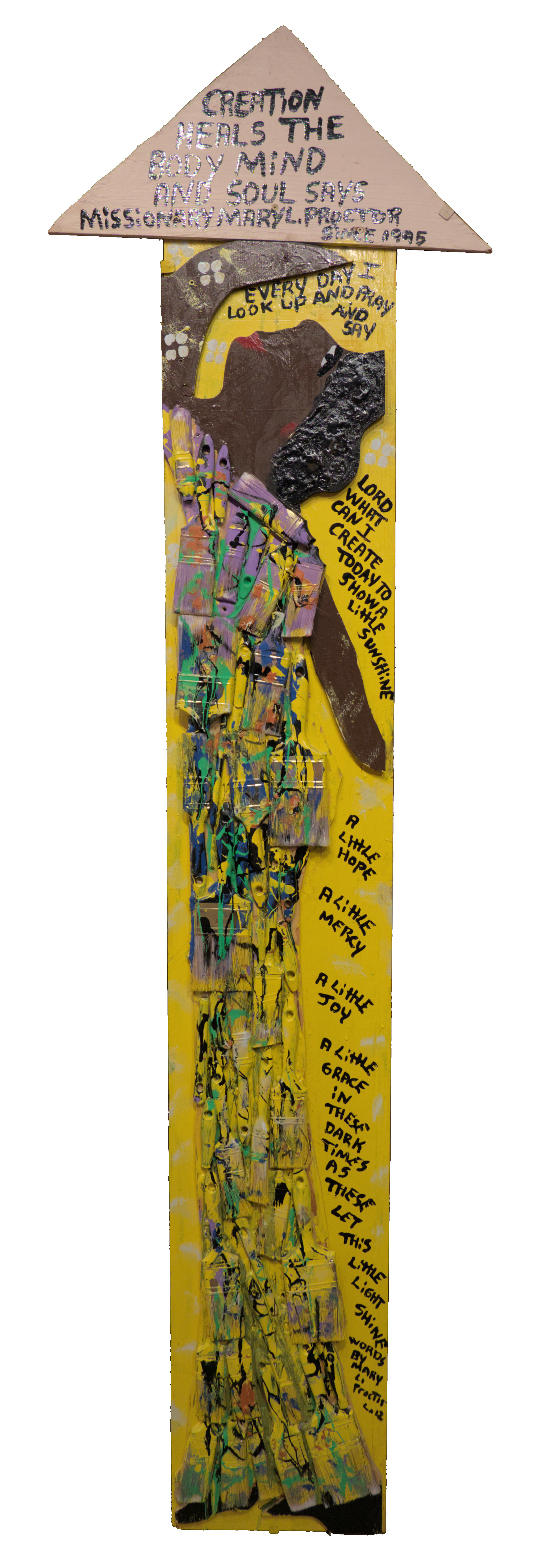
Another, much larger slim, approximately life-size, insists on the salubrious impact of art making. “Creation heals the body, mind, and soul,” it reads. “Every day I look up and pray and say, ‘Lord, what can I create today to show a little sunshine, a little hope, a little mercy, a little joy, a little grace.’ In these dark times as these, let this little light shine”—the latter phrase a reference to Jesus’s Sermon on the Mount (see Matt. 5:14–16). Lit by the Spirit, by whose power she shares the gospel, Proctor prays that her art will benefit not only herself but all those who encounter it.
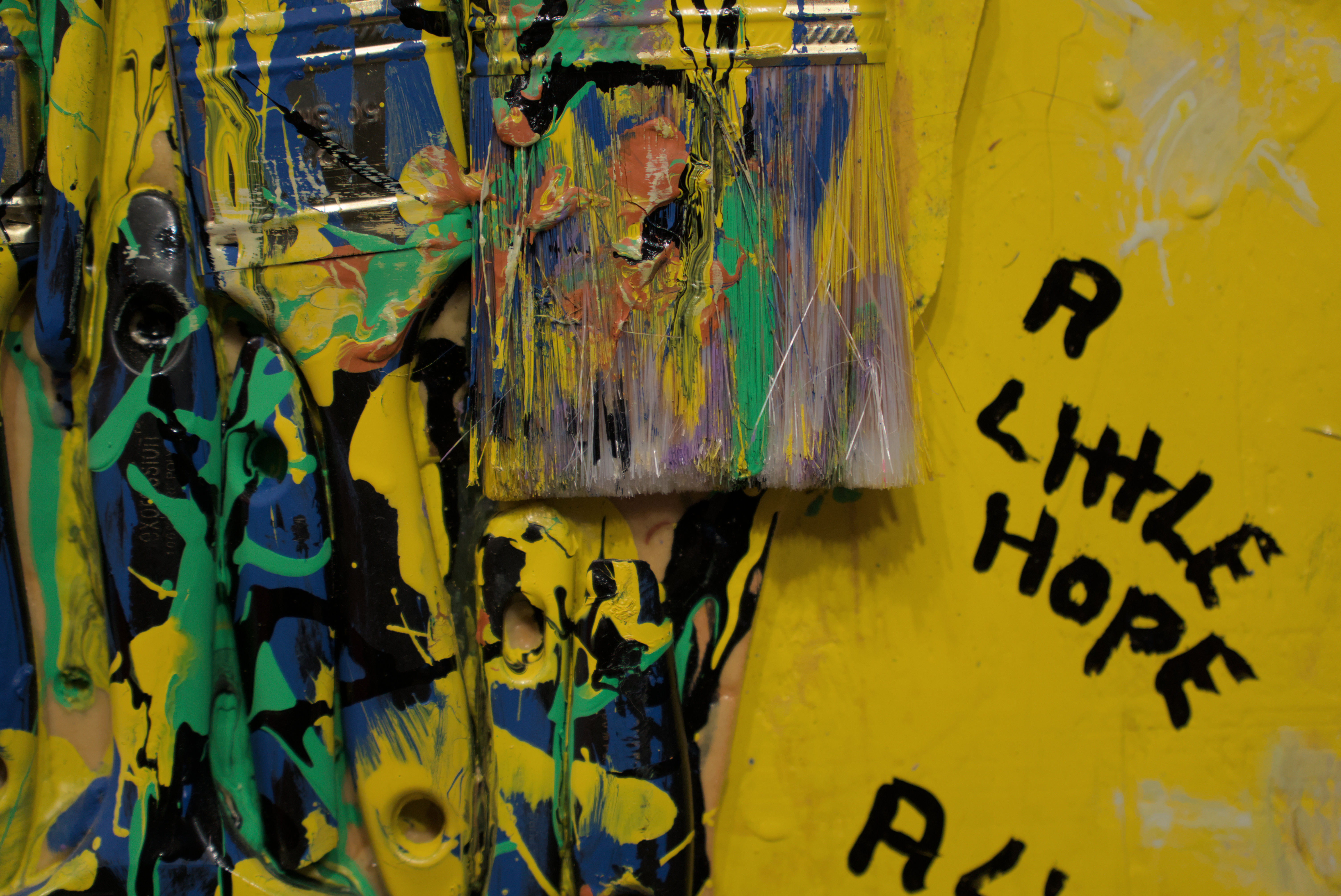
Creation Heals the Body, Mind, and Soul
Mary L. Proctor (American, 1960–), Creation Heals the Body, Mind, and Soul, 2012. Paintbrushes, house paint, and liquid nails on door. Courtesy of Drs. Dahlia Hirsch and Barry Wohl.

Detail

When she makes art, she says, she feels free, like a butterfly.
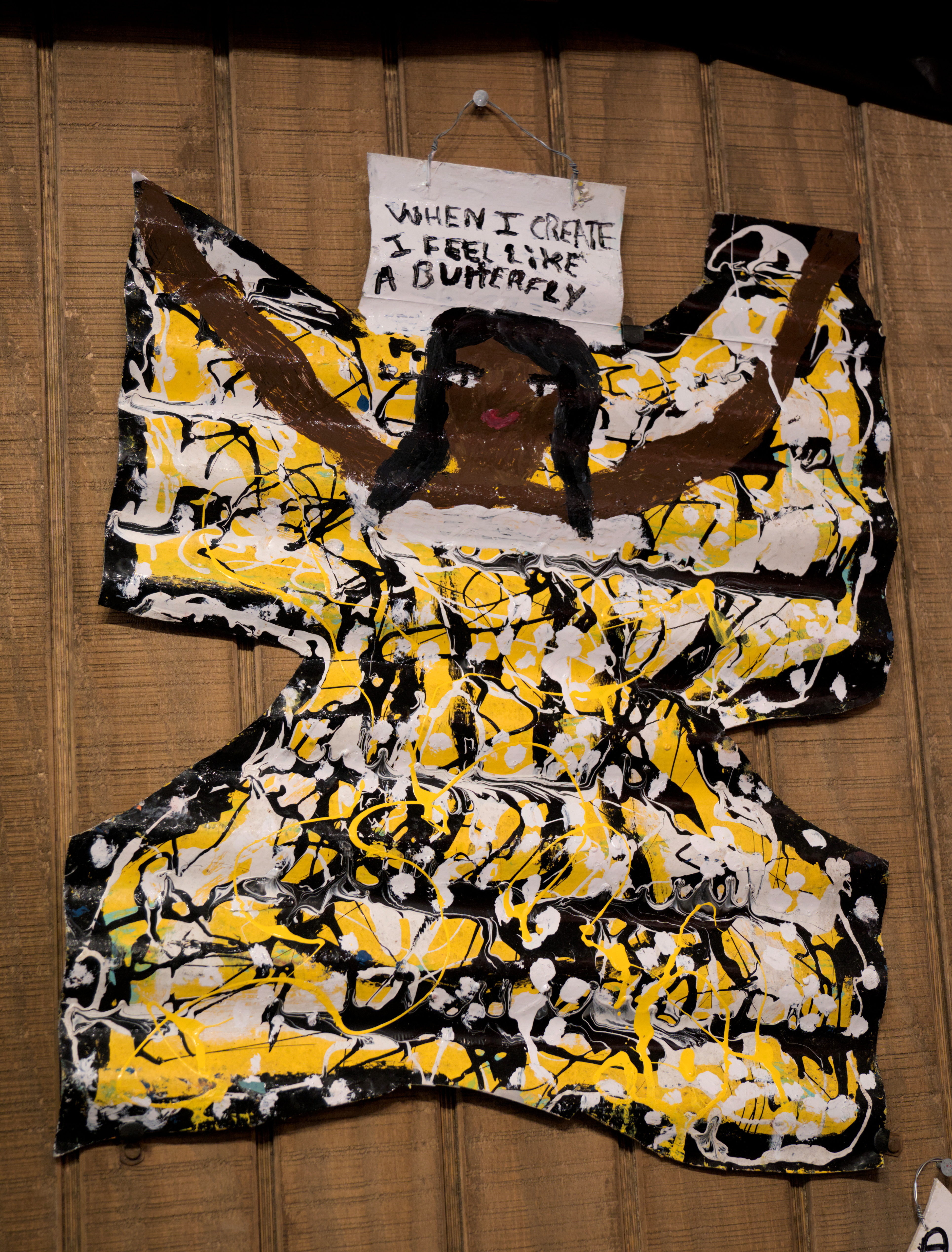
Butterfly

It’s a feeling that’s well captured in It’s a Woman’s World, an unironically titled painting that revels in the abundant life Jesus came to give both sexes (John 10:10), all us descendants of Adam and Eve. The painting shows four Black women in beaded jumpers leaping impossibly wide in the air, their arms outstretched, hearts floating.
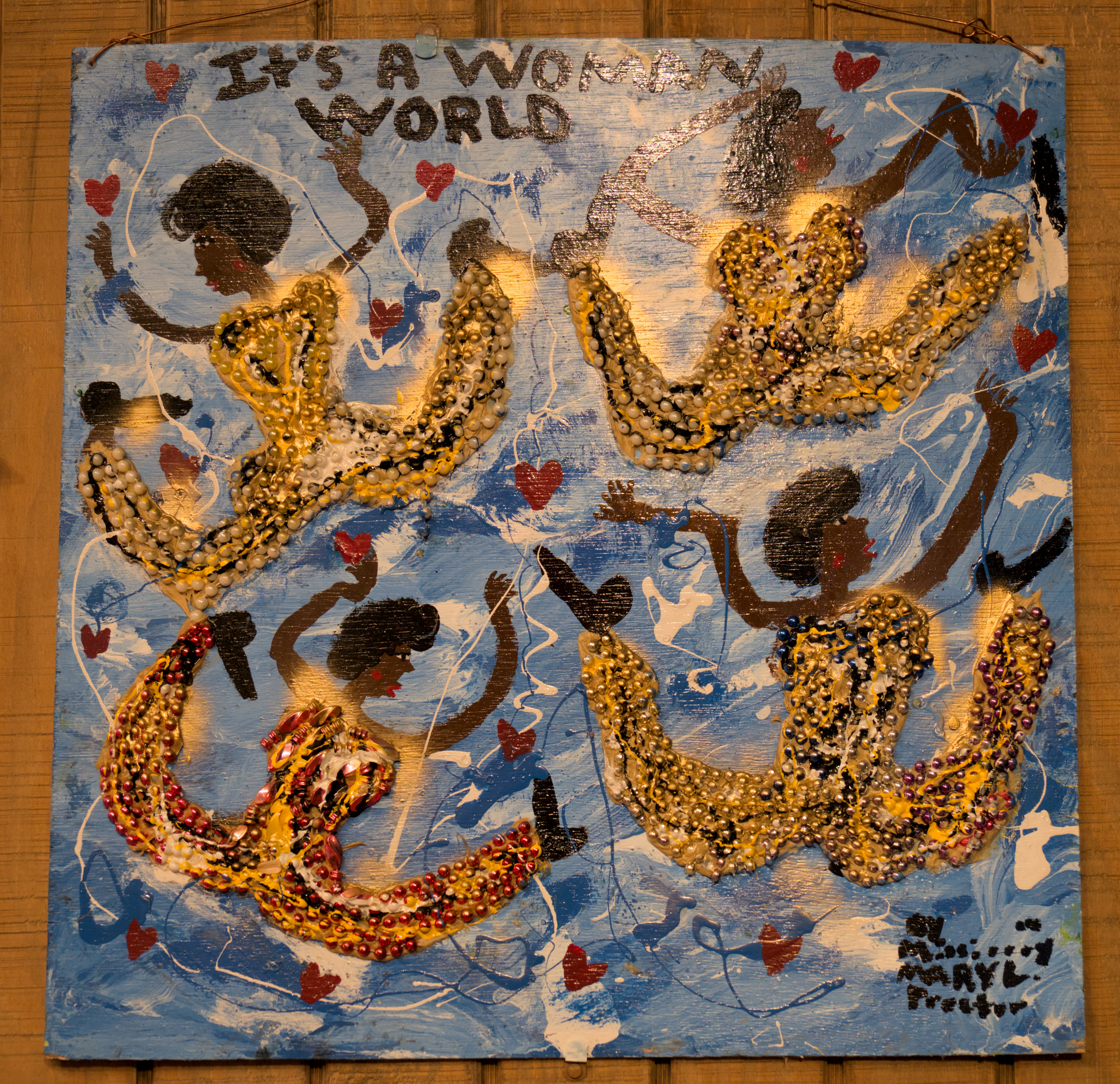
It's a Woman's World
Mary L. Proctor (American, 1960–), It’s a Woman’s World, n.d. Acrylic, spray paint, and beads on Masonite panel. American Visionary Art Museum, Baltimore.

In the article “From Zora Neale to Missionary Mary: Womanist Aesthetics of Faith and Freedom,”Ada C. M. Thomas identifies the womanist (Black feminist) theology expressed in Proctor’s art, which “celebrates Black women as bold, audacious, and determined to embrace their lived experiences”; her figures “embody a prideful yet humbled aesthetic. They are self-possessed and possessed by an intimate, activist faith. The women’s eyes are frequently cast upwards in hopefulness and anticipation.”

Indeed, Proctor considers it part of her mission “to get a message out to broken womens [sic], a message to help and glorify them,” she says. “I’m going to get a message out so men can search their hearts, learn to respect us and treat us the right way.”

She believes everyone is a child of God, and she wants her art to connect people to the hope, peace, joy, and love that’s accessible through him. She calls herself a missionary, often using that title in signatures of her name. “The Lord spoke, and he said, ‘You are on a mission to get a great message out into the houses and hearts,’” she testifies.

(Related post: “The Biblical Imagination of Folk Sculptor Annie Hooper”)

In Look and See the Angel Is You, by using a mirror as the face of the holy figure, Proctor preaches the imago Dei (image of God) in every person, encouraging viewers to recognize their inherent dignity and worth, imbued in them by their Creator.
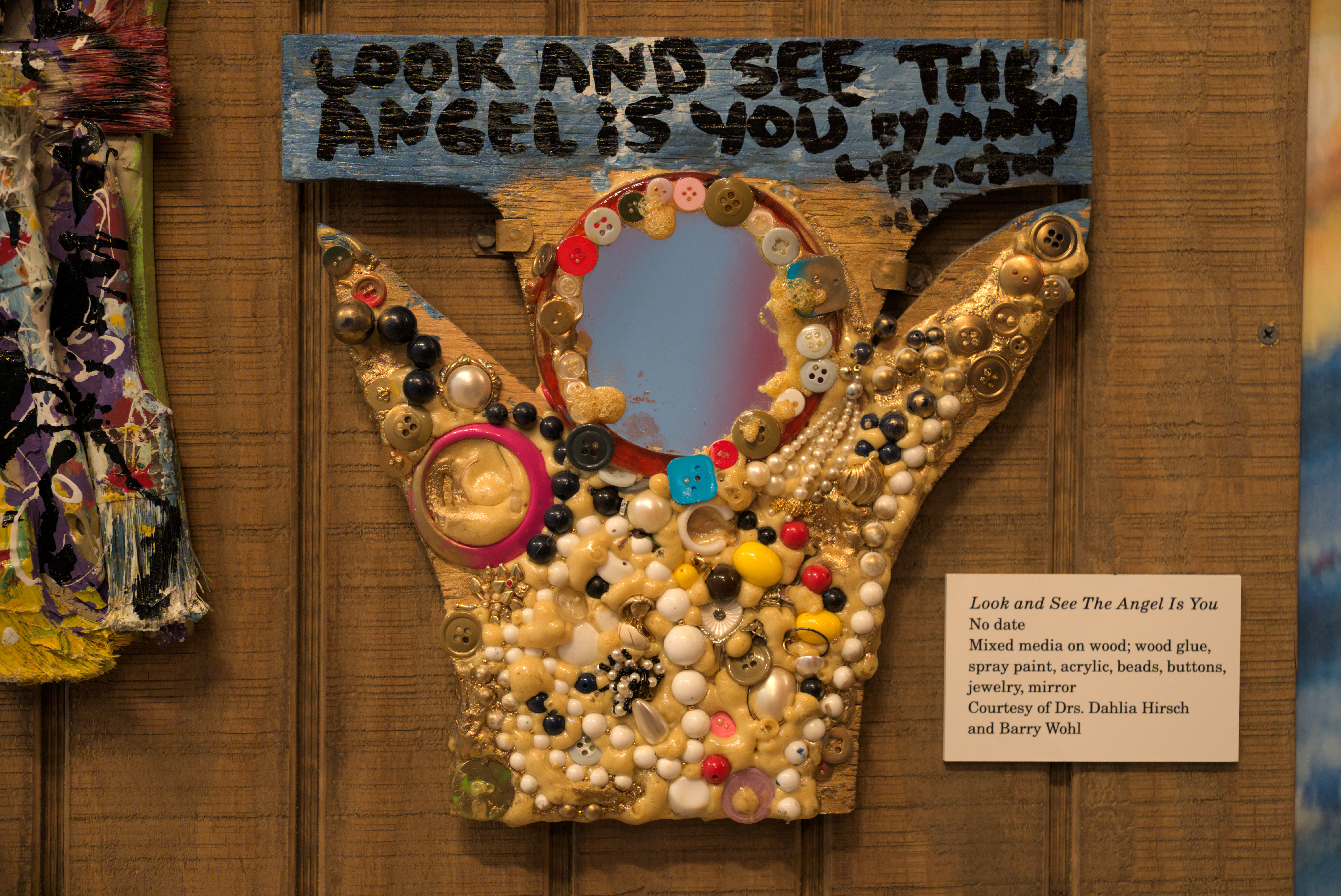
Look and See the Angel Is You
Mary L. Proctor (American, 1960–), Look and See the Angel Is You, n.d. Wood glue, spray paint, acrylic, beads, buttons, jewelry, and mirror on wood. Courtesy of Drs. Dahlia Hirsch and Barry Wohl.

In Every Child Was Born to Rise Up and Be Creative, she echoes the cultural mandate God gave to humans in the garden of Eden: to develop and rearrange the raw materials of creation for the flourishing of all. While not everyone is called to be an artist, we are all called to create.
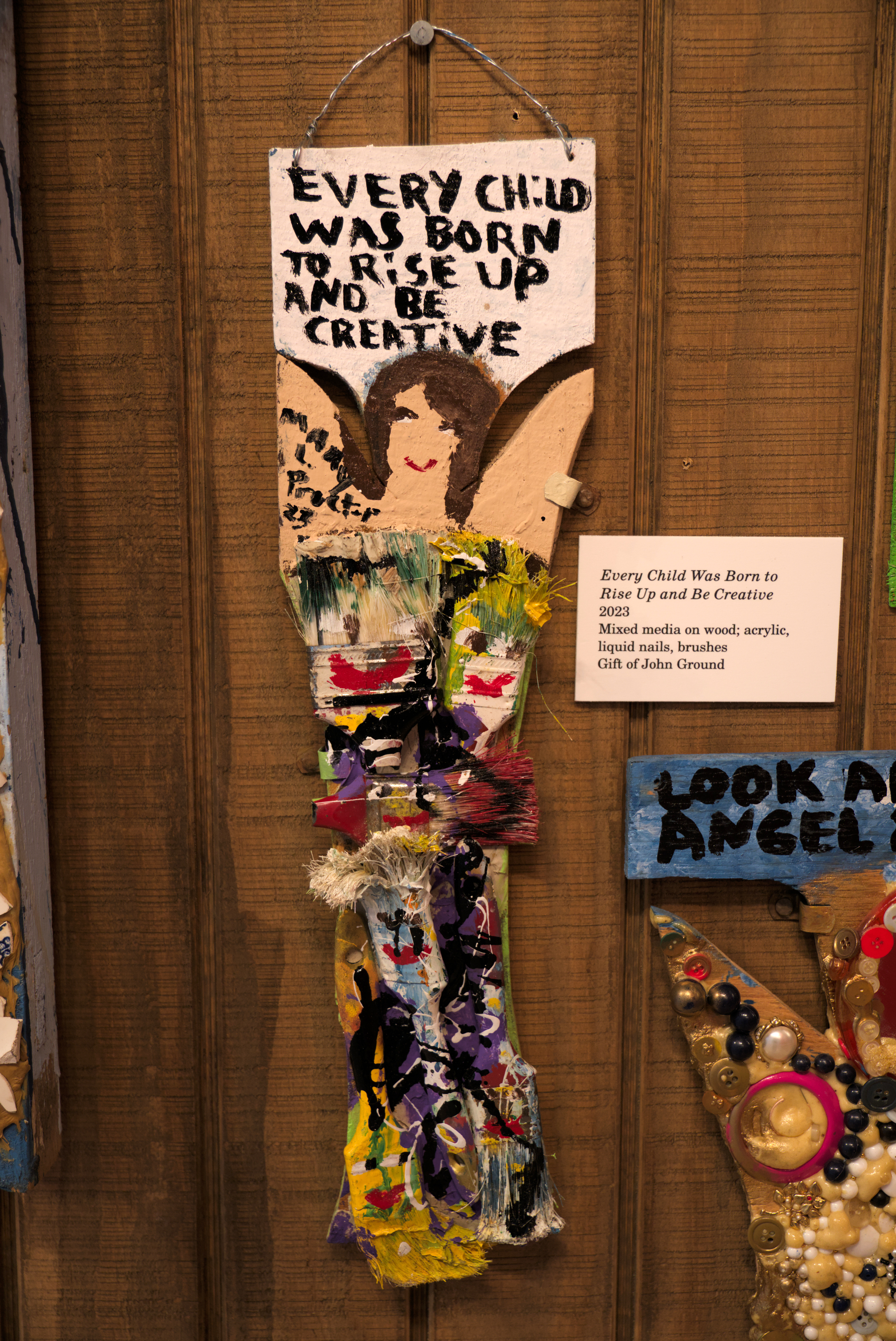
Every Child Was Born to Rise Up and Be Creative
Mary L. Proctor (American, 1960–), Every Child Was Born to Rise Up and Be Creative, 2023. Acrylic, liquid nails, and paintbrushes on wood. American Visionary Art Museum, Baltimore.

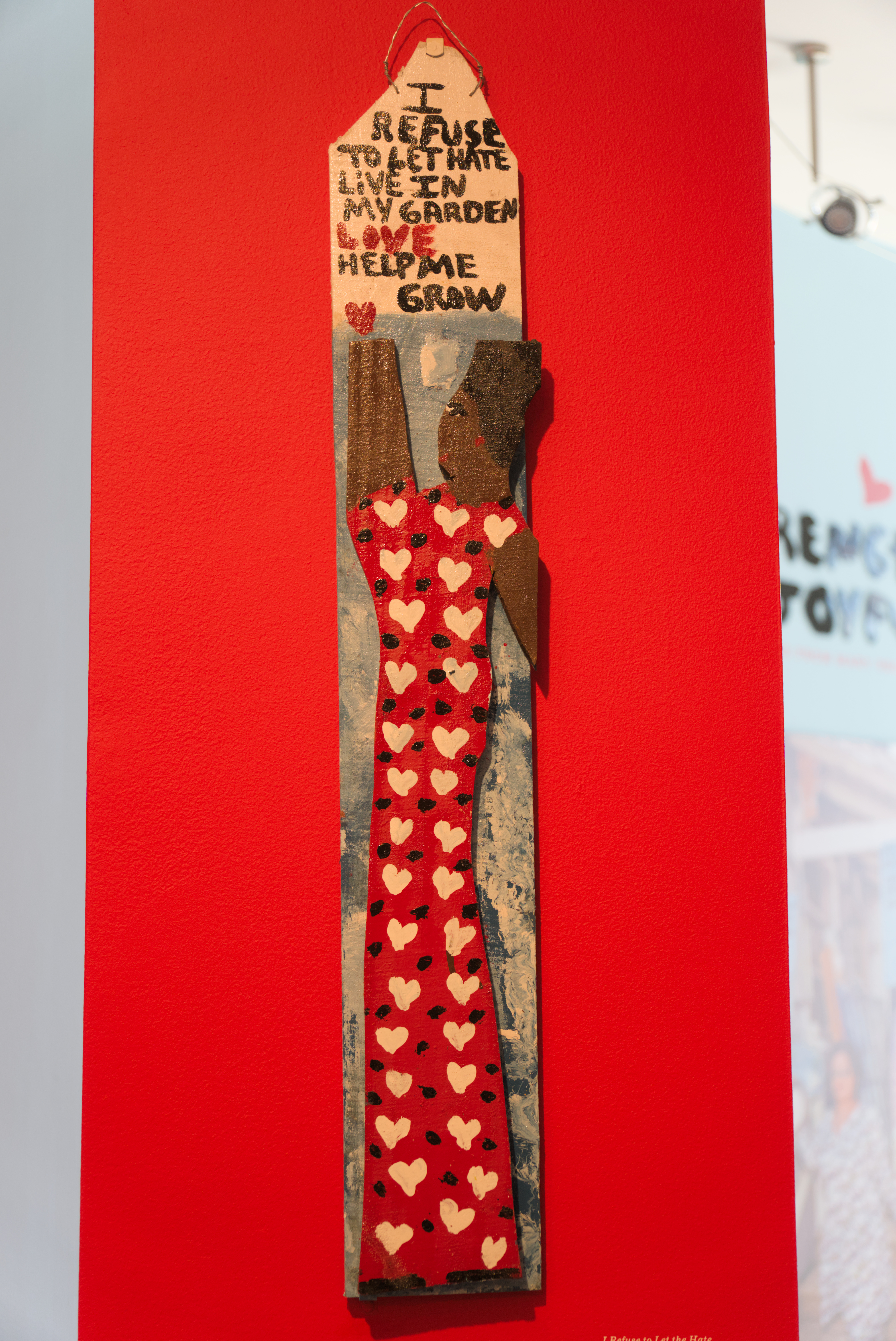
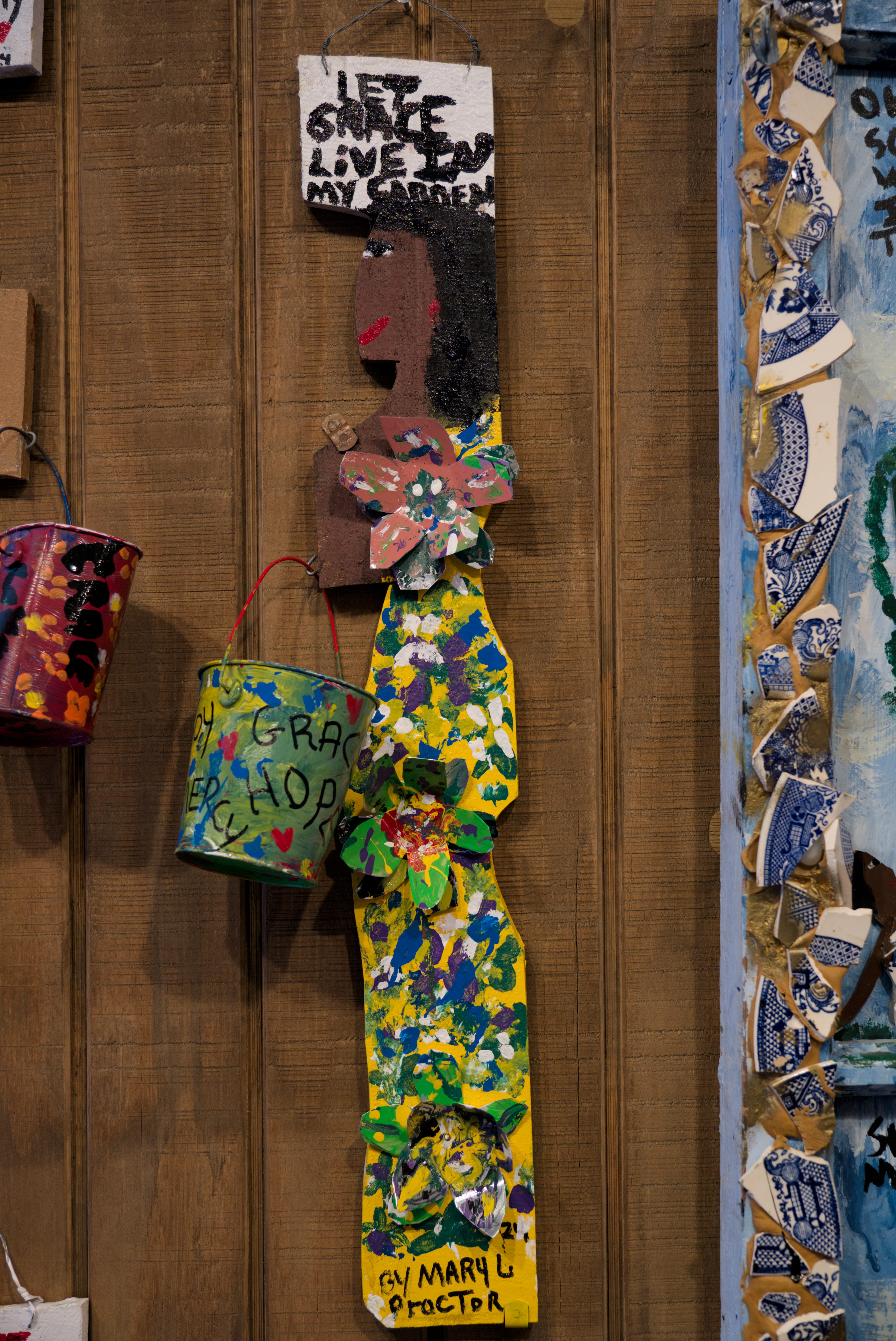
We ought also to cultivate our own selves. Proctor often uses the metaphor—popular in the Middle Ages—of the soul as a garden in which we grow “flowers” of virtue. For example, a series of wood cutouts portrays women holding pails, with signs like “Let love live in my garden” and “Let grace live in my garden.” Another declares and beseeches, “I refuse to let hate live in my garden. Love, help me grow.”
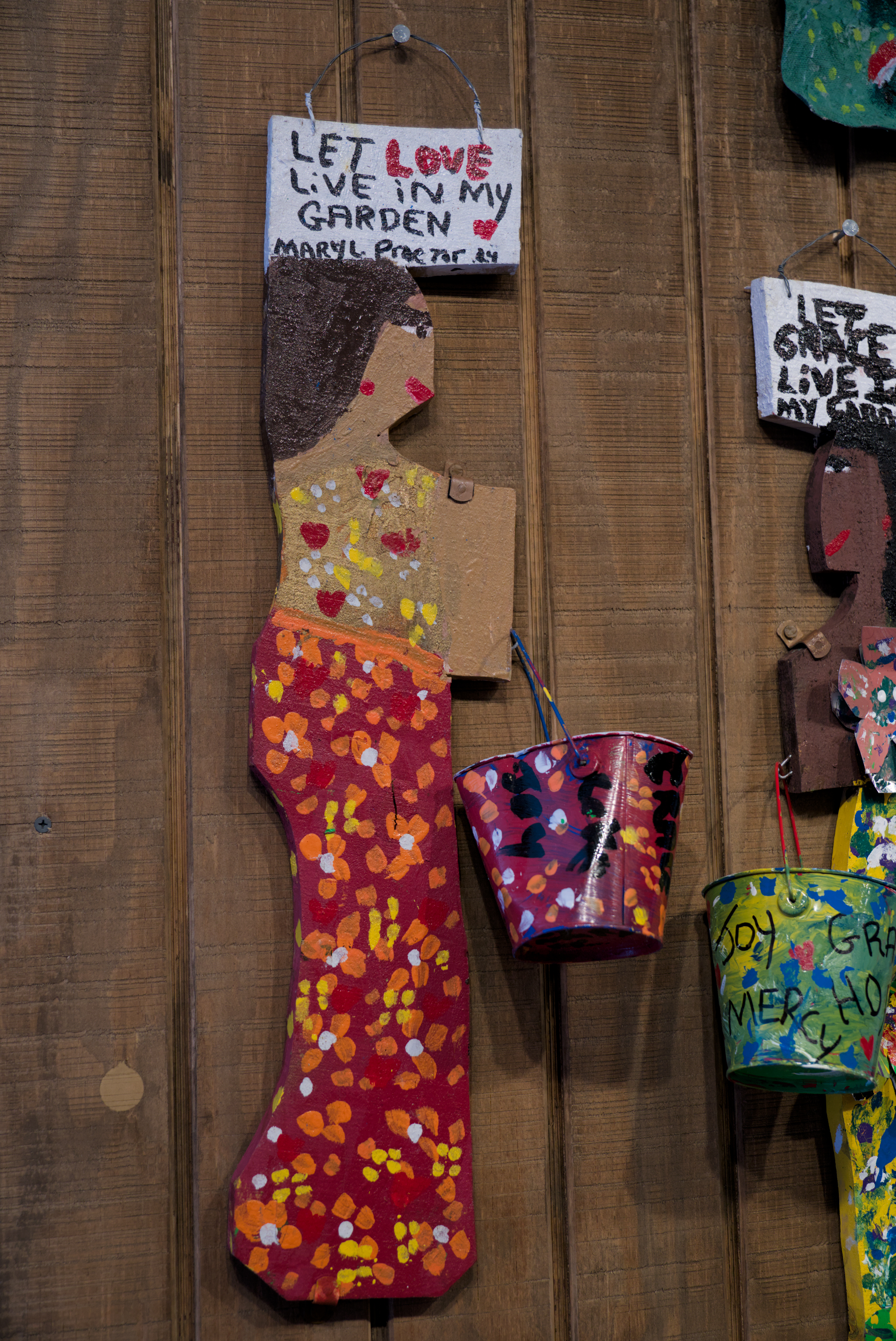
"Let love live in my garden"
"Let grace live in my garden"
I Refuse to Let the Hate Live in My Garden
Mary L. Proctor (American, 1960–), I Refuse to Let the Hate Live in My Garden, 2022. Acrylic on cut wood. American Visionary Art Museum, Baltimore.

Besides vows and petitions, Proctor’s art also contains testimonies. In the Black church, testifying is a sacred tradition of sharing personal stories of survival, deliverance, and praise. Encouragement is a key component. One of Proctor’s painted testimonies reads, “It may seem dark at times, yet I hold on, I know the sun will shine.” She knows God will never forsake her, though he may occasionally seem absent.
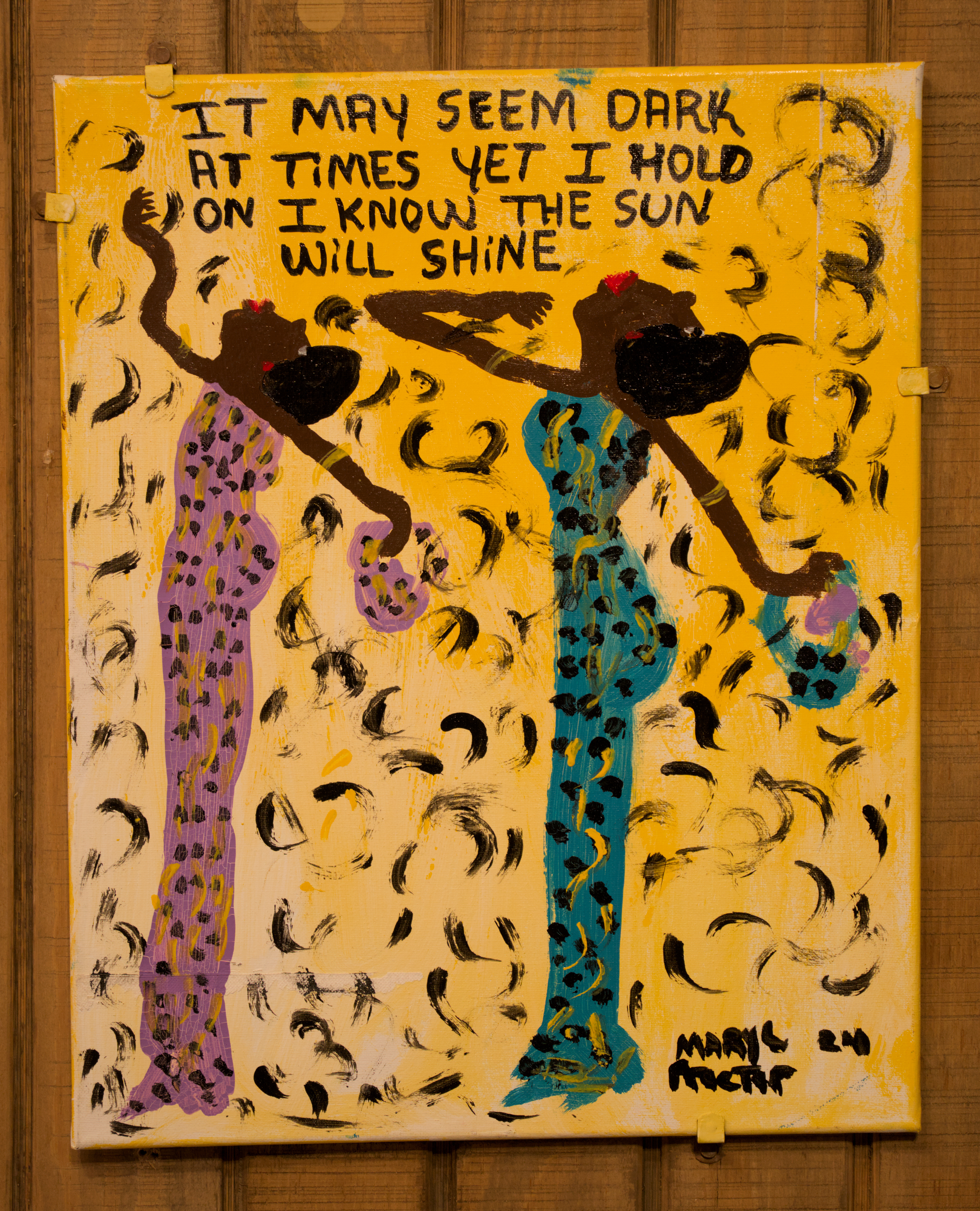
It May Seem Dark at Times

Other paintings by Proctor mark milestones in her spiritual journey, such as her baptism in Lloyd Creek in 1975 at age fifteen. One such painting references the African American spiritual “Down by the Riverside,” its refrain about relinquishing hatred and violence—“Ain’t gonna study war no more”—taken from Isaiah 2:4 and Micah 4:3. Members of her Missionary Baptist church community gather round, dressed in white and golden robes. At the bottom center, two elders raise up Proctor’s arms as she emerges from the baptismal waters, cleansed and reborn.
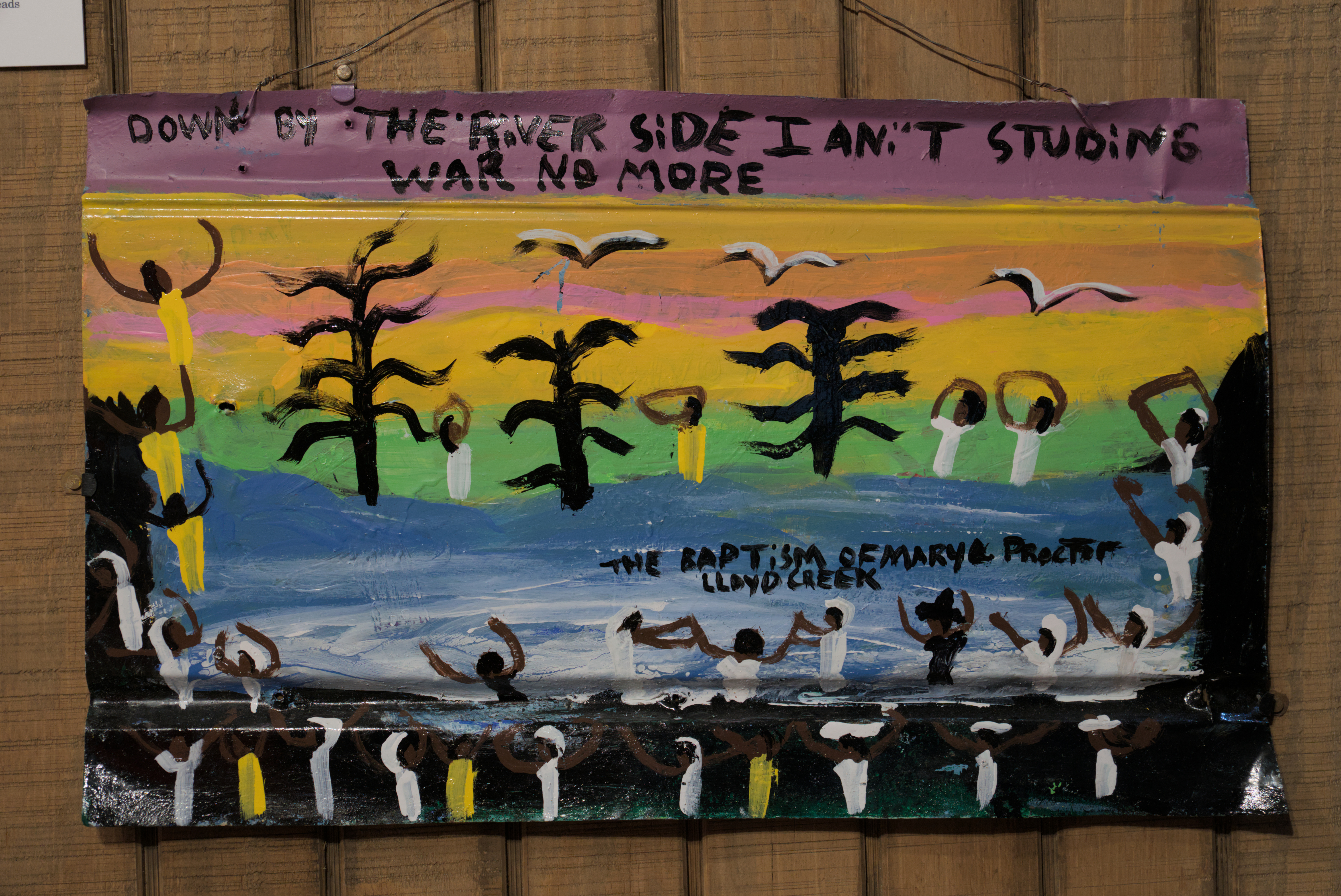
Baptism at Lloyd Creek

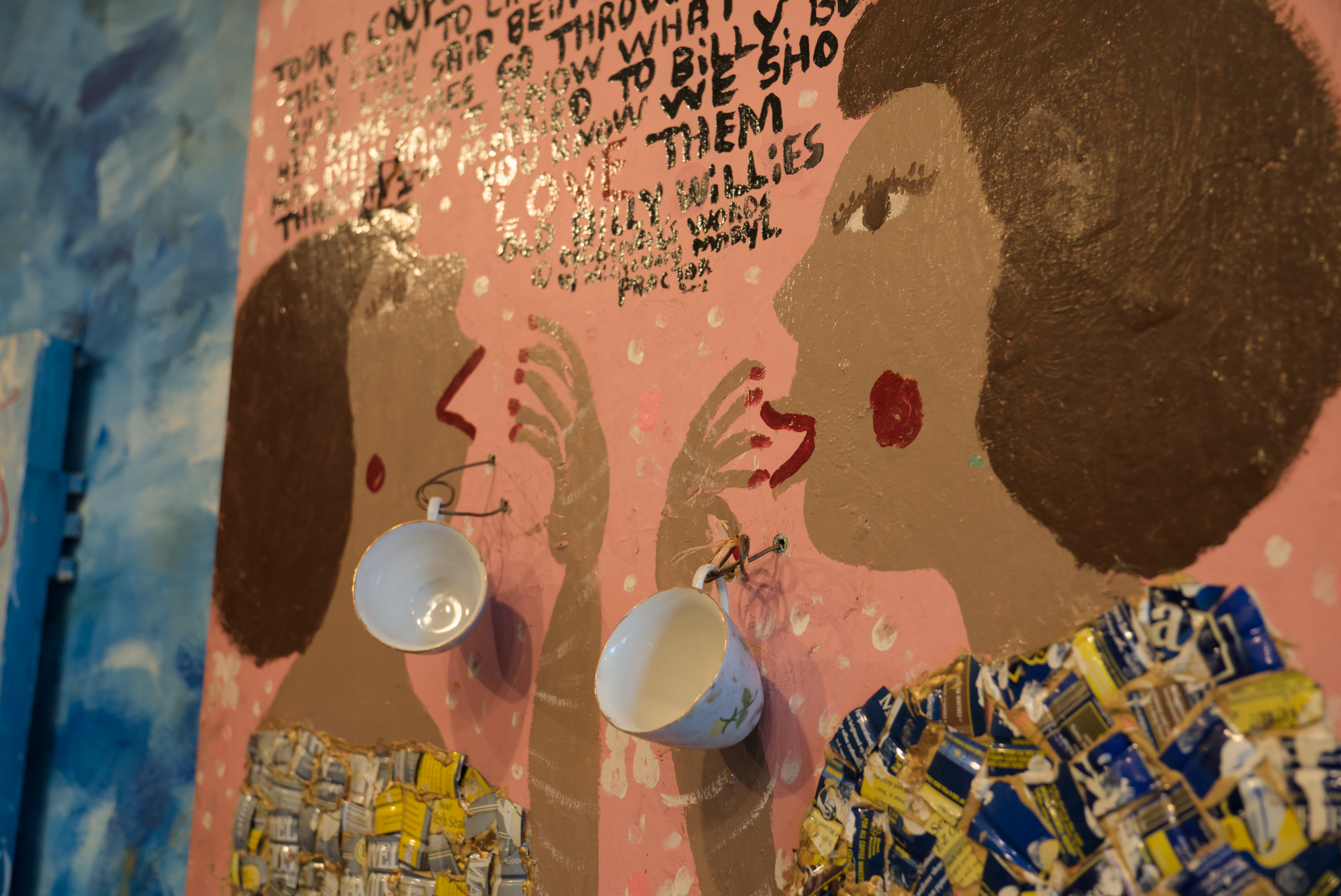
Several pieces highlight Proctor’s whimsical sense of humor. It Ain’t Over Till the Fat Lady Sings God Bless America, a patriotic adaptation of a well-worn idiom, made me laugh. So did the adjacent painting, The Story of the Two Maxwell House Friends Mrs. Lilly and Mrs. Dilly, married to Willie and Billy; the women, Proctor narrates, would meet in Philly, get chilly (and so sip their coffee), and giggle about matters silly. Proctor affixed two teacups to the wood, giving the work three-dimensionality.
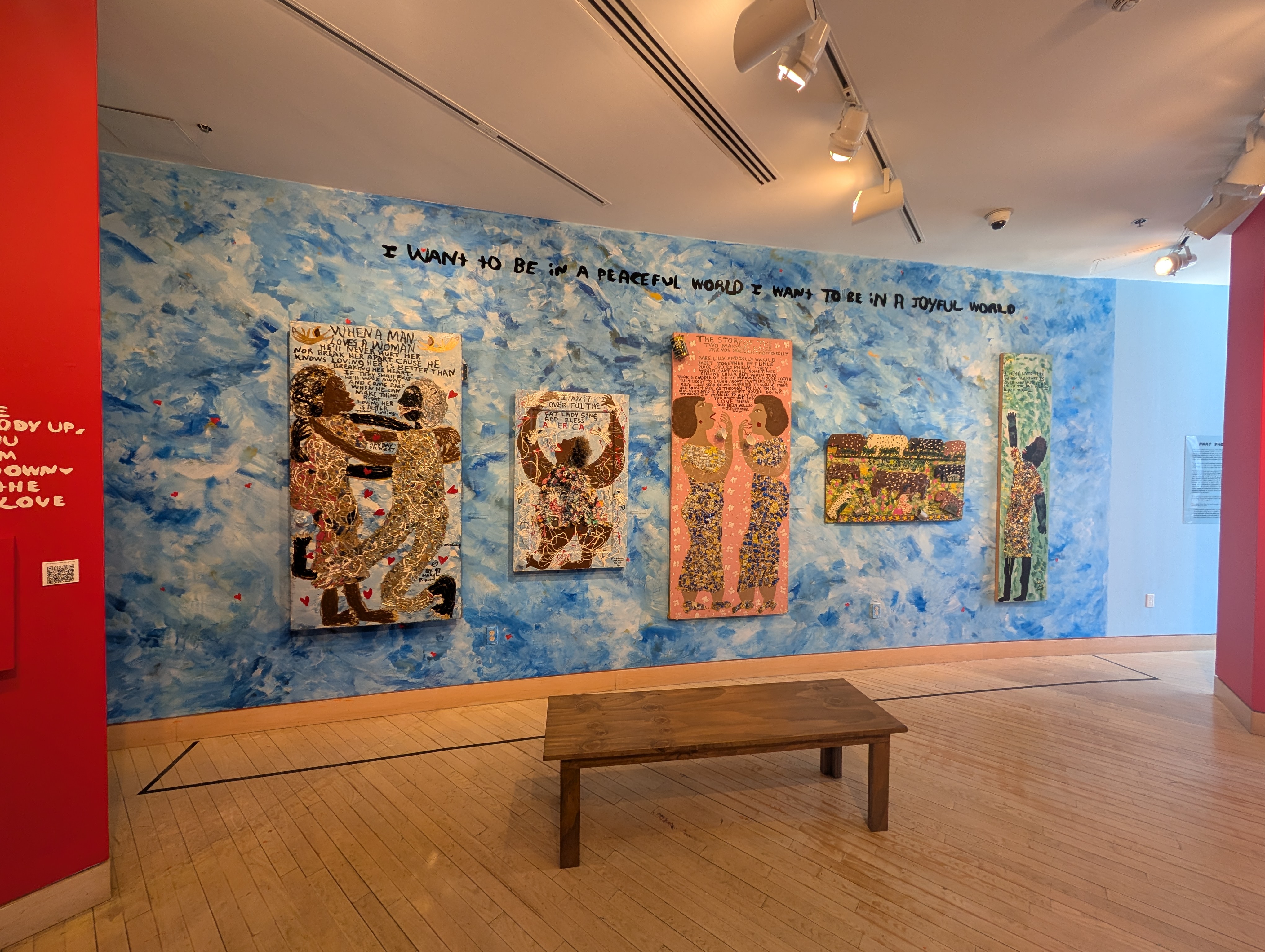
Exhibition view, The Strength to Be Joyful
From left to right: When a Man Loves a Woman, 1997; It Ain’t Over Till the Fat Lady Sings God Bless America, 1996; The Story of Two Maxwell House Friends Mrs. Lilly and Mrs. Dilly, 1996; If the Cows Can Dance in Green Pastures, 2012; I Cry Unto Thee When My Heart Is Overwhelmed, 1995

Mrs. Lilly and Mrs. Dilly (detail)

A sense of delight infuses Proctor’s art. She’s attuned to the beauty of the ordinary, the sacramentality of the everyday. She identifies a spirit of joy and gratitude even in animal life. “Every day I pass the cows,” she writes in one painting. “In the sunshine or rain the cows dance. If the cows can dance in green pastures why can’t we?” Speckled and smiling, her cows bear signs that say “Enjoy life,” “Be content,” “It’s going to be fine.” Cattle are among those named as being part of the cosmic choir of creation in Psalm 148, praising the Lord—Proctor goes even further and imagines them dancing.
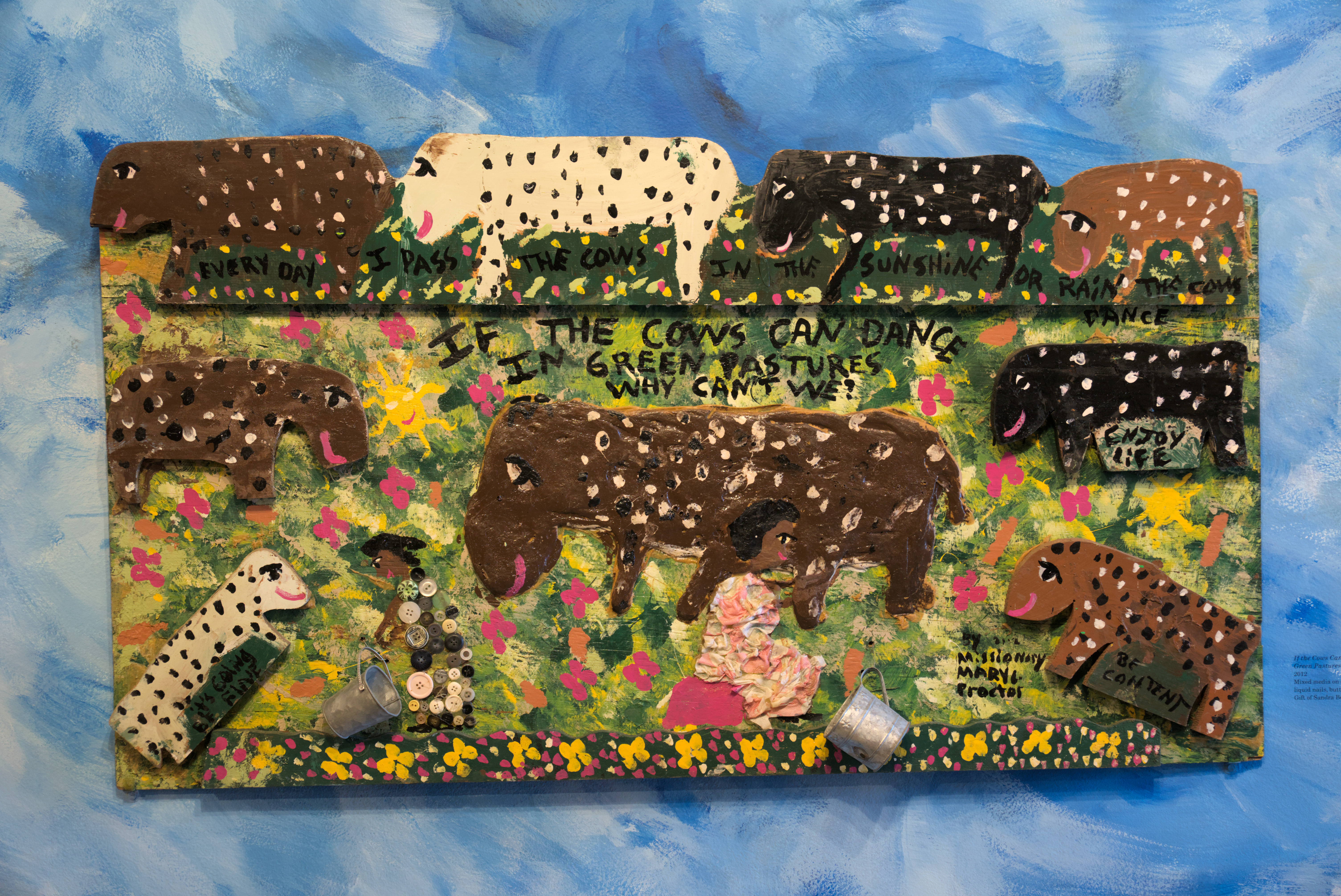
If Cows Can Dance in Green Pastures
Mary L. Proctor (American, 1960–), If the Cows Can Dance in Green Pastures, 2012. Acrylic, house paint, liquid nails, and buttons on door. American Visionary Art Museum, Baltimore.

In the hallway outside the exhibition gallery, it’s a trio of women who dance. The central painting shows Proctor’s signature upward-gazing gal, in a fringed dress, opening her hands to receive divine love, symbolized by the red hearts that angels pass down to earth in one long chain. “It’s the love of God that makes the world go round,” Proctor preaches. “Pass the love from above.”
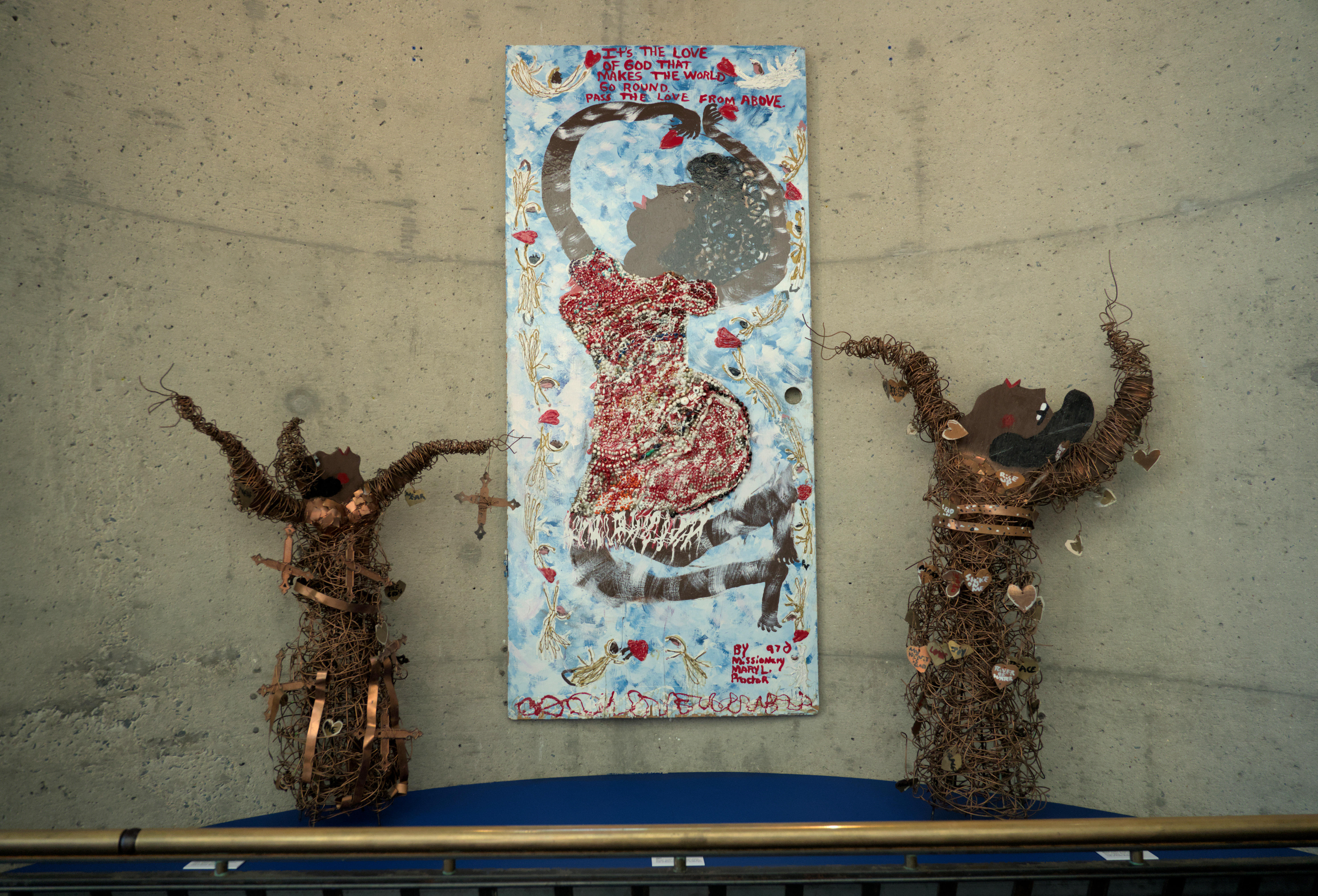
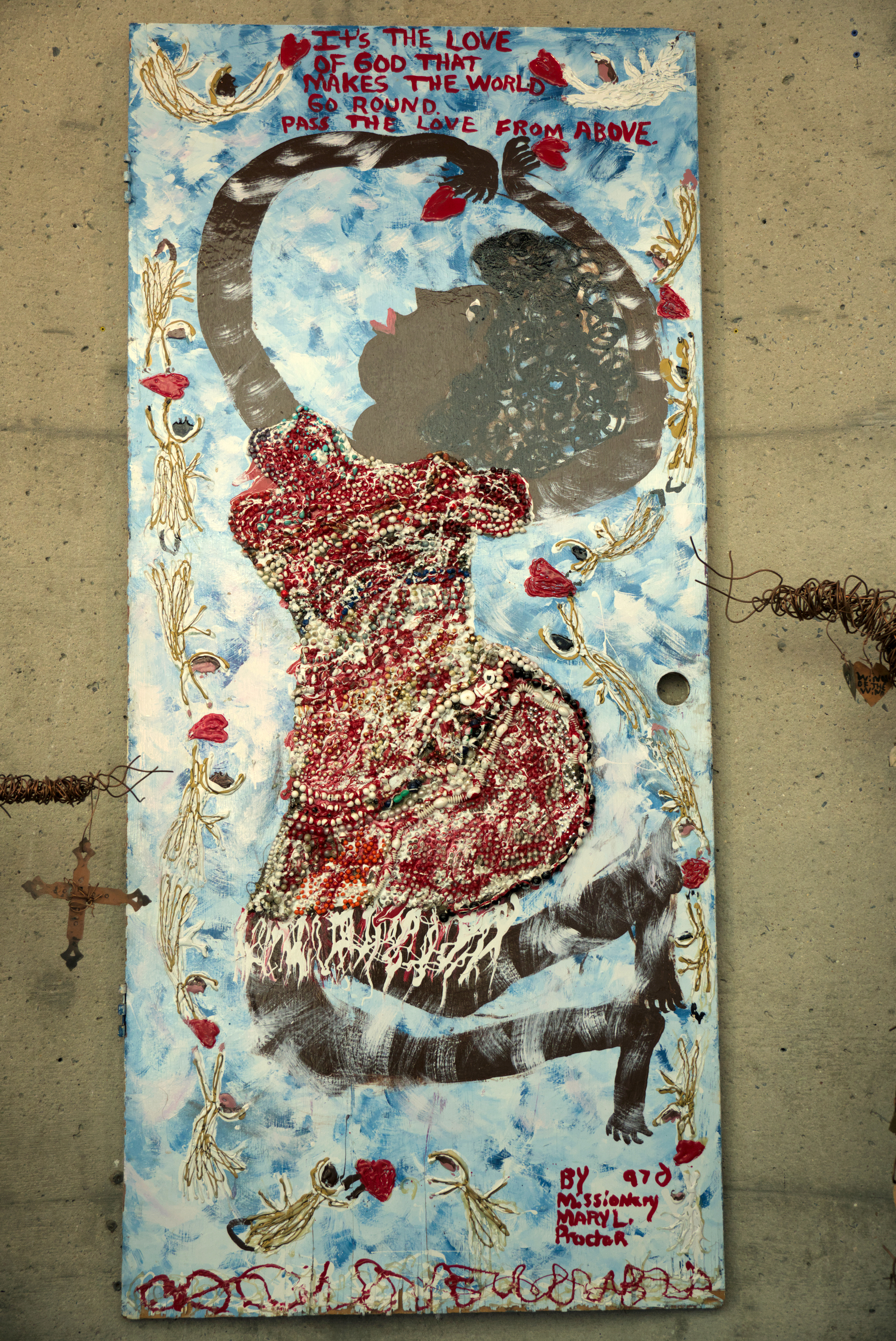
Love Makes the World Go Round
Mary L. Proctor (American, 1960–), Love Makes the World Go Round, 1997. House paint, acrylic, glass, ceramic, beads, and hot glue on wood. American Visionary Art Museum, Baltimore.

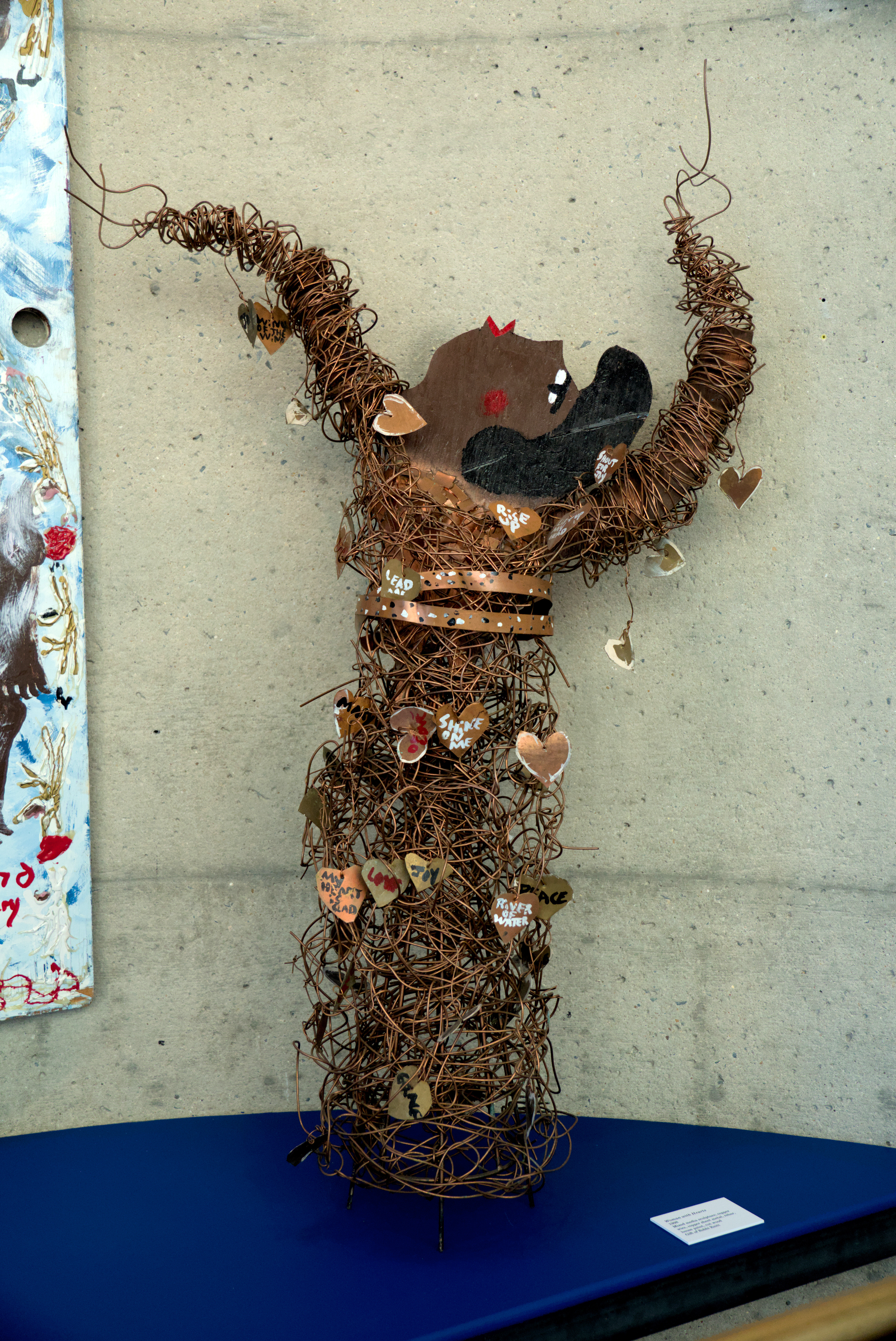
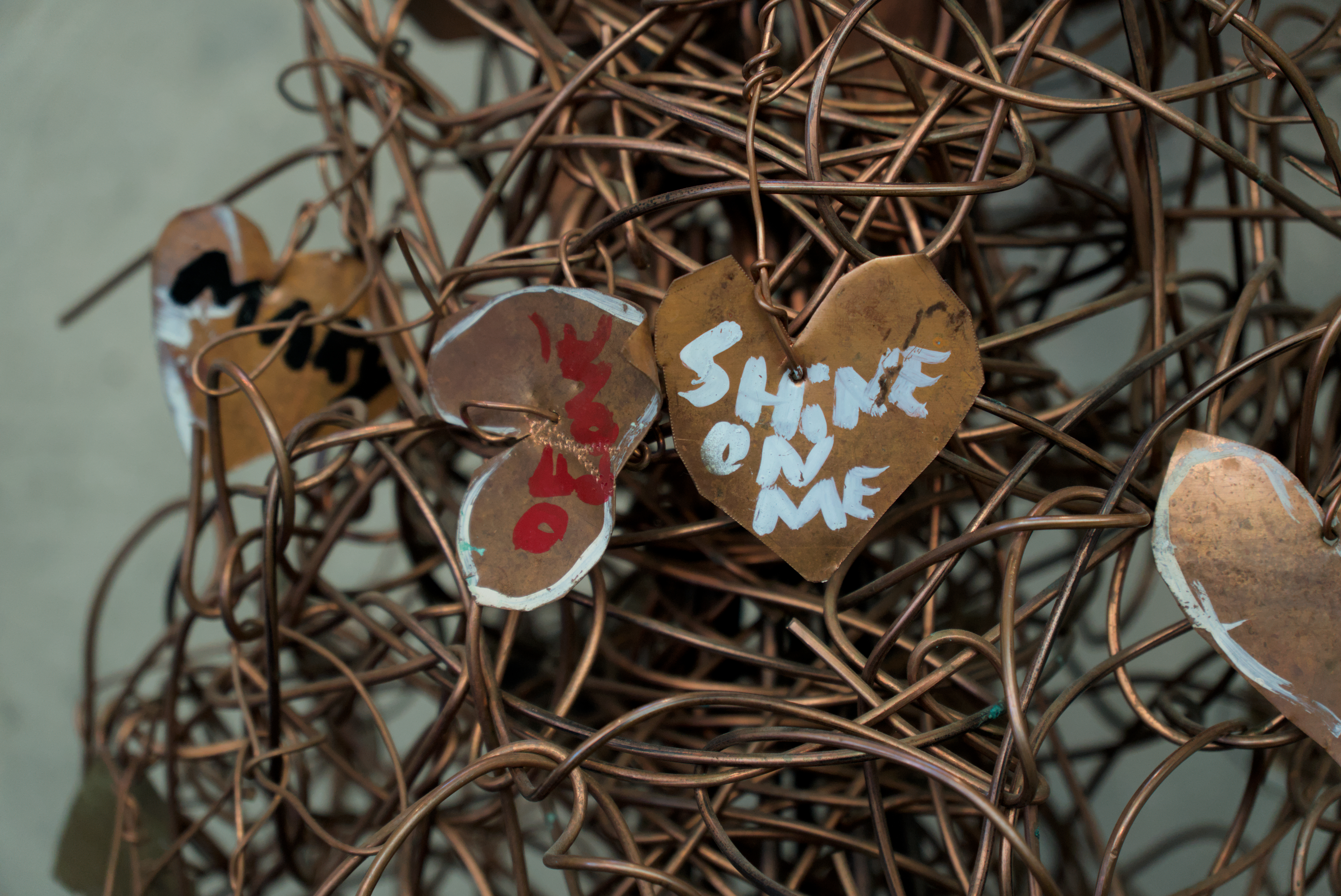
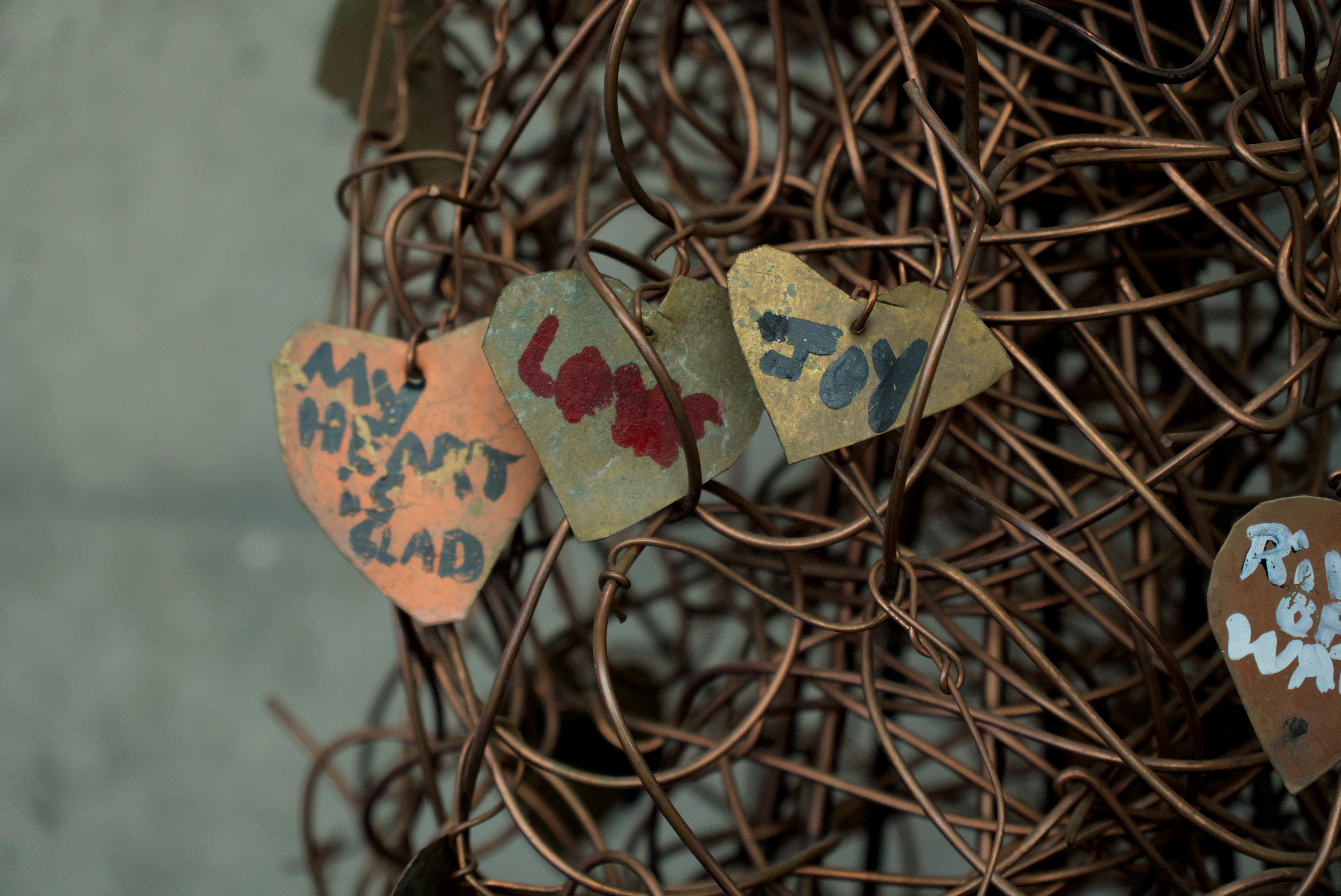
Flanking this painting are two wire sculptures of worshipping women who wear crosses and heart-shaped bangles inscribed with “Near the Cross” (the title of a popular hymn by Fanny Crosby) and psalmic phrases such as “Shout for joy,” “Rise up,” “Lead me,” “Shine on me,” and “My heart is glad.”
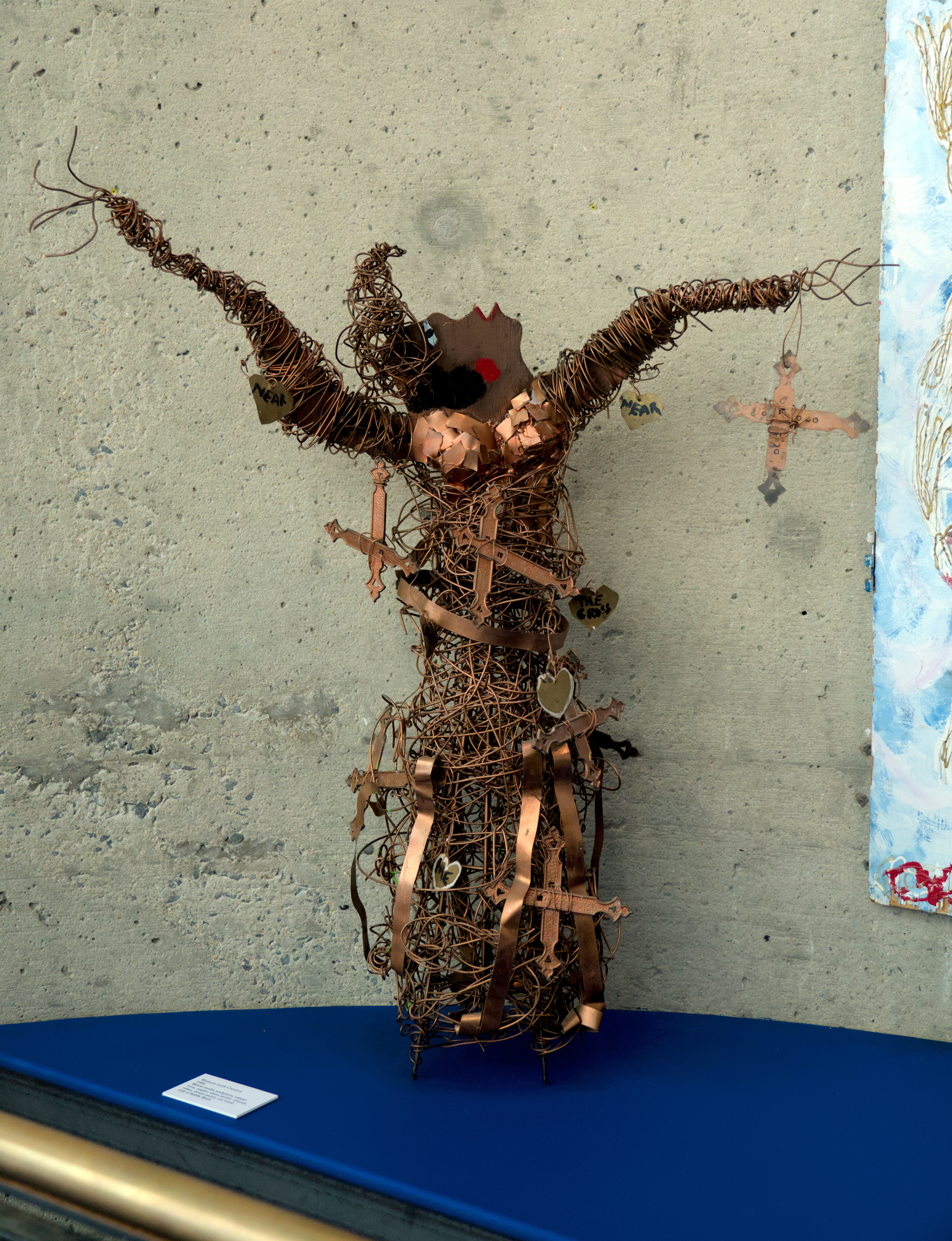
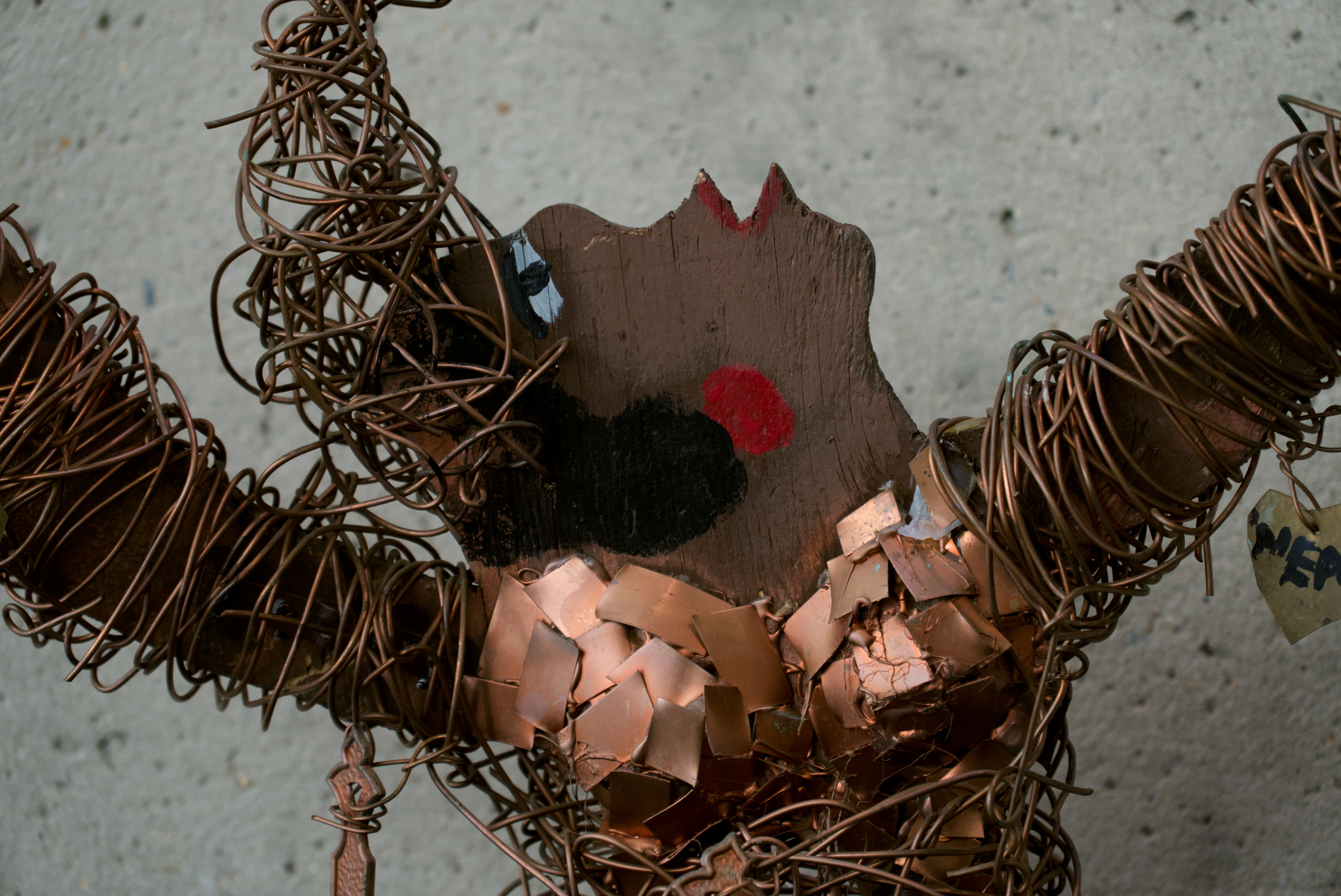
Woman with Crosses
Mary L. Proctor (American, 1960–), Woman with Crosses, 1998. Copper wire, copper sheet metal, crosses, rebar, house paint, and cut wood. American Visionary Art Museum, Baltimore.

Woman with Crosses (detail)
Woman with Hearts
Mary L. Proctor (American, 1960–), Woman with Hearts, 1998. Copper wire, copper sheet metal, rebar, house paint, and cut wood. American Visionary Art Museum, Baltimore.

Woman with Hearts (detail)

Proctor acknowledges that some may look at her art and see only messy pictures or rubbish. But paraphrasing the apostle Paul (1 Cor. 1:26–31), she says God uses foolish things—like scrap wood or twisted wire decorated with cheap paint and baubles—to confound the wise.

Shortly after getting married, Proctor moved to Tallahassee with her husband Tyrone, where they raised three sons and a daughter. They now live back in Lloyd but operate a small gallery in Tallahassee proper, where they sell Proctor’s work. Follow them on Instagram @marysvisions or on Facebook.

The Strength to Be Joyful: Messages from Mary Proctor runs through August 2, 2027, at the American Visionary Art Museum in Baltimore. Admission to the museum is $20.


Don’t miss two more works by Mary Proctor that are on display in the third-floor café, each titled Music Heals the Body, Mind, and Soul. Made of mixed media on wood, they show a man with a guitar and a singing, dancing woman, and scattered across the backgrounds are sheet music fragments from a Christian hymnal.
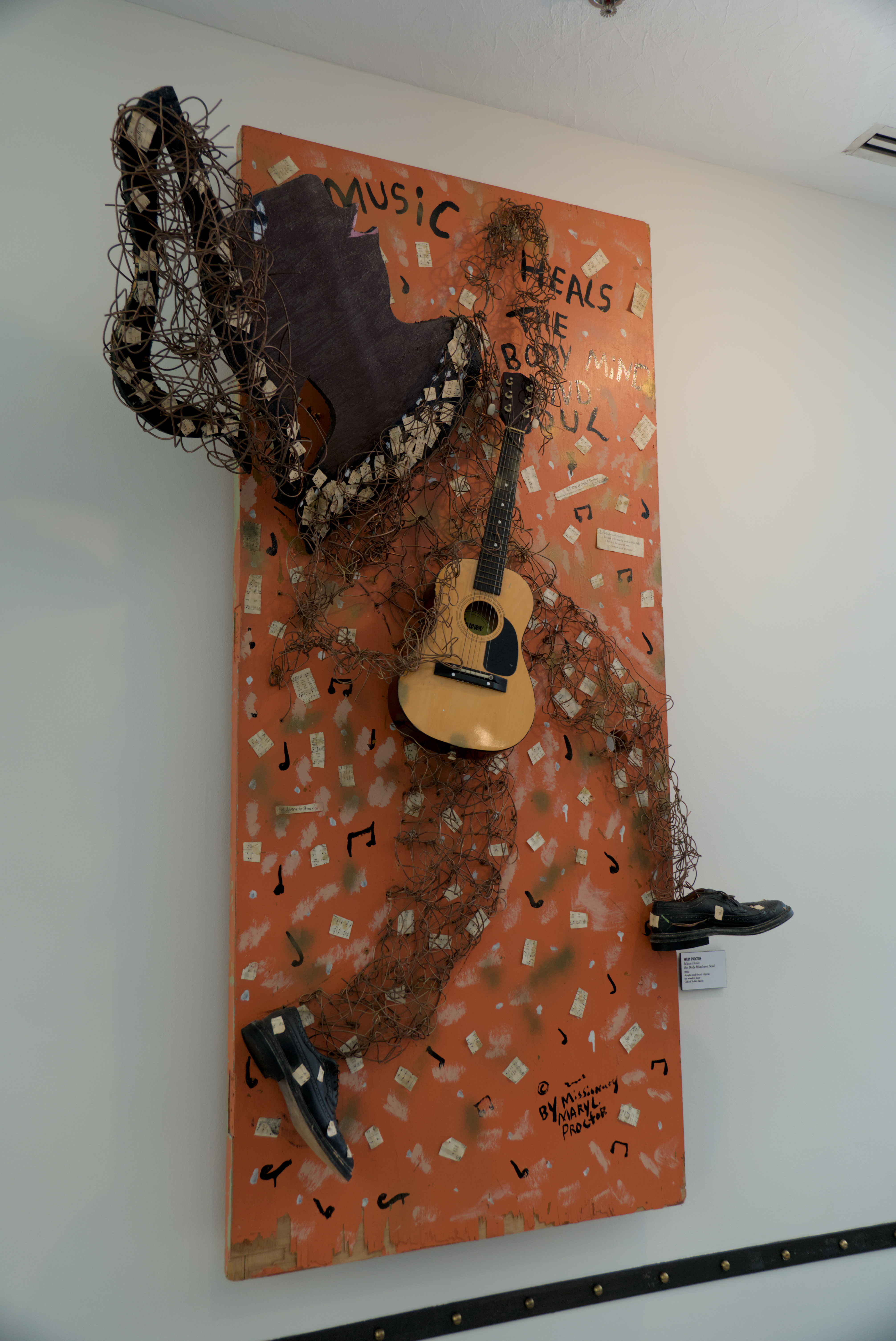
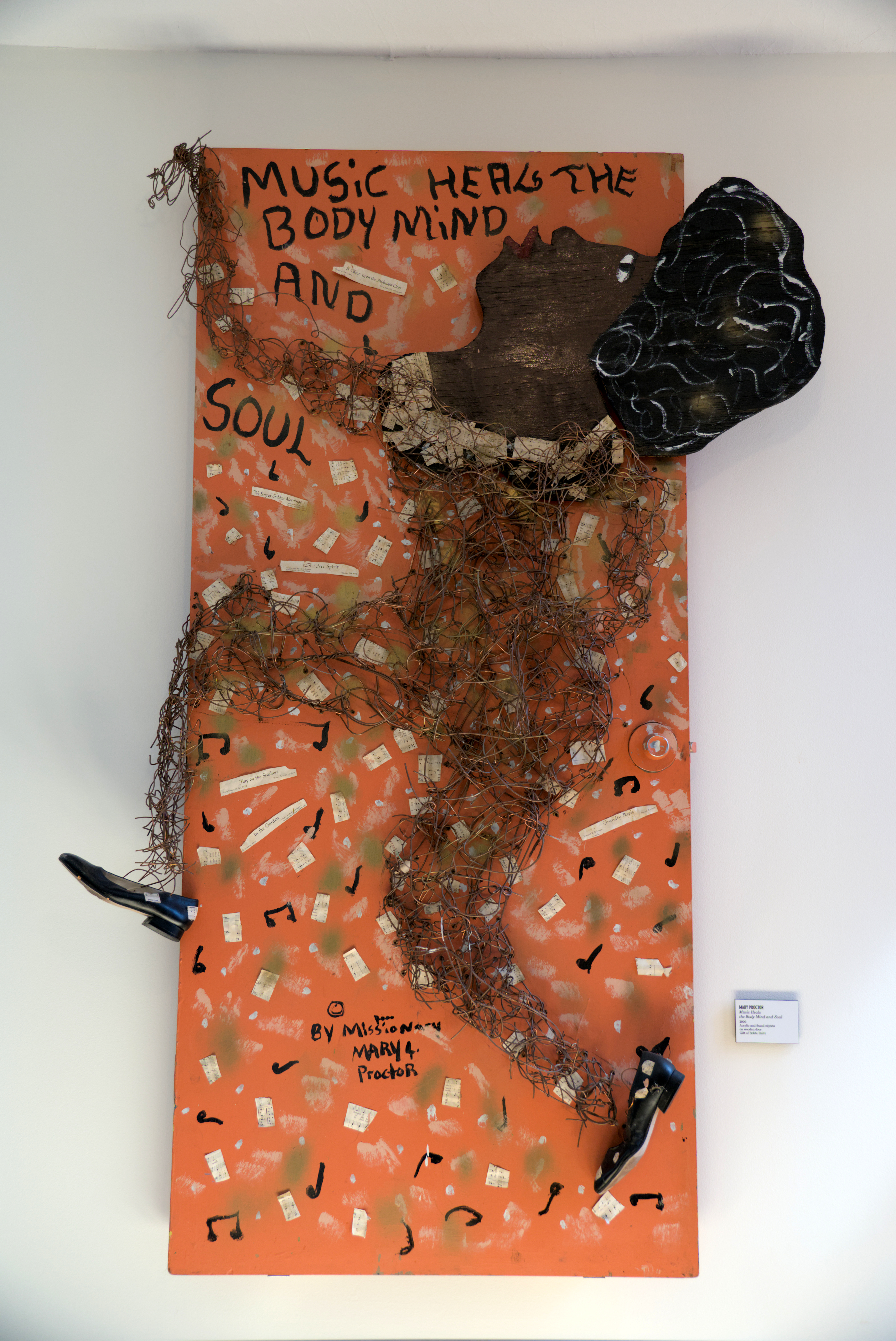
Music Heals the Body, Mind, and Soul
Mary L. Proctor (American, 1960–), Music Heals the Body, Mind, and Soul, 2000. Acrylic and found objects on wooden door. American Visionary Art Museum, Baltimore.

Music Heals the Body, Mind, and Soul
Mary L. Proctor (American, 1960–), Music Heals the Body, Mind, and Soul, 2000. Acrylic and found objects on wooden door. American Visionary Art Museum, Baltimore.


If you download the Bloomberg Connects mobile app and search “AVAM,” then select “The Strength to Be Joyful,” you can access seven audio interviews with artist Mary Proctor (transcripts included), which are tied to different displays in the exhibition. The exhibition also runs a video interview on loop.

But also, here’s a 2003 news segment shot with Proctor in the “art yard” outside her house:

And a more recent interview clip, from 2022, of Proctor talking about her grandmother’s importance in her life:

Favorite Films of 2022, Part 2

Read part 1 here.

11. After Yang, dir. Kogonada. Set in the near future, After Yang is a patiently minimalist, transcendent film about learning to treasure those moments of mundane beauty that make up our lives. When Jake (Colin Farrell) and Kyra (Jodie Turner-Smith) adopt their daughter Mika (Malea Emma Tjandrawidjaja) from China, they purchase a preowned “technosapien,” a humanoid robot, named Yang (Justin H. Ming) to educate her about her cultural roots and to be an older sibling to her. But one day Yang malfunctions and shuts down, and Mika is devastated.

When Yang is opened up at the repair shop to be diagnosed, Jake discovers Yang’s memory bank, where Yang stored all the memories he thought important. He unlocks it. By viewing the world, especially his family life, as processed by Yang, Jake realizes he has failed to engage meaningfully with the small daily gifts he has been given. He also becomes aware of more of Yang’s history—of his previous families and loves.

Streaming on Showtime.

12. Petite Maman, dir. Céline Sciamma. In this poignant French drama, eight-year-old Nelly (Joséphine Sanz) accompanies her parents (Nina Meurisse and Stéphane Varupenne) on a trip to clear out her mother’s childhood home following her grandmother’s death. As she explores the nearby woods, she meets a neighbor girl her own age (Gabrielle Sanz), and the two strike up a bond. There’s a fantasy element I won’t reveal—it’s better to let the movie unfold it for you—but suffice it to say, I love the imaginative way that writer-director Céline Sciamma tells this mother-daughter tale of grief and loss.

Streaming on Hulu.

13. The Wonder, dir. Sebastián Lelio. Inspired by the nineteenth-century phenomenon of the “fasting girls” and based on Emma Donoghue’s celebrated novel of the same name, this psychological drama is set in a rural Irish Catholic community in 1862. Eleven-year-old Anna O’Donnell (Kíla Lord Cassidy) has allegedly not eaten anything for four months but has been miraculously sustained by “manna from heaven.” As pilgrims begin flocking to witness the miracle and rumors swirl about possible sainthood, a council of local dignitaries initiates an investigation to determine whether Anna’s survival without food is indeed a holy feat, or a hoax perpetrated by Anna and her family.

The council hires Lib Wright (Florence Pugh)—a scientifically minded English nurse—and a nun to independently observe Anna over two weeks in alternating eight-hour shifts and to report back. Lib grows increasingly concerned for Anna’s health and safety, and when Anna reveals to her the reason for her fast, she knows she must act drastically.

Streaming on Netflix.

14. Apollo 10½: A Space Age Adventure, dir. Richard Linklater. Apollo 10½ is writer-director Richard Linklater’s nostalgic homage to growing up in a Houston suburb in the 1960s, the youngest of six. This was during the Space Race, and Linklater uses that context to interweave real childhood memories with his childhood fantasy of being an astronaut. So in a tongue-in-cheek revision of history, he has NASA recruit fourth-grader Stan (Milo Coy) to fly a secret mission to the moon to test out a landing module shortly before Apollo 11 goes up. The film uses an animation technique known as rotoscoping, which layers animation over live performances.

While I can appreciate the blend of dream and reality, I was much more interested in the real-life portions of the movie, which are substantial, than the revisionist space stuff. Playing kickball on the school blacktop, getting disciplined, eating Frito pies at the pool, watching cheesy TV shows with family, listening to the Monkees and the Archies and the 5th Dimension, riding to the beach in the bed of a pickup truck, braving the Black Dragon at AstroWorld, fighting Roman candle wars in the backyard on New Year’s Eve, competing in Little League, stealing plywood from home construction sites with his cheapskate father, listening to Grandma’s conspiracy theories—ordinary memories like these are narrated with such fondness by adult Stan (voiced by Jack Black) and so meticulously rendered, and it’s here where the movie really shines. If you like The Wonder Years, you’ll like this.

Streaming on Netflix.

15. Decision to Leave, dir. Park Chan-wook. A slow-burn crime drama with a heavy dose of romance, this film follows the married police detective Hae-joon (Park Hae-il), who, when investigating the death of a mountain-climber, becomes infatuated with the prime murder suspect, the climber’s widow, Seo-rae (Wei Tang). In an interview, the director said his goal was “to make a love story that does not say the words, ‘I love you.’” The film is all about what’s not said, what’s observed. For much of the movie we question whether Seo-rae is manipulating Hae-joon or is actually falling for him too.

I have to admit, I didn’t like either of the characters; I struggled to understand them or to be invested in their “love” story, which to me seems more like simply lust or intrigue. Seo-rae’s inscrutability is, I think, part of the point; she is a mystery to be solved, as much as the murders happening around her. And attraction is rarely rational, I suppose. (But c’mon, Hae-joon, you’ve got a loving wife back home!) Despite my failure to connect with it on all levels, this is a beautifully shot, craftily edited, engrossing film with a sustained, understated sensuality that is to be commended.

Streaming on MUBI.

16. God’s Creatures, dir. Saela Davis and Anna Rose Holmer. Aileen (Emily Watson) works as a shift manager at a seafood processing plant, alongside most of the other local women, in a remote Irish fishing village. When one of her coworkers, Sarah (Aisling Franciosi), files a rape claim against her son, Brian (Paul Mescal), Aileen fabricates an alibi to protect him. Is she incredulous that he could be capable of sexual assault, or is her denial more sinister? Atmospheric and tense, the film centers on Aileen’s psychological grappling with the limits of maternal love and her duty to what’s right and just.

17. Elvis, dir. Baz Luhrmann. Frenetic and flashy, this music biopic traces the meteoric rise and fall of rock and roll’s biggest legend, Elvis Presley (Austin Butler). The story is narrated by Elvis’s exploitative manager, Colonel Tom Parker (Tom Hanks), and examines their complex, twenty-plus-year relationship. Butler is amazing in the role, embodying Elvis’s energy and sex appeal while also showing his emotional vulnerability.

I appreciate how the movie shows the influence of Black artists on Elvis’s music, even dispelling the myth that he was the founder of rock and roll—a credit that he himself, in multiple interviews, rejected, instead crediting his Black predecessors. Elvis grew up in a Black neighborhood in Tupelo, Mississippi, and when he moved to Memphis as a teenager, he frequented Beale Street, a hub of African American culture. From these environments he absorbed the sounds of Pentecostal gospel and rhythm and blues.

Elvis features stunning performances by historical Black characters. An early scene intercuts bluesman Arthur Crudup (Gary Clark Jr.) performing his original song “That’s All Right” in a juke joint—which would become Elvis’s first single—with “I’ll Fly Away” sung by a Black congregation at a tent revival; preteen Elvis observes one through a hole in the wall and participates, Spirit-caught, in the other. As a young aspiring recording artist, prior to mounting the Louisiana Hayride stage, his first big premiere, he pumps himself up by singing “I’ll Fly Away.”

Later, Elvis hears Big Mama Thornton (Shonka Dukureh) perform the raunchy “Hound Dog” (written for her by a Jewish songwriting duo, Jerry Leiber and Mike Stoller) in a bar on Beale Street, which is then sampled and interpolated in a song by Doja Cat commissioned for the movie. At Club Handy, Elvis hangs out with his friend B.B. King (Kelvin Harrison Jr.) and is blown away by the vitality and genius of the young Little Richard (Alton Mason), who performs his original and then-unknown “Tutti Frutti” for the crowd; the conversation Elvis has about it with King, and what King says and doesn’t say, speaks volumes. As people shuffle out for the night, the pioneering rock singer-guitarist Sister Rosetta Tharpe (Yola) sings “Working on the Building” and “Strange Things Happening Every Day.”

All these and more were part of Elvis’s music education. They came before. His use of Black source material has always been controversial, deemed “cultural appropriation” (i.e., theft) by some. He profited greatly from the creative contributions of Black women and men, many of whom failed to attain proper recognition and compensation for their work. They lacked the platform and the acceptance across racial lines, whereas Elvis’s whiteness opened doors for him. And so he brought rock and roll—developed in Black churches, juke joints, streets, and nightclubs—to the masses. For sure, he added his own stamp, synthesized it with other influences, and was a majorly talented performer in his own right. Elvis celebrates the title character’s inventiveness but also recognizes his indebtedness to Black musicians. It’s not a central concern of the movie, but it is present. More central is, as one might expect of the genre, the toll of fame.

Streaming on HBO Max.

18. Nope, dir. Jordan Peele. In this neo-western sci-fi thriller, OJ (Daniel Kaluuya) and his sister, Em (Keke Palmer), own a family ranch in California, where they train and handle horses for television and film productions. But their business is struggling, and to keep it afloat they sell some horses to Jupe (Steven Yeun), a former child actor who operates a nearby theme park that capitalizes on his surviving an infamous violent attack on the set of a nineties sitcom. (Best opening scene of the year?) Then their ranch becomes a site of abduction—a UFO takes some of their horses. They attempt to capture video evidence with the help of tech salesman Angel Torres (Brandon Perea) and documentarian Antlers Holst (Michael Wincott). The film’s epigraph is a quotation of Nahum 3:6, a pronouncement of divine judgment: “I will cast abominable filth upon you, make you vile, and make you a spectacle.”

Nope is not as concise as Peele’s other two films, Get Out and Us; I couldn’t follow all the threads. But surely a major thread is an indictment of our voracious need for spectacle. Another is the traumas that the film industry can inflict on people. Another, or maybe a subset of the previous, is the erasure of Black cowboys from our stories of the American West. Nope pokes and prods at these issues and raises questions rather than providing answers. For example, there’s a tension here between the magic of spectacle and its insidiousness. Peele participates in what he condemns. As film critic Thomas Flight articulates, “Nope is a spectacular horror film about the danger of spectacle. It’s a big-budget Hollywood film that critiques the Hollywood industry. It’s not a movie that can draw a clear resolution to those dualities. Instead, it’s a film that explores the queasiness that arises when we’re not sure if something’s good or bad but we find ourselves in the midst of it.”

Entertaining; suspenseful; riveting sound design by Johnnie Burn; and an infectious performance by Palmer as the charismatic Emerald, her live-wire personality a perfect foil to the taciturn OJ’s.

19. Cha Cha Real Smooth, dir. Cooper Raiff. Andrew (Cooper Raiff), a Gen Zer, is a recent college grad who lives with his mom, stepdad, and younger brother and works as a party starter at bar mitzvahs. At one he meets Domino (Dakota Johnson) and her daughter, Lola (Vanessa Burghardt), who has autism, and strikes up a friendship. This movie is sweet and slight, and it takes a few missteps, but I enjoyed it a lot.

I find Raiff’s onscreen persona—essentially the same one he adopted in his debut feature, which I also really liked—charming, though I know others find it insufferable! Andrew is vulnerable, quippy, awkward. He loves his mom. He cries openly. He lacks direction. He seeks connection. He’s trying to figure life out, and growth comes slowly. He’s someone I recognize and have empathy for.

Streaming on Apple TV+.

20. Causeway, dir. Lila Neugebauer. This quiet drama follows the physical and emotional recovery of Lynsey (Jennifer Lawrence), a US military veteran who returns home to New Orleans after suffering a traumatic brain injury serving in Afghanistan. In the process, she develops a friendship with her auto mechanic, James (Brian Tyree Henry), who bears his own wounds from a tragic event—some visible, some not. The two help each other work through the lingering effects of their traumas and move closer to wholeness. Their gentle, easy vibe with one another is really beautiful to witness.

Streaming on Apple TV+.

HONORABLE MENTIONS: Sr.; Hustle; Marcel the Shell with Shoes On; The Sea Beast