
He was oppressed, and he was afflicted,
yet he did not open his mouth;
like a lamb that is led to the slaughter
and like a sheep that before its shearers is silent,
so he did not open his mouth.—Isaiah 53:7
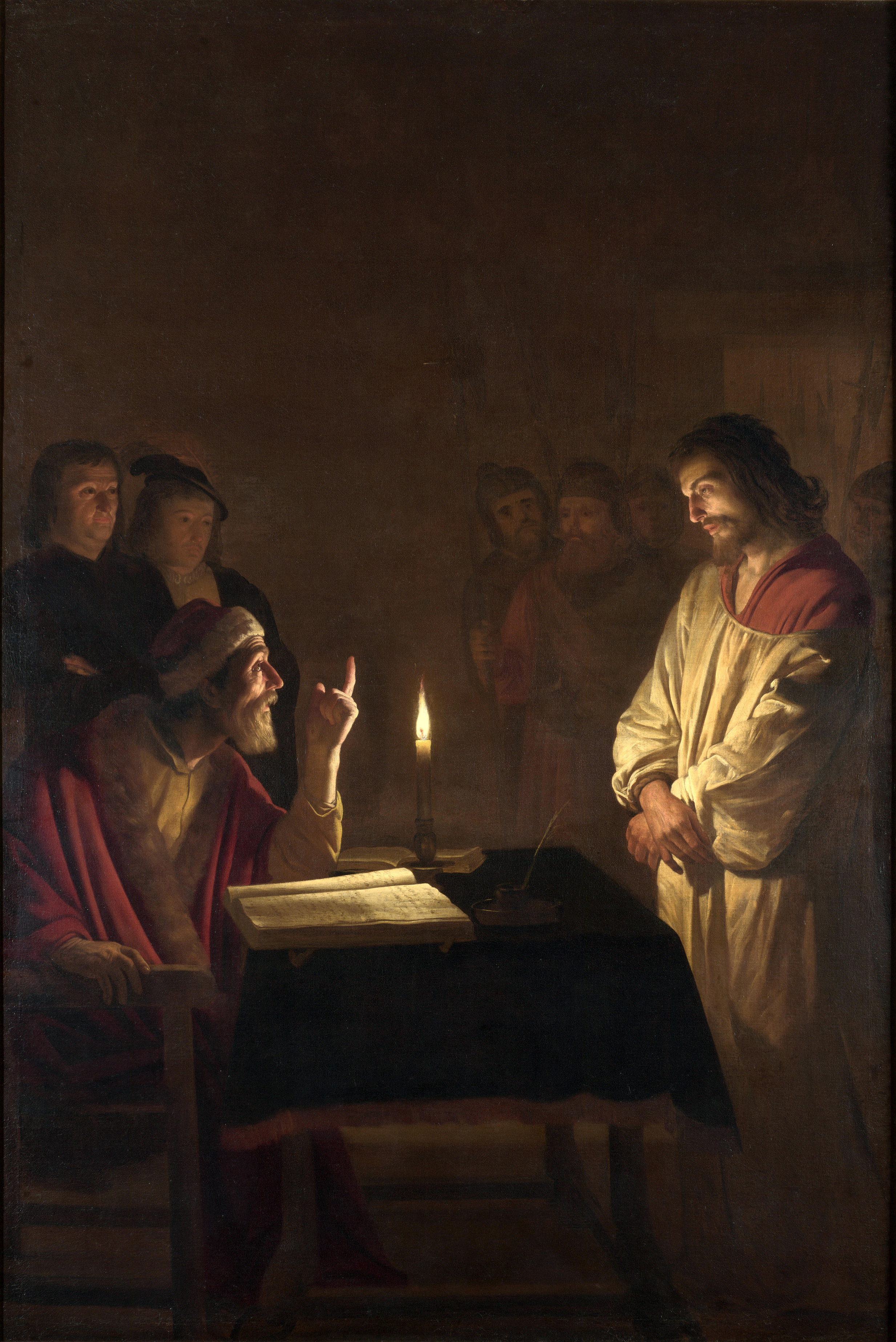
As soon as it was morning, the chief priests held a consultation with the elders and scribes and the whole council. They bound Jesus, led him away, and handed him over to Pilate. Pilate asked him, “Are you the King of the Jews?” He answered him, “You say so.” Then the chief priests accused him of many things. Pilate asked him again, “Have you no answer? See how many charges they bring against you.” But Jesus made no further reply, so that Pilate was amazed.
—Mark 15:1–5
LOOK: Christ before the Judge by Cecil Collins

I learned of this painting from the book The Image of Christ in Modern Art by Richard Harries. In the painting, Harries writes, Pilate is fierce, angular, aggressive, baring his teeth. “He represents the mechanism of law against Christ, now striated by the flagellation, and wearing a large crown of thorns. But Christ’s eyes are wide open, revealing a strong, serene and eternal order that remains untouched by the harshness.”
LISTEN: “Silencio,” movement 28 from La pasión según San Marcos (St. Mark’s Passion) by Osvaldo Golijov, 2000
The video below is the world premiere performance by the Orquesta La Pasión and the Schola Cantorum de Venezuela, conducted by María Guinand, on September 5, 2000, at the Beethovenhalle in Stuttgart, Germany. The “Silencio” movement is cued up for playback, but I recommend listening to the entire work!
Osvaldo Golijov (born 1960) is an Argentine composer born in La Plata to Ukrainian and Romanian Jewish parents. He left his native Argentina in 1983 to study for three years at the Rubin Academy of Music in Jerusalem, and then he settled in the United States. He lives in Massachusetts.
Golijov was one of four composers commissioned by the International Bach Academy of Stuttgart in 1996 to write a Passion oratorio to commemorate the 250th anniversary of J. S. Bach’s death in 2000. (I featured another, Tan Dun, in a recent roundup.) Golijov chose Mark’s Gospel as his basis, compiling the libretto from a Spanish translation of the Gospel and other Spanish-language sources, and for the music, drawing on a variety of Latin American styles and rhythms.
The “Silencio” movement of Golijov’s La pasión según San Marcos captures the moment at which Christ stands before Pontius Pilate, the governor of the Roman province of Judaea. He had already appeared before Caiaphas, the Jewish high priest; now he’s been handed over to another authority to stand trial yet again.
Much to everyone’s surprise, he does not defend himself against the charges of sedition, treason, and blasphemy—not because he was guilty, but because he knew it would do no good. He had already told the people who he was and what he was there to do—had demonstrated it with miracles—but most of those in power continued to disbelieve and resist him. And so he returns their accusations with a dignified silence. He has purposed to take his gospel all the way to the cross to further reveal the heart of God.
(Related post: “The ‘Nothing’ that won our salvation”)
“Silencio” (Silence), which comes between “Amanecer: Ante Pilato” (Dawn: Before Pilate) and “Sentencia” (Sentence), consists of clapping and stomping in the mode of flamenco, the texture thickening to convey ratcheting tension. “Spanish flamenco suggests the influence of the colonizing power, akin to ancient Rome in the Holy Land,” Thomas May writes, “and is thus suitable for Jesus’ betrayal and sentencing by the authorities – but also for the fatalistic aura of his impending death.”
There are no vocals in this movement, and the only instruments are the cajón and body percussion. The chorus creates rhythms with their hands and feet, representing the chief priests and scribes and the gathered crowds who wait anxiously for a word from the accused, but who are more anxious still for a verdict.
 Art & Theology