Christmas, Day 10: Balulalow

LOOK: The Birth of Christ by Ulyana Tomkevych

Tomkevych, Ulyana_The Birth of Christ
Ulyana Tomkevych (Ukrainian, 1981–), The Birth of Christ, 2016. Egg tempera on gessoed wood, 11 1/2 × 12 in. Sacred Art Pilgrim Collection of John A. Kohan. Photo: Victoria Emily Jones, at East Meets West: Women Icon Makers of Western Ukraine, St. Christopher’s Episcopal Church, Chatham, Massachusetts, 2017.

Frosty yet warm, this icon by Ulyana Tomkevych of Ukraine is one of my favorite Nativity paintings. It shows Mary embracing her swaddled newborn, Jesus, amid a bleak midwinter. She reclines across a red blanket of flowers inspired by Ukrainian embroidery patterns, which hovers mystically above a line of barren trees, suggesting that Christ’s birth has ushered in a new springtime.

The wisps of white against the cool green-grays at the bottom suggest snowdrifts, whereas the faint rose tints at the top imply a suffusing warmth. The silver semicircle at the top, with its emanating beams, represents the mystery and presence of God breaking into the world.

Following Greek Orthodox tradition, Christ’s halo is inscribed with the Greek letters ώ Ό Ν (omega, omicron, nu), spelling “He who is” (see Exod. 3:14). Tomkevych is a member of the Ukrainian Greek Catholic Church, which is in communion with the Holy See but follows the Byzantine Rite.

LISTEN: “Balulalow” | Original German words by Martin Luther, 1535 (title: “Vom Himmel hoch da komm ich her”) | Translated into Scots by James, John, and Robert Wedderburn, 1567 | Music by Peter Warlock, from his Three Carols suite, 1923 | Performed by Sting on If on a Winter’s Night, 2009 [see full credits]

O my deare hert, young Jesu sweit,
Prepare thy creddil in my spreit
And I sall rock thee in my hert,
And never mair from thee depert.

But I sall praise thee evermore
With sangis sweit unto thy gloir.
The knees of my hert sall I bow,
And sing that richt Balulalow.

Literal English translation:

O my dear heart, young Jesus sweet,
Prepare thy cradle in my spirit
And I shall rock thee in my heart,
And nevermore from thee depart.

But I shall praise thee evermore
With songs sweet unto thy glory.
The knees of my heart shall I bow,
And sing that true Balulalow.

English translation, from the German, by Catherine Winkworth:

Ah! dearest Jesus, holy Child,
Make thee a bed, soft, undefiled
Within my heart, that it may be
A quiet chamber kept for Thee.

My heart for very joy doth leap;
My lips no more can silence keep.
I too must sing with joyful tongue
That sweetest ancient cradle song.

These two stanzas in Middle Scots are an extract from the longer “Ane Sang of the Birth of Christ,” also known by its first line, “I come from heuin to tell,” from the Ane Compendious Buik of Godly and Spirituall Sangis (1567). In this part of the hymn, the speaker asks Jesus to be at home in their heart and receive their sweet songs. Mary is the model for this reception, love, and adoration of the Christ child—she who cradled him, praised him, sang to him, and held him close.

The word balulalow is derived from the Scottish word for “lullaby.”

For all fifteen stanzas in Scots, see here, and for Catherine Winkworth’s full English translation, here. The hymn actually originated in German from the pen of Martin Luther, who titled it “Vom Himmel hoch da komm ich her” (From Heaven Above to Earth I Come). It spread to the Netherlands and the British Isles in the 1560s.

In his recording, the cross-genre English musician Sting uses neither the German folk tune that Luther paired with the text upon its first publication, nor the melody Luther composed for it in 1539. Instead Sting uses the 1923 setting written by the English composer Peter Warlock for his Three Carols suite.

In Sting’s rendition, which he arranged in collaboration with Robert Sadin, the female backing vocals evoke a wintry wind and a snare drum creates a forward momentum, while a cello supports Sting’s languid singing. The tone is tender and haunting.


This post is part of a daily Christmas series that goes through January 6. View all the posts here, and the accompanying Spotify playlist here.

Contemporary icons of the Baptism of Christ

Today, January 6, is the feast of Epiphany (“manifestation,” “revelation,” “shining forth”)—also referred to as Theophany (“revelation of God”), or the Feast of Lights. While the Western church commemorates the visit of the Magi on this day, focusing on God’s revelation to the world through the birth of Christ, the Eastern church commemorates Jesus’s baptism, focusing on the Father and Spirit’s affirmation of the Son’s divinity at the beginning of his public ministry. Matthew 3:13–17 gives us the account:

Then Jesus came from Galilee to the Jordan to John, to be baptized by him. John would have prevented him, saying, “I need to be baptized by you, and do you come to me?” But Jesus answered him, “Let it be so now, for thus it is fitting for us to fulfill all righteousness.” Then he consented. And when Jesus was baptized, immediately he went up from the water, and behold, the heavens were opened to him, and he saw the Spirit of God descending like a dove and coming to rest on him; and behold, a voice from heaven said, “This is my beloved Son, with whom I am well pleased.”

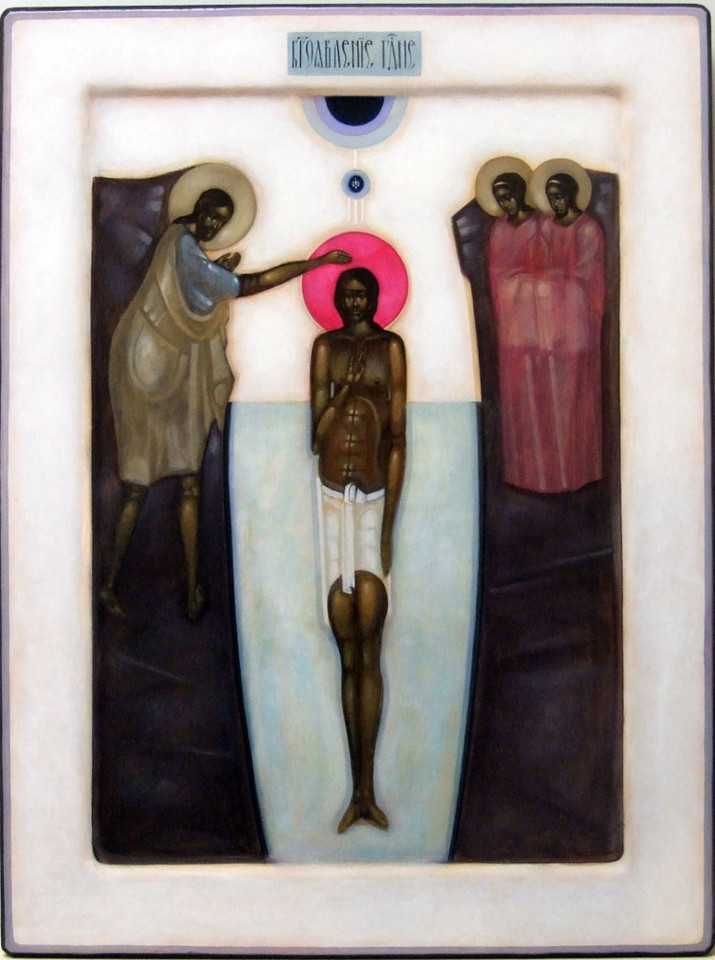
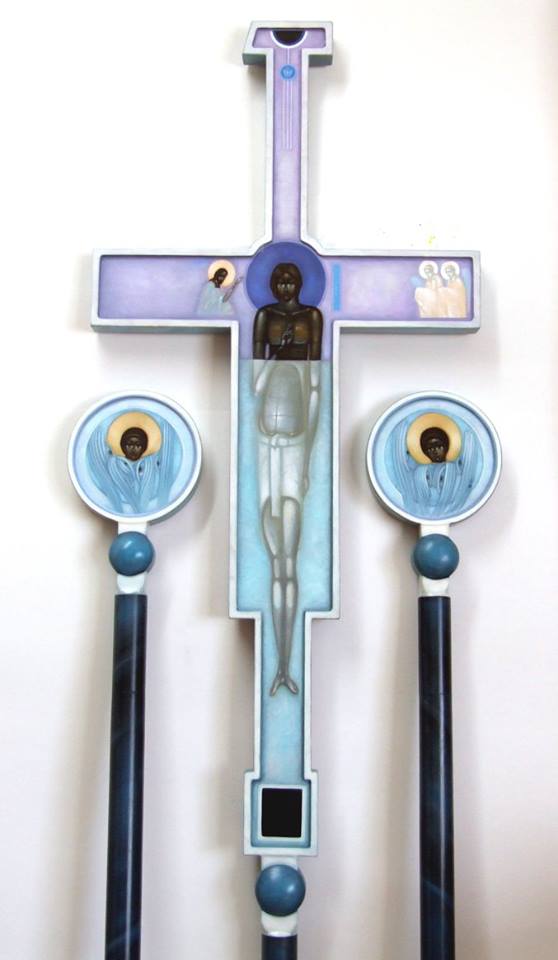
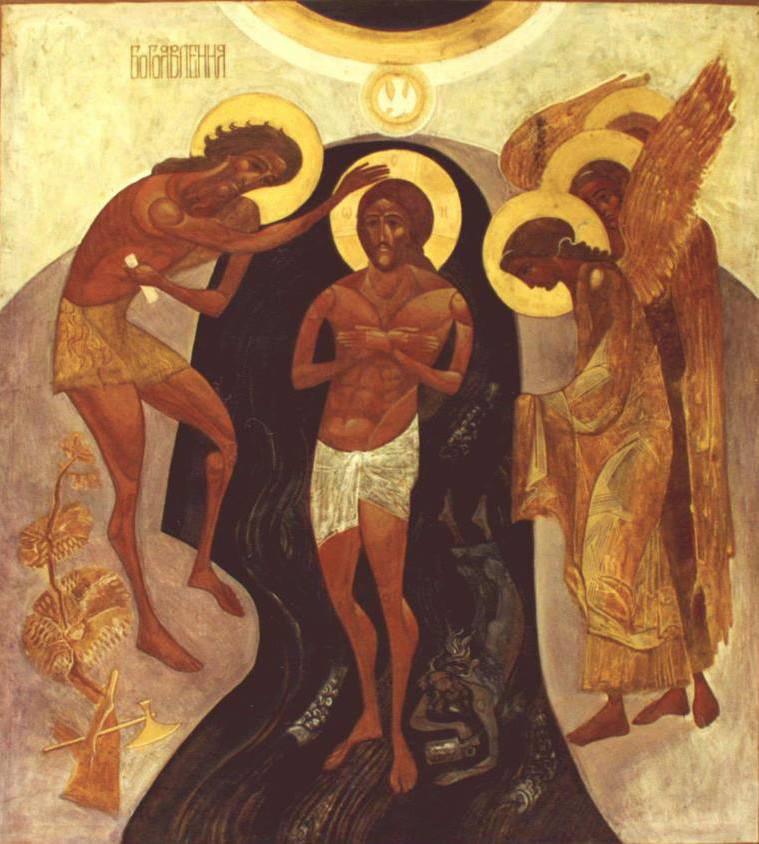
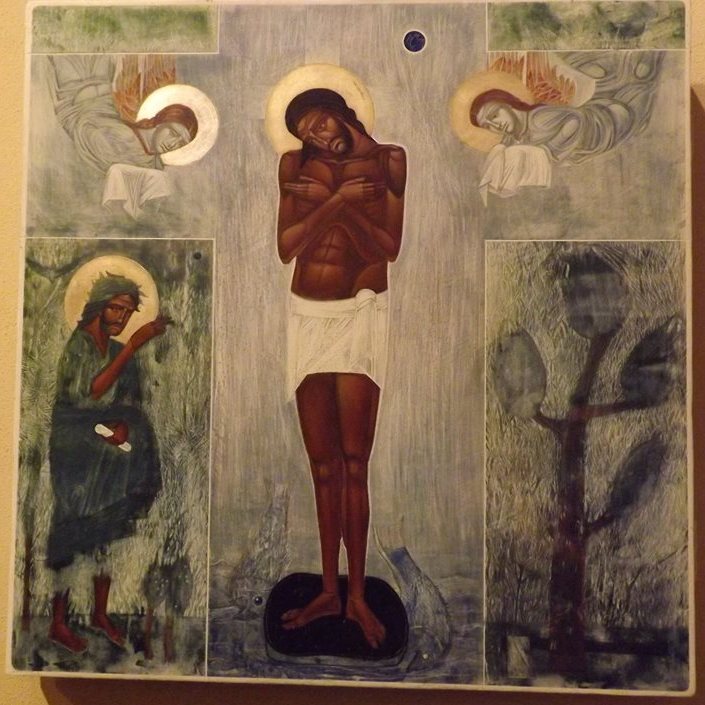
Below is a selection of contemporary Theophany icons from Ukraine, Russia, Poland, Greece, and Romania. All but one of them bear a semicircle at the top, which signifies the “opening of the heavens” and the voice of God reaching down; in Ioan and Camelia Popa’s, God’s hand is even visible. (Representation of the Father is forbidden by tradition, though a hand is generally acceptable because the Bible itself uses anthropomorphic expressions like “God’s hand” and “God’s mighty arm.”) A dove descends from this aperture, a literalization of the Gospel writers’ simile.

On the shores of the Jordan stand one or more angels at the service of their Lord. Their hands are covered by their own cloaks as a sign of reverence—or in some representations, they hold garments to drape over Christ when he emerges from the water. (Early icons of Jesus’s baptism show him completely naked, emphasizing his self-emptying; now, however, it’s more common to see him in a loincloth.)

In Lyuba Yatskiv’s and the Popas’ icons—the most traditional of this bunch—there is an allegorical figure in the river by Christ’s feet, pouring out water from a jug. This man is a personification of the Jordan River, which miraculously dried up, temporarily, to allow the ancient Israelites to cross over into the Promised Land (Joshua 3:15–17). Some icons, though none pictured here, include a second allegorical figure, (Red) Sea, who is turning away, parting (see Psalm 114:3).

In George Kordis’s icon, instead of Jordan at Christ’s feet, there’s a serpent being crushed, a reference to Psalm 74:13: “You divided the sea by your might; you broke the heads of the sea monsters on the waters.” Visually, this recalls the Eastern church’s Resurrection icon, which depicts Christ breaking down the doors of hell, flattening Satan.

Back to Yatskiv and Popa. In these two there is an axe lying next to a tree, alluding to the sermon by John the Baptist that immediately preceded this episode, in which he proclaimed, “Even now the axe is laid to the root of the trees. Every tree therefore that does not bear good fruit is cut down and thrown into the fire” (Matthew 3:10).

Epiphany calls us to worshipfully behold the shining forth of Jesus as messiah and as the second person of the Trinity. To orient yourself to the Orthodox celebration of today’s feast, here are two liturgical hymns, the Troparion and the Kontakion, that will be sung congregationally:

When Thou, O Lord, wast baptized in the Jordan, worship of the Trinity wast made manifest; for the voice of the Father bore witness to Thee, calling Thee His beloved Son. And the Spirit in the form of a dove confirmed the truth of His word. O Christ our God, Who hath appeared and enlightened the world, glory to Thee.

. . .

On this day Thou hast appeared unto the whole world, and Thy light, O Sovereign Lord, is signed on us who sing Thy praise and chant with knowledge: Thou hast now come, Thou hast appeared, O Thou Light unappproachable.

They offer a perfect lens through which to view the following icons.

Baptism of Christ by Jerzy Nowosielski
Jerzy Nowosielski (Polish, 1923–2011), The Baptism of Jesus Christ in the Jordan, 1964. Oil on canvas, 100 × 80 cm.

Baptism of Christ by Greta Leśko
Greta Leśko (Polish, 1979–), Baptism of Christ. Oil on board, 40 × 30 cm. Private collection.

Baptism of Christ by Greta Lesko
Greta Leśko (Polish, 1979–), Baptism of Christ, 2014. Oil on board, 40 × 40 cm.

Baptism of Christ by Greta Lesko
Two-sided processional cross and ripidions by Greta Leśko (Polish, 1979–), 2011. Mixed media on wood. Cross: 90 cm tall (without shaft); ripidions: 13 cm diameter. Church of the Exaltation of the Holy Cross in Górowo Iławeckie, Warmian-Masurian Voivodeship, Poland. (See reverse)

Baptism of Christ by Lyuba Yatskiv
Icon by Lyuba Yatskiv (Ukrainian, 1977–)

Baptism of Christ by Ulyana Tomkeyvch
Icon by Ulyana Tomkevych (Ukrainian, 1981–)

Baptism of Christ by Ivanka Demchuk
Ivanka Demchuk (Ukrainian, 1990–), Baptism of Christ, 2015. Mixed media on canvas and wood, 30 × 40 cm.

Continue reading “Contemporary icons of the Baptism of Christ”