
LOOK: Harrowing of Hell by Kateryna Shadrina
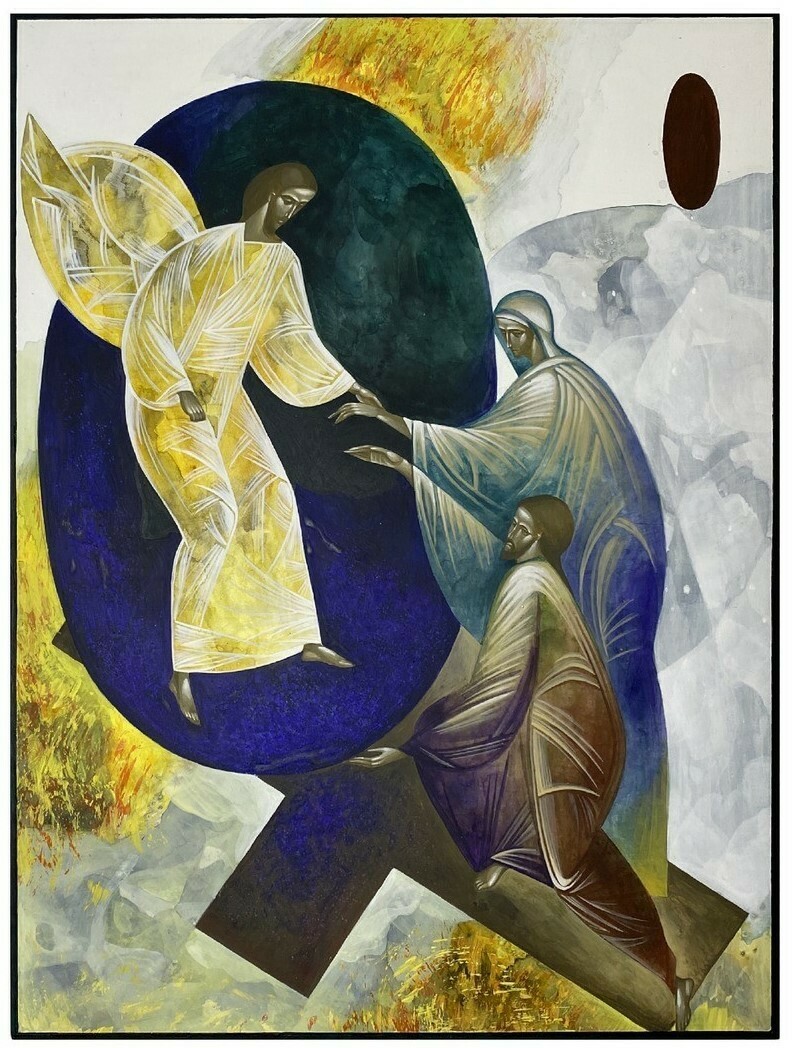
This contemporary icon of the Resurrection shows Christ standing atop the gates of hell—which have fallen into the shape of a cross—redeeming Adam and Eve while flames whip all around. In the sudden rush of rescue, his cloak billows behind him. His mandorla—that is, the radiant oval that frames him—is traditionally gold, but here the artist has chosen a deep royal blue, symbolic of heaven, and jade green for healing, renewal, and prosperity. The black oval in the upper right may signify the mouth of the empty tomb, or the portal through which Christ will return with the newly liberated to the realms above.
LISTEN: “Welcome, Happy Morning!” | Original Latin words by Venantius Fortunatus, 6th century; English translation by John Ellerton, 19th century | Music: NOEL NOUVELET (traditional French tune), 15th century | Performed by the Green Carpet Players (musicians of Redeemer Church of Knoxville), feat. Tyler Anthony, on Rise, O Buried Lord, 2011
“Welcome, happy morning!”
age to age shall say:
hell today is vanquished,
heav’n is won today.
Lo! the dead is living,
God forevermore!
Him, their true Creator,
all his works adore.“Welcome, happy morning!”
age to age shall say:
hell today is vanquished,
heav’n is won today.Maker and Redeemer,
life and health of all,
thou, from heav’n beholding
human nature’s fall,
of the Father’s Godhead
true and only Son,
manhood to deliver,
manhood didst put on.Thou, of life the author,
death didst undergo,
tread the path of darkness,
saving strength to show.
Come then, True and Faithful,
now fulfill thy word;
’tis thine own third morning:
rise, O buried Lord!Loose the souls long prisoned,
bound with Satan’s chain;
thine that now are fallen
raise to life again;
show thy face in brightness,
bid the nations see;
bring again our daylight;
day returns with thee.
I like how this hymn—whose origins are in the sixth century!—integrates the Incarnation into the story of Easter, enfolding together Jesus’s birth, life, death, and resurrection as well as his second coming.
To deliver humanity from the thrall of sin and death, the second person of the Trinity put on human flesh. He lived faithfully and died a sacrificial death. And then this God-Man came back to life! Now all the created world praises his name. The hymn ends with a prayer to see resurrection life in our world and for Christ’s return. “True and Faithful” in the third stanza are epithets of Jesus, the white-horse rider, in Revelation 19:11.
The musicians of Redeemer Church of Knoxville have paired the early medieval text with the fifteenth-century French carol tune NOEL NOUVELET, which is more commonly used with “Sing We Now of Christmas” and “Now the Green Blade Riseth” but works equally well here. The group brings a raucous energy and sings at a quickened tempo, using xylophones, mandolins, and trumpets in their celebration of the Risen Christ.
This song and many others can be found on my Eastertide playlist.
During the Easter Octave (the first eight days of the fifty-day season of Easter), I will continue publishing short daily posts in this art-and-song format.

 Art & Theology