“Sparrow Lament” by William Woolfitt (poem)

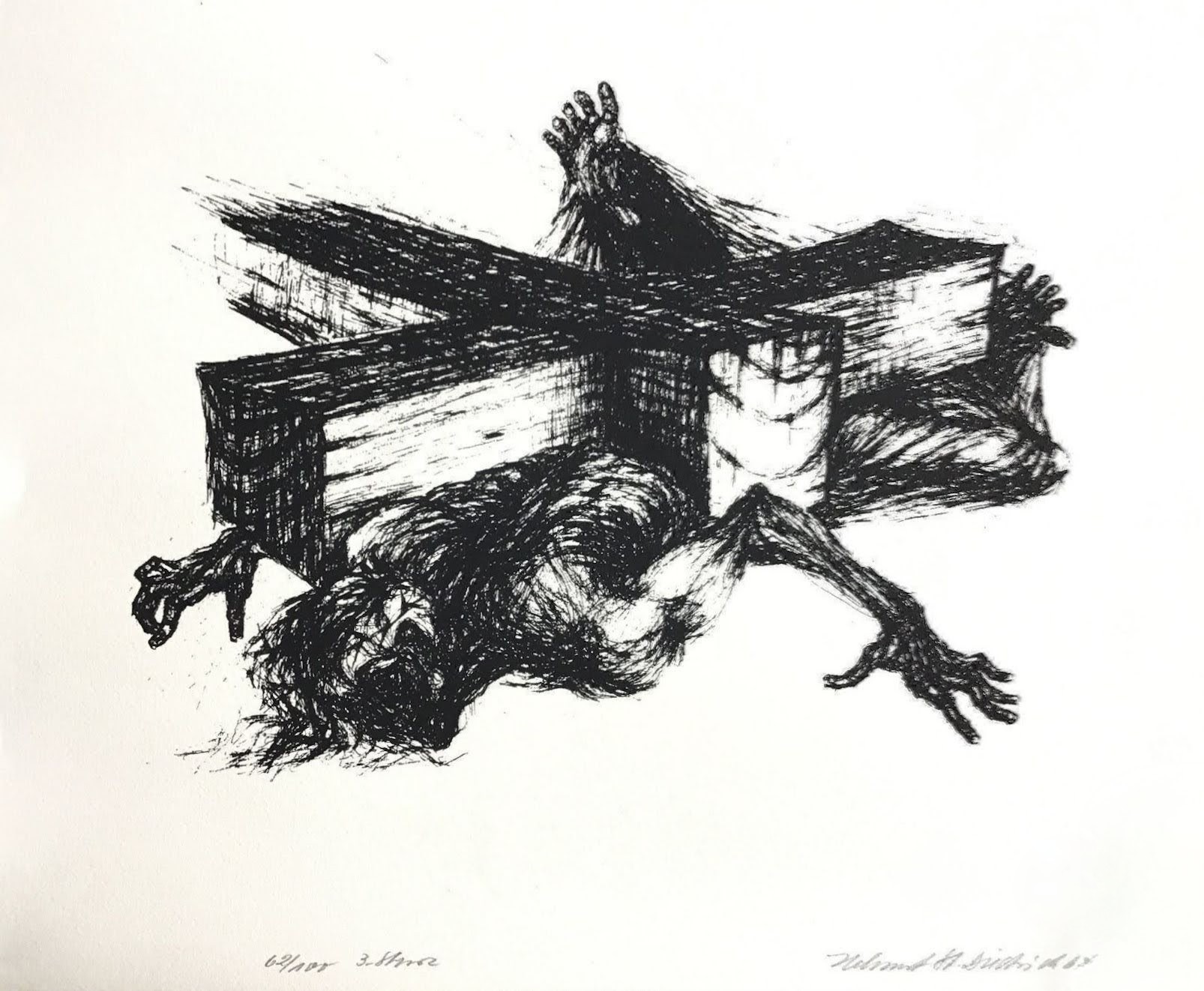
Diedrich, Helmut Stephan_Kreuzfall
Helmut Stephan Diedrich (German, 1937–), Kreuzfall, 1964. Lithograph, edition 62/100.

You fall, sparrow-bone, God-eyed leaf,
black hair of ox, kernel of wheat,
gold blown from the stalk. You lift wood,
trudge, and lurch, your back pulped. You would
spit up the cup-dregs for relief—

but no, you want not; you believe
your master’s dream. You toss your dreams
like chaff to the breeze. You lift wood.
You fall,

thin coin,

widow’s all,

copper seed
into the mouth of the box. She
brushed you a hundred times, so good
to hold, but better to drop. Wood
weights you, snapped bone, wind-flung leaf.
You fall.

This poem was originally published in Christianity and Literature 59, no. 2 (Winter 2010) and is anthologized in Imago Dei: Poems from Christianity and Literature, ed. Jill Peláez Baumgaertner (Abilene Christian University Press, 2012). Used by permission of the poet.


Originating in the Middle Ages, the Stations of the Cross is a Christian devotional practice in which participants commemorate the journey Jesus took down the Via Dolorosa (Way of Sorrows) to his death—either on location in the Holy Land, physically following a demarcated route, or, more accessibly, in their imaginations, through the aid of images or meditative texts. Traditionally, there are fourteen stations, the third, seventh, and ninth of which are “Jesus falls.” At these stopping places, Christians reflect on the crushing weight of sin and wood, on Jesus’s intensifying exhaustion, and yet, too, on his perseverance to get up each time and, pushing through the debility, to continue his trek to its fatal, foreordained end.

In his poem “Sparrow Lament,” William Woolfitt alludes to Jesus’s three falls on his way to Golgotha: “You fall,” “You fall,” “You fall.” He uses a string of metaphors from the natural world for the falling Christ: He’s a sparrow bone (spat out by a predator?), a floating leaf, a shed bovine hair, a grain of wheat blown loose from its stalk. These are wistful images of solitariness, passage, decease—and yet the descriptor “God-eyed” indicates that the path Christ is on is governed by divine providence.

The sparrow reference, given further weight by its use in the poem’s title, evokes Jesus’s teaching in Matthew 10:28–31: “Do not fear those who kill the body but cannot kill the soul; rather, fear the one who can destroy both soul and body in hell. Are not two sparrows sold for a penny? Yet not one of them will fall to the ground apart from your Father. And even the hairs of your head are all counted. So do not be afraid; you are of more value than many sparrows.”

The Father has willed the Son to drink the bitter cup of suffering and death, which, despite Jesus’s distressed plea less than twenty-four hours prior that the cup be removed, he downs in trust, casting off any dreams he had for living into old age. As he carries out his calling, he stumbles, he falls to the ground—but not apart from the will of his Father.

In the middle of the poem, the lineation—the arrangement of words using lines and line breaks—mimics a downward motion. Like the drop of the storied widow’s coin into the offering box (Mark 12:41–44; Luke 21:1–4). Most biblical interpreters assume that Mary, Jesus’s mother, was a widow by the time Jesus started his ministry, since Joseph is never mentioned in any of the Gospel accounts after the episode of Jesus disappearing in the temple at age twelve. Woolfitt refers to Jesus as “widow’s all”—Mary’s everything, her firstborn son, whom she sacrificially gives to the world, knowing God will bless her gift. She doesn’t hoard this dear treasure of hers. She surrenders him to God’s greater plan.

It wasn’t an easy choice to make. Mothers instinctively want to hold on to their children, and tight. Many intrusively fear dropping them as infants and would do anything to spare them pain. Well, Mary drops her son, on purpose. She relinquishes him, “copper seed,” whose death bears fruit, yields dividends.


William Woolfitt is a writer across the genres of poetry, fiction, and essay. His poetry collections are The Night the Rain Had Nowhere to Go (Belle Point, 2024), Spring Up Everlasting (Mercer, 2020), Charles of the Desert (Paraclete, 2016), and Beauty Strip (Texas Review, 2014). He is an associate professor of creative writing at Lee University in Cleveland, Tennessee, where he lives with his wife and two children. He founded and edits Speaking of Marvels, a blog that features interviews with authors of chapbooks, novellas, and books of assorted lengths.
Holy Week: “See how they done my Lord”

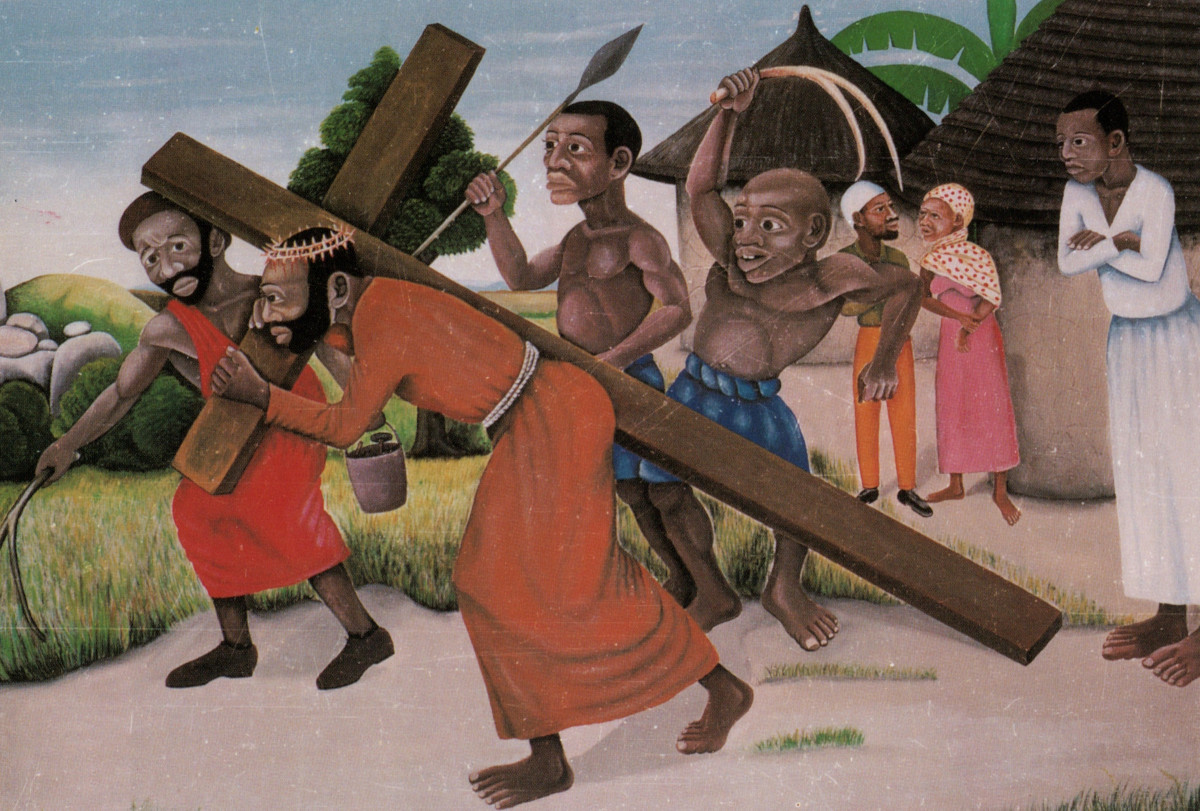
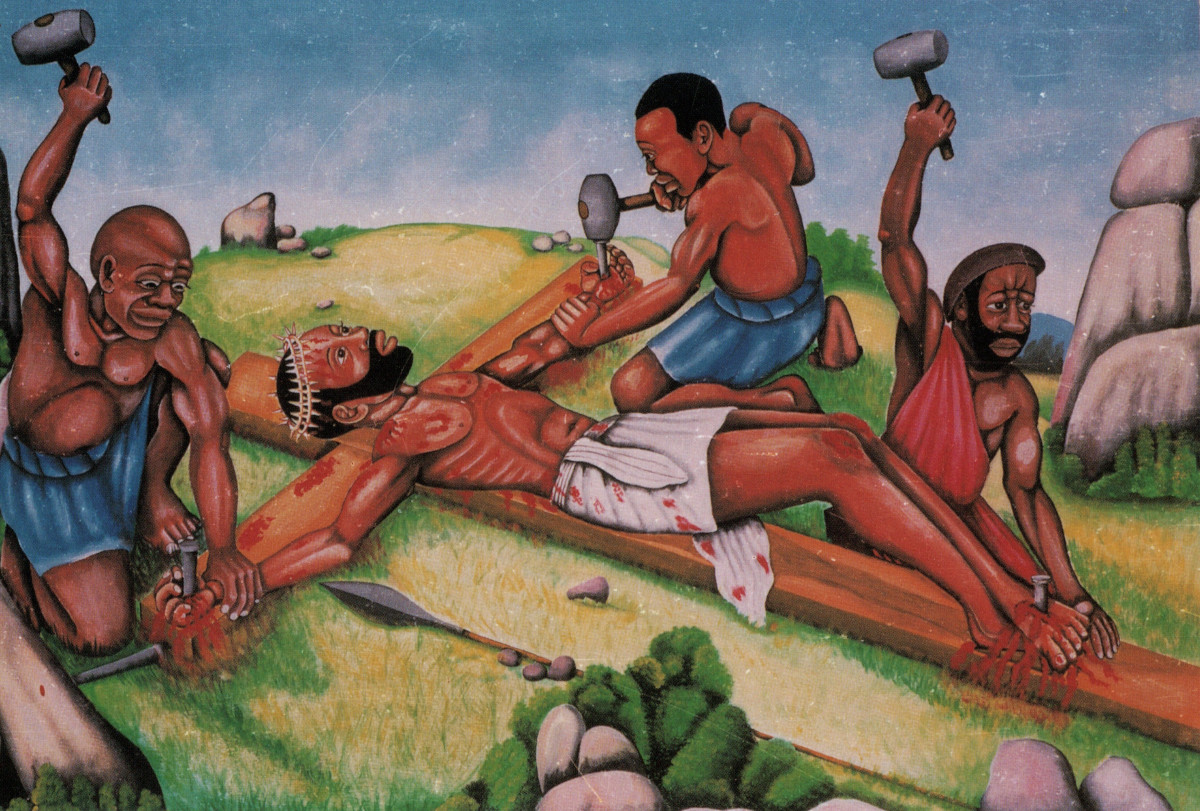
LOOK: Stations of the Cross #2 and #11 by Charles Ndege

Ndege, Charles_Jesus Takes Up His Cross
Charles S. Ndege (Tanzanian, 1966–), Station II: Jesus Takes Up His Cross. Wall painting from St. Joseph Mukasa Balikuddembe Church, Nyakato (Mwanza region), Tanzania. Source: Were You There? Stations of the Cross by Diana L. Hayes

Ndege, Charles_Jesus Is Nailed to the Cross
Charles S. Ndege, Station XI: Jesus Is Nailed to the Cross

The cement walls of St. Joseph Mukasa Balikuddembe Church in Nyakato, Tanzania, bear a series of murals by the Tanzanian artist Charles Ndege depicting the Stations of the Cross, set around the southern shores of Lake Victoria.

I couldn’t find what year the murals were painted, but the earliest would be 1995, as they are mentioned (and one is reproduced) in the book Towards an African Narrative Theology by the American Maryknoll missionary priests Joseph Healey and Donald Sybertz, which came out in 1996.

I found out about Ndege’s Stations from the book Were You There? Stations of the Cross (Orbis, 2000), a small paperback that reproduces all fourteen scenes in full color and features reflections by the African American Catholic theologian Diana L. Hayes. I recommend it.

You can also view the images in this document provided by Maryknoll, with descriptions and prayers by Fr. Joseph Veneroso, MM.

LISTEN: “See How They Done My Lord,” traditional African American gospel song | Performed by the Angola Quartet (there are actually six voices) from Camp A on Angola Prison Spirituals, 1959

See how they done my Lord
(Can’t you) See how they done my Lord
Lord, have mercy on me

Well, they whipped him all night long
They whipped him all night long
(Tell me) Whipped him all night long
Lord, have mercy on me

Well, they whipped him up a hill
They whipped him up a hill
(Tell me) Whipped him up a hill
Lord, have mercy on me

Well, they nailed him to the cross
They nailed him to the cross
(Tell me) Nailed him to the cross
Lord, have mercy on me

Well, two thieves was hanging beside him
Two thieves was hanging beside him
(Tell me) Two thieves was hanging beside him
Lord, have mercy on me

This song is sung by six unidentified men incarcerated at the Louisiana State Penitentiary, known colloquially as Angola Prison, one of the largest maximum-security prisons in the United States. A lament reflecting on Christ’s passion, it’s one of a series of Black gospel songs and spirituals recorded at the prison by the folklorist and musicologist Harry Oster in the late 1950s.

“How they done him” is slang for “how they wronged him” or “how they treated him badly.”

I can’t help but wonder if the singers identified with the abuse Christ suffered and found comfort in knowing that God himself walked the road before them and is with them in their own ways of sorrow. Perhaps (instead or too) they saw themselves in the penitent thief mentioned in the last stanza, who acknowledged the justice of his own sentence and asked Jesus to remember him in God’s kingdom.

The song’s refrain, “Lord, have mercy,” is a common one in liturgical churches, one that invokes God’s mercy in light of personal and corporate sins. It’s a plea for God’s compassion and forgiveness, and for relief.

Holy Week: Jesus Takes Up His Cross

. . . carrying the cross by himself he went out to what is called the Place of the Skull, which in Hebrew is called Golgotha. There they crucified him . . .

—John 19:17–18

LOOK: White Mountain by Ihor Paneyko

Paneyko, Ihor_White Mountain
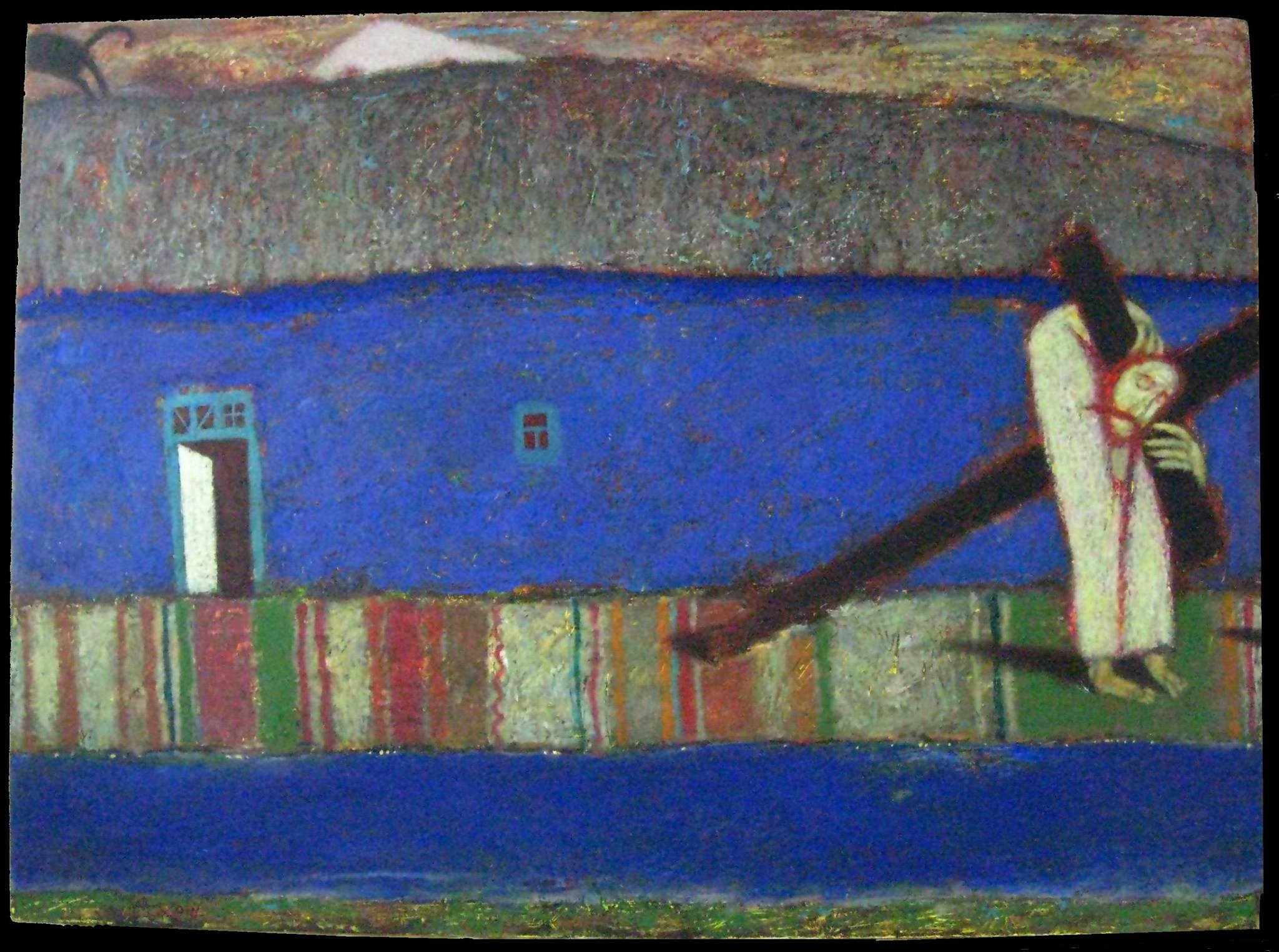
Ihor Paneyko (Игоря Панейка) (Ukrainian, 1957–), White Mountain, 2011. Egg tempera on gessoed board.

LISTEN: “Solus ad victimam” (Alone to Sacrifice Thou Goest, Lord) | Original Latin words by Peter Abelard, second quarter of 12th century; English translation by Helen Waddell, 1929 | Music by Kenneth Leighton, 1973 | Performed by St. Olaf Cantorei, dir. John Ferguson, on Hidden in Humbleness: Meditations for Holy Week and Easter, 2010

Alone to sacrifice thou goest, Lord,
Giving thyself to Death, whom thou hast slain.
For us, thy wretched folk, is [there] any word,
Who know that for our sins this is thy pain?

For they are ours, O Lord, our deeds, our deeds.
Why must thou suffer torture for our sin?
Let our hearts suffer for thy passion, Lord,
That very suffering may thy mercy win.

This is that night of tears, the three days’ space,
Sorrow abiding of the eventide,
Until the day break with the risen Christ,
And hearts that sorrowed shall be satisfied.

So may our hearts share in thine anguish, Lord,
That they may sharers of thy glory be.
Heavy with weeping may the three days pass,
To win the laughter of thine Easter Day.

“In Parasceve Domini: III. Nocturno,” whose first line is “Solus ad victimam procedis, Domine,” is a Latin hymn by the French scholastic philosopher, theologian, and poet Peter Abelard (1079–1142). It appears in his collection Hymnarius Paraclitensis—a major contribution to medieval Latin hymnody—and was sung in the night office (Nocturns) of prayers on Good Friday.

Today it is best known through its modern choral setting of the English by British composer and pianist Kenneth Leighton (1929–1988). Dr. David Ouzts, the minister of music and liturgy at Church of the Holy Communion in Memphis, says this is “one of the most effective musical settings of any anthem of the 1,000-plus octavos in our parish music library.” He continues:

This anthem is one of those with harmonies and sonorities that may not sound correct when they are. Worshipers will hear the sparseness of the choir singing in simple same-note octaves, and in the next moment, dissonances between the choral voices will appear.

Though this 12th century text is most certainly a Passiontide text, my favorite aspect is that it foreshadows Easter and the Resurrection.

The wordplay of the music that accompanies “laughter” in the text is notable. The choral voices are high in their tessituras, and the full choir ends literally on a high note, after which the organ accompaniment steals the show with great dissonant chords, only to land on a huge, bright E Major chord.

The hymn invites us to follow Christ to Golgotha, beholding his suffering so that we might be moved to contrition and, clinging to God’s mercy, rise to newness of life—or, as the wonderful last line puts it, “win the laughter of [Christ’s] Easter Day.” The fourth stanza alludes to Romans 8:17, where the apostle Paul writes that we are “heirs of God and joint heirs with Christ, if we in fact suffer with him so that we may also be glorified with him.” Paul speaks elsewhere of believers being “crucified with Christ” (Gal. 2:20)—see my visual commentaries on this passage—and “baptized into his death” (Rom. 6:3) as well as being raised with him.

Jesus may have gone “alone to sacrifice”—but the fruits of that sacrifice abound to all who would eat. Praise be to God.

As we enter the Paschal Triduum, let us weep for our sins and for the innocent Lamb who was slain to atone for them. Let us also look with hope toward daybreak.