
Easter, Day 5: Glory to the Risen Lamb!

Then I saw in the right hand of the one seated on the throne a scroll written on the inside and on the back, sealed with seven seals, and I saw a mighty angel proclaiming with a loud voice, “Who is worthy to open the scroll and break its seals?” And no one in heaven or on earth or under the earth was able to open the scroll or to look into it. And I began to weep bitterly because no one was found worthy to open the scroll or to look into it. Then one of the elders said to me, “Do not weep. See, the Lion of the tribe of Judah, the Root of David, has conquered, so that he can open the scroll and its seven seals.”

Then I saw between the throne and the four living creatures and among the elders a Lamb standing as if it had been slaughtered, with seven horns and seven eyes, which are the seven spirits of God sent out into all the earth. He went and took the scroll from the right hand of the one who was seated on the throne. When he had taken the scroll, the four living creatures and the twenty-four elders fell before the Lamb, each holding a harp and golden bowls full of incense, which are the prayers of the saints. They sing a new song:

You are worthy to take the scroll
    and to break its seals,
for you were slaughtered and by your blood you ransomed for God
    saints from every tribe and language and people and nation;
you have made them a kingdom and priests serving our God,
    and they will reign on earth.

Then I looked, and I heard the voice of many angels surrounding the throne and the living creatures and the elders; they numbered myriads of myriads and thousands of thousands, singing with full voice,

Worthy is the Lamb that was slaughtered
to receive power and wealth and wisdom and might
and honor and glory and blessing!

Then I heard every creature in heaven and on earth and under the earth and in the sea and all that is in them, singing,

To the one seated on the throne and to the Lamb
be blessing and honor and glory and might
forever and ever!

And the four living creatures said, “Amen!” And the elders fell down and worshiped.

—Revelation 5 (NRSV)

LOOK: The Vision of the Lamb in the Midst of the Four Living Creatures, from a medieval English apocalypse

Lamb Upon the Throne (Getty)
The Vision of the Lamb in the Midst of the Four Living Creatures and the Twenty-Four Elders, made in London, ca. 1255–60. Tempera, gold leaf, colored washes, and pen and ink on parchment, 12 9/16 × 8 7/8 in. (31.9 × 22.5 cm). J. Paul Getty Museum, Los Angeles, Ms. Ludwig III 1 (83.MC.72), fol. 5.

LISTEN: “Glory to the Risen Lamb!” | Words compiled by Jean Anne Shafferman, 2007, from traditional sources (William Saunders and Hugh Bourne, 1821; Job Hupton, 1805; F. R. Warren, 1878) | Tune: INVITATION (New), from William Walker’s Southern Harmony, 1854 | Performed by musicians at Byford Parish Church, Georgetown, Massachusetts, 2020

Hear the gospel news resounding: “Christ has suffered on the tree;
streams of mercy are abounding; grace for all is rich and free.”

Refrain:
Hallelujah, hallelujah! Glory to the Risen Lamb!
Hallelujah, hallelujah! Glory to the great I AM!

Grace is flowing like a river from the Savior’s wounded side.
Still it flows as fresh as ever; all may live, for Christ has died. [Refrain]

On the cross for our redemption, see him all his lifeblood pour!
There he wins our full salvation, dies that we may die no more. [Refrain]
Stomp (Artful Devotion)

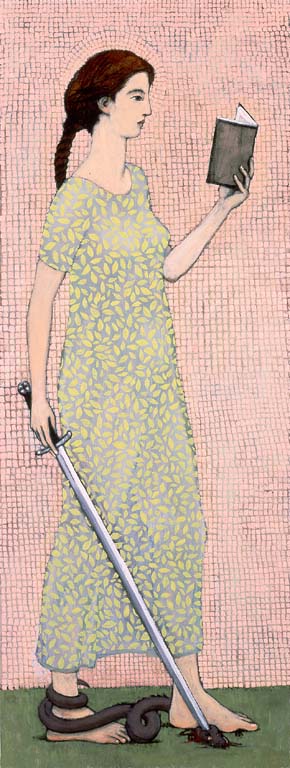
Treading the Basilisk by Brian Kershisnik
Brian Kershisnik (American, 1962–), Treading the Basilisk, 2003. Oil on panel, 85 × 32 in.

Because you have made the Lord your dwelling place—
the Most High, who is my refuge—
no evil shall be allowed to befall you,
no plague come near your tent.

. . .

You will tread on the lion and the adder;
the young lion and the serpent you will trample underfoot.

“Because he holds fast to me in love, I will deliver him;
I will protect him, because he knows my name . . .”

—Psalm 91:9–10, 13–14

+++

SONG: “Anyataka” (Victory), a Congolese folk song | Performed by New City Fellowship, July 21, 2013

This video is from a Sunday worship service at New City Fellowship (previously here and here), a multicultural church in St. Louis, Missouri. The church contains a fair number of immigrants from the Democratic Republic of the Congo, including on its leadership team, which has led it to partner with churches in the DRC, a relationship of mutual encouragement. “Anyataka” was introduced to the congregation by Athoms Mbuma, a visiting pastor and musician from Kinshasa and a member of the popular Congolese worship band Le Groupe Adorons L’Éternel (GAEL).

Anyati Satana lelo! (“We stomp on Satan!”), sing the worshippers in Lingala, miming the action with gusto. “Victory! We have victory in Jesus.” And the refrain: “Yahweh, you reign.”

Click here for a leadsheet, as well as music for trumpet, alto sax, flute, and trombone.

+++

Many Christians read Psalm 91 as a messianic psalm, prophesying Christ’s victory over Satan. (Visual theologians included: check out the fascinating super aspidem motif, aka “Christ treading on the beasts.”) But it can also be applied more broadly, as the psalmist no doubt intended, to the people of God.

An adder, or viper, is a venomous snake; the word is sometimes alternately translated as “asp,” “cobra,” or even “basilisk,” a mythical reptile. According to the ESV Study Bible commentary, “The lion and the adder are probably images for people bent on harming the faithful (cf. Ps. 58:3–6; Deut. 32:33), or perhaps the demonic agents that inspire the harm.” I’m reminded of Luke 10:19 (cf. 9:1), where Jesus delegates his power over demons to his disciples: “Behold, I have given you authority to tread on serpents and scorpions, and over all the power of the enemy, and nothing shall hurt you.”

The Christian’s power over evil is rooted in the very power of Christ, who by his death and resurrection has vanquished the Enemy. Now we, too, can put evil under our feet.

Both works of art in this post—the painting by Kershisnik and the Congolese worship song—are inspired by Psalm 91 (the song a little less directly), but they approach it with different tones. The song is very exultant, heightened by a demonstrative performance in which the singers enact the victory of which they sing. By contrast, the figure in the painting is very matter-of-fact about her crushing of the snake; by the power of the word (signified doubly by the book in one hand and the sword in the other), she quietly and assuredly renders it powerless. She appears completely undisturbed by the incident; it barely registers!

Both responses to the text are, I think, appropriate. Christ’s victory, which he grants to us, ought to elicit our loud and happy praise, befitting the context of a worship gathering. But what Kershisnik gives us in this private devotional painting is a calm assurance that in our day-to-day, when the Enemy rears its head, we need not fear one bit; we can carry on unfazed because the battle has already been won—we merely need to claim the victory.


This post belongs to the weekly series Artful Devotion. If you can’t view the music player in your email or RSS reader, try opening the post in your browser.

To view all the Revised Common Lectionary scripture readings for the First Sunday in Lent, cycle C, click here.