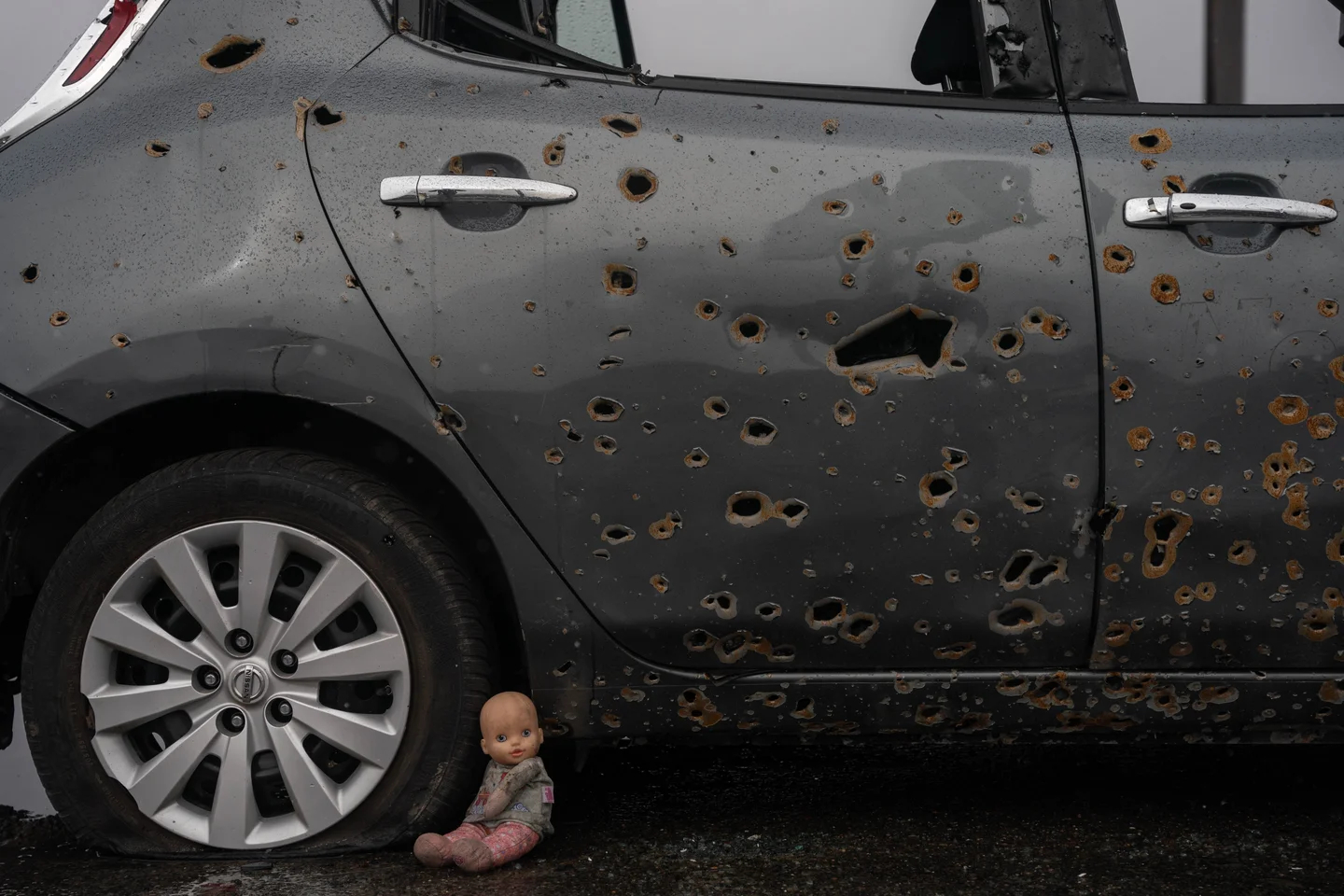
Withdrawing from Kyiv on April 2, 2022, after a lost battle, Russian troops left destruction in their wake. A bullet-riddled car with a flat tire sits abandoned, along with a doll, on the bridge crossing into Irpin, Ukraine. Photo: Franco Fafasuli.
The Russo-Ukrainian war is now in its twelfth year, and it’s been almost four years since Russia’s full-scale military invasion of Ukraine. The devastation is staggering. I can’t even imagine what it must be like to live in a war zone, with bombs, missiles, and gunfire an ever-present threat, part of the everyday background noise. While many photographs have documented the wider destruction and human losses in Ukraine, I was struck by this one by the young Argentine journalist Franco Fafasuli, which focuses not on leveled buildings or intimate griefs but on possessions left behind in the chaos of war: a car, now dotted with dozens of bullet holes, and a plastic-headed baby doll, now covered in grime.
As I reflect on Christ’s coming this Advent season, I think of how he came as a vulnerable child, into a world where people deliberately hurt and kill other people. Then, it was with swords, daggers, spears, arrows, and stones; now we’ve added all manner of firearms and large explosives to our arsenal. That innocent, bald little babe sitting by a deflated tire, suggesting a family with child having suddenly fled their hometown—it looks at me with the eyes of Christ, wondering why we continue to harm each other, but smiling, too, a smile of divine grace. He’s here to show us another way.
LISTEN: “О, Зійди” (Oh, Come Down) by Room for More, 2022
Вся земля cхилилася
Втомлена від боротьби
Зітхаємо у марноті
Бо втратили ми Твій дотик

Заспів:
О, зійди!
Спасе відроди.
Зійди!

Небеса далекі нам
Власний шлях обрали ми
Вся земля чекає на
Спасителя, на мир і спокій

Заспів:
О, прийди!
Царю милості, прийди!
Освіти!
Всім хто в темноті, світи

Небеса схиляються
Являють нам святе Дитя
Земле вся, заспівай
Правдивий Цар, Бог наш з нами

Заспів:
О, радій!
Спас Месія нам родивсь!
О, вклонись!
Царю всіх царів, вклонись!

Бридж:
Підіймай опущені руки
Потішай тих хто відчаєм скуті
Відкриває Син нову
Надію, силу й повноту

Заспів:
О, радій!
Спас Месія нам родивсь!
О, прийми!
Це рятунок твій, прийми!
The whole earth bows down
Weary of the struggle
We sigh in vain
For we have lost your touch

Refrain:
Oh, come down!
Savior, revive
Come down!

The heavens are far from us
We have chosen our own path
The whole earth awaits
The Savior, peace and tranquility

Refrain:
Oh, come!
King of mercy, come!
Enlighten!
Onto all who are in darkness, shine

The heavens bow down
Show us the holy Child
All the earth, sing
The true King, our God is with us

Refrain:
Oh, rejoice!
The Messiah is born to us!
Oh, bow down!
He’s the King of all kings, bow down!

Bridge:
Lift up your hands that hang down
Comfort those who are bound by despair
The Son reveals a new
Hope, strength, and fullness

Refrain:
Oh, rejoice!
The Messiah is born to us!
Oh, accept!
This is your salvation, accept!
The lead singer on “О, Зійди” (Oh, Come Down) is Yaryna Vyslotska. The song was written by Jonathan (Jon) Markey, an American-born minister and musician who grew up as a missionary kid in Ukraine and since 2008 has been a pastor at Calvary Chapel in Ternopil. In 2017 he and his wife Stephanie (Steffie) founded the Ukrainian Christian music collective Room for More.
. . . each day a misery and a marvel, each person also.
—Rachel E. Hicks, from “Accumulated Lessons in Displacement”
A white American born in the foothills of the Himalayas to international school educators, Rachel E. Hicks is a second-generation third-culture kid (TCK) whose writing reflects decades of living as a global nomad, exploring themes of memory, connection, suffering, exile (both physical and spiritual), hospitality, and hope. She grew up in six countries—India, Pakistan, the United States, Jordan, the Democratic Republic of the Congo, and Hong Kong—and spent seven years as an adult in Chengdu, China, where she worked for the relief and development organization Food for the Hungry.
In 2013, she, her husband, and their two kids repatriated to the US, settling in Baltimore, where they live today. Hicks has lived in Baltimore longer than in any other city. But even with this rootedness, “the soil of each place in which I’ve lived still clings,” she says.
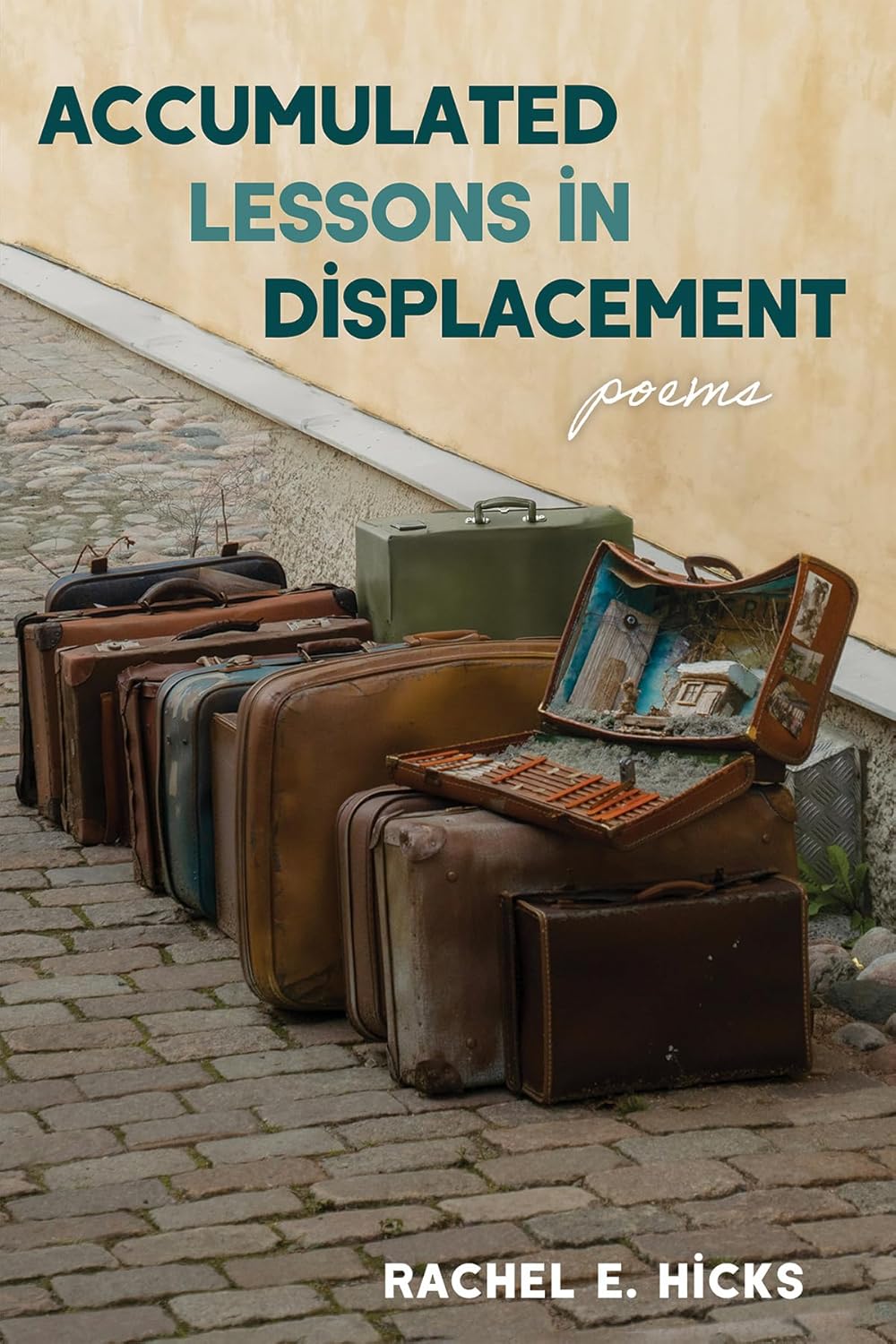
In her debut poetry collection, Accumulated Lessons in Displacement (Wipf & Stock / Resource Publications, 2025), Hicks grapples with the experience of being a “perpetual pilgrim”—on her way to a particular place but also attuned to the significance of each moment along the way. “Pilgrims learn to walk a life of paradox: even though their hearts are set on their final destination, they walk through each day alive to its possibilities, people and lessons,” she wrote in a 2014 blog post.
What is “home”? How can we bear to leave home, whether forced to do so by war, famine, or natural disaster, or we choose to for opportunity or ministry? What do we do with feelings of alienation when we find ourselves in a culture not our own or in which we don’t fit well? How do we live cross-culturally? How do we make a home where we’re at? What are our responsibilities to place? Who is our neighbor?
“I believe that many—all?—of us live our lives with some sense of exile,” Hicks writes on her blog. “We experience it and are aware of it to varying degrees, but it’s there. So many of our quests, our longings, our purpose-seeking, and the stories we create and tell are about trying to find our way home. Home being that place—literal or figurative—in which we feel wholeness and true belonging.”
Accumulated Lessons is divided into two parts: “Bright Sadness, Bitter Joy” and “A Deeper Knowing.” The term “bright sadness”—a translation of the Greek word charmolypê—comes from the Eastern Orthodox tradition, and it describes the paradoxical state of mourning over sin while rejoicing in God’s grace. It can also describe the paradox of living a life of joy amid suffering.
I was trying to learn the word for joy
that settles awkwardly in grief’s nest, an oversized bird. I didn’t want to scare it away.
So says the speaker in the book’s title poem, “Accumulated Lessons in Displacement.” Unfolding over eight sections, this persona poem draws on Hicks’s own experience of abrupt displacement from Kinshasa as a teenager, as well as the experiences of Bosnian refugee friends, and Syrian refugees she had only read about in the news.
It opens with a reflection on “home” in all its ordinariness—the yellow coffee cup, the dusty houseplant, the sunlit window seat—and laments that “no footpath exists leading back to these things,” which, the reader is led to presume, have been destroyed by armed conflict, or its residents blocked from returning by threat of death.
The poem contains several arresting images, like the green threads of a sweater on barbed wire tracing a path across miles. A boy who collects bullet casings to make a necklace for his sister. Charred diary pages dancing around a blown-out living room, “ma[king] a strange poem in my heart.”
Hicks wrestles with the savage violence humans are capable of:
It makes no sense that a soldier can press a button
and somewhere a baby ignites into flame. And he goes home and brushes his teeth.
What we do to each other, to other created souls. Always I carry this burden like a child on my hip.
Another powerful poem in the collection is “Visit to Sarajevo,” where Hicks describes visiting the Bosnian-Herzegovinan capital with her friend Dragan, who was forced to flee it as a young married adult with a child in the 1990s after the city was besieged by Serbian forces. Hicks had met Dragan and his family in 2000 through her husband, Jim, who worked alongside him at a refugee resettlement agency in Phoenix, Arizona, and the families became close. Meeting up years later in Dragan’s hometown, Dragan leads Hicks through the once-familiar streets “in a haze of pride, nostalgia, nightmare,” giving her a tour of sites both historically significant and deeply personal.
Hicks’s passport country too has its national traumas, one of which was precipitated by 9/11, when in 2001, terrorists flew planes into the World Trade Center in New York City, killing almost three thousand people. In “Disaster Chaplaincy Training,” she describes a course she took, taught by a Ground Zero worker, to become further equipped for her work in China, which was focused on disaster preparedness and response. In the course, she learned how to “loiter with intent” in zones of disaster, “acclimat[ing] to [suffering’s] pungency.” Make sure, said the instructor, to “let them see you cupping a small ball / of hope—toss it up, catch it.”
Nationwide crisis struck the US again when on April 12, 2015, a young Black man from Baltimore, Freddie Gray, died of a spinal cord injury while in police custody, allegedly due to police brutality—though none of the six involved officers was ultimately held responsible. Gray’s death led to civil unrest in Baltimore (which Hicks had recently made her home) and throughout the country, as citizens demanded recognition, in word and practice, that “Black lives matter.”
Hicks wrote “The Morning After Freddie Gray’s Funeral” while Baltimore was on lockdown. Fumbling for words, she tries to explain to her children what’s going on as she, too, tries to educate herself more deeply about the history of racism in America and the longstanding grievances of the Black community she lives in. In the poem, she harvests mint from her garden to brew a gallon of black mint tea to share with her neighbor—
as what? An offering, apology?
A way to say I’m trying—learning about all that fuels these fires still smoldering this hushed morning?
The staining of the clear water as the tea steeps becomes a metaphor.
Accumulated Lessons in Displacement addresses global suffering, more localized suffering, as well as personal and family suffering.
One example of the latter has to do with Hicks’s daughter’s diagnosis, following an ankle sprain, with complex regional pain syndrome (CRPS), Ehlers-Danlos syndrome (EDS), and postural orthostatic tachycardia syndrome (POTS), chronic conditions that cause extreme nerve pain. “Bright Sadness” describes a return car ride from a fruitless medical visit, her daughter crying and gasping in agony in the back seat, when offhandedly, Hicks insists, “Turn your cries into opera!” This unexpected and ridiculous suggestion defuses, if for just a moment, the intense situation, resulting in “joy-laughing” amid plaintive contralto tones all the way home.
“Post-Miracle (I)” celebrates her daughter’s miraculous healing, holds the strange, tentative, empty-handed feeling of a fervent prayer request graciously granted. But then comes “Post-Miracle (II),” written when, after two months of her daughter being pain-free, the CRPS returned. Hicks wrestles with gratitude for the brief reprieve and anger at God’s “undoing” the miracle. She wonders about some of the healings Jesus performed in the Gospels, and whether they stuck.
“Post-Miracle (II)” is one of the few poems in the collection with end rhyme, each quatrain following an abba pattern. Perhaps the choice to work with a rhyme scheme for this particular subject represents, consciously or subconsciously, her attempt to make things rhyme again, to harmonize the reality of chronic pain with a good and loving God, to impose structure on the chaos.
Several of Hicks’s poems engage with biblical stories: the Suffering of Job, the Parable of the Prodigal Son, the Massacre of the Innocents, Zacchaeus encountering Jesus, the Walk to Emmaus. She performs poetic midrash, imaginatively interpreting and expanding the texts to connect with them on a deeper level.
Besides the biblical authors, some of her literary conversation partners in this collection are Frederick Buechner, Henri Nouwen, Simone Weil, Czesław Miłosz, Dostoevsky, G. K. Chesterton, Gregory of Nyssa, Paul Kingsnorth, and Karen Blixen.
Although there’s a heaviness to much of the material, it’s not overwhelming, as small graces are woven throughout: complimentary walnuts from a fruit shop owner on a winter Sunday; laughter over language barriers; refreshment from a water hose; the scent of turmeric and cardamom at a Punjab store in Baltimore, reminders of the poet’s birthplace; “the comfort of the priest’s thick thumb / upon my forehead, the signature of / Jesus,” on Ash Wednesday; dandelions and buttercups brushing ankles; a cairn at West Clear Creek; the monks at Great Lavra, Greece, making room for the dispossessed; bundles of sheep ascending limestone slopes at dawn in the Cotswolds; the delightful word cusp; her son’s euphoria upon gliding down a mountain on skis; the slow labor of opening a pomegranate and obtaining its ruby-red seeds for her daughter to eat.
The book is shot through with joy—a joy that coexists with suffering and that is sustained through faith.
“These are poems to live by—to help you stay human, love people, find joy in sorrow, pay attention to the world around you, open yourself to God, welcome mystery, and understand our times at a deeper level,” Hicks wrote in an email announcing the launch of the book. “You’ll journey all around the world and find it—in spite of its sorrow—full of beauty and worth loving.”
One of my favorite poems is “Just Before,” a perfect reading for the upcoming Advent season. It spans four cities of the world—places where people work, play, pray, and rest; places of economic disparity, of spiritual longing as well as mundane concerns—in each imagining the moment just before Jesus returns. In the midst of our threshing corn or lighting a lamp or settling a legal dispute or herding sheep, Jesus will come with a beauty that blossoms all the way out to the horizon, calling all nomads home.
“Just Before” by Rachel E. Hicks
When Jesus comes again in all his glory, somewhere in the Sichuan mountains tires will crackle over corn spread out on the road— easy threshing—while a small child urinates in the gutter, absorbed in watching the car shoot by.
As the first rent opens a fingernail tear in the hazy sky, a woman in the foothills above Rishikesh will lay down her firewood burden and light the clay Diwali lamp in the chilling dusk, circling her cupped hands in blessing.
In the pause before the clamor of heaven’s trumpets, the jurors’ waiting room in Baltimore’s civic court will throb with the quiet turning of pages, a buzzing phone in the hand of a tired man, berating himself for forgetting to bring coffee.
Just before we are aware of him, Jesus will pause to survey the view; two shepherd boys amidst boulders in the Wadi Rum hills south of Amman wipe sleep from their eyes and stand amazed at the blood-red poppies at their feet stretching to the eastern horizon.
Purchase Accumulated Lessons in Displacement here. (Update, 11/14/25: Wipf & Stock is offering a 50% discount through November 30, 2025; use code CONFSHIP at checkout. Media mail shipping is free.)
“Just Before” is reproduced with permission from Wipf and Stock Publishers, www.wipfandstock.com.
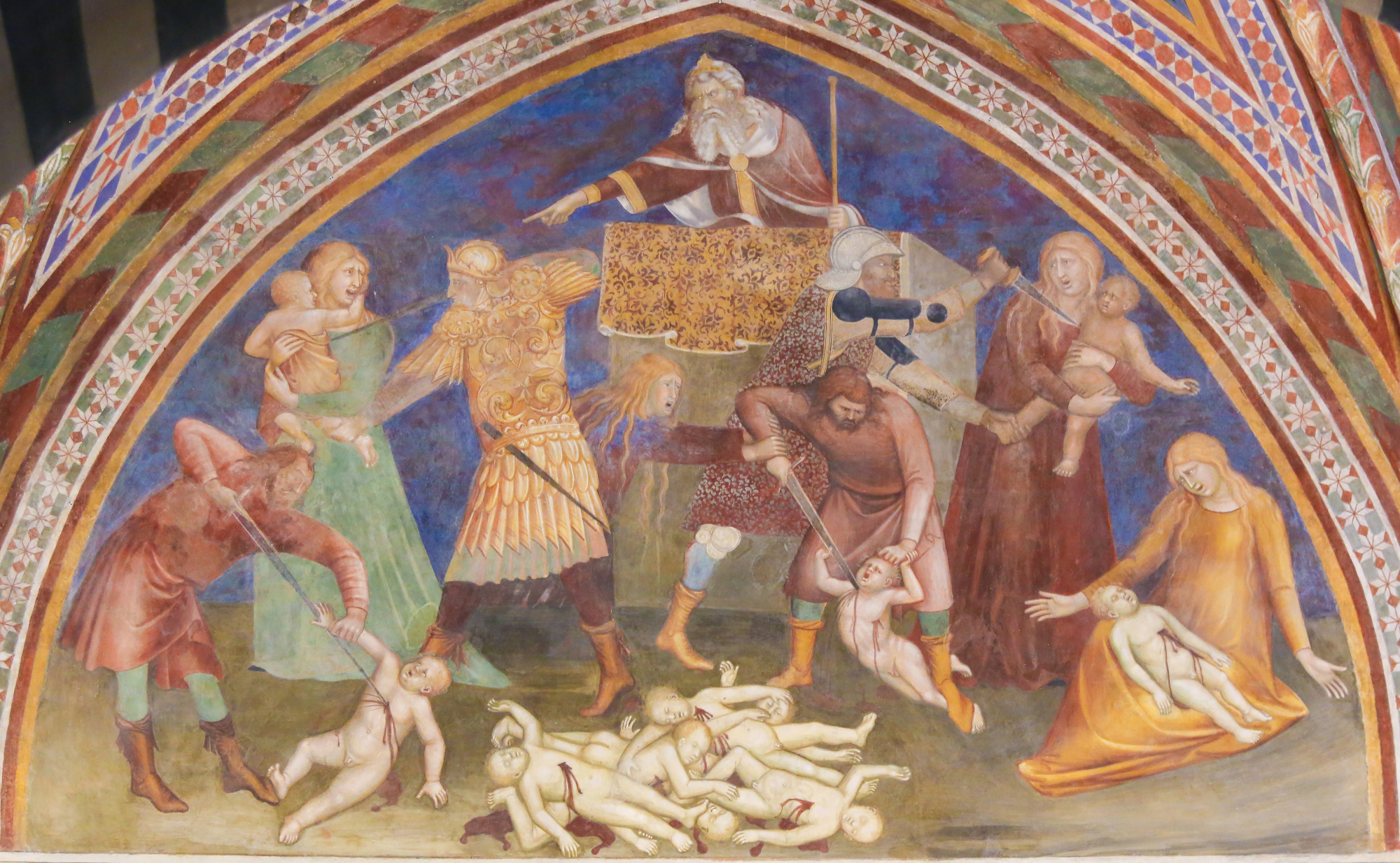
When Herod saw that he had been tricked by the magi, he was infuriated, and he sent and killed all the children in and around Bethlehem who were two years old or under, according to the time that he had learned from the magi. Then what had been spoken through the prophet Jeremiah was fulfilled:
A voice was heard in Ramah, wailing and loud lamentation, Rachel weeping for her children; she refused to be consoled, because they are no more.
—Matthew 2:16–18
Even though we often omit it from our Christmas pageants and sermons, the Massacre of the Innocents recounted in Matthew 2 is part of the Christmas story. December 28 is set apart yearly to commemorate the babies who lost their lives in this slaughter. View posts on this subject from previous years here and here.
LOOK: Massacre of the Innocents by Lippo Memmi (attrib.)
Attributed to Lippo Memmi (Italian, ca. 1291–1356), Massacre of the Innocents, ca. 1335–45. Fresco, Collegiate Church of San Gimignano, Italy.
In the Collegiate Church of San Gimignano, this scene is part of a narrative cycle on Christ’s infancy in six upper bays, comprising also the Annunciation, the Nativity and Adoration of the Shepherds, the Adoration of the Magi, the Presentation in the Temple, and the Flight to Egypt.
LISTEN: “And Herod Rages On”| Words by Kate Bluett, 2020 | Music by Elise Massa, 2020 | Performed by Elise Massa
The streets ran red in Bethlehem; our little boys were gone when soldiers came on Herod’s whim, but Herod rages on. No newborn king his light should dim; he’d be the only dawn, sent men to tear them limb from limb— and Herod rages on.
Two thousand years, all filled with births and stained as red as dawn by blood that soaks the thirsty earth, still Herod rages on. And what is all this bloodshed worth, our sons and daughters gone, but barren fields and empty hearths, while Herod rages on?
Dear infant Christ in Joseph’s arms, escaped before the dawn, O come and heal how we’ve been harmed, for Herod rages on. The sirens shriek, deep fear alarms; when will you make them gone? Or must we wait ’til hate’s disarmed? For Herod rages on.
The stones that wept in Abel’s gore cry out with every dawn ’til swords are laid down evermore, while Herod rages on. Someday he’ll fall to rise no more; someday he will be gone. Our hearts ’til then are bleeding sore, and Herod rages on.
This song by Kate Bluett and Elise Massa views Herod as representative of any political leader whose policymaking or direct command threatens the lives of innocent children today. Lord, have mercy.
This post is part of a daily Christmas series that goes through January 6. View all the posts here, and the accompanying Spotify playlist here.
Warning: This post contains distressing photographs, including one of an emaciated child and one of a wounded (but bandaged) infant.
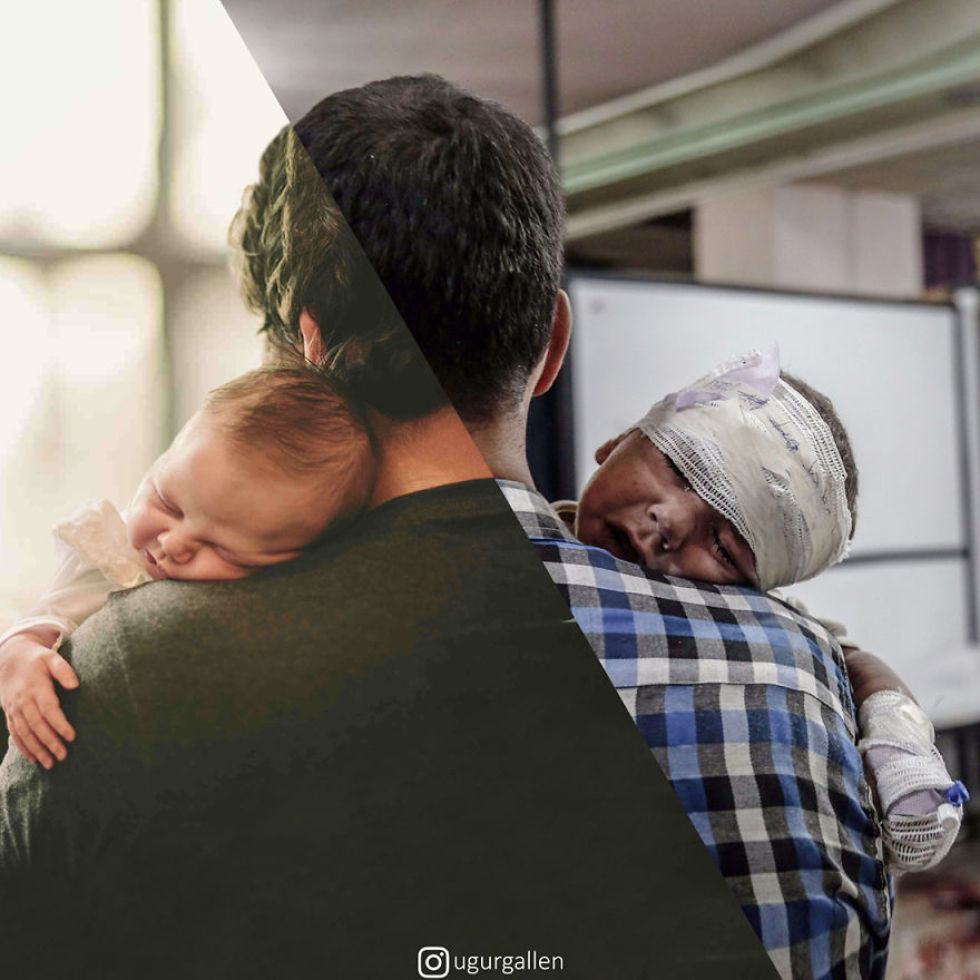
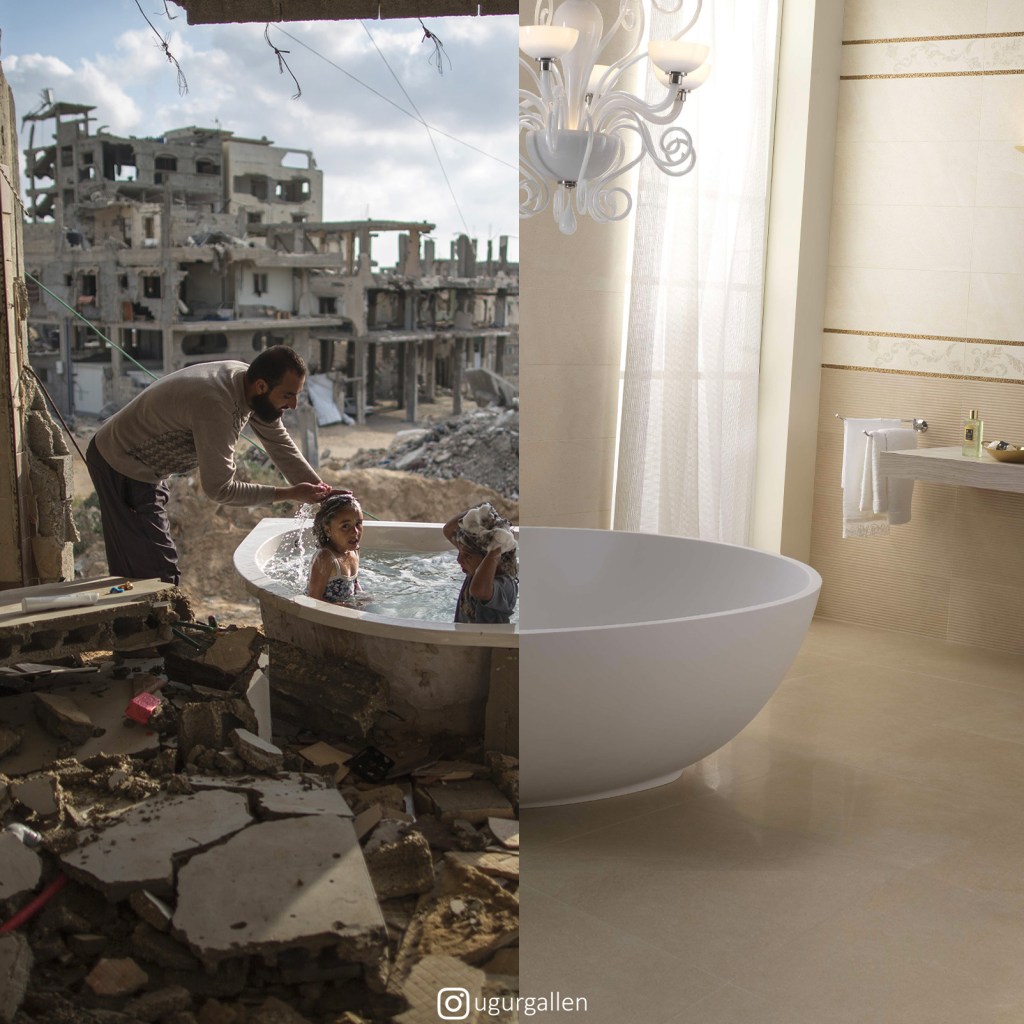
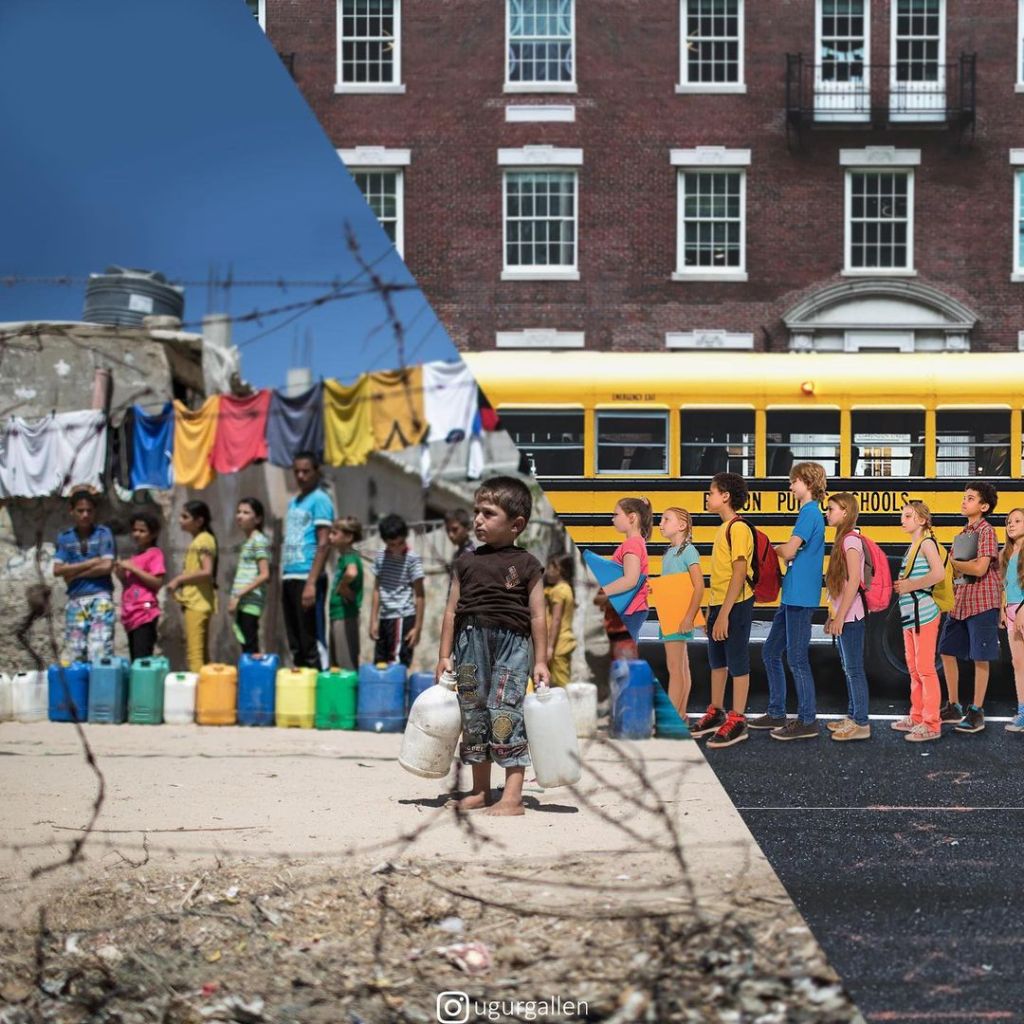
Uğur Gallenkuş (Turkish, 1990–) is an Istanbul-based artist whose digital photomontages address the widening global divide between the privileged and the oppressed. By combining photojournalistic images and stock photos with similar compositional elements, he juxtaposes the relative safety, stability, comfort, and flourishing experienced by middle- and upper-class Westerners with the violence, terror, trauma, and hardship experienced by victims of poverty, war, and displacement. Because Gallenkuş lives in the Middle East, he focuses on that geographic region.
Releasing November 20 in honor of World Children’s Day, Parallel Universes of Children brings together fifty of Gallenkuş’s sobering mash-ups, integrating facts of children’s lived realities around the world. It is $60 plus shipping, available only through the artist’s website. (For US buyers, there’s stock warehoused in New Jersey, so you won’t be paying to ship it from Turkey.)
“I aim to create awareness and inspire action to remember and to ask ourselves every day what we have done to safeguard children’s rights, both near home and across the globe,” Gallenkuş says. He wants not only to alert the well-off to the suffering they often shield themselves from, shaking them out of their complacency, but also to remind those in underdeveloped countries that they deserve better government and education, the right to thrive.
I’ve linked each image to its source on Instagram, where you can find out more information about it—when and where the photograph was taken and by whom (Gallenkuş does not take the photos himself), context, stats, etc. Some of the links will take you to a revised (updated) form of the image; in those instances, the originals I found at Juxtapoze.
The stark contrast between the two component photos of each montage is jolting, intentionally so. Reflecting socioeconomic and political disparities, they tell drastically different stories about childhood. My existence must look like a fairy tale to those who have grown up in war zones or refugee camps.
One of Gallenkuş’s montages shows a lavish bathroom with a chandelier, pristine tiles, and freshly pressed towels next to the remnants of a bathroom whose walls were blown out by an Israeli airstrike, where a father bathes his daughter and niece.
Another one shows a line of American schoolchildren waiting to board a bus, which transforms into a line of Palestinian children waiting to fill jerrycans and bottles with drinking water from public taps at the Deir al-Balah refugee camp in central Gaza Strip. (Many fall sick from the water, whose source is polluted with human waste.)
Consider, too, the differences in play. A child at an IDP camp plays with a toy grenade launcher, while his counterpart plays doctor. A Syrian boy has fun balancing on the barrel of a tank in a pile of wreckage, while opposite him, in a green park, a boy rides a harmless seesaw. The imaginations of children are shaped by what surrounds them, whether that be violence or possibility.
Jonah Swallowed and Jonah Cast Up, commentary by Victoria Emily Jones: My latest visual meditation for ArtWay was published Sunday—it’s on two third-century Jonah sculptures from Asia Minor that likely decorated a family fountain. Early Christians read the story allegorically (at least on one level), as pointing forward to the death and resurrection of Christ. The “great fish” is portrayed as a ketos, a sea-monster of Greek myth.
“Jonah Swallowed” and “Jonah Cast Up,” made in Asia Minor, probably Phrygia, 280–90 CE. Marble, 50.4 × 15.5 × 26.9 cm (left) and 41.5 × 36 × 18.5 cm (right). Cleveland Museum of Art, Ohio.
Run by Marleen Hengelaar-Rookmaaker, the faith-based website ArtWay has been publishing a new visual meditation every Sunday for years, as well as a lot of other content from a variety of contributors. To subscribe to the weekly email, click here. Here are just a few VMs published in the past year that I particularly enjoyed:
Manu-Kahu by Brett a’Court, commentary by Rod Pattenden: Pattenden begins, “This striking image of an airborne Christ is from New Zealand painter Brett a’Court. It is part of his investigations into a way of bringing together the spiritual insights of the indigenous culture of the Maori people and that of Christianity brought to New Zealand by British settlers. In cultural terms it is a hybrid image. This is something that occurs when two cultures are in a process of mutual re-assessment. That sort of conversation is full of conflict and critique but also allows for the potential for new forms to arise that express the best of both traditions. A Christ figure flying in the sky like a kite, is such a form. It is a new thing, a potential heresy or aberration, but one full of potential for new insight and spiritual refreshment.”
Brett a’Court (New Zealand, 1968–), Manu-Kahu, 2007. Oil on canvas.
Knife Angel by Alfie Bradley, commentary by Rachel Wilkerson: This twenty-seven-foot-tall sculpture, welded from 100,000 knives collected in confiscations and amnesties around the UK, confronts the issue of knife violence. The artist cleaned and dulled the blade of each knife he received and engraved personal messages on all the wings’ “feathers,” messages sent by families affected by knife violence.
Cathedra by Barnett Newman, commentary by Grady van den Bosch: I saw this painting in Amsterdam last spring and was surprised by how it compelled me. (I don’t typically gravitate to abstract art.) After spending some time up close—I supposed this was a Newman, and Newman says his paintings need to be experienced up close—I looked at the label and saw that it has a religiously inflected title: Cathedra. The word is Latin for “seat,” and in Christianity it refers specifically to the bishop’s chair inside a church (churches that had a cathedra were called cathedrals). But Newman was of Jewish descent, and van den Bosch writes that Cathedra is meant to represent the throne of God. “And above the firmament that was over their heads was the likeness of a throne, as the appearance of a sapphire stone . . .” (Ezek. 1:26).
Barnett Newman (American, 1905–1970), Cathedra, 1951. Oil and acrylic on canvas, 243 × 543 cm. Stedelijk Museum, Amsterdam, Netherlands. Photo: Victoria Emily Jones.
As someone who loves historical Christian art, including its many Christ Pantocrators, I must nevertheless admit that there is something so right about modern artists’ often apophatic approach to evoking the Divine. While I do believe God imaged Godself in the person of Jesus Christ and is therefore representable, I understand the argument some make that abstraction is a better visual language for spiritual subject matter or encounter. I accept both/and. Whether God is shown as a rich, blue expanse that invites and envelops, or a heroic nude emerging from the jaws of death, or a Man of Sorrows head with a harrier hawk’s body, I think we can learn a little something from the diversity of representations, which are not mutually exclusive. Not all representations need be embraced, but nor do unfamiliar, difficult, or even shocking ones need be automatically dismissed.
Click on the link for more on how to read Newman’s color field paintings, including his signature “zips.”
The course aims to help Christians develop critical tools for watching television and a vocabulary that is as rich and thoughtful as the medium itself, so that we can engage it constructively. (It need not be mindless entertainment!) Callaway explores television as a technology, a narrative art form, a commodity, and a portal for our ritual lives. He’s interested in how stories are told in this episodic, audiovisual format, and what that means for the Story we tell. The course is not about what Christians should watch, but how Christians should watch, leaving ample room for individual viewers to set their own boundaries, ethical and otherwise. (Callaway acknowledges that TV can form as well as de-form us.) He discusses empathy building and access to other perspectives, knowing your sensibilities, how being offended can be useful, watching in community, seeing God in all places, being aware of how your desires and imagination are being shaped, Christians in Hollywood (and Christian characters on TV), and the culture shaping TV and TV shaping culture, among other things.
The course is fairly broad in its approach; it does not analyze particular shows or episodes, though some specific examples are mentioned in conversations, and students are encouraged to form discussion groups with friends or family members and apply what they’re learning to shows of their choice. I really appreciated the assigned PBS docuseries America in Primetime (somewhat outdated because made in 2011 but very good nonetheless), whose four episodes explore character types throughout the history of TV, from the fifties to today: “The Independent Woman,” “Man of the House,” “The Misfit,” and “The Crusader.” From taking this course I realized how many acclaimed TV shows I’ve never seen. I’ve got a lot of homework to do!
Other arts courses offered by Fuller Formation are
POEM: “My Mother’s Body” by Marie Howe, read with commentary by Pádraig Ó Tuama: As Mother’s Day is Sunday, I thought I’d share this wonderful, sad-sweet, mother-themed episode of the new Poetry Unbound podcast from On Being Studios. Pádraig Ó Tuama introduces Marie Howe’s “My Mother’s Body,” in which a middle-age woman, caring for her dying mother, thinks back to the time when her mother was just a twenty-four-year-old girl giving birth to her. The speaker in the poem is Howe.
She imagines being in her mother’s womb, experiencing the rhythm of her mother’s heartbeat. (What an exercise, to imagine yourself as your mother’s baby!) Now decades later, her mother is dying—that heart is failing, and the kidneys too. The uterus has been removed. Toggling between the two time frames, the poem is both a celebration of the strength of women’s bodies and a lament for its vulnerabilities, especially in old age. Howe marvels at how her mother’s body was capable of such a wonder as giving and sustaining life, and now to see that once-vibrant form breaking down grieves her. In some sense their roles have switched as daughter mothers mother, combing her hair, changing her soiled bedsheets.
The poem opens with “Bless my mother’s body” and ends with “Bless this body she made . . .” In the progression of pronouns in the last two lines—my, her, our—is a recognition of how our mothers always remain a physical part of us. They are in our cells. “My Mother’s Body” is a thank-you and a letting go.
ARTICLE: “5 Contemporary Poets Christians Should Read” by Mischa Willett:“There is so much good crop still being pulled from the fertile fields of theologically inflected verse,” writes poet Mischa Willett—so don’t stop short, content merely with Donne and Hopkins! This is an excellent short list of contemporary poets of faith, with summaries of key themes and recommendations for which volume(s) to start with. Willet was recently on The Ride Home with John and Kathy to discuss this topic, and he wrote a follow-up post on his blog.
+++
MUSIC VIDEO: “I Am a Poor Wayfaring Stranger”: One of the most poignant scenes in last year’s 1917 is when, after a harrowing journey across No Man’s Land, Lance Corporal William Schofield—exhausted, disoriented—reaches a wood and encounters a fellow British soldier singing the spiritual “Wayfaring Stranger” [previously] to a battalion that sits at somber attention, for they’re about to go into battle. This official music video from Sony splices together clips from the movie with studio footage of the actor and singer Jos Slovick.



 Art & Theology