
Jina la Bwana ni takatifu! (Artful Devotion)

At that time Mary got ready and hurried to a town in the hill country of Judea, where she entered Zechariah’s home and greeted Elizabeth. When Elizabeth heard Mary’s greeting, the baby leaped in her womb, and Elizabeth was filled with the Holy Spirit. In a loud voice she exclaimed: “Blessed are you among women, and blessed is the child you will bear! But why am I so favored, that the mother of my Lord should come to me? As soon as the sound of your greeting reached my ears, the baby in my womb leaped for joy. Blessed is she who has believed that the Lord would fulfill his promises to her!”

And Mary said:

“My soul glorifies the Lord
and my spirit rejoices in God my Savior,
for he has been mindful
of the humble state of his servant.
From now on all generations will call me blessed,
for the Mighty One has done great things for me—
holy is his name.
His mercy extends to those who fear him,
from generation to generation.
He has performed mighty deeds with his arm;
he has scattered those who are proud in their inmost thoughts.
He has brought down rulers from their thrones
but has lifted up the humble.
He has filled the hungry with good things
but has sent the rich away empty.
He has helped his servant Israel,
remembering to be merciful
to Abraham and his descendants forever,
just as he promised our ancestors.”

—Luke 1:39–55

+++

SONG: “Jina la Bwana: An African Magnificat” by Steven C. Warner, 1995 | Performed by the University of Notre Dame Folk Choir, on Prophets of Joy (1996)

The Swahili refrain, “Jina la Bwana ni takatifu,” translates as “The name of the Lord is holy.”

+++
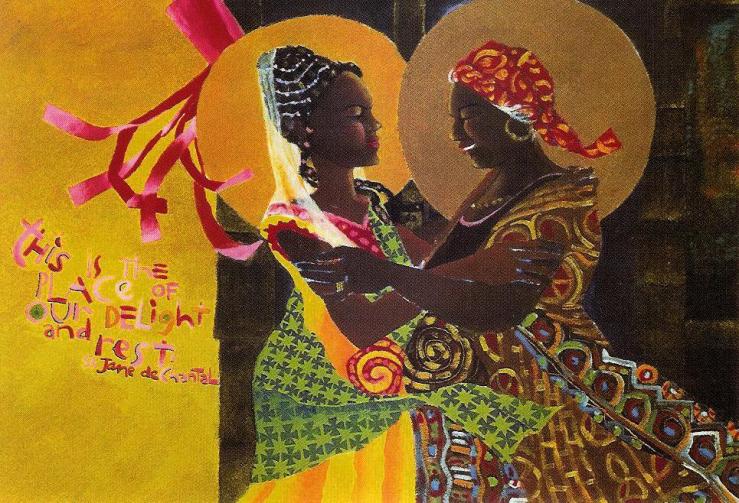
Windsock Visitation by Mickey McGrath
Mickey McGrath, OSFS (American), Windsock Visitation, 1995. Visitation Monastery of Minneapolis.

Artist’s statement:

This image of the Visitation of Mary and Elizabeth was commissioned for the Monastery of the Visitation in north Minneapolis, a group of monastic sisters very near and dear to my heart. In what has become a well-known neighborhood tradition, the sisters hang a windsock outside their house every other day of the week as a signal to the neighborhood children that they can come in and enjoy after-school activities. They read and paint. They pray and have fun. The sisters celebrate birthdays with the kids and walk through hard times with them as well. The spirit of the first Visitation, where Jesus was so lovingly shared between two kinswomen, is very much alive today and is the inspiration for this painting.

Mary, dressed in gold because she is the woman clothed with the sun, also wears a cape with green stars and blue crosses, which symbolize Bethlehem and Calvary. She is a little fearful of the news she has recently received herself, that she was pregnant with God’s child. But Luke tells us that she put her fears aside to be with her cousin Elizabeth and help her in her own miraculous pregnancy. Elizabeth’s bright and welcoming smile assures Mary, and us, that in God’s plans, everything always works out for the best. The tops of their halos form a heart which meets at the bottom in the wombs of the two women. The fluttering windsock behind them reminds us of the wind of the Holy Spirit, ever fresh, ever new.


This post belongs to the weekly series Artful Devotion. If you can’t view the music player in your email or RSS reader, try opening the post in your browser.

To view all the Revised Common Lectionary scripture readings for the Third Sunday of Advent, cycle B, click here.
Advent 2017 online arts devotional by Biola University

The Advent Project published yearly by Biola University’s Center for Christianity, Culture, and the Arts (CCCA) is an online devotional that brings together daily scripture readings, visual art, music, poetry, and written reflections for the seasons of Advent and Christmas (which this year is December 3–January 6). Introduced in 2013, it is the only recurrently published art-forward Advent/Christmas devotional I know of, and I recommend it highly. It is in large part what inspired my year-round “Artful Devotion” series and the Advent art booklet I published digitally last year.

Click here to view and/or subscribe to Biola’s Advent Project 2017.

With so many different elements, design matters a lot, and I’m super-impressed by what Biola has come up with. The homepage is laid out as a gridded calendar with thumbnail images; click on a date, and you’re brought to a new viewing mode in which a large image and a music player are set in a fixed position on the left while the right sidebar contains scrollable text, separated into two tabs—the main content, and biographical information about the artists. This design enables the image to remain before your eyes so that you can continue to reference it as you read on (something that, frustratingly, I cannot achieve with Art & Theology’s long-scrolling format), and it also relegates the bios to “back matter.” It’s all very organized and easily navigable.

This initiative is an outworking of the CCCA’s mission to explore the rich interrelationships between contemporary art making, theology, and religious tradition. Be sure to check out the other sections of their website; they offer plenty of free resources, including an archive of past Advent (and Lent!) devotionals, and a calendar of events, such as lectures, workshops, symposia, art exhibitions, concerts, film screenings, and more.

Below is one of my favorite Advent Project entries from last year, reproduced by kind permission of the CCCA. Centered on Mary’s Magnificat, it brings together the work of an Italian Renaissance painter, a contemporary British video artist (who I’ve written about before), a modern Bohemian Austrian poet, and a minimalist composer working with Spanish, Latin, and English texts. Adjunct professor of philosophy Evan Rosa (who is a superb writer!) reflects on how scandalous Mary’s humility is for power-hungry Western Christians—just as it would have been for the Greco-Roman world in which she lived. He concludes with a prayer that invites us to move from self-magnification to the magnification of God.

Due to this blog’s design limitations, I had to adapt the following content from its original format. To view the devotion on the Biola website, click here. I have excluded biographical information for the song performers and poet.

+++

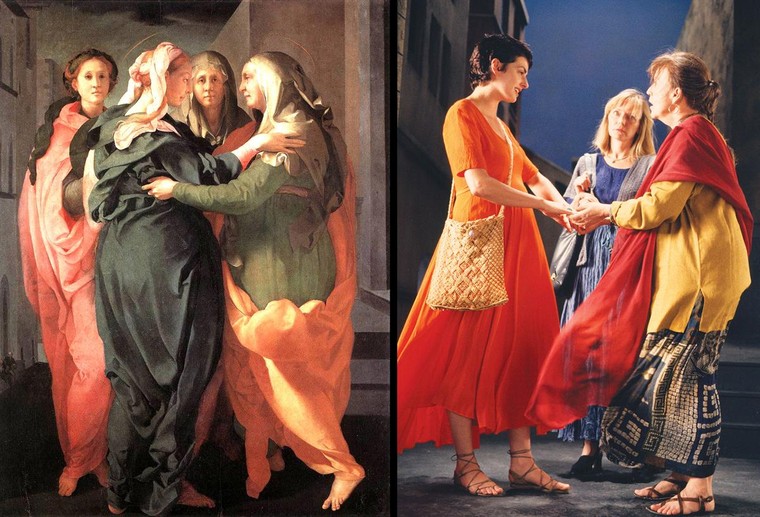
ARTWORKS: The Visitation by Pontormo; The Greeting by Bill Viola

The Greeting by Bill Viola
Left: Jacopo da Pontormo, The Visitation, 1528, oil on canvas, Church of San Francesco de Michele, Carmignano, Italy. Right: Bill Viola, The Greeting, 1995, still image from a large-screen video installation.

About the Artist and Artwork #1:

Jacopo Carucci (1494–1557), usually known as Pontormo, was an Italian Mannerist painter and portraitist from the Florentine School. His work represents a profound stylistic shift from the calm perspectival regularity that characterized the art of the Florentine Renaissance. He is famous for his use of twining poses, coupled with ambiguous perspective; his figures often seem to float in an uncertain environment, unhampered by the forces of gravity. Pontormo’s painting The Visitation, completed in 1528, now adorns the altar of a side chapel in a small church called the Pieve di San Michele in Carmignano, a town west of Florence, Italy. The setting for this painting is the visitation of the Virgin Mary on her older pregnant cousin Elizabeth, the wife of Zacharias. Elizabeth and Mary, who are painted in profile, gracefully embrace each other as they exchange glances of mutual affection and share in the news of Mary’s pregnancy. They dominate the canvas as they stand on the threshold of Zacharias’s house.

About the Artist and Artwork #2:

Bill Viola (b. 1951) is internationally recognized as one of today’s leading artists. He has been instrumental in the establishment of video as a vital form of contemporary art, and in so doing has helped to greatly expand its scope in terms of technology, content, and historical reach. His works focus on universal human experiences—birth, death, the unfolding of consciousness—and have roots in both Eastern and Western art as well as spiritual traditions.

Bill Viola’s large-screen video installation The Greeting was inspired by The Visitation, painted by Italian Mannerist artist Jacopo Pontormo. Viola’s video sequence echoes the drama of Pontormo’s Visitation, but transforms the moment into an enigmatic contemporary narrative. In this still frame, three women are dressed in long, flowing garments and stand in an Italianate architectural setting similar to that in Pontormo’s painting. The woman in the orange dress, her stomach visibly swollen, has just entered the scene from the left, interrupting a conversation and perhaps whispering to the older woman the news of her pregnancy. This encounter was filmed in less than a minute, but Viola has slowed the video down to ten minutes. The use of extreme slow motion draws attention to the nuances of the women’s gestures and glances, and intensifies the psychological dynamic of the exchange.  

Continue reading “Advent 2017 online arts devotional by Biola University”

John the Baptist at the National Gallery, London

The feast day of John the Baptist’s birth is coming up on June 24, and London’s National Gallery has provided a great way to immerse yourself in his story—through art! The museum has produced a ten-video series called Saint John the Baptist: From Birth to Beheading, in which Professor Ben Quash, director of the Centre for Arts and the Sacred at King’s College, joins Dr. Jennifer Sliwka, curator of art and religion at the National Gallery, for a stroll through the museum and some nearby sites to discuss various works of art in which John appears.

Quash and Sliwka teach a collaborative master’s program in Christianity and the Arts, which invites participants to

investigate how Christian scripture, beliefs and practices have found expression in art over 2,000 years; trace the idea of beauty in Western theological tradition; make use of examples in London. . . . The MA will enable students to work across disciplinary and specialism boundaries, and in particular to explore simultaneously the art-historical and theological dimensions of Christian art – approaches which are generally pursued in isolation from one another.

Their analysis of the paintings in this video series is superaccessible to those with no art background, and familiarity with Christianity isn’t assumed either.

The ten videos—about eight minutes each—are embedded below.

  1. Introduction

Artwork: Saint John the Baptist from Carlo Crivelli’s Demidoff Altarpiece

  1. Visitation

Artworks: a Visitation painting from the workshop of Goossen van der Weyden; Francesco Zaganelli’s The Baptism of Christ

  1. Birth and Naming

Artworks: scenes from Niccolò di Pietro Gerini’s Baptism Altarpiece; a predella panel by Giovanni di Paolo

  1. Infancy

Artworks: Garofolo’s The Holy Family with Saints; Bronzino’s The Madonna and Child with Saints; Leonardo da Vinci’s The Virgin of the Rocks

  1. Wilderness

Artworks: Giovanni di Paolo’s Saint John the Baptist retiring to the Desert; Saint John the Baptist by an anonymous Italian artist from about 1640–60; Moretto da Brescia’s Christ blessing Saint John the Baptist

  1. Preaching

Artworks: Raphael’s Saint John the Baptist Preaching; Pier Francesco Mola’s Saint John the Baptist preaching in the Wilderness; Parmigianino’s The Madonna and Child with Saints John the Baptist and Jerome

  1. Baptism

Artworks: the baptismal font at Salisbury Cathedral, designed by William Pye; Adam Elsheimer’s The Baptism of Christ; and the most famous painting of this subject in any collection: Piero della Francesca’s The Baptism of Christ

  1. Martyrdom

Artworks: Caravaggio’s The Beheading of Saint John the Baptist at St. John’s Co-Cathedral in Malta; Pierre-Cécile Puvis de Chavanne’s The Beheading of Saint John the Baptist

  1. The Baptist’s Head

Artworks: Caravaggio’s Salome receives the Head of John the Baptist; Ana Maria Pacheco’s Study of Head (John the Baptist III) at a private residence (includes an interview with the artist)

  1. Power and Judgment

Artworks: the anonymous English Portrait of Richard II at Westminster Abbey (John the Baptist was his patron saint); a scene above the central panel of Giovanni dal Ponte’s Ascension of Saint John the Evangelist Altarpiece depicting John the Baptist preparing souls to enter into heaven; and The Wilton Diptych, depicting John the Baptist presenting King Richard to the heavenly retinue


To engage with more art from the National Gallery, consider buying one of the two books I reviewed here.