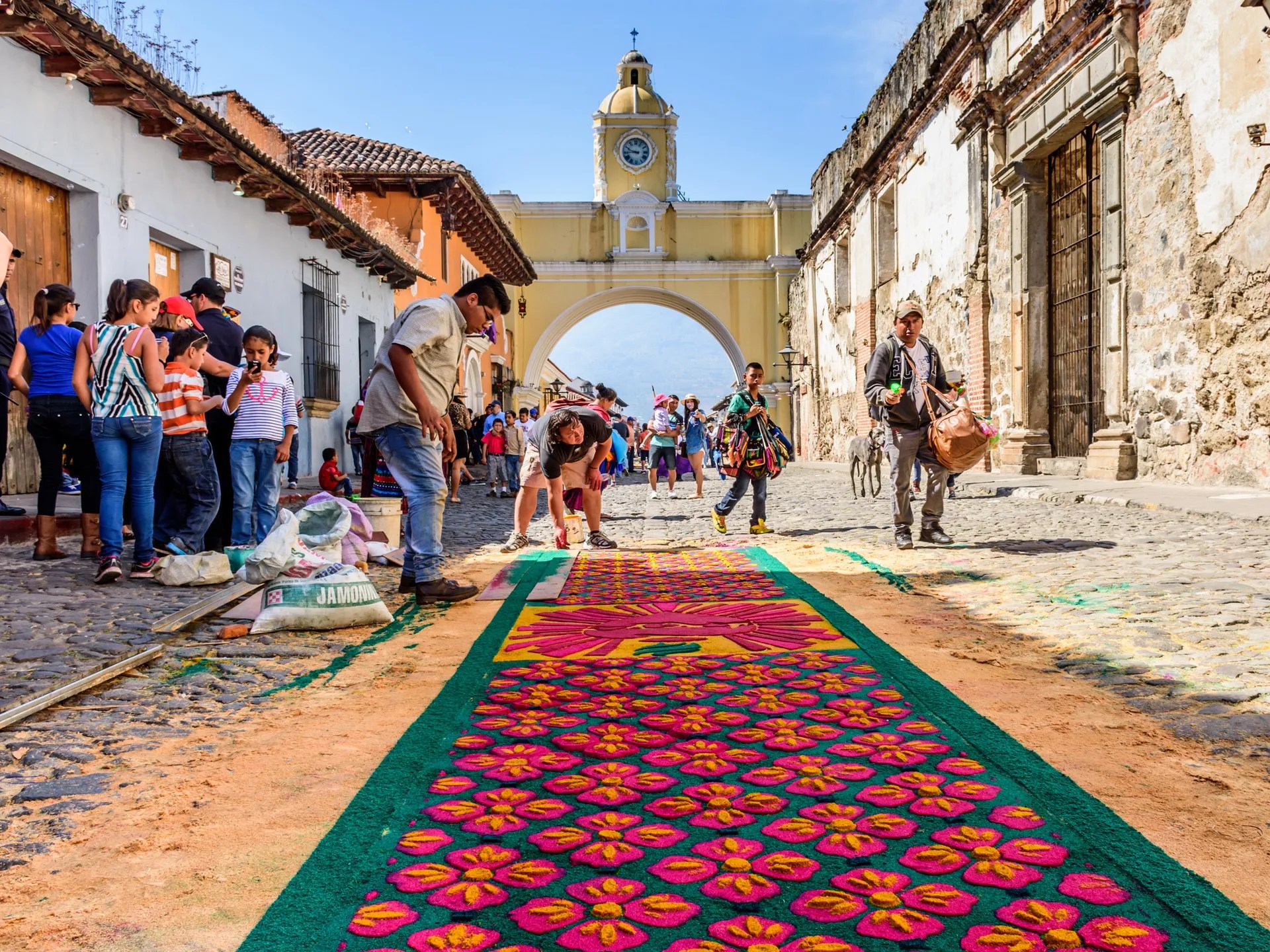
HOLY WEEK TRADITION: Antigua, Guatemala, is renowned for its annual Good Friday observance, which involves the laying out of alfombras (carpets) of multicolored sawdust through the city’s cobblestone streets, hundreds of feet long. On Maundy Thursday, the city closes so that families and businesses can spend the day constructing the carpets, applying the sawdust to planned designs using stencils and strainers and adding pine needles, flowers, fruits, and other natural materials as well.
People watch while locals make an alfombra (carpet) of dyed sawdust for Antigua’s Good Friday processions, the most famous in Latin America. Photo: Lucy Brown, 2016.
At 4 a.m. on Good Friday, the processions begin, with people carrying floats that bear statues of Christ carrying his cross, followed by marching bands playing solemn music. (This is a remembrance of Jesus’s walk to Calvary.) As their feet pass over the alfombras, the dust scatters. Locals and visitors gather along the streets dressed in black for mourning, and at 11 p.m. a figure of Jesus is laid to rest in the church.
Here are two resources for exploring this tradition further:
>> VIDEO: “Alfombras de Semana Santa en Guatemala,” dir.Federica Dominguez: This short film (in Spanish, with English subtitles) interviews Rolando Ortiz, an alfombrero who is also a shoemaker. He explains that the carpets hark back to Jesus’s triumphal entry into Jerusalem, when the crowds strewed his path with palm branches (giving him the red carpet treatment, so to speak). Even though the alfombras last only a brief time, locals spare no expense in bringing them to fruition each year—“for Jesus,” Ortiz says. “It is an act of gratitude above all.” An offering of beauty and praise.
+++
NEW ALBUM: As Foretold, Part 3 by Poor Bishop Hooper: Released today, this is the final album in a trilogy based on the prophetic fulfillment passages in the Gospel of Matthew. It centers on Jesus’s passion and concludes with a resurrection epilogue. As with all their music, the duo graciously offers it for free download from their website.
+++
SONGS performed by Emorja Roberson: Emorja Roberson [previously] is a singer, gospel choir conductor, and assistant professor of music and African American studies at Oxford College of Emory University in Georgia. I enjoy following his YouTube channel. Here are two songs that are especially fitting for Holy Week.
>> “I Know It Was the Blood”: Roberson sings three verses of this beloved African American spiritual: the title verse, “They whipped him all night long,” and “He never said a mumblin’ word.” The song is more typically sung in a major key, and its full lyrics span Christ’s passion, resurrection, ascension, and second coming. But Roberson slows down the tempo and sings in a minor key, homing in on the sorrow of Good Friday.
>> “He Decided to Die” by Margaret Pleasant Douroux: Roberson, on keys, sings a gospel classic with friends Marcus Morton and Cameron Scott, a song that emphasizes Christ’s resoluteness on the cross, his endurance for love.
+++
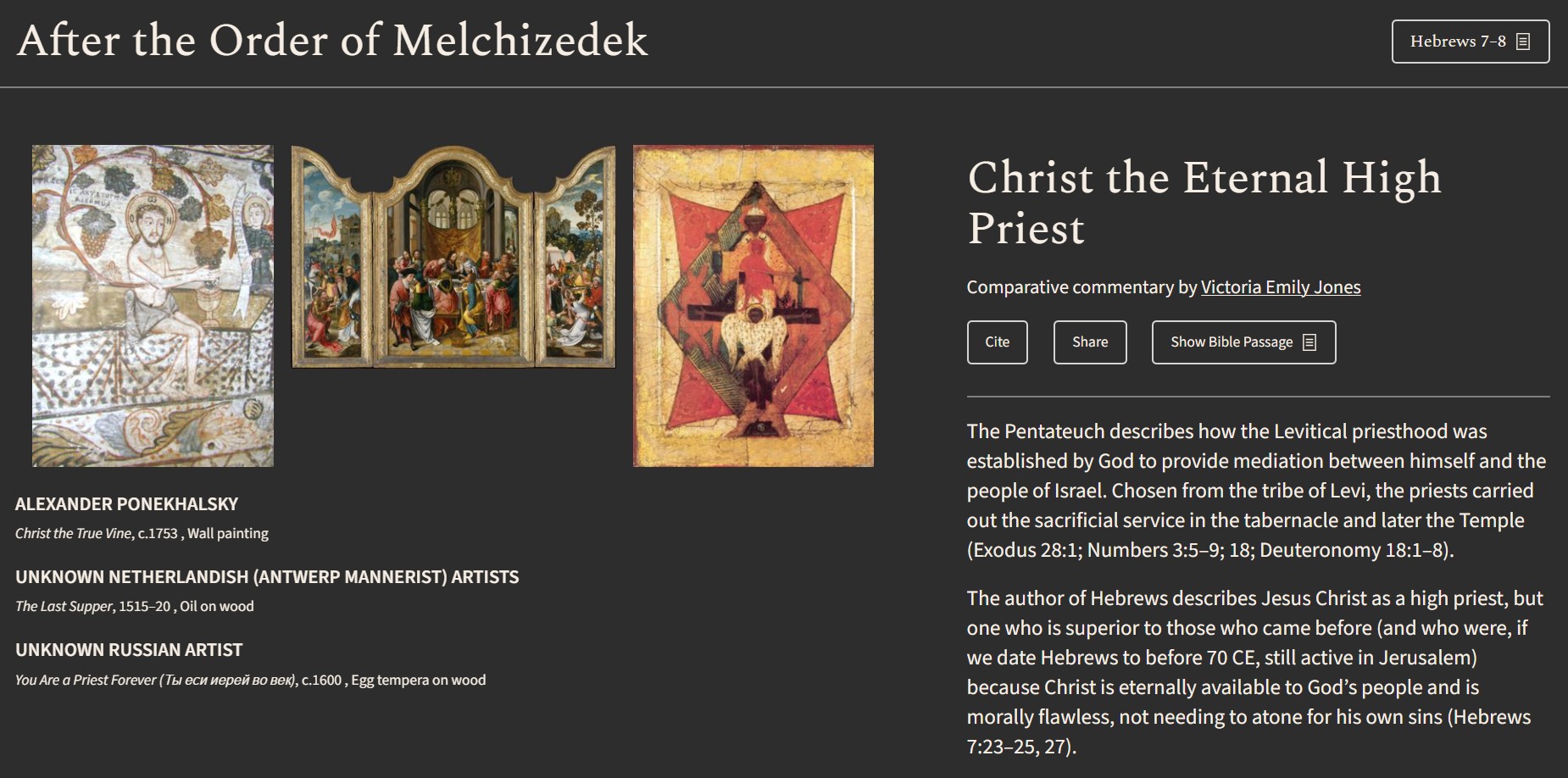
VISUAL COMMENTARIES: “After the Order of Melchizedek” by Victoria Emily Jones: My latest contribution to the Visual Commentary on Scripture, a project based out of King’s College London, was published earlier this month. Tasked with choosing and commenting on three artworks that dialogue with Hebrews 7–8, I landed on a “You Are a Priest Forever” icon from Russia (very strange!), an Antwerp Mannerist triptych that centers the Last Supper, and (my favorite) a wall painting of Christ the Grapevine from a Romanian church. I was interested to explore the idea of how Jesus, in giving his body and blood, is both the offerer and the offered, both priest and sacrifice.
+++
POEM: “The Death of Christ” by Emperor Kangxi: Emperor Kangxi (1654–1722) ruled in China for sixty-one years during the Qing Dynasty. In 1692 he issued the Edict of Toleration, which barred attacks on churches and legalized the practice of Christianity among Chinese people. Curious about and respectful of other faiths, he penned this short poem on the Crucifixion using the classical qi-yen-she form.
+++
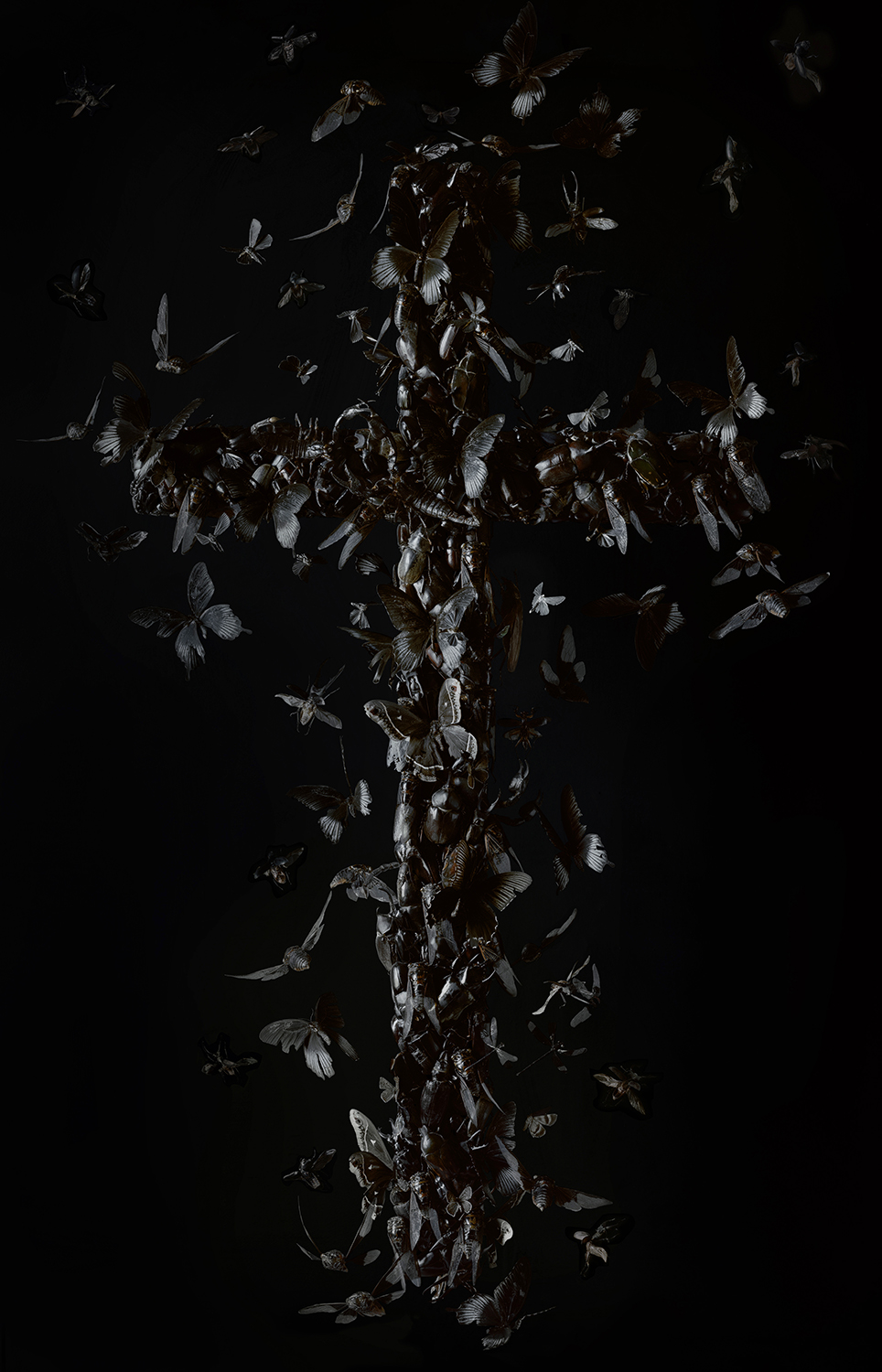
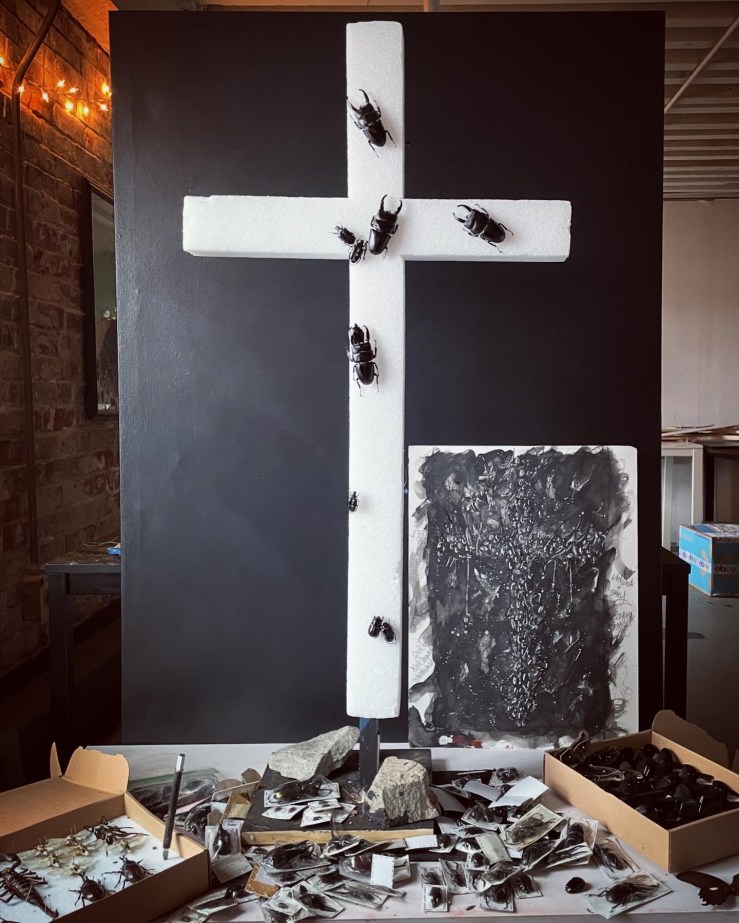
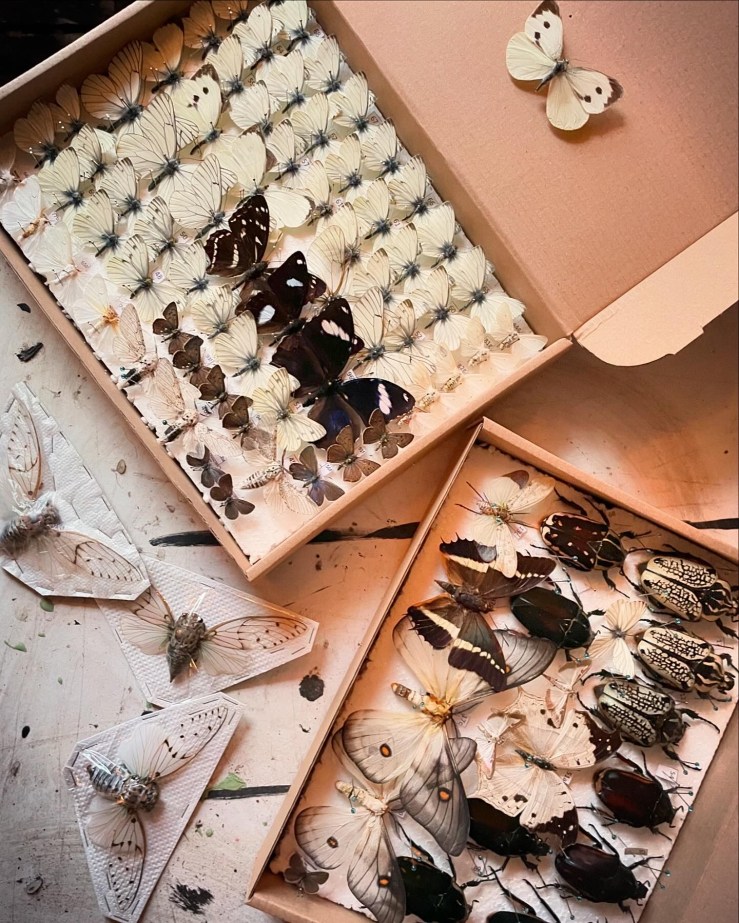
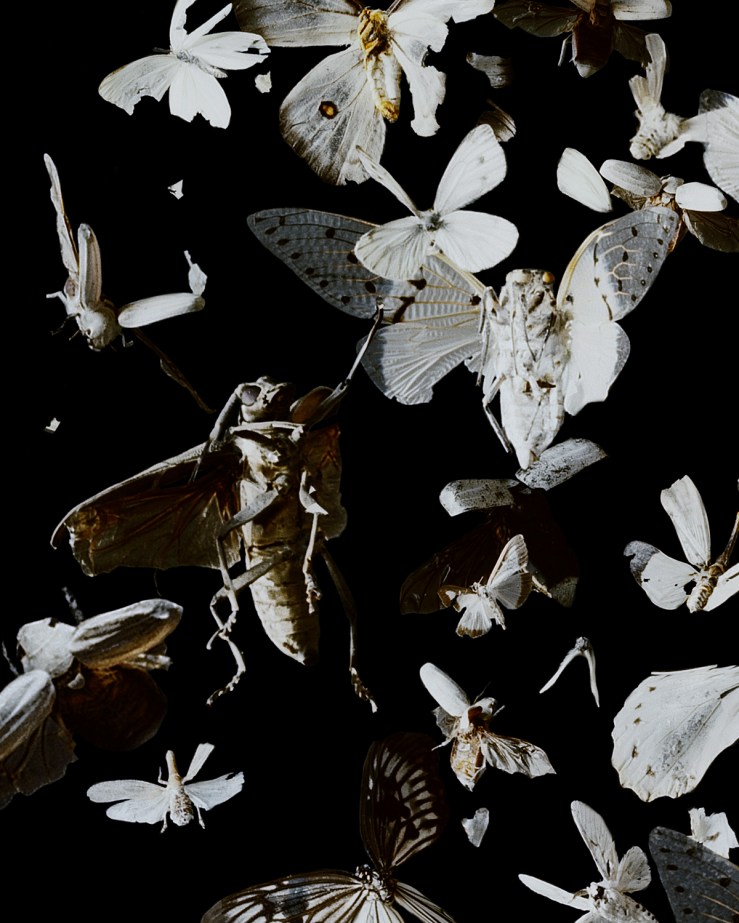
EXHIBITION: Tara Sellios: Ask Now the Beasts, Fitchburg Art Museum, January 18, 2025–January 18, 2026:Tara Sellios is a multidisciplinary artist from South Boston working mainly in large-format photography. Delighting in detail and complex symbolism, she often uses insects, dried fauna, bone, and other organic matter to create elaborate still lifes that she then photographs under dramatic lighting. She is inspired by art historical representations of the end of the world, especially the bizarre paintings of Hieronymus Bosch and Albrecht Dürer’s Apocalypse woodcuts, and by seventeenth-century Dutch vanitas paintings.
The photographs in her current solo show, Ask Now the Beasts at Fitchburg Art Museum in Massachusetts, are “contemporary allegories of suffering and transcendence.” The exhibition’s title comes from Job 12:7.
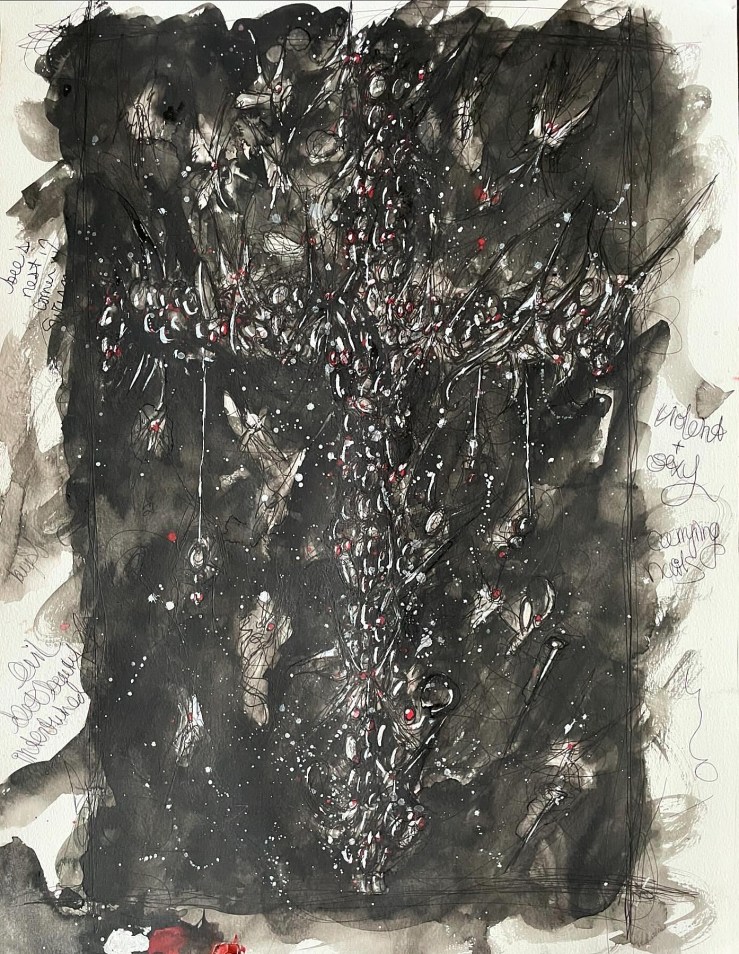
Two of the works on display are a pair of crosses: Umbra (Latin for “darkness” or “shadow”) and Dilucesco (“to begin to grow light, to dawn”), which together suggest a movement from death to resurrection. Constructed with a throng of black beetles and other black insects, the Umbra cross evokes the detail from the Synoptic Gospels’ Crucifixion accounts that at noon, “darkness came over the whole land until three in the afternoon, while the sun’s light failed” (Luke 23:44–45; cf. Matt. 27:45; Mark 15:33). Dilucesco, on the other hand, shows the cross seemingly exploding into light, as white moths and other winged insects break out of their cruciform shape. View these two photographic artworks, plus a few process photos and sketches the artist sent me, below. See, too, www.tarasellios.com.
Tara Sellios (American, 1987–), Umbra, 2024, from the series Ask Now the Beasts. Inkjet print from 8 × 10 negative, 55 × 35 in. Courtesy of the artist.Tara Sellios (American, 1987–), Dilucesco, 2024, from the series Ask Now the Beasts. Inkjet print from 8 × 10 negative, 55 × 35 in. Courtesy of the artist.
>> The Divine Dark, vol. 1: This three-song EP was released December 15, 2024, on Re-Echo Records, a new label for music created by artists from Resurrection Philadelphia church. “The Divine Dark is an ongoing series of original arrangements and compositions for devotion, contemplation, and edification. The series takes its name from a phrase that emerged in the fifth century among Christian mystics to describe the ineffable unknowableness of God . . . in all his kindness, grace, and mystery.”
The first volume features new arrangements by Joshua Stamper [previously] of two seventeenth-century German hymns (both translated into English by Catherine Winkworth, and sung here by Sarah Long), plus one new hymn that Stamper wrote with his wife, Kory Stamper, whose refrain is taken from Psalm 127:4. The songs quietly explore the mysteries of salvation, the Eucharist, and God’s sovereignty as well as some of the paradoxes of God’s character, such as his being both storm and shelter (wild and thundering, but also safe and enfolding).
Volume 2 of The Divine Dark is likely to release later this year.
>> It Is Good to Be Here with You by Nick Chambers: Out today, the first full-length album by singer-songwriter Nick Chambers. These songs of spiritual seeking touch on sobriety, divine nearness, ambiguity and wonder, the pursuit of understanding or insight, the longing to be held and loved, and more. Chambers deftly weaves voices from scripture—the blind beggar Bartimaeus, who cried out to Christ for mercy; the sons of Korah, who thirsted for God like a deer thirsts for water; the apostle Paul, who experienced a frustrating tension between desire and action—with his own poetic voice, finding companionship with those ancient seekers who were transformed by their encounters God. There’s reference to the wrestling patriarch Jacob, the blazing bush-vision of Moses, Elijah in a wilderness cave, the mount of Transfiguration, the eighth day of creation. Besides biblical texts, the songs bear influences from writers Rainer Maria Rilke, Madeleine L’Engle, Gregory of Nyssa, and Esther de Waal.
The album features some co-writing contributions by Jon Guerra (“Hold Me”), Paul Zach (“A Sweeter Word,” “Always Already”), and Tyson Matthews (“It Is Good to Be Here with You”).
My favorite tracks: “To an Unknown God,” “Hear,” “Thanks Be to God.”
+++
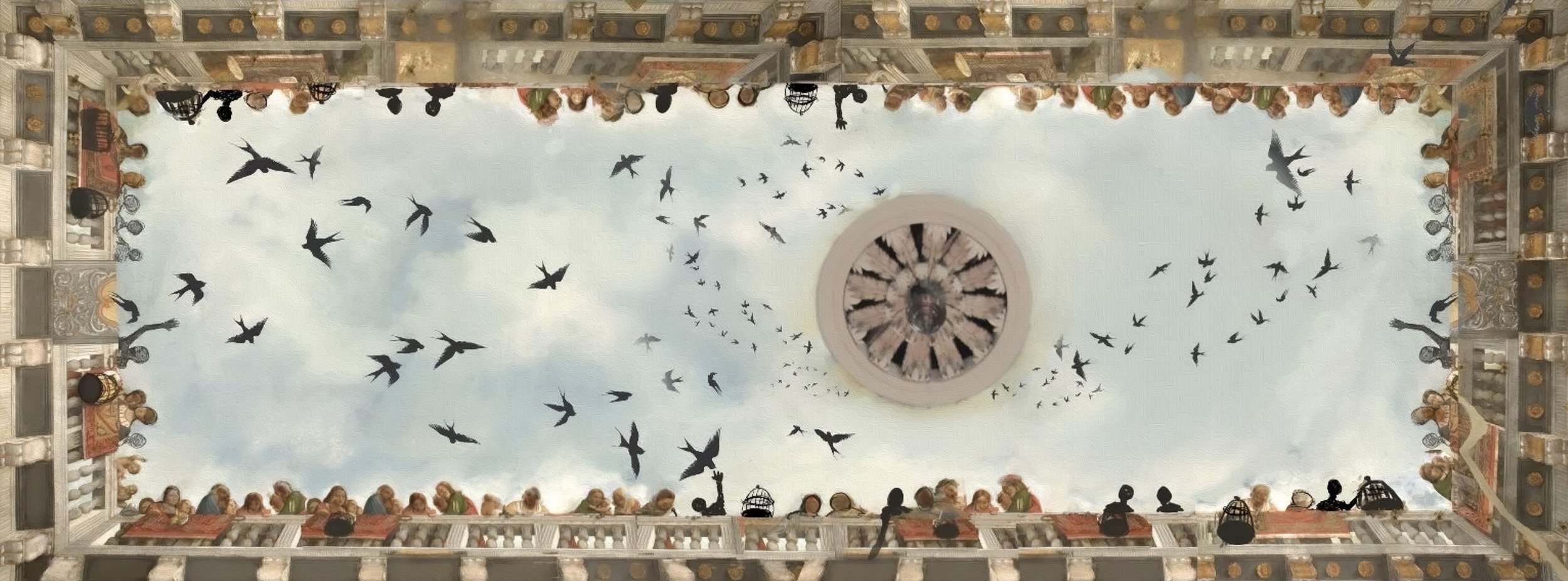
NEW ART COMMISSION: Memorial to Enslaved Persons by Harmonia Rosales, King’s Chapel, Boston:Harmonia Rosales, an Afro-Cuban artist born and raised in Chicago and living in Los Angeles, is at work on a three-part commission for the historic King’s Chapel at 58 Tremont Street in Boston, a church originally built in wood in 1686 and then rebuilt in stone in the 1750s. One of the oldest churches in the United States, it (and its adjacent burying ground) is one of the stops along the Freedom Trail, and it still has an active congregation.
Conceptual image of the mural by Harmonia Rosales that’s being installed this year on the ceiling of King’s Chapel in Boston, Massachusetts
Despite being in the North, King’s Chapel has links to the slave trade. Historical documents reveal that at least 219 persons, most of them of African descent but at least two of them Native American, were enslaved by ministers and members of the church throughout its history, and that even after slavery was abolished in Massachusetts in 1783, donations to the church continued to flow in from people whose wealth depended on Southern slave labor, such as textile magnates. You can read more details in Slavery and King’s Chapel, the thirty-two-page report published by King’s Chapel’s Ad Hoc Committee on Slavery in 2018.
Until at least the mid-nineteenth century, people of color, both enslaved and free, who attended King’s Chapel were relegated to the balcony seats. We know the names of 182 enslaved attendees from the church’s baptismal, marriage, and burial registers. “As a community of faith,” the church writes on its website, “we are working to recover, honor, and remember these long-overlooked members of our community. We hope to make their lives and their presence in early Boston visible in new and powerful ways as we tell a more complete version of our history for our congregation, our city, and the 4 million people who walk the Freedom Trail each year.”
In addition to setting up a “living fund” to “provide monetary support for programs and engagement centered around reparative justice and reconciliation in the community,” the church has hired artist Harmonia Rosales, in partnership with the MASS Design Group, to create a physical commemoration of this history, which has three components: a figurative sculpture in the church’s courtyard, a collection of bronze birds perched throughout the church’s exterior and grounds, and a trompe l’oeil ceiling mural in the sanctuary. The memorial will be unveiled later this year. Here are two videos about it:
>> “How a Freedom Trail landmark is reckoning with its ties to slavery,” GBH News, July 19, 2023: This news segment features interview clips of Cassandra Dumay and Jessie Sage O’Leary, Boston University journalism students who are inquiring further into King’s Chapel’s links to the colonial slave trade; Rev. Joy Fallon, senior minister at King’s Chapel; Marissa Cheifetz, director of the King’s Chapel History Program; and memorial committee member David Waters.
>> “VCS Creative Conversations: Ben Quash with Harmonia Rosales,”Visual Commentary on Scripture,February 27, 2025: Theologian and VCS director Ben Quash sits down with artist Harmonia Rosales inside King’s Chapel to discuss her latest commission for that space, plus her paintings Birth of Oshun, The Creation of God, Strangler Fig, and more. Raised in the Santería religious tradition, in her art Rosales draws Yoruba deities (the orishas) into play with Christian ones and centers Black women. Speaking of the VCS’s commitment to showcasing biblical engagement from diverse vantage points, Quash tells Rosales, “We’ve always said that these conversations should not just be about the Bible’s importance to Christians or Jews, but the Bible’s importance to those of other traditions, as something to bounce off, to use, sometimes to object to. And you are a wonderful example of how to do that in a way that’s constantly creative and generous.”
+++
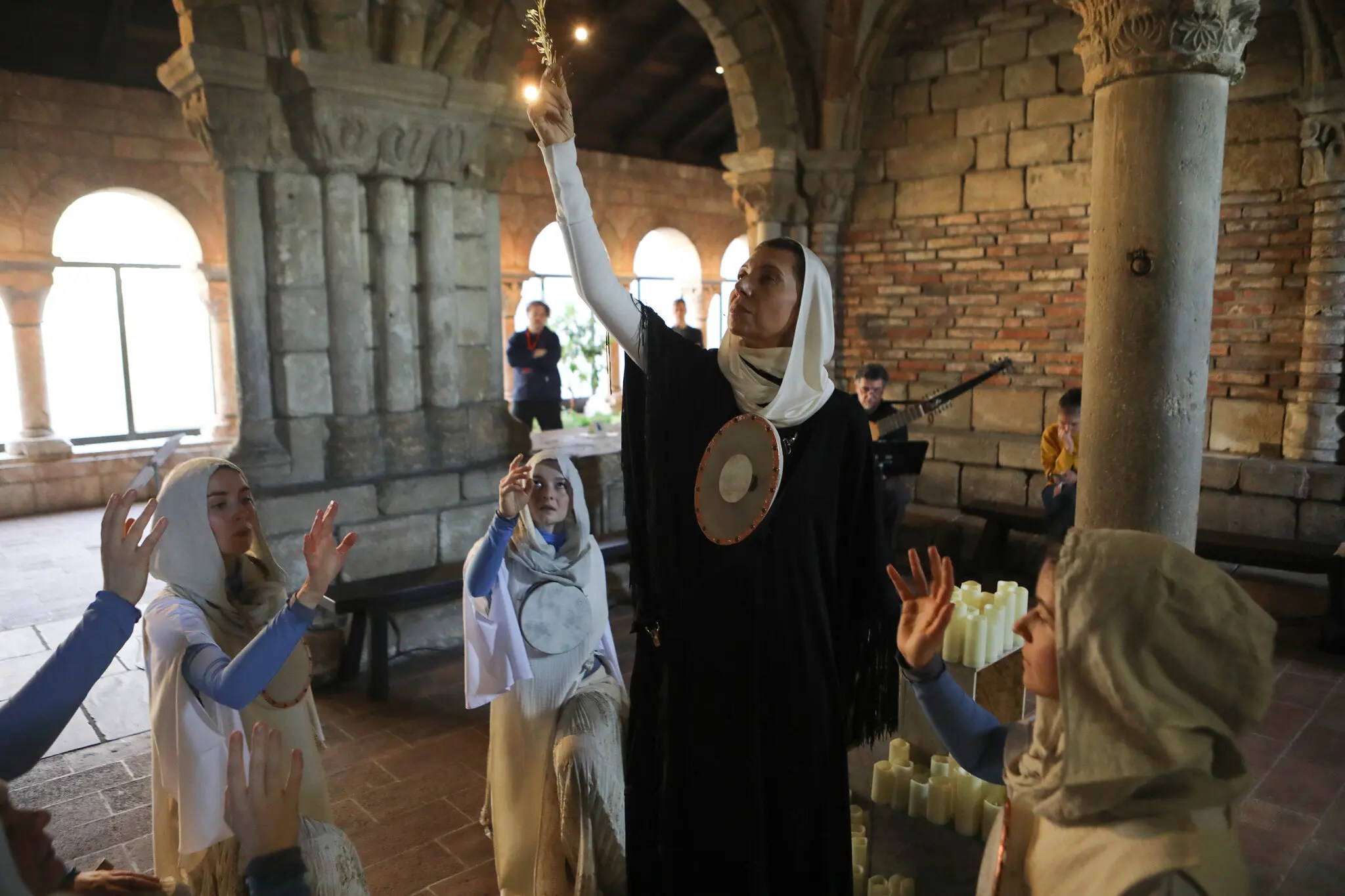
ARTICLE: “At the Cloisters, Sor Juana’s Words Ring Out in Song” by Elisabeth Vincentelli, The New York Times:Primero Sueño (First Dream) is a new opera by Magos Herrera and Paola Prestini that adapts to music the seventeenth-century mystical poem of the same title by the Mexican Catholic nun Sor Juana Inés de la Cruz, one of the greatest literary works of the Hispanic Baroque. Commissioned by the Metropolitan Museum of Art’s Department of Live Arts (MetLiveArts) and VisionIntoArt, it was conceived as a processional opera that meanders throughout the Met Cloisters, audience in tow—an appropriate choice, as the poem is about the soul’s journey. It premiered January 23, with Herrera playing Sor Juana, the nun in black, “sing[ing] in an earthy mezzo that complements the heavenly harmonies of the six nuns in white, performed by the German vocal ensemble Sjaella.” Accompaniment was provided by harps, hand percussion, theorbo, and Spanish guitar. Here’s a trailer (not filmed on location):
Magos Herrera, center, as Sor Juana in a rehearsal of the opera Primero Sueño at the Met Cloisters. Photo: Earl Wilson / The New York Times.
The Cloisters—a building designed to evoke a medieval European monastery and housing a sizeable portion of the Met’s medieval art collection—is one of my favorite spaces in all of New York. What a delight that Herrara, Prestini, and team utilized its halls and rooms as staging ground for this dramatic, musical reimagining of a historic sacred poem by a pioneering female Christian writer.
+++
INTERFAITH ART EXHIBITION: Cloud of Witnesses: Images of Faith and Divinity Today, St John’s Waterloo, London, March 4–April 27, 2025: A juried exhibition featuring the work of twenty-six artists from the UK, funded and supported by Art + Christianity; The God Who Speaks; St John’s Church, Waterloo; the Catholic Bishops’ Conference of England and Wales; Culham St Gabriel Trust; and Bible Society. Click here to view the exhibition catalog.
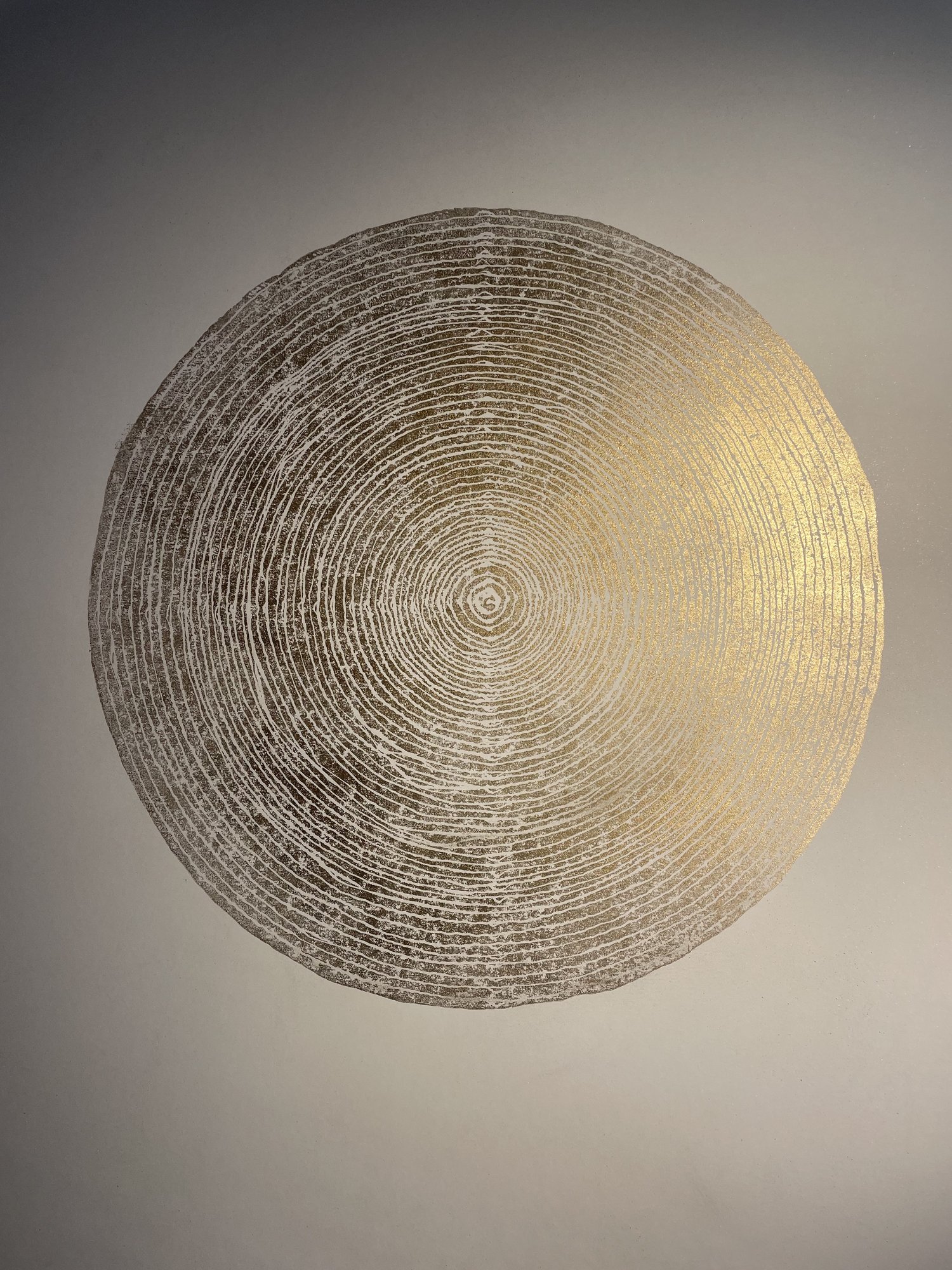
The image used for the cover of the exhibition catalog is Life 1, a linocut by Svetlana Atlavina consisting of fifty golden concentric circles that she said represent the vibrations of the heart—the sounds constantly being emitted from our cardiac valves, which mean we’re alive.
Svetlana Atlavina, Life 1, 2024. Handmade linocut with gold ink on 300g white Somerset paper, 70 x 50 cm.
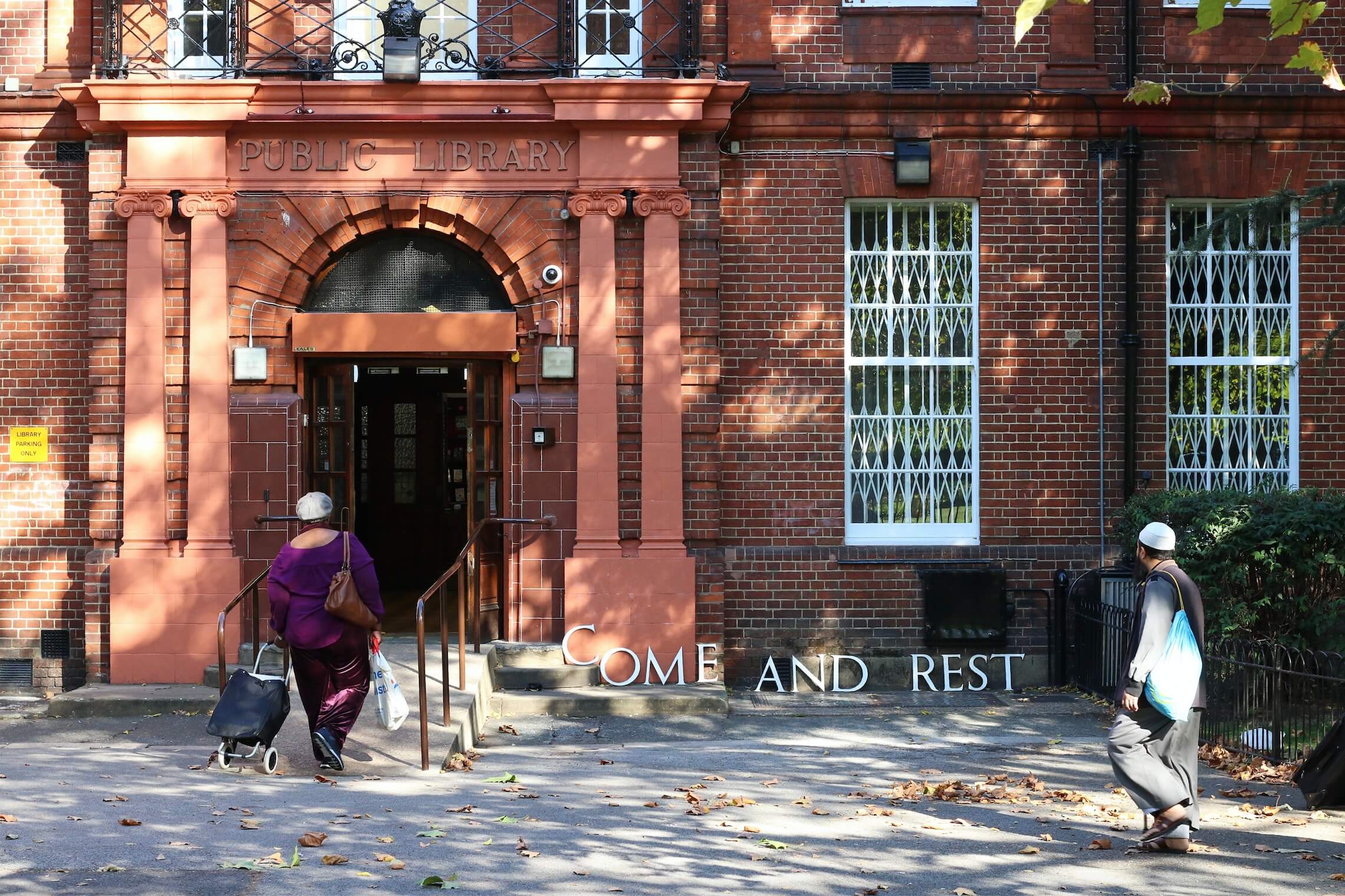
The work that I find most compelling is the eight-piece series of COME AND REST photographs by Kirsty Kerr.
Kirsty Kerr, COME AND REST: Bethnal Green Library, 2018. Photograph of a public intervention, from a series, 30.5 × 44 cm. Documentation by Will Alcock.
COME AND REST documents a series of public interventions informed by the demolition and rebuilding of Bethnal Green Mission Church. Taking letters from a scripture text that had hung on the old building (Jesus’ words: ‘Come to me and I will give you rest’), Kirsty spelt the phrase in Bethnal Green locations, recording the process with local filmmaker Will Alcock. The words were a gentle yet radical proclamation: of welcome, refuge, and quiet protest against loneliness and exhaustion often synonymous with city life. The act of spelling them out became a performed prayer, symbolic of the church’s continued presence and God’s enduring invitation.
Against the backdrop of this racially and religiously diverse neighbourhood, the words were both witnessed to and overlooked by passers-by of all faiths and none.
Kerr displayed Christ’s invitation in fields and basketball courts, on street corners and scaffolding and bandstand steps, outside subway stops and housing estates and libraries. View the full series here, using the right scroll arrow. I also enjoyed exploring the artist’s other projects on her website.
+++
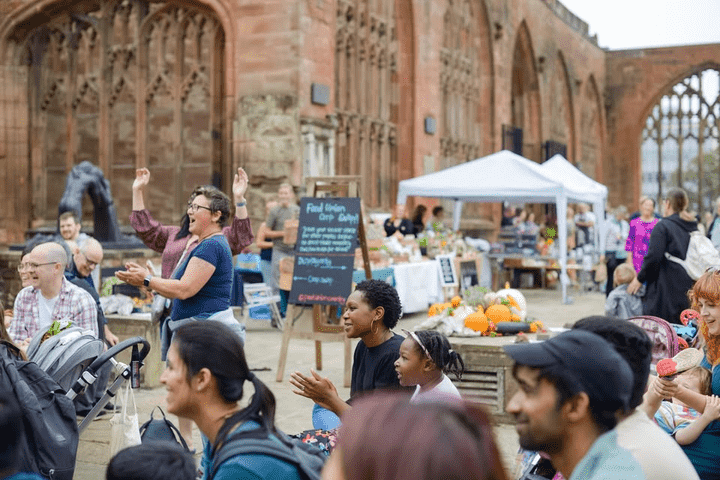
EVENT: Taste of Heaven Intercultural Worship Festival, Coventry Cathedral, May 24, 2025: Organized by Intercultural Churches UK. “The Taste of Heaven Festival will be an exciting opportunity to celebrate the rich cultural diversity and creativity of the UK church through live performances, workshops, food and worship. The festival will take place in the iconic venue of Coventry Cathedral and its beautiful surrounding ruins. The day will trace our history of increasing diversity, by highlighting different cultural worship expressions from Celtic to Choral, South Asian and Caribbean, to more recent immigrant communities including Middle Eastern, African, and Hong Kong. It will culminate in a celebration of Intercultural Worship, demonstrating how churches can draw from different cultural streams in their corporate worship.” Tickets range from £10 to £25. Register here. [HT: Global Christian Worship]
+++
SPOTIFY PLAYLIST: April 2025 (Art & Theology): The song selections on my short monthly playlists are somewhat random—a smorgasbord of what I’ve been listening to, a mix of brand-new releases and older faves—but for thematic playlists keyed to where we are in the liturgical calendar during April, see my Lent Playlist, Holy Week Playlist (I’m especially proud of this one!), and Eastertide Playlist.
>> “Ennil Adanga Sthothiram” (எண்ணிடலங்கா ஸ்தோத்திரம்) (Of Many Blessings I Will Sing Forever), performed by Zanbeni and Benny Prasad: On February 10, 2019, at Trinity Worship Center in Chennai, Zanbeni Prasad Odyuo, who is from Nagaland in northeastern India, sang a popular Tamil Christian praise song, accompanied on guitar by her husband, Dr. Benny Prasad. Tamil is not her native language (Lotha is), but she learned the words phonetically and worked with Tamil-speaking friends on pronunciations. The song expresses gratitude for God’s goodness and enjoins all of creation—dwellers on land and in the seas and skies—to praise him. I love this jazz waltz arrangement and Zanbeni’s gorgeous vocals.
>> “Tlotlo le be ho Modimo” (Glory to God in the Highest): A song from the Catholic Mass in the Sesotho language of South Africa, with a Latin refrain taken from Luke 2:14.
Here are the lyrics, with a rough English (auto)translation on the right:
Tlotlo le be ho Molimo
Ea busang maholimong
Khotso e be teng lefatsheng
Ho batho ba lokileng
Re u boka ka thabo
Re phehella thorisong
Gloria! Gloria! in excelsis Deo!

Re ntse re u khumamela
Ka tumelo e phelang
A re rosiseng Molimo
Tebohong e sa feleng
U mohloli e moholo
Ea busang maholimong
Gloria! Gloria! in excelsis Deo!

Jesu mora oa Molimo
U konyana e tlosang
Libe tsa lefatshe lohle
Re batla ho u rata
U re hauhele bohle
Ba llang mona lefatsheng
Gloria! Gloria! in excelsis Deo!
Glory be to God
Who reigns in the heavens
Peace be on earth
To righteous people
We praise you with joy
We pursue praise
Gloria! Gloria! in excelsis Deo!

We continue to worship you
With living faith
Let us praise God
In eternal gratitude
You are a great source
Who reigns in the heavens
Gloria! Gloria! in excelsis Deo!

Jesus, Son of God
You are the Lamb who takes away
The sins of the whole world
We want to love you
You have mercy on all
Who cry here on earth
Gloria! Gloria! in excelsis Deo!
+++
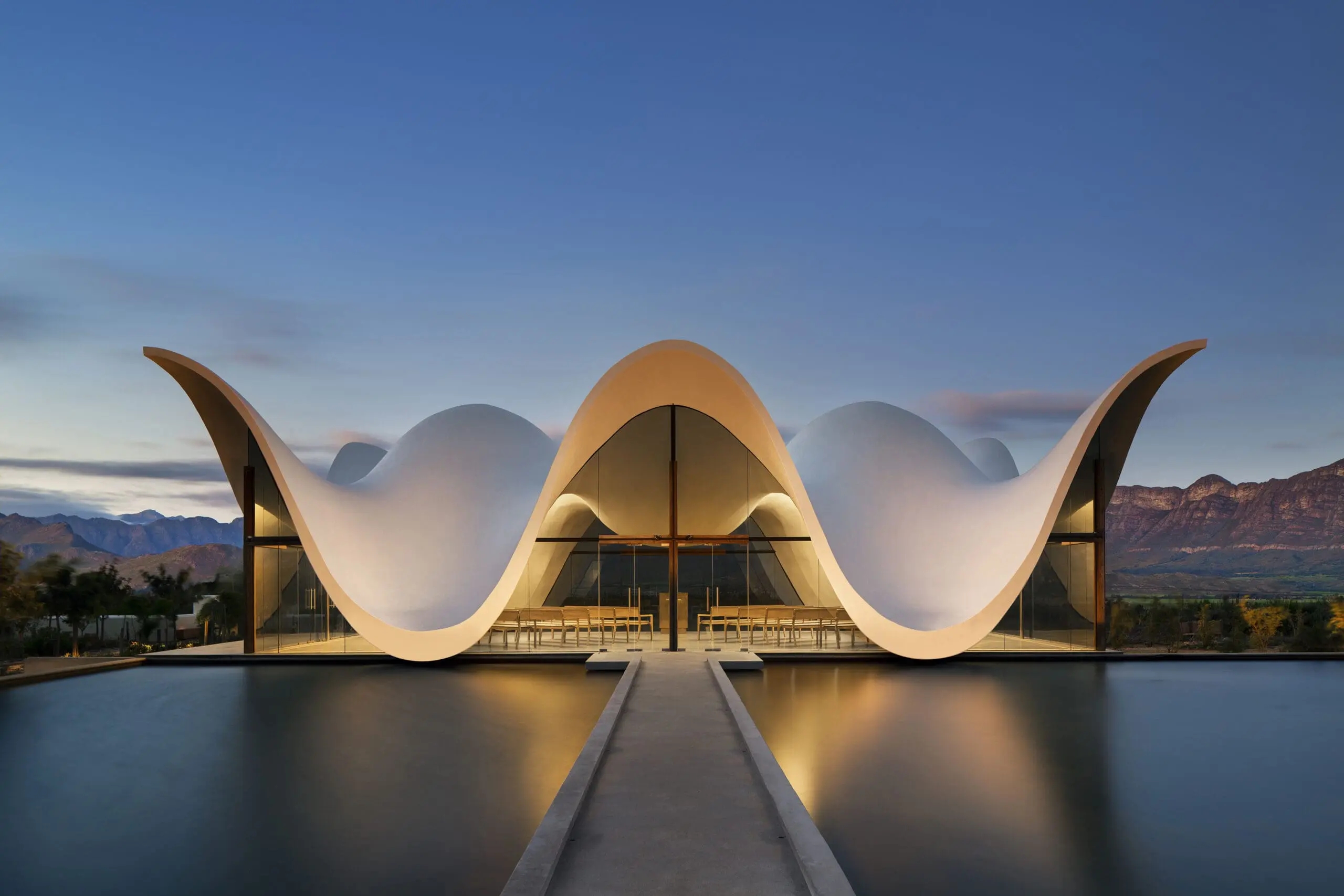
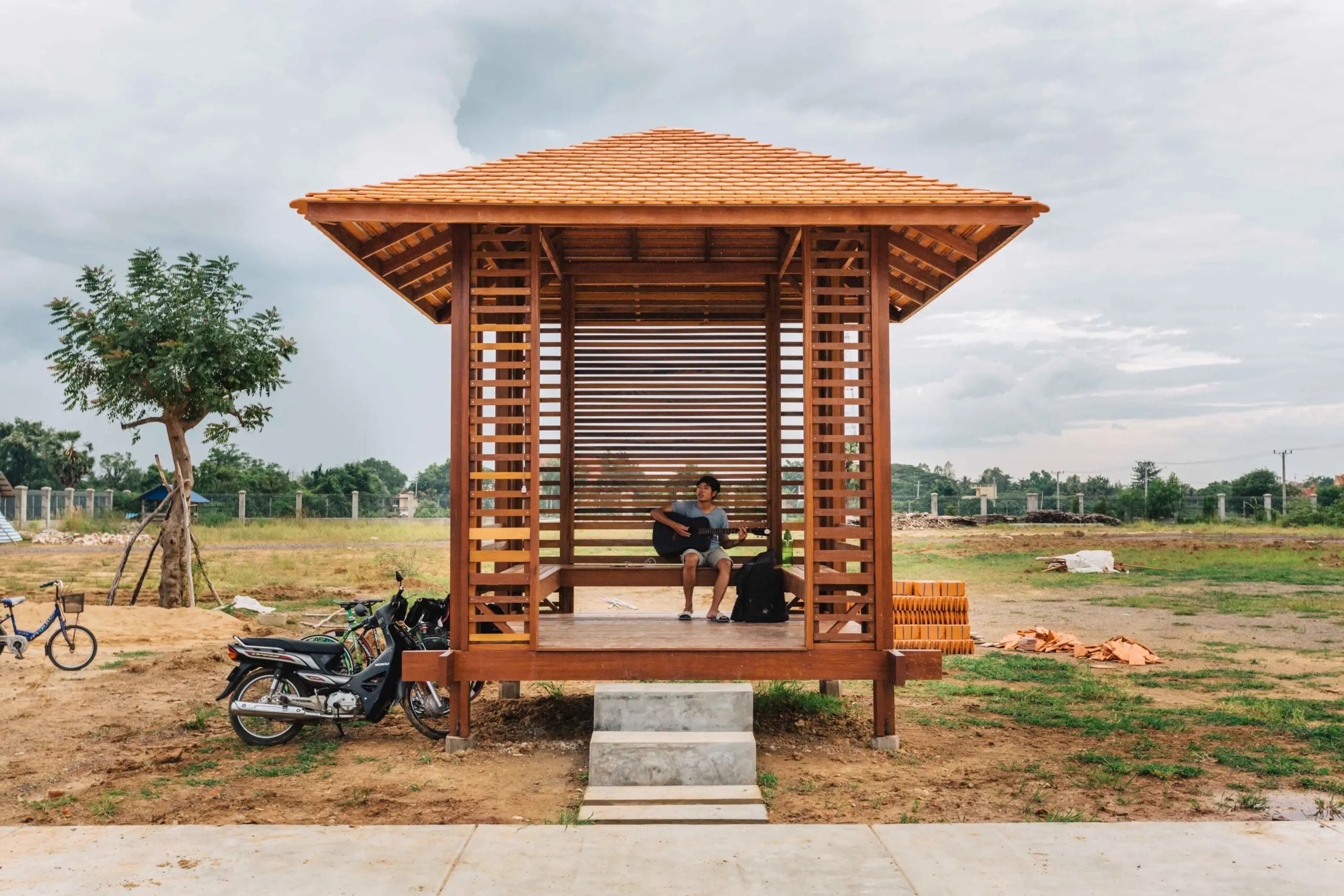
PRINT INTERVIEW (heavily illustrated!): “The Architecture of Prayer” with Amanda Iglesias, Comment: For his latest Material Mysticism column in Comment magazine, art historian Matthew J. Milliner talks with architect Amanda Iglesias, who curated the traveling exhibition The Architecture of Prayer to showcase the best of contemporary church architecture across a variety of cultures, denominations, and budgets. She discusses traditional versus modernist architecture, the church as the longest and richest of architectural experiments (even today, Christianity remains a generative influence on architecture, she says), examples of churches as conversations with history or as an exegesis of scripture, architecture’s redemptive capacity, why church projects are desirable for an architect, advice for congregations with modest means seeking to work with an architect, advice for those looking to enter the field of architecture, and book recommendations.
Bosjes Chapel in South Africa, designed by Steyn Studio, completed 2016. Photo: Adam Letch. The sinuous, winged form of this building was inspired by Psalm 36:7: “All people may take refuge in the shadow of your wings.”Christian prayer pavilion, or “gathering hut,” on the campus of the University of the Nations, Battambang, Cambodia, designed by 100 Fold Studio, completed 2017. Photo courtesy of 100 Fold Studio.
The Architecture of Prayer is on display at the Brauer Museum of Art at Valparaiso University in Indiana through September 28. (I saw the exhibition last year at Calvin University, and it’s great! Take a virtual walk-through, and view the gallery booklet.) You can follow Iglesias on Instagram @iglesiasproject.
+++
ARTICLE: “Inuce designs Mountain Church of Julong as ‘more than just a place of worship’” by Tom Ravenscroft, Deezen: The construction of a remarkable new church has recently been completed in Julong, China. It’s the first church in the city, and one of several churches in China designed by the international architecture studio Inuce (including a pink pebbledash church in Fuzhou and a church wrapped in 100,000 panes of stained glass in Luoyuan). “Located at the foot of a mountain surrounded by forest and with views across the town, the Mountain Church of Julong references both the form and representation of an ark,” Ravenscroft writes in the article. Inuce founder Dirk U. Moench told him that “biblical archetypes were fundamental in our design process. . . . As a powerful symbol for shelter and new beginnings, the ark of salvation, safely landed on a foundation of rock, became the crystallisation point for our design.” [HT: Mark Meynell]
The Mountain Church of Julong near Quanzhou, China, designed by the architecture studio Inuce and completed in 2024, evokes the form of an ark resting on a rock, as in Genesis 8:4.
+++
VIDEO PODCAST INTERVIEW: “Dr. David Taylor on Worship, Embodiment, and the Value of Beauty in Church Buildings,”Making Space: Sara Joy Proppe is the founder of Proximity Project, which helps churches discover real estate and placemaking solutions that fit their mission in the neighborhood. Here she presents a recent Barna poll result in which, when asked, “Which do you feel are the most important to having a meaningful experience at a church?,” 64 percent of Christians and 65 percent of non-Christians responded “art and beauty in the building.” She then speaks with liturgical theologian and author W. David O. Taylor on how we’re shaped by the physical spaces we worship in. I appreciate the charitable attitude of Taylor, who is Anglican, toward a variety of Christian traditions and aesthetic expressions, not holding any single one up as the only right way but rather inviting us to consider how our notion of “church” plays out in the buildings we construct and how we use them. The conversation with Taylor starts at the 11:48 timestamp. (There are overlaps with a podcast interview of his that I recommended in 2021.)
“I love church architecture, I love how it can tell the story of God’s creative and recreative work, I love how our bodies are integrally attuned to spaces and can come alive (or go dead) in particular spaces, and I love how architects invite us to pray with our whole beings in order that we might be both re-habituated and re-sensitized to our calling to be Christ’s ‘little tabernacles’ wherever we may go,” Taylor wrote on social media when sharing this interview.
VISUAL COMMENTARY ON SCRIPTURE: “The Earthly Tent (2 Corinthians 5:1–10)” by Sarah White: For this coming Sunday’s New Testament lectionary reading from Paul’s second letter to the church at Corinth, Sarah White, a visual arts program curator and artist mentor at Morphē Arts, has curated a VCS mini-exhibition of three contemporary artworks that speak obliquely to that text: a performance art piece in a Manhattan cathedral by Eiko Otake; a forest diorama by Alyssa Coffin, meant to be “read” and “seen” through touch; and a giant hand-sewn jute sack sculpture by Ibrahim Mahama, which is draped over buildings. “Internal to this section of 2 Corinthians is a series of accumulating metaphors of architecture, clothing, geography, and time,” White writes. “The dynamics of these allusions are accentuated and shifted as we consider the performance of materials, bodies, and spaces in all three of these artworks.”
Eiko Otake (Japanese, 1952–), Eiko at St John the Divine, 26 November 2016, No. 1374, 2016. Photographed dance performance. Photo: William Johnston.
For example, at the Cathedral of Saint John the Divine in New York, Otake articulated both a personal and collective mourning through “the contortions and contractions of her body and face” and “moments of stumbling, falling, and lying down,” evoking Paul’s line about our groaning and longing. Her performance came out of her time as artist in residence at Saint John’s. I’m always intrigued by how artists respond to church spaces and help awaken worshipping communities (and curious publics!) to aspects of God’s story and our own—and I’m thrilled when churches invest in artists’ work. I wish that were more normative.
Since the Middle Ages, the Roman Catholic Church has celebrated May, a time of new growth, as “Mary’s month.” The calendrical placement of this celebration probably has to do in part with the fact that the ancient Greeks celebrated a festival to Artemis, the goddess of fecundity, in May; the ancient Romans, Flora, the goddess of flowers and spring. Because Mary, by the power of the Holy Spirit, conceived in her womb and brought to birth the life of the world, Jesus Christ, Christians see her as standing at the threshold of an eternal springtime.
POLL QUESTION: Before moving on to the six roundup items below, if you are a regular reader of this blog or other media like it, would you please help me out by answering the following poll question? (I’m trying out this WordPress feature for the first time!) Over the years I’ve gathered a lot of compelling poems and artworks on the Annunciation, encompassing a variety of eras, styles, and perspectives, and I’d like to pursue the idea of turning one or the other, or both, into a book. Which kind of Annunciation-themed book would you be most inclined to buy? Keep in mind that a book with art would cost significantly more because it would be in full color and probably a larger hardcover. Also note that a book that combines art and poetry would obviously have fewer selections of each than a book dedicated fully to one or the other.
+++
UPCYCLED MARY STATUETTES:Soasig Chamaillard is a French artist who, since 2006, has been acquiring small, damaged statues of the Virgin Mary—either from garage sales or received donations—and restoring and transforming them, often with reference to children’s toy lines and media franchises, comic book heroes, or other pop-culture icons. Some are silly or irreverent; others, merely quirky. Here are two I like, which both modernize Mary, by her dress or her reading material. Click on the images to view detail photos of the final product, and see here and here for blog posts that document the transformation process.
Before/After. Right: Soasig Chamaillard (French, 1976–), Jeans-Marie (Jeans Mary), 2015. Plaster, acrylic paint, resin, metal frame, height 48 cm.Before/After. Right: Soasig Chamaillard (French, 1976–), Nouvelle Bible (New Bible), 2008. Plaster, acrylic paint, resin, digital print, height 40 cm.
The first shows Mary in high-waisted jeans and red Converse high-tops with rosettes on the tongues. The second one, a Madonna del Parto, shows her pregnant and reading the book J’élève mon enfant (Raising My Child) by Laurence Pernoud, picking up tips on being a new mom.
+++
ESSAY: “Mary: Evolution of a Bookworm” by Joel J. Miller: “It’s unlikely the historical Mary could read at all, but medieval Christians transformed her into an icon of literacy,” often showing her with a book in hand, whether as a child learning to read from her mother, Saint Anne; at the Annunciation, with the book of Isaiah, the Psalter, or a book of hours splayed open on her lap; or teaching her own child, Jesus, how to read. Drawing on the research of Laura Saetveit Miles, author of The Virgin Mary’s Book at the Annunciation: Reading, Interpretation, and Devotion in Medieval England [previously], Joel J. Miller discusses how images of Mary reading “rode a wave of rising female literacy and simultaneously encouraged its expansion.”
Ivory plate of the Annunciation from the Brunswick Casket, made in Metz, France, ca. 860–70. Herzog Anton Ulrich Museum, Braunschweig, Lower Saxony, Germany. This is the earliest known representation of the Virgin Mary with a book at the Annunciation.Lorenzo Costa (Italian, 1460–1535), Annunciation (Mary Reading), first third of 16th century. Oil on panel, 62 × 60.5 cm. Gemäldegalerie Alte Meister (Old Masters Picture Gallery), Dresden, Germany.
+++
CONVERSATION: “Sacra Conversazione” with Walter Hansen and Bruce Herman: In this written conversation from Image no. 62, artist Bruce Herman [previously] and patron Walter Hansen discuss the two large altarpieces Herman produced comprising six paintings on the life of the Virgin Mary: Miriam, Virgin Mother and Second Adam. The article is about the creative process and Herman’s collaboration with Hansen and with student apprentices in Orvieto, Italy, but it’s also about attempting to recover Mary’s image from a heap of the saccharine or overly exalted on the one hand, and ironic detachment on the other. Herman says,
I had vivid memories of Boston art critics and museum people back in the 1980s telling me that [religious] subject matter could only be approached ironically, but I had a persistent feeling that they were wrong. I’ve sensed for many years that the tradition of biblical imagery in art is far from exhausted—maybe simply stalled out due to loss of nerve or imagination. To me, much of the recent religious imagery we’ve inherited is fairly shallow. I know this might sound odd, given more than a thousand years of tradition, but I honestly believe that new insights are arrived at in every generation. Why can’t a contemporary artist paint the Virgin Mary without irony—and maybe even specifically attack the problematic nature of much Marian imagery? Why can’t a century of experimentation in painting yield something relevant to that tradition?
It’s an excellent conversation! You may have to subscribe to Image journal to access it, but it’s well worth it for all the wonderful content they put out quarterly and access to their archives.
Bruce Herman (American, 1953–), Miriam, Virgin Mother, 2007. Oil on wood with silver and gold leaf, 95 × 154 in. (241.3 × 391.2 cm).
Read more about the two altarpieces and view more photos at www.bruceherman.com/magnificat, and in the beautifully produced catalog magnificat, with a foreword by Hansen and essays by Rachel Hostetter Smith and John Skillen. The book also features four paintings from Herman’s related Woman series.
+++
ART VIDEOS:
What follows are my two favorite videos from the Visual Commentary on Scripture’s twelve-episode series “Unlocking Christian Art: The Virgin Mary,” in which theologian Ben Quash and art historian Jennifer Sliwka discuss religious artworks from museums in Berlin.
>> “Holy Kinship”: The subject of this video is a late medieval German limewood carving by Hans Thoman depicting Jesus’s extended family on his mother’s side. He and his mom, grandma, grandpa, step-grandpas, aunts, and cousins pose for this matriarchal family portrait that reflects a medieval legend (rejected by the Council of Trent) that Saint Anne was grandmother not just to Jesus but also, through two subsequent marriages, to five of the twelve apostles: James the Greater, Simon, Jude, James the Less, and John the Evangelist. Also included in this sculpture group are Elizabeth and Zechariah with their son, John the Baptist, and Emelia with her son Servatius of Tongeren, a fourth-century saint whom legends name a distant relative of Jesus. [view object record]
>> “Leave-Taking”: From the same period and general region as the above sculpture comes a painting by Bernhard Strigel (1460–1528) that shows Jesus taking leave of his mother just before his entry into Jerusalem the week of his death, a popular subject in northern Europe in the sixteenth century. The episode derives from a versified Marienleben (Life of Mary) from the early fourteenth century written by the Carthusian monk Philipp von Seitz, aka Bruder Philipp, from Middle Franconia. [view object record]
SONG: “Mary” by Patty Griffin: “Mary, you’re covered in roses, you’re covered in ashes, you’re covered in rain . . .” From the 1998 album Flaming Red by the country-folk artist Patty Griffin, the song “Mary” is a tribute to the woman who mothered Jesus and mothers us all. A compassionate presence who lives on in heaven at her son’s right hand, she feels the pain of other mothers who’ve lost their children. Griffin sings of Mary’s beautiful, big, humble, suffering, nurturing, pondering heart.
+++
POEM: “Christ’s Mother Reflects: His Childhood”by Micha Boyett: This is the last in a series of five Advent poems written from the perspective of Mary for John Knox Presbyterian Church in Seattle in 2010, the other four being on the subjects of the Annunciation, the boy who is snatched away by a dragon in Revelation 12, the Visitation, and the Nativity. Here, after Jesus’s death, Mary reflects back on his life—an early heartbreak of his, his contemplative nature, a question he once asked, his delight in scripture study, the hard choices he made, her own unfulfilled hope for normalcy on his behalf, the tearing of his flesh that mends us.
ANNOUNCEMENT: Vatican to hold Stations of the Cross art contest: Artists from across the globe are encouraged to participate in the Vatican-sponsored contest for fourteen new Stations of the Cross paintings. The winner will be announced September 30, 2024, awarded €120,000 (about $131,000), given a year to complete the commission, and then have their set of paintings exhibited in St. Peter’s Basilica during Lent 2026. The first step is to fill out an online application, which will become available January 8, with a deadline of January 31. Learn more at the link. (Update: The registration link is now live at https://contest.viacrucis2026.va/en/registration.)
+++
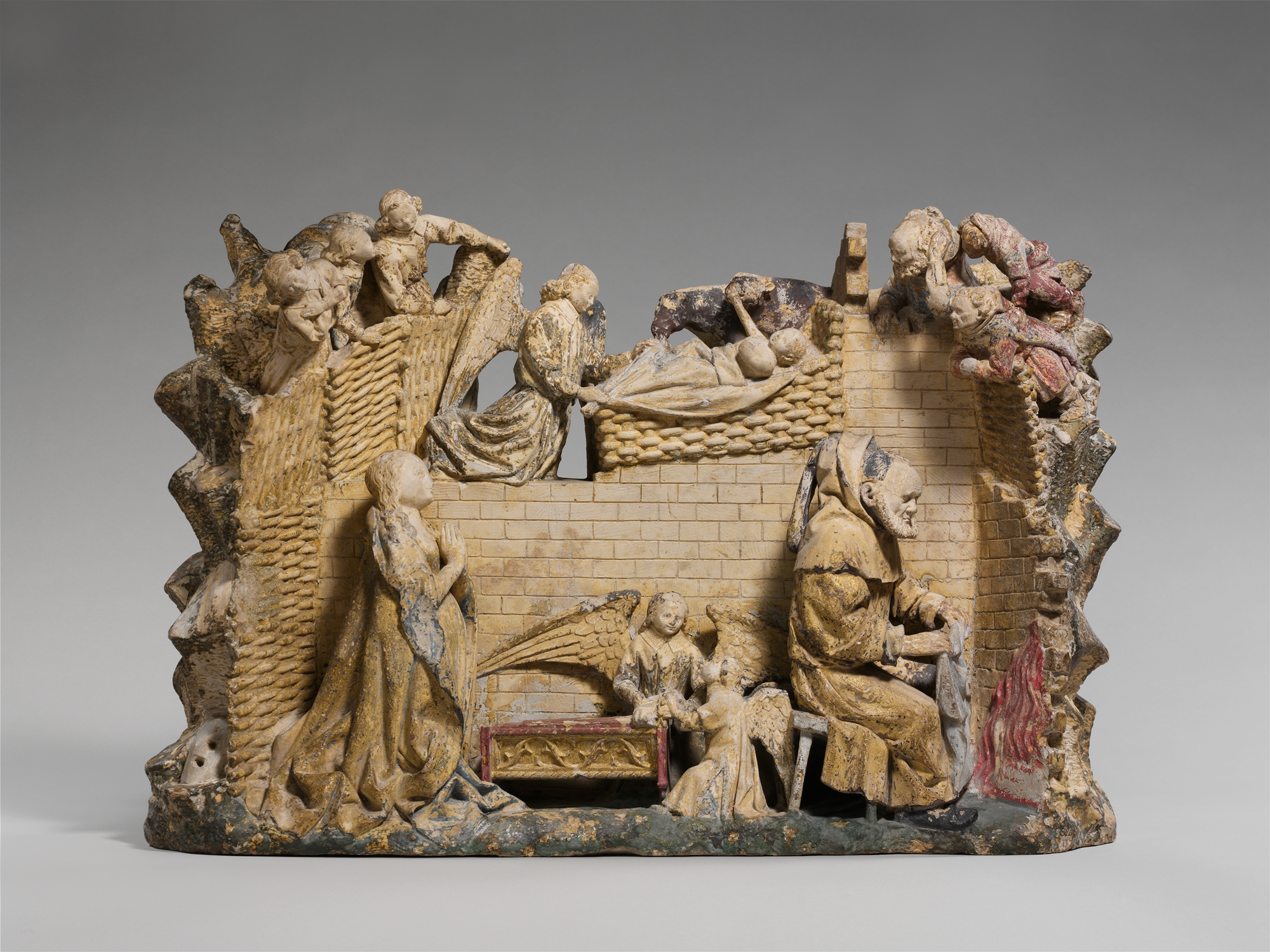
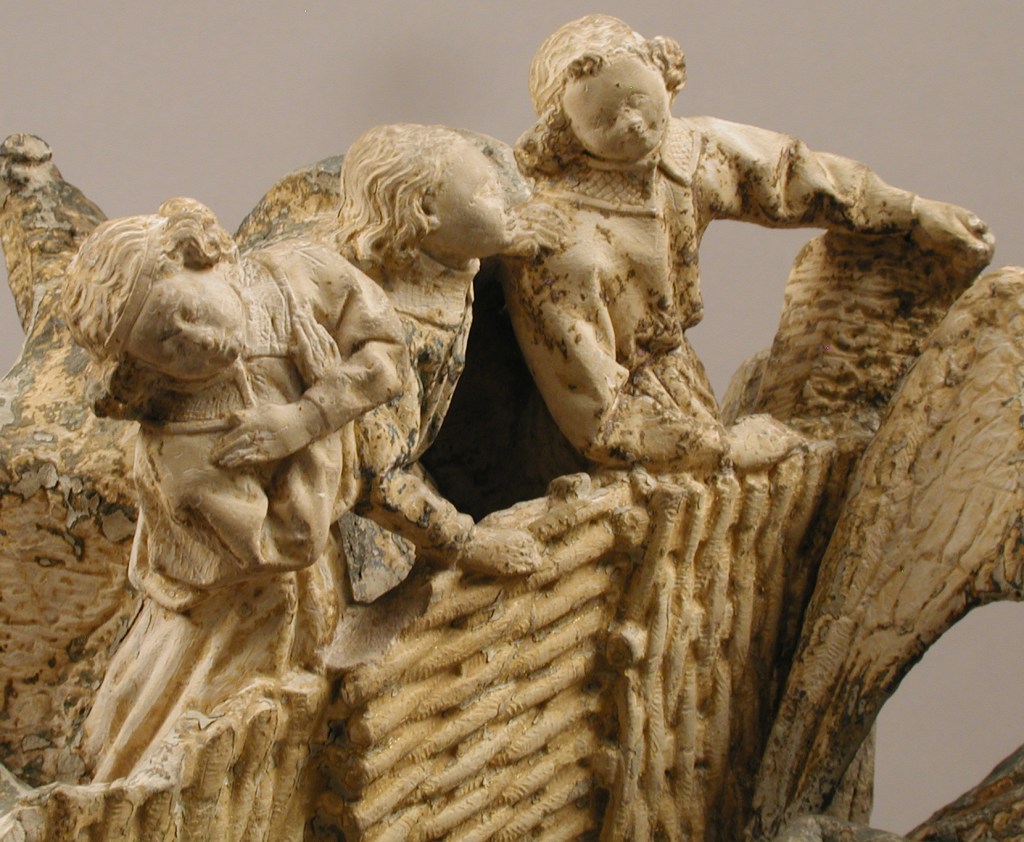
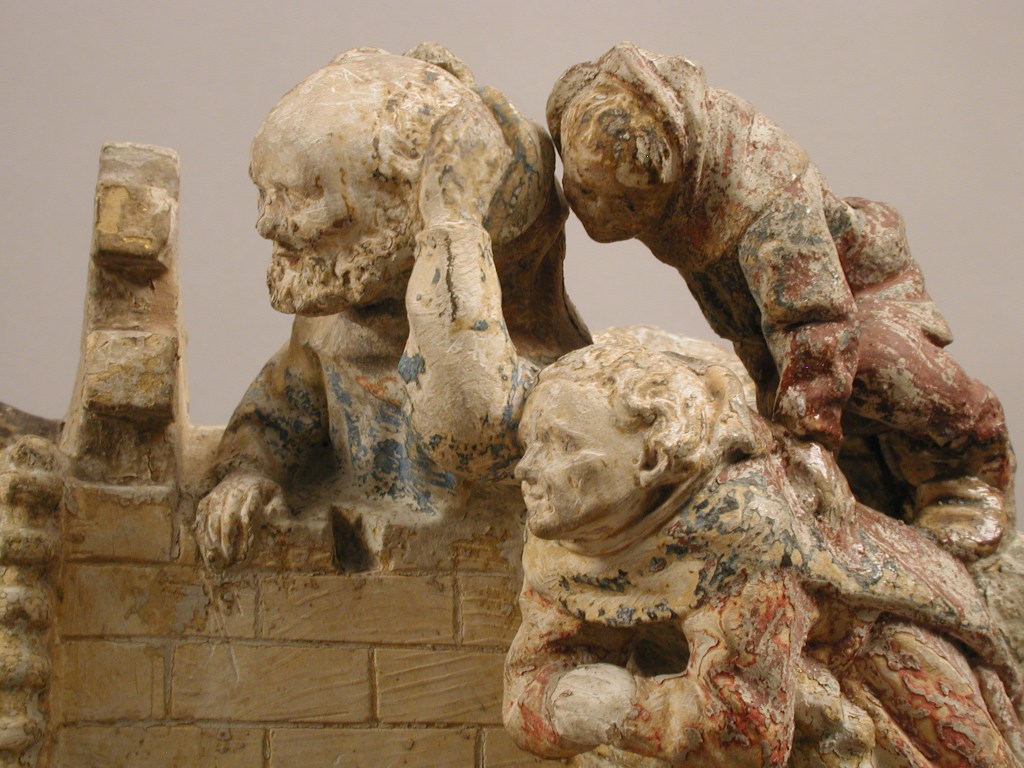
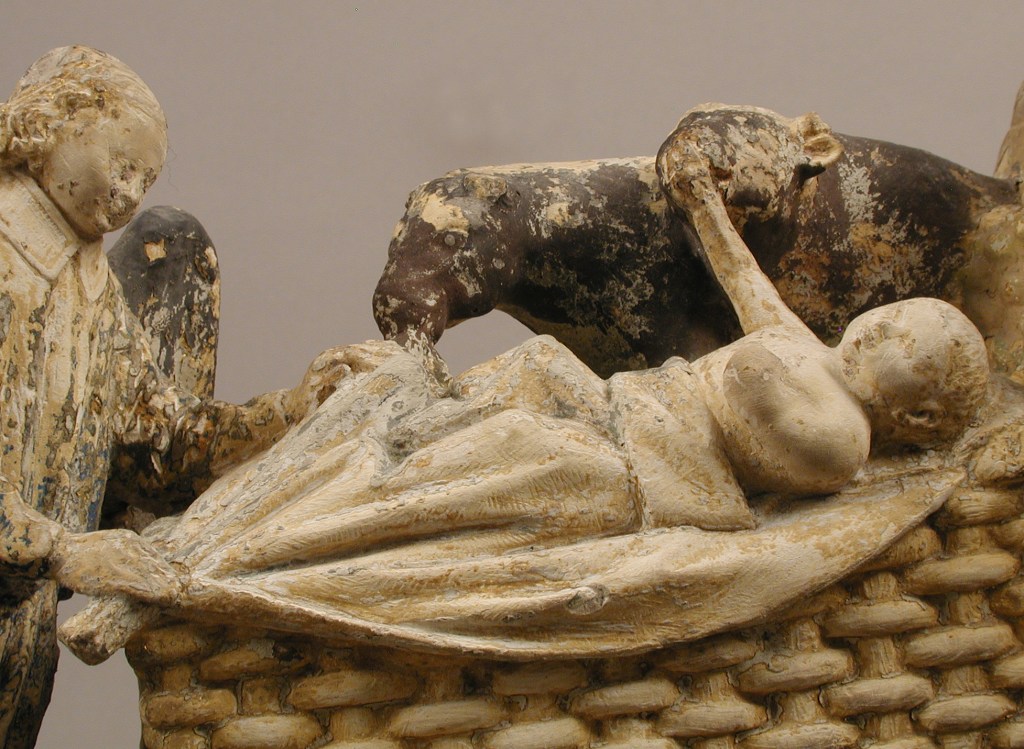
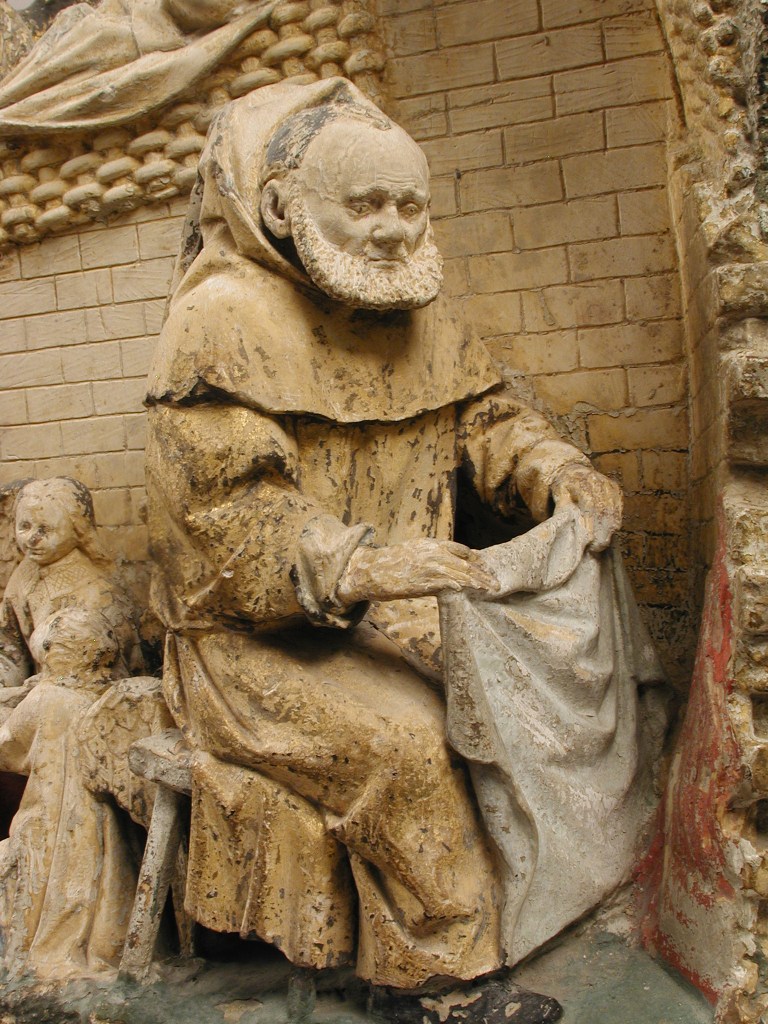
ART OBJECT: Burgundian Crèche, ca. 1450: In researching depictions of Joseph at the Nativity, I came across this charming little limestone-carved crèche from fifteenth-century Burgundy, France, acquired by the Metropolitan Museum of Art. Set inside a dilapidated brick interior patched with wattled matting, the scene portrays the infant Christ lying in a wattled manger that rests on a crumbling wall ledge. Such an unusual composition! I’m not sure why the infant is placed so precariously and at a height when there’s a carved cradle available on the ground, where angels kindly fluff his pillow, but I suppose it was to avoid overcrowding and for visual balance.
Circle of Antoine Le Moiturier (French, 1425–1495), Nativity, Burgundy, France, ca. 1450. Limestone with later paint and gilding, 17 3/4 × 25 7/8 × 7 1/4 in. (45.1 × 65.7 × 18.4 cm). Metropolitan Museum of Art, New York.
A donkey licks Christ’s feet while an ox licks his hand, which he appears to delight in, as he lifts his arm for better access. To the left and right of him are a trio of angels and shepherds, respectively, excitedly leaning in from outside to get a better look. Mary gazes up at her son in adoration while Joseph dutifully tends to a parental chore: drying one of Jesus’s freshly washed linens at the fire. (Dad doing laundry—huzzah!)
ART COMMENTARY: On The Adoration of the Magi by Domenico Veneziano: From the Visual Commentary on Scripture comes this 2022 video, one in a series filmed on-site at the Gemäldegalerie in Berlin. Theologian Ben Quash and art historian Jennifer Sliwka discuss an early Italian Renaissance tondo depicting the Adoration of the Magi.
+++
SONGS:
>> “Rejoice with Exceeding Great Joy”: Written by Lanny Wolfe in 1978 and performed by Reggie Smith, Charlotte Ritchie, and Ladye Love Smith at Bill and Gloria Gaither’s Homecoming Christmas 2006:
>> “Star of Bethlehem”: Written by Noel Dexter, arranged by C. S. (Cedron) Walters, and performed by the Jamaica Youth Chorale at their 2019 Christmas concert. Noel Dexter (1938–2019) was a Jamaican composer, choir director, and music educator, and this is probably his best-known work. It’s set to a Nyabinghi rhythm.
When the star of Bethlehem arise, hallelujah When the star of Bethlehem arise, hallelujah When the star of Bethlehem arise Come show me where the young child born!
There were wise men coming from the east, hallelujah There were wise men coming from the east, hallelujah There were wise men coming from the east Come show me where the young child born!
They brought gold, frankincense, and myrrh . . .
Not a man can save my soul . . . But Jesus! Show me where the young child born!
+++
VIDEO:“#NatZooZen: Giant Pandas Mei Xiang and Tian Tian in the Snow”: This Smithsonian’s National Zoo cam footage from January 2021 shows two giant pandas at play, sliding down a snowy hill! So adorable. Tian Tian and Mei Xiang arrived at the National Zoo in 2000 and in 2020 produced a cub, Xiao Qi Ji. All three pandas returned to Beijing in November, having been lent to the US by China as part of a cooperative research program whose contract has expired.
In the church calendar, the linked seasons of Advent, Christmas, and Epiphany are sometimes referred to as the “cycle of light.” “Since earliest times the Christian community has utilized light as a primary symbol to convey the meaning of the Christ-event,” writes Wendy M. Wright in The Vigil: Keeping Watch in the Season of Christ’s Coming. “The power of the symbol was not lost on most generations of believers who lived closer than we do to the truth that we are all ultimately dependent upon the light of the sun for warmth, vision, and life itself” (152). Light imagery permeates scripture and the writings of the church fathers.
The capstone of the cycle of light, celebrated each year on January 6, is Epiphany, which means “manifestation” or “appearance.” In the West, this feast commemorates the visit of the magi, to whom the divinity of Christ was revealed, and who brought back the light they received to their homelands, an early spreading of the gospel. Epiphany is exactly one month away, but I wanted to provide a few resources in advance. For those in the DC metro area: note that there are just two weeks left to see the Anne Lindberg exhibition!
+++
NEW PLAYLIST: Epiphany (Art & Theology): I put together a playlist of nearly a hundred Epiphany songs that celebrate Jesus as the light of the world and that mark the magi’s transformative encounter with him.
Besides the classic “We Three Kings,” it also includes a few versions of the ancient hymn “Phos Hilaron” (originally written in Koine Greek and translated into English as “Gladsome [or Gladdening] Light”), a Provençal carol popularized by Bizet, a shape-note hymn from Appalachia, aguinaldos from Puerto Rico, Arabic hymns from Syria and Lebanon, plainchant scripture settings, Renaissance motets, traditional and contemporary Black gospel songs, indie songs (including retuned hymns) from the past decade, and choral works from the UK, Jamaica, and Argentina. Some of the selections are quieter, more reflective, whereas others are very exuberant, like “Jesus Is the Light” by Hezekiah Walker and the Love Fellowship Crusade Choir:
And “Los Reyes Magos,” the fifth movement of Ariel Ramirez’s folk drama Navidad Nuestra (lyrics here); the song was written as a taquirari, a type of Bolivian folk song that has a syncopated rhythm and that is danced to, and features a charango (small guitar) and siku (Andean panpipe):
+++
ART COMMENTARIES: The VCS Advent Calendar 2023: Every Advent, the Visual Commentary on Scripture sends out a daily image from its online archives to its email list around a seasonal theme. This year’s theme is “light.” The images are keyed to particular scripture passages having to do with light and are accompanied by commentary from a range of contributors. So far the VCS has featured a Genesis 1–inspired Sistine Chapel fresco, John Piper and Patrick Reyntiens’s extraordinary Baptistery Window at Coventry Cathedral, a Trinitarian miniature from an English book of hours, a heliotropic landscape sculpture by David Wood, a light installation by Dan Flavin at a church in Milan, and Vincent van Gogh’s Starry Night.
Baptistery Window, Coventry Cathedral. Designed by John Piper and made by Patrick Reyntiens, 1957–61. Stained glass, 85 × 56 ft.
+++
EXHIBITIONS:
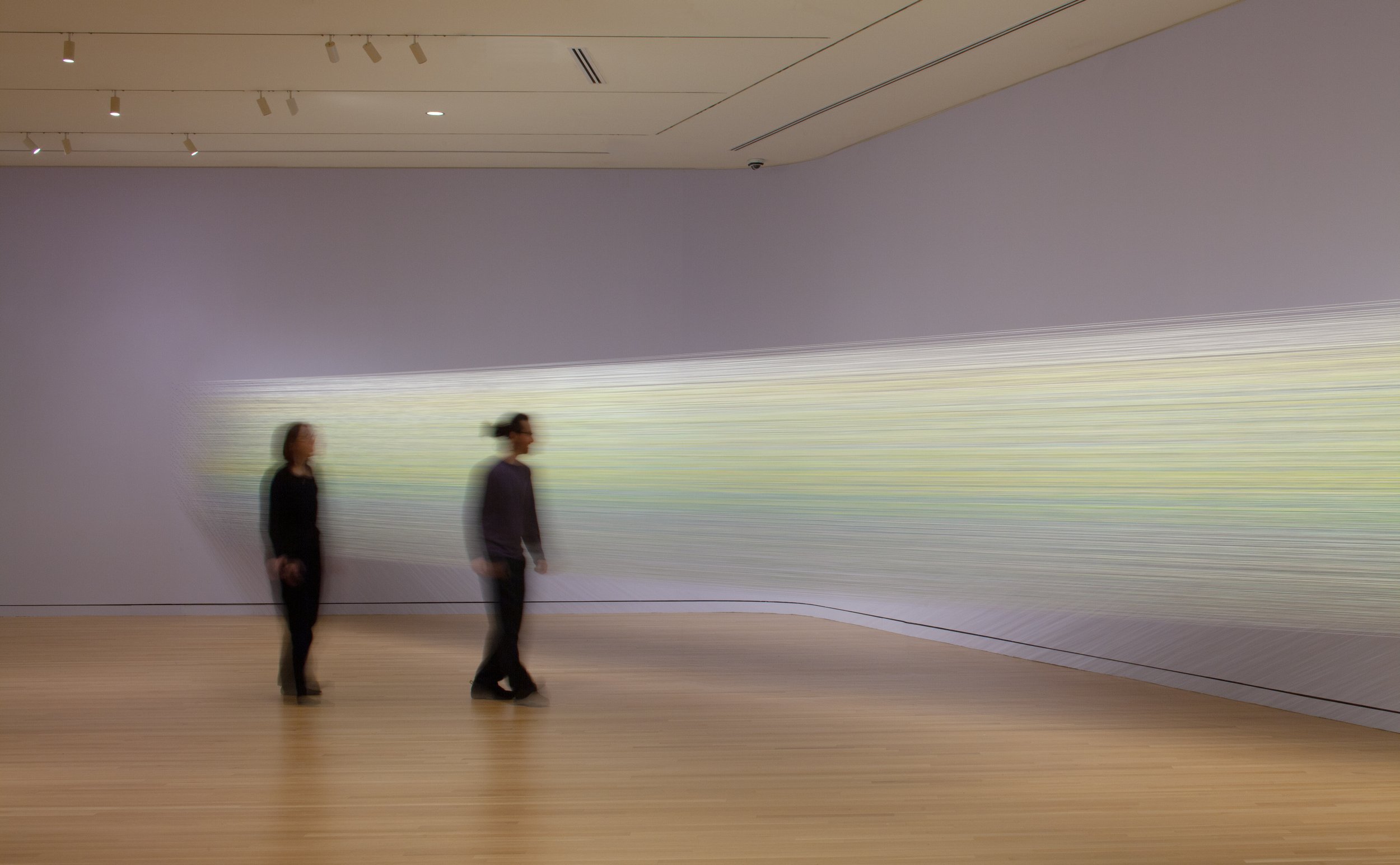
>> What color is divine light? by Anne Lindberg, January 5–December 22, 2023, Textile Museum at George Washington University, Washington, DC: I saw this installation last month, and it is striking! About four thousand strands of complementary yellow and blue cotton thread (and some white and green), stretching across the gallery against a backdrop of lavender-painted walls, evoking light. The artist describes the work as a drawing made of textile material in the air. It was inspired by a 1971 essay of the same title by the art historian Patrik Reuterswärd (see The Visible and Invisible in Art: Essays in the History of Art), and it opened adjacent to an exhibition of prayer carpets, titled Prayer and Transcendence.
Anne Lindberg (American, 1962–), What color is divine light?, 2023. Cotton thread, staples, 5 × 55 × 14 ft. Solo exhibition at the Textile Museum, George Washington University, Washington, DC. Photo: Derek Porter.
>> Bubble Universe: Physical Light, Bubbles of Light, Wobbling Light, and Environmental Light by teamLab, opens early February 2024, Borderless (museum), Azabudai Hills, Tokyo: teamLab is an international collective of “ultra-technologists” consisting of artists, programmers, engineers, CG animators, mathematicians, and architects who collaborate on immersive art projects. One of their upcoming installations is a room with hundreds of glowing spheres, each containing unique changing lights that interact with guests and the environment itself. [HT: My Modern Met]
teamLab, Bubble Universe, 2023 (work in progress). Interactive installation, Borderless, Azabudai Hills, Tokyo.
+++
NEW ALBUMS:
>> The Light by Sarah Sparks: A four-song EP by a Christian singer-songwriter from Hawaii. Here’s the first track:
>> Morning Star: Music for Epiphany Down the Ages by the Gesualdo Six: Released November 3, this wonderful album comprises twenty-one choral pieces for Epiphany—a mix of plainchant propers for Mass, hymns, Renaissance motets, and twenty-first-century works. One of the contemporary works is a setting by Owain Park of Psalm 43:3: “O send out thy light and thy truth, that they may lead me; let them bring me unto thy holy hill, and to thy dwelling”:
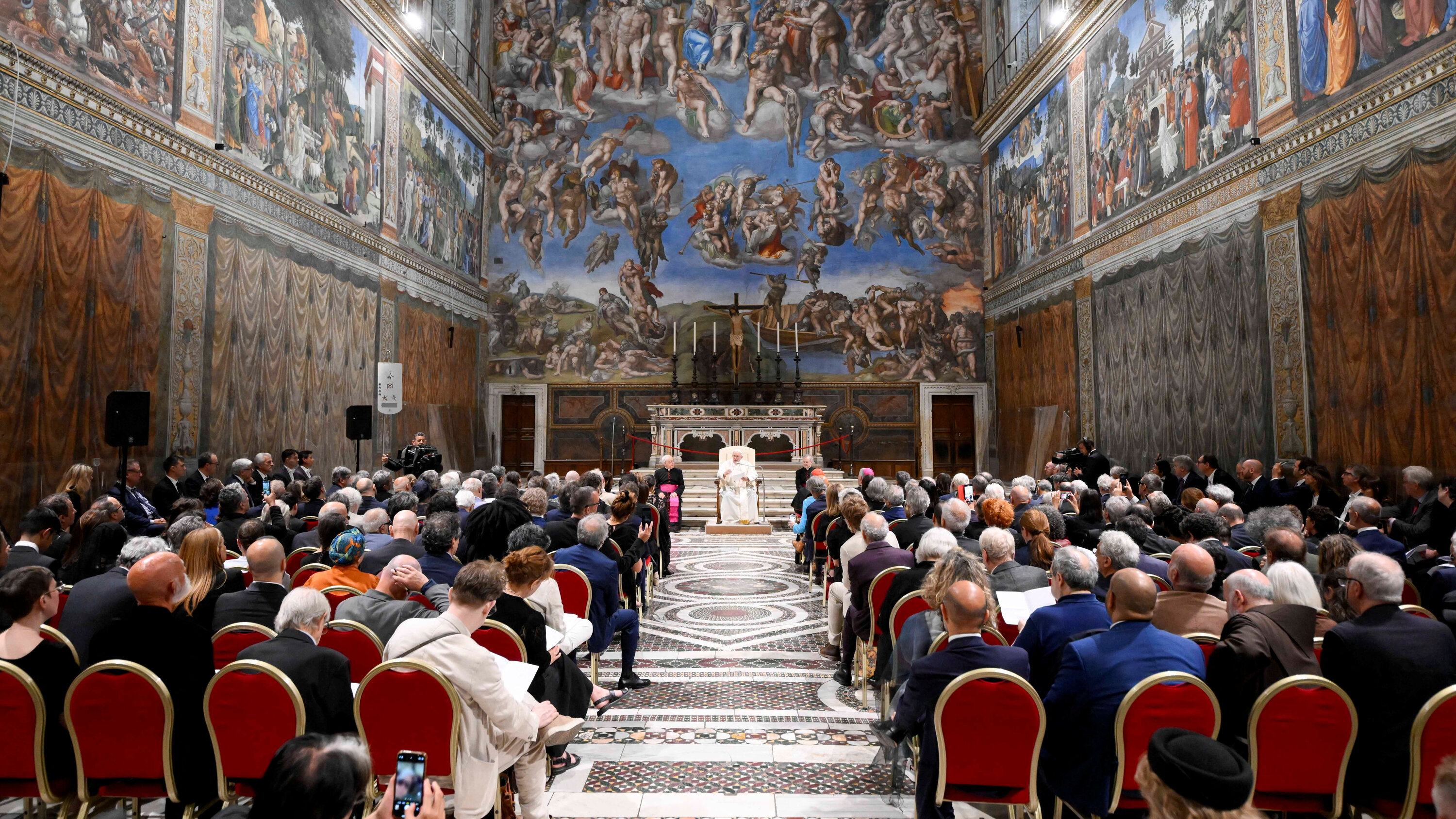
SPEECH: “Address of His Holiness Pope Francis to Artists for the 50th Anniversary of the Inauguration of the Vatican Museums’ Collection of Modern Art”: On June 23, at the invitation of Pope Francis, some two hundred select visual artists, filmmakers, composers, poets, and other creatives gathered at the Sistine Chapel to commemorate the fiftieth anniversary of the Vatican Museums’ Collection of Modern and Contemporary Art, inaugurated in 1973 by Pope John Paul VI. “One of the things that draws art closer to faith is the fact that both tend to be troubling,” Pope Francis said last Friday. “Neither art nor faith can leave things simply as they are: they change, transform, move and convert them.” He applauded how “artists take seriously the richness of human existence, of our lives and the life of the world, including its contradictions and its tragic aspects. . . . Artists remind us that the dimension in which we move, even unconsciously, is always that of the Spirit. Your art . . . propel[s] us forward.” For reporting on this event by the New York Times, see here.
Pope Francis addresses a group of artists, June 23, 2023. Photo: Vatican Media, via Reuters.
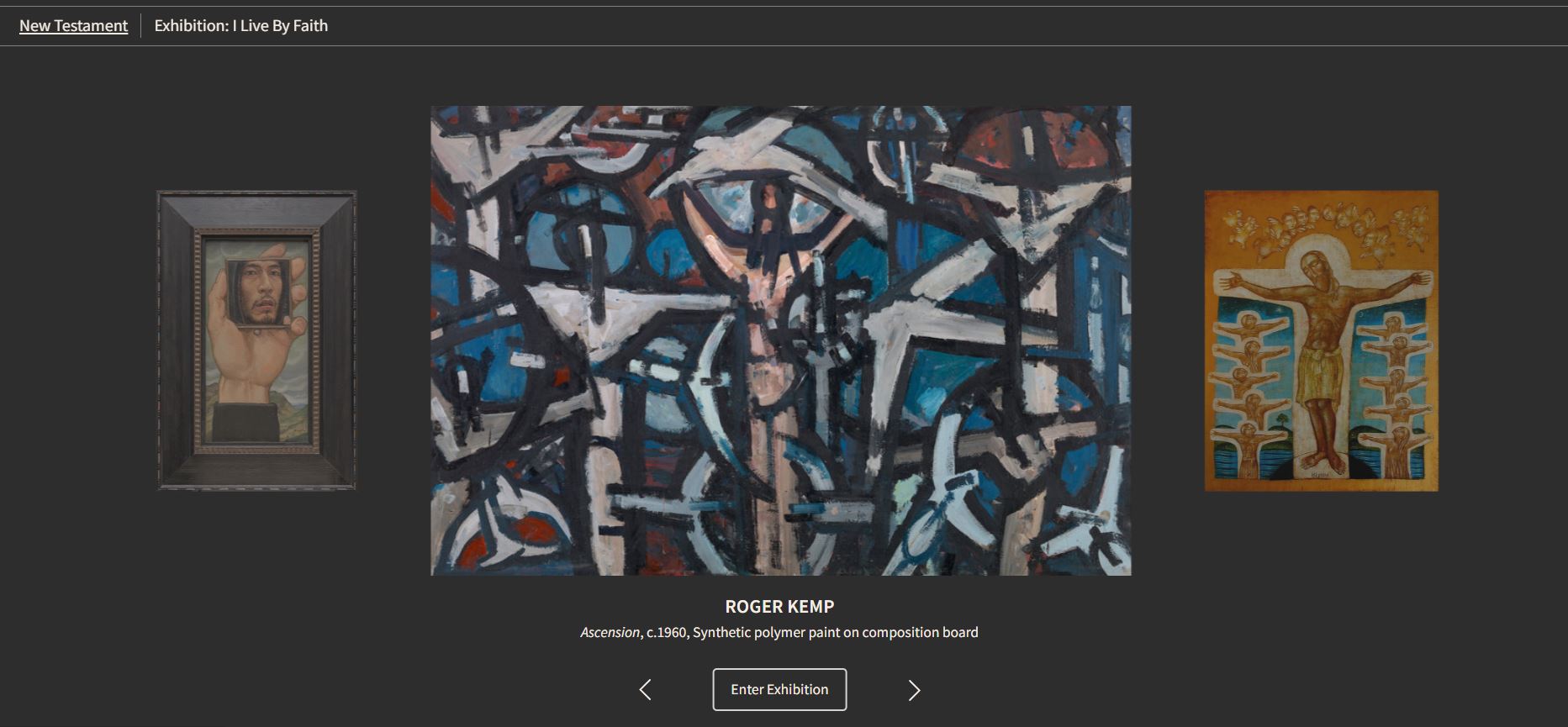
VISUAL COMMENTARY ON SCRIPTURE: “I Live by Faith (Galatians 2:15–21)” by Victoria Emily Jones: My latest set of commentaries for the VCS went live this month! It centers on one of Paul’s famous sayings: “I have been crucified with Christ, and it is no longer I who live, but it is Christ who lives in me.” I was bummed that one of the three commentaries I originally wrote had to be scrapped because the image permission was ultimately denied; I thus had to reconfigure and replace, and I ended up with two artworks in the three-piece exhibition that aren’t as diverse from each other as I had hoped. But still, each artwork brings a unique and compelling lens through which to examine this passage. (Note: If you’re viewing the exhibition on your phone, after you “Enter Exhibition,” you’ll need to expand the “Exhibition Menu” to access the “Show Commentary” button.)
VIDEO: “Abraham: An Interfaith Discussion at the Bode-Museum, Berlin”: Besides publishing written commentaries on works of art in dialogue with Bible passages, the Visual Commentary on Scripture also produces videos. This one brings together an Anglican Christian priest (who directs the VCS), a Jewish rabbi, and a Muslim theologian around a fifth-century ivory pyxis depicting Abraham, a figure held in common by all three faith traditions.
+++
POEM:“Gate A-4”by Naomi Shihab Nye: I’ve always loved this heartwarming poem about an unexpected moment of communion shared with strangers at an airport, made possible through kindness and the letting down of one’s guard. Listen to commentary by Joanne Diaz and Abram Van Engen on the Poetry for All podcast, episode 19; they answer the question “Why is this a poem?” Here’s a video of Nye reading it herself:
+++
NEW ALBUMS:
>> April 21: Worship for Workers by the Porter’s Gate: “In 2022 a group of songwriters, pastors, and professionals gathered in Nashville, Tennessee to write a series of worship songs for workers. Over three days they discussed the spiritual, emotional, and material struggles facing workers around the world today. Soon enough, they began to compose a series of songs specifically designed to help Christians carry their daily work before the Lord.” Here’s one of the thirteen songs on the album, “You Hold It All”:
The Worship for Workers album is part of a larger project, sponsored by the Brehm Center and a number of other institutions, to provide music, prayers, art, liturgies, and training to the church around the topic of work. It grew out of the book Work and Worship: Reconnecting Our Labor and Liturgy by Matthew Kaemingk and Cory Willson.
>> May 5: Glory Hour by Victory: Victory Boyd [previously] is a Grammy-winning soul and gospel artist who got her start singing with her siblings in the group Infinity Song but whose career really kicked into high gear when she worked as a songwriter for Kanye West’s Jesus Is King (2019). Glory Hour is her second full-length album as a solo artist; its title refers to the time of the morning when the sun rises. Most of the tracks are original songs or spoken word, but there are also three classic hymns/gospel songs: “His Eye Is on the Sparrow,” “Great Is Thy Faithfulness,” and “I Know It Was the Blood.” Here’s the music video for “Just like in Heaven,” based on the Lord’s Prayer:
>> May 19: Seven Psalms by Paul Simon: Paul Simon released this original seven-movement composition about doubt and belief as a single thirty-three-minute track, as it is meant to be listened to in one sitting. I’m a Simon fan; one of my early blog posts is a review of his and Garfunkel’s debut album, Wednesday Morning, 3 A.M. But if I’m honest, I was underwhelmed by this much-anticipated release. I’m in the minority there, so I think I’ll need to give it another listen. What do you think of it? Here’s the trailer:
>> June 2: Byrd: Mass for Five Voicesby the Gesualdo Six: One of my favorite vocal ensembles has just come out with an album of songs by William Byrd—his setting of the Mass along with a handful of motets. A Catholic composer in Protestant England in the late Renaissance, Byrd wove together musical “notes as a garland to adorn certain holy and delightful phrases of the Christian rite,” as he wrote in the preface to his second book of Gradualia (1607). Here’s the Gesualdo Six’s performance of his “Afflicti pro peccatis nostris,” a Latin prayer, a desperate plea for sanctification, that translates to “Afflicted by our sins, each day with tears we look forward to our end: the sorrow in our hearts rises to thee, O Lord, that you may deliver us from those evils that originate within us”:
For the first time, this year I plan on publishing short daily posts for the entirety of Lent and for the Octave of Easter, pairing a visual artwork with a piece of music along the seasons’ themes (for an example of this format, see here)—just an FYI of what to expect. I also have several poems lined up. And you might want to check out the Art & Theology Lent Playlist and Holy Week Playlist on Spotify (introduced here and here respectively), which I’ve expanded since last year. I’m very pleased with the Holy Week Playlist in particular.
+++
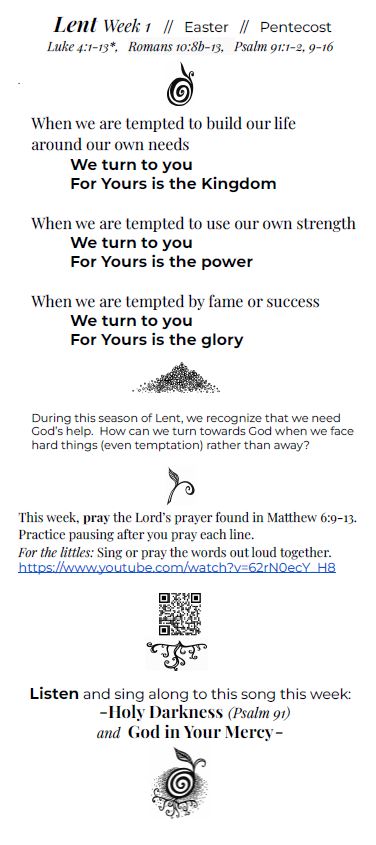
NEW RESOURCE FOR HOME LITURGIES:The Soil and The Seed Project: Directed by Seth Thomas Crissman of The Walking Roots Band [previously] and with the contributions of a team of artists, writers, and musicians, “The Soil and The Seed Project nurtures faith through music, art, and Little Liturgies for daily and weekly use in the home. These resources help establish new rhythms of faith as together we turn towards Jesus, believing and celebrating the Good News of God’s Love for the whole world.” The project launched in November 2021 with its Advent/Christmas/Epiphany collection. When the project is complete it will consist of four volumes of music (forty-plus songs total—all original, save for a couple of reimagined hymns) and four liturgical booklets that include responsive scripture-based readings, reflection prompts, suggested practices, and an original artwork.
Thanks to a community of generous donors, The Soil and The Seed Project gives away all its content for free, including shipping, to anyone who is interested (individuals, couples, families, churches, etc.); request a copy of the latest music collection and liturgies here. CDs and printed booklets are available only while supplies last (1500 copies have been pressed/printed for this collection), but digital copies of course remain available without limit.
+++
CONVERSATIONS AT CALVIN: Below are two videos (of many!) from the 2022 Calvin Symposium on Worship, which took place earlier this month.
>> “Modern-Day Prophets: How Artists and Activists Expand Public Worship” with Nikki Toyama-Szeto: A writer, speaker, and activist on issues of justice, leadership, race, and gender, Nikki Toyama-Szeto is the executive director of Christians for Social Action and a leading voice for Missio Alliance. Here she is interviewed by preacher and professor Noel Snyder. They discuss the generativity of imagination, and its invitation to displacement; the connection between corporate worship and public witness; the movement of the Holy Spirit outside church walls; “political” and “pastoral” as classifications that differ from group to group; embracing messiness; and what pastors can learn from artists and activists.
A few quotes from Toyama-Szeto that stood out to me:
“Part of what we’re trying to do at Christians for Social Action is stir the Christian imagination for what a fuller followership of Jesus looks like in a more just society. The word ‘imagination,’ and I would say specifically Christian imagination, I think of as the dream that God dreams for his people and his creation. What does it mean to be oriented toward the dream that God is dreaming? Another word for it is shalom—the full flourishing of all his creation and all his people. And if you look at the gap between where we are today and what that dream is, that gap is imagination. How is it that we get from here, the broken world we see . . . how do we press in and lean into the dreams that God dreams for his people and for his world?”
“For me, I have found artists and prophets—those who are agitating for justice—are ones who help dislodge me from everyday things I take for granted, and those assumptions, and they help me to dream new and bigger dreams.”
“The pursuit of justice is the declaration of God’s character in the public square.”
Smith shares his frustration that often the only Christians who endeavor to learn other languages and develop cultural intelligence and appreciation are those who are preparing to be missionaries in a foreign country, and they do it only for the purpose of missional effectiveness.
If you take one piece of theology [i.e., evangelism] and try and make that the bit that’s about cultural difference, that puts distortions into the conversation. . . . You might want to think about mission, but you might also want to think about what it means to be made in the image of God. Does that mean everyone’s the same, or does it mean everyone has responsibility for shaping culture and we might all do it in different ways, and you have to make space for that? We might need to think about the cross. We might need to think about God’s embrace of us and how we embrace each other. We might need to think about love of neighbor. We might need to think about the body of Christ and the makeup of the early church. . . . You might have to visit a whole bunch of different theological places to get a composite picture rather than saying this is the doctrine that somehow solves cultural difference for us.
I was also struck by Smith’s discussion of how cultural difference can help us read the scriptures in a new way (see 19:38ff.). He gives an example from In the Land of Blue Burqas, where Kate McCord, an American, describes her experience reading the Bible with Muslim women from Afghanistan, and particularly how they taught her a very different interpretation of John 4, the story of Jesus’s encounter with the Samaritan woman at the well. Wow.
+++
VISUAL COMMENTARY ON SCRIPTURE: The Transfiguration: In churches that follow the Revised Common Lectionary, this Sunday, the last Sunday in the Epiphany season, is Transfiguration Sunday, giving us a vision with which to enter Lent. (Other traditions celebrate Jesus’s transfiguration on August 6.) In this video from the Visual Commentary on Scripture project, art historian Jennifer Sliwka and theologian Ben Quash discuss this New Testament event through three visual artworks: a fifteenth-century icon by Theophanes the Greek, which shows the “uncreated light” revealed to Peter, James, and John on Mount Tabor; a fresco by Fra Angelico from the wall of a friar’s cell in Florence, where Jesus’s pose foreshadows his suffering on the cross; and a contemporary light installation by the seminary-educated American artist Dan Flavin, comprising fluorescent light tubes in the shape of a mandorla. Brilliant!
+++
CIVA TRAVELING EXHIBITION: Again + Again, curated by Ginger Henry Geyer with Asher Imtiaz: “A photography exhibition that invites recurring and fresh contemplation of the ordinary and extraordinary through the seasons of the Christian liturgical calendar,” sponsored by Christians in the Visual Arts. The show will be on view at Second Presbyterian Church in Indianapolis from February 26 to March 26 and is available for rental in North America after that. I saw it at St. David’s Episcopal Church in Austin in November at the CIVA biennial and was impressed! It is accompanied by a beautifully designed catalog that pairs each photograph with a poem, several of which were written specifically for the exhibition and which respond directly to a given photo.
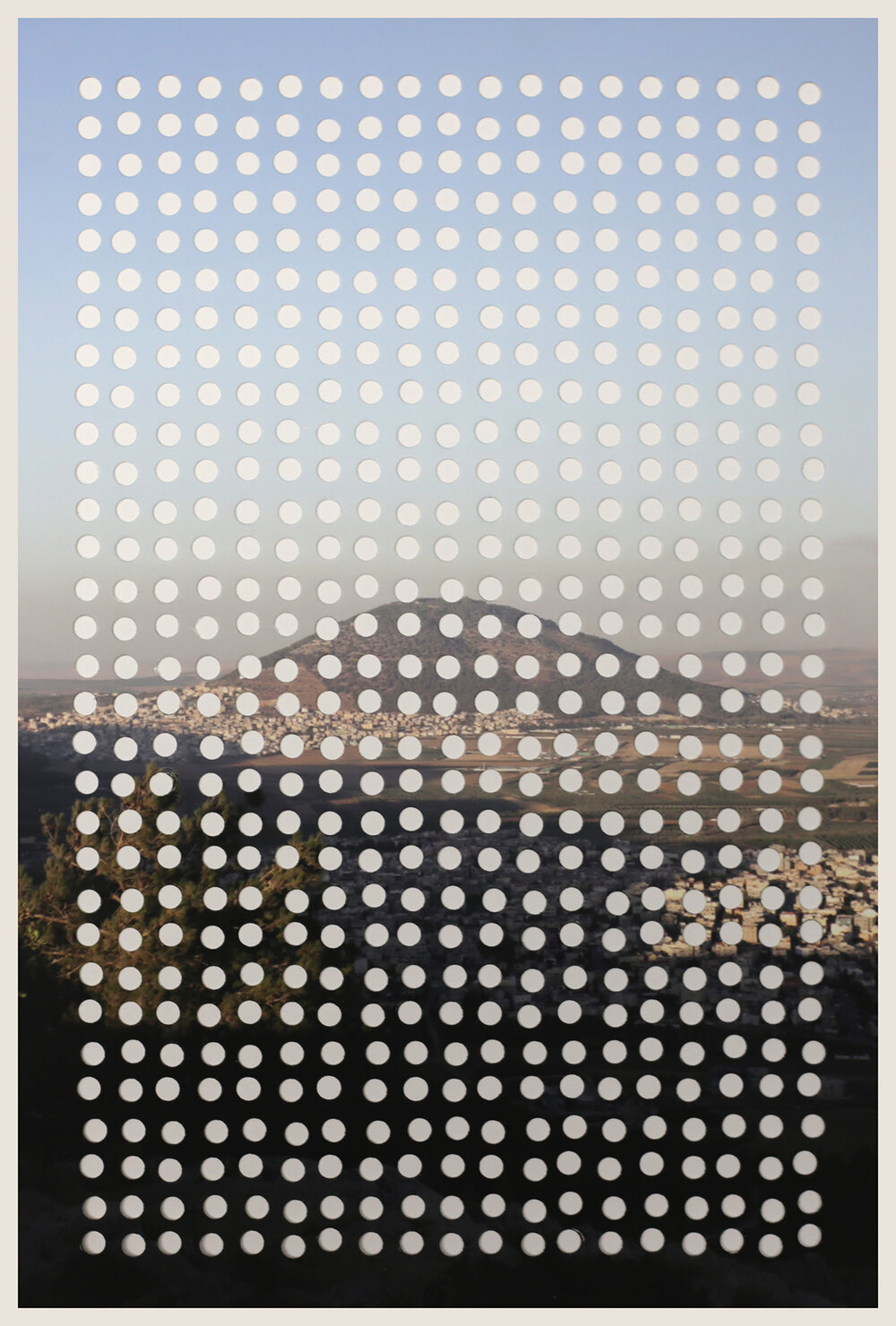
Michael Winters, Mount Tabor, June 2017, 2017. Inkjet print with holes punched out in white wood frame, 19 × 13 in.
One of my favorite art selections is Mount Tabor, June 2017 by Michael Winters, the director of arts and culture at Sojourn Church Midtown in Louisville, Kentucky. “Mount Tabor . . . is where the transfiguration of Christ is thought to have occurred,” Winters writes. “I stood viewing that scene in 2017. It looked so normal. I’m not sure why I felt compelled to punch holes in this photograph, but I think it’s because I wanted to be able to see through this ‘normal’ landscape to the glory of the transfigured Christ—which is to say, I wanted to see reality.”
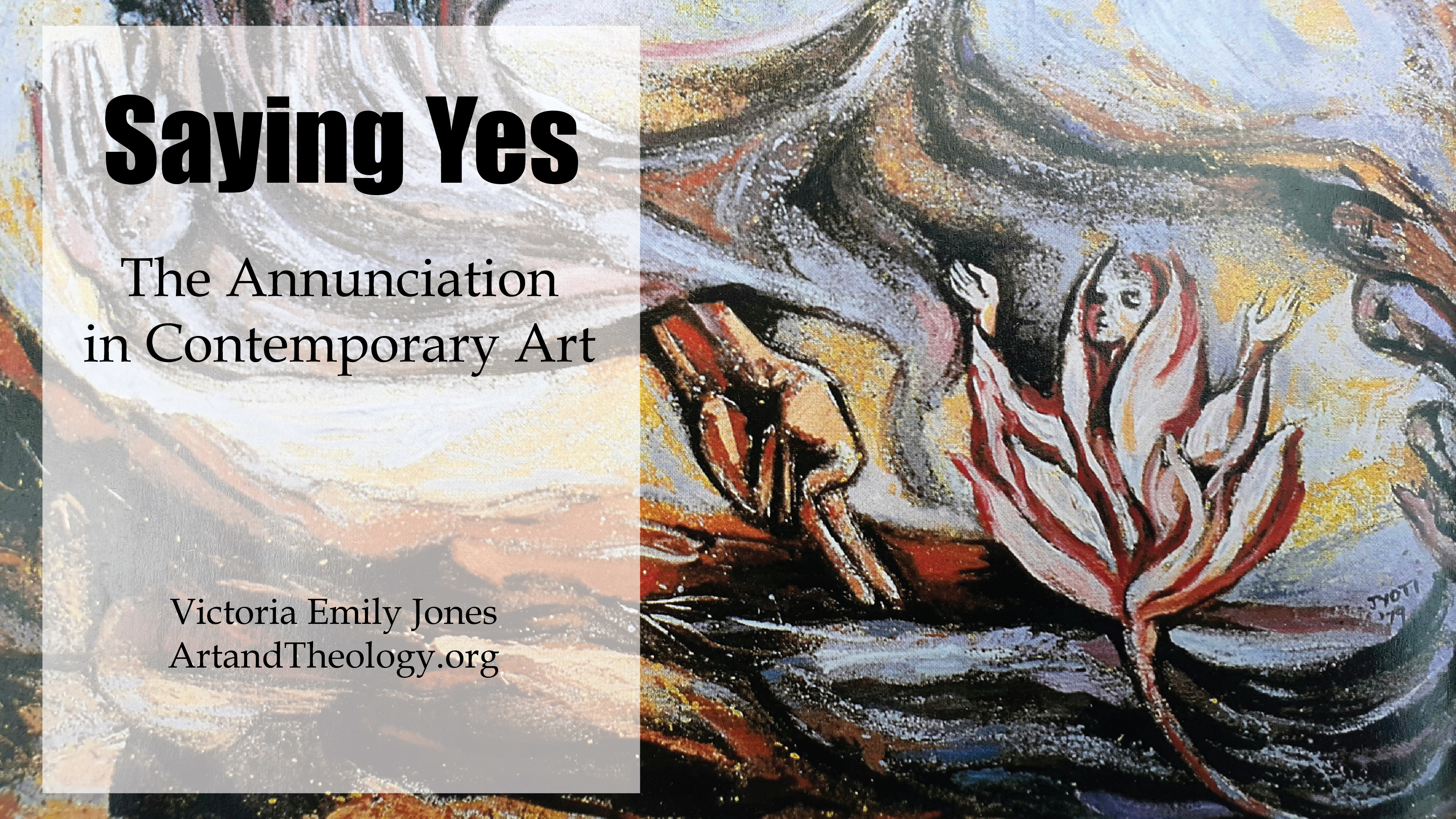
This year’s The Breath and the Clay creative arts gathering, on the theme of “Reenchantment,” is taking place March 17–21, with both in-person (in Winston-Salem, North Carolina) and virtual options. Registration for virtual attendees is pay-what-you-wish. Presenters include theologian Jeremy Begbie, poet Pádraig Ó Tuama, singer-songwriter Joy Ike, contemplative author Christine Valters Paintner, dancer Camille D.C. Sutton, and many more . . . including me! On the evening of March 18 I’ll be giving a twenty-minute talk titled “Saying Yes: The Annunciation in Contemporary Art,” which will be archived online afterward. (The global church celebrates the feast of the Annunciation the following week, on March 25.) (Update: Watch here.) Here’s the description:
The story of Jesus’s miraculous conception in the womb of Mary, a first-century Galilean peasant girl, told in Luke 1 has activated the imaginations of artists since the early Christian era. When an angelic messenger came and told Mary she had been chosen to bear God’s Son, she cycled through a range of emotions before ultimately accepting the call, stepping onto a path that, though scary, would be life-giving not only for her but also for her religious and ethnic community and for the whole world.
God invites us to participate in his work in the world and gives us the grace to do it. When his voice breaks through our safe, predictable routines, calling us to something big, do we respond with brave obedience? In this talk Victoria Emily Jones will share a handful of contemporary artworks that visualize that pivotal moment in salvation history when Mary said yes and set in motion the incarnation. These works show us the wild beauty of God’s plans and can help us tune our ears to the annunciations in our own lives.
(The title slide image is a detail of an Annunciation painting by Jyoti Sahi.)
I’m always impressed by the variety of artists, arts professionals, and art lovers that director Stephen Roach manages to bring together for The Breath and the Clay. Click here to learn more and to register.
+++
ONLINE LENT SERIES:
>> VCS Lent 2021: The Visual Commentary on Scripture is highlighting a different exhibition from its archives for each week of Lent, with new content including a video introduction to the week by Ben Quash and an audio reading of each of the three constituent commentaries.
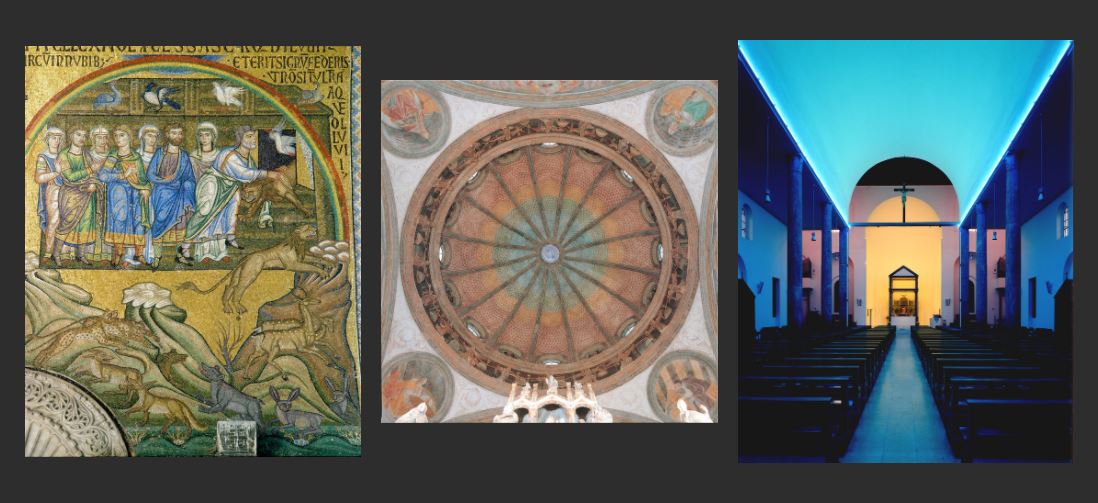
The first week was on the theme of Covenant and covers Genesis 8:20–9:17. Stefania Gerevini curated three artworks from Italy that convey some aspect of the rainbow as divine promise: a thirteenth-century mosaic from the Basilica di San Marco in Venice, a colorful dome fresco (fifteenth century) from the Cappella Portinari in Milan, and a contemporary light installation by Dan Flavin at Santa Maria Annunciata in Chiesa Rossa, also in Milan.
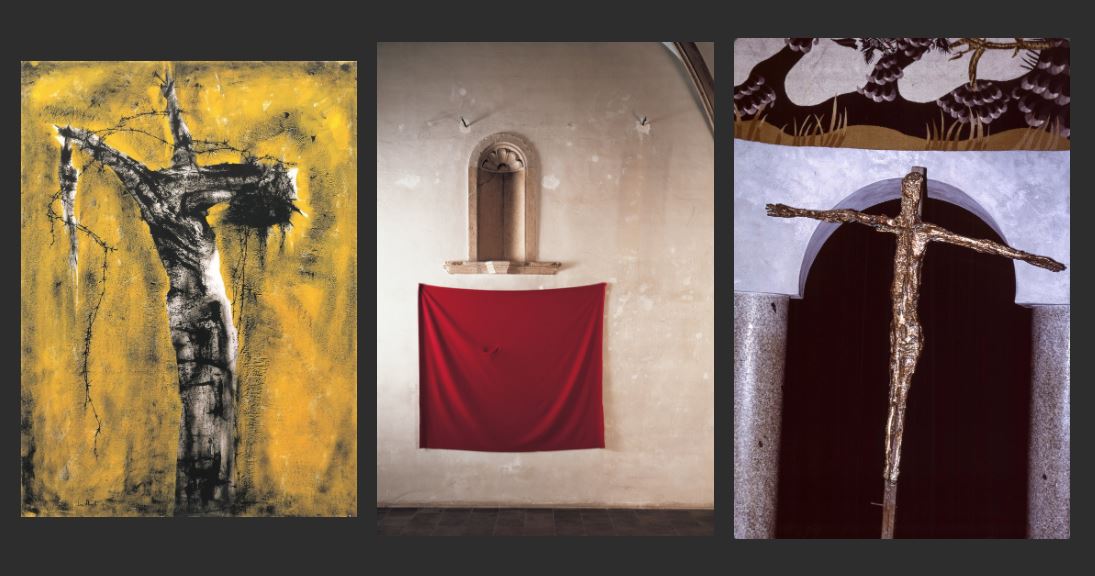
Week 2, on Prophecy, explores the Suffering Servant of Isaiah 53. Jonathan Koestlé-Cate comments on three modern artworks: Crucified Tree Form by Theyre Lee-Elliott, a crucifix by Germaine Richier (which sparked outrage when it was unveiled at Notre-Dame de Toute Grâce, Assy, in 1950), and an installation by postminimalist artist Anish Kapoor at the church of Saint Peter, Cologne.
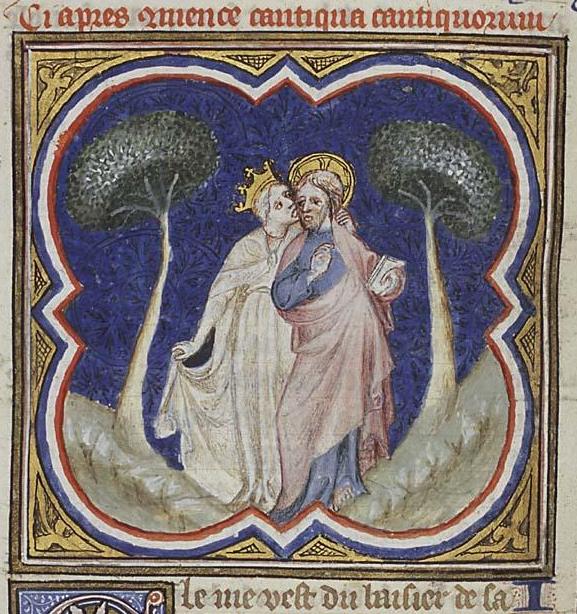
>> “The Many Faces of Jesus”: I’ve been enjoying this Lenten series (on blog andpodcast) by medievalist Dr. Grace Hamman, who makes medieval lit super accessible.“For Lent, Old Books With Grace will share and explore some medieval representations of Jesus in art and literature—the versions of Jesus that dominate the medieval church’s imagination. These medieval portrayals of Jesus may strike us as odd, threatening, charming, creative, stupid, or inspiring. In attending to these versions of Jesus, I hope for a few end goals: the first is that we may expand our Christian imagination. Perhaps a side of Jesus that has never occurred to you, or been sideswept by our contemporary culture, will suddenly illuminate an aspect of the Jesus of scripture. The second is that we may better identify the ways that we ourselves have culturally contained and portrayed Jesus, in positive and negative ways. Often the strangeness of the past helps us recognize the weird or damaging things we believe in order to make Jesus more palatable, understandable, or like us.”
Jean Bondol, “The bride (Ecclesia) and bridegroom (Christ),” from a Bible Historiale made in Paris, 1371–72. The Hague, MMW, 10 B 23, fol. 330v.
>> “Up from My Youth (Psalm 129)” by Advent Birmingham, feat. CashBack and Terence June Gray: This is such a strange and compelling fusion! “An 1806 hymn by Isaac Watts meets hip-hop meets Johnny Cash meets folk meets New Orleans jazz meets industrial steel factory.”
Led by Zac Hicks, Advent Birmingham [previously] is a group of worship musicians from the Cathedral Church of the Advent in downtown Birmingham, Alabama. Hicks wrote this new tune for Isaac Watts’s metrical paraphrase of Psalm 129 and integrated a rap by guest artist Terence June Gray from Memphis. Singing lead (and playing drums) is Leif Bondarenko, the front man of the Johnny Cash tribute band CashBack. The video was filmed at Birmingham’s historic Sloss Furnaces. Available on iTunes, Amazon, and Spotify.
You can read the lyrics here, which include a slight revision of Watts’s verse 6.
POETRY READING:“Phase One” by Dilruba Ahmed, read, with commentary, by Pádraig Ó Tuama, Poetry Unbound: “What do you find hard to forgive in yourself? What might help? In this poem, the poet makes a list of all the things she holds against herself: opening fridge doors, fantasies, wilted seedlings, unkempt plants, lost bags, feeling awkward, treating someone poorly. Dilruba Ahmed repeats the line ‘I forgive you’ over and over, like a litany, in a hope to deepen what it means to be in the world, and be a person of love.”
I’m super-excited to share with you all a major new project I’ve contributed to, which is the Visual Commentary on Scripture (VCS), a free online publication that provides theological commentary on the Bible through the skillful selection of works of art. Launched November 6, 2018, at a reception at the Tate Modern, the VCS is directed by Professor Ben Quash of King’s College London and is funded in large part by Roberta and Howard Ahmanson.
As Quash explains in the introductory video, the VCS aims to demonstrate how visual art itself can serve as biblical commentary, and when placed in conversation with other “visual commentaries” on the same text, the meaning of said text potentially becomes all the more clear. This practice of compiling diverse theological perspectives on a biblical text for their dialogical potential has ancient roots. The Jewish Talmud, for example, gathers together the viewpoints of different rabbis, not because they all necessarily agree but often because they constructively disagree—and there’s value in that conversation. The equivalent in the Christian tradition is the Catenae.
Translating this tradition into a modern, visual format, the VCS comprises virtual “mini-exhibitions” of three works of art per biblical passage, along with a short textual commentary on each artwork and one comparative commentary. (Currently about one hundred passages have gone live, and the goal is to cover the entire Bible.) The commentaries are written for nonspecialists but are grounded in detailed theological and art-historical research. Care is taken to secure the highest-quality images, which you can zoom in on.
Art historian Matthew Milliner calls the VCS “the Biblia pauperum of our time,” referring to the relatively accessible block-printed picture Bibles of the Middle Ages:
Let’s face it: new commentaries, and the academic library subscriptions necessary to come with them, are expensive. Add to that the fact that attention spans are famously declining, and increasingly privilege (for better or for worse) the visual. Perhaps these factors make the Visual Commentary on Scripture, which is actually . . . wait for it . . . free, the biblia pauperum (Bible for the poor) of the twenty-first century. Every minister should be talking about this homiletical goldmine.
YES. I would love to see pastors and seminary students using the VCS as a resource for their biblical and theological studies and sermon preparation.
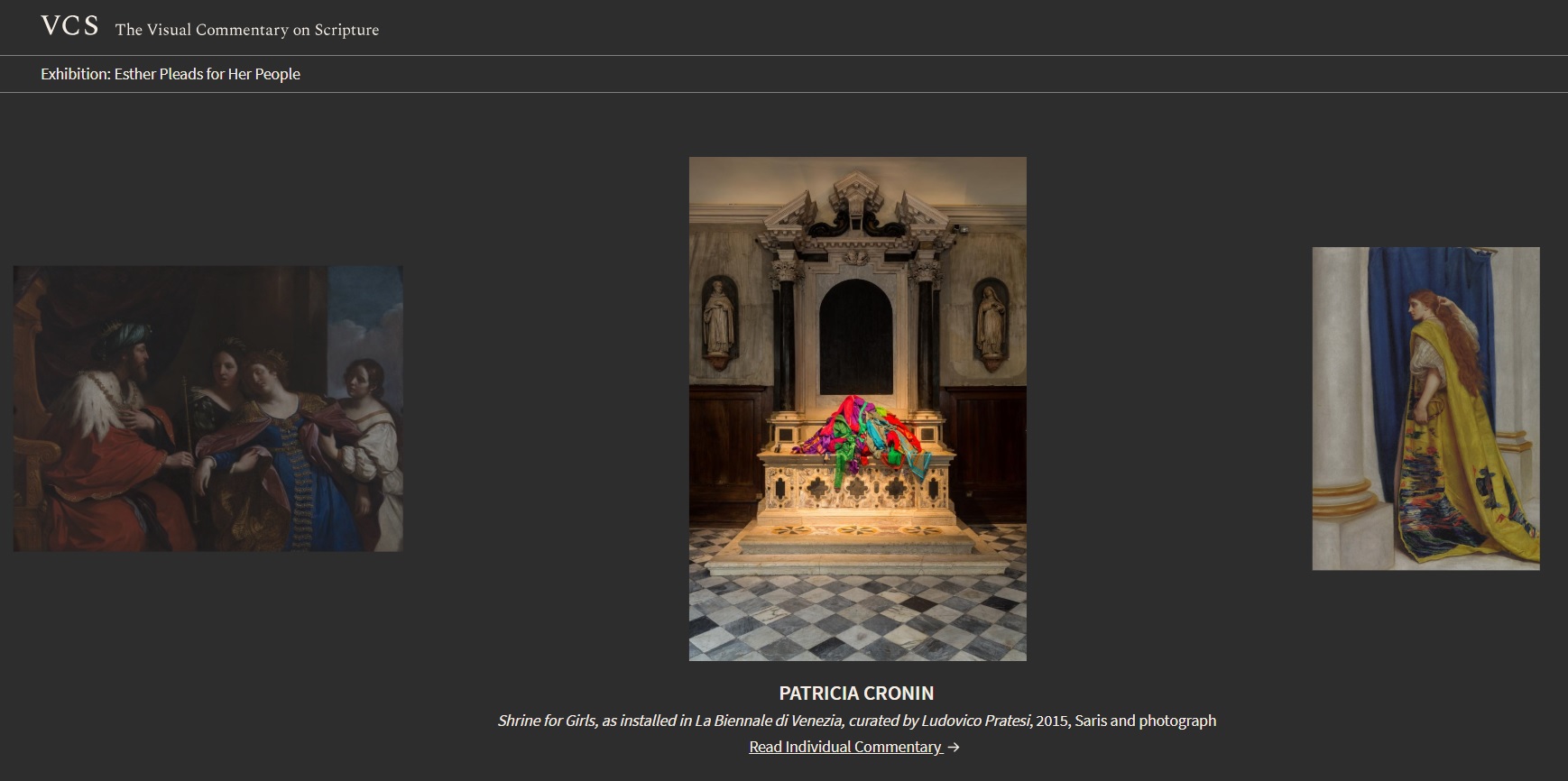
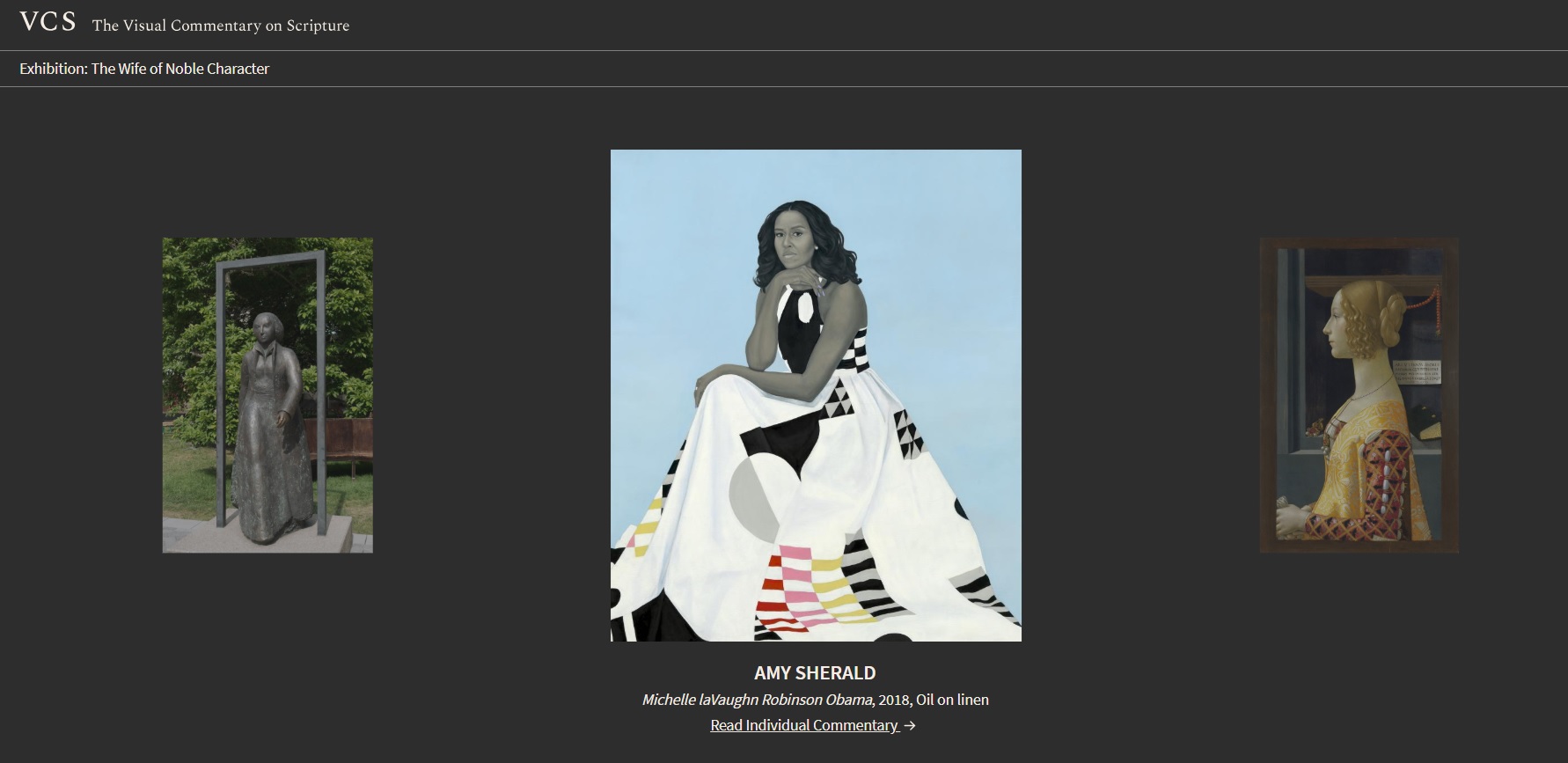
The exhibitions are arranged by biblical text for easy searching—and there are so many fantastic ones. I especially enjoy the ones that include a contemporary art selection. For example, Ayla Lepine ingeniously chose Patricia Cronin’s Shrine for Girls from the 2015 Venice Biennale to converse with Esther 8, in which Esther pleads for the deliverance of her people. Ursula Weekes curated an eclectic trio of portraits—of Florentine noblewoman Giovanna degli Albizzi Tornabuoni, German Reformer Katharina von Bora (Martin Luther’s wife), and former US First Lady Michelle Obama—to interact with the famous “wife of noble character” passage from Proverbs 31. And Pablo Perez d’Ors places Michael Landy’s kinetic sculpture Doubting Thomas, made of found objects and inviting viewer participation, side by side with Old Master paintings to probe the significance of that famous resurrection encounter.
“Physical sight can be a pathway to spiritual insight,” Quash says, affirming the eighth-century monk John of Damascus, who wrote that “just as [through] words perceived by the senses we hear with bodily ears, and understand what is spiritual, so through bodily vision we arrive at spiritual contemplation” (In Defense of Icons 3.12).
+++
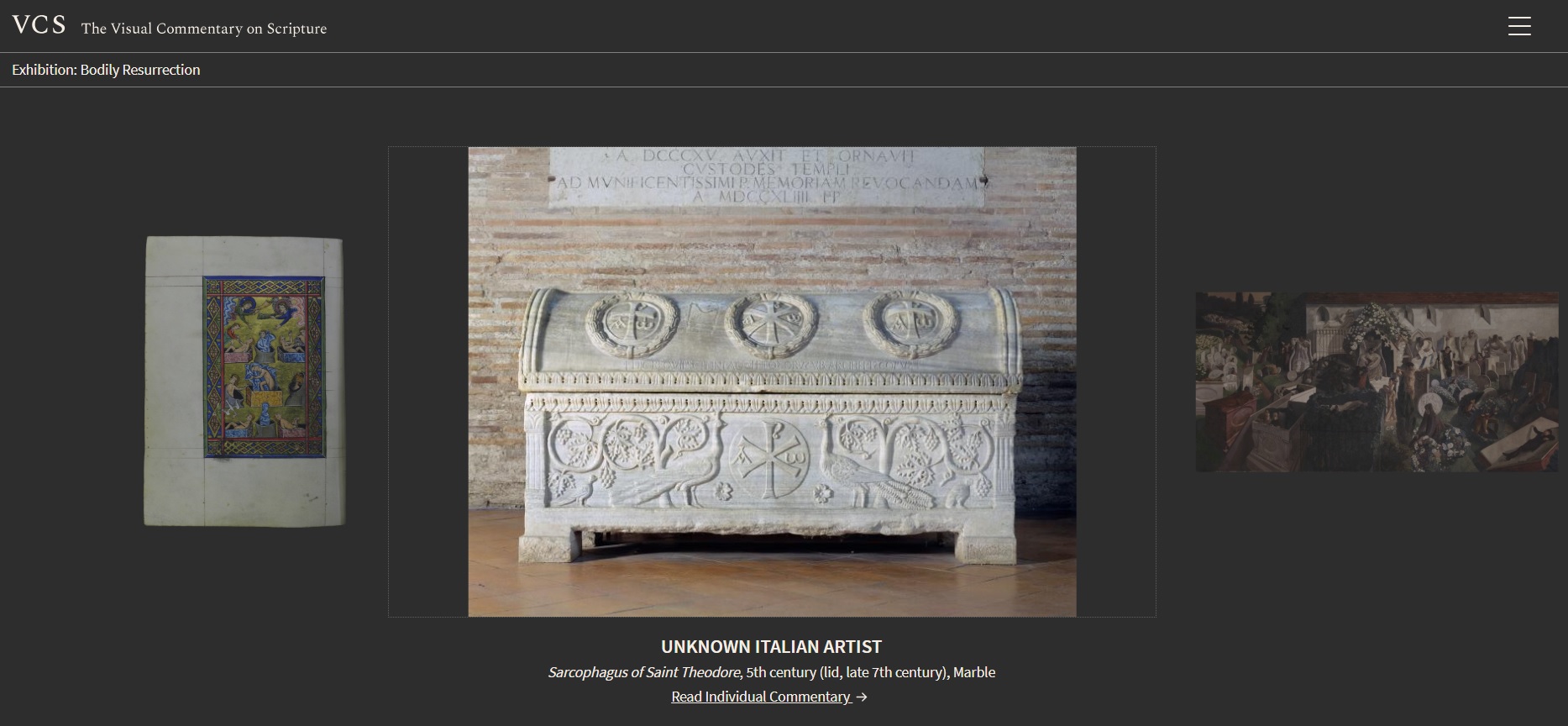
I curated the “Bodily Resurrection” exhibition for the VCS, which takes as its basis 1 Corinthians 15:35–58. After reading the passage many times, including in the context of the whole epistle, and meditating on it, I wanted to investigate how the church has interpreted it over the centuries, so I read Caroline Walker Bynum’s excellent book The Resurrection of the Body in Western Christianity, 200–1336, which quotes from and summarizes a wealth of patristic and medieval writings on the topic. That led me to Tertullian’s On the Resurrection of the Flesh, an extensive treatise from the early second century. They were both fascinating reads.
In addition to the Pauline metaphor of the seed, Bynum writes,
the resurrection of the body is also described by theologians as the flowering of a dry tree after winter, the donning of new clothes, the rebuilding of a temple, the hatching of an egg, the smelting out of ore from clay, the reforging of a statue that has been melted down, the growth of the fetus from a drop of semen, the return of the phoenix from its own ashes, the reassembling of broken potsherds, the vomiting up of bits of shipwrecked bodies by fishes that have consumed them . . . (6)
I realized that I had never really thought about the logistics of the doctrine of the general resurrection, and although, as with other doctrines, the mechanics are not what’s important, it was interesting to consider what my resurrected body might look like, and how (and whence) it will be reconstituted once it decomposes, turns to dust. Some of the conjectures I found to be quite amusing—like Gregory of Nyssa’s claim that in heaven we will have neither genitals nor intestines, because there will be no procreation or digestion. Or Augustine’s suggestion that we will receive back all the bits of ourselves that we ever had, including nail and hair clippings, but the excess will not necessarily go to our fingers and heads but rather will become absorbed into our flesh (so that we don’t look freakish).
I spent a lot of time wrestling through the paradox, held consistently by the church throughout the ages, that the resurrection body will be both identical to the one we have now and new. This particular passage from Paul seems to emphasize the new aspect. He contrasts “physical”/“terrestrial” and “spiritual”/“celestial” bodies. What does he mean by the latter?
Choosing only three images to open up this rich theological doctrine was a real challenge, and I cycled through dozens before landing on the ones I did.
At the outset, I was cognizant that the resurrection Paul writes about, which will occur “at the last trumpet,” is distinct from the spectacular rising from the graves that occurred on the day Jesus was crucified (Matthew 27:52)—so although there are many fine examples of that latter episode in art, I passed them over for this assignment. I also passed over images of Ezekiel in the valley of dry bones, since that narrative is rooted in a different passage (see the VCS exhibition), even though there is an obvious intertextual link between the two.
I was intrigued by the “second Adam” motif present in the Pauline text, and I considered several artworks that follow that vein, including ones depicting the “Harrowing of Hell,” or, as it’s called in the Orthodox tradition, the Anastasis, in which the resurrected Christ pulls up Adam, Eve, and other Old Testament saints from Sheol. This iconographic type would have made a particularly apt pairing with the passage’s triumphant ending: “Death is swallowed up in victory.” But strictly speaking, the harrowing has already taken place (according to church tradition, on Holy Saturday), and although it prefigures the future resurrection, I wanted to keep the focus on the yet-to-come event that Paul is talking about. Plus, I figured that the harrowing will almost surely make an appearance in some other VCS commentary.
Anastasis fresco in the parecclesion of Chora Church, Istanbul, Turkey, ca. 1315.
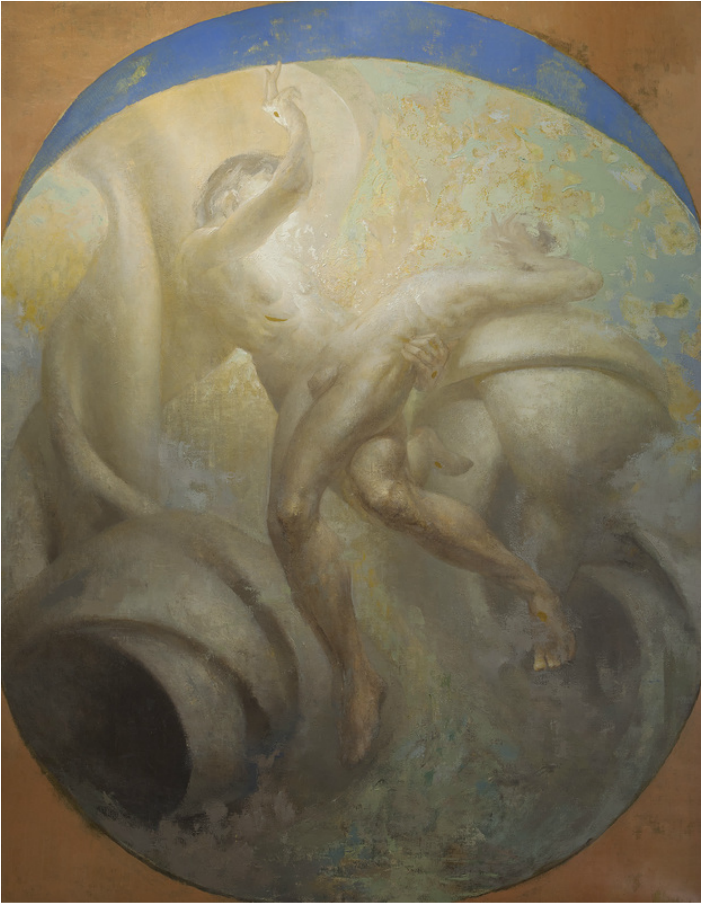
A related image I found, a contemporary one, very unique in its approach and theologically loaded, is a life-size painting by Caleb Stoltzfus that shows the glorious nude Christ, his puncture wounds visible, pulling up a man from the dust. It’s titled Resurrection. I love this image, and there’s much that could be said about it—but ultimately, I felt that it fit better with the passage preceding mine, in particular 1 Corinthians 15:20: “But in fact Christ has been raised from the dead, the firstfruits of those who have fallen asleep.” Read the artist’s commentary at http://www.calebstoltzfus.com/blog/resurrection.
Caleb Stoltzfus (American), Resurrection, 2016. Oil on linen, 6.5 × 5 ft.
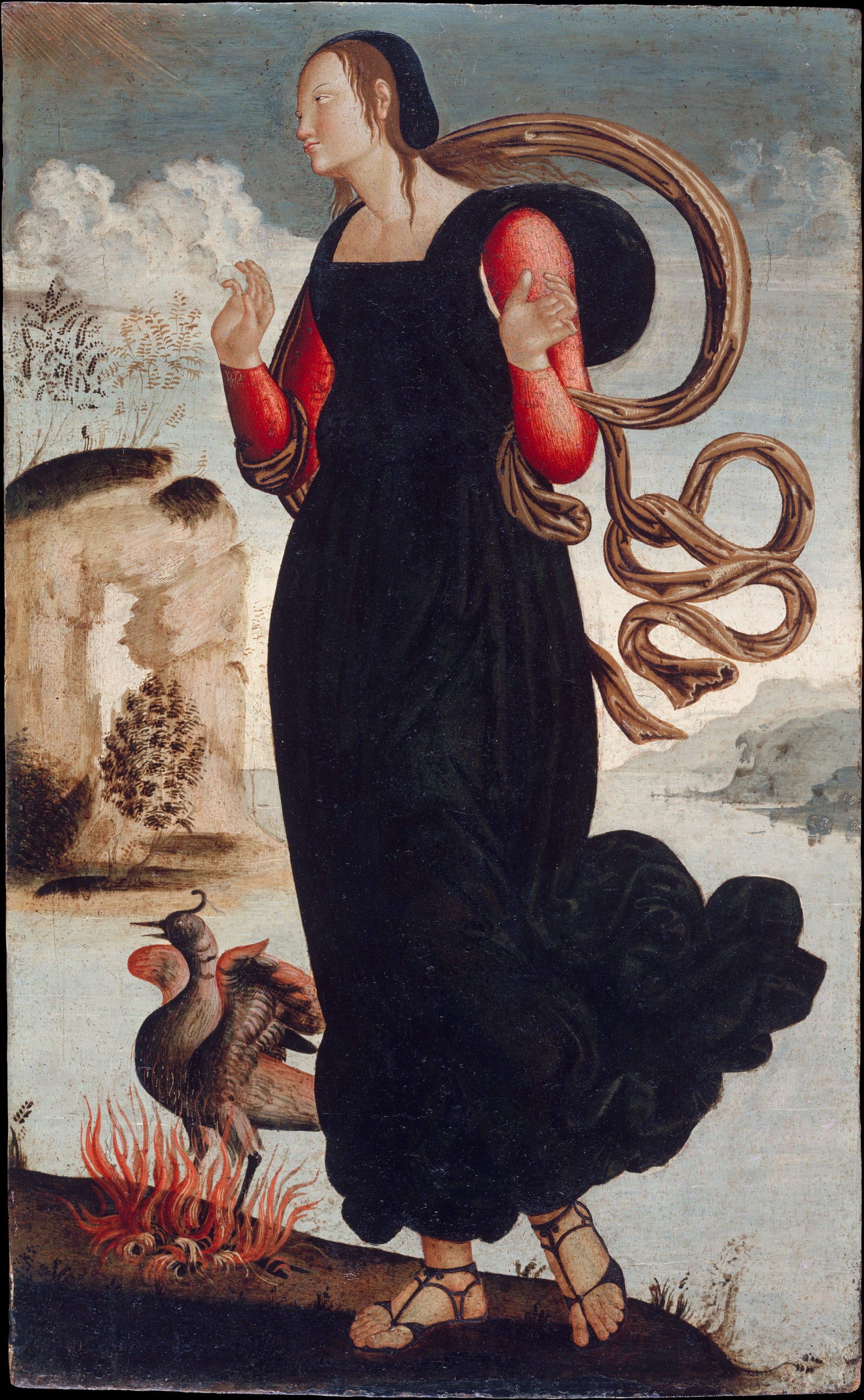
In my image search, I also examined a lot of symbolic bird imagery of the resurrection—that is, phoenixes and peacocks. The phoenix is a mythological bird that dies but then rises up from its own ashes, and the flesh of the peacock was thought to not decay, giving both birds a theological weight since the earliest era of Christian art, where they sometimes stand in for Christ’s resurrection and, by extension, our own. Thinking I’d draw this visual tradition into conversation with 1 Corinthians 15, I came close to selecting Hope, a Renaissance painting from Umbria, Italy, from a set of three allegorical paintings on the theological virtues; in it Hope is personified as a woman who squints her eyes toward the sun and catches a wind as she stands beside a phoenix on its pyre—suggesting the Christian hope of life after death. Although hope is implicit in the Corinthians passage, it’s not a keyword, so I ultimately decided not to include the Umbrian painting in my selection. Peacocks, however, did make the cut! (See below.)
Italian (Umbrian) painter, Hope, ca. 1500. Tempera and gold on wood, 29 1/8 × 17 7/8 in. (74 × 45.4 cm). Metropolitan Museum of Art, New York.
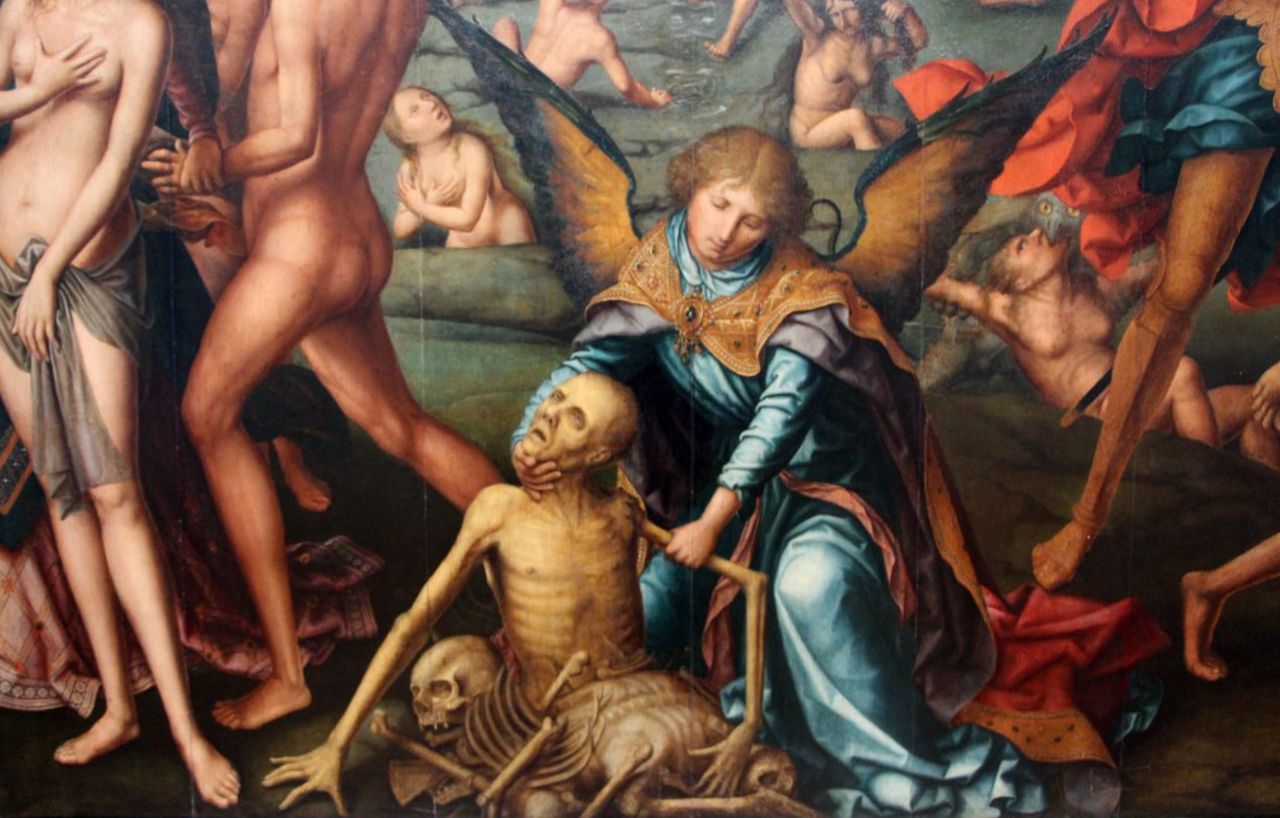
Another shortlisted artwork was the Last Judgment triptych by Jean Bellegambe, a French-speaking Flemish painter of the early sixteenth century. I was particularly drawn in by a detail at the bottom of the central panel, which shows skeletons in the process of acquiring flesh, and an angel reassembling body parts. It is very common in historical works of art for the resurrection of the dead to be subsumed under a larger visual program of the Last Judgment—but Paul doesn’t discuss judgment in my given passage, so I decided to move away from that context.
Jean Bellegambe (French/Flemish, ca. 1470–1535/36), Triptych with the Last Judgment (detail), ca. 1525. Oil on oak panels. Gemäldegalerie, Staatliche Museen, Berlin.
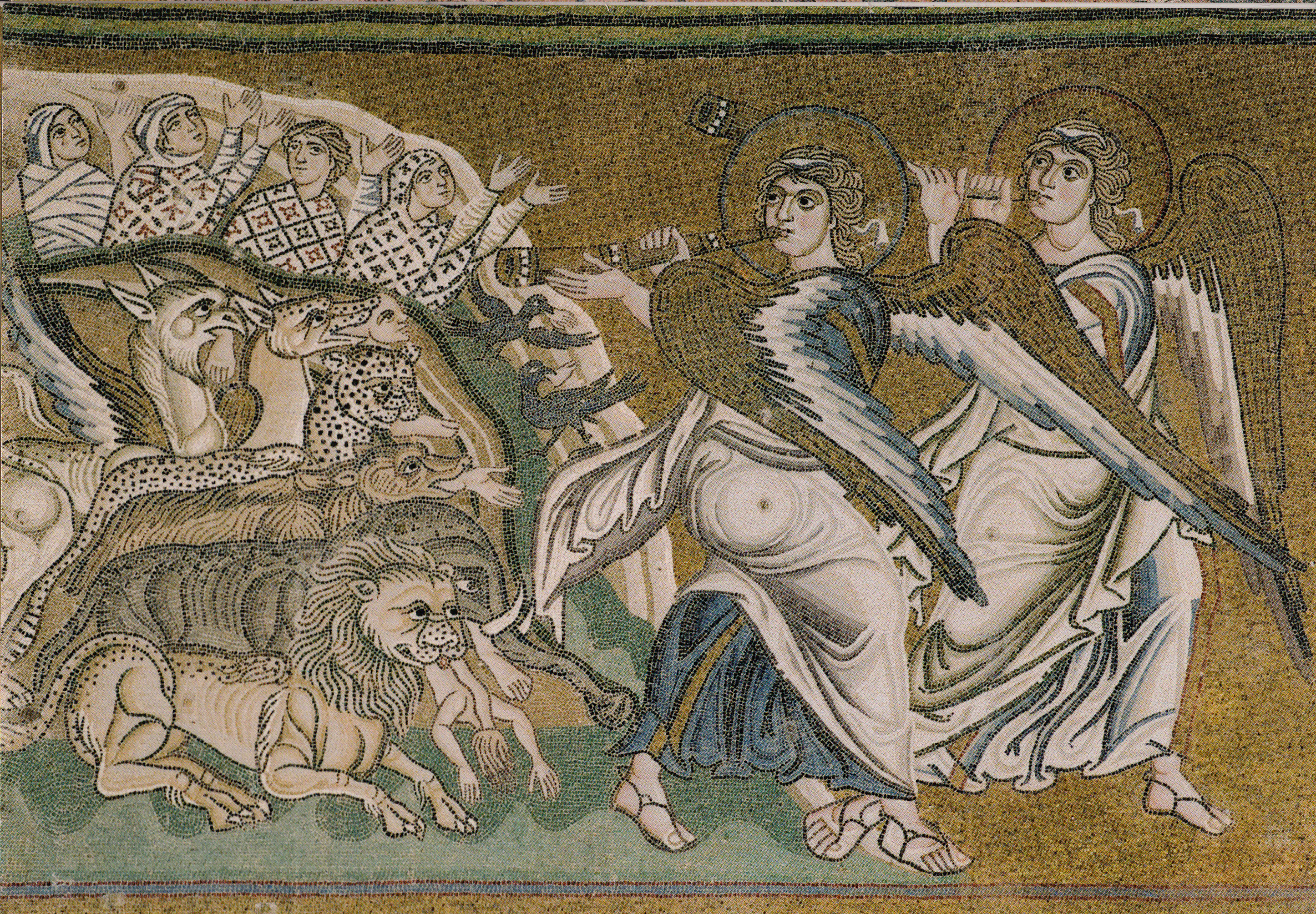
Probably the most unusual thing I discovered in the course of my research was the “regurgitation motif,” which shows animals vomiting up human body parts (from the corpses they have eaten) for reassembly on the last day. Several early church fathers mentioned that this would happen in their theologies of the resurrection, but its visual origin is attributed to the posticonoclastic East and the Carolingian-Ottonian West; it continues down into modern times in Greek, Bulgarian, and Russian frescoes. One of the best-known examples (in the West) is from the monumental twelfth-century mosaic at Torcello near Venice.
Last Judgment (detail), 12th century. Mosaic, west wall, Church of Santa Maria Assunta, Torcello, Venice, Italy.
Last Judgment (detail), 12th century. Mosaic, west wall, Church of Santa Maria Assunta, Torcello, Venice, Italy.
Bynum cites a handful of other examples in her aforementioned book and discusses the motif in depth, contributing to one of her main theses: damnation is swallowing, salvation is regurgitation. An absolutely brilliant argument, drawing heavily on visual theology.
It’s likely that Revelation 20:13 (“And the sea gave up the dead which were in it . . .”) influenced the creation of this motif. Because Paul himself doesn’t mention the mouths of animals giving up their dead, I decided not to go with the extraordinary Torcello mosaic. But I was able to sneak in a reference to that tradition by way of a side detail in one of the paintings I chose. It’s almost comical to look on, how literal it is. But it’s also thought-provoking. If our dead bodies are eaten and digested by worms or carrion beasts—or, God forbid, we meet our end through the mouth of a wild animal—then what remains of us, if we are divided into parts, mere particles, even? Will we ever be made whole again? If we are both body and soul, as Christianity attests, then isn’t our material continuity essential?
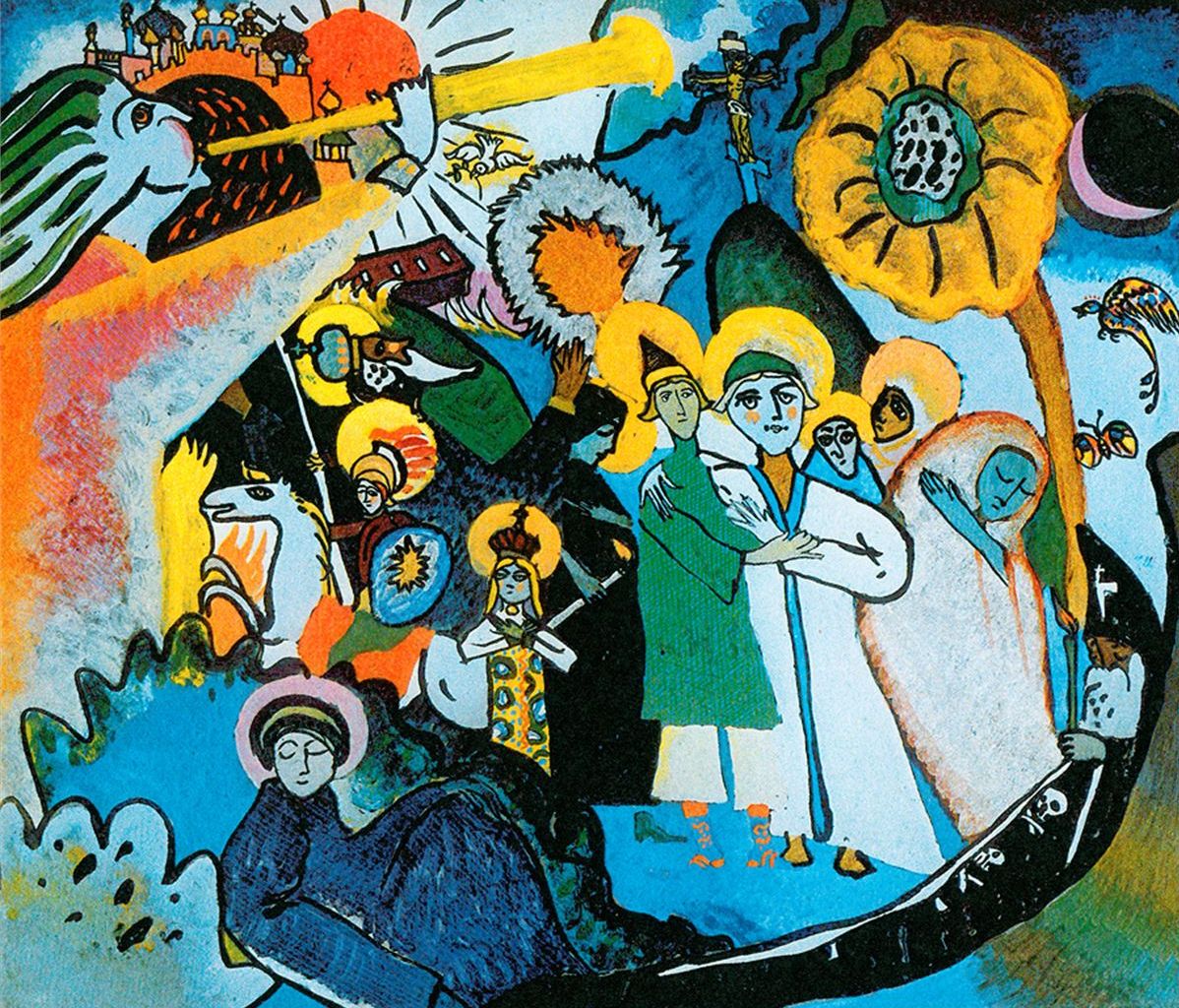
Other runners-up that didn’t make the cut were Wassily Kandinsky’s eschatological paintings—for example, All Saints I and Composition V. I wanted to choose artworks from three different countries and eras, and for the modern period, I just had to go with Stanley Spencer, who is renowned for his many resurrection paintings, localized to his hometown of Cookham in the UK. (I also felt a little out of my depth writing about Kandinsky’s radical style and spiritual approach to painting.)
Wassily Kandinsky (Russian, 1866–1944), All Saints I [Allerheilgen], 1911. Reverse glass painting, 20 × 24 in. Städtische Galerie im Lenbachhaus, Munich, Germany.
The inclusion of Spencer also influenced my choice, after some consideration, not to go with the Harrowing panel from Nicholas Mynheer’s Wilcote polyptych. (Two twentieth-century British paintings would have presented too limited a range.) It would have fit well with the Corinthians passage, which talks about us being sown in dust and reaped in glory—and its juxtaposition with Adam and Eve’s expulsion from paradise, on the opposite wing of the altarpiece, further underscores this theme. I wrote about the altarpiece as a whole a few years ago at Art & Theology.
Nicholas Mynheer (British, 1958–), The Harrowing, extreme right inner panel of a polyptych, 1999. Wilcote Chapel, St. Mary’s Church, North Leigh, Oxfordshire, England.
+++
So what did I end up choosing?
A fifth-century Christian sarcophagus from Italy, emphasizing Paul’s metaphor of the body as seed that, once buried, will flower forth in life
A thirteenth-century German psalter illumination that shows the dead casting off their grave-clothes and “putting on” immortality
A twentieth-century painting by the British master Sir Stanley Spencer, who set the resurrection in a local churchyard, using his friends and neighbors as subjects












 Art & Theology