Holy Week: Jesus Washes His Disciples’ Feet

If I, your Lord and Teacher, have washed your feet, you also ought to wash one another’s feet. For I have set you an example, that you also should do as I have done to you. . . .

I give you a new commandment, that you love one another. Just as I have loved you, you also should love one another. By this everyone will know that you are my disciples, if you have love for one another.

—John 13:14–15, 34–35

LOOK: We Are by Hyeyoung Shin [HT]

Shin, Hyeyoung_We Are
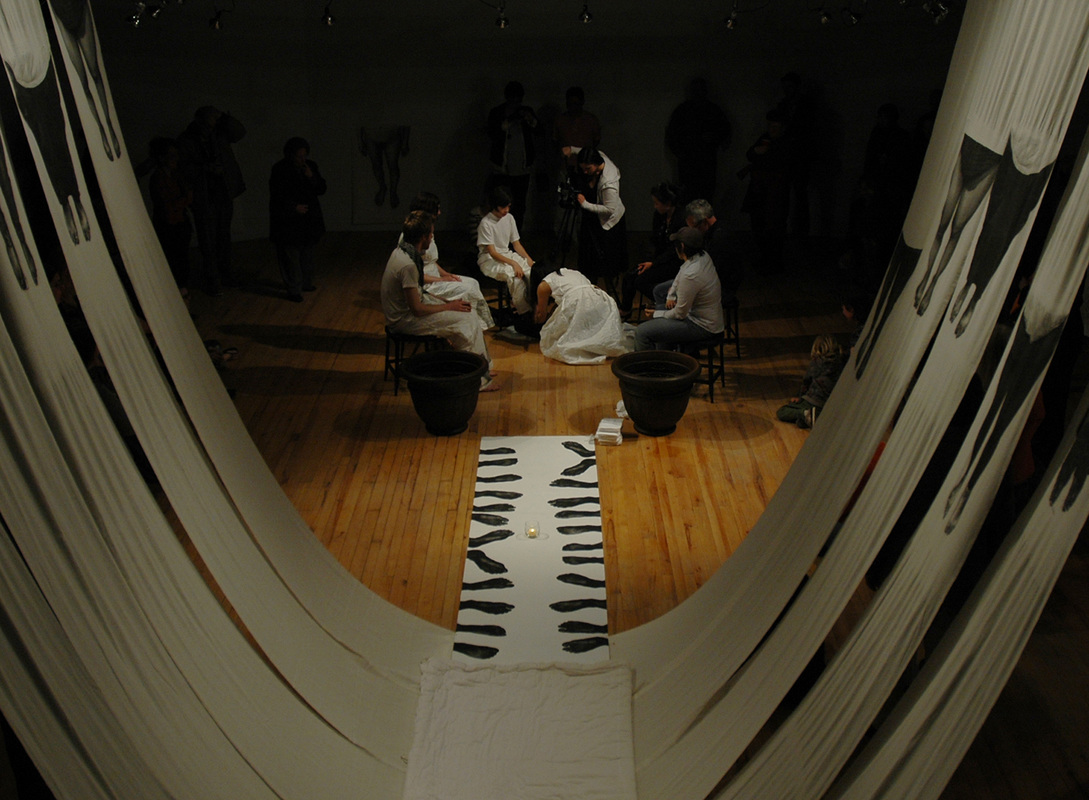
Hyeyoung Shin (Korean American, 1974–), We Are, 2010. Performance, graphite drawings on paper and paper garments, and lithographs on muslin. Big Orbit Gallery, Buffalo, New York.

Shin, Hyeyoung_We Are
Foot-washing performance by Hyeyoung Shin at the opening of We Are, April 23, 2010, Big Orbit Gallery, Buffalo, New York.

Hyeyoung Shin is a South Korean–born, Kansas City–based artist whose work explores human vulnerability, humility, intimacy, empathy, interpersonal relationships, and belonging.

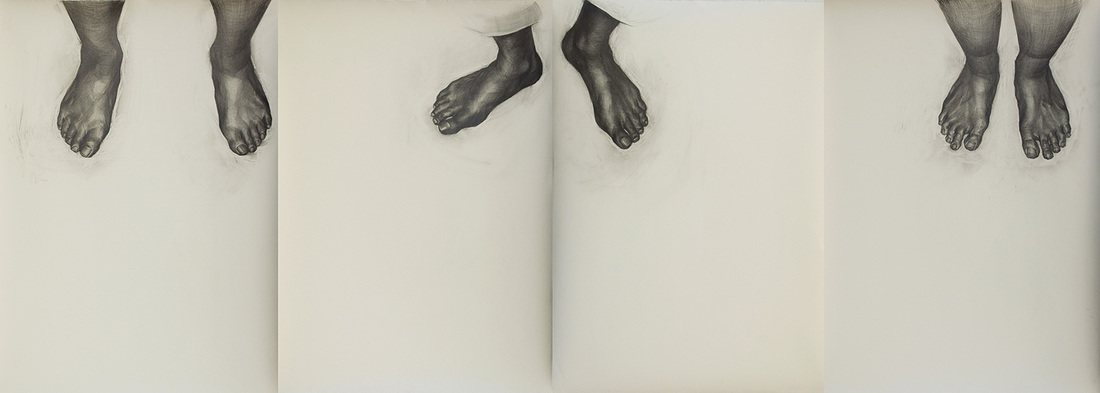
We Are is the name of a solo exhibition of hers from 2010 consisting of life-size drawings and lithographs of human feet and a foot-washing performance. Shin executed thirty-four graphite drawings on paper as well as on paper garments that she custom-made. The structural anchor of the installation was five muslin panels, each ten yards long, suspended from the ceiling and draped like a hammock. On the upper reaches of each were lithographs of two pairs of legs, and in the bed of the hammock lay a mat, a pillow, and a paper dress. Leading up to the hammock was a long sheet of paper with twelve sets of footprints arranged in two rows, evoking Jesus’s twelve disciples.
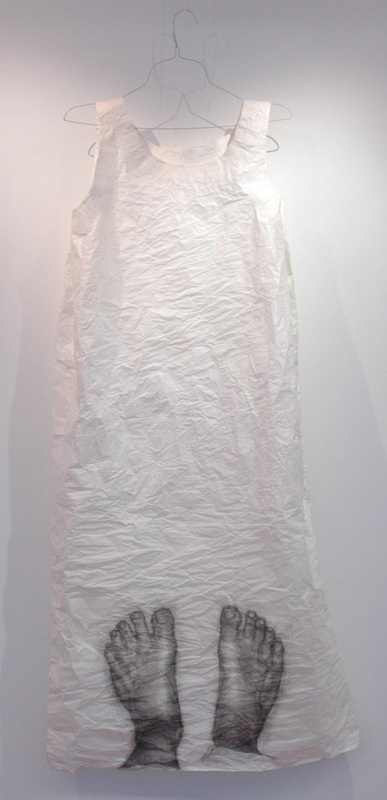

Graphite drawing on handmade paper garment with hanji, 2009

Shin, Hyeyoung_We Are
Lithographs on muslin, approx. 288 × 30 in., 2009–10

Shin, Hyeyoung_We Are (drawing series)
Graphite drawings on paper, 42 × 64 in., 2009

Shin enacted the foot washings herself. She said that “through the experiences, I began to learn again how to practice love akin to holding my mother’s feet” as she lay dying of a terminal illness. The physical proximity and tender touch at that gallery event opened up channels of empathy between the artist and participants.

LISTEN: “Reverie: This is my will,” arr. Anne-Marie O’Farrell, on Easter in Ireland: Music for the Paschal Season (2020)

Rev. Dr. Anne-Marie O’Farrell, a harpist, composer, and Church of Ireland minister from Dublin, wrote this reverie on the Maundy Thursday hymn “This Is My Will” for solo lever harp in 2019. (A reverie is an instrumental piece suggesting a dreamy or musing state.) The Jesuit priest James Quinn (1918–2010) of Scotland wrote the hymn text, reproduced below, in 1969, a paraphrase of John 15:11–17, pairing it with a traditional Irish suantraí (lullaby) melody. It is that melody—which in Ireland has come to be associated with Holy Week, thanks to Quinn—that O’Farrell has arranged here. Purchase sheet music for O’Farrell’s harp reverie, or an arrangement for SATB voices and solo.

This is my will, my one command,
that love should dwell among you all.
This is my will, that you should love
as I have shown that I love you.

No greater love a man can have
than that he die to save his friends.
You are my friends if you obey
all I command that you should do.

I call you now no longer slaves;
no slave knows all his master does.
I call you friends, for all I hear
my Father say you hear from me.

You chose not me, but I chose you,
that you should go and bear much fruit.
I called you out that you in me
should bear much fruit that will abide.

All that you ask my Father dear
for my name’s sake you shall receive.
This is my will, my one command,
that love should dwell in each, in all.

Jesus speaks this discourse after washing his disciples’ feet the day before his death. The name traditionally accorded to Thursday of Holy Week—Maundy Thursday—comes from the Latin word mandatum, “command,” referencing this passage.

Maundy Thursday (Artful Devotion)

Kazanivska, Solomia_Washing of the Feet
Solomia Kazanivska, Washing of the Feet, 2018

Now before the Feast of the Passover, when Jesus knew that his hour had come to depart out of this world to the Father, having loved his own who were in the world, he loved them to the end. During supper, when the devil had already put it into the heart of Judas Iscariot, Simon’s son, to betray him, Jesus, knowing that the Father had given all things into his hands, and that he had come from God and was going back to God, rose from supper. He laid aside his outer garments, and taking a towel, tied it around his waist. Then he poured water into a basin and began to wash the disciples’ feet and to wipe them with the towel that was wrapped around him. He came to Simon Peter, who said to him, “Lord, do you wash my feet?” Jesus answered him, “What I am doing you do not understand now, but afterward you will understand.” Peter said to him, “You shall never wash my feet.” Jesus answered him, “If I do not wash you, you have no share with me.” Simon Peter said to him, “Lord, not my feet only but also my hands and my head!” Jesus said to him, “The one who has bathed does not need to wash, except for his feet, but is completely clean. And you are clean, but not every one of you.” For he knew who was to betray him; that was why he said, “Not all of you are clean.”

When he had washed their feet and put on his outer garments and resumed his place, he said to them, “Do you understand what I have done to you? You call me Teacher and Lord, and you are right, for so I am. If I then, your Lord and Teacher, have washed your feet, you also ought to wash one another’s feet. For I have given you an example, that you also should do just as I have done to you. Truly, truly, I say to you, a servant is not greater than his master, nor is a messenger greater than the one who sent him. If you know these things, blessed are you if you do them.”

. . .

When [Judas] had gone out, Jesus said, “Now is the Son of Man glorified, and God is glorified in him. If God is glorified in him, God will also glorify him in himself, and glorify him at once. Little children, yet a little while I am with you. You will seek me, and just as I said to the Jews, so now I also say to you, ‘Where I am going you cannot come.’ A new commandment I give to you, that you love one another: just as I have loved you, you also are to love one another. By this all people will know that you are my disciples, if you have love for one another.

—John 13:1–17, 31b–35

The Thursday before Easter is referred to as Maundy Thursday—the Middle English word maundy being a derivation of the Old French mandé, from the Latin mandatum, “commandment.” The name refers to John 13:34, where, after the Last Supper, Jesus commands his disciples to love one another.

+++

SONG: “Ubi caritas” | Words: Traditional | Music by Ola Gjeilo, 1999 | Performed by Voces8, on Lux, 2015


“Ubi caritas” is an ancient (or early medieval—it’s disputed) Latin text that is traditionally used as an antiphon, or sung refrain, for the foot-washing ceremony on Maundy Thursday. The current Roman Catholic Missal reassigns it to the offertory procession of the Maundy Thursday Mass.

Originally the text was set to a Gregorian chant melody, but it has since been set and/or arranged by Maurice Duruflé, Ola Gjeilo, Paul Mealor, Ivo Antognini, Audrey Assad, and many others. I’ve chosen the setting by Ola Gjeilo, a Norwegian composer and pianist born in 1978 and now living in the United States.

Ubi caritas et amor, Deus ibi est.
Congregavit nos in unum Christi amor.
Exsultemus, et in ipso jucundemur.
Timeamus, et amemus Deum vivum.
Et ex corde diligamus nos sincero.

Ubi caritas et amor, Deus ibi est.
Simul ergo cum in unum congregamur:
Ne nos mente dividamur, caveamus.
Cessent iurgia maligna, cessent lites.
Et in medio nostri sit Christus Deus.

Ubi caritas et amor, Deus ibi est.
Simul quoque cum beatis videamus,
Glorianter vultum tuum, Christe Deus:
Gaudium quod est immensum, atque probum,
Saecula per infinita saeculorum. Amen.

English Translation:
Where charity and love are, there God is.
The love of Christ has gathered us into one.
Let us exult, and in Him be joyful.
Let us fear and let us love the living God.
And from a sincere heart let us love each other.

Where charity and love are, there God is.
Therefore, whensoever we are gathered as one:
Lest we in mind be divided, let us beware.
Let cease malicious quarrels, let strife give way.
And in the midst of us be Christ our God.

Where charity and love are, there God is.
Together also with the blessed may we see,
Gloriously, Thy countenance, O Christ our God:
A joy which is immense, and also approved:
Through infinite ages of ages. Amen.

+++

The main panel of contemporary iconographer Solomia Kazanivska’s Washing of the Feet shows Christ, whose halo bears a faint cross-shape, washing the dirt off Peter’s feet, as the other disciples, silhouetted in white, look on. At first Peter was much distraught by the notion of his superior stooping to such a menial act of servitude, and he objected. But when Jesus told Peter that Peter would have no part with him unless Peter received the foot-washing, Peter changed his tune completely: he figured that if this were true, then a full body wash would give him an even bigger part with Jesus, so he exclaimed, “Wash my hands and my head too!” That’s why icons show Peter pointing to his head (not, as might be assumed, to signal his initial discomfort, as in “Oh dear . . .”).

What strikes me most about Kazanivska’s icon is the bottom panel, which seems to show the disciples washing one another’s feet, following their teacher’s example. (It’s possible that this band is meant to show Christ washing different disciples’ feet, as the biblical text says he did, but the different clothing of the kneeling figure in each of the six tableaux inclines me toward the other interpretation.) Kazanivska is not suggesting that that’s how it literally went down that evening—the disciples immediately understanding Christ’s meaning and faithfully imitating him. Rather, I read this an aspirational and metaphoric image, of how Christians are to interact with one another: in love and humility, time after time (hence the repetition). And that’s why I chose it to complement the “Ubi caritas” hymn.

Follow Solomia Kazanivska on Facebook @Kazanivska.Icon.Art or on Instagram @kazanivskaicon.


This post belongs to the weekly series Artful Devotion. If you can’t view the music player in your email or RSS reader, try opening the post in your browser.

To view all the Revised Common Lectionary scripture readings for Maundy Thursday, cycle A, click here.