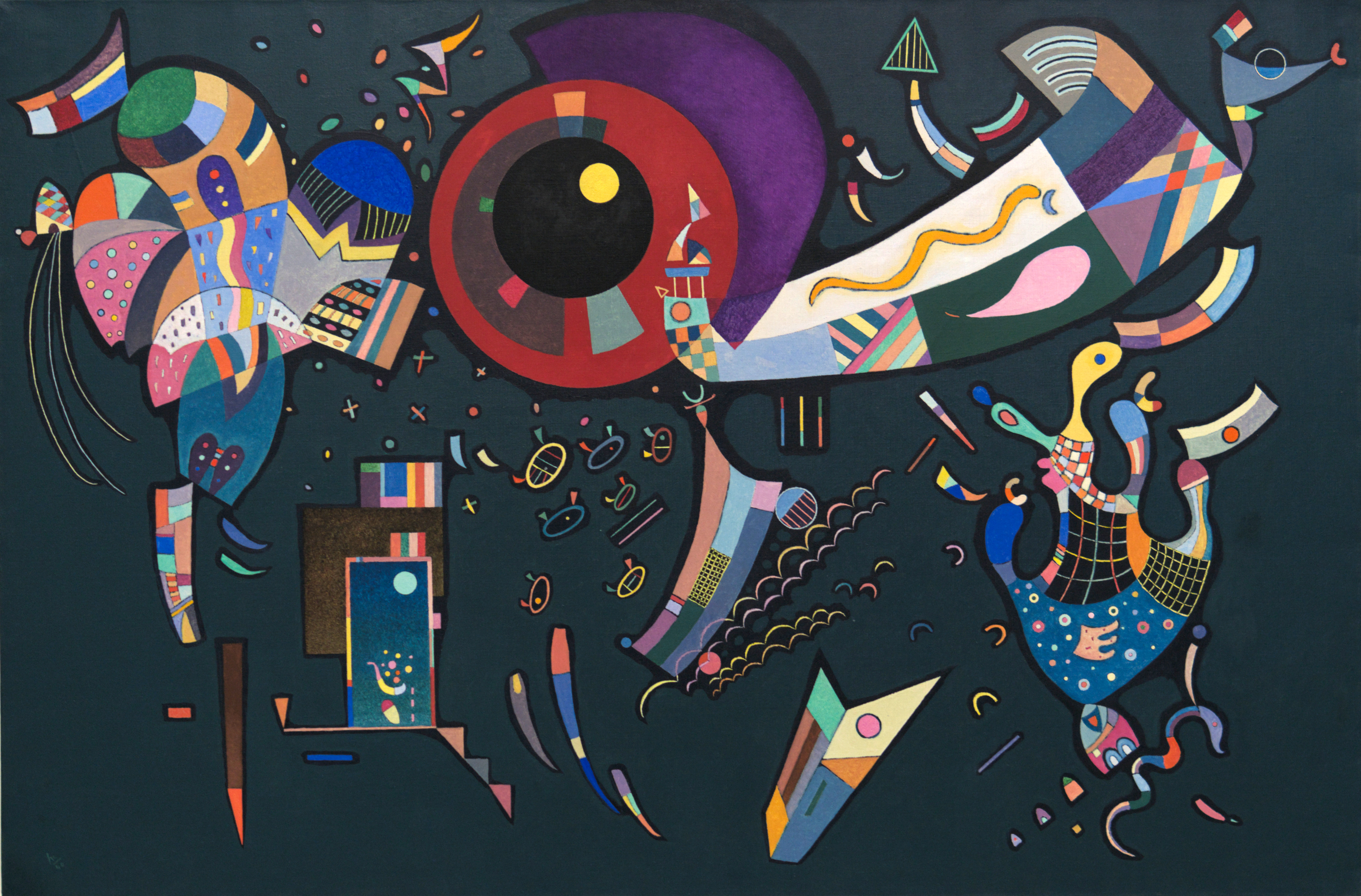
Wassily Kandinsky (Russian, 1866–1944), Around the Circle (Autour du cercle), 1940. Oil and enamel on canvas, 38 1/4 × 57 5/8 in. (97.2 × 146.4 cm). Solomon R. Guggenheim Museum, New York. Photo: Victoria Emily Jones. [object record]
I saw this vibrant abstract painting by the pioneering Russian French artist Wassily Kandinsky at the Guggenheim in 2022. The museum label stated:
Around the Circle, one of Kandinsky’s last major paintings, is a milestone in the artist’s circular journey. It reflects not only contemporary concerns but also his abiding interest in the belief systems and folklore of Russian and Siberian cultures. The dominant red circle at top center; the form cresting the undulating lines of “sacred waters” below; and a third, upside-down stylized humanoid form at bottom right have all been interpreted as potential allusions to shamans, or spiritual leaders and healers, in states of transformation. At bottom left, a lunar orb glows in the expanse beyond an open doorway, which is connected to a set of stairs with no physical support. This could be a portal to the cosmos, or some otherwise indeterminate space beyond the picture plane, in a probable nod to alternate dimensions or to the capacity for mystical ascendance.
What do I see? Color. Confetti, streamers, celebration. A rocket ship. Stars. Birds. Waves. A falling man. A doorway. An eye.
Advent is a dual-toned season that combines lament and penitence—an honest accounting of the brokenness of the planet, global and personal relationships, systems, and our own selves—with joyful expectation of Christ’s glorious intervention. In my annual Advent selections I seek to honor this characteristic balance between darkness and light.
Today’s art selection leans into the light—into the bubbling joy for what is just over the horizon, or just through the door. I think of the Magnificat of the Mother of God, a praise song in which, pregnant with Christ, she exults in the powerful being thrown down and the humble uplifted. She sings of the marvelous salvation wrought by God.
Let us rejoice with her in the righteousness to come.
LISTEN: “Maranatha” by David Benjamin Blower, on Hymns for Nomads, vol. 1 (2018)
Let the trees all clap their hands And the stones all jump for joy Let the earth shake off its bonds Let the peoples all rejoice
Refrain: Maranatha, our Maker Who maketh all things right Maranatha, our Healer Come rise, O healing light
Let the peoples all delight In the messianic light Let the whole earth be glad At the making all things right [Refrain]
Let the poor be lifted up From the ashes and the dust Let the proud climb down from their thrones And we all shall be reconciled at once [Refrain]
Wassily Kandinsky (Russian, 1866–1944), Three Sounds, 1926. Oil on canvas, 23 5/8 × 23 1/2 in. Solomon R. Guggenheim Museum, New York.
the silent stars descend to us
come angel seraph sheep pear-tree

o holy o cold
dawn come in snow

offspring of day
light is lily above us

glory birds, calling birds
sun, the fields shining

the day, the earth, skies
peace, contemplation and music

hosanna, no, holly stand
suddenly tree displayed

the yonder star our comfort
bring time again

joy, excelsis a-leaping
world and hope embrace

lullay image and sing sing
a happy new begin
“seasonal ghazal” by Harry Gilonis appears in the chapbook The Twelve Poems of Christmas, vol. 3, ed. Carol Ann Duffy (Candlestick Press, 2011), and in Haphazard by Starlight: A Poem a Day from Advent to Epiphany by Janet Morley (SPCK, 2013). Used by permission of Harry Gilonis.
A ghazal is a traditional Arabic verse-form originating in seventh-century Arabia and spreading in the medieval era into Africa, Spain, Persia, South Asia, and Turkey, where it has continued to develop. It is made up of five to fifteen self-contained couplets connected loosely by mood or theme, however allusive. The poet Agha Shahid Ali compares each ghazal couplet to “a stone from a necklace” that should continue to “shine in that vivid isolation.”
Harry Gilonis’s “seasonal ghazal” doesn’t adhere to all the principles of the classic form (which involve rhyme and refrain), but it does give us autonomous couplets of roughly equal length that unfold without linearity, and these all center on the twinned seasons of Advent and Christmastide. Gilonis composed the poem using a cut-up technique, in which he printed out pages’ worth of sacred and secular English carol texts, excised words or short phrases that stood out to him, and rearranged those excised fragments into varying combinations, creating a medley of seasonal keywords that strikes a new chord.
By separating the words from their original syntactic contexts and collaging them together in new ways, he defamiliarizes and thus revivifies them. Traditional elements of the Christmas story are playfully refreshed.
The poem captures the magic and wonder of the season and a hint of its yearning and lament. For example, the exultant excelsis, Latin for “highest,” from the angels’ song to the shepherds is followed one stanza later by lullay, an archaic word used to soothe children to sleep and voiced in the “Coventry Carol” by mothers of ancient Bethlehem who lullaby into eternal rest their infant sons who are about to be slain by Herod. Elevated choral anthems contrasted with deep, mournful groans. Christmastide is full of “light” and “glory,” but there’s also “cold.”
The line “world and hope embrace” is particularly compelling—a picture of hope throwing its arms around a weary and skeptical world, and the world hugging back.
Because of the poem’s fragmentary nature, the grammatical mood of some of the verbs can’t be definitively discerned, but I read the following, in addition to the Hebrew-derived “hosanna” (“save us, please!”), as imperatives addressed to God: “descend,” “come,” “bring,” and the final word, open and expansive, “begin”—a curtailment of the noun “beginning.”
Jesus’s birth was a new and universal beginning. Can you hear echoes of Isaiah?: “See, I am doing a new thing! Now it springs up; do you not perceive it?” (Isa. 43:19a NIV). Many Christians see in this Hebrew Bible passage the promise of a messianic kingdom inaugurated by Jesus’s birth but not yet brought to completion. The speaker of “seasonal ghazal” seems to recognize the salvation project that’s in motion but longs for “the day” of the Lord, “the earth, skies” reunited. “Begin,” he beckons. Bring in the new era.
What word combinations in this poem stick out to you? What meaning(s) do you see?
I’m super-excited to share with you all a major new project I’ve contributed to, which is the Visual Commentary on Scripture (VCS), a free online publication that provides theological commentary on the Bible through the skillful selection of works of art. Launched November 6, 2018, at a reception at the Tate Modern, the VCS is directed by Professor Ben Quash of King’s College London and is funded in large part by Roberta and Howard Ahmanson.
As Quash explains in the introductory video, the VCS aims to demonstrate how visual art itself can serve as biblical commentary, and when placed in conversation with other “visual commentaries” on the same text, the meaning of said text potentially becomes all the more clear. This practice of compiling diverse theological perspectives on a biblical text for their dialogical potential has ancient roots. The Jewish Talmud, for example, gathers together the viewpoints of different rabbis, not because they all necessarily agree but often because they constructively disagree—and there’s value in that conversation. The equivalent in the Christian tradition is the Catenae.
Translating this tradition into a modern, visual format, the VCS comprises virtual “mini-exhibitions” of three works of art per biblical passage, along with a short textual commentary on each artwork and one comparative commentary. (Currently about one hundred passages have gone live, and the goal is to cover the entire Bible.) The commentaries are written for nonspecialists but are grounded in detailed theological and art-historical research. Care is taken to secure the highest-quality images, which you can zoom in on.
Art historian Matthew Milliner calls the VCS “the Biblia pauperum of our time,” referring to the relatively accessible block-printed picture Bibles of the Middle Ages:
Let’s face it: new commentaries, and the academic library subscriptions necessary to come with them, are expensive. Add to that the fact that attention spans are famously declining, and increasingly privilege (for better or for worse) the visual. Perhaps these factors make the Visual Commentary on Scripture, which is actually . . . wait for it . . . free, the biblia pauperum (Bible for the poor) of the twenty-first century. Every minister should be talking about this homiletical goldmine.
YES. I would love to see pastors and seminary students using the VCS as a resource for their biblical and theological studies and sermon preparation.
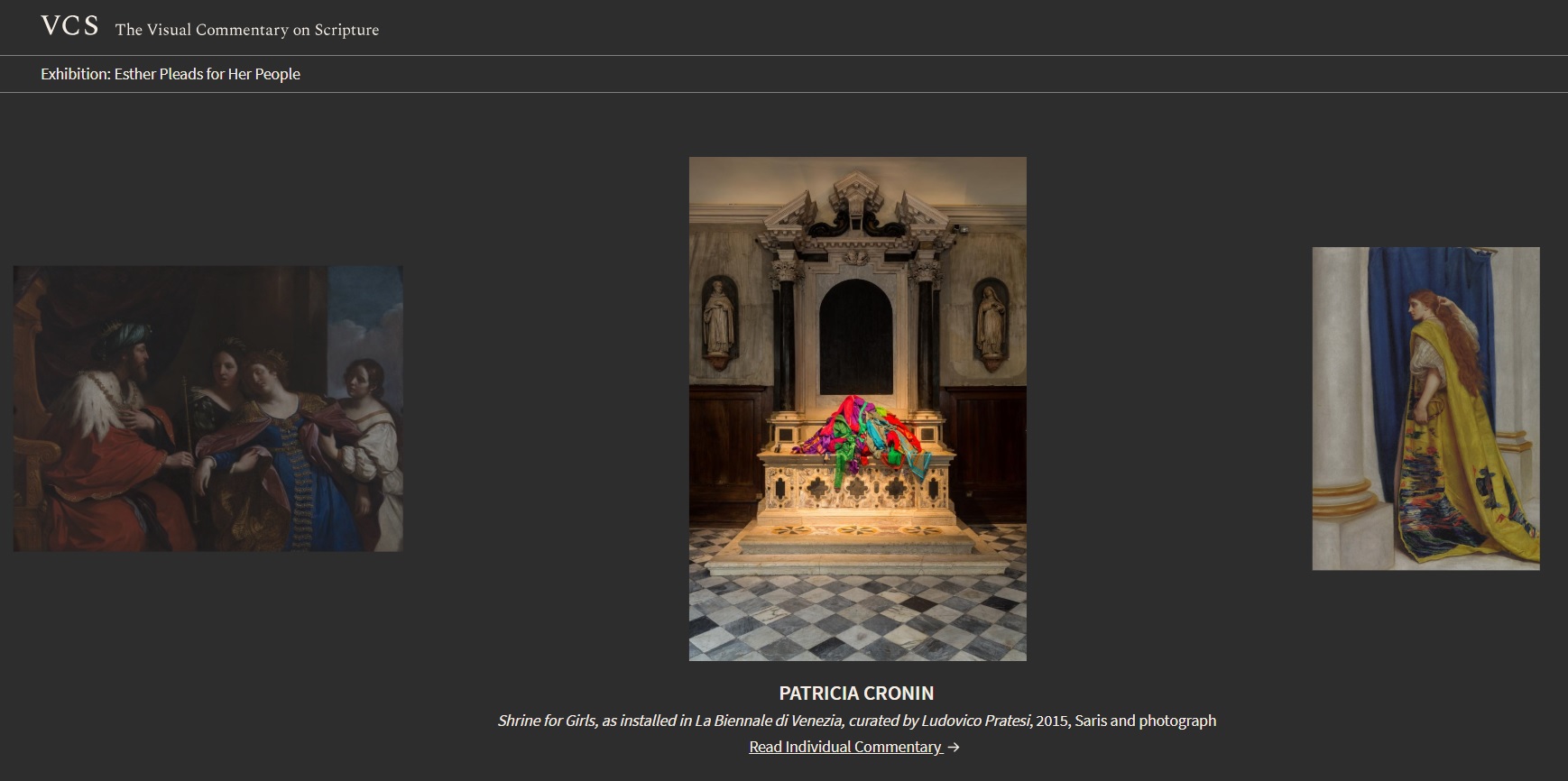
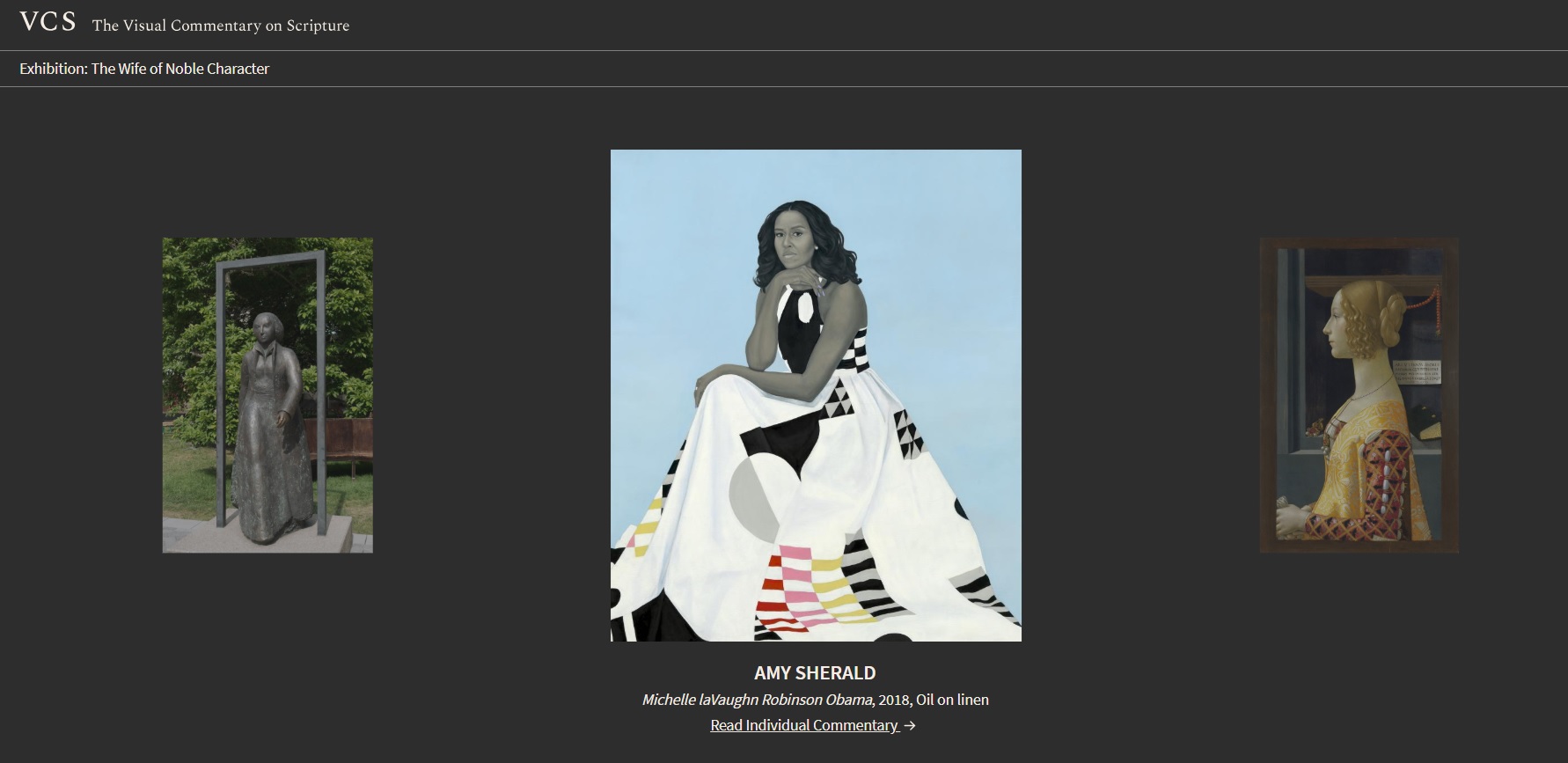
The exhibitions are arranged by biblical text for easy searching—and there are so many fantastic ones. I especially enjoy the ones that include a contemporary art selection. For example, Ayla Lepine ingeniously chose Patricia Cronin’s Shrine for Girls from the 2015 Venice Biennale to converse with Esther 8, in which Esther pleads for the deliverance of her people. Ursula Weekes curated an eclectic trio of portraits—of Florentine noblewoman Giovanna degli Albizzi Tornabuoni, German Reformer Katharina von Bora (Martin Luther’s wife), and former US First Lady Michelle Obama—to interact with the famous “wife of noble character” passage from Proverbs 31. And Pablo Perez d’Ors places Michael Landy’s kinetic sculpture Doubting Thomas, made of found objects and inviting viewer participation, side by side with Old Master paintings to probe the significance of that famous resurrection encounter.
“Physical sight can be a pathway to spiritual insight,” Quash says, affirming the eighth-century monk John of Damascus, who wrote that “just as [through] words perceived by the senses we hear with bodily ears, and understand what is spiritual, so through bodily vision we arrive at spiritual contemplation” (In Defense of Icons 3.12).
+++
I curated the “Bodily Resurrection” exhibition for the VCS, which takes as its basis 1 Corinthians 15:35–58. After reading the passage many times, including in the context of the whole epistle, and meditating on it, I wanted to investigate how the church has interpreted it over the centuries, so I read Caroline Walker Bynum’s excellent book The Resurrection of the Body in Western Christianity, 200–1336, which quotes from and summarizes a wealth of patristic and medieval writings on the topic. That led me to Tertullian’s On the Resurrection of the Flesh, an extensive treatise from the early second century. They were both fascinating reads.
In addition to the Pauline metaphor of the seed, Bynum writes,
the resurrection of the body is also described by theologians as the flowering of a dry tree after winter, the donning of new clothes, the rebuilding of a temple, the hatching of an egg, the smelting out of ore from clay, the reforging of a statue that has been melted down, the growth of the fetus from a drop of semen, the return of the phoenix from its own ashes, the reassembling of broken potsherds, the vomiting up of bits of shipwrecked bodies by fishes that have consumed them . . . (6)
I realized that I had never really thought about the logistics of the doctrine of the general resurrection, and although, as with other doctrines, the mechanics are not what’s important, it was interesting to consider what my resurrected body might look like, and how (and whence) it will be reconstituted once it decomposes, turns to dust. Some of the conjectures I found to be quite amusing—like Gregory of Nyssa’s claim that in heaven we will have neither genitals nor intestines, because there will be no procreation or digestion. Or Augustine’s suggestion that we will receive back all the bits of ourselves that we ever had, including nail and hair clippings, but the excess will not necessarily go to our fingers and heads but rather will become absorbed into our flesh (so that we don’t look freakish).
I spent a lot of time wrestling through the paradox, held consistently by the church throughout the ages, that the resurrection body will be both identical to the one we have now and new. This particular passage from Paul seems to emphasize the new aspect. He contrasts “physical”/“terrestrial” and “spiritual”/“celestial” bodies. What does he mean by the latter?
Choosing only three images to open up this rich theological doctrine was a real challenge, and I cycled through dozens before landing on the ones I did.
At the outset, I was cognizant that the resurrection Paul writes about, which will occur “at the last trumpet,” is distinct from the spectacular rising from the graves that occurred on the day Jesus was crucified (Matthew 27:52)—so although there are many fine examples of that latter episode in art, I passed them over for this assignment. I also passed over images of Ezekiel in the valley of dry bones, since that narrative is rooted in a different passage (see the VCS exhibition), even though there is an obvious intertextual link between the two.
I was intrigued by the “second Adam” motif present in the Pauline text, and I considered several artworks that follow that vein, including ones depicting the “Harrowing of Hell,” or, as it’s called in the Orthodox tradition, the Anastasis, in which the resurrected Christ pulls up Adam, Eve, and other Old Testament saints from Sheol. This iconographic type would have made a particularly apt pairing with the passage’s triumphant ending: “Death is swallowed up in victory.” But strictly speaking, the harrowing has already taken place (according to church tradition, on Holy Saturday), and although it prefigures the future resurrection, I wanted to keep the focus on the yet-to-come event that Paul is talking about. Plus, I figured that the harrowing will almost surely make an appearance in some other VCS commentary.
Anastasis fresco in the parecclesion of Chora Church, Istanbul, Turkey, ca. 1315.
A related image I found, a contemporary one, very unique in its approach and theologically loaded, is a life-size painting by Caleb Stoltzfus that shows the glorious nude Christ, his puncture wounds visible, pulling up a man from the dust. It’s titled Resurrection. I love this image, and there’s much that could be said about it—but ultimately, I felt that it fit better with the passage preceding mine, in particular 1 Corinthians 15:20: “But in fact Christ has been raised from the dead, the firstfruits of those who have fallen asleep.” Read the artist’s commentary at http://www.calebstoltzfus.com/blog/resurrection.
Caleb Stoltzfus (American), Resurrection, 2016. Oil on linen, 6.5 × 5 ft.
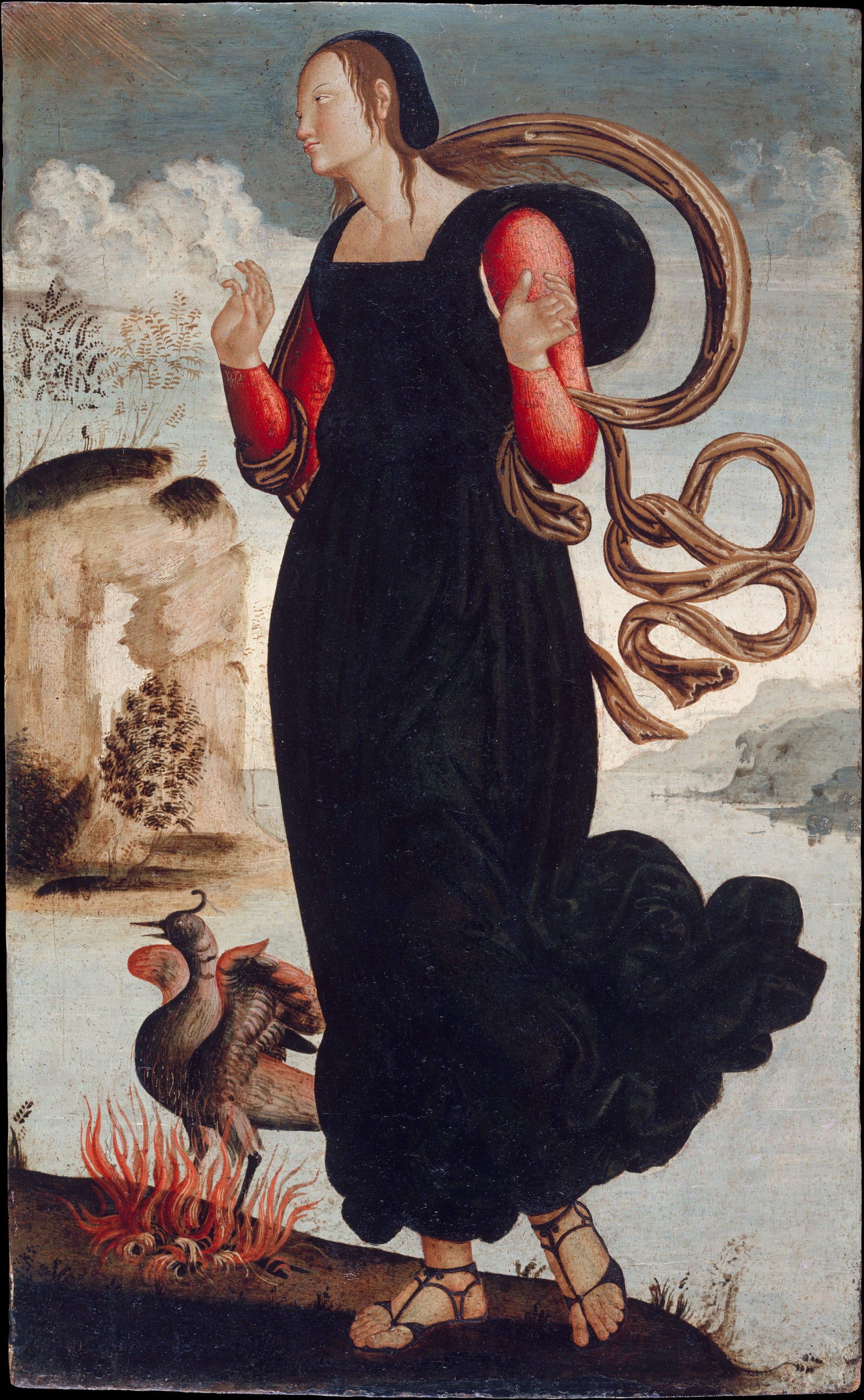
In my image search, I also examined a lot of symbolic bird imagery of the resurrection—that is, phoenixes and peacocks. The phoenix is a mythological bird that dies but then rises up from its own ashes, and the flesh of the peacock was thought to not decay, giving both birds a theological weight since the earliest era of Christian art, where they sometimes stand in for Christ’s resurrection and, by extension, our own. Thinking I’d draw this visual tradition into conversation with 1 Corinthians 15, I came close to selecting Hope, a Renaissance painting from Umbria, Italy, from a set of three allegorical paintings on the theological virtues; in it Hope is personified as a woman who squints her eyes toward the sun and catches a wind as she stands beside a phoenix on its pyre—suggesting the Christian hope of life after death. Although hope is implicit in the Corinthians passage, it’s not a keyword, so I ultimately decided not to include the Umbrian painting in my selection. Peacocks, however, did make the cut! (See below.)
Italian (Umbrian) painter, Hope, ca. 1500. Tempera and gold on wood, 29 1/8 × 17 7/8 in. (74 × 45.4 cm). Metropolitan Museum of Art, New York.
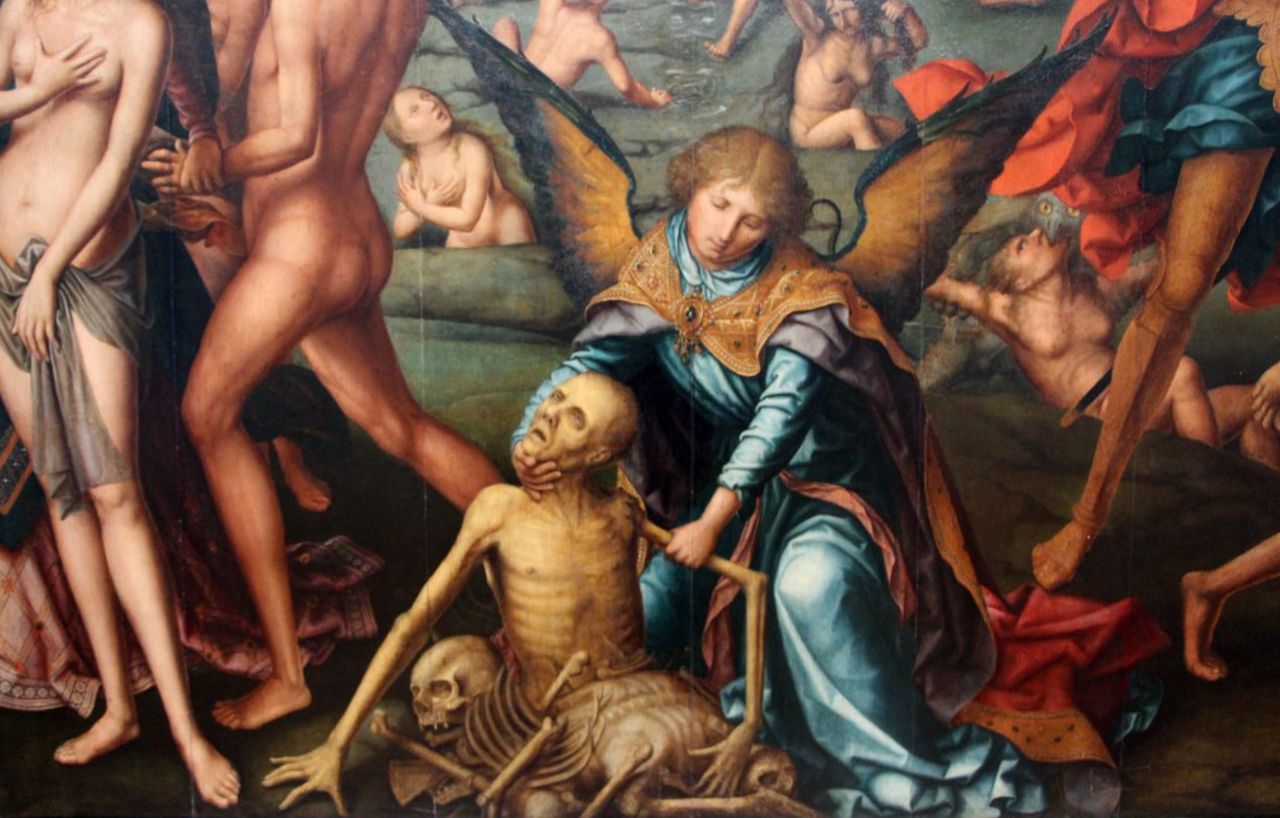
Another shortlisted artwork was the Last Judgment triptych by Jean Bellegambe, a French-speaking Flemish painter of the early sixteenth century. I was particularly drawn in by a detail at the bottom of the central panel, which shows skeletons in the process of acquiring flesh, and an angel reassembling body parts. It is very common in historical works of art for the resurrection of the dead to be subsumed under a larger visual program of the Last Judgment—but Paul doesn’t discuss judgment in my given passage, so I decided to move away from that context.
Jean Bellegambe (French/Flemish, ca. 1470–1535/36), Triptych with the Last Judgment (detail), ca. 1525. Oil on oak panels. Gemäldegalerie, Staatliche Museen, Berlin.
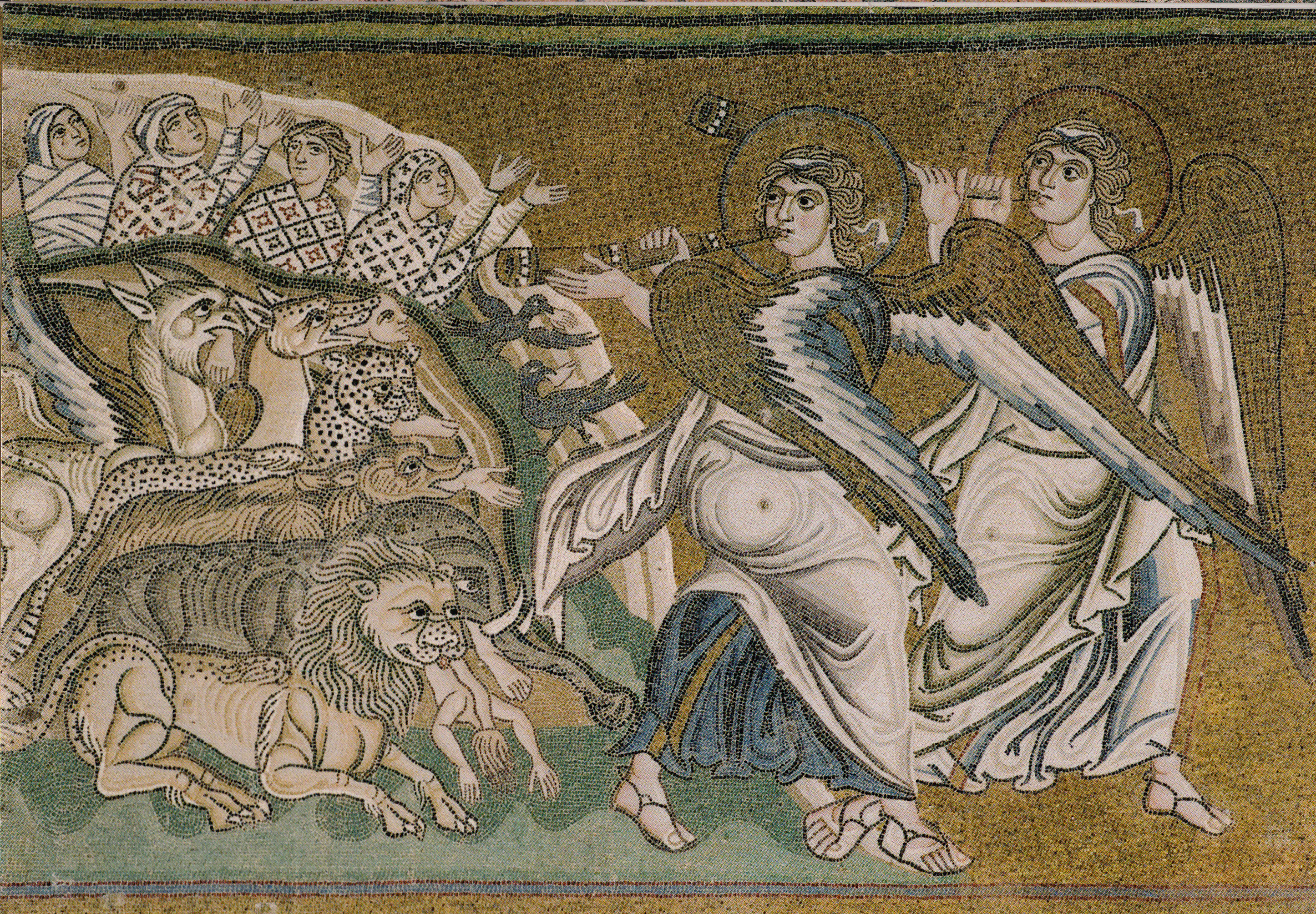
Probably the most unusual thing I discovered in the course of my research was the “regurgitation motif,” which shows animals vomiting up human body parts (from the corpses they have eaten) for reassembly on the last day. Several early church fathers mentioned that this would happen in their theologies of the resurrection, but its visual origin is attributed to the posticonoclastic East and the Carolingian-Ottonian West; it continues down into modern times in Greek, Bulgarian, and Russian frescoes. One of the best-known examples (in the West) is from the monumental twelfth-century mosaic at Torcello near Venice.
Last Judgment (detail), 12th century. Mosaic, west wall, Church of Santa Maria Assunta, Torcello, Venice, Italy.
Last Judgment (detail), 12th century. Mosaic, west wall, Church of Santa Maria Assunta, Torcello, Venice, Italy.
Bynum cites a handful of other examples in her aforementioned book and discusses the motif in depth, contributing to one of her main theses: damnation is swallowing, salvation is regurgitation. An absolutely brilliant argument, drawing heavily on visual theology.
It’s likely that Revelation 20:13 (“And the sea gave up the dead which were in it . . .”) influenced the creation of this motif. Because Paul himself doesn’t mention the mouths of animals giving up their dead, I decided not to go with the extraordinary Torcello mosaic. But I was able to sneak in a reference to that tradition by way of a side detail in one of the paintings I chose. It’s almost comical to look on, how literal it is. But it’s also thought-provoking. If our dead bodies are eaten and digested by worms or carrion beasts—or, God forbid, we meet our end through the mouth of a wild animal—then what remains of us, if we are divided into parts, mere particles, even? Will we ever be made whole again? If we are both body and soul, as Christianity attests, then isn’t our material continuity essential?
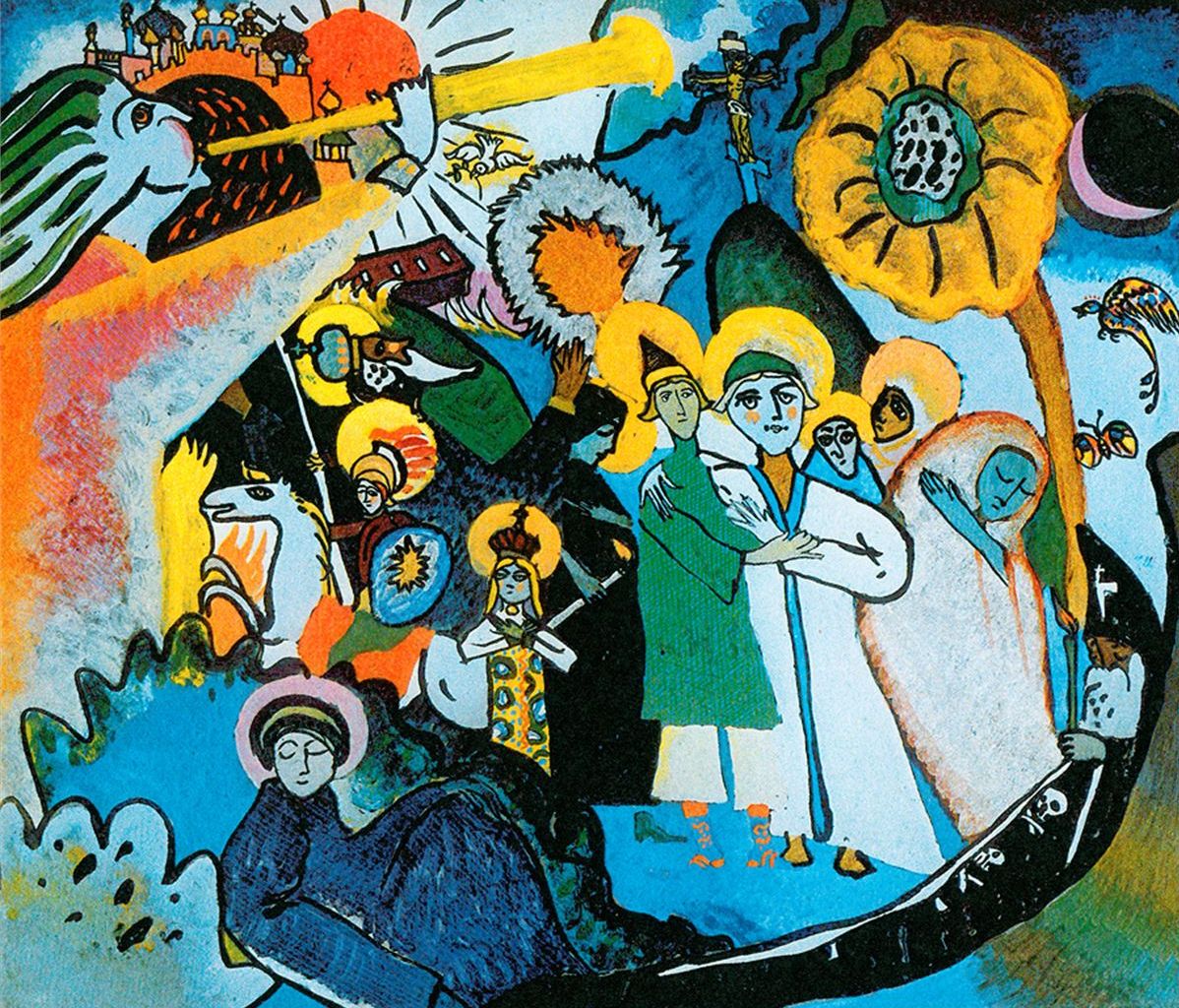
Other runners-up that didn’t make the cut were Wassily Kandinsky’s eschatological paintings—for example, All Saints I and Composition V. I wanted to choose artworks from three different countries and eras, and for the modern period, I just had to go with Stanley Spencer, who is renowned for his many resurrection paintings, localized to his hometown of Cookham in the UK. (I also felt a little out of my depth writing about Kandinsky’s radical style and spiritual approach to painting.)
Wassily Kandinsky (Russian, 1866–1944), All Saints I [Allerheilgen], 1911. Reverse glass painting, 20 × 24 in. Städtische Galerie im Lenbachhaus, Munich, Germany.
The inclusion of Spencer also influenced my choice, after some consideration, not to go with the Harrowing panel from Nicholas Mynheer’s Wilcote polyptych. (Two twentieth-century British paintings would have presented too limited a range.) It would have fit well with the Corinthians passage, which talks about us being sown in dust and reaped in glory—and its juxtaposition with Adam and Eve’s expulsion from paradise, on the opposite wing of the altarpiece, further underscores this theme. I wrote about the altarpiece as a whole a few years ago at Art & Theology.
Nicholas Mynheer (British, 1958–), The Harrowing, extreme right inner panel of a polyptych, 1999. Wilcote Chapel, St. Mary’s Church, North Leigh, Oxfordshire, England.
+++
So what did I end up choosing?
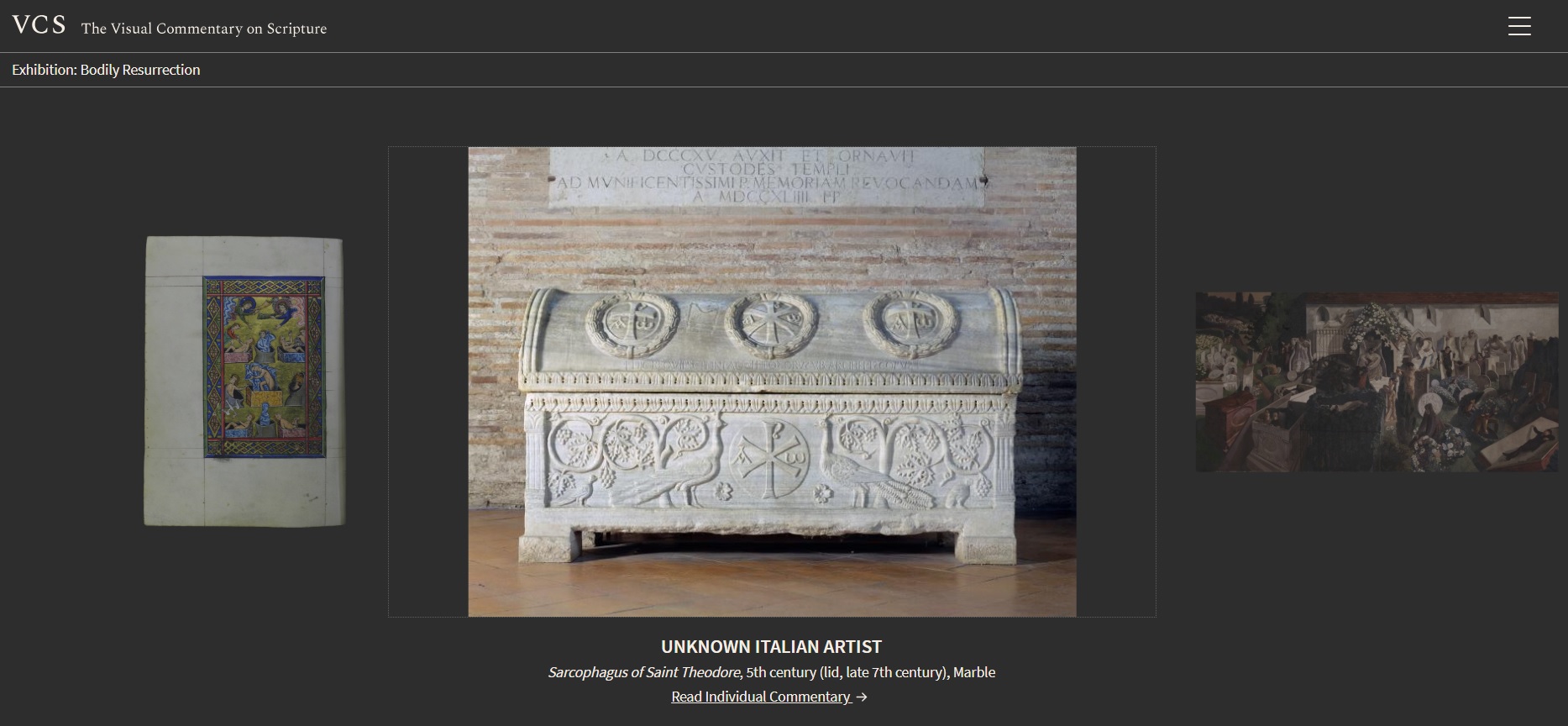
A fifth-century Christian sarcophagus from Italy, emphasizing Paul’s metaphor of the body as seed that, once buried, will flower forth in life
A thirteenth-century German psalter illumination that shows the dead casting off their grave-clothes and “putting on” immortality
A twentieth-century painting by the British master Sir Stanley Spencer, who set the resurrection in a local churchyard, using his friends and neighbors as subjects







 Art & Theology