LOOK: Adoration of the Magi by Silvestro dei Gherarducci
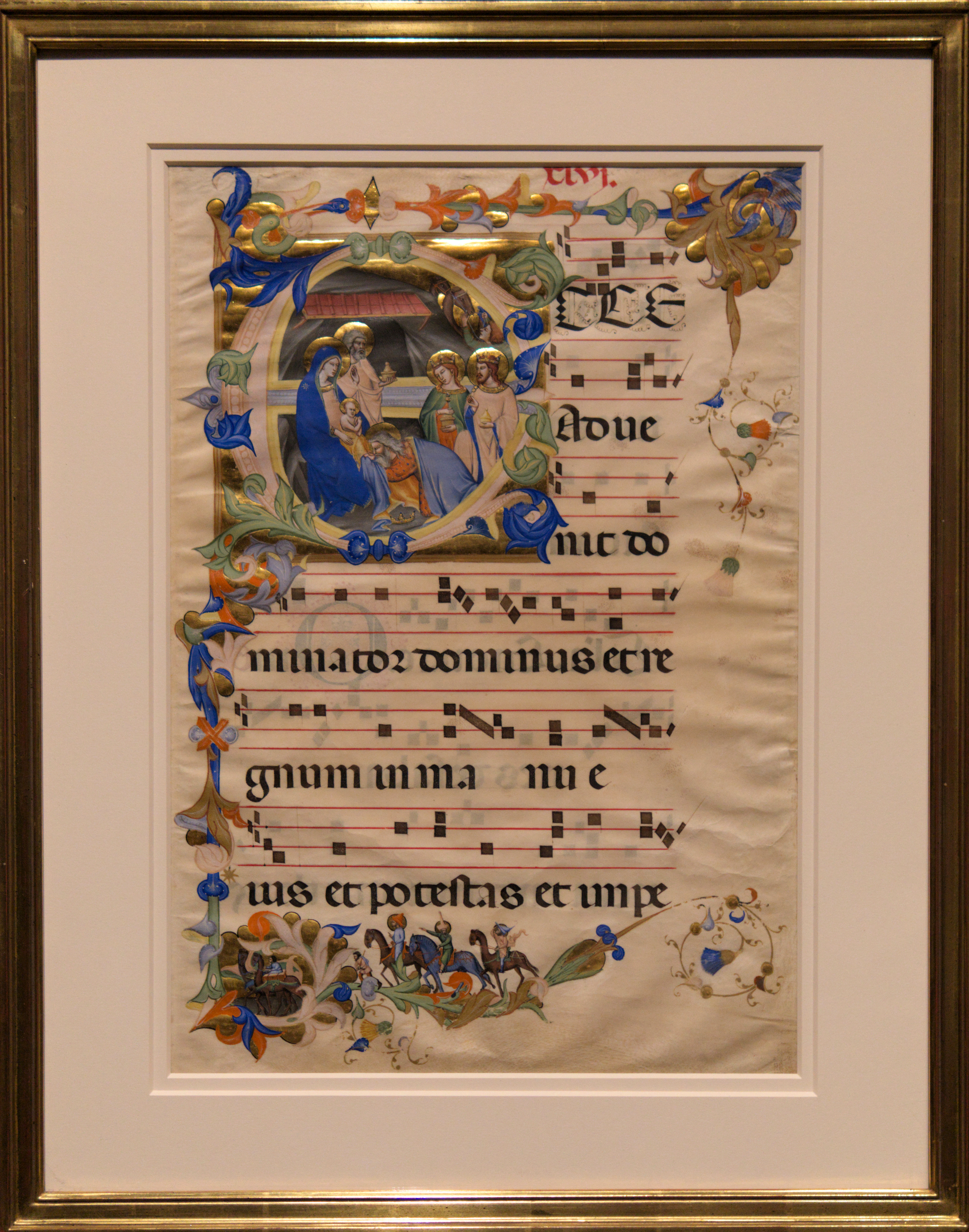
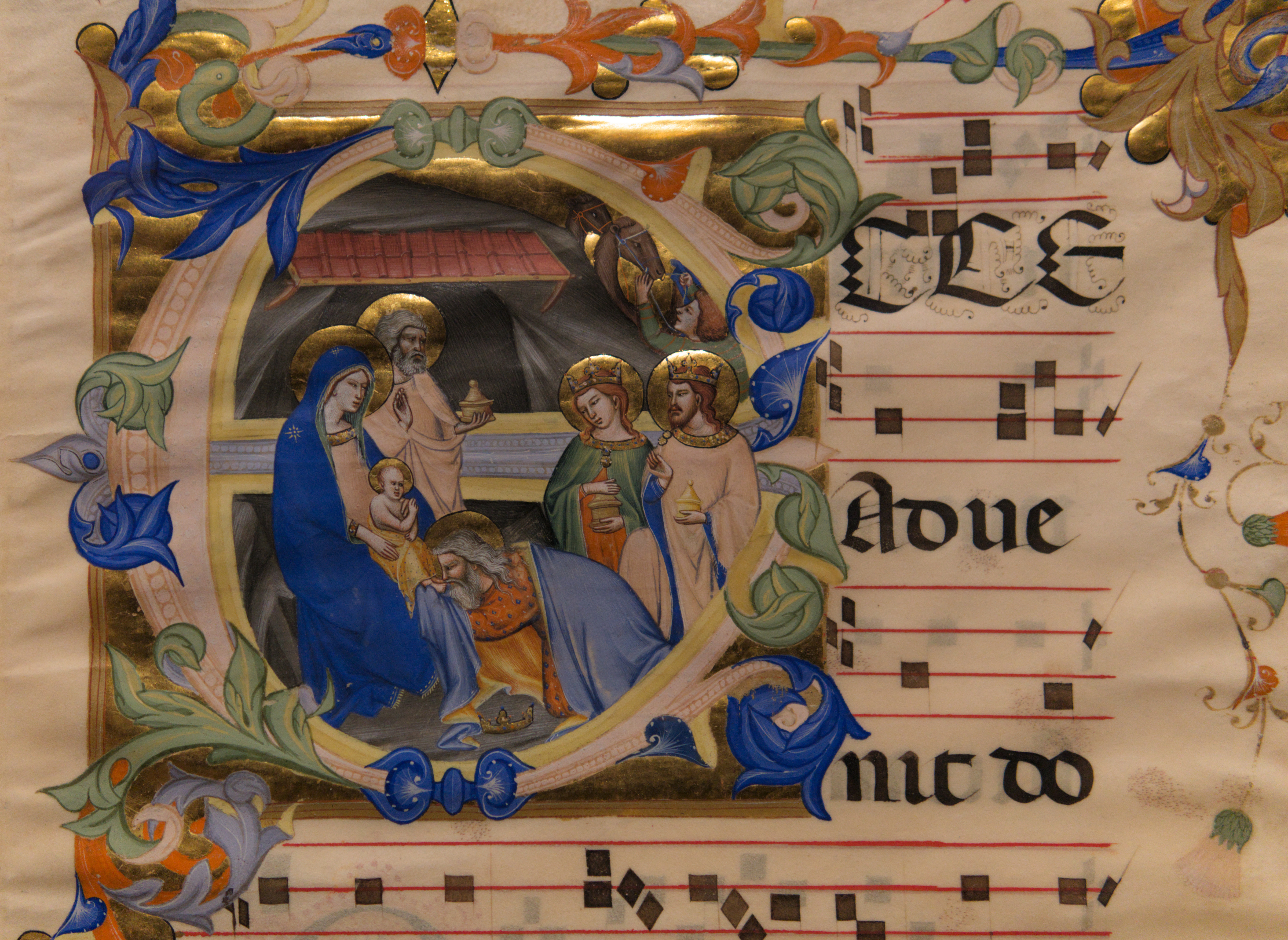
Silvestro dei Gherarducci (Italian, 1339–1399), Adoration of the Magi in an Initial E, cutting from a gradual, Florence, 1392–99. Illumination on parchment, 59 × 40 cm. Morgan Library and Museum, New York, MS M.653.5. All photos by Victoria Emily Jones. [object record]
(See commentary below.)
LISTEN: “Ecce advenit dominator Dominus” (Behold, the Sovereign Lord Is Come), introit for the Epiphany of the Lord, ca. 7th century | Performed by Floriani (men’s vocal ensemble), 2024
Ecce advenit dominator Dominus:
et regnum in manu eius
et potestas et imperium.

Deus, judicium tuum regi da,
et justitiam tuum filio regis.

Gloria patri,
et filio, et spiritui sancto,
sicut erat in principio,
et nunc, et semper,
in saecula saeculorum. Amen.
Behold, the Sovereign Lord is come,
and in his hand the kingdom,
and power, and dominion.

Give the king your justice, O God,
and your righteousness to a king’s son.

Glory be to the Father,
and to the Son, and to the Holy Spirit,
as it was in the beginning,
is now, and ever shall be,
world without end. Amen.
In the Roman Catholic Church, the introit (sung while the priest approaches the altar for the Eucharist) for the Mass of the Epiphany is derived from three Old Testament texts: Malachi 3:1, 1 Chronicles 29:12, and Psalm 72:1. It communicates the royalty of Christ.
The church has sung this cento since as far back as the seventh century. The musical notation has been preserved in graduals (books that collect all the musical items of the Mass).
Two years ago at the Morgan Library and Museum in New York, I saw an Ecce advenit leaf from a now-dispersed medieval gradual that caught my attention with its glimmering gold. It’s one of twenty-three cuttings that the museum owns from a manuscript made at the Camaldolese monastery of Santa Maria degli Angeli in Florence, Italy, in the late fourteenth century, for the monastery of San Michele a Murano in Venice. The illuminations are by the then-prior (head) of Santa Maria, Silvestro dei Gherarducci.
The primary image on the page is an Adoration of the Magi inside a letter E (for Ecce). When a scene or figures appear inside a large decorative letter at the start of a text section, it’s called a historiated initial.
In the scene, the Holy Family stands at the mouth of a cave—Jesus is seated on Mary’s lap, while Joseph stands beside them holding a vessel that the elder magus handed him, a gift for the Christ child. It was typical for artists to depict the three magi as different ages: young (beardless), middle-aged, and elderly (gray-haired). The oldest of the group kneels on the ground, lays down his crown, and kisses Christ’s feet while the other two await their turn. In the background, a servant restrains two bridled camels.
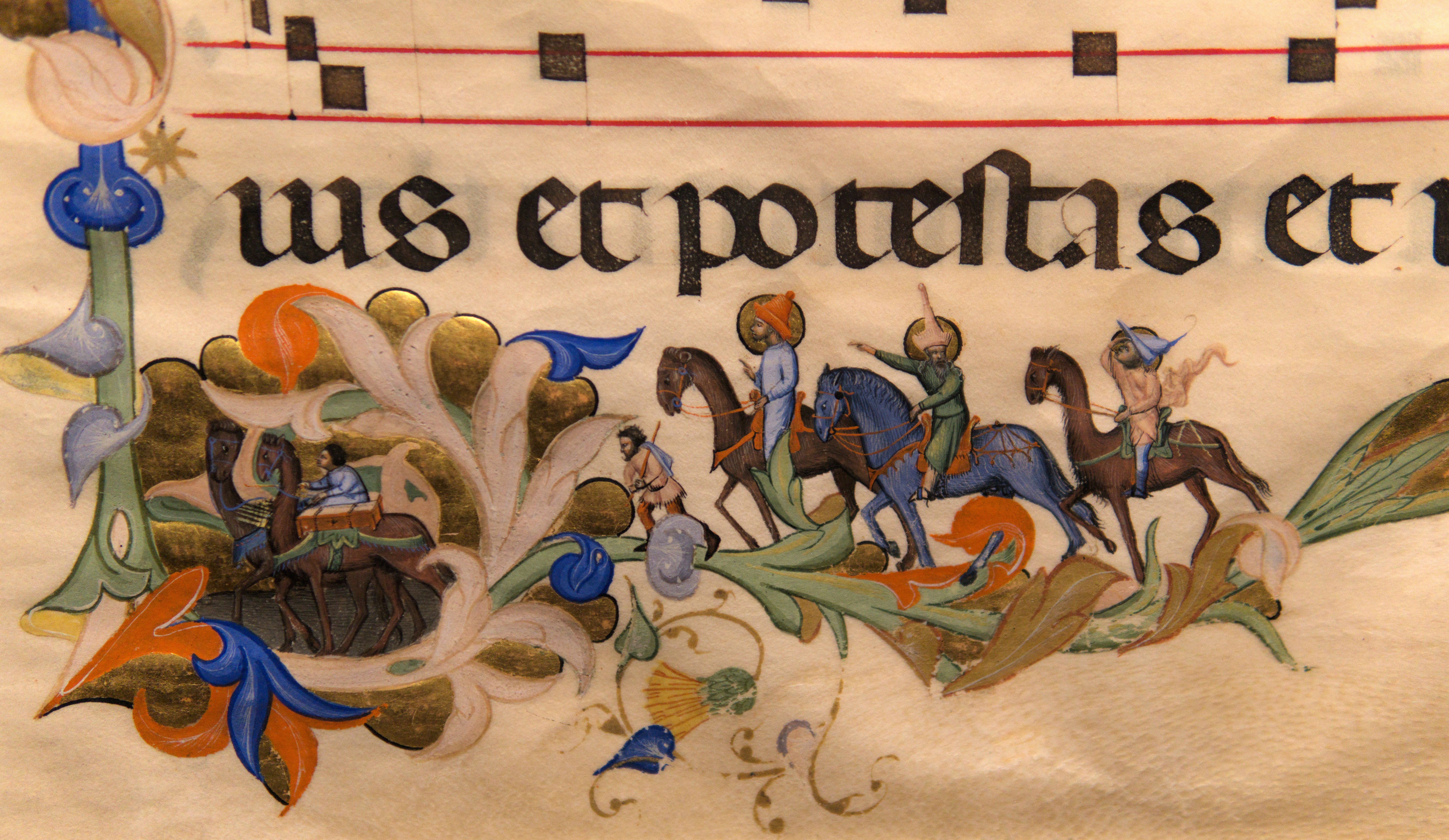
Across the top and left margins of the page is a colorful vine scroll, and in the lower margin there’s a bas-de-page depicting the magi following the star. I love their fantastic hats! The elder one, astride a horse, points the way forward (the guiding star shines from the left of the page near some blue foliage); the other two follow his direction on camels. In front of the caravan are two servants, one walking on foot with a bag slung over his shoulder, and the other riding a camel beside a second camel carrying a chest that contains the treasures the magi will bestow on the newborn king they’re journeying to pay homage to.
I like to imagine the community of Camaldolese monks in late medieval Venice singing from this choirbook on Epiphany, the lovingly wrought images of Christ-pursuing, Christ-worshipping magi enlivening their engagement with the gospel story and supplementing their own worship.
While monastic choirs have retained the monophonic style of music (that is, a single melody line sung in unison or traded off) that the church used for most of the Middle Ages—what we call Gregorian chant—over time, the church at large developed a taste for more elaborate, polyphonic music (that is, music with two or more simultaneous but relatively independent melodic lines), which came into full flower during the Renaissance and was sung in cathedrals.
To illustrate the difference between medieval monophony and Renaissance polyphony, here’s an example of the latter: the English composer William Byrd’s setting, from 1607, of the Ecce advenit. During his lifetime it was sung in Epiphany services in the Church of England as well as in the manor houses of recusant Catholic families (who were forced by law at the time to worship clandestinely).
Epiphany is no isolated and solitary act. It is a process: it is eternally typical of the Divine character. We will not merely look back over the long centuries at the manifestation that first flashed forth before the eyes of the Three Wise Men. Here and now, God is revealing Himself afresh before our very eyes. . . . For us too, clogged and choked by the dismal sand, there is a star that guides, a God who beckons. If only we would see!
Among this month’s thirty spiritual songs of note are three by Indigenous artists of Turtle Island (North America):
>> “Ambe Anishinaabeg” from Cree composer Andrew Balfour’s Nagamo project, which explores the intersections of Indigenous song and Anglican choral music. The Ojibway text of “Ambe Anishinaabeg” was gifted to Balfour by Cory Campbell: “Ambe Anishinaabeg / Biindigeg Anishinaabeg / Mino-bimaadiziwin omaa” (Come in, two-legged beings / Come in, all people / There is good life here). On the album (and the playlist), the text is set to the “Gloria in excelsis Deo” by the late English Renaissance composer Thomas Weelkes; but in another iteration, captured in the following video, Balfour pairs the text with the music of William Byrd’s “Sing Joyfully” (itself a setting of Psalm 81:1–4). (Balfour has also written original music for Campbell’s text.) See the third roundup item for more about Nagamo.
>> “Jesus I Always Want to Be Near to You,” a solo by Doc Tate Nevaquaya (1932–1996) on Native American flute. Nevaquaya, who was Comanche, played an important role in the revival of the Native American flute in the 1970s, expanding the repertoire and playing techniques. This instrumental is one of twelve from the album Comanche Flute Music, originally released in 1979 by Folkway Records, which also includes Nevaquaya’s adaptations of non-Comanche flute melodies, his own compositions, and one piece by his son Edmund. As he states in his introduction to this track, “Jesus I Always Want to Be Near You” is an original Christian hymn written by the Comanche people. I couldn’t find the lyrics, but to listen to some more Comanche hymns, with words, see this video by Comanche Nation tribal members Anthony Nauni and Chad Tahchawwickah, and this recorded gathering at Lawton Indian Baptist Church in Oklahoma.
>> “naká·yè·ʔr sihskę̀·nęʔ (may it be that you have peace)” by Tuscarora singer Jennifer Kreisburg, a song of blessing from the new Yo-Yo Ma EP Our Common Nature. According to Sony Classical, the song expresses “hope for a future where humanity and nature coexist in harmony.” I just started listening to the album’s wonderful companion podcast, for which four of the seven episodes have been released.
+++
Also for November: See my Thanksgiving Playlist [introduction], comprising a hundred-plus songs of gratitude, with a few recent additions at the bottom; and my Christ the King Playlist [introduction], which I made for the final feast of the church year, celebrated Sunday, November 23, this year.
+++
ALBUM: Nagamo by Andrew Balfour: In May and June 2022, the Vancouver-based vocal ensemble musica intima teamed up with composer Andrew Balfour to create Nagamo (Cree for “sings”), a concert and CD recording that reimagines the Anglican choral tradition through an Indigenous lens. A child of the Sixties Scoop, Balfour was born in 1967 in the Fisher River Cree Nation near Winnipeg but at six weeks old was forcibly removed from his birth family by child welfare authorities of Manitoba and adopted by white parents. He says his childhood was happy, and that he was fortunate to have been put in a men and boy’s choir from a young age, where he received a musical education and international travel opportunities; but of course, the sudden rupture from his culture of origin left wounds.
With Nagamo, Balfour seeks to bring together his identities as Cree and as the son of Anglicans of Scottish descent, who raised him in the church (his father was a minister); his love of Renaissance choral music, much of which voices polyphonic praises to the God of Abraham, Isaac, and Jacob, and an Indigenous spiritual sensibility. The album comprises two original compositions (including one in Scots Gaelic), five Renaissance songs retexted (not translated) in Cree or Ojibway, and five unaltered works by William Byrd and Alfonso Ferrabosco. “The concept mines the fantastical question of what might have happened musically should Indigenous and European musics and cultural expressions come together in a manner collaborative and respectful, rather than divisive,” writes music journalist Andrew Scott for The WholeNote.
Examples of the adaptations include “Four Directions,” a recitation in Ojibway of the four cardinal directions—Ningaabiianong (West), Giiwedinong (North), Wabanong (East), Zhaawanong (South)—set to Thomas Tallis’s “Te lucis ante terminum” [previously], a prayer for protection through the night. And “Ispiciwin” (Journey), whose musical basis is Orlando Gibbons’s “Drop, drop, slow tears,” a Christian hymn of contrition, but whose Cree lyrics make reference instead to a smudging ceremony, a sacred cleansing ritual practiced by many Indigenous peoples. Here’s a mini-documentary about the Nagamo project:
Balfour “re-imagines how settler and Indigenous spiritualities can interact with one another. In essence, Balfour imagines a new system of power relations where both spiritualities can co-exist and engage in dialogue without the power imbalances of colonization,” Lukas Sawatsky writes in his master’s thesis Converging Paths: Settler Colonialism and the Canadian Choral Tradition, the final chapter of which explores Nagamo as a case study of “the reclaiming of settler-originated aesthetic models and genres by Indigenous people for their own storytelling purposes.” Sawatsky continues, “Through the lens of the Anglican choral tradition, Balfour synthesises his Indigenous cultural identity into music that proudly celebrates both parts, without resolving their differences. Through this, Balfour looks towards a world where the settlers and Indigenous people can exist without settler colonialism.”
+++
EVENT RECORDING:“A Timbered Choir: The Witness of Creation,”Wheaton College, Illinois, October 28, 2025: Last week the Marion E. Wade Center and the Conservatory of Music at Wheaton College presented “A Timbered Choir: The Witness of Creation,” an evening of music and poetry inspired by J. R. R. Tolkien’s and Wendell Berry’s love of creation and visions of stewardship. Readings and reflections by Wheaton professors from across the disciplines of biology, literature, and art culminated in the world premiere of a new Wade Center commission, a fifteen-minute choral cycle by Josh Rodriguez called A Timbered Choir, which sets to music three poems by Berry. “It was my aim to create a work which captures a sense of awe: at the trees which play such an important role in our fragile ecosystem, at the beauty and life-giving pleasure they provide for us, and at our urgent responsibility to care for them,” Rodriguez explains. “In this three-part tale on the life of trees, the audience is invited to witness an opening lullaby about the birth of the forest, followed by a desperate lament on the destruction of nature’s life-giving biodiversity, and a concluding celebration of nature’s resilience.”
The Wade Center is dedicated to promoting the study of seven British Christian writers: Owen Barfield, G. K. Chesterton, C. S. Lewis, George MacDonald, Dorothy L. Sayers, J. R. R. Tolkien, and Charles Williams. Wendell Berry—an American poet, novelist, and farmer especially known for his “Sabbath poems,” an expansive series he wrote over decades during his Sunday walks in the woods—is not part of their archive. But Wade Center Director Jim Beitler says they built this recent event around Berry because they want to encourage learners not just to look at the seven authors but to look with them, at the things they cared about. The center identified particular resonance between Berry and Tolkien.
Here are the time stamps from the video recording. The songs are performed by the Wheaton College Concert Choir under the direction of John William Trotter:
Opening remarks by Jim Beitler, director of the Wade Center
Also, the Armerding Center for Music and the Arts, where the event was held, is hosting tree-related art in the lobby: Cross of the Feast by Sung Hwan Kim (a crucifix in wood and mixed media made for a past KOSTA [Korean Students All Nations] Conference at Wheaton), permanently installed; and a set of graphite drawings by David Hooker, on display through Christmas break.
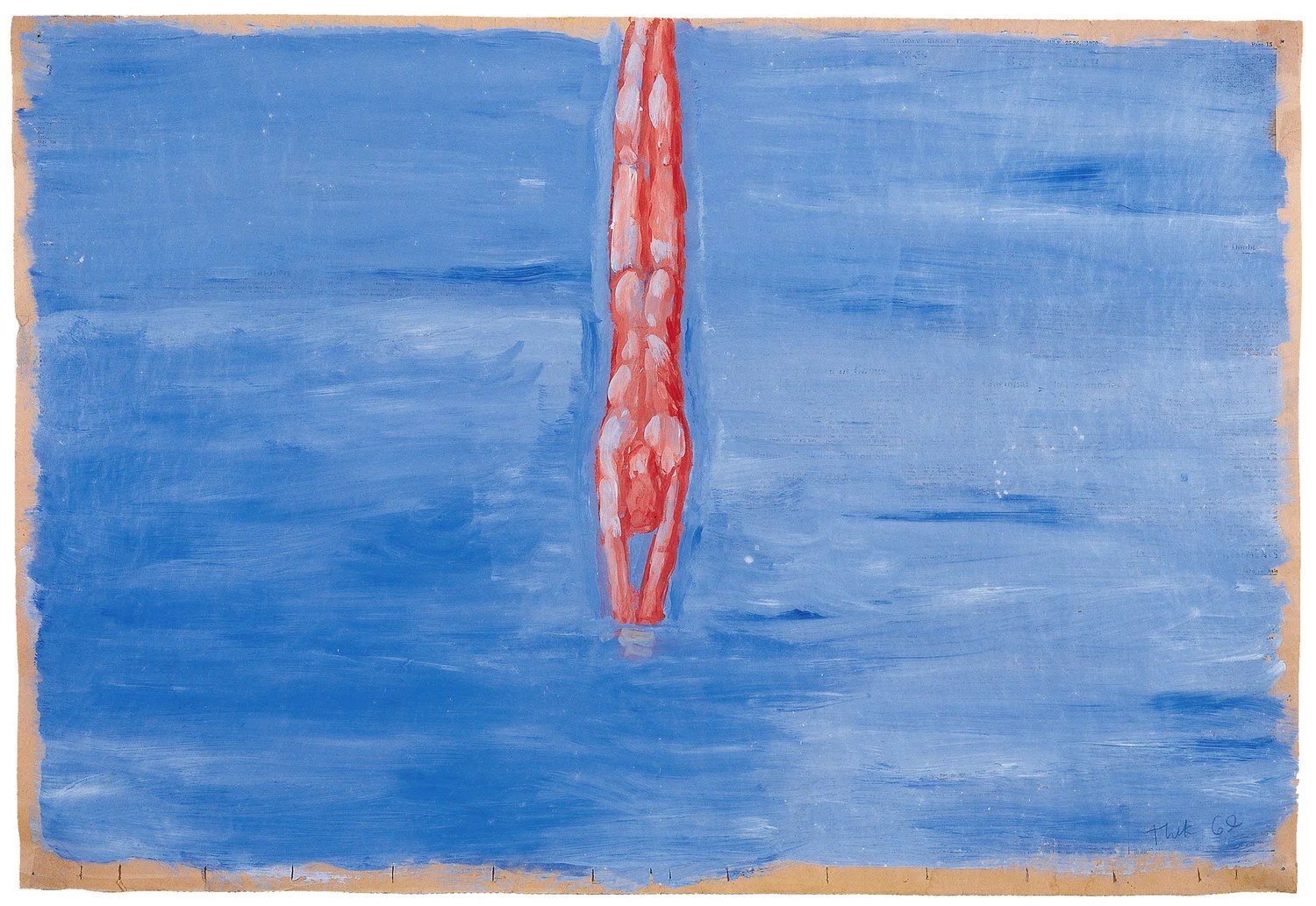
ARTICLE: “Regarding the Face of God: On the Paintings, Drawings, and Notebooks of Paul Thek” by Wallace Ludel, Triangle House Review:Last month I wrote about a chalk drawing by Paul Thek that the Archdiocese of Cologne curated for its latest exhibition at Kolumba museum. In preparation for writing, I did some basic research about the artist, who’s best known for his “Meat Pieces,” and was led to this fascinating article that focuses instead on his paintings, drawings, and notebooks, especially the religiosity and contradictions they are charged with.
Writer Wallace Ludel describes Thek’s “Diver” paintings of 1969–70, speculated to have been inspired by an ancient fresco inside the Tomb of the Diver in Paestum, Italy, as “at once ebullient and lonesome, womb-like and deathly.”
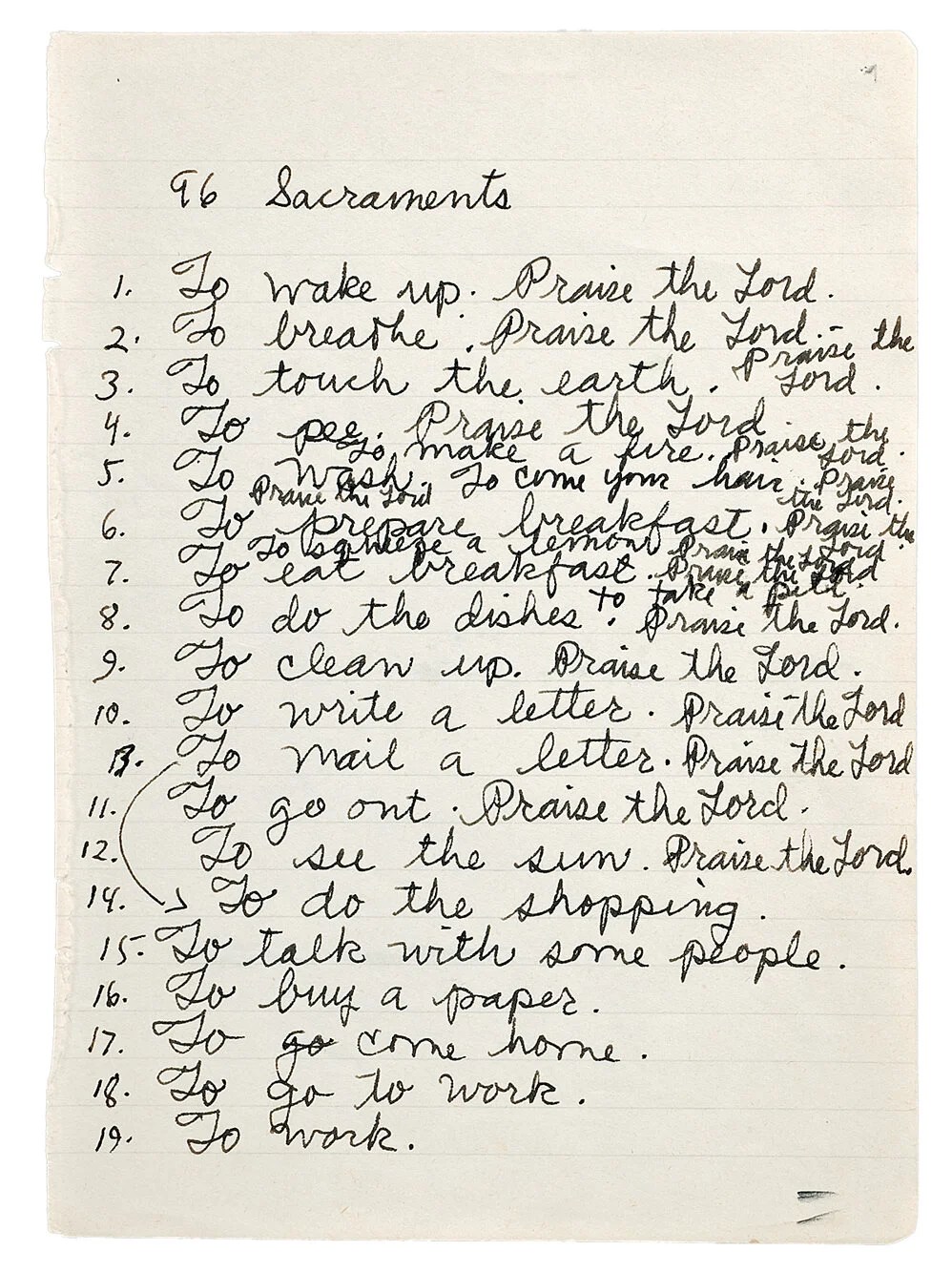
Thek identified as a “predominately gay” Catholic man and was even accepted as a novice by a Carthusian monastery in Vermont shortly before he died of AIDS in 1988. From 1970 onward, he kept notebooks where he copied long passages from spiritual texts and wrote his own devotional musings, as well as made drawings and watercolors and recorded various diaristic thoughts and mantras. One set of the pages, for example, titled “96 Sacraments,” enumerates ninety-six activities—“to breathe . . . to pee . . . to do the dishes . . . to forget bad things . . .”—each followed by the refrain “Praise the Lord.” This list evinces the spiritual influence of Brother Lawrence, who talked about “practicing the presence of God” in all things, which Thek remarked on in a 1984 letter to the Carthusians.
Thek is an artist I had never heard of prior to seeing his work exhibited at Kolumba. Visiting art museums, taking note of the works that intrigue you, and following up afterward with online searches to see and learn more is a great way to develop knowledge of the art that’s out there and to start to identify some of your own personal favorites—which is one of the primary questions I get asked. (“Where do you find all this art?”)
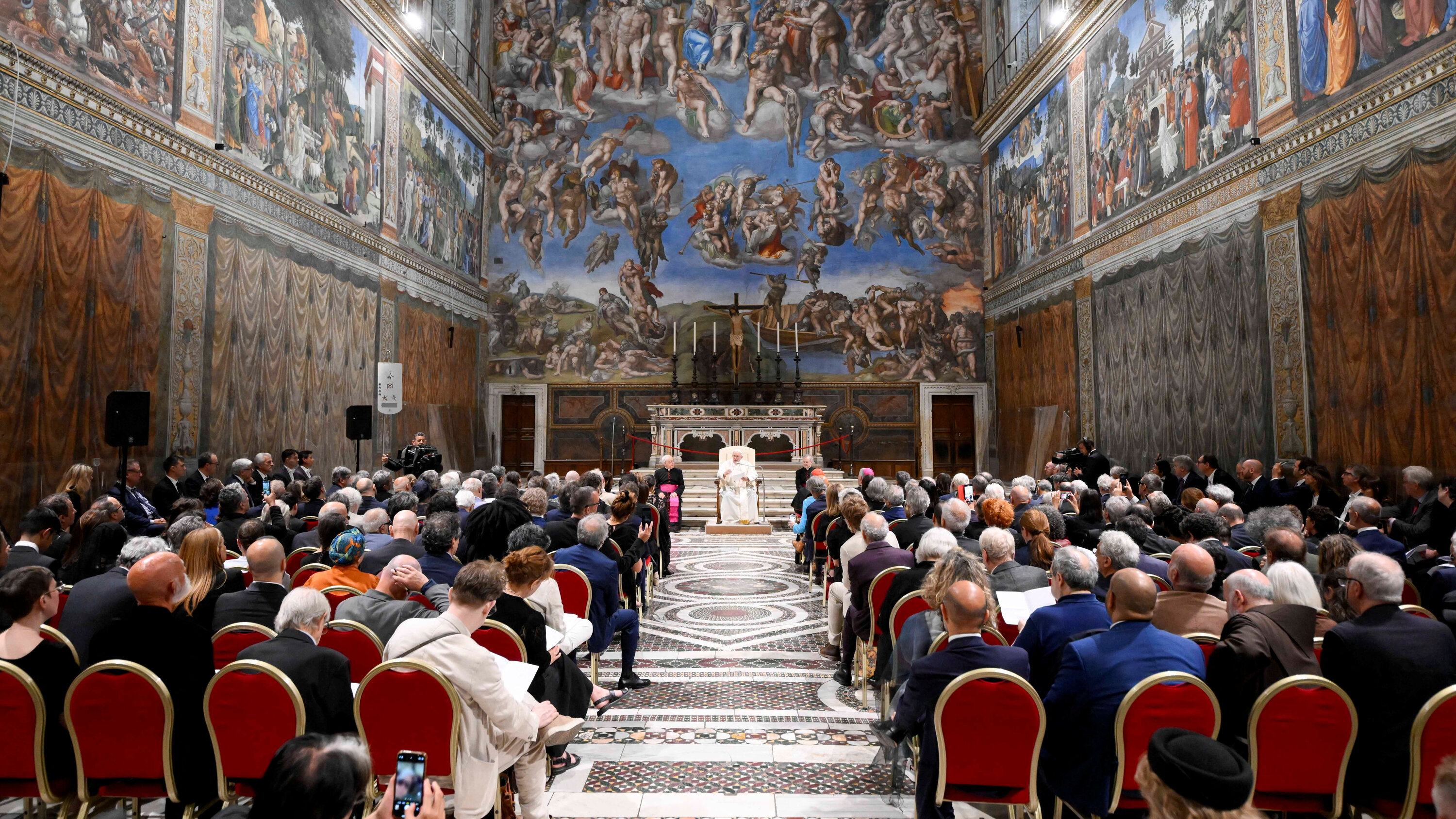
SPEECH: “Address of His Holiness Pope Francis to Artists for the 50th Anniversary of the Inauguration of the Vatican Museums’ Collection of Modern Art”: On June 23, at the invitation of Pope Francis, some two hundred select visual artists, filmmakers, composers, poets, and other creatives gathered at the Sistine Chapel to commemorate the fiftieth anniversary of the Vatican Museums’ Collection of Modern and Contemporary Art, inaugurated in 1973 by Pope John Paul VI. “One of the things that draws art closer to faith is the fact that both tend to be troubling,” Pope Francis said last Friday. “Neither art nor faith can leave things simply as they are: they change, transform, move and convert them.” He applauded how “artists take seriously the richness of human existence, of our lives and the life of the world, including its contradictions and its tragic aspects. . . . Artists remind us that the dimension in which we move, even unconsciously, is always that of the Spirit. Your art . . . propel[s] us forward.” For reporting on this event by the New York Times, see here.
Pope Francis addresses a group of artists, June 23, 2023. Photo: Vatican Media, via Reuters.
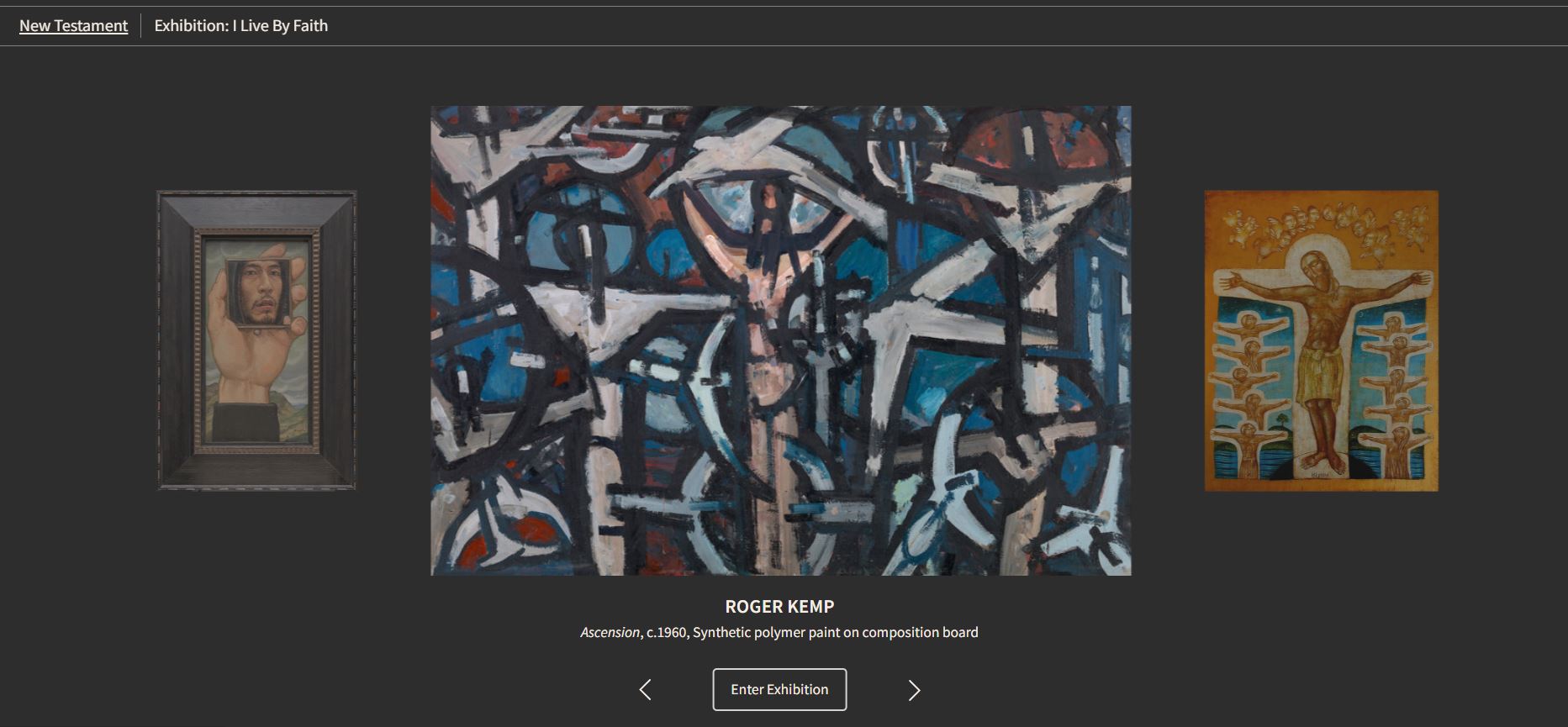
VISUAL COMMENTARY ON SCRIPTURE: “I Live by Faith (Galatians 2:15–21)” by Victoria Emily Jones: My latest set of commentaries for the VCS went live this month! It centers on one of Paul’s famous sayings: “I have been crucified with Christ, and it is no longer I who live, but it is Christ who lives in me.” I was bummed that one of the three commentaries I originally wrote had to be scrapped because the image permission was ultimately denied; I thus had to reconfigure and replace, and I ended up with two artworks in the three-piece exhibition that aren’t as diverse from each other as I had hoped. But still, each artwork brings a unique and compelling lens through which to examine this passage. (Note: If you’re viewing the exhibition on your phone, after you “Enter Exhibition,” you’ll need to expand the “Exhibition Menu” to access the “Show Commentary” button.)
VIDEO: “Abraham: An Interfaith Discussion at the Bode-Museum, Berlin”: Besides publishing written commentaries on works of art in dialogue with Bible passages, the Visual Commentary on Scripture also produces videos. This one brings together an Anglican Christian priest (who directs the VCS), a Jewish rabbi, and a Muslim theologian around a fifth-century ivory pyxis depicting Abraham, a figure held in common by all three faith traditions.
+++
POEM:“Gate A-4”by Naomi Shihab Nye: I’ve always loved this heartwarming poem about an unexpected moment of communion shared with strangers at an airport, made possible through kindness and the letting down of one’s guard. Listen to commentary by Joanne Diaz and Abram Van Engen on the Poetry for All podcast, episode 19; they answer the question “Why is this a poem?” Here’s a video of Nye reading it herself:
+++
NEW ALBUMS:
>> April 21: Worship for Workers by the Porter’s Gate: “In 2022 a group of songwriters, pastors, and professionals gathered in Nashville, Tennessee to write a series of worship songs for workers. Over three days they discussed the spiritual, emotional, and material struggles facing workers around the world today. Soon enough, they began to compose a series of songs specifically designed to help Christians carry their daily work before the Lord.” Here’s one of the thirteen songs on the album, “You Hold It All”:
The Worship for Workers album is part of a larger project, sponsored by the Brehm Center and a number of other institutions, to provide music, prayers, art, liturgies, and training to the church around the topic of work. It grew out of the book Work and Worship: Reconnecting Our Labor and Liturgy by Matthew Kaemingk and Cory Willson.
>> May 5: Glory Hour by Victory: Victory Boyd [previously] is a Grammy-winning soul and gospel artist who got her start singing with her siblings in the group Infinity Song but whose career really kicked into high gear when she worked as a songwriter for Kanye West’s Jesus Is King (2019). Glory Hour is her second full-length album as a solo artist; its title refers to the time of the morning when the sun rises. Most of the tracks are original songs or spoken word, but there are also three classic hymns/gospel songs: “His Eye Is on the Sparrow,” “Great Is Thy Faithfulness,” and “I Know It Was the Blood.” Here’s the music video for “Just like in Heaven,” based on the Lord’s Prayer:
>> May 19: Seven Psalms by Paul Simon: Paul Simon released this original seven-movement composition about doubt and belief as a single thirty-three-minute track, as it is meant to be listened to in one sitting. I’m a Simon fan; one of my early blog posts is a review of his and Garfunkel’s debut album, Wednesday Morning, 3 A.M. But if I’m honest, I was underwhelmed by this much-anticipated release. I’m in the minority there, so I think I’ll need to give it another listen. What do you think of it? Here’s the trailer:
>> June 2: Byrd: Mass for Five Voicesby the Gesualdo Six: One of my favorite vocal ensembles has just come out with an album of songs by William Byrd—his setting of the Mass along with a handful of motets. A Catholic composer in Protestant England in the late Renaissance, Byrd wove together musical “notes as a garland to adorn certain holy and delightful phrases of the Christian rite,” as he wrote in the preface to his second book of Gradualia (1607). Here’s the Gesualdo Six’s performance of his “Afflicti pro peccatis nostris,” a Latin prayer, a desperate plea for sanctification, that translates to “Afflicted by our sins, each day with tears we look forward to our end: the sorrow in our hearts rises to thee, O Lord, that you may deliver us from those evils that originate within us”:
Shower, O heavens, from above, and let the skies rain down righteousness; let the earth open, that salvation may spring up, and let it cause righteousness to sprout up also; I the LORD have created it.
—Isaiah 45:8
Let us know, let us press on to know the LORD; his appearing is as sure as the dawn; he will come to us like the showers, like the spring rains that water the earth.
—Hosea 6:3
LOOK: Appalachian Rhapsody in Blues: or, He Will Come to Us Like the Spring Rains by Grace Carol Bomer
LISTEN: “Rorate caeli” by William Byrd, 1605 | Performed by The Gesualdo Six, directed by Owain Park, 2020
Rorate caeli desuper, et nubes pluant justum: aperiatur terra, et germinet salvatorem.
Benedixisti, Domine, terram tuam: avertisti captivitatem Jacob.
Gloria Patri, et Filio, et Spiritui Sancto. Sicut erat in principio, et nunc, et semper, et in saecula saeculorum. Amen.
English translation:
Drop down, ye heavens, from above, and let the skies pour down righteousness: let the earth open and bring forth a Savior.
Lord, thou hast blessed thy land: thou hast turned away the captivity of Jacob.
Glory be to the Father, and to the Son, and to the Holy Ghost. As it was in the beginning, is now, and ever shall be, world without end. Amen.
The text of “Rorate caeli” (Let the heavens) is taken from the Vulgate translation of Isaiah 45:8. It “is frequently sung to plainsong at Mass and in the Divine Office during Advent, where it gives expression to the longings of Patriarchs and Prophets, and symbolically of the Church, for the coming of the Messiah. Throughout Advent it occurs daily as the versicle and response after the hymn at Vespers” [source].
William Byrd’s five-voice motet adds an additional verse from Psalm 85:1 (84:1–2 in the Vulgate), followed by the Gloria Patri.
This video performance is part of the Gesualdo Six’s 2020 Advent Sessions YouTube series.
There are hundreds of thousands of musical works, from a range of genres, inspired by Christ’s passion, especially his death on the cross, which, along with the resurrection, is the centerpiece of the Christian faith. I’ve curated just a sampling of these on Spotify, from across time periods and countries, to serve as an aural guide through the final week of Jesus’s life. The drama begins with Christ’s triumphal entry into Jerusalem on a donkey, where he’s hailed with hosannas, and then continues with a last supper shared with his disciples, an agonized prayer in Gethsemane followed by betrayal and arrest, then, all in one day, multiple trials (religious and civil), conviction by mob, a public execution, and burial. Many of the playlist selections are narrative in character, while some have a more theological bent. My hope is that these pieces aid you in observing this most holy of weeks, walking with Christ through the shadows, taking in how “he himself bore our sins in his body on the tree, that we might die to sin and live to righteousness. By his wounds [we] have been healed” (1 Pet. 2:24).
To add the playlist to your account, open the Art & Theology Holy Week Playlist link, then click on the More (…) icon and select “Save to Library.”
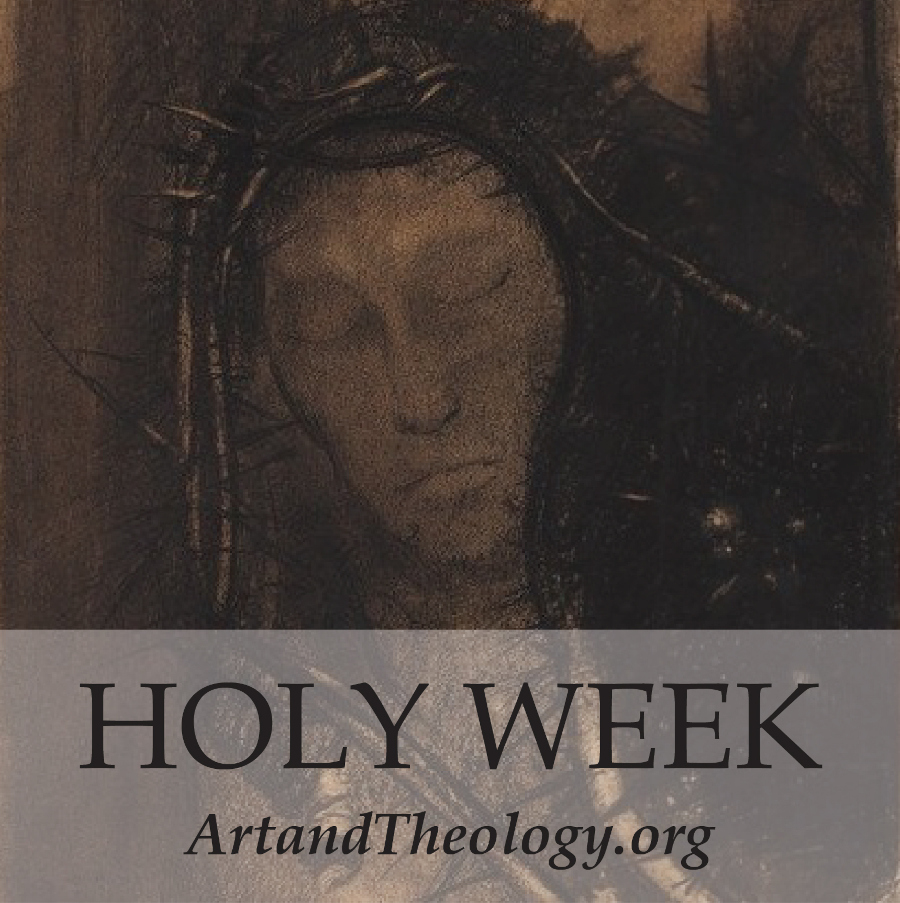
[Playlist cover art: Odilon Redon, Christ, ca. 1895, charcoal, chalk, pastel, and pencil on paper, Museum of Modern Art, New York]
The playlist is a mixture of classical and popular (indie-folk, gospel) music. In this post I want to provide a little context for some of the pieces, by which I mainly mean translations of all the non-English lyrics. Because of what you see here, you might get the wrong impression that the list is almost entirely classical; actually, it’s only about half.
The opening track, “Herr, unser Herrscher” (Lord, Our Ruler), is a unique arrangement of the opening chorus from Johann Sebastian Bach’s St. John Passion, a Good Friday oratorio in German.
Herr, unser Herrscher, dessen Ruhm
In allen Landen herrlich ist!
  Zeig uns durch deine Passion,
  Daß du, der wahre Gottessohn,
  Zu aller Zeit,
  Auch in der größten Niedrigkeit,
  Verherrlicht worden bist!
Lord, our ruler, whose fame
In every land is glorious!
  Show us, through your passion,
  That you, the true Son of God,
  Through all time,
  Even in the greatest humiliation,
  Have become transfigured! [source]
Unique, because the Baroque choir and orchestra are accompanied by an ensemble of Gabonese musicians who contribute their own rhythmic profile, along with solo percussionists Sami Ateba from Cameroon and Naná Vasconcelos from Brazil. The recording, rereleased on the compilation album Babel (2008), is originally from Lambarena: Bach to Africa (1995), a collaboration between French composer and producer Hughes de Courson and Gabonese composer and guitarist Pierre Akendengué, synthesizing two disparate sound worlds. (“Bombé / Ruht wohl, ruht wohl, ihr heiligen Gebeine” is another highlight from the album. For weeks I debated whether to include it on this playlist—adding it, taking it off, adding it back again—ultimately deciding to leave it off, the reason being that it overlays Bach’s choral rondo with music and invocations to the dead from a Bwiti religious ritual. Though sonically compelling and worth listening to, I felt that it might impede some Christians’ ability to engage this list in a devotional way; so I opted for a traditional Western classical recording instead.)
Other selections from Bach’s St. John Passion are:
>> “Christus, der uns selig macht”
Christus, der uns selig macht,
Kein Bös’ hat begangen,
Der ward für uns in der Nacht
Als ein Dieb gefangen,
Geführt für gottlose Leut
Und fälschlich verklaget,
Verlacht, verhöhnt und verspeit,
Wie denn die Schrift saget.
Christ, who makes us blessed,
committed no evil deed,
for us he was taken in the night
like a thief,
led before godless people
and falsely accused,
scorned, shamed, and spat upon,
as the scripture says. [source]
>> “Petrus, der nicht denkt zurück”
Petrus, der nicht denkt zurück,
Seinen Gott verneinet,
Der doch auf ein' ernsten Blick
Bitterlichen weinet.
Jesu, blicke mich auch an,
Wenn ich nicht will büßen;
Wenn ich Böses hab getan,
Rühre mein Gewissen!
Peter, who did not recollect,
denied his God,
who yet after a serious glance
wept bitterly.
Jesus, look upon me also,
when I will not repent;
when I have done evil,
stir my conscience! [source]
>> “O große Lieb”
O große Lieb, O Lieb ohn alle Maße,
Die dich gebracht auf diese Marterstraße!
Ich lebte mit der Welt in Lust und Freuden,
Und du mußt leiden.
O great love, O love beyond measure,
that brought you to this path of martyrdom!
I lived with the world in delight and joy,
and you had to suffer. [source]
>> “Ruht wohl, ihr heiligen Gebeine”
Ruht wohl, ihr heiligen Gebeine,
Die ich nun weiter nicht beweine,
Ruht wohl und bringt auch mich zur Ruh!
Das Grab, so euch bestimmet ist
Und ferner keine Not umschließt,
Macht mir den Himmel auf und schließt die Hölle zu.
Rest well, you blessed limbs;
now I will no longer mourn you.
Rest well and bring me also to peace!
The grave that is allotted to you
and encloses no further suffering
opens heaven for me and closes off hell. [source]
For Bach’s St. Matthew Passion—one of the most celebrated works of classical sacred music ever written, right up there with Handel’s Messiah—I’ve drawn from the abridged English version (rather than the original German), translated by the Rev. Dr. John Troutbeck and performed in 1962 by the New York Philharmonic and Collegiate Chorale under the direction of Leonard Bernstein. I chose just a few pieces from it, not wishing to replicate the whole thing; as you can see, I tend to favor chorales over arias.


 Art & Theology