
Holy Week: Jesus Dies

It was nine o’clock in the morning when they crucified him. . . .

When it was noon, darkness came over the whole land until three in the afternoon. At three o’clock Jesus cried out with a loud voice, “Eloi, Eloi, lema sabachthani?” which means, “My God, my God, why have you forsaken me?” . . . Then Jesus gave a loud cry and breathed his last.

—Mark 15:25, 33–34, 37

LOOK: Crucifix 45 by William Congdon
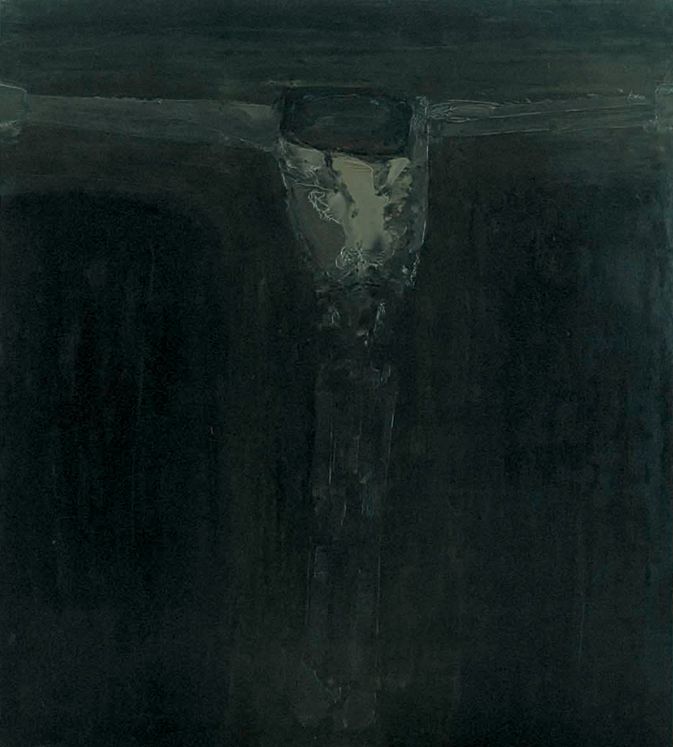
Congdon, William_Crucifix 45
William Congdon (American, 1912–1998), Crocefisso 45 (Crucifix 45), 1966. Oil on canvas, 152 × 139 cm. Collection of the William G. Congdon Foundation, Milan.

After his conversion to Catholicism in 1959, artist William Congdon [previously], an American expatriate living in Italy, spent the next twenty years of his life painting dozens of Crucifixions. One of them, Crocefisso 45, shows the crucified Christ immersed in near total darkness. His form is barely differentiated from the black background but can just be discerned by the faint band of light that outlines it. Congdon writes that he wanted to portray “a body soaked with pain to the point that one cannot distinguish the body from the pain, almost as though the pain had become a body and not the body a pain.”1

Christ’s head, like a gaping hole, hangs down to rest on his dimly luminescent chest. It’s as if the light of the world has been eclipsed. Art historian Giuseppe Mazzariol wrote of the recurring nero sole (black sun) in Congdon’s work, whose purpose is “to express the spiritual widowhood of a world marked by suffering.”2 Here it expresses the utter desolation of Good Friday.

Fred Licht writes that “in the Crucifixes [of Congdon] the black spot becomes the storm over Golgotha which is repeated every year with the advent of Good Friday, erasing the images from the altars, extinguishing the candles, and plunging the Christian world into deepest night.”3

Notes:

1. William Congdon, Esistenza/Viaggio di pittore americano: Diario (Milan: Jaca Book, 1975), 154.

2. Giuseppe Mazzariol, Introduzione a William Congdon, exh. cat. (Ferrara, 1981).

3. Fred Licht, “The Art of William Congdon,” in Fred Licht, Peter Selz, and Rodolfo Balzarotti, William Congdon (Jaca Book: Milan, 1995): 11–58.

LISTEN: “The Sun’s Gone Dim and the Sky’s Turned Black” by Jóhann Jóhannsson, on IBM 1401, A User’s Manual (2006) [HT]

The sun’s gone dim
And the sky’s turned black
’Cause I loved her
And she didn’t love back

“The Sun’s Gone Dim and the Sky’s Turned Black” by the late Icelandic composer Jóhann Jóhannsson (1969–2018) blends, as does most of his work, traditional orchestration with contemporary electronic elements. The elegiac lyrics, which repeat multiple times over the nearly six-minute runtime, are adapted from “Two-Volume Novel” by Dorothy Parker, a four-line poem about unrequited love.

This piece was inspired by a recording of an IBM mainframe computer that Jóhannsson’s father, Jóhann Gunnarsson, made on a reel-to-reel tape machine in the 1970s. (Gunnarsson was an IBM engineer and one of Iceland’s first computer programmers, who used early hardware to compose melodies during his downtime at work.) It was recorded by a sixty-piece string orchestra, with Jóhannsson on vocals.

Credit goes to the Rabbit Room not only for this find but also for connecting it to Good Friday. (I found the song on their Lent playlist.) Imagine the speaker as Jesus on the cross, speaking to the world that he so loved (John 3:16) but who rejected him. Even the sky mourns with him as the sun veils her face. All is dark and seemingly lost.
Lent, Day 25

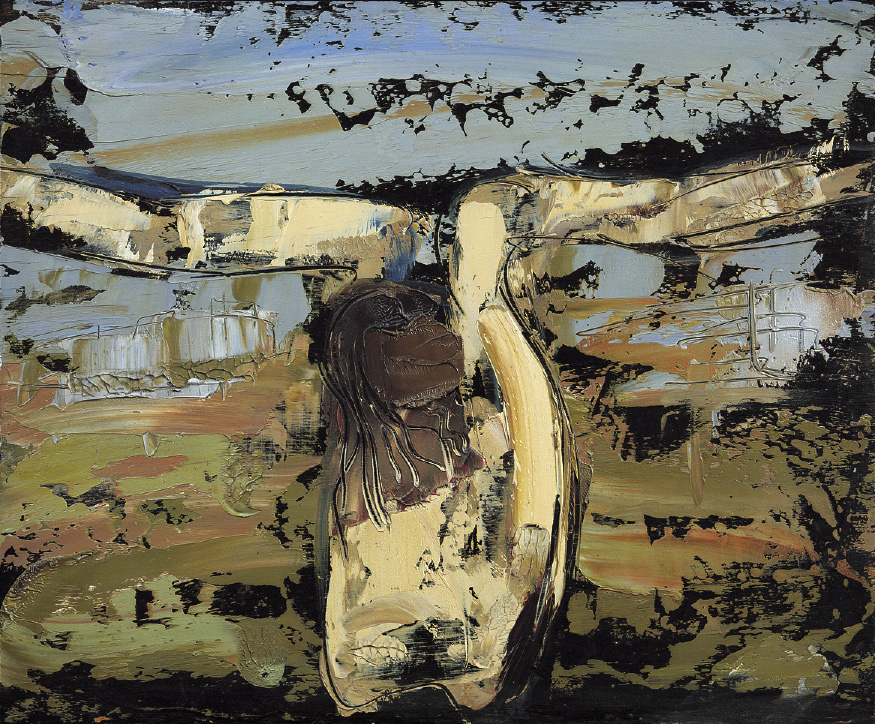
LOOK: Crucifix No. 9 by William Congdon

Congdon, William_Crucifix No. 9
William Congdon (American, 1912–1998), Crocefisso 9 (Crucifix 9), 1961. Oil on Masonite, 19 11/16 × 23 5/8 in. (50 × 60 cm). Private collection, Milan. Photo © The William G. Congdon Foundation.

William Grosvenor Congdon (1912–1998) was a modern American artist, often classified as an abstract expressionist, who spent much of his life in Italy after World War II. He converted to Catholicism in 1959 and for the next two decades painted dozens of Crucifixions, which became more and more abstract as he went on. The one above is one of his earliest, and the subject is still easily recognizable.

Christopher Reardon explains how Congdon achieved the thick surface textures of his paintings:

Typically Congdon applied paint with a palette knife, then incised the encrustations of oil with a jackknife or awl. The technique suited him to the end. “With a brush, it’s a kiss,” he said after painting one of his final landscapes last winter [1997]. “You have to fight with a knife.”

This technique contributes to the agitated feel of many of his Crucifixion paintings.

LISTEN: String Quartet No. 1 “Calvary” by Coleridge-Taylor Perkinson, 1956 | Performed by the Catalyst Quartet, 2021

Coleridge-Taylor Perkinson (1932–2004) was a prodigious American composer whose work spans many genres, including classical, jazz, pop, film, television, and dance. After receiving his bachelor’s and master’s degrees from the Manhattan School of Music, he cofounded the Symphony of the New World in New York in 1965 and later became its music director. He was also music director of Jerome Robbins’s American Theater Lab and the Alvin Ailey American Dance Theater.

Perkinson composed his first string quartet when he was twenty-three, basing it on the melody of the African American spiritual “Calvary.” It’s in three movements, which together capture the light and shade of the Crucifixion event:

I. Allegro
II. Quarter note = 54 (video time stamp: 5:40)
III. Rondo: Allegro vivace (video time stamp: 10:36)

The performance above is by the Grammy-winning Catalyst Quartet. It was part of the “Uncovered” series they played last year at The Greene Space at WNYC & WQXR, comprising three free concerts of work by five historically important Black composers: Florence B. Price, Jessie Montgomery, Coleridge-Taylor Perkinson, George Walker, and Samuel Coleridge-Taylor (Perkinson’s namesake!). View the full concert series here.

I wanted to show a performance caught on video so that you can better see how the instruments interact with one another, but for an album recording, see Perkinson: A Celebration (2000), where the piece is performed by the New Black Music Repertory Ensemble Quartet. I include two of the movements, in addition to the Calvary Ostinato from Perkinson’s Black Folk Song Suite, on my Holy Week Playlist.

“Not as a dove…”: Two Pentecost poems by Mark DeBolt

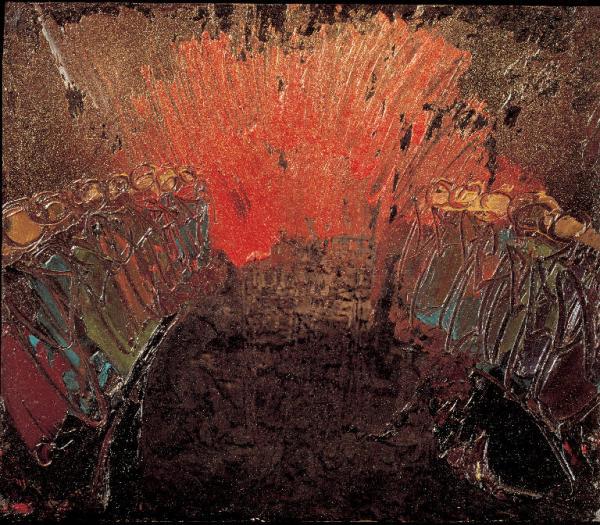
Pentecost by William Congdon
William Congdon (American, 1912–1998), Pentecost 2, ca. 1962. Oil on tile, 4 × 4 cm. The Province of Milan Art Collection.

“Pentecostal Hour” by Mark DeBolt

No zephyr soft
but cyclone strong
bore thoughts aloft
in windy song.

No flicker mild
but flames of red
danced hot and wild
upon each head.

And so fierce was
our thundering word
in languages
of all who heard,

all knew it meant
the Spirit’s power.
This was our Pent-
ecostal hour.

“Pentecost Villanellette” by Mark DeBolt

Not as a dove the Holy Spirit came
to the disciples gathered in a room,
but as a violent wind and tongues of flame.

A cyclone roared the ineffable name
as fire on each blushing brow did bloom.
Not as a dove the Holy Spirit came

to give sight to the blind and heal the lame
and raise the dead and dispel error’s gloom,
but as a violent wind and tongues of flame.

The Breath of God is anything but tame.
Who dally with it dally with their doom.
Not as a dove the Holy Spirit came,
but as a violent wind and tongues of flame.

These poems are published in For the Mystic Harmony: Collected Poems 1997–2011 by Mark DeBolt and are used by permission of the author.

+++

This Sunday Christians will celebrate Pentecost, the historic giving of the Holy Spirit to all believers in Jesus Christ and thus the birthday of the church.

Before it was the name of a Christian holiday, Pentecost (Heb. Shavuot) was celebrated annually by the Jewish people in honor of the giving of the Torah on Mount Sinai. Jews still celebrate it today, fifty days after Passover—hence the name Pentecost (“pente” = five). (Appropriately, Christian Pentecost occurs fifty days after Easter.) Because of the importance of the feast, ancient Jews traveled from all over the known world to their religious capital, Jerusalem, for the occasion, and that’s what we see in Acts 2—a multiregional, multilinguistic gathering.   Continue reading ““Not as a dove…”: Two Pentecost poems by Mark DeBolt”