
Juneteenth roundup: Songs, poems, two painting series, and Step Afrika! performance

Juneteenth is a federal holiday that commemorates the end of slavery in the United States. It is celebrated annually on June 19, the date on which, in 1865, the Union army finally arrived in the nation’s farthest reaches—Texas—to enforce the proclamation Lincoln had signed more than two and a half years earlier. While the holiday is marked predominantly by joy, it also calls on celebrants to reflect on the complicated meaning of freedom—“freedom that came at the end of the bloodiest war on the American soil where more than 700,000 lives were lost, freedom that came at the death of many enslaved people who never lived to see it, and freedom that people still fight for today,” historian Daina Ramey Berry told Life & Letters. In the words of another historian, Mitch Kachun, Juneteenth is a time “to celebrate, to educate, and to agitate.”

Yesterday I published a long-form article on the three twenty-first-century stained glass windows at New Mount Pilgrim Missionary Baptist Church in Chicago, which explore America’s stained past, Black communities’ resilience, present-day gang violence, and “the values of the village.” The article provides ample fodder for possible ways to honor Juneteenth, such as these:

  • Donate to the MAAFA Redemption Project to support the promise and genius of Chicago’s Black and Brown youth. Or choose another Black cause, publication, individual, or business to invest in.
  • Watch the documentary All These Sons to learn about how two Chicago organizations are loving and transforming their neighborhoods, seeking to free residents from cycles of violence and help them reclaim their self-worth.
  • Spend ten minutes looking at and meditating on each of the three rose windows at New Mount Pilgrim. Think of them as visual prayers that you can enter into.
  • “Read” (that is, view, as it’s almost entirely a picture book) The Middle Passage by Tom Feelings, pausing at each illustration to really feel the weight of the atrocities perpetrated during the transatlantic slave trade. Practice lament.
  • Watch the groundbreaking miniseries Roots, based on Alex Haley’s novel, which traces the saga of a Mandinka family for three generations, before, during, and after slavery. It originally aired on ABC over eight consecutive nights in 1977, and later that year on BBC One; it’s streaming for free on Tubi (no account needed) in the form of six ninety-minute episodes.
  • For a firsthand account of slavery written by someone who was himself enslaved, read Olaudah Equiano’s autobiography, or passages from it.
  • Read the poet Lucille Clifton, who writes about Black womanhood, history, family, and religion. A good place to start would be her National Book Award–winning Blessing the Boats.
  • Peruse the Adinkra Symbol Index, put together by web designer Jean MacDonald, to learn more about this West African writing system and some of the concepts and proverbs represented in it.

+++

YOUTUBE PLAYLIST: Juneteenth 2024, compiled by Victoria Emily Jones: As a follow-up to the Juneteenth Playlist I published on YouTube in 2022, I’ve put together a brand-new one of nineteen songs, including a ring shout from South Carolina, a Sam Cooke cover, a virtuosic performance by the Trinidadian pianist Hazel Scott, a song-turned-children’s-book by Rhiannon Giddens, some seventies funk, and more. Here are two selections from the list:

>> “Feelin’ Good”: Written in 1964 by English composers Anthony Newley and Leslie Bricusse for the musical The Roar of the Greasepaint – The Smell of the Crowd, this song became a classic when Nina Simone recorded it the following year for her album I Put a Spell on You. In 2021, Dove, Verve Records, UMe, and the Nina Simone Charitable Trust teamed up to create the first-ever music video for Simone’s version of the song. Directed by Sarah Lacombe and featuring dancer Raianna Brown, the new music video “aims to continue Simone’s important legacy by telling a story of Black female empowerment . . . follow[ing] four generations of Black women living their truths, loving each other, celebrating their hair, and feeling good,” according to the press release.

>> Soul Force by Jessie Montgomery:Soul Force is a one-movement symphonic work which attempts to portray the notion of a voice that struggles to be heard beyond the shackles of oppression,” writes composer Jessie Montgomery. “The music takes on the form of a march which begins with a single voice and gains mass as it rises to a triumphant goal. Drawing on elements of popular African-American musical styles such as big-band jazz, funk, hip-hop and R+B, the piece pays homage to the cultural contributions, the many voices, which have risen against aggressive forces to create an indispensable cultural place.” It’s performed here by the national youth ensembles NYO-USA, NYO2, and NYO Jazz, established by Carnegie Hall.

The title of the work comes from Rev. Dr. Martin Luther King’s “I Have a Dream” speech, in which he states, “We must not allow our creative protest to degenerate into physical violence. Again and again, we must rise to the majestic heights of meeting physical force with soul force.”

Click here to access all nineteen songs on Art & Theology’s YouTube playlist for Juneteenth 2024. (See also my Juneteenth playlist on Spotify.)

+++

WASHINGTON, DC, EVENTS:

I live about an hour north of DC in Central Maryland, so I try to take advantage of some of the many cultural offerings of that city. If you, too, live nearby and don’t already have plans for Juneteenth, here are two ideas of things to do outside the house.

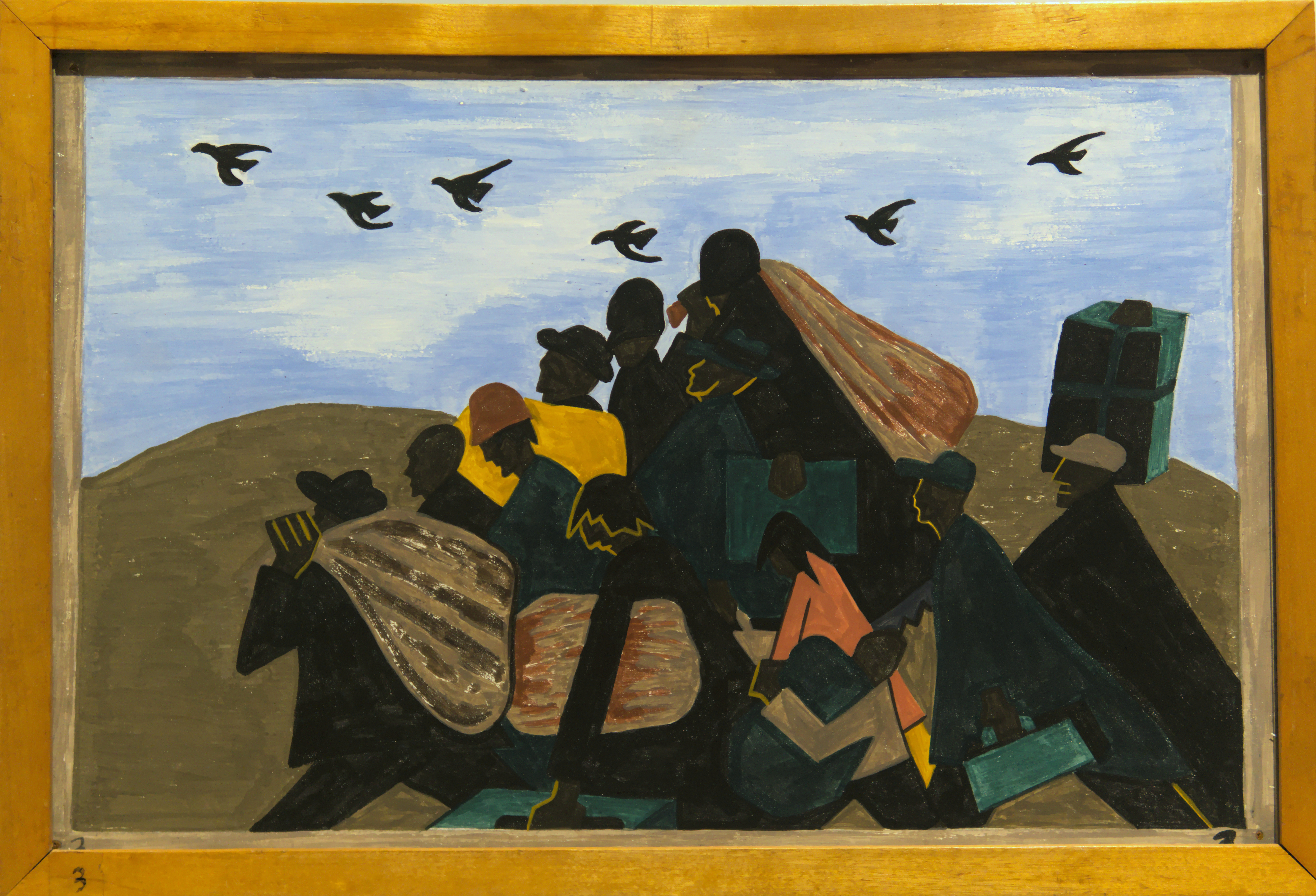
>> STEPPING PERFORMANCE: “Step Afrika! The Migration: Reflections on Jacob Lawrence,” Arena Stage, running through July 14: I’ll be going tomorrow, thanks to an invite from a friend! “Using its hallmark style of percussive dance-theater, Step Afrika!’s The Migration: Reflections on Jacob Lawrence tells the story of one of the largest movements of people in United States history, when millions of African American migrants moved from the rural South to the industrial North in the 1900s to escape Jim Crow, racial oppression, and lynchings. Inspired by Jacob Lawrence’s iconic 60-panel The Migration Series (1940-41), this signature work from the award-winning dance company uses the images, color palette, and motifs in the painting series to tell this astonishing story through pulsating rhythms and visually stunning movement.” The performance fuses body percussion, tap, and contemporary dance with live gospel, jazz, and blues.

Here’s a video promo made by New Victory Theater when the show toured there a few years ago:
Lawrence, Jacob_Migration Series 3
Jacob Lawrence (American, 1914–2000), “From every southern town migrants left by the hundreds to travel north,” panel 3 from The Migration Series, 1940–41. Casein tempera on hardboard, 12 × 18 in. Phillips Collection, Washington, DC. Photo: Victoria Emily Jones. [object record]

Browse all sixty panels from The Migration Series at https://lawrencemigration.phillipscollection.org/. Lawrence pictures different aspects of the northern migration story, such as crowded train stations, rotting crops, lynchings, urban housing, educational opportunity, and church life.

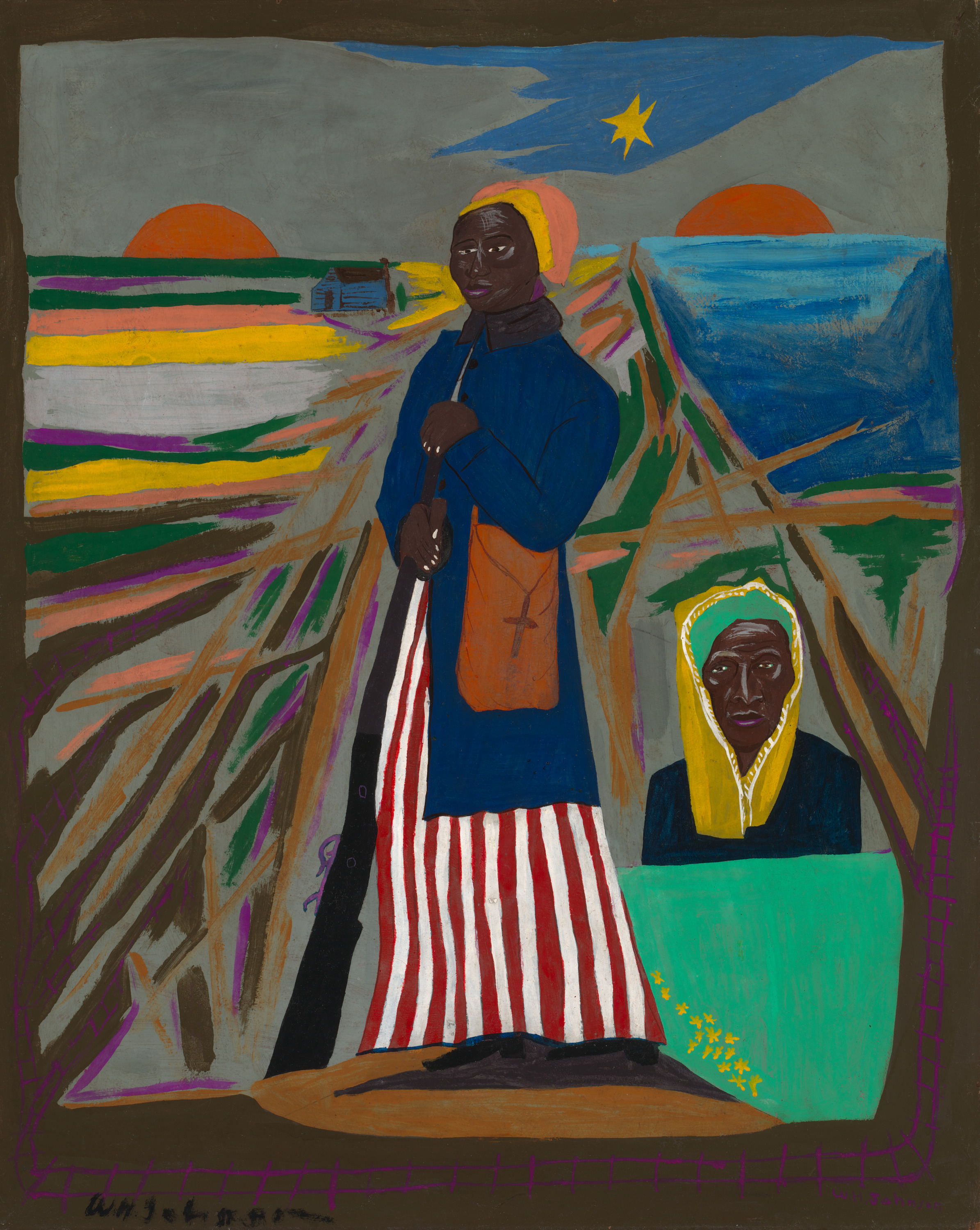
>> ART EXHIBITION: Fighters for Freedom: William H. Johnson Picturing Justice, Smithsonian American Art Museum, March 8–September 10, 2024: Another African American artist who was working around the same time as Jacob Lawrence is William H. Johnson (1901–1970). Last weekend I saw his Fighters for Freedom series of paintings at the SAAM—the first time the works have been shown together since 1946. He painted the series in the mid-1940s as a tribute to African American activists, scientists, teachers, and performers as well as international leaders working to bring peace to the world. Interactive kiosks identify the many historical figures. I learned so much! I can picture this exhibition being a good teaching tool for children as well. Spending time with every painting would be overwhelming for them, but choosing a few select artworks as entry points into talking about the freedom fighters depicted and the larger freedom story they’re a part of should work well.
Johnson, William H._Harriet Tubman
William H. Johnson (American, 1901–1970), Harriet Tubman, ca. 1945. Oil on paperboard, 28 7/8 × 23 3/8 in. (73.5 × 59.3 cm). Smithsonian American Art Museum, Washington, DC.

At the exhibition there are also signs and photos that inform viewers of related artifacts at other Smithsonian museums in the city, including:

(Click on the links for short video features about these objects, made specially for this exhibition.)

+++

POEMS:

>> “Paul Robeson” by Gwendolyn Brooks: Though in popular culture he is best remembered as an international star of stage and screen, the bass-baritone singer and actor Paul Robeson was also a prominent activist who graduated from law school and fought for civil rights. In this poem, Gwendolyn Brooks celebrates that latter legacy of his, his commitment to seeing the Black community in America, as well as other oppressed people groups around the world, flourish. The powerful final lines—“we are each other’s / harvest: / we are each other’s / business: / we are each other’s / magnitude and bond”—communicate the wisdom that we reap the good fruit that grows from seeds sown by others. She references Robeson’s most famous song, “Ol’ Man River,” sung by the character Joe in the musical Show Boat; the song laments the hardships faced by African Americans and expresses envy of the carefree Mississippi River, which just keeps rolling along, free from toil. But Brooks was happy to see Robeson move beyond the despondency embodied by Joe the deck hand, to take a much more empowered stance in public life.

>> “Juneteenth” by Marilyn Nelson: Here Nelson reflects on the childhood of her mother, Johnnie, who grew up in the all-Black pioneer town of Boley, Oklahoma. In Boley, then as now, June 19 is a “second Easter,” a time of food, family, games, and celebration. After several stanzas spent recounting the lighthearted festivities, the last line lands with a thud, a brutal reminder of the terror these community members fled to establish a place of their own. The poem is ultimately about overcoming, but even as the Black residents of Boley have built a new life for themselves and their families, racism is still a wound they bear. “Juneteenth” can be found in the excellent collection The Fields of Praise: New and Selected Poems by Marilyn Nelson (Louisiana State University Press, 1997).

Lent, Day 8

LOOK: Mount Calvary by William H. Johnson

Johnson, William H._Mount Calvary
William H. Johnson (American, 1901–1970), Mount Calvary, ca. 1944. Oil on paperboard, 27 3/4 × 33 3/8 in. (70.5 × 84.9 cm). Smithsonian American Art Museum, Washington, DC.

LISTEN: “Draw Me Nearer” (I Am Thine, O Lord) | Words by Fanny Crosby, 1875 | Music by William H. Doane, 1875 | Performed by Nina Simone on Let It All Out, 1966

I am Thine, O Lord, I have heard Thy voice,
And it told Thy love to me;
But I long to rise in the arms of faith,
And be closer drawn to Thee.

[Refrain] Draw me nearer, nearer, nearer, blessed Lord,
To the cross where Thou hast died;
Draw me nearer, nearer, nearer, blessed Lord,
To Thy precious, bleeding side.

Consecrate me now to Thy service, Lord,
By the pow’r of grace divine;
Let my soul look up with a steadfast hope,
And my will be lost in Thine.

God, Swing Down Low (Artful Devotion)

Johnson, William H._Swing Low, Sweet Chariot
William H. Johnson (American, 1901–1970), Swing Low, Sweet Chariot, ca. 1944. Oil on paperboard, 28 5/8 × 26 1/2 in. (72.6 × 67.2 cm). Smithsonian American Art Museum, Washington, DC.

And as [Elijah and Elisha] still went on and talked, behold, chariots of fire and horses of fire separated the two of them. And Elijah went up by a whirlwind into heaven. And Elisha saw it and he cried, “My father, my father! The chariots of Israel and its horsemen!” And he saw him no more.

—2 Kings 2:11–12a

+++

SONGS: “Swing Low, Sweet Chariot,” attributed to Wallace Willis, ca. 1840; “Swing Down, Chariot,” author unknown, 19th century

Most Negro spirituals are of unknown authorship, but one of the best loved, “Swing Low, Sweet Chariot,” was, according to several accounts, written by Wallace Willis, the black slave of a Choctaw Indian who had been forced out west into what is now Oklahoma. Uncle Wallace, as he was known, was hired out part-time by his master to Spencer Academy, a Choctaw boys’ school, and this is one of the songs he sang to entertain the students. It became popular among them, and during the Fisk Jubilee Singers’ inaugural tour in 1871, the academy’s superintendent, Alexander Reid, shared the song with the all-black group. They had never heard of it but added it to their repertoire, performing it on concert stages throughout the US, along with other slave songs. It was one of twelve songs they chose to record for the first time in 1909, further cementing its longevity.

In 2002 the Library of Congress added this historic recording to the United States National Recording Registry, to be preserved for future generations. The accompanying essay by Toni P. Anderson recounts, in addition to Uncle Wallace’s story, an alternate origin account that says “Swing Low” was the creation of Sarah Hannah Sheppard, a southern slave who had set out to drown herself and her daughter in the Cumberland River, until an elderly slave woman intervened, urging her to instead “let de chariot of de Lord swing low”—rescue would come, she prophesied. And for Sarah and her little Ella, it soon did.

In one sense, “Swing Low, Sweet Chariot” is a plea for death: come and carry me over, God. “Home” is heaven, the promised land, just “over Jordan,” and the chariot refers to the divine vehicle that swept down to take Elijah there. In another sense, “home” could signify an earthly place outside the bounds of slavery, a place of relative safety and liberation and reunion with family—such as the North, just over the Ohio River. A clandestine “chariot” was in operation during the antebellum period, run by Harriet Tubman and a network of others (a “band of angels”), who transported slaves up to freedom, and this is the chariot to which the unnamed prophet of Sarah Hannah Sheppard’s story refers.

The song is often performed slowly, solemnly, as a weary surrender to death—as in this bluesy version by contemporary gospel singer Robert Robinson:

But it can also be inflected differently—with joyful anticipation and celebration. Such is the musical interpretation of The Lower Lights:

“In biblical tradition,” writes Old Testament scholar Iain W. Provan,

both chariotry and fire have strong associations with God’s self-disclosure. Both images come together in the most common natural form of divine appearing (“theophany”) in the OT: the thunderstorm—the storm cloud representing the divine chariot or throne (Ezek. 1; Hab. 3:8) and the fiery lightning bolts representing the divine weapons (Ps. 18:14; Hab. 3:11). [ESV Study Bible, p. 648]

Tim Mackie of The Bible Project calls the eccentric theophanic vehicle of Ezekiel 1 the “God mobile.” It’s God’s glory on the move. And it was probably what (or at least similar to what) Elisha witnessed when his predecessor, Elijah, was whisked away into the heavens. It may also be what the prophet Habakkuk had in mind when he wrote about God’s “chariot of salvation” that flashes forth lightning (Hab. 3:8, 11).

“Swing Low, Sweet Chariot” is sometimes sung in medley with “Swing Down, Chariot” (variant title: “Swing Down, Sweet Chariot”), a fast-paced spiritual popularized by the Golden Gate Quartet in the 1940s. See, for example, this clip from the 2003 movie The Fighting Temptations, featuring Beyoncé:

This clip from Elvis’s movie The Trouble with Girls (1969) is also a lot of fun:

“Swing Down, Chariot” references Ezekiel’s vision of the God mobile, humorously nicknaming the prophet Zeke. It has him chancing upon an angel repairing a chariot wheel in the middle of a field. Having never seen such a vehicle, he approaches it, runs his hand over the exterior. The angel offers him a ride, which he gladly accepts. It’s a bumpy one, but Zeke doesn’t mind; “he just wanted to lay down his heavy load.”

Listening to these two spirituals side by side can help us make connections between Bible passages, as we see God’s fiery chariot present not only at Elijah’s ascension but also at Ezekiel’s call to the office of prophet. When mapped onto the context of enslavement, the chariot’s meaning is made real and intensified, a symbol of hope, release, freedom, of God’s wild and transporting glory.

As previously mentioned, the Negro spirituals were multivalent. To some, the chariot was this-worldly, effecting a passage to the northern states where slaveholders held reduced power. To others, to beckon the chariot meant to beckon death, to initiate a departure to the otherworld. The chariot songs held both meanings to their early singers, marking the tension between the slave’s will to live, to survive trauma, and his or her desire to be with God in the flesh, the ultimate freedom.

+++

William H. Johnson (1901–1970) is one of my favorite artists—I wrote about him in stations 3 and 13 of the Stations of the Cross audio tour at the Smithsonian American Art Museum, and in my review of Beholding Christ and Christianity in African American Art.

In his painting Swing Low, Sweet Chariot, a two-wheeled horse-drawn car sweeps in from the upper left, fiery orange and red and filled with stars. Eleven angels in brightly colored dresses and anklet socks hover above, one of them waving hello to the aged man on the opposite side of the river, who runs to catch his ride. His arms are stretched out wide, ready to embrace his new home.

This is probably the best artistic representation of death in the Christian tradition that I know of. It’s glorious and sweet and evocative. The old man’s body is just on the verge of release from its pains, and I feel it. His heaviness is already giving way to lightness, to nimbleness. I feel the joy that awaits him across the river, which the yellow flowers seem to anticipate (they vibrate!), and I sense the community of friends that the thin, magenta-winged beings will be escorting him to. God’s presence, the sun’s orb, glows intensely, the same deep orange as the chariot’s exterior. That’s the glory into which the man is heading.

+++

There are so many wonderful renditions of “Swing Low, Sweet Chariot.” What’s your favorite?


This post belongs to the weekly series Artful Devotion. If you can’t view the music player in your email or RSS reader, try opening the post in your browser.

To view all the Revised Common Lectionary scripture readings for Proper 8, cycle C, click here.

Book Review: Beholding Christ and Christianity in African American Art, ed. James Romaine and Phoebe Wolfskill

Typically when scholars interpret African American art, they do so through the primary lens of racial identity, often glossing over overt Christian themes, expressions of religious identity. Beholding Christ and Christianity in African American Art (Penn State University Press, 2017), edited by James Romaine and Phoebe Wolfskill, seeks to redress that dearth by examining the Christian content, including theological significance, of works by fourteen African American artists who came to maturity between the Civil War and the civil rights era: Mary Edmonia Lewis, Henry Ossawa Tanner, Aaron Douglas, Malvin Gray Johnson, Archibald Motley Jr., William H. Johnson, James Richmond Barthé, Allan Rohan Crite, Sister Gertrude Morgan, William Edmondson, Horace Pippin, James VanDerZee, Romare Bearden, and Jacob Lawrence. Many of these artists were themselves devout Christians, working out of internalized religious convictions and not merely outward tradition or market expectations.

Beholding Christ and Christianity in African American ArtThe essayists certainly take race into account as a factor in the works discussed, but not the only factor; political, socioeconomic, and biographical circumstances are also considered. Christianity, however, as the title suggests, is given pride of place in the selection and examination of the fifty-five images reproduced in the book.

One of the hallmarks of Beholding Christ is the diversity of styles, media, and denominational affiliations represented. As the book shows, African American art is no monolith, and neither is African American Christianity. While there is so-called primitive art and visionary art created by self-taught individuals with crayons, cardboard, or salvaged limestone, there is also neo-classical sculpture, as well as other academically informed works that tend toward impressionism or expressionism. Among the pages are rough-hewn stone sculptures, abstract watercolors, naturalistic oil paintings, and portrait photographs. While there are many depictions of Christ as black, there are also, per tradition, white Christs, and even a Middle Eastern one. What was most surprising to me was to see examples of art by African Americans from high-church traditions, like Catholicism and Anglicanism, who distinguish themselves from low-church Baptists, Pentecostals, and Holiness Christians. The editors are to the applauded for resisting the urge to perpetuate a narrow vision of “Negro art” in line with what the artists’ contemporary critics and viewers principally sought.

Another hallmark of the book is the rigorous formal evaluation and content analysis of specific artworks that make up the bulk of almost every essay, encouraging readers to look deeply. Biographical information about the artists is well integrated and does not overwhelm the focus on the works themselves. Given this image-forward approach, I must say, I’m disappointed that a handful of works, for which color photographs should be available, are reproduced in black and white—for example, Motley’s Tongues (Holy Rollers), Edward Hicks’s Peaceable Kingdom, and Lawrence’s Sermon II and Sermon VII. Luckily these can be found online, but seeing as the entire book is printed in full color with glossy pages, I wonder why color photographs of these were not obtained.

Lastly, I really appreciate the connections between artists made possible by the bringing together of these essays—some made explicitly by the authors, others implied. Douglas and Lawrence both dignified the art of black preaching by visualizing sermons. Crite and Johnson visualized the spirituals, but using very different approaches. Edmondson and Morgan were both motivated by a belief that they were divinely ordained to create by supernatural visions. Episcopal Crite and Catholic Motley intertwined class and religion in their works.

This book is essential reading for anyone in the fields of Christianity and the arts or African American studies. As one belonging to the former category, I see these artworks as part of not only art history but Christian history, and as worthy of being studied by Christians as any theological treatise, written scripture commentary, saint’s biography, or church trend. These artworks teach theology; they encapsulate hopes and fears; they comment on public issues; they expose sin; they lead us in celebration and in lament; they help us to re-member the works of Christ, and invite us into communion with him; they tell us who we are and from whence we’ve come; they cast a biblically grounded vision for the future.

What follows is a brief summary of each chapter.

In chapter 1, Kirsten Pai Buick traces the network of patronage that supported Catholic sculptor Mary Edmonia Lewis, as well as the multiple geographic moves she made to further her career: from Boston to Rome (1865), Rome to Paris (1893), and Paris to London (1901). Because many of Lewis’s religious works have been lost, little attention is given in this chapter to the art itself; the only art illustration is her conventional-looking Bust of Christ (1870), mentioned cursorily in the text.

In chapter 2, James Romaine demonstrates the shift in Henry Ossawa Tanner’s paintings from the visual clarity favored by nineteenth-century academic art to a mood of personalized spiritual mystery favored by the twentieth-century symbolists. He examines four paintings as representative of this move—The Resurrection of Lazarus (1896), Nicodemus (1899), The Two Disciples at the Tomb (ca. 1906), and The Disciples See Christ Walking on the Water (ca. 1907)—revealing how each explores the complex exchange between vision and belief.

Nicodemus by Henry Ossawa Tanner
Henry Ossawa Tanner (American, 1859–1937), Nicodemus, 1899. Oil on canvas, 85.5 × 100.3 cm (33.7 × 39.5 in.). Pennsylvania Academy of the Fine Arts, Philadelphia.

In chapter 3, Caroline Goeser examines the seven gouaches Aaron Douglas made in response to James Weldon Johnson’s God’s Trombones: Seven Negro Sermons in Verse. These images align biblical narrative with modern black experience to tell socially resonant stories. In its attention to the African Simon of Cyrene, for example, The Crucifixion (1927) promotes an “Ethiopianist” narrative, influenced by the late nineteenth-century biblical scholar Edward W. Blyden. Simon looms large as the most prominent figure, heaving Christ’s heavy cross over his shoulders, heroized by his vigorous stride and his active gaze toward God’s light above. Bearing similarities to that of the trudging African American migrant in Douglas’s On de No’thern Road (1926), this pose subtly associates the Great Migration north with the burdensome road to Calvary.

Crucifixion by Aaron Douglas
Aaron Douglas (American, 1899–1979), The Crucifixion, 1927. Oil on Masonite, 121.9 × 91.4 cm (48 × 36 in.) Private collection.

Up Golgotha’s rugged road
I see my Jesus go.
I see him sink beneath the load,
I see my drooping Jesus sink.
And then they laid hold on Simon,
Black Simon, yes, black Simon;
They put the cross on Simon,
And Simon bore the cross.

In chapter 4, Jacqueline Francis examines the dozen or so paintings Malvin Gray Johnson created between 1927 and 1934, the final years of his life, as visual interpretations of Negro spirituals. Modernist in style, these paintings, she says, united old and new and high and popular expressions, helping to revive and elevate this genre of black folk music that saw diminishing audiences during the Great Depression. Swing Low, Sweet Chariot (1928), a night scene painted in thick, dark hues and mounted in a gold lunette frame reminiscent of medieval icons, received the most critical attention in Johnson’s time, eliciting comparisons to Albert Pinkham Ryder. The artist said,

I have tried to show the escape of emotion which the plantation slaves felt after being held down all day by the grind of labor and the consciousness of being bound out. Set free from their tasks by the end of the day and the darkness, they have gone from their cabin to the river’s edge and are calling upon their God for the freedom for which they long. (qtd. 56)

Swing Low, Sweet Chariot by Malvin Gray Johnson
Malvin Gray Johnson (American, 1896–1934), Swing Low, Sweet Chariot, 1928. Oil on canvas, 124.5 × 73.5 cm (49 × 29 in.). Studio Museum in Harlem, New York.

Continue reading “Book Review: Beholding Christ and Christianity in African American Art, ed. James Romaine and Phoebe Wolfskill”