O set me as a seal upon thy heart O set me as a seal upon thine arm For love is strong, strong as death, my love And jealousy is cruel as the grave
Its flashes are the living flame of a blazing fire That cannot be drowned out in a flood All earthly gold in exchange for love Would be utterly contemptible and scorned
Come, my love Let me hear your voice My companions and I wait in the garden Make haste, my love, and shine out like the rising sun Like a stag appearing on the mountain
After the crucifixion of Jesus, a small group of his female followers purchased spices and prepared them to bring to the tomb to anoint his body on Sunday morning. (Sabbath restrictions prevented them from doing work on Saturday.) This was an act of love and reverence that served the practical function of counteracting the smell of decomposition.
The singer-songwriter Katy Wehr [previously] imagines the women consoling each other by singing excerpts from the Song of Songs as they crushed the myrrh, mixed it with oil, and bottled it up for transport—maybe also as they headed over to the gravesite. Wehr has set to music four of the verses from the book’s final chapter, a setting she says she hopes conveys a tone that is both mournful and hopeful.
The Song of Songs, or Song of Solomon, is an ancient collection of Hebrew love poems that Christians have long read as allegorical of the love between Christ and his bride, the church.
Wehr’s selections comment on the nature of love: it is permanent, strong, passionate, inextinguishable, and priceless. The female speaker in the poem seeks to stamp herself on her lover’s heart like a seal, claiming him as hers. She professes love’s power, which is as severe and enduring as death. In the context of this passage, the word “jealousy” appears to be used in the positive sense to mean zeal or passion—a resolute devotion.
She goes on to describe love as fiery and intense.
It seems her lover has gone out for the day, or gone on a trip, and she calls him back home. She can’t wait to hear his voice again. She waits outside for him in the garden, wishing for him to come bounding back into her arms.
“Make haste, my love, and shine out like the rising sun.” One can imagine the myrrh-bearing women of the Gospels hoping beyond hope that their beloved Jesus would arise, would speak their names once more, would prove that love is indeed stronger than death.
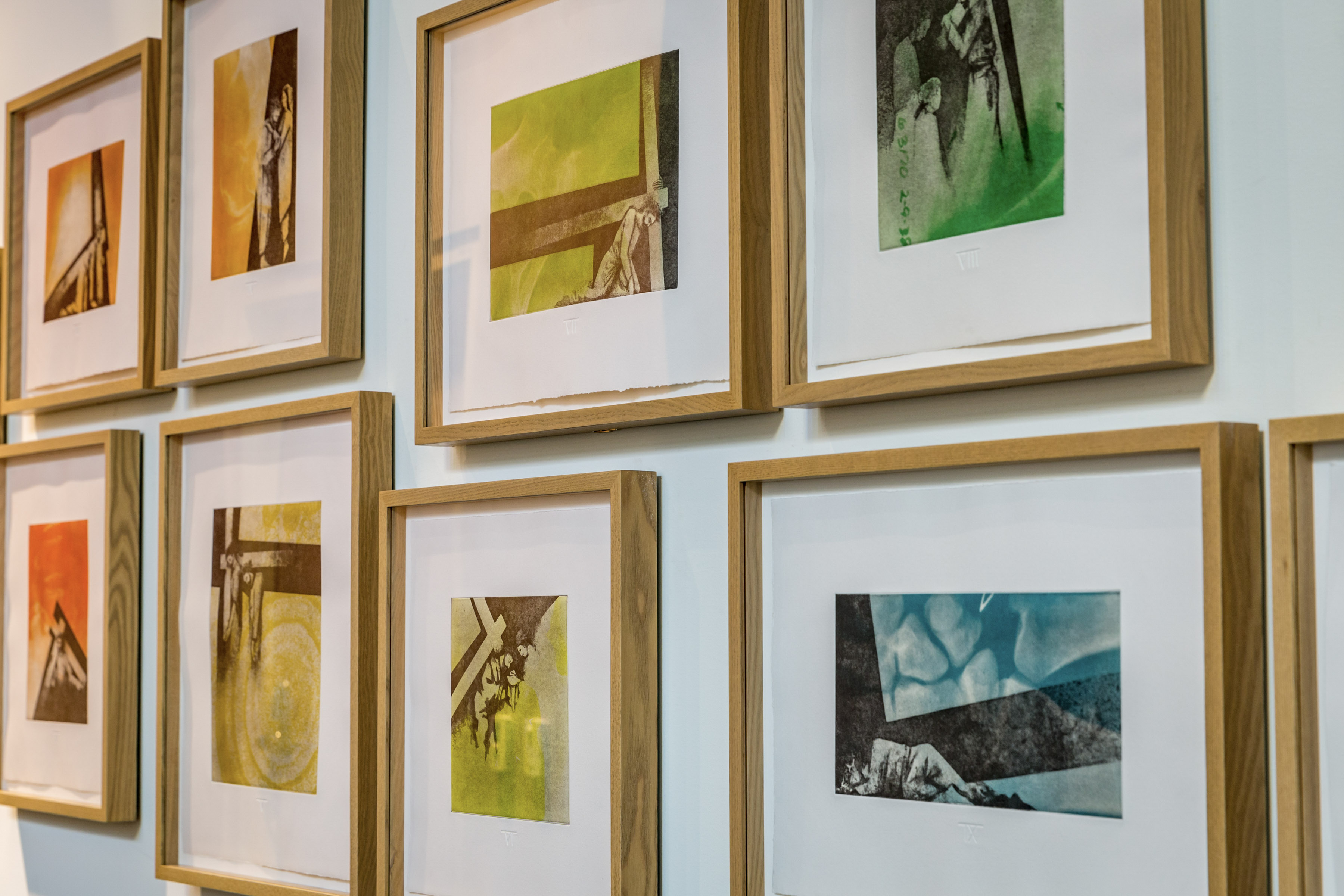
PRINT SUITE: Via Dolorosa by William Frank: Commissioned by SSM Saint Louis University Hospital for their chapel, this set of Stations of the Cross prints by William Frank combines depictions of Christ’s passion with diagnostic X-ray imaging of patients from the hospital’s archives. “The human body, and the community, act as the landscape,” he told me. A bullet in the spine, a kidney stone, a wrist fracture, a tumor, tuberculosis of the bones—Jesus’s suffering unfolds against the backdrop of these specific, tangible forms of suffering. But the rainbow color scheme transforms the stark black-and-white medical images into something a little less scary, suggesting hope and promise—maybe healing, maybe not, but at the very least, divine accompaniment along the path of sorrow.
William Frank (American, 1984–), Via Dolorosa (installation detail), 2020. Etching, archival inkjet, chin collé, with embossment, suite of fourteen prints, overall 4 × 16 ft. SSM Saint Louis University Hospital Chapel, St. Louis, Missouri. Photo: Lisa Johnston, courtesy of the artist.
This year, the Catholic Health Association of the United States created a set of video reflections around Frank’s Stations, one for each piece, which you can find at https://www.chausa.org/prayers/lent-reflections. They also shot a video conversation with the artist:
NEW SONG: “Spooling” by Rev. Matt Simpkins: Diagnosed with stage 4 skin cancer, the Rev. Matt Simpkins [previously] of Lexden in Colchester, an Anglican vicar and a rock musician, said the only way he could calm his nerves enough to get through his next MRI scan was by writing a song from inside the machine. He composed some words and harmonies in his head to the “groovy,” sonorous beeps of the scanner, recording the song afterward using sampling, thus turning a typically threatening, antiseptic medical sound into a party vibe. He was interviewed on the BBC about it last month:
And here’s the bizarre music video, with special effects!
“I’m in a difficult situation with stage 4 cancer, but again, you’ve got a choice, and this song is a good example of that—how you can take something up into song and live,” he says. He hopes the song will minister to those who are undergoing cancer treatment or facing a possible diagnosis—that it is a small oasis, a source of silly laughter, comfort, and strength, for those in dire health.
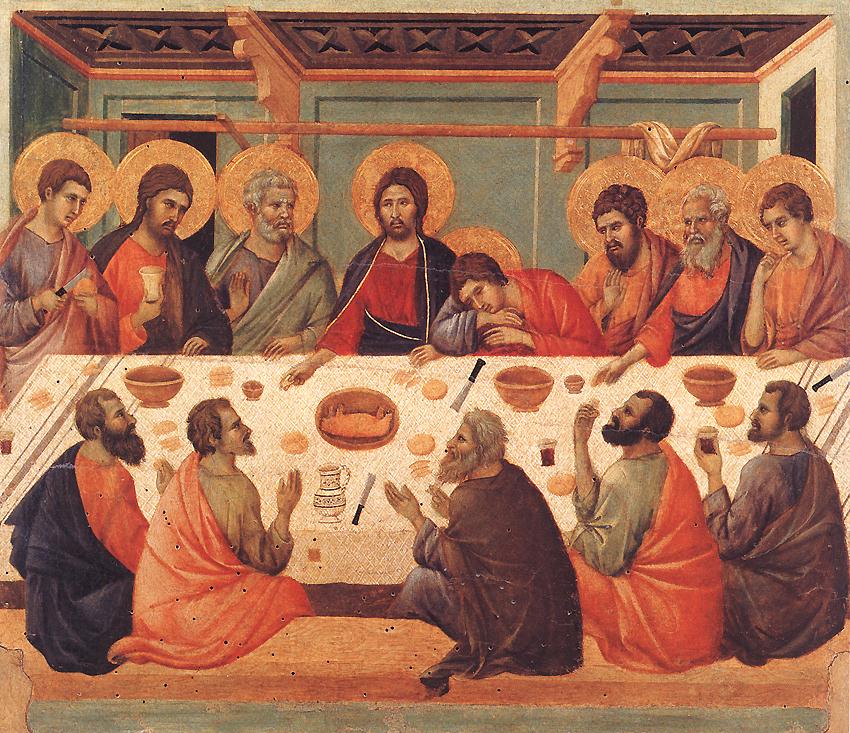
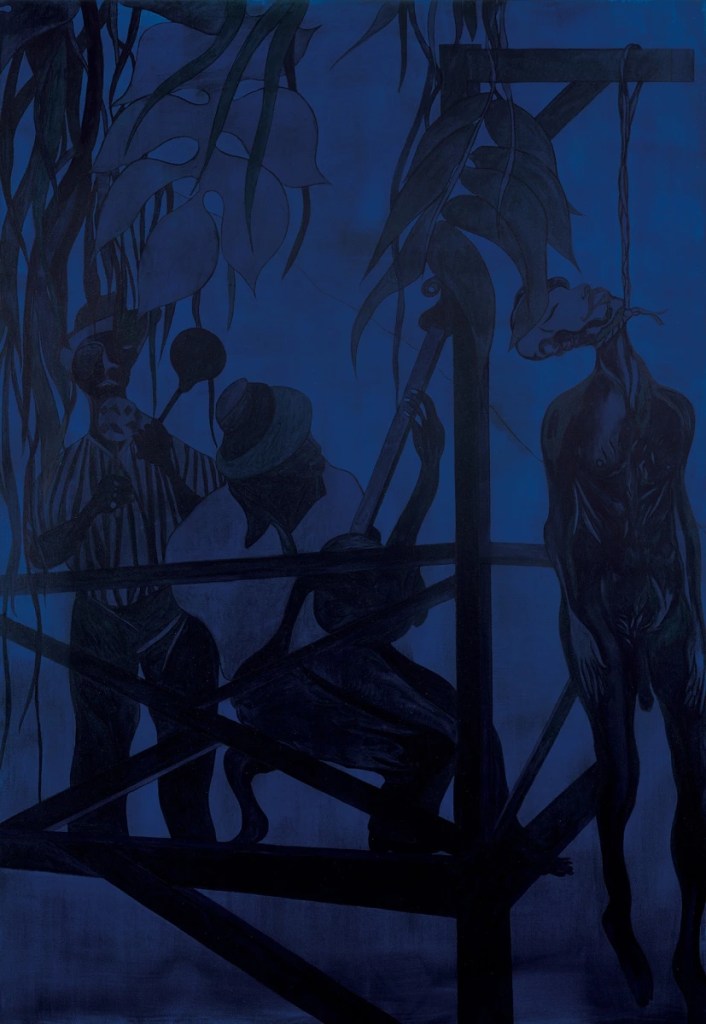
ART COMMENTARY: The Apostle Judas by Adrienne Dengerink Chaplin: As part of the Visual Commentary on Scripture project, Dr. Adrienne Dengerink Chaplin has selected three artworks that in some way interpret Matthew 26:20–25 (and parallel passages), when at the Last Supper Jesus announces that someone there will betray him. Rather than featuring the more common portrayals of Judas as malevolent, halo-less, and/or segregated from the group at the far end of the table, Dengerink Chaplin has chosen works that show him integrated and indistinct, one of twelve betrayers, whose treachery, she boldly proposes, we might construe as “a happy fault.”
Chris Ofili (British, 1968–), The Upper Room, 1999–2002. Oil paint, acrylic paint, glitter, graphite, pen, elephant dung, polyester resin, and map pins on 13 canvases, each 183.2 × 122.8 cm, except head canvas, 244.2 × 183 cm. Installation at Victoria Miro Gallery, London. Collection of Tate, London.
Duccio di Buoninsegna (Italian, d. 1318), The Last Supper, from the Maestà Altarpiece, 1308–11. Tempera and gold on panel, 50 × 53 cm. Museo dell’Opera del Duomo, Siena, Italy.
Chris Ofili (British, 1968–), Iscariot Blues, 2006. Oil and charcoal on linen, 281 × 194.9 cm. Photo courtesy of Victoria Miro and David Zwirner.
With the Duccio panel, she points out something I’ve often contemplated as well: that Jesus feeds Judas with the element he calls his body, keeps communion with him, and is there not a preemptive forgiveness implicit in that act?
+++
SONG: “In the Night” by Andrew Peterson: At a Laity Lodge retreat in 2015, Andrew Peterson of Nashville performed one of the songs from his album Counting Stars (2010) with fellow musicians Buddy Greene, Jeff Taylor, and Andy Gullahorn. “In the Night” rehearses “dark night” stories from scripture: Israel wrestles with God, is enslaved by Egypt, is pressed in by Syria; a prodigal son must resort to eating pig slop; the Son of Man is beaten and killed. But in each of these stories, deliverance comes. Hence the refrain: “In the night, my hope lives on.”
+++
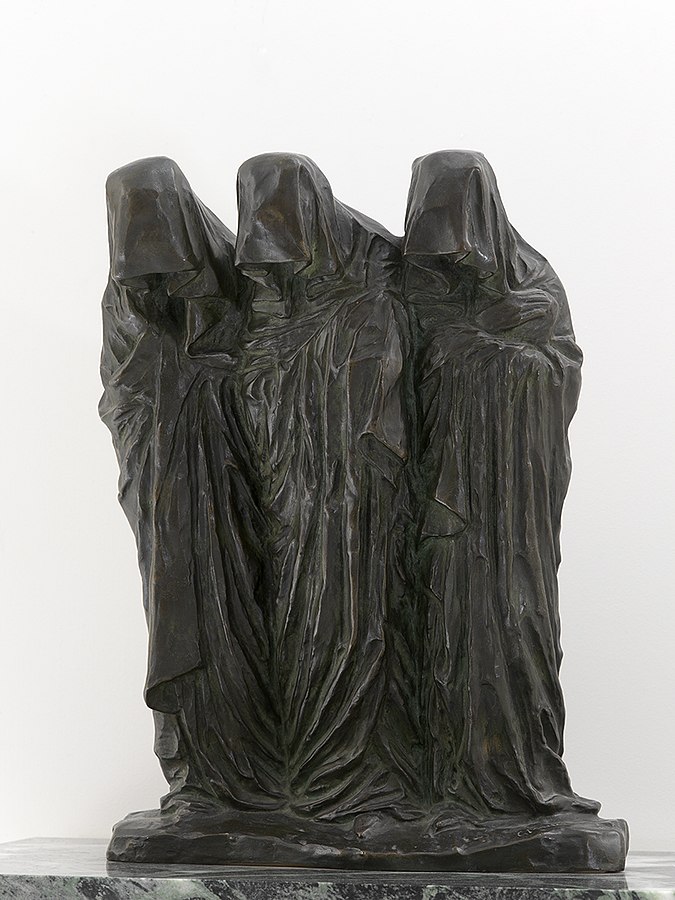
VISUAL MEDITATION: On TheHoly Women at the Tomb by George Minne, commentary by Marleen Hengelaar-Rookmaaker: Marleen Hengelaar-Rookmaaker, the creator of ArtWay, writes about a nineteenth-century bronze sculpture by the Belgian artist George Minne, which shows the three women who went to Jesus’s tomb on Easter morning in an attitude of grief—bent backs, bowed heads—drawing on the gothic pleurants, or weepers, of late medieval tombs. The women are “totally enwrapped in mourning their beloved,” Hengelaar-Rookmaaker writes. “This is in fact the very last moment of the passion, the last moment of suffering past the Pietà and the burial of Christ. It will only be a minute before their hoods will come off and the news of the resurrection will enter their numbed minds.”
George Minne (Belgian, 1866–1941), Les saintes femmes au tombeau (The Holy Women at the Tomb), 1896. Bronze, 44.5 × 62 × 20.5 cm. Groeningemuseum, Bruges, Belgium.
This composition by Minne also exists in granite, wood, and plaster versions.
+++
NEW PLAYLIST: April 2023 (Art & Theology): Includes an excerpt from the psychedelic rock–style Mass in F Minor by the Electric Prunes, “The Outlaw” by Jesus Movement icon Larry Norman, a chuckle-inducing bluegrass song first recorded in 1926 by Gid Tanner and Faith Norris and covered here by the Local Honeys, a choral setting of Psalm 128 (“Happy is everyone who fears the Lord, who walks in his ways . . .”) by the Italian Jewish Renaissance composer Salomone Rossi, Whitney Houston’s rendition of “His Eye Is on the Sparrow,” and a short Kiowa Apache church song that translates to “Son of our Father will set up a cedar tree / Now he is calling to us / He’s going to heal our minds / That’s why he is calling to us.”



 Art & Theology