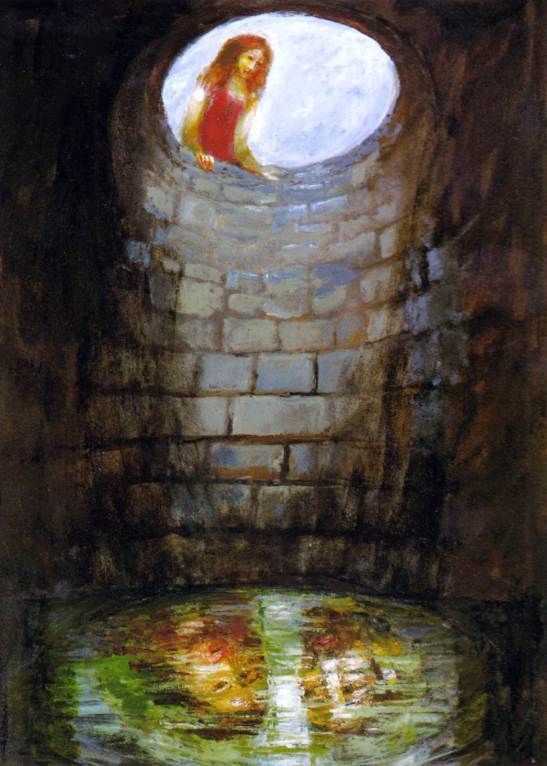
It joined us together, the well;
the well led me into you.
No one between us but light
deep in the well, the pupil of the eye
set in an orbit of stones.

Within your eyes, I,
drawn by the well,
am enclosed.
Translated by Jerzy Peterkiewicz, fromCollected Poemsby Karol Wojtyla (Random House, 1982)
This contemplative poem was originally published in Polish in Kraków’s leading Catholic periodical, Tygodnik Powszechny (Universal Weekly), on May 7, 1950, when Karol Wojtyla was a twenty-nine-year-old parish priest. It’s the sixth in a sequence of eight poems collectively titled “Song of the Brightness of Water” (Pieśń o blasku wody), all reflecting on Jesus’s encounter with the Samaritan woman in John 4.
Karol Wojtyla (1920–2005) was a theologian, philosopher, poet, and priest best known for serving as head of the Catholic Church as Pope John Paul II from 1978 until his death. He traveled more than any other pope (visiting 129 countries), helped end Communism in Eastern Europe, fostered interfaith dialogue, and promoted human rights. He was canonized on April 27, 2014. Born, raised, and educated in Poland, in 1938–39 Karol studied Polish philology (literature and language) at Jagiellonian University, but his academic pursuits were interrupted by the Nazi occupation. He avoided conscription in the German military by working as a manual laborer in a quarry—which he did while secretly taking seminary courses in Kraków from 1942 to 1946 (Catholicism was suppressed at the time) and participating in the underground theater scene as both an actor and a playwright. After graduating, he was ordained to the priesthood. Throughout the first half of his adult life—as a student, young parish priest, bishop, archbishop, and cardinal—Karol wrote and published poetry anonymously and then pseudonymously under the names Andrzej Jawień and Stanisław Andrzej Gruda. After he became pope, many of these poems were compiled into a collection, translated into English with Vatican approval, and released in book form under his given name. Karol continued writing poetry during his pontificate, but at a much slower pace. His most famous writings are in prose and include the landmark encyclical Evangelium Vitae (The Gospel of Life) on human dignity, the international bestseller Crossing the Threshold of Hope, and a series of 129 addresses titled The Theology of the Body.
Jerzy Peterkiewicz (1916–2007) was a Polish poet, novelist, and translator. In 1940 he fled his home country, arriving in England as a war refugee with no knowledge of the language. He went on to become a literature professor at London University, and in 1960, with coeditor and cotranslator Burns Singer, he published the influential anthology Five Centuries of Polish Poetry, 1450–1950. He was later chosen by a papal commission to translate the poetry of Pope John Paul II (Karol Wojtyla).
WORLD PREMIERE: “Yr Oedd Gardd / There Was a Garden” by Alex Mills, March 29, 2024, Saint Deiniol’s Cathedral, Bangor, Wales: On Good Friday this year, a new setting of seven unpublished R. S. Thomas poems, curated from the archives of the R. S. Thomas Research Centre, will be performed for the first time by Saint Deiniol’s Cathedral Choir under the direction of Joe Cooper, accompanied by devotional readings. The choral composition is by Alex Mills [previously], and it was commissioned by Saint Deiniol’s for Holy Week. The title comes from John 19:41–42: “Now there was a garden in the place where he was crucified, and in the garden there was a new tomb in which no one had ever been laid. And so, because it was the Jewish day of Preparation, and the tomb was nearby, they laid Jesus there.”
Thomas was a priest in the Church of Wales and one of the twentieth century’s greatest poets, his works exploring the cross, the presence and absence of God, forgiveness, and redemption.
This is the second commission Mills has fulfilled for the cathedral; last year he wrote “Saith Air y Groes / Seven Last Words from the Cross,” a choral setting of the seven short phrases uttered by Jesus from the cross, according to the Gospel writers, but in Welsh.
+++
CONTEMPORARY HYMNS/GOSPEL SONGS BY WOMEN:
I try to be intentional about featuring the work of women throughout the year, but as March is Women’s History Month, I wanted to call attention to these three sacred songs by Christian women from the generation or two before me.
>> “Christ Jesus Knew a Wilderness” by Jane Parker Huber (1986): Born in China to American Presbyterian missionaries, Jane Parker Huber (1926–2008) is best known as a hymn writer and an advocate for women in the church. This hymn—which can be found in A Singing Faith (1987), among other songbooks—is particularly suitable for Lent. Huber wrote the words, pairing them with an older tune by George J. Elvey. Lucas Gillan, a drummer, educator, church music director, composer, and occasional singer-songwriter from Chicago and founding member of the jazz quartet Many Blessings, arranged the hymn and performs it here with his wife, Anna Gillan, a project commissioned by Saint Matthew Lutheran Church in Walnut Creek, California. What a great violin part!
Christ Jesus knew a wilderness Of noonday heat and nighttime cold Of doubts and hungers new and old Temptation waiting to take hold
Christ Jesus knew uncertainty Would all forsake, deny, betray? Would crowds that followed turn away? Would pow’rs of evil hold their sway?
Christ Jesus knew an upper room An olive grove, a judgment hall A skull-like hill, a drink of gall An airless tomb bereft of all
Christ Jesus in our wilderness You are our bread, our drink, our light Your death and rising set things right Your presence puts our fears to flight
>> “For Those Tears I Died (Come to the Water)” by Marsha Stevens-Pino (1969): I grew up in an independent Baptist church in the southern US, and though the worship music consisted almost entirely of traditional hymns, I have a faint recollection of a woman singing this song as an offertory one Sunday. (Or maybe I heard it on a Gaithers’ television special at my grandma’s house?) It is an early CCM (contemporary Christian music) song that was popular with the emerging Jesus Movement. Marsha Stevens-Pino (née Carter) (born 1952) of Southern California wrote it in 1969 when she was sixteen and a brand-new Christian, and it was recorded by Children of the Day in 1971.
In the video below, excerpted from the DVD Stories and Songs, vol. 1, it is sung by Callie DeSoto and Maggie Beth Phelps with their father, David Phelps.
>> “The First One Ever” by Linda Wilberger Egan (1980): An alumna of the Union Theological Seminary School of Sacred Music with a background in voice and organ, Linda Wilberger Egan (born 1946) has served Lutheran, United Methodist, and Presbyterian congregations as music director throughout her career. Based on Luke 1:26–38, John 4:7–30, and Luke 24:1–11, her hymn “The First One Ever” honors the gospel witness of biblical women: Mother Mary, who said yes to God’s plan for her life, bearing the Messiah into the world; the unnamed woman of Samaria, who, after Jesus personally revealed his messianic identity to her, evangelized her whole village; and Mary Magdalene, Joanna, and Mary the mother of James, the first people to receive the news of Jesus’s resurrection and to preach it to the apostles.
The hymn is sung in the following video by Lauren Gagnon at St. Mark’s Episcopal Church in Chenango Bridge, New York, accompanied by her husband, Jacob Gagnon, on guitar.
+++
SUBSTACK POST: “St. Gabriel to Mary flies / this is the end of snow & ice” by Kristin Haakenson: Kristin Haakenson, creator of Hearthstone Fables, is an artist, farmer, and mom from the Pacific Northwest who shares art and reflections inspired by the sacred and the seasonal, place and past. In this most recent post of hers, she discusses the yearly intersection of Lent and the Feast of the Annunciation. “In a time when the Annunciation isn’t celebrated as universally within the Church as it once was, it may feel somewhat disjointed to stumble upon this joyful feast – celebrating the conception of Jesus – during the penitential season of Lent,” she writes. “This timing, though, is part of a revelatory harmony within the Christian calendar. When we step back to see it in the context of the rest of the liturgical year – and also in the context of the natural, astronomical seasons – the theology embedded in this system of sacred time begins to absolutely bloom.”
+++
LITURGICAL POEM: “Annunciation 2022” by Kate Bluett:Kate Bluett from Indiana writes metrical verse around the liturgical calendar and is also one of the lyricists of the Porter’s Gate music collective. In this poem (which she said was inspired in part by the timing of this blog post!) she brings the Annunciation into conversation with the Song of Solomon in such resonant ways.
Toros Taronatsi (Armenian, 1276–ca. 1346), The Annunciation to the Virgin Mary, 1323, from a Gospel-book made at Gladzor Monastery, Siunik, Armenia. MS 6289, fol. 143, Matenadaran Collection (Mesrop Mashtots Institute of Ancient Manuscripts), Yerevan.
On Holy Saturday I’m planning to feature a song that connects the Song of Solomon to the women at Jesus’s tomb! If you haven’t read that Old Testament book or it’s been a while, I’d encourage you to do so, as then you’ll be able to more easily identify the references in Bluett’s poem and the upcoming song I’ve scheduled for the Paschal Triduum.
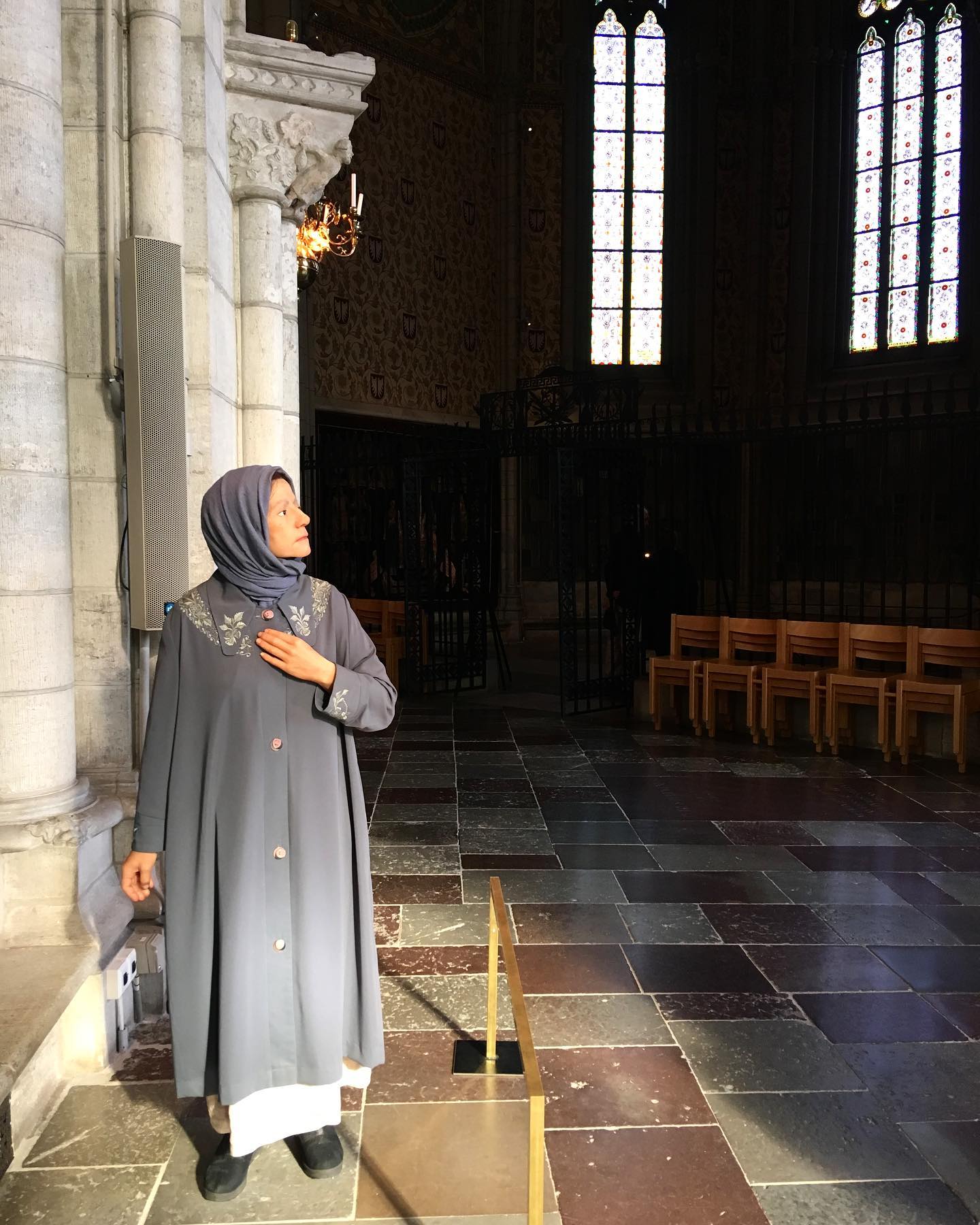
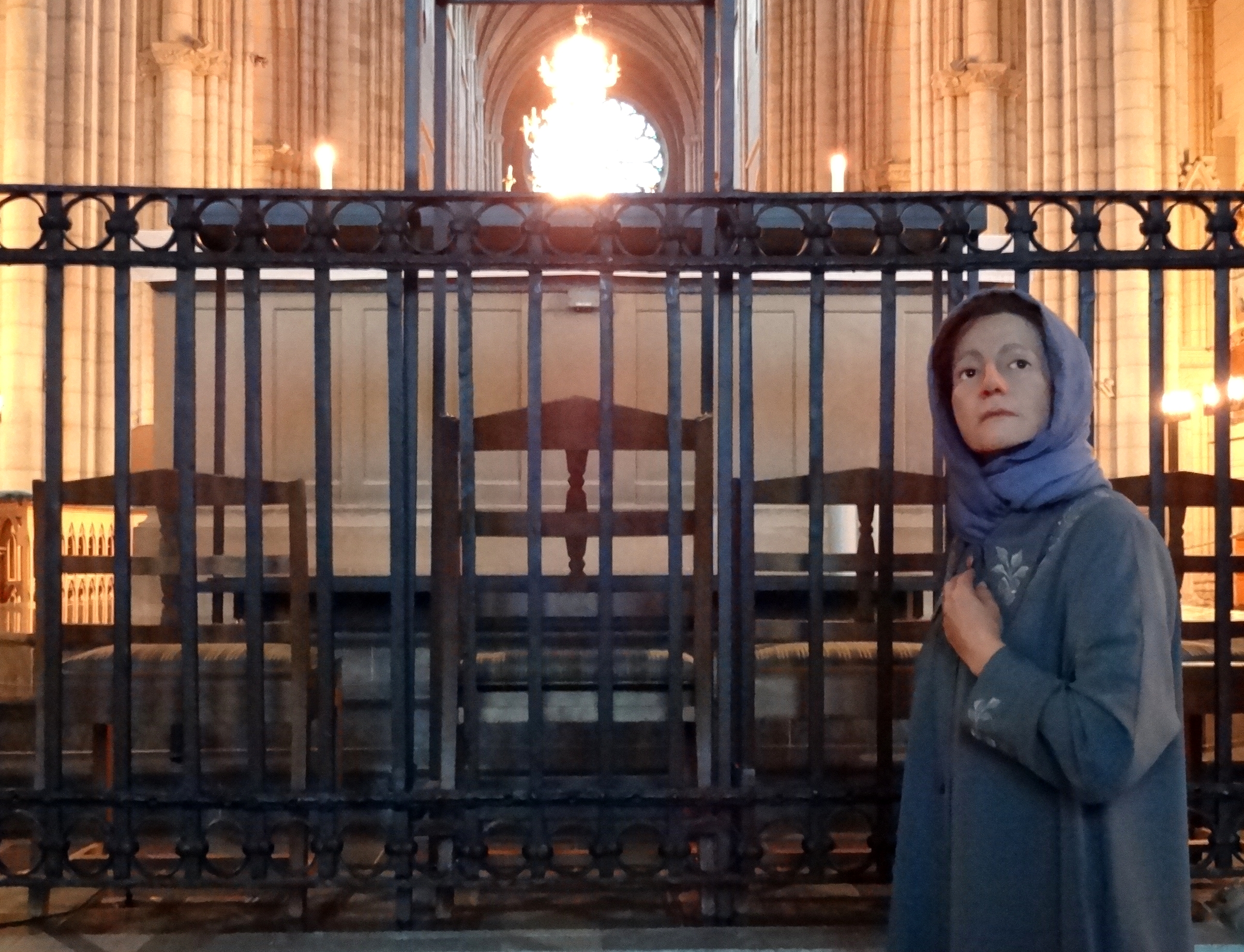
Anders Widoff (Swedish, 1953–), Maria (The Return), 2005. Polyester, silicone, fabric, glass, hair, and oils. Uppsala Cathedral, Sweden. Photo: Lieke Wijnia.
The lengthening shadows of the cedar trees
Have blended into twilight, and the sun
Has plunged in glorious gold precipitance
Beyond the dim crest of the western hills,
Bearing with it the day’s disquietudes;
And now the stars, that lamp the feet of God,
Are lighted, and night’s purple silences
Steal gently round me fraught with memories.

’Twas such an hour as this—long, long ago
Yet seeming yesterday—he came to me,
My little son, in joyous travail born
Out there across the hills in Bethlehem,
Where we who journeyed southward to be taxed—
Strangers in our own father’s land—had found
No shelter in the crowded khan, and shared,
Perforce, a grotto with the stabled kine.

Ah, how it all comes back again to me!
The courtyard, in the flickering torchlight, filled
With huddled trav’lers sleeping ’neath the sky,
The kneeling camels of a caravan,
The patient asses dozing by the wall,
A smell of roasting meat at little fires,
The shouts of melon-sellers, the low drone
Of reverend elders bending at their prayers,
Barking of street-dogs, porters’ blasphemies,
The laughter of a girl, the mellow flute
Of some rapt lover, and the tinkling tune
Of sheep-bells forward moving through the dark.
And then the hour supreme, wherein my soul
Clomb the dark pinnacles of pain, and death
Grappled with life through whirling aeoned years,
But fled at length and left the Miracle.

They laid him there beside me on the hay,
A wee pink being in his world’s first sleep;
My arm was round about him and his breath
Was warm with life on my exultant breast,
And they whose winged watch is set to keep
Ward in the valley lands of heaven looked down,
Not up, that night to find their paradise.
All weak with labor and soul’s happiness,
I lay beneath the sapphire tent of skies,
And in my heart I made a little prayer
Of thanks that flew up to the throne of God
On swift dove pinions of unuttered song;
And as I prayed, lo, upon loops of stars
Night’s velvet curtainings were lifted up,
A wondrous light turned all the world to rose,
And down the skies swept singing seraphim
In mighty echoes of my little prayer.

Oh, can it be that threescore years have marched
In troubled caravan across the waste
Of desert life since then, and can it be
That I, who sit here in mine eventide,
White with the snows of sorrow and of time,
Was once a bright tressed girl who heard the choirs
Of heaven rejoice that she had borne a son?
Why, I can feel that little heart beat still
Close to my own, the touch of little hands
Warm and caressing on this withered breast;
Still I can hear the first low wail that marked
His woe’s beginning and the tortured path
That he should tread in mighty gentleness,
With pain and anguish, ’til his love supreme
And terrible meekness, overcoming death,
Should lead him conqueror to sit with God,
Pleading for sinful men in paradise.

Today I stole into the synagogue
And heard a rabbi read the sacred scroll:
How that my lord, Isaiah, said of old,
Thy Maker is thy husband, he hath called thee
As a forsaken woman, spirit grieved;
God, for a little moment, hides his face
From thee, but with his loving kindness soon
And tender mercies shall he gather thee.
Then was I comforted, and peace displaced
The turmoil in my heart, and minded me
Of that great promise Gabriel bore from God
And the immeasurable fruitage of his word,
The life and death and glory of my son.

So in the shades of life and night I sit,
Under the sheltering arbor of the dark
That curves above, vined o’er with trellised stars,
Waiting my spirit bridegroom, and the sound
Of that loved voice—long silent save in dreams—
Calling across the vibrant firmament,
O Mary, Mother Mary, come to Me.
This poem is from ’Prentice Songs (Pittsburgh: Aldine Press, 1913) and is in the public domain.
George Mahaffey Patterson (M. P.) Baird (1887–1970) was a lifelong resident of Pittsburgh, Pennsylvania, who worked in theater and city government. He graduated from the University of Pittsburgh in 1909 and then taught in the Department of English as a professor of theater history and production. He formed the student group the Pitt Players, financing, writing, and directing several of their early plays. While on the faculty, he also locally published three collections of poetry: ’Prentice Songs (1913), Loaves for Hyacinths (1914), and Rune and Rann (1916). In 1917 Baird joined the US Army, serving as a lieutenant in the Sanitary Corps during World War I. Upon his return to civilian life he began a career in government service for the city of Pittsburgh, serving as executive secretary of the Art Commission and chief examiner and later president of the Civil Service Commission. He was senior research analyst for the Department of City Planning when he retired in 1961.
CALL FOR ART: Light in the Dark, Sojourn Arts: Sojourn Arts, a ministry of Sojourn Midtown church in Louisville, Kentucky, is accepting entries for wall-hung visual artworks on the theme “Light in the Dark” for its juried art show this Advent and Christmas. It is free to enter (see email submission instructions at link), but selected artists will be responsible for shipping costs to the venue. Three cash prizes will be awarded. Deadline: October 8, 2023. Open to continental US artists only.
>> “O My Hope (A Prayer of Saint Isaac the Syrian)” by Symon Hajjar:Symon Hajjar is a singer-songwriter from Tulsa, Oklahoma. I love, love, love his setting of this passage (lightly adapted from an English translation by Sebastian Brock) from the writings of Isaac the Syrian, a seventh-century theologian from Mesopotamia. Because the song would work well for Epiphany, Hajjar released it as the final track on his album Finally Christmas (2015), although it’s not available on Bandcamp as all the other tracks are.
O my Hope, pour into my heart the inebriation that consists in the hope of you. O Jesus Christ, the resurrection and light of all worlds, place upon my soul’s head the crown of the knowledge of you, and open before me suddenly the door of mercies; cause the rays of your grace to shine out in my heart. . . . I give praise to your holy nature, Lord, for you have made my nature a sanctuary for your hiddenness, a tabernacle for your mystery, a place where you can dwell, a holy temple for yourself.
Currently, Hajjar writes and performs kids’ songs under the name Hot Toast Music.
>> “Mahima Mariyeko Thumalaai” (महिमा मारिएको थुमालाई) (Glory to the Lamb Who Was Slain), arranged and performed by Psalms Unplugged: This song is #505 from Nepali Khristiya Bhajan, the definitive Nepali-language hymnal; the words are by Rev. Solon Karthak, and the music is by the late Kiran Kumar Pradhan, the most influential writer of Nepali hymns, who was particularly active in the 1990s. Inspired by Revelation 5:12, its refrain translates to “Glory to the Lamb who was slain / Praise to the Lord of lords / Shouts to the King of kings.” Read the original Nepali lyrics here.
The musicians who form the Nepali worship collective Psalms Unplugged are extraordinary. In this video are Subheksha Rai Koirala (vocals), John Rashin Singh (flute), Ayub Bhandari (keys), Sagar Pakhrin (guitar), and Enosh Thapa Magar (drums). The group’s mission is to see the transformation of lives through the preservation, cultivation, and spread of Nepali Christian music.
+++
LECTURE: “Janet McKenzie’s Women: Mothers, Midwives, and Missionaries” by Sister Barbara E. Reid, OP, September 27, 2015, Catholic Theological Union, Chicago: In this lecture, New Testament scholar Barbara Reid, OP, discusses three painted artworks by Janet McKenzie featuring women of the Bible, all in the collection of Catholic Theological Union: The Succession of Mary Magdalene, a triptych that shows Mary Magdalene deaconing with Susanna and Joanna (Luke 8:1–3), seated with Jesus Christ, her commissioning teacher (John 20:17), and preaching the Resurrection to Peter and John (John 20:2–9, 18); Mary with the Midwives, showing the Mother of God in the early stages of labor; and one of McKenzie’s most reproduced images, Epiphany, which replaces the traditional three wise men with wise women!
Janet McKenzie, The Succession of Mary Magdalene (triptych), 2008. Left to right: Companion; The One Sent; Apostle of the Apostles. Collection of Catholic Theological Union, Chicago.
Professor Reid’s talk starts at 13:55. Before that, there is an introduction by Barbara Marian from Harvard, Illinois, who commissioned the paintings and donated them to CTU (“The giftedness of women and our call to minister in the church must be made visible, no longer hidden or ignored and devalued,” she says), and by CTU President Mark Francis, CSV. Because the feast day of Mary Magdalene is coming up on July 22, it’s a particularly apt time of the liturgical year to share this!
+++
VIDEO: “12 Ways to Be a Christian” by SALT Project: The nonprofit production company SALT Project creates beautiful short films for churches and other clients. In sixty seconds, this one lists (and visualizes) twelve practical ways of living Christianly. The video is fully customizable to include your church’s name, logo, worship times, and website; click here for prices.
Then Jesus went with his disciples to a place called Gethsemane, and he said to them, “Sit here while I go over there and pray.” He took Peter and the two sons of Zebedee along with him, and he began to be sorrowful and troubled. Then he said to them, “My soul is overwhelmed with sorrow to the point of death. Stay here and keep watch with me.”
Going a little farther, he fell with his face to the ground and prayed, “My Father, if it is possible, may this cup be taken from me. Yet not as I will, but as you will.”
Then he returned to his disciples and found them sleeping. “Couldn’t you men keep watch with me for one hour?” he asked Peter. “Watch and pray so that you will not fall into temptation. The spirit is willing, but the flesh is weak.”
He went away a second time and prayed, “My Father, if it is not possible for this cup to be taken away unless I drink it, may your will be done.”
When he came back, he again found them sleeping, because their eyes were heavy. So he left them and went away once more and prayed the third time, saying the same thing.
Then he returned to the disciples and said to them, “Are you still sleeping and resting? Look, the hour has come, and the Son of Man is delivered into the hands of sinners. Rise! Let us go! Here comes my betrayer!”
—Matthew 26:36–46 NIV, emphasis added
LOOK: Agony in the Garden by Fra Angelico [HT: John Skillen]
Fra Angelico (Italian, ca. 1387–1455), Agony in the Garden, ca. 1450. Fresco, 177 × 147 cm. Cell 34, Convent of San Marco, Florence.
This fresco is from one of the forty-four cells in the Dominican convent of San Marco in Florence whose walls Fra Angelico and his assistants painted with religious scenes in the mid-fifteenth century. The friars who lived at San Marco—of which the artist, whose nickname means “Angelic Brother,” was one—used these paintings for private meditation.
Here we see Jesus in the garden of Gethsemane pleading with God the Father to let the cup of suffering, held out by an angel, pass him by. As he prays in agony, his disciples James, John, and Peter nod off just a stone’s throw away. Jesus had asked them to stay awake and pray with him, but their tiredness gets the better of them. In their friend’s hour of deepest need, they fail him.
By contrast—and this is unique!—Mary and Martha, two sisters from Bethany who are also followers of Jesus, are awake and alert under an open loggia, diligently praying and studying God’s word. Perhaps Mary points, in the book in her lap, to the passage of the Suffering Servant in Isaiah 53, recognizing Christ in it, or to the book of Exodus, where the Israelites celebrate their first Passover by smearing the blood of a lamb over their doors. Perhaps Martha prays that the Father would grant Jesus discernment of his will and the strength to follow through with it—that he would sustain him all the way to the cross and beyond.
While the male disciples on the other side of the wall fall asleep, heads in hands, the women watch and wait through the night, exemplars of faithfulness. They trust the prophecies and keep vigil, supporting their Lord in his suffering.
LISTEN: “Stay with Me” by Jacques Berthier, 1984 | Performed by the Taizé Community Choir on Songs of Taizé: O Lord, Hear My Prayer & My Soul Is at Rest, 1999
Stay with me Remain here with me Watch and pray Watch and pray
The words from this Taizé chant come from Jesus’s words in Matthew 26:38, 41 (cf. Mark 14:34, 38). He and his disciples have just finished the Passover Seder, and with full bellies, three of them follow Jesus up to an olive grove, which was perhaps a favorite prayer spot. But they neglect his instruction to stay awake and pray with him.
How can we remain with Christ this Maundy Thursday?
To “keep vigil” this night is to be fully present to Christ’s suffering and spiritually awake to his will and way.
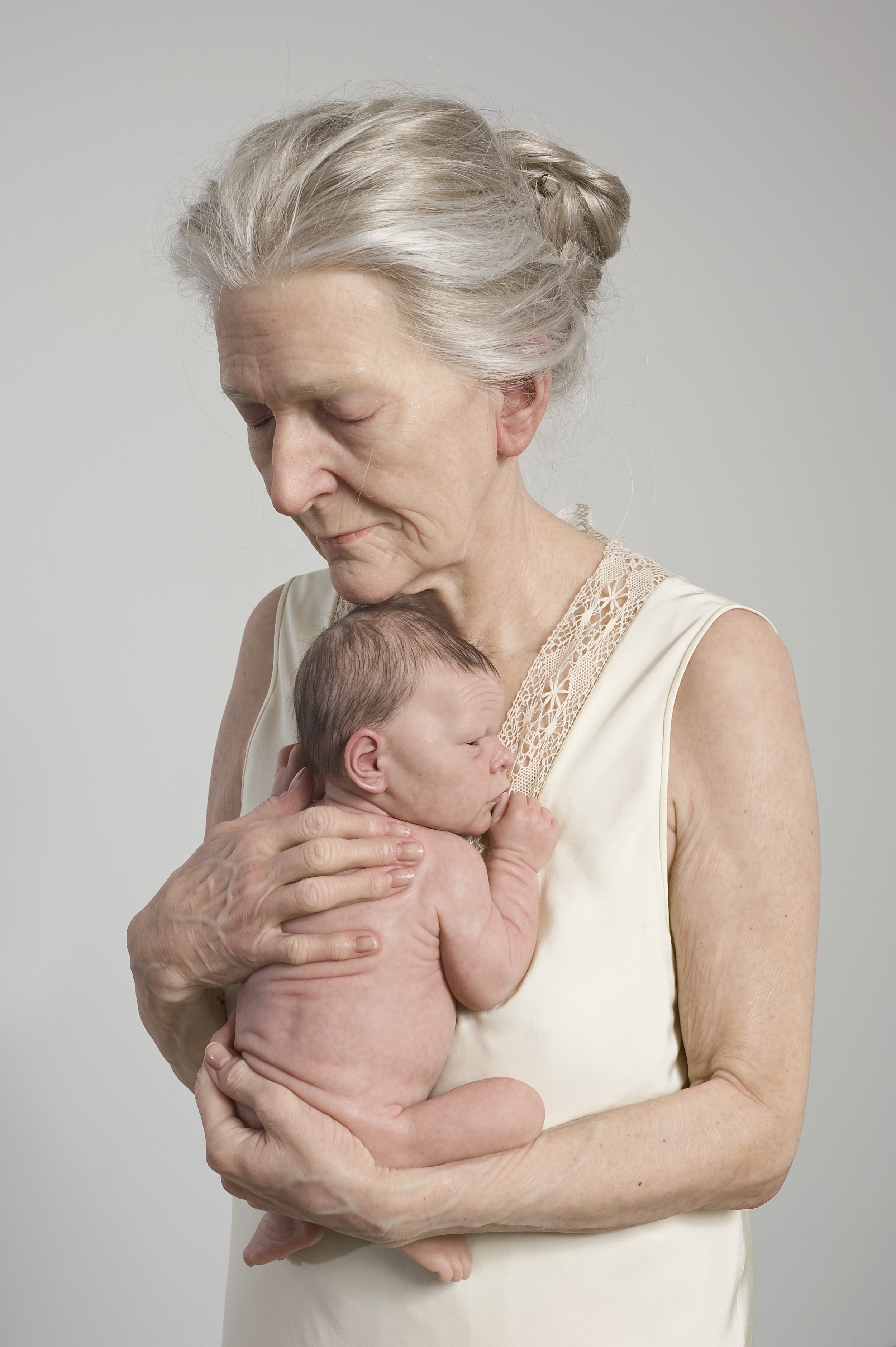
Sam Jinks (Australian, 1973–), Woman and Child, 2010. Silicone, silk, human hair, acrylic, nylon, polyurethane foam, timber, 145 × 40 × 40 cm. Shepparton Art Museum, Shepparton, Victoria, Australia.
Widows of Jerusalem, I too was once
young enough to believe my life mattered.
When I woke, the sun rose for me. I tucked lilies in my hair.
Now I am eighty years a temple dweller.

What a wonder of faith! they proclaim. Truth is,
I cry in the dark. I beg priests for bread

and pick insects from my hem. But today,
an infant came to be blessed. He curled

into the crook of my arm, and when his eyes
wandered to mine, I remembered every hope

stored in my childhood’s heart: gazelles
and henna shrubs, doves perched in the crags.

I touched his face—
that skin we were meant to wear forever.
Inspired by Luke 2:36–38, this poem appears in Tania Runyan’s first full-length poetry collection, Simple Weight (Lexington, KY: FutureCycle, 2010). Used by permission.
Tania Runyan, MA/MFA, lives in Illinois, teaching sixth-grade language arts, speaking at writing workshops, and writing poetry, much of which grapples with scripture. She is the author of five poetry collections—What Will Soon Take Place, Second Sky, A Thousand Vessels, Simple Weight, and Delicious Air—and the popular instructional guides How to Read a Poem and How to Write a Poem. Her most recent book is Making Peace with Paradise: An Autobiography of a California Girl, about her West Coast upbringing.
Sarah, you massaged my sacrum
with a tennis ball when I was in labor.
Like a priestess of the body, you
wiped the newborn Ismail clean
of birthblood and whispered first
holy words into his ear. You are his mother
too. We are kin. No decrees
of man or God can make this truer
than it is, nor can it be cloven.

We did not begin with the husband we shared,
but in Egypt, with divine
intelligence arrowed from eye to eye
across a patio of pagan strangers,
when I was royalty and you were trembling
in the house. You knew exile and I
knew exile. You suffered and I suffered.

Like matter, kinship can be changed
but not destroyed. Cruelty tarnishes,
but cannot dissolve it. We are kin
from bread baked together,
salted, broken, eaten, sacred
as a challah braid at sunset on the Night of Power;
from the battering waters of the sea we crossed;
from the Tree of Life whose branches
we burned to stay alive. Kin
we are from knowledge of the Name;

you had the first letters, I had the last
and, putting them together, we
spelled out the Secret.
“Kin” by Mohja Kahf is from Hagar Poems (University of Arkansas Press, 2016). Reprinted by permission of The Permissions Company, Inc., acting on behalf of the publisher.
Mohja Kahf is a Syrian American poet, novelist, and scholar of Arabic literature, postcolonial studies, and Arab and Arab American feminism. Born in Damascus but moving to the midwestern US as a child, she was raised in a devout Muslim household. In her creative work and scholarship, she both respects and interrogates her own faith tradition.
Her second poetry collection, Hagar Poems, gives voice to several female characters from the Qur’an and Islamic history, many of whom are also present in the biblical narrative. Part 1 focuses on Hajar (or Hagar, as she’s called in the Bible) and, to a lesser extent, Sarah, the ancient matriarchs of Islam and Judaism, respectively. The remaining two parts spotlight Zuleikha (Potiphar’s wife); Asiya (Moses’s adoptive mother); Balqis (the queen of Sheba); Maryam (Mary); Khadija, Aisha, and Fatima (wives of Muhammad); Nusaiba (a disciple of Muhammad’s); and Hamamah (an Ethiopian princess-turned-slave known primarily as the mother of Bilal, a Muslim convert). The stories of these women are sometimes transposed into contemporary times. For example, Hajar goes to the moon, sees a therapist, participates in an AIDS march, and is visited by a caseworker responding to a report of domestic violence.
Like a few others in the volume, the poem I’ve selected here explores the relationship between Hagar and Sarah as a metonym for the relationships between modern-day adherents of the two religions they represent, on both personal and political scales (i.e., the Arab-Israeli conflict). But “Kin” is revisionist and aspirational, reimagining a more congenial, mutually supportive, compassionate sisterhood between the two matriarchs, and therefore also a brighter future for their descendants. It might be said that patriarchy made Hagar and Sarah rivals. Both suffered abuse within the system and at different points inflicted it as each gained privilege over the other and vulnerabilities and power dynamics shifted.
According to the biblical story (Gen. 12:10–20), a famine in Canaan drove Abraham and his wife Sarah to seek relief in Egypt. Fearful that his life would be endangered because of Sarah’s beauty (kings were, after all, known to go to extreme measures to get what they want), Abraham presents Sarah to the royal court as his sister, implying that she is sexually available. Pharaoh thus acquires her for his harem and, in gratitude for the giving over of his “sister,” lavishes Abraham with livestock and servants. But as judgment against Pharaoh’s act of (unwitting) adultery, God strikes him and his household with plagues, which is when Pharaoh realizes that he has been deceived. He orders Abraham and Sarah to leave Egypt.
It’s not until Genesis 16:1 that we meet Hagar, identified as “an Egyptian slave” (or, as some translations have it, a handmaid or servant) owned by Sarah. Presumably Sarah acquired—and yes, I use that disgusting term again, because women were treated as possessions in ancient Mesopotamia, including by other women—Hagar during her time in Egypt.
When Sarah cannot get pregnant, she forces Hagar to have sex with Abraham to bear him an heir. But when Hagar conceives Ishmael, Sarah becomes jealous, and the abuse worsens to the point that Hagar runs away. But God visits Hagar in the wilderness with words of comfort and reassurance. She returns to Abraham’s household and gives birth to Ishmael. Sometime later, Sarah herself miraculously conceives and gives birth to a son, Isaac, after which she casts out Hagar and Ishmael, no longer having need of them. God again comes to Hagar and to her son, both of them weak from thirst and on the verge of death. He reveals to them a well and promises to make of Ishmael a great nation, just as he promised of Isaac. “You are the God who sees me,” Hagar exults (Gen. 16:13).
According to Jewish midrash, before her enslavement to Sarah, Hagar was actually an Egyptian princess—that is, a daughter of Pharaoh’s. When Pharaoh witnessed the power of Sarah’s God, who came to Sarah’s defense by unleashing pestilence on Pharaoh’s house, he gave Hagar to her, saying, “Better that my daughter be a maidservant in this house than a mistress in another house” (Genesis Rabbah 45:1). In other retellings, Pharaoh gives her away reluctantly as penance, not wanting to incur any more of God’s wrath. And in yet another version, leaving Egypt with Sarah is Hagar’s idea, as she wishes to follow the one true God.
Islamic tradition also affirms Hagar’s royal birth, though according to the Qisas Al-Anbiya, she was the daughter of the king of Maghreb, whom Pharaoh killed, thus capturing her. Notably, neither Sarah nor Hagar are mentioned by name in the Qur’an; they are only briefly alluded to in Surah Ibrahim 14:37, where Abraham says in prayer, “I have settled some of my family in a barren valley near your Sacred House.” Hagar is, however, mentioned amply in the hadith.
In “Kin,” Kahf is interested in what binds Sarah and Hagar—and Jews and Muslims—together. Both women were subjected to gendered oppression, including sexual abuse, and had no recourse against it. Both were, at different times, strangers in a strange land—first Sarah in Egypt, then Hagar in Canaan and later the wilderness of Paran. Both experienced miraculous interventions by God and even heard his voice. Both were mothers. They shared, at least initially, a husband and a home—they baked and broke bread together. Their family lines would diverge, but the two, Kahf writes, were as intertwined as the braids of a challah loaf. “Kin / we are from knowledge of the Name”—both knew and embraced the same God, as would their spiritual descendants.
The poem is written to Sarah from Hagar’s perspective. Hagar looks back with empathy to their first meeting, when “I was royalty” (as rabbinic tradition has it) “and you were trembling / in the house.” Kahf idealistically envisions an intimacy between the two, and a cooperative spirit—for example, Sarah giving Hagar a sacral massage while she’s in labor, afterward welcoming Ishmael into the world with love and devotion.
This picture is not what we get in the sacred texts, where Sarah regards Hagar with bitterness and hostility and mistreats her, and, if Sarah’s complaints can be trusted, Hagar lords it over Sarah when Hagar becomes pregnant with Abraham’s first son.
But what if the women had been friends? What if Ishmael and Isaac had been raised together as brothers? How might those strong familial ties and goodwill have impacted subsequent generations and influenced Jewish-Muslim relations in the present day?
Like Kahf, Indian American Jewish artist Siona Benjamin also explores gender and religious identity through her work, focusing especially on the biblical matriarchs. Also like Kahf, she is interested in the midrashic process by which exegetes, be they scholars or artists, approach the stories of scripture with a spirit of seeking and inquiry, responding with creative interpretations that read between the lines and ponder implications.
Siona Benjamin (Indian American, 1960–), Beloved (Sarah and Hagar), 2004. Gouache on paper, 20 × 16 in. From the Finding Home series.
In her painting Beloved (Sarah and Hagar), Sarah wears a kippah on her head and tefillin (small boxes with passages from the Torah curled inside) on her arms, while Hagar wears a hijab and a misbaḥah (string of prayer beads). The two women are wound together in a tight embrace—“reflections of each other,” the artist says. They’re also wounded together, their bodies blown apart, blood dripping like tears from the rifts. To the side is a pair of amputee Israeli soldiers, whose surveillance camera has identified three Palestinian suicide bombers. Integrated into the foliate decoration around the border are guns and grenades.
Benjamin says this painting represents the eventual reuniting of Sarah and Hagar after Hagar’s banishment, an invented outcome but one that expresses hope for reconciliation between Jews and Muslims, and particularly between Israel and Palestine. When we recognize the shared humanity of the “other,” and how they are just as beloved of God, it becomes impossible to view them as the enemy, to be occupied or killed.
Did Sarah and Hagar ever share the kind of closeness Benjamin envisions in Beloved? Probably not. But does that mean the two nations they founded must forever be at war? Let us pray for peace and pursue it.
Instead of finger-pointing or offering political solutions, these two artistic works—one by a Muslim, one by a Jew—serve as prayers of lament and hope. They probe beneath the surface of Sarah and Hagar’s story and imagine future possibilities.
At the beginning of the book of Exodus, the Hebrews have been in Egypt for several generations, their migration blessed by a previous pharaoh in appreciation of Joseph’s handling of a food crisis. But their peaceful coexistence comes to an end when a new pharaoh comes to power and conscripts the Hebrews into hard labor. In addition to the enslavement, Pharaoh issues an imperial edict that all newborn Hebrew boys are to be killed.
In her excellent new book Defiant: What the Women of Exodus Teach Us about Freedom, practical theologian and community developer Kelley Nikondeha talks about the exodus of the Israelites out of captivity in Egypt as a series of small rescue operations, starting with the midwives who refuse to carry out Pharaoh’s death order. Then there’s Jochebed, Moses’s birth mother, who relinquishes her son in order to save him, placing him in a basket on the Nile: Nikondeha imagines her navigating the basket across the river and placing it strategically in a thicket of reeds to be discovered by Pharaoh’s daughter, whose pensive nature and possible sympathies she had been observing for the past three months.
Pharaoh’s daughter is unnamed in the biblical narrative, but Jewish tradition gives her the Hebrew name Bithiah, “daughter of Yahweh” (Leviticus Rabbah 1:3), identifying her with the woman in 1 Chronicles 4:18. In this verse she is called a Judahite (i.e., a Jew), which Megillah 13a says is because she repudiated the gods of her people—that when “she came down to bathe at the river” (Exodus 2:5), it was to cleanse herself of idolatry; essentially, to perform a ritual conversion to Judaism, as her loyalties will bear out. When she discovers the baby, she knows he’s Hebrew, and presumably out of compassion, she decides to raise him as her own. She hires Jochebed as a wet-nurse (it’s unclear whether she knows Jochebed is Moses’s birth mother) and, once the child is weaned two to three years later, receives him into the palace. She names him Moses, Egyptian for “son” but also sounding like the Hebrew word mashah, “to draw out” (of the water).
Scripture gives us no information about Moses’s upbringing and very little about his adoptive mother, so questions are unavoidable. Did Moses look different from the Egyptians? Did Pharaoh know Moses was Hebrew but overlook it to indulge his daughter, or did Bithiah have to hide Moses from him and others at court? When did Moses find out he was Hebrew? (The biblical narrative skips from Bithiah naming Moses as a toddler to “One day, when Moses had grown up, he went out to his people . . . ,” meaning the Hebrews, and he clearly knew at that point. No more mention of Bithiah.) Had Bithiah told Moses about his heritage, or did she hide it from him? Maybe his biological sister, Miriam, encountered him one day and told him? Did Moses ever know his birth mother? And what ever happened to Bithiah—if Pharaoh disapproved of her making a Hebrew part of the royal family, was she exiled (as a popular rabbinical interpretation suggests), or even killed? Was she married, and did she have any other children? Did she follow Moses out of Egypt? (Jewish tradition supposes yes.) The Bible leaves room for multiple interpretations, and stories have developed in different directions to try to fill in the gaps.
I love Nikondeha’s speculative retelling of the Exodus story. (Her book, Defiant, integrates exegesis, meditation, and imagination, as she believes, as do I, that biblical study is enriched by the practice of envisioning fully fleshed narratives, including character backstories and relationships.) Nikondeha sees Bithiah as an Egyptian princess who has slowly awakened to her father’s tyranny—she sees a dead baby in the water one day, she hears the Hebrew mothers’ laments across the river. She wants to stand against the injustice but is unsure where to start, feeling overwhelmed and powerless. And then she meets Moses. The Hebrew women had initiated a strategy for liberation, and Bithiah commits then and there to become an ally, to partner with them in their freedom work. To fight the evils of empire, but secretly from within.
Nikondeha imagines that during Moses’s breastfeeding years Bithiah developed a relationship with Jochebed, which was doubtless fraught at first, but Jochebed eventually opened up, and Bithiah learned to listen. During clandestine meetings in the palace gardens and even twice in the slaves’ quarters, Jochebed taught Bithiah about Hebrew history and culture, and Bithiah bore witness to Hebrew rage, which further catalyzed her to resist her father. The two women were part of what Nikondeha calls the Nile network, a resistance movement that crossed ethnic and socioeconomic lines, operating in the shadows.
Nikondeha, who is a light-skinned American, writes not only as an adopted child but also as the adoptive mother of a Burundian son. (Her husband is Burundian.) This gives her special insight into Moses’s transcultural adoption story and Bithiah’s mindset. She describes Bithiah’s thoughts after saying goodbye to Jochebed for the last time, once Moses is weaned:
She knew relaying his full identity to him was her responsibility now. Continuing his connection to his Hebrew heritage would be her yoke to carry. Also on her shoulders: the subversive work of educating her son to see injustice from the inside and imagine something different. She would raise him in Pharaoh’s house but not indoctrinate him with the imperial values that produced endless quotas, death edicts, and dead boys washed up on the river’s shore. . . .
I feel a kinship with Bithiah, not only in her position of privilege that needed to be disarmed but also in her determination to make sure Moses knew he was as Hebrew as he was Egyptian. She didn’t erase his Hebrew heritage; she didn’t ignore it. She marked him with a name that said “you are both” and set him out on that journey of discovery. It is what I aim to do with my own son. I doubt either of us do it perfectly, and Lord knows we need help from our sisters to deepen our understanding. I think that in my own way, I, like Bithiah, set foot on a journey as a novice peacemaker that continues as I learn to navigate two cultures, various animosities, and what it means to oppose discrimination for the sake of peace for my son. . . .
Moses followed the liberation trajectory set by the mothers in his life—Jochebed and Bithiah but also all the other women who mothered him with liberative verve. (100, 104, 113)
Max Beckmann (German, 1884–1950), The Egyptian Woman, 1942. Oil on canvas, 60 × 30 cm. Private collection.
“Epitaph” by Eleanor Wilner
Though only a girl, the first born of the Pharaoh,I was the first to die.
Young then,
we were bored already,
rouged pink as oleanders
on the palace grounds, petted
by the eunuchs, overfed
from gem-encrusted bowls, barren
with wealth, until the hours of the afternoon
seemed to outlast even
my grandmother’s mummy, a perfect
little dried apricot
in a golden skin. We would paint
to pass the time, with delicate
brushes dipped in char
on clay, or on our own blank lids.
So it was that day we found him
wailing in the reeds, he seemed
a miracle to us, plucked
from the lotus by the ibis’ beak,
the squalling seed of the sacred
Nile. He was permitted
as a toy; while I pretended play
I honed him like a sword.
For him, I was polished and as perfect
as a pebble in a stutterer’s mouth.
While the slaves’ fans beat
incessantly as insect wings,
I taught him how to hate
this painted Pharaoh’s tomb
this palace built of brick
and dung, and gilded like a poet’s
tongue; these painted eyes.
The epigraph of the poem is the epitaph of Pharaoh’s daughter, Bithiah. It could mean she died in the tenth plague God unleashed on Egypt: the death of every Egyptian firstborn. While Exodus 4:23 and 13:15 seem to suggest it was only the firstborn sons who were killed, some rabbis have said that firstborn daughters were also among the victims—but that Bithiah was spared (Exodus Rabbah 18:3). The day before Passover each year, it’s customary in Jewish families for the firstborn to fast to commemorate the salvation of the Israelite firstborns; in most traditions the fast is obligatory for males only, but in some communities it is observed by female firstborns as well. Anyway, if all firstborns, regardless of gender and without exception, were struck by the plague, Bithiah, if she was Pharaoh’s firstborn and wasn’t already deceased, would have fallen.
But I don’t read the epitaph this way. I take it to mean that Bithiah rejected her despotic father and chose Israel over Egypt, which was itself a kind of death. She was “the first to die” because she “died” decades before the plagues swept through. She died to the expectations she had had for her life and, if we assume she left Egypt with Moses and the rest, forsook all the comforts and privileges that came with being a pharaoh’s daughter. One Jewish exegetical tradition commends her heroism and has God saying, “Because she caused salvation to come to Israel and brought them forth to life, behold, I will prolong her life. . . . I have made a covenant with your fathers and they followed in the path of their fathers. This woman, however, who has forsaken her royal status and attached herself to you [Israel], shall I not reward her?” (Kallah Rabbati 3:25).
“Epitaph” is written in Bithiah’s voice. She describes her boredom with pampered palace life, the emptiness of wealth (and, as her family’s was amassed through abuse of power, its foulness), and her growing revulsion for all that her father stands for. For the time being she still looks and acts the part of princess, but underneath the surface she seethes. When a Hebrew baby shows up on the riverbank, separated from his mother in a desperate attempt to protect him from Pharaoh’s genocide, Bithiah resolves to take him in and raise him—but not as allegiant to Pharaoh. “While I pretended play / I honed him like a sword,” she says, teaching him about his origin and exposing him to the hideousness of slavery while instilling in him values of compassion and bravery. She sharpened his perception of the world and of his own identity and calling.
“I was polished and as perfect / as a pebble in the stutterer’s mouth”—a reference to Exodus 4:10, where Moses expresses reticence about being God’s mouthpiece, telling him, “I am not eloquent . . . I am slow of speech and of tongue.” (The Greek orator Demosthenes was said to have treated his speech impediment by talking with pebbles in his mouth.) By raising Moses to hate oppression, Bithiah planted seeds of rebellion in him that germinated during his time in Midian, sprouted in his conversations with God, and came into full bloom in his dramatic confrontations with the next Pharaoh.
Bithiah leveraged her privilege to save not only Moses but all of Israel. Ashamed of the exploitative practices and murders perpetrated by her father, she joined the Hebrew resistance, ultimately foiling the house of Pharaoh by helping to free Israel.
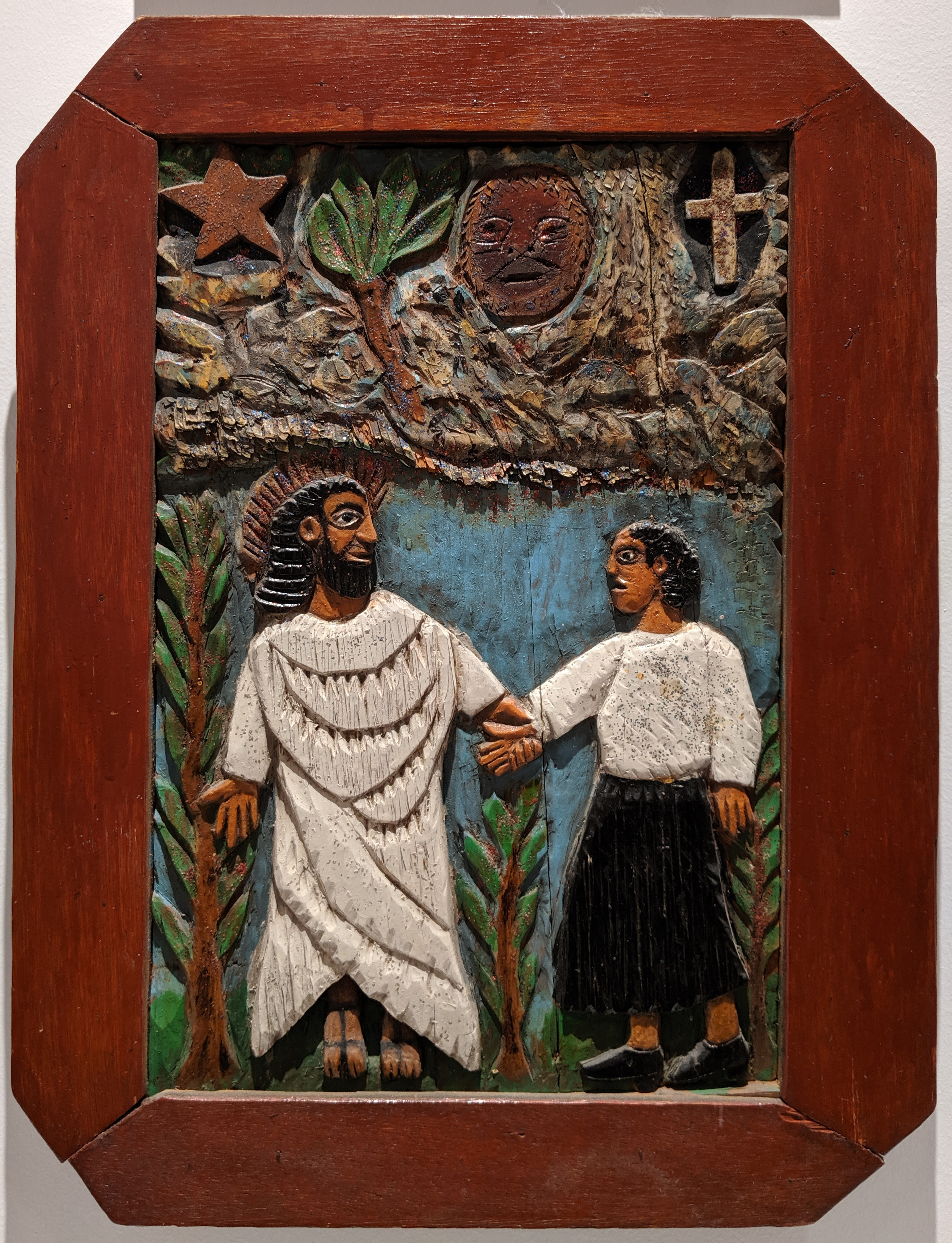
Elijah Pierce (American, 1892–1984), Christ and Lady, 1968. Wood, paint, and glitter, 21 1/2 × 16 1/2 × 1 1/4 in. High Museum of Art, Atlanta. Photo: Victoria Emily Jones.
A woman, a Samaritan, came to draw water. Jesus said, “Would you give me a drink of water?” (His disciples had gone to the village to buy food for lunch.)
The Samaritan woman, taken aback, asked, “How come you, a Jew, are asking me, a Samaritan woman, for a drink?” (Jews in those days wouldn’t be caught dead talking to Samaritans.)
Jesus answered, “If you knew the generosity of God and who I am, you would be asking me for a drink, and I would give you fresh, living water.”
The woman said, “Sir, you don’t even have a bucket to draw with, and this well is deep. So how are you going to get this ‘living water’? Are you a better man than our ancestor Jacob, who dug this well and drank from it, he and his sons and livestock, and passed it down to us?”
Jesus said, “Everyone who drinks this water will get thirsty again and again. Anyone who drinks the water I give will never thirst—not ever. The water I give will be an artesian spring within, gushing fountains of endless life.”
SONG: “Jesus Gave Me Water” by Lucie E. Campbell, 1946 | Performed by Sam Cooke and the Soul Stirrers, 1951
“One of the most regarded composers of African American religious song, Lucie E. Campbell [1885–1963] was a pioneering figure linking traditional hymnody to modern gospel composition and bridging gender and racial divides in the world of gospel music. Alongside such musical peers as Thomas A. Dorsey, Roberta Martin, and fellow Memphian Reverend W. Herbert Brewster, she helped forge the black gospel sound of the first half of the twentieth century and further belongs to a small coterie of composers who have set lasting standards for religious music in the black Baptist church.” (https://memphismusichalloffame.com/inductee/luciecampbell/)
Campbell’s song “Jesus Gave Me Water” was first recorded by Artis Kitchen in 1947. For a partial list of subsequent covers, see secondhandsongs.com. I like Sam Cooke’s version best, from 1951, when he was singing lead for the Soul Stirrers—no one can beat his honey-smooth vocals. You might know him, as I first did, as the singer of hits like “You Send Me,” “Chain Gang,” “Another Saturday Night,” “Twisting the Night Away,” “Cupid,” and “A Change Is Gonna Come.” (I have fond memories of listening to Oldies 100.7 FM in car rides with my dad growing up!) But like many famous soul singers, Cooke, a PK (preacher’s kid), got his start singing at church, at age six. His leadership of the popular black gospel group the Soul Stirrers from 1951 to 1956 propelled his career, and he crossed over into pop with great success.
A self-taught artist born in Baldwyn, Mississippi, Elijah Pierce began wood carving as a young child, using the pocketknife his father gave him. He knew he didn’t want to farm for a living like the rest of his family, so he left home as a teenager and eventually settled in Columbus, Ohio, where he ran a barbershop and led a church congregation. He described his wood carvings as sermons he used to teach people about the Bible. After encountering how Pierce used art to supplement his teaching, Leroy Almon (another celebrated folk artist, unknown at the time) apprenticed himself to Pierce.
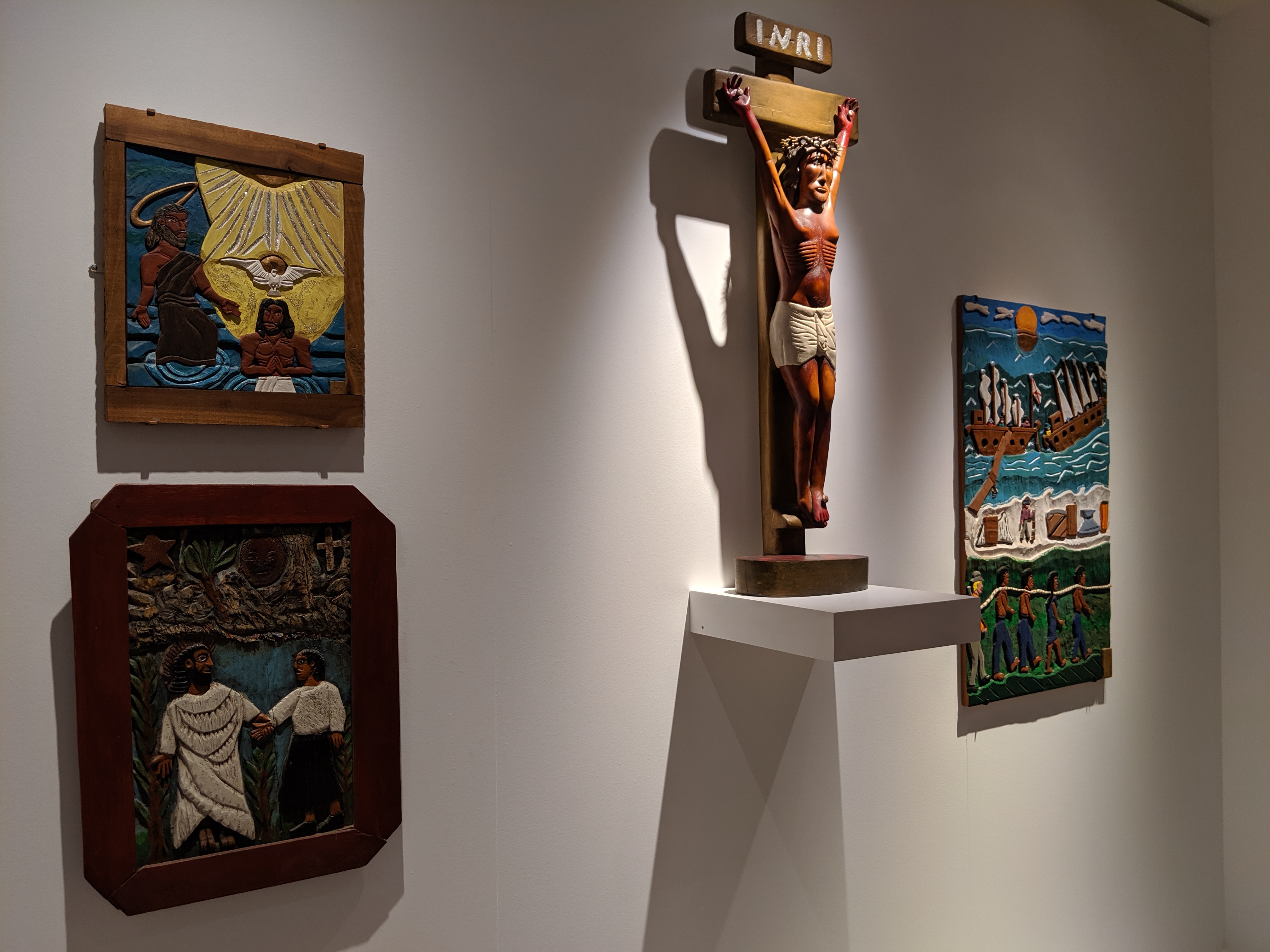
The High Museum of Art in Atlanta has a wonderful collection of folk art, including works by Pierce and his student Almon. Pictured below, from my visit last year, are: Leroy Almon, The Baptism of Jesus, 1983; Elijah Pierce, Christ and Lady, 1968; Ulysses Davis, Jesus on the Cross, 1946; and Leroy Almon, Slavery Time, 1990.
Though no well is visible in Christ and Lady and the title is generic, I see it as a depiction of the Samaritan woman from Sunday’s lectionary reading, and the description on the museum’s label also interprets it that way.
This post belongs to the weekly series Artful Devotion. If you can’t view the music player in your email or RSS reader, try opening the post in your browser.
To view all the Revised Common Lectionary scripture readings for the Third Sunday of Lent, cycle A, click here.
The Breath and the Clay Artists (speakers/workshop leaders/Q&A panel members): John Mark McMillan, Stephen Roach, Jason Upton, Cageless Birds, Joel McKerrow, Josh Riebock, Stephen Roach, Mykell Wilson, Ray Hughes, Gemma Bender, Taylor Johnson, Eastlyn and Joshua, Vesper Stamper, Turtledoves, Avril Ward Date: March 22–25, 2018 Location: Awake Church, Winston-Salem, North Carolina Cost: $100 (but see pricing details for other options; some events free to public) Description: “The Breath & the Clay is a creative arts gathering exploring the intersections of faith, art & culture. The weekend event includes times of worship, keynote speakers, performances, and a curated art gallery hosted by CIVA. Hands-on workshops [poetry, choreography, songwriting, painting, photography], a private luncheon and an after-party are available for additional purchase.” If you’re not able to attend, you should at least check out their Makers & Mystics podcast, which is in its third season.
Urban Doxology Songwriting Internship (PAID) Application deadline: April 15, 2018 Dates of internship: June 3–July 30, 2018 Location: East End Fellowship, Richmond, Virginia Description: “The Urban Doxology Songwriting Internship is an intensive eight-week leadership development program offered in partnership by Arrabon and East End Fellowship. Interns participate in a learning experience of the following subjects: (1) biblical theology and exposition (2) worship studies with a focus on multicultural worship (3) race, class and culture (4) songwriting and (5) community engagement. Interns will spend the remainder of their time writing songs, rehearsing music, and planning worship for a congregation in the urban context.”
“Telling Stories: A Conference of Faith and Art” Speakers: Natalie Diaz, Barbara Brown Taylor, Esra Akin-Kivanç, Arthur Skinner, Alex Harris, Herbert Murphy, Peter Meinke Date: April 19–22, 2018 Organizers: Eckerd College, Palma Ceia Presbyterian Church, NEXT Church, Image journal Location: Eckerd College, Saint Petersburg, Florida Cost: Free Description: “With the theme of ‘Telling Stories’ as guide, this conference will employ discussions, poetry readings, presentations, visual arts, and theater to examine art’s power to confront current narratives, allow people to tell their own stories, and explore new ways of talking about God, faith, and social responsibility. . . . Designed for anyone interested in the imaginative and prophetic intersection of faith and arts.”
Call for Creation-Care Worship Materials Submission deadline: April 30, 2018 Sponsor: Christian Reformed Church Description: The Climate Witness Project and other CRC ministries are partnering to crowdsource creative worship resources that “celebrate and honor God’s creation while addressing creation-care challenges, such as climate change, facing the world.” Songs, prayers, images, videos, sermon notes, litanies, and other elements are all invited for submission and will be collated and published online in fall 2018. By submitting your work, you agree to the terms of a CC BY-NC license.
Call for Papers on US Immigration and the Arts Submission deadline: May 1, 2018 (abstract) Organization:Society for the Arts in Religious and Theological Studies Description: SARTS “seeks presentations by scholars, teachers, pastors, or artists that explore creative/artistic engagements with and/or responses to the reality of immigration in the United States. Topics include but are not limited to the perspectives of the various groups of people on the move, crossing and policing borders, religious landscapes of immigration, immigration and the imagination, place making, political advocacy, and activism. All forms of artistic expression are welcome.”
Hymn Society Songwriting Contest Submission deadline: May 15, 2018 Sponsor: The Hymn Society Prize: $500 Description: As part of the Hymn Society’s ongoing commitment to the enrichment of congregational song, the executive committee has announced a search for a new short-form song suitable for congregational singing. (Both text and tune must be original.) In addition to receiving prize money, the winning entry will premiere July 15–19, 2018, at the society’s conference in St. Louis, Missouri, and be published in the Autumn 2018 issue of The Hymn.
“Afterlives of Biblical Women in Art, Literature, and Culture”(summer course) Instructor: Amanda Russell-Jones Date: July 2–13, 2018 Institution: Regent College, Vancouver Cost: Starting at Can$700 Description: The arts have profoundly shaped our interpretation of biblical characters, whether we realize it or not. In this graduate-level course, one of the learning objectives is to be able to “discuss the significance of a variety of biblical women, differentiating between the content of the biblical text and the ways later additions and interpretations changed how the woman was viewed.” How has the mirror held up to women like Eve, Bathsheba, Mary Magdalene, the woman at the well, etc., made the biblical texts clearer, and how has it distorted them? You do not have to be a currently enrolled college student to register.
Glen Workshop Faculty: Chigozie Obioma, Scott Cairns, Lauren Winner, Marianne Lettieri, Gina Franco, Lee Isaac Chung, Over the Rhine, Ned Bustard, Malcolm Guite Date: July 29–August 5, 2018 Location: St. John’s College, Santa Fe, New Mexico Organizer: Image Cost: Starting at $1,150 (scholarships available) Description: “Situated in the foothills of the Sangre de Cristo Mountains, the Glen Workshop is equal parts creative workshop, arts festival, and spiritual retreat. The Glen’s arresting natural environment is contrasted by its casual and inviting crowd of artists, writers, musicians, art appreciators, and spiritual wayfarers of all stripes.” Workshops are offered on spiritual writing, songwriting, fiction writing, poetry writing, poetry reading, mixed-media art, relief printing, and filmmaking. The faculty lineup is phenomenal! And I appreciate the all-inclusive package option.







 Art & Theology