Advent Prelude: Out of Darkness

LOOK: Serenade: A Christmas Fantasy by Joseph Stella
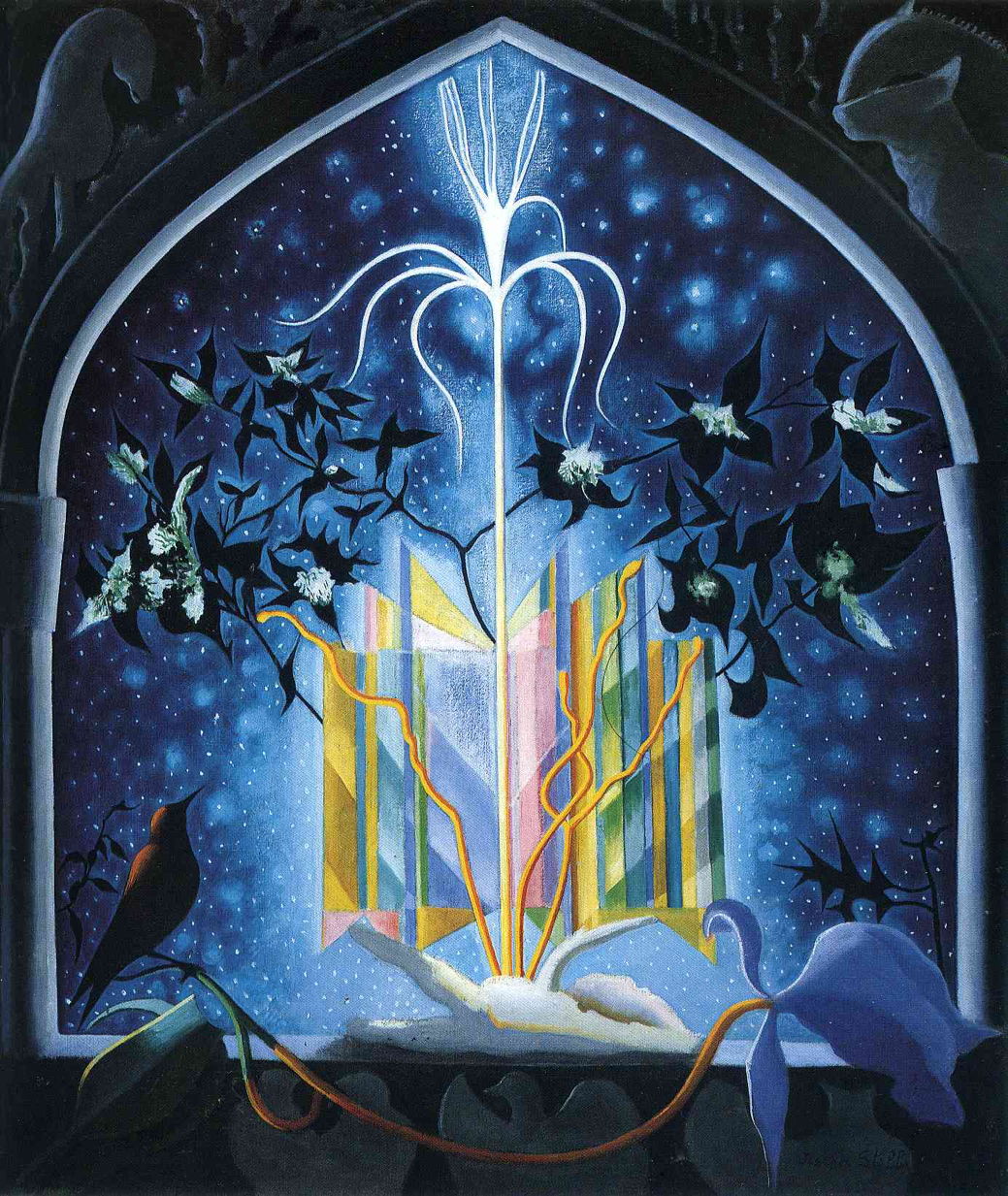
Stella, Joseph_Serenade: A Christmas Fantasy
Joseph Stella (Italian American, 1877–1946), Serenade: A Christmas Fantasy (La Fontaine), 1937. Oil on canvas, 43 1/8 × 37 1/8 in. (109.5 × 94.3 cm). Hirshhorn Museum and Sculpture Garden, Washington, DC.

Joseph Stella (1877–1946) [previously] was an Italian American painter who became an important figure in modern art. His Serenade: A Christmas Fantasy is not overtly religious, but it does incorporate a few elements traditionally associated with Christmastime—a starry night sky, a holly branch, an ox and ass, a dove—and has a mystical quality. In the center, a flower emerges from what appears to be a conch shell, its pistil and stamen glowing. The flower’s stem shoots up past an abstract, mobile-like object that could be shards of colorful glass or pieces of cut paper. It’s a visionary composition that is open to multiple readings.

Art historian Judith Zilczer comments on the painting in the exhibition catalog Joseph Stella: The Hirshhorn Museum and Sculpture Garden Collection (Smithsonian Institution, 1983):

Serenade: A Christmas Fantasy typifies Stella’s mature symbolist style. Framed by an arch, a fantastic tree form bisects the composition and serves as the central image of the painting. The colors of the iridescent prism surrounding the central axis recall the abstract geometric style of Stella’s Futurist canvases.

The meaning of Stella’s complex imagery remains elusive. The ox and ass in the upper right spandrel traditionally appear together in paintings of the Nativity. The image of the dove in the center of the lower border is the symbol of the Holy Ghost. These Christian symbols are consistent with the painting’s subtitle, A Christmas Fantasy. The painting is also known as The Fountain (La Fontaine). The treelike form in the center may represent an abstraction of a jet of water. The image of the fountain often served as an attribute of the Virgin Mary, who was regarded as the “fountain of living waters.” It is possible that in this canvas Stella has fused the image of the tree of life with the fountain as the symbol of the Virgin. The nightingale perched on the tendril [of the purple iris] in the lower left is the source of the serenade. (54)

I see in Serenade the promise of Advent—light emerging out of darkness, wondrous new life growing out of dormancy. There’s a coming fullness here, a blossoming. The chromatic spectrum refracted by the center object evokes a rainbow, the sign of God’s covenant with all living creatures in Genesis 9.

LISTEN: “Wonder” by MaMuse (Sarah Nutting and Karisha Longaker), on Prayers for Freedom (2018)

Oooh, I wonder
Oooh, I wonder
Oooh, I wonder
What is to come out of this darkness

I’ve been moving, moving, moving, moving through the darkness
Moving, moving, moving, moving through the darkness
I wonder when the light is cracking open

Oooh, I wonder
Oooh, I am filled with wonder
Oooh, I wonder
What is to come out of this darkness

I thought this candle had long gone out
I thought that it had long gone out
But today, today, today, today I can see
There’s still a flickering, flickering

Oooh, I wonder
Oooh, I wonder
Oooh, I wonder
What is to come out of this darkness

Burn, burn, burn, burning on the inside
Burn, burn, burn, burning like a bright light
Burn, burn, burn, burning on the inside
This light’s still burning, burning bright

I thought this candle had long gone out
I thought that it was long gone out
I thought that this candle had long gone out
But today, today, today, today I can see
There’s more than a flickering

Oooh, I wonder
Oooh, I am filled with wonder
Oooh, I wonder
What is to come out of this darkness

This song was written by MaMuse [previously], an acoustic folk duo who I’d say are “spiritual but not religious,” several years ago on the winter solstice. Watch a live video recording from January 2019 at the Chico Women’s Club in Chico, California, the two’s hometown.

Advent is sometimes mischaracterized as glum, but actually, joyfulness is a key aspect of the season. There’s a somberness, for sure, but it’s married with excitement for what’s coming.

I hope to capture this dual tone of Advent in my selection of art and music over the next twenty-four days. This is the first post in a daily series that will run to the end of Advent on December 24, and then for the duration of Christmas, from December 25 to January 6. Many of the songs in the series can be listened to on the Art & Theology Advent Playlist, Christmastide Playlist, and Epiphany Playlist on Spotify.

In the liturgical calendar, Advent-Christmas-Epiphany is known as the cycle of light. Many churches and families light candles around an Advent wreath, progressively more until Christmas, symbolizing the Light of the World getting nearer, dispelling more of the darkness.

May you be blessed this Advent season as you wonder and explore what is to come out of December’s darkness. May you discern with delight those places where “the light is cracking open,” where God is shining through.

“Thanksgivings for the Body” by Thomas Traherne (excerpt)

Owunna, Mikael_Lébé and His Articulations
Mikael Owunna (Nigerian American, 1990–), Lébé and His Articulations, from the Infinite Essence series, 2019. Dye sublimation print, 60 × 40 in. (152.4 × 101.6 cm). Edition of 3 + 1AP. [for sale]

                                O Lord!
        Thou hast given me a body,
Wherein the glory of thy power shineth,
Wonderfully composed above the beasts,
Within distinguished into useful parts,
Beautified without with many ornaments.
        Limbs rarely poised,
                And made for heaven:
        Arteries filled
                With celestial spirits:
        Veins, wherein blood floweth,
                Refreshing all my flesh,
                                Like rivers.
        Sinews fraught with the mystery
            Of wonderful strength,
                Stability,
                Feeling.
        O blessed be thy glorious Name!
That thou hast made it
            A treasury of wonders,
                Fit for its several ages;
                    For dissections,
                    For sculptures in brass,
                    For draughts in anatomy,
        For the contemplation of the sages.
                Whole inward parts,
                        Enshrined in thy libraries,
        Are:
                The amazement of the learned,
                The admiration of kings and queens,
                The joy of angels,
                The organs of my soul,
                The wonder of cherubims.
        Those blinder parts of refined earth,
                        Beneath my skin,
            Are full of thy depths,
            For:
                        Many thousand uses,
                        Hidden operations,
                        Unsearchable offices.
        But for the diviner treasures wherewith thou hast endowed
            My brains,
            My heart,
            My tongue,
            Mine eyes,
            Mine ears,
            My hands,
O what praises are due unto thee,
        Who has made me
                    A living inhabitant
                            Of the great world,
                    And the centre of it!
        A sphere of sense,
                            And a mine of riches,
Which when bodies are dissected fly away.
        The spacious room
                    Which thou has hidden in mine eye;
        The chambers for sounds
                    Which thou has prepar’d in mine ear;
        The receptacles for smells
                    Concealed in my nose;
        The feeling of my hands;
                    The taste of my tongue.
        But above all, O Lord, the glory of speech,
whereby thy servant is enabled with praise to
celebrate thee.
                                    For
        All the beauties in heaven and earth,
        The melody of sounds,
        The sweet odours
                            Of thy dwelling-place.
        The delectable pleasures that gratify my sense,
                            That gratify the feeling of mankind.
        The light of history,
                            Admitted by the ear.
        The light of heaven,
                            Brought in by the eye.
        The volubility and liberty
                            Of my hands and members.
        Fitted by thee for all operations,
                            Which the fancy can imagine,
                            Or soul desire:
        From the framing of a needle’s eye,
                            To the building of a tower;
        From the squaring of trees,
                            To the polishing of kings’ crowns.
        For all the mysteries, engines, instruments, wherewith the world is filled, which we are able to frame and use to thy glory.
        For all the trades, variety of operations, cities, temples, streets, bridges, mariner’s compass, admirable pictures, sculpture, writing, printing, songs and music, wherewith the world is beautified and adorned.
        Much more for the regent Life,
            And power of perception,
                Which rules within.
        That secret depth of fathomless consideration
            That receives the information
                Of all our senses,
That makes our centre equal to the heavens,
    And comprehendeth in itself the magnitude of the world;
        The involved mysteries
                            Of our common sense;
        The inaccessible secret
                            Of perceptive fancy;
        The repository and treasury
                            Of things that are past;
        The presentation of things to come;
            Thy Name be glorified
                For evermore.
    For all the art which thou hast hidden
            In this little piece
                Of red clay,
    For the workmanship of thy hand,
        Who didst thyself form man
            Of the dust of the ground,
        And breathe into his nostrils
            The breath of life.
    For the high exaltation whereby thou hast glorified every body,
                Especially mine,
        As thou didst thy servant
                Adam’s in Eden.
    Thy works themselves speaking to me the same thing that was said unto him in the beginning,
                WE ARE ALL THINE.

This poem excerpt is from A Serious and Pathetical Contemplation of the Mercies of God, in Several Most Devout and Sublime Thanksgivings for the Same by Thomas Traherne, published posthumously in 1699. It is in the public domain.

Thomas Traherne (1636/37–1674) was a country priest from England whose devotional writings, both prose and verse, are remarkable for their spiritual intensity. He wrote rapturously about the goodness, love, and mercy of God and the glories of God’s creation. He is sometimes classed as a Metaphysical poet, though his poems read more like Walt Whitman, with their long catalogs and ebullient joy. Traherne is most celebrated for his Centuries of Meditations, a collection of theological reflections that wasn’t published until 1908.

“Miracles” by Walt Whitman

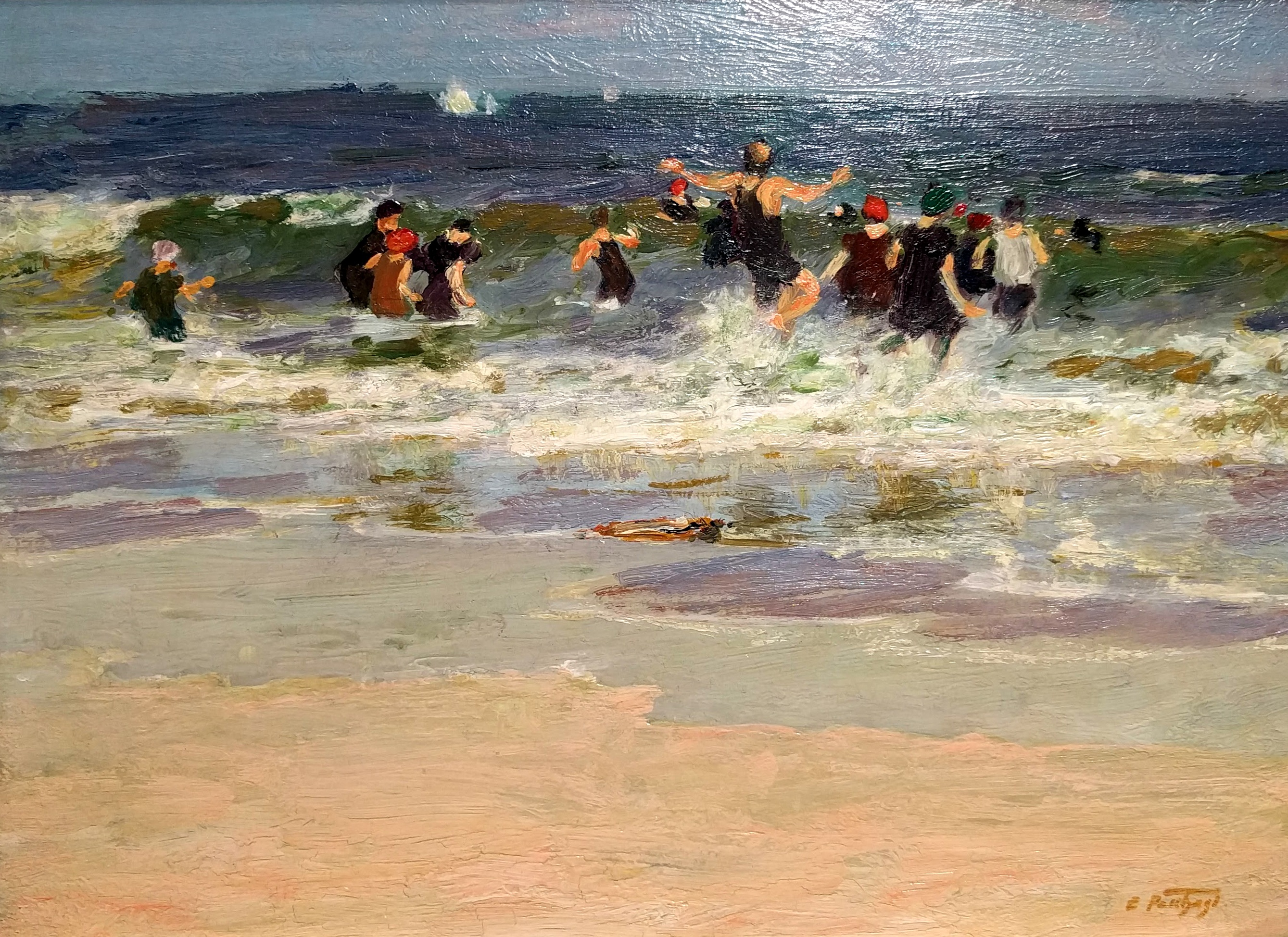
Potthast, Edward_Beach Scene, Coney Island
Edward Henry Potthast (American, 1857–1927), Beach Scene, Coney Island, 1915–18. Oil on wood panel, 11 7/8 × 16 in. (30.2 × 40.6 cm). Brandywine River Museum of Art, Chadds Ford, Pennsylvania. Photo: Victoria Emily Jones. [object record]

Why! who makes much of a miracle?
As to me, I know of nothing else but miracles,
Whether I walk the streets of Manhattan,
Or dart my sight over the roofs of houses toward the sky,
Or wade with naked feet along the beach, just in the edge of the water,
Or stand under trees in the woods,
Or talk by day with any one I love—or sleep in the bed at night with any one I love,
Or sit at table at dinner with my mother,
Or look at strangers opposite me riding in the car,
Or watch honey-bees busy around the hive, of a summer forenoon,
Or animals feeding in the fields,
Or birds—or the wonderfulness of insects in the air,
Or the wonderfulness of the sun-down—or of stars shining so quiet and bright,
Or the exquisite, delicate, thin curve of the new moon in spring;
Or whether I go among those I like best, and that like me best—mechanics, boatmen, farmers,
Or among the savans—or to the soirée—or to the opera,
Or stand a long while looking at the movements of machinery,
Or behold children at their sports,
Or the admirable sight of the perfect old man, or the perfect old woman,
Or the sick in hospitals, or the dead carried to burial,
Or my own eyes and figure in the glass;
These, with the rest, one and all, are to me miracles,
The whole referring—yet each distinct, and in its place.
  
To me, every hour of the light and dark is a miracle,
Every cubic inch of space is a miracle,
Every square yard of the surface of the earth is spread with the same,
Every foot of the interior swarms with the same;
Every spear of grass—the frames, limbs, organs, of men and women, and all that concerns them,
All these to me are unspeakably perfect miracles.
  
To me the sea is a continual miracle;
The fishes that swim—the rocks—the motion of the waves—the ships, with men in them,	 
What stranger miracles are there?

“Miracles” by Walt Whitman was originally published in the second edition of Leaves of Grass (Fowler & Wells, 1856). It is in the public domain.

“Morning Reflections” by Enuma Okoro

Smith, Stan_Kites Over Twickenham
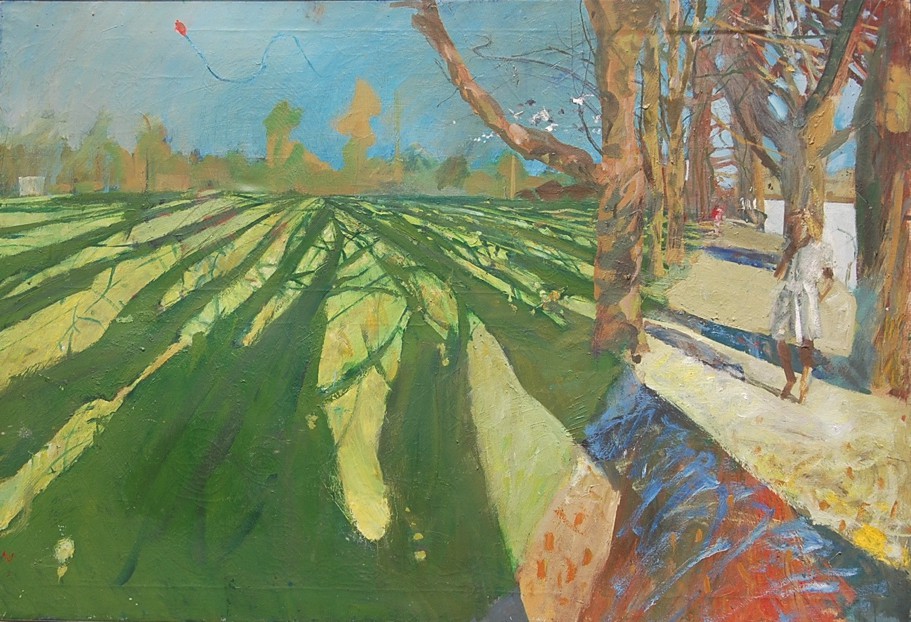
Stan Smith (British, 1929–2001), Kites Over Twickenham, ca. 1985. Oil on canvas, 82 × 121 cm.

What is this unfolding, this slow-
going unraveling of gift held
in hands open
to the wonder and enchantment of it all?

What is this growing, this rare
showing, like blossoming
of purple spotted forests
by roadside grown weary with winter months?

Seasons affected, routinely disordered
by playful disturbance of divine glee
weaving through limbs with sharpened shards of mirrored light,
cutting dark spaces, interlacing creation,
commanding life with whimsical delight.

What is this breaking, this hopeful
re-making, shifting stones, addressing dry bones,
dizzying me with blessings,
intercepting my grieving
and raising the dead all around me?

This poem by Enuma Okoro first appeared in At the Still Point: A Literary Guide to Prayer in Ordinary Time, compiled by Sarah Arthur. It is reproduced here by permission of the poet.

Enuma Okoro is a writer and speaker on story, soul care, culture, and the arts. Born in the United States and raised in Nigeria, Côte d’Ivoire, and England, she holds a master of divinity degree from Duke Divinity School and is a certified spiritual director in the Ignatian tradition. In addition to being published in the New York Times, Artsy, Harper’s Bazaar, Vogue, and the Atlantic, she writes a weekly column, “The Art of Life,” for the Financial Times Weekend. She is the author of Reluctant Pilgrim: A Moody, Somewhat Self-Indulgent Introvert’s Search for Spiritual Community and Silence and Other Surprising Invitations of Advent and a co-editor of Common Prayer: A Liturgy for Ordinary Radicals and Talking Taboo: American Christian Women Get Frank About Faith. Follow her on Twitter @EnumaOkoro and Instagram @enums.

“Silent Wonders” by Sándor Reményik

Gilmour, Gina_A Door in the Woods

Do not wait for the earth to shatter,
Sodom’s consumption by fire.
Tiny wonders from day to day are
Greater, deeper to admire.

Come, place your hand upon your heart and
Hear well, observe what it conveys.
Is this fine beating not by far the
Greatest, most wonderous music phrase?

Come, look into that deep blue Endless,
Look at those tiny silver things:
Not wonderous that your orphaned soul is
Rising towards them, spreading wings?

Look how your shadow runs before you,
How it expands and shrinks with you.
Not a wonder? Or that the waters
Reflect the heavens for your view?

Do not expect big things in life, for
Joys are snowflakes, they drift and stray.
Silent, sifting petals of wonder.
In them’s God’s voice: I’m coming.

Translated from the Hungarian by Leslie A. Kery. Reproduced by permission of Mr. Kery.

Image credit: Gina Gilmour (American, 1948–), A Door in the Woods, 1994. Oil on canvas, 79 × 88 3/4 in. (200.7 × 225.4 cm). Bechtler Museum of Modern Art, Charlotte, North Carolina. Photo: Victoria Emily Jones.