Three Advent video series

“Art for Advent 2017” (Dr. James Romaine): For the third year in a row, my friend James Romaine, an art historian, is releasing four videos in which he discusses historically significant artworks keyed to the season of Advent. Last year he looked at works from the Met Cloisters; this year he’s focusing on paintings by the African American artist Henry Ossawa Tanner (1859–1937). If you want to learn more about Tanner, see Romaine’s essay on him in the recently published book Beholding Christ and Christianity in African American Art, which Romaine coedited; I own a copy and look forward to reviewing it on the blog in the new year! (Update: Here’s the book review.)
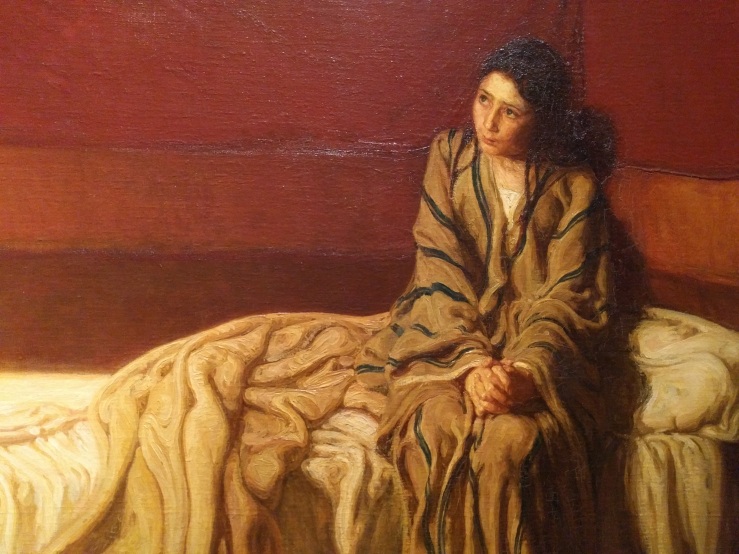
Annunciation (detail) by Henry Ossawa Tanner
Henry Ossawa Tanner (American, 1859–1937), The Annunciation (detail), 1898. Oil on canvas, 57 × 71 1/4 in. (144.8 × 181 cm). Philadelphia Museum of Art. Photo: Victoria Emily Jones.

Romaine’s first “Art for Advent 2017” video covers Tanner’s Annunciation, which has been the header image of this website for the last two months. I saw the painting in person for the first time this summer at the Philadelphia Museum of Art, and it transfixed me. (Along with Rogier van der Weyden’s Crucifixion, it was my favorite piece on display.) It was the first major painting of a biblical subject that Tanner completed following his six-week trip to the Holy Land, undertaken as part of his search for historically authentic imagery.

First Sunday of Advent: The Annunciation:

Second Sunday of Advent: The Holy Family:

Third Sunday of Advent: Flight into Egypt:

Fourth Sunday of Advent: Christ and His Mother Studying the Scriptures:

To view “Art for Advent” videos from previous years, visit Romaine’s Seeing Art History YouTube channel.

+++

“The Joyous Mysteries” (The Liturgists): Meditating on the five “Joyous Mysteries” of Christ’s childhood—the Annunciation, the Visitation, the Nativity, the Presentation in the Temple, and the Finding of Christ in the Temple—is a Catholic devotional practice, part of “praying the rosary,” that some Protestants have found spiritually helpful and have adapted to their own quiet times with God.

To draw us into the movements of the Christmas story, The Liturgists invited four visual artists to create a work based on one of the first four Joyous Mysteries. They then shot two videos for each artwork—one an “Artist Narrative,” where the artist talks about his or her work and process, and the other an “imago divina” meditation led by Mike McHargue (“Science Mike”), which guides us through looking at and responding to the artwork. The videos are backed by original instrumental compositions by Tim Coons of Giants & Pilgrims and one by Jon Leverkuhn, which you can download for free on Bandcamp. You can also purchase signed, limited edition art prints for $35 each, or $95 for a full set.

Here is the list of videos; I’ve embedded my two favorites (I’m partial to figurative art):

1. The Annunciation, with art by Betony Coons: Meditation | Artist Narrative

2. The Visitation, with art by Wes Sam-Bruce: Meditation | Artist Narrative

3. The Nativity, with art by Katie Mai-Fusco: Meditation | Artist Narrative

4. The Presentation, with art by Tony Garza: Meditation | Artist Narrative

Thank you, Liturgists and friends, for this impressive Advent offering!   Continue reading “Three Advent video series”
Roundup: Cracked lanterns; Incarnation songs; Christmas gallery talks; pregnancy poem

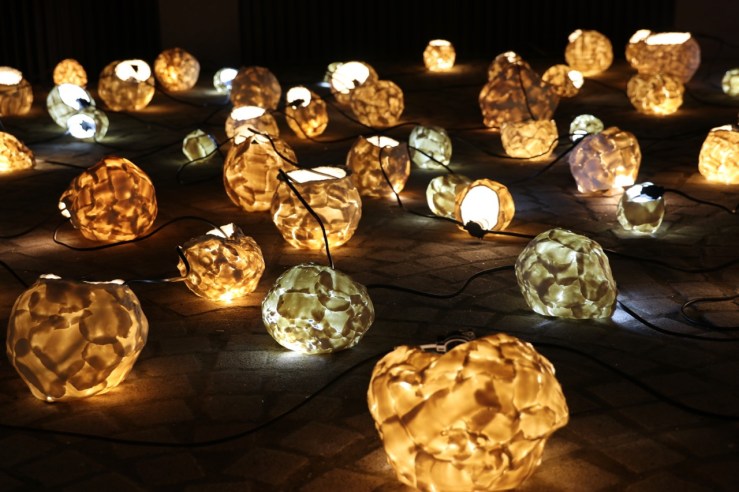
COMMUNITY ART PROJECT + INSTALLATION: Light the Well by Anna Sikorska: Last month artist Anna Sikorska led the congregation of St. Martin-in-the-Fields in creating a constellation of cracked, translucent porcelain globes, lit from within like lanterns and linked together—a visualization of Paul’s words in 2 Corinthians 4:6–12, about our hearts being clay jars whose fragility and brokenness enable the light of Christ to shine through all the more. Light the Well was installed at St. Martin’s on November 11, and since November 19 the individual lanterns have been selling for £10 a piece to benefit New Art Studio and Art Refuge UK, charities working with art therapy in the context of migration and displacement. Associate vicar Jonathan Evens delivered a beautiful reflection on this artwork and the scripture that inspired it, as well as a prayer and benediction, which you can read in full here.

Light the Well installation

I love it when churches use art not merely to decorate or prettify the building but to further the congregation’s engagement with scripture and to foster shared doing and seeing.

+++

SONGS:

“City of David” by the Gray Havens: The Gray Havens, a “narrative pop folk duo” from Nashville made up of married couple David and Licia Radford, released a new Christmas single on November 17—recorded on an iPhone! Listen to the song and watch some of their “making of” process in the video below. God the Father often gets overlooked during this season, so I like that the refrain reminds us that “the Father sent him [the Son] down.” [Purchase here]

“Human for Me” by Katy Kinard: Released last year on the album God of Fireflies, this song praises God for assuming full humanity—for not circumventing any frustrating or painful aspect of it. [Purchase here]

+++

GALLERY TALKS:

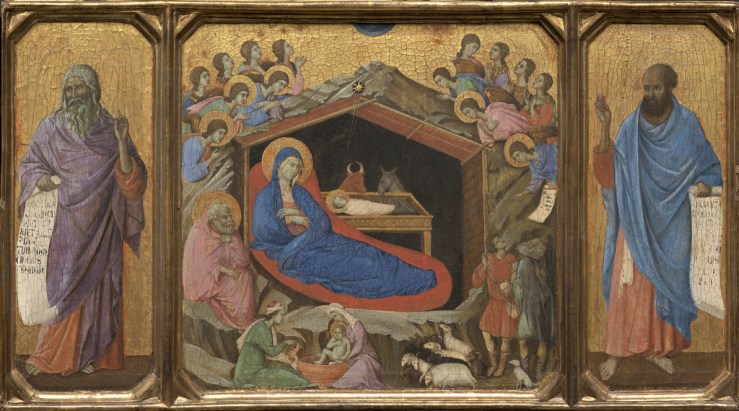
“The Christmas Story in Art” at the National Gallery, Washington, DC: Gallery lecturer David Gariff will lead a 75-minute discussion about paintings in the collection that depict the birth of Jesus, including one of my favorites, Duccio’s Nativity with the Prophets Isaiah and Ezekiel. (Click on the link to see a full list of works.) The event is free and geared to an adult audience. To participate, meet in the West Building Rotunda at 1 p.m. on December 9 or 10, or 2 p.m. on December 14, 18, 20, 21, or 22.

Nativity with Isaiah and Ezekiel by Duccio
Duccio (Italian, ca. 1255–60–ca. 1318/19), The Nativity with the Prophets Isaiah and Ezekiel, 1308/1311. Tempera on single poplar panel, 48 × 86.8 × 7.9 cm (18 7/8 × 34 3/16 × 3 1/8 in.). National Gallery of Art, Washington, DC.

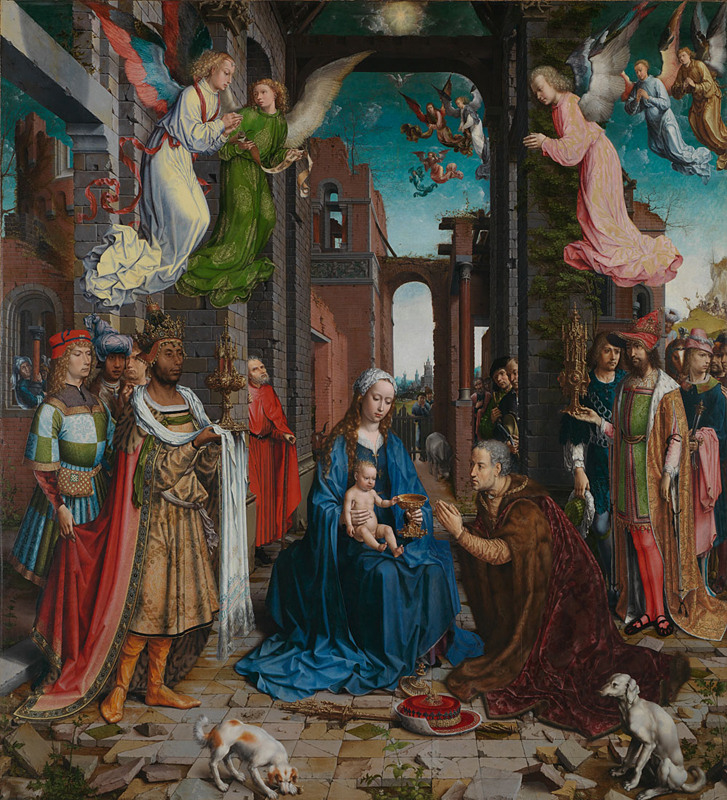
“Adoration of the Kings” Facebook Live tour at the National Gallery, London: Friday, December 15 at 9 a.m. GMT, director Gabriele Finaldi will be exploring Jan Gossaert and Pieter Bruegel the Elder’s paintings of the Adoration of the Magi. This “tour,” offered exclusively online, will be broadcast live on the Gallery’s Facebook page, and a replay version will be available on the channel afterward.

Adoration of the Kings by Jan Gossaert
Jan Gossaert (Flemish, d. 1532), The Adoration of the Kings, 1510–15. Oil on oak, 179.8 × 163.2 cm. National Gallery, London.
Adoration of the Kings by Pieter Bruegel
Pieter Bruegel the Elder (Flemish, d. 1569), The Adoration of the Kings, 1564. Oil on oak, 112.1 × 83.9 cm. National Gallery, London.

+++

POEM: “Scale” by Chelsea Wagenaar: Chelsea and I went to the same small North Carolina church as kids, back when she was a Henderson and I a Hartz, so we share a heritage of learning Bible lessons from Butch the Dragon and competing annually in the Bean Bag Relay at the AWANA Olympics. Now she is an award-winning poet, a Lilly Fellow, a lecturer in Valparaiso University’s English department, and a mom!

Inspired by her pregnancy, the poem “Scale” is full of metaphors that revel in the wonders of prenatal life—the womb is a “winterplum sky,” the cluster of baby cells “untufted cotton,” the belly a “Lenten moon.” The central theme, which Chelsea cleverly plays around, is Psalm 139:16, a praise verse by King David: “Your eyes saw my unformed substance; in your book were written, every one of them, the days that were formed for me, when as yet there was none of them.”

Chelsea’s poem is especially appropriate for Advent, a season of pregnancy in which we position ourselves retrospectively with Mary, letting our hearts expand as we wait expectantly for that marvelous deliverance, the coming of the Christ child.

Prepare the Way (Artful Devotion)

Serima Mission Church door (detail)
Teak wood relief door panel carved by Cornelio Manguma, 1958, showing John the Baptist preaching repentance (upper register) and baptizing Christ (lower register). St. Mary’s Church, Serima Mission, Zimbabwe. [full door]

A voice cries:

“In the wilderness prepare the way of the LORD;
make straight in the desert a highway for our God.
Every valley shall be lifted up,
and every mountain and hill be made low;
the uneven ground shall become level,
and the rough places a plain.
And the glory of the Lord shall be revealed,
and all flesh shall see it together,
for the mouth of the Lord has spoken.”

—Isaiah 40:3–5

The beginning of the gospel of Jesus Christ, the Son of God.

As it is written in Isaiah the prophet,

“Behold, I send my messenger before your face,
who will prepare your way,
the voice of one crying in the wilderness:
‘Prepare the way of the Lord,
make his paths straight,’”

John appeared, baptizing in the wilderness and proclaiming a baptism of repentance for the forgiveness of sins. And all the country of Judea and all Jerusalem were going out to him and were being baptized by him in the river Jordan, confessing their sins. Now John was clothed with camel’s hair and wore a leather belt around his waist and ate locusts and wild honey. And he preached, saying, “After me comes he who is mightier than I, the strap of whose sandals I am not worthy to stoop down and untie. I have baptized you with water, but he will baptize you with the Holy Spirit.”

—Mark 1:1–8

+++

SONG: “Prepare the Way, O Zion” | Text by Frans Mikael Franzen, 1812; trans. Augustus Nelson, 1958; adapt. Charles P. Price, 1980 | Music: Then Swenska Psalmboken, 1697 | Arranged and performed by Chicago Metro Presbytery Music, on Proclaim the Bridegroom Near, 2011

+++

In A Tourist in Africa (1960), the British writer Evelyn Waugh describes St. Mary’s Church in Serima, Zimbabwe, as the “African Chartres.” Designed by the Swiss Catholic missionary Fr. John Groeber, it was built in 1956–66 and filled with hundreds of carvings, murals, and ecclesiastical artworks by the Shona people. To see more photos of the church and to learn more about it, visit ZimFieldGuide.com or, if you can get your hands on a copy, check out the bilingual (English-German) book Serima: Towards an African Expression of Christian Belief (Gwelo, Rhodesia: Mambo Press, 1974), edited by Albert B. Plangger and Marcel Diethelm.

Another great resource for learning about the Serima Mission, and African Christian art in general, is Christliche Kunst in Afrika by Josef Franz Thiel and Heinz Helf (Berlin: Dietrich Reimer Verlag, 1984), whence I scanned the above photo. The text is all German, but there are hundreds of magnificent art images from all over the African continent that make this volume one of my favorites from my personal library.


This post belongs to the weekly series Artful Devotion. If you can’t view the music player in your e-mail or RSS reader, try opening the post in your browser.

To view all the Revised Common Lectionary scripture readings for the Second Sunday of Advent, cycle B, click here.

Advent 2017 online arts devotional by Biola University

The Advent Project published yearly by Biola University’s Center for Christianity, Culture, and the Arts (CCCA) is an online devotional that brings together daily scripture readings, visual art, music, poetry, and written reflections for the seasons of Advent and Christmas (which this year is December 3–January 6). Introduced in 2013, it is the only recurrently published art-forward Advent/Christmas devotional I know of, and I recommend it highly. It is in large part what inspired my year-round “Artful Devotion” series and the Advent art booklet I published digitally last year.

Click here to view and/or subscribe to Biola’s Advent Project 2017.

With so many different elements, design matters a lot, and I’m super-impressed by what Biola has come up with. The homepage is laid out as a gridded calendar with thumbnail images; click on a date, and you’re brought to a new viewing mode in which a large image and a music player are set in a fixed position on the left while the right sidebar contains scrollable text, separated into two tabs—the main content, and biographical information about the artists. This design enables the image to remain before your eyes so that you can continue to reference it as you read on (something that, frustratingly, I cannot achieve with Art & Theology’s long-scrolling format), and it also relegates the bios to “back matter.” It’s all very organized and easily navigable.

This initiative is an outworking of the CCCA’s mission to explore the rich interrelationships between contemporary art making, theology, and religious tradition. Be sure to check out the other sections of their website; they offer plenty of free resources, including an archive of past Advent (and Lent!) devotionals, and a calendar of events, such as lectures, workshops, symposia, art exhibitions, concerts, film screenings, and more.

Below is one of my favorite Advent Project entries from last year, reproduced by kind permission of the CCCA. Centered on Mary’s Magnificat, it brings together the work of an Italian Renaissance painter, a contemporary British video artist (who I’ve written about before), a modern Bohemian Austrian poet, and a minimalist composer working with Spanish, Latin, and English texts. Adjunct professor of philosophy Evan Rosa (who is a superb writer!) reflects on how scandalous Mary’s humility is for power-hungry Western Christians—just as it would have been for the Greco-Roman world in which she lived. He concludes with a prayer that invites us to move from self-magnification to the magnification of God.

Due to this blog’s design limitations, I had to adapt the following content from its original format. To view the devotion on the Biola website, click here. I have excluded biographical information for the song performers and poet.

+++

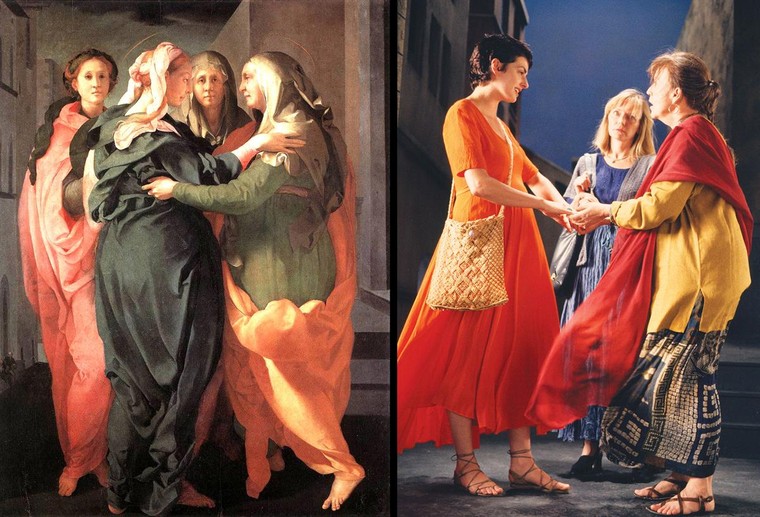
ARTWORKS: The Visitation by Pontormo; The Greeting by Bill Viola

The Greeting by Bill Viola
Left: Jacopo da Pontormo, The Visitation, 1528, oil on canvas, Church of San Francesco de Michele, Carmignano, Italy. Right: Bill Viola, The Greeting, 1995, still image from a large-screen video installation.

About the Artist and Artwork #1:

Jacopo Carucci (1494–1557), usually known as Pontormo, was an Italian Mannerist painter and portraitist from the Florentine School. His work represents a profound stylistic shift from the calm perspectival regularity that characterized the art of the Florentine Renaissance. He is famous for his use of twining poses, coupled with ambiguous perspective; his figures often seem to float in an uncertain environment, unhampered by the forces of gravity. Pontormo’s painting The Visitation, completed in 1528, now adorns the altar of a side chapel in a small church called the Pieve di San Michele in Carmignano, a town west of Florence, Italy. The setting for this painting is the visitation of the Virgin Mary on her older pregnant cousin Elizabeth, the wife of Zacharias. Elizabeth and Mary, who are painted in profile, gracefully embrace each other as they exchange glances of mutual affection and share in the news of Mary’s pregnancy. They dominate the canvas as they stand on the threshold of Zacharias’s house.

About the Artist and Artwork #2:

Bill Viola (b. 1951) is internationally recognized as one of today’s leading artists. He has been instrumental in the establishment of video as a vital form of contemporary art, and in so doing has helped to greatly expand its scope in terms of technology, content, and historical reach. His works focus on universal human experiences—birth, death, the unfolding of consciousness—and have roots in both Eastern and Western art as well as spiritual traditions.

Bill Viola’s large-screen video installation The Greeting was inspired by The Visitation, painted by Italian Mannerist artist Jacopo Pontormo. Viola’s video sequence echoes the drama of Pontormo’s Visitation, but transforms the moment into an enigmatic contemporary narrative. In this still frame, three women are dressed in long, flowing garments and stand in an Italianate architectural setting similar to that in Pontormo’s painting. The woman in the orange dress, her stomach visibly swollen, has just entered the scene from the left, interrupting a conversation and perhaps whispering to the older woman the news of her pregnancy. This encounter was filmed in less than a minute, but Viola has slowed the video down to ten minutes. The use of extreme slow motion draws attention to the nuances of the women’s gestures and glances, and intensifies the psychological dynamic of the exchange.  

Continue reading “Advent 2017 online arts devotional by Biola University”