
Most of us grew up celebrating Easter Sunday like it was the finish line, the big, joyful mic drop: “He is risen!” But the church, historically, has never treated Easter as a single day. It’s a whole season—Eastertide, stretching fifty days from resurrection to Pentecost. Fifty days of practicing resurrection. Of sitting in the reality that new life doesn’t just burst forth . . . it unfolds.
And yet, many evangelical spaces move on by the next Sunday. Back to regular programming. Back to “what’s next.”
What if we didn’t rush past resurrection? What if we let joy linger? What if we made space for wonder, for doubt, for the slow work of becoming people shaped by an empty tomb?
Eastertide invites us to stay. To notice. To live like resurrection is still happening. Maybe that’s something worth recovering.
+++
BLOG POSTS: “Rejoice Now!” by Sarah J. Biggs and “Exultet rolls: Celebrating the return of light” by Eleanor Jackson: These two posts from the British Library’s Medieval Manuscripts Blog contain overlapping content; the first (from 2013) is better for images, the second for text. “The medieval churches of Southern Italy maintained a very special Easter tradition,” writes curator Ellie Jackson. “They celebrated the Easter Vigil of Holy Saturday from a scroll made to be used once a year for this specific ritual. Known as Exultet rolls, these manuscripts combine words, music and pictures to create an enthralling multimedia experience centred on the joyful theme of light returning to the world.” Their name comes from the first word of the ancient proclamation sung by a deacon or priest during the blessing of the Paschal candle in the Roman Rite: “Exultet iam angelica turba caelum . . .” (Rejoice now, all you heavenly choirs of angels . . .) “Exsultent,” with an s, is a variant spelling.
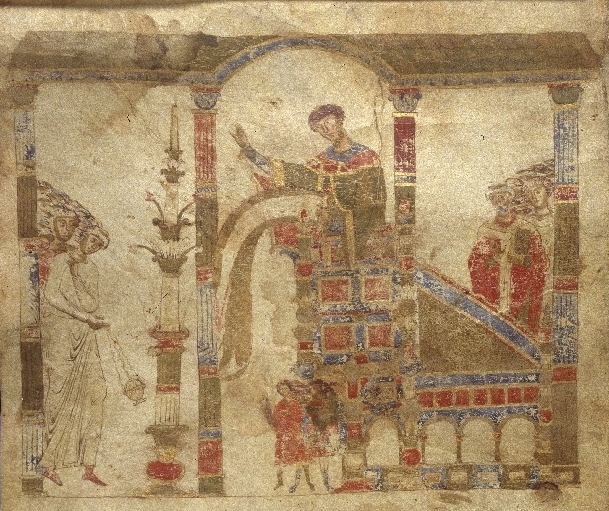
The British Library has one Exultet roll in its collection (Add MS 30337); learn more about it from either of these blog posts. Unfortunately, the full digitized manuscript file was among the thousand-plus lost in a massive cyberattack in October 2023, and it has not yet been rescanned, but select images can be viewed in low resolution in the posts. These images include a personification of Mother Earth and her abundance, a comparison of the Crossing of the Red Sea (the quintessential saving act in Israel’s history) to the Harrowing of Hell, bees gathering nectar (which accompanies words of gratitude to the bees that produced the wax of the Paschal candle), and more.
To read the Exultet (Easter Proclamation) from the Roman Catholic liturgy and for additional images from other Exultet rolls, see the Ad Imaginem Dei blog post “Exultet! The Easter Proclamation” by Margaret M. Duffy. To hear the Exultet sung using the Gregorian chant melody from the Roman Missal, see the following rendition from Liturgical Folk’s 2017 album Table Settings, or the 2010 OCP recording from Pange Lingua Gloriosi: Choral Music for Holy Week.
+++
SONGS:
>> “Surrexit Christus” by Jacques Berthier: Kester Limner and Andy Myers perform a 1984 song from Taizé, an ecumenical monastic community in Burgundy, France. Its Latin refrain, “Surrexit Christus . . . Cantate Domino,” translates to “Christ is risen . . . Sing to the Lord!”
>> “Sing, Little Bird” by Dan Damon: In 2024, the California-based hymnist Dan Damon penned new lyrics to a traditional Ukrainian folk tune that I’m sure you’ll recognize. He writes,
The Ukrainian folk song SHCHEDRYK (lit. “bountiful evening”) is a shchedrivka, or New Year’s song, known in English as “The Little Swallow.” It tells of a swallow bringing good news for the coming year. Ukrainian composer Mykola Leontovych (1877–1921) arranged the folk song in 1916. Twenty years later, American composer Peter J. Wilhousky published his own lyrics for the song. His choral arrangement, “Carol of the Bells,” has become a standard in the Christmas repertoire. As I was working on a solo piano arrangement of this song, I got an idea for an Easter text that could be sung by a congregation. The swallow in the original folk song made me think of a little bird singing the good news of the resurrection.
“Sing, Little Bird” is the title song of his latest hymn collection that is forthcoming from Hope Publishing Company in July 2026. Another new Easter hymn that will be included is “Last night did Christ the Sun rise from the dark,” a setting of a ninth-century text by Sedulius Scottus that I featured last year; follow the link to listen to Damon’s demo.
>> “Gone” by Eldridge Fox: Teddy Huffam and the Gems, with pianist Anthony Burger, perform a classic Southern gospel song written by Eldrige Fox in 1972.
+++
VIRTUAL TOUR: Calvary Chapel, Biola University, La Mirada, California: Constructed in 1975, Biola University’s Calvary Chapel [previously] was completely renovated in summer 2018 to enhance the sense of the sacred in that space. Biola commissioned leading Danish artists Peter Brandes and Maja Lisa Engelhardt, a husband-wife team, to conceive and carry out a creative vision that would involve updated lighting, colors, flooring, and seating and the making of new art. The renovated chapel features thirty-two handcrafted stained glass windows by Brandes (integrating innovative LED illumination technology) and two large gilded sculptures by Engelhardt, all created around the central theme of the Resurrection. The focal point is a thirty-one-foot-long gold relief sculpture that depicts the resurrected Christ emerging from the tomb, radiant with glory.
Biola’s website offers a self-guided tour comprising six videos—one for each of the four wings, plus an intro and a conclusion—and photographs and descriptions of the art. I highly encourage you to explore this resource! Here’s the video for the “western wing” (the liturgical east end):
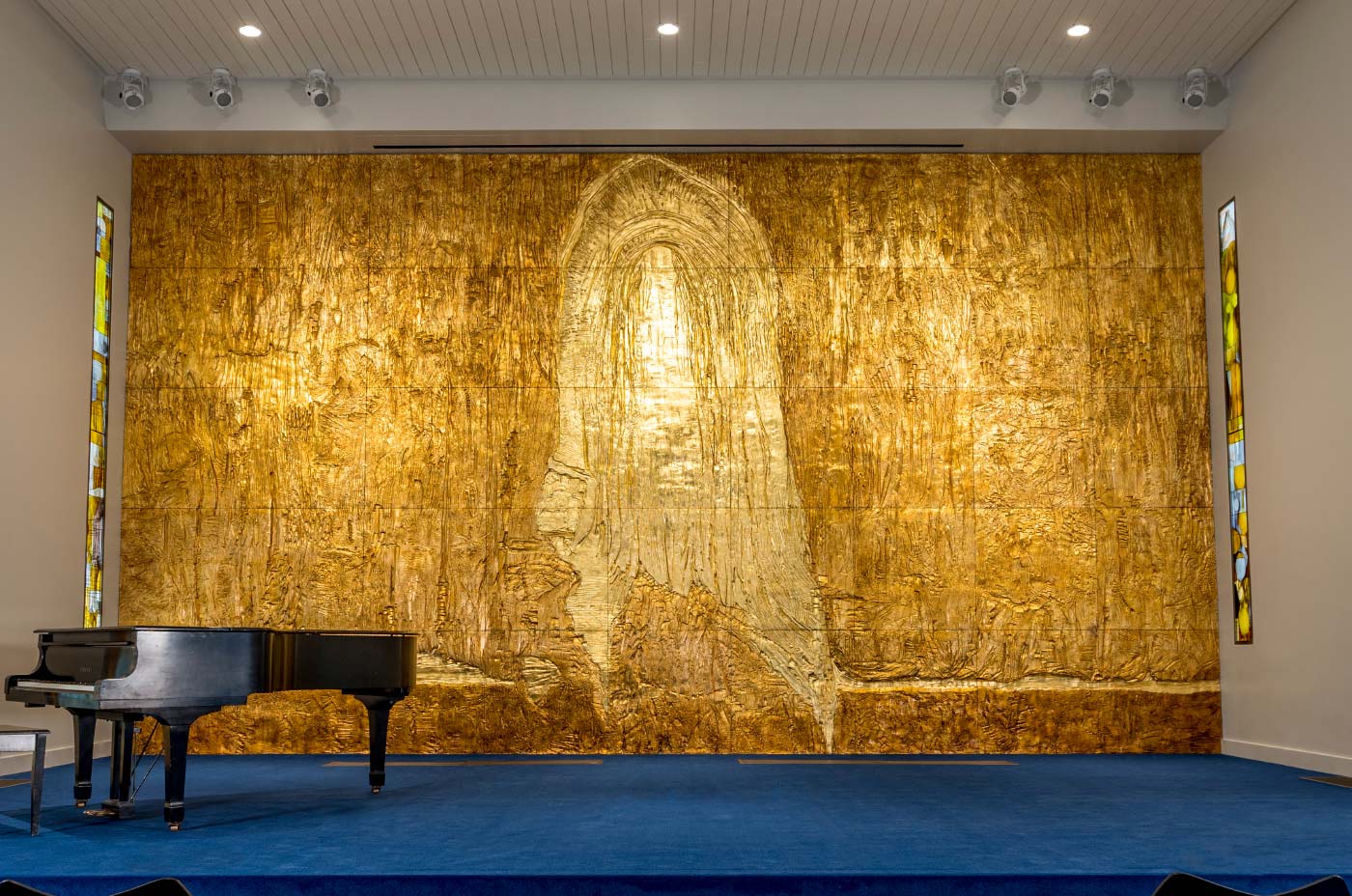
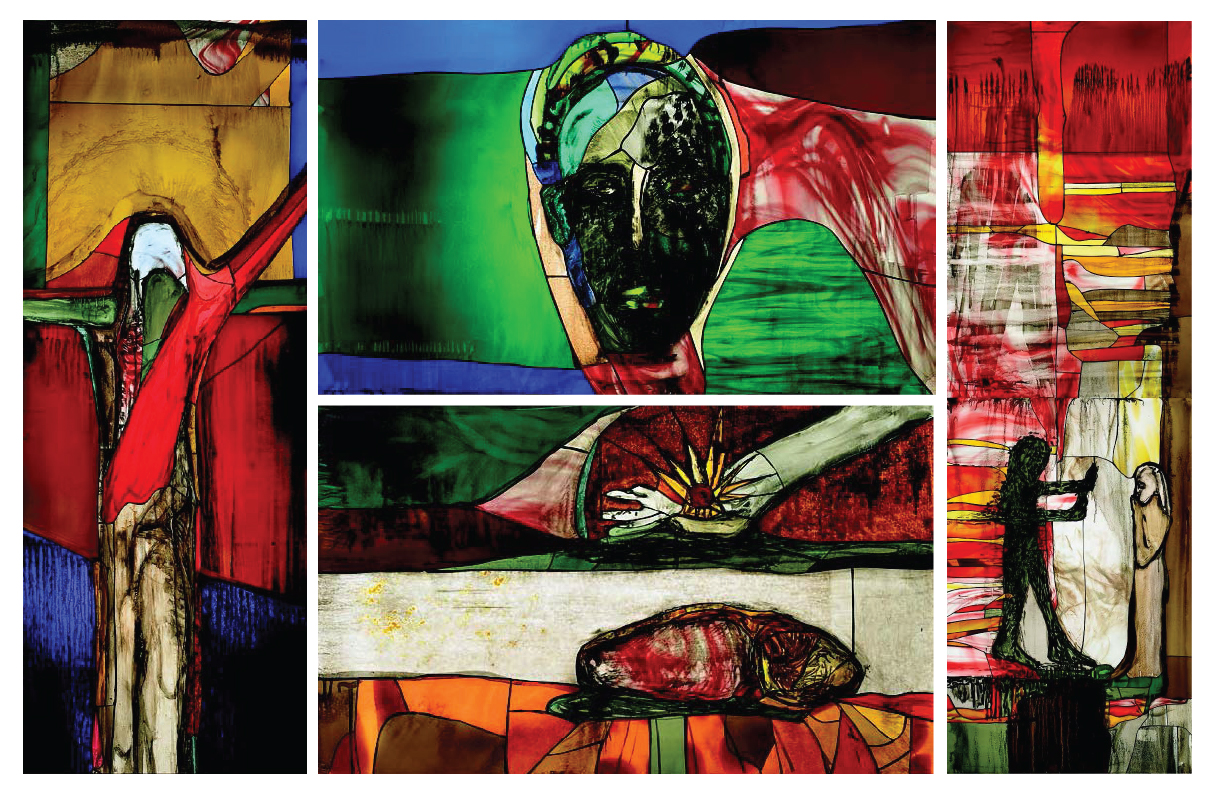
I really like the allusiveness of the altarpiece and the semiabstract style of the biblical scenes in the windows, which include the Sacrifice of Isaac, Elijah Raising the Widow’s Son, David Playing the Harp for King Saul, Cain Killing Abel, the Baptism of Christ, Nicodemus Visiting Christ, Christ in Gethsemane,the Crucifixion, the Eucharist, the Supper at Emmaus, Christ as the Sowing Farmer, and the Return of the Prodigal Son.


[…] From an Art & Theology roundup, a blog post from the British Library about “Exultet Rolls.” […]
LikeLike