Roundup: Exultet rolls, “Sing, Little Bird,” Biola’s Calvary Chapel, and more

Most of us grew up celebrating Easter Sunday like it was the finish line, the big, joyful mic drop: “He is risen!” But the church, historically, has never treated Easter as a single day. It’s a whole season—Eastertide, stretching fifty days from resurrection to Pentecost. Fifty days of practicing resurrection. Of sitting in the reality that new life doesn’t just burst forth . . . it unfolds.

And yet, many evangelical spaces move on by the next Sunday. Back to regular programming. Back to “what’s next.”

What if we didn’t rush past resurrection? What if we let joy linger? What if we made space for wonder, for doubt, for the slow work of becoming people shaped by an empty tomb?

Eastertide invites us to stay. To notice. To live like resurrection is still happening. Maybe that’s something worth recovering.

@thetheologygirls

+++

BLOG POSTS: “Rejoice Now!” by Sarah J. Biggs and “Exultet rolls: Celebrating the return of light” by Eleanor Jackson: These two posts from the British Library’s Medieval Manuscripts Blog contain overlapping content; the first (from 2013) is better for images, the second for text. “The medieval churches of Southern Italy maintained a very special Easter tradition,” writes curator Ellie Jackson. “They celebrated the Easter Vigil of Holy Saturday from a scroll made to be used once a year for this specific ritual. Known as Exultet rolls, these manuscripts combine words, music and pictures to create an enthralling multimedia experience centred on the joyful theme of light returning to the world.” Their name comes from the first word of the ancient proclamation sung by a deacon or priest during the blessing of the Paschal candle in the Roman Rite: “Exultet iam angelica turba caelum . . .” (Rejoice now, all you heavenly choirs of angels . . .) “Exsultent,” with an s, is a variant spelling.
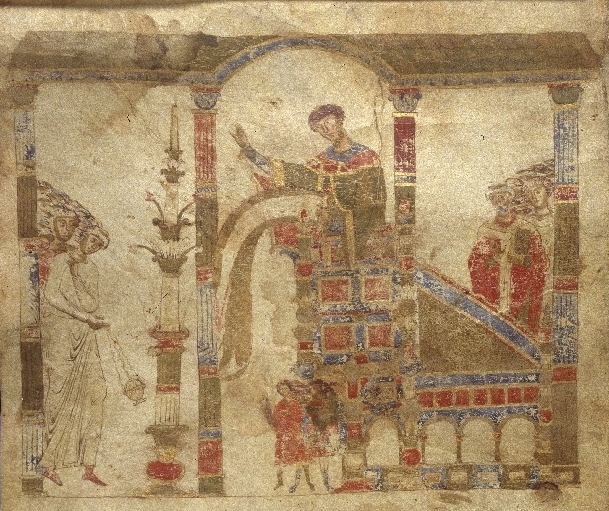
Deacon reading from an Exultet roll
A deacon reading the Exultet roll in church, from the Monte Cassino Exultet Roll, made at the Benedictine abbey of Monte Cassino in southern Italy, ca. 1075–80. London, British Library, Add MS 30337, membrane 11.

The British Library has one Exultet roll in its collection (Add MS 30337); learn more about it from either of these blog posts. Unfortunately, the full digitized manuscript file was among the thousand-plus lost in a massive cyberattack in October 2023, and it has not yet been rescanned, but select images can be viewed in low resolution in the posts. These images include a personification of Mother Earth and her abundance, a comparison of the Crossing of the Red Sea (the quintessential saving act in Israel’s history) to the Harrowing of Hell, bees gathering nectar (which accompanies words of gratitude to the bees that produced the wax of the Paschal candle), and more.

To read the Exultet (Easter Proclamation) from the Roman Catholic liturgy and for additional images from other Exultet rolls, see the Ad Imaginem Dei blog post “Exultet! The Easter Proclamation” by Margaret M. Duffy. To hear the Exultet sung using the Gregorian chant melody from the Roman Missal, see the following rendition from Liturgical Folk’s 2017 album Table Settings, or the 2010 OCP recording from Pange Lingua Gloriosi: Choral Music for Holy Week.

+++

SONGS:

>> “Surrexit Christus” by Jacques Berthier: Kester Limner and Andy Myers perform a 1984 song from Taizé, an ecumenical monastic community in Burgundy, France. Its Latin refrain, “Surrexit Christus . . . Cantate Domino,” translates to “Christ is risen . . . Sing to the Lord!”

>> “Sing, Little Bird” by Dan Damon: In 2024, the California-based hymnist Dan Damon penned new lyrics to a traditional Ukrainian folk tune that I’m sure you’ll recognize. He writes,

The Ukrainian folk song SHCHEDRYK (lit. “bountiful evening”) is a shchedrivka, or New Year’s song, known in English as “The Little Swallow.” It tells of a swallow bringing good news for the coming year. Ukrainian composer Mykola Leontovych (1877–1921) arranged the folk song in 1916. Twenty years later, American composer Peter J. Wilhousky published his own lyrics for the song. His choral arrangement, “Carol of the Bells,” has become a standard in the Christmas repertoire. As I was working on a solo piano arrangement of this song, I got an idea for an Easter text that could be sung by a congregation. The swallow in the original folk song made me think of a little bird singing the good news of the resurrection.

“Sing, Little Bird” is the title song of his latest hymn collection that is forthcoming from Hope Publishing Company in July 2026. Another new Easter hymn that will be included is “Last night did Christ the Sun rise from the dark,” a setting of a ninth-century text by Sedulius Scottus that I featured last year; follow the link to listen to Damon’s demo.

>> “Gone” by Eldridge Fox: Teddy Huffam and the Gems, with pianist Anthony Burger, perform a classic Southern gospel song written by Eldrige Fox in 1972.

+++

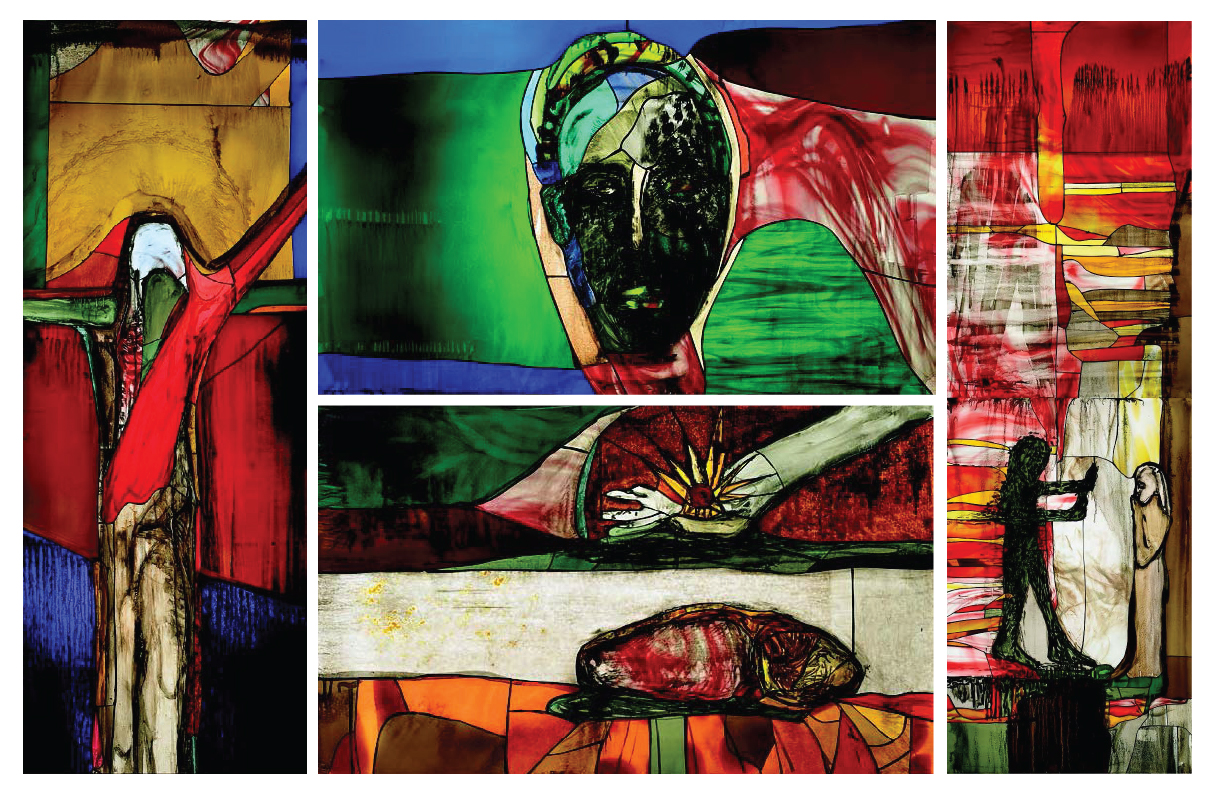
VIRTUAL TOUR: Calvary Chapel, Biola University, La Mirada, California: Constructed in 1975, Biola University’s Calvary Chapel [previously] was completely renovated in summer 2018 to enhance the sense of the sacred in that space. Biola commissioned leading Danish artists Peter Brandes and Maja Lisa Engelhardt, a husband-wife team, to conceive and carry out a creative vision that would involve updated lighting, colors, flooring, and seating and the making of new art. The renovated chapel features thirty-two handcrafted stained glass windows by Brandes (integrating innovative LED illumination technology) and two large gilded sculptures by Engelhardt, all created around the central theme of the Resurrection. The focal point is a thirty-one-foot-long gold relief sculpture that depicts the resurrected Christ emerging from the tomb, radiant with glory.

Biola’s website offers a self-guided tour comprising six videos—one for each of the four wings, plus an intro and a conclusion—and photographs and descriptions of the art. I highly encourage you to explore this resource! Here’s the video for the “western wing” (the liturgical east end):
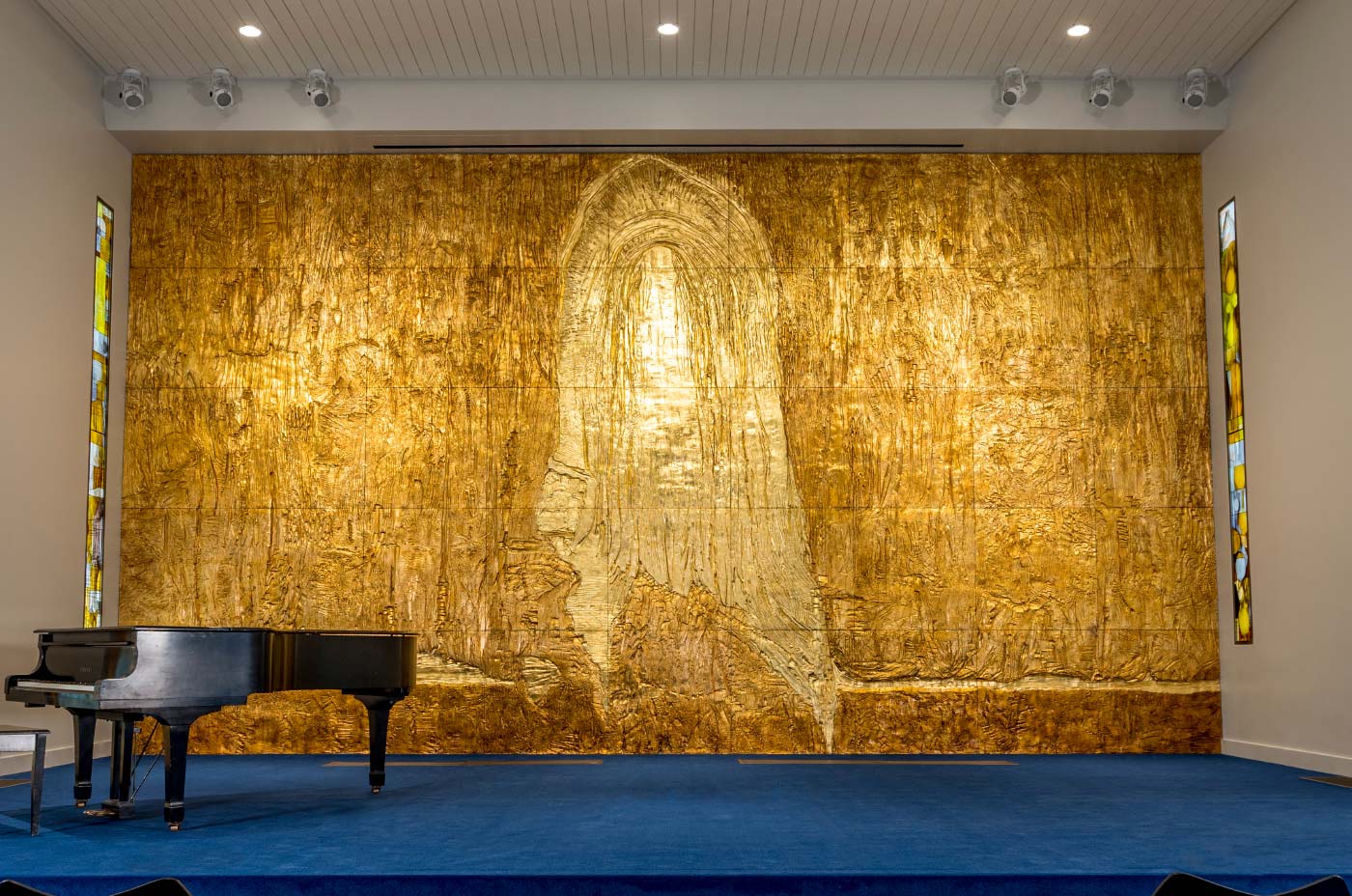
Engelhardt, Maja Lisa_Resurrection
Maja Lisa Engelhardt (Danish, 1956–), Resurrection, 2018. Gilded plaster relief wall, 31 × 18 ft. Calvary Chapel, Biola University, La Mirada, California.

Peter Brandes stained glass
Peter Brandes (Danish, 1944–2025), The Crucifixion of Christ, Supper at Emmaus, and The Resurrected Christ Encounters Mary Magdalene, 2018. Stained glass, Calvary Chapel, Biola University, La Mirada, California.

I really like the allusiveness of the altarpiece and the semiabstract style of the biblical scenes in the windows, which include the Sacrifice of Isaac, Elijah Raising the Widow’s Son, David Playing the Harp for King Saul, Cain Killing Abel, the Baptism of Christ, Nicodemus Visiting Christ, Christ in Gethsemane,the Crucifixion, the Eucharist, the Supper at Emmaus, Christ as the Sowing Farmer, and the Return of the Prodigal Son.
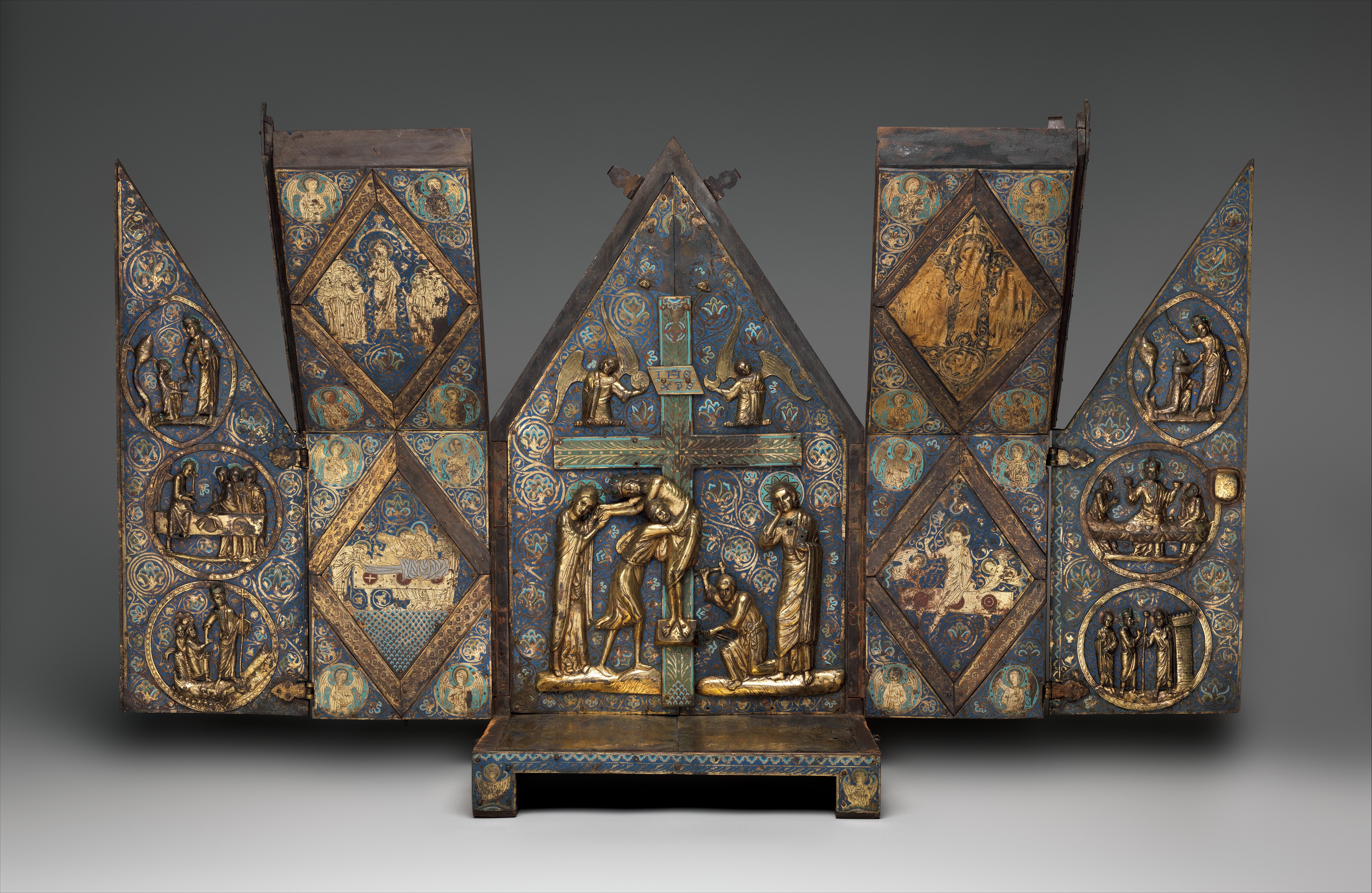
The Tabernacle of Cherves (Limoges enamel, 13th century)

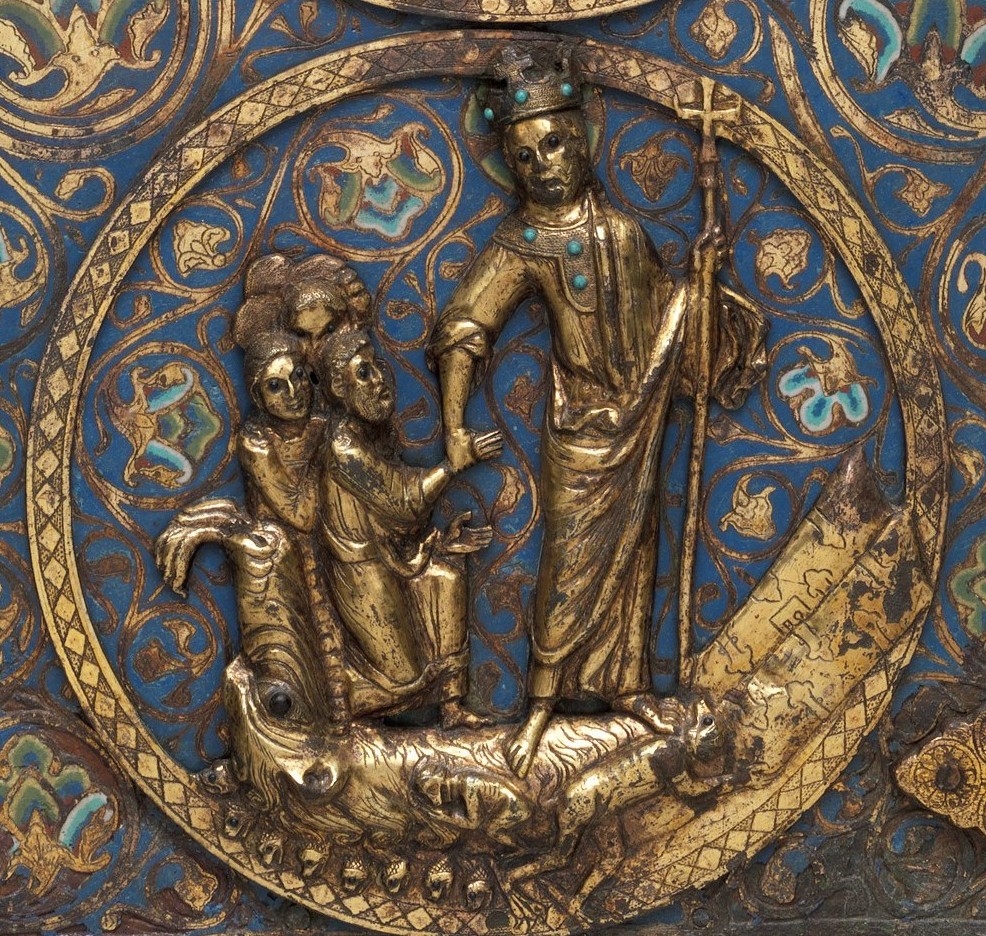
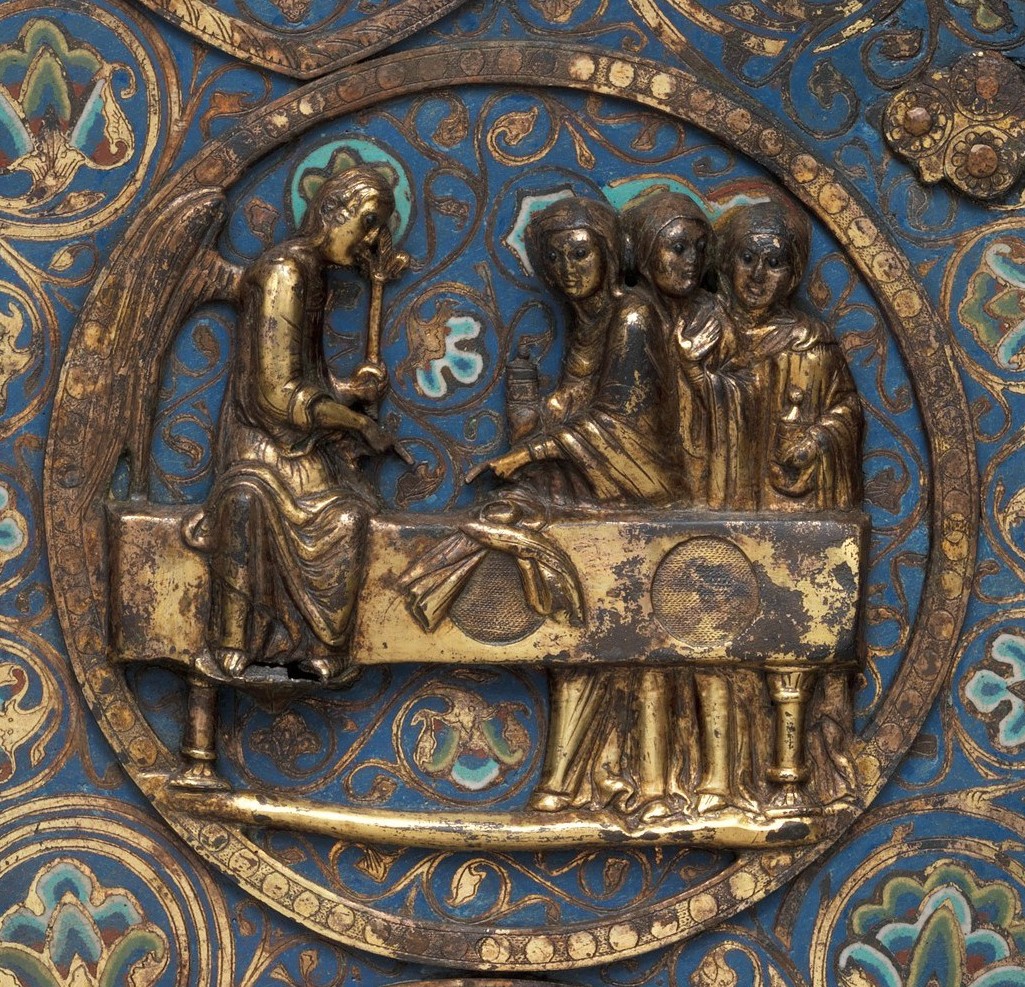
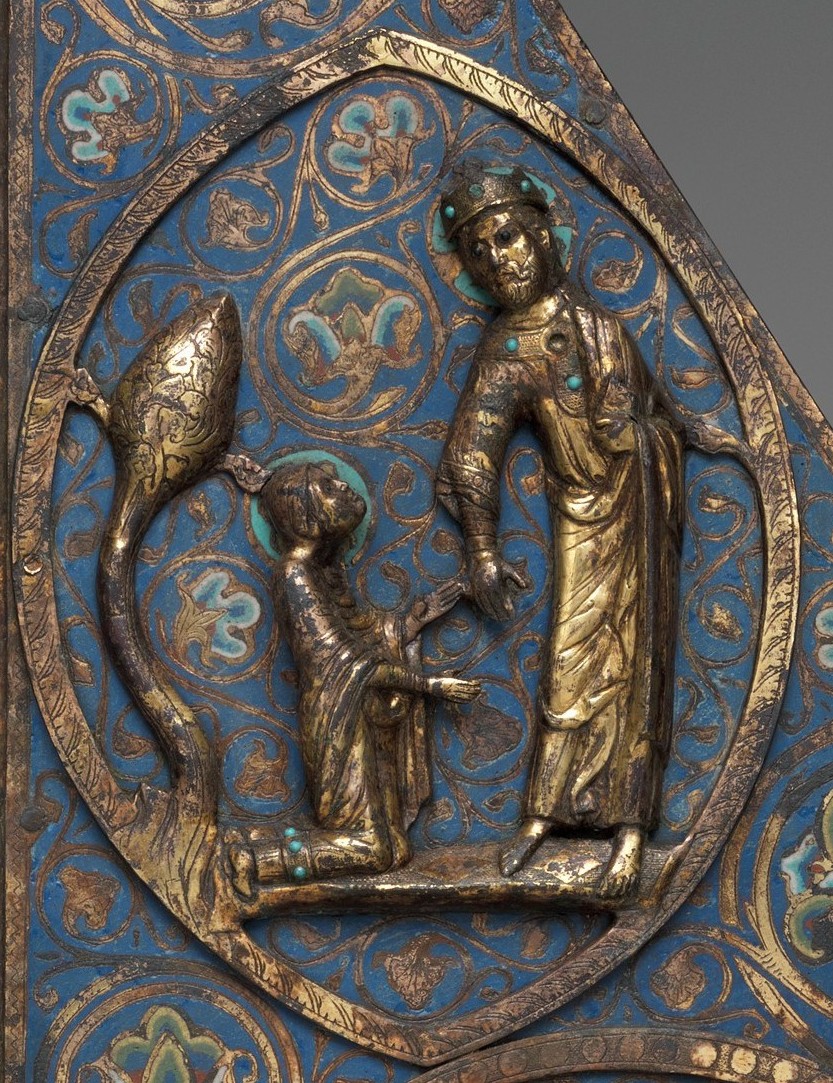
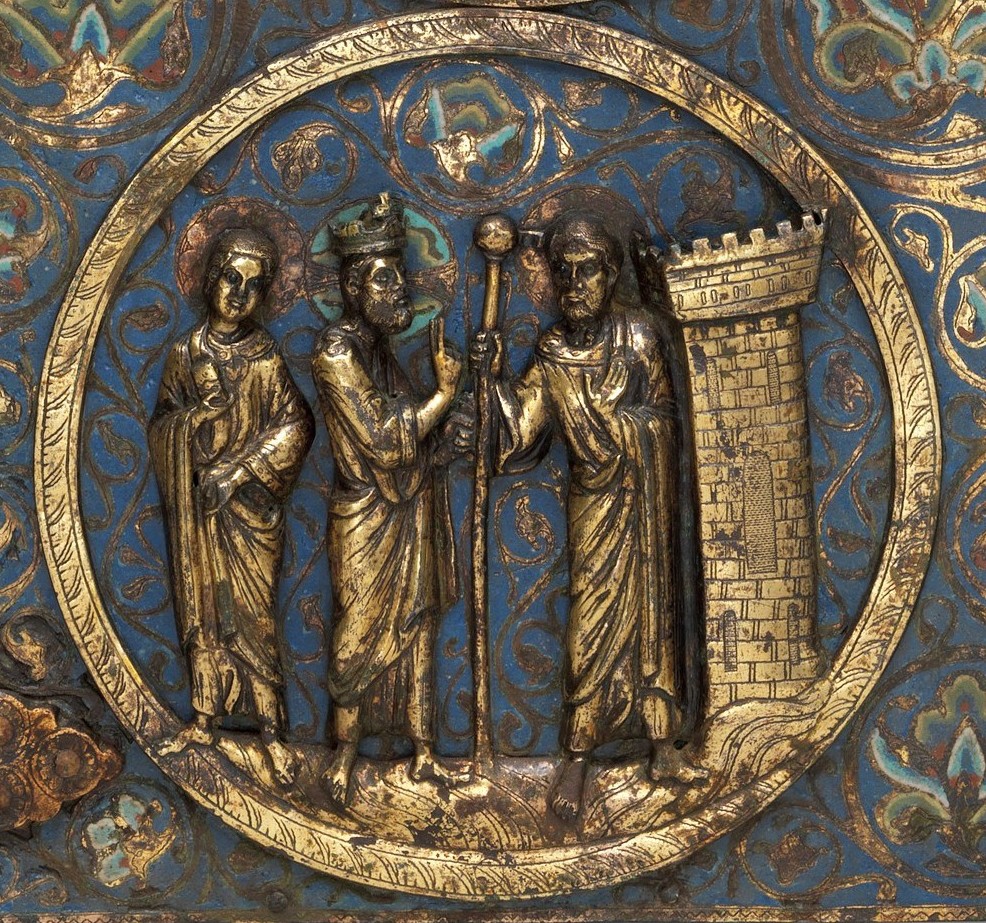
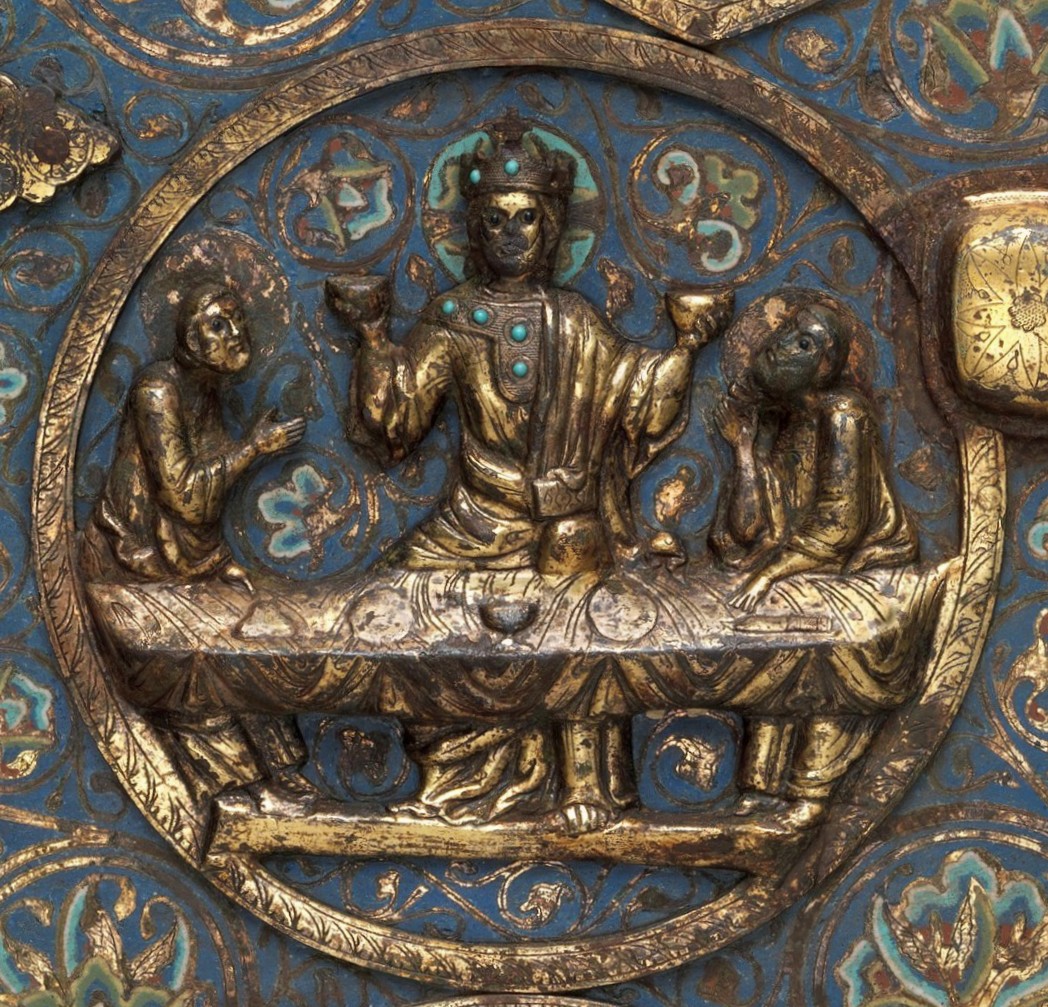
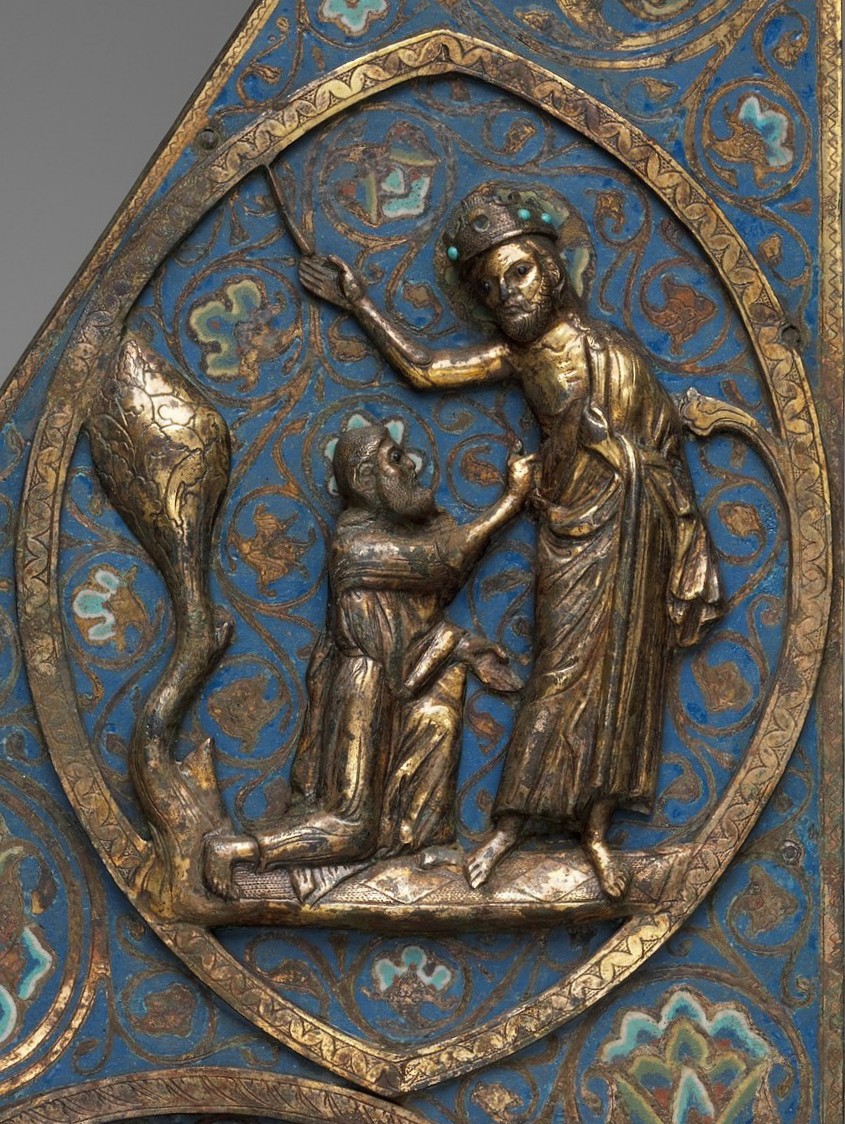
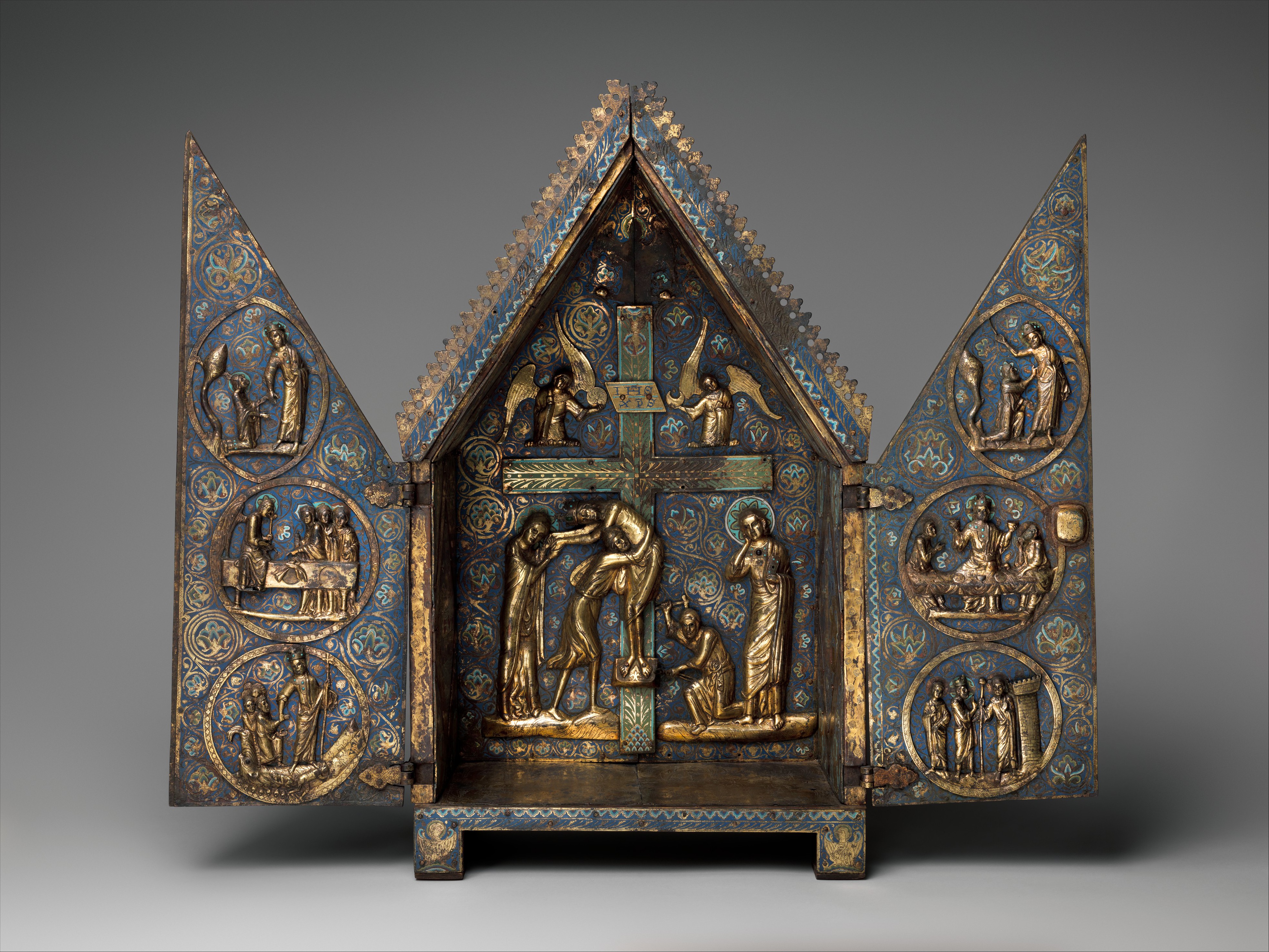
The Met Cloisters in New York City—the branch of the Metropolitan Museum of Art devoted to the art and architecture of medieval Europe—has some of the most beautiful Christian art objects I’ve seen. Here I’ll share just one of them: an elaborately decorated champlevé enamel tabernacle, that is, a cupboard where the vessels containing the “reserved Eucharist,” the already-blessed bread and wine, are kept. The primary scene represents the descent of Christ’s body from the cross, while the six medallion scenes on the interior doors (Christ’s appearance to Mary Magdalene, Thomas, and the Emmaus pilgrims; the holy women at the tomb; and the Harrowing of Hell) all have to do with the resurrection. To indicate his kingliness, Christ wears a crown. More on the iconography below.

Tabernacle of Cherves
Tabernacle of Cherves, Charente, France, ca. 1220–30. Champlevé enamel and copper, open: 33 × 37 3/4 × 10 3/4 in. (83.8 × 95.9 × 27.3 cm). Metropolitan Museum of Art, New York.

The enameled metalworks produced in twelfth- through fourteenth-century Limoges in southwestern France are renowned for their exquisite craftsmanship, which contemporary makers still marvel at. Some 7,500 such objects still survive in a variety of forms, including altar frontals, book covers, candlesticks, censers (incense burners), chrismatories (containers for chrism oil), coffers, croziers (bishop’s staffs), reliquaries (containers for relics), gemellions (handwashing basins), pyxides (small receptacles for the consecrated host), and more. The large concentration of churches and monasteries in France’s Limousin region created a large demand for decorated liturgical objects, which led to the rise of enamel workshops in the city of Limoges, located at the intersection of major trade routes. The technical and artistic mastery of these workshops’ products meant that soon orders were being placed by buyers in other regions and countries, and for a more diversified range of objects, not just those for church use.

The champlevé method of enameling, the predominant decorative technique associated with Limoges, first requires the gouging out of a prepared metal substrate (almost always copper) to create cells. Enamel powder, made from shards of colored glass, is carefully laid into these recessed cells and the object is fired, then cooled, then polished. Champlevé enamels often have appliqué figures attached to them. These are created from copper sheet that is raised from the back and then finished from the front using various specialized tools. For a detailed description of the creation process, which I find fascinating, see the essay “Techniques and Materials in Limoges Enamels” by Isabelle Biron, Pete Dandridge, and Mark T. Wypyski, in the 1996 Met exhibition catalog Enamels of Limoges, 1100–1350, available for free download from MetPublications.

The Cherves tabernacle, so named because it was discovered in the Cherves-Richemont commune near the site of a ruined priory, is one of only two enamel tabernacles that have survived from the Middle Ages. It consists of blue, turquoise, green, yellow, red, and white champlevé enamel; gilded copper figures shaped by the twin metalworking techniques of repoussé (hammering from the reverse side to create a design in low relief) and chasing (hammering on the front side, sinking the metal); and, on the inside gables, engraved copper plaques covered in gold leaf. Its wood support was fabricated after the object was excavated at Château-Chesnel, near Plumejeau, in 1896.

The following text, written by Barbara Drake Boehm, senior curator at the Met Cloisters, is reproduced from pages 299–302 of the book Enamels of Limoges, 1100–1350 by permission of the publisher. I’ve inserted one bracketed note, plus hyperlinks on references that may be unfamiliar to readers. All photos are courtesy of the museum and are linked to their source page.

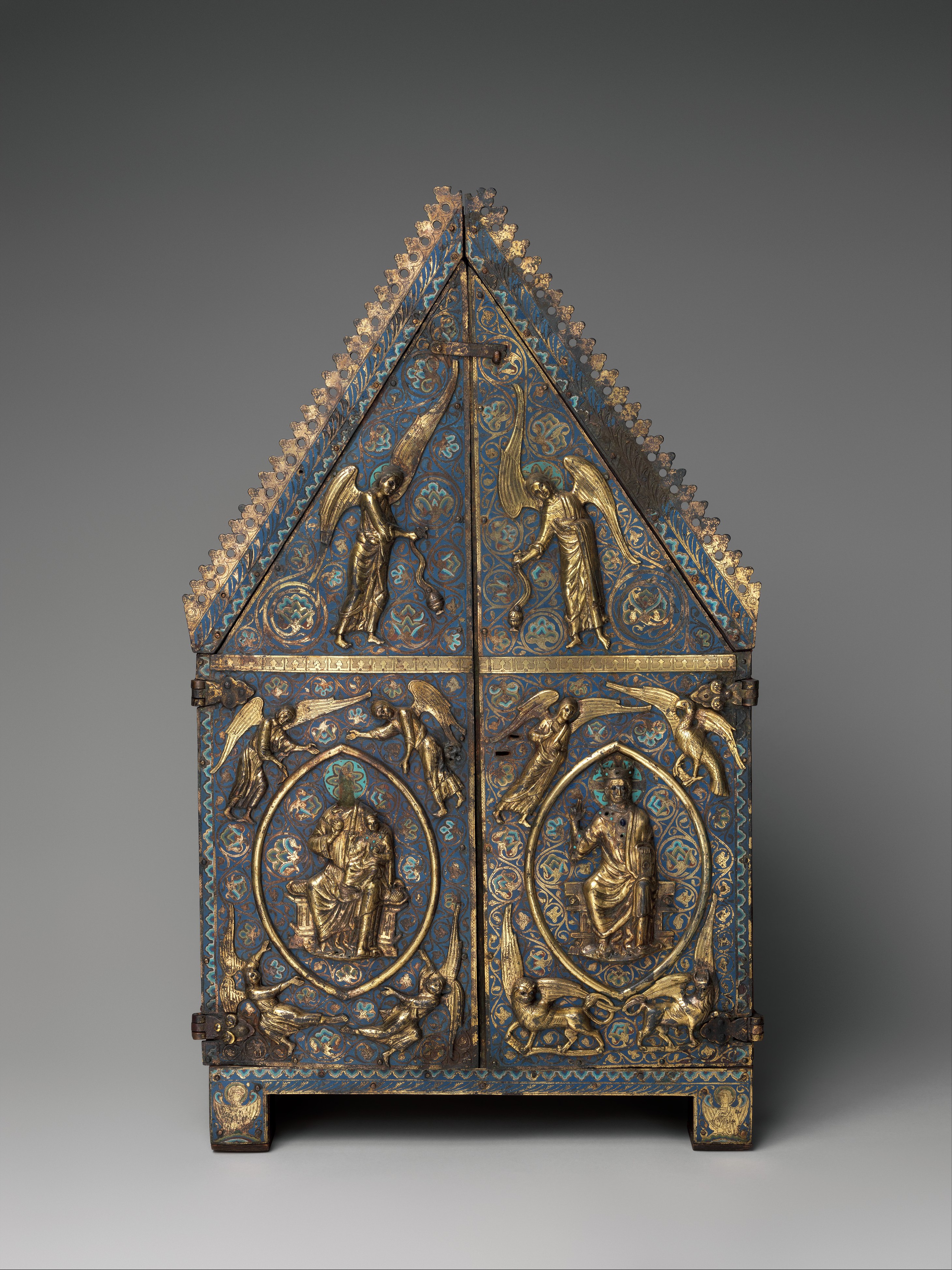
Tabernacle of Cherves (closed)
Closed view (the Virgin’s head is missing)

Standing on short legs, the tabernacle is in the form of a gabled cupboard with hinged doors. Gilded repoussé figures are applied to copper plates decorated with enameled foliate ornament. On the outside of the proper left door is the figure of Christ in Majesty, enthroned in a mandorla and surrounded by symbols of the evangelists. Opposite him on the proper right door is the Virgin with the Infant Jesus on her lap. She is framed within a mandorla and surrounded by four angels. Above them on the roof are two full-length angels, each holding a censer. Across the front runs a band of gilt copper inscribed with a decorative pattern derived from Kufic script, apparently based on the Arabic word yemen.

Tabernacle of Cherves (fully open)
Overall, all wings completely open

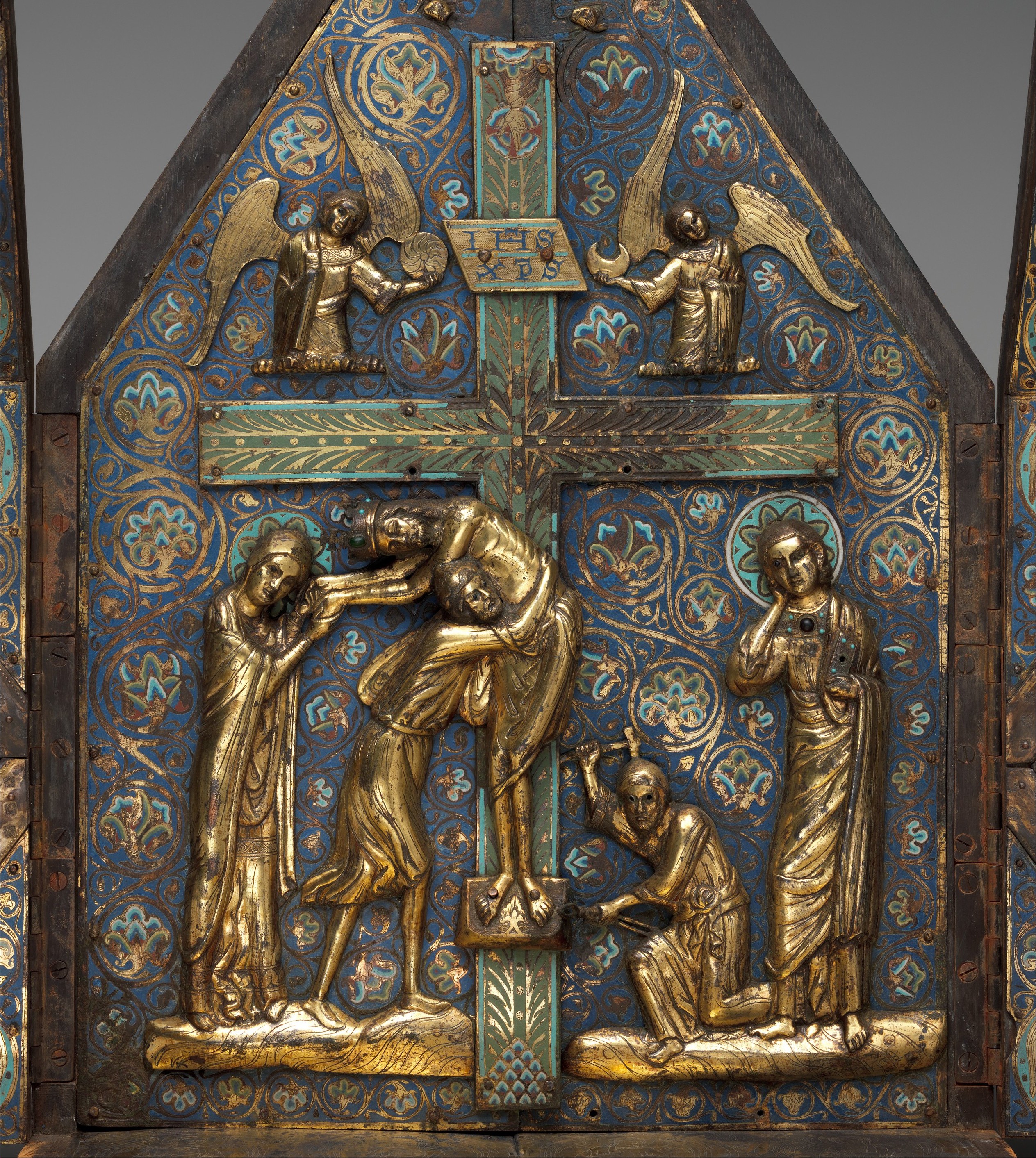
At the center of the open tabernacle, against its back wall, are appliqué figures representing the Descent from the Cross. Joseph of Arimathea takes the torso of the dead Christ in the arms as Nicodemus uses pliers and a hammer to remove the nails that still hold Christ’s feet to the green-enameled cross. The Virgin takes her son’s hands in hers and gently pulls them to her cheek; Saint John looks on from the opposite side, his head resting in his hand. Above the arms of the cross, two half-length angels hold emblems of the sun and moon. The Hand of God appears at the top of the cross; another figure of an angel once stood over it.

Tabernacle of Cherves (Harrowing of Hell)
The Harrowing of Hell

Tabernacle of Cherves (Empty Tomb)
The Holy Women at the Tomb

Tabernacle of Cherves (Noli me tangere)
“Noli me tangere” (The risen Christ appears to Mary Magdalene)

Tabernacle of Cherves (Road to Emmaus)
The Road to Emmaus

Tabernacle of Cherves (Supper at Emmaus)
The Supper at Emmaus

Tabernacle of Cherves (Incredulity of Thomas)
The Incredulity of Saint Thomas

On the insides of the doors are openwork medallions recounting the events that followed the Crucifixion, reading from lower left to upper right. The first is the Descent into Limbo, a nonscriptural image of Jesus leading souls by the hand out of the mouth of Hell, which is seen as the gaping mouth of a dragonlike beast. Set above it is the scene of the Holy Women arriving at the tomb of Jesus on Easter Sunday. Following the account in the Gospel of Mark (16:1), they bear jars of unguent to anoint the body and are greeted by a man, seen here as winged, who informs them that Jesus has risen. In the almond-shaped medallion above, Mary Magdalen meets the risen Christ in the garden (Mark 16:9; John 20:14–18), where he backs away and advises her not to touch him yet. At the lower right, the apostles on the road outside the walls of Emmaus (Luke 24:13–35) are greeted by Jesus, attired as a pilgrim; in the roundel above, they dine with him at Emmaus and realize who he is when he breaks bread with them. In the oval at the upper right, Saint Thomas (Doubting Thomas) touches the wound in Jesus’ side and is convinced of his Resurrection (John 20:24–29).

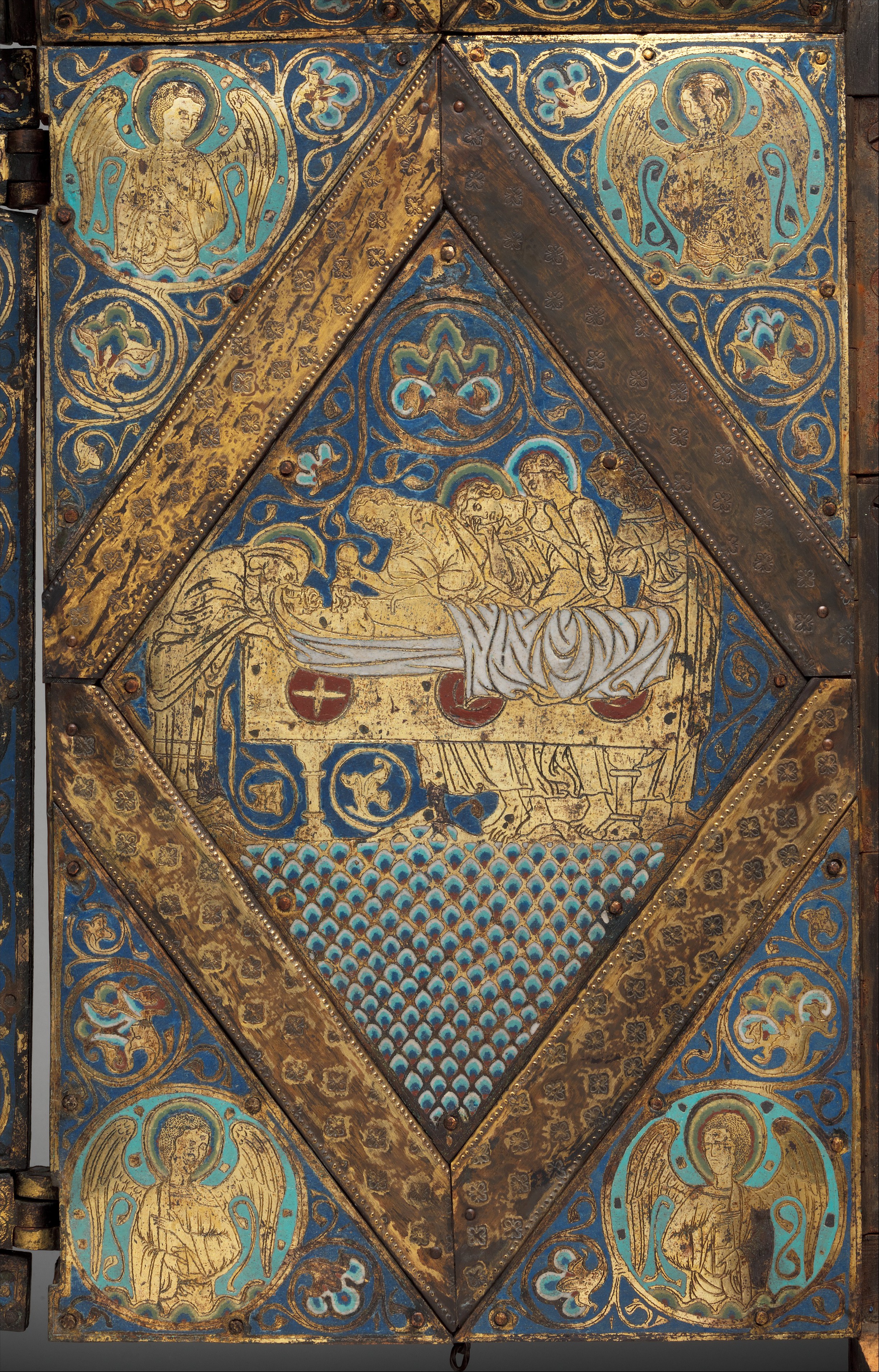
Tabernacle of Cherves (Entombment)
The Entombment

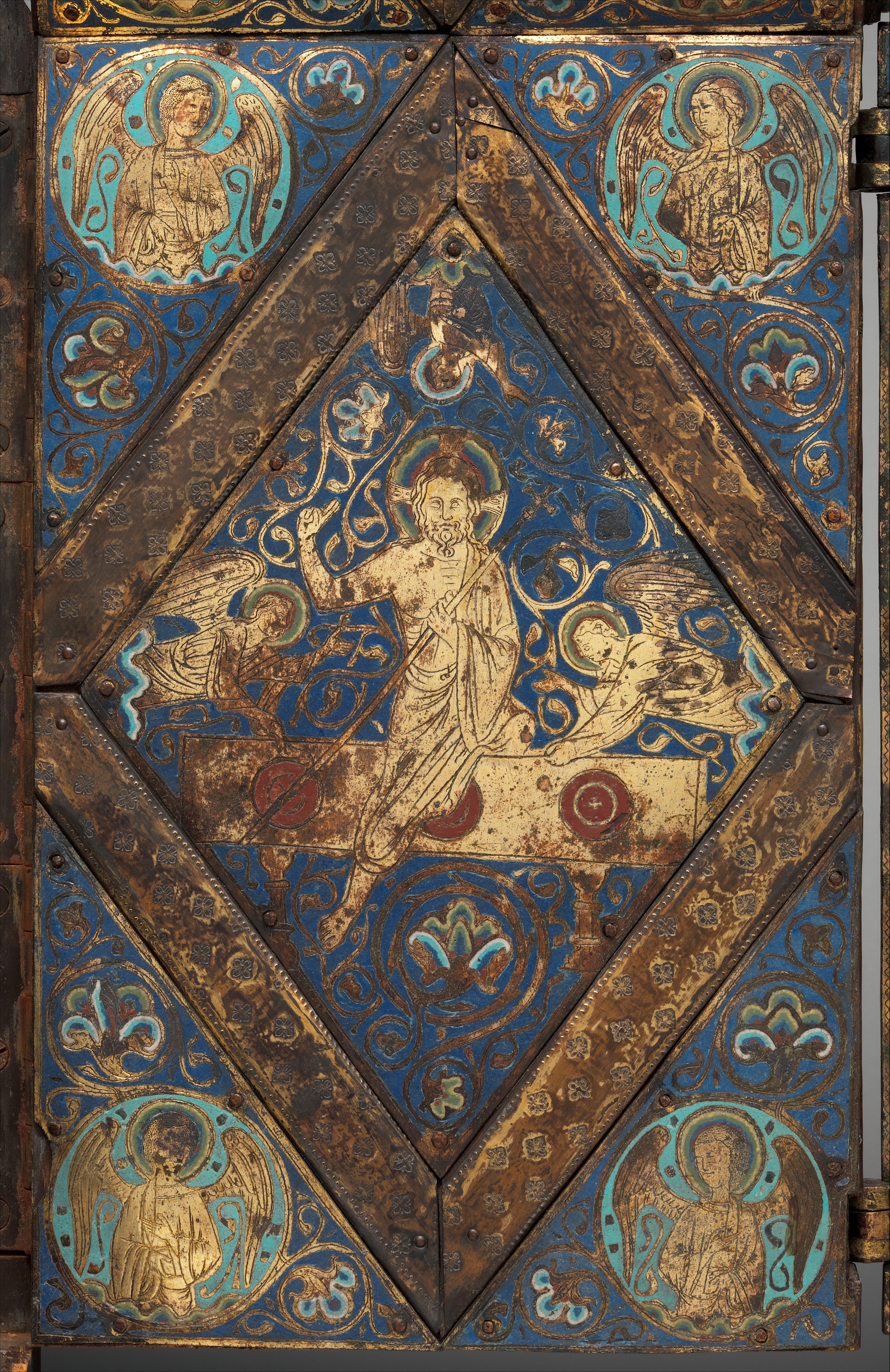
Tabernacle of Cherves (Resurrection)
The Resurrection

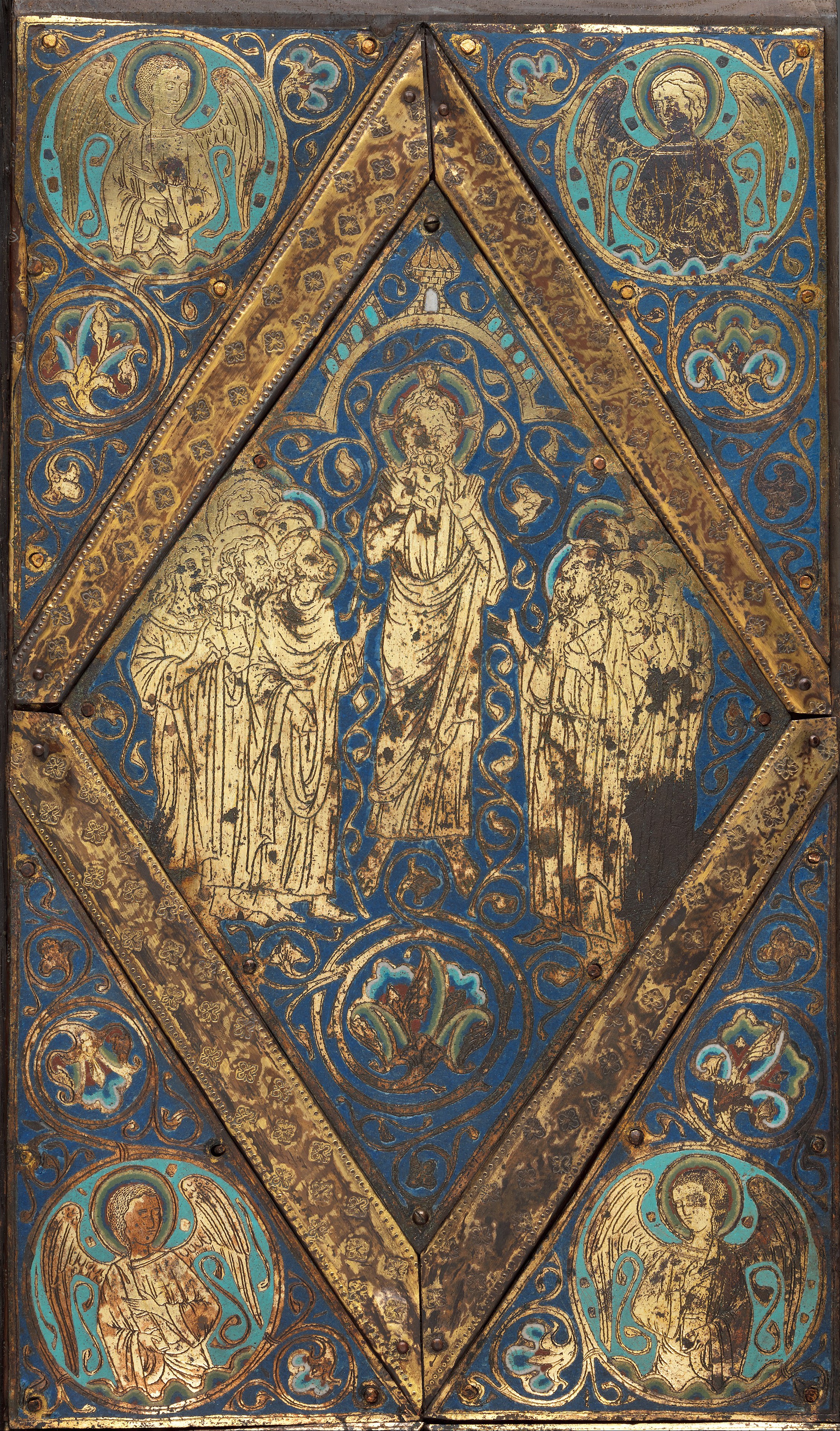
Tabernacle of Cherves (Ascension)
The Ascension

The interior side panels of the tabernacle have large lozenges with engraved figurative scenes framed at the corners by triangular enamel plaques, each depicting an angel in a roundel. At the lower left is the Entombment of Christ; at the upper left is the Ascension. At the lower right, Christ emerges from his tomb, with angels at either side. The base of the cupboard is covered with sheets of gilt copper depicting angels in roundels.

The tabernacle of Cherves is remarkable for its iconographic sophistication and for the dialogue established compositionally and visually between thematically related scenes. On the insides of the doors, Jesus guides souls out of the mouth of Hell at the lower left; at the lower right, he guides the apostles on the journey to Emmaus. On the center left roundel, the Holy Women seek Jesus’ body and find it gone; on the center right roundel, Jesus offers his body to the apostles in the sacrament of bread and wine. At the upper left, he tells the Magdalen it is too soon to touch him; at the upper right, he invites Thomas to touch his wound. In the inside lozenge at the left, Jesus is lowered into his tomb; at the right, he rises from it. At the upper left, he leaves his apostles and rises to heaven; at the upper right, the Holy Spirit descends from heaven on the apostles in a representation of Pentecost. [This latter scene is missing and has been replaced by a copy on paper or parchment of the Ascension image opposite it.]

Tabernacle of Cherves (Deposition)
The Descent from the Cross

The Descent from the Cross is both elegant and full of pathos, a masterpiece of Gothic relief sculpture. As such, it has rightly served as a point of comparison with works in other media, notably the ivory Descent from the Cross in the Louvre. A number of gilt-copper relief sculptures produced in the Limousin but now isolated from their original contexts can be compared with those on the Cherves tabernacle. Notable among these is the Descent from the Cross preserved in the Abegg-Stiftung, Bern, first recorded in 1870. Most of these reliefs are presumed to come from altar frontals.

The enameled ground of the Cherves tabernacle, with its strong concentric circles of reserved gilt copper enclosing full fleurons, seems to anticipate the enameled plate of the tomb effigy of John of France of after 1248.

The identification of this enameled cupboard as a tabernacle for the consecrated Host has not been confirmed: the Church of the Middle Ages had no universal custom for the reservation of the Eucharistic bread or regulations requiring a tabernacle. Nor is there a wealth of comparative medieval examples. Only one other Limoges tabernacle of this type is known; it was acquired by the cathedral of Chartes in the nineteenth century, and its earlier history is not known. The supposition that the enameled cupboard from Cherves is a Eucharistic tabernacle is based on its resemblance in form to later tabernacles, its subject matter, and even the gilt-copper base plate which would allow an enclosed pyx to slide easily in and out.

Soon after its discovery in 1896, the tabernacle was presented to the Société archéologique de la Charente by Maurice d’Hauteville, a curator at Angoulême and son-in-law of Ferdinand de Roffignac, on whose property it was unearthed. He suggested that the treasure could have come from the Benedictine monastery of Fontdouce, founded in 1117. More recently it has been supposed that the treasure at Cherves comes from the Grandmontain foundation at Gandory, of which, unfortunately, there are no remains.

Since its discovery, the tabernacle of Cherves has been recognized as a masterpiece of Limoges work in the Gothic period. Part of a larger treasure, . . . it was exhibited successively at Poitiers, Brive, and Limoges, and then at the Musée de Cluny before being sent to Great Britain.

You can explore other champlevé enamels at the Met using its website’s advanced search function. If you wish to study the topic in more depth, the book I’ve quoted from is an excellent resource, featuring essays as well as photographs and descriptions of 157 objects not only from the Met’s collection but also from the Louvre and various other European and American museums, ecclesiastical institutions, and private collections. Click on the cover image to go to the book page.

Enamels of Limoges

Sowing the stigmata: A reading of Fra Angelico’s Noli me tangere by Georges Didi-Huberman

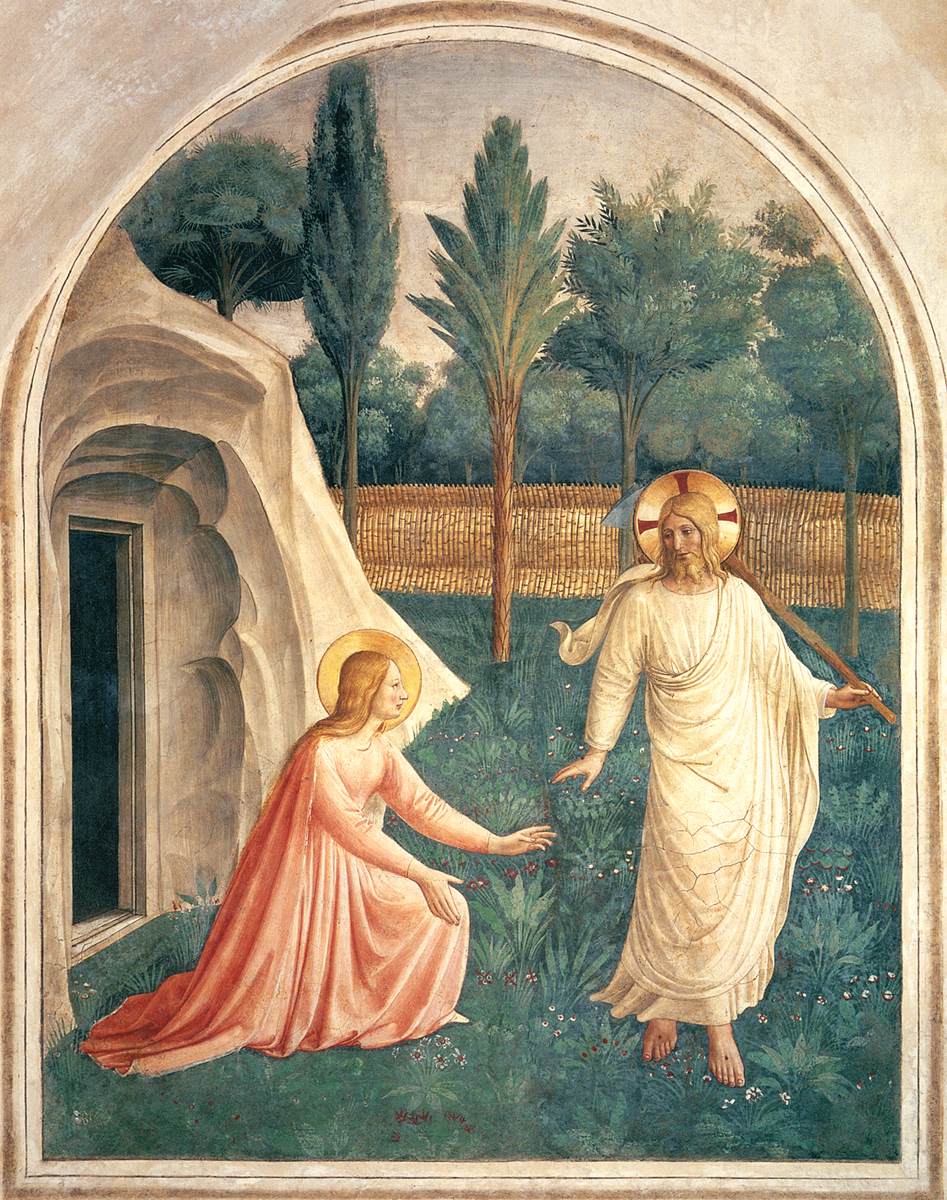
During Easter 2016 I published an article on Jesus as the gardener of our souls, featuring a roundup of Noli me tangere (“Touch me not”) paintings that portray the risen Christ as a literal gardener, including a fresco by Fra Angelico from the convent of San Marco in Florence.

Noli me tangere by Fra Angelico
Fra Angelico (Italian, ca. 1395–1455), Noli me tangere, 1440–42. Fresco from the convent of San Marco, Florence, Italy.

I spent the spring semester of my junior year of college living in Florence and, while there, fell in love with Renaissance art, and in particular the paintings of Fra Angelico (ca. 1395–1455). Born Guido di Pietro, he took vows as a Dominican friar and, together with his assistants, painted two corridors and the forty-four cells in the newly built San Marco, where he lived. The convent is now a state museum and is one of my favorite sites in the city.

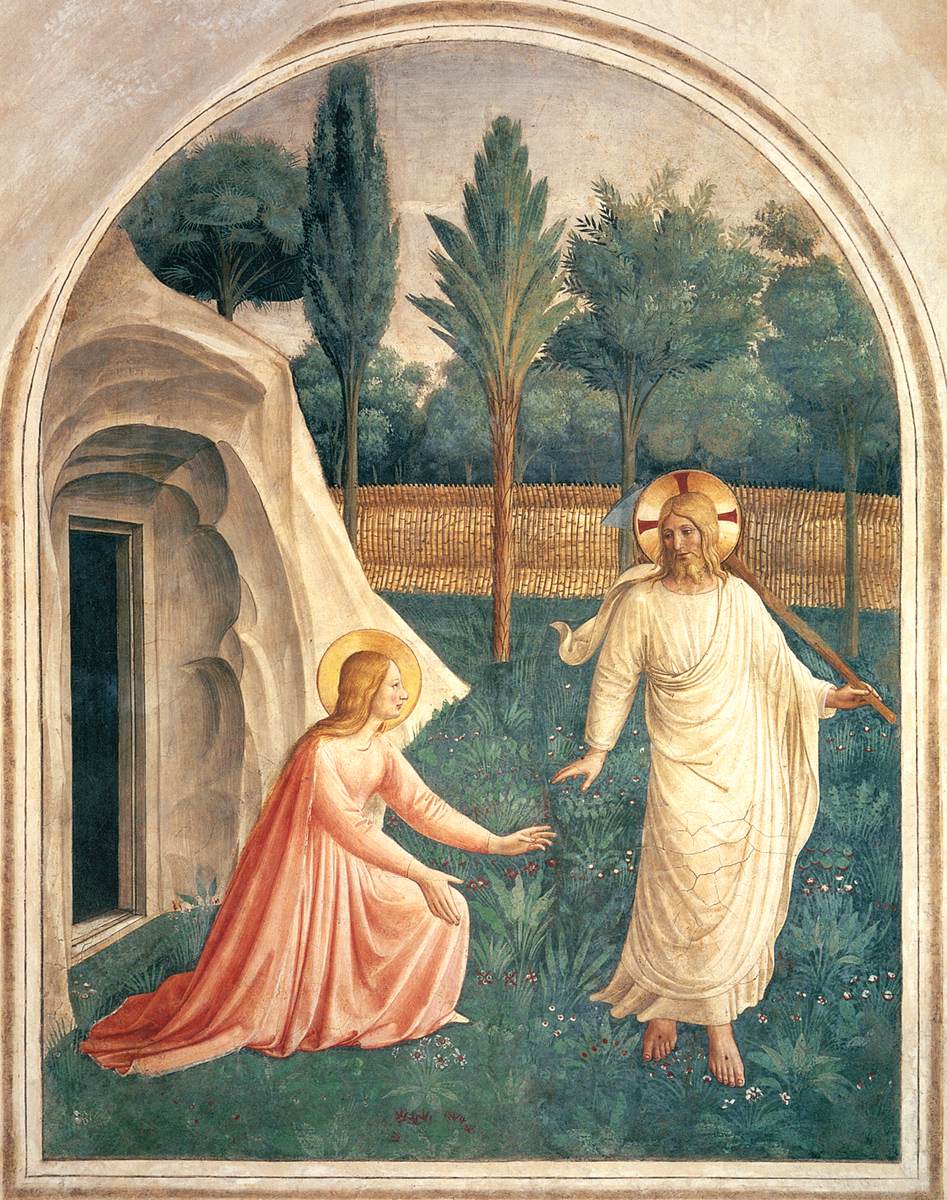
In 1990 art historian Georges Didi-Huberman published a monograph on Fra Angelico, spending considerable time on his Noli me tangere, especially its red flowers, which he reads as a figural displacement of Christ’s stigmata (nail wounds). (More on this below.) In the painting, he writes, Christ’s blood “soaks the earth and makes a new humanity grow there, a humanity in the imitation of Christ, a humanity redeemed from sin” (161). He notes how the floral imagery is echoed in the Annunciation in the hallway outside the cell, serving to visually connect these two stages of redemption: Christ’s “flowering,” or conception, in the womb of Mary and his flowering forth from the womb of the earth on Easter.

(Related: “Rosing from the Dead” by Paul J. Willis)

The figure of the Christ-flower was already a common one in the medieval West. For example, the great thirteenth-century theologian Albertus Magnus writes,

The Christ-flower [flos Christus] blossomed in the Nativity, as we read in Isaiah 11:1: “There shall come forth a rod out of the stem of Jesse.” It withered in the Passion, when there was no longer aspect or beauty. . . . It blossomed again at the Resurrection according to human nature, in the very place where it had withered. Thus it is said: “And my flesh blossomed anew” (Psalm 27:7). [De laudibus 12.4.2]

Fra Angelico furthered the development of this metaphor in visual form, picturing Christ’s blood (according to Didi-Huberman) as a fertilizing material, the agent of regeneration.

The following excerpt is taken from Fra Angelico: Dissemblance and Figuration* by Georges Didi-Huberman, translated from the French by Jane Marie Todd (Chicago: University of Chicago Press, 1995), pages 19–22. I find some of the semiotics discourse to be abstruse, but I’ve highlighted a few standout ideas in boldface—ideas that have helped me to see Fra Angelico’s Noli me tangere (and the Resurrection!) with new eyes.

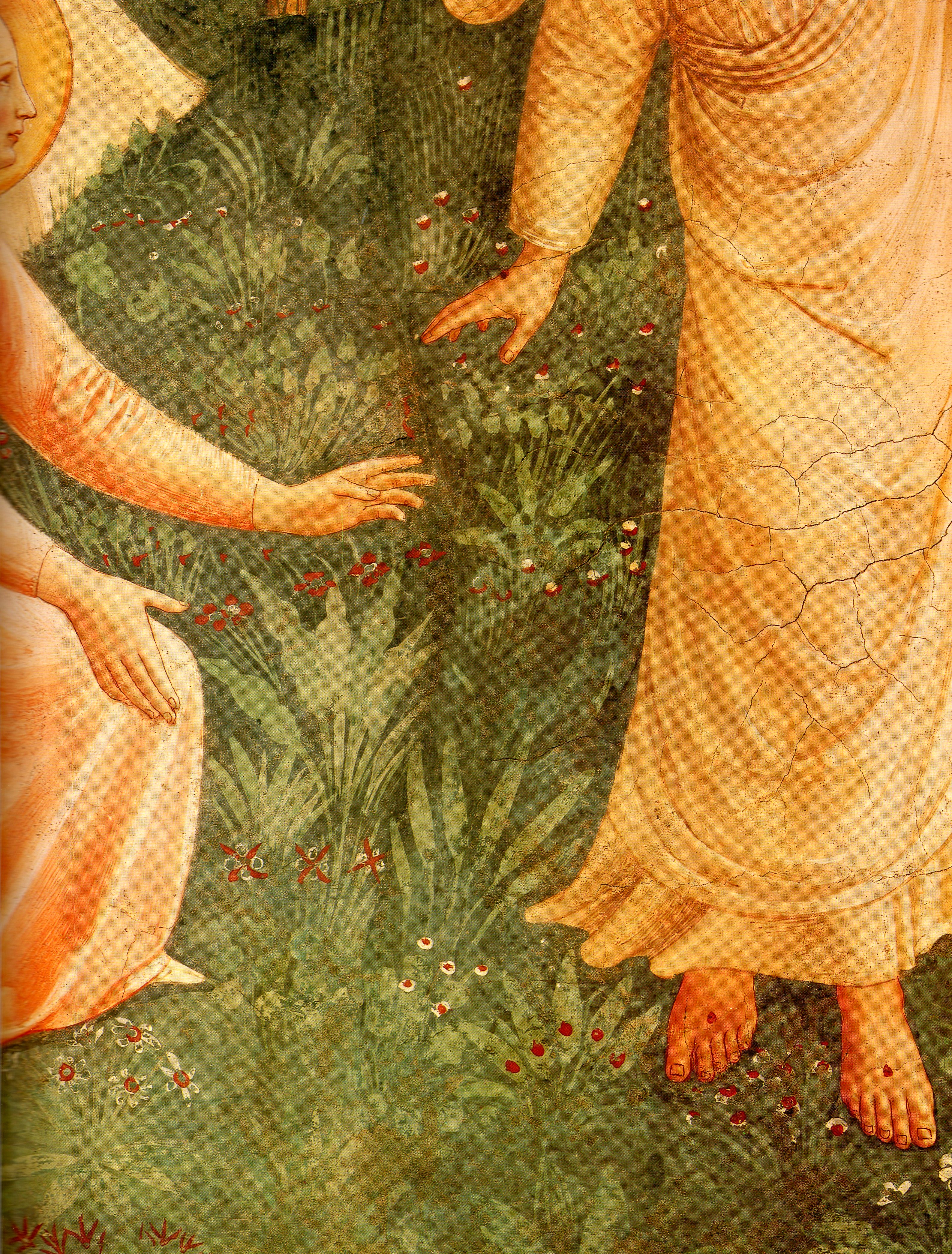
Noli me tangere (detail) by Fra Angelico

Angelico sprinkled little spots, deposited little splotches all over this “field” [of green]: more or less regular blotches, made of Saint John White [bianco di San Giovanni]—that is, the very material that constitutes the intonaco of the pigment—and, on top of that, red. It is a bright color, a terra rossa, and it forms a slight relief from the wall; the rhythmic effect, the pattern effect, is only that much stronger.

But what about this “field” in the economy of representation? And in particular, what exactly do these little spots of red pigment spread across the surface like stars represent? To what category of signs do they belong? A response suggests itself at first glance, a response relating to the obviousness of the storia and, consequently, to the overall mimetic, “realist” nature of the fresco: these little red blotches without a doubt represent flowers in the meadow. In [Charles Sanders] Peirce’s semiotic typology, these little red blotches would therefore be icons of flowers in a meadow. Peirce noted quite rightly, concerning this concept of the icon, the extent to which we have a tendency when contemplating a painting to forget the distinction between the present sign (in this case, the red blotches) and the absent reality (the flowers). We therefore need to go a bit further in our contemplation of the little blotches themselves.

We notice at this point that the colored patterns are absolutely not painted like flowers. They do not describe anything, do not suggest any distinguishing features: in these flowers, there are no calyxes, no corollas, no pistils, no stamens. They are colored blotches, no more and no less. And it would be completely absurd to invoke at this point some incompetence on Fra Angelico’s part in representing a flower with its pistil and stamens: he carried out the task perfectly well elsewhere, and moreover, he proved himself competent in the face of much greater mimetic difficulties. It would be just as pointless to imagine the painter “not having the time,” or the coat of paint drying too quickly. If Angelico had wanted to paint a flower like a flower, he would have done so; he would have applied himself. But that is precisely the point: he did not decide to do so. He was satisfied with laying on little circular “heaps” of terra rossa. Why? The response is not in absentia, in a meadow or a text, for example; it is in praesentia, on the fresco itself. For if we persist in wondering what the red blotches are painted like, we can give as our response only what we see: in all rigor, these red blotches are painted like—that is, exactly in the same manner as—Christ’s stigmata.

These red blotches are even painted the way Fra Angelico painted stigmata in general, Christ’s or Saint Francis’s, everywhere in San Marco: they are small circular inflections of the brush that deposits its thick pigment of terra rossa. And the evidence of such a relation is accentuated, specified, virtually demonstrated by the constellation effect Angelico actually bestowed on his little blotches: these flowers scattered across a green ground follow a trajectory that ends with a repetition of the same pictorial sign on Christ’s hand and foot.

Noli me tangere details sketch
Detail sketches of Fra Angelico’s Noli me tangere, showing Christ’s dispersal of his stigmata. Source: Fra Angelico: Dissemblance and Figuration, p. 20

Confronted with what amounts to a real displacement of the iconic sign, I can no longer affirm anything that has the minimal stability required for the notion of a motif: speaking in absolute terms, I can no longer say “it is” or “it is not” in a decisive way. There is a displacement of the iconic value and hence an equivocal representation. For example, I can very well affirm that Christ’s stigmata are, according to Fra Angelico, the flowers of his body. And I will have no difficulty, by the way, in finding a Thomist text to support an affirmation of this kind: for instance, the article in his Summa theologica that Aquinas devotes to the question of whether Christ’s risen body had or did not have scars. To the objector who maintained that stigmata are wounds, and hence a “corruption” and a “defect,” Aquinas responds yes, but those wounds, on Christ, possess a “special beauty” (specialis decor) which is Beauty itself, the (bleeding, of course) Beauty of the Virtue of Humility [Summa theologica 3a.54.4].

But I could just as easily affirm, confronted with Angelico’s fresco, that Christ is here represented in the emblematic act of “sowing” his stigmata in the garden of the earthly world, just before going to rejoin the right hand of his Father in heaven. The idea finds support, by the way, if we pay attention to the fact that, seven times in the fresco and especially next to the stigmata stricto sensu, the red “flowers” appear in groups of five, the symbolically very pregnant number of Christ’s wounds.

In short, in considering these little red blotches in terms of the how of their presence in the fresco, we are led to equivocate on the question of what they represent mimetically. The iconic character of these red signs moves to the background, submits to a logical aporia, while their nature as indexes, as blotches, as pure physical, colored traces, takes center stage. And their way of signifying—between the flower and the stigmata, creating the notion of a relation above all—no longer has anything to do with the way the story delivers its very recognizable meaning.

Finally, as if to definitively convince his meditative fellow friar that he was not merely recounting a too well-known anecdote from the Gospels, Fra Angelico placed a third type of sign at the level of the gaze, something that does not look like anything recognizable in a meadow or even in the story of the Noli me tangere: it is a symbol, three little bleeding crosses, placed between Mary Magdalene and the risen Christ. Here is something that does not “resemble” anything in the order of meadow reality, but nonetheless possesses an obvious memorative function, pointing toward a meditation on Christ’s Passion and the Trinity.

It is particularly important to note that Angelico’s fresco signifies a great deal beyond the conventional iconographical attributes of its story. The example of the little patterns of red in itself raises the possibility of a painter’s using pictorial signs that constitute, strictly speaking, signa translata, a term I will translate as “transit signs,” signs or operators of conversion. And these signs of conversion are not simply metaphors, because their material existence sets up a labile movement between signs of very different semiotic status—icons, indexes, and symbols. That is why such pictorial signs immediately prohibit any univocal relation of attribution—a word to be understood in its two senses, logical and iconological. Such signs have the value of displacement, movement, and association rather than definition, identification, or predication.

But that does not mean they have a lesser value. On the contrary: if there is a type of thinking characteristic of images, it is associative—translata—thinking, a thinking that structures itself by shifting. To represent flowers in a field, Fra Angelico chose to produce only stigmata, simple marks, red colored traces; but these traces, arranged in series, in some sense bridge the gap between two completely heterogeneous (but theologically articulable) orders of thought: a field in springtime on the one hand, and Christ’s body “decorated” with wounds, his stigmata, on the other. That is what, in all rigor, is called a practice of figurability. The image, incapable of—or rather oblivious to—strict logical thinking, draws from this obliviousness all its signifying force. It is only a matter of seeing in Angelico’s fresco how a single material element—that famous terra rossa color—can function on the whole surface of the work as the privileged operator of displacements and structurers of meaning: this red speaks to us of sin in Mary Magdalene’s robe, but it is also, across from her, the very place of Christ’s suffering, the stigmata; it returns to Mary Magdalene in the converted form of compassion; it is disseminated as spring flowers, as an emblem of the Passion, but also of the Resurrection; it continually shifts between the flesh of man—since it is in general a stroke of that same red that outlines bodies in Angelico’s frescoes—and the glory of Christ’s risen flesh, the incarnate of his lips, the red cross of his halo. . . .


* This is an Amazon affiliate link, meaning that Art & Theology will earn a small commission on any purchase that originates here.

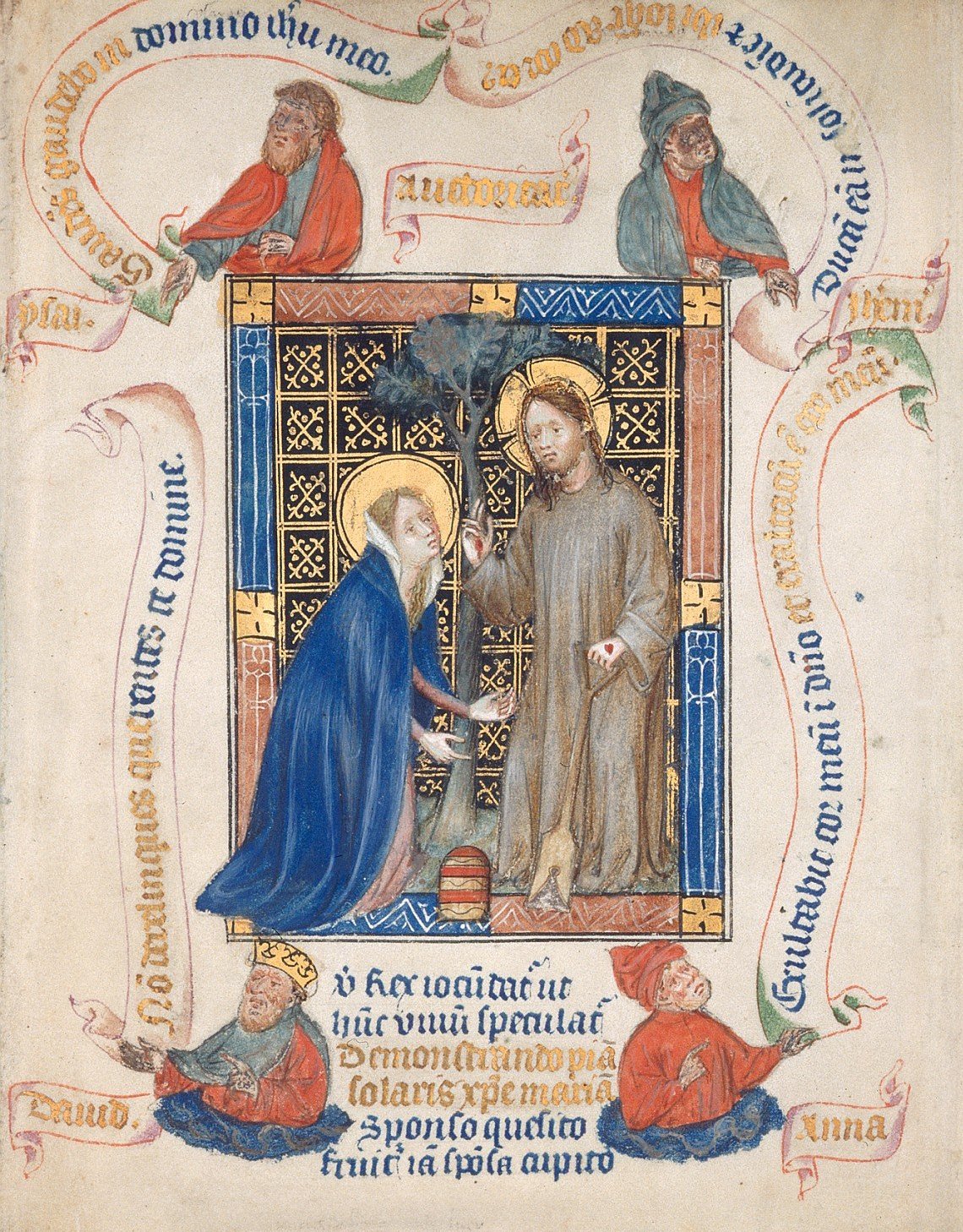
She mistook him for the gardener

In his Gospel John records that on the Sunday morning following Jesus’s crucifixion, Mary Magdalene went to the tomb and, finding it empty, started to weep, for she thought someone had taken the body. In her worry and frustration, she “turned around and saw Jesus standing, but she did not know that it was Jesus . . . supposing him to be the gardener” (John 20:14–15). It isn’t until he says her name that she recognizes him.

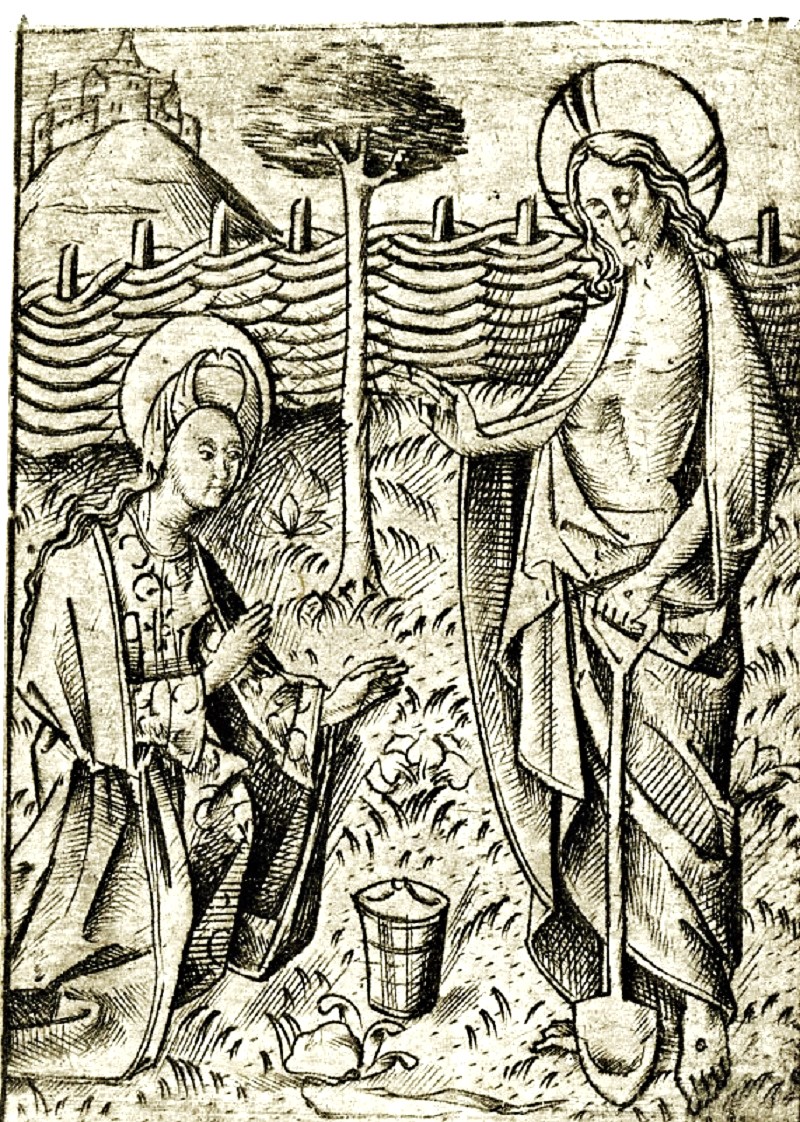
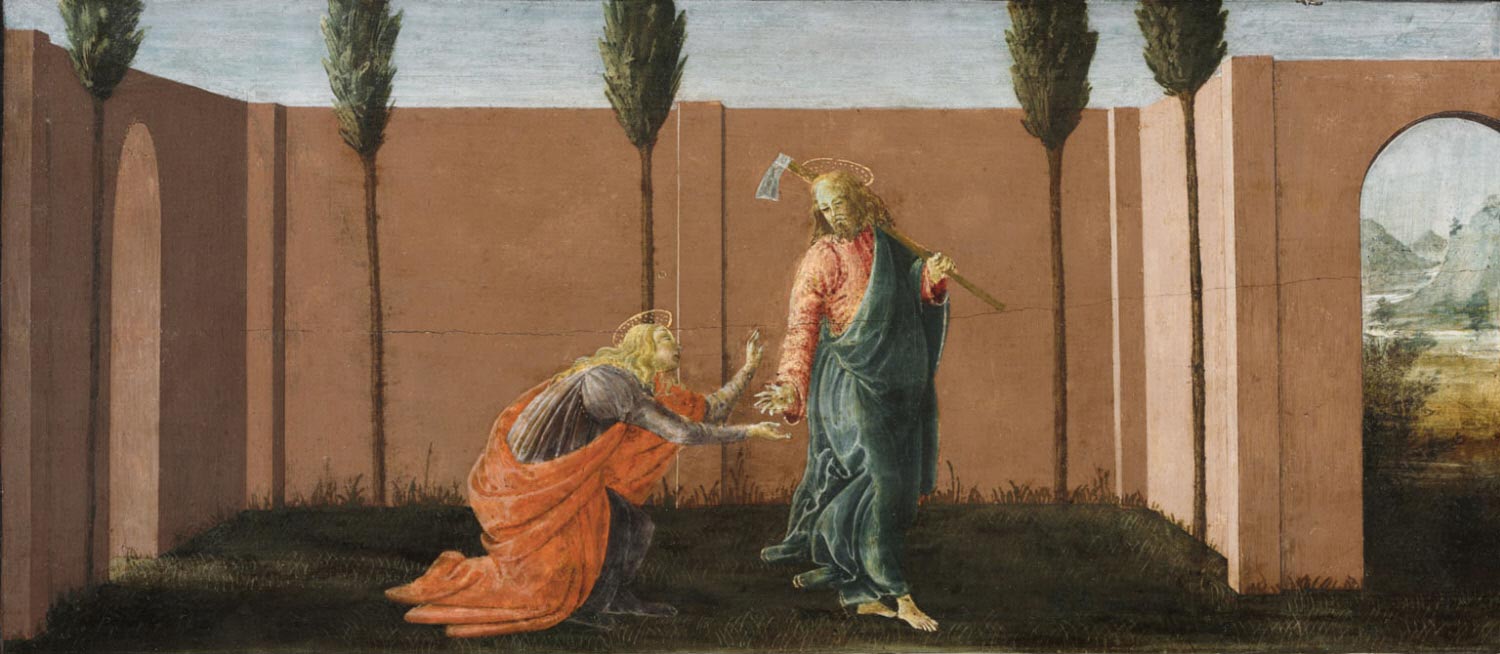
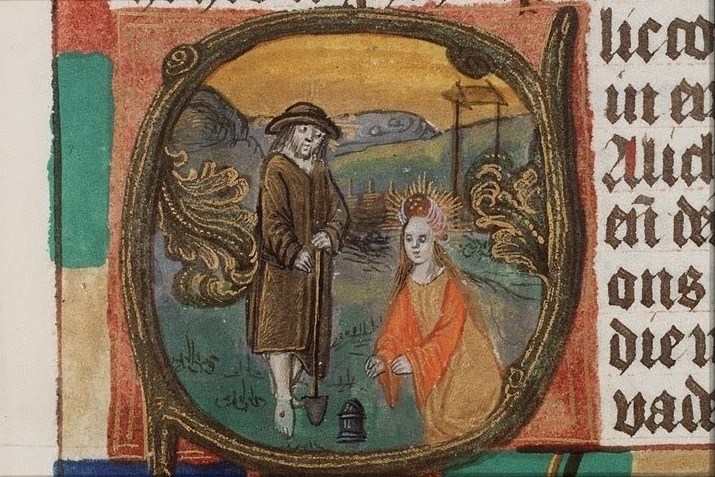
Artists—mainly from the fifteenth and sixteenth centuries—have latched onto this detail of mistaken identity, representing Jesus carrying gardening tools, like a shovel or a hoe, and sometimes sporting a floppy gardener’s hat. A few artists, such as Lavinia Fontana, Rembrandt, and the illuminators of the book of hours and passional shown below, have even shown Jesus in full-out gardener’s getup. (In her commentary on John, Dr. Jo-Ann A. Brant mentions that the fact that Jesus left his burial clothes in the tomb, coupled with Mary’s confusion, might provoke the “fanciful speculation” that Jesus actually borrowed the gardener’s clothes. Nevertheless, a different understanding is more likely behind the artistic representations; read on.)

Noli me tangere by Jacopo di Cione
Attributed to Jacopo di Cione (Italian, 1365–1398/1400), Noli me tangere, ca. 1368–70. Pinnacle panel from a Florentine altarpiece, now in the collection of the National Gallery, London.

Jesus Appears to Mary Magdalene
Jesus Appears to Mary Magdalene, from a Biblia Pauperum (typological picture book), ca. 1405, Netherlands. British Library, London.

Noli me tangere by Fra Angelico
Fra Angelico (Italian, ca. 1395–1455), Noli me tangere, 1440–42. Fresco from the convent of San Marco, Florence, Italy. [commentary by Georges Didi-Huberman]

Noli me tangere by Israhel van Meckenem
Israhel van Meckenem (German, ca. 1445–1503), Noli me tangere, 1460–1500. Engraving. British Museum, London.

Noli me tangere by Sandro Botticelli
Sandro Botticelli (Italian, 1445–1510), Noli me tangere, ca. 1484–91. Predella panel from an altarpiece from the convent of Sant’Elisabetta delle Convertite, Florence, Italy, in the collection of the Philadelphia Museum of Art.

Jesus as Gardener (Book of Hours)
Master of the Dark Eyes, “Christ Appears to St. Mary Magdalene as a Gardener,” from The Hours of the Eternal Wisdom: Lauds (KB, 76 G 9), fol. 88r, ca. 1490. Koninklijke Bibliotheek (National Library of the Netherlands), The Hague.

Jesus as Gardener (cca. 1503)
“Christ Appears to Mary Magdalene as a Gardener” (detail), ca. 1503–1504, England. Fol. 134v, Vaux Passional (Peniarth 482D), National Library of Wales.

Continue reading “She mistook him for the gardener”