Occurring forty days after Easter, Ascension Day is this Thursday, May 14, and will be celebrated by many churches on Sunday, honoring Jesus’s ascent to heaven. This historic event “represents both a conclusion and a commencement,” writes Ashley Tumlin Wallace: “Jesus finished his earthly work while setting into motion the gift of the Holy Spirit and the birth of the Church.” Below are a few items for the occasion.
QUOTE: “In the mystery of the Ascension we reflect on the way in which, in one sense, Christ ‘leaves’ us and is taken away into Heaven, but in another sense he is given to us and to the world in a new and more universal way. He is no longer located only in one physical space to the exclusion of all others. He is in the Heaven which is at the heart of all things now and is universally accessible to all who call upon Him. And since His humanity is taken into Heaven, our humanity belongs there too, and is in a sense already there with him. ‘For you have died,’ says St. Paul, ‘and your life is hidden with Christ in God.’ In the Ascension Christ’s glory is at once revealed and concealed, and so is ours.”—Malcolm Guite
+++
ARTICLE: “Ten Reasons to Celebrate Ascension Day” by John Witvliet, Reformed Worship: John Witvliet, senior scholar and professor of theology, worship, and the arts at Belmont University, answers the question “Why does Ascension Day matter?” He concludes with two book recommendations and some suggestions for corporate worship.
+++
ALBUM: Ascension Songs by Cardiphonia: This compilation album from 2012 features nineteen traditional hymns about Christ’s ascension, seventeen of which have been retuned by contemporary singer-songwriters and worship leaders. I featured one by Sarah Majorins back in 2019; here are two other favorites, the latter from the Sacred Harp tradition:
>> “Today Our Lord Went Up On High” | Words by Johann Zwick, 1542; trans. Catherine Winkworth, 1858 | Music by Rebekah Osborn, 2012
>> “Jesus, My All, to Heav’n Has Gone” | Words by John Cennick, 1743 | Music (NORTH PORT) by R. R. Osborne, 1850 | Arranged by Bruce Benedict, 2010
(Related post: “A Hymn of Glory Let Us Sing”)
+++
ORATORIO: Lobet Gott in seinen Reichen (Praise God in His Realms) by J. S. Bach: Known as the Ascension Oratorio, Bach’s BWV 11 was composed for the Feast of the Ascension almost three centuries ago. It is structured in eleven movements in two parts and runs about a half hour. Its libretto comprises some original texts (likely written by the German poet and Bach’s regular collaborator Picander) as well as quotations from the Bible and hymns by Johann Rist and Gottfried Wilhelm Sacer. It both mourns Christ’s bodily departure and extols his universal reign.
The oratorio’s closing chorale fantasia (starting at 25:48 in the video above) is often cited as one of many examples of Bach’s sophisticated expression of theology through music. The orchestra plays in D major while the chorus sings in B minor—“When shall it happen, / When will the dear time come, / That I shall see him / In his glory?”—conveying the human state of waiting and hoping for Christ’s return and the fulfillment of that hope. Both jaunty and full of longing, and harmonious between the two, movement 11 anticipates the day when we will be reunited with Christ in the flesh. Craig Smith writes,
The final chorale is an amazing tour de force. A verse set to the melody of the grave chorale “Von Gott will ich nicht lassen” is imbedded in the brilliant trumpet- and drum-dominated D Major texture of the orchestra. The B minor of the chorale never loses its identity but is simply swallowed up in the D Major. Bach understands the melancholy of being left behind, and profoundly includes it here in this ostensibly joyous festival.
The above performance from 2013 is by the Monteverdi Choir and English Baroque Soloists, conducted by John Eliot Gardiner. An English translation of the German lyrics is given as subtitles, but you can also follow along here.
+++
REFLECTION: “Let me go, because then the Spirit will come” by Jonathan Evens: Jonathan Evens, a vicar in the Church of England, shares the reflection he gave on Ascension Day at St Martin-in-the-Fields in London in 2020, which concludes with a verse-style meditation that I really like. Here’s the first stanza:
Touch me not.
I am not yours
to have and hold,
in this shape
in this form.
Let go.
Let me go.
Let my Spirit come.
Divine my Spirit,
know me
within.
+++
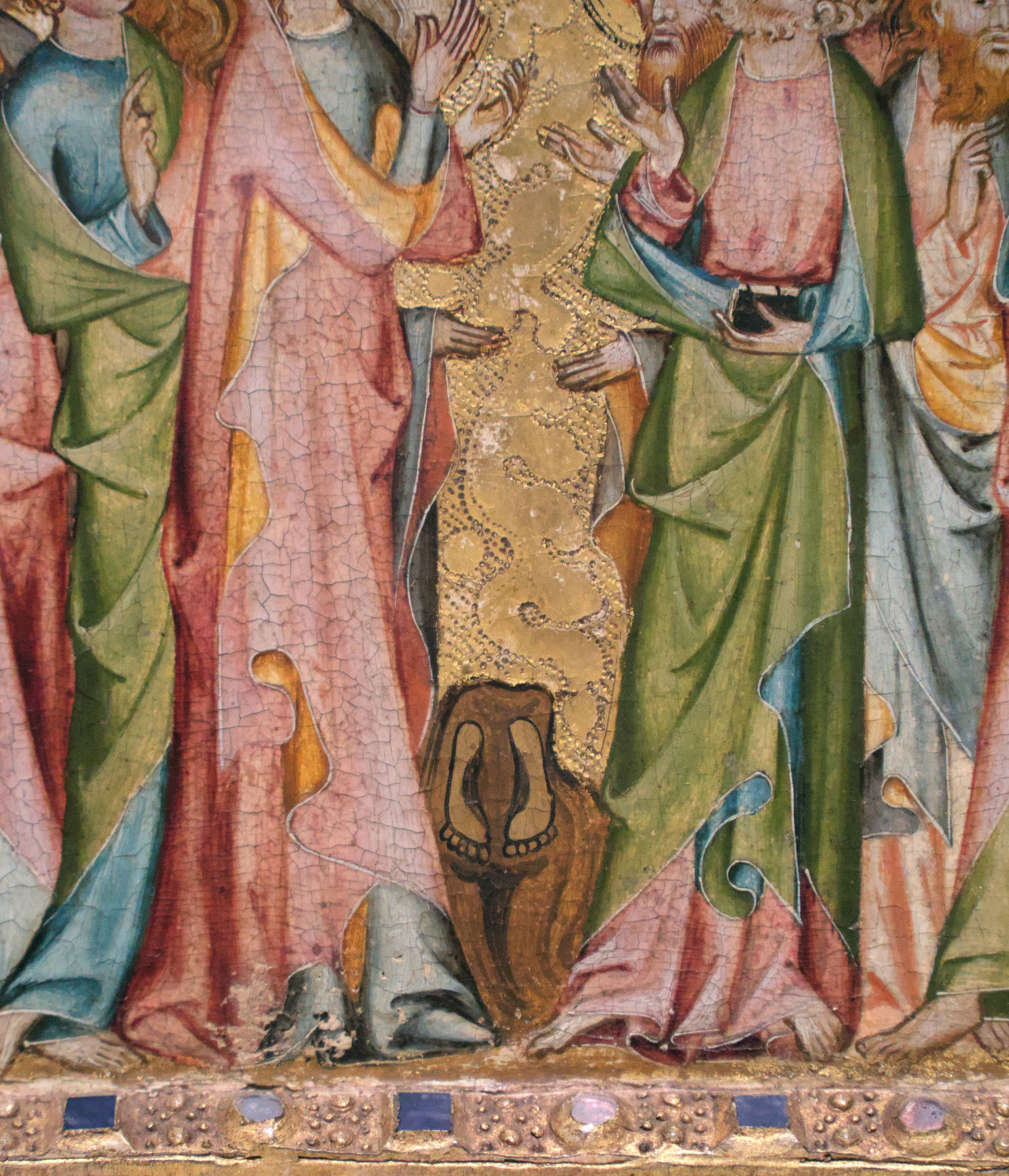
PAINTING: The Ascension, ca. 1340–50: Last fall while I was in Cologne, I visited the Wallraf-Richartz-Museum, which has an excellent collection of medieval German art. Here’s a lovely little Ascension painting I saw:
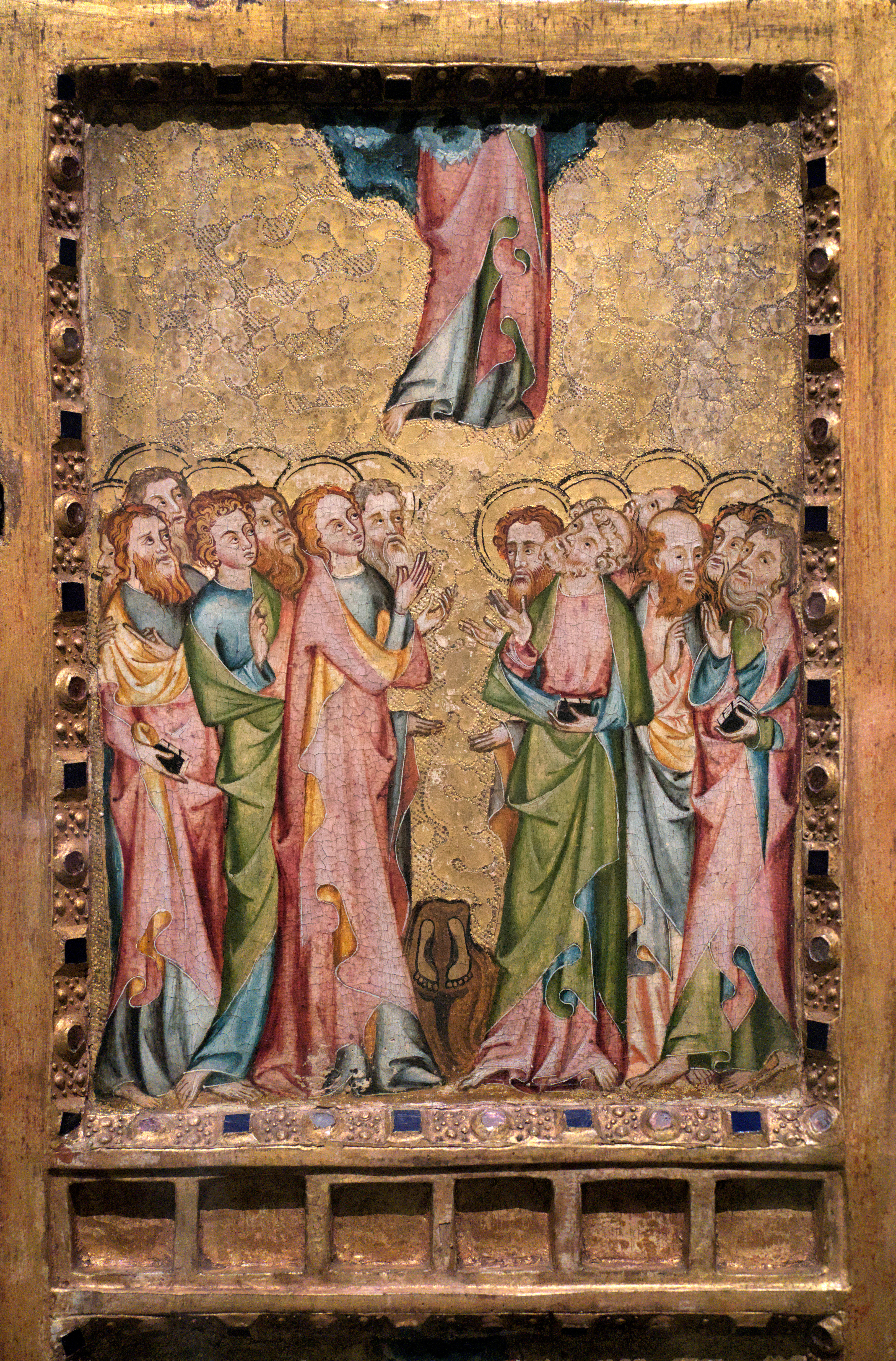
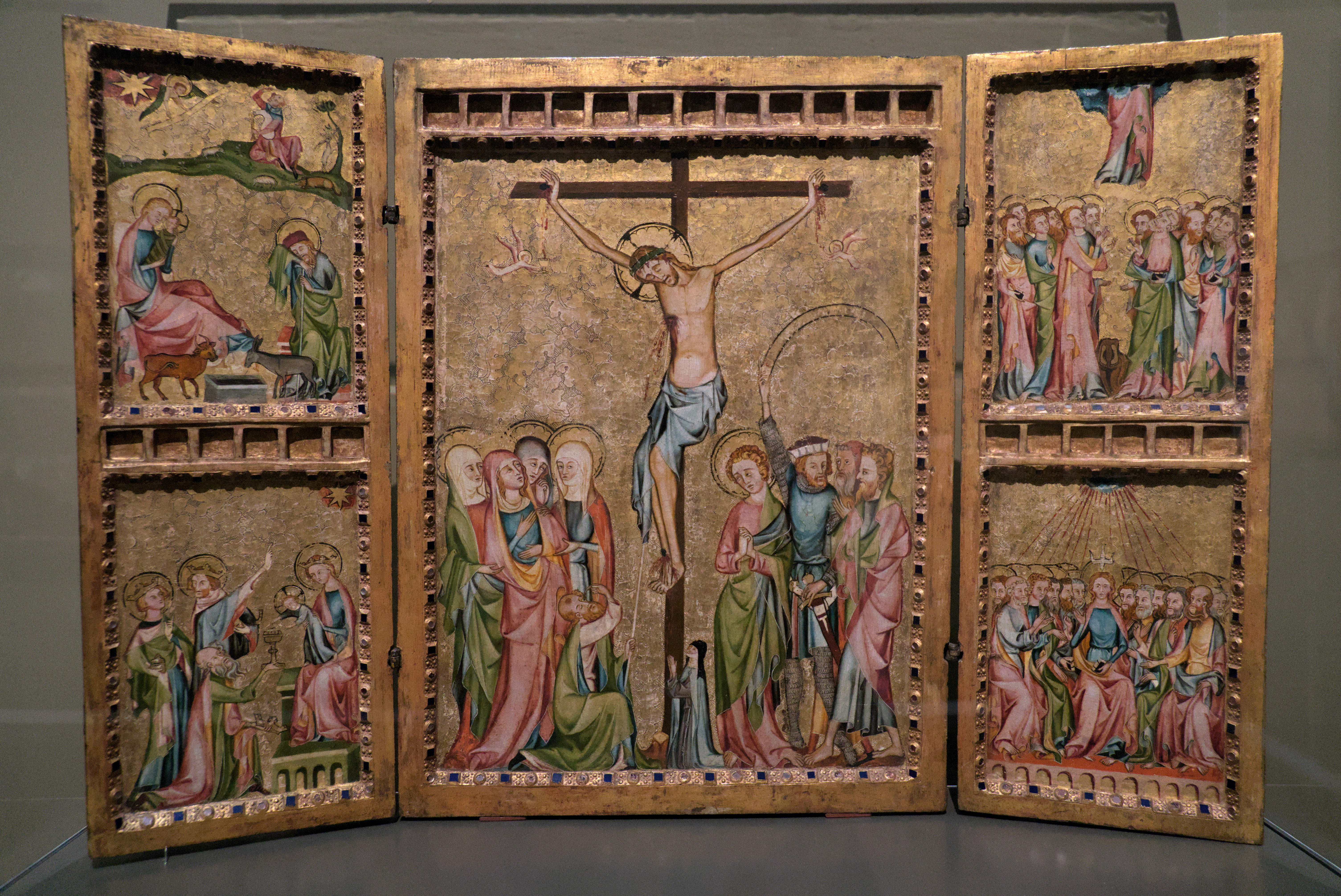
It’s from a small triptych made in the mid-fourteenth century in a Cologne workshop for a Poor Clares cloister in the city. The object would have been used by the nuns for private contemplation. Its central scene is the Crucifixion, and the wings portray, in addition to the Ascension: the Nativity, the Adoration of the Magi, and the Descent of the Holy Spirit.
As is common in medieval paintings of the Ascension, that panel shows Jesus from the waist down, rising out of frame, leaving behind a set of footprints on the Mount of Olives. To me, that physical impression is a reminder of how Jesus, the God-man, has a body—he walked the earth in it, feeling dirt between his toes, and went to heaven with it, prefiguring the day when those who are in Christ will also, soul and body, join the Father in glory. That little mark on the mound, a negative space where Jesus’s weight once pressed, speaks both presence and absence. Ten days later, he’d send down his Spirit on the same gazing group, and many more besides, and their beautiful feet would carry the good news of his risen life far and wide.