Ascension Day Roundup

Occurring forty days after Easter, Ascension Day is this Thursday, May 14, and will be celebrated by many churches on Sunday, honoring Jesus’s ascent to heaven. This historic event “represents both a conclusion and a commencement,” writes Ashley Tumlin Wallace: “Jesus finished his earthly work while setting into motion the gift of the Holy Spirit and the birth of the Church.” Below are a few items for the occasion.

QUOTE: “In the mystery of the Ascension we reflect on the way in which, in one sense, Christ ‘leaves’ us and is taken away into Heaven, but in another sense he is given to us and to the world in a new and more universal way. He is no longer located only in one physical space to the exclusion of all others. He is in the Heaven which is at the heart of all things now and is universally accessible to all who call upon Him. And since His humanity is taken into Heaven, our humanity belongs there too, and is in a sense already there with him. ‘For you have died,’ says St. Paul, ‘and your life is hidden with Christ in God.’ In the Ascension Christ’s glory is at once revealed and concealed, and so is ours.”—Malcolm Guite

+++

ARTICLE: “Ten Reasons to Celebrate Ascension Day” by John Witvliet, Reformed Worship: John Witvliet, senior scholar and professor of theology, worship, and the arts at Belmont University, answers the question “Why does Ascension Day matter?” He concludes with two book recommendations and some suggestions for corporate worship.

+++

ALBUM: Ascension Songs by Cardiphonia: This compilation album from 2012 features nineteen traditional hymns about Christ’s ascension, seventeen of which have been retuned by contemporary singer-songwriters and worship leaders. I featured one by Sarah Majorins back in 2019; here are two other favorites, the latter from the Sacred Harp tradition:  

>> “Today Our Lord Went Up On High” | Words by Johann Zwick, 1542; trans. Catherine Winkworth, 1858 | Music by Rebekah Osborn, 2012

>> “Jesus, My All, to Heav’n Has Gone” | Words by John Cennick, 1743 | Music (NORTH PORT) by R. R. Osborne, 1850 | Arranged by Bruce Benedict, 2010

(Related post: “A Hymn of Glory Let Us Sing”)

+++

ORATORIO: Lobet Gott in seinen Reichen (Praise God in His Realms) by J. S. Bach: Known as the Ascension Oratorio, Bach’s BWV 11 was composed for the Feast of the Ascension almost three centuries ago. It is structured in eleven movements in two parts and runs about a half hour. Its libretto comprises some original texts (likely written by the German poet and Bach’s regular collaborator Picander) as well as quotations from the Bible and hymns by Johann Rist and Gottfried Wilhelm Sacer. It both mourns Christ’s bodily departure and extols his universal reign.

The oratorio’s closing chorale fantasia (starting at 25:48 in the video above) is often cited as one of many examples of Bach’s sophisticated expression of theology through music. The orchestra plays in D major while the chorus sings in B minor—“When shall it happen, / When will the dear time come, / That I shall see him / In his glory?”—conveying the human state of waiting and hoping for Christ’s return and the fulfillment of that hope. Both jaunty and full of longing, and harmonious between the two, movement 11 anticipates the day when we will be reunited with Christ in the flesh. Craig Smith writes,

The final chorale is an amazing tour de force. A verse set to the melody of the grave chorale “Von Gott will ich nicht lassen” is imbedded in the brilliant trumpet- and drum-dominated D Major texture of the orchestra. The B minor of the chorale never loses its identity but is simply swallowed up in the D Major. Bach understands the melancholy of being left behind, and profoundly includes it here in this ostensibly joyous festival.

The above performance from 2013 is by the Monteverdi Choir and English Baroque Soloists, conducted by John Eliot Gardiner. An English translation of the German lyrics is given as subtitles, but you can also follow along here.

+++

REFLECTION: “Let me go, because then the Spirit will come” by Jonathan Evens: Jonathan Evens, a vicar in the Church of England, shares the reflection he gave on Ascension Day at St Martin-in-the-Fields in London in 2020, which concludes with a verse-style meditation that I really like. Here’s the first stanza:

Touch me not.
I am not yours
to have and hold,
in this shape
in this form.
Let go.
Let me go.
Let my Spirit come.
Divine my Spirit,
know me
within.

+++

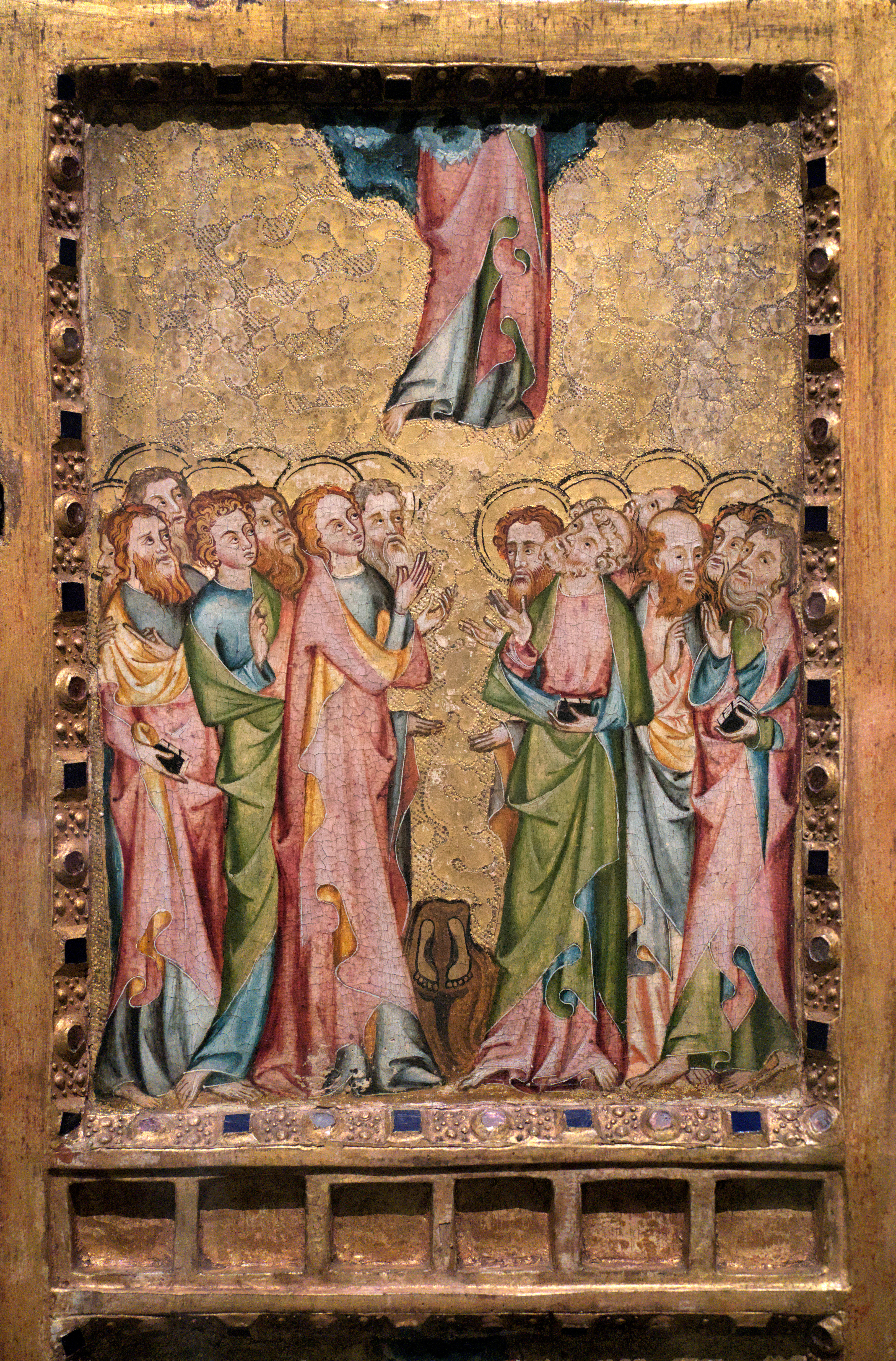
PAINTING: The Ascension, ca. 1340–50: Last fall while I was in Cologne, I visited the Wallraf-Richartz-Museum, which has an excellent collection of medieval German art. Here’s a lovely little Ascension painting I saw:
Ascension (Cologne)

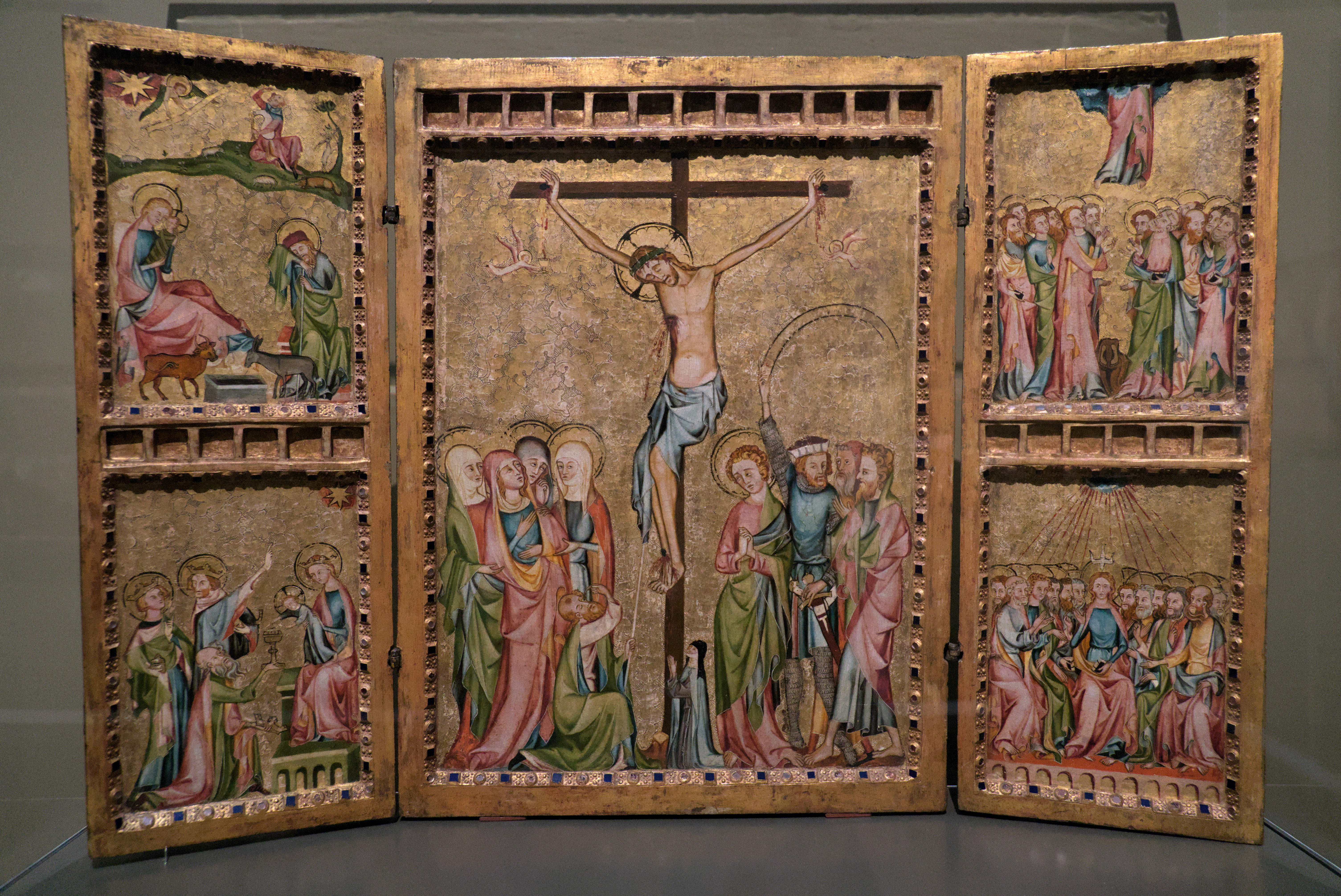
It’s from a small triptych made in the mid-fourteenth century in a Cologne workshop for a Poor Clares cloister in the city. The object would have been used by the nuns for private contemplation. Its central scene is the Crucifixion, and the wings portray, in addition to the Ascension: the Nativity, the Adoration of the Magi, and the Descent of the Holy Spirit.
Triptych with Depiction of the Outworking of God's Plan for Salvation
Triptych with Depiction of the Outworking of God’s Plan for Salvation, Cologne, ca. 1340–50. Tempera on oak. Wallraf-Richartz-Museum, Cologne, Inv. 1. Photo: Victoria Emily Jones.

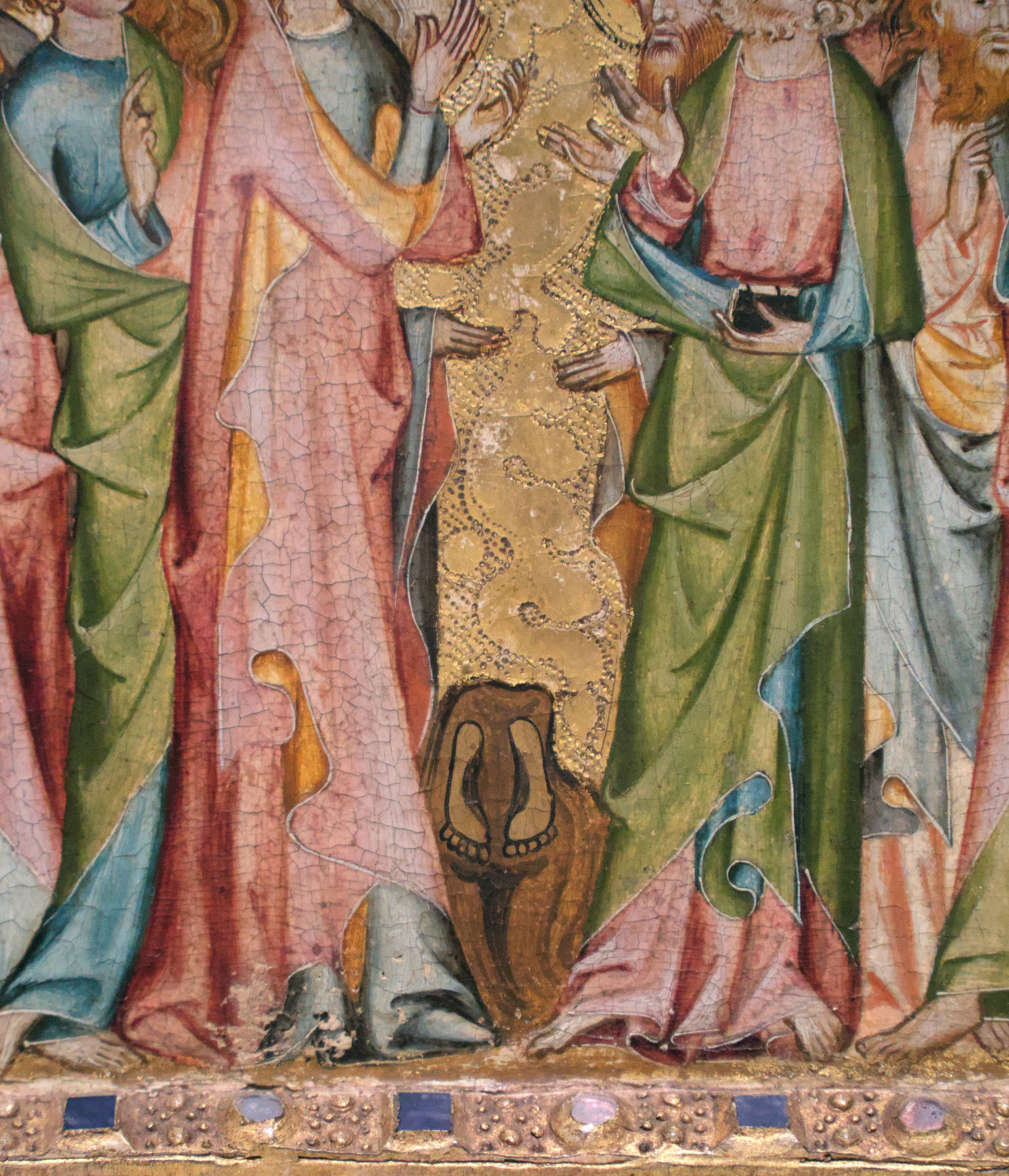
As is common in medieval paintings of the Ascension, that panel shows Jesus from the waist down, rising out of frame, leaving behind a set of footprints on the Mount of Olives. To me, that physical impression is a reminder of how Jesus, the God-man, has a body—he walked the earth in it, feeling dirt between his toes, and went to heaven with it, prefiguring the day when those who are in Christ will also, soul and body, join the Father in glory. That little mark on the mound, a negative space where Jesus’s weight once pressed, speaks both presence and absence. Ten days later, he’d send down his Spirit on the same gazing group, and many more besides, and their beautiful feet would carry the good news of his risen life far and wide.
Footprints at the Ascension

Roundup: Korean-English worship, “God Breathed” by Ruth Naomi Floyd, John Witvliet on liturgical sincerity, and more

WORSHIP SERVICES:

In February I shared a few of the Vespers services offered at this year’s Calvin Symposium on Worship at Calvin University in Grand Rapids, Michigan, which I was privileged to attend. Here are two of the full-fledged services that give you a sense of what the larger corporate gatherings are like. (The theme was Ezekiel.) I love the cross-cultural sharing that goes on, learning new songs alongside others, getting refreshed by prayer and formed by liturgy, sitting under the teaching of wise ministers of God from various backgrounds, and taking Communion with friends new and old.

>> “God’s Glory Departs from Israel,” February 8, 2024 (with bilingual Korean-English music and liturgy): This worship service was led in Korean and English by the Woodlawn Christian Reformed Church Choir, directed by Chan Gyu Jang; the Living Water Church Worship Team, directed by Yohan Lee; and members of the Calvin University and Calvin Theological Seminary Korean communities. Rev. Dr. Anne Zaki from Evangelical Presbyterian Seminary in Cairo, Egypt, preached on Ezekiel 10–11.

This is an example of bilingual worship done really well! (I’ve seen it done poorly: with lack of communication of intention, one-sided involvement in the design or execution, inadequate pronunciation coaching for non-native speakers at the mic, unclear instructions that create confusion as to who is supposed to say or sing what, unintelligibility, etc.) I’m so grateful for all the creativity and thoughtfulness that went into creating this service—with a special shout-out to the bulletin designers and livestream technicians.

The bulletin provides this note on bilingual worship:

Two languages are intertwined together in this bilingual service. At times, words are spoken in one language, and their translation—unspoken—is provided on the righthand column; at times, the leaders demonstrate to the congregation how to sing or speak the words through transliteration; and at other times, the leaders and congregation converse in both languages, providing meaning to each other, so that no word sung or spoken is left unintelligible. We seek understanding and order in the sharing of our gifts.

In our pursuit, however, we practice patience and hospitality. In this service, we are called not only to speak and sing, but also to listen, to take turns. By listening, we create a room—a shelter—for travelers and strangers in this land, since language and music have power to transport one’s soul homeward. By taking turns, we practice the pace and posture of dialogue, even monolingual dialogue.

Beautiful! Here are three songs I’ll call out for special attention:

  • 9:14: “Joo-yeo, Come, O Lord” by Sunlac Noh: This song, which is particularly well suited for Advent, originated in the Anglican Church of Korea and was translated into English last year by Martin Tel (see podcast interview below). The version we sang at the symposium preserves two of the Korean titles for Jesus.
  • 23:36: 우리에게 향하신 (Woo-ri-e-ge Hyang-ha-shin) (Never-Ending Is God’s Love) by Jin-ho Kim, based on Psalm 117:2: Sung entirely in Korean, this was used as a refrain during the Assurance of Pardon and the Prayers of the People. A simple, repeated line, either sung or spoken, is a good way to involve non-native speakers of a given language.
  • 1:14:37: 주님 다시 오실 때까지 / Rise, My Soul, Till Jesus Comes Again” by Hyeong-won Koh: The closing song is a charge to continue in the way of Jesus, all the way Home. The vocalists on stage sang the song themselves in its original Korean the first time through, and then we all joined in in English for the second time.

All the song credits are provided in full in the YouTube video description.

>> “The Valley of Dry Bones,” February 8, 2024: Rev. Dr. Brianna K. Parker from Dallas, founder of Black Millennial Café, preached on the famous Ezekiel 37 passage, and the Calvin University Gospel Choir, directed by Nate Glasper, led music, along with guest artist Ruth Naomi Floyd.

I want to especially draw your attention to 23:31, where Floyd premieres an extraordinary new song of hers, “God Breathed.” It opens and closes with a flute, and in between are her powerful jazz vocals, singing an original poetic text based on Ezekiel 37, accompanied by James Weidman on piano. (Update: Here’s a standalone video of the song.)

+++

PODCAST EPISODE: “Fighting Back Against the Storms of Life with Martin Tel,” Psalms for the Spirit: Host Kiran Young Wimberly interviews Martin Tel, director of music at Princeton Theological Seminary and senior editor of Psalms for All Seasons: A Complete Psalter for Worship (2012), about the Psalms—the importance of psalm singing in his Dutch Reformed upbringing; the Psalms as a form of resistance and protest; the Psalms as a means of praying our own prayers and those of others; our need to overhear some psalms as being prayed against us (that is, have you considered that you might be someone else’s oppressor?); and ideas for framing a psalm with a refrain, such as these:

  • Combine the Charles Albert Tindley gospel song “The Storm Is Passing Over” with Psalm 57 (“In the shadow of your wings I will take refuge, until the destroying storms pass by . . .”). Sing into the storm.
  • Choose a Gospel passage of someone in deep lament (e.g., the ten lepers in Luke 17:11–19), surround it with Psalm 88, and have the congregation sing “Kum Ba Yah” (Gullah for “Come by Here”) in minor mode as a refrain (“Someone’s crying, Lord . . .”). A choir can hum the spiritual while the reader(s) read the scriptures.
  • Intersperse the verses of Psalm 14 (“Fools say in their heart, ‘There is no God.’ . . . They have all gone astray . . .”) with the refrain “Prone to wander, Lord, I feel it . . .” to help the congregation members see their own foolishness instead of assuming it’s someone else who’s the fool.

+++

ARTICLE: “The Mysteries of Liturgical Sincerity” by John Witvliet, Worship (reprinted Pray Tell), May 2018: Some Protestants accuse the more liturgically inclined Christians, like me, of not valuing sincerity in worship because we value prewritten prayers and other set forms. But just because something is scripted or done habitually does not make it “rote” or “empty.”

“Among my mostly Protestant students, no theme is more contested, misunderstood, or cherished” than sincerity, writes John D. Witvliet, director of the Calvin Institute of Christian Worship and professor of worship, theology, and congregational and ministry studies at Calvin University and Calvin Theological Seminary. In this article he explores several different definitions of sincerity, which vary widely across cultures, centuries, philosophical frameworks, and Christian traditions, and then offers six “corrective lenses” to common astigmatisms in the free-church Protestant way of viewing the world: outside-in sincerity, vicarious sincerity, trait sincerity, symbiotic sincerity, sincerity as gift, and aspirational sincerity.

This article is SO GOOD. I have been greatly influenced over the years by Dr. Witvliet’s teachings on liturgical formation, and I strongly encourage you all to read this piece.

+++

EKPHRASTIC POEMS:

An ekphrastic poem is a poem written in response to a work of visual art. Here are two examples I like from the past two years:

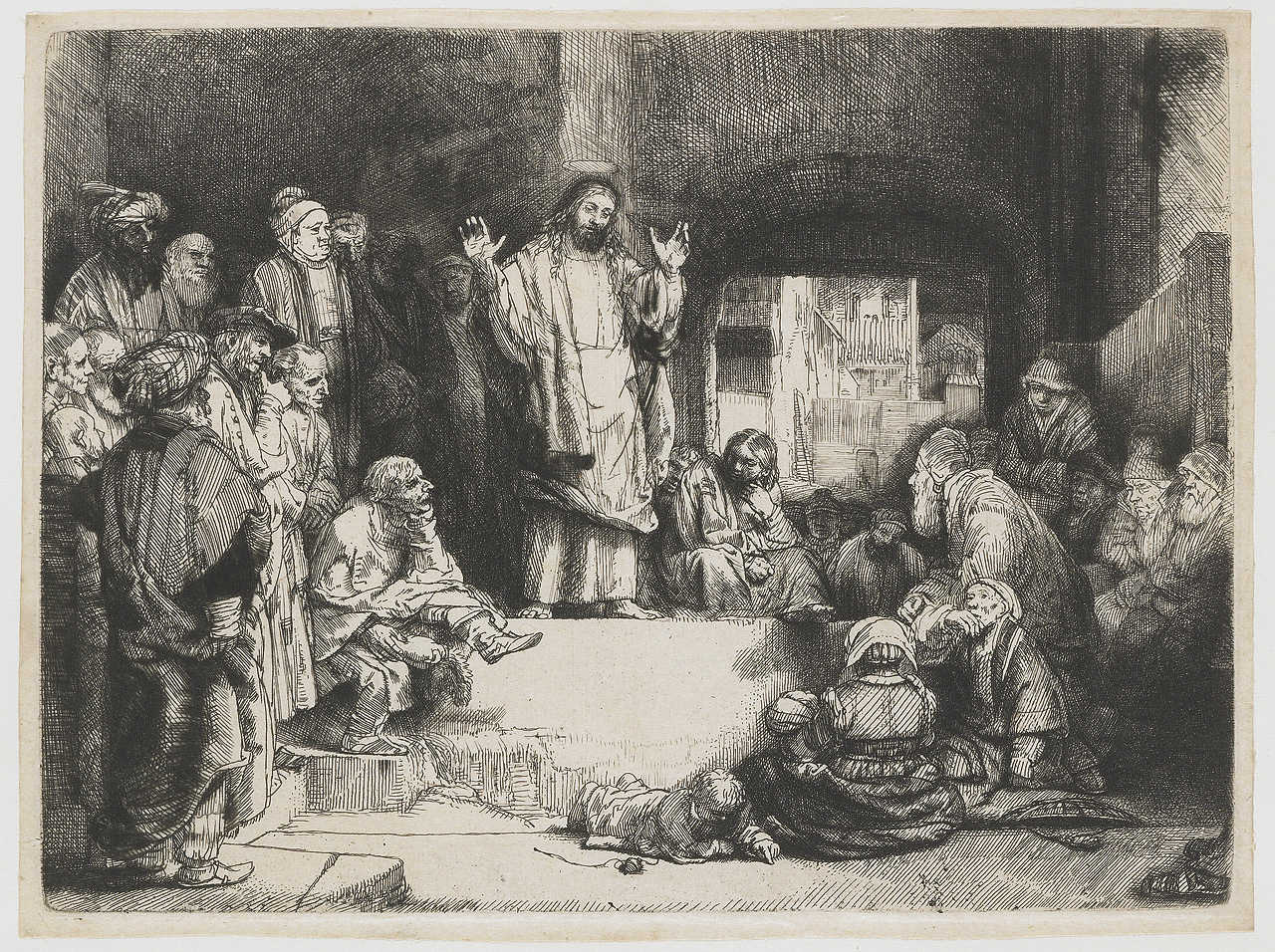
>> “Christ Preaching” by Keene Carter, Image: “I forgive the absent boy,” begins this poem based on a Rembrandt etching, directing our attention to the young child in the foreground who has turned away, disinterested, from Jesus’s sermon, drawing on the ground instead. Jesus gives grace to those in the crowd with averted gazes or who are distracted, simply continuing to preach on on the virtue of empathy—of seeing yourself in others—and on true life.

Rembrandt_Christ Preaching (1652)
Rembrandt van Rijn (Dutch, 1606–1669), Christ Preaching (La Petite Tombe), ca. 1652. Etching, engraving, and drypoint on paper, 6 1/4 x 8 5/16 in. (15.9 × 21.1 cm). National Gallery of Art, Washington, DC.

>> “L’Angélus” by Seth Wieck, Grand Little Things: The Angelus is a traditional Christian prayer whose name comes from its opening words in Latin, “Angelus Domini” (The angel of the Lord). For centuries it was prayed by the faithful three times a day—at 6 a.m., noon, and 6 p.m.—the times announced by the ringing of bells from church towers. In the nineteenth century Millet famously painted two peasant farmers at dusk pausing from their labor in the fields to bow their heads and pray the Angelus. Seth Wieck interprets the painting through poetry, homing in on the part of the prayer that says, “Let it be done to me according to thy word,” expressing an attitude of surrender to God’s will. Wieck imagines the hard life of the man and woman shown pulling up potatoes from the earth—the same earth in which, shortly hence, they’ll bury a child, lost to sickness. The poem becomes a meditation on death, harvest, and acceptance.

Millet, Jean-Francois_The Angelus
Jean-Franҫois Millet (French, 1814–1875), The Angelus, 1857–59. Oil on canvas, 55.5 × 66 cm. Musée d’Orsay, Paris.


DONATE

I am committed to keeping all Art & Theology posts freely available to all; no paywalls here. To help me make a part-time living developing content for the site, would you consider donating to the work, or supporting my research by buying me a book from my Amazon wish list? I appreciate it!

7 Hours of Interviews on Religion and the Arts

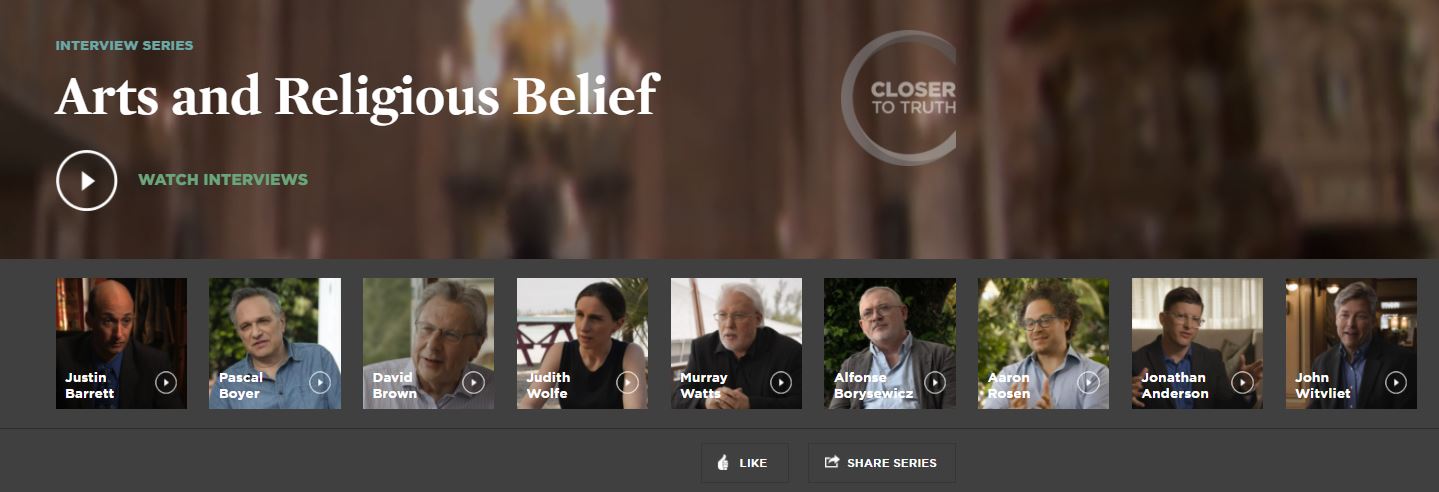
Created, written, and hosted by Robert Lawrence Kuhn, Closer To Truth is a public television series that explores fundamental questions relating to the cosmos, consciousness, religion, and the search for ultimate reality and purpose. The program boasts a robust website featuring over four thousand video interviews with scientists, philosophers, theologians, artists, and other scholars and practitioners.

I am particularly interested in the seven hours’ worth of interviews on art and religion/God that fall under the “Art Seeking Understanding” rubric. They are separated into three- to twelve-minute segments spread across these eight topical series:

  • Art and the Philosophy of Religion: “Can art inform topics in philosophy of religion? Can the existence and varieties of art address or affect theological questions about God, faith, belief, worship?”
  • Arguing God from the Arts?: “Is it possible to infer something of the nonphysical, divine existence of God from the physical, human existence of art? Can one argue for God from art?”
  • Can the Arts Reveal God’s Traits?: “If God is the Creator of human beings and art is a feature of human sentience, then can examining the arts help discern characteristics of God? Can one infer from various aspects of art various traits of God?”
  • Arts and Religious Experience: “What is the relationship between experiencing art and experiencing God? Can the arts generate or trigger religious experience? If so, can it be validated?”
  • Arts and Religious Belief: “Is there a relationship between diverse arts and belief in God? Can the arts express or encourage religious belief? If so, can it be validated?” (*This is my favorite.)
  • Arts and Religious Practice (Liturgy): “Why are the arts so deeply embedded in religious settings and services? How do the arts work in religious spaces and activities? What are differences among the arts, say music and painting, in the liturgy?” (*This is my second favorite!)
  • Arts and Religious Reality: “Art is deeply involved in the practice of religion, embedded in the rituals and liturgy of almost every religion. But how could the ubiquity of the arts in religion affect whether or not religion is real?”
  • Co-Evolution of Art and Religion: “Did art and religion co-evolve in parallel as archeology and anthropology suggest, and if so, what would be the significance? What do art and religion have in common that could enable their common, co-temporal development?”
Closer to Truth screen cap

Interviewees include Nicholas Wolterstorff, Matthew Milliner, Jonathan A. Anderson, Judith Wolfe, Aaron Rosen, Alfonse Borysewicz, John Witvliet, and others. I’m disappointed by the lack of diversity among interviewees—the program is very heavy on white male Christians—but I am nevertheless grateful for the wisdom these individuals share, and for the efforts of the Closer To Truth team to coax it out, capture it onscreen, and present it freely to the public.

Here are a few interviews I’ll call your attention to:

These videos and many more can also be found on Closer To Truth’s YouTube channel.