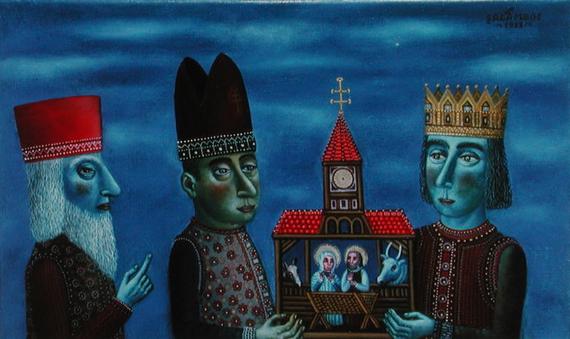
Tamás Galambos (Hungarian, 1939–), The Adoration of the Magi, 1988. Oil on canvas.
When that our gentle Lord was born
And cradled in the hay,
There rode three wise men from the east—
Three rich wise men were they—
And in the starry night they came
Their homage gifts to pay.
They got them down from camel-back,
The cattle shed before,
And in the darkness vainly sought
A great latch on the door.
“Ho! this is strange,” quoth Balthazar,
“Aye, strange,” quoth Melchior.
Quoth Gaspar, “I can find no hasp;
Well hidden is the lock”;
“The door,” quoth Melchior, “is stout
And fast, our skill to mock”;
Quoth Balthazar, “The little King
Might wake, we dare not knock.”
The three wise men, they sat them down
To wait for morning dawn;
The cunning wards of that old door
They thought and marveled on;
Quoth they, “No gate in all the East
Hath bar-bolts tighter drawn.”
Anon there came a little lad
With lambskins for the King;
He had no key, he raised no latch,
He touched no hidden spring,
But gently pushed the silent door
And open it gan swing.
“A miracle! a miracle!”
Cried out the wise men three;
“A little child hath solved the locks
That could not opened be.”
In wonder spake the shepherd lad:
“It hath no locks,” quoth he.
This poem was originally published in Rune and Rann by George M. P. Baird (Pittsburgh: Aldine Press, 1916) and is in the public domain.
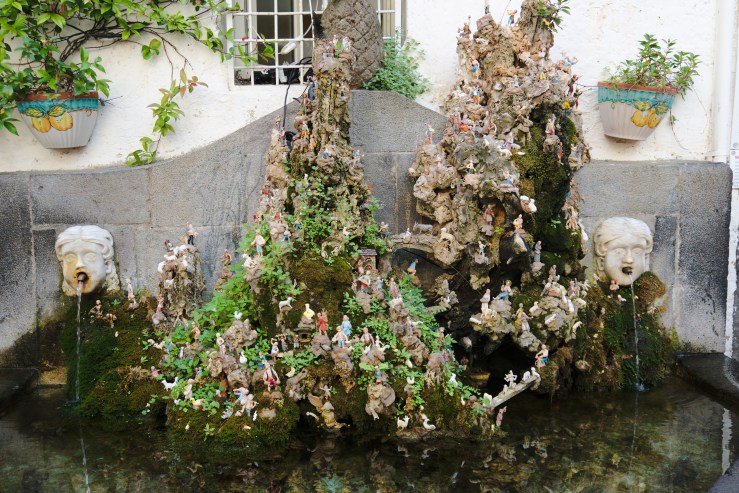
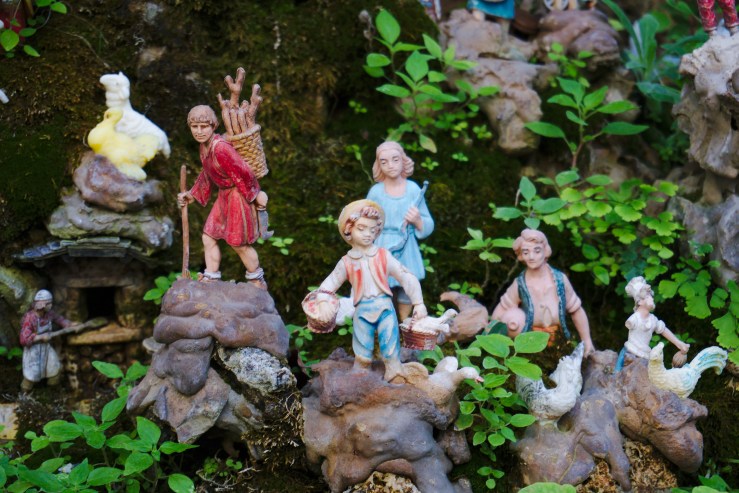
When Eric and I were in Amalfi on the southern coast of Italy last August, we chanced upon a charming little fountain just off the town’s main street in Piazza dello Spirito Santo. Built during the eighteenth century in stone, with two marble faces that spout water, it is known, in local dialect, as the Fontana de Cape ’e Ciucci (Donkey’s Head Fountain), since the donkeys arriving with heavy loads from the nearby mountain village of Pogerola would stop here for water.
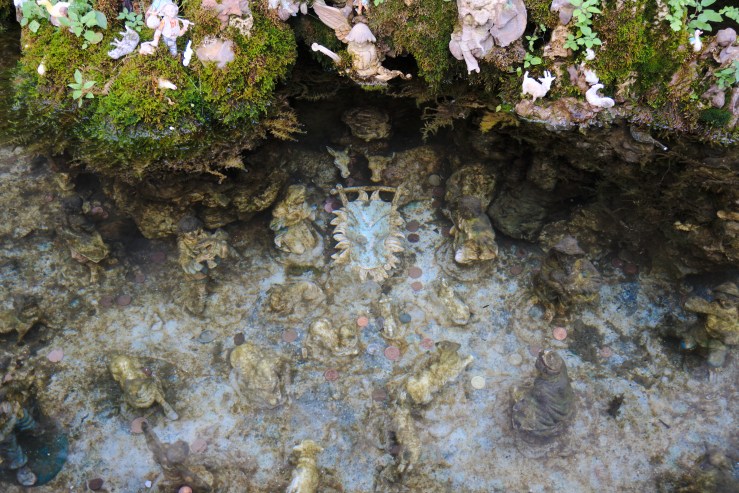
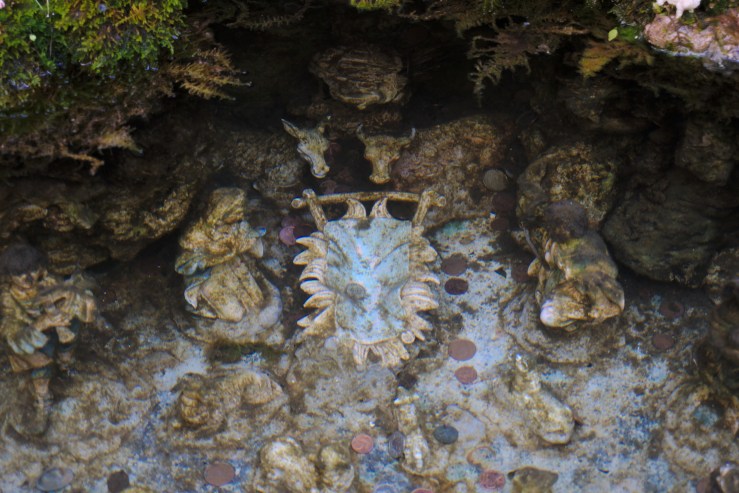
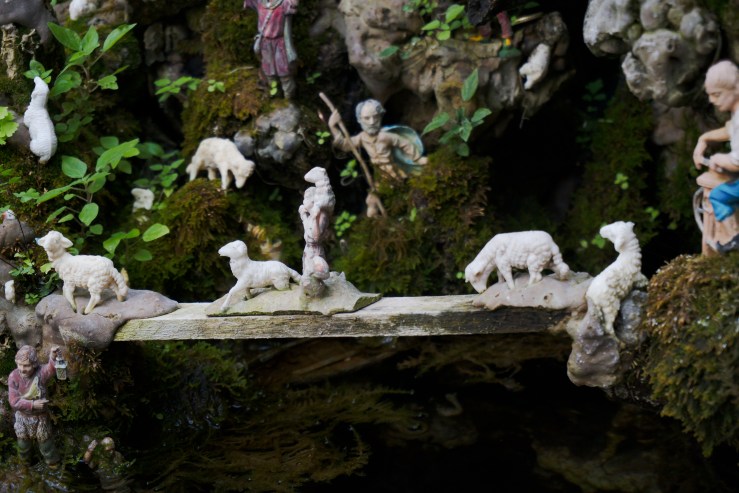
What makes the fountain unique, though, is the elaborate presepe (nativity scene) sited inside, an addition made in 1974 by Giuseppe Buonocore, Vincenzo Livano, and Nicola Pepe, who placed various small figurines on and around the rocky outcrop. Over the years, several of these figurines have become submerged by the flowing water. But a local family, the Infantes, takes care of maintaining the presepe, keeping it in decent condition.
Handmade presepi are a living tradition in and around Naples, and they are notable for their blending of the sacred and profane: biblical figures like the Holy Family, the shepherds, and the magi are set alongside vignettes of Neapolitan life in the eighteenth century (when the making of presepi was at its peak). Shoemakers and innkeepers, bakers and pizzaioli (pizza makers), fishmongers and butchers, carpenters and blacksmiths, bricklayers and fruit vendors and tailors—just ordinary people going about their everyday lives, with Jesus right in their midst (though in this case, it appears that he is missing from the manger! perhaps he is added at Christmas?). And in addition to the traditional ox and ass, there are geese, rabbits, ducks, chickens, and other native animal life present.
Photos by Victoria Emily Jones/ArtandTheology.org.
Christmas isn’t over yet, so I hope you’re still celebrating! As has been the case for centuries, many Christians spread their holiday festivities over twelve days, from December 25 to January 5, followed by the culminating feast of the Epiphany on January 6. Epiphany commemorates the visit of the magi to the Christ child and thus God’s physical manifestation to the Gentiles. In Spanish-speaking countries and communities, it’s commonly known as Three Kings Day. This year it just so happens to fall on a Sunday.
+++
Juan Cartagena, Los Tres Reyes Magos (The Three Kings), Puerto Rico, 19th century. Painted wooden bulto. Vidal Collection, National Museum of American History, Smithsonian Institution, Washington, DC.
Now after Jesus was born in Bethlehem of Judea in the days of Herod the king, behold, wise men from the east came to Jerusalem, saying, “Where is he who has been born king of the Jews? For we saw his star when it rose and have come to worship him.” . . .
After listening to the king, they went on their way. And behold, the star that they had seen when it rose went before them until it came to rest over the place where the child was. When they saw the star, they rejoiced exceedingly with great joy. And going into the house, they saw the child with Mary his mother, and they fell down and worshiped him. Then, opening their treasures, they offered him gifts, gold and frankincense and myrrh.
Los Jíbaros, also known as the Cuarteto Flores, were a popular and influential Puerto Rican group founded in New York in 1930 by Pedro Flores. Their name refers to the peasant farmers of Puerto Rico, who developed a style of mountain music, jibaro music, that’s rooted in music brought to the island by early settlers from Andalusia and Extremadura in southern and western Spain during the seventeenth century.
The jibaro song “Décimas de Nacimiento” is an aguinaldo (Christmas carol; literally “gift”) that comprises four décimas (ten-line stanzas) performed in dialogue. In this traditional poetic form, each line contains eight syllables and follows a rhyme scheme of ABBAABBAAB—but here the poet has adapted the scheme to ABBAACCDDC. The two singers perform to an accompaniment of three guitars and a guiro (scratch gourd).
En un pesebre nacio
A eso de la medianoche
Un niño que sin reproche
Clamaron hijo de Dios
Una estrella iluminó
El sitio donde María
Tenía en brazos al Mesías
Que acaba de nacer
Al que empezaban a ver
Al amanecer del día
Los tres magos soberanos De los reinos del Oriente Vinieron muy diligentes A ofrendar su Dios cristiano Y todo el mundo pagano Recuerda las profecías Pues sabian que nacería Pronto el hijo de Israel Y que lo iban a ver Al amanecer del día
Todas las aves cantaban Olian todas las flores Bonita luz y colores Las astros del cielo daban Los buenos sabios oraban Los réprobos se escondian En las pajas ya había Nacido el niño sonriente Se postró un mundo creyente Al amanecer del día
Y a través de las edades Recordando al soberano El universo cristiano Celebra las navidades Dice así, felicidades El humano se extasía Y aún pedimos al Mesías Hijo de María y José Que algo de su gracia nos dé Al amenecer del día
He was born in a manger
About midnight
An innocent child
Proclaimed the Son of God
A star shone upon
The place where Mary
Held our Savior in her arms
Who had just been born
They beheld him
At daybreak
The three wise men
From the Orient
Promptly came
To offer gifts to the Son of God
And all the pagan world
Remembered the prophecies
That foretold the birth
Of the Son of Israel
And they came to see him
At daybreak
All the birds were singing
All the flowers were perfumed
Stars in the sky were shedding
Beautiful light and colors
The wise men were praying
The scoundrels were hiding
Already, in the straw
The smiling child had been born
Everyone fell to their knees
At daybreak
Throughout the ages
In memory of our Sovereign
The Christian universe
Celebrates his birth
With good wishes
Humanity is ecstatic
And we still pray for the Messiah
Son of Mary and Joseph
To shed his grace upon us
At daybreak
This is one of many songs that might be heard at a parranda, a Puerto Rican caroling party that moves from house to house, lasting from around 10 p.m. to dawn on any given night of Christmas. The repertoire is a mix of sacred and secular songs, but unlike in the continental US, they are all festive and upbeat. As the carolers progress to each new stop, the head of that house invites them in for food and beverages. Parrandas are one of the leading social activities of the Christmas season on the island.
“Décimas de Nacimiento” was originally released by Columbia Records on vinyl in the 1930s. In 2004 it was reissued by Dust-to-Digital on a compilation Christmas album produced by folk music preservationist Lance Ledbetter and musicologist Dick Spottswood; there it appears alongside other rare recordings of American gospel, blues, and hillbilly music from the twenties and thirties.
Celebrated annually on January 6, El Día de los Tres Reyes Magos, or simply Three Kings Day, is one of the most important holidays on the Puerto Rican calendar—so much so that Puerto Ricans invented a verb, reyar, that means “to celebrate Three Kings Day.” On the eve of the holiday, children put a shoebox filled with straw under their beds for the animal transports, be they camels or horses, of the Three Kings, who visit their homes with presents between midnight and dawn. Children awake not only to gifts but also to a day of parades and feasting with family and friends. Old San Juan throws an annual festival at the Luis Muñoz Marín Park with live music, food and drink, and free gifts, but the highlight of the day occurs when the Three Kings come walking into town. They start from their unofficial hometown of Juana Díaz in the south and travel around the island, stopping to celebrate in various localities—but no celebration is larger than that in Old San Juan.
Los Tres Reyes Magos (The Three Kings), Puerto Rico, late 19th century. Painted wooden bulto by a member of the Rivera family. Vidal Collection, National Museum of American History, Smithsonian Institution, Washington, DC.
Not surprisingly, the Three Kings are among the most popular santos (handmade images of saints and other religious figures) in Puerto Rico. Since camels were unknown to earlier local santeros (makers of religious images), the Three Kings are typically shown riding Paso Fino horses. The gifts they bear may be the three traditional ones—gold, frankincense, and myrrh—or typical Puerto Rican gifts, such as musical instruments. In Puerto Rico, Melchior is shown with dark skin, and he is often given special prominence, especially by santeros of African descent.
The two bultos (small religious carvings) pictured above were gifted to the Smithsonian, along with 3,200-plus other objects, by Puerto Rican folk art collector Teodoro Vidal. Learn more about the Vidal Collection at https://amhistory.si.edu/vidal/. (You may remember me speaking about another bulto donated by Vidal, Señor de la Humildad y la Paciencia, in my Stations of the Cross audio guide.)
This post belongs to the weekly series Artful Devotion. If you can’t view the music player in your email or RSS reader, try opening the post in your browser.
To view all the Revised Common Lectionary scripture readings for Epiphany, cycle C, click here.




 Art & Theology