All four canonical Gospel accounts of the retrieval of Jesus’s body from the cross and its entombment are very matter-of-fact. There is no mention of grieving. The focus is on the roles of Joseph of Arimathea and Nicodemus, though Matthew and Mark mention two Marys being present (Matt. 27:61; Mark 15:47), and Luke refers generically to “the women who had come with him from Galilee” (Luke 23:55). Mark and Luke also mention the women preparing and, after the Sabbath, returning with burial spices (Mark 16:1; Luke 23:56–24:1).
Leave it to the artists, poets, and composers to inject some emotion into these undeniably wrenching moments! Of carrying the corpse of a loved one, cleaning it, dressing it, and saying goodbye as it’s put into the earth. There is an enormous number of paintings, sculptures, music, and literary texts composed over the centuries to aid Christians in meditating on the dead Christ and vicariously lamenting with those present, especially the Virgin Mary.
After Mary and the others laid Jesus to rest on Friday, their mourning continued, I’m sure, into Saturday. They were utterly bereft.
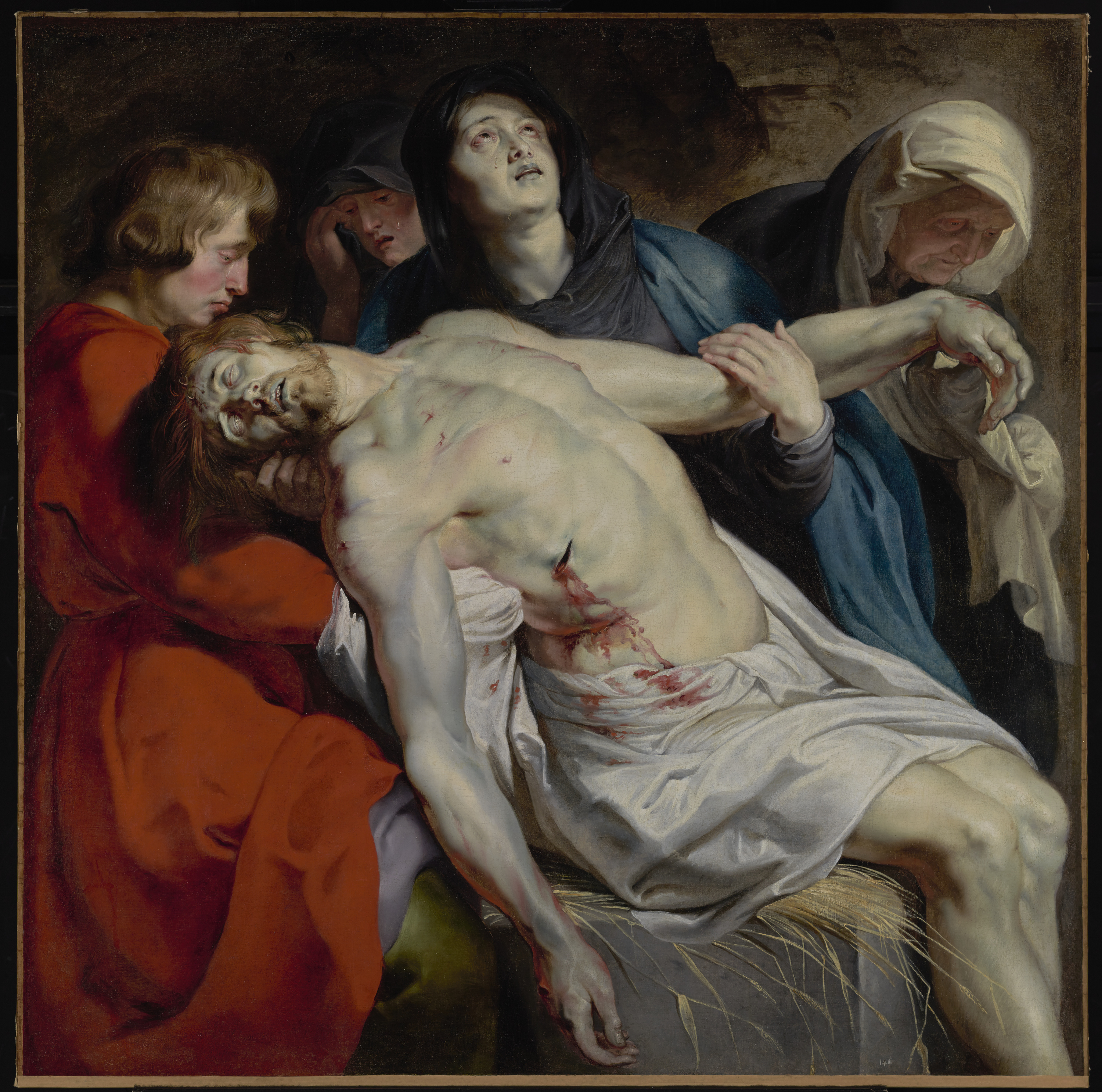
LOOK:Peter Paul Rubens (Flemish, 1577–1640), The Entombment, ca. 1612. Oil on canvas, 51 5/8 × 51 1/4 in. (131.1 × 130.2 cm). J. Paul Getty Museum, Los Angeles.
The Flemish Baroque artist Peter Paul Rubens painted scenes of the lamentation of Christ many times. I saw this one in person at the Getty a few years ago, and it really drew me in. It shows Saint John and the Virgin Mary supporting Jesus’s body as they lay him down onto a stone slab. Mary Magdalene weeps from behind, and another, older Mary, the mother of James the Younger and Joseph (Matt. 27:56; Mark 15:40), gingerly lifts his wounded hand, fixing her sorrow there.
Rubens does not shy away from the ugliness of death, showing Jesus’s eyes rolled back in his head, his lips blue, and blood caked in his hair and dried up around the gaping laceration in his side. His whole body is pale with death, his skin green-tinged, in contrast to John’s ruddy complexion; his mother wears the same deathly pallor. Her eyes are red and puffy, and she looks up to the heavens as if to question why, or to petition God for strength.
The wheat that Jesus lies on alludes to the straw he was bedded in as a newborn and to the bread of the Eucharist on the altar. Christ’s body is given as a holy offering for the sins of the world.
Áine Minogue is an award-winning Irish harpist, singer, arranger, and composer, now living in the Boston area. She plays and sings a mix of traditional tunes and original songs, most with Gaelic lyrics. “Song of Keening” wasn’t written explicitly for Holy Week, but it is a funeral lament that uses non-word utterances to express grief. Minogue writes,
In old Ireland, the practice of keening provided a physical and emotional release for those who grieved. Sometimes, keening was a direct emotional response to loss, practiced by both men and women, though particularly by women who had lost young children—a common occurrence in the past, when child mortality rates were significantly higher.
However, often a professional keener was hired by a family as a way of honoring the dead. These professional mourners were always women, and their keening was more stylized, taking the form of an improvisation based on particular structures and handed-down phrases. Though practiced in diverse cultures from Ireland to Greece, keening was generally frowned upon by church authorities, and treated with disdain by those who embraced the trappings of modernity. The practice now has virtually died out.
This piece is improvised in the old style, using old structures and vocables.
Professional mourners (moirologists) were used in ancient Israel too, at least by those wealthy enough to afford them. There’s no indication that any were present at the death of Jesus. In art history the chief mourners at Jesus’s crucifixion and burial are his mother, Mary; John, to whose care Mary was entrusted; Mary Magdalene; and Jesus’s other female followers.
Now from the sixth hour there was darkness over all the land until the ninth hour. And about the ninth hour Jesus cried out with a loud voice, saying, “Eli, Eli, lema sabachthani?” that is, “My God, my God, why have you forsaken me?” And some of the bystanders, hearing it, said, “This man is calling Elijah.” And one of them at once ran and took a sponge, filled it with sour wine, and put it on a reed and gave it to him to drink. But the others said, “Wait, let us see whether Elijah will come to save him.” And Jesus cried out again with a loud voice and yielded up his spirit.
—Matthew 27:45–50 (emphasis added; cf. Mark 15:33–37)
According to the ESV Study Bible, “Jesus’s call to God in Aramaic (’Eli, ’Eli) sounds similar to the Hebrew name for Elijah (’Eliyahu), which the bystanders misunderstand as a summons to the prophet.” A minority opinion among scholars is that, instead, the bystanders deliberately twist Jesus’s words to further mock him. It was a common expectation of Jews during Jesus’s time that Elijah would return as a precursor to the great day of the Lord (see Mal. 4:5).
What Jesus was in fact citing was Psalm 22, a lament of David, which opens with this searing cry of dereliction: “My God, my God, why have you forsaken me?” A series of raw and wrenching poetic descriptions of suffering and pleas for deliverance, the psalm is nevertheless punctuated with reflections on God’s holiness, faithfulness, and care. Verse 22 (“I will tell of your name . . .”) marks a clear turn in which the speaker moves into a hope that is triumphant.
My God, my God, why have you forsaken me? Why are you so far from saving me, from the words of my groaning? O my God, I cry by day, but you do not answer, and by night, but I find no rest.
Yet you are holy, enthroned on the praises of Israel. In you our fathers trusted; they trusted, and you delivered them. To you they cried and were rescued; in you they trusted and were not put to shame.
But I am a worm and not a man, scorned by mankind and despised by the people. All who see me mock me; they make mouths at me; they wag their heads; “He trusts in the LORD; let him deliver him; let him rescue him, for he delights in him!”
Yet you are he who took me from the womb; you made me trust you at my mother’s breasts. On you was I cast from my birth, and from my mother’s womb you have been my God. Be not far from me, for trouble is near, and there is none to help.
Many bulls encompass me; strong bulls of Bashan surround me; they open wide their mouths at me, like a ravening and roaring lion.
I am poured out like water, and all my bones are out of joint; my heart is like wax; it is melted within my breast; my strength is dried up like a potsherd, and my tongue sticks to my jaws; you lay me in the dust of death.
For dogs encompass me; a company of evildoers encircles me; they have pierced my hands and feet— I can count all my bones— they stare and gloat over me; they divide my garments among them, and for my clothing they cast lots.
But you, O LORD, do not be far off! O you my help, come quickly to my aid! Deliver my soul from the sword, my precious life from the power of the dog! Save me from the mouth of the lion! You have rescued me from the horns of the wild oxen!
I will tell of your name to my brothers; in the midst of the congregation I will praise you: You who fear the LORD, praise him! All you offspring of Jacob, glorify him, and stand in awe of him, all you offspring of Israel! For he has not despised or abhorred the affliction of the afflicted, and he has not hidden his face from him, but has heard, when he cried to him.
From you comes my praise in the great congregation; my vows I will perform before those who fear him. The afflicted shall eat and be satisfied; those who seek him shall praise the LORD! May your hearts live forever!
All the ends of the earth shall remember and turn to the LORD, and all the families of the nations shall worship before you. For kingship belongs to the LORD, and he rules over the nations.
All the prosperous of the earth eat and worship; before him shall bow all who go down to the dust, even the one who could not keep himself alive. Posterity shall serve him; it shall be told of the Lord to the coming generation; they shall come and proclaim his righteousness to a people yet unborn, that he has done it.
—Psalm 22
Ever since the early church, Christians have interpreted this psalm messianically, as there are many clear parallels to Christ’s passion, which the Gospel writers were well aware of.
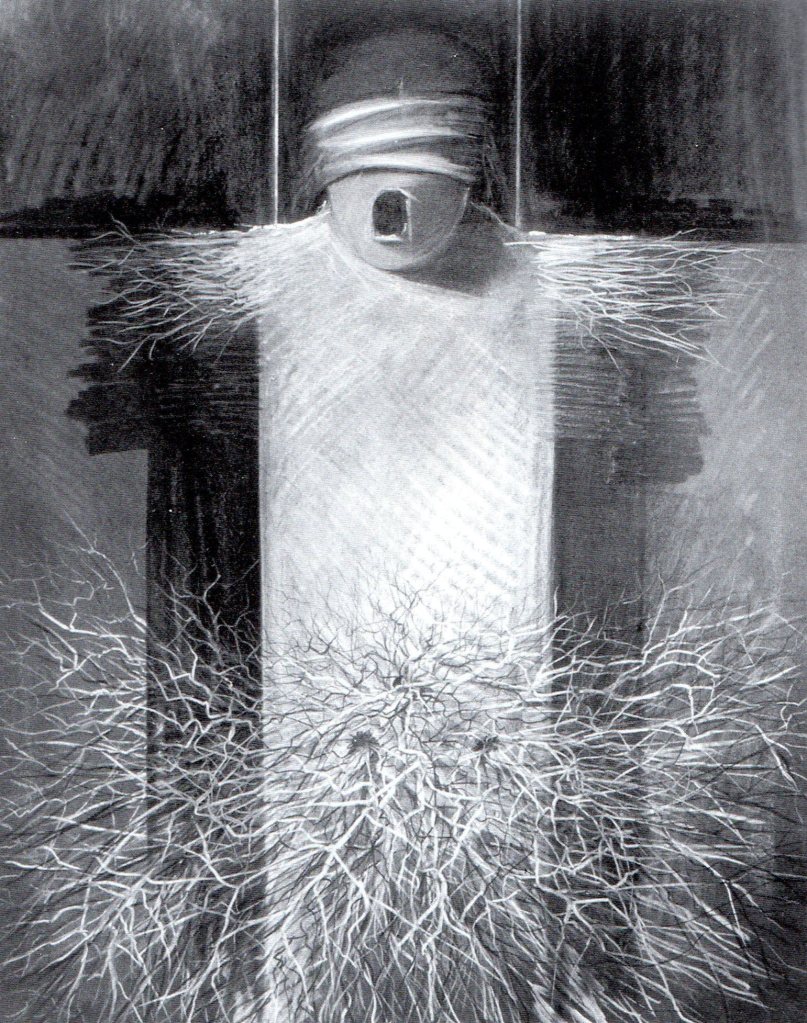
LOOK: Enrico Pinardi (American, 1934–2021), Crucifixion with Thorns, 2002. Oil on canvas.
I corresponded with the artist of this painting a few years ago after having found a black-and-white photo of it in the book The Crucifixion in American Art by Robert Henkes (2003). He granted me permission to reproduce the image on my blog, said he didn’t have a color photo. (“The image is kinda black, white, and blue,” he clarified.) I haven’t gotten around to posting it until now. I wish I had thought to ask about its location; I’m assuming it’s in a private collection somewhere, probably in the United States. After searching for Pinardi online the other week to see what he’s been up to, I found that he died January 30 due to complications from COVID-19.
Crucifixion with Thorns captures something of the horror of Christ’s felt abandonment on the cross. In the throes of death, he opens his mouth in a primal wail—the “loud voice” Matthew and Mark speak of, the “God, why?” He is becoming frayed, unraveled. A thicket of thorns tears through his body—or perhaps that is the cross-post (Pinardi’s expressionistic style deliberately makes it difficult to distinguish between the two). He is pierced.
He is also blindfolded. Luke 22:64 says that Jesus’s captors blindfolded him prior to his appearance before the Sanhedrin, striking him and asking him mockingly to identify, if he’s the Son of God, who it was who struck him. Though his eyes were not covered while he hung on the cross, the artist’s choice to cover them here amplifies the sense of his being in the dark, cut off, and also serves to identify him with other victims of political torture.
The following text was written by committee (with the input of nine Presbyterian denominations) and first published in Pittsburgh in The Psalter: With Responsive Readings (1912), paired with an older tune by Lowell Mason. It covers two-thirds of Psalm 22, omitting the last nine verses—or rather, if you want to look at it this way, compacting them into four lines, as they contain a lot of repetition. I’ve noted in a separate column which verses of the biblical psalm each line of the song corresponds to.
My God, my God, I cry to Thee;
O why hast Thou forsaken Me?
Afar from Me, Thou dost not heed,
Though day and night for help I plead.

But Thou art holy in Thy ways,
Enthroned upon Thy people’s praise;
Our fathers put their trust in Thee,
Believed, and Thou didst set them free.

They cried and, trusting in Thy Name,
Were saved, and were not put to shame;
But in the dust My honor lies,
While all reproach and all despise.

My words a cause for scorn they make,
The lip they curl, the head they shake,
And, mocking, bid Me trust the Lord
Till He salvation shall afford.

My trust on Thee I learned to rest
When I was on My mother’s breast;
From birth Thou art My God alone,
Thy care My life has ever known.

O let Thy strength and presence cheer,
For trouble and distress are near;
Be Thou not far away from Me,
I have no source of help but Thee.

Unnumbered foes would do Me wrong;
They press about Me, fierce and strong;
Like beasts of prey their rage they vent;
My courage fails, My strength is spent.

Down unto death Thou leadest Me,
Consumed by thirst and agony;
With cruel hate and anger fierce
My helpless hands and feet they pierce.

While on My wasted form they stare,
The garments torn from Me they share,
My shame and sorrow heeding not,
And for My robe they cast the lot.

O Lord, afar no longer stay;
O Thou My helper, haste, I pray;
From death and evil set Me free;
I live, for Thou didst answer Me.

I live and will declare Thy fame
Where brethren gather in Thy Name;
Where all Thy faithful people meet,
I will Thy worthy praise repeat.
v. 1

v. 2


v. 3

v. 4


v. 5

v. 6


v. 7

v. 8


v. 9

v. 10


v. 11


v. 12

v. 13
v. 14

v. 15

v. 16


v. 17
v. 18


v. 19

vv. 20–21a
v. 21b

v. 22
One hundred years later, the Rev. Vito Aiuto wrote a new melody for this metrical translation, his only modifications to the text being to substitute out the archaic pronouns (e.g., Thee, Thou) and verb forms (e.g., hast, dost), unless needed to retain the rhyme scheme or meter. He and his wife, Monique, perform the song on their second full-length album along with a team of other musicians, listed here. Sufjan Stevens is among those in the seven-person choir that wails and sings echoes in the first half.
The song opens with a metallic screeching sound, harsh and grating. There are tensions and dissonances in the music, but at verse 5 (around 4:07) a tonal shift happens, as groping in the dark gives way to greater clarity and confidence. The pain is still there, but, like the psalm on which it’s based, it stretches toward hope.
A graduate of Princeton Theological Seminary, Aiuto is one of the founders of Resurrection Brooklyn, a church network of five Presbyterian (EPC) congregations serving the borough. He has been the lead pastor of Resurrection Williamsburg since it began in May 2005. I had the pleasure of hearing him preach in person at CIVA’s 2019 conference.
I’ve featured retuned hymns by The Welcome Wagon twice before on the blog; see Artful Devotion posts “Hail to the Lord’s Anointed” (for the Baptism of the Lord) and “The Strife Is Over” (for Easter).
Then the soldiers of the governor took Jesus into the governor’s headquarters, and they gathered the whole battalion before him. And they stripped him . . .
And when they had crucified him, they divided his garments among them by casting lots.
—Matthew 27:27–28, 35
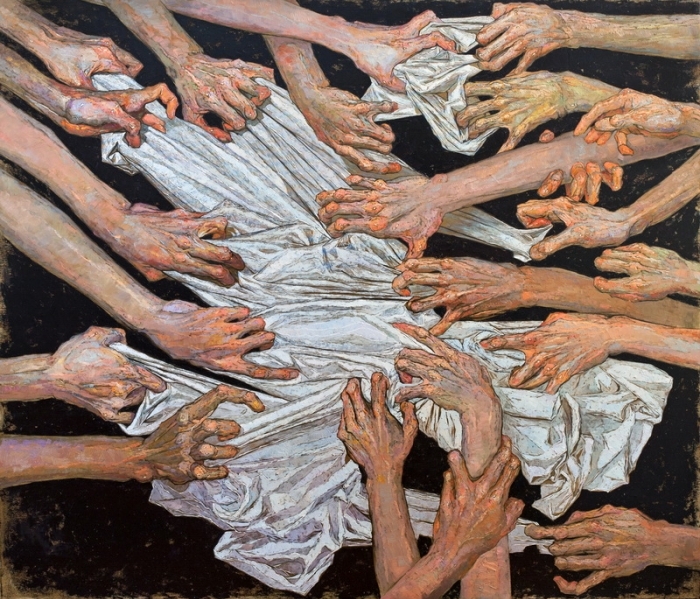
LOOK: Denis Sarazhin (Ukrainian, 1982–), Pantomime 6, 2015. Oil on canvas, 130 × 150 cm.
LISTEN: “They have stripped me of my garments,” Byzantine hymn in plagal second tone, chanted by Vassilis Hadjinicolaou [HT: Global Christian Worship]
This doxastikon (a type of hymn) is sung during the Orthros (Matins) of Great and Holy Friday, which is prayed on the night of Holy Thursday. Note that because they follow the Julian calendar rather than the Gregorian, Orthodox Christians celebrate Good Friday on April 30 this year (and Easter on May 2).
If you’re wondering where the (for me, uncomfortably) violent image in the last line comes from, it’s from Psalm 2:9 (cf. Rev. 19:15). Its insertion into the episode of Christ’s being mocked seems to me an odd choice, seeing as the whole passion narrative is about God the Son absorbing violence rather than enacting it, and we know from his issuance of forgiveness from the cross that he did not have a vengeful attitude toward his tormenters. I speak from outside the Orthodox tradition, though.
Otherwise I find this hymn very moving. Its first line is what inspired the image I chose—of numerous hands clawing at cloth. Nakedness is one of the many indignities Jesus faced on Good Friday; he was stripped, dressed parodically in purple, reclothed with his personal garments, and then stripped again before being crucified. As he hung dying, exposed to the public, the Roman soldiers gambled for his clothing, souvenirs from the high-profile execution. Again, the soldiers’ bestiality is reflected in Sarazhin’s painting.

 Art & Theology