Michael Wright on Keith Haring’s “Jesus freak” connection

Michael Wright is the creator of Still Life, a free weekly letter on art and spirit that I look forward to receiving in my inbox every Monday. On March 8 he wrote about Keith Haring (1958–1990), an artist whose work I first encountered as a child on the cover of the compilation album A Very Special Christmas, which we pulled out from the CD shelf in the family room every December. As an adult I came across Haring’s Life of Christ triptych inside Saint John the Divine in Manhattan (I instantly recognized the style), and one of his anti-apartheid paintings at the Stedelijk Museum Amsterdam. Wright discusses Haring’s connection to the Jesus People movement, which I, too, was unaware of! I share this excerpt from the latest edition of Still Life with Wright’s permission. Subscribe here.

+++

Haring, Keith_Untitled (1981)
Keith Haring (American, 1958–1990), Untitled, 1981. Acrylic on vinyl, 96 × 96 in. (244 × 244 cm). © Estate of Keith Haring

Friends,

This week I discovered that the famous street artist Keith Haring was part of the Jesus People before moving to New York City. He grew up in a Christian home in Kutztown, PA, went to church every Sunday and church camp every summer, and read the Bible voraciously. He even carefully read and rated each of the 150 Psalms. In his youth he found his way to the Jesus People movement, most likely through communes local in the area, and his early journals are filled with Christian symbols and apocalyptic ideas: “We must repent now and devote our lives to Jesus Christ! The time is now, time is running out, It can happen at any time! Be prepared for God!” Whew. I had no idea.

The Jesus People movement was a counter-cultural Christian movement of people who were anti-establishment (including church), highly critical of materialism, and committed to living with and supporting the poor. They shared their convictions through the Hollywood Free Paper, a free mailing that featured cartoons lampooning politicians, new age hucksters, and lukewarm Christians. While Haring no longer officially participated as an adult, American Art writer Natalie Phillips says there’s a “direct iconographic connection” between his style and the imagery of the paper. The Jesus People left an indelible mark on his “visual memory,” and once you know it, it’s hard to miss.

In his early subway drawings, Haring often drew the Radiant Child, a small crawling baby surrounded by beams of light. In one of the earliest versions, the baby is the central figure of a nativity scene: the Christ Child. Here’s his own description: “lines radiate from the baby indicating spiritual light glowing from within, as though the baby were a holy figure from a religious painting, only the glow is rendered in the visual vocabulary of a cartoon.” Another common image Haring used was the figure with a chest-sized hole. Sometimes filled with dollar signs, other times broken open by packs of wolves, the imagery evokes unfilled (or wrongly filled) longings and desire. And do you know what was common throughout the Hollywood Free Paper? Chest-sized holes in cartoon after cartoon, an image of spiritual voids filled by Christ himself.

On top of this, some of his late works were explicitly religious. He created a monumental series of the Ten Commandments, he created a mural for a church in Pisa, and, most poignantly, his final work was an altarpiece of the Last Judgment, on view at both New York’s Cathedral of St John the Divine and San Francisco’s Grace Cathedral. That’s not to say “Gotcha! He’s a Christian artist!” As a gay man dying of AIDS, Haring was vocally critical of the institutional church and kept his distance during his adult life. Nor should we say this is his “religious art” and everything else is the popular stuff. His compassion for the weak and vulnerable, his critical eye to unjust systems, his celebration of the body and human dignity—this was all part of Haring’s sensibility, and it’s deeply Christ-like too, even if it’s harder to trace in work without obvious religious subject matter.

I guess I’m bringing all this up because I want you to be surprised with me. When I say “Jesus Freak,” the first thing that comes to mind is dc Talk—not a sex-positive, ambiguously spiritual, gay street artist. And yet as a teen, that’s what he called himself. Keith Haring wrote about it in his journals, and he talked openly about the influence of his Christian background. Uncovering this history doesn’t burden the artwork or the artist—it gives me renewed interest in his work. Granted, I write about these topics in Still Life all the time, but I don’t think we have to be afraid of letting religion be one of the many interpretive lenses we use to enjoy the arts. At their best, art and religion can be exactly what Haring hoped for in his own creative work: “It should be something that liberates the soul, provokes the imagination and encourages people to go further. It should celebrate humanity instead of manipulating it.”

Take care, 
Michael

P.S. Many of the quotes above come from Natalie E. Phillips’ “The Radiant (Christ) Child: Keith Haring and the Jesus Movement,” published in American Art.
Roundup: (Virtual) Arts conference, Psalm 129 jazz-hip-hop-folk fusion, and more

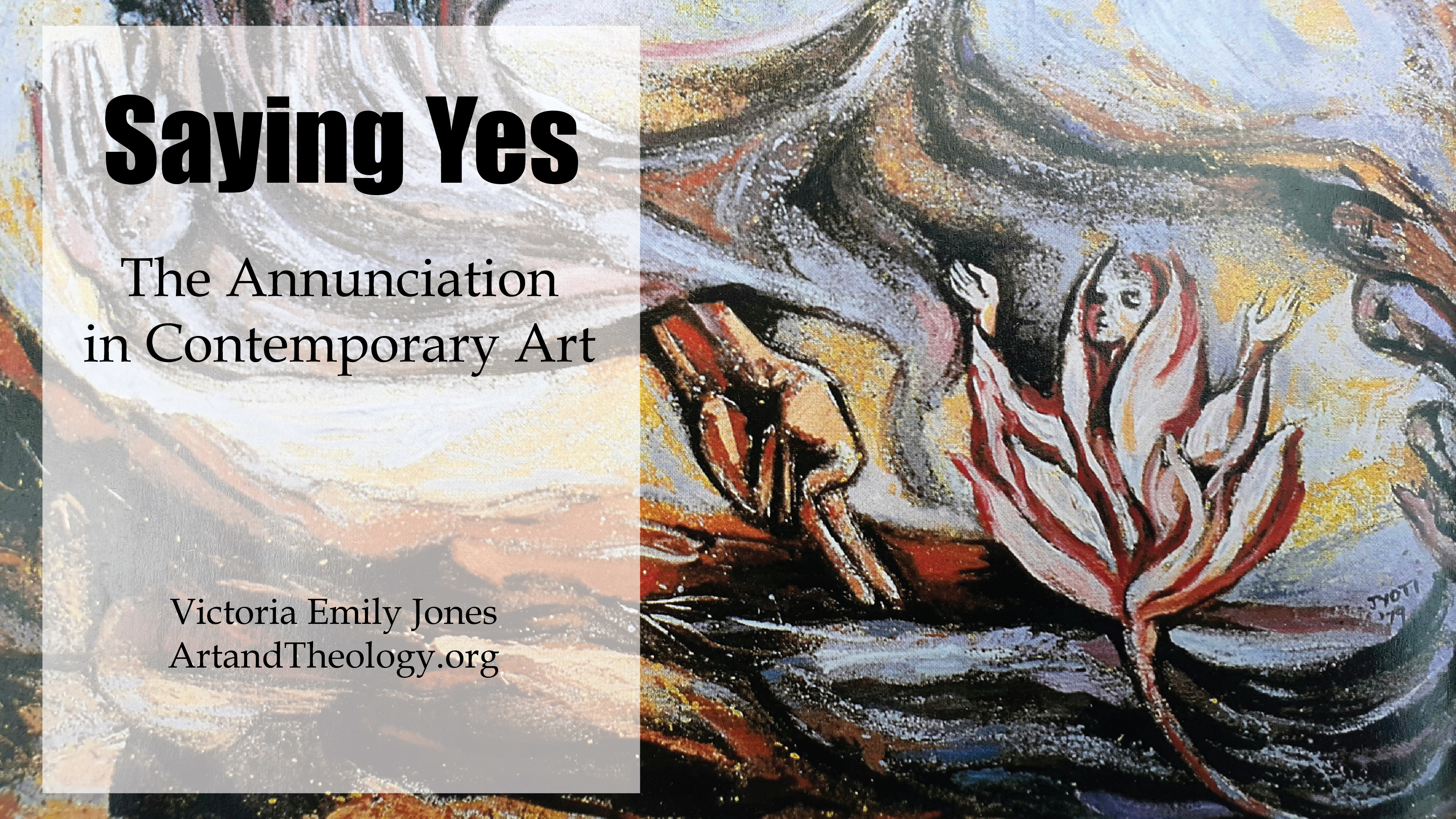
This year’s The Breath and the Clay creative arts gathering, on the theme of “Reenchantment,” is taking place March 17–21, with both in-person (in Winston-Salem, North Carolina) and virtual options. Registration for virtual attendees is pay-what-you-wish. Presenters include theologian Jeremy Begbie, poet Pádraig Ó Tuama, singer-songwriter Joy Ike, contemplative author Christine Valters Paintner, dancer Camille D.C. Sutton, and many more . . . including me! On the evening of March 18 I’ll be giving a twenty-minute talk titled “Saying Yes: The Annunciation in Contemporary Art,” which will be archived online afterward. (The global church celebrates the feast of the Annunciation the following week, on March 25.) (Update: Watch here.) Here’s the description:

The story of Jesus’s miraculous conception in the womb of Mary, a first-century Galilean peasant girl, told in Luke 1 has activated the imaginations of artists since the early Christian era. When an angelic messenger came and told Mary she had been chosen to bear God’s Son, she cycled through a range of emotions before ultimately accepting the call, stepping onto a path that, though scary, would be life-giving not only for her but also for her religious and ethnic community and for the whole world.

God invites us to participate in his work in the world and gives us the grace to do it. When his voice breaks through our safe, predictable routines, calling us to something big, do we respond with brave obedience? In this talk Victoria Emily Jones will share a handful of contemporary artworks that visualize that pivotal moment in salvation history when Mary said yes and set in motion the incarnation. These works show us the wild beauty of God’s plans and can help us tune our ears to the annunciations in our own lives.

(The title slide image is a detail of an Annunciation painting by Jyoti Sahi.)

I’m always impressed by the variety of artists, arts professionals, and art lovers that director Stephen Roach manages to bring together for The Breath and the Clay. Click here to learn more and to register.

+++

ONLINE LENT SERIES:

>> VCS Lent 2021: The Visual Commentary on Scripture is highlighting a different exhibition from its archives for each week of Lent, with new content including a video introduction to the week by Ben Quash and an audio reading of each of the three constituent commentaries.

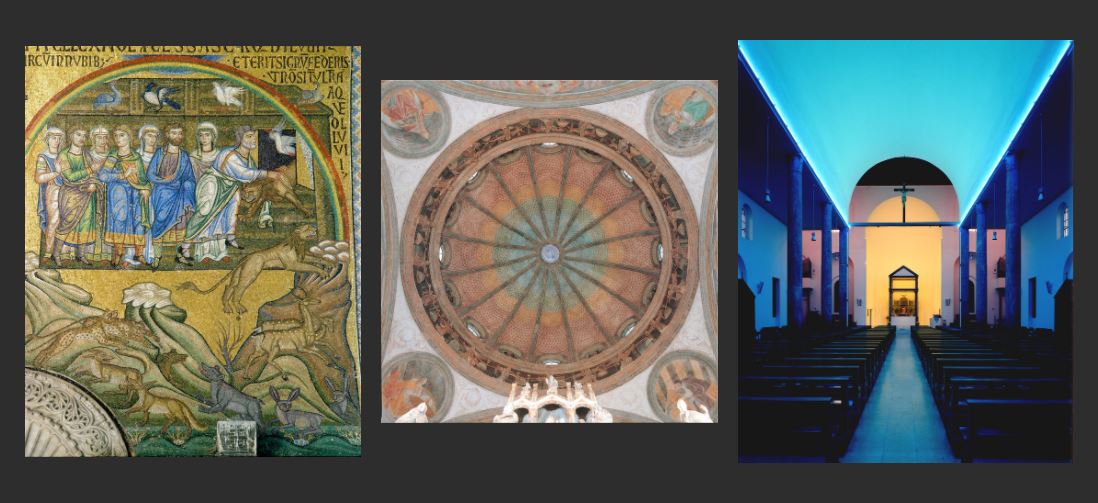
The first week was on the theme of Covenant and covers Genesis 8:20–9:17. Stefania Gerevini curated three artworks from Italy that convey some aspect of the rainbow as divine promise: a thirteenth-century mosaic from the Basilica di San Marco in Venice, a colorful dome fresco (fifteenth century) from the Cappella Portinari in Milan, and a contemporary light installation by Dan Flavin at Santa Maria Annunciata in Chiesa Rossa, also in Milan.

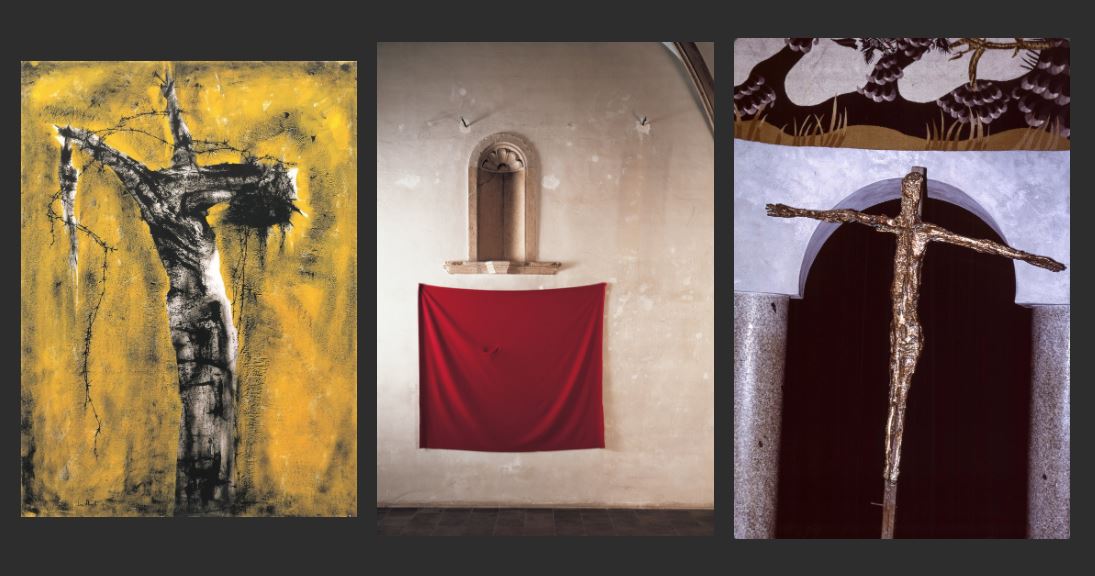
Week 2, on Prophecy, explores the Suffering Servant of Isaiah 53. Jonathan Koestlé-Cate comments on three modern artworks: Crucified Tree Form by Theyre Lee-Elliott, a crucifix by Germaine Richier (which sparked outrage when it was unveiled at Notre-Dame de Toute Grâce, Assy, in 1950), and an installation by postminimalist artist Anish Kapoor at the church of Saint Peter, Cologne.

>> “The Many Faces of Jesus”: I’ve been enjoying this Lenten series (on blog and podcast) by medievalist Dr. Grace Hamman, who makes medieval lit super accessible. “For Lent, Old Books With Grace will share and explore some medieval representations of Jesus in art and literature—the versions of Jesus that dominate the medieval church’s imagination. These medieval portrayals of Jesus may strike us as odd, threatening, charming, creative, stupid, or inspiring. In attending to these versions of Jesus, I hope for a few end goals: the first is that we may expand our Christian imagination. Perhaps a side of Jesus that has never occurred to you, or been sideswept by our contemporary culture, will suddenly illuminate an aspect of the Jesus of scripture. The second is that we may better identify the ways that we ourselves have culturally contained and portrayed Jesus, in positive and negative ways. Often the strangeness of the past helps us recognize the weird or damaging things we believe in order to make Jesus more palatable, understandable, or like us.”

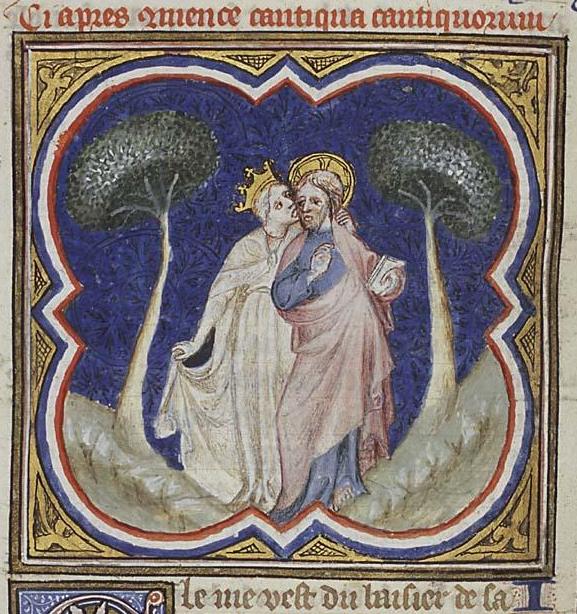
Christ and his bride
Jean Bondol, “The bride (Ecclesia) and bridegroom (Christ),” from a Bible Historiale made in Paris, 1371–72. The Hague, MMW, 10 B 23, fol. 330v.

So far she has covered Jesus as judge, lover, and knight.

+++

RETUNED HYMNS:

>> “Up from My Youth (Psalm 129)” by Advent Birmingham, feat. CashBack and Terence June Gray: This is such a strange and compelling fusion! “An 1806 hymn by Isaac Watts meets hip-hop meets Johnny Cash meets folk meets New Orleans jazz meets industrial steel factory.”

Led by Zac Hicks, Advent Birmingham [previously] is a group of worship musicians from the Cathedral Church of the Advent in downtown Birmingham, Alabama. Hicks wrote this new tune for Isaac Watts’s metrical paraphrase of Psalm 129 and integrated a rap by guest artist Terence June Gray from Memphis. Singing lead (and playing drums) is Leif Bondarenko, the front man of the Johnny Cash tribute band CashBack. The video was filmed at Birmingham’s historic Sloss Furnaces. Available on iTunes, Amazon, and Spotify.

You can read the lyrics here, which include a slight revision of Watts’s verse 6.

>> “Thy Mercy, My God”: Words by John Stocker, 1776; music by Sandra McCracken, 2005; performed by Ellen Petersen Haygood (of The Petersens bluegrass band), 2018.

+++

POETRY READING: “Phase One” by Dilruba Ahmed, read, with commentary, by Pádraig Ó Tuama, Poetry Unbound: What do you find hard to forgive in yourself? What might help? In this poem, the poet makes a list of all the things she holds against herself: opening fridge doors, fantasies, wilted seedlings, unkempt plants, lost bags, feeling awkward, treating someone poorly. Dilruba Ahmed repeats the line ‘I forgive you’ over and over, like a litany, in a hope to deepen what it means to be in the world, and be a person of love.”

“What Love Is This” by Edward Taylor

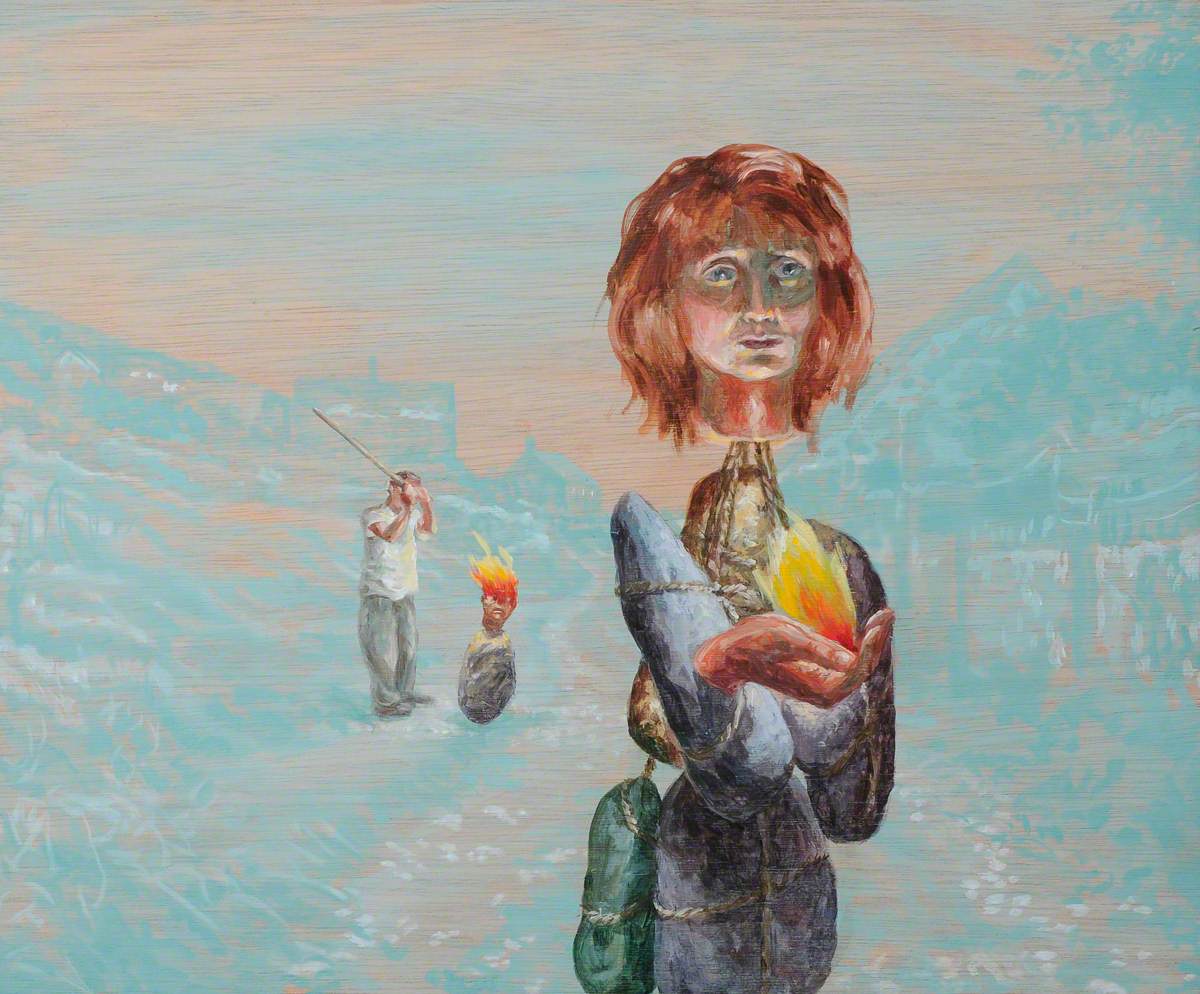
Adams, Susan_Waiting for Something
Susan Adams (British, 1966–), Waiting for Something, 2002. Oil on panel, 36 × 58 cm. Gwynedd Museum and Art Gallery, Bangor, Wales.

What love is this of thine, that cannot be
In thine infinity, O Lord, confined,
Unless it in thy very person see
Infinity and finity conjoin’d?
What! hath thy Godhead, as not satisfied,
Married our manhood, making it its bride?

Oh matchless love! filling heaven to the brim!
O’errunning it: all running o’er beside
This world! Nay, overflowing hell, wherein,
For thine elect, there rose a mighty tide!
That there our veins might through thy person bleed,
To quench those flames that else would on us feed.

Oh! that thy love might overflow my heart!
To fire the same with love: for love I would.
But oh! my straight’ned breast! my lifeless spark!
My fireless flame! What chilly love, and cold?
In measure small! In manner chilly! See.
Lord, blow the coal: thy love enflame in me.

Edward Taylor (1642–1729) was an American Puritan poet and minister of the Congregational church in Westfield, Massachusetts, for over fifty years. This is Meditation 1 in his Preparatory Meditations, a collection of over two hundred poems divided into two series. A private spiritual diary written from 1682 to 1725, the collection was unpublished until the twentieth century.

Roundup: Black art and Black church documentaries, “Hymns” album, and more

DOCUMENTARIES:

>> Black Art: In the Absence of Light (HBO): Directed by Sam Pollard, this ninety-minute documentary is an excellent introduction to the work of some of the foremost Black visual artists working in the US today. It opens by discussing the landmark 1976 exhibition Two Centuries of Black American Art, the first comprehensive survey of such. Curated by art historian and artist David C. Driskell (the main voice of the documentary), the exhibition, which opened at LACMA, showed the public that there is a lineage and a history, starting with early Black American artists like Joshua Johnson, Robert S. Duncanson, Edward Bannister and extending forward to artists like Romare Bearden, Charles White, Alma Thomas, and others. The exhibition inspired a whole new generation of Black artists, many of whom were encountering the work of their artistic forebears in person for the first time.

A range of contemporary Black artists are interviewed: Kerry James Marshall, Sanford Biggers, Jordan Casteel, Faith Ringgold, Richard Mayhew, Radcliffe Bailey, Kehinde Wiley, Amy Sherald, Hank Willis Thomas, Glenn Ligon, Fred Wilson, Carrie Mae Weems, Kara Walker, Theaster Gates, Betye Saar. So are several Black curators, art historians, and collectors, like Kasseem “Swizz Beatz” Dean, and Thelma Golden, director of the Studio Museum in Harlem, “the focal point of African American cultural and artistic production” since 1968 and “one of the most important institutions that we have,” as Weems says in the film. Another interviewee throughout is Maurice Berger, an art historian (who is white) and longtime voice against racism in the art world.

Both Driskell and Berger died of coronavirus while the film was in postproduction, and it is dedicated to their memory, as a postscript reads.

You can watch it for free, regardless of HBO subscription status, through March 17. HBO has also published a curriculum and art-making activities as supplements, which you can find at the link.

>> The Black Church: This Is Our Story, This Is Our Song (PBS): Written, hosted, and co-produced by Henry Louis Gates Jr., this two-part docuseries premiered February 16. It’s impossible to separate Black religion, politics, and culture, so the documentary weaves them all together over the course of four hours, showing how for centuries the Black church was the epicenter of Black life and exploring its role in the twenty-first century. I think it does a great job overall of avoiding an overly simplistic narrative.

The Black Church “traces the 400-year-old story of the Black church in America, all the way down to its bedrock role as the site of African American survival and grace, organizing and resilience, thriving and testifying, autonomy and freedom, solidarity and speaking truth to power. The documentary reveals how Black people have worshipped and, through their spiritual journeys, improvised ways to bring their faith traditions from Africa to the New World, while translating them into a form of Christianity that was not only truly their own, but a redemptive force for a nation whose original sin was found in their ancestors’ enslavement across the Middle Passage.”

You can watch online for free; just download the PBS Video app, or visit YouTube: episode 1; episode 2.

+++

SONG: “Lift Every Voice and Sing,” performed by Victory Boyd: WOW. Such a beautiful interpretation of this classic hymn. Victory writes, “I’m continually inspired by this song and how it was written in the 1800’s by 2 brothers both African Americans that saw and experienced great affliction in this Country… yet they still had hope. They still had a song of freedom on their lips and they encouraged EVERY voice to join in and sing alongside them this song of freedom. Recorded LIVE at The Secret Place.” [HT: SALT Project]

+++

ARTICLE: “Sacred faces: Father John Giuliani’s artwork honors Native American cultures and reminds us of how God comes into the world” by John Christman, SSS: Fr. John Giuliani, the Italian American artist-priest known for his many paintings depicting the Holy Family and other biblical figures as Indigenous peoples of the Americas, died in January. Paul Neeley of Global Christian Worship reminded me of the article U.S. Catholic magazine published on March 9, 2016, about his work.

Guatemalan Annunciation by Fr. John Giuliani
Giuliani, John_Jesus and His Disciples
Jesus and His Disciples (Navajo) by Fr. John Giuliani

“As a Catholic priest and son of Italian immigrants, I bear the religious and ethnic burden of ancestral crimes perpetrated on the first inhabitants of the Americas,” Giuliani once said. “Many have been converted to Christianity, but in doing so some find it difficult to retain their indigenous culture. My intent, therefore, in depicting Christian saints as Native Americans is to honor them and to acknowledge their original spiritual presence on this land. It is this original Native American spirituality that I attempt to celebrate in rendering the beauty and excellence of their craft as well as the dignity of their persons.”

See also the 2012 Indigenous Jesus article “Father John Giuliani, Painter of Native American Icons.”

+++

ALBUM: Hymns by Paul Zach: Released February 5, this new album by Paul Zach comprises eight of his favorite hymns plus two originals, with vocal contributions by Liz Vice, Page CXVI, Leslie Jordan, Taylor Leonhardt, and The Sing Team. There has been a lot of experimentation in the hymns genre among recording artists, but what Zach gives us is something quiet and pared-down, which is exactly what I like. And as I’ve said before, Zach’s voice is so wonderfully expressive. He’s a joy to listen to and to sing along with. Below is the opening track, “Just a Closer Walk with Thee,” followed by Zach’s gorgeous setting of Psalm 23. The album is available on iTunes and Spotify.

Lent, Day 7

Today’s two featured artists draw on the mythology of the phoenix, a fantastical bird that dies in flames but then is born again out of its own ashes. (An alternate legend, not as popular, says the phoenix dies and decomposes but then rises out of its rot.) In Christianity the phoenix became a symbol of resurrection—Jesus’s, and our own. The First Epistle of Clement to the Corinthians from the late first century CE is the first Christian writing to make this connection. And the phoenix points to not only the reconstitution of our bodies after death but also the spiritual regeneration we undergo in this life. Out of the ashes of our sin, the death of the old self, the new self rises with Christ.

Apart from (but not opposed to) this theological framework, the phoenix can be seen as a symbol of resilience through trials, of withstanding the forces of destruction, and it seems that’s the sense that life coach and creative Yolonda Coles Jones [previously] is after in her song. The chorus is a mantra that anyone, regardless of faith tradition, can make their own: “Rise from the ashes.”

LOOK: Nathan Florence (American, 1972–), Winging Phoenix, 2010. Oil on printed cotton, 20 × 20 in.

Florence, Nathan_Winging Phoenix

LISTEN: “Phoenix Bird” by Yolonda Coles Jones, 2019

Amazed at what I’m able to do
Lookin’ back on all I’ve been through
Survived unimaginable things, yeah
Phoenix bird claps her wings

Rise from the ashes (×4)

Spread your wings and fly
Phoenix bird, rise

Note to reader: I’m not able to sustain daily posts for the duration of Lent (I’m a one-woman show here!), so there won’t be a “Lent, Day 8,” etc., but I will continue to provide regular content throughout the season. In the meantime, I hope you’re enjoying the Lent Playlist I put together.

Lent, Day 6

LOOK: Mark Newport (American, 1964–), Mend 9 (detail), 2016. Embroidery on muslin, 17 × 13 in.

Artist’s statement: “As I fold my son’s laundered clothes, the holes in the knees of his pants remind me of my childhood exploits, the falls that punctuated each adventure and the scars I carry from those accidents. My body and most often the knees of my pants would be repaired the same way: wash then patch (an iron-on patch for the pants and a Band-Aid for me). When things were more serious, stitches might be required for the body and the clothes would be discarded. Even then, darning and suturing leave a mark, a scar. Each pierces the substrate it is repairing, performing a modest violence upon what is to be mended, and reminding each of us of our sensitivity, vulnerability, and mortality.”

LISTEN: “Fix You Up” by the Wild Reeds, on The World We Built (2017)

[Chorus]
Let my love fix you up when you’re coming undone

[Verse]
Do you believe me when I say:
“My mind is a radio calling your name”
When you’re heavy with uncertainty
Tune in and I’ll sing you to sleep

[Pre-Chorus]
’Cause the silver strings from my heart to yours
Send signals back and forth
And when we’re apart if you listen close
They play our favorite chord

[Chorus]
Let my love fix you up when you’re coming undone

[Bridge]
Close your eyes, open your mind
I’ll meet you there outside of time
When you fall apart across the great divide
I’m a satellite, a telescope
I’m a pyramid, a secret door
I’m a mystery that’s pointed straight at you

. . .

This song is featured on the Art & Theology Lent Playlist on Spotify.

Lent, Day 5

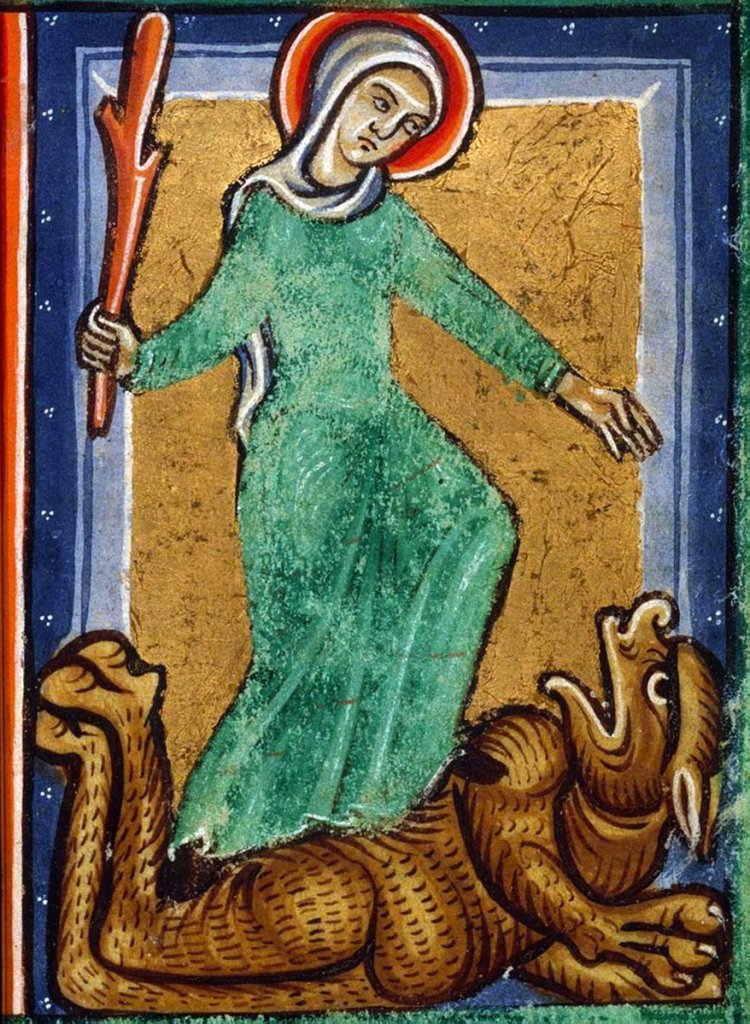
LOOK: (1) “St. Juliana of Nicomedia, the devil at her feet,” from a Picture Bible made at the Abbey of Saint Bertin, Saint-Omer, France, ca. 1190–1200. KB, 76 F 5, fol. 32r. Koninklijke Bibliotheek (Royal Library), The Hague, Netherlands. (2) “St. Juliana of Nicomedia binding the devil,” from the Passionary of Weissenau, made in Germany, 12th century. Codex Bodmer 127, fol. 44v. Fondation Martin Bodmer, Cologny, Switzerland.

St. Juliana of Nicomedia and the devil
St. Juliana binding the devil

Saint Juliana (ca. 286–ca. 304) was a Christian from Nicomedia in present-day Turkey—the eastern capital of the Roman Empire in her day—who suffered martyrdom under the Diocletian persecutions. Legend has it that she engaged in some serious combat with the devil, so in art she is sometimes shown beating him with a club, binding him with a rope or chain, or otherwise incapacitating him. Bam!

[Related post: “Stomp (Artful Devotion)”]

LISTEN: “Satan, Take Your Hands Off Me” by Essie Mae Brooks, on Rain in Your Life (2000)

. . .
Satan, take your hand off me.
I’m in God’s hand.
Jesus, my Jesus,
Has got his arm,
They wrapped all around me,
And the world can’t do me no harm.
. . .

Born in 1930, Essie Mae Brooks is a gospel singer-songwriter from Houston County, Georgia. Rain in Your Life is her debut album, which was followed up by I’ve Been Washed in the Water in 2002.

These two projects were financed by the Music Maker Relief Foundation, a nonprofit dedicated to preserving the musical traditions of the South by directly supporting the musicians who bear those traditions. Cofounder Tim Duffy realized, while studying folklore in college, that preservationists tended to focus on documenting and archiving rather than on taking care of the artists themselves, and he wanted to take a more people-centered approach. So he and his wife Denise launched the foundation in 1994, seeking to empower and sustain folk and blues musicians in and around Winston-Salem, North Carolina, and beyond.

Music Maker provides tour booking, management, and recording services to its artists in addition to grants, but more than that, it offers ongoing support that helps artists pay their bills. The organization focuses on the most vulnerable musicians: those over fifty-five who live on less than $25,000 a year.

To learn more, you can listen to the 2019 NPR segment “Capturing the Undersung Blues People of the Rural South” (or, from 2014, “Preserving American Roots Music Begins with Keeping the Lights On”). And visit the Music Maker website to explore more artists.

“Satan, Take Your Hands Off Me” by Essie Mae Brooks is featured on the Art & Theology Lent Playlist on Spotify.

Lent, Day 4

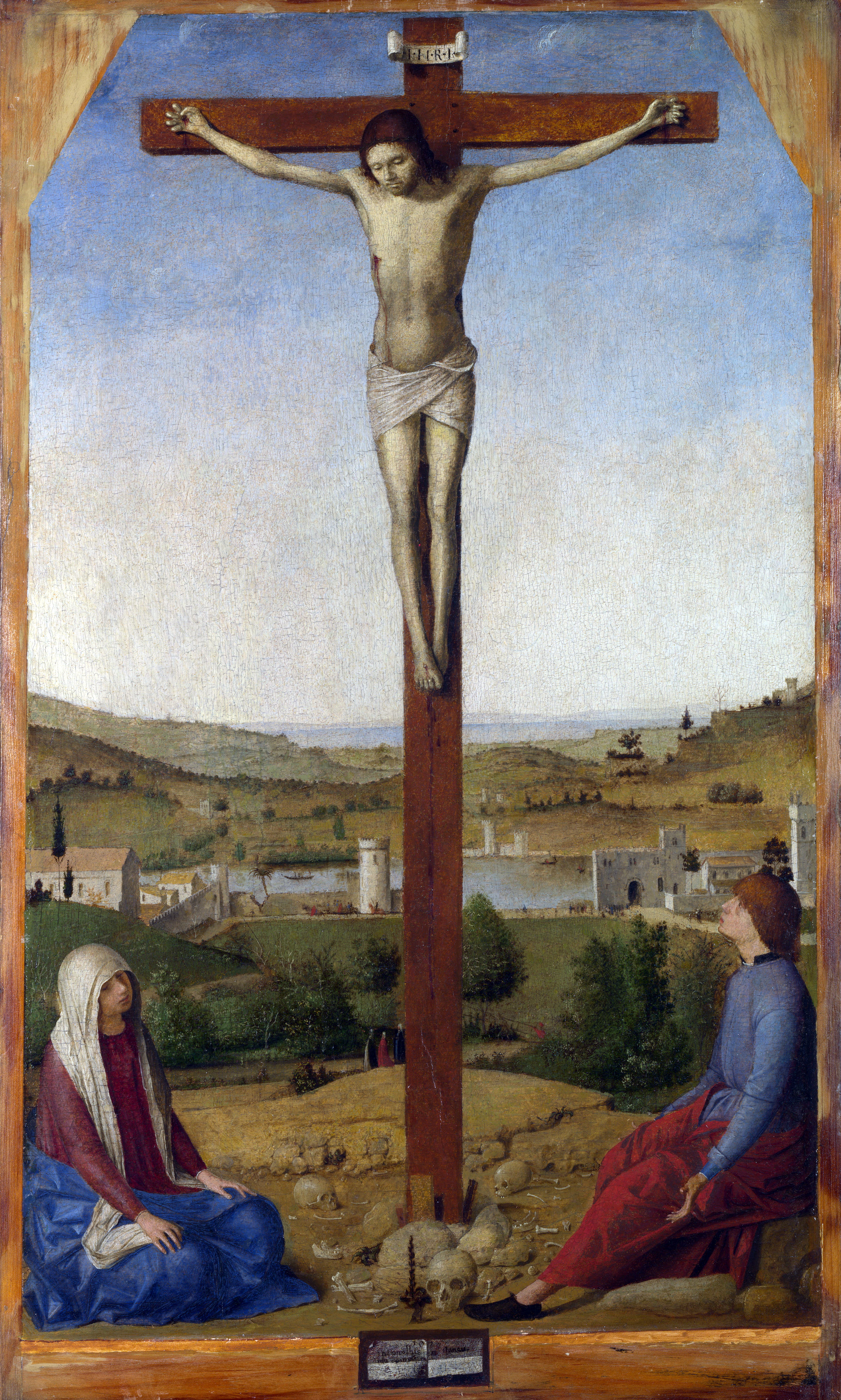
LOOK: Antonello da Messina (Italian, ca. 1430–1479), Christ Crucified, 1475. Oil on wood, 41.9 × 25.4 cm. National Gallery, London.

Messina, Antonello da_Christ Crucified

I’m struck by the strong verticality of this painting, which, by elevating Jesus so far above the ground, gives it a certain solitariness. Antonello composed the picture with a low viewpoint so that we, like John the apostle on the right, also have to look up to view the crucified Christ.

LISTEN: “Staff” by Josh Compton, on Awake, Awake by A Ship at Sea (2012)

As they looked upon the staff
That Moses wrapped the snake around
So my eyes behold the cross
That my Lord is placed upon

Bring me healing, bring me sight
Bring me feeling, bring me light
Bring anointing to my head
Make alive what once was dead

This song is inspired by Jesus’s words in John 3:14–15: “As Moses lifted up the serpent in the wilderness, so must the Son of Man be lifted up, that whoever believes in him may have eternal life.” Jesus is, of course, referring not only forward to his crucifixion but also back to the episode in Numbers 21:4–9, in which the people of Israel were healed from fatal snake bites by casting their gaze on a bronze serpent raised up on a pole.

Josh Compton is a singer-songwriter from Canton, Ohio, whose collaborative music projects have been recorded under the names The Brothers of Abriem Harp (I reviewed their Last Days album here) and A Ship at Sea [previously]. The latter’s Awake, Awake is one of my favorite albums.

“Staff” by A Ship at Sea is featured on the Art & Theology Lent Playlist on Spotify.

Lent, Day 3

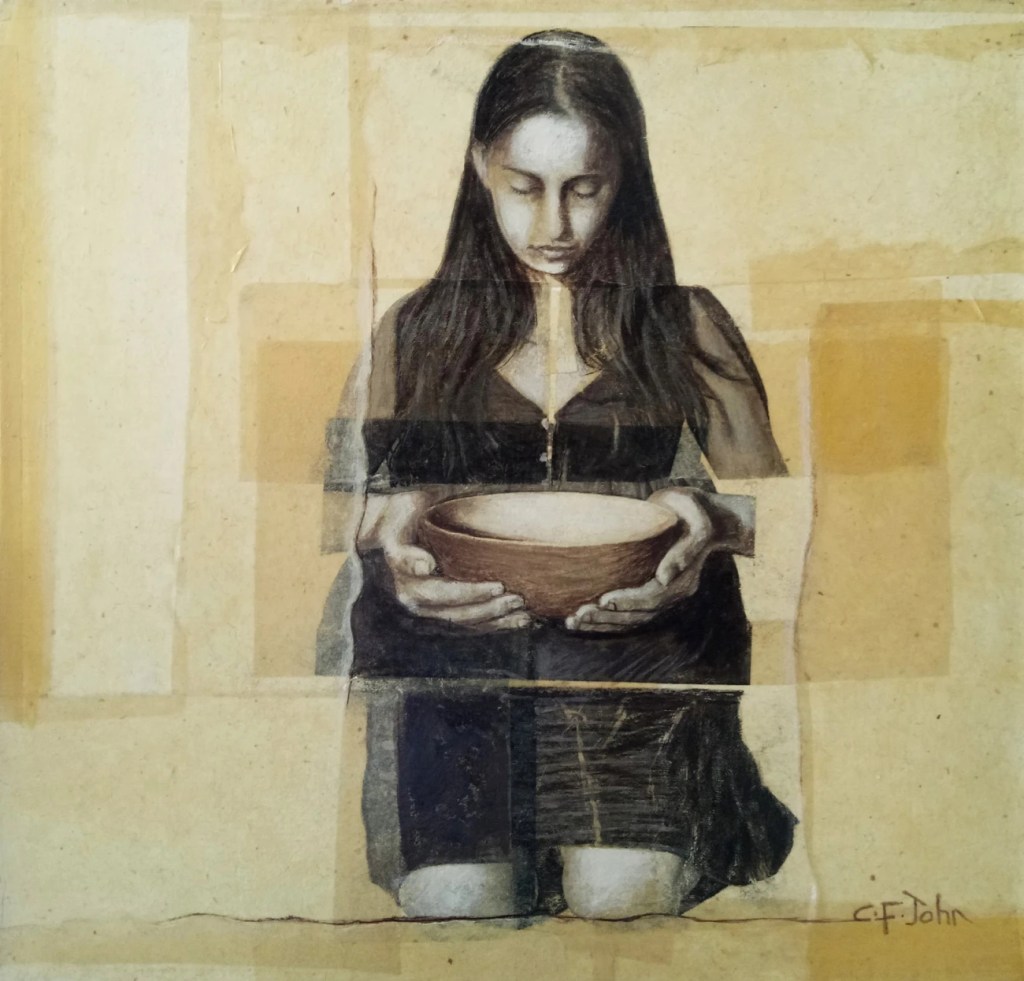
LOOK: C. F. John (Indian, 1960–), Gathering Fragments 1, 2009. Mixed media on banana fiber sheets on canvas, 12 × 12 in.

John, C.F._Gathering Fragments 1

C. F. John is an internationally exhibited, award-winning artist and social activist based in Bangalore, India. I learned about him from my friend Jyoti Sahi [previously], whose art ashram John lived at from 1984 to 1986. He works in oils, mixed media, and installation and has even designed a few architectural spaces. Spirituality and ecology are important in his practice.

The featured artwork here is from John’s Gathering Fragments series. To me it’s evocative of an emptying of self and the desire to be filled with God—a characteristic Lenten posture. The woman holds out her bowl with a readiness to receive.

To explore more of C. F. John’s art, visit https://cfjohn.com/.

LISTEN: Chorus from “Fill My Cup, Lord” by Richard Blanchard, 1959 | Performed by CeCe Winans, on Alabaster Box, 1999

Fill my cup, Lord;
I lift it up, Lord;
Come and quench this thirsting of my soul.
Bread of Heaven, feed me till I want no more.
Fill my cup, fill it up and make me whole.

Richard Blanchard (1925–2004) was an American Methodist minister and gospel songwriter. This most famous song of his was inspired by the story of the marginalized Samaritan woman whom Jesus engaged in conversation as the two of them were gathering water at a public well (John 4:1–45). Seeing that the woman was not only physically thirsty but also had a deep spiritual thirst, Jesus offered her “living water.” “Whoever drinks of the water that I will give him will never be thirsty again. The water that I will give him will become in him a spring of water welling up to eternal life,” he said. To which she replied, “Sir, give me this water!”

Though Blanchard’s song has three verses that make this connection explicit, gospel recording artists sometimes isolate the chorus and sing it as a standalone piece, as it’s such a powerful, concentrated expression of Godward yearning.

[Related posts: “Open Your Mouth (Artful Devotion)”; “Jesus Gave Me Water (Artful Devotion)”]

“Bread of Heaven” is a Christological title derived from John 6, a dialogue between Jesus and the crowds the day after he miraculously multiplied five loaves and two fishes a thousandfold.

When they found him on the other side of the sea, they said to him, “Rabbi, when did you come here?” Jesus answered them, “Truly, truly, I say to you, you are seeking me, not because you saw signs, but because you ate your fill of the loaves. Do not work for the food that perishes, but for the food that endures to eternal life, which the Son of Man will give to you. For on him God the Father has set his seal.” Then they said to him, “What must we do, to be doing the works of God?” Jesus answered them, “This is the work of God, that you believe in him whom he has sent.” So they said to him, “Then what sign do you do, that we may see and believe you? What work do you perform? Our fathers ate the manna in the wilderness; as it is written, ‘He gave them bread from heaven to eat.’” Jesus then said to them, “Truly, truly, I say to you, it was not Moses who gave you the bread from heaven, but my Father gives you the true bread from heaven. For the bread of God is he who comes down from heaven and gives life to the world.” They said to him, “Sir, give us this bread always.”

Jesus said to them, “I am the bread of life; whoever comes to me shall not hunger, and whoever believes in me shall never thirst. But I said to you that you have seen me and yet do not believe. All that the Father gives me will come to me, and whoever comes to me I will never cast out. For I have come down from heaven, not to do my own will but the will of him who sent me. And this is the will of him who sent me, that I should lose nothing of all that he has given me, but raise it up on the last day.  For this is the will of my Father, that everyone who looks on the Son and believes in him should have eternal life, and I will raise him up on the last day.”

—John 6:25–40 (emphasis mine)

Some modern hearers get confused by the request “Feed me till I want no more,” wondering at what point we would ever be so full of God that we wouldn’t want to be fed any more of him. But the word “want” is being used in the archaic sense of “lack”—the same way it’s used in Psalm 23: “The Lord is my shepherd, I shall not want.” (And in “Guide Me, O Thou Great Jehovah,” which contains the same exact line.) So it’s asking of God, “Feed me till I lack nothing.”

I love CeCe Winans’s rendition best, posted above. But if you want to watch a performance, here’s Tasha Cobbs Leonard singing live at Passion City Church in Atlanta:

And here’s a recording of the full song released just last month by the Living Stones Quartet from India. I’m not opposed to the verses, but they are a little hokey. Regardless, they bring back warm memories for me of singing this in church as a child. I’ve always been moved by the chorus.

“Fill My Cup, Lord,” as performed by CeCe Winans, is featured on the Art & Theology Lent Playlist on Spotify.

Lent, Day 2

To you, silence is praise, O God . . .

—Psalm 65:1*

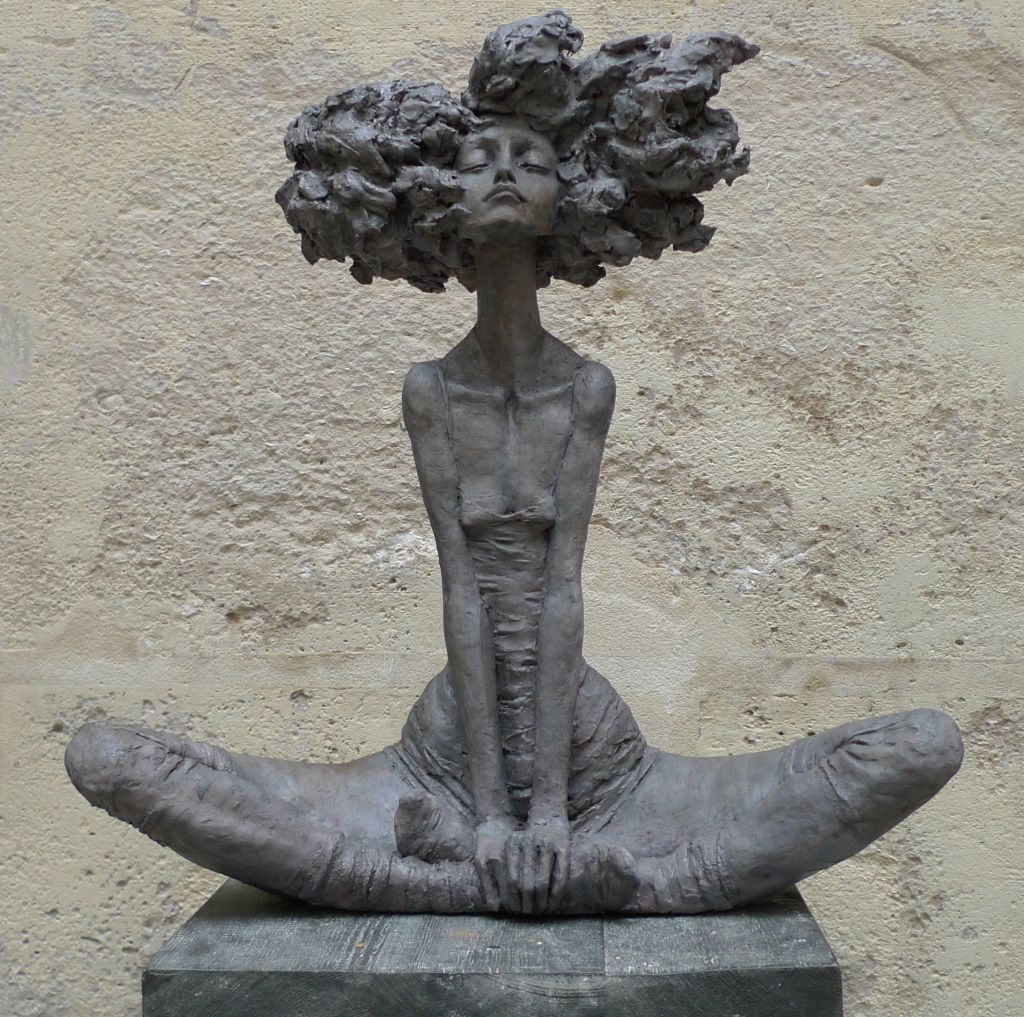
LOOK: Valérie Hadida (French, 1965–), Nuage (Cloud), 2013. Hadida is a contemporary figurative sculptor from France who works mainly in bronze and clay. Many of her “petites bonnes femmes” (little women) sculptures are available for sale through websites like Artsper and Artsy. View process photos on the artist’s Facebook page.

Hadida, Valérie_Nuage

LISTEN: “Dumiyah” by Richard Bruxvoort Colligan, on Our Roots Are in You: Short, Quiet Psalms (2013), feat. Trish Bruxvoort Colligan

Dumiyah
Tibi silens laus

English Translation:
Silence
For you, silence is praise

Dumiyyah (alternatively transliterated as dumiyah, dumiyya, or dûmîyâ) is one of several Hebrew words for “silence.” It’s used four times in the Psalms, most famously in Psalm 62:1—“For God alone my soul waits in silence; from him comes my salvation”—but also in Psalm 65:1. In addition to its straightforward sense, the word implies waiting or repose.

(Related post: “The savasana of Lent”)

The song above is a contemplative setting of the opening phrase of Psalm 65 in two languages. It layers the Hebrew dumiyyah with the Latin Vulgate translation of Leka dumiyyah tehillah.

In “Mystery of the Missing Silence,” Christian spirituality writer Carl McColman ponders why so many English translations of Psalm 65:1 eliminate or obscure the word dumiyyah that’s in the original text. The few well-established ones (in Christian circles) that retain it are:

  • The Darby Bible (DBY): “Praise waiteth for thee in silence, O God, in Zion . . .”
  • The New American Standard Bible (NASB): “There will be silence before You, and praise in Zion, O God . . .”
  • The GOD’S WORD Translation (GW): “You are praised with silence in Zion, O God . . .”
  • The English Standard Version (ESV) has “Praise is due you,” but a footnote provides the alternate translation “Praise waits for you in silence.”

McColman’s word study led him to reach out to Jewish friends with a familiarity of Hebrew, including one in rabbinical school, who pointed him to the Stone Edition Tanach from ArtScroll. First published in 1996, this translation by an international team of Torah scholars renders Psalm 65:1a as “To you, silence is praise, O God in Zion.” (Other modern Jewish translations, like Rabbi A.J. Rosenberg’s, have something similar.) A footnote in the Stone Edition cites commentary from the medieval rabbinic scholar Rashi (1040–1105), who said, “The praises of infinite God can never be exhausted. Silence is his most eloquent praise, since elaboration must leave glaring omissions.”

“Dumiyah” by Richard Bruxvoort Colligan is featured on the Art & Theology Lent Playlist on Spotify.

* Note: In most modern Jewish translations, which tend to count the original headings in the Psalms as verses, this is Psalm 65:2. In the Vulgate and in Eastern Orthodox Bibles, which follow the Septuagint numbering system instead of the Hebrew (Masoretic) one, it is Psalm 64:2. However, for consistency, I refer to it throughout this post as Psalm 65:1, following the numbering in Protestant Bibles.