
It was nine o’clock in the morning when they crucified him. . . .
When it was noon, darkness came over the whole land until three in the afternoon. At three o’clock Jesus cried out with a loud voice, “Eloi, Eloi, lema sabachthani?” which means, “My God, my God, why have you forsaken me?” . . . Then Jesus gave a loud cry and breathed his last.
—Mark 15:25, 33–34, 37
LOOK: Crucifix 45 by William Congdon
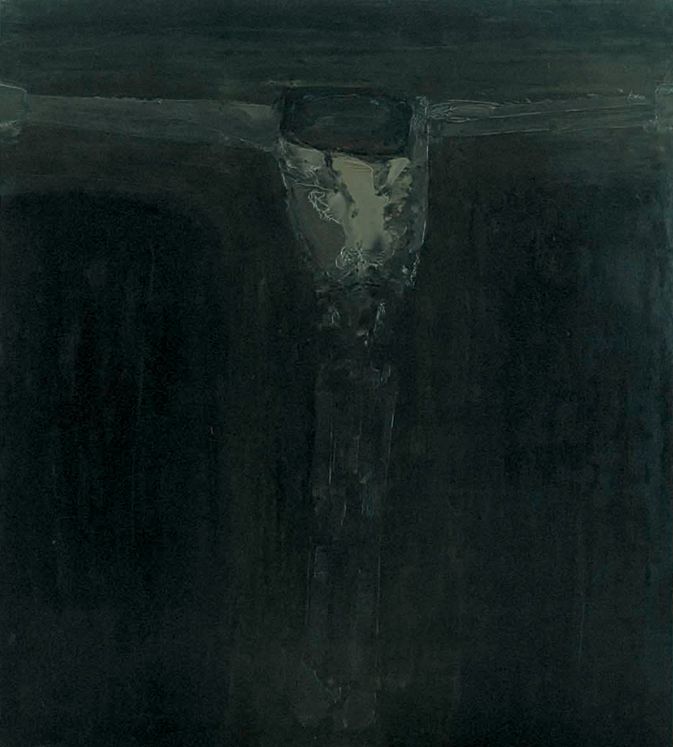
After his conversion to Catholicism in 1959, artist William Congdon [previously], an American expatriate living in Italy, spent the next twenty years of his life painting dozens of Crucifixions. One of them, Crocefisso 45, shows the crucified Christ immersed in near total darkness. His form is barely differentiated from the black background but can just be discerned by the faint band of light that outlines it. Congdon writes that he wanted to portray “a body soaked with pain to the point that one cannot distinguish the body from the pain, almost as though the pain had become a body and not the body a pain.”1
Christ’s head, like a gaping hole, hangs down to rest on his dimly luminescent chest. It’s as if the light of the world has been eclipsed. Art historian Giuseppe Mazzariol wrote of the recurring nero sole (black sun) in Congdon’s work, whose purpose is “to express the spiritual widowhood of a world marked by suffering.”2 Here it expresses the utter desolation of Good Friday.
Fred Licht writes that “in the Crucifixes [of Congdon] the black spot becomes the storm over Golgotha which is repeated every year with the advent of Good Friday, erasing the images from the altars, extinguishing the candles, and plunging the Christian world into deepest night.”3
Notes:
1. William Congdon, Esistenza/Viaggio di pittore americano: Diario (Milan: Jaca Book, 1975), 154.
2. Giuseppe Mazzariol, Introduzione a William Congdon, exh. cat. (Ferrara, 1981).
3. Fred Licht, “The Art of William Congdon,” in Fred Licht, Peter Selz, and Rodolfo Balzarotti, William Congdon (Jaca Book: Milan, 1995): 11–58.
LISTEN: “The Sun’s Gone Dim and the Sky’s Turned Black” by Jóhann Jóhannsson, on IBM 1401, A User’s Manual (2006) [HT]
The sun’s gone dim
And the sky’s turned black
’Cause I loved her
And she didn’t love back
“The Sun’s Gone Dim and the Sky’s Turned Black” by the late Icelandic composer Jóhann Jóhannsson (1969–2018) blends, as does most of his work, traditional orchestration with contemporary electronic elements. The elegiac lyrics, which repeat multiple times over the nearly six-minute runtime, are adapted from “Two-Volume Novel” by Dorothy Parker, a four-line poem about unrequited love.
This piece was inspired by a recording of an IBM mainframe computer that Jóhannsson’s father, Jóhann Gunnarsson, made on a reel-to-reel tape machine in the 1970s. (Gunnarsson was an IBM engineer and one of Iceland’s first computer programmers, who used early hardware to compose melodies during his downtime at work.) It was recorded by a sixty-piece string orchestra, with Jóhannsson on vocals.
Credit goes to the Rabbit Room not only for this find but also for connecting it to Good Friday. (I found the song on their Lent playlist.) Imagine the speaker as Jesus on the cross, speaking to the world that he so loved (John 3:16) but who rejected him. Even the sky mourns with him as the sun veils her face. All is dark and seemingly lost.
 Art & Theology