
Roundup: Site-specific dance in sanctuary, the Feast of Creation, botanical portraits of place, and more

DANCE: “Seraphim” (2026), choreographed by Lindsey Hanson: This is one of the most unique dances for film that I’ve seen. It’s absolutely mesmerizing! Filmed in Dimnent Memorial Chapel in Holland, Michigan, with a bird’s eye view camera, “Seraphim” features eight female dancers who utilize the space’s pews and at times appear to be swimming in water or floating in zero gravity. They curl and climb and slide and propel. I love the illusion of them ascending and descending a ladder using the bench ends—a reference to the ladder in Jacob’s vision, linking heaven and earth. (Reminds me of the angels on the limestone facade of Bath Abbey in the UK!) In part because of the work’s title, I imagine the dancers as the invisible spiritual presences that move about the church, quietly ministering.

“Seraphim” is the second of four new works created this year as part of the Sanctuary Project, funded by the Creative Arts Collective for Christian Life and Faith. The third work, “Gethsemane,” will be performed for a live audience, who will watch from the stage, on September 5 at the W83 Ministry Center Sanctuary at Redeemer Presbyterian Church in New York City; free reservations are open! Debuting in 2021, SANCTUARY is a site-specific dance made for Redeemer, to activate the architecture of the church’s worship space, and choreographer and director Lindsey Hanson has expanded the concept into a continuing body of work.

+++

POEM: “Lord of Light and Dark” by Haley Hodges Schmid, Reformed Journal: Haley Hodges Schmid is a sonically driven poet, and that shows in this gorgeous poem published last month, a prayer with internal rhyme, consonance, a verbified noun, and other language play. It’s about “holy darkening,” says Schmid, whose debut poetry collection, Eros Rex, was released earlier this year by Orison Books. She seeks to recover positive imagery of darkness, and so expand our metaphorical associations. I’m reminded of other poets who have similarly explored the biblical paradox of the light and darkness of God, including John Milton (“Dark with excessive bright thy skirts appear,” he writes in Paradise Lost) and Meister Eckhart via Jon M. Sweeney and Mark S. Burrows: “You are the One who is in-yet-beyond / the many, Light burning in darkness // and Darkness shining beyond light” (from Meister Eckhart’s Book of the Heart). There are a handful of contemporary hymns and worship songs that do the same.

“Lord of Light and Dark” was born out of a week-long residency on poetry and prayer that Schmid participated in in Asheville, North Carolina, led by Marie Howe, who had the group write collects, a short, structured prayer form used in Anglican worship.

+++

ARTICLES:

>> “A feast day for the whole church,” an interview with Kimberly Belcher, by Steve Thorngate, Christian Century: “This spring, the Consultation on Common Texts published an update to the Revised Common Lectionary: It added the Feast of Creation in Christ on September 1, offering biblical texts and other materials for use starting with the current church year. It’s a milestone in a decades-long ecumenical process.” Steve Thorngate talks with liturgical theologian Kimberly Belcher, who participated in the Assisi meetings in 2024–25, about this feast day that has only recently developed in the West but that has been celebrated in the East for more than five hundred years as the Feast of the Indiction. Belcher describes what’s behind the full name, how a feast day is distinct from a world day of prayer, the challenges and gifts of ecumenism, creation as revelation, and more.

Vooys, Mary Haasdyk_Feast of Creation in Christ
Illustration by Mary Haasdyk Vooys for The Christian Century‘s September 2026 cover story on the Feast of Creation in Christ, a new addition to the official liturgical calendars of many Western churches

I love the illustration Mary Haasdyk Vooys made for this article, which is used on the magazine’s cover. It shows Christ as Creator, holding a drafting compass and surrounded by diverse animals.

>> “Hillary Waters Fayle Creates ‘Portraits of Place’ from Seeds, Foliage, and Petals” by Kate Mothes, Colossal: Portraits of Place is an ongoing series of botanical artworks by Hillary Waters Fayle that pay tribute to the land and our relationship with it. The artist collects botanical material from a designated place, dries and preserves it, arranges it into an intricate, mandala-like pattern, and then uses that to create a cyanotype. Many of these she does on commission for people who want to commemorate a piece of land that is special to them.

“Penland Pop” by Hillary Waters Fayle
Penland Pop by Hillary Waters Fayle

I urge you to explore the artist’s website, which contains many more photos plus other extraordinary projects, including embroidered leaves and lacelike leafcuts: https://www.hillarywfayle.com/.

+++

WORSHIP RESOURCES: Creation Collection from Reformed Worship: ReformedWorship.org has compiled numerous resources on the theme of creation—worship services, songs, prayers, litanies, a Psalms-based reader’s theater, sermon series, stories, and more.

+++

SONG: “Die Himmel erzählen die Ehre Gottes” (The Heavens Declare the Glory of God) by Heinrich Schütz: This motet from 1648 is a setting of Psalm 19:1–6. It’s performed here by VOCES8 in the Christuskirche in Recklinghausen, Germany.
Advent Prelude: Out of Darkness

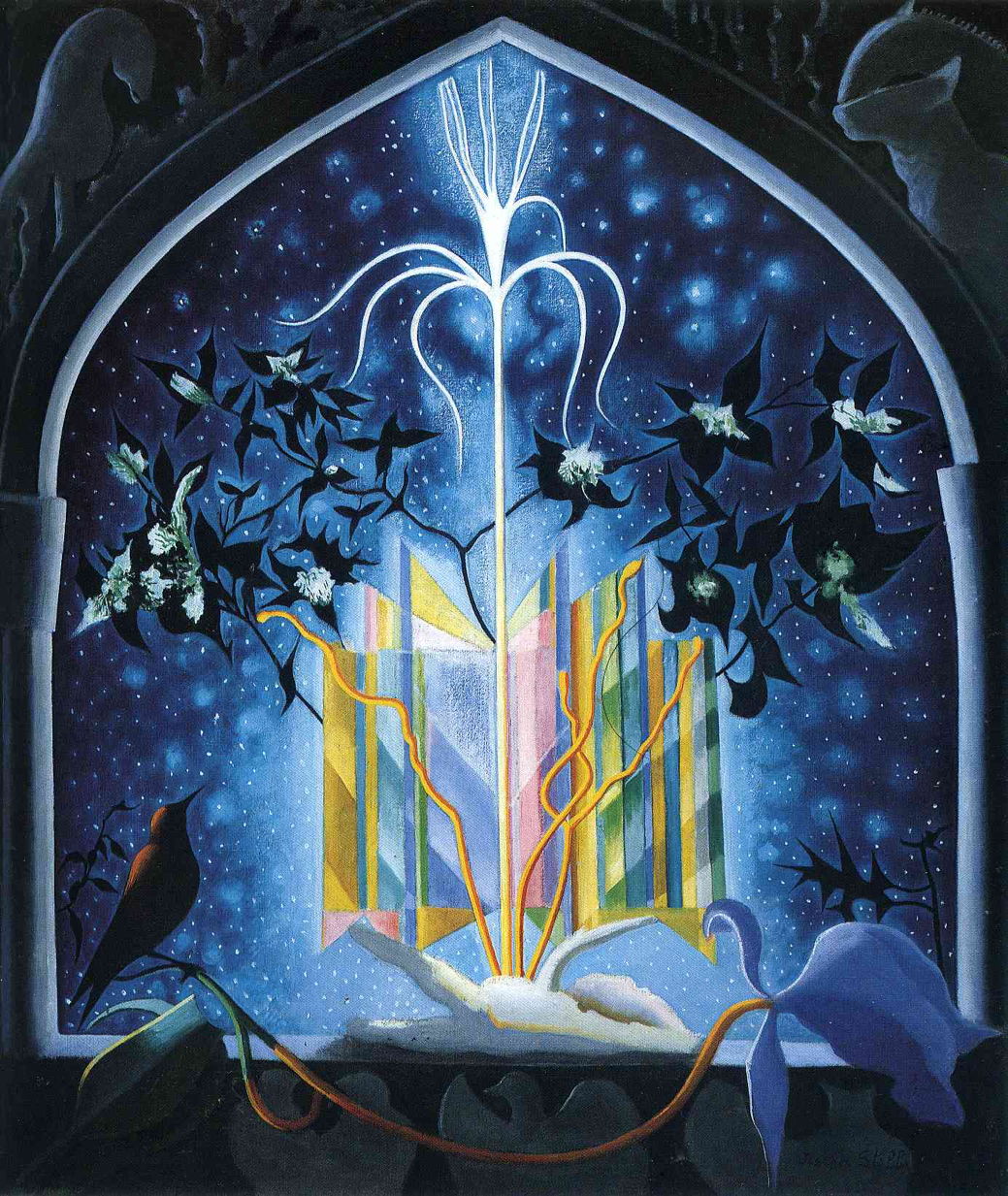
LOOK: Serenade: A Christmas Fantasy by Joseph Stella

Stella, Joseph_Serenade: A Christmas Fantasy
Joseph Stella (Italian American, 1877–1946), Serenade: A Christmas Fantasy (La Fontaine), 1937. Oil on canvas, 43 1/8 × 37 1/8 in. (109.5 × 94.3 cm). Hirshhorn Museum and Sculpture Garden, Washington, DC.

Joseph Stella (1877–1946) [previously] was an Italian American painter who became an important figure in modern art. His Serenade: A Christmas Fantasy is not overtly religious, but it does incorporate a few elements traditionally associated with Christmastime—a starry night sky, a holly branch, an ox and ass, a dove—and has a mystical quality. In the center, a flower emerges from what appears to be a conch shell, its pistil and stamen glowing. The flower’s stem shoots up past an abstract, mobile-like object that could be shards of colorful glass or pieces of cut paper. It’s a visionary composition that is open to multiple readings.

Art historian Judith Zilczer comments on the painting in the exhibition catalog Joseph Stella: The Hirshhorn Museum and Sculpture Garden Collection (Smithsonian Institution, 1983):

Serenade: A Christmas Fantasy typifies Stella’s mature symbolist style. Framed by an arch, a fantastic tree form bisects the composition and serves as the central image of the painting. The colors of the iridescent prism surrounding the central axis recall the abstract geometric style of Stella’s Futurist canvases.

The meaning of Stella’s complex imagery remains elusive. The ox and ass in the upper right spandrel traditionally appear together in paintings of the Nativity. The image of the dove in the center of the lower border is the symbol of the Holy Ghost. These Christian symbols are consistent with the painting’s subtitle, A Christmas Fantasy. The painting is also known as The Fountain (La Fontaine). The treelike form in the center may represent an abstraction of a jet of water. The image of the fountain often served as an attribute of the Virgin Mary, who was regarded as the “fountain of living waters.” It is possible that in this canvas Stella has fused the image of the tree of life with the fountain as the symbol of the Virgin. The nightingale perched on the tendril [of the purple iris] in the lower left is the source of the serenade. (54)

I see in Serenade the promise of Advent—light emerging out of darkness, wondrous new life growing out of dormancy. There’s a coming fullness here, a blossoming. The chromatic spectrum refracted by the center object evokes a rainbow, the sign of God’s covenant with all living creatures in Genesis 9.

LISTEN: “Wonder” by MaMuse (Sarah Nutting and Karisha Longaker), on Prayers for Freedom (2018)

Oooh, I wonder
Oooh, I wonder
Oooh, I wonder
What is to come out of this darkness

I’ve been moving, moving, moving, moving through the darkness
Moving, moving, moving, moving through the darkness
I wonder when the light is cracking open

Oooh, I wonder
Oooh, I am filled with wonder
Oooh, I wonder
What is to come out of this darkness

I thought this candle had long gone out
I thought that it had long gone out
But today, today, today, today I can see
There’s still a flickering, flickering

Oooh, I wonder
Oooh, I wonder
Oooh, I wonder
What is to come out of this darkness

Burn, burn, burn, burning on the inside
Burn, burn, burn, burning like a bright light
Burn, burn, burn, burning on the inside
This light’s still burning, burning bright

I thought this candle had long gone out
I thought that it was long gone out
I thought that this candle had long gone out
But today, today, today, today I can see
There’s more than a flickering

Oooh, I wonder
Oooh, I am filled with wonder
Oooh, I wonder
What is to come out of this darkness

This song was written by MaMuse [previously], an acoustic folk duo who I’d say are “spiritual but not religious,” several years ago on the winter solstice. Watch a live video recording from January 2019 at the Chico Women’s Club in Chico, California, the two’s hometown.

Advent is sometimes mischaracterized as glum, but actually, joyfulness is a key aspect of the season. There’s a somberness, for sure, but it’s married with excitement for what’s coming.

I hope to capture this dual tone of Advent in my selection of art and music over the next twenty-four days. This is the first post in a daily series that will run to the end of Advent on December 24, and then for the duration of Christmas, from December 25 to January 6. Many of the songs in the series can be listened to on the Art & Theology Advent Playlist, Christmastide Playlist, and Epiphany Playlist on Spotify.

In the liturgical calendar, Advent-Christmas-Epiphany is known as the cycle of light. Many churches and families light candles around an Advent wreath, progressively more until Christmas, symbolizing the Light of the World getting nearer, dispelling more of the darkness.

May you be blessed this Advent season as you wonder and explore what is to come out of December’s darkness. May you discern with delight those places where “the light is cracking open,” where God is shining through.

Holy Week: Jesus Dies

It was nine o’clock in the morning when they crucified him. . . .

When it was noon, darkness came over the whole land until three in the afternoon. At three o’clock Jesus cried out with a loud voice, “Eloi, Eloi, lema sabachthani?” which means, “My God, my God, why have you forsaken me?” . . . Then Jesus gave a loud cry and breathed his last.

—Mark 15:25, 33–34, 37

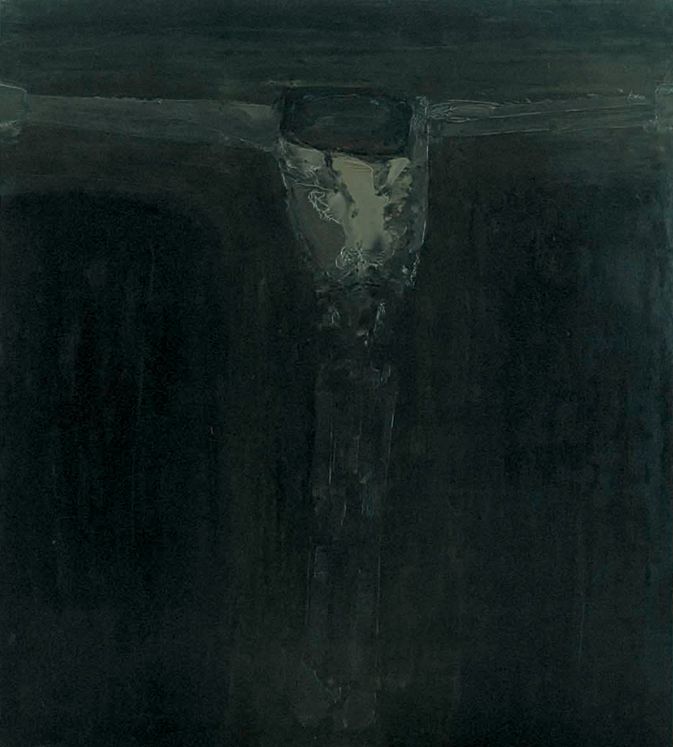
LOOK: Crucifix 45 by William Congdon

Congdon, William_Crucifix 45
William Congdon (American, 1912–1998), Crocefisso 45 (Crucifix 45), 1966. Oil on canvas, 152 × 139 cm. Collection of the William G. Congdon Foundation, Milan.

After his conversion to Catholicism in 1959, artist William Congdon [previously], an American expatriate living in Italy, spent the next twenty years of his life painting dozens of Crucifixions. One of them, Crocefisso 45, shows the crucified Christ immersed in near total darkness. His form is barely differentiated from the black background but can just be discerned by the faint band of light that outlines it. Congdon writes that he wanted to portray “a body soaked with pain to the point that one cannot distinguish the body from the pain, almost as though the pain had become a body and not the body a pain.”1

Christ’s head, like a gaping hole, hangs down to rest on his dimly luminescent chest. It’s as if the light of the world has been eclipsed. Art historian Giuseppe Mazzariol wrote of the recurring nero sole (black sun) in Congdon’s work, whose purpose is “to express the spiritual widowhood of a world marked by suffering.”2 Here it expresses the utter desolation of Good Friday.

Fred Licht writes that “in the Crucifixes [of Congdon] the black spot becomes the storm over Golgotha which is repeated every year with the advent of Good Friday, erasing the images from the altars, extinguishing the candles, and plunging the Christian world into deepest night.”3

Notes:

1. William Congdon, Esistenza/Viaggio di pittore americano: Diario (Milan: Jaca Book, 1975), 154.

2. Giuseppe Mazzariol, Introduzione a William Congdon, exh. cat. (Ferrara, 1981).

3. Fred Licht, “The Art of William Congdon,” in Fred Licht, Peter Selz, and Rodolfo Balzarotti, William Congdon (Jaca Book: Milan, 1995): 11–58.

LISTEN: “The Sun’s Gone Dim and the Sky’s Turned Black” by Jóhann Jóhannsson, on IBM 1401, A User’s Manual (2006) [HT]

The sun’s gone dim
And the sky’s turned black
’Cause I loved her
And she didn’t love back

“The Sun’s Gone Dim and the Sky’s Turned Black” by the late Icelandic composer Jóhann Jóhannsson (1969–2018) blends, as does most of his work, traditional orchestration with contemporary electronic elements. The elegiac lyrics, which repeat multiple times over the nearly six-minute runtime, are adapted from “Two-Volume Novel” by Dorothy Parker, a four-line poem about unrequited love.

This piece was inspired by a recording of an IBM mainframe computer that Jóhannsson’s father, Jóhann Gunnarsson, made on a reel-to-reel tape machine in the 1970s. (Gunnarsson was an IBM engineer and one of Iceland’s first computer programmers, who used early hardware to compose melodies during his downtime at work.) It was recorded by a sixty-piece string orchestra, with Jóhannsson on vocals.

Credit goes to the Rabbit Room not only for this find but also for connecting it to Good Friday. (I found the song on their Lent playlist.) Imagine the speaker as Jesus on the cross, speaking to the world that he so loved (John 3:16) but who rejected him. Even the sky mourns with him as the sun veils her face. All is dark and seemingly lost.