
LOOK: What You Gonna Name That Pretty Little Baby? by Aminah Brenda Lynn Robinson
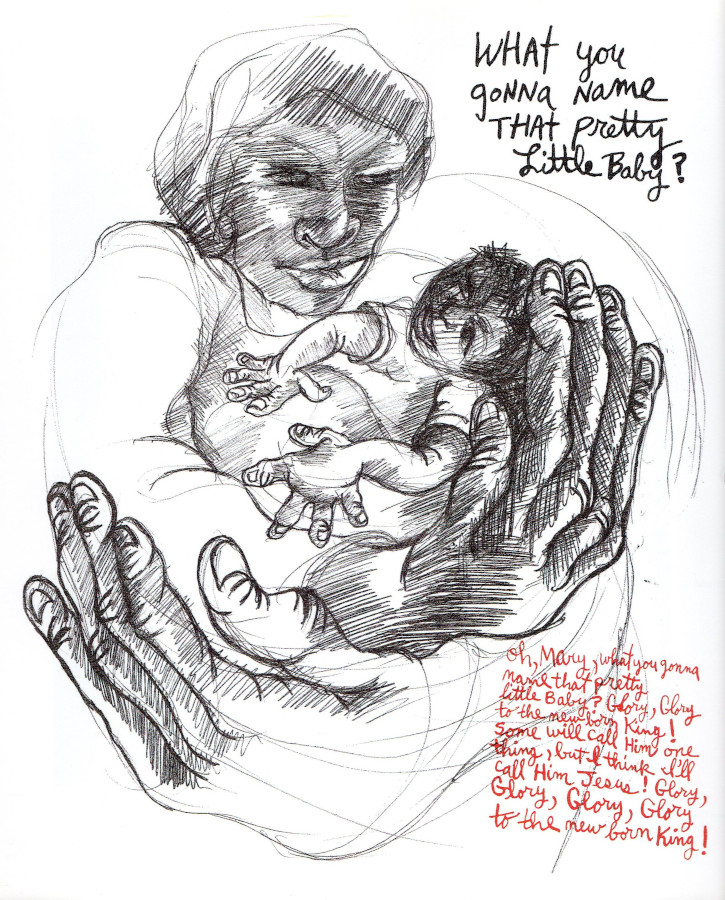
Aminah Brenda Lynn Robinson (1940–2015) was an artist working in multiple media whose work celebrates Black history and culture. She was a lifelong resident of Columbus, Ohio, and bequeathed her art, writings, home, and personal property to the Columbus Museum of Art, who established the Aminah Robinson Legacy Project in 2020.
The drawing above is one of twenty-six from Robinson’s excellent book The Teachings: Drawn from African-American Spirituals (Harcourt Brace Jovanovich, 1992). These drawings, she writes in the introduction, “have grown from the stories and songs that were given to me by my family and my early teachers, and I offer them here to the children of today’s troubled world and the children of tomorrow. They carry a message of dignity, knowledge, and wisdom . . . speak of survival, of freedom and determination, of love and faith, of justice and of hope . . .”
The artist’s estate is represented in the US by Fort Gansevoort in New York, which is currently showing Aminah Brenda Lynn Robinson: Character Studies through January 25.
Another exhibition of her work, Aminah Robinson: Journeys Home, a Visual Memoir, will be touring nationally for the next few years: to the Springfield Museum of Art in Ohio (February 1–July 13, 2025), the Newark Museum of Art in New Jersey (October 16, 2025–March 1, 2026), the Mobile Museum of Art in Alabama (March 26, 2026–January 9, 2027), and two remaining venues to be announced. This is a major exhibition that brings together Robinson’s drawings, prints, paintings, textiles, collages, homemade books, dolls, “hogmawg” sculptures (made of a mixture of mud, clay, twigs, leaves, lime, animal grease, and glue), and “RagGonNon” pieces (monumental swaths of fabric encrusted with buttons, beads, and other found objects) to create a portrait of her life.
LISTEN: “Mary, What You Gonna Name That Pretty Little Baby?,” African American spiritual | Arranged by Alex Bradford, 1961 | Performed by Princess Stewart and Marion Williams on Black Nativity: Gospel on Broadway! (Original Broadway Cast), 1962
Mary, Mary, what you gonna name that pretty little baby?
Mmm, mmm, pretty little baby
Mmm, mmm, pretty little baby
Glory be to the newborn KingSome call him one thing, I think I’ll call him Jesus
Mmm, mmm, sweet Jesus
Mmm, mmm, (ain’t he sweet?) sweet Jesus
Glory be to the newborn KingSome call him Jesus, I think I’ll call him Wonderful
Mmm, mmm, wonderful
Mmm, mmm, he’s so wonderful
Glory be to the newborn KingSome call him Wonderful, I think I’ll call him Emmanuel
Mmm, mmm, King Emmanuel
Mmm, mmm, (ain’t he the king?) Emmanuel
Glory be to the newborn KingSome call him Emmanuel, I’m gonna call him the Prince of Peace
Mmm, mmm, Prince of Peace
Mmm, mmm, Prince of Peace
Glory be to the newborn KingSome call him Prince of Peace, I’m gonna call him Jesus
Mmm, mmm, sweet Jesus
Mmm, mmm, (ain’t he sweet?) sweet Jesus
Glory be to the newborn KingMary, Mary, what you gonna name that pretty little baby?
Mmm, mmm, pretty little baby
Mmm, mmm, pretty little baby
Glory be to the newborn King
This Christmas spiritual, a dialogue between an unnamed visitor and the new mother Mary, has been recorded by many artists. I think I like the original cast recording from the Langston Hughes musical Black Nativity best, featuring soloist Princess Stewart on the first verse and Marion Williams on the remaining six, backed by the Stars of Faith.
But here’s a handful of other versions I like. Because the song was passed down orally, it has taken on different lyrical variations and accrued new verses. Some reference the wise men.
>> “The Virgin Mary Had One Son” by the Staple Singers, arr. Roebuck “Pops” Staples, on The 25th Day of December (1962):
>> “The Virgin Mary Had One Son” by Josh Garrels, on The Light Came Down (2016):
>> “What ’Cha Gonna Call the Pretty Little Baby” by the National Lutheran Choir, dir. David M. Cherwien, arr. Ronald L. Stevens, on Christ Is Born (2016):
>> “Glory to the Newborn King” by Chicago a Cappella, dir. Jonathan Miller, arr. Robert Leigh Morris, on Holidays a Cappella Live (2002):
>> “Virgin Mary Had One Son” by Joan Baez and Bob Gibson, live at the 1959 Newport Folk Festival (see also “Virgin Mary,” a bonus track on the 2001 Vanguard reissue of Baez’s 1966 album Noël):

 Art & Theology