
For all flesh is as grass, and all the glory of man as the flower of grass. The grass withereth, and the flower thereof falleth away: but the word of the Lord endureth for ever. And this is the word which by the gospel is preached unto you.
—1 Peter 1:24–25 (KJV) (cf. Isaiah 40:7–8)
Man is like a breath; his days are like a passing shadow.
—Psalm 144:4 (ESV)
LOOK: Fraktur attributed to David Kriebel
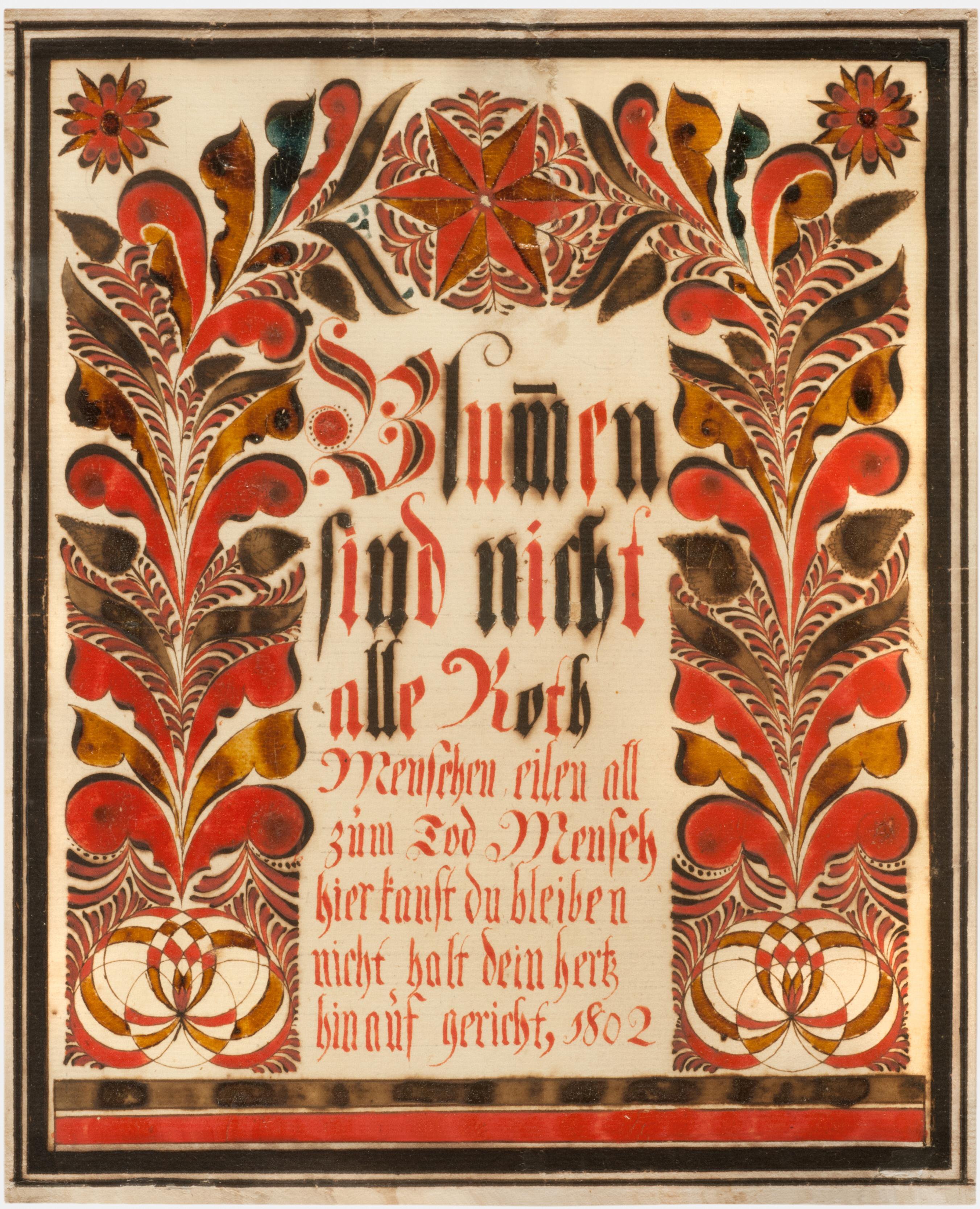
Referring to exuberantly decorated pages made by Pennsylvania Germans, fraktur is a type of folk art that flourished in the eighteenth and nineteenth centuries. Traditionally handwritten in ink and hand-painted with letter embellishments and design motifs like birds, hearts, and tulips, these works on paper often contain religious texts and/or commemorate important life events like births, deaths, and baptisms. They were made primarily by pastors and schoolmasters, who gifted them to parishioners or students. The recipients did not frame or hang them, but rather kept them in Bibles, drawers, or chests.
The German text of this fraktur translates to “Flowers are not all red. All men hasten toward death. Man cannot remain here, so direct your heart upward.” The piece features a foliate border and a color palette of reds and browns that captures both the bloom of youth and life’s inevitable withering. It was made by David Kriebel, a farmer from Gwynedd Township in Montgomery County, Pennsylvania, who would later move to nearby Worcester Township and become a minister in the Schwenkfelder Church, a small Christian denomination rooted in the Protestant Reformation teachings of Caspar Schwenkfeld von Ossig (1489–1561), which emphasize inner spirituality over outward form.
LISTEN: “As the Life of a Flower” by Laura E. Newell (words) and George H. Ramsey (music), 1904 | Performed by the Chuck Wagon Gang, 1953 [HT]
As the life of a flow’r, as a breath or a sigh
So the years that we live as a dream hasten by
True, today we are here, but tomorrow may see
Just a grave in the vale and a mem’ry of meRefrain:
As the life of a flow’r, as a breath or a sigh
So the years glide away, and alas, we must dieAs the life of a flow’r, be our lives pure and sweet
May we brighten the way for the friends that we greet
And sweet incense arise from our hearts as we live
Close to him who doth teach us to love and forgive [Refrain]While we tarry below, let us trust and adore
Him who leads us each day toward the radiant shore
Where the sun never sets and the flow’rs never fade
Where no sorrow or death may its borders invade [Refrain]
This early twentieth-century gospel hymn is performed here by D. P. Carter (tenor) and three of his nine children: Rose Carter Karnes (soprano), Anna Carter Gordon (alto), and Ernest (Jim) Carter (bass, guitar). The quartet formed in 1935 and started appearing on WBAP radio in the family’s hometown of Fort Worth, Texas, the following year, billing themselves as the Chuck Wagon Gang.
“As the Life of a Flower” draws on biblical passages that compare human life to a flower for its ephemerality (e.g., Job 14:2; Psalm 103:15–16; Isa. 40:6–8; 1 Pet. 1:24–25). But flowers are also fragrant, and the song makes that comparison too, echoing verses like 2 Corinthians 2:14–15, where Paul writes, “Thanks be to God, who . . . through us spreads in every place the fragrance that comes from knowing him. For we are the aroma of Christ to God among those who are being saved and among those who are perishing.”
Though we are fading, we are glorious creations of God with joyous and sweet-smelling potential. While we live on this earth, may we exude the beauty and aroma of Christ in all we say and do.
 Art & Theology
The Second-tone Funeral Hymn of St. John of Damascus, sung at every Orthodox Christian Funeral:
Like a blossom that wastes away, and like a dream that passes and is gone, so is every mortal into dust resolved; but again, when the trumpet sounds its call, as though at a quaking of the earth, all the dead shall arise and go forth to meet You, O Christ our God: on that day, O Lord, for him (her) whom You have withdrawn from among us appoint a place in the tentings of Your Saints;yea, for the spirit of Your servant, O Christ.
LikeLike