Flemish Tapestry with Scenes of the Passion

This month I traveled to parts of Germany and Belgium to experience some of the art of those countries, with a focus on medieval religious art. In Brussels, besides exploring the famous Oldmasters Museum (part of the Royal Museums of Fine Arts of Belgium), I visited the lesser-known Art and History Museum, whose collection includes not just western European art from prehistoric times through the nineteenth century, but also art from Asia (China, Korea, India, Pakistan, Afghanistan, Sri Lanka, Tibet, Nepal, Turkey, Iran, Cambodia, Thailand, Burma), Oceania, the pre-Columbian Americas, and ancient Egypt, Greece, and Rome.

Art and History Museum, Brussels

I spent the most time with the medieval European art on the ground floor—wooden statuettes, ivory and alabaster carvings, stained glass, paintings, metalworks, and tapestries. With the Google Translate app open, I hovered my phone over the Dutch and French descriptive labels to read them in English.

My favorite tapestry I saw, from fifteenth-century Tournai, portrays three scenes from the passion of Christ: Christ Carrying the Cross, the Crucifixion, and the Resurrection. The museum gallery it’s displayed in also houses a large medieval loom, which is what’s protruding at the bottom right corner of the following photo.

Tapestry of the Passion
Scenes from the Passion, Tournai, ca. 1445–55. Tapestry of wool and silk, 424 × 911 cm. Art and History Museum, Brussels, Belgium, Inv. 3644. All photos by Victoria Emily Jones.

Tapestries made in the Flemish city of Tournai were among the most sought after in the fifteenth century. These large-scale wall hangings were bought by royalty, nobles, and high-ranking clergy to decorate their palaces. This one, nearly thirty feet long, is the second of a two-part hanging whose first part (portraying Christ’s Entry into Jerusalem, the Last Supper, and the Arrest of Christ) is in the collection of the Vatican.

Below are some detail shots.

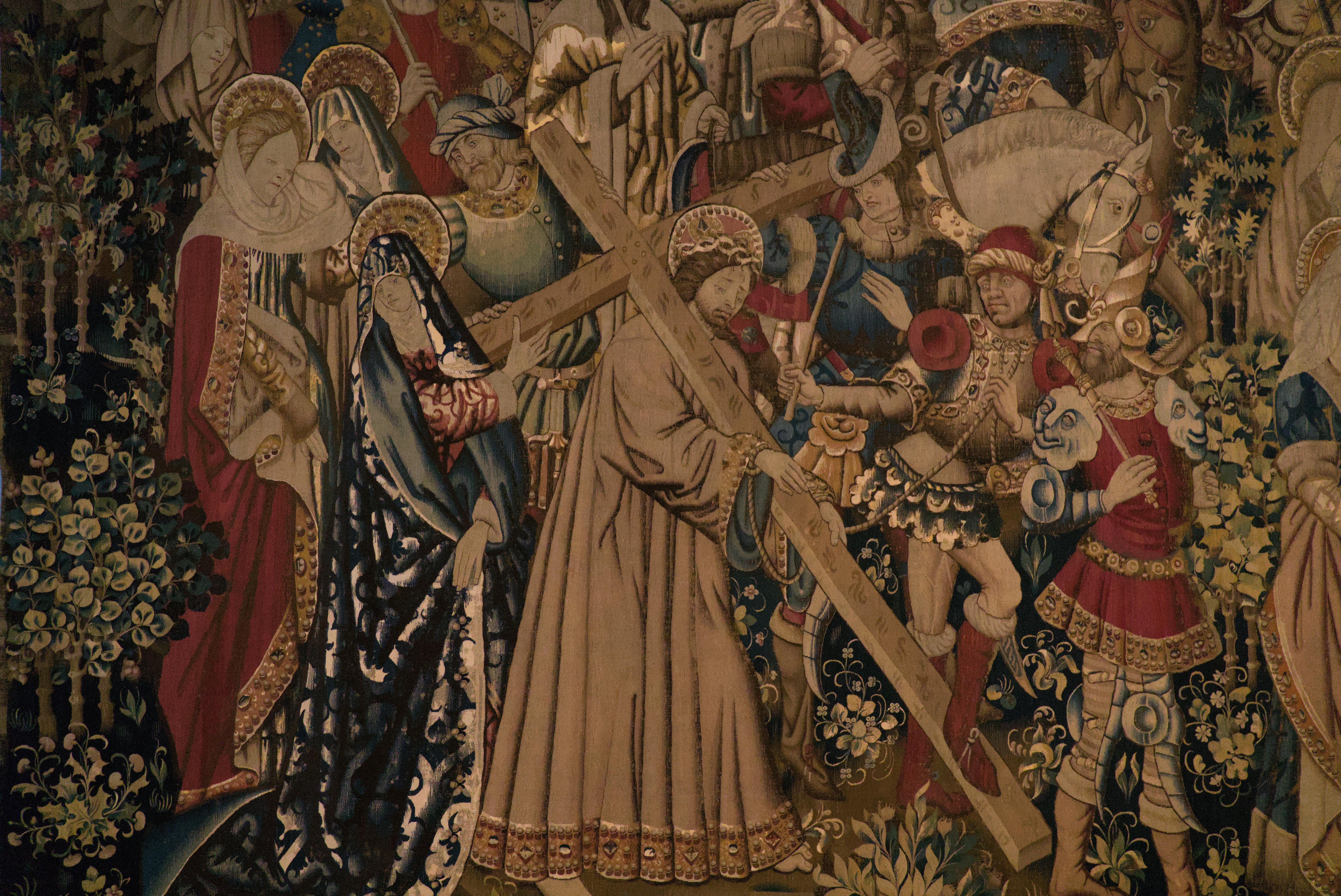
First, Christ carries his cross. A soldier pulls him forward by a rope tied to his wrists, while tauntingly standing on the vertical wood beam and hitting him with a baton. On a less serious note, those are some spiffy face-shaped shoulder scales on the right.
Sept2025_DSC1508

Christ crucified:

Sept2025_DSC1509

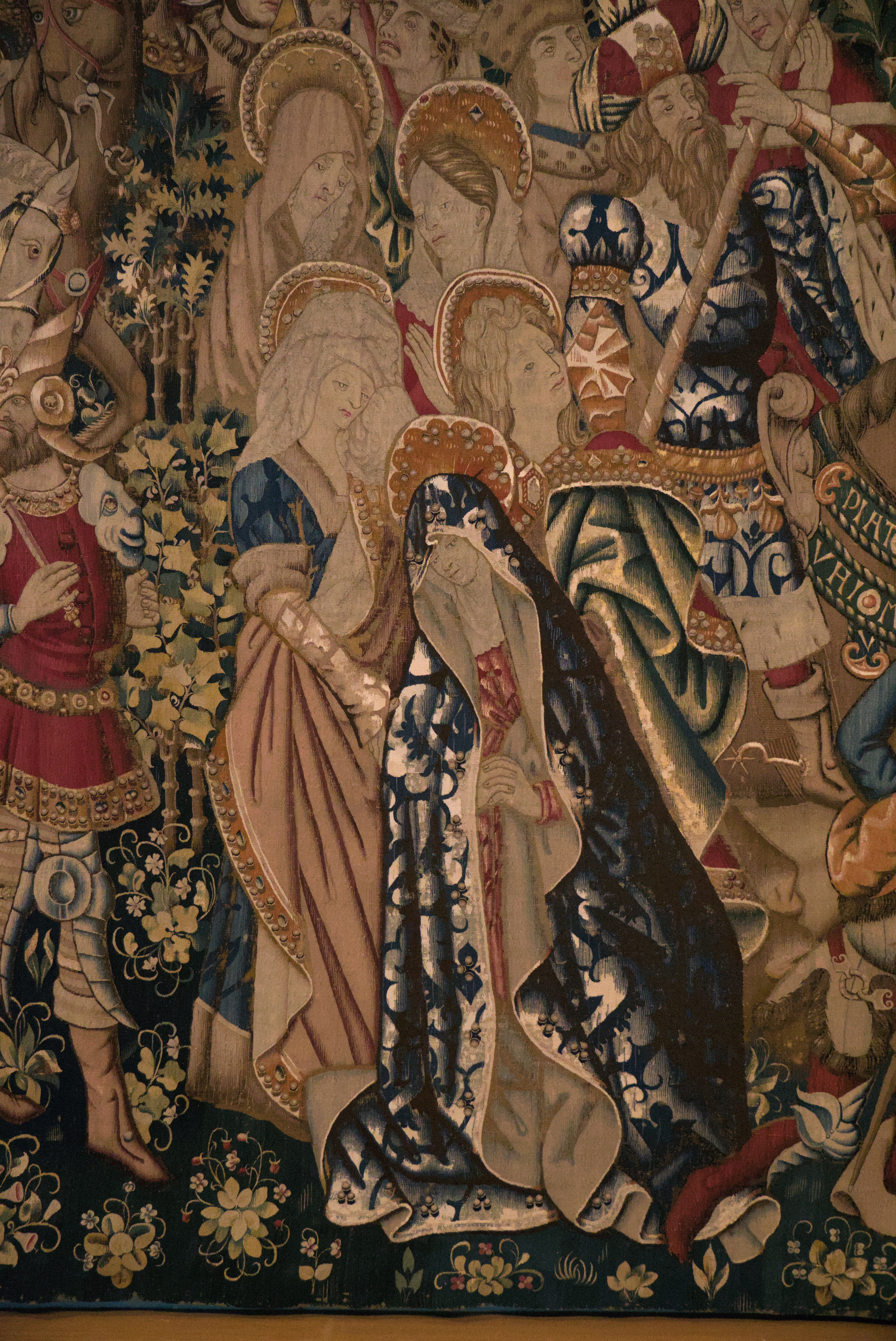
A group of four women mourn—the Virgin Mary up front in the blue mantle, backed by three other Marys—alongside a curly-haired apostle John in green.
Sept2025_DSC1515

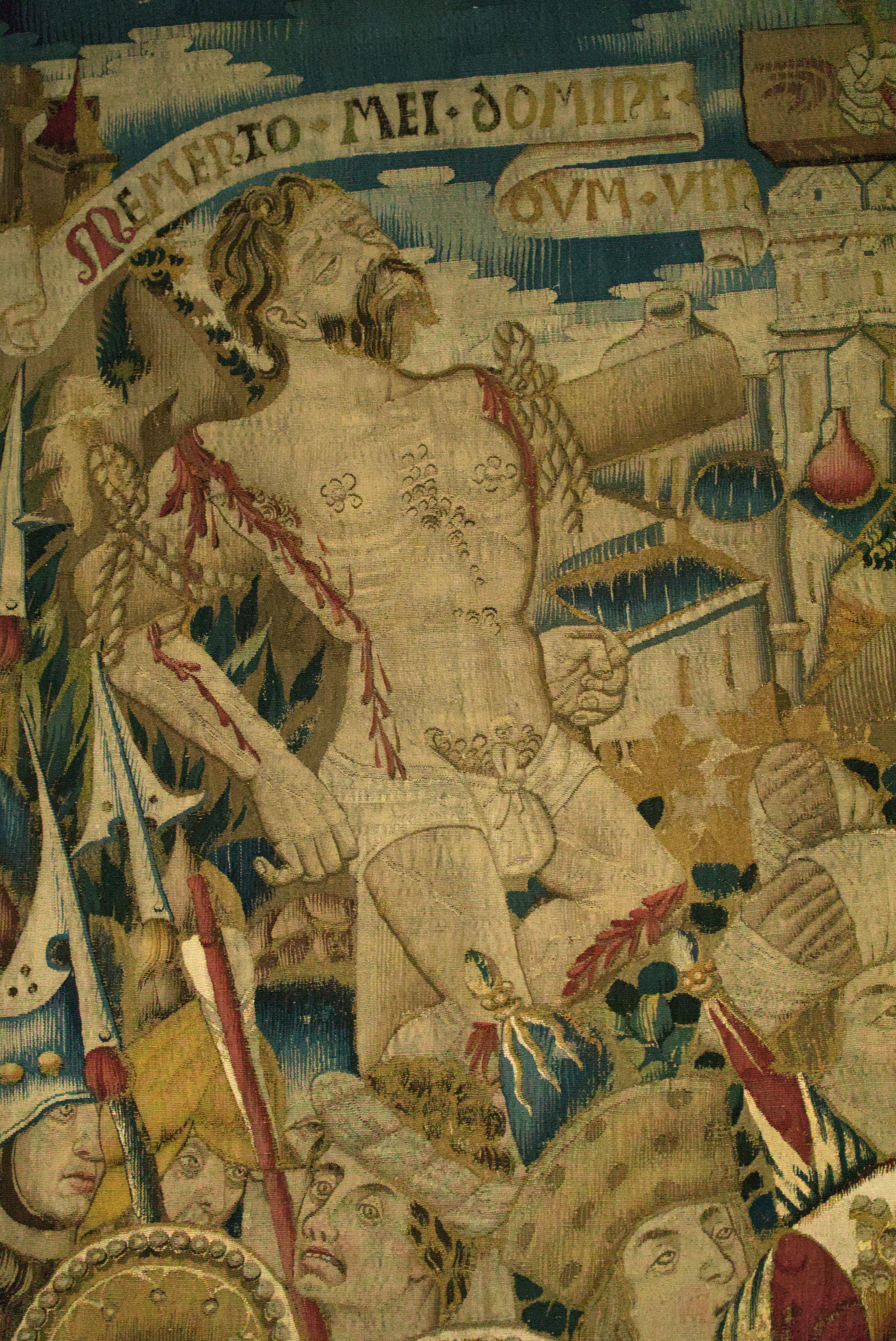
On Christ’s right (the viewer’s left), the penitent thief, with his last breaths, says, Memento mei, Domine, dum ven[eris in regnum tuum] (Remember me, Lord, when you come into your kingdom) (Luke 23:42).
Sept2025_DSC1512

The pointing man below the cross to Christ’s left, our right, is the Roman centurion (officer in command of one hundred soldiers) who, when Jesus died, proclaimed, Vere filius Dei erat iste (Truly this man was the Son of God!) (Matt. 27:54; Mark 15:39; cf. Luke 23:47).

Sept2025_DSC1513

On the other side of the cross, a Roman spearman, to whom tradition gives the name Longinus, points to his eyes. That’s because according to a medieval legend, Longinus was blind, but when he pierced Jesus’s side to verify his death, some of the blood from the open wound fell into Longinus’s eyes and restored his sight, after which he confessed allegiance to Christ.

Sept2025_DSC1516

Despite these three stories—two biblical, one apocryphal—of Christian conversion at the cross, Christ’s death did not move all the hearts of those present. At the base of the cross, two men fight with knives over Christ’s garment, their greed and aggression a foil to Christ’s selflessness and gentleness, and an example of the sin he came to redeem us from.

Sept2025_DSC1514

And again, pacifist though I am, I can’t help but remark on the fine-looking armor in the crowd:

Sept2025_DSC1519

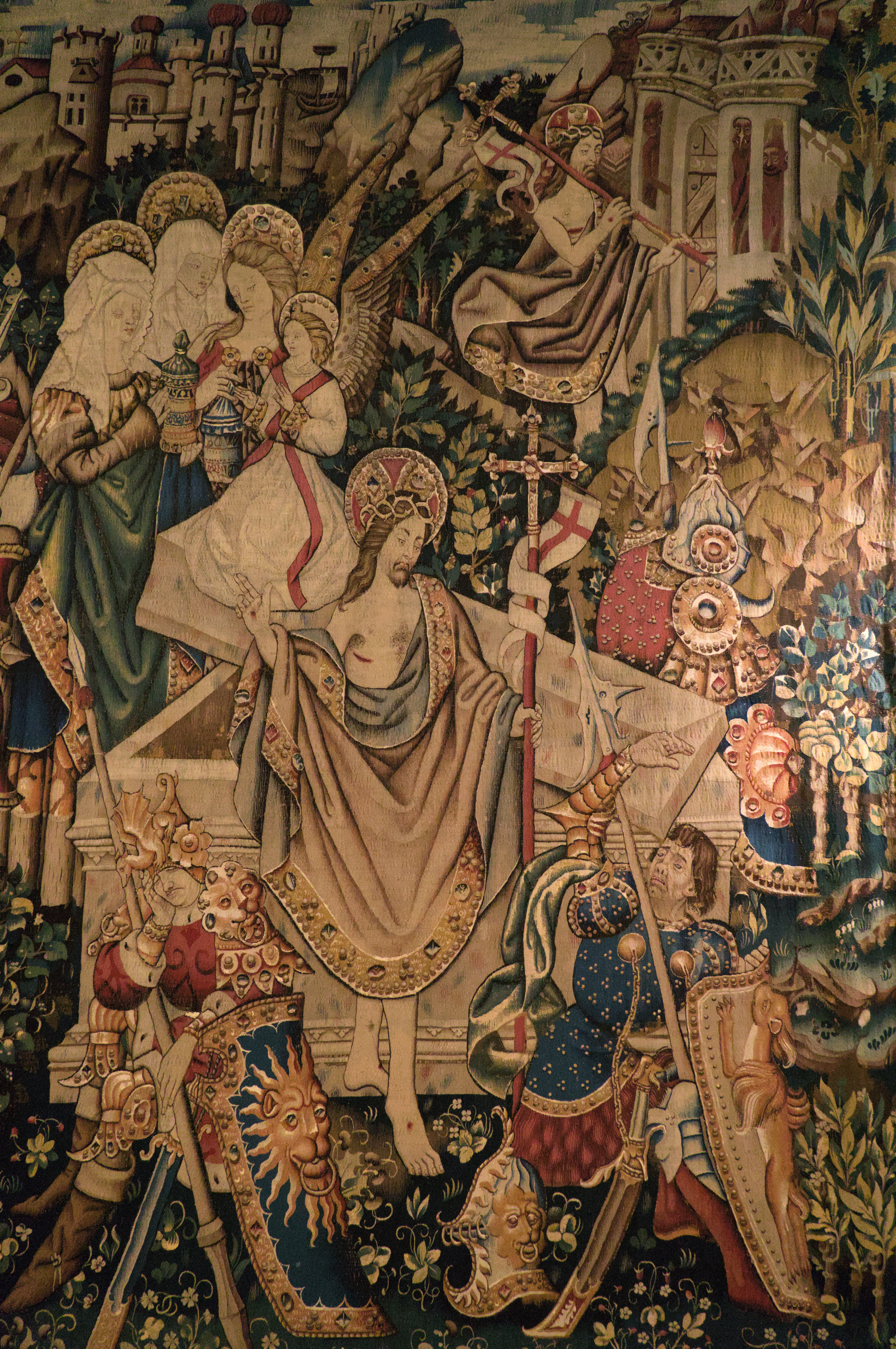
The right-most third of the tapestry portrays vignettes of the Resurrection.
Sept2025_DSC1525

At the bottom, Christ emerges triumphant from his tomb, holding a banner in one hand and bestowing blessing with the other.

Sept2025_DSC1521

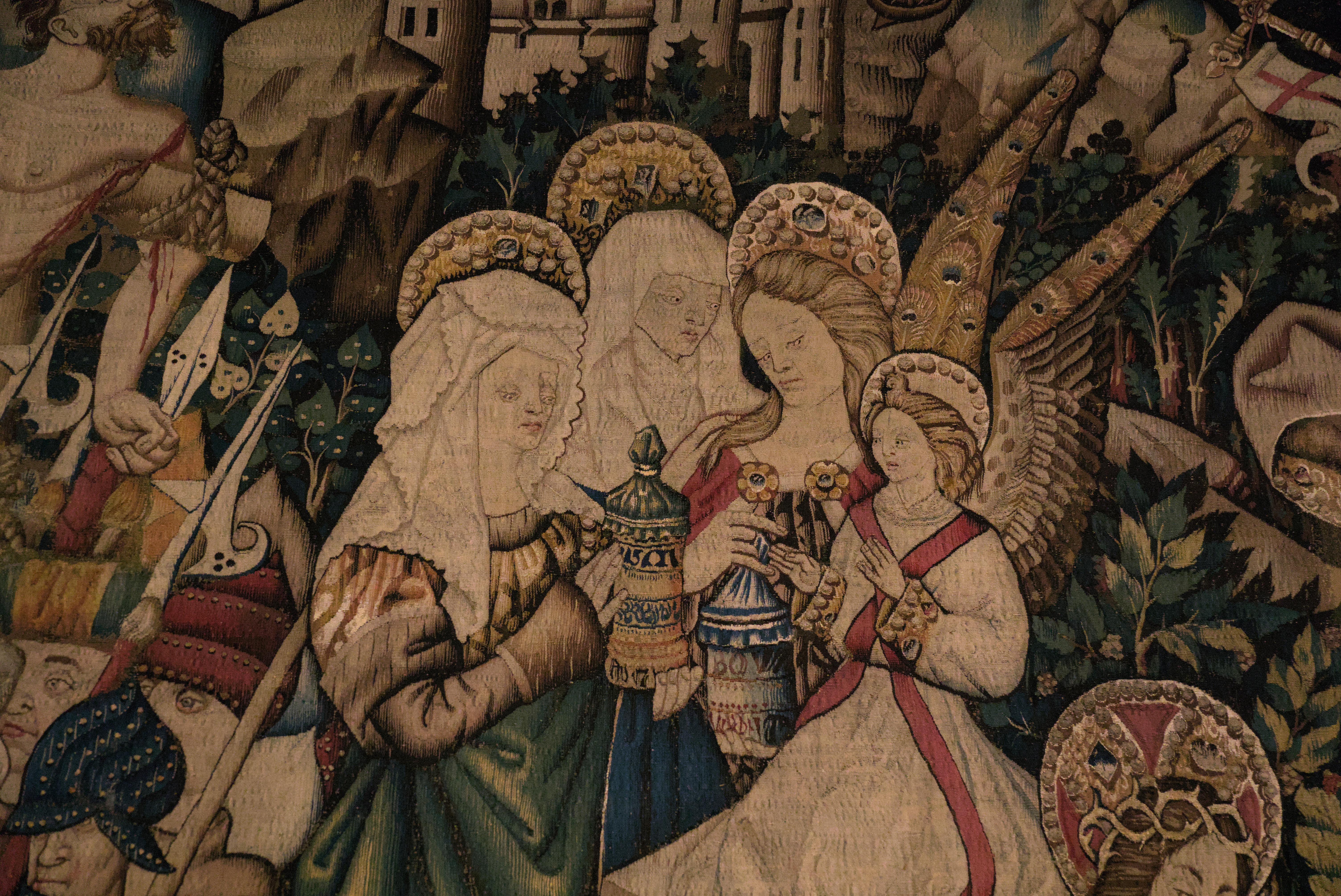
In the middle ground, the three Marys arrive at the empty tomb, ointments in hand, where they meet an angel who informs them that Christ has risen from the dead. Mary Magdalene is the one with her hair uncovered.
Sept2025_DSC1520

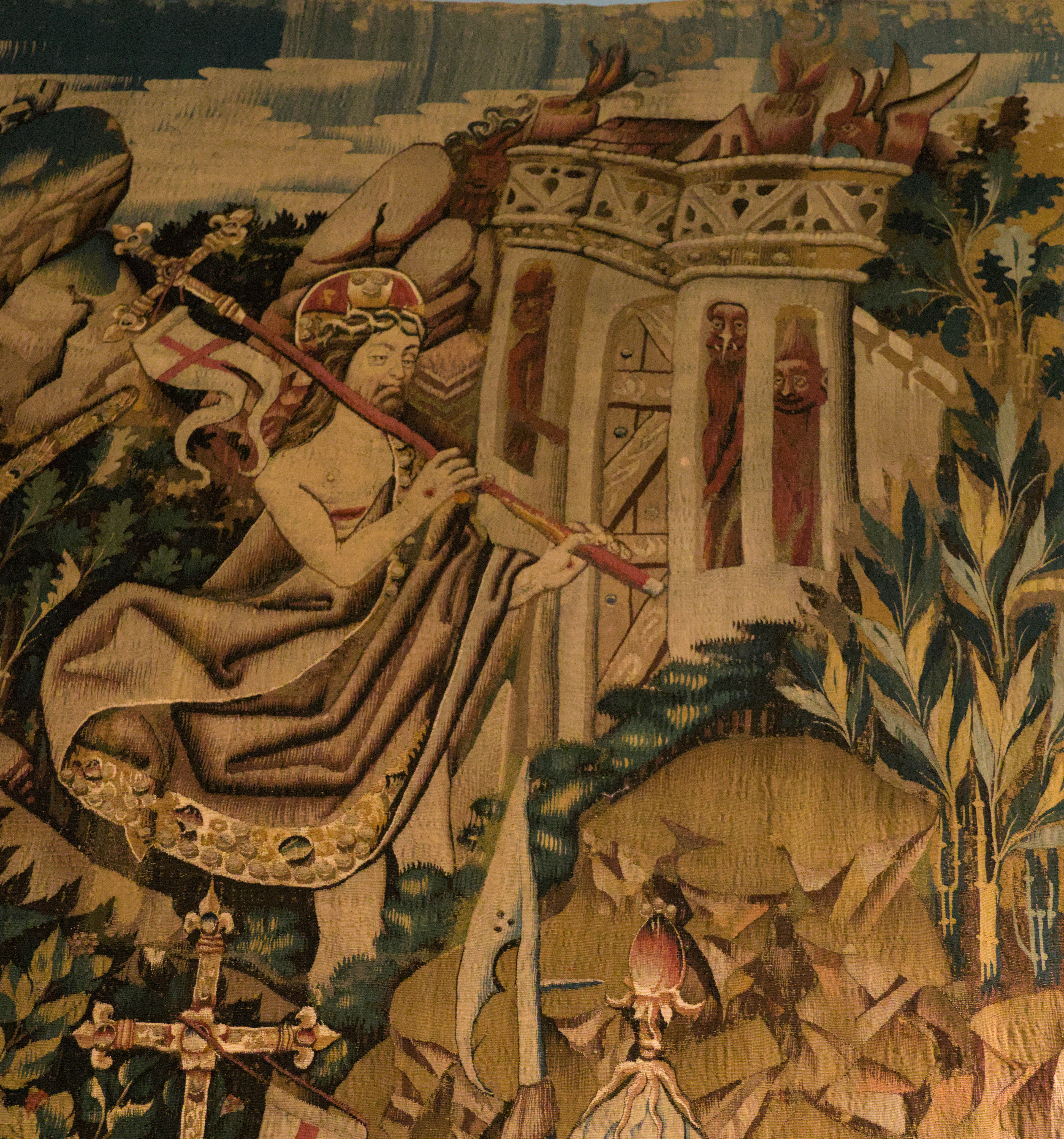
The risen Christ appears again at the top right, harrowing hell, a realm that is represented as a turreted fortress from whose windows fiery red demons glower and smirk. Christ has come to break down the doors and release the Old Testament saints being held captive—that is, those who died trusting in Yahweh and who were awaiting Christ’s redemption in the netherworld.
Sept2025_DSC1522

Let’s zoom in closer, shall we?

Sept2025_DSC1523

This is just one of the many artistic treasures, woven and otherwise, at Brussels’ Art and History Museum. I highly recommend a visit! I easily spent several hours there.
Roundup: “Heaven and Earth” performance for Psalms-based exhibition, pay-what-you-can film seminar, Doris Salcedo’s “A Flor de Piel,” and more

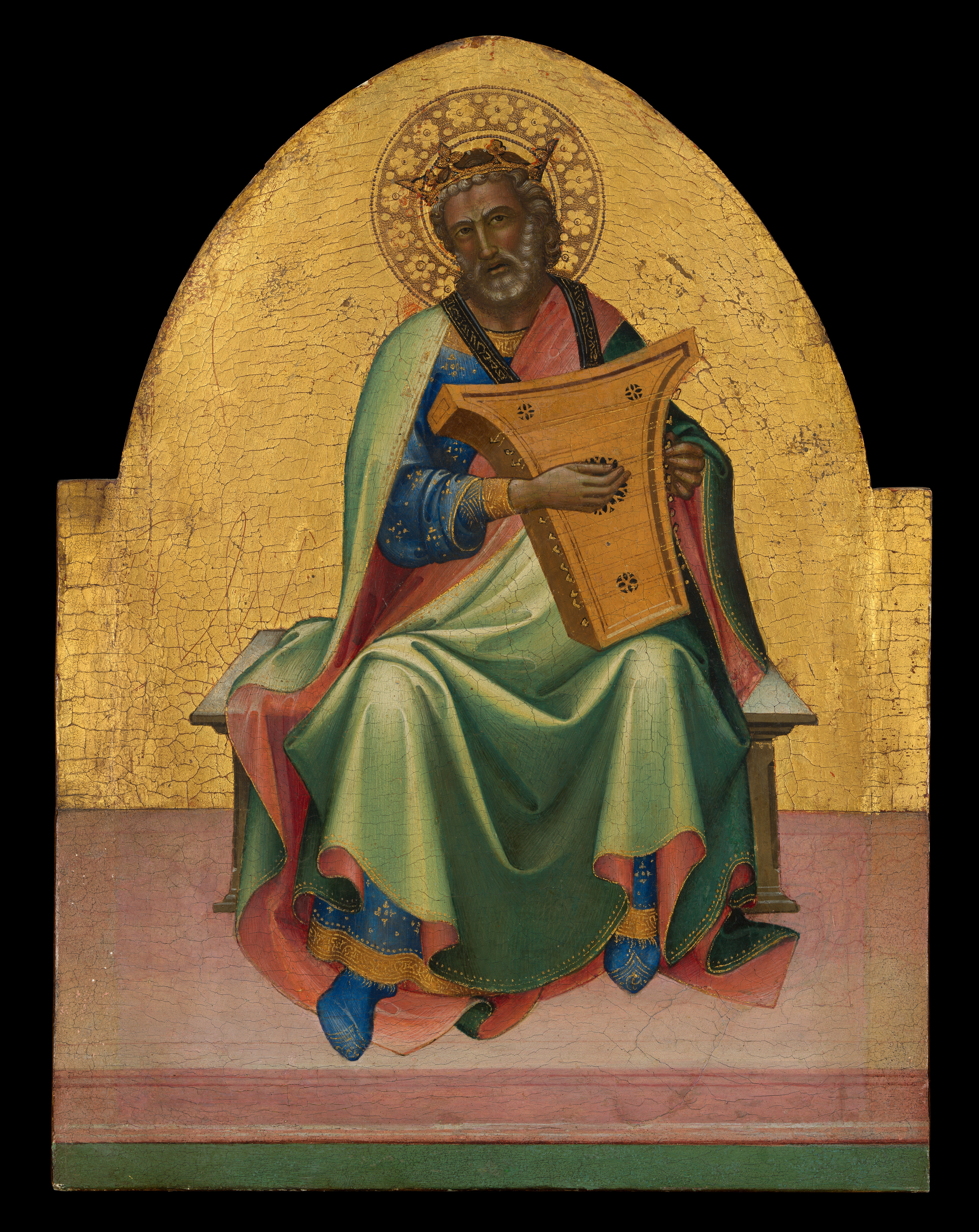
EXHIBITION: Sing a New Song: The Psalms in Medieval Art and Life, Morgan Library and Museum, New York, September 12, 2025–January 4, 2026: Sing a New Song traces the impact of the Psalms on people in medieval Europe from the sixth to sixteenth centuries, showing how this poetic book of the Bible suffused daily life, church liturgies, and art. The exhibition features, of course, numerous illuminated Psalters, as well as other art objects influenced by the Psalms, culled from the Morgan’s own collection and some two dozen institutions around the world.

Monaco, Lorenzo_David
Lorenzo Monaco (Italian, ca. 1370–ca. 1425), David, ca. 1408–10. Tempera on wood, gold ground, 22 3/8 × 17 in. (56.8 × 43.2 cm). Metropolitan Museum of Art, New York.

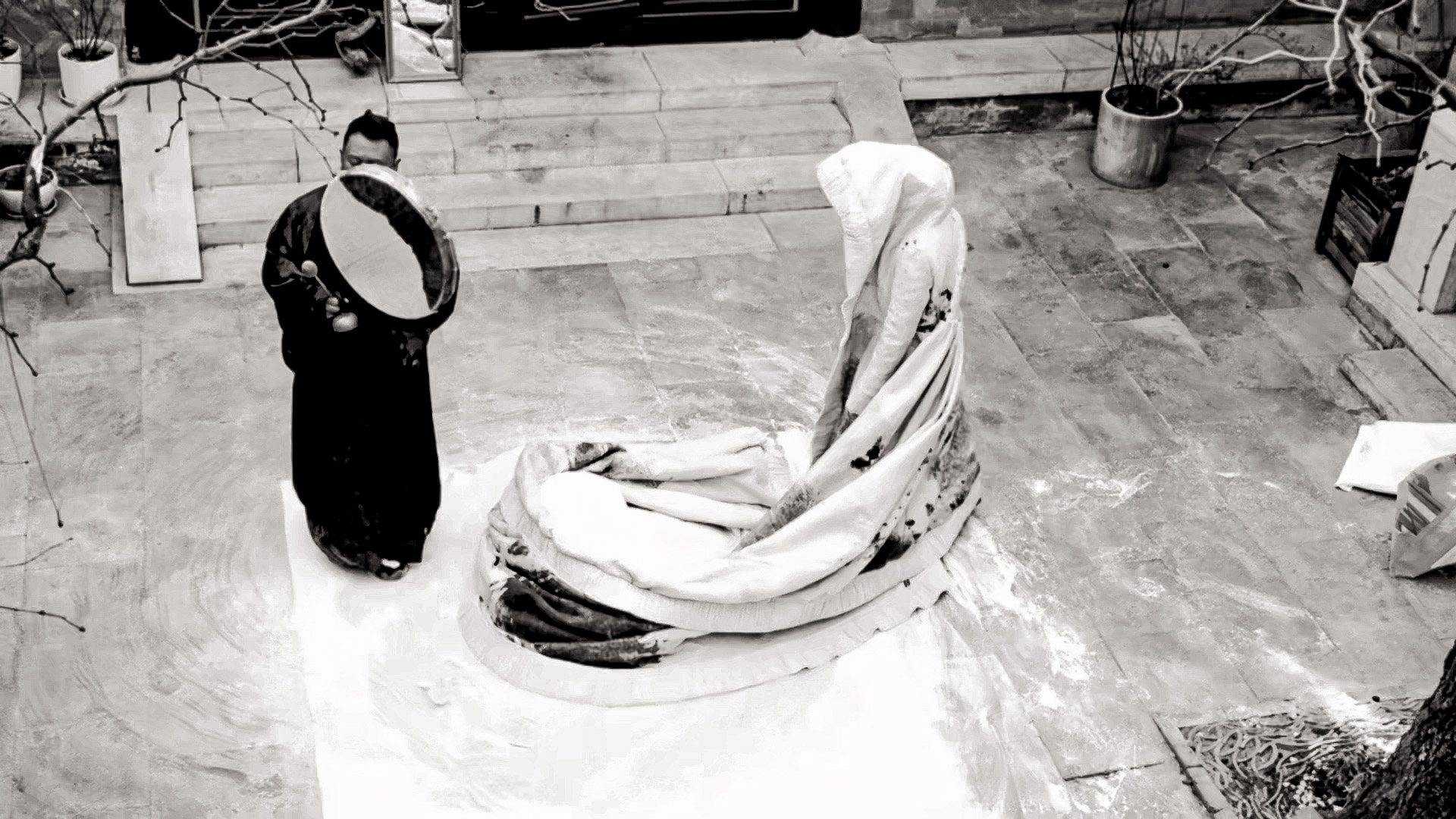
To coincide with the exhibition, on October 10 at 2 p.m. and 3 p.m., the Beijing-based artist Bingyi will be premiering a site-specific performance work in the Morgan’s garden (free with museum admission), made possible in part by the Foundation for Spirituality and the Arts. Titled Heaven and Earth: The Garden of Cosmos, the processional performance is “inspired by Psalm 104 and its reverence for creation, divine order, and cosmic harmony that transcend cultural boundaries.” Drawing on her longstanding engagement with both Abrahamic scriptures and Chinese philosophical traditions, Bingyi will be clad in a flowing, ink-painted garment and be joined by the Tibetan ritual master Nanmei and the Yi singer Aluo.

Bingyi_Heaven and Earth
Rehearsal for Heaven and Earth: The Garden of the Cosmos by Bingyi, to premiere October 10, 2025, at the Morgan Library and Museum in New York City

+++

ONLINE FILM SEMINAR: Dreaming the World: Looking at the World through the Eyes of the Other with Gareth Higgins, September 30–November 11, 2025: “We live in anxious times, with our vision often limited to suspicion of others, concern about the future, and withdrawing into enclaves of the familiar. It can become a self-fulling prophecy, a vicious cycle which does not nurture the security, never mind the happiness we seek. It’s becoming clearer by the day that we need to be dislodged from the narrow circles of self-oriented, tribal thinking. There is a more expansive universe, characterized by connection, sharing, and taking responsibility for co-creating the next good day.”

Sponsored by Image journal and The Porch, Dreaming the World is a seven-week course in which participants will watch seven movies—one from each continent—and learn a more global way of thinking. Leader Gareth Higgins [previously] will share a short video introduction and written essay for each film, and registrants are invited to join a members’ Facebook page for conversation, as well as a weekly video call to discuss the movie and its implications for how we might live better. Those video calls will take place on Tuesdays from 7:00 to 8:15 p.m. ET on September 30, October 7, October 14, October 21, October 28, November 4, and November 11, 2025, but will also be recorded for asynchronous viewing.

The seminar is valued at $195, but the organizer is generously allowing registrants to pay what they can. I will be participating. Join me?

+++

CALLS FOR PAPERS:

>> From the Association of Scholars of Christianity in the History of Art: ‘And Who is My Neighbor?’: Refuge, Sanctuary, and Representation: “The parable of the Good Samaritan (Luke 10:25–37) endures as a powerful meditation on compassion, hospitality, and the boundaries of moral responsibility. In an age marked by geopolitical instability, mass displacement, and deepening social divides, the question ‘And who is my neighbor?’ acquires renewed urgency. We welcome proposals that consider the ways in which visual culture has interpreted, challenged, or reimagined the ideals of refuge and hospitality within religious and intercultural frameworks. How have artistic practices responded to religious calls to welcome the stranger? In what ways do images negotiate the tensions between inclusion and exclusion, faith and politics, identity and alterity? How do modern and contemporary artworks embody, resist, or reinterpret Christian and other religious conceptions of community, care, and obligation? Proposals that engage Catholic visual cultures or interpretive frameworks, perspectives from the Global South, or comparative interreligious approaches are especially encouraged.” To be presented February 17, 2026, at ASCHA’s day-long symposium at DePaul University Chicago, or February 18–21 2026, at the 114th annual CAA Conference. Proposal submission deadline: October 15, 2025.

>> From the Raclin Murphy Museum of Art at the University of Notre Dame: The Art of Encounter: Exploring Spiritual Engagement with Art Objects”: This museum is seeking papers exploring the relationship between art, spirituality, and museum spaces, to be presented April 24, 2026, at the museum’s spring symposium. Proposals that investigate how encounters with art can shape spiritual understanding, foster theological insight, or deepen contemplative practice are all welcome. Proposal submission deadline: November 3, 2025.

+++

SONGS:

September 15 through October 15 is Hispanic Heritage Month. One of the many ways Latinos have contributed to Christian artistic culture has been through the writing and singing of coritos: short, rhythmic, Spanish-language choruses used in worship. Here are two examples, the first one traditional and the second one new.

>> “Montaña” (Mountain), led by Josue Avila: Recorded live on November 29, 2020, from Calvary Orlando’s Unity Sunday Service, this corito is based on Matthew 17:20. The lyrics translate to: “If you have faith like a mustard seed, thus says the Lord: you can tell the mountain, ‘Move, move,’ and that mountain will move!”

Watch another performance, from a concert context, by the Austin, Texas–based band Salvador.

>> “Sal 22 / Te Amo” (Psalm 22 / I Love You) by Israel and New Breed with Aaron Moses: These two coritos, which released this summer as a single track, were written by Israel Houghton, Meleasa Houghton, Ricardo Sanchez, Aaron Lindsey, Rene Sotomayor, and Aaron Moses. The first is based on Psalm 22:3, which says that God is enthroned on the praises of his people, and is sung by Moses on lead; Houghton sings lead on the second.

Aaron Moses, of Dominican and Ecuadorian descent, is best known for his work with Maverick City Música.

Israel Houghton is not himself Latino (his mother is white, his biological father Black), but he was significantly influenced by his upbringing in a Hispanic neighborhood and church, a culture reflected in his musical output and that he remains connected to, not least through his wife, Adrienne Bailon (whom I know from The Cheetah Girls!).

+++

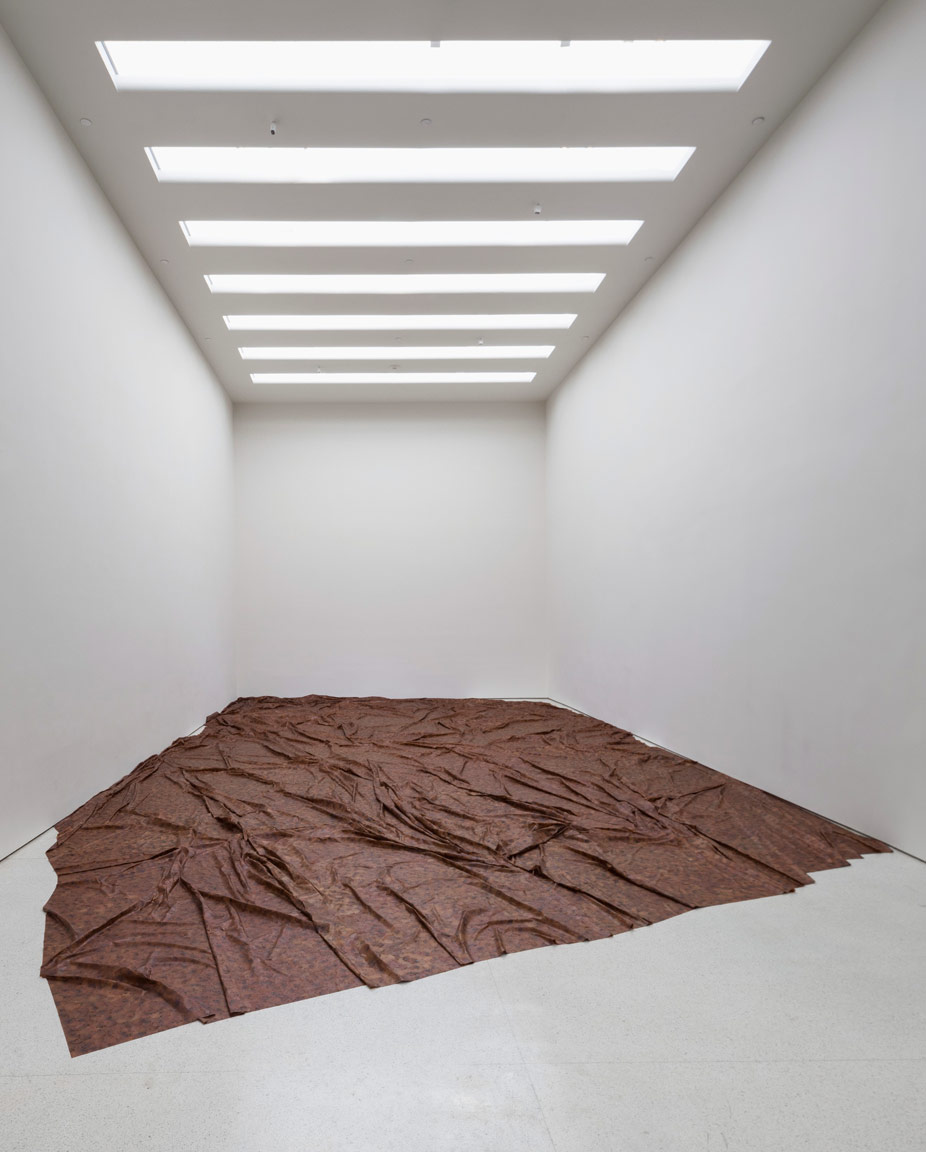
VIDEO: “In the Studio: Doris Salcedo making ‘A Flor de Piel’”: Produced by White Cube, this fourteen-minute documentary charts the collaborative, scientifically informed, labor-intensive process of making Doris Salcedo’s A Flor de Piel, an enormous shroud made of real rose petals as a memorial for a nurse who was brutally captured and murdered in Colombia. (“The title,” explains Lauren Hinkson, “is a Spanish idiomatic expression used to describe an overt display of emotions.”) The film includes footage from Salcedo’s Bogotá studio as well as interviews with the team of people who produced the work. I found this peek into the technical aspects of the piece fascinating.

Salcedo, Doris_A Flor de Piel
Doris Salcedo (Colombian, 1958–), A Flor de Piel, 2011–12. Rose petals and thread, approx. 246 7/8 × 433 1/8 in. (627 × 1100 cm). Photo © Solomon R. Guggenheim Foundation, New York, from the work’s installation at the Guggenheim in 2015.

However, the video doesn’t venture into the inspiration behind or meaning of the work. For a bit of that, see this audio clip from the Guggenheim (where A Flor de Piel was exhibited in 2015), and also Jonathan A. Anderson, The Invisibility of Religion in Contemporary Art, pages 123–24.

Cristo de la Encina (Christ of the Oak): A miraculous appearance in colonial Chile

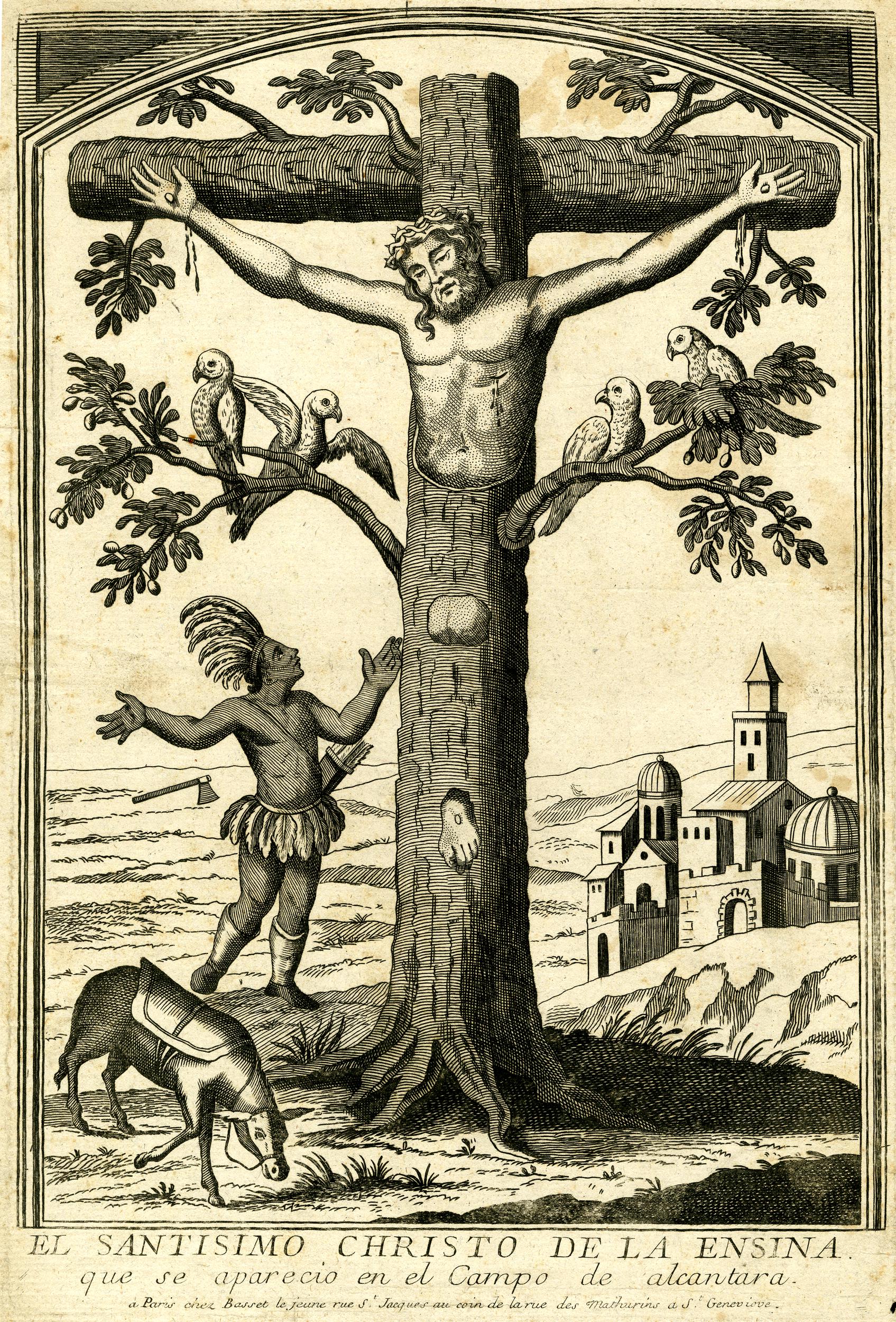
I came across the following strange image in a book on Christian art at the British Museum, where it appears without any explanation other than that it is part of a group of popular religious prints with Spanish texts that were made in Europe for export to the Spanish-speaking South American market.

Christ of the Oak (British Museum)
Cristo de la Encina (Christ of the Oak), 1750–60. Etching, 35.5 × 23.6 cm. Published by André Basset, Paris. Collection of the British Museum, London.

I was intrigued! I had seen art images before where Jesus is crucified on a living tree, his body sometimes melding into the trunk and branches. The motif of the cross as tree of life connects the beginning and the end of time, Eden and the eschaton, placing Christ’s act of self-giving at the crux and communicating its generative impact. But in this particular etching published in Paris, who is the Indigenous man at the base? The caption suggests that the image illustrates a miraculous appearance of Christ (or at least his form) in Latin America—so what’s the story behind it?

The answer is found in the Histórica relación del reyno de Chile (Historical Account of the Kingdom of Chile), a book by the Chilean Jesuit chronicler Alonso de Ovalle (1601–1651), published in Rome in 1646. Ovalle was serving in Rome as procurator for his order and wanted to teach Europeans about his homeland. He was glad to relate a supernatural occurrence, from just a decade prior, of Christ manifesting himself in nature, the subject of chapter 23, titled “En que se da fin a esta materia y se trata el prodigioso árbol que en forma de crucifixo nació en na de las montañas de Chile” (In which this subject is concluded and the prodigious tree that grew in the form of a crucifix in one of the mountains of Chile is discussed).

In 1636, Ovalle writes, an “Indian” in the valley of Limache near Valparaiso in Chile—he would have been Mapuche, though the artist of the Paris print shows him as a Tupi man of Brazil—went to cut down some trees for construction purposes. After striking an ax blow to one, he was astonished to realize that the tree was in the shape of a cross with a man on it. He immediately stopped hacking. The artist shows the ax flying out of the woodcutter’s hands as he throws them up in amazement. The caption reads, “El Santisimo Christo de la Ensina que se aparecio en el Campo de alcantara” (The Most Holy Christ of the Oak that appeared in the Alcántara countryside).

A variation of the legend, according to the blog El Señor de Renca, El Señor de los Milagros by Alejandro Caggiano, says the Mapuche woodcutter was blind, and that when he first struck the tree trunk, a few drops of sap got into his eyes, restoring his sight. It’s then that he saw Christ’s image.

Ovalle does not say whether the man converted to Christianity, but regardless, Ovalle considered the appearance of Christ’s form in the native plant life of Chile as a blessing and an encouragement—Christ taking root in the Americas. He says it should cause the reader to “admire the divine wisdom of our God and his most high providence in the means and motives that he has given us even in natural and insensible things for the confirmation of our faith and the increase of the piety and devotion of his faithful.”

Word spread of the miraculous tree, and pilgrims flocked to see it. Soon, as Orvalle recounts, a noblewoman had the tree uprooted and built a church nearby to house it, placing it behind the altar. That’s the building in the right background of the Paris print.

Sometime after Ovalle’s publication, the Jesuits relocated the tree to Renca, San Luis, in Argentina, just a few miles from Chile’s capital, and veneration continued. A fire destroyed most of the tree in 1729, but its charred remains were incorporated into a new wooden crucifix that is still in Renca. “The Lord of Renca, as the crucifix is now known, is a firm part of the regional religious folklore,” writes Georg T. A. Krizmanics, “and in a song called ‘Zamba del Señor de Renca,’ devoted parishioners and pilgrims cheerfully haunt the Mapuche soul by chanting ‘Christ, you were born Araucanian.’”

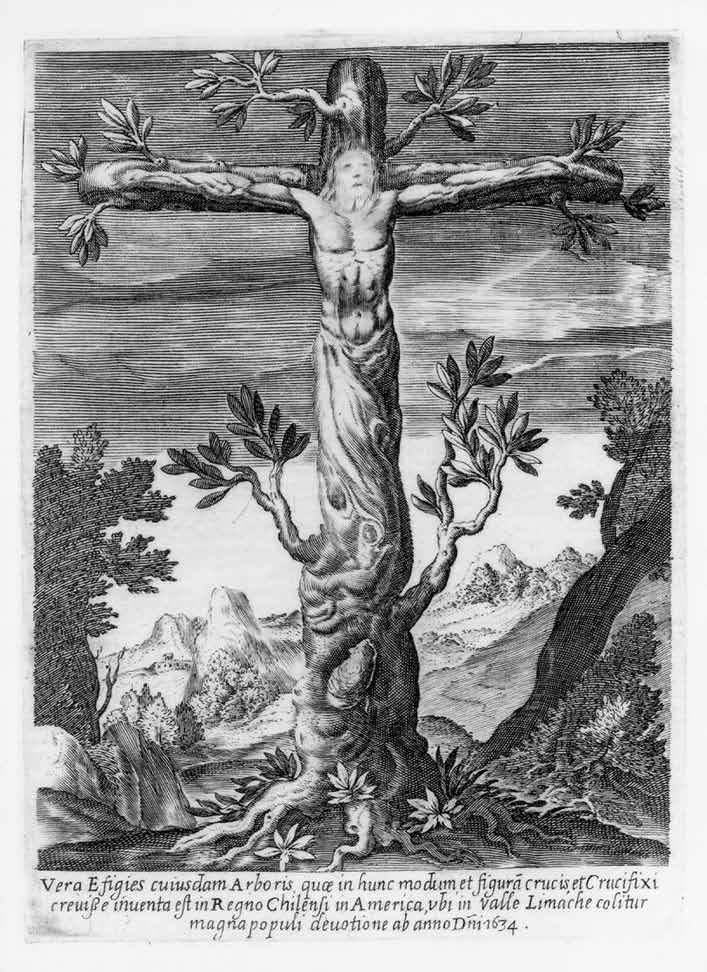
The Paris print in the collection of the British Museum is not the first artistic depiction of Christ of the Oak; that credit goes to an anonymous engraving published with Ovalle’s 1646 textual account of the miracle. No Indigenous person appears in this initial version—just the gnarled corpus of Christ crucified, embedded in a tree.

Christ of the Oak (1646)
The Limache Cross, engraving from Alonso de Ovalle’s Histórica relación del reyno de Chile (1646)

The caption reads, Vera effigies cuiusdam arboris quae in hunc modum et figuram crucis et crucifixi inventa est in Regno Chilensi in America, ubi in Valle Limache colitur magna populi devotione ab anno Domini 1634 (“A true image of a certain tree that was found in this manner in the shape of a cross and a crucifix in the Kingdom of Chile in America, where it has been venerated in the Valle Limache with great devotion by the people since the year 1634”).

Here are some other, later examples of the subject, which attained popularity in Spain.

Christ of the Oak
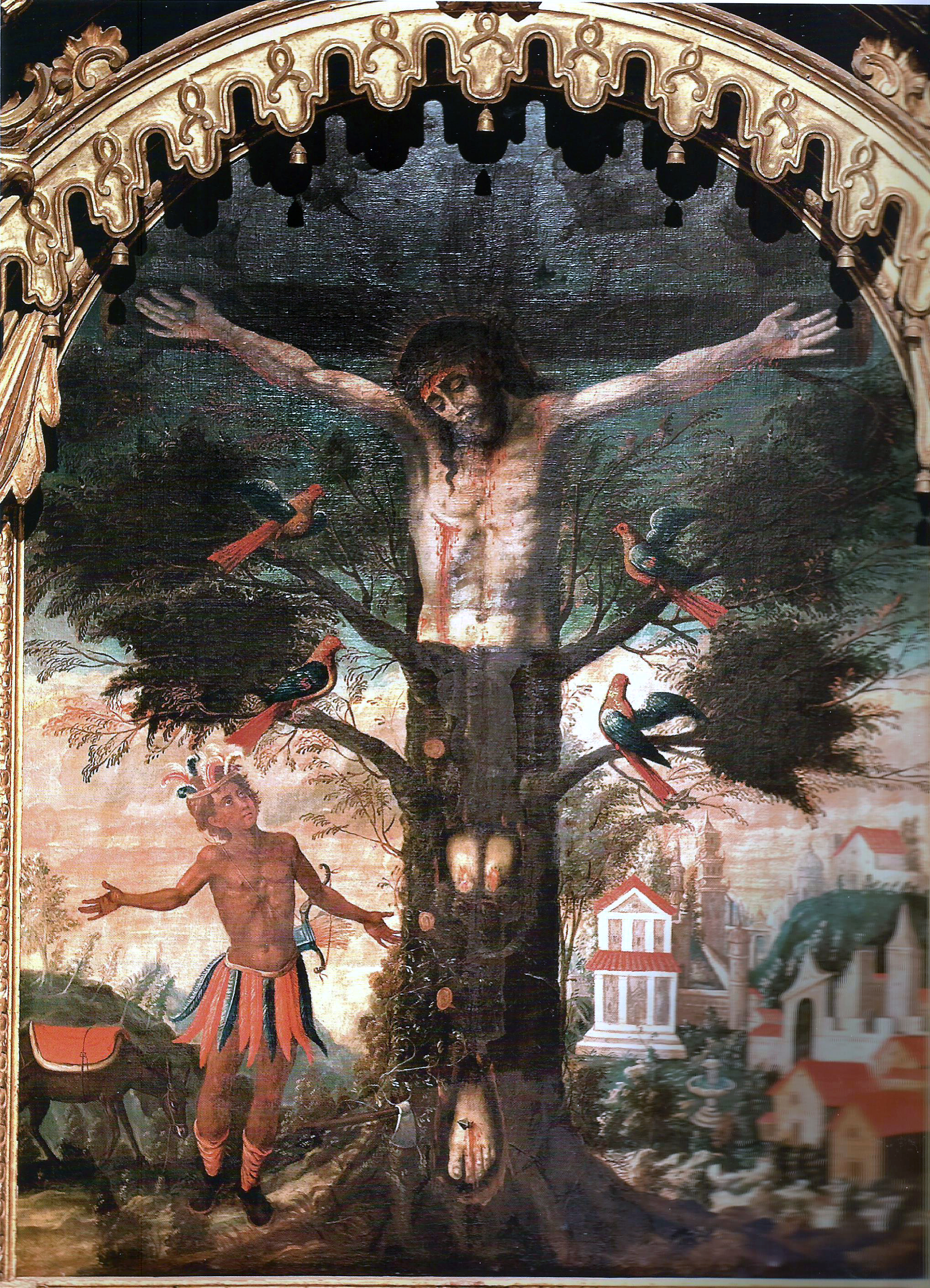
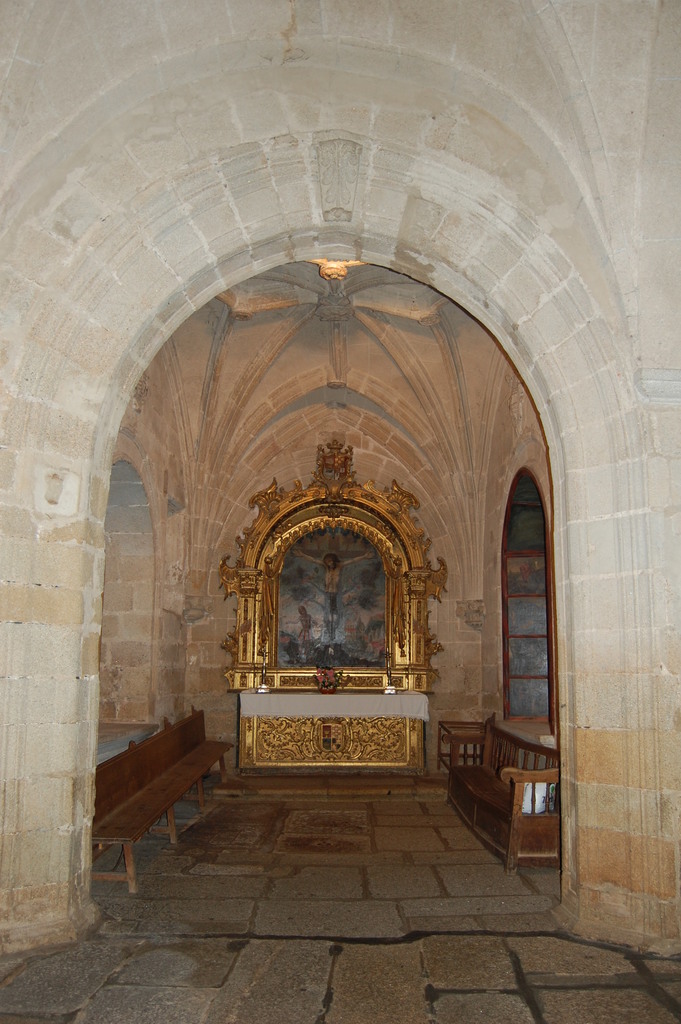
Cristo de la Encina, 1753. Oil on canvas. Capilla de San Juan Bautista (Chapel of St. John the Baptist), Iglesia de San Mateo, Cáceres, Spain. The next photo shows this painting in situ.

Christ of the Oak (in context)
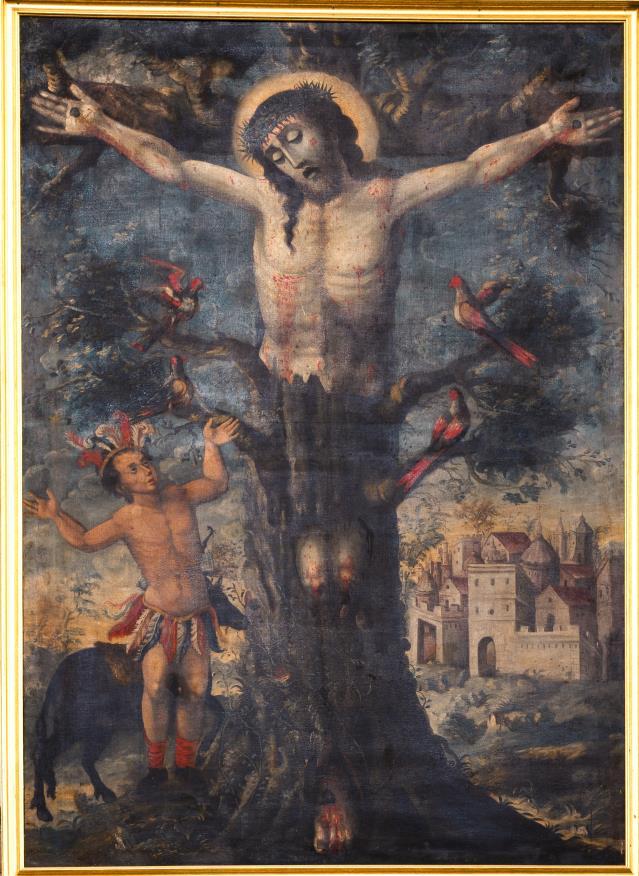
Christ of the Oak
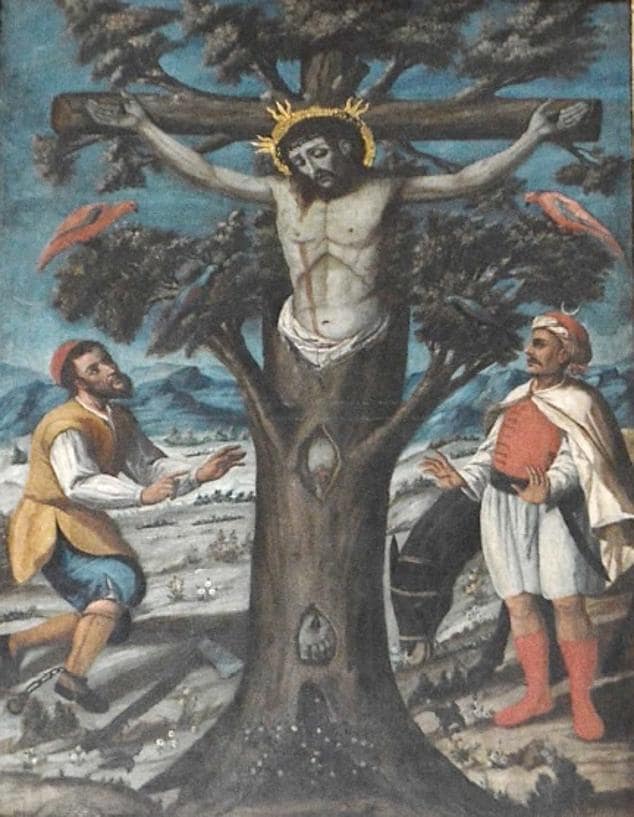
Cristo de la Encina, 18th century. Oil on canvas. San Vicente de Alcántara, Badajoz, Spain. Photo: Isidro Álvarez / Tecnigraf.

I’m delighted by the parrots perching on the branches! The tree of crucifixion was a site of both death and life. Christ endured its agony so that we, like those birds that are so at home, could find welcome and rest.

Christ of the Oak
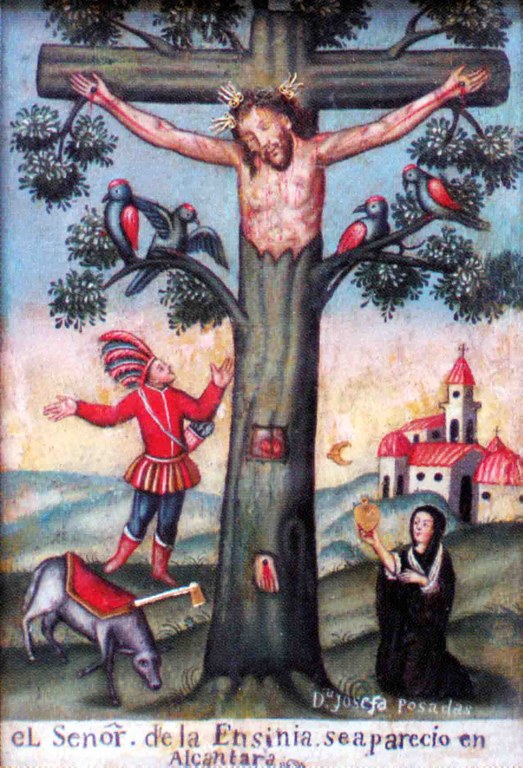
El Señor de la Ensinia se apareció en Alcántara (The Lord of the Oak Appeared in Alcántara), late 18th century. Oil on paper. Private collection, Medellín, Colombia. Photo: Gustavo Adolfo Vives Mejía / PESSCA Archive.

One late eighteenth-century painting of Christ of the Oak shows, opposite the woodcutter, a kneeling woman in a black robe. The inscription identifies her as Doña Josefa Posadas. It looks to me like she is holding up a milagro (literally “miracle”), also known as an ex-voto, a small tinplate charm shaped like a body part that is or was in need of healing. Historically in many Hispano-Catholic communities, milagros are pinned to crosses and wooden statues of Christ and the saints, or are hung with ribbons from altars and shrines, to petition the Divine for a cure from a physical ailment or to offer thanks for healing received. Given the shape of Doña Josefa’s milagro, she likely suffered from a heart condition.

Or, it’s possible that it’s not the literal organ that’s referred to in what she holds, but rather the heart as the center of the emotions, will, understanding, and soul, which she offers to Christ.

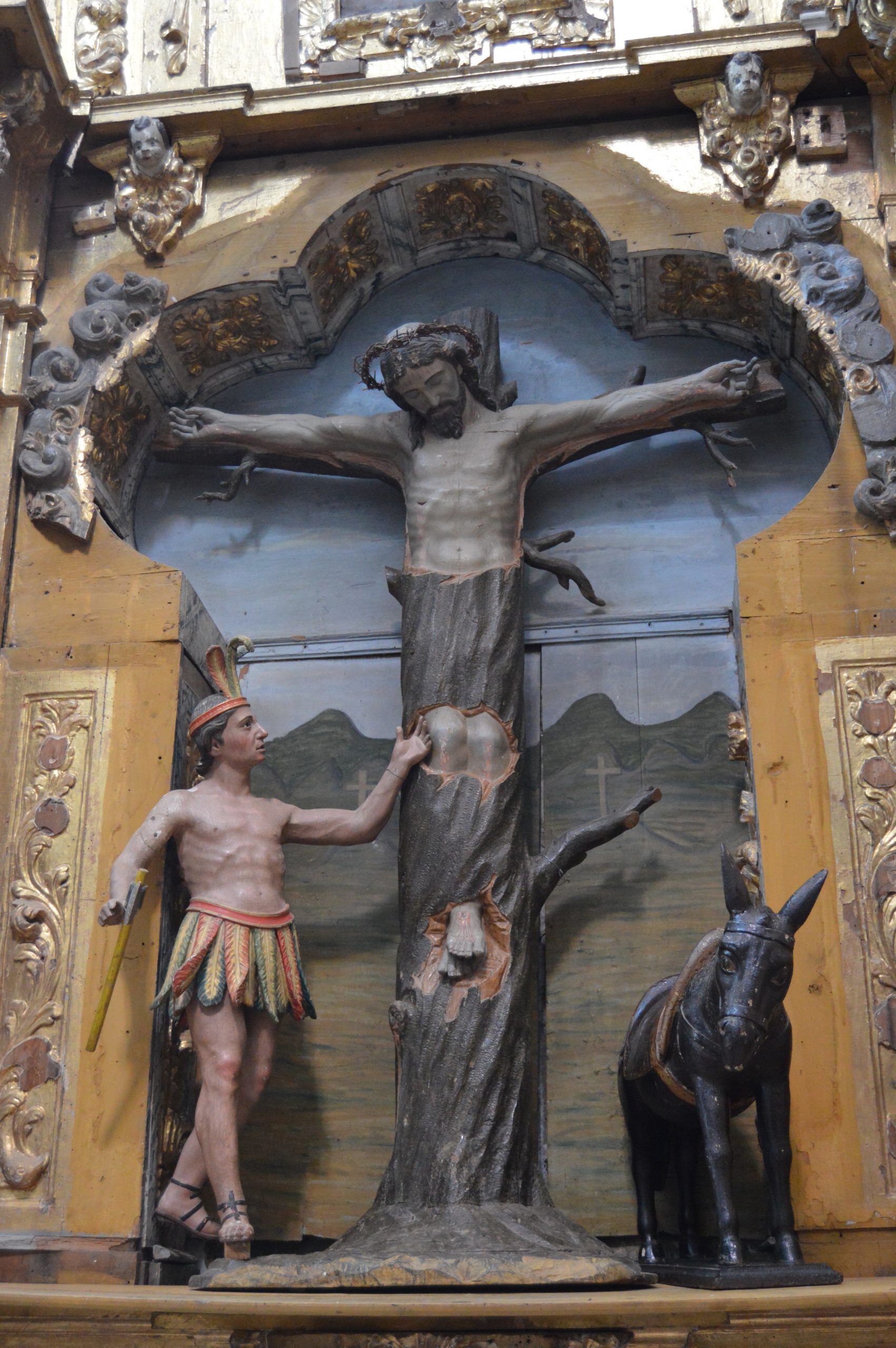
Christ of the Oak
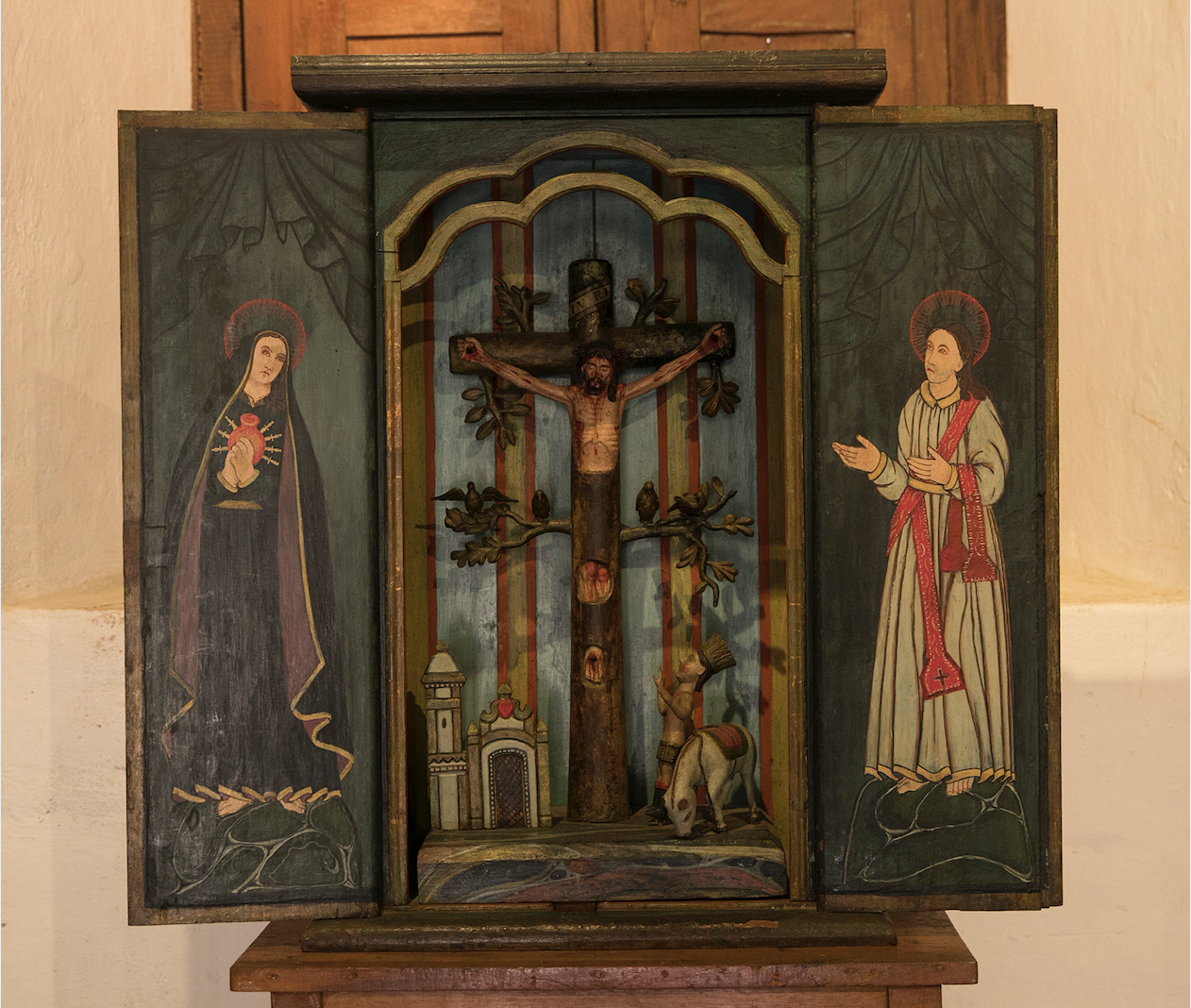
Cristo de la Encina, 18th century. Wood, polychrome. Santuario de Nuestra Señora del Encinar (Sanctuary of Our Lady of the Oak), Ceclavín, Cáceres, Spain.

Christ of the Oak (altarpiece)
Cristo de la Encina, 19th century. Wood, polychrome, 79 × 52 × 28 cm. Museo Monseñor Juan Sinforiano Bogarín, Asunción, Paraguay. Photo: Laura Mandelik.

Christ of the Oak with Muslim and Jew
Cristo de la Encina, 18th century. Oil on canvas. Ermita de Nuestra Señora de la Hermosa, Fuente de Cantos, Badajoz, Spain.

This last example is interesting: in a revision of characters, it shows a Muslim (right) and a Jew whose leg shackles are falling off at the sight of Christ. The painting seems to be an aspirational extension of the Limache legend—a prayer that Christ would reveal himself not only to Indigenous populations but also to those of other religious backgrounds.

I share these images not to affirm or disaffirm the appearance of Christ of the Oak, and not to comment on the colonizing undertones of such images or the cult that sprung up around them, but instead merely to inform you of an iconography that I found curious and compelling and wanted to find out more about. So now if you ever come across an image of Christ crucified on a tree with his bloody knees poking through the bark and an Indigenous, ax-wielding man reacting with surprise, you’ll know a bit about its context!


FURTHER READING

Francisco Javier Pizarro Gómez, “Extremadura en el viaje iconográfico del Cristo de la Encina entre Europa y América” (Extremadura in the iconographic journey of the Christ of the Oak between Europe and America), Quiroga no. 12 (July–December 2017): 72–83.

“Go to the Limits of Your Longing” (Book of Hours I, 59) by Rainer Maria Rilke

Guzman, Juan_Espíritu sin Medida
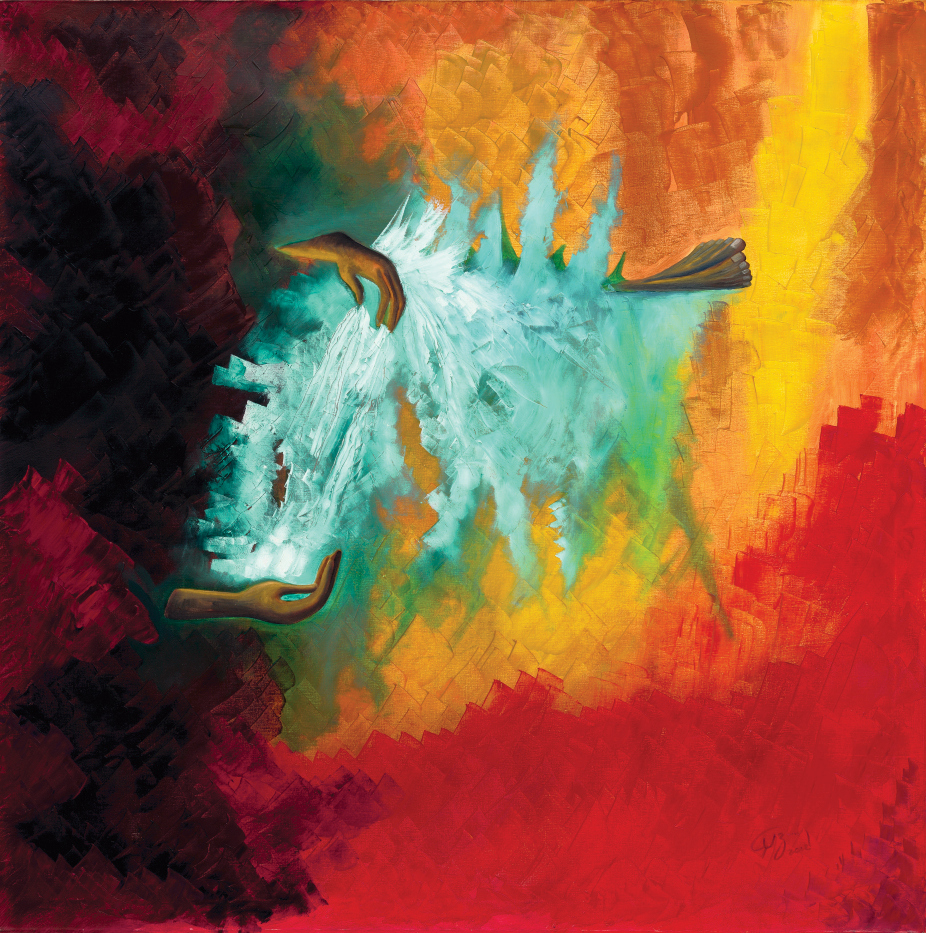
Juan Francisco Guzmán (Guatemalan, 1954–), Espíritu sin Medida (Spirit Without Measure), 2012. Oil on canvas, 103 × 102 cm. © missio Aachen.

God speaks to each of us as he makes us,
then walks with us silently out of the night.

These are the words we dimly hear:

You, sent out beyond your recall,
go to the limits of your longing.
Embody me.

Flare up like flame
and make big shadows I can move in.

Let everything happen to you: beauty and terror.
Just keep going. No feeling is final.
Don’t let yourself lose me.

Nearby is the country they call life.
You will know it by its seriousness.

Give me your hand.

From Rilke’s Book of Hours: Love Poems to God (Riverhead, 1996, 2005), translated by Anita Barrows and Joanna Macy. The original German is in the public domain.

Rainer Maria Rilke (1875–1926) was a primarily German-language lyric poet, playwright, and short story writer. Born of Catholic parents in Prague, then part of the Austro-Hungarian empire, he came to reject church dogma as an adult, though he maintained a lifelong fascination with Christian imagery and biblical stories. His volumes of poetry include Das Stunden-Buch (The Book of Hours) (1899–1903), about the search for God; Das Buch der Bilder (The Book of Images) (1902–6); Das Marienleben (The Life of Mary) (1913), a thirteen-poem cycle about the Virgin; the Duineser Elegien (Duino Elegies) (1922), which weigh beauty and existential suffering; and Sonette an Orpheus (Sonnets to Orpheus) (1922). After Rilke’s death from leukemia, a young mentee of his, Franz Xaver Kappus, compiled ten of the letters Rilke had written to him about creativity, the poetic vocation, and the inner life; published as Briefe an einen jungen Dichter (Letters to a Young Poet) (1929), this correspondence has influenced generations of writers and other artists.

Anita Barrows (born 1947) is a clinical psychologist, political activist, poet, and translator from German, French, and Italian. She lives in the Bay Area of California.

Joanna Macy (1929–2025) was a scholar of Buddhism, general systems theory, and deep ecology. A respected voice in movements for peace, justice, and environmentalism, she wove her scholarship with decades of activism.

Roundup: Pitjantjatjara picture Bible, “Feeling Through” short film, the reconciling Eucharist, and more

SPOTIFY PLAYLIST: September 2025 (Art & Theology): A new monthly playlist featuring a range of faith-based songs, including “Day by Day” by Lowana Wallace and Isaac Wardell of the Porter’s Gate (especially apt for Labor Day!), sung below by Kimberly Williams; “Jesus of Nazareth” by the early twentieth-century hymn writer Hugh W. Dougall, performed in a bluegrass style by the Lower Lights; and a fantastic instrumental jazz arrangement by Alice Grace of the classic children’s song “Jesus Loves Me,” performed by the Indonesian group Bestindo Music (Grace is at the keys).

+++

VIDEO: “The Apostles’ Creed”: This video presentation of the Apostles’ Creed, one of the oldest statements of Christian belief, used across denominations, was created in 2016 by Faith Church in Dyer, Indiana, using twenty-one of its members to voice the lines. [HT: Global Christian Worship]

+++

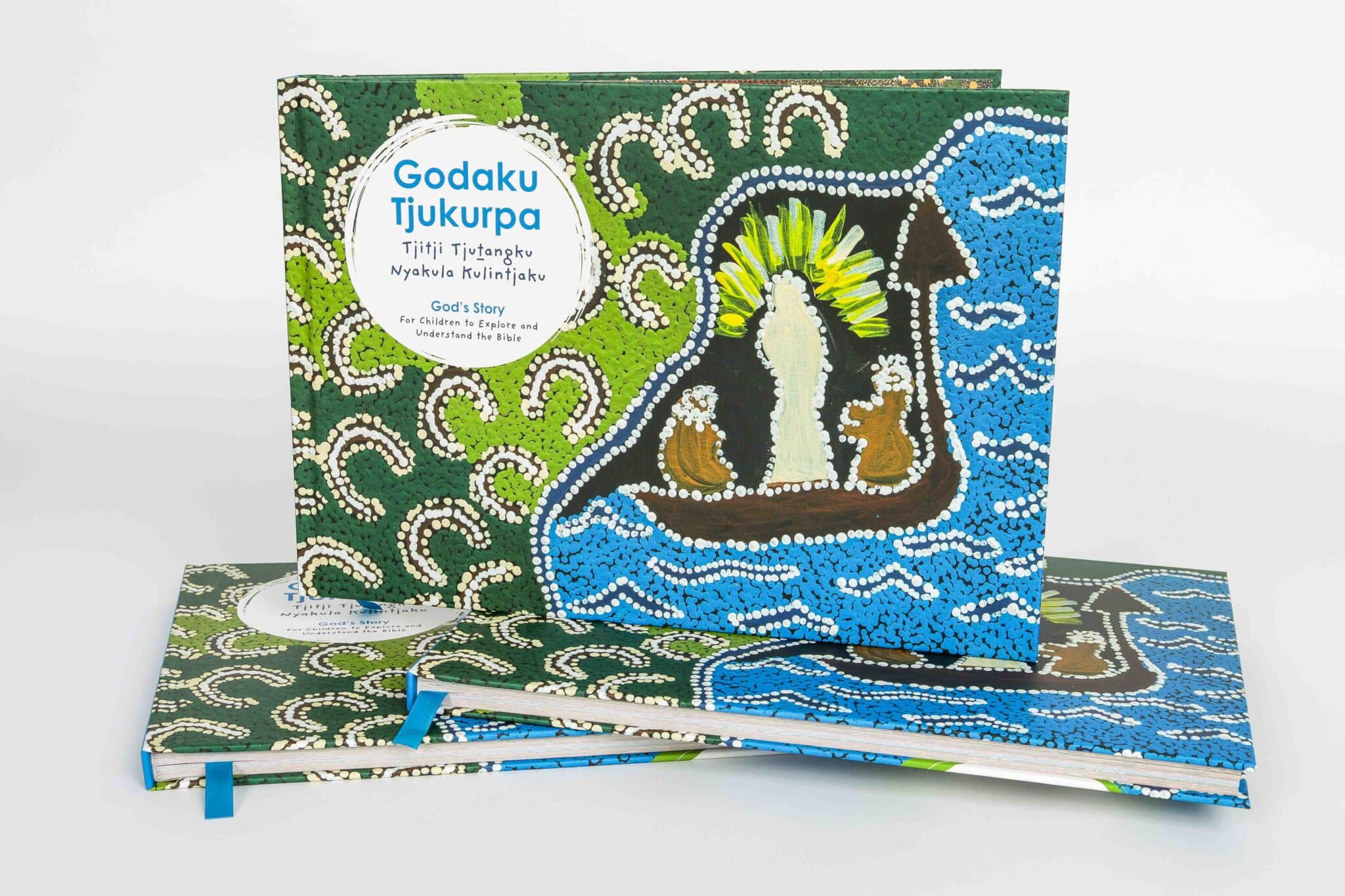
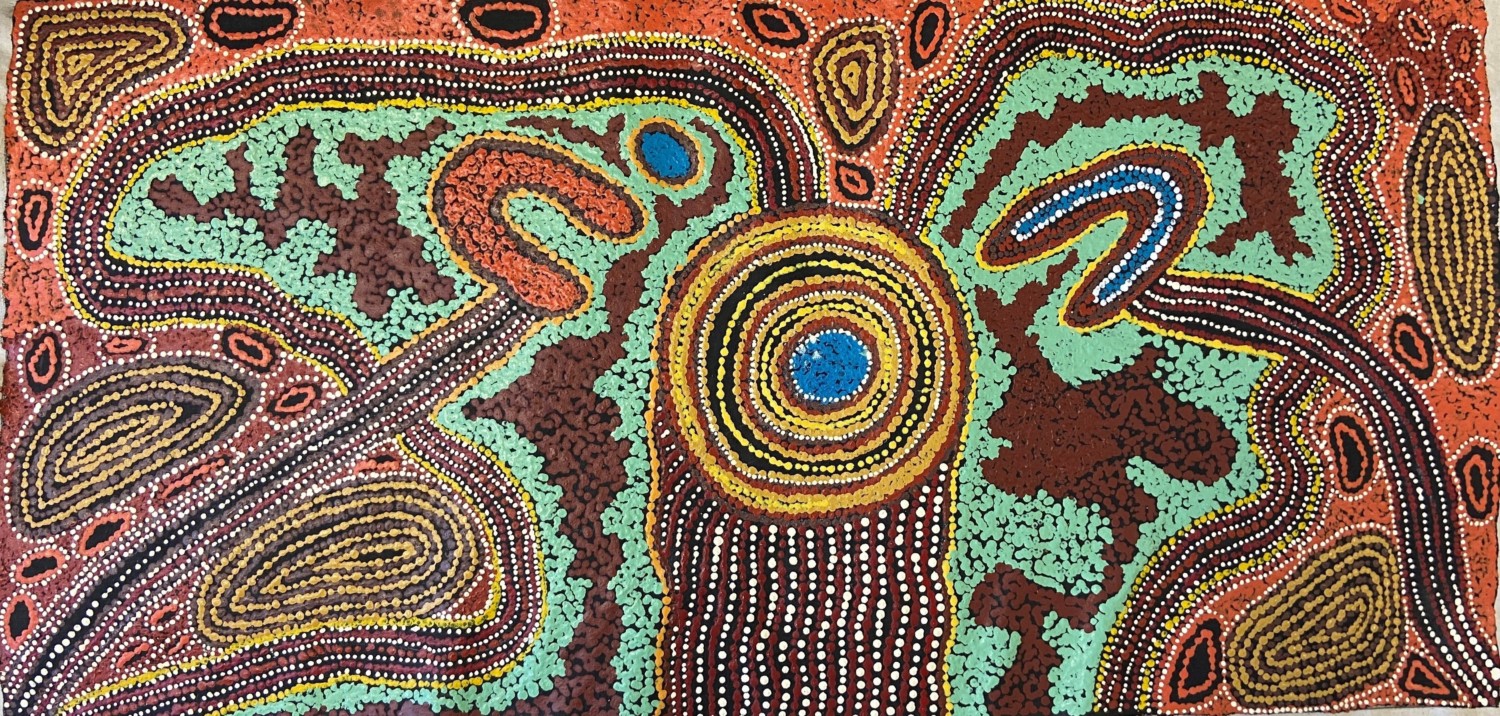
CHILDREN’S PICTURE BIBLE: Godaku Tjukurpa (God’s Story): Nami Kulyuru, a long-serving Pitjantjatjara Bible translator and artist from Central Australia, had the vision to pass on the stories of the Bible to her grandchildren and other young Pitjantjatjara readers using traditional Anangu paintings, compiled in book format. She began the artistic work in 2021 but shortly after was diagnosed with a malignant brain tumor. Following her death in 2022, her friends and colleagues rallied together to complete the project, which was published last November by Bible Society Australia. [HT: Global Christian Worship]

Godaku Tjukurpa
Kulyuru, Nami_Woman by the Well
Nami Kulyuru (Pitjantjatjara, 1964–2022), The Woman at the Well (John 4), 2021, from the bilingual book Godaku Tjukurpa (God’s Story) (Bible Society Australia, 2024)

Spanning the Old and New Testaments, Godaku Tjukurpa (God’s Story) features fifty-four Bible illustrations by Pitjantjatjara artists, along with descriptions in Pitjantjatjara and English. It is available for purchase through the Koorong website, but it appears that it can ship only to Australia or New Zealand.

+++

SHORT FILM: Feeling Through, dir. Doug Roland (2019): Nominated for an Academy Award in 2021, this eighteen-minute film is about a homeless teen (played by Steven Prescod) who encounters a DeafBlind man (played by Robert Tarango) on the streets of New York City. It was inspired by an actual experience writer-director Doug Roland had some years earlier. He partnered with the Helen Keller National Center to make the film, including casting a DeafBlind actor as co-lead, the first film to ever do so. You can watch Feeling Through for free on the film’s website, along with a “making of” documentary. Here’s a trailer:

+++

FEATURE FILM: Places in the Heart, dir. Robert Benton (1984): Set in Jim Crow Texas during the Great Depression, this film centers on the recently widowed Edna Spalding (Sally Field), a middle-age white woman who is struggling to run the cotton farm she inherited from her late husband and to make ends meet for herself and her two small children. To earn some cash, she takes in a boarder, Mr. Will (John Malkovich), a bitter World War I vet who is blind, and she hires Moze (Danny Glover), a Black drifter who is being harassed by the Ku Klux Klan, to teach her how to plant and harvest cotton. The three are thrown together out of necessity and help each other survive.

It’s a pretty good movie overall—and it won Sally Field her second Oscar for Best Actress—but what leads me to recommend it is its theologically profound closing scene, which shows the ordinance of Communion being celebrated at the local country church. First Corinthians 13:1–8, the famous “love” passage, is read from the pulpit, and the choir launches into “In the Garden” (a hymn inspired by the risen Christ’s appearance to Mary Magdalene on Easter morning) as the plates of bread and grape juice are passed down the pews. The camera zooms in close on each congregant as they receive the elements, starting with a couple whose marriage had suffered due to infidelity but who, in this scene, silently reconcile.

On my first watch, what signaled to me that we had entered the realm of the imaginary (the mystical? the aspirational?) was the presence of Moze, who had left town the previous night after having been beaten by Klansmen; he’s here, with no visible wounds, in this conservative white church in the 1930s that very likely would not have welcomed him, being served the body and blood of Christ by a deacon. I believe that some of the white men in the pews in front of him are repentant Klansmen who, when Mr. Will identified them under their hoods by their voices the previous night, mid-assault, slinked away in shame. Within the row, too, is the mortgage collector who was in conflict with Edna, insisting that she sell the farm.

After Edna receives the elements, she passes them to her husband, Royce, who was dead before but here is very much alive. He then passes the elements to the young Black teen, Wylie, who had shot and killed him in a drunken accident, whom vigilantes then lynched. “Peace of God,” they say to each other—a traditional Christian greeting expressing love and reconciliation. The final frame lingers on Royce and Wylie, sharing the meal together, and I’m intrigued by the actors’ choices of expression: Wylie is serene, grace-filled, whereas Royce appears befuddled, perhaps recognizing for the first time the blessed tie that binds him to his Black neighbor, his brother in Christ.

This scene speaks powerfully of the invitation of the Lord’s Table—open to all, even the most morally odious, who would come in humble confession of (and turning from) sin and reliance on God’s mercy through Christ, which heals and transforms. Partaking of the meal are various people from the community—people who have cheated on their spouses; people with ornery dispositions; people with narrow economic interests, who fail in compassion; people who have stolen; people who have committed cruel, racist, violent acts; people driven to drink, leading to fatal harm; people who have silently allowed racial terror to reign in their town. All these sinful, forgiven people make up the body of Christ, are united under his cross. They’ve often hurt one another, but the Holy Spirit is at work making them a new creation. I see this final scene as a picture of heaven, where wrongs are redressed, and of the “beloved community” Martin Luther King Jr. talked about.

Places in the Heart is streaming for free on Tubi (no account required).