
Other than the second one, captioned with a copyright notice, all photos in this article are my own.
When visiting the Landesmuseum (State Museum) in Hanover, Germany, last fall, I was struck by a monumental medieval altarpiece depicting thirty-six scenes from the life of Christ. Scholars refer to it as the Goldene Tafel (Golden Panel) after the now-lost large gold repoussé plaque, originally designed (most likely) as an antependium in the twelfth century, that was once at the center of its inner display, depicting Christ seated in a mandorla flanked by the twelve apostles.
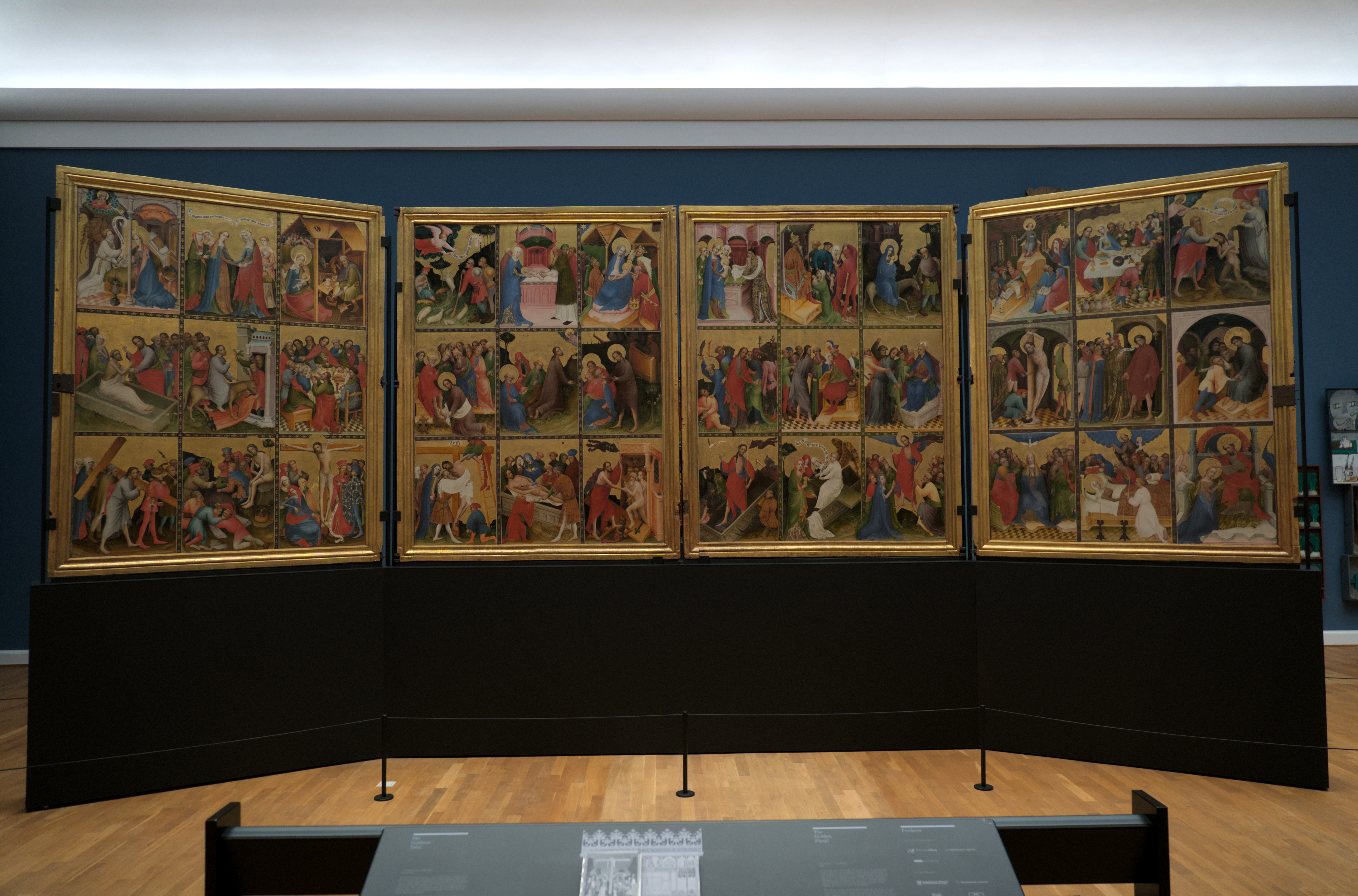
One of the most important northern German works in the International Gothic style, the altarpiece was created in the 1420s for the high altar of the newly built Benedictine monastery of St. Michael in Lüneburg. It was the work of carpenters, sculptors, and two painters, one from the circle of the Westphalian artist Conrad von Soest, and the other probably based in Cologne or even Lüneburg.
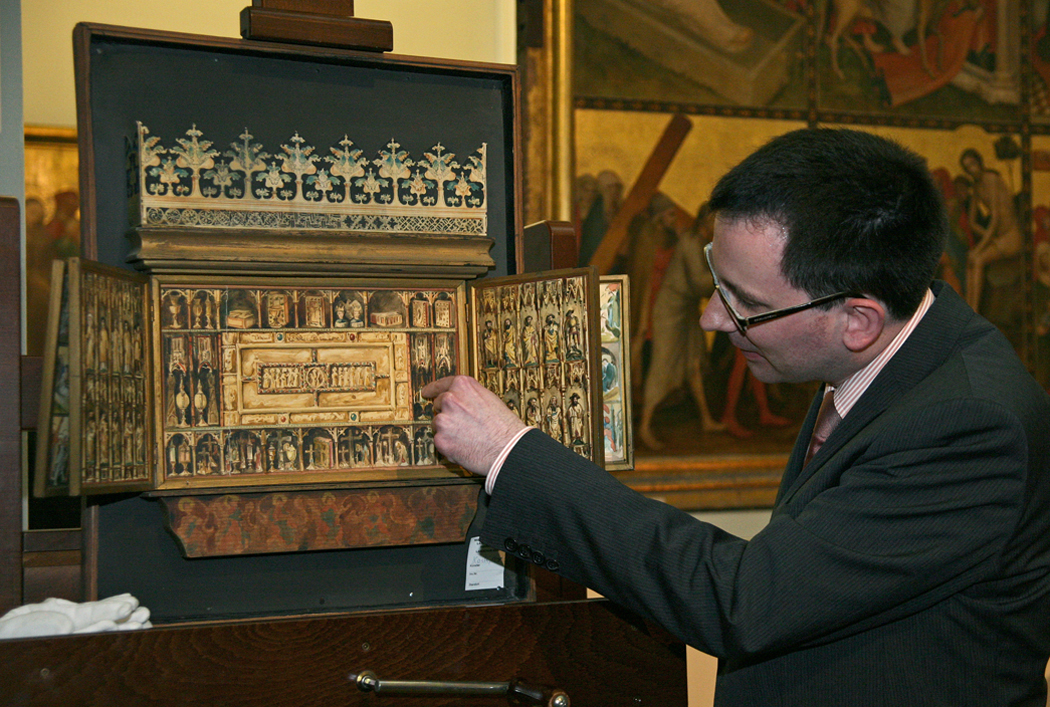
The Golden Panel altarpiece, in its original design, had two pairs of hinged wings that could be opened or closed over a fixed central shrine, offering three possible configurations. The shrine, irrecoverably robbed in 1644 and 1698, housed the monastery’s treasury, especially its reliquaries, displayed in a cabinet of twenty-two richly decorated rectangular compartments surrounding the eponymous, aforementioned “golden panel.” This main body of the altarpiece (called the corpus) was dismantled in 1792–94 and its remaining objects melted or sold. The predella (base) has also been lost.
However, the altarpiece’s two pairs of wings, replete with panel paintings and figural sculptures, have survived to the present day and, having been restored in 2016–19, are proudly displayed at the Landesmuseum Hannover for visitors to enjoy. When you enter the gallery, you are greeted with the full cycle of thirty-six painted scenes (nine per panel) from the life of Christ, read from left to right in long rows. Then you can walk behind to see the panels’ other sides, which would not have been simultaneously on view to the monks of St. Michael’s with the altarpiece’s original construction.
The scale model in the following photograph gives you a good sense of the three distinct viewing states that were originally possible.
View 1: The Brazen Serpent and The Crucifixion
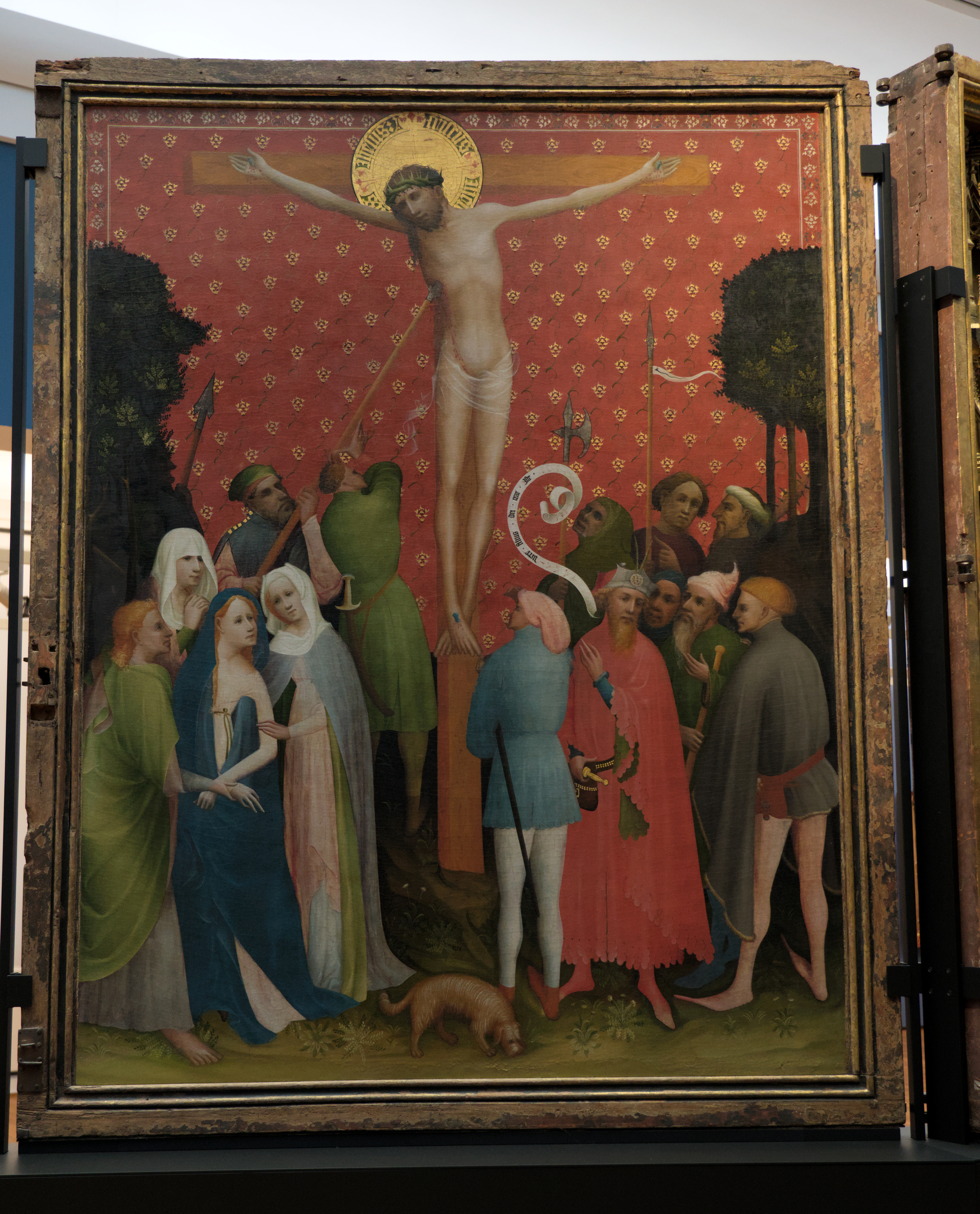
View 1, the closed view, juxtaposes a scriptural type and antitype: the brazen serpent in the wilderness, raised on a pole for the life of the people, and the crucifixion of Christ.
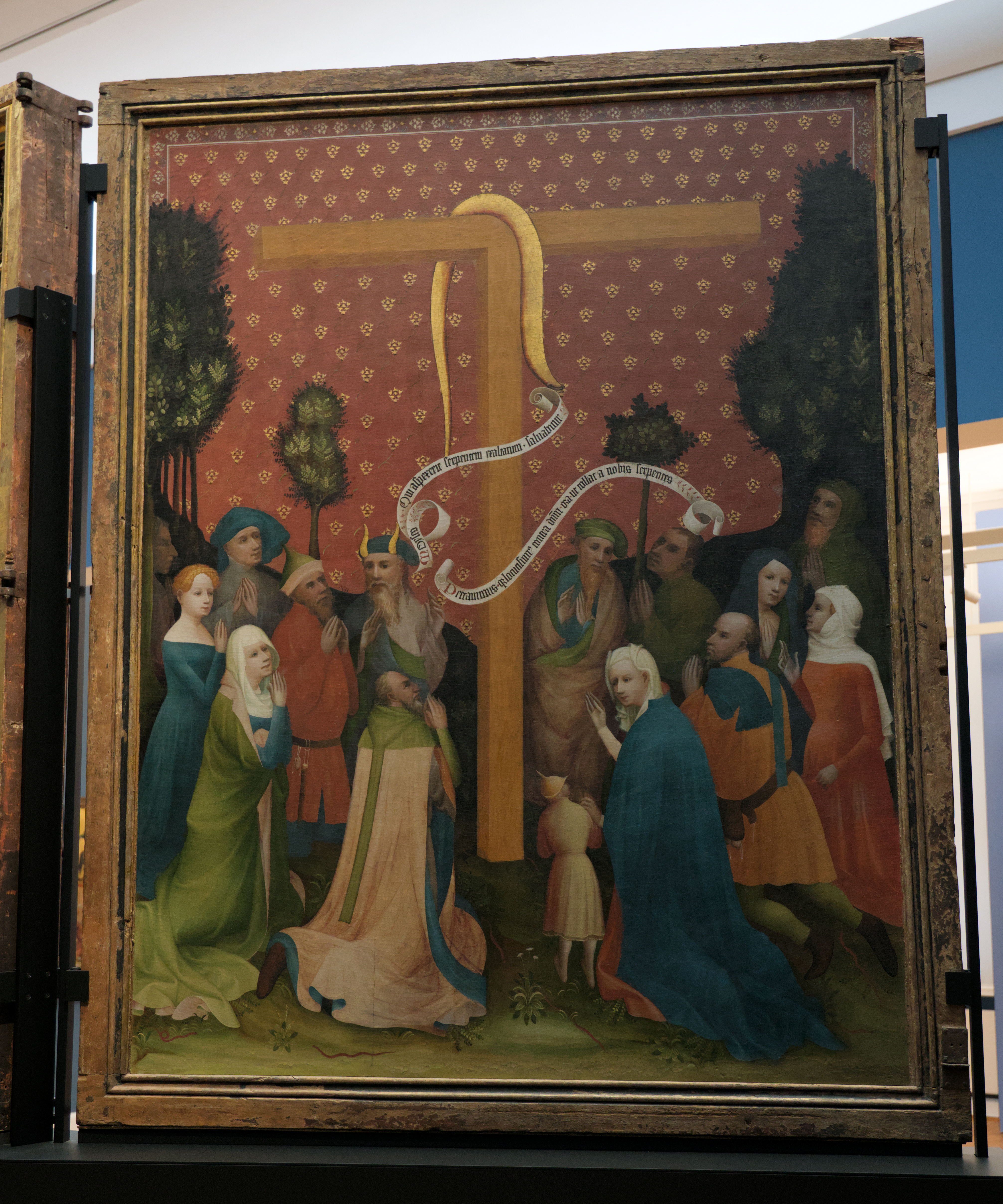
Numbers 21:4–9 tells of how, wandering the desert after God delivered them from slavery in Egypt, the Israelites complained about how life was better before. As punishment for their ingratitude, God sent poisonous serpents into their camps, and fatalities ensued. The people realized their sin and repented, asking Moses to intercede with God for relief. God told Moses to craft a bronze serpent and lift it high on a pole, and to instruct the people that if they are bitten, to look on the sculpture and they will be spared.
In John 3:14–15, Jesus interpreted this story as foreshadowing his being raised on a cross to bring healing: “And just as Moses lifted up the serpent in the wilderness,” he told Nicodemus, “so must the Son of Man be lifted up, that whoever believes in him may have eternal life.”
The anonymous artist shows the gleaming snake on a tau cross that mirrors the one Jesus hangs on in the opposite panel. The lower banderole reads, from the Vulgate, “Peccavimus quia locuti sumus contra Dominum et te ora ut tollat a nobis serpentes” (We have sinned, because we have spoken against the Lord and thee: pray that he may take away these serpents). I can’t make out the text on the upper banderole, other than aspexerit, “shall look,” but presumably it communicates God’s antidote to the snake bites.
Moses has horns, as is typical in Western iconography, because of a literal translation of the Hebrew qaran in Exodus 34:29–30:
And when Moses came down from Mount Sinai, he held the two tables of the testimony, and he knew not that his face was horned from the conversation of the Lord. And Aaron and the children of Israel seeing the face of Moses horned, were afraid to come near. (Douay–Rheims)
Almost all English translations say instead that Moses’s face “shone” or “became radiant,” interpreting qaran as horned with rays of light. This artist splits the difference and shows, growing out from under Moses’s hat, two bony protrusions that are luminous!
The Crucifixion scene shows a Roman spearman piercing Jesus’s side to confirm his death, while Jesus’s mother, two other Marys, and the apostle John mourn under his right hand. A centurion in the crowd exclaims, “Vere Filius Dei erat iste” (Truly this man was the Son of God).
(Related post: “Four scenes from a medieval German altarpiece”)
View 2: The Life of Christ
When these two outer panels were opened in their day, they would reveal view 2 of the altarpiece (pictured at top of article), or the first open view, displaying scenes from Jesus’s infancy, passion, and resurrection across four panels.
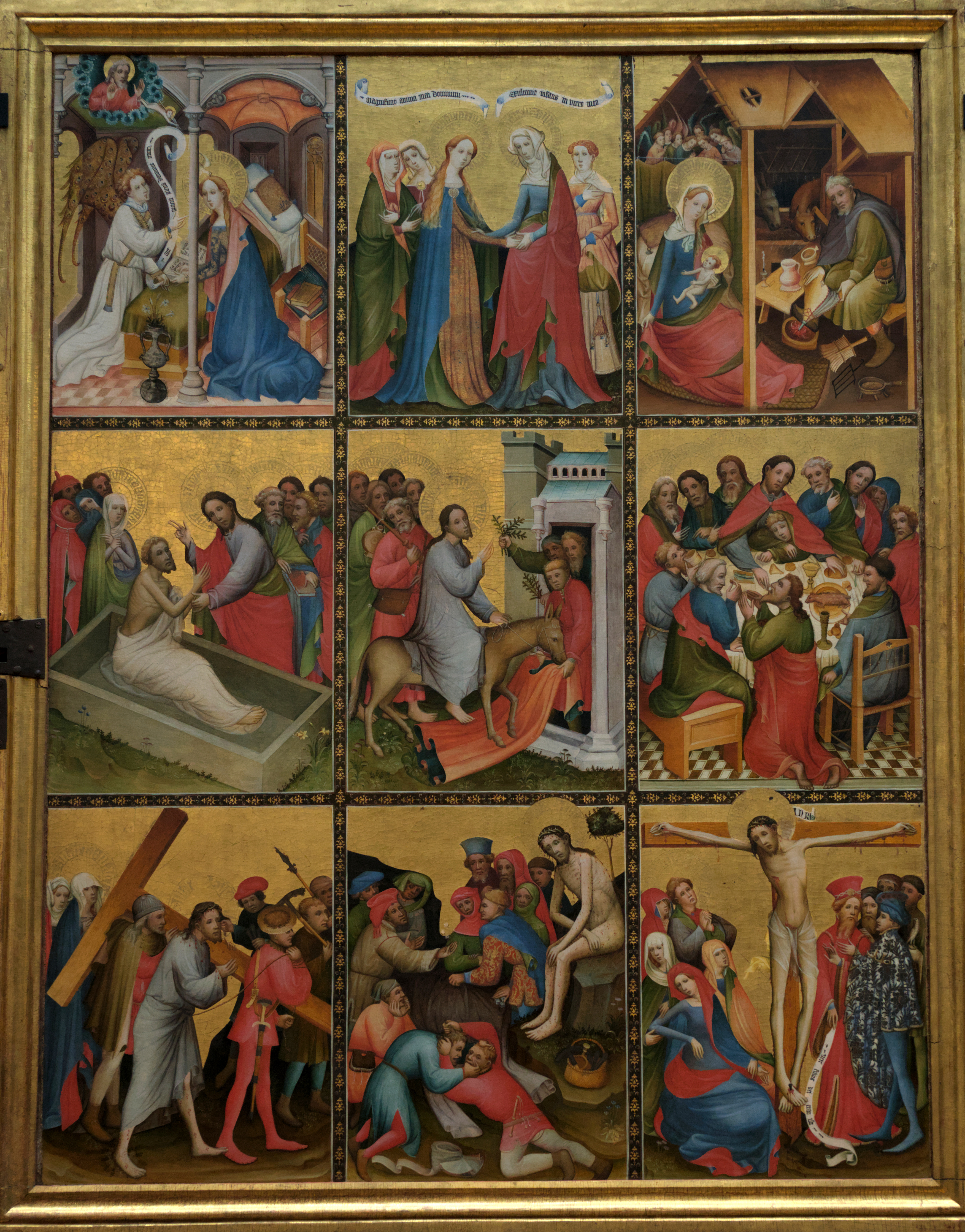
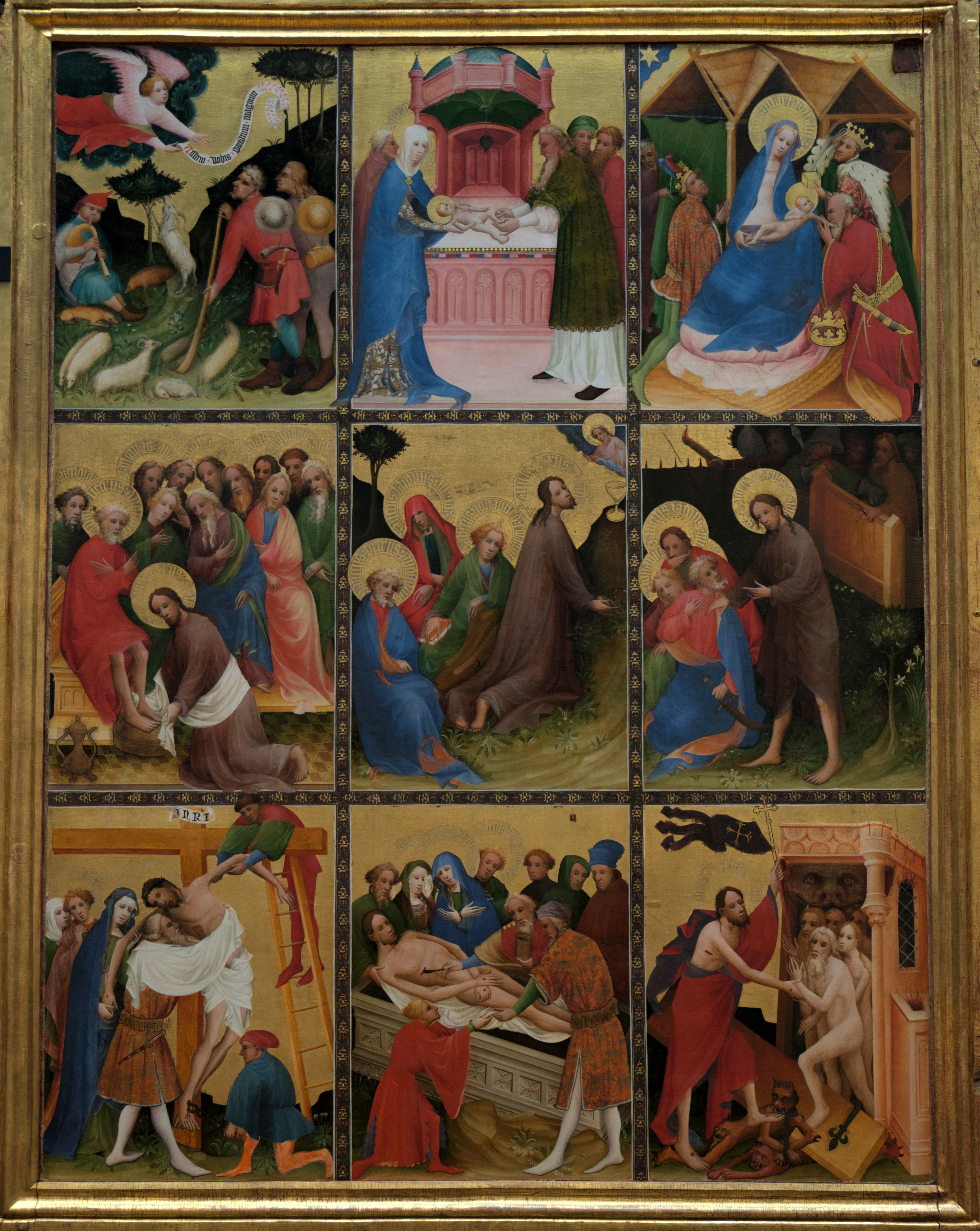
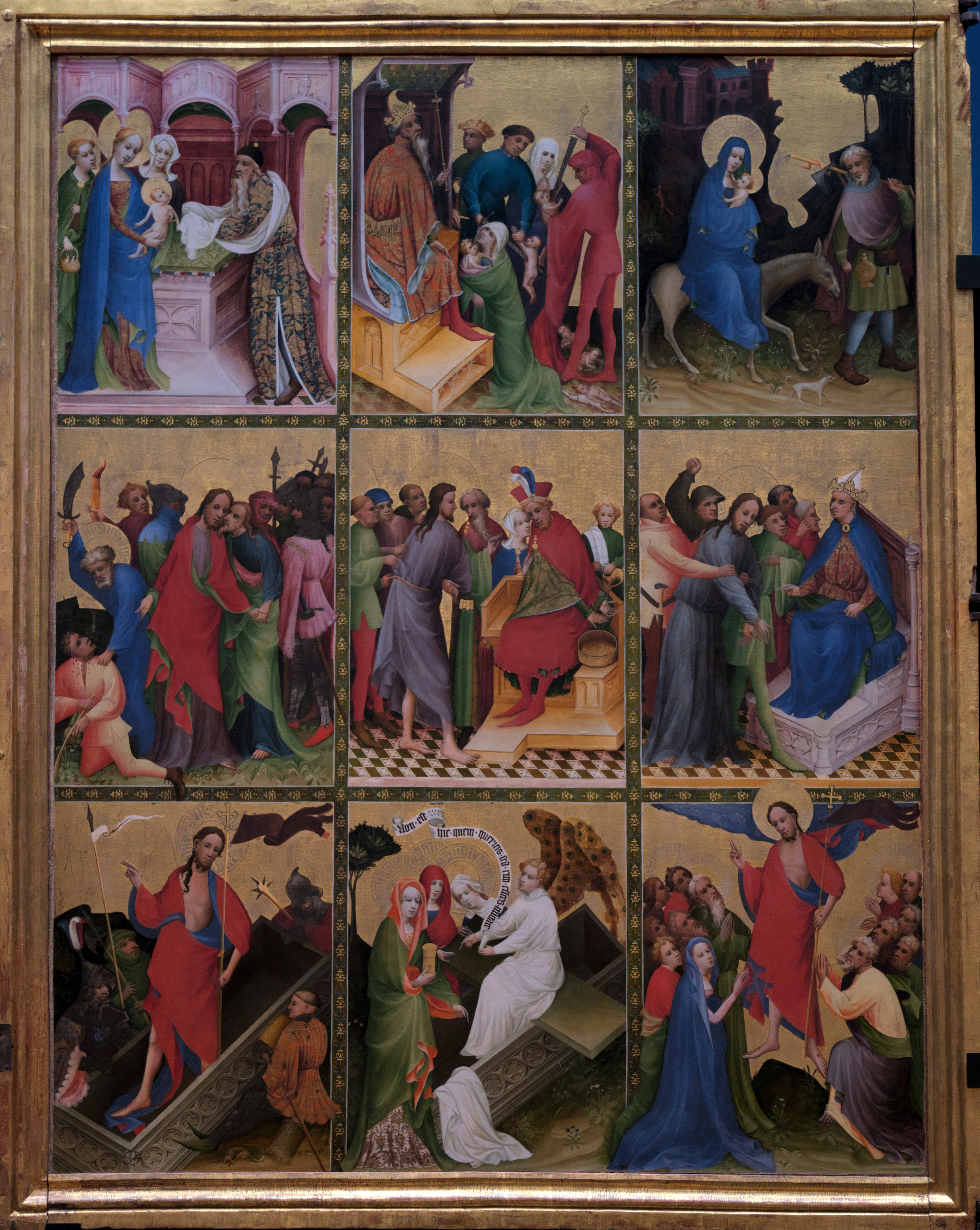
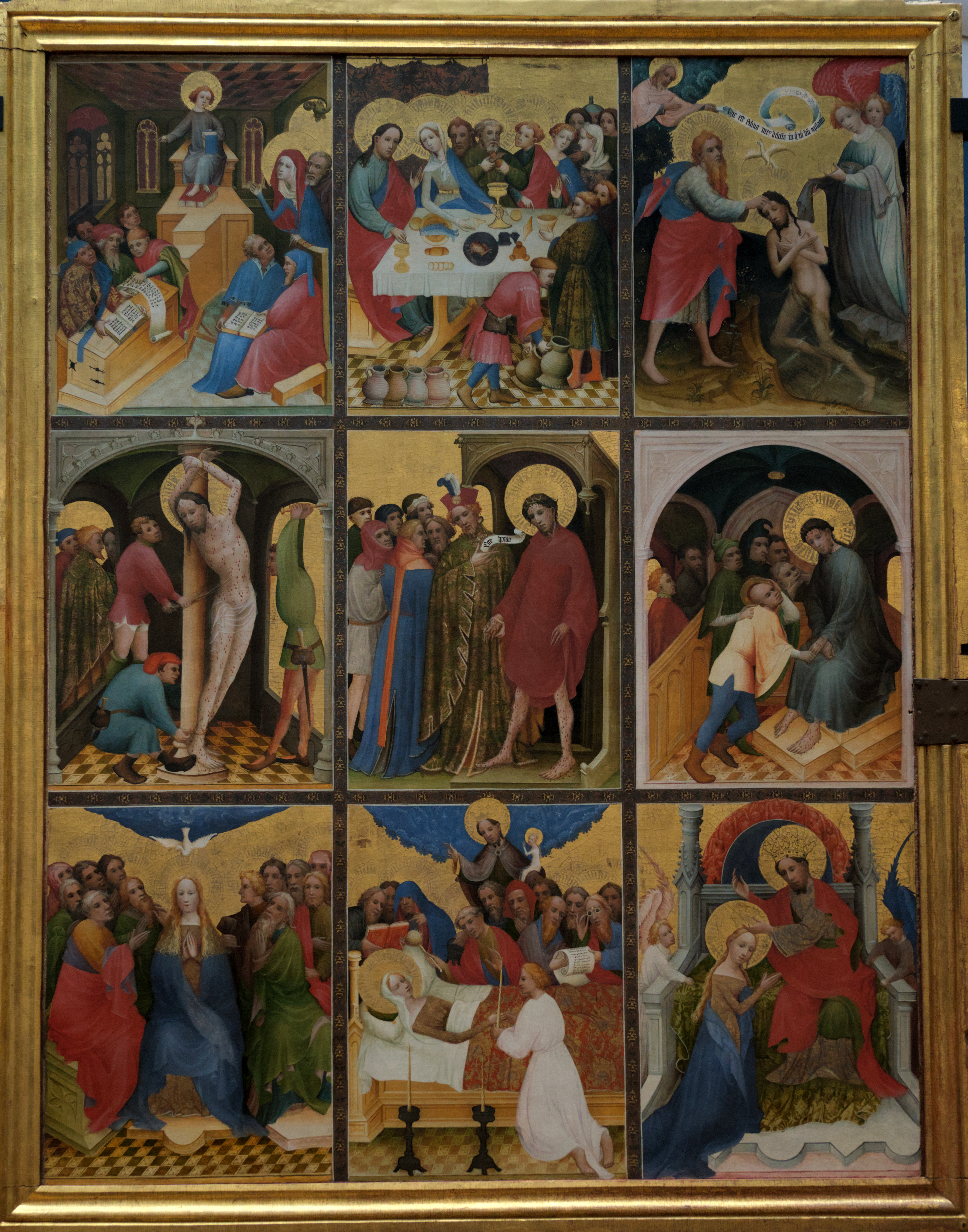
I’ll share a few of my favorite scenes.
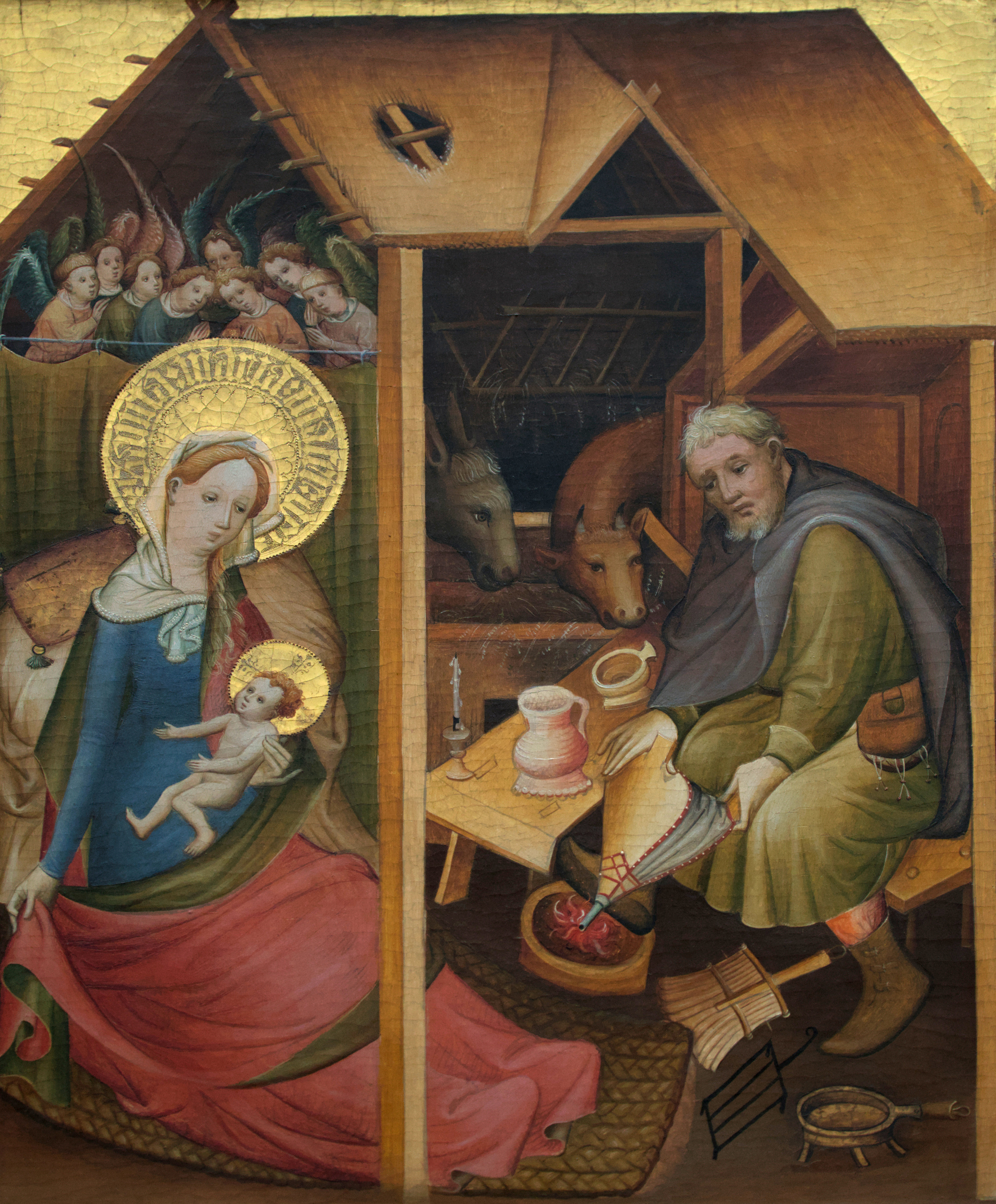
The Nativity features what I call the industrious Joseph motif [previously], as rather than sitting off to the side with his head in his hands, as he’s commonly shown, Jesus’s dad is hard at work trying to make his family comfortable. He pumps a bellows to supply air to the small fire he has going, either to warm his wife and child or, as he does in a handful of other medieval German Nativities, to cook a simple meal. Mary reclines with the infant Christ on a woven straw mattress while angels peek in from over a curtain to adore him.
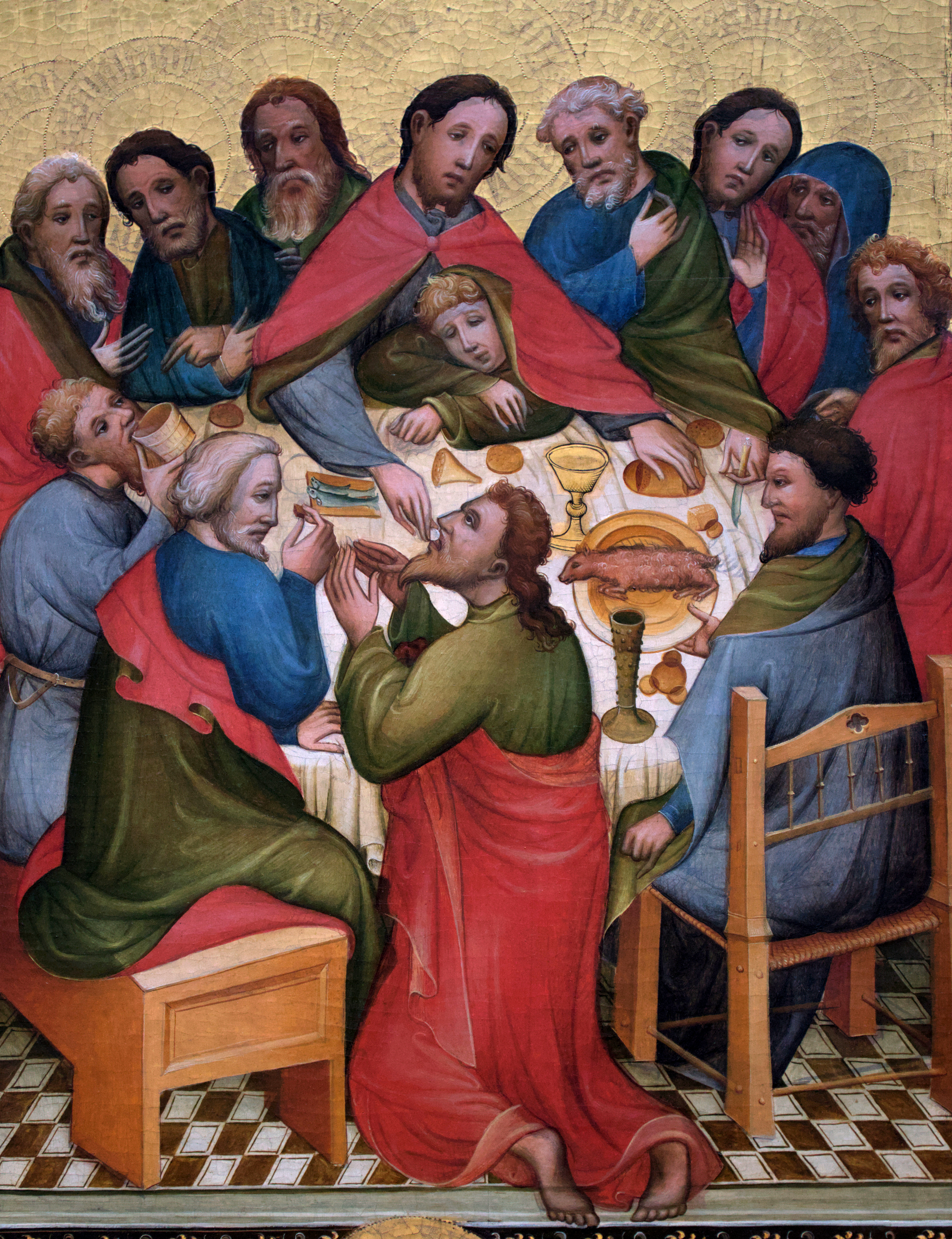
The Last Supper I found especially charming because of how the apostle John shelters under Jesus’s cloak, relaxed, secure. The image of John resting on Jesus’s breast rose to popularity in fourteenth-century Germany, a commemoration of the two’s bosom friendship and a call to, like John, abide in Christ. It’s based on the description in John 13:23, which says that at Jesus’s last meal, at Passover time, “one of his disciples—the one whom Jesus loved—was reclining close to his heart.” This verse alludes to the typical eating posture assumed at ancient Greco-Roman banquets, at which men reclined with their heads near a low table and their feet pointing away from it. But in Christian interpretation it has come to signify, more than simply a seating arrangement, the proximity of John to the heart of Christ.
In the Golden Panel’s Last Supper, Jesus enfolds John much like a mother hen would her chick (cf. Matt. 23:37; Luke 13:34), his garment like a wing. Even in this moment before his greatest trial, when most would be inclined to turn inward, Jesus shows concern for those he loves—he covers, protects. And nourishes. He stretches his hand across the table, laid with dishes of lamb and fish, to feed Judas a morsel of bread that resembles a eucharistic wafer. He sups with the man he knows will betray him. He does not turn him away.
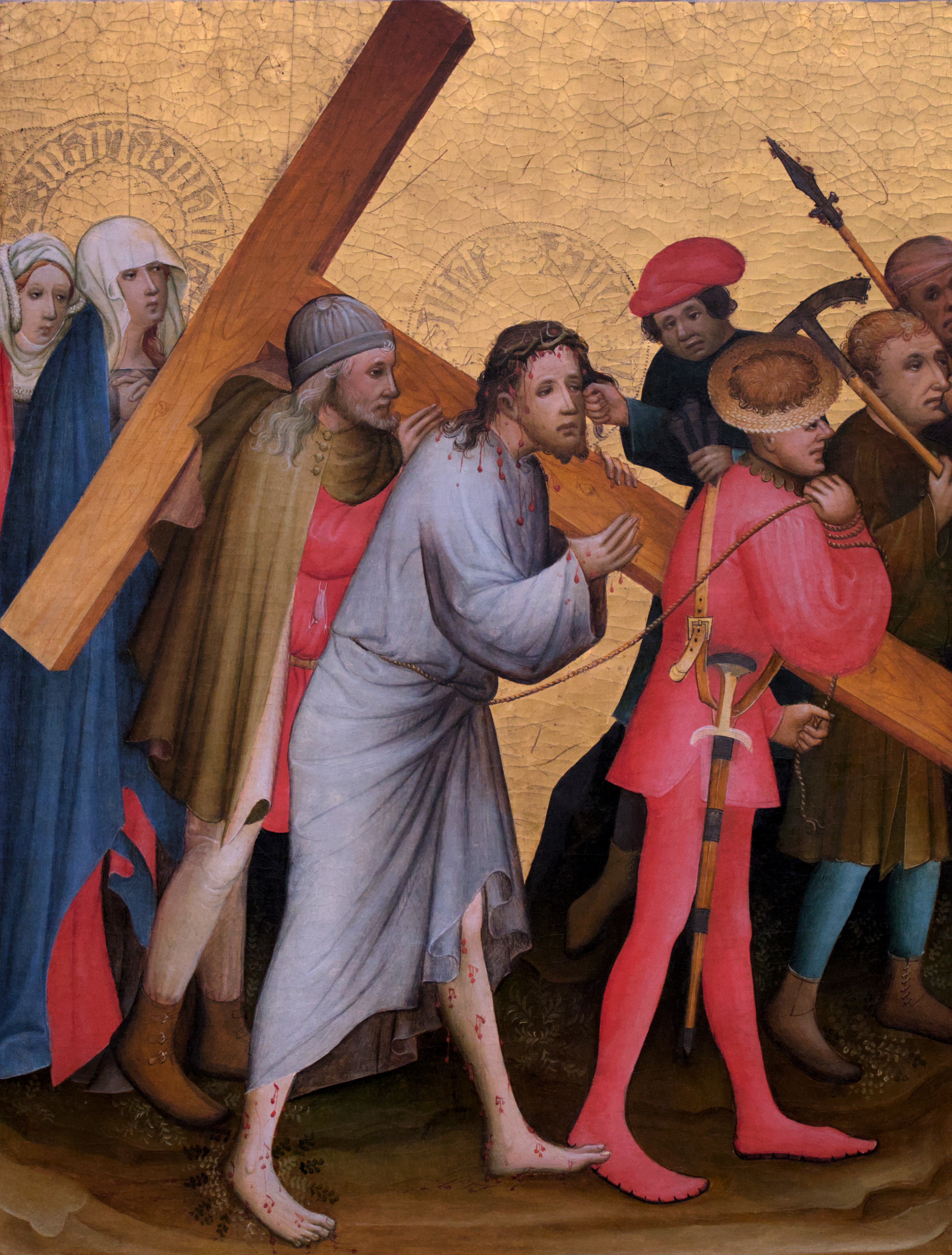
Further along in the narrative, the scene of Christ carrying his cross with the help of Simon of Cyrene stands out to me because of the man pulling Jesus’s hair as he walks. The cruel mocking and assault continue outside the courtroom and en route to Golgotha.
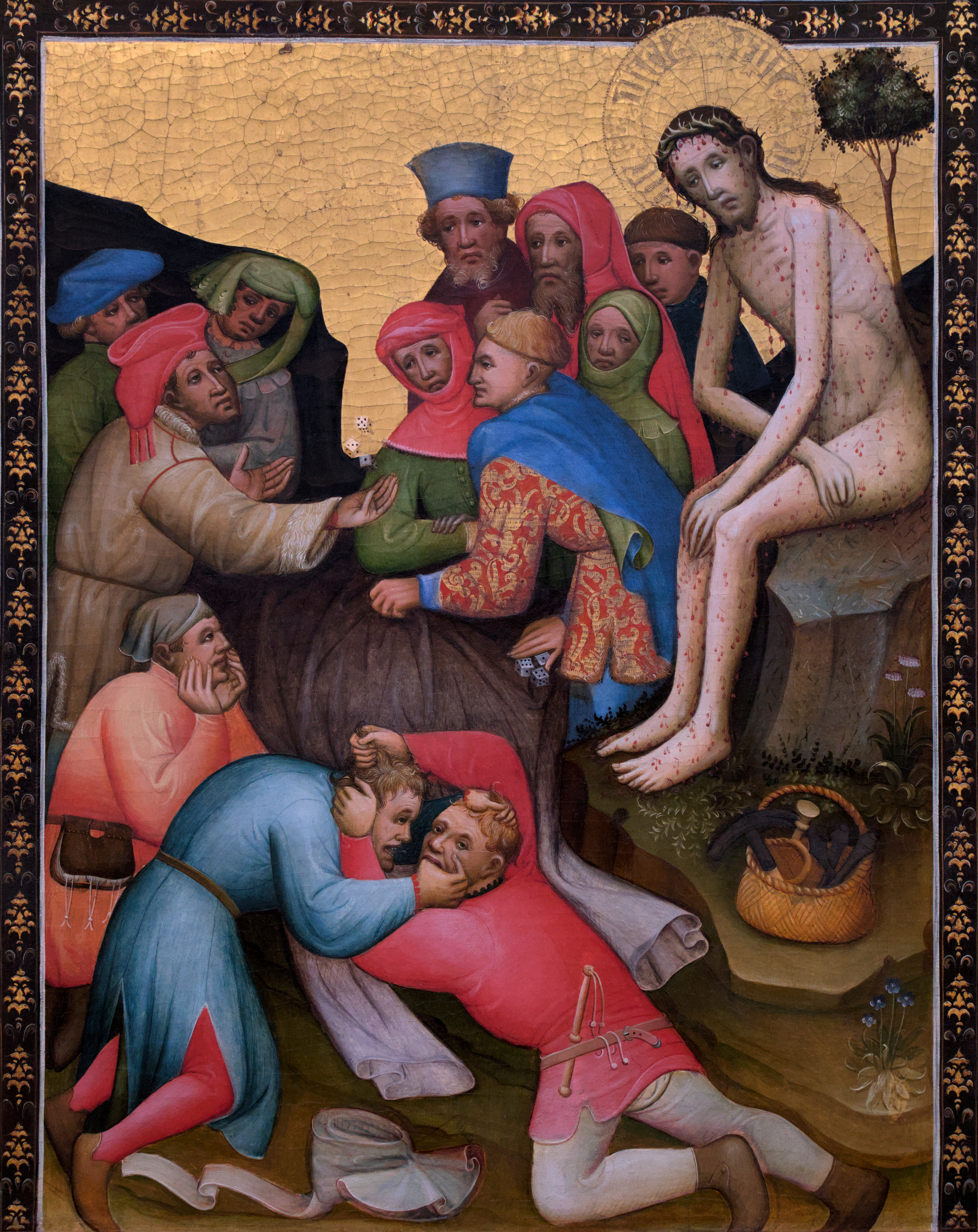
Called Christus im Elend (Christ in Distress) or Christus in der Rast (Christ at Rest), the subject depicted in the bottom center of the far left panel first started appearing in northern Germany in the second half of the fourteenth century. It shows Jesus sitting pensively, usually on a stone, waiting for his cross to be raised.
In the Golden Panel, Jesus, naked, bleeds all over while the soldiers roll dice and fight over who will get to keep his seamless tunic. The two men in the foreground, one with a flagrum tucked in his belt, tumble and tear at each other, pulling and biting, exemplifying the human penchant for violence that will culminate in the killing of God’s Son. (The basket of hammer and nails that has been procured for the task sits temporarily off to the side.) Combative and puerile, this is the humanity Christ has come to save.
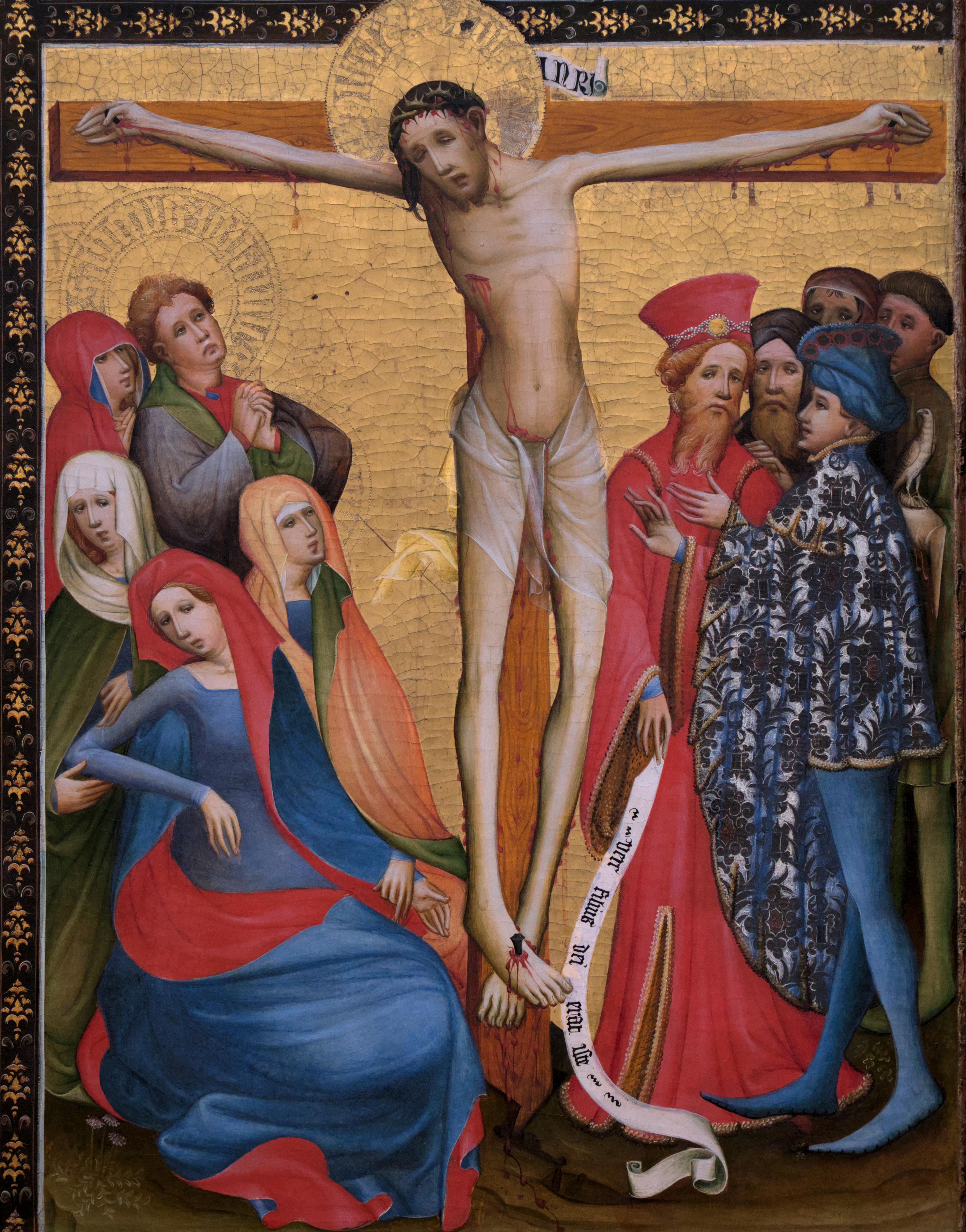
The interior Crucifixion painting is fairly standard, but oh, isn’t it lovely? One notable feature is how Christ’s blood flows from his side, his final wound, down to his groin, where he received, at eight days old, his first wound, the cutting off of his foreskin in a ritual circumcision. Scholars such as Leo Steinberg have remarked how this diversion of the blood’s natural path (which would be to the right thigh) was an intentional device some painters used to connect these two sheddings of blood, and thus the incarnation and the atonement.
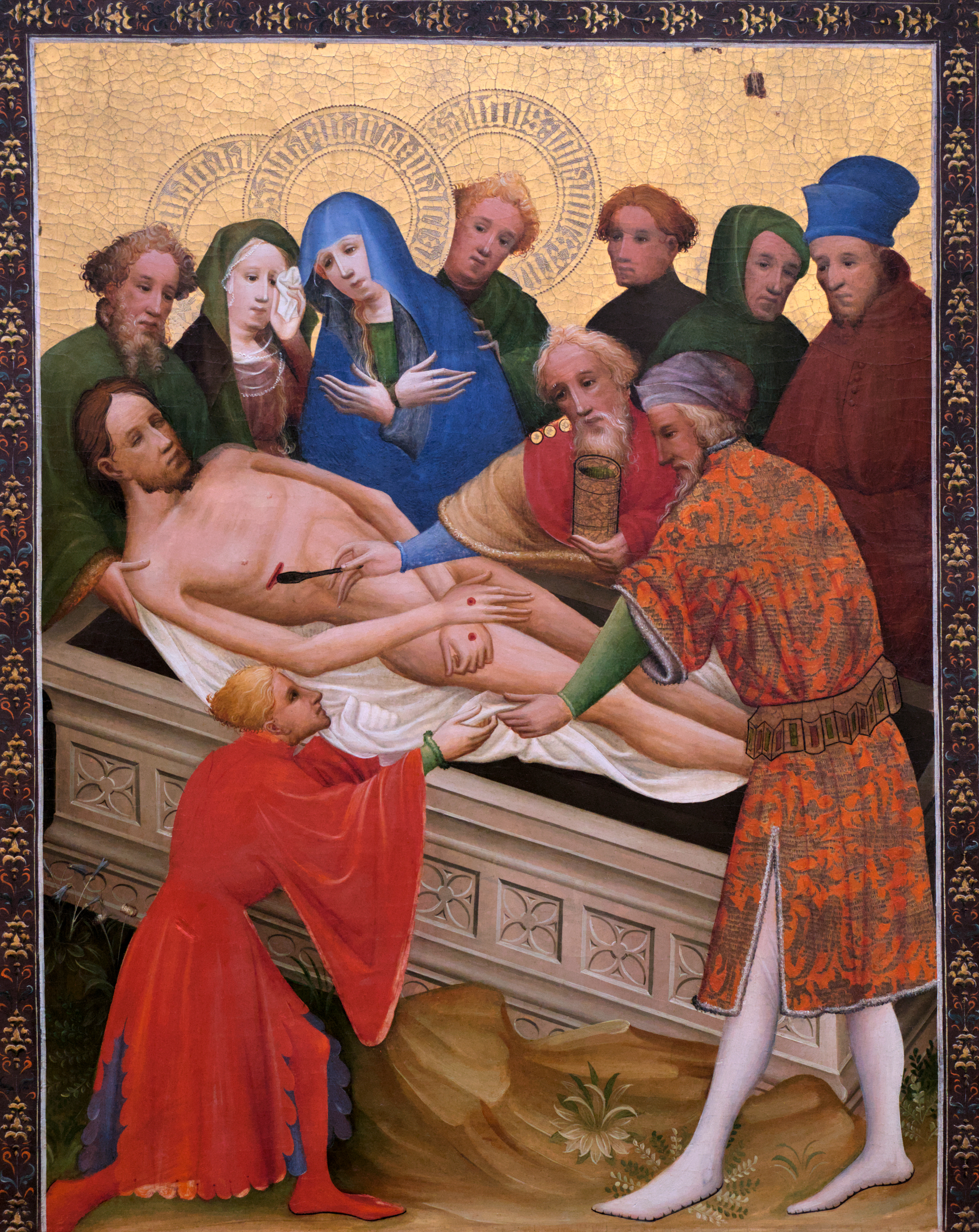
Moving two pictures down the line, the Entombment scene caught my eye because of the tender care shown to the dead Christ before he’s laid to rest. Nicodemus anoints Christ’s wounds with myrrh and aloes, applying them with a spatula, while Joseph of Arimathea, who has donated his tomb, prepares to enshroud the body.
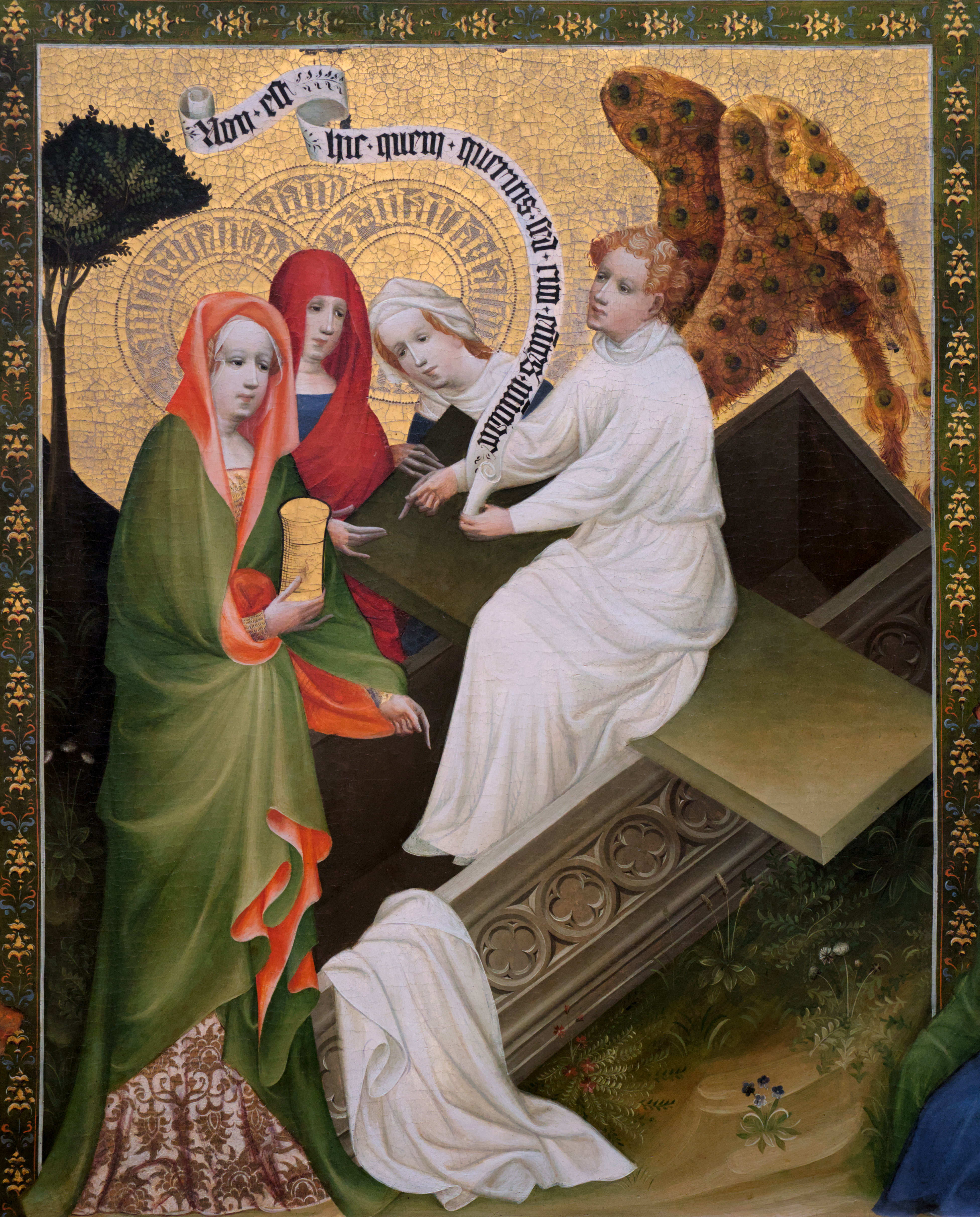
In a quintessential Easter scene, three faithful women come to the burial site after the Sabbath to complete the anointing ritual, only to find a finely feathered angel perched atop the skewed lid of Christ’s now-empty sarcophagus. Mary Magdalene, holding a golden jar, points into the vacant space as if to ask, “Where’s my Lord?” To which the angel responds that he is risen!
View 3 (Partial): Sculptures of the Saints
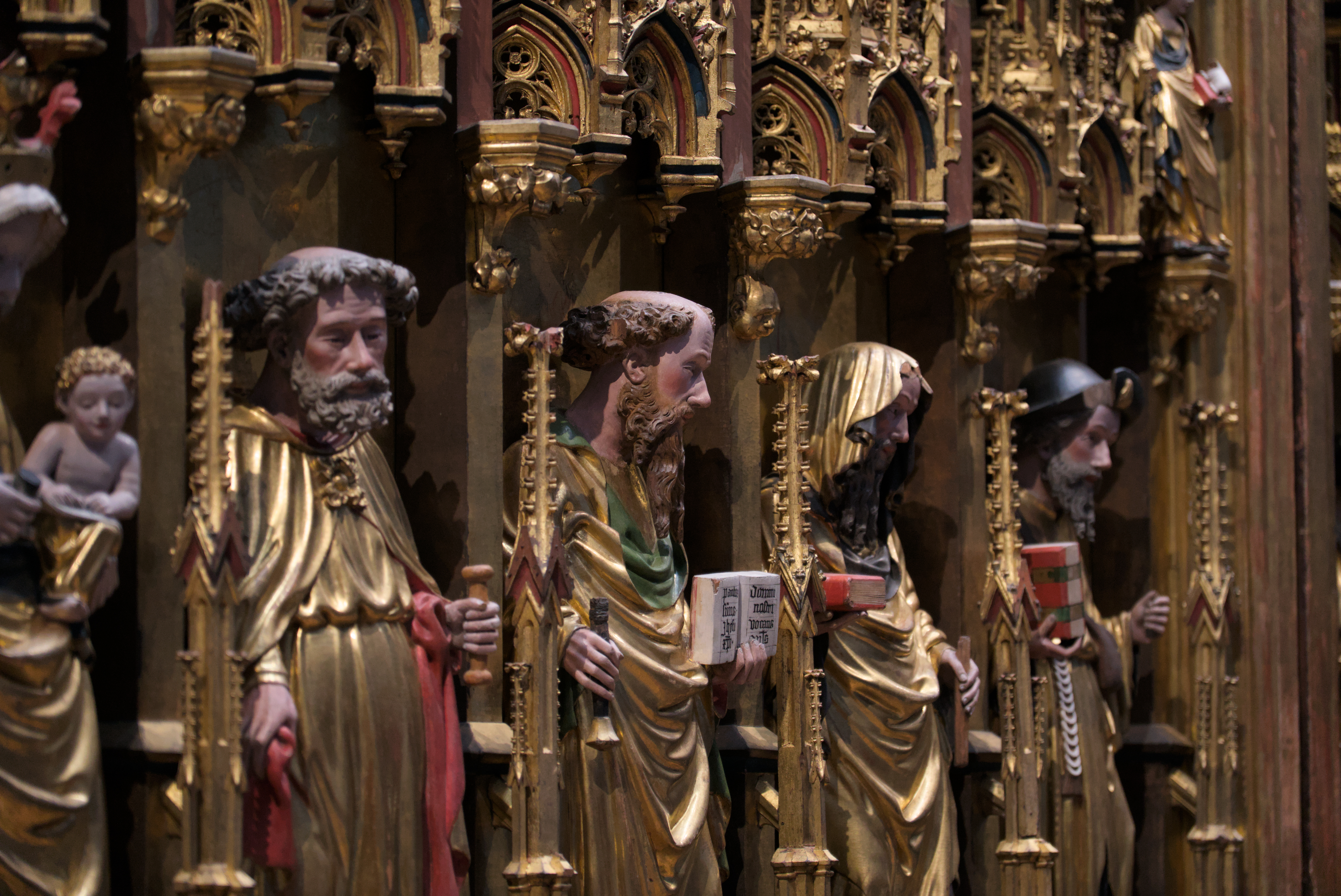
View 3 of the Golden Panel altarpiece—the fully open view, saved for important feast days—cannot be replicated because the shrine that formed the corpus is lost. But flanking the shrine would have been two wings that have survived largely intact, displaying polychrome wood sculptures of twenty (mostly male) saints and, in the intermediate row, smaller statuettes of six female saints (the other six are missing).
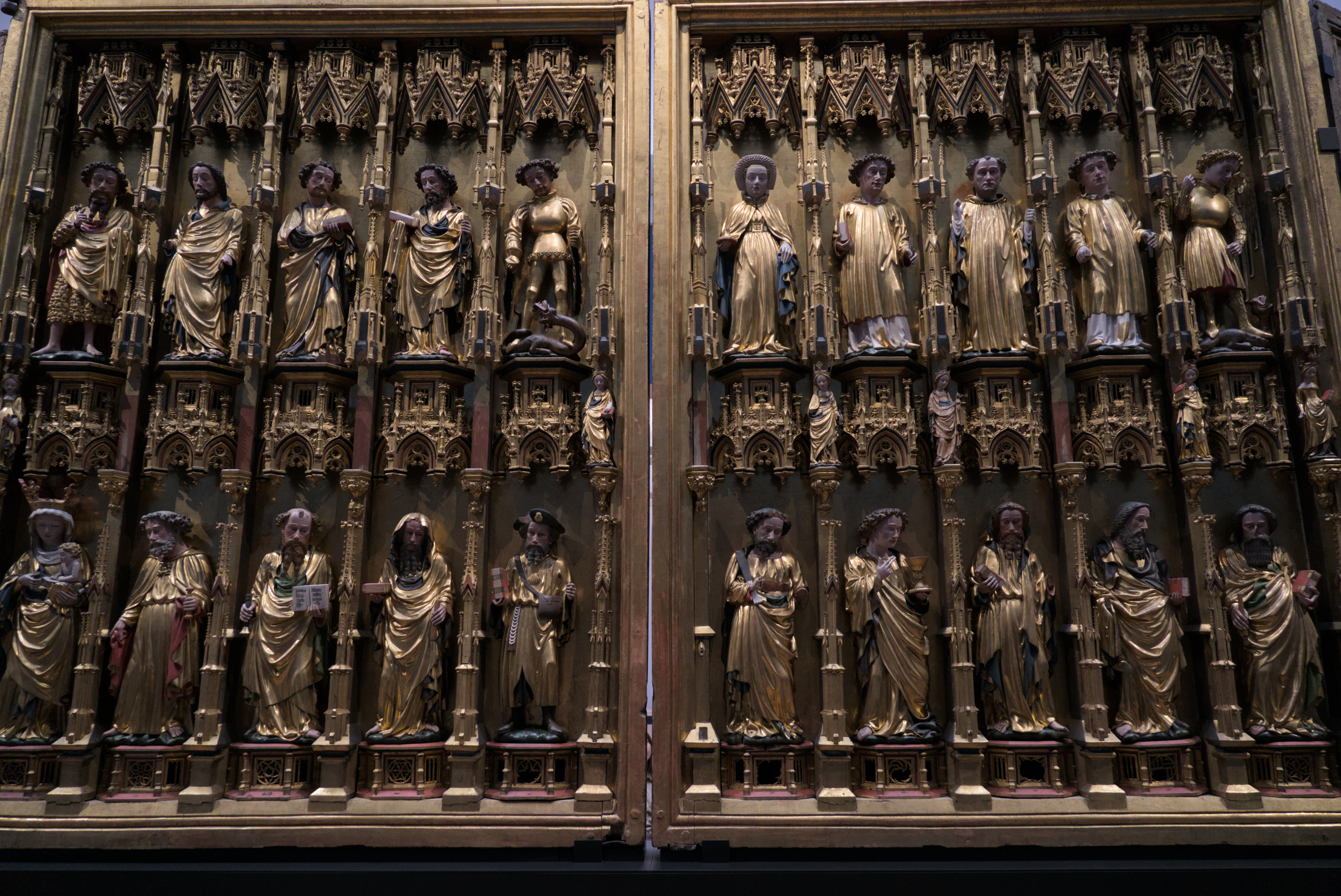
The identities of the main figures are listed below. The ones I couldn’t confirm but for which I proffer my best guess are followed by a question mark.
- Top left: John the Baptist, Thomas(?), Matthew, Simon(?), George
- Top right: Mary Magdalene, Lawrence (deacon), Benedict, Cyriacus (deacon), Michael
- Bottom left: Madonna and Child, Peter, Paul, James the Lesser(?), James the Greater
- Bottom right: Bartholomew, John the Evangelist, Jude (Thaddeus)(?), Andrew, Philip
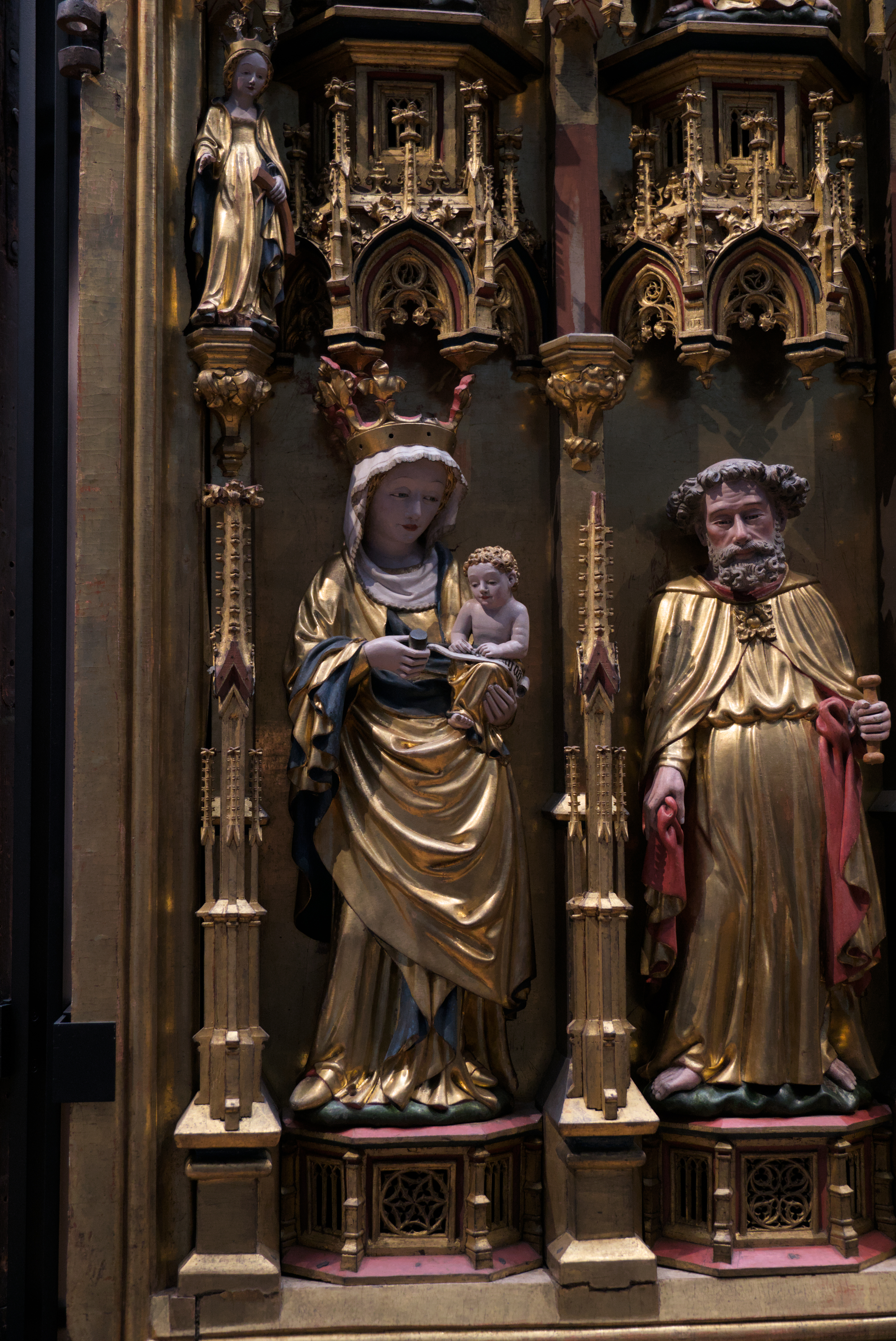
In the sculpture of the Madonna and Child, Mary holds an inkwell that Jesus dips his pen into as he writes on a scroll. How delightful! It’s a rare iconography but one that’s shared by the Tintenfassmadonna in Hildesheim Cathedral, sculpted around the same time.
The figure to the right of Mary is Peter. He holds a handle with a dowel hole on the underside; originally, a set of keys was attached to it and hung down.
The diminutive figure above Mary is Catherine of Alexandria, identifiable by the fragmented wheel she holds, a symbol of her martyrdom.
To learn more about the Golden Panel, see the book Die Goldene Tafel aus Lüneburg, edited by Antje-Fee Köllermann and Christine Unsinn (Michael Imhof, 2021), from the Niederdeutschen Beiträge zur Kunstgeschichte (Low German Contributions to Art History) series. Only three of its twenty-five chapters are in English; the rest is in German. It’s highly technical, the product of an interdisciplinary research project carried out from 2012 to 2016. There’s not much in it about the actual content of the images. But it provides ample color illustrations, which I always appreciate, as well as stylistic comparisons, historical inventories, and more.
 Art & Theology