The Lüneburg Goldene Tafel (Golden Panel): An International Gothic Masterpiece

Other than the second one, captioned with a copyright notice, all photos in this article are my own.

When visiting the Landesmuseum (State Museum) in Hanover, Germany, last fall, I was struck by a monumental medieval altarpiece depicting thirty-six scenes from the life of Christ. Scholars refer to it as the Goldene Tafel (Golden Panel) after the now-lost large gold repoussé plaque, originally designed (most likely) as an antependium in the twelfth century, that was once at the center of its inner display, depicting Christ seated in a mandorla flanked by the twelve apostles.
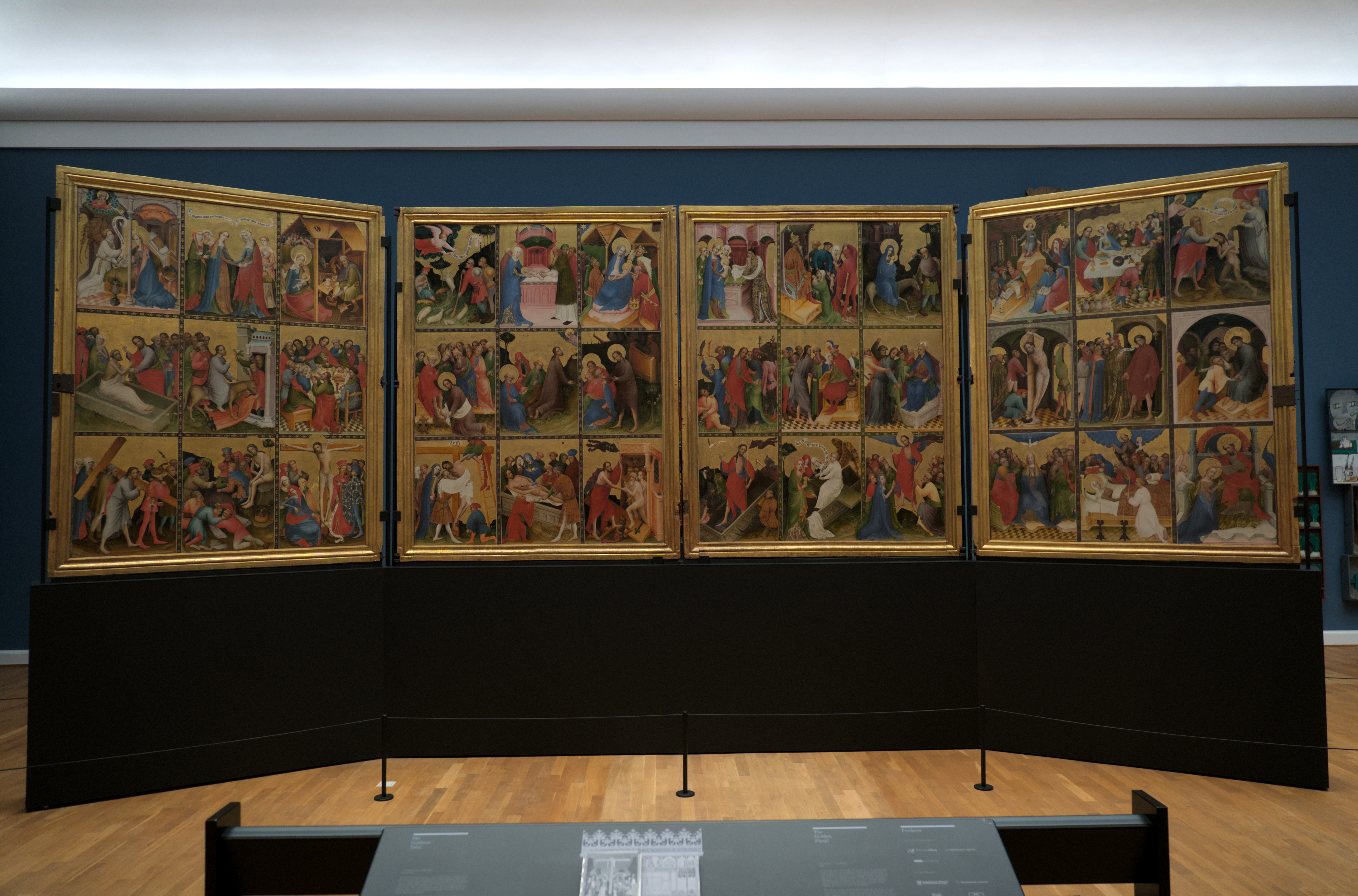
Golden Panel altarpiece
The “Goldene Tafel” (Golden Panel), made for the church of St. Michael’s monastery in Lüneburg, Germany, ca. 1420–30. Tempera and gold leaf on oak, each panel 231 × 184 cm (overall 231 × 736 cm). Landesmuseum Hannover, Germany, WM XXIII, 27. Photo: Victoria Emily Jones.

One of the most important northern German works in the International Gothic style, the altarpiece was created in the 1420s for the high altar of the newly built Benedictine monastery of St. Michael in Lüneburg. It was the work of carpenters, sculptors, and two painters, one from the circle of the Westphalian artist Conrad von Soest, and the other probably based in Cologne or even Lüneburg.

The Golden Panel altarpiece, in its original design, had two pairs of hinged wings that could be opened or closed over a fixed central shrine, offering three possible configurations. The shrine, irrecoverably robbed in 1644 and 1698, housed the monastery’s treasury, especially its reliquaries, displayed in a cabinet of twenty-two richly decorated rectangular compartments surrounding the eponymous, aforementioned “golden panel.” This main body of the altarpiece (called the corpus) was dismantled in 1792–94 and its remaining objects melted or sold. The predella (base) has also been lost.

However, the wings, replete with panel paintings and figural sculptures, have survived to the present day and, having been restored in 2016–19, are proudly displayed at the Landesmuseum Hannover for visitors to enjoy. When you enter the gallery, you are greeted with the full cycle of thirty-six painted scenes (nine per panel) from the life of Christ, read from left to right in long rows. Then you can walk behind to see the panels’ other sides, which would not have been simultaneously on view to the monks of St. Michael’s with the altarpiece’s original construction.

The scale model in the following photograph gives you a good sense of the three distinct viewing states that were originally possible.
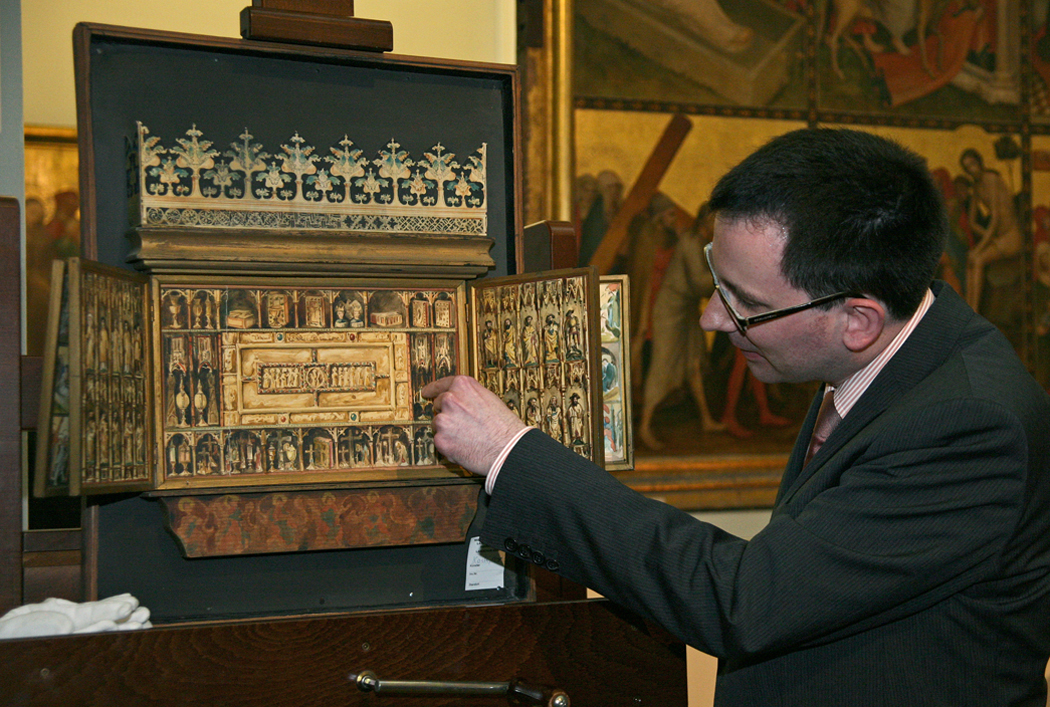
Golden Panel model
Dr. Bastian Eclercy, curator of Old Master paintings at the Landesmuseum Hannover from 2010 to 2013, presents a historical model of the Golden Panel. Photo © Landesmuseum Hannover.

View 1: The Brazen Serpent and The Crucifixion

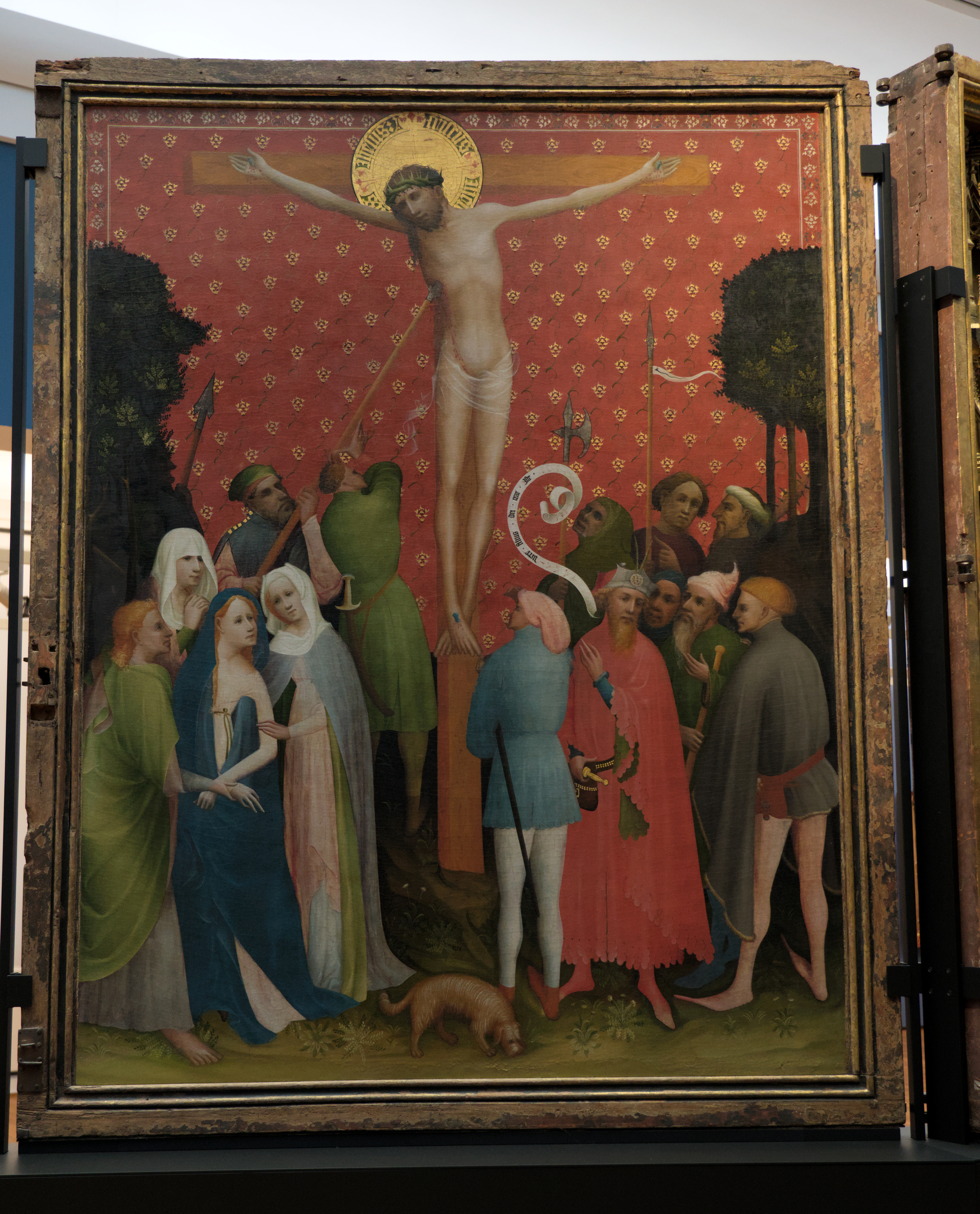
View 1, the closed view, juxtaposes a scriptural type and antitype: the brazen serpent in the wilderness, raised on a pole for the life of the people, and the crucifixion of Christ.
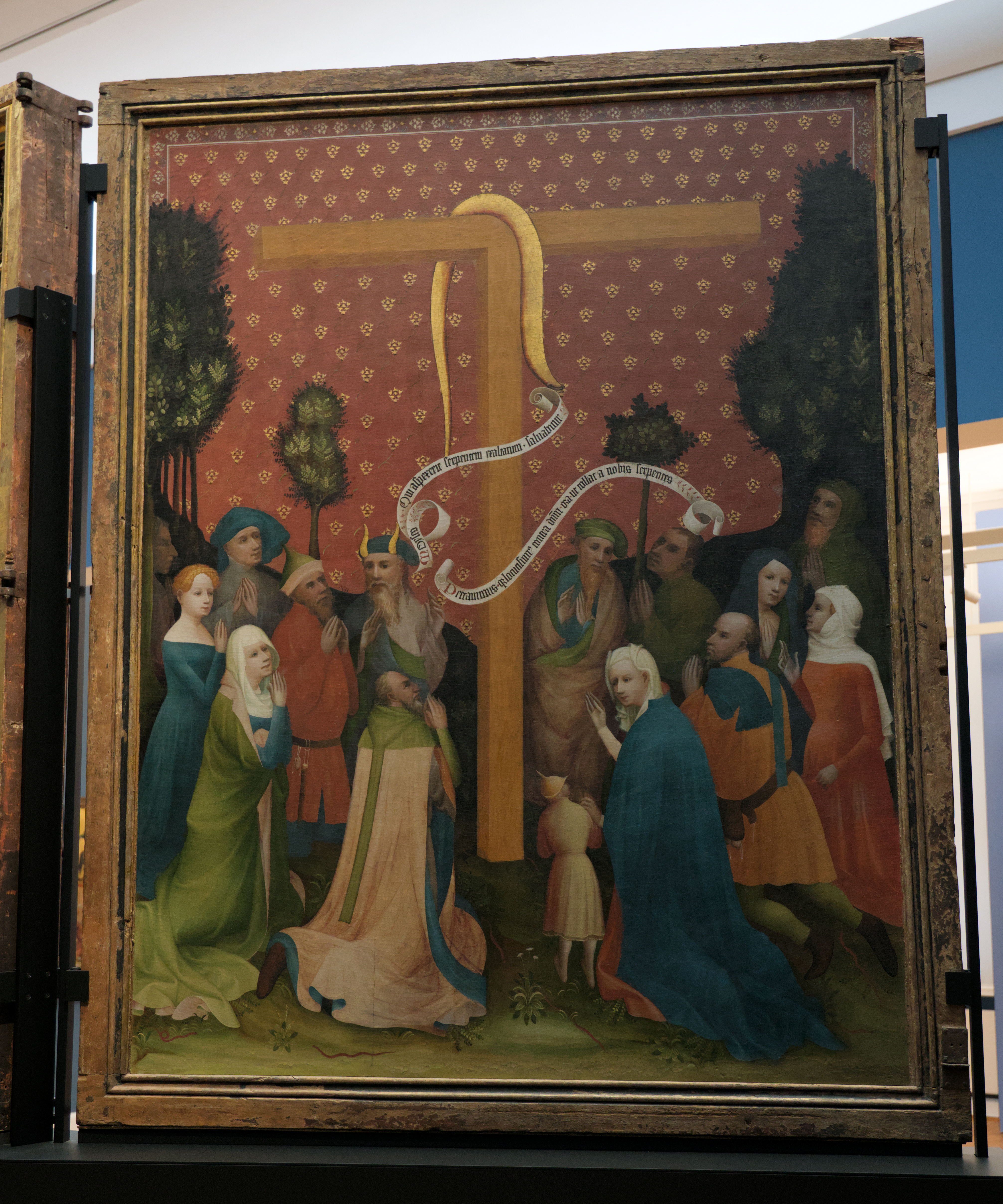
The Brazen Serpent
Crucifixion

Numbers 21:4–9 tells of how, wandering the desert after God delivered them from slavery in Egypt, the Israelites complained about how life was better before. As punishment for their ingratitude, God sent poisonous serpents into their camp, and fatalities ensued. The people realized their sin and repented, asking Moses to intercede with God for relief. God told Moses to craft a bronze serpent and lift it high on a pole, and to instruct the people that if they are bitten, to look on the sculpture and they will be spared.

In John 3:14–15, Jesus interpreted this story as foreshadowing his being raised on a cross to bring healing: “And just as Moses lifted up the serpent in the wilderness,” he told Nicodemus, “so must the Son of Man be lifted up, that whoever believes in him may have eternal life.”

The anonymous artist shows the gleaming snake on a tau cross that mirrors the one Jesus hangs on in the opposite panel. The lower banderole reads, from the Vulgate, “Peccavimus quia locuti sumus contra Dominum et te ora ut tollat a nobis serpentes” (We have sinned, because we have spoken against the Lord and thee: pray that he may take away these serpents). I can’t make out the text on the upper banderole, other than aspexerit, “shall look,” but presumably it communicates God’s antidote to the snake bites.

Moses has horns, as is typical in Western iconography, because of a literal translation of the Hebrew qaran in Exodus 34:29–30:

And when Moses came down from Mount Sinai, he held the two tables of the testimony, and he knew not that his face was horned from the conversation of the Lord. And Aaron and the children of Israel seeing the face of Moses horned, were afraid to come near. (Douay–Rheims)

Almost all English translations say instead that Moses’s face “shone” or “became radiant,” interpreting qaran as horned with rays of light. This artist splits the difference and shows, growing out from under Moses’s hat, two bony protrusions that are luminous!

The Crucifixion scene shows a Roman spearman piercing Jesus’s side to confirm his death, while Jesus’s mother, two other Marys, and the apostle John mourn under his right hand. A centurion in the crowd exclaims, “Vere Filius Dei erat iste” (Truly this man was the Son of God).

(Related post: “Four scenes from a medieval German altarpiece”)

View 2: The Life of Christ

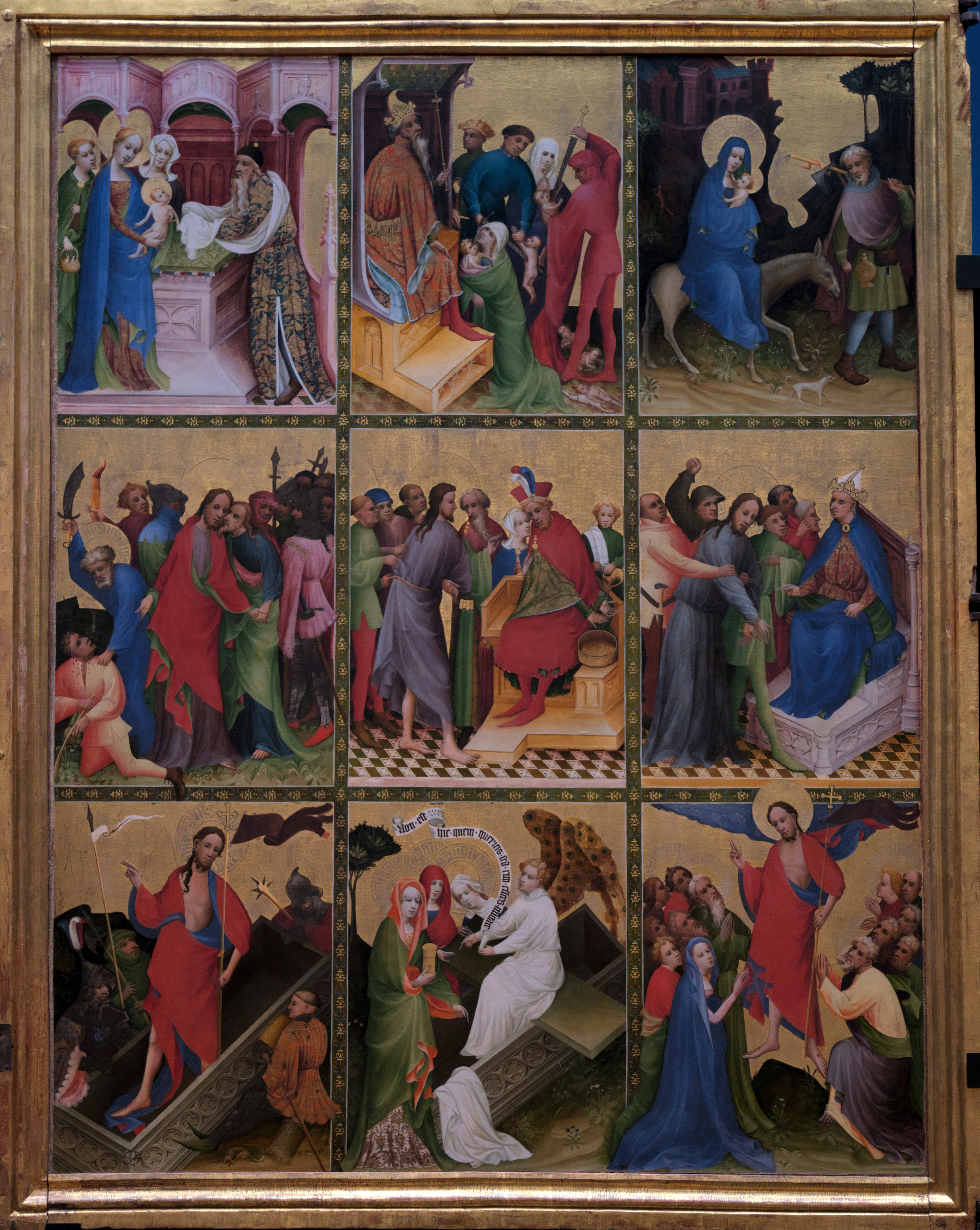
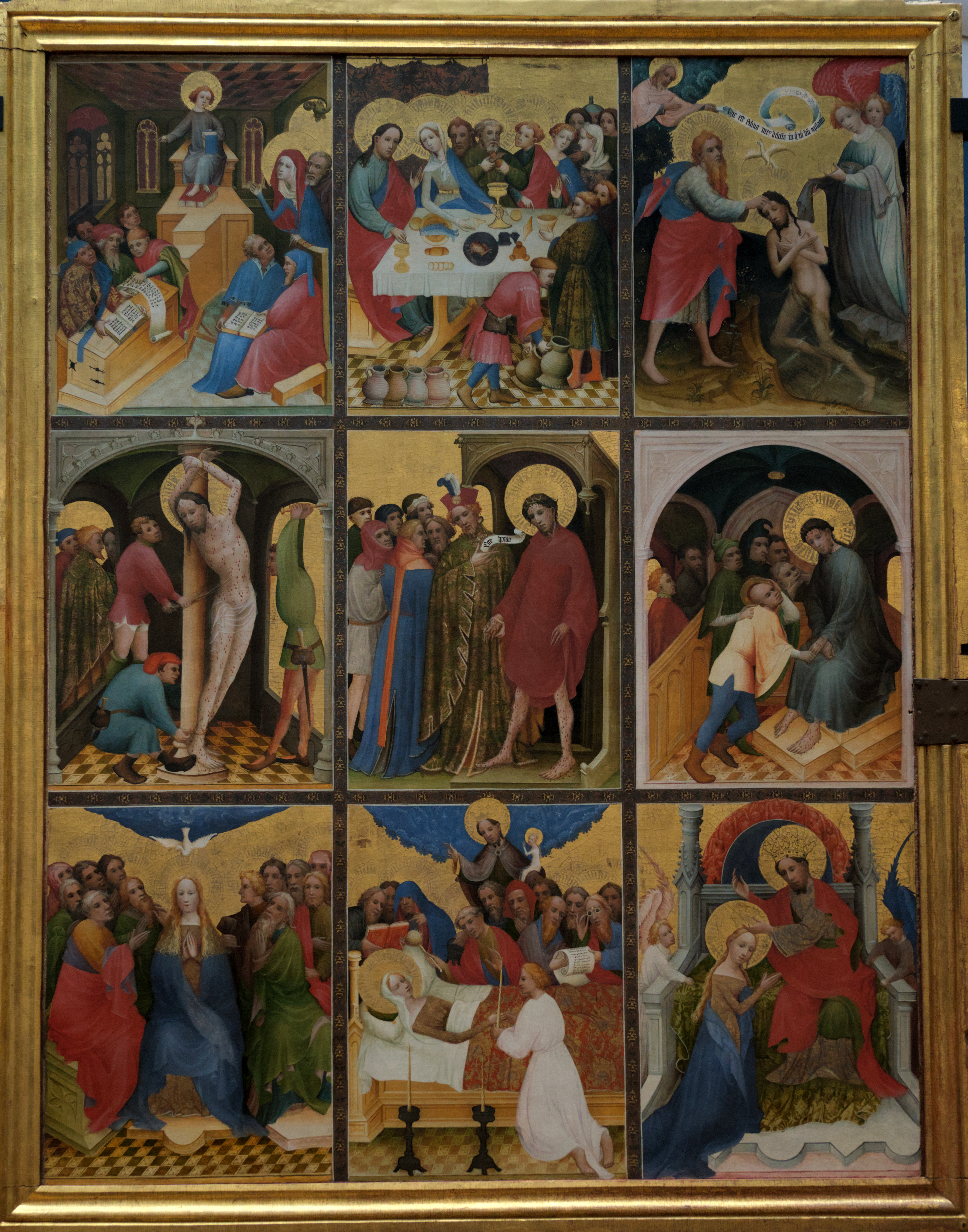
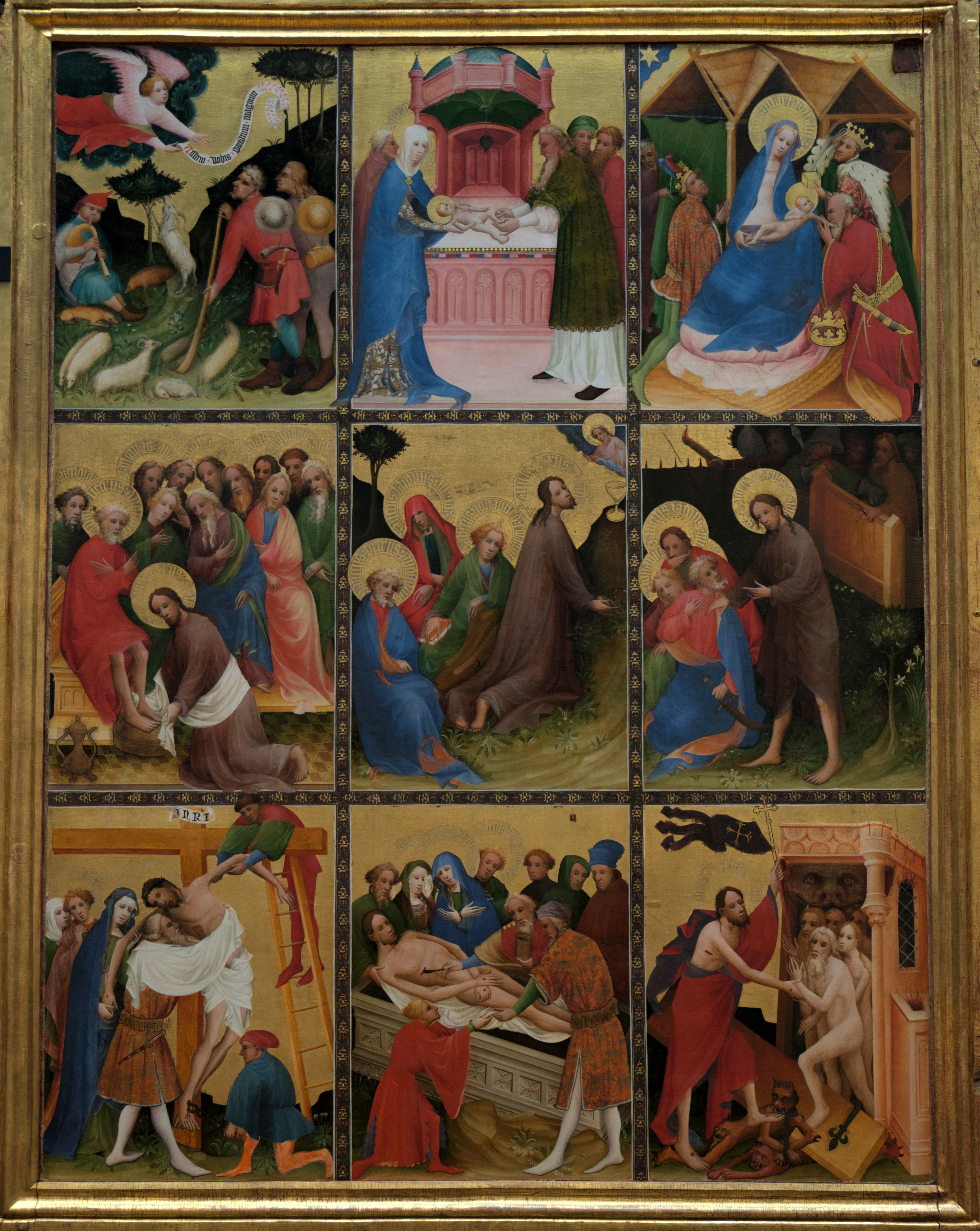
When these two outer panels were opened in their day, they would reveal view 2 of the altarpiece (pictured at top of article), or the first open view, displaying scenes from Jesus’s infancy, passion, and resurrection across four panels.
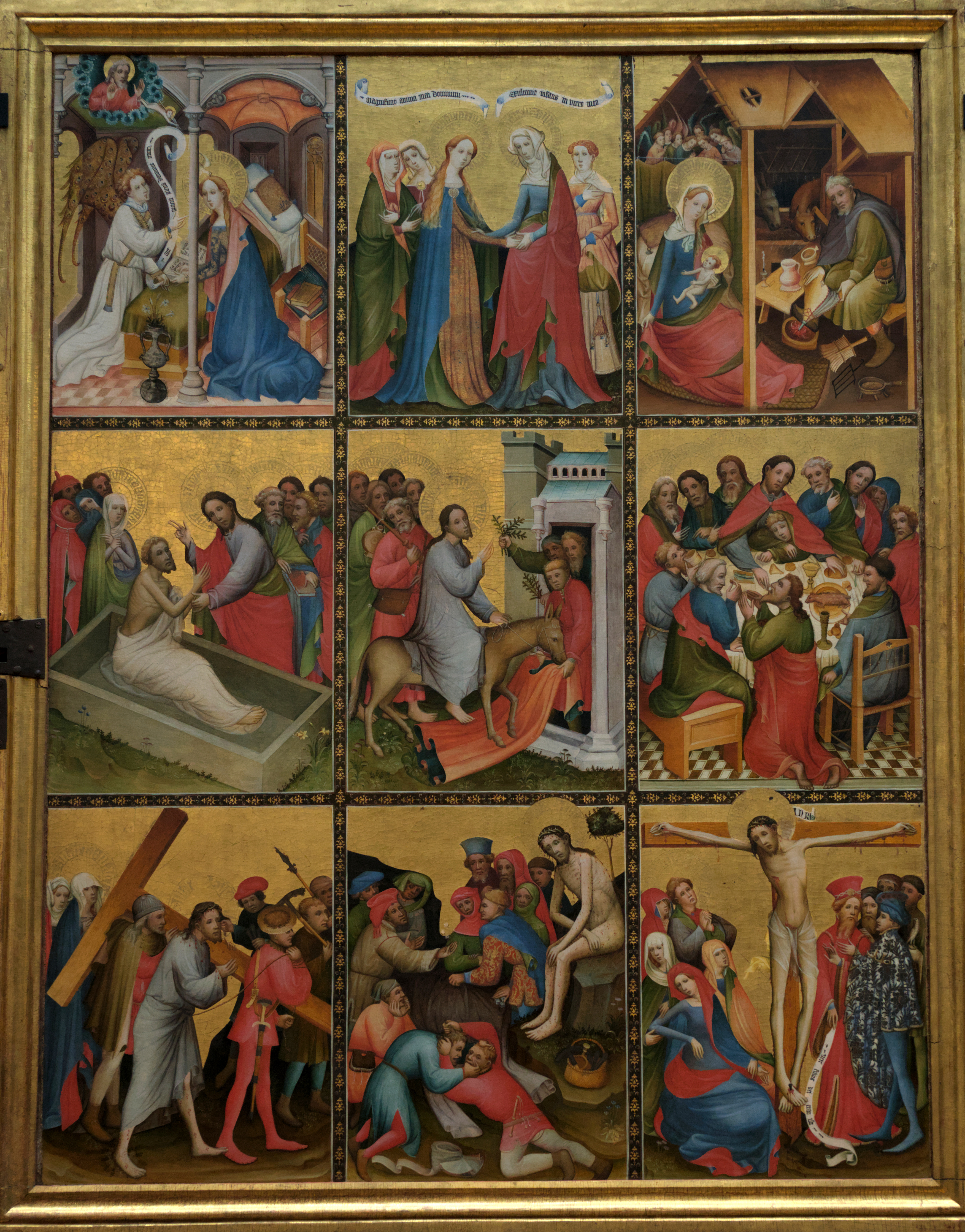
Golden Panel 1
The Annunciation; The Visitation; The Nativity; The Raising of Lazarus; Christ’s Entry into Jerusalem; The Last Supper; Christ Carrying His Cross; Christ in Distress; The Crucifixion

Golden Panel 2
The Annunciation to the Shepherds; The Circumcision of Christ; The Adoration of the Magi; Christ Washing His Disciples’ Feet; The Agony in the Garden (2); The Deposition; The Entombment; The Harrowing of Hell

Golden Panel 3
The Presentation in the Temple; The Massacre of the Innocents; The Flight to Egypt; The Arrest of Christ; Christ before Pilate; Christ before Herod; The Resurrection; The Holy Women at the Tomb; The Ascension

Golden Panel 4
Christ among the Doctors in the Temple; The Wedding at Cana; The Baptism of Christ; The Flagellation of Christ; Ecce Homo; The Mocking of Christ; The Descent of the Holy Spirit; The Death of the Virgin; The Coronation of the Virgin

I’ll share a few of my favorite scenes.
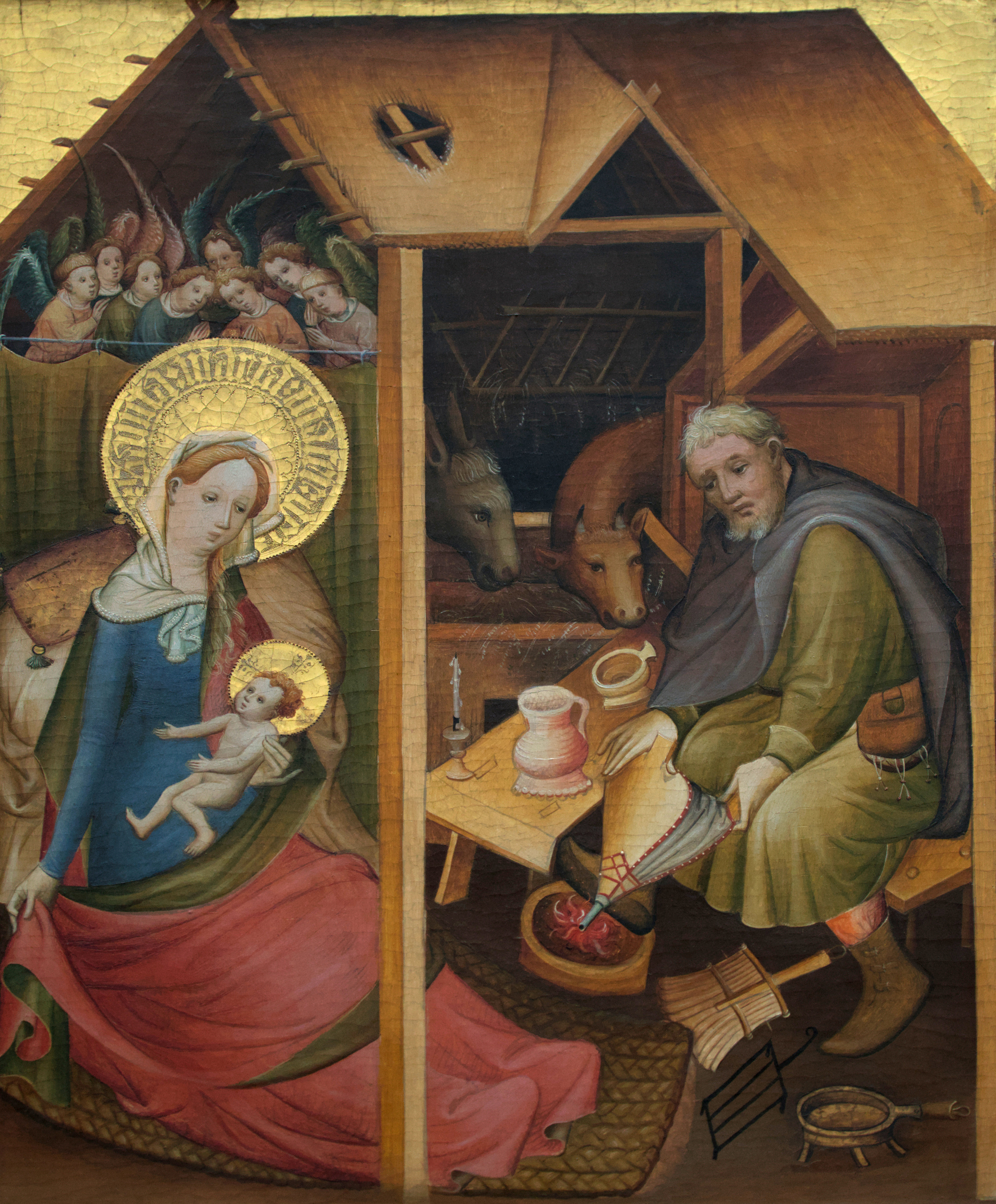
Nativity (Golden Panel)

The Nativity features what I call the industrious Joseph motif [previously], as rather than sitting off to the side with his head in his hands, as he’s commonly shown, Jesus’s dad is hard at work trying to make his family comfortable. He pumps a bellows to supply air to the small fire he has going, either to warm his wife and child or, as he does in a handful of other medieval German Nativities, to cook a simple meal. Mary reclines with the infant Christ on a woven straw mattress while angels peek in from over a curtain to adore him.
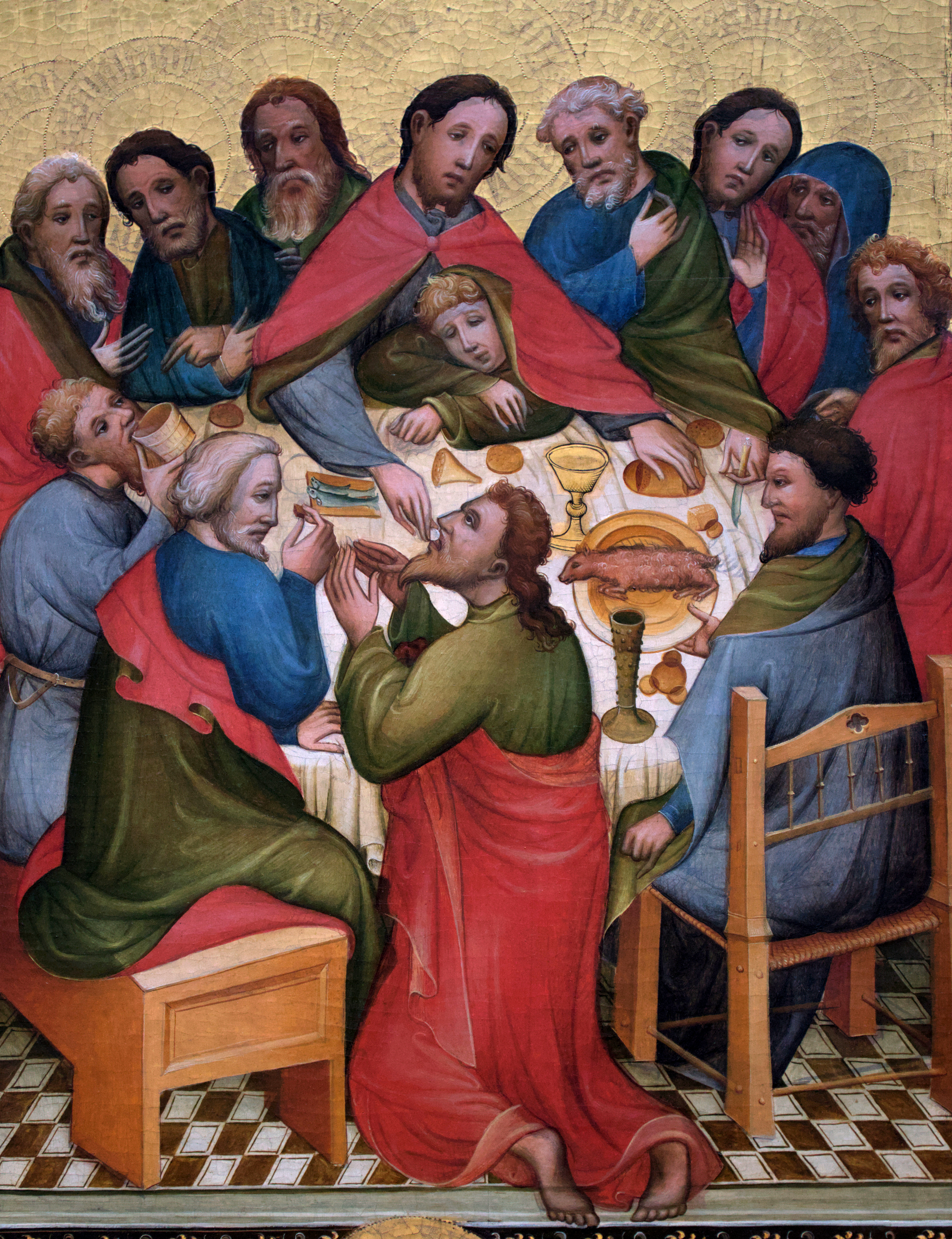
Last Supper (Golden Panel)

The Last Supper I found especially charming because of how the apostle John shelters under Jesus’s cloak, relaxed, secure. The image of John resting on Jesus’s breast rose to popularity in fourteenth-century Germany, a commemoration of the two’s bosom friendship and a call to, like John, abide in Christ. It’s based on the description in John 13:23, which says that at Jesus’s last meal, at Passover time, “one of his disciples—the one whom Jesus loved—was reclining close to his heart.” This verse alludes to the typical eating posture assumed at ancient Greco-Roman banquets, at which men reclined with their heads near a low table and their feet pointing away from it. But in Christian interpretation it has come to signify, more than simply a seating arrangement, the proximity of John to the heart of Christ.

In the Golden Panel’s Last Supper, Jesus enfolds John much like a mother hen would her chick (cf. Matt. 23:37; Luke 13:34), his garment like a wing. Even in this moment before his greatest trial, when most would be inclined to turn inward, Jesus shows concern for those he loves—he covers, protects. And nourishes. He stretches his hand across the table, laid with dishes of lamb and fish, to feed Judas a morsel of bread that resembles a eucharistic wafer. He sups with the man he knows will betray him. He does not turn him away.
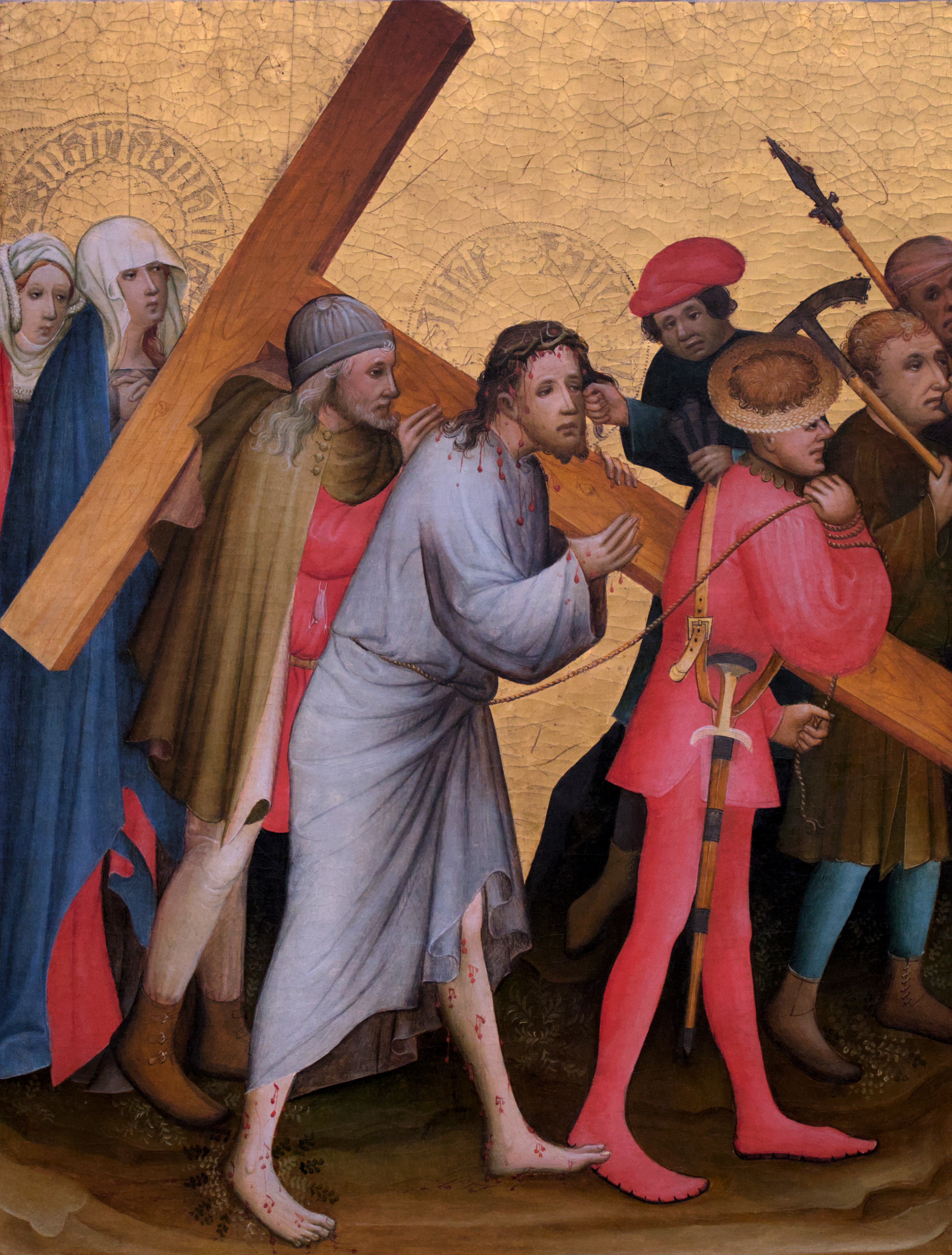
Christ Carries His Cross (Golden Panel)

Further along in the narrative, the scene of Christ carrying his cross with the help of Simon of Cyrene stands out to me because of the man pulling Jesus’s hair as he walks. The cruel mocking and assault continue outside the courtroom and en route to Golgotha.

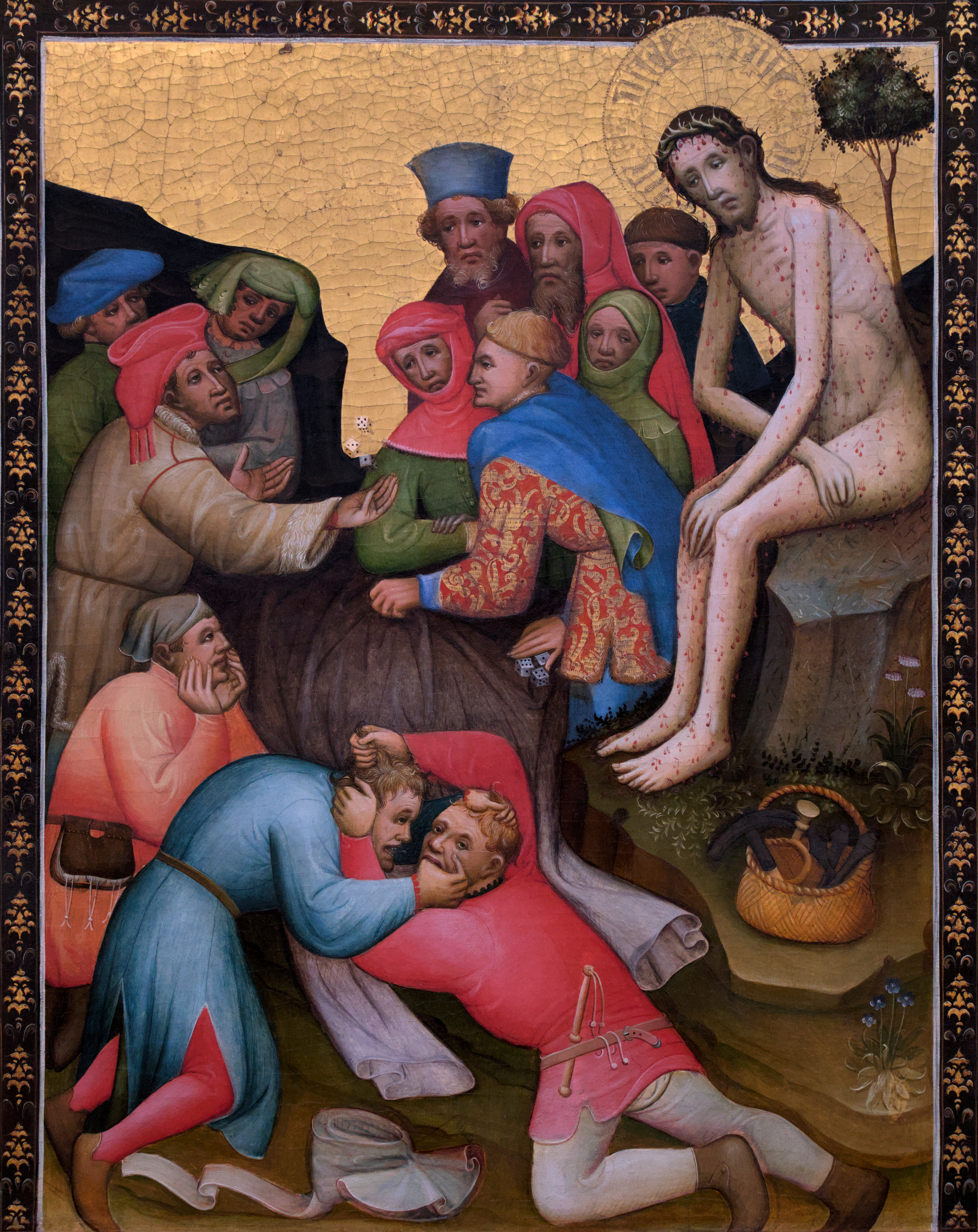
Christ in Distress (Golden Panel)

Called Christus im Elend (Christ in Distress) or Christus in der Rast (Christ at Rest), the subject depicted in the bottom center of the far left panel first started appearing in northern Germany in the second half of the fourteenth century. It shows Jesus sitting pensively, usually on a stone, waiting for his cross to be raised.

In the Golden Panel, Jesus, naked, bleeds all over while the soldiers roll dice and fight over who will get to keep his seamless tunic. The two men in the foreground, one with a flagrum tucked in his belt, tumble and tear at each other, pulling and biting, exemplifying the human penchant for violence that will culminate in the killing of God’s Son. (The basket of hammer and nails that has been procured for the task sits temporarily off to the side.) Combative and puerile, this is the humanity Christ has come to save.
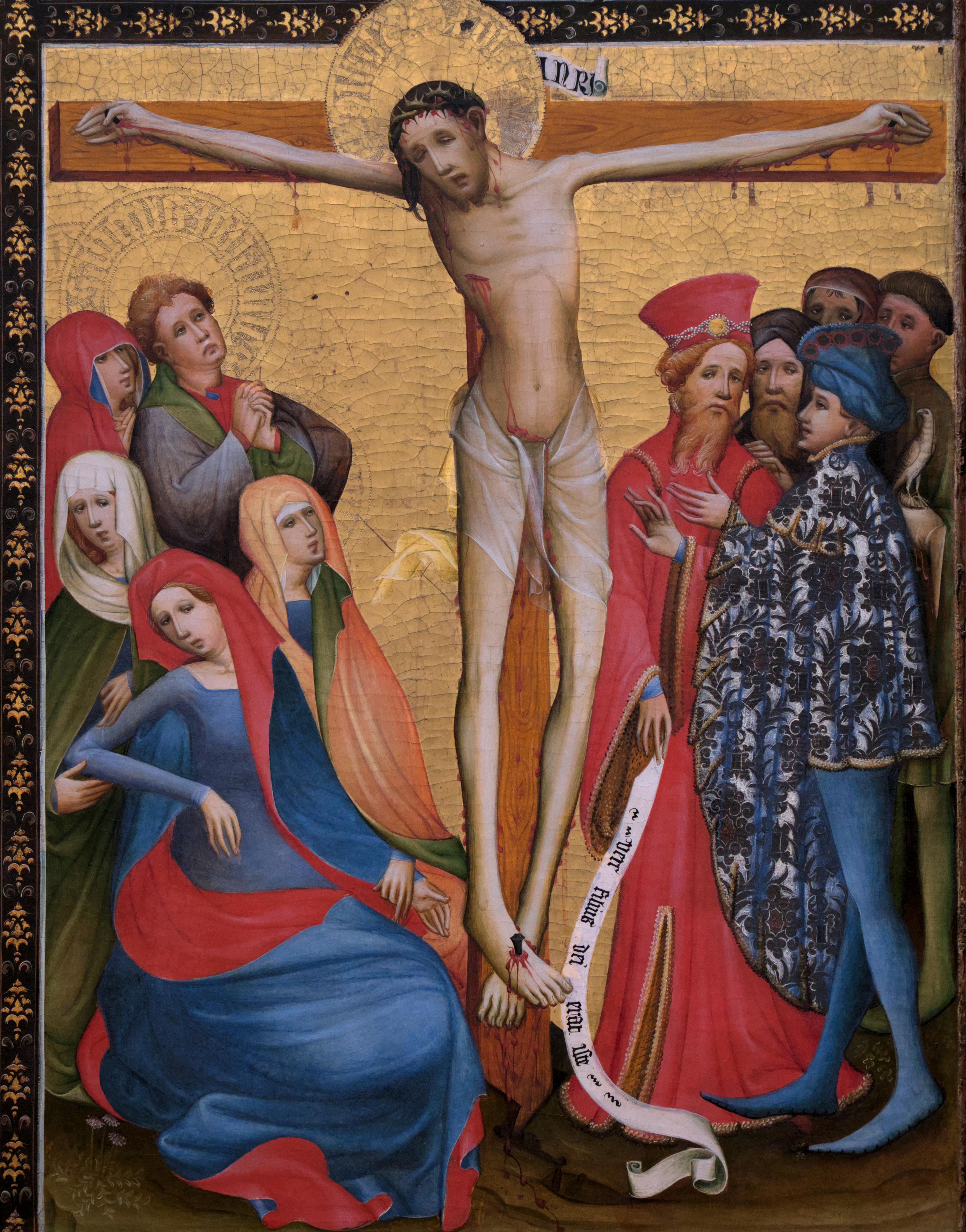
Crucifixion (Golden Panel)

The interior Crucifixion painting is fairly standard, but oh, isn’t it lovely? One notable feature is how Christ’s blood flows from his side, his final wound, down to his groin, where he received, at eight days old, his first wound, the cutting off of his foreskin in a ritual circumcision. Scholars such as Leo Steinberg have remarked how this diversion of the blood’s natural path (which would be to the right thigh) was an intentional device some painters used to connect these two sheddings of blood, and thus the incarnation and the atonement.
Entombment (Golden Panel)

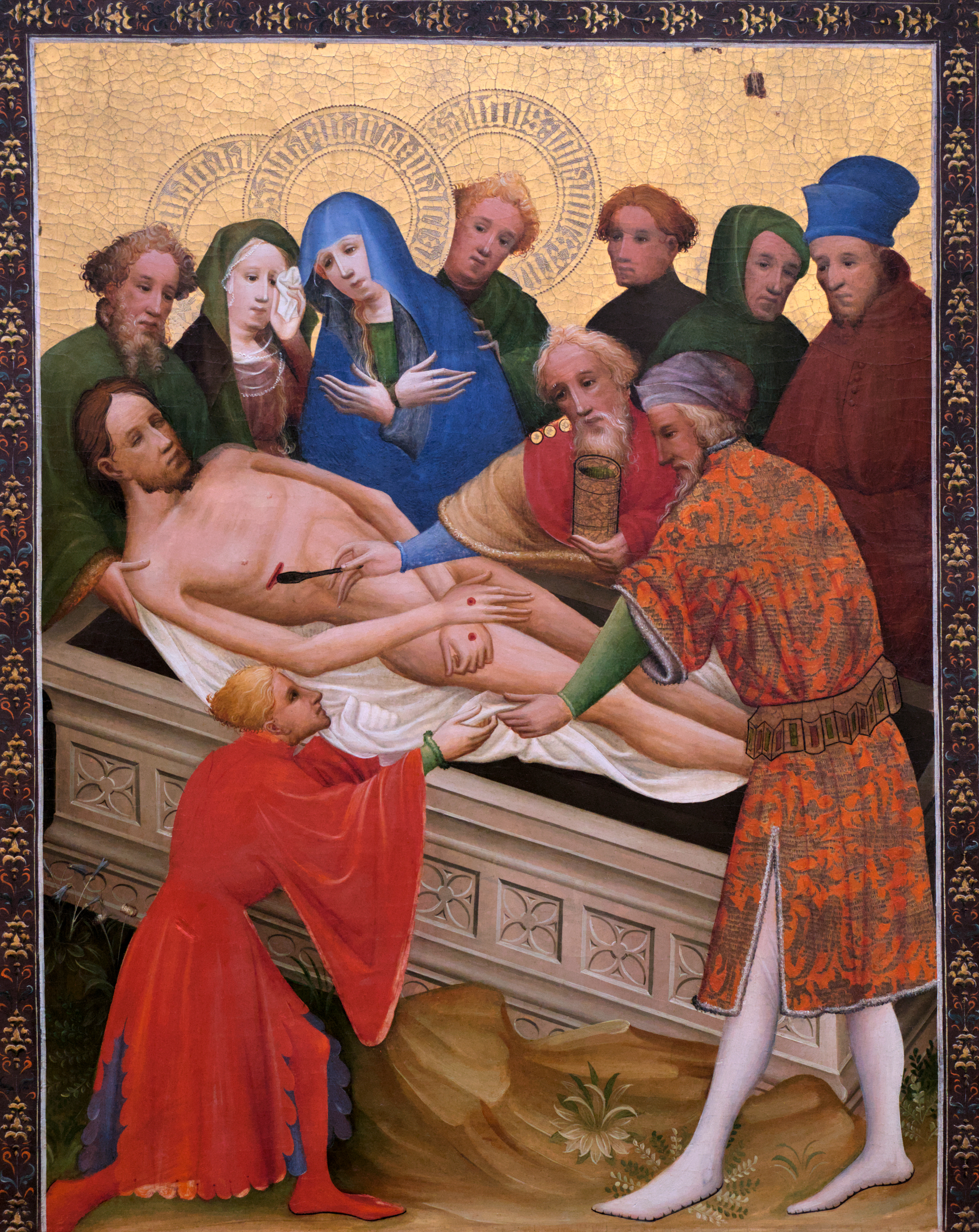
Moving two pictures down the line, the Entombment scene caught my eye because of the tender care shown to the dead Christ before he’s laid to rest. Nicodemus anoints Christ’s wounds with myrrh and aloes, applying them with a spatula, while Joseph of Arimathea, who has donated his tomb, prepares to enshroud the body.
Holy Women at the Tomb (Golden Panel)

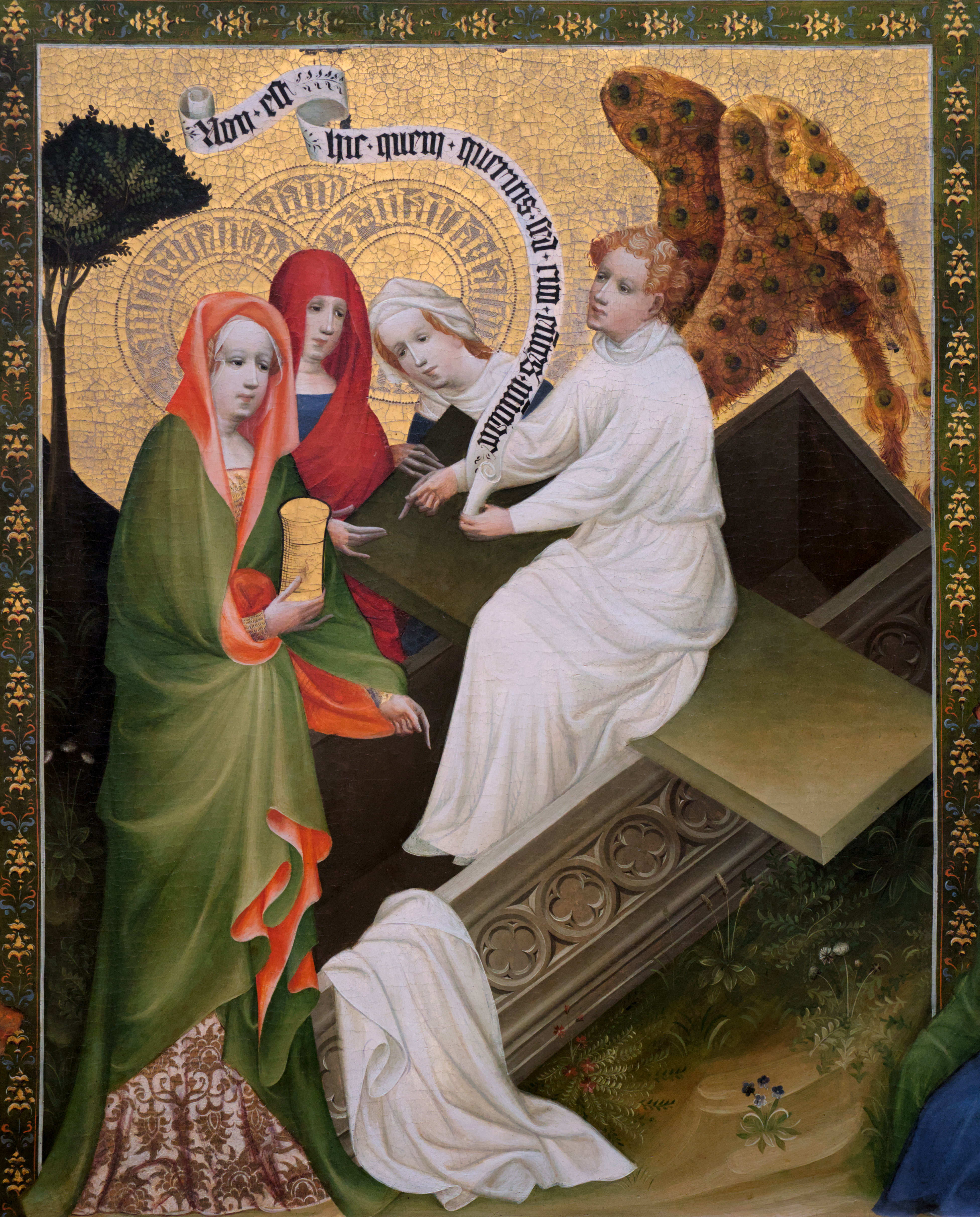
In a quintessential Easter scene, three faithful women come to the burial site after the Sabbath to complete the anointing ritual, only to find a finely feathered angel perched atop the skewed lid of Christ’s now-empty sarcophagus. Mary Magdalene, holding a golden jar, points into the vacant space as if to ask, “Where’s my Lord?” To which the angel responds that he is risen!

View 3 (Partial): Sculptures of the Saints

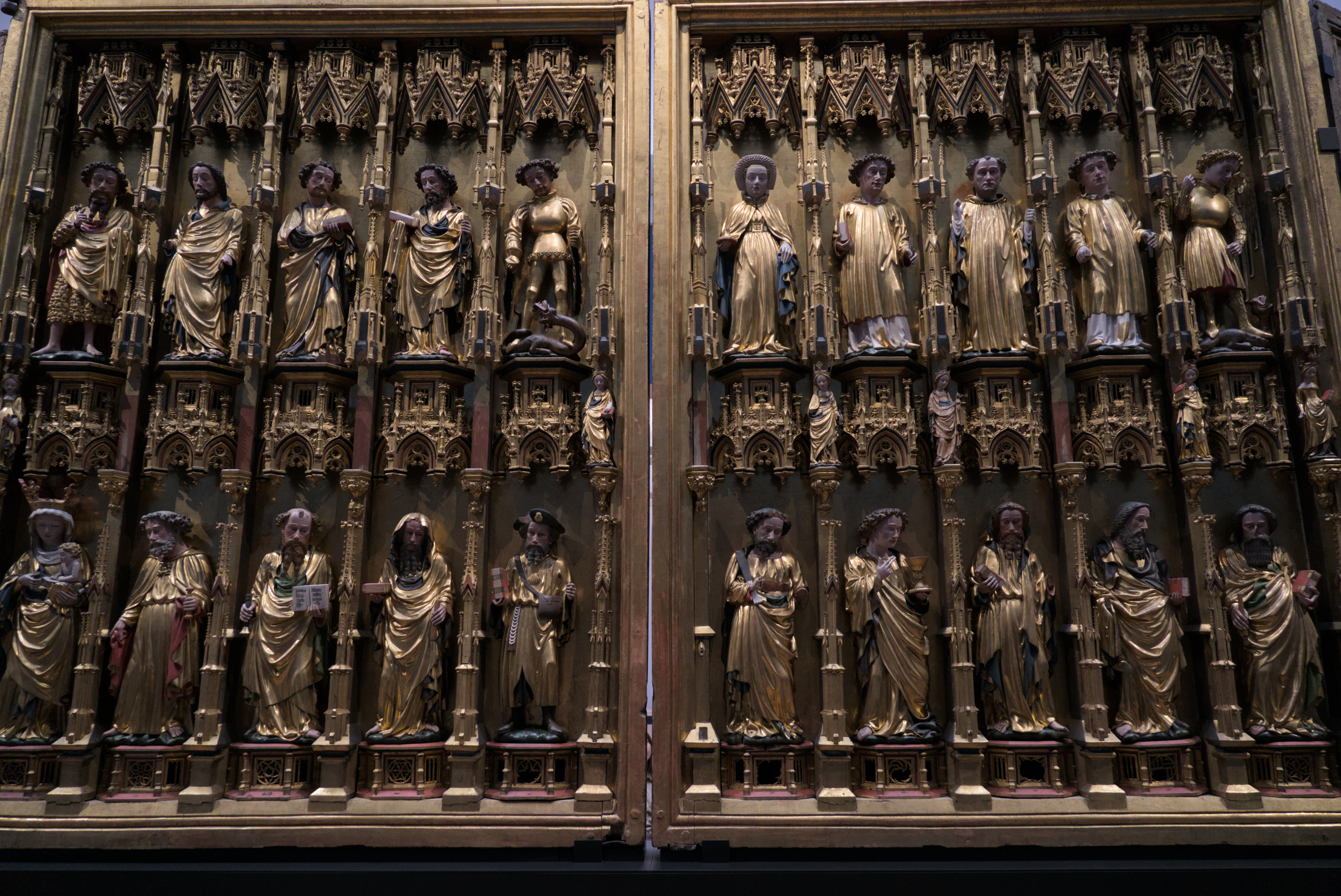
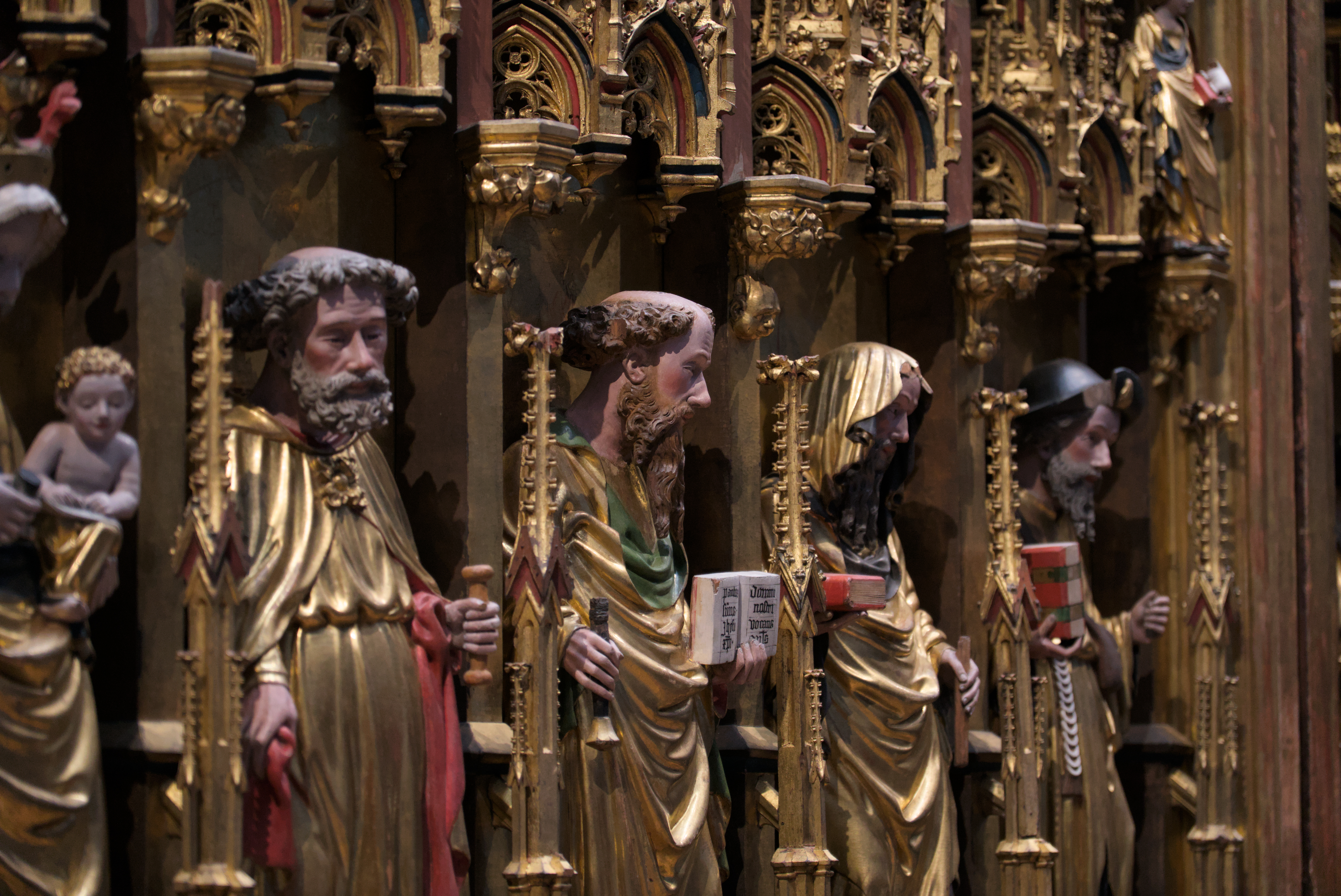
View 3 of the Golden Panel altarpiece—the fully open view, saved for important feast days—cannot be replicated because the shrine that formed the corpus is lost. But flanking the shrine would have been two wings that have survived largely intact, displaying polychrome wood sculptures of twenty (mostly male) saints and, in the intermediate row, smaller statuettes of six female saints (the other six are missing).
Golden Panel sculptures

The identities of the main figures are listed below. The ones I couldn’t confirm but for which I proffer my best guess are followed by a question mark.

  • Top left: John the Baptist, Thomas(?), Matthew, Simon(?), George
  • Top right: Mary Magdalene, Lawrence (deacon), Benedict, Cyriacus (deacon), Michael
  • Bottom left: Madonna and Child, Peter, Paul, James the Lesser(?), James the Greater
  • Bottom right: Bartholomew, John the Evangelist, Jude (Thaddeus)(?), Andrew, Philip
Madonna and Child sculpture

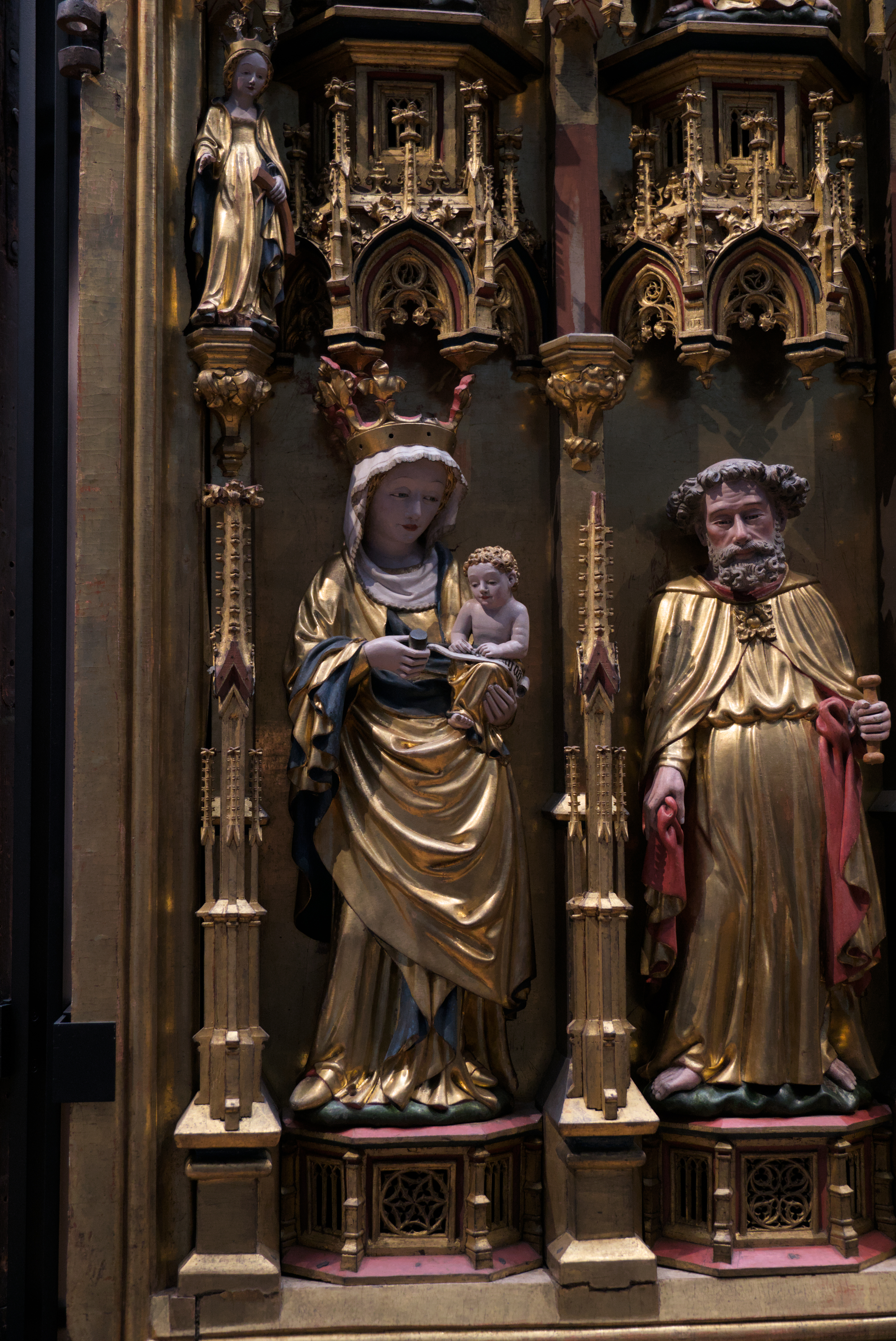
In the sculpture of the Madonna and Child, Mary holds an inkwell that Jesus dips his pen into as he writes on a scroll. How delightful! It’s a rare iconography but one that’s shared by the Tintenfassmadonna in Hildesheim Cathedral, sculpted around the same time.

The figure to the right of Mary is Peter. He holds a handle with a dowel hole on the underside; originally, a set of keys was attached to it and hung down.

The diminutive figure above Mary is Catherine of Alexandria, identifiable by the fragmented wheel she holds, a symbol of her martyrdom.
Saints' sculptures (detail)

To learn more about the Golden Panel, see the book Die Goldene Tafel aus Lüneburg, edited by Antje-Fee Köllermann and Christine Unsinn (Michael Imhof, 2021), from the Niederdeutschen Beiträge zur Kunstgeschichte (Low German Contributions to Art History) series. Only three of its twenty-five chapters are in English; the rest is in German. It’s highly technical, the product of an interdisciplinary research project carried out from 2012 to 2016. There’s not much in it about the actual content of the images. But it provides ample color illustrations, which I always appreciate, as well as stylistic comparisons, historical inventories, and more.
Christmas, Day 10: Love

LOOK: The Life of Christ by Keith Haring

Haring, Keith_The Life of Christ
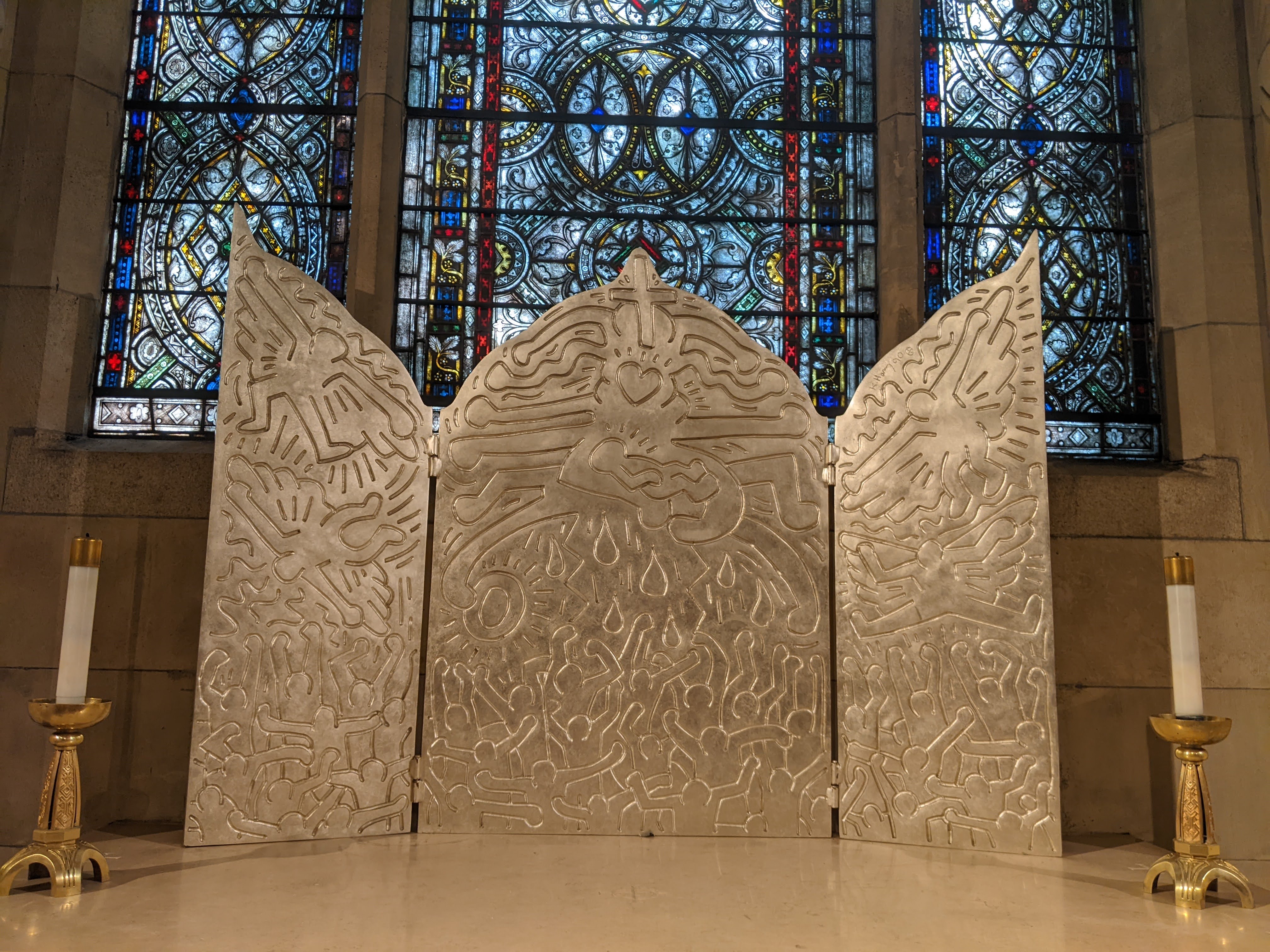
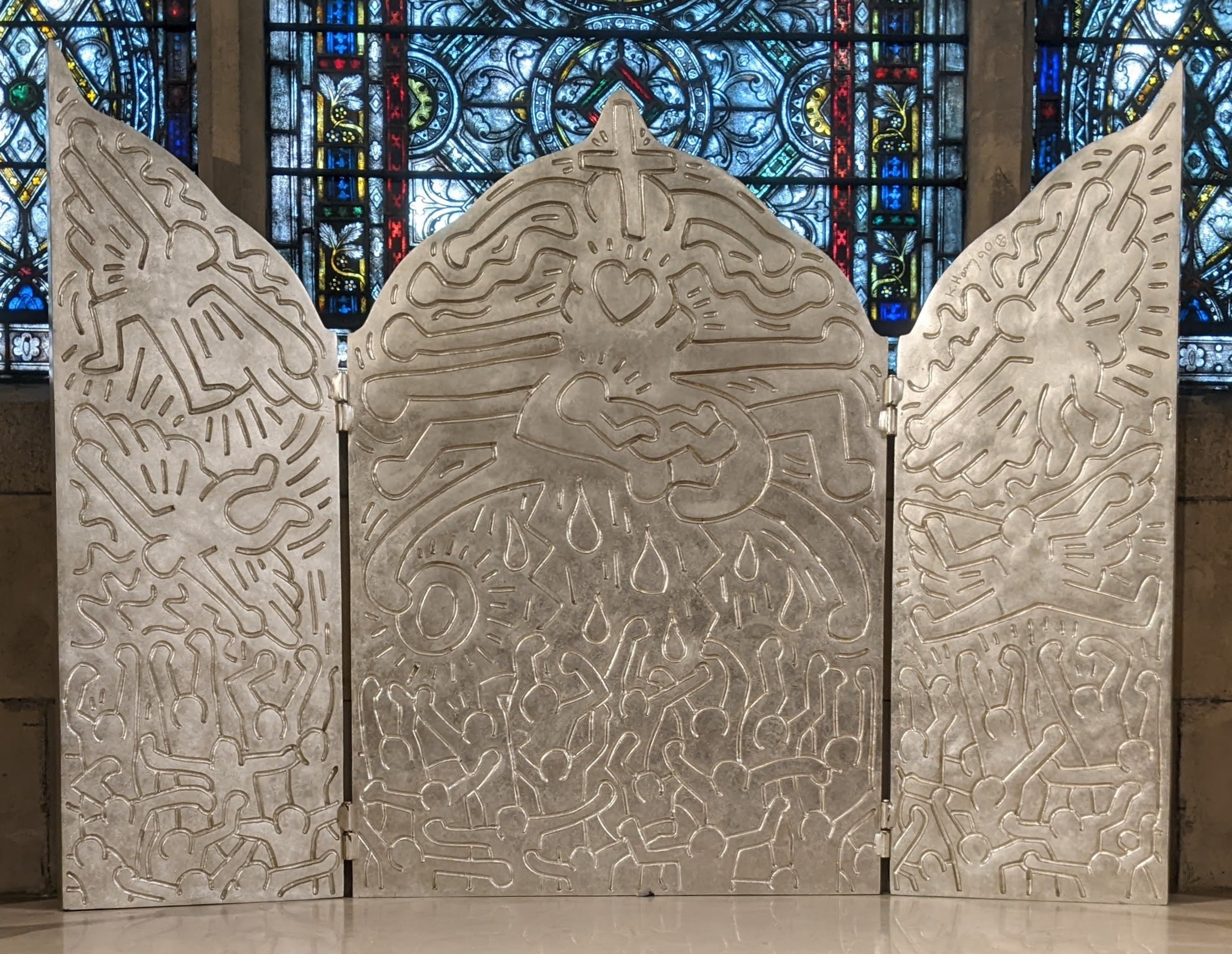
Keith Haring (American, 1958–1990), The Life of Christ, 1990. Bronze altarpiece with white gold leaf patina, 81 × 60 × 2 in. Edition of 9. Chapel of St. Columba, Cathedral of St. John the Divine, New York. All photos by Victoria Emily Jones.

Keith Haring [previously] was a popular artist and activist on the New York scene during the 1980s. Inspired by graffiti art, he started his career by filling empty poster spaces with chalk drawings in the city’s subway stations. He wanted to make art accessible to everyone and believed that it “should be something that liberates the soul, provokes the imagination, and encourages people to go further.”

His style is characterized by bold black outlines, vibrant colors, a sense of rhythm, and simple iconic figures like the Barking Dog and Radiant Baby, which recur again and again in his oeuvre.

Sadly, Haring’s career was cut short by AIDS, which he died of on February 16, 1990, at age thirty-one. The last work he completed, just weeks before his death, was a Life of Christ altarpiece, a work that conveys eternal love and loss, divine suffering and hope. Without any preliminary sketches, he cut the design into clay using a loop knife. It was posthumously cast in bronze and covered in a white gold patina, an edition of nine.

The first edition is housed in the Cathedral of St. John the Divine in New York, the world’s fourth-largest church by area, where Haring’s memorial service was held.

Chapel of St. Columba
Chapel of St. Columba, Cathedral of St. John the Divine, New York, designed by the architectural firm Heins & LaFarge, dedicated 1911. The stained glass windows are by Wilbur Burnham of Boston and Clayton & Bell of London, and the altarpiece, a later addition, is by Keith Haring.

Haring, Keith_The Life of Christ

(Related posts: “Michael Wright on Keith Haring’s ‘Jesus freak’ connection”; Felix Gonzalez-Torres, “Untitled [Portrait of Ross in L.A.]”)

Pulsating, cosmic, and somehow both mournful and joyous, the altarpiece is a triptych, meaning it has three panels. The central panel shows, at the top, a cross, below which is a multiarmed figure holding a baby. The top figure I interpret as God the Father, his arms all-embracing. Below him, at torso level, I discern a second figure (though the head is not clearly defined), who must be Mary, a shining heart over her face. Nestled in her arms is, irrefutably, her infant son Jesus.

Another possible reading is that this is the Trinity—Father, Spirit, and Son—united in an act of self-giving.

The surplus of arms (I count thirteen, plus the baby’s two) reminds me of the Thousand-Armed Avalokiteśvara in Buddhism; a bodhisattva associated with limitless compassion, his arms represent his extending aid, his reaching out to touch, heal, and uplift. One of the arms here stretches down to bestow a halo on humankind, which in Christianity symbolizes the grace/light of God.

Below this primary grouping is a crowd of people who appear to me to be dancing and celebrating, lifting their arms to receive the blessings that flow forth from the holy child. (Or are they clamoring, turning away, resisting? Without facial features and fingers, it’s hard to tell!) Drops of Jesus’s blood fall over all, bringing redemption.  

On the two side panels, angels careen down from the heavens, surfing, leaping, tumbling, one screeching to a halt.

Haring, Keith_The Life of Christ

Haring’s Life of Christ combines, as have many artworks before it, Jesus’s birth and death, collapsing his time on earth, his ministry of salvation, into a single image of incarnation and atonement. Mary holds him as a newborn, but she also holds him as a lifeless adult after his crucifixion—a traditional representation known as the Pietà. Many artists have given Mary a sad twinge in her eye at the nativity, suggesting a premonition of loss.

Haring’s figures are faceless, so we can’t look there for emotional clues, but Mary’s body language suggests both a desire to keep and protect her son, and a willingness to give him up for the greater good.

I wonder whether, when Haring incised the sacred blood drops, he was not only thinking of the “power in the blood” that Christians sing about in reference to Jesus’s redemptive sacrifice—and all the weight that bodily fluid as Christian symbol carries—but also lamenting the HIV infecting his own bloodstream, ravaging his body and stigmatizing him, and that had already killed many of his friends and his partner.

Haring’s friend Sam Havadtoy, who was present at the altar’s creation, reports that when Haring finished the piece, he stepped back and, gazing at it, said, “Man, this is really heavy.”

I think the prominence of blood must have been at least partly influenced by the destructiveness of the AIDS epidemic and the artist’s meditation on his mortality, perhaps even hope for transcendence through death. And if so, then the Radiant Baby, who, the artist’s title would lead us to assume, is Jesus, could also double as the soul of an AIDS victim being taken back up to God.

While I hesitate to ascribe prayers or intentions to others that they have not clearly voiced, I can’t help but think that this last artwork of Haring’s, executed in the final throes of his illness, its subject returning him to the Christianity of his youth, to a story that once captivated him, was in one sense a plea for (physical and spiritual?) cleansing, for deliverance.

LISTEN: “We Sing Glory” by Fred Hammond, on Fred Hammond Christmas . . . : Just Remember (2001)

Little baby boy, sent as God among us
For your plan to free all humanity
We sing glory to your name
Sing glory to your name

Tiny fragile heart
Pumped your blood to save us
For you’ve come to be a sin offering
Singing glory to the Lamb
Sing glory to the Lamb

Singing glory to the one
Who saved the whole world
Born to die but you live again
And take all our sins away

Little hands and feet
Made for nail and hammer
For the pain and grief you suffered for me
I sing glory to the Lamb
Oh, glory to the Lamb

Tiny arms and legs
Broad, strong, and sturdy
You carry the key to our victory
We sing glory to your name

We sing glory to the Child
Who will save the whole world
Born to die and then live again
To take all our sins away

Glory, glory to the one
Who was born to save the whole world
You died but you’ll rise again
So Jesus, we praise your name

Hark the herald angels sing
Glory to the newborn King
Peace on earth and mercy mild
God and sinner reconciled
Thank you, Jesus

Hark the herald angels sing
Glory to the newborn King
Peace on earth and mercy mild
God has come to save us
Yes, he has

Gloria in excelsis Deo
God has come to save us

I Am Covered (Artful Devotion)

Altarpiece by Sieger Koder
Altarpiece (closed) by Sieger Köder (German, 1925–2015), 1970, St. Stephen’s Church, Wasseralfingen, Germany. Photo: Zvonimir Atletić / Alamy Stock Photo (ref. no. 2BAA8HW).

The LORD said to Moses and Aaron in the land of Egypt, “This month shall be for you the beginning of months. It shall be the first month of the year for you. Tell all the congregation of Israel that on the tenth day of this month every man shall take a lamb according to their fathers’ houses, a lamb for a household. And if the household is too small for a lamb, then he and his nearest neighbor shall take according to the number of persons; according to what each can eat you shall make your count for the lamb. Your lamb shall be without blemish, a male a year old. You may take it from the sheep or from the goats, and you shall keep it until the fourteenth day of this month, when the whole assembly of the congregation of Israel shall kill their lambs at twilight.

“Then they shall take some of the blood and put it on the two doorposts and the lintel of the houses in which they eat it. They shall eat the flesh that night, roasted on the fire; with unleavened bread and bitter herbs they shall eat it. Do not eat any of it raw or boiled in water, but roasted, its head with its legs and its inner parts. And you shall let none of it remain until the morning; anything that remains until the morning you shall burn. In this manner you shall eat it: with your belt fastened, your sandals on your feet, and your staff in your hand. And you shall eat it in haste. It is the LORD’s Passover. For I will pass through the land of Egypt that night, and I will strike all the firstborn in the land of Egypt, both man and beast; and on all the gods of Egypt I will execute judgments: I am the LORD. The blood shall be a sign for you, on the houses where you are. And when I see the blood, I will pass over you, and no plague will befall you to destroy you, when I strike the land of Egypt.

“This day shall be for you a memorial day, and you shall keep it as a feast to the LORD; throughout your generations, as a statute forever, you shall keep it as a feast.”

—Exodus 12:1–14

+++

SONG: “Passover Song” by IAMSON (Orlando Palmer), on Bread for the Journey by Urban Doxology (2016) and iAmSon (2017)

Passover is a major Jewish holiday celebrated every spring, marking God’s deliverance of the people of Israel out of Egyptian bondage. Exodus 12 tells the story of how in Egypt God sent death as a means of judgment against oppressors but “passed over” the houses of the faithful who, following God’s instructions, smeared their doorposts with the blood of a lamb.

Christians interpret this event as a prefiguration of the death of Jesus, the lamb of God, whose blood saves from death those who choose to place themselves under it, liberating us from our slavery to sin. Driving home the connection, all four Gospel writers mention that Jesus was killed during the feast of Passover. His blood smeared the wooden posts of the cross.

+++

Father Sieger Köder was born in Wasseralfingen in Swabia in southwestern Germany in 1925. From 1947 to 1951 he attended the State Academy of Fine Arts Stuttgart, where he trained as a silversmith and a painter. While establishing his art practice, he also worked as an art teacher at a secondary school in Aalen for just over a decade. Increasingly he felt a pull into Christian ministry, so from 1965 to 1970 he studied theology in Tübingen, becoming ordained in the Catholic Church a year later. He served as a parish priest in Hohenberg and Rosenberg from 1975 to 1995, combining that vocation with his work as an artist. He continued his art making well into retirement, dying in 2015 at age ninety. His religious paintings can be found all over Germany and in other parts of Europe.

The artwork above is the closed view of the high altarpiece Köder made for the parish church in his hometown, Saint Stephen’s (Sankt Stephanus).

Koder, Sieger_Hospitality of Abraham

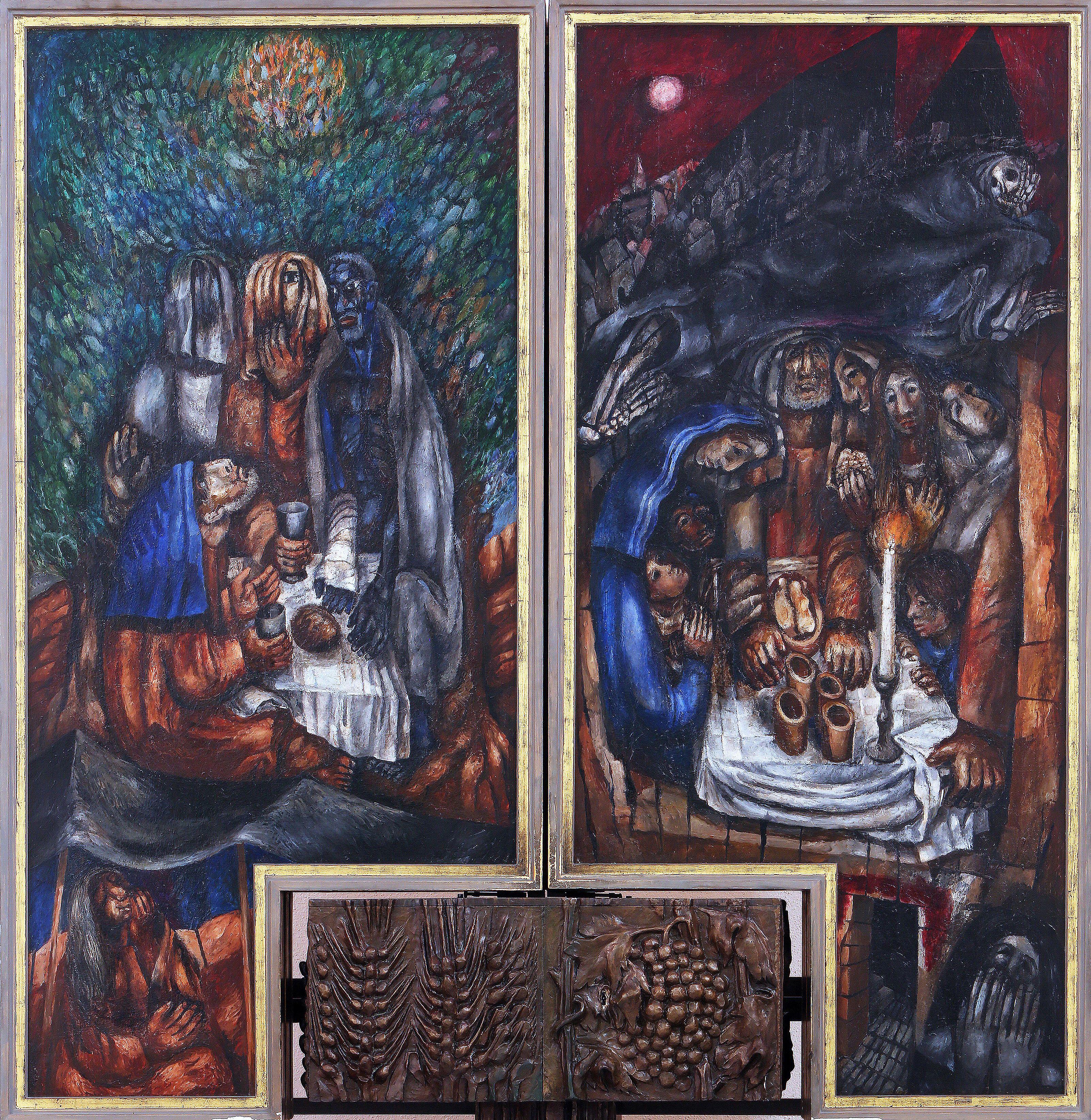
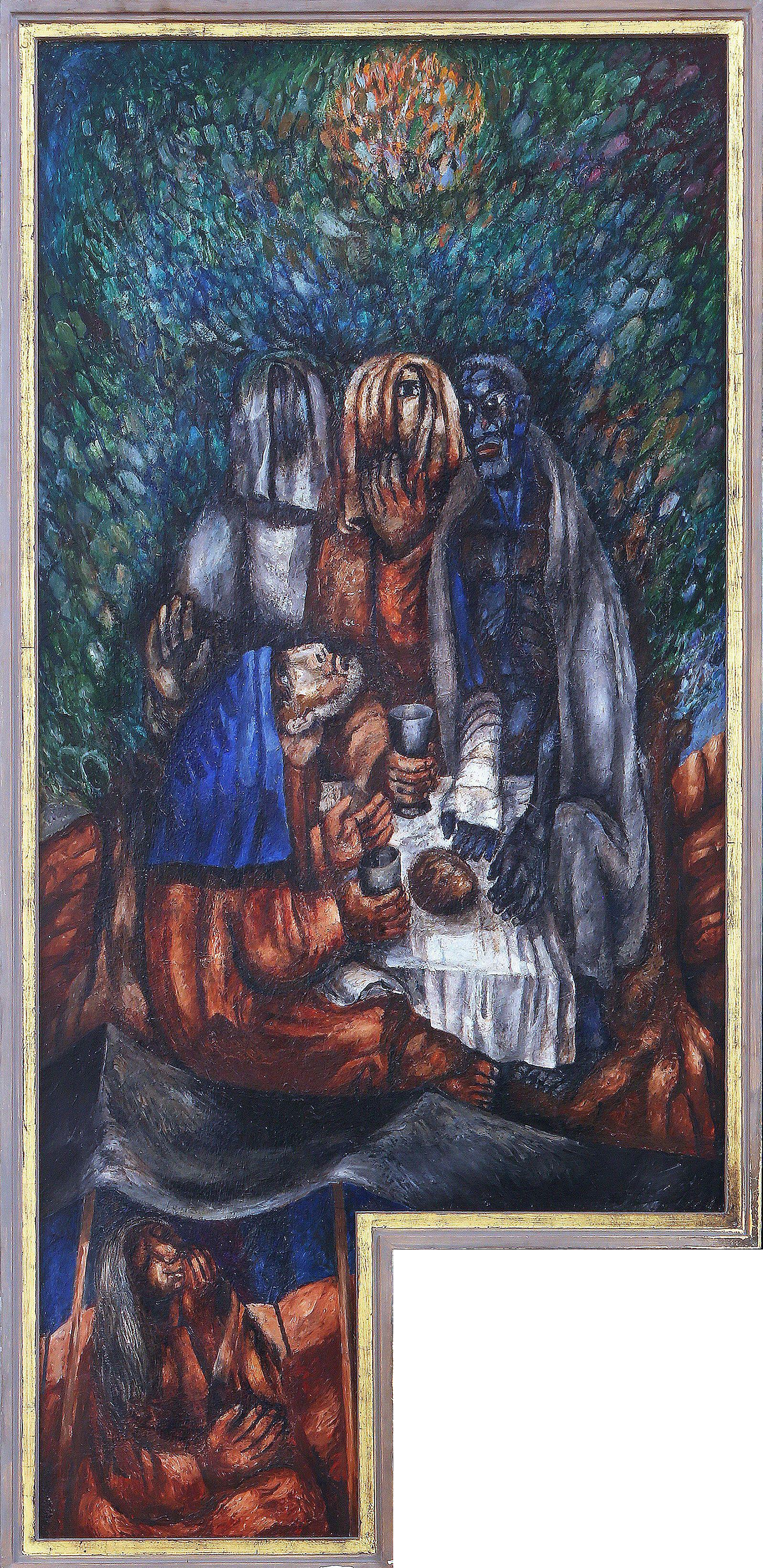
The outer left panel shows the Hospitality of Abraham (Genesis 18:1–21)—that is, Abraham’s entertaining three men who turn out to be a theophany, an appearance of God in a human body (or in this case, three human bodies). I’m guessing that the man on the left, who is veiled, represents God the Father; the man in the middle, who’s holding the cup, is God the Son; and the man on the right, who appears to have a broken arm and to be naked except for a blanket draped over him, is God the Spirit—though he is likely also meant to show how God often comes to us in the guise of the poor, the hungry, the unsheltered (Matthew 25:31–46). Above the heads of this trinity, glowing through the oak leaves, is a fiery orb reminiscent of the burning bush from which God would call Moses a few centuries later. At the bottom of the painting Abraham’s wife Sarah laughs from inside her tent, having eavesdropped on the visitors’ news that she, a nonagenarian, will conceive a child. The lineage of that child, Isaac, would produce Jesus.

Koder, Sieger_Passover

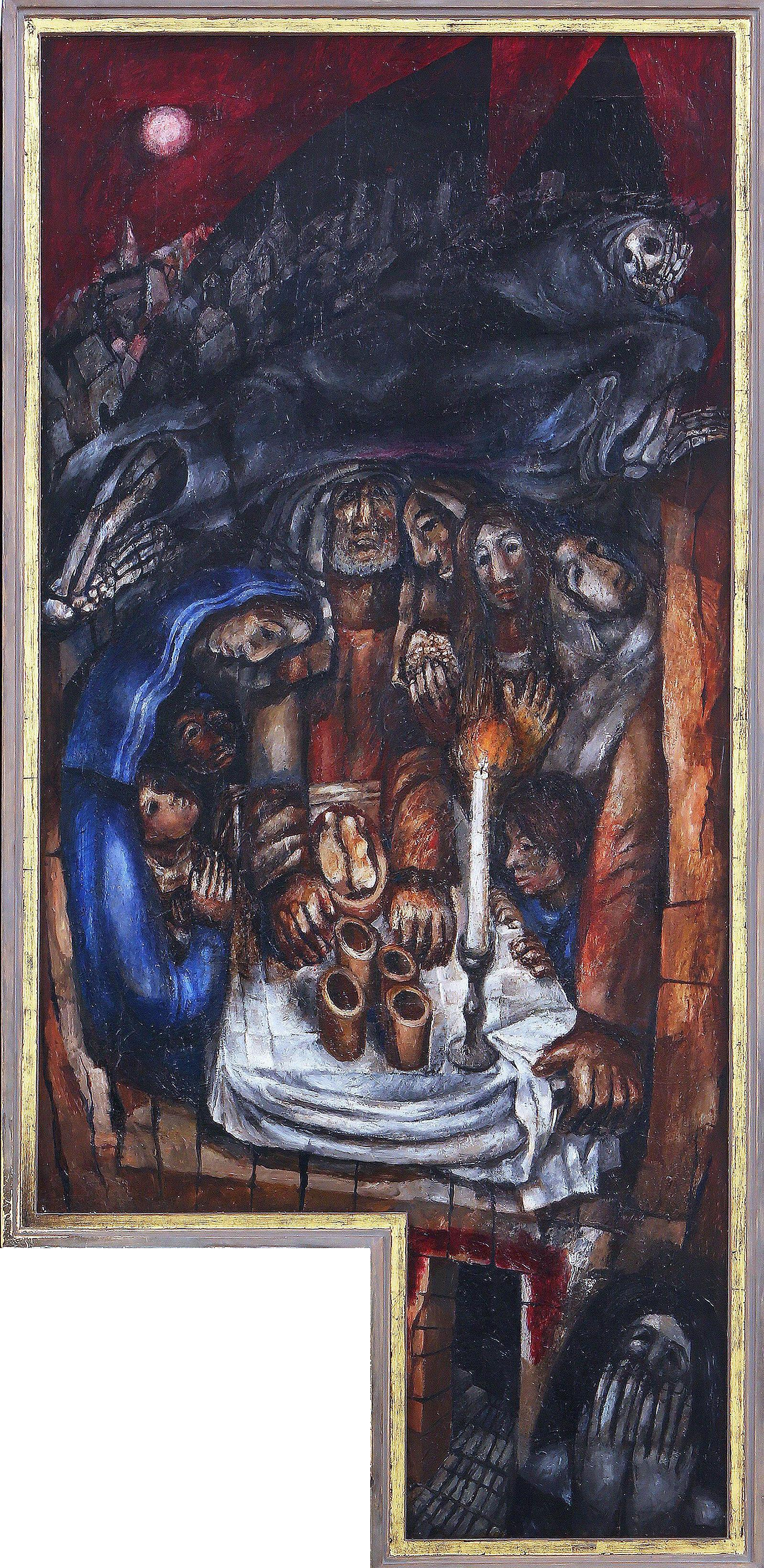
The outer right panel, based on Sunday’s lectionary reading, shows the first Passover. Israelite families huddle around a meal of roast lamb, unleavened bread, and bitter herbs as a cloaked, skeletal presence passes by overhead. One of the adults tries to steady the rattling table with his hand while a mother protects two of her children, hugging them tightly to herself. Though afraid, they are in no danger, as their doorway is covered in the blood of the lamb whose flesh they eat.

Altarpiece by Sieger Koder
Altarpiece by Sieger Köder (German, 1925–2015), 1970, St. Stephen’s Church, Wasseralfingen, Germany. Photo: Zvonimir Atletić / Alamy Stock Photo (ref. no. 2BABBYY).

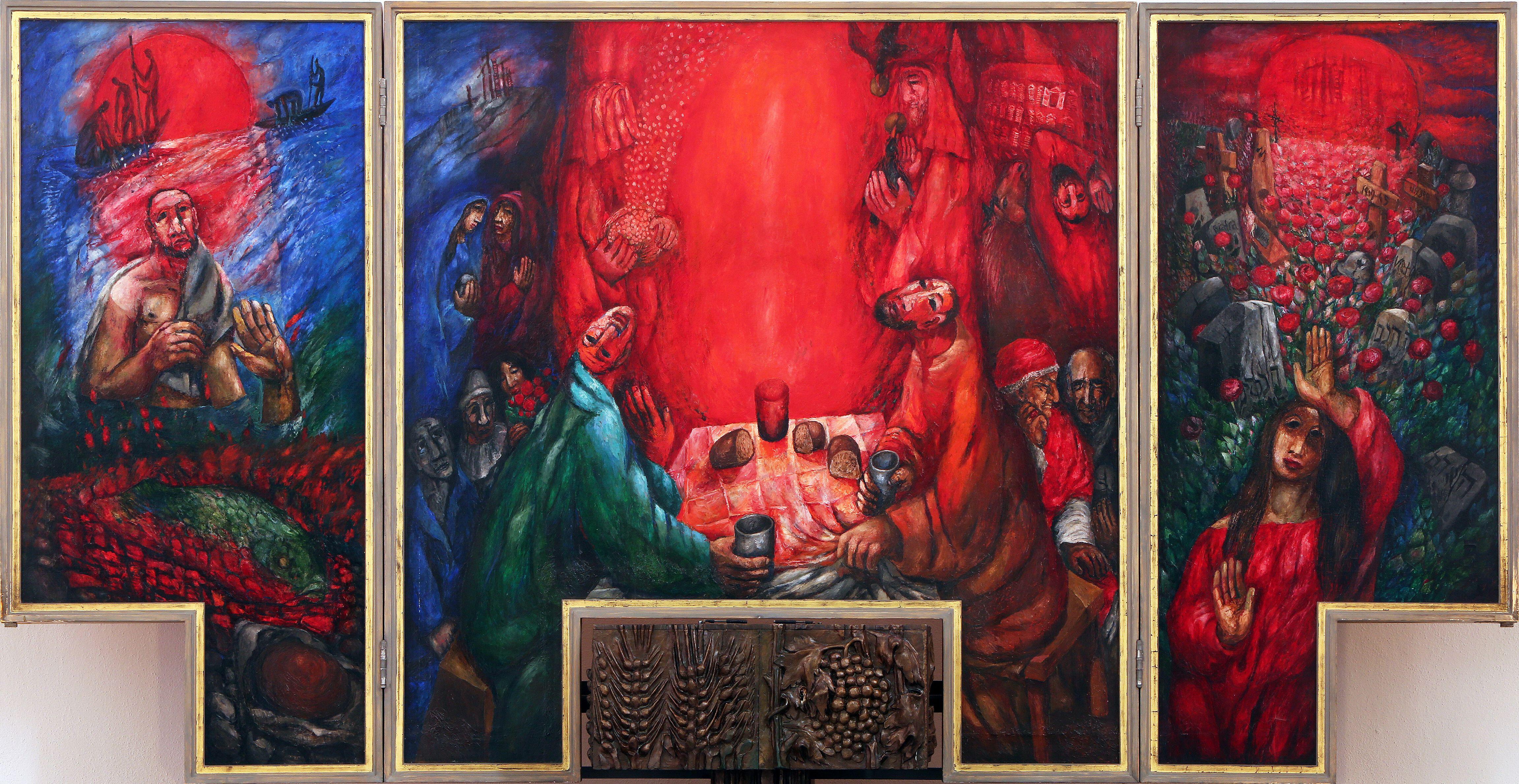
When opened, the triptych reveals three Resurrection-themed panels. The inner left panel shows one of my favorite biblical episodes, which I call “Breakfast on the Shore”: Jesus’s resurrection appearance to Peter at dawn on the Sea of Galilee (John 21). Following Jesus’s instruction in Jerusalem (Matthew 28:7, 10), Peter had returned home with some of the other disciples and, not knowing what to do, took back up his fishing nets. He and six others are on the lake when a man calls out from the shore, “Children, do you have any fish?” They don’t. The man tells them to cast in their nets once more, and when they do, up comes a humongous catch. After which Peter exclaims, “It is the Lord!” Ever the impulsive one, he throws himself into the sea and pushes his way through the water to greet Jesus. They chargrill some of the fish and sit down to eat.

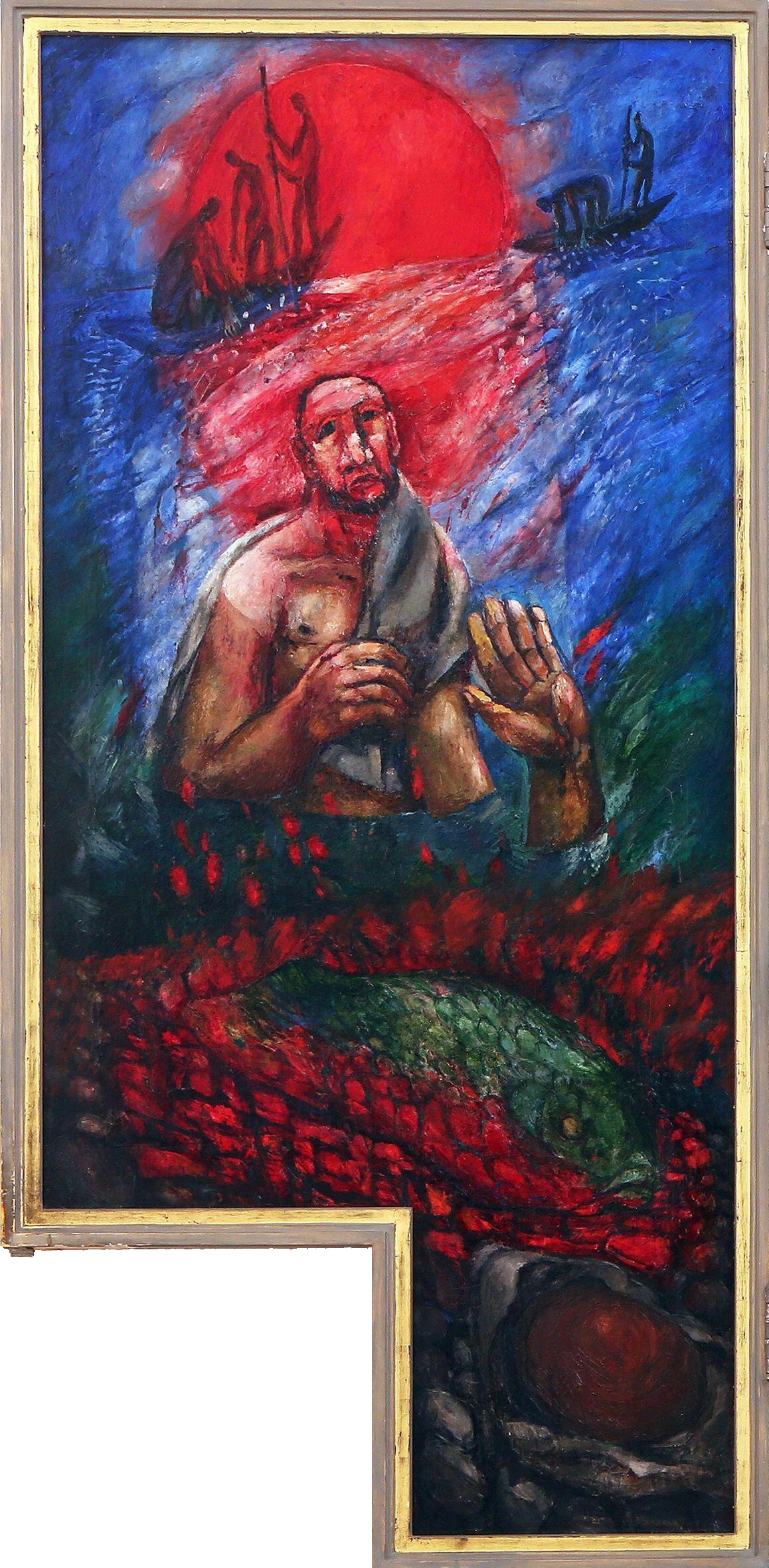
Koder, Sieger_Breakfast on the Shore

The scene is one of reconciliation. Peter had denied he knew Jesus three times the night of Jesus’s arrest, abandoning him in his time of need, and now, after breakfast, Jesus gives Peter three chances to reaffirm his love for him, asking him thrice, “Simon, son of John, do you love me?” The foregrounding of the hot coals in Köder’s painting is perhaps a subtle nod to the recent failure of Peter’s, as earlier in his Gospel John mentions that, in the courtyard of the high priest where Jesus was being tried, Peter warmed himself at a charcoal fire alongside Jesus’s captors (John 18:18). There’s also a hand coming up out of the water that I’m guessing references the earlier episode of Peter’s walking on water and then, when doubt in Jesus’s power set in, sinking, only to be saved by Jesus’s outstretched hand (Matthew 14:22–33). But Jesus forgives Peter’s weaknesses and disloyalty, restoring him to fellowship. He invites Peter to come and feast. The sun at the top indicates that it’s the dawn of a new era.

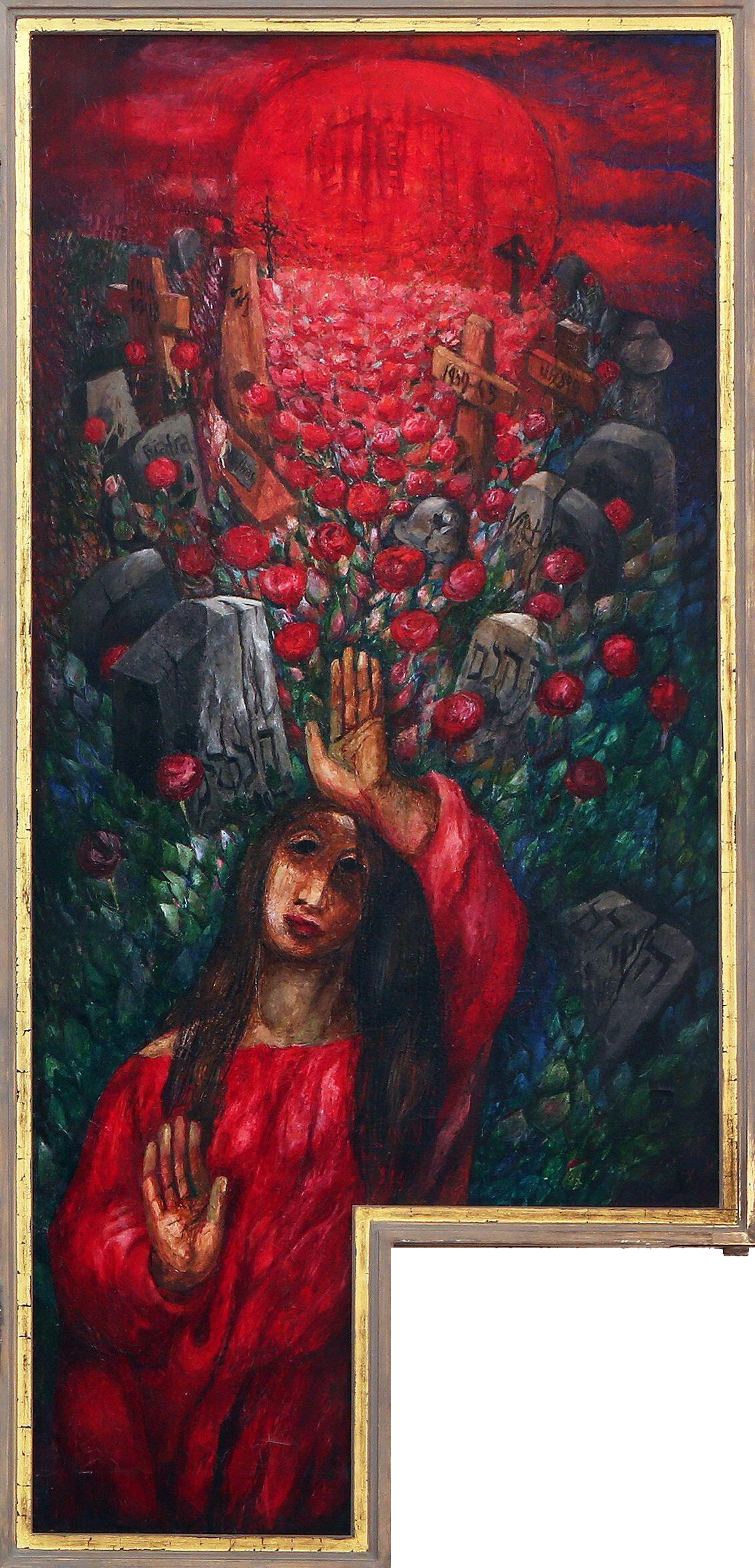
The bright-red morning sun also appears on the inner right panel, which shows another very personal encounter between the risen Christ and a disciple: Mary Magdalene at the empty tomb. In Köder’s visual retelling, Mary wades through a sea of poppies—a red flower symbolic of sacrifice—her hand shielding her eyes from the brilliance of Jesus’s resurrection body. He who she initially thought to be the cemetery gardener is in fact her dear friend and Lord.

Koder, Sieger_Mary Magdalene at the Tomb

Look closely at some of the grave markers, and you’ll notice that they carry the names and/or dates of wars: “1914–1918,” “1939–1945,” “Vietnam,” “Biafra” (a reference to the Nigerian Civil War). The latter two were still raging on when Köder painted this. The artist was actually a prisoner of war during World War II, and underneath the cross representing that war in the painting is a bullet-blasted soldier’s helmet. I take these graves to imply that Jesus’s resurrection put death to death.

I’m not sure what the Hebrew grave inscriptions say—anyone know?

Update, 9/30/21: Dr. Franz Posset, a former student of the artist’s, emailed me today with transcriptions and translations of the Hebrew tombstone inscriptions:

  • האדם – Adam, The Man (lower right corner, next to Mary’s elbow)
  • חוה – Eve, The Woman (in the shadows at the right, behind the “Vietnam” tombstone)
  • החכם – The Wise (to the right of Mary’s raised hand)
  • כסילה – The Fool (to the left of Mary’s raised hand)

Supper at Emmaus by Sieger Koder

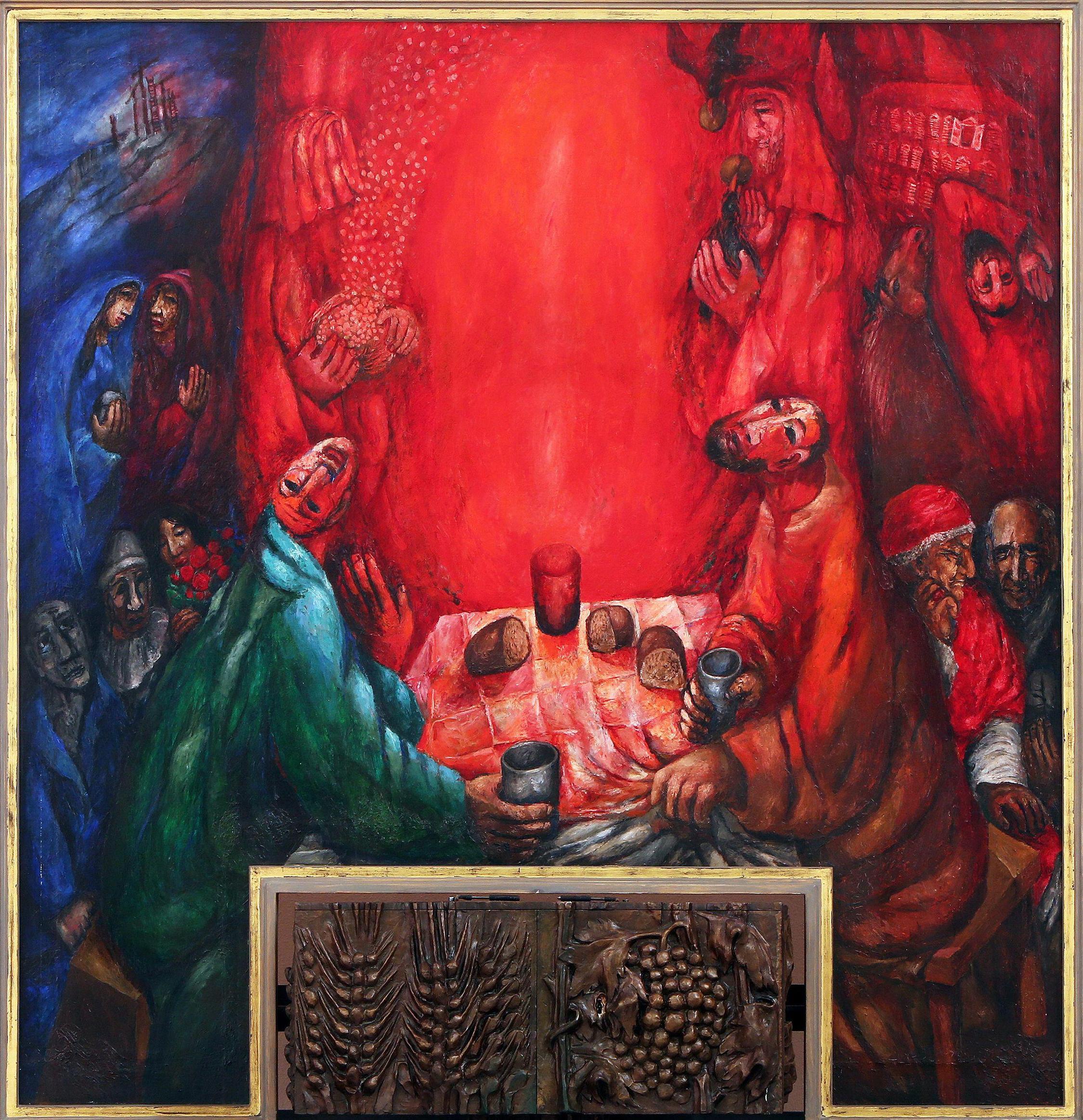
The central panel of the altarpiece portrays the Supper at Emmaus as a sort of Transfiguration à la Mount Tabor, an unveiling of Christ’s glory. Luke tells us that after the resurrection Jesus appeared to Cleopas and another unnamed disciple, who were on their way home from Jerusalem; their hearts “burned within them” as he spoke about the scriptures, but their eyes weren’t opened to his true identity until he blessed and broke the bread at mealtime. In Köder’s painting, Jesus’s form is barely discernible through the red glow—he’s a pillar of light, really. Artists have always struggled to give an impression of what Jesus’s resurrection body might have looked like: it was a flesh-and-bone body, for sure, but a glorified one, not always immediately recognizable, and it seems as though he was able to walk through walls and disappear. Köder bathes him in the color of blood—of his passion, and of life. Köder’s nonrepresentational approach emphasizes the otherness aspect of the newly risen Christ and the marvel the two Emmaus disciples must have felt upon realizing who they were dining with.

Jesus appears between Moses, who holds a basket of manna (Exodus 16), and Elijah, who cradles a raven with a morsel of bread in its beak, a reference to his being fed miraculously by God in the wilderness (1 Kings 17:1–7). The figure to the right of Elijah may be Paul (Saul) fallen off his horse on the road to Damascus.

Koder, Sieger_Wasseralfingen Altarpiece (wide shot)
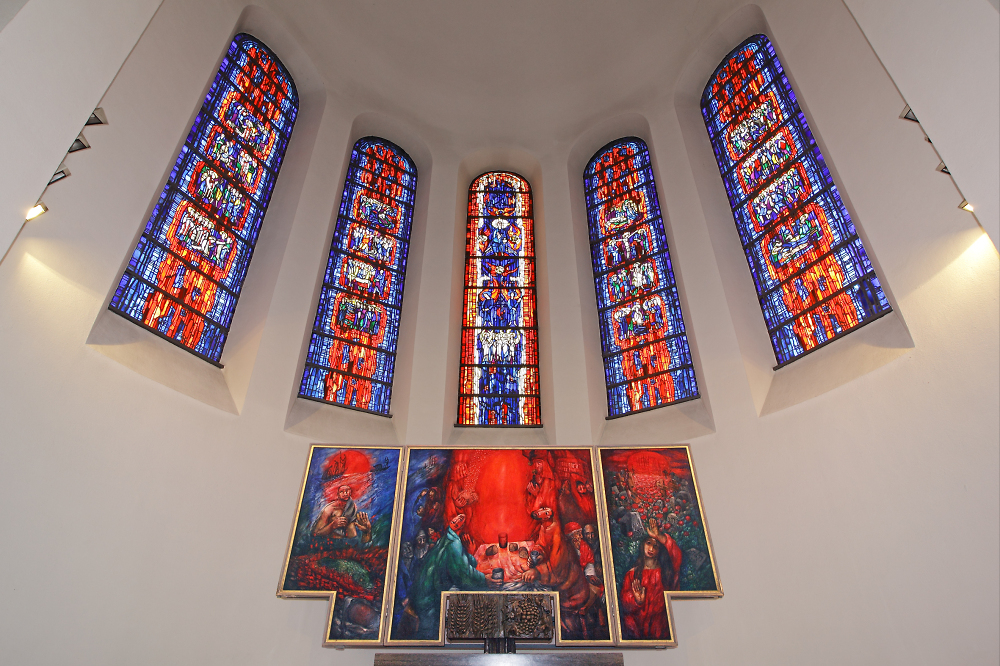
East end of Saint Stephen’s, Wasseralfingen. Altarpiece by Sieger Köder, stained glass windows by Rudolf Haegele. Photo © Stadt Aalen.

At Saint Stephen’s the Eucharist is celebrated regularly before this altarpiece. (The metalwork tabernacle below, decorated with stalks of grain and clusters of grapes, is where the eucharistic elements are stored.) Köder reminds partakers that they are covered (pardoned) by Jesus’s blood, that Christ is present in the meal, that he nourishes and sustains his people with his very self. Death has passed over us because it struck the firstborn of all creation, who bore the curse on our behalf. However, death could not keep him down, and on the third day he rose again, appearing to many, the firstborn of new creation. “Mary,” he called out to one of his closest followers outside his tomb, speaking her name in a familiar tone, sparking recognition and joy. “Come and have breakfast,” he called out to Peter. To the Emmaus disciples he illuminated the scriptures and finally revealed himself around a table. Christ invites us into fellowship with him, through his blood.

P.S. It appears there is yet a third configuration of the altarpiece, as indicated by this photo, which includes a Madonna and Child, the Tower of Babel, and I can’t make out the left two panels.


This post belongs to the weekly series Artful Devotion. If you can’t view the music player in your email or RSS reader, try opening the post in your browser.

To view all the Revised Common Lectionary scripture readings for Proper 18, cycle A, click here.

Wilcote altarpiece by Nicholas Mynheer

Oxford painter, sculptor, and glass designer Nicholas Mynheer works almost exclusively on religious themes, fulfilling commissions for churches throughout the UK (he’s working on two right now). His style is instantly recognizable—a distinctive blend of medieval, expressionist, and primitive influences resulting in simplified figures with exaggerated features and compositions full of color and movement.

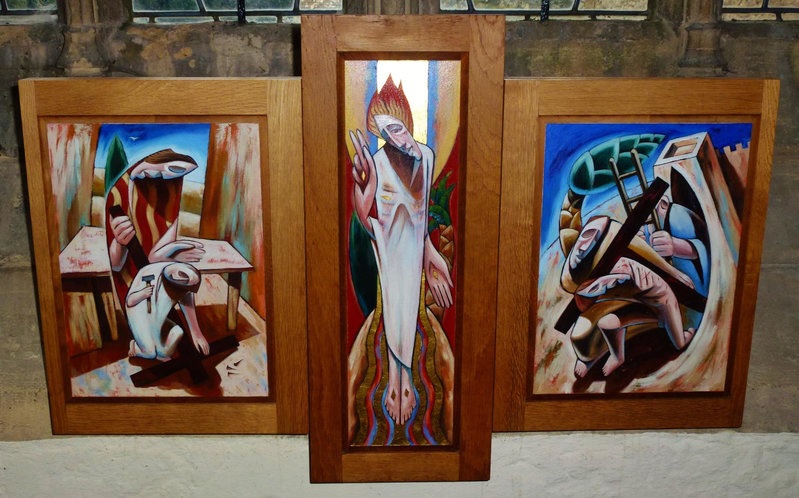
In 1999 Mynheer was commissioned by St. Mary’s Church in North Leigh, Oxfordshire, to create an altarpiece for its fifteenth-century Wilcote Chapel. He decided to create a hinged polyptych (multipanel painting) that shows three Christ-based scenes in its closed view and then opens to reveal four additional scenes on the wings. (The center panel remains fixed.)

Wilcote Chapel, St. Mary's, North Leigh, Oxfordshire
Wilcote Chapel, St. Mary’s Church, North Leigh, Oxfordshire.

Wilcote altarpiece
Wilcote Chapel polyptych (open view) by Nicholas Mynheer (British, 1958–), 1999. Oil on oak panels. St. Mary’s Church, North Leigh, Oxfordshire, England.

Wilcote altarpiece (closed)
Wilcote Chapel polyptych (closed view) by Nicholas Mynheer (British, 1958–), 1999. Oil on oak panels. St. Mary’s Church, North Leigh, Oxfordshire, England.

One of the challenges of painting a polyptych is figuring out how to arrange various episodes into one unified story, or, if portraiture is used instead of narrative, how to draw multiple figures into thematic coherence. The panels should not be isolated pictures but should speak to one another, aiding the viewer in worship. Mynheer achieves this unity brilliantly by establishing visual links through symmetry, which suggest associations of contrast between an earlier event and a later one: the expulsion versus the resurrection of the saints (sin and redemption), the nativity versus the pietà (birth and death), Jesus in Joseph’s workshop versus Jesus carrying his cross (wood as an innocent building material, wood as a horrendous instrument of execution).

Expulsion

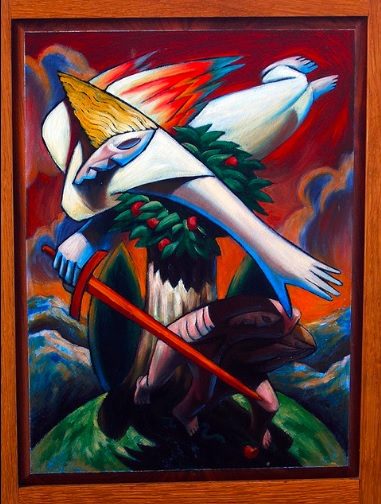
When the wings of the altarpiece are open, the leftmost panel depicts the expulsion of Adam and Eve from the Garden of Eden after they had broken fellowship with God. Miserable and ashamed, the couple departs under the shadow of sin’s curse while a cherub enforces the banishment with a red-hot sword. As they go, though, they step—seemingly unawares—on a snake, foreshadowing the Second Adam who would come to crush Satan, as prophesied in Genesis 3:15.   Continue reading “Wilcote altarpiece by Nicholas Mynheer”