Easter, Day 1: He Died . . . But He Rose!

Christ is risen! He is risen indeed! Happy Easter, friends.

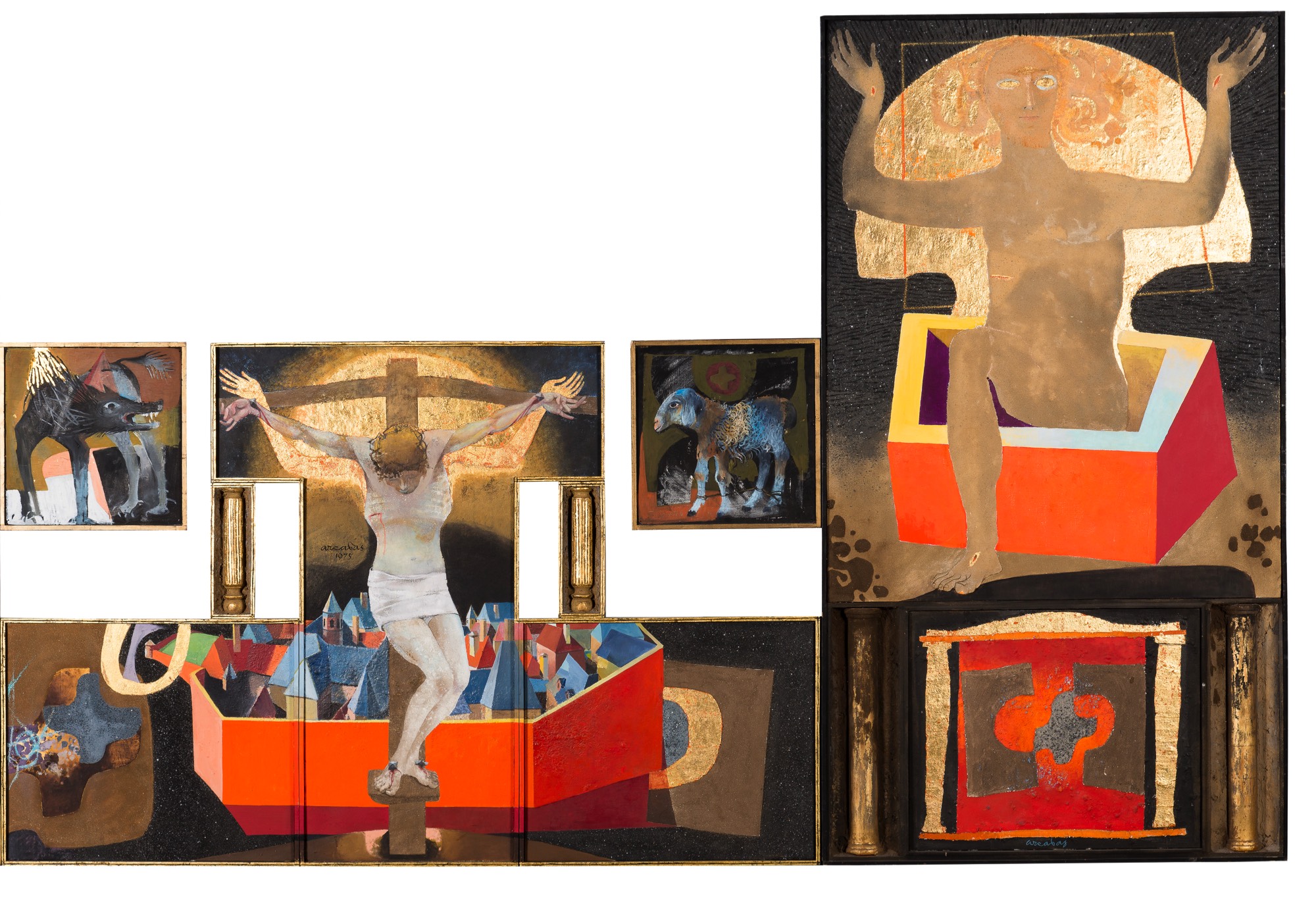
LOOK: Crucifixion sur la ville and Résurrection by Arcabas
Arcabas_Crucifixion and Resurrection
Arcabas (French, 1926–2018), Crucifixion sur la ville (Crucifixion over the City) and Résurrection, from the Petite suite en noir et or (Little Suite in Black and Gold), 1975. Oil on canvas.

There is very little written in English about the sacred French artist Jean-Marie Pirot (1926–2018), known as Arcabas [previously]—which is a shame, because his work is fantastic. I’d love to see it in person someday. Much of it is concentrated at L’église de Saint-Hugues-de-Chartreuse, near where he lived from 1950 until his death. One published source of information about the artist is Dr. David Lyle Jeffrey’s wonderful book In the Beauty of Holiness: Art and the Bible in Western Culture (Eerdmans, 2017); he devotes the book’s final section, pages 349–63, to Arcabas, reproducing in full color seven of his paintings and translating material from French interviews. Jeffrey cites Kirsten Appleyard’s honors thesis at Baylor University from 2009, which he supervised, as the most complete study of the artist’s work available in English, which I believe is still the case.

Unfortunately, the website arcabas.com, from which I gathered photos of many of Arcabas’s works some ten years ago, is now defunct. That’s where today’s featured image was sourced from. The panels are from a larger polyptych, which you can view in this photo of its temporary exhibition at L’église Saint Ignace in Paris. I’m not sure where it resides now.

The left panels portray Jesus being crucified outside the city walls. But the cityscape is not of first-century Jerusalem; it’s a modern French village. As have many artists before him, Arcabas collapses the distance between Jesus’s life and times and his own by transposing Jesus’s death to a familiar setting.

On the right is a lamb whose legs are bound in preparation for sacrifice—an emblem of Christ, who was led “like a lamb . . . to the slaughter” (Isa. 53:7). Opposite the lamb is a snarling wolf, a reference to Psalm 22:16–18:

For dogs are all around me;
    a company of evildoers encircles me;
they bound my hands and feet.
I can count all my bones.
They stare and gloat over me;
they divide my clothes among themselves,
    and for my clothing they cast lots.

The Crucified One bows his head. His hands, nailed by the wrists to the cross, are contorted in pain. His ribcage protrudes from his emaciated torso. But as he gives up the spirit, it spills out, a silhouette of his form, in gold, dissolving into a sun/halo behind his head. His golden arms are strong, vigorous, alluding to the Resurrection and capturing something of the paradox of the cross, a site of both shame and glory.

In the right panel, which is on a larger scale than the others, granting it preeminence, Christ emerges victorious from a multicolored sarcophagus. He rises bodily, but his form is transfigured, shiny, especially his eyes. Stepping out of the box that cannot contain him, he lifts his hands to reveal the wounds of crucifixion, signs of our redemption. The lustrous swirls about his head could be his wild, windswept hair, or else some kind of electric or mystic force.

This is one of several Resurrection images Arcabas painted during his lifetime. Another one, you can hear the artist discuss (in French) in the following 2005 interview, cued up at 20:26:

This whole KTO TV segment, nearly an hour long, is worth watching if you’re a French speaker! I am not, but a generous follower of my blog, knowing my enthusiasm for Arcabas, translated significant portions of it for me into English.

Since Arcabas’s death, a new online hub has sprung up to showcase his work: https://arcabas.net/. While it doesn’t host as many image files as its .com predecessor, this archive provides helpful location and copyright information, and I believe it’s in a state of expansion.

LISTEN: “The Resurrection” by Richard Smallwood (based on Rachmaninoff’s “Vocalise”), 1982

And he died
For our sin and our shame
Jesus died
For our sins
He hung high
On a hill called Calvary
To save a wretch undone
Like you and me

I can’t forget how he died for me
He suffered so much on Calvary
I can’t forget how they pierced his side
And he bowed his head and died

But he rose
Conquered death, hell, and grave
And he rose
With all power
Jesus rose
Now he lives forevermore
Through Christ we now are saved eternally

Richard Smallwood (1948–2025) was a legendary gospel composer, pianist, and singer, known for blending classical music with traditional gospel. For “The Resurrection,” which debuted on the album The Richard Smallwood Singers (1982), he adopted the main theme of Rachmaninoff’s wordless song “Vocalise” as the basis. Meditating on Christ’s crucifixion and then resurrection, Smallwood’s song evolves in tone from elegiac to triumphant.


This is the first post in a daily series for the first eight days of Easter, each one of which will pair a visual artwork with a piece of music to encourage celebration of the risen Christ.
“Quiet I” by Leslie Anne Bustard (poem)

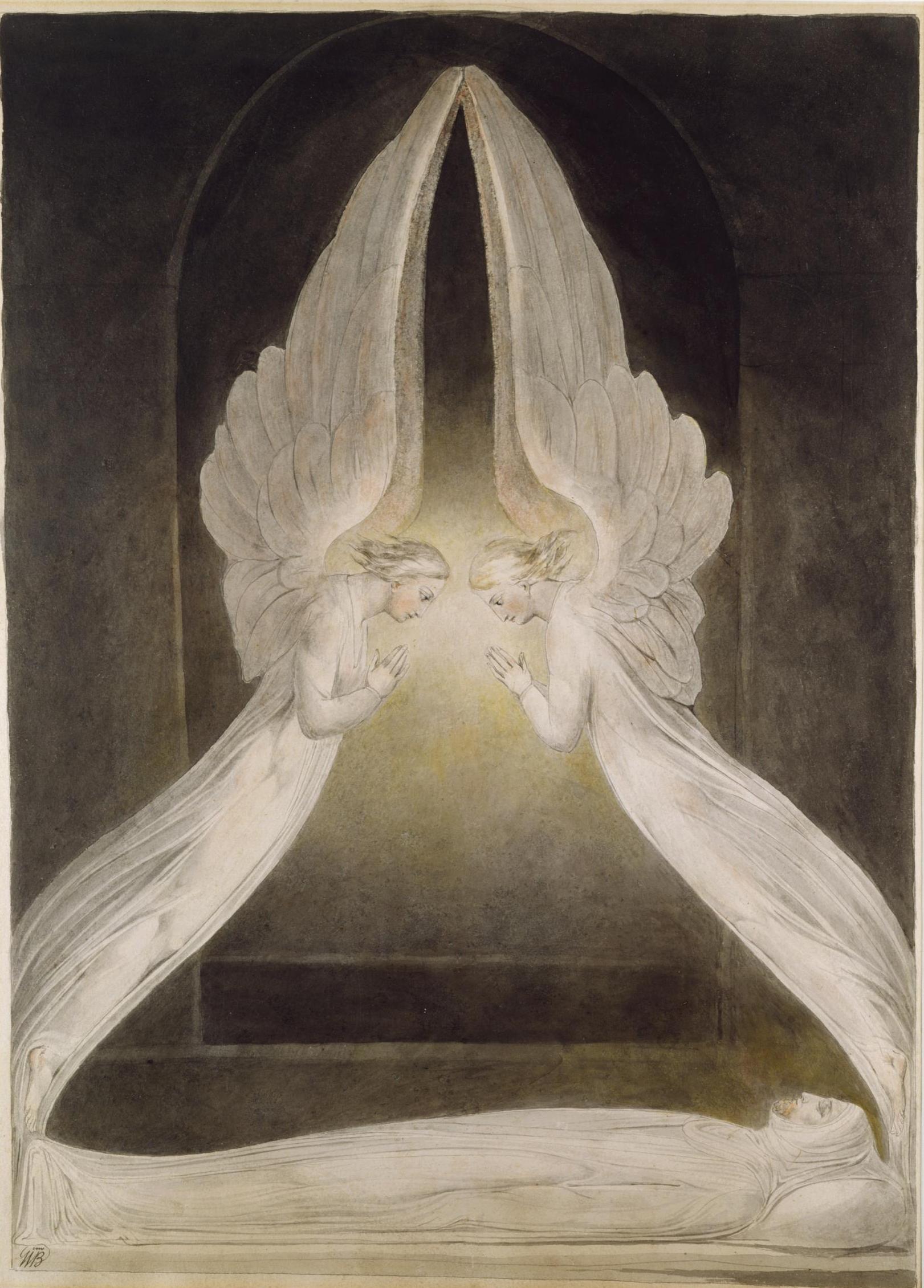
Blake, William_Christ in the Sepulchre
William Blake (British, 1757–1827), The Angels Hovering over the Body of Christ in the Sepulchre, ca. 1805. Watercolor on paper, 42 × 30.2 cm. Victoria and Albert Museum, London.

A robin’s egg in a nest,

a row of yellow tulips, petals closed,

the last few shadowed moments
on the eastern horizon,

and Holy Saturday,
as Christ was lying in the sealed tomb,
and angels were waiting.

from The Goodness of the Lord in the Land of the Living (Square Halo Books, 2023); used with permission


Comprising just seven spare lines, this poem is a wonderfully succinct evocation of the anticipation of Easter. An egg about to hatch, a flower about to bloom, the sun about to rise—Leslie Anne Bustard gives us these images from nature to sit with on Holy Saturday, a day of waiting in the still, silent moment before life, light, and beauty break forth from Christ’s tomb and he ambles out, calling our names.


Leslie Anne Bustard (1968–2023) was a teacher, a writer, and a producer of high school and children’s theater in Lancaster, Pennsylvania, where she lived with her husband, Ned, and raised three daughters. A lover of the arts, she was the vice president of Square Halo, a Christian nonprofit that publishes books, hosts an annual conference, curates a contemporary art gallery, and records a podcast. She is the coeditor, with Carey Bustard and Théa Rosenburg, of Wild Things and Castles in the Sky: A Guide to Choosing the Best Books for Children (2022) and the author of The Goodness of the Lord in the Land of the Living: Selected Poems (2023) and the posthumously published Tiny Thoughts That I’ve Been Thinking: Selected Writings of Leslie Anne Bustard (2024) and Strong Allies: Creating, Cultivating, Restoring (2026). She died of cancer at age fifty-five.

Holy Week: Silence

What is happening? Today there is a great silence over the earth, a great silence, and stillness, a great silence because the King sleeps . . .

—Epiphanius of Cyprus, “The Lord’s Descent into Hell”

Ours is the long day’s journey of the Saturday. Between suffering, aloneness, unutterable waste on the one hand and the dream of liberation, of rebirth on the other.

—George Steiner, Real Presences

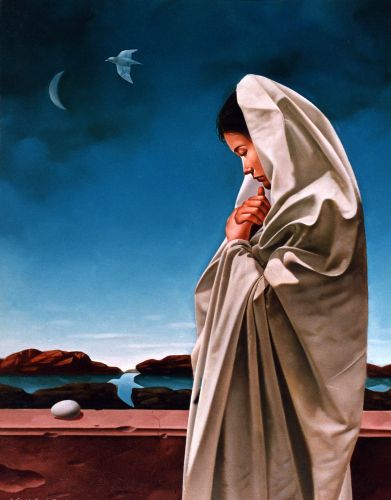
LOOK: Kesunyian by F. Sigit Santoso

Santoso, F. Sigit_Silence
F. Sigit Santoso (Indonesian, 1964–), Kesunyian (Silence), 1998. Oil on canvas, 50 × 40 cm.

In this contemplative painting by the Javanese artist F. Sigit Santoso, a cloaked woman stands in profile near a stone ledge, holding her hands over her chest (a gesture of self-comfort? of nervous anticipation?) and staring down at an egg. Eggs typically represent resurrection and new life, since latent underneath that shell, if the egg is fertile, is a chick or other creature waiting to be born. It seems this woman is waiting for the egg to hatch. Maybe she doubts it ever will.

In the background, a body of water cuts through a rocky landscape. The moon is visible in the darkness, but so is a rising dawn on the horizon. A bird wings its way through the sky, a symbol of transformation and freedom. Cast like a bright shadow, its shape is repeated in silhouette near the egg; it reminds me of the bird paintings of the Belgian surrealist René Magritte.

LISTEN: “Silentium” by Arvo Pärt, 1977 | Performed by A Far Cry, feat. Alexi Kenney and Stefan Jackiw, 2025

The Estonian composer Arvo Pärt [previously], a devout Eastern Orthodox Christian, is one of the three greatest exponents of the contemporary Western classical movement known as “holy minimalism” (the other two are John Tavener and Henryk Górecki), characterized by an unadorned aesthetic and religious or mystical leitmotifs. Pärt uses the term tintinnabuli (from the Latin tintinnabulum, “little monastic bell”) to describe his meditative, two-voice compositional style. 

Written in D minor, “Silentium” (Silence) is the second movement of Pärt’s Tabula Rasa, a double concerto for two solo violins, prepared piano, and chamber orchestra. Whereas the first movement, “Ludus” (Play), is full of energy and momentum, “Silentium,” writes Paula Marvelly, “is intentionally slower-paced with the delicate melody evolving gradually, carrying us through towards the dénouement. And yet as it approaches its tonic end, it progressively becomes more prolonged and gentle, until the final note is left unplayed.” The piece “resolves” on four written bars of silence.

In their recording of “Silentium” released last year (featured above), the Boston-based chamber orchestra A Far Cry plays the piece at nearly half the speed of the best-known version, released by ECM Records in 1984. The group notes that the piece is known for its healing properties for the dying and is often used in palliative care facilities, with one patient famously calling it “angel music.” In the Plough article “Harmonizing Silence,” composer Joel Clarkson writes of how Pärt’s music “speaks in an especially potent way to those who have been thrust into the dreaded silence of human suffering. In response to such silences – spaces that can feel so vacant of hope and meaning – Pärt’s hushed music doesn’t seek to fill the void or distract from it, but rather to gently hallow it, transfiguring a location of pain into a space of encounter with the love of the God who, as Psalm 34:18 says, is ‘close to the brokenhearted.’” 

Holy Week: Lifeblood

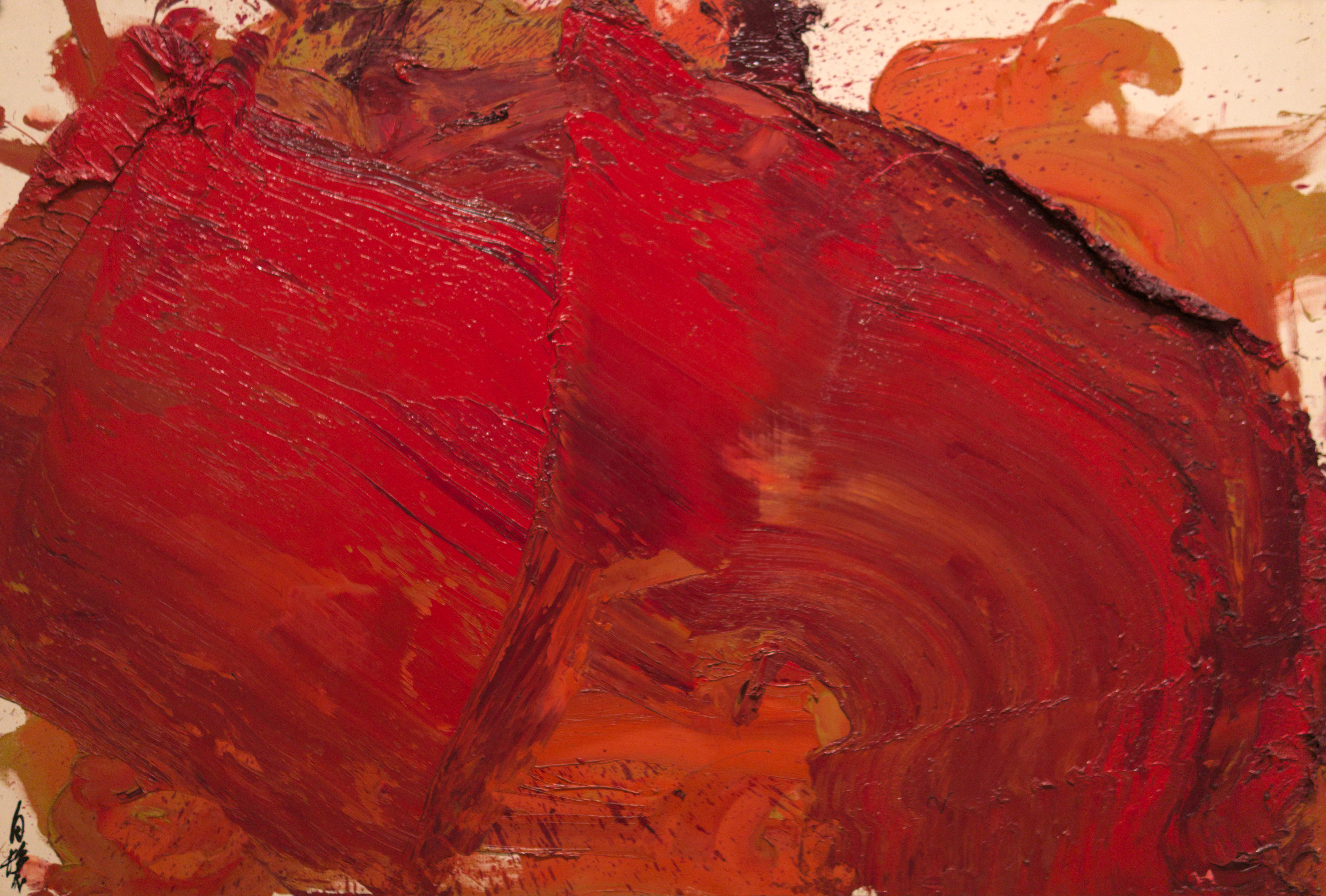
LOOK: Untitled by Kazuo Shiraga

Kazuo Shiraga painting
Kazuo Shiraga (Japanese, 1924–2008), Untitled, 1964. Oil on canvas, 51 1/2 × 76 3/8 in. (130.8 × 194 cm). Museum of Modern Art, New York. Photo: Victoria Emily Jones. [object record]

LISTEN: “Glory Be to Jesus” (original title: “Viva! viva! Gesù”) | Words: Anon., Italian, 18th century; trans. Edward Caswall, 1857 | Music by Friedrich Filitz, 1847 | Performed by Wes Crawford on Hymns for This World and the Next, 2024

Glory be to Jesus,
who, in bitter pains,
poured for me the lifeblood
from his sacred veins.

Grace and life eternal
in that blood I find;
blest be his compassion,
infinitely kind.

Blest through endless ages
be the precious stream
which from endless torments
did the world redeem.

Oft as earth exulting
wafts its praise on high,
angel hosts rejoicing
make their glad reply.

Lift we, then, our voices,
swell the mighty flood,
louder still and louder
praise the precious blood!

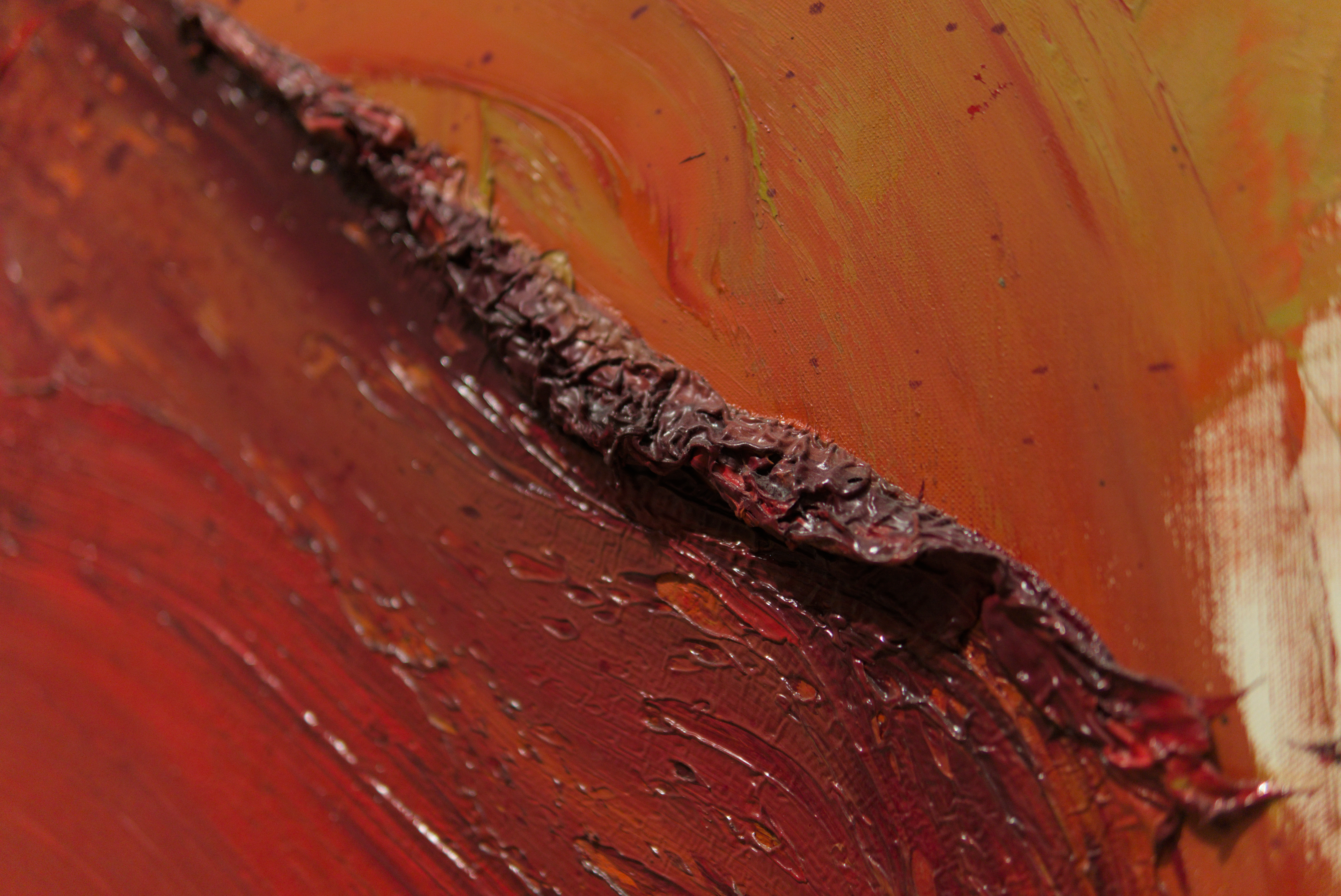
Kazuo Shiraga painting detail
Kazuo Shiraga, Untitled (detail), 1964. Photo: Victoria Emily Jones.

Holy Week: Sweet Son

LOOK: The Crucifixion by Andrea Mantegna

Mantegna, Andrea_Crucifixion (San Zeno Altarpiece)
Andrea Mantegna (Italian, ca. 1431–1506), The Crucifixion, 1457–59. Tempera on panel, 75 × 96 cm. Musée du Louvre, Paris. [object record]

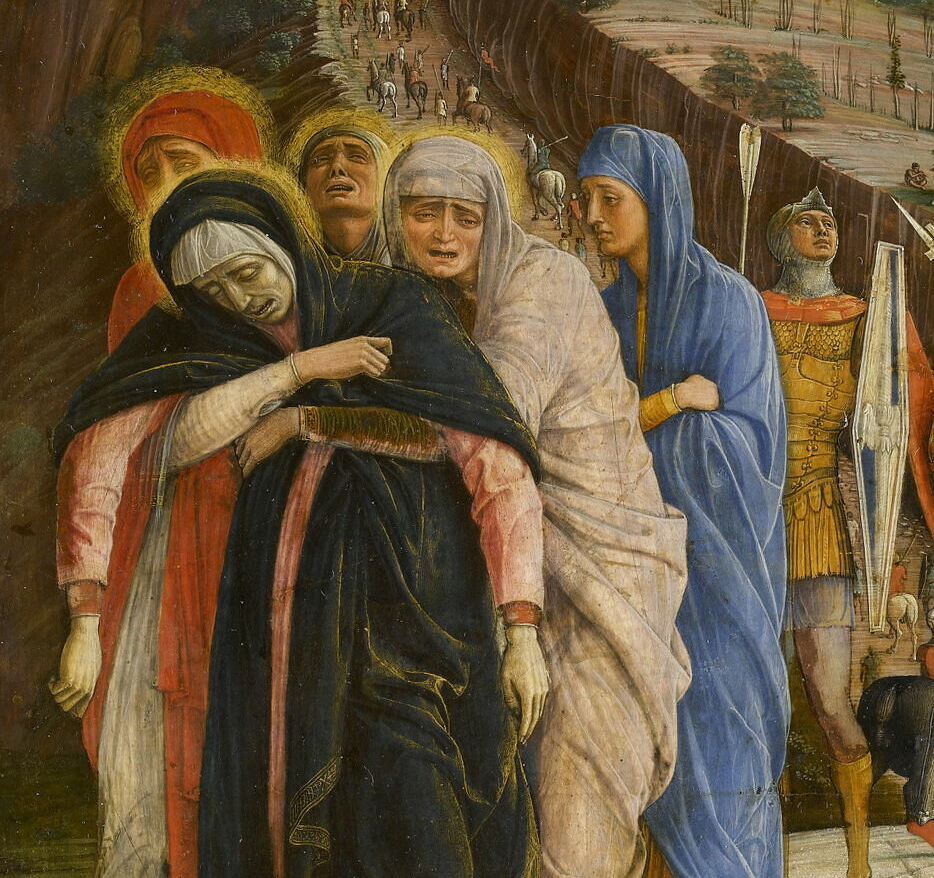
There’s much to look at in this painting. I want to focus on Jesus’s grieving mother under the cross to our left.

Mantegna, Crucifixion detail

In Renaissance art of the Crucifixion, Mother Mary is often shown swooning, supported by John or by one of her female companions. Here she’s with a group of four women—the other Marys—two of whom wrap an arm around her to bolster her up when her legs give out. Her son has just died, and she can’t bear to look.

This work was painted by Andrea Mantegna between 1457 and 1459 as the central element of the predella (base) of the high altarpiece at San Zeno in Verona, Italy, a monumental work of art. In 1797, French Napoleonic forces plundered the altarpiece and brought it to Paris; the country returned the three main panels to Verona in 1815 when Napoleon lost power, but they kept the three predella panels, which are on display in museums: The Crucifixion at the Louvre, and The Agony in the Garden and The Resurrection at the Musée des Beaux-Arts in Tours.

LISTEN: “Swete Sone” | Words: Anon., 14th century (before 1372) | Music by Katharine Blake, 1998 | Performed by Mediæval Bæbes on Worldes Blysse, 1998

This song is in Middle English. If you’re reading along with the lyrics, you’ll want to know that the letter thorn, þ, says th; and u makes a w or v sound. I’ve bracketed the two words that the Mediæval Bæbes leave out.

Suete sone, reu on me, & brest out of þi bondis;
For [nou] me þinket þat i se, þoru boþen þin hondes,
Nailes dreuen in-to þe tre, so reufuliche þu honges.
Nu is betre þat i fle & lete alle þese londis.

Suete sone, þi faire face droppet al on blode,
& þi bodi dounward is bounden to þe rode;
Hou may þi modris herte þolen so suete fode,
Þat blissed was of alle born & best of alle gode!

Suete sone, reu on me & bring me out of þis liue,
For me þinket þat i se þi detȝ, it neyhit suiþe;
Þi feet ben nailed to þe tre—nou may i no more þriue,
For [al] þis werld with-outen þe ne sal me maken bliþe.

Source: Edinburgh, National Library of Scotland, Adv.MS.18.7.21, fol. 120r (DIMEV 5089); as transcribed by Carleton Brown in Religious Lyrics of the XIVth Century (1924)

MODERN ENGLISH TRANSLATION:

Sweet son, have pity on me, and break out of your bonds;
For I think I see through both your hands
Nails have been driven into the tree, so painfully you hang there.
It would be better if I fled now and abandoned all these lands.

Sweet son, your beautiful face is dripping with blood,
And your body beneath is bound to the cross;
How will your mother’s heart endure [the suffering of] such a sweet child,
Who was born most blessed of all and was the most goodly of all!

Sweet son, have pity on me and deliver me from this life,
For I think I see your death approaches quickly;
Your feet have been nailed to the tree—now I may never prosper,
For without you, all this world can never make me happy.

These three monorhyming quatrains are from John of Grimestone’s commonplace book, where he jotted down material for sermons; it’s unknown whether they’re original to him or compiled from some other source. (For other lyrics I’ve featured from this notebook, see “Undo Thy Door, My Spouse Dear” and “Love Me Brought.”)

In the poem, written in Mother Mary’s voice, Mary reveals a premonition she’s had of her son being nailed on a tree to die. (At least that’s how I read it, mainly because of the “I think I sees.”) She agonizes over this nightmare and asks Jesus that if it be true, to deliver her from this life, as she won’t be able to endure the sorrow of losing him.

Verses like these really humanize Mary, a woman who, faithful though she was to God’s unfolding plan, nevertheless felt the intense parental pangs that inevitably accompany witnessing one’s child being brutalized and killed.

The poem has been set to medieval-style music by Katharine Blake, the founder of Mediæval Bæbes, a classical chart–topping British music ensemble celebrating its thirtieth anniversary this year.

The song opens with an unaccompanied solo voice singing in free time. In the second half of the first stanza, additional voices enter, as well as a strummed instrument. Then with “& þi bodi dounward is bounden to þe rode,” the tempo quickens; a 2/4 meter takes shape and regularizes, with percussion keeping the beat; and the volume amplifies with twelve women now singing. With the final stanza, there’s once again a softening as the song returns to a single vocalist and the instrumentation drops out. This movement from weary pain, Mary barely able to speak it aloud, to foot-stomping anger, which her friends join in solidarity, and back to solitary desolation captures different shades of grief.

For a wholly a cappella solo rendition, see this performance by Ariana Ellis:

Holy Week: The Mocking

They will mock him and spit upon him and flog him and kill him . . .

—Mark 10:34

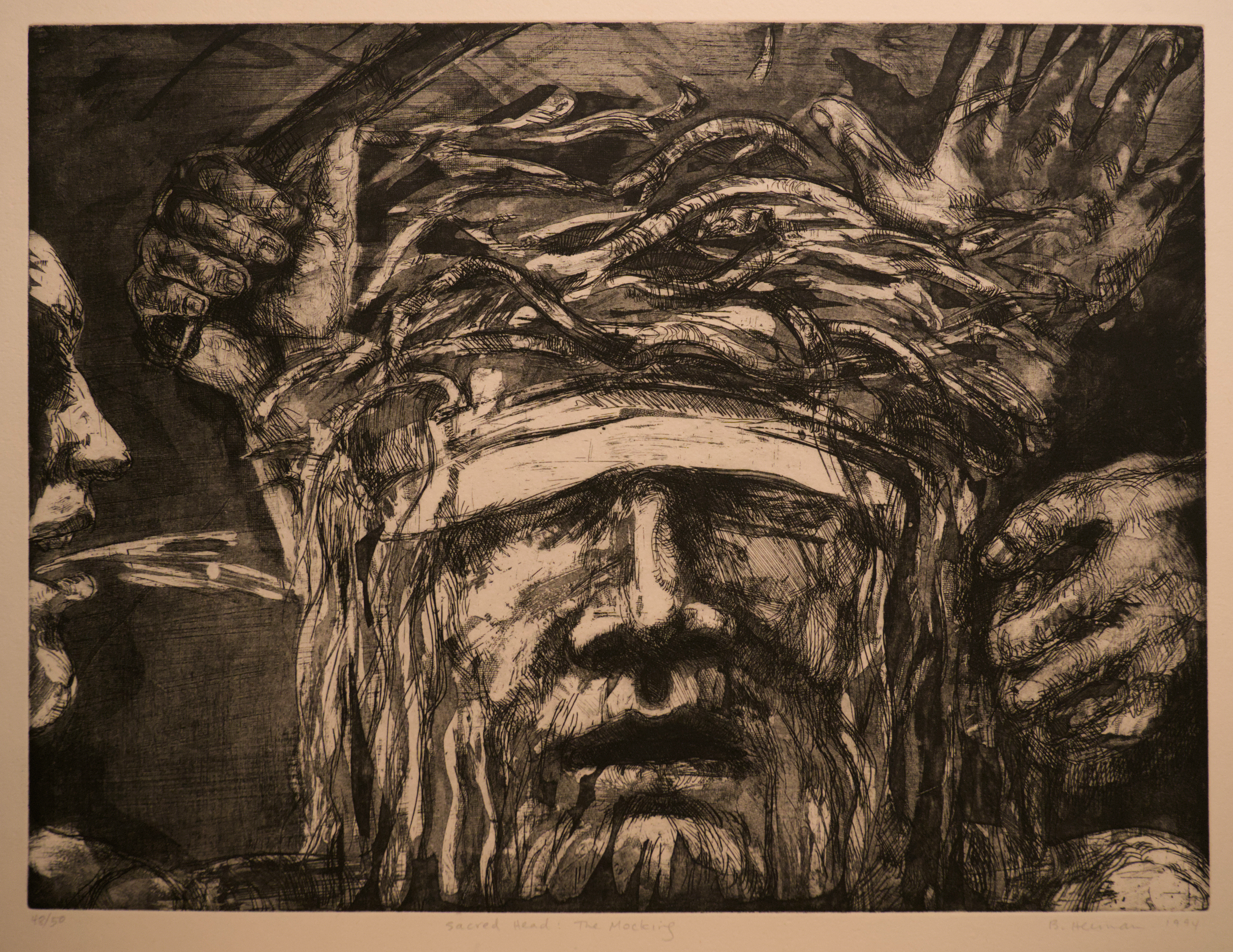
LOOK: Sacred Head II: The Mocking by Bruce Herman

Herman, Bruce_Sacred Head II
Bruce Herman (American, 1953–), Sacred Head II: The Mocking, from the Florence Portfolio, 1994. Intaglio, edition 48/50, sheet 21 1/2 × 30 1/8 in., image 17 3/4 × 23 5/8 in. Collection of Victoria Emily Jones.

The Florence Portfolio is a suite of twenty intaglio prints based on the biblical theme of sacrifice, made by six artists from Christians in the Visual Arts (CIVA) who lived and worked together for a month in Florence, Italy. I purchased two limited-edition portfolio prints—this one, and Wayne Forte’s Deposition—from the CIVA store shortly before the organization closed its operations in 2023.

A tightly cropped image of Christ’s blindfolded face, Bruce Herman’s Sacred Head II: The Mocking conveys disorientation. Hands slapping, shoving, pounding. Spittle on the cheek, in the ear. A nest of thorns piercing the scalp. Taunting epithets and derisive laughter. A cracking scourge. This is only a fraction of the violence and humiliation Christ suffered in the hours before his death.

LISTEN: “Crucify Him” by Sarah Wilcox, on Crucify Him (2023)

Pilate took Jesus and flogged him
Soldiers, they twisted a crown of thorns
And put it on his head
And arrayed him in a purple robe

Hail, King of the Jews!

And they struck him with their hands
And when they had mocked him
They stripped him of the purple robe
And put on his own clothes
And they led him away
To crucify him