Roundup: New VCS commentary, dichroic glass installation, the Lord’s Prayer in 11 languages, and more

With the feast of Pentecost coming up this Sunday, celebrating the gift of the Holy Spirit and the mission of the church, here are a few items of interest from around the web.

VISUAL COMMENTARIES: “The Risen Christ Appearing to the Disciples” by Victoria Emily Jones: This spring my latest exhibition for the Visual Commentary on Scripture was published, on Luke 24:36–49 and John 20:19–23, where Jesus appears to his frightened disciples after his resurrection, giving them peace, assurance, renewed purpose, and power. (In John’s telling of this episode, sometimes referred to as the Johannine Pentecost, Jesus breathes his Spirit onto them!) I selected and wrote about paintings by a medieval German artist, an Italian Renaissance artist, and a contemporary Indian artist that triangulate these parallel passages.
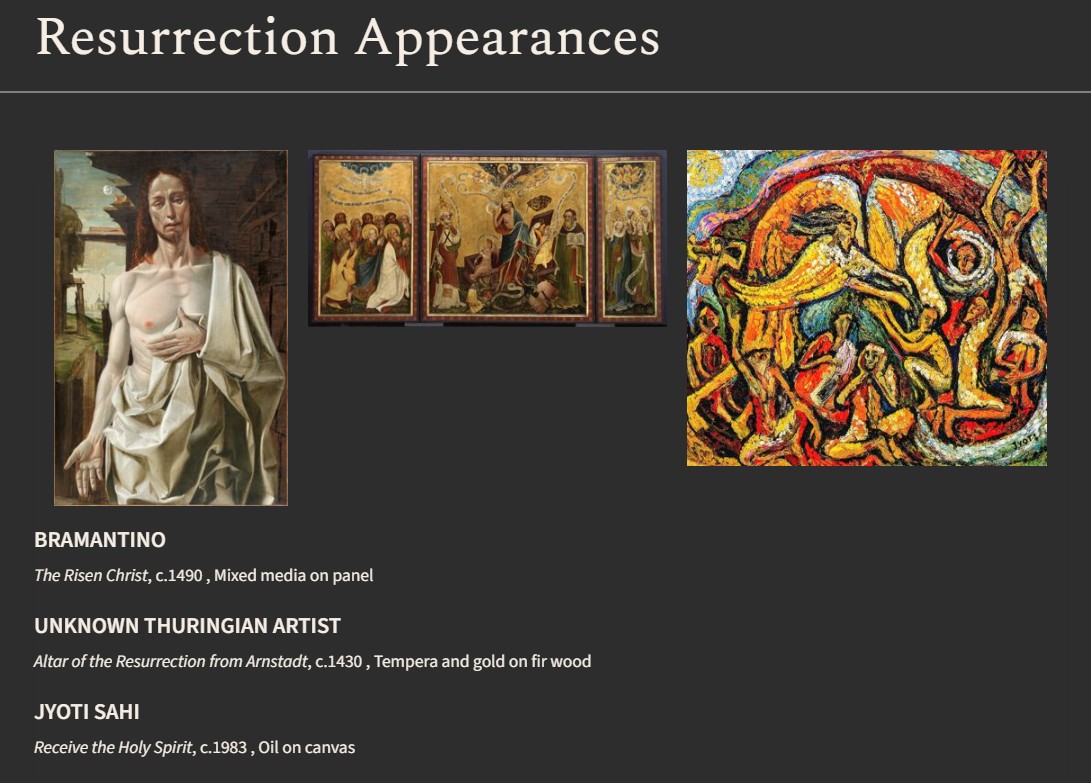
Resurrection Appearances screenshot

Two shortlisted artworks were David LaChapelle’s photograph Evidence of a Miraculous Event and a digital painting by Duncan Robertson.

>> Want to learn more about the Visual Commentary on Scripture [previously], an excellent free resource for pastors and other readers and teachers of the Bible? Check out the Exhibiting Faith podcast episode from April 30, where host David Trigg interviews VCS director Ben Quash about it.

+++

SONGS:

>> “O for a Thousand Tongues to Sing,” arr. Christopher M. Smith, performed by the MNU Heritage Choir: Smith arranged two stanzas of this Wesleyan hymn for the student choir he directs at MidAmerica Nazarene University in Olathe, Kansas. They perform the song inside the Bell Cultural Events Center, which has lines from the hymn inscribed on the walls.

>> “Citizen” by Philippa Hanna and Israel Houghton, performed with Moses Bliss

>> “For Your Gift of God the Spirit” by Margaret Clarkson (words) and Darwin Jordan (music), performed by musicians at Philpott Church in Hamilton, Ontario

+++

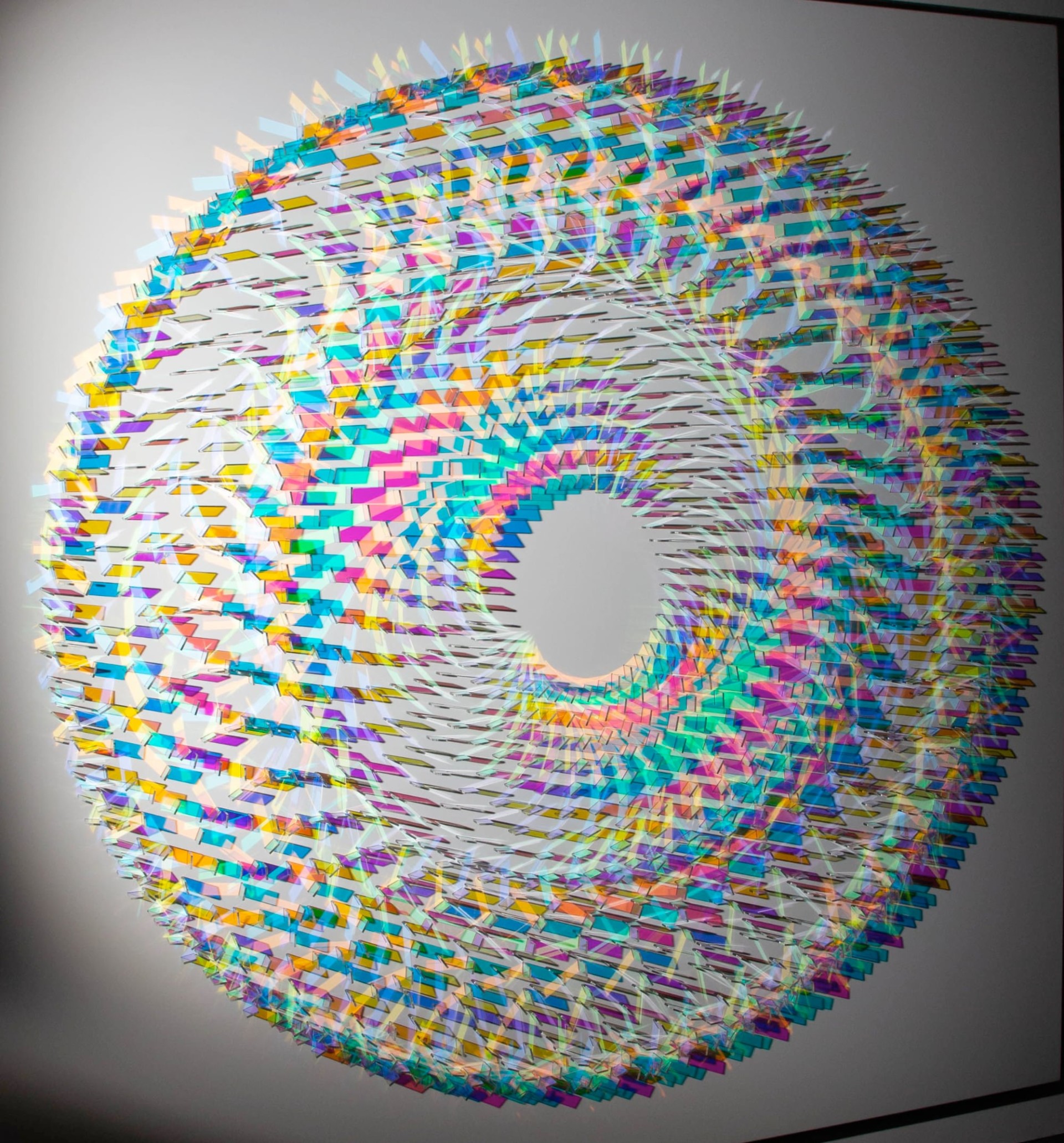
ARTICLE: “Vivid Spectrums of Color Radiate from Chris Wood’s Intricate Installations of Dichroic Glass” by Grace Ebert, Colossal: When I saw photos of this artwork by the Cambridgeshire-based light artist Chris Wood, with its prismatic colors and outward expansion, I thought of Pentecost—of the radiant gospel of Jesus Christ, from the launchpad of his resurrection and subsequent giving of his Spirit, going out to the world via and to various people groups, setting it ablaze. The artist says she was inspired by the logarithmic spiral of the nautilus shell. “We find in this a representation of how radiance can be embodied within us, as projected to those around us,” she says.

Wood, Chris_40 x 40
Chris Wood (British, 1954–), 40 × 40, 2022. Dichroic glass, diameter 160 cm. Commissioned by Clé de Peau Beauté.

Wood, Chris_40 x 40 (detail)

40 × 40 was commissioned in 2022 by the Japanese luxury skincare and makeup brandClé de Peau Beauté for its fortieth anniversary. The work comprises forty spirals, each made up of forty pieces of dichronic glass, each forty millimeters long.  

“Dichroic is a material that is colorless, but it has an optical filter on it,” Wood explains. “So when light hits it, certain wavelengths, which are manifested as colors, reflect back, and the remaining wavelengths pass through, creating two colors. Those colors change depending on the angle and quality of the light and the viewpoint. It’s just the most eloquent description of the magic of light that I could find.”

+++

VIDEO: “The Lord’s Prayer: One Church, One Prayer”: ICF (International Christian Fellowship) Rotterdam-Noord, an intercultural church in the Netherlands, recently put together a video compilation of some of its members praying the Lord’s Prayer in their mother tongues; represented are English, Papiamentu, Dutch, Malayalam, Swahili, Arabic, Twi, Spanish, Tagalog, Chinese, and German.

Rotterdam is a diverse city, home to 170 different nationalities. In the neighborhoods ICF North serves, 70 percent of residents have a migrant background. Every Sunday the church, pastored by Fred Kappinga, offers an Arabic-Dutch service and an English-Dutch service, with translations into other languages when necessary and possible. They sing Christian worship songs from around the world and host guest preachers of various ethnicities.
Ascension Day Roundup

Occurring forty days after Easter, Ascension Day is this Thursday, May 14, and will be celebrated by many churches on Sunday, honoring Jesus’s ascent to heaven. This historic event “represents both a conclusion and a commencement,” writes Ashley Tumlin Wallace: “Jesus finished his earthly work while setting into motion the gift of the Holy Spirit and the birth of the Church.” Below are a few items for the occasion.

QUOTE: “In the mystery of the Ascension we reflect on the way in which, in one sense, Christ ‘leaves’ us and is taken away into Heaven, but in another sense he is given to us and to the world in a new and more universal way. He is no longer located only in one physical space to the exclusion of all others. He is in the Heaven which is at the heart of all things now and is universally accessible to all who call upon Him. And since His humanity is taken into Heaven, our humanity belongs there too, and is in a sense already there with him. ‘For you have died,’ says St. Paul, ‘and your life is hidden with Christ in God.’ In the Ascension Christ’s glory is at once revealed and concealed, and so is ours.”—Malcolm Guite

+++

ARTICLE: “Ten Reasons to Celebrate Ascension Day” by John Witvliet, Reformed Worship: John Witvliet, senior scholar and professor of theology, worship, and the arts at Belmont University, answers the question “Why does Ascension Day matter?” He concludes with two book recommendations and some suggestions for corporate worship.

+++

ALBUM: Ascension Songs by Cardiphonia: This compilation album from 2012 features nineteen traditional hymns about Christ’s ascension, seventeen of which have been retuned by contemporary singer-songwriters and worship leaders. I featured one by Sarah Majorins back in 2019; here are two other favorites, the latter from the Sacred Harp tradition:  

>> “Today Our Lord Went Up On High” | Words by Johann Zwick, 1542; trans. Catherine Winkworth, 1858 | Music by Rebekah Osborn, 2012

>> “Jesus, My All, to Heav’n Has Gone” | Words by John Cennick, 1743 | Music (NORTH PORT) by R. R. Osborne, 1850 | Arranged by Bruce Benedict, 2010

(Related post: “A Hymn of Glory Let Us Sing”)

+++

ORATORIO: Lobet Gott in seinen Reichen (Praise God in His Realms) by J. S. Bach: Known as the Ascension Oratorio, Bach’s BWV 11 was composed for the Feast of the Ascension almost three centuries ago. It is structured in eleven movements in two parts and runs about a half hour. Its libretto comprises some original texts (likely written by the German poet and Bach’s regular collaborator Picander) as well as quotations from the Bible and hymns by Johann Rist and Gottfried Wilhelm Sacer. It both mourns Christ’s bodily departure and extols his universal reign.

The oratorio’s closing chorale fantasia (starting at 25:48 in the video above) is often cited as one of many examples of Bach’s sophisticated expression of theology through music. The orchestra plays in D major while the chorus sings in B minor—“When shall it happen, / When will the dear time come, / That I shall see him / In his glory?”—conveying the human state of waiting and hoping for Christ’s return and the fulfillment of that hope. Both jaunty and full of longing, and harmonious between the two, movement 11 anticipates the day when we will be reunited with Christ in the flesh. Craig Smith writes,

The final chorale is an amazing tour de force. A verse set to the melody of the grave chorale “Von Gott will ich nicht lassen” is imbedded in the brilliant trumpet- and drum-dominated D Major texture of the orchestra. The B minor of the chorale never loses its identity but is simply swallowed up in the D Major. Bach understands the melancholy of being left behind, and profoundly includes it here in this ostensibly joyous festival.

The above performance from 2013 is by the Monteverdi Choir and English Baroque Soloists, conducted by John Eliot Gardiner. An English translation of the German lyrics is given as subtitles, but you can also follow along here.

+++

REFLECTION: “Let me go, because then the Spirit will come” by Jonathan Evens: Jonathan Evens, a vicar in the Church of England, shares the reflection he gave on Ascension Day at St Martin-in-the-Fields in London in 2020, which concludes with a verse-style meditation that I really like. Here’s the first stanza:

Touch me not.
I am not yours
to have and hold,
in this shape
in this form.
Let go.
Let me go.
Let my Spirit come.
Divine my Spirit,
know me
within.

+++

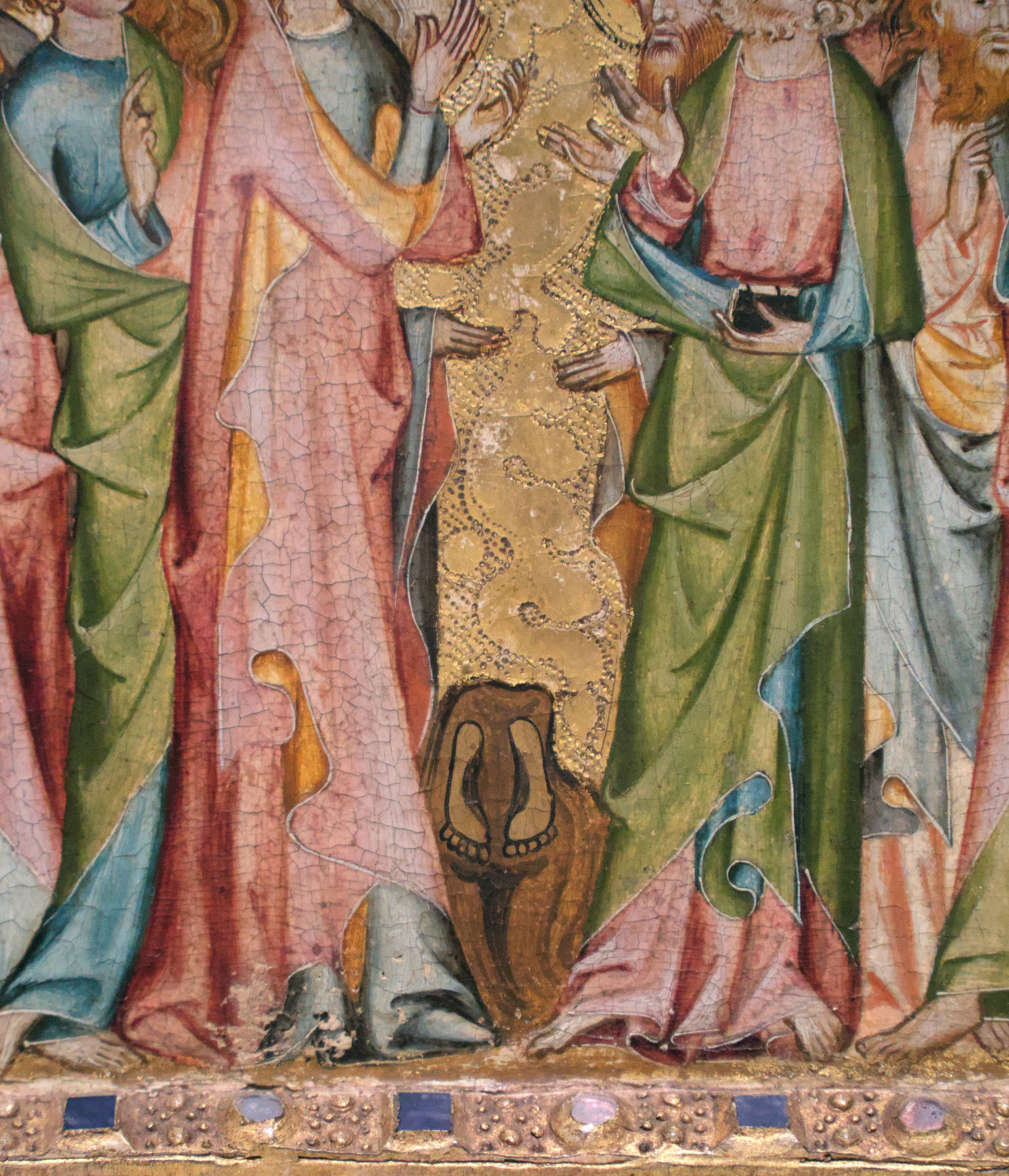
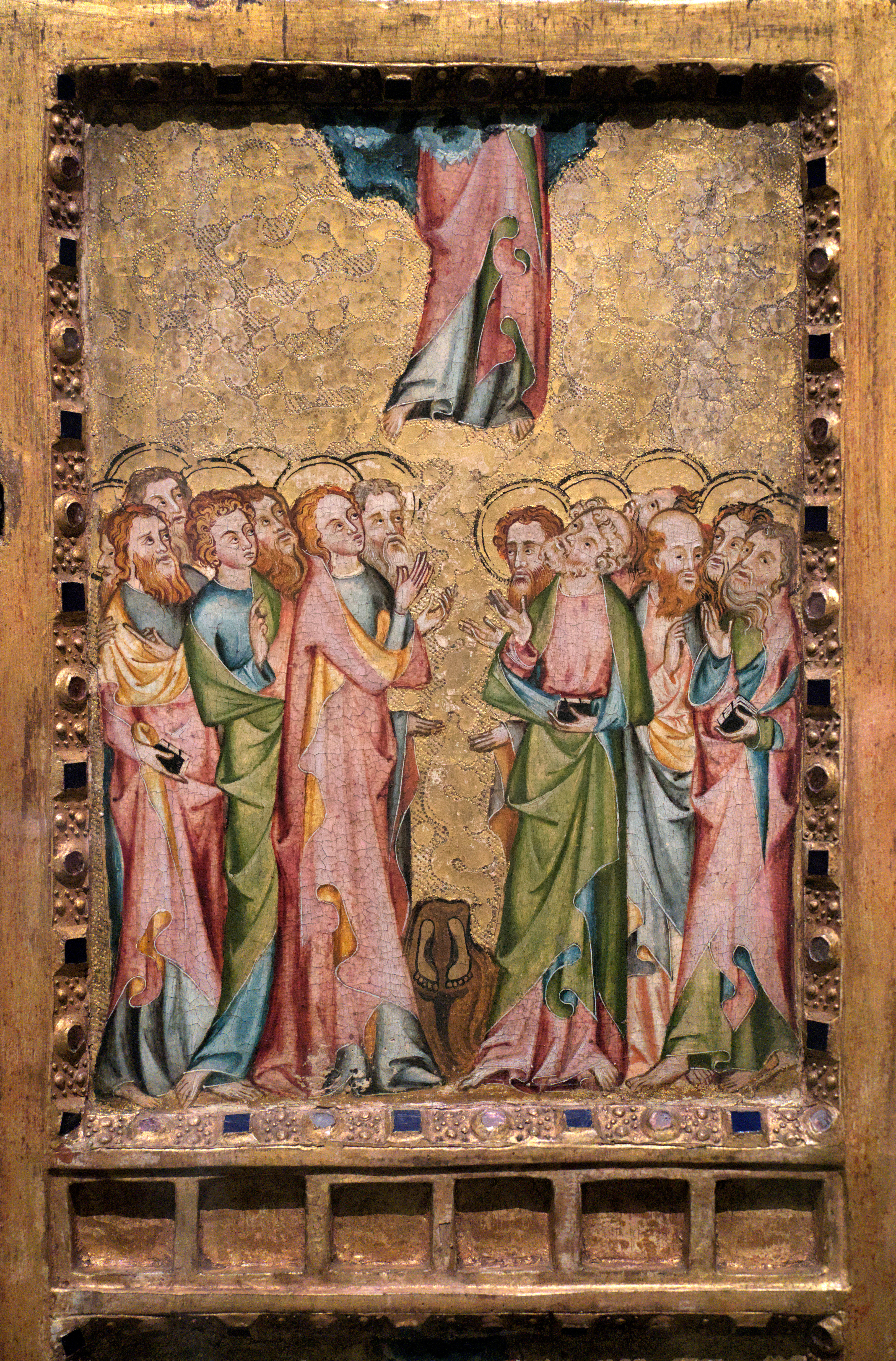
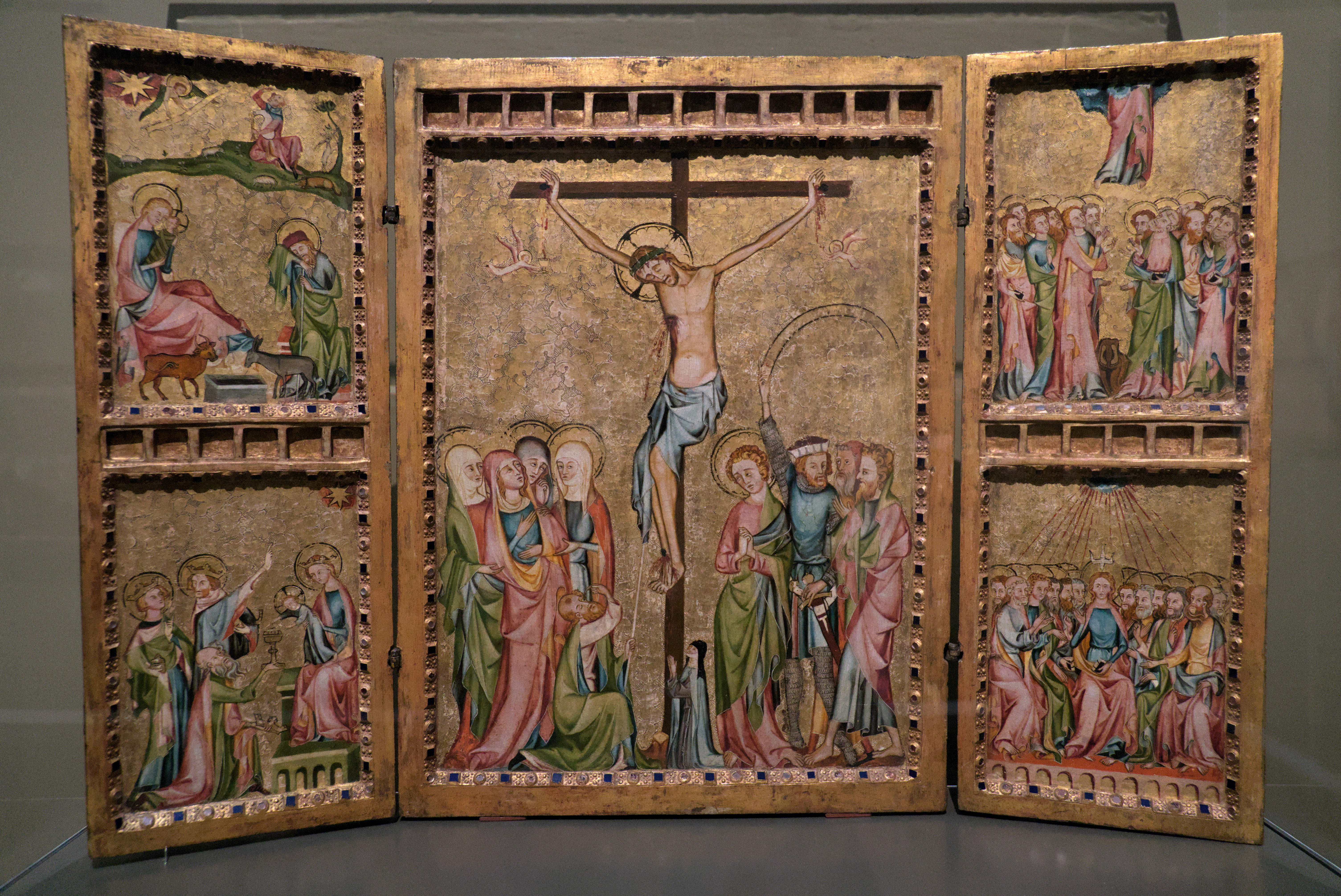
PAINTING: The Ascension, ca. 1340–50: Last fall while I was in Cologne, I visited the Wallraf-Richartz-Museum, which has an excellent collection of medieval German art. Here’s a lovely little Ascension painting I saw:

Ascension (Cologne)

It’s from a small triptych made in the mid-fourteenth century in a Cologne workshop for a Poor Clares cloister in the city. The object would have been used by the nuns for private contemplation. Its central scene is the Crucifixion, and the wings portray, in addition to the Ascension: the Nativity, the Adoration of the Magi, and the Descent of the Holy Spirit.

Triptych with Depiction of the Outworking of God's Plan for Salvation
Triptych with Depiction of the Outworking of God’s Plan for Salvation, Cologne, ca. 1340–50. Tempera on oak. Wallraf-Richartz-Museum, Cologne, Inv. 1. Photo: Victoria Emily Jones.

As is common in medieval paintings of the Ascension, that panel shows Jesus from the waist down, rising out of frame, leaving behind a set of footprints on the Mount of Olives. To me, that physical impression is a reminder of how Jesus, the God-man, has a body—he walked the earth in it, feeling dirt between his toes, and went to heaven with it, prefiguring the day when those who are in Christ will also, soul and body, join the Father in glory. That little mark on the mound, a negative space where Jesus’s weight once pressed, speaks both presence and absence. Ten days later, he’d send down his Spirit on the same gazing group, and many more besides, and their beautiful feet would carry the good news of his risen life far and wide.

Footprints at the Ascension

Roundup: Dissident cinema, extreme birdwatching, Thomas Kinkade’s hidden vault, and more

SPOTIFY PLAYLIST: May 2026 (Art & Theology)

+++

PODCAST SERIES: Dissident Cinema Marathon, Filmspotting: Over the next two months, Filmspotting, my favorite film podcast, is running a marathon on the theme of politically dissident cinema, exploring six films that confront authoritarian power and state abuse. They come from the US, Italy, Japan, Greece, France, and Iran:

  1. The Great Dictator (Chaplin, 1940) – Kanopy, HBO, Amazon Prime, Criterion Channel, etc.
  2. Rome, Open City (Rossellini, 1945) – HBO
  3. No Regrets for Our Youth (Kurosawa, 1946) – Criterion Channel
  4. Z (Gavras, 1969) – HBO
  5. The Sorrow and the Pity (Ophuls, 1969) – Kanopy, Kino Film Collection (free trial)
  6. The Circle (Panahi, 2000) – psst

The first episode of the marathon aired May 4 (see below). It reviews Charlie Chaplin’s first true sound film, The Great Dictator, a political satire denouncing Hitler and Nazism. Chaplin stars as Adenoid Hynkel, the delusional, power-hungry, self-obsessed “phooey” (parody of Führer) of Tomainia. Chaplin started writing the script in fall 1938 and began filming it in September 1939; the movie was released in the US in October 1940. At a time when European nations were making concessions to Hitler and many Germans, swayed in part by his charisma and promises, were supporting his ultranationalist ideology, and others were simply conveniently ignoring him (Chaplin’s own adopted country was trying to maintain neutrality), Chaplin had the guts to call a spade a spade and openly mock the world leader and, in the character of a Jewish barber who’s mistaken for Hynkel, deliver a sincere and rousing speech against his fascist rule.

Chaplin realized, says cohost Josh Larsen [previously], that “it’s a crucial thing . . . calling out a dictator, whether it’s Hitler or someone we’re living with. You call him out as an idiot, because as a comedian, this is what Chaplin is going to be able to do: lampoon the inherent silliness . . . the puffery, the pageantry, the needing of arches and ballrooms and your face on every frickin’ thing everyone looks at. . . . It takes a comedian to spoof all of this self-important buffoonery that, to my mind, is really just an attempt to mask a lack of moral authority.” The movie contains one of cinema’s most memorable and prescient scenes: the demented globe dance, where Hynkel gracefully tosses, kicks, and balances a balloon globe, imagining a “pure Aryan world” with himself as a god.

Dissident Cinema Marathon

To participate in the marathon, watch the films on your own (above, I shared the streaming services they’re on, but you might also see if DVDs are available at your local library), and listen to the podcast discussions that will be released one by one in the coming weeks on YouTube and your favorite podcast platform.

+++

BOOK EXCERPT: “Thinking about Cinema and Spirituality” by Gareth Higgins, from A Whole Life in Twelve Movies: Last year I published a micro-review of A Whole Life in Twelve Movies: A Cinematic Journey to Deeper Spirituality by Kathleen Norris and Gareth Higgins. Here’s an excerpt from the book’s introduction, in which Higgins provides some principles to help you go deeper into movies, to “experienc[e] images, sounds, words, and stories in a sacramental way.” Three primary questions to ask are:

  • What do you remember most about the movie—what stands out for you?
  • What was a highlight for you, and what was a challenge?
  • What questions does the film raise for your own life or for the world as you see it?

And he suggests several more questions to consider as and after you watch.

This excerpt is published on the Substack Soul Telegram, which Norris and Higgins also jointly author. The second half comprises Norris’s reflections on Life Itself, a 2014 documentary about the famous film critic Roger Ebert.

+++

PODCAST EPISODE: “Songs for Public Faith, with Jon Guerra,” Conversing, February 10, 2026: “Singer-songwriter Jon Guerra [previously] joins Mark Labberton to explore devotional songwriting, public faith, and the tension between the kingdom of Jesus and American cultural power. Through music and reflection, Guerra considers how art can hold grief, courage, and hope together in turbulent times.” Guerra says he wants his music to help orient people to higher and longer and deeper things. He discusses his songs “American Gospel,” “Love Your Enemies,” “The Kingdom of Jesus,” and “Citizens” (last two embedded below).

+++

DOCUMENTARY: Listers: A Glimpse into Extreme Birdwatching (2025), dir. Owen Reiser: In 2024, twenty-something brothers Quentin and Owen Reiser, the latter a wildlife photographer, embarked on what birders call a “big year,” traveling the contiguous United States attempting to witness and identify as many bird species as possible, trying to beat the record of 751 birds. They undertook this challenge on a meager $16,000 budget (in contrast to most big year competitors, who spend hundreds of thousands of dollars), driving and sleeping in a Kia Sedona and eating mostly beans and canned tuna. Listers—a term describing birdwatchers who keep detailed records of the birds they encounter—is a documentary about the Reisers’ whimsical excursion, learning the ins and outs of birding by poring over field guides, calling rare bird hotlines, interviewing members of the birding community, and simply doing. The film alternates between high-resolution footage of the birds they observe and handheld camcorder footage of their other experiences on the road and in the wild. They delve into relevant controversies and debates, such as the playback of recorded bird calls to attract birds into view and the increasing gamification of birding through the citizen science app eBird.

Listers documentary

But the film also encourages an appreciation of the beauty and variety of North American birds. It closes with an intertitle quote by the naturalist Kenn Kaufman, from his book Kingbird Highway: “As trivial as our listing pursuit may be, it gets us out there in the real world, paying attention, hopeful and awake. Any day could be a special day, and probably will be, if we just go out to look.”

The Reisers received distribution offers from Netflix, HBO, and Amazon but turned them all down, as they want Listers to be freely accessible to everyone. Watch the film here; trailer below. They also self-published their own field guide as a supplement.

+++

ARTICLE: “Lessons from the Hidden Vault of Thomas Kinkade” by Michael Wright: After Thomas Kinkade, the best-selling evangelical Christian “painter of light,” died of an overdose in 2012, his estranged family found a vault in his home containing hundreds of off-brand paintings he had made. Dark, moody, experimental—they are a far cry from the idyllic cottages that made him rich and famous. These previously unseen paintings are featured in the recent documentary Art for Everybody, directed by Miranda Yousef. (See trailer below.) Michael Wright shares some thoughts after seeing the film, which he says cultivated sympathy in him for Kinkade and the pressures he faced to be a “Good Christian Leader” and softened his harsh opinions of the artist into more complicated questions, such as “Why does an artist hide vital parts of himself for the sake of success? What happens when we curate branded versions of ourselves? Why do we continue to see this cycle of Christian leaders wrecking their lives? How can we imagine new social landscapes?” How can the market make room for an artist’s whole self?