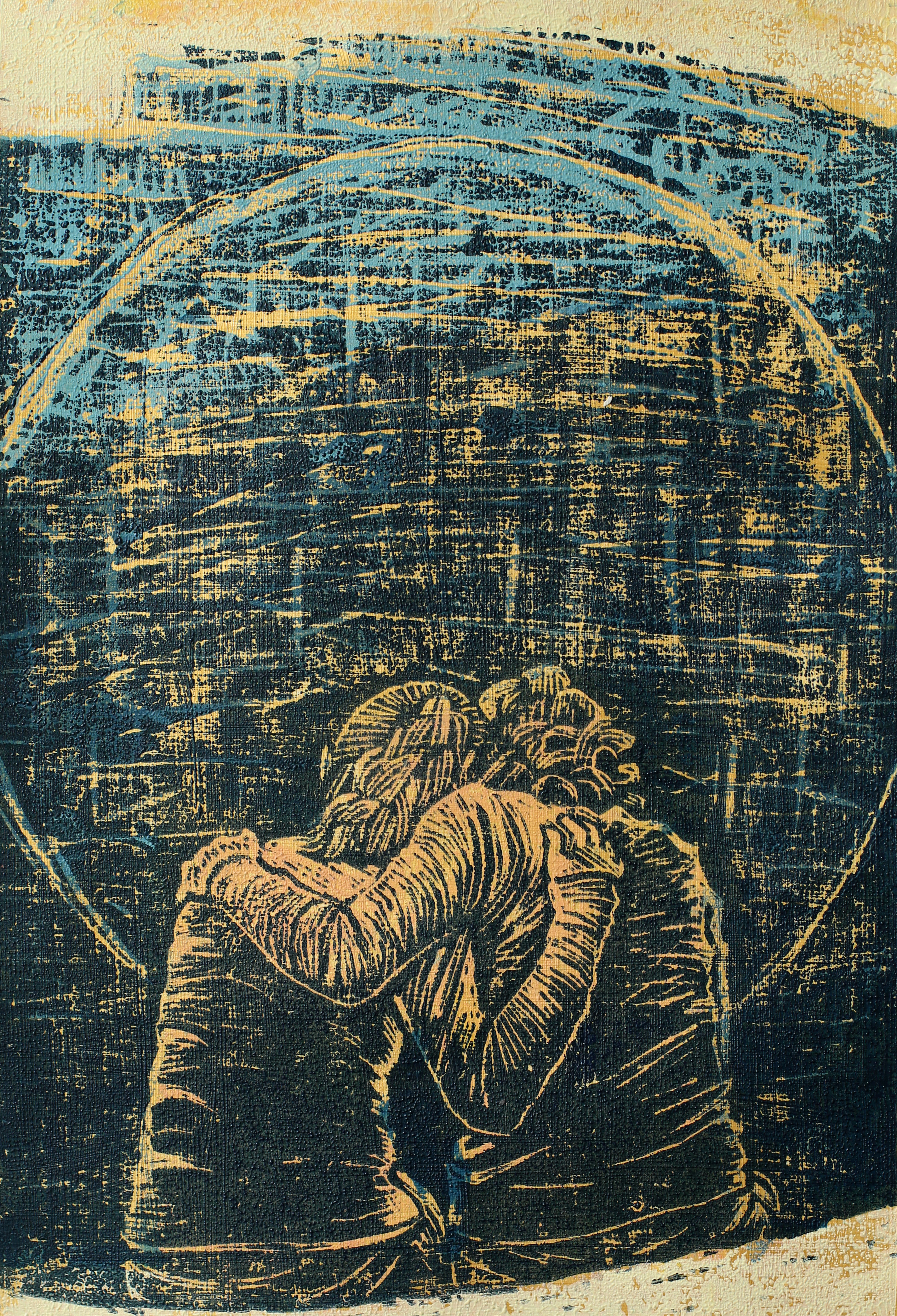
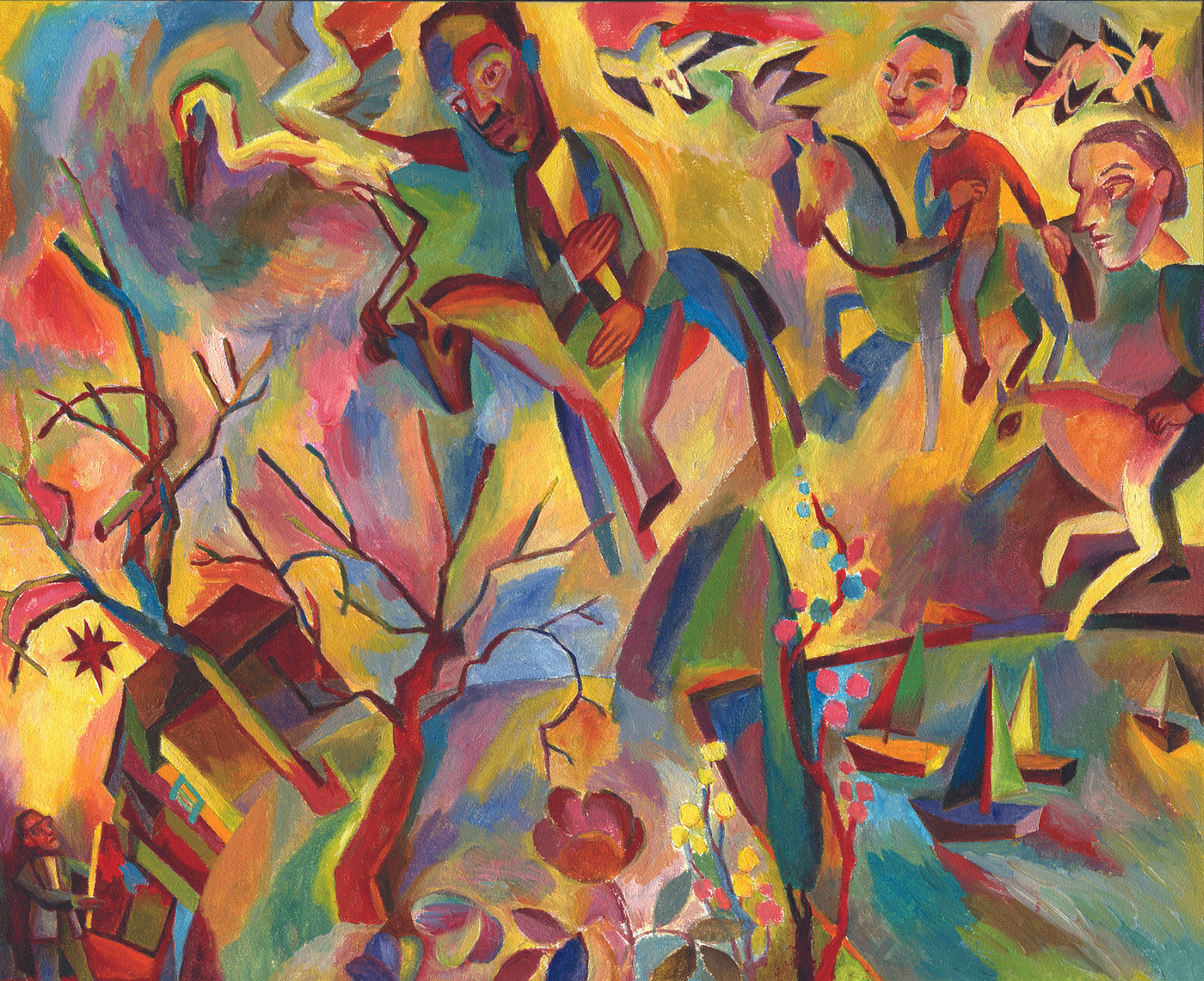
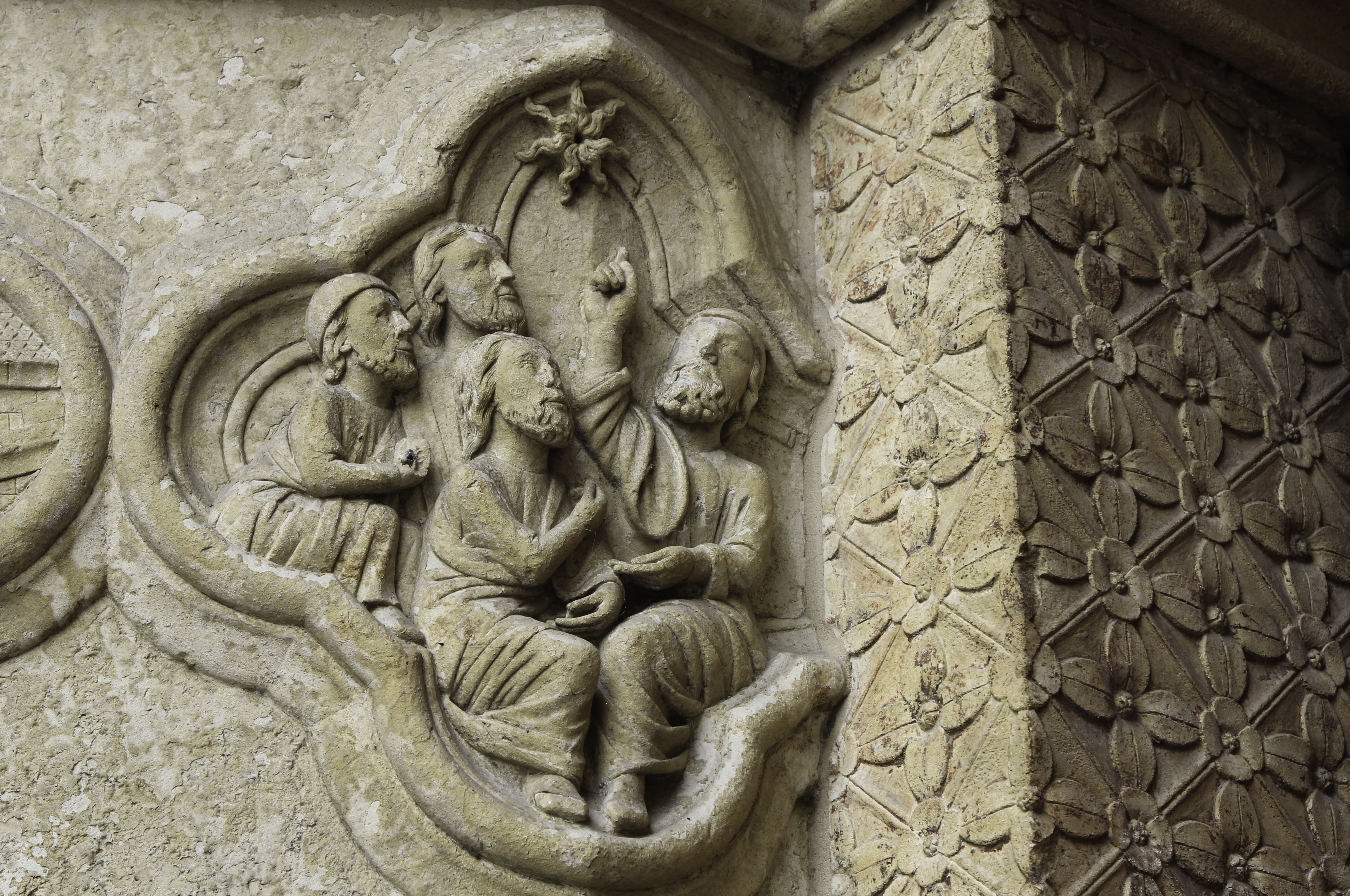
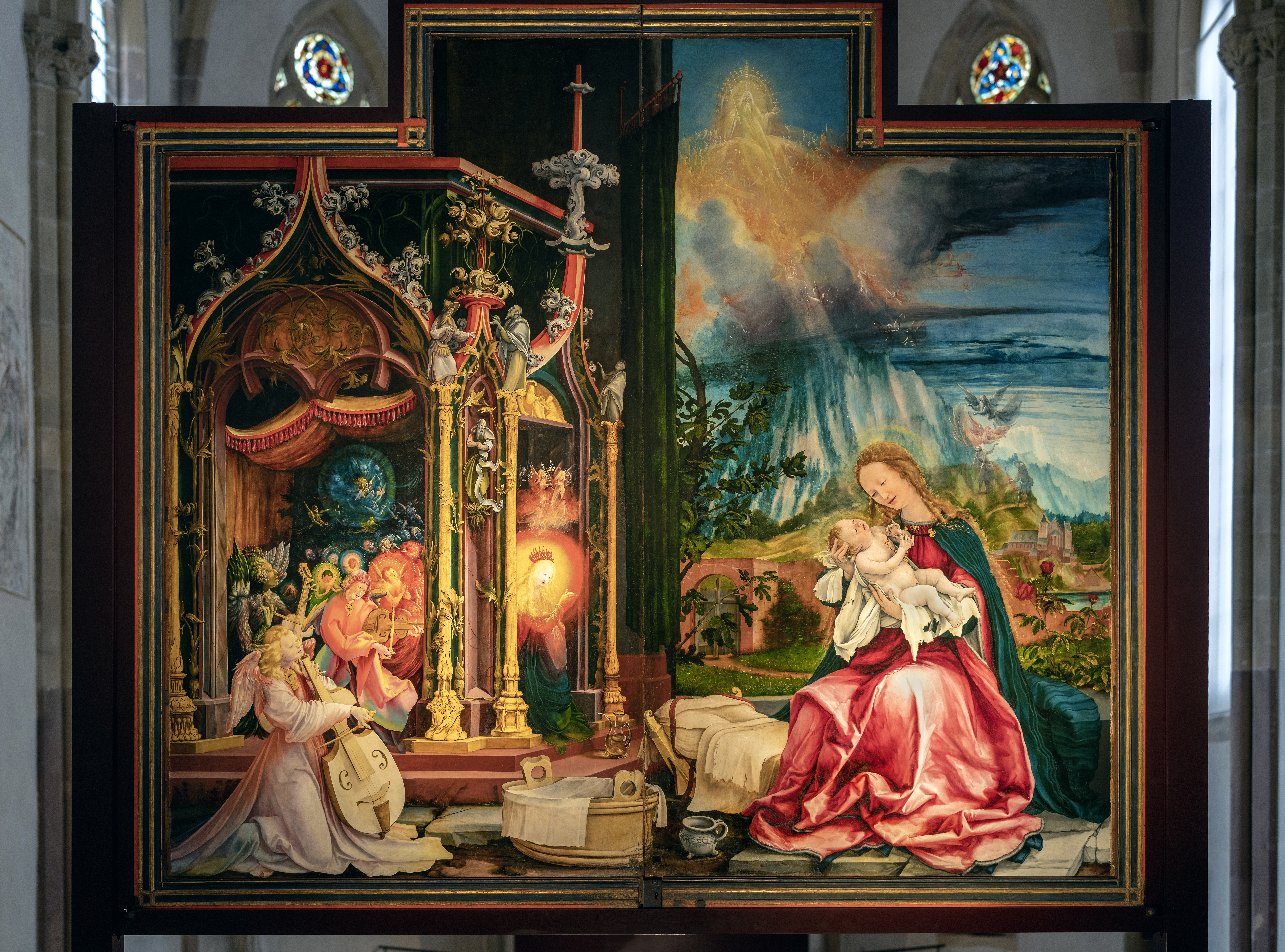
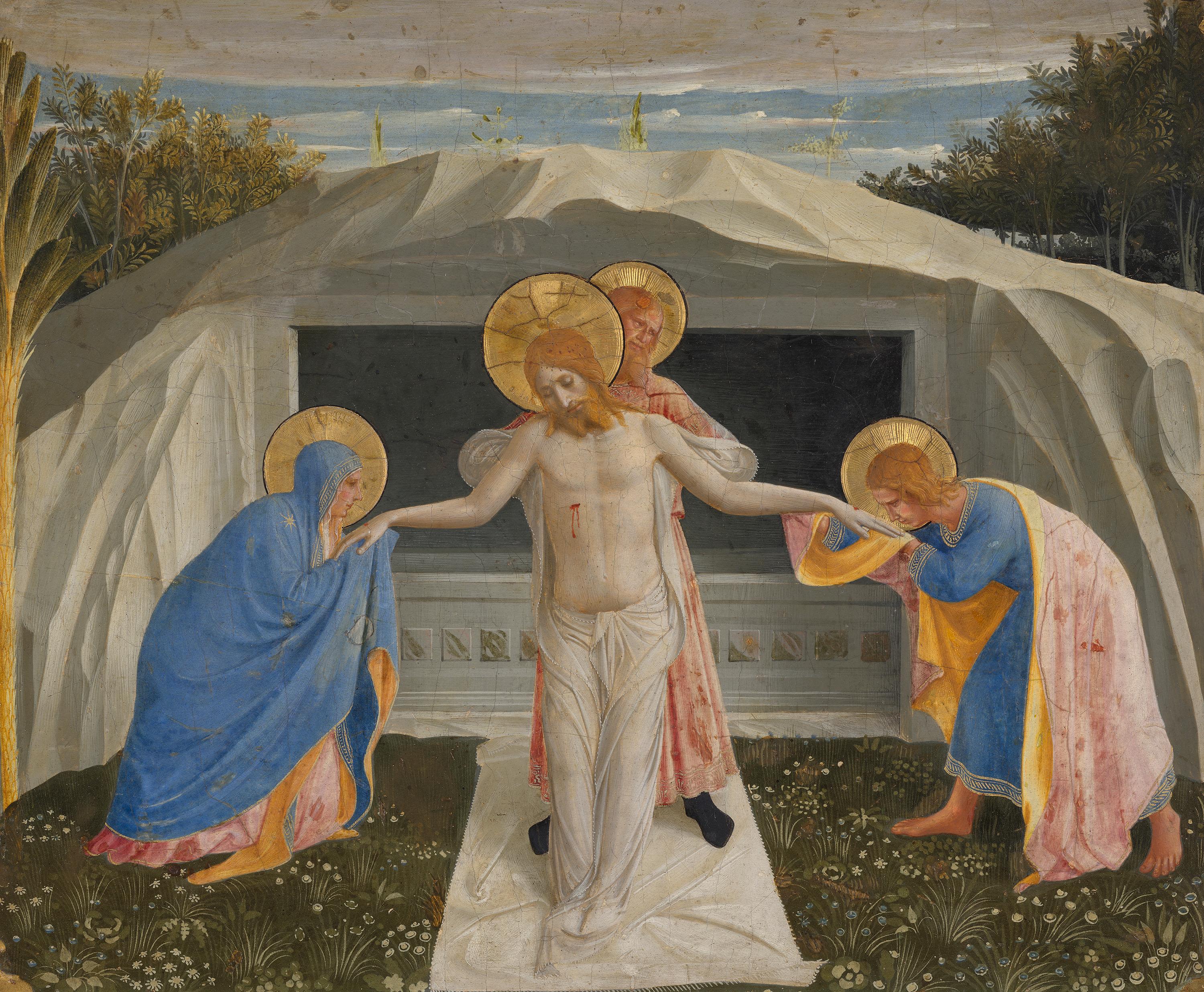
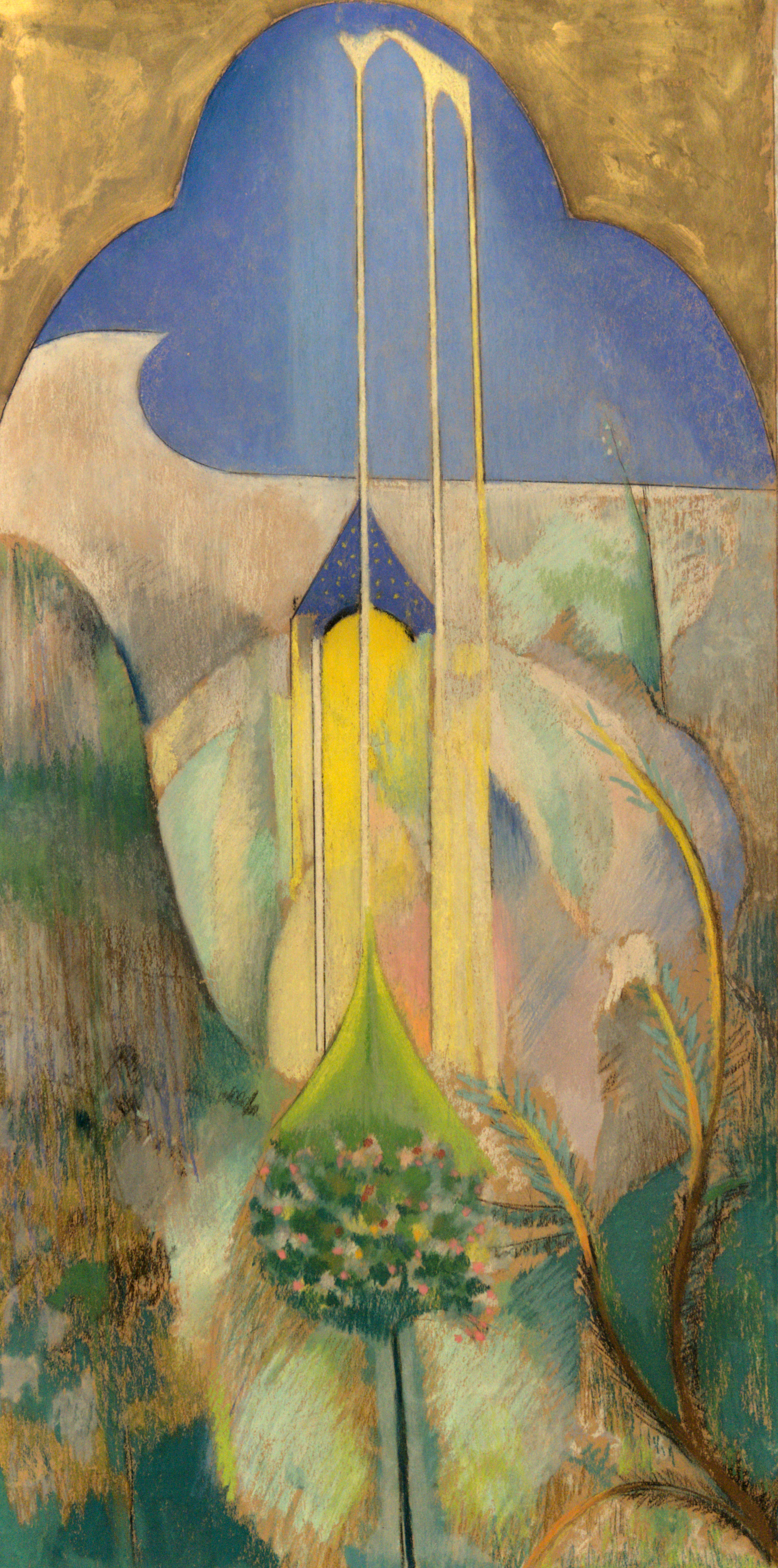
Natalya Rusetska (Ukrainian, 1984–), Nativity, 2016. Tempera on gessoed wood, 17.5 × 15.5 cm.
Gravity’s maker, spinner of spheres and spiraling matter, made into weight, to sweat. His own feet vulnerable, drawn flat and close against the punishing ground.
Star-strayed infant, wrapped in weight, heavy heaven. In the hollow of the years, long and narrow as a well, he waits suspended, bucket-drawn, clapper in a bell.
Ringing and ringing in the heatfolds of gravity, lines and lines of weight leaning us into each other, caught up, tumbled open-face roses in a blue bolt of thorn-pricked cloth.
God made known, fleshly God, Godlight bodied, bleeding out into wood, over stone. God from God, telluric God, shadowcast God, lightstricken God, bloodwritten. The pull
electric of low, deep center. God flesh, corpus God, Verbum corpse, light-riven. Inscribed, blooded, God-heft falling death- bitten into weighted rising, made and given; the miracle of leaven.
LeighAnna Schesser is a Catholic writer from south-central Kansas whose poetry collections include Struck Dumb with Singing (2020) and Heartland (2016).
Marc Chagall (Russian/French, 1887–1985), Peace Window, 1964. Stained glass, 12 × 15 ft. Public lobby, General Assembly Building, United Nations Headquarters, New York. Manufactured by Brigitte Simon and Charles Marq.
This stained glass window by Marc Chagall was commissioned as a memorial for the Swedish diplomat Dag Hammarskjöld (1905–1961), who served as the second secretary-general of the United Nations, and for the fifteen other UN staff and peacekeepers who died with him when their plane crashed on the way to a peace negotiation for the Congo Crisis in Northern Rhodesia. The artist’s handwritten dedication reads, “A tous ceux qui ont servi les buts et principes de la Charte des Nations Unies et pour lesquels Dag Hammarskjöld a donné sa vie” (To all who served the purposes and principles of the United Nations Charter, for which Dag Hammarskjöld gave his life).
Chagall’s design was executed by master glassmakers Brigitte Simon and Charles Marq of Atelier Simon-Marq.
Chagall was born in 1887 into a Hasidic Jewish family in Vitebsk, Russia (now Belarus). He moved to Paris in 1910 to develop his art, becoming a French citizen in 1937. When Nazis took over the country, threatening Chagall’s safety, he was successfully extricated to the United States with the help of Alfred Barr, director of the Museum of Modern Art in New York. He returned to France for good in 1948. His impressive body of work, marked by a spiritual vivacity, includes—in addition to stained glass—paintings, drawings, book illustrations, stage sets, ceramics, and tapestries.
His 1964 Peace Window in New York City—not to be confused with his similar but much larger Peace Window of 1974 in the Chapel of the Cordeliers in Sarrebourg, France—is full of biblical allusions.
My eyes are drawn first to the red and purple bouquet in the center, under which stands an amorous couple. Who are they? What do they represent? I can think of several possibilities:
1. Adam and Eve. In the sketch Chagall made for the window, the woman is very clearly naked, though she’s less obviously so in the final window. That Eve, pre-fall, is traditionally portrayed unclothed, and that Chagall’s later Peace Window unequivocally portrays Adam and Eve within a red tree, lends credence to the interpretation of these figures as our primordial foreparents, in which case the flowering mass would stand for the tree of life in the garden of Eden (Gen. 2:9).
2. The Annunciation—the angel Gabriel coming to Mary to announce that she had been chosen to birth and mother God’s Son. The male head is bodiless, emerging from the crimson bloom (suggesting, perhaps, a supernatural entity), and there’s a yellow glow at the woman’s breast, perhaps signifying the conception of Christ. What’s more, the woman appears to be cradling something—her pregnant belly?
3. God and the human soul, or Christ and his church. One traditional Jewish interpretation of the poetic book of scripture known as the Song of Solomon is that it celebrates the love between humanity and the Divine. Medieval Christians, similarly, spoke of the book as an allegory of the future marriage of Christ and the church, his bride, drawing too on the New Testament book of Revelation, which culminates in a mystical union, a picture of cosmic harmony, heaven and earth inseparably joined.
4. The kiss of Justice and Peace. Psalm 85:8–11, a common Advent text, speaks of the divine attributes that coalesce to accomplish salvation (in the Christian reading, in the Incarnation):
Let me hear what God the LORD will speak, for he will speak peace to his people, to his faithful, to those who turn to him in their hearts. Surely his salvation is at hand for those who fear him, that his glory may dwell in our land.
Steadfast love and faithfulness will meet; righteousness and peace will kiss each other [emphasis mine]. Faithfulness will spring up from the ground, and righteousness will look down from the sky.
5. The kiss of Joy. Beethoven’s Ninth Symphony was a favorite of Dag Hammarskjöld’s, and its performance, at least the “Ode to Joy” chorus in its final movement, is a United Nations Day concert tradition. Hammarskjöld described the work as “a jubilant assertion of life,” championing universal peace and brotherhood. One of the lines from Friedrich Schiller’s text that Beethoven set exclaims that “Joy . . . kiss[es] . . . the whole world!”
I suspect some or all of these ideas were at play when Chagall designed the window. Or even just romantic love in general (with other types of love portrayed elsewhere in the composition), as he often painted himself and his wife Bella kissing or embracing.
After this tableau, my eyes go to the large male figure cloaked in purple just right of center. I take him to be the prophet Isaiah, beholding a vision of wild animals and children cavorting together in harmony (see Isaiah 11). A boy, for example, reaches his hand out toward a viper and is not harmed.
But it’s also possible that’s meant to be Isaiah at the bottom left of the window, his face illumined by the beauty spread out before him, which an angel gestures to, guiding the prophet’s imagination:
On the top right, another angel delivers the Ten Commandments to the people of God.
Next to this communication of God’s word is the death of God’s Word in the flesh, Jesus Christ, around whom the crowds have gathered. A man ascends a ladder propped against the cross, the ladder being a multivalent symbol harking back to Jacob’s dream at Bethel and evoking notions of descent and ascent.
Vignettes below include a couple embracing with an infant in hand, a woman being fed at a table (the Eucharist?), a family reading a book (probably the Bible), a woman making music, and another bearing flowers.
At the top left is a lamentation scene that evokes those of Christ deposed from the cross. A man in a loincloth lies dead or wounded on the ground, his head cradled by a loved one, while at his feet another mourner throws her arms up in grief. This is the cost of human violence.
By contrast, in the bottom left corner, a mother cradles her child, evoking scenes of the nativity of Christ—of Mary with her newborn son.
All these characters—human, animal, and divine—are sprawled across a warm azure background, playing out love, suffering, death, peace, joy, and reconciliation.
LISTEN: “Oracles” by Steve Bell, on Keening for the Dawn (2012)
O ancient seer, your vision told Of desert highways streaming home To the mountain of the Lord Where nations sound a righteous song forevermore
And on that mountain men will forge From cruel implements of war The tools to till and garden soil The rose will bloom and faces shine with gladdening oil
And it will surely come to pass Justice will reign on earth at last The wolf will lie down with the lamb No beast destroy, no serpent strike the child’s hand
And God himself will choose the sign A frightened woman in her time Will bear a son and name him well God with us! O come, O come, Emmanuel!
I remain confident of this: I will see the goodness of the LORD in the land of the living. Wait for the LORD; be strong and take heart and wait for the LORD.
—Psalm 27:13–14 (NIV)
LOOK: The Waiting by Charlotte Mann Lee
Charlotte Mann Lee (American, 1996–), The Waiting, 2021, from the Desert series. Watercolor and gold pigment on paper, 18 × 24 in. (45.7 × 61 cm).
Artist Charlotte Mann Lee is a friend of mine from Maryland. Her watercolor The Waiting, a self-portrait at Great Sand Dunes National Park in Colorado, is inspired by the final verse of Psalm 27 (quoted above). The Hebrew verb קָוָה (qavah), meaning “to wait for, or to look expectantly,” stretches across the scene, a breeze scattering its gold flecks to the sky. A majestic vista lies just over the sand.
“In the desert times of life, when the soul is dry and weary, the barren landscape seemingly endless before us, waiting is difficult,” Lee writes. “What we know to be true may be in conflict with our current experience. There is an ongoing tension between what we see and feel currently in our suffering, and what God promises in His Word.” It’s that tension she seeks to convey here, as well as “the hope that anchors [the Christian] amidst trials and struggles in the desert”: God in Christ.
LISTEN: “Psalm 27” by Psalm Project Africa, on Sing Psalms, vol. 1 (2013)
Of this I’m sure I’ll see God’s goodness My soul will rest in The land of the living Be strong in the Lord
Refrain: The Lord is my light And my salvation Whom shall I fear Shall I be afraid The Lord is my light And my salvation Whom shall I fear Shall I be afraid The Lord is my life
One thing I need One thing I ask you To dwell in your house Each day of my life Delighting in you [Refrain]
In troubled times He keeps me secure He covers me He lifts my head Above the storm [Refrain]
A program of the Reformed Student Organisation in Kampala, Uganda, Psalm Project Africa was a collective of songwriters and musicians who led workshops at African churches and colleges, encouraging Christians to sing the Psalms in African styles. It appears they were active from 2013 to 2017, releasing three albums of psalm settings within that period.
Wassily Kandinsky (Russian, 1866–1944), Around the Circle (Autour du cercle), 1940. Oil and enamel on canvas, 38 1/4 × 57 5/8 in. (97.2 × 146.4 cm). Solomon R. Guggenheim Museum, New York. Photo: Victoria Emily Jones. [object record]
I saw this vibrant abstract painting by the pioneering Russian French artist Wassily Kandinsky at the Guggenheim in 2022. The museum label stated:
Around the Circle, one of Kandinsky’s last major paintings, is a milestone in the artist’s circular journey. It reflects not only contemporary concerns but also his abiding interest in the belief systems and folklore of Russian and Siberian cultures. The dominant red circle at top center; the form cresting the undulating lines of “sacred waters” below; and a third, upside-down stylized humanoid form at bottom right have all been interpreted as potential allusions to shamans, or spiritual leaders and healers, in states of transformation. At bottom left, a lunar orb glows in the expanse beyond an open doorway, which is connected to a set of stairs with no physical support. This could be a portal to the cosmos, or some otherwise indeterminate space beyond the picture plane, in a probable nod to alternate dimensions or to the capacity for mystical ascendance.
What do I see? Color. Confetti, streamers, celebration. A rocket ship. Stars. Birds. Waves. A falling man. A doorway. An eye.
Advent is a dual-toned season that combines lament and penitence—an honest accounting of the brokenness of the planet, global and personal relationships, systems, and our own selves—with joyful expectation of Christ’s glorious intervention. In my annual Advent selections I seek to honor this characteristic balance between darkness and light.
Today’s art selection leans into the light—into the bubbling joy for what is just over the horizon, or just through the door. I think of the Magnificat of the Mother of God, a praise song in which, pregnant with Christ, she exults in the powerful being thrown down and the humble uplifted. She sings of the marvelous salvation wrought by God.
Let us rejoice with her in the righteousness to come.
LISTEN: “Maranatha” by David Benjamin Blower, on Hymns for Nomads, vol. 1 (2018)
Let the trees all clap their hands And the stones all jump for joy Let the earth shake off its bonds Let the peoples all rejoice
Refrain: Maranatha, our Maker Who maketh all things right Maranatha, our Healer Come rise, O healing light
Let the peoples all delight In the messianic light Let the whole earth be glad At the making all things right [Refrain]
Let the poor be lifted up From the ashes and the dust Let the proud climb down from their thrones And we all shall be reconciled at once [Refrain]
Not only are humans tired and stressed and in need of deliverance; so is the environment. Today’s two featured works function as a call to care for the earth—the one a performative enactment of said care, tender and consoling, and the other an urgent lament by choir.
The gospel is for more than just humanity; it’s for all the earth—animals and insects, plants and soil, skies and oceans. All creation groans for redemption, Paul says in his letter to the early church in Rome. And in the final book of the Bible, John the Revelator’s vision is of the whole world renewed.
LOOK: Earth Rite by Holly Slingsby
Holly Slingsby (British, 1983–), Earth Rite, performance at St Pancras Church, London, July 6, 2024. Duration: 1 hour. Photo: Adam Papaphilippopoulos.
Artist Holly Slingsby’s Earth Rite premiered at the Ritual/Bodies live performance event that took place at St Pancras Church in London on July 6, 2024, organized by Dr. Kate Pickering. It was one of eight performance works by eight different artists (one work was by two performers; two works were by one) that collectively spanned some three hours, followed by a ninety-minute panel discussion.
In Earth Rite, “a solo performer sits atop a mound of earth, cradling it in her arms. The earth slips away only to be regathered, in a continuous act of generating, losing, and regenerating.” Charles Pickstone, an Anglican priest, reviewed the work in the Autumn 2024 issue of Art + Christianity journal, writing:
Holly Slingsby, in a loose white dress, sat on the church steps on a mound of rich soil, arms folded in embrace. Where one might have expected a baby, the artist was embracing armfuls of soil, constantly replenishing her burden as the soil slipped away from her. Part earth mother, part mourner, on the edge of the busy and noisy Euston Road, the artist made what could have been rather a moralistic revisiting of a well-known theme (compare William-Adolphe Bouguereau’s Charity, perhaps an influence on this work) into a courageous and compelling glimpse of the earth’s abused and vulnerable soil.
Slingsby reprised the performance on September 27, 2025, at the International Forum of Performance Art in Drama, Greece.
LISTEN: “Kasar mie la Gaji” (The Earth Is Tired) by Alberto Grau, 1987 | Performed by Stellenbosch University Choir, dir. André van der Merwe, 2024
“Kasar mie la gaji” is a Hausa saying from the Sahel region of Africa that means roughly “The earth is tired.” In 1987 leading contemporary Venezuelan composer Alberto Grau (b. 1937) set it to music, creating a magnetic choral composition for, in his words, “an international mobilization to save THE EARTH.”
In their performance notes, the Stellenbosch University Choir from South Africa writes: “The composition is designed on hypnotic repetition, with a steady reiteration of the text. Plaintive glissandos and layered ostinato patterns create a compelling chant, begging for justice and rebirth.”
Kathy Romey, the director of choral activities at the University of Minnesota, offers further description:
The work is broken into three distinct sections, of which the first and third incorporate short melodic motives combined with rhythms from traditional South American dance music intensified by clapping and stomping. The middle section is a slow lament and utilizes various special effects for a cappella chorus, including glissandi, whispering, talking, and hissing.
Why is the earth tired? Because we are depleting her resources. We are disrupting her ecosystems. The carbon emissions from our burning of fossil fuels for energy and transportation are trapping heat in her atmosphere and causing extreme weather.
Lord, have mercy. Please help us restore our planet to health and treat her with respect, recognizing that she, as part of your creation, is precious to you.
Then the angel showed me the river of the water of life, bright as crystal, flowing from the throne of God and of the Lamb through the middle of the street of the city. On either side of the river is the tree of life with its twelve kinds of fruit, producing its fruit each month, and the leaves of the tree are for the healing of the nations.
—Revelation 22:1–2
LOOK: Tree of Life by Kateryna Shadrina
Kateryna Shadrina (Ukrainian, 1995–), Tree of Life, 2022. Acrylic on gessoed wood, 60 × 60 cm.
For the healing of the nations, God, we pray with one accord; for a just and equal sharing of the things that earth affords; to a life of love in action help us rise and pledge our word.
Lead us forward into freedom; from despair your world release, that, redeemed from war and hatred, all may come and go in peace. Show us how through care and goodness fear will die and hope increase.
All that kills abundant living, let it from the earth be banned; pride of status, race, or schooling, dogmas that obscure your plan. In our common quest for justice may we hallow life’s brief span.
You, Creator God, have written your great name on humankind; for our growing in your likeness bring the life of Christ to mind, that by our response and service earth its destiny may find.
ONLINE DISCUSSION: “Poems of Advent, Christmas, and Epiphany” led by Brian Volck,December 13, 2025, 12–1:30 p.m. ET: Poet Brian Volck (whose work I’ve shared here and here) is leading a free online discussion on Advent, Christmas, and Epiphany poetry next Saturday. Sponsored by the Ekklesia Project, it will bring together diverse poetic styles and voices. “Each poem is read by a volunteer and then the group discusses what stood out, what struck them, and what questions the poem raises,” Volck says. “My goal is to encourage a diversity of responses rather than impose mine. No preparation is required.” Register here to receive the Zoom link and the poems in advance.
+++
INSTALLATION: Hear Us, Canterbury Cathedral, October 17, 2025–January 18, 2026: Graffiti-style stickers are affixed to the medieval walls, floors, and pillars of England’s Canterbury Cathedral in the temporary installation Hear Us, voicing questions to God collected from local marginalized individuals, such as:
Why is there so much pain and destruction?
Is this all there is?
Are you there?
Does everything have a soul?
Do you ever regret your creations?
How do I break the cycle?
Does our struggle mean anything?
How is my dog Bear doing?
God, do you know me?
Photo: Krisztian Elek
Photo courtesy of Canterbury Cathedral
Photo: Krisztian Elek
Curator Jacquiline Creswell [previously], collaborating with poet Alex Vellis, organized a series of workshops led by artists Sven Stears, Henry Madd, Jasbir Dhillon, Adam Littlefield, Alice Gretton, and Callum Farley, which invited people who felt the cathedral was not for them to gather together and delve into discussions about their lives, experiences, and aspirations. Among the participants were members of the Black and Brown diasporas, LGBTQIA+ people, neurodivergent people, people in addiction recovery, and people with mental health disorders. They were asked to respond to the prompt “If you could ask God a question, what would it be?”
Many of the responses were then translated into big, colorful word graphics that cannot be overlooked. “All of the questions are prayers. All of the questions are already sacred,” Vellis says. “So by putting the questions into an already existent sacred space, we are saying you are valid, your words are valid, your prayers are in a place in which they can be heard and they can be seen and they can be supported.”
I learned about this installation from the Exhibiting Faith podcast’s interview with Creswell and Vellis—an episode I heartily commend. They explain how the exhibition was developed, how they persuaded the cathedral to agree to it, and how they have dealt with the storm of criticism it has generated. Many have called it an act of vandalism (even though the stickers were authorized by the dean and will leave no trace when they’re removed next month) and irreverence, desecration. US Vice President JD Vance said the exhibition “mak[es] a beautiful historical building really ugly,” and Elon Musk called it a “suiciding” of Western culture.
I have not seen the exhibition in person, and I am neither British nor Anglican, so I don’t possess the same sense of my identity or heritage being threatened that many Church of Englanders have expressed. But I personally like the confrontational clash of aesthetics: traditional juxtaposed with modern; majestic Gothic architecture, staid limestone, garishly “spray-painted” in a street style, bringing contemporary spiritual and theological questions into a nearly millennium-old church building. I also like the concept of amplifying rather than diminishing the voices of those who feel marginalized by the church but who still want to engage, who are curious—bringing their questions into the space where we gather as a community of Christ followers and using them as a portal into further faith conversations, as Creswell put it in a media interview.
+++
BLOCKPRINT SERIES: Dios con Nosotros (God with Us) by Kreg Yingst:Kreg Yingst [previously] is my favorite contemporary printmaker working on religious themes. Last December he shared a series of hand-colored linocut prints that he started in 2019 and that is ongoing, collectively titled Dios con Nosotros (God with Us)—“a modern-day American Christmas story which takes place somewhere south of the U.S. border,” he writes.
>> “Un Cuento de Navidad” (A Song of Christmas): This original song by Adrian Roberto and Melissa Romero is about a town that had lost its wonder—until a child discovered a Bible, and his reading aloud its story of a Savior sparked revival.
>> “What Child Is This / Child of the Poor”: The Hound + The Fox are Reilly and McKenzie Zamber, a husband-wife musical duo from Oregon. This song of theirs interleaves the classic Christmas carol “What Child Is This” by William Chatterton Dix with a new song that emphasizes Christ’s solidarity with the poor.
Here are the Zambers’ new lyrics:
Helpless and hungry, lowly, afraid, Wrapped in the chill of midwinter; Comes now, among us, born into poverty’s embrace, New life for the world.
Who is this who lives with the lowly, Sharing their sorrows, Knowing their hunger? This is Christ revealed to the world In the eyes of a child, a child of the poor.
Who is the stranger here in our midst, Looking for shelter among us? Who is the outcast? Who do we see amidst the poor, The children of God?
So bring all the thirsty, all who seek peace; Bring those with nothing to offer. Strengthen the feeble; Say to the frightened heart, “Fear not: here is your God!”
>> “Everybody Ought to Treat a Stranger Right”: Arranged and expanded by Dan Damon [previously], this traditional blues song is performed here by the Dan Damon Quartet, featuring guest vocalist Sheilani Alix, at a concert at Community Church of Mill Valley in California on December 10, 2023. “Blind Willie Johnson recorded this song in 1930 with two Christmas verses mixed in. I separated them out, added two verses to tell a fuller Christmas story, and recorded the Christmas version with my band on the album No Obvious Angels,” Damon explains. “According to the writer of Hebrews, some have entertained angels unawares.”
Sliman Mansour (Palestinian, 1947–), The Way to Bethlehem, 1990s. Acrylic on canvas.
LISTEN: “Bethlehem” by Jack Henderson | Performed by Over the Rhine, feat. Jack Henderson, on Blood Oranges in the Snow (2014)
Oh little town of Bethlehem Have you been forsaken? In your dark and dreamless sleep Your heart is breaking And in your wounded sky The silent stars go by
Oh little town of Bethlehem Be still tonight, be still
Mary, she was just a kid Jesus was a refugee A virgin and a vagabond Yearning to be free Now in the dark streets shining Is their last chance of a dream
Oh little town of Bethlehem Be still tonight, be still
Cradled by a crescent moon Born under a star Sometimes there’s no difference Between a birthmark and a scar
Oh little town of Bethlehem With your sky so black May God impart to human hearts The wisdom that we lack Should you chance to find A hope for all mankind
Oh little town of Bethlehem Be still tonight, be still
Over the Rhine is Karin Bergquist and Linford Detweiler, a married, music-making couple from Ohio. In preparation for their album Blood Oranges in the Snow, they put out a call to a few select colleagues for assistance with the songwriting. Glasgow-based singer-songwriter Jack Henderson responded with a demo of “Bethlehem,” which “reinvents the nativity story as a very modern tale set amid the ongoing Palestinian-Israeli conflict,” he writes. Over the Rhine arranged it, with Henderson singing lead and Bergquist providing backing vocals.
“How ironic that the very birthplace of Jesus should prove to be one of the most conflicted, unpeaceful regions of the world,” Bergquist says. Bethlehem is located in the West Bank, a Palestinian territory that has been under the military occupation of Israel since 1967. Numerous checkpoints have been set up in and around the Bethlehem district to restrict Palestinian movement.
The lyrics to Henderson’s “Bethlehem” pick up lines from the traditional Christmas carol “O Little Town of Bethlehem,” transposing them to the present day and giving them a dark twist. Phrases like “dreamless sleep” and “silent stars,” which in the original carol connote inexpectant slumber and a hushed nighttime idyll, in their new context allude to the nightmare of occupation (unjust arrests and imprisonments, shootings, house demolitions, impoverishment, impeded access to essential services like water and hospitals) and the seeming silence of God. The second verse highlights the Holy Family’s vulnerable status after Herod deployed troops to exterminate Jesus in an attempt to protect his own power.
The refrain, “Be still tonight, be still,” is a prayer for the cessation of violence in the land of Jesus’s birth.
Withdrawing from Kyiv on April 2, 2022, after a lost battle, Russian troops left destruction in their wake. A bullet-riddled car with a flat tire sits abandoned, along with a doll, on the bridge crossing into Irpin, Ukraine. Photo: Franco Fafasuli.
The Russo-Ukrainian war is now in its twelfth year, and it’s been almost four years since Russia’s full-scale military invasion of Ukraine. The devastation is staggering. I can’t even imagine what it must be like to live in a war zone, with bombs, missiles, and gunfire an ever-present threat, part of the everyday background noise. While many photographs have documented the wider destruction and human losses in Ukraine, I was struck by this one by the young Argentine journalist Franco Fafasuli, which focuses not on leveled buildings or intimate griefs but on possessions left behind in the chaos of war: a car, now dotted with dozens of bullet holes, and a plastic-headed baby doll, now covered in grime.
As I reflect on Christ’s coming this Advent season, I think of how he came as a vulnerable child, into a world where people deliberately hurt and kill other people. Then, it was with swords, daggers, spears, arrows, and stones; now we’ve added all manner of firearms and large explosives to our arsenal. That innocent, bald little babe sitting by a deflated tire, suggesting a family with child having suddenly fled their hometown—it looks at me with the eyes of Christ, wondering why we continue to harm each other, but smiling, too, a smile of divine grace. He’s here to show us another way.
LISTEN: “О, Зійди” (Oh, Come Down) by Room for More, 2022
Вся земля cхилилася Втомлена від боротьби Зітхаємо у марноті Бо втратили ми Твій дотик
Заспів: О, зійди! Спасе відроди. Зійди!
Небеса далекі нам Власний шлях обрали ми Вся земля чекає на Спасителя, на мир і спокій
Заспів: О, прийди! Царю милості, прийди! Освіти! Всім хто в темноті, світи
Небеса схиляються Являють нам святе Дитя Земле вся, заспівай Правдивий Цар, Бог наш з нами
Заспів: О, радій! Спас Месія нам родивсь! О, вклонись! Царю всіх царів, вклонись!
Бридж: Підіймай опущені руки Потішай тих хто відчаєм скуті Відкриває Син нову Надію, силу й повноту
Заспів: О, радій! Спас Месія нам родивсь! О, прийми! Це рятунок твій, прийми!
The whole earth bows down Weary of the struggle We sigh in vain For we have lost your touch
Refrain: Oh, come down! Savior, revive Come down!
The heavens are far from us We have chosen our own path The whole earth awaits The Savior, peace and tranquility
Refrain: Oh, come! King of mercy, come! Enlighten! Onto all who are in darkness, shine
The heavens bow down Show us the holy Child All the earth, sing The true King, our God is with us
Refrain: Oh, rejoice! The Messiah is born to us! Oh, bow down! He’s the King of all kings, bow down!
Bridge: Lift up your hands that hang down Comfort those who are bound by despair The Son reveals a new Hope, strength, and fullness
Refrain: Oh, rejoice! The Messiah is born to us! Oh, accept! This is your salvation, accept!
The lead singer on “О, Зійди” (Oh, Come Down) is Yaryna Vyslotska. The song was written by Jonathan (Jon) Markey, an American-born minister and musician who grew up as a missionary kid in Ukraine and since 2008 has been a pastor at Calvary Chapel in Ternopil. In 2017 he and his wife Stephanie (Steffie) founded the Ukrainian Christian music collective Room for More.
At Christmas, we celebrate how light entered into darkness. But first, Advent bids us to pause and look, with complete honesty, at the darkness. Advent asks us to name what is dark in the world and in our own lives and to invite the light of Christ into each shadowy corner. To practice Advent is to lean into a cosmic ache: our deep, wordless desire for things to be made right. We dwell in a world shrouded in sin, conflict, violence, and oppression. . . .
Before the delight of Christmas, Advent invites us to a vulnerable place—a place of individual and communal confession where we honestly name unjust systems, cultural decay, sorrow, the sin of the world, and the sin in our own lives. Only by dwelling in that vulnerable place can we learn to profess true hope. Not cheap hope, spun from falsehoods, half-truths, or denial, but a hope offered by the very light that darkness cannot overcome.